



Abstract
Recent research suggests that the effect of self-affirmation on readers’ responses to media messages is not uniform across groups. The present experiment examined whether self-affirmation and group/user status interacted in influencing participants’ responses to a news article with identity-threatening information related to Apple sweatshops in China. Results revealed that for non-Apple users, self-affirmation influenced their appraisal of emotional responses, led them to perceive more news slant and more negative influence of the article on neutral Americans, and lowered their future purchase intentions. The effect of self-affirmation was nonsignificant among Apple users, which could have been thwarted by Apple users’ high defensiveness. Both theoretical implications for future self-affirmation research and practical implications are discussed.
Many incidents in our daily lives touch on the insecurities deep inside us. Personal failures, health- and risk-related messages, and news containing negative information about ourselves may threaten our public or private identities. Previous research has found that exposure to an identity-threatening message can cause humans to exhibit defensive reactions by either derogating the source of the message or downplaying its importance (e.g., Arpan & Raney, 2003; Zhao & Nan, 2010). Individuals may also opt for information or information sources that are congenial to their own views (Iyengar & Hahn, 2009), or avoid information that suggests their existing attitudes and behaviors are misguided (e.g., Klein & Harris, 2009). Such defensive reactions are maladaptive and forestall learning. They potentially hinder personal growth and health as well as a democratic society in which information should be received and understood by the majority. It is important, therefore, to identify the contexts in which such defensive responses occur, as well as possible avenues for mitigating them.
The present study examines how self-affirmation (i.e., providing participants with an alternative means to affirm their self-worth; Steele, 1988) and user status may interact in influencing readers’ responses to a news article with identity-threatening information. First, in addition to providing insight into a practical, real-world scenario related to a news story about Apple sweatshops in China, our research may indicate the need for further theorizing about how the effects of self-affirmation may vary among different groups (e.g., Apple users vs. non-users). Because previous research focused on user groups for whom a message was personally relevant (e.g., anti-smoking message for smokers), less is known about the effects of self-affirmation on the groups to which a message is less relevant (Zhao, Peterson, Kim, & Rolfe-Redding, 2014). In addition, several recent studies have revealed some mixed effects of self-affirmation on the low-relevance groups (Harris & Napper, 2005; Zhao et al., 2014). Second, recent theorizing underscores the importance of including emotional responses in media effects and persuasion research because various messages may elicit both cognitive and emotional responses (Arpan & Nabi, 2011; Dillard & Seo, 2013) and emotional responses may influence one’s “perception of situation, information preference, and desire for action” (Arpan & Nabi, 2011, p. 5). However, self-affirmation research focuses mainly on cognitive judgments and evaluations of the media stimulus (e.g., Harris & Epton, 2009). Thus, to extend the predominantly cognition-based self-affirmation research, we explore how self-affirmation may influence one’s emotional responses. Last, few studies examine the theory in a news context (Sherman & Cohen, 2006). News reading offers a potentially useful context in which to examine self-affirmation because unlike many health messages, news stories in general are non-persuasive messages and are less likely to offer explicit conclusions that command the readers to engage in a particular behavior. Previous research has shown that messages with less explicit and controlling language (vs. more) may arouse less psychological reactance from participants (Dillard & Shen, 2005). Therefore, the present research tested the generalizability of self-affirmation theory to other information contexts.
Self-Affirmation Theory and News
Self-affirmation theory asserts that “the overall goal of the self-system is to protect an image of its self-integrity, of its moral and adaptive adequacy” (Sherman & Cohen, 2006, p. 185; Steele, 1988), perhaps because living with a damaged self-worth is uncomfortable and ego-defensive reactions may benefit one’s psychological well-being (Taylor & Brown, 1988). Self-affirmation theory also states that individuals generally strive to maintain a global sense of self-worth. Those with a large reservoir of self-worth have the option of confirming their own self-worth by drawing upon alternative values. However, those with a low level of self-worth may be reluctant to acknowledge the potential threat to their already thin self-worth. Instead, they may downplay the importance of the message, avoid the message, or derogate the message or its source. In general, the effects of self-affirmation in promoting in-depth or objective processing have been observed in several areas and topics including capital punishment (Cohen, Aronson, & Steele, 2000) and risk-related health information (Harris & Epton, 2009; Zhao et al., 2014).
Threats to one’s self-worth may take many forms, such as negative information about one’s values, beliefs, or identities (Sherman & Cohen, 2006). News may contain information about health risks or social groups that may impact one’s personal and social identities. News consumers with strong ties to an issue may perceive content as unfair and inaccurate. For example, Arpan and Nabi (2011) found that participants rated an identity-threatening news article more biased than did participants who were exposed to a neutral or irrelevant news article. Furthermore, individuals may develop general beliefs about media unfairness, which can lead to quick dismissal of relevant but threatening content (Giner-Sorolla & Chaiken, 1994). Because self-affirmation theory is applicable to messages that may compromise one’s self-worth, it is possible that it may promote in-depth and objective processing of news information that may threaten one’s values and identity.
User Status as a Moderator
Previous research revealed that user status (or group status) may moderate the effects of self-affirmation on one’s responses to a health message or in interpersonal communication. For example, Sherman, Nelson, and Steele (2000) found that self-affirmation increased the degree of acceptance of a health message among coffee drinkers but not among non-coffee drinkers. Similarly, Armitage, Harris, and Arden (2011) and Harris, Mayle, Mabbott, and Napper (2007) found a debiasing effect among heavy smokers and no effect of self-affirmation on message resistance among light smokers.
The theoretical explanation for the moderating role of group or user status maintains that health or media messages are relevant or important to some, but not all, groups or users (Sherman & Cohen, 2006; Sherman et al., 2000). Only personally relevant messages may link the behavior or issue under consideration to one’s personal or social identity such that threatening information in the messages may threaten one’s self-worth, whereas non-relevant messages are unrelated to one’s self-worth. As such, individuals receiving a relevant message with threatening information are motivated to process the message defensively in an effort to restore their self-worth, whereas individuals receiving an irrelevant message will not process the message defensively and probably will not care. For example, smoking may pose more health problems and thus a higher level of threat to those who smoke more than to those who smoke less. Thus, an anti-smoking message is more relevant to a heavy smoker than to a light smoker, and it probably does not make sense to inform “established” non-smokers about the health risks associated with smoking. However, heavy smokers are often defensive and are likely to discount the evidence that they are at risk of lung cancer or other health problems (e.g., Harris et al., 2007). Similarly, news readers may reject stories that include negative information that is relevant to their identities (Vallone, Ross, & Lepper, 1985). Because self-affirmation can reduce defensive reactions, the effects of self-affirmation may be more pronounced for groups for which a message is personally relevant and important (vs. groups that the message is not relevant) because their defensive reactions are generally stronger.
However, a few recent studies showed some mixed results (Harris & Epton, 2009; Klein & Harris, 2009; Zhao et al., 2014). For example, Zhao et al. (2014) found significant interactions between self-affirmation and smoking status (i.e., daily vs. occasional smokers). However, further simple effects analysis found that self-affirmation was nonsignificant among daily smokers on all dependent variables, whereas self-affirmation increased message elaboration and reduced perceived effectiveness, fear, and quit intentions among occasional smokers. Klein and Harris (2009) found that self-affirmation increased moderately heavy drinkers’ attention to threatening words in an article and that self-affirmation did not increase the heaviest alcohol drinkers’ attention to the words that reported health risks. Regarding the mixed results, Zhao et al. (2014) noted that previous research did not provide a definite conclusion on whether self-affirmation may facilitate more in-depth processing of persuasive messages among participants of different risk levels because high- versus low-risk smokers were often determined by statistical conventions (e.g., 1 SD above or below the mean) and that the samples often showed a large variability. For example, the moderately heavy drinkers in Klein and Harris may be classified as a high-relevance group instead of a low-relevance group. In general, previous research confirmed the efficacy of self-affirmation among groups for which a message is relevant (Harris & Epton, 2009). However, either no effect or sometimes negative effects were found among groups to which a message is not relevant (e.g., Harris & Napper, 2005; van Koningsbruggen & Das, 2009; van Koningsbruggen, Das, & Roskos-Ewoldsen, 2009).
Hypotheses and Research Questions: The Case of Apple Sweatshops in China
The present study examined the effects of self-affirmation on how Apple and non-Apple users responded to a news article about Apple sweatshops in China. Criticism over Apple’s manufacturing intensified in early 2012 (e.g., Duhigg & Barboza, 2012). Articles reporting the unethical practices in Foxconn factories were closely connected to those who possessed a product produced in a sweatshop. Being consistent with one’s moral standards and values is an important part of one’s self-integrity (Sherman & Cohen, 2006; Steele, 1988). Having and using a product produced in sweatshop conditions may contribute to the suffering of others and is considered unethical in the United States. Thus, it was premised that the connection between using or buying Apple products and news related to Apple sweatshop conditions could threaten Apple users’ identity and may trigger their defensive reactions toward the news. Although Apple’s expansive and distinct marketing of MacBooks, iPhones, iPads, and other Apple products might also make sweatshop-related news relevant to non-Apple users, we predicted that because non-Apple users did not own Apple products, they would be less likely than current owners to respond defensively. In other words, articles related to the sweatshop conditions should be more relevant to Apple users who currently owned an Apple product than to non-users.
Message Evaluation and Acceptance
In general, previous research shows that self-affirmation reduces defensive processing of a message and may promote more in-depth processing of the message. In their narrative review, Harris and Epton (2009) found that self-affirmed participants in general showed a high level of message acceptance, such as accepting that risk for them was high or that there was a link between the risk and themselves. For example, Jessop, Simmonds, and Sparks (2009) found that self-affirmed sunbathers exhibited more favorable attitudes toward applying sunscreen than non-affirmed sunbathers after reading a leaflet discussing the risks of skin cancer and the importance of using sunscreen. 1 News stories containing negative information about a particular behavior one practices or a social group to which one belongs can pose risks or threats to one’s identity or social status. Research in hostile media perceptions (Vallone et al., 1985) operationalized perceived risks or threat to one’s social identity as how neutral Americans would perceive the group after reading a story. If participants process the message more thoroughly and in a more objective manner, they should be more likely to carefully consider the risk information presented in the message or how the message may impact their group status or their own identity.
Message evaluation is often measured differently based on the study context, such as whether a message is accurate (Sherman et al., 2000), convincing (Cohen et al., 2000; Harris & Napper, 2005), or flawed/biased (Cohen et al., 2000). For example, van Koningsbruggen and Das (2009) found that self-affirmed (vs. non-affirmed) coffee drinkers rated the evidence in a fictitious medical article on the effects of caffeine intake more reliable and formed a higher intention to reduce caffeine consumption and that there was no difference between affirmed and non-affirmed non-coffee drinkers. In news writing, evaluation of a message is traditionally measured by two concepts: One is related to perceived news slant (i.e., whether the story is objective in its description of the actions of the parties that are involved; Arpan & Nabi, 2011; Vallone et al., 1985) and the other is related to the overall credibility of the news (e.g., whether the news is accurate or newsworthy; Arpan & Nabi, 2011). It should be acknowledged that self-affirmation does not lead participants to trivialize an issue or render them more agreeable with issue positions advocated in the message (Correll, Spencer, & Zanna, 2004). Correll et al. (2004) found that among the participants who found the issue of tuition increases important, self-affirmed participants rated strong arguments more persuasive than weak arguments. In the news context, affirmed Apple users would be more likely to judge news slant based on the content and writing of the news than would non-affirmed Apple users. Furthermore, Correll et al. (2004) and a number of other studies (e.g., Cohen et al., 2000) showed that, in general, self-affirmed participants (vs. non-affirmed) rated the persuasiveness or favorability of counterattitudinal messages higher than did non-affirmed participants. Because news related to Apple sweatshop practice was counterattitudinal for Apple users, we expect that affirmed Apple users would rate the message more favorably than would non-affirmed Apple users.
Furthermore, a primary indicator of the positive message effects of self-affirmation is the message recipients’ intention to adopt the recommended behavior. Because news articles are usually non-persuasive in nature, we did not want to violate the ecological validity of our experiment to include a direct call for action. We thus included in the stimulus news story perspectives from both Apple supporters and labor activists and included an indirect quote from activists stating that not buying Apple products was the way to urge Apple Inc. to change its unethical labor practice. Participants’ intention to do so was then measured.
Previously, we noted that the effects of self-affirmation may depend on group or user status and that a sweatshop-related news article should be more relevant to Apple users than to non-Apple users. As such, the effects of self-affirmation should be more pronounced among Apple users than for non-Apple users. Thus,
Hypothesis 1 (H1): Self-affirmation and user status interact in influencing participants’ responses such that affirmed Apple users—vs. non-affirmed Apple users—(a) will estimate greater perceived influence of the story on neutral Americans’ perceptions of Apple and its users, (b) will rate the article as more slanted (more unfavorable to Apple and its users), (c) will rate the article as more credible, and (d) will form lower intentions to buy Apple products in the future, whereas the effects of self-affirmation on non-Apple users will be nonsignificant on these four dimensions.
Emotional Responses
More recent research has suggested a need to reconsider and reconceptualize the affective dimension of responses to news articles (Arpan & Nabi, 2011) and persuasive messages following self-affirmation (e.g., anti-smoking, graphic warning labels; Zhao et al., 2014). According to Lazarus (1991), humans may experience discrete emotions, such as anger, guilt, or happiness, when they appraise and evaluate an event that has the ability to affect their achievement of desired goals, including information seeking and processing. As such, persuasion scholars have recommended measuring discrete emotions as responses to persuasive messages (Dillard & Seo, 2013). Because different emotions have different appraisal patterns, we only include emotions (i.e., anger, guilt, and happiness) that are most relevant to our news article.
Because self-affirmation may introduce more in-depth message processing among participants who find the message relevant, self-affirmed participants (vs. non-affirmed) should be able to more accurately appraise their emotions based on the message content and their life events. For example, Zhao et al. (2014) found that self-affirmed occasional smokers showed less positive affect and less fear than non-affirmed occasional smokers after being exposed to graphic warning labels. We suspect that self-affirmed occasional smokers experienced less positive affect due to their more in-depth processing of the graphic warning labels. However, they likely experienced less fear because these graphic warning labels depicted the consequences of severe smoking, but not occasional smoking.
Anger responses are often conceptualized as one form of defensive reaction to a perceived offense inflicted by an external agent (Berkowitz & Harmon-Jones, 2004). Dillard and Shen (2005) conceptualized that anger is part of one’s psychological reactance in response to health messages and may influence message acceptance. Similarly in the news context, Arpan and Nabi (2011) found that identity-threatening information resulted in anger responses. Related to self-affirmation research, Zhao and Nan (2010) found that affirmed smokers exhibited less anger than non-affirmed smokers after being exposed to a loss-framed anti-smoking message. However, self-affirmation increased the participants’ anger responses when they were exposed to a gain-framed message. Because self-affirmation research using anger as a dependent variable is still limited and does not provide a clear pattern of prediction, we propose a research question:
Research Question 1 (RQ1): Do self-affirmation and user status interact such that self-affirmation influences Apple users’ and non-Apple users’ anger responses differently?
Guilt is an unpleasant emotional state as a result of “one’s objection to his or her action or inaction” (Baumeister, Stillwell, & Heatherton, 1994, p. 245) that violates the accepted moral and ethical norms; that is, individuals typically feel guilty when they feel they have done something wrong to others and when they realize their action or inaction has caused suffering. Similarly, Roseman, Wiest, and Swartz (1994) found that guilty individuals felt that they should not have performed a behavior. Using and buying products made in a sweatshop endorses the unethical practices of corporations and is a violation of accepted moral norms in Western countries, and thus may lead one to experience guilt. It is premised that Apple users should be more likely to feel guilty than non-Apple users because Apple users possess products made in a sweatshop. Self-affirmation may promote in-depth processing such that affirmed Apple users should appraise the situation better and may feel more guilt than non-affirmed Apple users.
In a broad sense, happiness is a positive, pleasant emotion (Uchida, Norasakkunkit, & Kitayama, 2013). More specifically, happiness is the feeling that individuals experience when they achieve or make progress toward their desired goals or recognize the positivity in themselves (Uchida et al., 2013). Messages containing pleasant or entertaining information are consistent with one’s goal state to maintain a positive feeling (Zillmann, 2000) and may induce happiness. In the present case, an article related to sweatshop or poor work conditions and protests is not pleasant. Furthermore, such an article is not consistent with one’s desired goal state (e.g., good work conditions for self and others vs. sweatshop conditions) and will likely decrease happiness among the participants. Although we believe that self-affirmation may induce in-depth processing of a message such that those who read the message more carefully (vs. less) may report less happiness and that the effects may be more pronounced among Apple users than among non-Apple users, we posed the following research question because self-affirmation research considering discrete emotions and user status is limited:
Research Question 2 (RQ2): Does the effect of self-affirmation on readers’ emotional responses (specifically, guilt and happiness) vary according to user status?
Method
The present study used a 2 (self-affirmation vs. non-affirmation) × 2 (Apple product users vs. non-users) factorial design. Self-affirmation was experimentally manipulated; Apple product user status was based on self-report. Participants were informed that the purpose of the study was to understand students’ opinions toward current events and that they would first complete a short, randomly selected warming-up exercise and then read a news article and complete a questionnaire. The affirmation and non-affirmation conditions only differed in terms of the experimental manipulation (see below). The average time used to complete the experiment was 771 seconds (SD = 701).
Participants
Undergraduate students were invited to participate in the online experiment for a chance to win one of 10 US$20 cash awards. Participants were randomly assigned to the self-affirmation and non-affirmation conditions. The final data analysis was limited to 52 participants who did not own any Apple product and 70 participants who owned a MacBook, an iPad, and/or an iPhone. 2 The average age of the final sample (n = 122) was 21.4 (SD = 5.5), and 39.3% were male. Racial composition was 12.3% Asian, 6.6% Black, 4.1% Hispanic, 73.8% White, and 3.3% of other racial backgrounds. Participants cut across different majors.
A pretest survey, conducted with another sample of 99 students, showed that there was no difference between Apple users (M = 5.68, SD = 1.10) and non-users (M = 5.73, SD = 1.12) in how they thought about themselves, ranging from 1 (very negative) to 7 (very positive), t(97) = −0.19, ns. Further, 96 participants indicated how interested they were in reading the full article for each of six news headlines, from 1 (not at all) to 7 (very interested): One headline was related to Apple sweatshops in China and was the same headline used in the main experiment; another was related to positive reviews of new Apple products. The other four were filler headlines. Apple users (M = 4.28, SD = 1.83) were more interested than non-Apple users (M = 2.90, SD = 1.89) in reading positive reviews of Apple products, t(94) = 3.02, p < .01, and were less interested in reading sweatshop news, M = 3.68 (SD = 1.81) versus M = 4.62 (SD = 1.86), t(94) = −2.06, p < .05.
Self-Affirmation Manipulation Versus Control
Participants in the self-affirmation condition were given two tasks, which were used to manipulate self-affirmation in a large number of studies (McQueen & Klein, 2006; Zhao & Nan, 2010) and were successful. The first task asked them to select two values that were the most important to them from a list of values/personality traits: smart/wise, perseverance/having a positive attitude toward life, loving/having a good relationship with others, nice/polite to others, hardworking/accomplished, and humorous/fun to be with. Participants were then asked to discuss why their Number 1 ranked value/personality trait was the most important and to provide one example from their life experience.
To closely match the experimental procedure in both conditions, participants in the control condition were also given two tasks to complete before they read the Apple sweatshop article. By doing so, participants in both conditions were equally fatigued or warmed up when they read the news article. The first task in the control condition required participants to check items from a list of food that they ate for their most recent meal. The second task was to list the major ingredients and briefly discuss how the food was made. Cohen et al. (2000) chose a similar task, instead of writing about unimportant values, because “students tend to turn any self-reflective writing task into a self-affirming one” (p. 1154).
A manipulation check, using the same procedure, was conducted with another sample of students who were similar to those in the main experiment because including a manipulation check in the main experiment may make values and self-worth salient to the participants in the control condition and may confound the manipulation (Steele, Spencer, & Lynch, 1993). At the end, these participants answered the following question: “How do you feel about yourself?” (Sherman et al., 2000). Responses ranged from 1 (very negative) to 7 (very positive).
Experimental Stimulus Article
All participants read the same news article related to Apple products and sweatshop issues in China. This article was created by merging several sentences from various news articles and was rewritten by a journalism professor. The experiment stated that the article was selected from USA Today. The title and the body of the article contained 202 words, and the latter was divided into 7 short paragraphs. The article discussed Apple Inc.’s agreement to make improvements and bloggers’ perspectives that the conditions in Foxconn were better than other factories in China (26 words). It also discussed activists’ claims about tainted Apple identity and violations of work conditions in China (176 words). The last paragraph of the story stated, “Activists say the only way to convince Apple to take labor abuses seriously is for consumers to stop buying Apple products and instead support other companies with higher ethical standards.” However, the news article did not offer an explicit command regarding what consumers should do, other than presenting different perspectives from bloggers or activists.
Measures
Perceived influence on neutral Americans
Participants were asked how neutral Americans would think about Apple users/Apple products/Apple Inc. after they had read the article (e.g., Vallone et al., 1985). Values ranged from 1 (very negative) to 7 (very positive). Alpha coefficient was .83.
Perceived news slant
Participants were asked what they thought about the description of the issues in the news article by responding to statements based on a 7-point scale ranging from 1 (strongly disagree) to 7 (strongly agree): “The description of the issues was strictly in favor of Apple users/Apple products/Apple Inc.” Similar measures were used by Gunther, Edgerly, Akin, and Broesch (2012). Alpha coefficient was .83.
Credibility of the article
This measure was based on three statements: “The news article was accurate/newsworthy/meaningful.” Responses ranged from 1 (strongly disagree) to 7 (strongly agree). Alpha coefficient was .81.
Intentions to purchase Apple products
Participants indicated their likelihood to choose an Apple product if they were to make a new purchase or upgrade their existing device. Three items were adapted from the reasoned action literature (e.g., Wang, 2013): “. . . I intend to buy a new device made by Apple Inc.,” “. . . it is likely that I buy a new device made by Apple Inc.,” and “I desire to buy a new device made by Apple Inc.” Scale values ranged from 1 (strongly disagree) to 7 (strongly agree). Cronbach’s alpha was .96.
Emotional responses
Participants were asked to rate how they felt after reading the news article based on a list of emotional descriptors ranging from 1 (not at all) to 7 (very much). Three items were related to anger (α = .88; Dillard & Shen, 2005): angry, irritated, and annoyed. Three items were related to guilt (α = .91): guilty, shameful, and regret. Two items were related to happiness (α = .92): pleased and happy. Confirmatory factor analysis, based on the robust maximum likelihood estimate and covariance matrix, showed that the three-factor model was satisfactory, Satorra–Bentler, χ2(17, N = 122) = 26.3, p = .12, root mean square error of approximation = .055, standardized root mean square residual = .075, and comparative fit index = .99.
A question related to demand characteristics was included at the end. No participant guessed the true purpose of the experiment.
Results
Manipulation Check
A manipulation check, 3 conducted among another group of participants who were similar to those in the main experiment, showed that those who were self-affirmed thought more positively about themselves (M = 5.86, SD = 0.66) than those who were not affirmed (M = 5.19, SD = 1.30), t(46.8) = 2.42, p < .05. Given the results from our manipulation check and support for this manipulation in the literature (McQueen & Klein, 2006), we assumed that our manipulation was successful.
Data Analysis
Because our hypothesis and research questions involved multiple dependent variables, we first conducted MANOVA. MANOVA analysis revealed significant interaction effects between self-affirmation and user status, Wilks’s Lambda = .82, F(7, 112) = 3.56, p < .01,
For H1a, the interaction between self-affirmation and user status was marginally significant on perceived influence on neutral Americans, F(1, 118) = 2.80, p < .10,
For H1b, there was a significant interaction effect between self-affirmation and user status on perceived news slant, F(1, 118) = 4.74, p < .05,
For H1c, the interaction between self-affirmation and user status on the credibility of the article was significant, F(1, 118) = 3.96, p < .05,
For H1d, in the presence of a significant interaction effect on intentions, F(1, 118) = 6.24, p < .05,
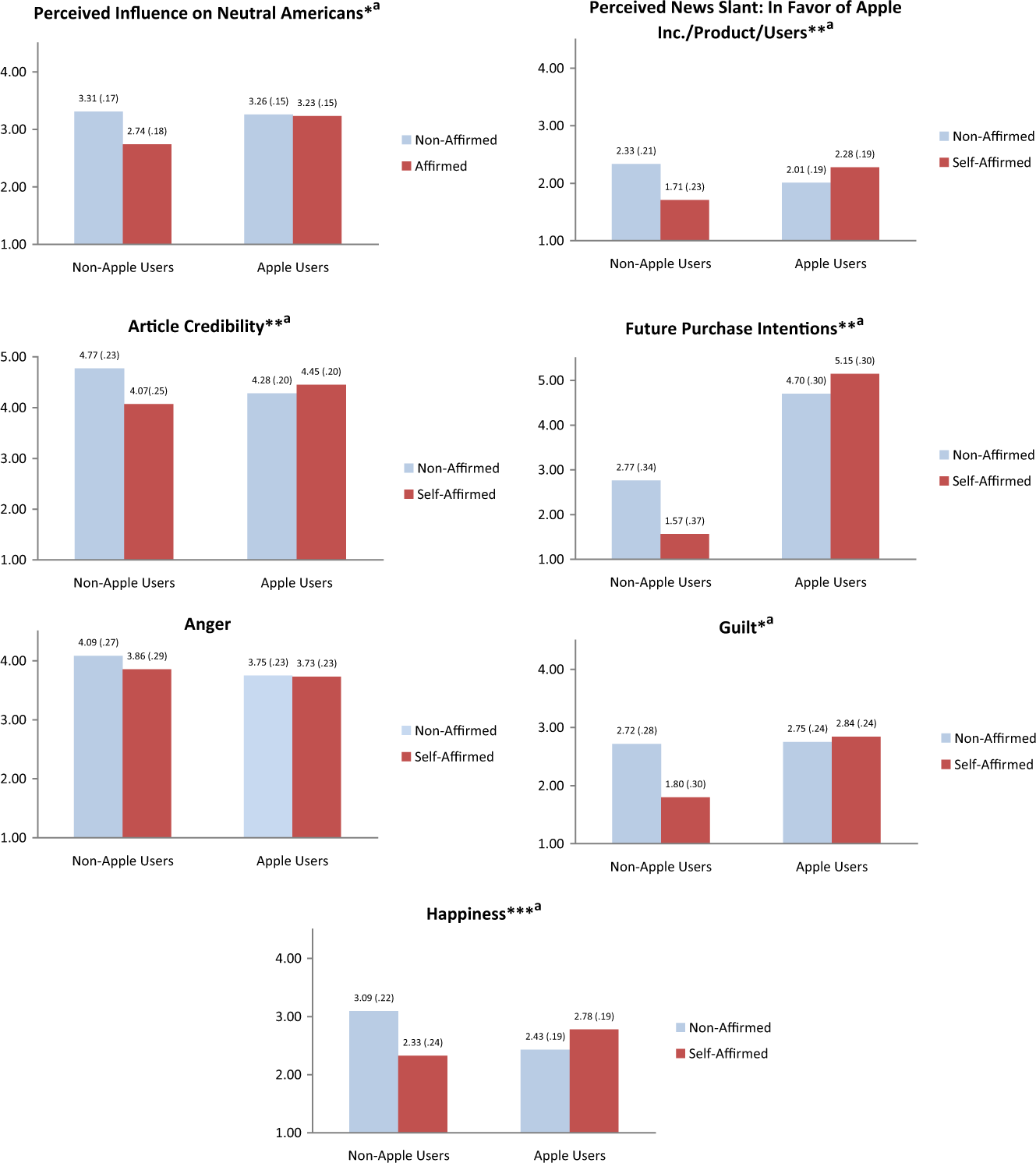
Means and standard errors for dependent variables based on experimental manipulation and user status.
For RQ1, self-affirmation and user status did not interact in influencing participants’ anger, F(1, 118) = 0.17, ns,
For RQ2, there was a marginally significant interaction effect on guilt, F(1, 118) = 3.59, p = .06,
Discussion
The present study examined the influence of self-affirmation in news research and provided evidence for the moderating role of group/user status. Before discussing the theoretical implications, we note that our pretest showed that Apple and non-Apple users had a similar level of self-concept. This result helped rule out two alternative explanations 4 : First, if Apple users (vs. non-Apple users) had a higher level of self-worth, they might have naturally self-affirmed such that Apple users exhibited less defensiveness than did non-Apple users. Second, if Apple users had thought much more positively about themselves, self-affirmation might be ineffective due to a ceiling effect. Given the pretest result, neither explanation seems valid.
Theoretical Discussion
First, our results showed a relatively consistent pattern that self-affirmation introduced a difference—on six out of the seven dependent variables—in how non-Apple users responded to a news article about the Apple sweatshop situation, whereas there was no difference between the responses from affirmed and non-affirmed Apple users. This is contrary to our expectations that news related to Apple sweatshop conditions should be more relevant and threatening to Apple users than to non-users such that the effects of self-affirmation would be larger among Apple users. A few recent studies also showed a more nuanced picture of self-affirmation effects (Harris et al., 2007; Harris & Napper, 2005; Jessop et al., 2009; Klein & Harris, 2009; Nan & Zhao, 2012; Zhao et al., 2014). There could be several explanations for these nuanced findings: First, Klein and Harris speculate that individuals at particularly high risk may have well-worn strategies for resisting risk information and may “engage stubborn defensive processes.” That is, high defensiveness might have rendered self-affirmation ineffective among heaviest alcohol drinkers in their study. Nan and Zhao (2012) provided evidence that trait reactance, a form of defensiveness, interacted with self-affirmation such that the effect of self-affirmation was unclear among smokers with high trait reactance. Second, whether the issue under investigation is a novel issue and how user/group status is classified may contribute to the mixed findings. Several recent studies (e.g., Klein & Harris, 2009; Zhao et al., 2014) were conducted among daily smokers or heaviest alcohol drinkers who likely had been repeatedly exposed to anti-smoking or drinking messages, and these participants were found to be unaffected by self-affirmation. Furthermore, the comparison groups in these studies included participants for whom drinking or smoking was also relevant. Results revealed that self-affirmation increased these participants’ attention to risk information (Klein & Harris, 2009) and the depth of message processing (Zhao et al., 2014). However, self-affirmation was clearly effective among coffee drinkers and patients living with type II diabetes who likely had not been exposed to the novel or fictitious health risks (e.g., Sherman et al., 2000; van Koningsbruggen & Das, 2009), and the control groups in these studies were non-coffee drinkers or other people who likely did not find the messages relevant.
Thus, it seems reasonable that additional insights into Apple users’ identity may help delineate when self-affirmation may be effective. Previous marketing research has documented that Apple product users are “insanely” loyal among users of all computer brands (e.g., Dooley, 2012) or among all phone or tablet users (Gallo, 2012; Sparkes, 2014). We provided additional evidence based on thought listing analysis 5 and revealed that Apple users were more likely than non-users to be in state of denial and believed that such messages had little effects on others’ perceptions or purchase intentions because Apple products were of good quality. Our pretest also showed that Apple users indicated less interest in negative reports than non-Apple users. Taken together, it seems that high defensiveness might have thwarted the effectiveness of self-affirmation among Apple users such that both affirmed and non-affirmed Apple users responded to the news in a similar fashion. Similar patterns have been found with respect to the effects of inoculation on protecting existing attitudes among those with high levels of issue involvement: Such individuals are quite able and motivated to defend their attitudes such that attempts to assist them may have diminishing marginal returns (Pfau, 1997).
However, Apple’s expansive marketing of its products on college campuses in the nation (Apple Inc., 2013) makes news about the company and its products personally relevant and desirable to college students who currently do not own an Apple product. Although they seem unexpected, our results, together with a number of other studies (e.g., Klein & Harris, 2009; Nan & Zhao, 2012), have presented a more intriguing picture to the self-affirmation literature: Personal relevance alone cannot explain why self-affirmation influenced non-Apple users’, but not Apple users’, responses. Because our study did not directly test defensiveness as an explanation, future research might need to examine the efficacy of a short self-affirmation exercise on message processing among users or groups with a varying degree of defensiveness and relevance.
Second, our study examined both emotional responses and cognitive judgments. For the emotional responses, self-affirmed non-Apple users were less likely to experience guilt, which is reasonable because self-affirmed non-Apple users (vs. non-affirmed) were more likely to realize that they did not contribute to the potential problems. However, because the article dealt with an issue related to the bad working conditions and product boycott, self-affirmed non-Apple users would experience less happiness if they paid more attention to the content of the message. Finally, for the anger response, there was no difference between Apple users and non-users perhaps because the Apple users seemed to indicate that such news did not have an effect on others’ perceptions of Apple products or users, there was nothing to be angry about and no one to blame. Overall, our study provides a more complete picture of the effects of self-affirmation on both cognitive and emotional responses: The effects of self-affirmation on emotional responses were largely consistent with the propositions that self-affirmation promotes in-depth processing of the messages and that the specific message features are related to the emotional responses.
Additional analysis showed that self-affirmation resulted in greater perceptions of negative influence on neutral Americans’ perceptions of Apple and its users and lower intentions to buy among non-Apple users. Previous research found that self-affirmation may have unintended negative effects; for example, self-affirmation decreased risk perceptions and negative affect among low-risk drinkers (Harris & Napper, 2005). We believe that the apparent inconsistency can be explained by the theorizing that self-affirmation promotes more in-depth and objective message processing and attention to risk information (Correll et al., 2004; Klein & Harris, 2009; Sherman & Cohen, 2006). In our study, perceptions of news slant or negative influence are consistent with the overall writing of the news article where 26 out of 202 words discussed the efforts that Apple Inc. and Foxconn made to address the problem, whereas 176 words discussed sweatshop conditions. More in-depth reading of the news article will lead participants to perceive more news slant (that the content was largely unfavorable toward Apple and its users) and will lead them to perceive that negative information would influence others to think more negatively about Apple and its users. However, the stimulus article in Harris and Napper’s study addressed the problems related to “excessive” drinking (p. 1254), which was not a concern for low-risk participants. More in-depth processing among the affirmed low-risk participants in Harris and Napper’s study might lead them to understand that they were not at risk of problems related to “excessive” drinking and, thus, lowered their risk perceptions and reduced feelings of fear.
It is interesting to note that self-affirmation does not necessarily increase overall favorable evaluations of the article. Previous research indicates that the effects of self-affirmation may depend on message quality (Correll et al., 2004) and possibly the type of messages. In the news context, perceptions of news slant are negatively correlated with the credibility of the article. That is, when news readers perceive that a news article is more negative toward one side than toward the other, news readers may rate the article as less credible. Furthermore, in the present study, affirmed (vs. non-affirmed) non-Apple users rated the news less credible and yet, they formed lower intentions to purchase Apple products in the future. This indicates that factors, other than message evaluation, may influence one’s behavioral intentions. For example, perceived influence of an article may influence one’s behavioral intentions. Additional theorizing based on the reasoned action theoretical framework states that one’s behavioral intentions are predicted by attitude toward a behavior/issue, norms, efficacy, and possibly emotions (e.g., Wang, 2011, 2012). Message evaluation may be related to one’s attitude toward a behavior and is just one of the many possible variables.
Practical Implications
It is important for news consumers to learn about threats from news and assess their risks accurately and appropriately. News consumers may self-affirm in two ways: First, people who engage in interpersonal discussion may help encourage the other person to self-affirm by providing positive feedback. Second, a number of considerations may act as naturalistic self-affirmation. Those with a pre-existing high self-concept (i.e., high trait self-esteem, high social status, or having a good family) may process messages more carefully and objectively than those with a low self-concept. Indeed, Duck, Terry, and Hogg (1998) found that the political group with positive status was less likely to perceive bias than the group with low political status. Finally, in health-related research, perceived risk to one’s health will more likely to be noted by affirmed participants. When receiving threatening information in a news story, if participants are more likely to pay attention to negative words, they may perceive greater identity threat in a truly unbalanced article. However, because our study only used one experimental article, we can only assert that a truly unbalanced article may result in perceived negative influence on others.
Limitations and Conclusion
It should be acknowledged that we did not measure the depth of message processing or cognitive efforts that were devoted to message processing. However, based on previous theorizing and research (Correll et al., 2004; Klein & Harris, 2009; Zhao et al., 2014), we argued that self-affirmation promoted more in-depth processing of the news article and found that the outcomes were largely consistent with the consequences of in-depth processing. That is, we built our rationale based on the previous literature and focused on outcome measures. Interested researchers may pursue further evidence by measuring cognitive efforts devoted to message processing (e.g., time spent on the article, attention to certain words). Second, although it informs our understanding of self-affirmation research and is quite the norm of experimental research, our experiment is limited to one news issue and thus limited in generalizability to other phenomena and other groups with a different identity. Furthermore, although the experimental stimulus article was consistent with the tone of some articles published in major U.S. newspapers or posted on blogs and had ecological validity, future research should evaluate the possibility of using articles with a different degree of threat or news slant to ascertain whether affirmed participants simply pay more attention to the negative information or make a more objective assessment of the overall article. Third, our division of Apple users and non-Apple users offered only one incident of classification and was based on categories. The thought listing procedure and our review of several studies (e.g., Klein & Harris, 2009) indicates that defensiveness may be the reason for the moderating role of user status. Future research might need to measure or experimentally manipulate defensiveness.
Notwithstanding the limitations, this present study extended self-affirmation in the news context and offered a nuanced picture of how self-affirmation may affect readers’ responses to a news article. It is of particular importance to note that based on previous marketing research and our own pretest, the naturalistic classification of Apple and non-Apple users provided insights on how users of high relevance are not influenced by the self-affirmation process. Finally, although we offered potential explanations regarding our findings, we did not directly test our explanations for the findings. As such, we reiterate Zhao et al.’s (2014) call for more research regarding the psychological mechanism of self-affirmation.
Footnotes
Acknowledgements
The authors would like to acknowledge Editor Roloff’s and three anonymous reviewers’ excellent guidance and constructive comments throughout the review process.
Declaration of Conflicting Interests
The authors declared no potential conflicts of interest with respect to the research, authorship, and/or publication of this article.
Funding
The authors received no financial support for the research, authorship, and/or publication of this article.