




Abstract
We examine predictors of outgroup partner “fit” (the extent to which an individual is seen as representative of a group), and whether fit determines generalization from a discrete intergroup communication experience to intentions for future contact with the outgroup. In an experiment, 288 undergraduate students imagined a conversation with an older target who was presented either positively or negatively. The positively valenced older adult was seen as being more representative of older people in general (high fit), and this link was stronger for those with more past positive and fewer past negative communication experiences. Fit moderated the effects of imagined interaction valence on intentions for future intergroup contact. A positive older partner perceived as fitting the category “older people” resulted in greater intention to communicate with older people in the future than a negative partner; individuals who saw their partner as atypical showed the reverse pattern—they were less likely to report intentions for future intergenerational contact after a positive than a negative manipulated interaction. The findings demonstrate that negative intergroup communication can, at times, have positive effects, and positive contact can have negative effects.
Keywords
Considerable research demonstrates that contact between people from different social groups can positively affect intergroup relations: Most notably, contact between groups reduces prejudice (Pettigrew & Tropp, 2006). However, attention to contact’s communicative elements has been less common than examinations of its context and psychological outcomes. This article takes a more directly communicative approach to contact by examining desire for specific types of future intergroup communication as a reaction to a presently manipulated communication experience, interpreted in light of expectations based on past intergroup communication. We consider explicitly how communication-related factors may enhance or inhibit positive effects from contact, by framing future communication expectations as a critically important outcome of intergroup contact. Individuals, particularly prejudiced individuals, experience resistance and anxiety concerning intergroup communication (Pettigrew & Tropp, 2008, 2011), and hence our broadest goal here is uncovering ways to overcome such resistance.
We examine contact in the intergenerational context, an area in which young people’s perceptions of older people have received considerable attention. Some scholars demonstrated fairly negative attitudes (Kite, Stockdale, Whitley, & Johnson, 2005), while others showed that intergenerational perceptions are more complex and ambivalent (Fiske, Cuddy, Glick, & Xu, 2002; Hummert, Garstka, Shaner, & Strahm, 1994). Hence, we examine the complexities of intergroup contact’s effects when perceptions of the target outgroup are something other than wholly negative, while also considering the role of both positive and negative communication experiences in influencing perceptions of intergroup relations.
We explore intergenerational contact using an imagined contact paradigm (Crisp & Turner, 2009). Three specific questions underlie this research. First, we ask whether the quality of an imagined interaction influences the extent to which a target outgroup person is perceived to “fit” the outgroup category: Are they seen as representative or prototypical of that category? To give the classic example, a robin has better fit to the category “birds” than, say, a penguin. Prior research has demonstrated that fit determines whether the outcome of a communication event with an outgroup member generalizes to perceptions of the outgroup as a whole (Brown & Hewstone, 2005), in part because fit determines category activation (Rothbart & John, 1985). More broadly, fit concerns are central to a variety of psychologically important processes. Beginning with an assumption that cognitive categories are flexible and dynamic (rather than static structures), it is critical to understand when and how particular cognitive categories are treated as cognitively relevant for processing incoming stimuli, as well as the extent to which particular exemplars are seen as “belonging” or not belonging in those categories (Bodenhausen & Peery, 2009). This belongingness can be influenced by characteristics of the exemplars themselves, of course, but also a host of other factors (judgment context, other relevant categories, linguistic frames: Rosch, 2011). From this broad perspective on the importance and context-dependence of psychological categories, it is important to focus on fit between category and exemplar in the context of intergroup interaction.
Second, we ask whether experiences of prior contact moderate the effects of present contact on fit. This approach will help us integrate previous experimental work (which has tended to examine the effects of a single contact experience in the present) with survey work that has examined the effects of overall levels of past intergroup communication experiences (Paolini, Hewstone, Voci, Harwood, & Cairns, 2006).
Third, we examine whether fit moderates the effects of present intergroup contact on desire for future communication with the outgroup. Although most research has focused on non-communicative attitudinal outcomes, examining desire for future communication provides us with an indication of whether positive intergroup communication can have a self-perpetuating positive effect. We believe ours is the first work to integrate past, present, and future intergroup communication experiences in a single framework, suggesting pathways for building sustained and ongoing positive intergroup relations in society (Pettigrew & Tropp, 2011).
Many Forms of Intergroup Contact Influence Prejudice
Beginning with Allport’s (1954) classic statement, work has flourished on the beneficial effects of intergroup communication on intergroup attitudes. For the purposes of this article, the groups being discussed are large social groups with which people have meaningful identifications (e.g., racial/ethnic groups, age groups, religious affiliations, etc.). Within the literature on intergroup communication, it is conventional to use “ingroups” to reference groups to which an individual belongs and “outgroups” to reference groups to which an individual does not belong. Hundreds of studies have examined contact’s effects on prejudice, and a recent meta-analysis demonstrates that positive interaction between groups improves attitudes (Pettigrew & Tropp, 2006). In line with works such as those by Bless and Schwarz (2010), we describe traditional contact effects as “assimilation” effects. The cognitive representation of the group as a whole is shifted toward the particular exemplar that a participant has experienced: The exemplar is adopted as a part of the category and perceptions of the category shift toward the exemplar. Hence, encountering a positive member of the outgroup results in a positive shift in perceptions of the outgroup as a whole.
Research on intergroup contact takes a number of forms (see Brown & Hewstone, 2005, for a comprehensive review). The two dominant paradigms are survey-based research examining associations between experiences with members of an outgroup and outgroup prejudice, or experimental research in which either the presence or the nature of intergroup contact is manipulated and then attitudes about the interaction (and sometimes toward the outgroup more broadly) are subsequently measured. The nature of the contact that occurs varies dramatically, with recent years seeing a growth in consideration of forms of contact beyond direct face-to-face interaction. For example, research has considered contact with media characters, contact through new media, indirect forms of contact such as observing or hearing about ingroup and outgroup members communicating with one another, and visualizing or imagining communication with an outgroup member (Harwood, 2010). Our study will consider the latter form of contact, examining the ways in which imagining communication with an outgroup member is associated with changing attitudes about the outgroup more broadly.
Imagining a conversation with an outgroup member (a) permits us a high level of experimental control, (b) is an intervention that is applicable to a large population at relatively high efficiency (and hence useful in the practical sense), and (c) builds on the growing literature in contact theory examining various mediated and indirect forms of contact. Imagining contact is particularly relevant to our interests because prior research demonstrates that imagined interactions are closely tied to real interactions, can influence future interactions, and vary along multiple dimensions commonly examined in the contact literature (including our study—for example, valence: Honeycutt, 2010a). Indeed, imagined contact, while quite distinct in its goals and theoretical framework, is complementary to and informed by an established tradition of communication work on imagined interactions (Bodie, Honeycutt, & Vickery, 2013). As such, imagined interaction and imagined contact can offer an immediate and sensible bridge between the contact and communication literatures (Honeycutt, 2010b). While imagined contact foregoes certain complexities of actual conversation, our purposes include a specific focus on the “fit” of intergroup communication, and in this case the complexities of “real” communication might mask or confound a controlled observation of this variable (see also “Fit” section below).
We contribute to the intergroup contact literature by (a) further elaborating on the role of fit in imagined contact, (b) considering what predicts fit, including aspects of present and past intergroup communication, and (c) considering the role of contact and fit in predicting explicitly communication-related outcome measures. Below, we elaborate on these three contributions.
The Role of Fit in Determining Generalization From Group Member to Entire Group
How does an interaction with a specific outgroup member generalize to feelings about that person’s group more broadly, including intentions to communicate with other group members? To answer this question, Hewstone and Brown (1986) suggested that a minimum level of category salience or typicality be present in the encounter: The person’s outgroup category membership must be cognitively available within the interaction, and the outgroup member needs to be seen as representative of their group (see also Rothbart & John, 1985; Wilder, 1984). Previous literature has used salience and typicality somewhat interchangeably. Our read of the original sources suggests that both are important. Hence, we reframe salience and typicality under the broader concept of “fit,” as detailed in self-categorization theory (Turner, Hogg, Oakes, Reicher, & Wetherell, 1987; see Honeycutt, 2010a for the related concept of “discrepancy”). At its simplest, fit is the degree to which a category member belongs in the broader category, the similarity of a category member to the category’s prototype. Fit can be conceptualized in descriptive or evaluative terms (Coates, Latu, & Haydel, 2006; Haslam, Oakes, Turner, & McGarty, 1995). Descriptive fit is when an individual matches a group category on a content dimension. For example, for someone who believes that English people are very formal, a particular formal English person would have high descriptive fit to the category. Evaluative fit is when an individual matches a group category on overall valence: An Anglophile will view globally “nice” English individuals as having better fit to the category than globally unpleasant English individuals.
Empirical research has supported Hewstone and Brown’s (1986) hypothesis: Brown and Hewstone’s (2005) narrative review demonstrates convincingly that fit moderates the effects of contact on prejudice. When fit of the outgroup member is high, positive effects of positive contact (assimilation effects) are stronger than when fit is low. Indeed, Brown and Hewstone go so far as to conclude support for a “strong” version of this effect, wherein contact only has effects when fit is high (vs. a weaker version which would suggest that contact has more effects when fit is high).
Assimilation effects are unlikely when an outgroup exemplar is perceived as atypical of the group. As noted by Rothbart and Lewis (1988), As the attributes of a category member become less congruent with the attributes of the category, that member is less likely to be associated with the category, and generalization of the category member’s attributes to the category as a whole becomes less probable. (p. 862)
This phenomenon has variously been referred to as subtyping or re-fencing: The atypical exemplar is cognitively excluded or set aside from the group, and thus the exemplar’s characteristics are not generalized to the group as a whole. Such instances should lead to no change in the cognitive representation of the category.
However, the cognitive exclusion of atypical group targets can result in non-obvious consequences for group evaluations. Perceptions of the group as a whole can be adjusted in the opposite direction to or contrasted against the characteristics of a particularly deviant outgroup member. In such situations, the outgroup member becomes a specific standard of comparison or baseline against which perceptions of the entire outgroup are re-evaluated (Bless & Schwarz, 1998; Kunda & Oleson, 1997). For instance, if a particularly aggressive and nasty woman is subtyped away from perceptions of women as a whole, she can become a new baseline against which women in general may appear even more passive and nurturing than they were previously thought to be. We term such effects contrast effects: The exemplar is rejected from the category, and the overall conceptualization of the category shifts to be more distant from the exemplar (Bless & Schwarz, 2010). Our presentation of assimilation and contrast effects offers parallels to social judgment theory (Hovland, Harvey, & Sherif, 1957) in terms of a message recipient shifting toward or away from a message position. However, we are, of course, not working in social judgment theory’s realm of explicitly persuasive messages.
What Influences Fit?
In focusing on the moderating role of fit, research has largely ignored how contact itself and the characteristics of the contact partner influence fit. In a dynamic ongoing interaction, reciprocal influence between perceived fit and behavior is not an unreasonable assumption. Below we present arguments for how three specific phenomena influence fit.
Valence of Contact
Perhaps the most basic dimension defining a communication experience is its valence (Honeycutt, 2010a). Because of an interest in improving attitudes, examination of positive contact has dominated the literature. However, recent research has considered the effects of valence more focally, including examining the effects of negative contact compared to positive contact. The most developed line of this research has made a bold claim that negative contact has stronger effects than positive contact (Barlow et al., 2012; Paolini, Harwood, & Rubin, 2010). The rationale underlying this argument is that, for negatively perceived outgroups, a negative contact experience has greater fit with how the outgroup is perceived, and therefore that perceived group salience should be higher in negative encounters (a “valence-salience effect”) and lead to larger negative generalizations. As outlined above, when typicality or salience is higher, the effects of contact should be stronger; therefore, the negative effects of negative contact with a member of a negative group should be stronger than the positive effects of positive contact with a member of a negatively perceived group. This line of research has presented a number of studies demonstrating convincingly that valence of contact does indeed influence fit in the predicted manner. (Negative contact leads to higher fit: Paolini et al., 2014.)
However, and as noted earlier, research on stereotyping of older people demonstrates that perceptions of the group are not wholly negative, and that there are some well-developed positive perceptions that coexist with the negative (Cuddy, Norton, & Fiske, 2005; Hummert, 1990; Hummert et al., 1994). Hence, our research develops prior work on valence-salience effects by examining the effects of positive and negative contact with an ambivalently perceived group. We predicted that perceived fit of an older target will match perceptions of older adults in our sample: If existing perceptions of older people are broadly positive, then a positive older individual should have greater fit to the category; if perceptions of older people are broadly negative, then a negative older individual should have greater fit (Hypothesis 1 [H1]).
Specific Characteristics of the Outgroup Member
Beyond the global perceptions of valence described in the previous section, it is also important to consider the complexity of perceptions of older adults, and in particular, the ways in which positive and negative perceptions exist side by side and manifest themselves with regard to different stereotype traits (Ota, McCann, & Honeycutt, 2012). Fiske et al.’s (2002) stereotype content model (SCM) claims that group stereotypes can be broadly understood as varying along two dimensions: warmth and competence. Older adults (the outgroup for our particular research) are perceived as warm, but typically not competent relative to younger people (Cuddy et al., 2005). While some cross-cultural variation in perceptions of older people is clear from the literature, the broad pattern of high warmth and low competence evaluations is fairly cross-culturally stable (Cuddy et al., 2005; Ota et al., 2012). Other outgroups are perceived as typically competent but not warm (e.g., Germans, Asians), or in some cases neither warm nor competent (e.g., homeless or mentally ill people). The combination of warmth and competence perceptions associated with a group has consequences for the emotional and behavioral responses displayed toward the group (e.g., pity and helping toward groups perceived as high warmth and low competence: Cuddy, Fiske, & Glick, 2008). SCM research has been extended to consider a further distinction within the “warm” dimension between perceptions of sociability and perceptions of morality (Brambilla, Rusconi, Sacchi, & Cherubini, 2011). The former relate to the ease and pleasantness of interaction, while the latter relate to perceptions of an individual or group’s integrity and trustworthiness. Ours is the first research to examine this elaboration of the SCM in the area of age stereotypes.
If established stereotypes of older adults hold, the fit of a particular older adult should be higher to the extent that they are perceived positively on warmth (sociability and morality) and negatively on competence. Likewise, fit should be lower if an older target is seen as cold (negative warmth) or competent (positive competence). In other words, while overall valence might influence fit, valence should interact with stereotype content. Therefore, we predict that the fit-enhancing effects of target valence will mirror more general perceptions of older adults: For dimensions on which older adults are perceived positively (morality, sociability), a positive (moral, sociable) older target will be seen as having higher fit than a negative (immoral, unsociable) older target; for dimensions on which older adults are perceived negatively (competence), a negative (incompetent) older target will be seen as having higher fit than a positive (competent) target (Hypothesis 2 [H2]).
Specific Prior Communication Experiences of the Contact Experiencer
The previous two sections made arguments based on population-level stereotypes and attitudes. However, the individuals making these judgments are of course unique and bring their own histories of intergroup communication to any particular encounter; those histories should influence what they see as fitting. While people may be influenced by broad social stereotypes, their reactions to a given communication event will be formed in the context of individual perceptions developed over a lifetime of communication experiences. So far very few works have examined interactions between past and present contact, but Paolini et al. (2014) show that such effects occur in theoretically sensible ways. They examined the tendency for fit to be higher with negative contact for negatively perceived groups, negative valence-salience asymmetries, and demonstrated that negative intergroup contact in the present only has higher levels of fit for individuals who have histories of negative intergroup contact experiences (Bowman & Denson, 2012). Consistent with this, we predicted that the association between contact valence and fit will be moderated by past contact experiences: Histories of negative contact experiences with the outgroup should mean that current negative communication is seen as more fitting of the outgroup than current positive communication; histories of positive communication experiences with the outgroup should yield the reverse effect (Hypothesis 3 [H3]). We examine past negative and positive histories separately: It is possible for individuals to have high levels of both positive and negative communication, and plausibly one or other of those might be more powerful (e.g., via a general process that negative stimuli are more powerful and garner more attention than positive: Baumeister, Bratslavsky, Finkenauer, & Vohs, 2001).
Fit Moderates the Effects of Present Contact on Future Communication Intentions
In addition to examining how the above factors influence perceived fit, we also investigated the moderating role of fit in the effect of imagined contact on communication-related outcomes. Demonstrating the effects of contact on attitudes is a worthy goal, but for communication researchers, the critical issue is whether positive effects extend to behavioral, and particularly communication outcomes (Tropp & Mallett, 2011): Are behaviors toward the outgroup being affected? This connects with prior work on imagined interactions (Honeycutt, 2010a) that describes a rehearsal function, whereby imagined communication sets the stage for “actual” interaction. Indeed, this is a point that has also been made in the contact literature (Crisp, Husnu, Meleady, Stathi, & Turner, 2010). We are concerned with three effects stemming from this background.
First, positive contact should have positive effects on global intentions concerning future intergroup interaction (Hypothesis 4 [H4]). Relatively little work has examined future intentions as an outcome of contact (but see Crisp & Husnu, 2011; Stathi, Cameron, Hartley, & Bradford, 2014). To the extent that these effects can be demonstrated across a variety of forms of contact, they would suggest that contact has a self-perpetuating positive effect such that once set in motion it yields both positive attitudes and a desire for more contact, which of course should help sustain whatever attitude change has been achieved. The converse of this is that simple attitudinal effects may fade over time in the absence of continued intergroup contact (Hill & Augoustinos, 2001; but see Malhotra & Liyanage, 2005, for long-term positive outcomes of contact). Thus, sustained positive effects of contact require both positive effects on attitudes and positive effects on desiring and seeking future communication opportunities with the outgroup to maintain those attitudes. Hodson, Costello, and MacInnis (2013) make a similar point, suggesting that mental visualizations might be an effective tool to encourage future sustained interaction, even for those who are initially unwilling or unable to engage in contact (e.g., the prejudiced or those in highly segregated settings: Crisp & Turner, 2009).
Second, we extend the literature in this area by examining intention to engage in specific forms of communication as an outcome. Advice-seeking has been tied to at least one long-term attitudinal concern central to intergroup relations: trust (Tam, Hewstone, Kenworthy, & Cairns, 2009). A significant barrier to intergroup relations is the idea that members of other groups are untrustworthy. Intentions to seek advice from outgroup members reflects a level of trust in the outgroup, and actually engaging in advice-seeking should reinforce trust. Advice-seeking has interesting connections to perceptions of older people. Specifically, older people are often perceived as wise (and hence potential sources of valuable advice) and kind (and hence presumably unlikely to intentionally provide misleading guidance). However, they are also stereotyped as incompetent, particularly in terms of mental speed and acuity, which might suppress the perception that they have the capacity to provide insightful advice. Thus, we sought to investigate whether valence and trait-based characterizations of an older imagined conversation partner influence advice-seeking intentions with regard to other older adults. In terms of valence, we predicted that advice-seeking intentions with older people would be higher as a result of imagined contact with a positively (vs. negatively) characterized older adult (Hypothesis 5 [H5]). In terms of traits, the SCM trait dimensions (outlined above) have fairly straightforward connections to specific advice-seeking goals. For example, positive perceptions on a dimension such as sociability might be associated with advice-seeking related to issues pertaining to social activities but not concerning career choices. Positive perceptions on competence might relate to life-decision advice-seeking but not necessarily advice-seeking on relationships (Bonhard, 2005). Therefore, we predict links from the specific trait dimension of our manipulation to specific forms of advice-seeking (Hypothesis 6 [H6]).
Third, and consistent with Hewstone and Brown (described earlier), the effects in H4 to H6 should be moderated by fit (Hypothesis 7 [H7]). When the exemplar is perceived to have high fit, a positive older adult exemplar should yield greater intentions to communicate with other older adults than a negative older adult exemplar (assimilation effects). However, when the exemplar is perceived to have low fit, we explore whether contrast effects are present: Specifically, does a low fit positive outgroup member reduce desire to interact in the future, and/or does a low fit negative outgroup member increase desire for future interaction with the outgroup.
Method
Overview
Participants completed an online pretest including measures of perceptions of older adults on sociability, competence, and morality, as well as their previous communication experiences with older people. Approximately 1 week later, participants completed the main study (again online) in which they visualized a conversation with a specific older person whose characteristics were manipulated in a 2 (valence: positive/negative) × 3 (trait dimension: competence/sociability/morality) between-subjects design. For example, some respondents imagined a competent (positive-competence) older adult, while others imagined an unsociable (negative-sociability) older adult. Following the visualization, they rated the older person they had imagined on a variety of dimensions including perceived sociability/competence/morality and fit (similarity to other older people). Finally, participants rated their level of interest in future interaction with older people, and their likelihood of seeking advice from older adults on a number of issues. Details of manipulation and measures are provided below. The respondents were 320 U.S. communication undergraduates who participated as part of a research requirement. We excluded 32 participants: 16 who checked a box indicating that we should not use their data, 9 who had taken a course on communication and aging that explicitly addressed issues of age stereotypes and contact theory, 6 who were over the age of 25 years (to maintain homogeneity among respondents in terms of age identity), and 1 whose self-rated English skills fell below the midpoint of a competence scale. The final sample size was 288 (68% female, 76% White/Caucasian, Mage = 20.27, SD = 1.29).
Measures and Manipulation
Pretest measure of perceptions of older adults
Participants rated “elderly people (people over 65)” on nine traits, on 6-point scales (not at all to very). The traits assessed perceptions of morality (trustworthy, honest, sincere, α = .86), sociability (friendly, warm, likeable, α = .85), and competence (intelligent, competent, skillful, α = .74). For comparative purposes, the same measures were also collected for perceptions of younger adults (α = .84, .78, .76). These items were derived from the work by Brambilla et al. (2011).
Pretest measure of prior contact with older adults
Two items from Barlow et al. (2012) measured the frequency with which participants had previous “positive/good” and “negative/bad” communication with older adults on 7-point (low to high) scales. Given our interest in differential effects of positive and negative contact, these were kept as separate single-item measures.
Imagined contact manipulation
While there are no definitive standards on how to structure imagined contact, research on imagined interactions (Honeycutt, 2003) suggests that verbal imagery tends to be more tied to conflict, whereas visual imagery tends to be tied to pleasant interactions. To provide the greatest possible variability of imagined contact, we asked our participants to generate both verbal and visual imagery. Specifically, participants were told, Imagine you are traveling on a plane. When you board you discover that you are sitting next to an elderly woman (about 70-75 years old). Imagine that this woman is [
The bracketed area represented the manipulation—this example displays the positive (negative) competence conditions. The other conditions involved positive or negative sociability ((un)sociable and (un)friendly), and positive or negative morality ((un)trustworthy and (in)sincere). This resulted in a total of six conditions in a 2 (valence: positive/negative) × 3 (trait dimension: sociability/competence/morality) all between-subjects design. Respondents were asked to picture the person in their heads and write a brief description. Then, consistent with Honeycutt (2003), they were asked to: Imagine that you start a conversation with this [manipulated traits inserted here] woman. Please take a minute to imagine what this conversation would be like. When you are ready to start imagining, click to the next page. You will have a full minute to imagine the conversation before moving on to further questions. It may help to close your eyes while imagining the conversation.
The online questionnaire then paused for a full minute. After this visualization, participants were asked to write a description of the conversation, and then they responded to the post-test measures. Most respondents were involved in the task, as indicated by the fact that the responses averaged 48 words in length. In the sociable condition, one respondent wrote, I and the elderly woman talked about each others families. She told me that I reminded her of her grand daughter. I felt very happy to speak with this woman. She was very friendly and sweet. I had a smile on my face throughout the entire conversation. Even though I was given one minute to imagine my conversation with the elderly woman it felt like an hour long conversation.
The last sentence illustrates the level of involvement that many participants felt; the earlier portions demonstrate that the responses tended to reflect the manipulation content. This is also apparent in the following (from the untrustworthy condition): To begin the conversation was filled with what she had to say . . . then she began to go into a saga about herself. She was very direct and made her life sound like it was perfect and that I should be envying her. She continued on to talk about her children and grandchildren, and by the way she was describing them I felt as if she was putting on an act so that I wouldn’t be skeptical of her. She was fiddling with her thumbs the entire conversation and her eye contact was scarce.
Post-test measure of fit
Fit was assessed in a variety of ways. Partner typicality was measured with four items (To what extent does this person represent elderly people? To what extent is this person like other elderly people? To what extent is this person typical of elderly people? Overall, how similar was your partner to other elderly people?). These were rated on a 5-point scale from not at all to very much (α = .93). The evaluative fit measure (Coates et al., 2006) was derived from a single-item measure asking “Compared to a typical conversation with an elderly person, was the conversation that you imagined . . . ” followed by a 5-point scale from much more negative to much more positive. Respondents scoring at the midpoint of the scale (about the same) scored a 3, those one point below or above scored a 2, and those at either end of the scale scored a 1, resulting in a measure of evaluative fit that was lowest for individuals who imagined a conversation that was much more positive or much more negative than a typical conversation with an older person. Descriptive fit was assessed along the three trait dimensions—sociability, morality, and competence. Respondents assessed “elderly people” in general on these measures in the pretest using three-item scales (see above). After imagining the interaction, they rated their elderly partner on the same three items for each dimension (competence α = .92, morality α = .90, sociability α = .96). For each, the absolute size of the difference between the rating of older people in general and the target was treated as a measure of “lack of” descriptive fit, and was therefore reverse coded, resulting in three measures of descriptive fit (similarity between perceptions of the target and perceptions of older adults in general, on three descriptive trait dimensions). All five “fit” measures (typicality, evaluative fit, three measures of descriptive fit) were substantially intercorrelated (average and median r = .39); to avoid overcomplicating the report of results and reporting redundant effects, we did not pursue separate analysis for each. Instead, z scores for all five of these variables were averaged to create a single measure of fit (α = .76).
Post-test measures of future communication intentions
We asked participants three questions about their intentions to interact with and learn about the elderly, as well as how important they believed this future interaction was. These items were all on 9-point scales ranging from not at all (none) to very much (a lot of time, highly important). We averaged these items to form a reliable future Communication Intentions Scale (α = .85). We also asked participants to rate their likelihood of seeking advice from an elderly person (rated from very unlikely (1) to very likely (7)). We conceived of advice-seeking on three dimensions expected to be relevant to the underlying trait dimension model; hence, the advice-seeking factors were determined theoretically a priori. Moral advice-seeking consisted of asking older people about how to be a good person, how to make moral choices, and ethical behaviors (α = .85). Competence advice-seeking consisted of asking how to be wise, how to make important life choices, and how to solve difficult problems (α = .77). Social advice-seeking consisted of asking relationship advice, how to be a popular person, and about popular culture. This third scale was not reliable (α = .49); the removal of the relationship advice item increased reliability (α = .62; Spearman-Brown coefficient = .62); while this is still low, it is acceptable for a two-item scale.
Results
Pretest Measure of Perceptions: Older Adults Perceived Positively
Older people were perceived more positively than younger people along all three trait dimensions (Figure 1). Both the age group main effect, F(1, 287) = 239.74, p < .001,
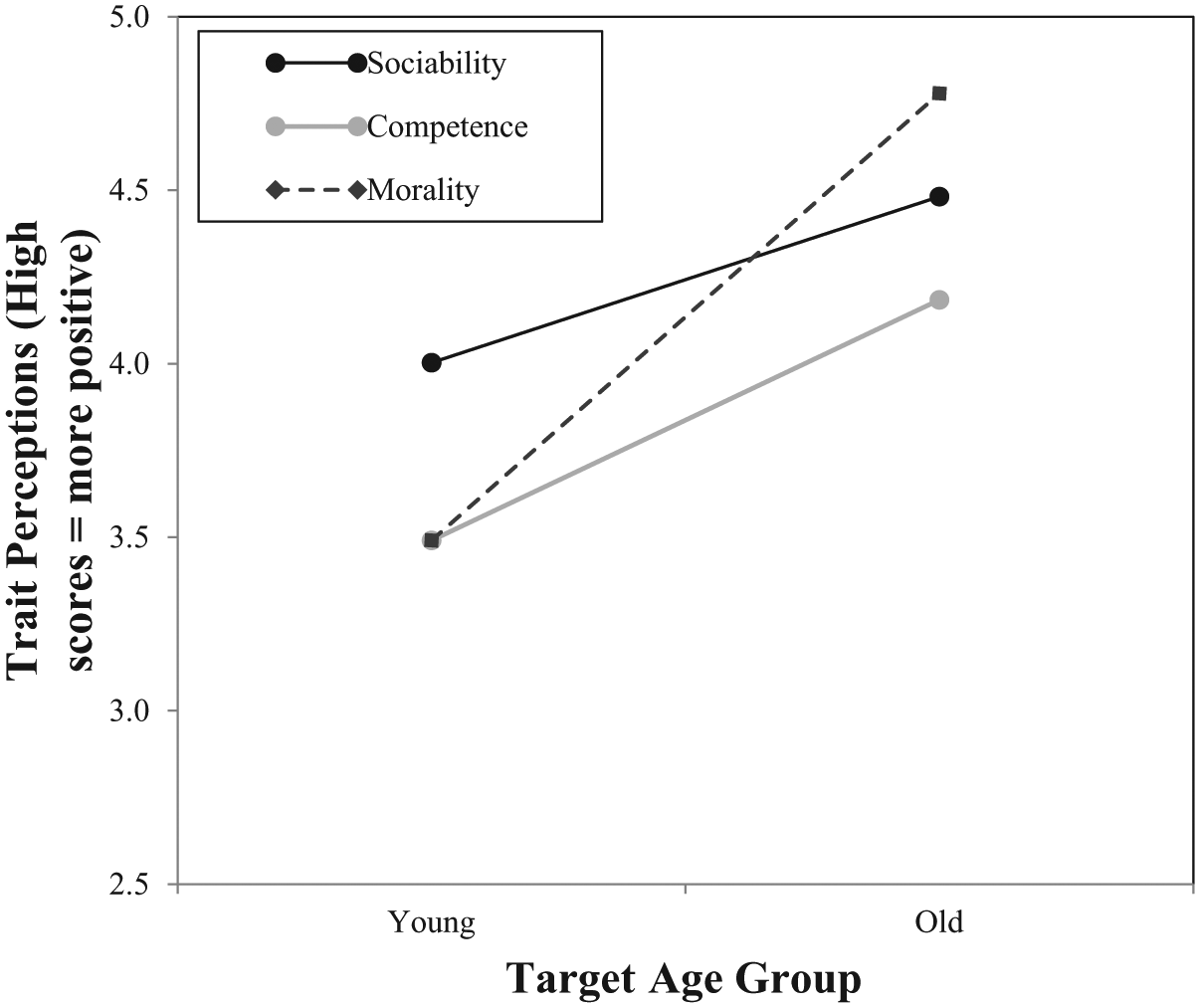
Stereotypes of young and old age groups on sociability, competence, and morality traits. Perceptions of older people are generally more positive than perceptions of young people, with the effect being steepest for perceptions of morality.
Effects of Manipulations on Perceived Fit (H1, H2)
We examined the effect of our experimental manipulations on fit using a 2 (valence: positive/negative) × 3 (trait dimension: sociability/morality/competence) ANOVA, with fit as the dependent variable. H1 predicted that perceived fit of an older target would match perceptions of older adults in our sample; given that perceptions of older adults were positive (see previous section), a positive (vs. negative) older individual should have greater fit to the category (H1). Supporting H1, fit was higher in the positive than the negative condition across all three trait measures: valence main effect, F(1, 282) = 154.15, p < .001,
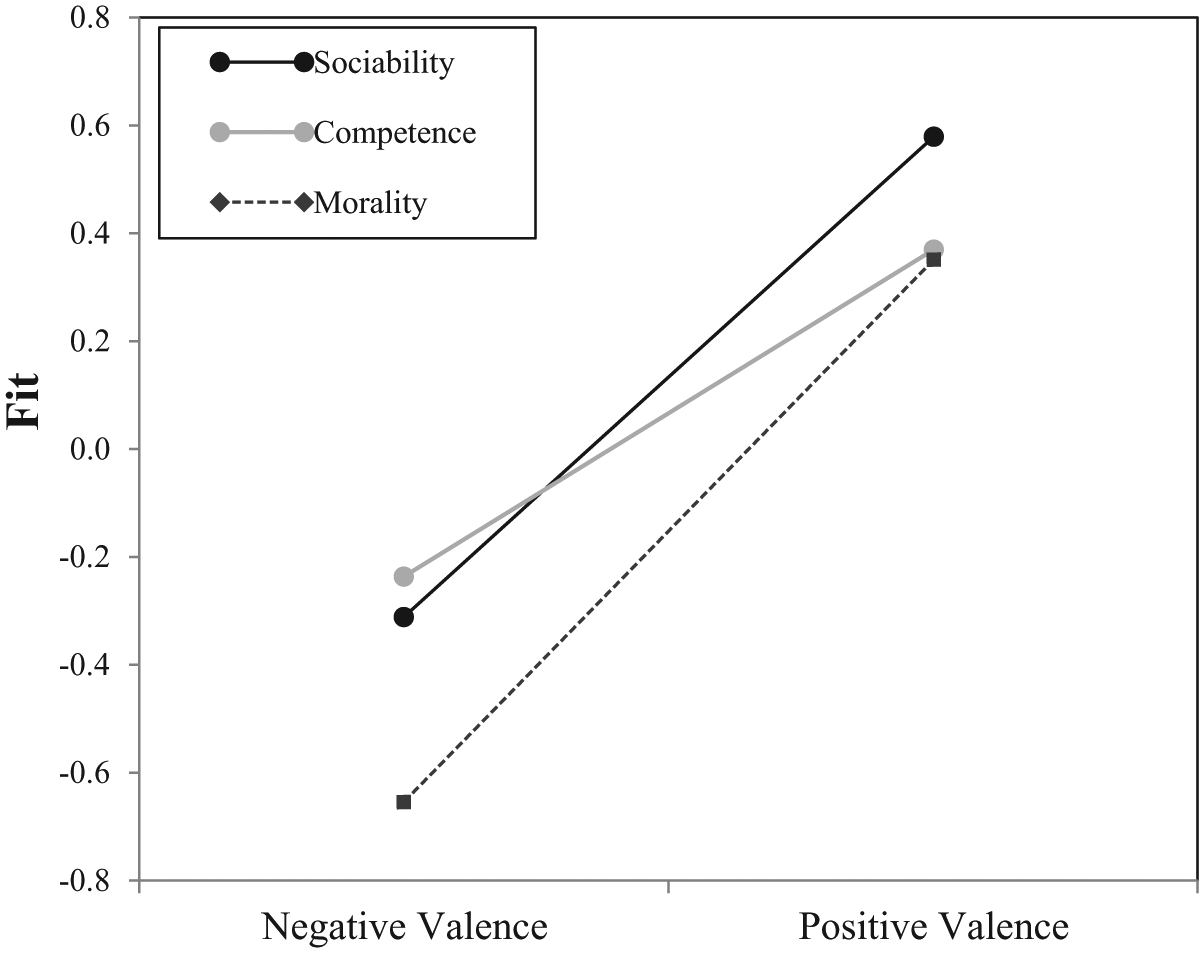
Effects of contact valence and trait manipulations on perceptions of target older adult’s fit to the general category of “elderly people.” Positive older targets are seen as fitting the category (“elderly people”) better than negative older targets, with the weakest effect for positive (vs. negative) competence.
Moderating Effects of Past Contact With Older People on the Valence-Fit Effects (H3)
H3 predicted that the association between contact valence and fit (just described) would be moderated by past intergroup communication experiences, such that an association between positive valence and fit would be stronger for those with more positive histories with older people and weaker for those with more negative histories. These effects were examined using Model 3 of the PROCESS macro for SPSS (Hayes, 2013). The model tested the effect of two simultaneous moderators (good and bad histories with older people) on the association between valence of the target exemplar and perceived fit of the exemplar. Analysis included two dummy codes to control for the effect of the trait manipulation. The effects of the trait manipulation are not considered directly in these analyses because we do not have a complementary trait-based measure of past contact, and because the analysis already presented demonstrates that the trait manipulations were much weaker than the valence manipulations. Positive and negative past contact both moderated the effects of the valence manipulation on fit (bad contact moderator B = −.10, SE = .08, p < .05; good contact moderator B = −.15, SE = .05, p < .01). Both moderators operated in a consistent manner: Past contact consistent with the manipulation makes the target of the manipulation have greater fit. People with high levels of past bad contact with older people see the negative target as more fitting than those with low levels of past bad contact; those with high levels of past good contact see the negative target as less fitting and the positive target as more fitting than those with low levels of past good contact (graphs of simple slopes are in Figure 3). Past bad contact does not influence fit perceptions of the positive target. These effects broadly support H3: A history of negative contact increases the fit of negative contact but does not decrease the fit of positive contact. On the other hand, a history of positive contact increases the fit of positive contact and decreases the fit of negative contact.
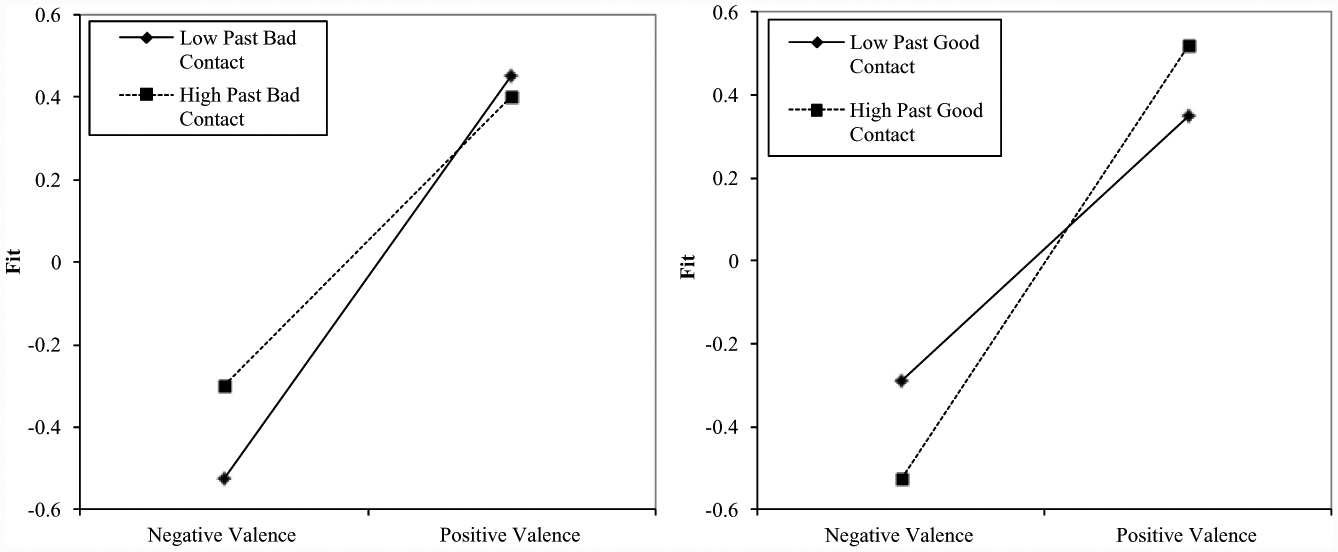
Moderating effects of past bad contact (left chart) and good contact (right chart) on the effects of exemplar contact valence on fit. Those in the negative valence condition who had experienced less past negative contact saw the negative target as less fitting of the category than those with more past negative contact. For those with more good contact in the past, the positive exemplar was seen as more fitting and the negative as less fitting the category than for those with lower levels of past good contact.
Valence and Trait Manipulations Influence Future Communication Intentions (H4-H6) and Moderating Effects of Fit (H7)
H4 and H5 predicted that valence of contact would influence global intentions concerning future intergroup interaction and specific intentions concerning advice-seeking. This was tested with four 2 × 3 ANOVAs. The manipulations were the independent variables and the four intentions measures were dependent variables. There were no significant effects of the manipulations on overall desire for future communication, moral advice-seeking, or competence advice-seeking (all main effects and interactions, F < 1, p > .05). Significant effects did occur for the dependent variable intention to seek social advice from older adults. A main effect for valence indicated that social advice-seeking was more likely in the positive (M = 2.99, SD = 1.16) than the negative (M = 2.69, SD = 1.24) condition, F(1, 282) = 4.12, p = .04,
The moderating effects of fit on the previously described effects (H7) were first examined using ANCOVA. Fit was included as a covariate in the 2 × 3 ANOVAs described in the previous paragraph, with interaction terms involving fit included. There was no significant moderation of the trait effects by fit (all Fs ≤ 2.37, all ps ≥ .10), but there were a number of significant Valence × Fit interactions. Those effects were explored more thoroughly using regression tests of moderator effects (Model 1 in PROCESS). These analyses controlled for the trait manipulation via two dummy coded variables. Fit moderated the valence effects for advice-seeking about competence and morality as well as global future communication intentions (moderator Bs = .69, .58, .72, respectively; SEs = .26, .29, .36, all ps < .05). The moderation effect was non-significant for sociability advice-seeking. Simple slopes for the three significant moderator effects are in Figure 4. The effects are consistent across the three measures. As predicted (H7), when the specific outgroup partner is perceived to have high fit, positive contact is associated with more positive attitudes about moral and competence advice-seeking, as well as increased desire for future interaction with older adults. Also, and more novel, contrast effects occurred across all three variables. When the positive target was perceived to have low fit, participants expressed decreased intentions for future advice-seeking and lower desire for future interaction relative to the negative target.
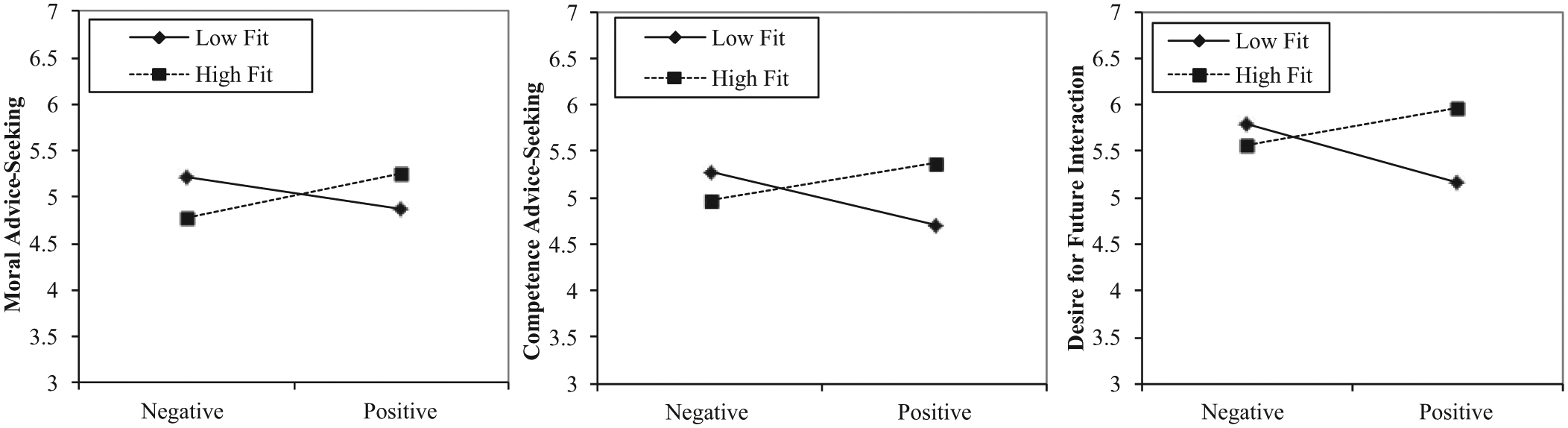
Perceived fit moderates the effects of contact valence on morality-based advice-seeking, competence-based advice-seeking, and intentions to communicate with older adults in the future. Future interaction intentions are higher when a positive target is seen as having good fit, or a negative target is seen as having poor fit. High-fit-negative and poor-fit-positive targets reduce future interaction intentions. No significant moderating effect occurred for the third measure of advice-seeking (sociability-related advice-seeking).
One alternative explanation for these final results is that people with initially negative attitudes about older people might (a) see positive exemplars as low fit or negative exemplars as high fit and (b) desire less interaction with older adults. Similarly, people with initially positive attitudes about older people might (a) see positive exemplars as high fit or negative exemplars as low fit and (b) desire more interaction with older adults. These patterns would result in patterns fairly similar to our Figure 4 moderator effects. To control for this possibility, we re-ran the analyses controlling for a pretest measure of attitudes about older people. Specifically, in our pretest, respondents were asked “Overall, what is your global impression of elderly people” on a 1 to 7 scale, where high scores indicated a more positive global impression.” They were also asked the same question about young people. We subtracted the rating for young people from the rating for elderly people to yield a global measure of pretest positive attitudes about older adults. Including this in our analyses did not change the substance of the findings, although it did weaken the significance of the effects. Effects for morality advice-seeking and desire for future interaction are reduced to “marginally” significant levels (p < .10); effects for competence and sociability-related advice-seeking are unchanged. Patterns of the simple slopes are unchanged for all variables.
Discussion
We show that the fit of an individual older adult exemplar to the category of older people is influenced by the valence of the exemplar and prior communication experiences with older people. Positive exemplars are more “fitting” of older adults as a group (in the context of the group as a whole being viewed positively), particularly among people with more positive and less negative past contact. We also show that fit moderates the effect of exemplar valence on intentions to communicate with other older people; therefore, ours is the first work we are aware of to simultaneously examine fit as an outcome of contact, and as a moderator of contact’s influence on group perceptions. Either positive or negative contact with an older person can increase the desire to engage in intergenerational interaction: When fit was low, negative imagined contact increased intentions to engage with the outgroup, while positive contact suppressed such plans, a finding that we believe is unprecedented in the literature. We discuss the effects using literatures on intergroup communication and cognitive processing of group-relevant information.
Negative Contact Can Have Positive (and Positive Contact Can Have Negative) Effects
No previous work has demonstrated positive effects of negative contact; our findings show that a negative exemplar who has poor fit with the group is associated with increased future contact intentions. This finding illuminates a striking and novel consequence of the “re-fencing” (subtyping) phenomenon described in the introduction. Subtyping has typically been viewed as a problem—if a positive exemplar is not viewed as typical, then they do not improve the stereotype. We demonstrate a potential upside of this same point: A subtyped negative target might actually improve attitudes. Our effect is consistent with previous demonstrations of “contrast” or “boomerang” effects in the stereotyping literature. As noted in the introduction, when a positive exemplar is dissociated from a group (presented as unrepresentative), perceptions of the group as a whole become more negative (Bless & Schwarz, 1998; Paolini, Crisp, & McIntyre, 2009). When perceptions of the group are dissociated from perceptions of the individual, the group not only “loses” its association with the positive characteristics displayed by the atypical positive exemplar, but it might be assessed more harshly against such an extreme positive reference point and hence be perceived more negatively. We replicate that effect, and show that communicating with an unrepresentative negative exemplar makes communicating with other outgroup members more appealing by contrast, presumably by emphasizing that the (rest of the) group does not possess the unappealing characteristics. This effect is consistent with exemplar-based models of processing, with judgments of groups being generated on-the-fly based on currently salient examples (Smith & Zarate, 1992; see Biernat, Vescio, & Manis, 1998, for discussion of contrast effects). Some work suggests that just the act of making a typicality judgment is sufficient to trigger (or suppress) contrast effects (Bodenhausen, Schwarz, Bless, & Wänke, 1995, Study 3). Birtel and Crisp (2012) do discuss an indirect positive outcome of negative contact, achieved via sequential exposure to first negative and then positive contact. Their work uses conditioning paradigms suggesting that fear structures need to be activated (via negative experience) before they can be “treated.” It is an interesting effect but not a direct positive effect of negative contact as demonstrated in our findings.
Beyond the contrast-effect process described by Bless and Schwarz (1998), there are two intriguing alternative explanations for this effect. First, some of our participants may have imagined negative outgroup exemplars that were nonetheless appealing in some manner (e.g., hilariously grumpy or brash and rude). Older adults who violate stereotypes in an extreme manner are a staple of entertainment television and movies (Harwood & Giles, 1992; Springer, Joyce, & Harwood, 2014), and our respondents might have drawn on such stereotypes in imagining a cantankerous yet engaging older conversation partner. However, manipulation check data suggest that the general evaluations of the conversations were substantially and significantly more negative in the negative condition (d = 1.51, p < .001, for valence condition comparisons on valence of conversation), so this type of response was not widespread in our sample. Second, our negative exemplars might be getting some credit for being “unique individuals” as a result of their perceived atypicality relative to their group. The value placed on individuality in Western culture (Kim & Markus, 1999) suggests that individuals might receive credit for not conforming to stereotypes under certain circumstances; that credit might (ironically) extend to the group as a whole as perceivers become aware that it is possible for members of the group to not conform (Rubin, Paolini, & Crisp, 2013). Our findings are most specifically tied to intentions to communicate with older adults. However, people have complex and ambivalent beliefs about many groups; hence, the findings here are not restricted to older people as the target (Bodenhausen et al., 1995; Fiske et al., 2002).
Positive Valence-Salience Effects
Prior work has suggested that negative valence is associated with greater perceived fit of outgroup members to their groups and higher salience of the group (termed a valence-salience effect). Such findings have been explained by the fit between negative group members and negatively stereotyped group perceptions. However, because of a focus on negative groups, prior work has not been able to distinguish between this explanation and a more general pattern whereby negative valence makes all group memberships more salient (Baumeister et al., 2001); under such an effect, a negative exemplar of a positively perceived group might also be perceived as having greater fit. In this context, our work is theoretically important because it is the first to demonstrate that positively valenced members of positively perceived groups have greater fit, and hence that the match between exemplar valence and general group valence (not mere exemplar valence) determines fit (Coates et al., 2006).
Our work is also unique in tying together past and present, as well as positive and negative contact in examining these effects. Most notably, we show that our positive valence-salience effects are particularly strong for people with low levels of past negative contact and high levels of past positive contact with the outgroup. Hence, while the overall pattern indicates consistency with the general perceptions in our sample (positive equals high fit for older exemplars), this effect is not uniform. A chronic history of negative experiences without counterbalancing positive experiences increases the perceived fit of negative outgroup exemplars and reduces the fit of positive exemplars. Interestingly, this latter effect is more strongly influenced by an absence of positive history rather than the presence of a negative history, suggesting that creating opportunities for joyful intergroup encounters is at least as important as reducing intergroup conflict. Work in the area of marital communication suggests that about five positive communication behaviors are necessary to make up for one negative behavior and that the precise ratio of negative to positive behaviors is critical to predicting the future of a relationship (Gottman & Levenson, 1992). Our work suggests that exploring the positive: negative ratio of intergroup communication histories might provide insight on how people interpret current intergroup contact.
Connections to Imagined Interaction Research
Connections between work on imagined contact (Crisp & Turner, 2009) and imagined interaction (Honeycutt, 2010b) are becoming increasingly clear in the literature, although there is still some way to go. This study demonstrates that features of imagined interaction research (valence) are associated with typical outcomes from imagined interaction research (plans for future interaction), within a study that was developed primarily within the imagined contact paradigm. There are numerous directions to further integrate these two lines of research. Both share a conviction that imagining communication events is a powerful social phenomenon. They also share some specific assumptions: that imagination occurs actively and “consciously” (it is not just random daydreaming), that the richness and development of the imagination matters (Husnu & Crisp, 2010), and that imagined interactions are a means toward managing conflict (by preparing people for real interaction: Honeycutt, 2010b). The key differences in the literatures are the level of analysis (interpersonal vs. intergroup), the focus on content versus effects of imagined communication, and the nature of the partner (a known real person in imagined interaction research, an unknown mentally constructed stranger in imagined contact). Further attention to these differences and similarities and consideration of how to integrate these two literatures is warranted. To provide one example, Honeycutt and colleagues have developed strong tools for understanding why people spontaneously engage in imagined interaction. Imagined contact work is exclusively based on experimental manipulations. Understanding why people might spontaneously engage in imagined intergroup interactions would complement the current imagined contact literature, helping us understand the practical applicability of imagined contact as a prejudice-reduction intervention.
Connections to Aging Research
Most notably in terms of work on aging, our data show unusually positive perceptions of older people on the competence dimension. This might signal a shift in younger people’s perceptions of older adults: Perhaps the current cohort of college students have grandparents who are more active, healthy, and societally involved than the grandparents of college students 20 years ago (reflecting broader cultural changes: Ota et al., 2012), and the grandchildren’s evaluations of older people draw on their grandparents. Or perhaps advocacy for older adults and societal moves against ageism are affecting either younger people’s perceptions of older adults or their willingness to express negative attitudes. It is also plausible that our competence measures (items: intelligent, competent, skillful) triggered a stereotype of older people as “experienced” or “wise”—aspects of competence that are positively associated with age but that have not been the focus of prior research on evaluations of older people. Notably, reliabilities for our competence measures were lower than our sociability or morality measures, perhaps suggesting that perceptions of “intelligence” (wisdom) do not mesh well with perceptions of how generally “competent” older adults are. Possibly, previous work has focused on competence with regard to specific “test-like” tasks, whereas our study focused on conversation, a task for which wisdom and experience are more important than technical expertise or cognitive speed. Meta-analytic data show that negative competence-related perceptions of older adults persisted at least into the late 1990s but that the degree of that negativity was declining over time (Kite et al., 2005, p. 254). Longitudinal work, work on implicit attitudes, and cross-cultural work might clarify whether ageism is really declining.
In this context, it is perhaps also worth noting that exploratory examinations of whether moderation occurred using specific trait-based dimensions of descriptive fit or particular trait-related outcomes did not yield any reliable pattern in our data. Our moderating effects of fit related generally to valence rather than to particular stereotype-related traits, and in general, our results show many more, and larger, effects for overall valence than for specific traits. It is possible that in imagining an initial conversation with a stranger, the overall valence (good-bad) simply overwhelms more specific information about traits. It is also possible that our participants were, for whatever reason, insensitive to differences between trait dimensions, which might explain the rather homogenous evaluations across trait evaluations of older adults more generally. Related, we found little evidence of substantial differences between the sociability and morality subdimensions of warmth evaluations across our dataset, and hence these are discussed together for the most part.
Our work contributes to the literature on intergroup communication by addressing issues of past, present, and future intergroup contact in a single study, by demonstrating valence-salience effects relating to a positively perceived outgroup, and by demonstrating that positive and negative contact interventions can have counterintuitive effects on intentions for future communication, depending on the outgroup partner’s fit to their group. In so doing, we place some boundary conditions to the wide applicability and unconditional safety of imagined contact interventions to improve intergroup relations. These data suggest that there are limits to its applicability and that, just like face-to-face communication, even positive imagined communication does not come without risk. As noted at the outset, our broadest goal is to understand how communication environments can support or discourage productive intergroup communication and improved intergroup relations. We demonstrate complexities connecting past, present, and future contact, and show that intentions to engage in intergroup communication can be increased by engaging in high-fit positive imagined contact, thus offering pathways to sustainable and self-perpetuating improvements in intergroup relations. We also offer some “tonic” for negative intergroup encounters: To the extent we can work to make participants perceive such encounters as having low fit, their negative consequences should be ameliorated or perhaps even reversed.
Footnotes
Authors’ Note
Data and materials from the study are available from the primary author.
Declaration of Conflicting Interests
The authors declared no potential conflicts of interest with respect to the research, authorship, and/or publication of this article.
Funding
The authors disclosed receipt of the following financial support for the research, authorship, and/or publication of this article: This research was supported by an Australian Research Council grant (DP0770704).