




Abstract
The objective of this article is to improve the understanding of mood and judgment effects evoked by major televised sport events like national football matches. According to disposition theory of sport spectatorship, viewers’ affective experiences, specifically their moods, are assumed to be affected by the outcomes of the matches they watch. This study tests whether these mood effects depend on viewers’ team identification as well as viewers’ sex. Moreover, past research has indicated that mood changes as effects of sport viewing could influence viewers’ subsequent judgments in line with feeling-as-information theory. Based on this line of arguments, a quasi-experimental pre-post-test study with 180 participants was conducted to assess the moods and judgments (self-confidence, evaluation of the economic situation, government satisfaction) of viewers before and after a win and a defeat of the German national football team during the 2011 women’s FIFA World Cup. The results support disposition theory of sport spectatorship as well as feeling-as-information theory and give new insights into the moderating role of team identification and sex.
Past research has shown that viewers’ emotions and moods are particularly susceptible to the influence of televised sports. According to Raney (2006), sports programs are highly likely to affect viewers’ feelings both during and after reception, as most spectators attend to sports television primarily to gain emotional rewards. Interestingly, the viewing of televised sports affects not only viewers’ moods but also their judgments regarding unrelated issues, as people often draw on current mood states when making decisions and judgments (Schwarz, 2011). For instance, past research has shown that in watching televised sports, the outcome of the event and the ensuing moods that result from the outcome can influence viewers’ judgments regarding self-esteem (Hirt, Zillmann, Erickson, & Kennedy, 1992), their political assessments (Schweitzer, Zillmann, Weaver, & Luttrell, 1992), and economic decisions, such as their trading behavior on stock markets (Edmans, García, & Norli, 2007).
The low level of television coverage dedicated to women’s sports has been repeatedly noted in previous research studies (e.g., Messner, Duncan, & Willms, 2006; Tuggle, 1997). However, this low level of coverage seems to be shifting, as events such as the women’s FIFA World Cup football tournament are increasingly receiving attention from the media. For instance, the entire 1999 women’s FIFA World Cup tournament was broadcast on U.S. national television, and the tournament “dominated much of the sports media coverage for June and July of 1999” (Christopherson, Janning, & McConnell, 2002, p. 171); over 40 million U.S. citizens watched the final match between the United States and China (Longman, 1999). Similarly, the entire women’s FIFA World Cup tournament in Germany in 2011 was broadcast on German national television, and the games appeared to attract as much national attention; more than half of the German population followed at least one match on television, and the matches played by the German women’s team were viewed by up to 17 million people (Dahms-Kießling, Gutweiler, & Schneider, 2011). Considering that up to 17 million television viewers per match were possibly influenced by the women’s 2011 FIFA World Cup results, the importance of such games to the moods and judgments of viewers is of obvious relevance to media psychological studies. Hence, this study aims at investigating effects of women’s football broadcastings on viewers’ mood and judgments as well as specifying boundary conditions regarding the assumed effects.
Televised Sports and Viewers’ Feelings
Viewers of televised sports often turn to television in their search for emotional rewards (Raney, 2006). For instance, a national survey conducted prior to the 2011 FIFA World Cup found that already a quarter of the German population was in an elated mood before the event had even begun, simply due to their anticipation of the event (Allianz, 2011); this sort of pre-game disposition renders emotional effects during the actual tournament even more likely. In considering the situation of single matches, on average, about only one half of the spectators will be positively affected by the outcome of a match, whereas the other half will be negatively affected by the outcome. This is due to the fact that wins and defeats are inherently rooted in the competitive nature of sport events, which precisely accounts for the events’ emotional appeal (Wann, 2006). The disposition theory of sport spectatorship of Zillmann, Bryant, and Sapolsky (1989) provides a good foundation from which to understand these feelings elicited by sports outcomes. According to disposition theory, defeats can be understood in terms of a loss of value and wins in terms of a gain of value, whereas loss and gain of value can be understood here as failing or succeeding in the eyes of the respective viewers. Depending on whether (1) the loss of value is inflicted upon “enemies” and the gain of value is obtained by “friends,” or whether (2) the gain of value is obtained by “enemies” and the loss of value is inflicted upon “friends,” viewers respond in terms of either appreciation or sorrow, respectively. “Ultimately, the enjoyment of viewing a sporting event is a function of the outcome of the game in relation to the strength and valence of the disposition held toward the competitors” (Raney, 2006, p. 316). Hence, viewing televised football matches will leave a spectator in a most positive mood if his or her strongly favored team wins. In contrast, a spectator will experience the least enjoyment (i.e., greatest disappointment) if his or her strongly favored team loses.
Obviously, feelings elicited by viewing televised sports do not only depend on the valence but also depend on the strength of the relationships that viewers maintain with teams. Accordingly, this moderating role of team identification has been demonstrated in a couple of studies (see Wann, 2006, for a summary). For instance, Wann, Dolan, McGeorge, and Allison (1994) were able to show that highly identifying sport spectators reported an increase in positive emotions after watching a win, whereas low identifying viewers showed almost no emotional change. The same pattern was found after watching a defeat, whereas in this case, the negative emotions increased for highly identifying viewers. These effects can be explained by social identity theory (Tajfel & Turner, 1979) because highly identifying sports fans view their team as being part of their social identity and therefore take a defeat of their team as a personal defeat and a win of their team as a personal victory resulting in respective mood (Bryant & Cummins, 2009). If a spectator is indifferent toward, or has no affinity with, the teams involved in a match, then flat or no affective reactions are expected to occur because teams are unrelated to one’s identity and their performance is therefore irrelevant to one’s feelings.
Albeit hardly considered in past research, we assume spectators’ sex to be additionally moderating the effect of sport outcomes on spectators’ mood. This seems very likely as previous research highlighted sex as a consequential variable for the enjoyment of televised sports. For instance, male viewers express greater enjoyment for sports showing immediate combat, whereas “women are more gratified when seeing competition that avoids overt aggressiveness and highlights the stylish movement of individual bodies in terms of beauty” (Sargent, Zillmann, & Weaver, 1998, p. 46). These findings were discovered in a study by Sargent and colleagues (1998) investigating sex differences in terms of sports enjoyment. Asking participants about their perceptions of 25 different sports (e.g., level of violence or elegance), the authors were subsequently able to cluster these in 3 fundamental sport types. The final set was made up of combative, stylistic, and mechanized sports. Football, in the sense of soccer, was grouped as one of the combative sports. “Combative sports feature confrontations in which one party wins at the expense of an opposing party” (Sargent et al., 1998, p. 52). Compared with female viewers, male viewers expressed significantly more enjoyment for these kinds of sports, whereas it was the other way around when it came to stylistic sports. The authors attribute this result to the fact that males are more attracted by close and combative competition, whereas females are more fascinated by graceful and aesthetically pleasing sports, both due to corresponding play and activity preferences developed throughout their childhood and adolescence. Sargent and colleagues argued that boys engage more in aggressive play activities characterized by stalking, chasing, and fighting, whereas girls engage more in nurturant play or creative activities leading to corresponding sport preferences in adolescence and adulthood.
Looking at a study by Bryant, Comisky, and Zillmann (1981), comparable results were obtained. According to their findings, the more men enjoy watching sports, the greater the degree of apparent roughness; however, no such effects appear regarding women. The authors explain this greater enjoyment of rough or combative sports similarly by the fact that “rough and aggressive play is seen to stand for human conflict at its peak, and intense conflict is the heart and soul of high drama” (Bryant et al., 1981, p. 257), which eventually entertains (male) viewers (Peterson & Raney, 2008). Although Bryant and colleagues conducted their study with respect to American football, results can very likely be transferred to European football (soccer) because experts as well as viewers perceive European football at least in some respect as a similar aggressive and combative sport (Jewell, Moti, & Coates, 2011; McDaniel, 2003; Parry, 1998; Schramm & Klimmt, 2003). Important to note, this applies to male as well as female football (Christopherson et al., 2002; Shugart, 2003). Summing up, men when compared with women are apparently more attracted to sport because of its combative and competitive nature, that is, essentially, watching a party winning at the expense of an opposing party (see also Gantz & Wenner, 1991; Raney & Depalma, 2006).
Despite these sex differences in enjoyment of combat and competition in sports as well as the knowledge that mood effects eventually depend on competitions and their outcome, studies dealing with mood effects of televised sports hardly integrated sex in their research. Moreover, some studies even excluded sex difference investigating solely male-only samples (e.g., Bizman & Yinon, 2002; Hirt et al., 1992, Study 2; Schwarz, Strack, Kommer, & Wagner, 1987). However, there is one study integrating sex revealing promising results, though not explicitly investigating the effect of sex on mood. Asking television viewers of a college football match about their enjoyment, Schweitzer and colleagues (1992) were able to show that fans of the winning team reported greater enjoyment compared with those of the defeated team, whereas there were no differences in terms of sex. However, a sex difference emerged when specifically asking participants for their rating of enjoyment of the decisive second half. Results show that sex significantly interacted with being either a fan of the winning or losing team, that is, compared with women, men rated their enjoyment higher when being a fan of the winning team and rated their enjoyment lower when being related to the defeated team. Obviously, male viewers are more affected in their enjoyment when it comes to the final competition and the results of a match, in this case the more decisive second half (see also Gan, Tuggle, Mitrook, Coussement, & Zillmann, 1997, for similar reasoning). Summing up, we assume mood effects of televised football to be dependent on the respective competition outcome, identification with athletes or teams, and spectators’ sex, that is, males will be more affected by game outcomes than females.
Feelings and Judgments
Although research on the effects of the outcome of a women’s FIFA World Cup on viewers’ mood already seems warranted, given that up to 17 million viewers might be affected by such matches, the research would be deemed even more worthy if we consider the influence of viewers’ moods on their subsequent judgments. For instance, Schweitzer and colleagues (1992) compared mood variations and resulting differences in estimations of the likelihood of war (in the period leading up to the Gulf War) in the fans of two American college football teams. The fans were questioned after watching a televised competition between the two teams. Results showed that the reported mood states of fans of the winning team were higher than those of the fans of the losing team, which is in agreement with the disposition theory of sports spectatorship; in addition, fans of the winning team estimated the likelihood of war to be less than did fans of the defeated team. Similarly, Schwarz and colleagues (1987) investigated mood effects and subsequent consequences among German sports viewers during the 1982 FIFA World Cup. In this study, German residents were telephoned immediately before or after two games involving the German national team, who were victorious in one of the games and who drew the other. The results showed a significant difference between pre- and post-game measurements of mood as related to game outcome; that is, viewers who watched the victory reported higher post-game ratings of global well-being as compared with viewers who were interviewed prior to the game, whereas those who watched the draw reported lower ratings of global well-being after the match as compared with those interviewed prior to the game.
According to the feeling-as-information approach (Schwarz, 2011), different levels of post-game estimation can be attributed to different levels of post-game mood, as people frequently draw upon their feelings when making judgments. This is especially likely if an evaluative task is complex as well as demanding, in which case feelings then function as mental simplifications or shortcuts. Thus, instead of investing effort and time to solving a task, people often refer to their temporary feelings by asking themselves how they feel about the object being judged (Schwarz & Clore, 1988). As feelings may be evoked by various causes that may be difficult to identify or distinguish, people may be influenced by feelings that were not originally evoked by the object being assessed.
Because we have only one window on our experience, it is difficult to distinguish integral feelings, elicited by the target, from incidental feelings that happen to be present at the time. Hence, we may mistake incidental feelings, like a preexisting mood, as part of our reaction to the target. This results in judgments that are congruent with the implications of our feelings [even if the feelings were not originally directed toward the judged object]. (Schwarz & Clore, 2007, p. 386)
It is important to note that conscious attribution of feelings toward a given object does not necessarily occur during the judging process. Instead, the process is better understood as automatic, in that people usually reference their feelings to whatever is currently in the focus of their attention, and thereby defer to them as an automatic default option (Schwarz, 2011).
Following this reasoning, it seems highly likely that the judgments of television viewers of women’s football matches are influenced by the outcomes of the matches, as the outcomes affect their moods. As compared with emotions, which are always caused by a specific referent (e.g., anger caused by a foul committed by the opposing team), moods are diffuse affective experiences that lack a specific referent (Schwarz & Clore, 2007). As a result, responses influenced by moods can often be unrelated to the mood-precipitating event; that is, moods can influence a wide variety of cognitive, affective, and behavioral responses (Morris, 1989). Moods are particularly likely to influence decisions or estimations when demanding judgmental tasks are at hand, especially in those who lack processing capacity and/or motivation (Schwarz, 2011). Evaluating one’s own overall personal situation could result in just such a judging task, as people often do not deeply investigate their lives when asked about their personal situations. Accordingly, viewers reported higher levels of self-esteem (Hirt et al., 1992) and higher levels of global well-being (Schwarz et al., 1987) after watching a favorite sports team win, as compared with the situation of watching a loss. It is important to note that people only tend to draw their judgments from feelings if the perceived value of the feeling is not questioned and is attributed to some other irrelevant cause (e.g., the weather; see Schwarz & Clore, 1983). In addition, the feelings must be perceived as relevant to the matter at hand (Raghunathan & Pham, 1999). Interestingly, moods evoked by sport competitions can still influence the estimation of unrelated and impersonal matters, such as the likelihood of war (Schweitzer et al., 1992). Evidence from economics as well as political science additionally suggests that outcomes of football matches might influence economic or political evaluations. For instance, Edmans et al. (2007) were able to show that losses by national football teams were followed by strong negative responses on the stock market on the following day. The authors assumed that changes in the moods of investors caused these reactions (also see Chang, Chen, Chou, & Lin, 2012). Similarly, Zeh and Müller-Klier (2004) suggested that outcomes of important football matches can influence viewers’ political judgments, especially with regard to decisions about elections. The authors assume that current governing parties will benefit from the wins of national teams, as the uplifted moods of viewers can result in positive assessments of the current national situation or the efforts of the governing party. Not surprisingly, politicians often make appearances at major football events, both men’s and women’s. Although such associations of political or economic evaluations and successful sport events seem highly plausible, they have only been linked to each other on aggregated levels. Hence, whether viewers’ mood affected by outcomes of sport events actually influences this kind of estimations has yet to be tested.
Hypotheses
Given the preceding review of past research findings, it is proposed on the basis of the disposition theory of sport spectatorship (Zillmann et al., 1989) that watching a women’s FIFA World Cup on television will affect viewers’ moods depending on whether or not the favored team is victorious or defeated.
The disposition theory of sport spectatorship predicts that post-game moods are influenced not only by the valence but also by the strength of the relationship developed between viewers and their favored teams. Various studies have supported this moderating role of team identification on the mood variations that result from the outcomes of matches (Wann, 2006). As outlined above, we assume this relationship to be additionally dependent on viewers’ sex predicting a three-way interaction between game outcome, team identification, and viewers’ sex.
Following the feelings-as-information theory (Schwarz, 2011; Schwarz & Clore, 1983), it is further assumed that mood changes due to game outcomes influence viewers’ judgments and estimations. Specifically, we hypothesize that moods that result from the outcomes of games will influence viewers’ (1) self-confidence, (2) estimations of current economic situations, and (3) estimations of government satisfaction.
Method
Study Design
This study generally follows the research design of Schwarz and colleagues (1987), as their study was also conducted in the context of a FIFA World Cup and their design produced useful results. A quasi-experimental pre-post-test between-subjects design was employed, using one victory and one defeat of the German national team during the 2011 FIFA World Cup as experimental conditions. The victory occurred during the second game of the preliminaries, in which Germany won 1–0 in a match against Nigeria; the defeat occurred in the quarterfinals, in which Germany lost 0–1 to Japan in overtime. As outlined above, we attribute the sex difference to the fact that males are more attracted by the combative and competitive nature as well as the final results of sports. Starting from that premise, we deliberately chose football as a combative sport (see Sargent et al., 1998). In addition, we deliberately chose World Cup matches instead of normal league games as experimental manipulation. Looking at World Cups, there is a lot more at stake for players as well as viewers ensuring strong competition among the opposing parties. As a result, the assumed sex differences in terms of enjoyment and mood effects of competitive sports should be facilitated and more pronounced given this specific content. Furthermore, being by far the most popular sport in Germany (Institut für Demoskopie Allensbach, 2015), the tremendous importance of the World Cup was continuously broadcasted by the media before and throughout the event. Needless to say, German viewers expected a lot of their national team enforced by respective media campaigns and the fact that the championship took place in their home country (Dahms-Kießling et al., 2011).
Participants were asked to complete an online questionnaire. The online interface facilitated the collection of a large number of samples so as to fulfill the sampling requirements of the four experimental conditions; the interface also provided full anonymity of the participants (Birnbaum, 2004). The research setting was realistic in the sense that participants did not view the games in a laboratory setting, but rather the viewing was voluntary and occurred in the participants’ homes. Participants completed the survey within either 3 days prior to or 3 days subsequent to one of the games to ensure measuring mood effects and effects on estimations as longer lasting effects. Previous studies have measured the effects of game outcomes almost immediately after the viewing of an event (e.g., Hirt et al., 1992; Schwarz et al., 1987) enabling only short-term propositions, which contradict at least partially the assumed nature of moods that are generally expected to be longer lasting (Schwarz & Clore, 2007). Our data showed that during the 3-day intervals, participants completed the survey with roughly the same frequency on each of the 3 days of any given 3-day interval, that is, effects were measured averagely 1½ days before and 1½ days after the match.
Participants
Participants were recruited via the website of a major German television network, which was one of two networks broadcasting the matches. During the period of the tournament, the television network posted the link, leading to the online survey, in its news section. A total of 201 television viewers of the World Cup took part in the study. However, 21 participants were excluded from the analysis as they indicated a team different from Germany to be their favorite team. We introduced this criterion to ensure that participants were actually watching their favorite team win when watching the German win against Nigeria and watching their favorite team lose when watching the German lose to Japan. The remaining 180 participants all met this condition. Consequently, possible effects can be attributed to the fact that viewers were indeed either watching their favorite team win or lose.
With respect to sex, 42% of the 180 participants were female and 58% were male. With regard to the age distribution, 29% of the participants were 29 years old or younger, 28% were 30 to 49 years old, 28% were 50 to 64 years old, and 14% were 65 years old or older. A national, representative survey of the actual TV audience of the World Cup (Dahms-Kießling et al., 2011) provided a measure of the external validity of the sample. According to the survey, the actual audience was 41% female and 59% male; with regard to the age distribution, 12% of viewers were 14 to 29 years old, 30% were 30 to 49 years old, 27% were 50 to 64 years old, and 30% were 65 years old or older. Regarding sex composition, our participant sample was comparable with the actual distribution of the TV audience, differing by only 1%. Regarding the age distributions, the participant sample was slightly younger than the actual population, whereas the percentages of participants in the 30- to 49- and 50- to 64-year-old age brackets were nearly equal to that of the actual age distribution.
Table 1 summarizes the sample and gives an overview of how sex, age, and team identification are distributed among the four investigated groups. Although groups are occasionally somewhat differing in terms of sex, age, or team identification, none of these differences appeared to be significant when calculating ANOVA or a chi-square test, respectively (sex: χ2(3) = 4.44, ns; age: F(3, 161) = 1.89, ns; team identification: F(3, 161) = 1.63, ns). Consequently, sex, age, and team identification can be said to be roughly equally distributed among the four groups as intended.
Distribution of Sex, Age, and Team Identification Among the Sample and Its Four Sub-Groups.

Measurements
Mood was measured using three items; two of the items referred to participants’ moods at the time the questionnaire was completed (these items were adapted from Hirt & colleagues, 1992), and the third item referred to participants’ moods during the previous 1 or 2 days, accounting for mood as a longer term affective experience (Schwarz & Clore, 2007). The items were as follows: “On the whole I presently feel being in a good mood,” “I think I am a happy person,” and “I personally was in a very good mood during the past 1 to 2 days.” All items were measured on the same 5-point scale ranging from “This is in no way true” to “This is absolutely true.” The reliability of the data was satisfactory, with a Cronbach’s alpha of .87 (M = 3.66, SD = 0.91).
Self-confidence was measured by two items on the same established 5-point scale. The items were as follows: “I feel very confident about my personal future” and “I currently feel highly self-confident.” As the measurement consisted of only two items, split-half reliability rather than Cronbach’s alpha was used to assess reliability (Hulin, 2001). The Spearman-Brown coefficient yielded a satisfactory reliability of .74 (M = 3.38, SD = 0.88).
Evaluation of the economic situation was originally intended to be measured by two combined items. The first item considered participants’ estimations of their country’s economic situation, and the second item considered their estimations of their personal economic situations. The items were as follows: “I assess the economic situation of our country as positive” and “I generally assess my own economic situation as very positive.” However, a low Spearman-Brown coefficient of .47 (M = 3.16, SD = 0.84) indicated that the two items actually measured different constructs. Consequently, both items were treated as single items measuring the estimation of one’s country’s economic situation and the estimation of one’s personal economic situation, separately.
The satisfaction of participants with their government was measured using two items. The items were as follows: “I am pleased with the present government of our country” and “I think that our politicians are currently doing their job well.” Again, participants indicated their approval level on the established 5-point scale. The reliability of the data was good, with a Spearman-Brown coefficient of .90 (M = 1.89, SD = 0.86).
The measurement of team identification was based on two items proposed by Schramm and Klimmt (2003), which effectively assessed the team identification of supporters of the German national team during the 2002 FIFA World Cup. The established 5-point scale was applied. The items were as follows: “I watch the games because I am proud when my favorite team wins” and “I watch the games to keep my fingers crossed for my favorite team.” The reliability of the data was good, with a Spearman-Brown coefficient of .81 (M = 4.05, SD = 1.22). 1
Results
H1 predicted that viewers’ mood should improve after watching a women’s football event if the viewers’ favored team won the match (H1a), whereas the opposite was expected if the viewers’ favored team lost (H1b). Following Schwarz and colleagues (1987), a two-way ANOVA was performed to test the predictions of this hypothesis. In the ANOVA, the time of the measurement (before or after the game) and the game outcome (win or loss) were independent variables, and the viewer’s mood was a dependent variable. Because an increase in mood was expected only after having watched a win, and a decrease in mood was expected only after having watched a loss, an interaction was expected between the two independent variables (Time of measurement × Outcome of the game); this expectation was observed in the results of the analysis, which showed a significant interaction between measurement time and game outcome (F(1, 176) = 3.21, p ≤ .05,
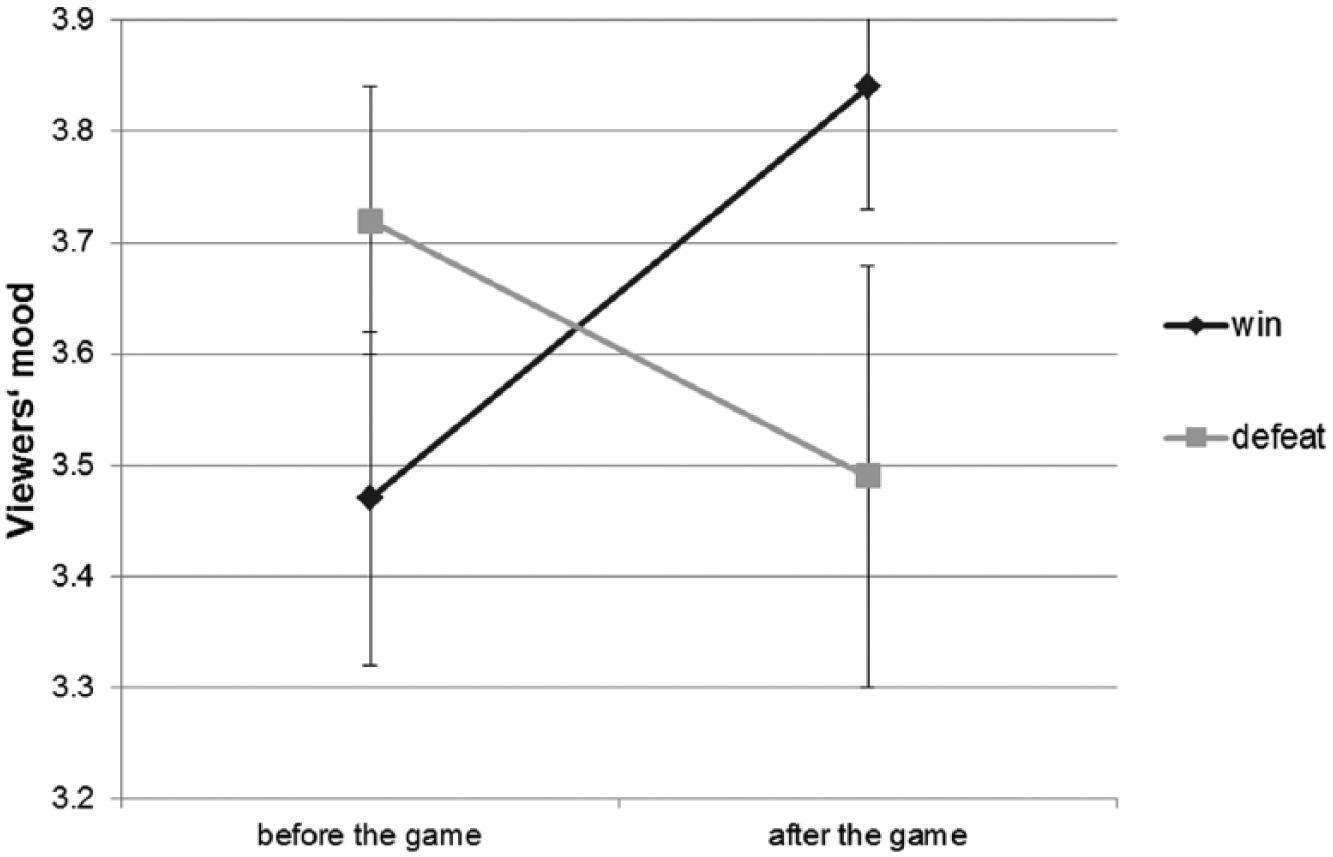
Effect of game outcome and measurement time on viewers’ moods.
H2 assumed the influence of game outcome on viewers (H1) to be moderated by viewers’ identifications with teams and their sex predicting a three-way interaction. As game outcome only had a significant effect on viewers’ moods after having watched a win (see above), the remaining analyses focus only on this event. As one of the moderators (team identification) was measured as a continuous variable and the other was measured as a categorical variable, ordinary least squares (OLS) regression analysis was applied accounting for the full variance of both moderators (West, Aiken, & Krull, 1996; sex was coded 0 for women and 1 for men). Specifically, the SPSS macro Process (Hayes, 2012) was used as it not only offers basic regression results but also provides an appropriate method for probing interactions in linear models, the so-called pick-a-point approach (Hayes & Matthes, 2009). “This approach involves selecting representative values (e.g., high, moderate, and low) of the moderator variable and then estimating the effect of the focal predictor at those values” (Hayes & Matthes, 2009, p. 924) and testing its significance. As shown in Table 2(A), regression analysis revealed the predicted three-way interaction of watching a win or not, team identification, and sex at p < .05. Furthermore, Table 3 shows the results from calculating the moderation following the pick-a-point approach. Specifically, the influence of game outcome on viewers’ mood was estimated at different levels of the two moderators, that is, male or female in the case of sex, and in the case of team identification, its mean as well as one standard deviation below and above the mean representing moderate, low, and high levels of team identification (see also Hayes & Matthes, 2009). As already indicated by the significant three-way interaction, only moderately and highly identifying men were significantly affected by watching their favored team win, whereas women and low identifying men did not show significant changes in mood after watching the German team win. Looking at effect sizes, moderately identifying men reported their mood to be increasing by 0.48 points on a 5-point scale, whereas the mood of highly identifying men increased by 0.73 points. Hence, H2 was supported.
Regression Results for Testing the Indirect Effect of Watching a Win on Viewers’ Estimations (B-E) via Viewers’ Mood (A; n = 105).

Conditional Effect of Watching a Win on Viewers’ Mood at Levels of the Two Moderators: Sex and Team Identification (n = 105).
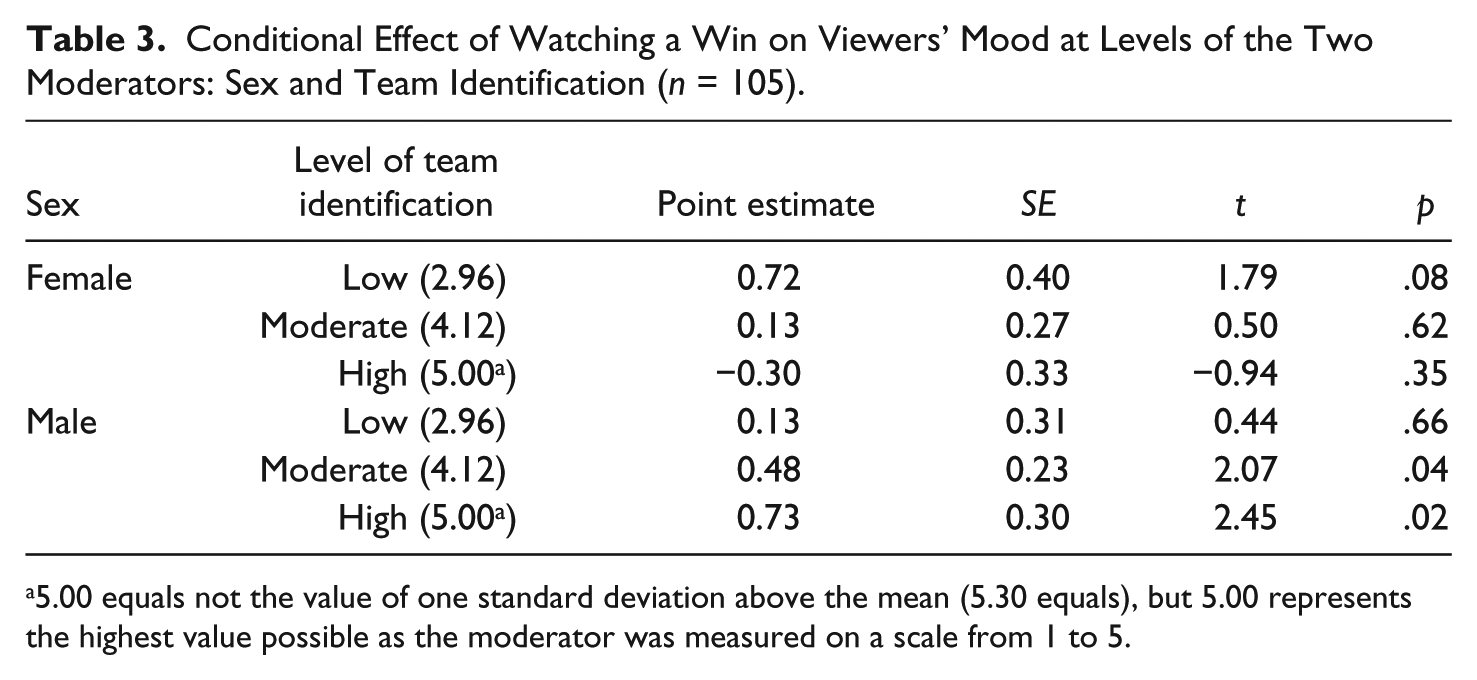
5.00 equals not the value of one standard deviation above the mean (5.30 equals), but 5.00 represents the highest value possible as the moderator was measured on a scale from 1 to 5.
H3 assumed that the outcome of a win or loss of a favored team would affect television viewers’ levels of self-confidence, their estimates of the current economic situation, and their satisfaction with government. Specifically, viewers’ moods, which were affected by game outcome (according to H1), were expected to mediate the relationship between game outcome and viewers’ estimations of self-confidence, the economic situation, and their satisfaction with government (H3a-H3c). Given that the “first stage” of the assumed mediation is moderated by team identification and sex (H2), the whole indirect effect of watching a win on viewers’ estimations will be moderated (Edwards & Lambert, 2007). Testing this moderated mediation (Hayes, 2013a), bootstrapping analyses were applied using the same SPSS macro “Process” as before. In terms of mediation analysis, Process follows a path analytic framework resembling the mediation analysis approach proposed by Edwards and Lambert (2007). Path coefficients are estimated using OLS regression, and mediation can be tested using bootstrapping analysis following current mediation-testing practice (Preacher & Hayes, 2004; Preacher, Rucker, & Hayes, 2007). Bootstrapping analysis involves computing a confidence interval around the assumed indirect effect, in our case, the 95% confidence level. If the confidence interval does not contain the value of zero, then the indirect effect is statistically significant at p < .05 (two-tailed). All analyses and bootstrap estimates that follow are based on 5,000 bootstrap samples with bias-corrected confidence intervals. In addition, Process offers the advantage of testing the moderated mediation in one single model (Hayes, 2013b: Model 11). Specifically, the indirect effects of watching a win on viewers’ estimations as well as their significance were calculated at different levels of the assumed moderators’ team identification and sex comparable with H2.
Looking at the results from regression analyses (see Table 2 and Figure 2), viewers’ mood, significantly affected by game outcome (Table 2, A), itself significantly predicted viewers’ estimation of self-confidence as well as the estimation of one’s own economic situation (Table 2, B and C). In addition, there was an almost significant effect of viewers’ mood on government satisfaction (Table 2, E), whereby the evaluation of one’s country’s economic situation was not significantly affected (Table 2, D). Furthermore, there were no significant direct effects of watching a win on any of the viewers’ estimations. Thus, results from regression analysis already indicate indirect effects as the assumed mediator was significantly influenced by the independent variable, whereas the mediator in turn influenced three of the four estimations. Final support of the assumed moderated mediation can be obtained from Table 4 showing the confidence intervals calculated from bootstrapping analyses. Specifically, only moderately and highly identifying male viewers appeared to be significantly affected in their self-confidence, their estimation of their own economic estimation, and their government satisfaction because only those intervals were entirely above zero indicating significant indirect effects. In terms of effect sizes, highly identifying men rated there self-confidence about .41 points higher on a 5-point scale, estimated their economic situation to be better by .29 points, and were more satisfied with their government by .12 points after watching their favored team win. Effect sizes were, respectively, lower for moderately identifying men. In contrast, low identifying male viewers as well as female viewers in general were not significantly influenced in terms of any of the estimations as the confidence intervals for all measures included zero. Furthermore, there were no indirect effects for any of the participants regarding the estimation of one’s country’s economic situation as already indicated above by the non-significant effect of viewers’ mood on this kind of estimation (see Table 2, E). In summary, there was a conditional effect of team identification and sex on the mediation process as viewers of the football matches appeared to be only indirectly influenced by game outcome via mood if they were highly or moderately identifying men. Thus, H3 was supported for highly or moderately identifying men.
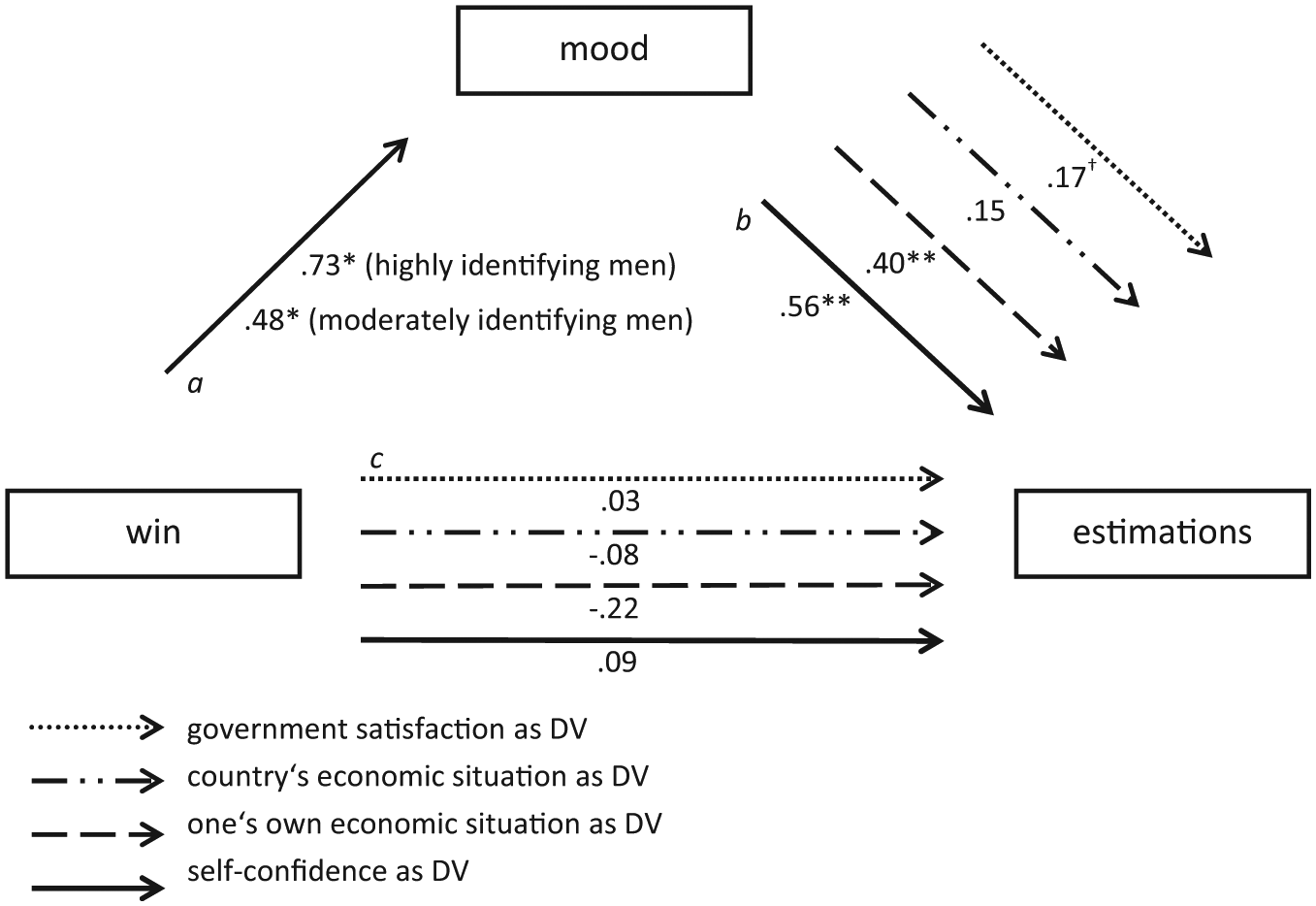
Indirect effect of watching a win on viewers’ estimations via viewers’ mood.
Conditional Indirect Effect of Watching a Win on Viewers’ Estimations at Levels of the Two Moderators: Sex and Team Identification (n = 105).

Note. CI = confidence interval.
5.00 equals not the value of one standard deviation above the mean (5.30 equals), but 5.00 represents the highest value possible as the moderator was measured on a scale from 1 to 5.
An additional analysis was performed investigating whether the effects on viewers’ mood after watching the win would gradually wear out within the observed 3-day interval. If this was the case, viewers’ mood should be negatively correlated to the time having been passed (measured in hours) between the end of the match and viewers’ participation in the survey, that is, the more may be as identifying with time that had passed, the lower viewers’ mood. Pearson’s correlation was solely calculated for male viewers (n = 27), as these were the only ones significantly affected in their mood after the win. Results show almost zero correlation (r = −.07, ns), indicating that male viewers’ mood neither increased nor decreased over time in the 3-day period after the win. Consequently, effects can be said to have been constantly prevailing at least up to 3 days after the match.
Discussion
Mood Effects and Their Boundary Conditions
The objective of the present study was to improve the understanding of mood effects evoked by televised football matches. As most spectators watch sports television to become emotionally involved (Raney, 2006), viewers’ affective experiences, specifically their moods, were assumed to be influenced by the outcomes of the matches that they watched. In line with the disposition theory of sport spectatorship (Zillmann et al., 1989), television viewers showed enhanced moods after watching their favored team win, whereas the opposite was true after watching their favored team lose. Although only the increase in mood after a victory was significant (the decrease in mood after a defeat was not significant), both affective reactions support the disposition theory of sport spectatorship (Zillmann et al., 1989).
Obviously, you would expect the fact that Germany lost the second game in overtime to reinforce effects as such a situation is experienced much more dramatically by the viewers (Zillmann et al., 1989). However, we ascribe the missing reinforcement and missing effect to the fact that we most likely were not able to survey the viewers most affected by the loss. These viewers were probably least motivated to take part in a voluntary survey about the World Cup after having watched their favorite team being kicked out of the tournament. This assumption is further supported by the fact that participants who did take part in the survey were less identifying with the German team as compared with participants taking part before the match or taking part with regard to the first match (cf. Table 1). Hence, highly identifying and thereby potentially highly affected participants did evidently take part in the study to a lesser extent after the loss. Future studies are recommended to apply survey methods that are less dependent on participants’ initial motivation, such as surveys by telephone (Schwarz et al., 1987).
In addition to investigating whether watching football matches can affect viewers’ moods, the second goal of this study was to test whether these effects depend on viewers’ team identification as well as viewers’ sex. Although a range of previous studies, researching mood induction through televised sports, dedicated themselves to the moderating role of team identification (Wann, 2006), viewers’ sex was not paid much attention to, even though sex is well known as a consequential variable for the enjoyment of televised sports (e.g., Bryant et al., 1981). As the emotional process of enjoying televised sports can be seen as closely related to post-game moods, similar effects of sex on viewers’ mood were expected. Specifically, effects of game outcomes on viewers’ mood were expected to be stronger for men than for women because previous studies were able to show comparable effects in terms of enjoyment (Bryant et al., 1981; Gantz & Wenner, 1991; Sargent et al., 1998). As predicted, viewers’ sex exerted, next to team identification, a moderating influence on the mood induction process. Specifically, viewers of the football matches appeared to be only influenced by game outcome in their mood levels if they were highly or moderately identifying men. In the light of these results, being a highly identifying viewer seems to be a necessary but not a sufficient condition when it comes to effects on viewers’ moods. Even though female viewers (M = 4.31, SD = 1.06; t(160, 98) = 2.47, p < .05) were generally more identifying with the national team compared with men (M = 3.86, SD = 1.29), they did not show corresponding mood when watching their team win. Keeping in mind that the present study dealt with mood effects of women’s football broadcastings and men identified significantly lower with the national team, mood effects of televised male sports might even be stronger for highly identifying men.
As outlined above, we attribute the sex difference to the fact that males are more attracted by the competitive nature and final results of sports, resulting in stronger mood effects when it comes to the final results of sports competitions. Although women may be identifying with and cheering for their team, they are less interested in the final outcome of the matches and the ultimate competition that leads to these results (Gan et al., 1997; Schweitzer et al., 1992). These sex differences may eventually vanish when it comes to sports that are less combative and competitive like, for instance, the stylistic or mechanized kinds of sports discovered by Sargent and colleagues (1998). Mood effects may equally appear with respect to male or female viewers or not appear at all. Future research should look into these kinds of sports more deeply or purposefully manipulate the competitive nature of sports broadcastings looking for boundary conditions of the found sex difference.
Summing up, the effect of game outcomes on viewers’ moods is evidently conditional on a certain level of team identification and viewers’ sex. It is important to note that this does not exclude female viewers in principle from being influenced in their mood from sports outcomes. To the contrary, some might be equally strongly related to outcomes of televised sports in their affective experience. Past research was, for instance, able to show that female viewers may be equally attracted by aggressive and combative sports when featuring a certain level of trait aggressiveness (Lefkowitz, Walder, Eron, & Huesmann, 1973). Future research may therefore also investigate whether sex differences originate from certain personality characteristics related to sex.
Effects on Personal and Impersonal Judgments
Next to mere effects on viewers’ mood, the study investigated whether these mood effects transfer to a range of personal as well as impersonal estimations following feeling-as-information theory (Schwarz, 2011; Schwarz & Clore, 2007). As predicted by this approach, viewers experiencing a win of their favored team reported enhanced self-confidence as well as increased estimations of their current economic situations and increased government satisfaction, as compared with measures before the game. As these changes are considered to occur as a consequence of being in a better mood after viewing a win, only moderately and highly identifying men reported the enhanced estimations (see H2). Using bootstrapping analysis, the present study was able to show that these changes in estimations were actually mediated by viewers’ mood, whereby the mediation itself was moderated by team identification and viewers’ sex. This corresponds nicely with the notion of Edwards and Lambert (2007) saying that the whole indirect effect of a variable on another is moderated if the “first stage” (the influence of game outcome on viewers’ mood) is moderated. Moreover, there were no additional direct effects of game outcomes on viewers’ estimations, indicating that viewers’ estimations depend primarily on their current mood instead of being directly inferred from sports events. Looking at different kind of estimations, the effects on government satisfaction and the personal economic situation seem particularly important. Even though previous research was able to link public mood throughout and after major sport events to political attitudes or economic decisions on an aggregated level, they did not test whether such estimations were actually influenced by people’s mood evoked by sport events (Chang et al., 2012; Edmans et al., 2007; Zeh & Müller-Klier, 2004). Looking at the present results, people apparently base political as well as economic judgments to some extent on their current moods being evidently influenced by the outcomes of sport events. Hence, it seems unsurprising that politicians and decision makers would seek to link themselves to such events, hoping to transfer some of the possibly positive mood to the perception of themselves or their issues.
Looking at effect sizes, the strongest effects were obtained regarding viewers’ self-confidence (.41) and estimation of their own economic situation (.29), whereas the effect for government satisfaction was substantially lower (.12), and there was no effect in terms of one’s country’s economic situation. Evidently, judgments about personal matters were more affected by viewers’ mood than judgments about impersonal matters. It is highly likely that viewers’ feelings were less or not sufficiently relevant to these impersonal matters to have an effect. According to Schwarz and Clore (2007), the influence of feelings on judgments partly depends on their perceived relevance. For instance, people are more influenced by their feelings when they make decisions concerning their own preferences than they are when making decisions concerning the preferences of others (Raghunathan & Pham, 1999). Another example is the study by Schwarz and colleagues (1987) showing that post-game moods strongly affect television viewers’ judgments about their personal well-being but to a lesser extent judgments about national issues. Similarly, television viewers of the present study might have considered their current mood as relevant when making estimations of self-confidence or their own economic situations, whereas the feelings were considered less or non-relevant with respect to estimations of more impersonal matters, such as their government satisfaction or the country’s economic situation. In that way, findings are consistent with previous research on feeling-as-information theory revealing that “the impact of feeling increases with their perceived relevance to the judgment at hand” (Schwarz, 2011, p. 296).
The Influences’ Effective Period
Even though effect sizes were rather low—strongly identifying men reported increases of self-confidence of .41 points, improvements of their economic situation of .29 points, and more government satisfaction by .12 points (on a 5-point scale)—the present research was able to account for longer lasting effects. Measurements of moods and estimations obtained within 3 days after the end of a game provide the opportunity to observe viewing effects lasting for up to 72 hours. Although previous studies have measured the effects of game outcomes almost immediately after the viewing of an event (e.g., Hirt et al., 1992; Schwarz et al., 1987), the effective period of influence of televised sports on viewers’ moods and judgments appears to last for at least of the order of days. In addition, even low effect sizes might be relevant when considering the enormous audiences being possibly influenced by a game (more than 17 million German viewers, in the case of the match between German and Nigeria in the 2011 FIFA World Cup).
Limitations
Finally, the present research study is not free of limitations. Participants took part in the survey voluntarily, and they chose the day of their participation; thus, participants were not randomly allocated to different experimental conditions. Because of the participant selection method, measured differences between the groups could have arisen from sources other than the intended win versus loss manipulation. However, it seems rather unlikely that differences might have arisen from other sources, as there were no differences between the groups concerning possibly influential variables such as age, sex, or team identification. In addition, the present results are limited to large sports events, which probably exert a stronger influence on viewers’ moods than, for instance, routine football games in national leagues. Thus, testing whether the effects noted in this study hold true for less momentous sporting events would be worthwhile.
Footnotes
Declaration of Conflicting Interests
The authors declared no potential conflicts of interest with respect to the research, authorship, and/or publication of this article.
Funding
The authors received no financial support for the research, authorship, and/or publication of this article.