



Abstract
The purposes of the current study were (1) to examine the relationship between social networking service (SNS) dependency and local community engagement among Seoul residents, (2) to test the hypothesis that integrated connectedness to a community storytelling network (ICSN) is positively related to local community engagement, and (3) to investigate the moderating role of ICSN between SNS dependency and local community engagement. The current study is theoretically guided by communication infrastructure theory (CIT). We used online survey data collected during summer 2013 from a sample of 890 SNS users between the ages of 19 and 59 who lived in 25 districts in Seoul. We focused on four variables as local community engagement outcomes: neighborhood belonging, two collective efficacy variables (informal social control and social cohesion), and community activity participation. We found that SNS dependency and ICSN were positively associated with all local community engagement variables. We also identified the moderating role of ICSN between SNS dependency and the two collective efficacy variables. In addition, we found that closed SNSs (e.g., KakaoTalk) are more likely to facilitate community engagement than open SNSs (e.g., Facebook or Twitter).
One of the most popular research topics in the early days of the Internet addressed whether this new network technology would promote or reduce local community engagement. Scholars had already noted that social capital at the local community level was in decline in most urban areas in developed countries (Putnam, 1995), and many were suspicious (or even worried) that the Internet could accelerate this trend. Conflicting findings were reported during the mid- to late 1990s (Kraut et al., 1998; Nie & Erbing, 2000). However, the majority of studies conducted since the early 2000s have suggested that the Internet has the potential to function as a facilitator, rather than an inhibitor, of local community engagement (Kavanaugh & Patterson, 2001; Kraut, Kiesler, Boneva, Cummings, & Helgeson, 2002; Wellman et al., 2003). Internet users did not necessarily feel lonely in their neighborhoods: They knew and met more neighbors and were more active in community activities than nonusers (Hampton & Wellman, 2000).
The web environment has changed in significant ways since the Internet was first introduced, especially with the introduction of more interactive and participatory media such as social networking services (SNSs; Benkler, 2006; boyd & Ellison, 2007; Castells, 2009). SNSs have been defined as interactive platforms that make it possible for individual users to present profiles and create and maintain social network ties (e.g., Facebook friends or Twitter followers) to share various types of content (text, pictures, videos, etc.; boyd & Ellison, 2007). One of the recent trends in SNS is the popularity of various closed mobile SNSs (e.g., Avocado, Between, Edmodo, KakaoTalk, LINE, Nextdoor, and Path), which exclusively offer online spaces for group interactions among those who are already connected off-line. As the members of these closed SNSs already have ties with one another, they do not necessarily have to show their profiles or lists of friends. Considering these new trends, we define an SNS more generally as any online platform where individuals use and share content through their social ties (both strong and weak). Today, people talk with others, maintain their social relationships, find news and information, and consume media content (e.g., pictures, music, video clips, stories, and the like) through their preferred SNSs (Hampton, Goulet, Raine, & Purcell, 2011; Y. C. Kim, 2011, 2012).
It is conceivable that individual residents could use SNSs to develop, maintain, and strengthen their local relationships. In fact, SNSs have the potential to provide novel ways to explore, learn, and engage in local relationships and local events by, for example, offering new venues to obtain news and information about local areas, developing new connections to others in local neighborhoods, and sharing stories about local communities. 1 However, at the same time, it is also possible that individuals use SNSs to obtain relationship-based resources and benefits (e.g., various types of social support) easily from people outside their local community, as it becomes easier to make connections with SNSs to anyone from anywhere and exchange different types of resources including social capital. If this is the case, individuals may lose motivation to invest time, money, and effort to engage in their local communities. These two contrasting plausible scenarios motivated us to ask the old community question (Wellman, 1979) again in the context of SNSs: Would SNSs promote or reduce local community engagement?
The purpose of this study was to examine the relationship between SNS use and local community engagement with the guidance of communication infrastructure theory (CIT; Y. C. Kim & Ball-Rokeach, 2006a). CIT proposes that the influence of new media technologies on individual community engagement is moderated by the connections of those individuals to community storytelling resources (Y. C. Kim & Ball-Rokeach, 2006b). In other words, the potential of new media to be a facilitator of community engagement is realized more among individuals who have integrated connections to a special type of network—a community storytelling network—among local storytelling agents (i.e., local community media, community organizations, and other residents) to produce, receive, and share stories about their local communities. Based on this theoretical framework, in addition to testing the direct effect of SNS use on community engagement, we examine the moderating role of individual connectedness to a community storytelling network (ICSN) between SNS use and community engagement. In all of the main analyses conducted in the current study, we will also pay attention to the differences between open and closed SNSs in terms of their effects on community engagement.
SNS Use and Local Community Engagement
SNSs have both centrifugal and centripetal forces as factors in local community engagement. First, SNSs may have a “push effect”: SNS users can turn their interest away from their local communities while still maintaining, diversifying, and strengthening nonlocal relationships and sharing global interests with people outside of their immediate local communities. Even when individuals read and communicate about local matters on SNSs, such interactions may not facilitate off-line interactions and participation within the local community. Communication and actions related to local communities on SNSs may end up as “slacktivism” (Christensen, 2011), or online engagement without real-world connections.
SNSs may also show a “pull effect” as a facilitator of off-line community engagement. According to Gordon and de Souza e Silva (2011), SNSs can foster localism for the following two reasons: (1) local people can increase their conversation opportunities and enjoy easier communication; and (2) SNSs decrease the transaction costs of communication within a community. SNSs and other network media provide online forums that can be used as venues for local storytelling (Hampton & Wellman, 2000; Matei & Ball-Rokeach, 2003). Previous studies using empirical data have shown significant positive relationships between the existence of online neighborhood forums and increases in within-neighborhood communication (Gordon & de Souza e Silva, 2011; Hampton, 2007; Hampton & Wellman, 2000; Kavanaugh, Carroll, Rosson, Zin, & Reese, 2005). In addition, many recent studies found that SNS use has positive impacts on local community engagement (Bakker & Dekker, 2012; Ellison, Steinfield, & Lampe, 2007, 2011; Enjolras, Steen-Johnsen, & Wollebaek, 2013; Gil de Zúñiga, 2012; Hargittai & Sahw, 2013; J.-H. Lin, Peng, Kim, Kim, & LaRose, 2012; Men & Tsai, 2013; Steinfield, Ellison, & Lampe, 2008; Valenzuela, Park, & Kee, 2009). Recent empirical data generally support the hypothesis of SNS use as a facilitator, rather than an inhibitor, of local community engagement.
Social impacts of media technologies are often moderated by conditional factors. Recent media studies that have shown a moderation effect imply that media technologies do not have predetermined effects on users. The ways in which a technology influences its users and the degree to which it does so are often shaped by conditional factors or moderators. For example, Ellison et al. (2007) found that Facebook can have a positive effect on community engagement when either of the two following conditions for users are met: high-level life satisfaction and self-esteem, or using Facebook for social information-seeking. Junco (2012) reported that Facebook use and community engagement are more likely to be positively associated among those using Facebook for a broader (vs. a narrower) range of activities. Stavrositu and Sundar (2012) suggested that individuals using network media such as blogs and social media are likely to gain psychological empowerment only when they have a higher level sense of community. In addition to individual-level characteristics, other studies have considered community-level conditions such as neighborhood-level economic disadvantage. For example, Kavanaugh et al. (2005) found that online communication in disadvantaged areas is not as effective a tool for community engagement as it is in less disadvantaged areas, while Hampton’s (2010) findings contrasted with this, suggesting that the marginal effect of SNSs on collective efficacy and community engagement would be higher in more disadvantaged areas than in less disadvantaged areas.
New Media and Communication Infrastructure
CIT has been developed to explain how community-based communication (or community storytelling) resources function as critical components of local infrastructure for building and maintaining local communities (Ball-Rokeach, Kim, & Matei, 2001; Y. C. Kim & Ball-Rokeach, 2006a). CIT focuses on three key local agents as potential community storytellers: community organizations, community media, and residents. When these local agents actively participate in producing and sharing local stories, they become community storytellers. The network formed among these storytellers in a local context, which CIT refers to as the community storytelling network, is a critical part of the community-level communication infrastructure (Y. C. Kim & Ball-Rokeach, 2006a).
One of the most basic tenets of CIT is that individual residents are more likely to become engaged in local issues and activities when they are connected to the local community storytelling network: That is, one has to be strongly connected to community media, actively participate in community organizations, and frequently talk with others about their neighborhood (Ball-Rokeach et al., 2001). One connection to a community storyteller has to facilitate other connections: That is, there should be an integrated connectedness to a community storytelling network or ICSN. ICSN is defined as the degree to which individuals are connected to a network of integrated opportunities to participate in storytelling about the local community through their connection to each of the three storytelling agents: interpersonal networks among residents, the local media, and community organizations (Y. C. Kim & Ball-Rokeach, 2006a, 2006b). ICSN was measured as a summation of three interaction terms between pairs of the three storytelling connection variables (see the “Method” section for details). Those with high ICSN are more likely to show a higher level sense of belonging, collective efficacy, community engagement (Y. C. Kim & Ball-Rokeach, 2006b), more active civic action after disasters (Y. C. Kim, Ball-Rokeach, Cohen, & Jung, 2002; Y. C. Kim & Kang, 2010), more effective cultural adaptation of migrants to the host society (E. Kim, 2013), and more active community lives of elders (Kang, 2012).
CIT proposes a theory-based view regarding the effects of new media on community engagement. CIT argues that (1) new media technology must be part of the communication infrastructure of a community to function as a facilitator of community involvement (Hampton et al., 2011; Y. C. Kim, Jung, & Ball-Rokeach, 2007; Matei & Ball-Rokeach, 2003); (2) if new media technology does not work as part of the communication infrastructure of a community, it can be a detracting factor (Y. C. Kim, 2012; Matei & Ball-Rokeach, 2001); (3) whether new media technology will be incorporated into the communication infrastructure of local civic engagement depends on the existing quality and strength of the community storytelling network (Chen, Dong, Ball-Rokeach, Parks, & Huang, 2012; Hayden & Ball-Rokeach, 2007; Jung, Kim, Lin, & Cheong, 2005; Katz, Matsaganis, & Ball-Rokeach, 2012); and (4) at the individual level, the use of new media by residents will have positive effects on local community engagement when the residents have high-level ICSN (Jung, Toriumi, & Mizukosh, 2013; Katz, 2010; Y. C. Kim, 2003, 2012; W. Lin, Cheong, Kim, & Jung, 2010). We believe that we can apply these theoretical propositions from CIT to the case of SNS use in the context of urban neighborhoods.
The effects of SNSs on community engagement depend on whether they are well incorporated into an existing storytelling network in a community-level communication infrastructure. CIT explains the three levels of community storytelling in terms of primary storytelling referent and imagined audience (Y. C. Kim & Ball-Rokeach, 2006a): macro (national or city), meso (community), and micro (interpersonal) levels. In their research on the impacts of the Internet on neighborhood belonging within ethnic communities in Los Angeles, Matei and Ball-Rokeach (2003) observed that the Internet has the potential to function as a meso-level storyteller for local communities. However, SNS platforms may have the potential to work at all three levels (Jung & Moro, 2012). SNSs can function as macro-level storytellers mainly talking about nonlocal stories. An SNS’s incorporation into a community storytelling network implies that it may work at either at the micro level (as a tool for individual residents to talk with other residents about their communities) or at the meso level (as a tool for community media to share community news with their local audience or for local community organization to share stories about their activities with community members).
SNS Dependency
Previous studies regarding the effects of new media use on civic engagement have examined questions regarding how new media use should be measured. Many of these studies addressed the limitations of dichotomous measures of media use (i.e., use or nonuse) or measures based on time (Jung, Qiu, & Kim, 2001; Moy, Scheufele, & Holbert, 1999), and proposed more nuanced measures that cover multifaceted dimensions of new media use. Following this line of thought, recent studies on SNS use have proposed concepts and measures embracing multidimensional aspects of media use such as SNS intensity (Ellison et al., 2007; McQuiston, 2013; Ross et al., 2009), SNS dependency (R. J. Lee, Moore, Park, & Park, 2012), and SNS connectedness (Tazghini & Siedlecki, 2013). 2 However, the theoretical bases of these measures have not always been clearly described.
In the present study, we use a theory-based measure of SNS dependency (Y. C. Kim & Jung, 2014) from the perspective of media system dependency (MSD) theory (Ball-Rokeach, 1985). This SNS dependency measure is designed to cover multifaceted dimensions of new media use similar to the measures mentioned in the previous paragraph. Unlike those measures, however, the dimensions that should be included in the SNS dependency measure are specified by an established theory: MSD. Based on the definition of media dependency in MSD (Ball-Rokeach, 1993), we define SNS dependency as a relationship in which the capacity of individuals to attain their goals is contingent upon the capacities of SNSs to create, gather, process, and disseminate information (Y. C. Kim & Shin, 2013; N. Park, Kim, Shon, & Shim, 2013). MSD conceptualizes six everyday goals: personal understanding, social understanding, action orientation, interaction orientation, solitary play, and interaction play (Ball-Rokeach, 1985). Another important goal for which individuals rely on SNSs is expressing and sharing what they know, think, and feel. Therefore, we add “expression” as an additional goal in the conceptualization of SNS dependency (Y. C. Kim & Jung, 2014). High SNS dependency suggests high-level perception of importance of SNSs in achieving critical everyday goals in one’s life.
Hypotheses
Based on the discussion presented in the previous paragraphs, we propose three hypotheses and one research question in this study. First, we hypothesize that SNS dependency is positively related to community engagement based on the results of recent studies about SNS use and civic engagement, as discussed earlier. SNS use has entered the process of “normalization” in people’s everyday lives, and has begun to be incorporated into their existing social relationships, as we have witnessed in the case of the Internet and other “old” new media (e.g., the telephone in the early 20th century). We included four community engagement variables as dependent variables: neighborhood belonging (perceived sense of community), two collective efficacy belief variables (informal social control and social cohesion), 3 and community activity participation (actual participation experience in local neighborhood revitalization activities).
Second, we also hypothesize that ICSN is a positive factor in the local community engagement variables mentioned in the previous paragraph. This hypothesis is directly based on CIT (Ball-Rokeach et al., 2001; Y. C. Kim & Ball-Rokeach, 2006a). ICSN has been recognized to be a consistently strong factor in neighborhood engagement in many different contexts (Kang, 2012; Y. C. Kim & Ball-Rokeach, 2006b; Y. C. Kim & Kang, 2010). We propose that this will also be the case with Seoul residents. Third, based on one of the propositions of CIT that individual residents’ new media use will have stronger positive impacts on local community engagement among the residents with high-level ICSN than those with low-level ICSN (Jung et al., 2013; Katz, 2010; Y. C. Kim, 2003, 2012; W. Lin et al., 2010), we hypothesize that there will be positive interaction effects of SNS use and ICSN on the four community engagement variables.
In addition to the three hypotheses, we have one research question addressing the possible differences of open and closed SNSs in terms of their effects on community engagement considering the recently increasing popularity of closed SNSs such as KakaoTalk in Korea (Ha, Kim, Libaque-Saenz, & Chang, 2015).
Method
Data Collection
An online survey was conducted in Seoul, South Korea, between August 6 and August 19, 2013, as part of a larger study examining new media use and community engagement in Seoul. Survey respondents were recruited from the online panel directory of a Seoul-based research firm that is highly regarded for its systematic survey execution and high-quality outcomes. There are about 1,000,000 people in the panel directory. An email invitation was sent to 8,520 potential respondents who met our study criteria (between the ages of 19 and 59 and residing in Seoul). We used a stratified sampling procedure with three criteria: (1) gender, (2) age (20s, 30s, 40s, and 50s), and (3) 25 subdistricts, called ku, of Seoul. Among the 2,352 invited potential respondents who visited the online survey website that we built for the current research, 1,305 completed the survey. Thus, the participation rate of this survey was 15.4% (1,305 out of 8,520). In the final sample, 305 respondents were excluded because (1) they did not meet our basic stratifying conditions such as region or age; or (2) their answers were suspicious (e.g., cases in which the log file showed that the survey was completed unusually quickly). Eventually, a total of 1,000 Seoul residents aged between 20 and 59 from 25 ku districts were included in our sample. As this study tests the impact of SNS dependency on local community engagement, only SNS users (n = 890) were included in the analyses. When compared with the most recent census data, our sample is similar to the general Seoul population in terms of gender and age; however, the sample shows slightly higher education and income levels than the general Seoul population.
Measures
Independent variable
SNS dependency
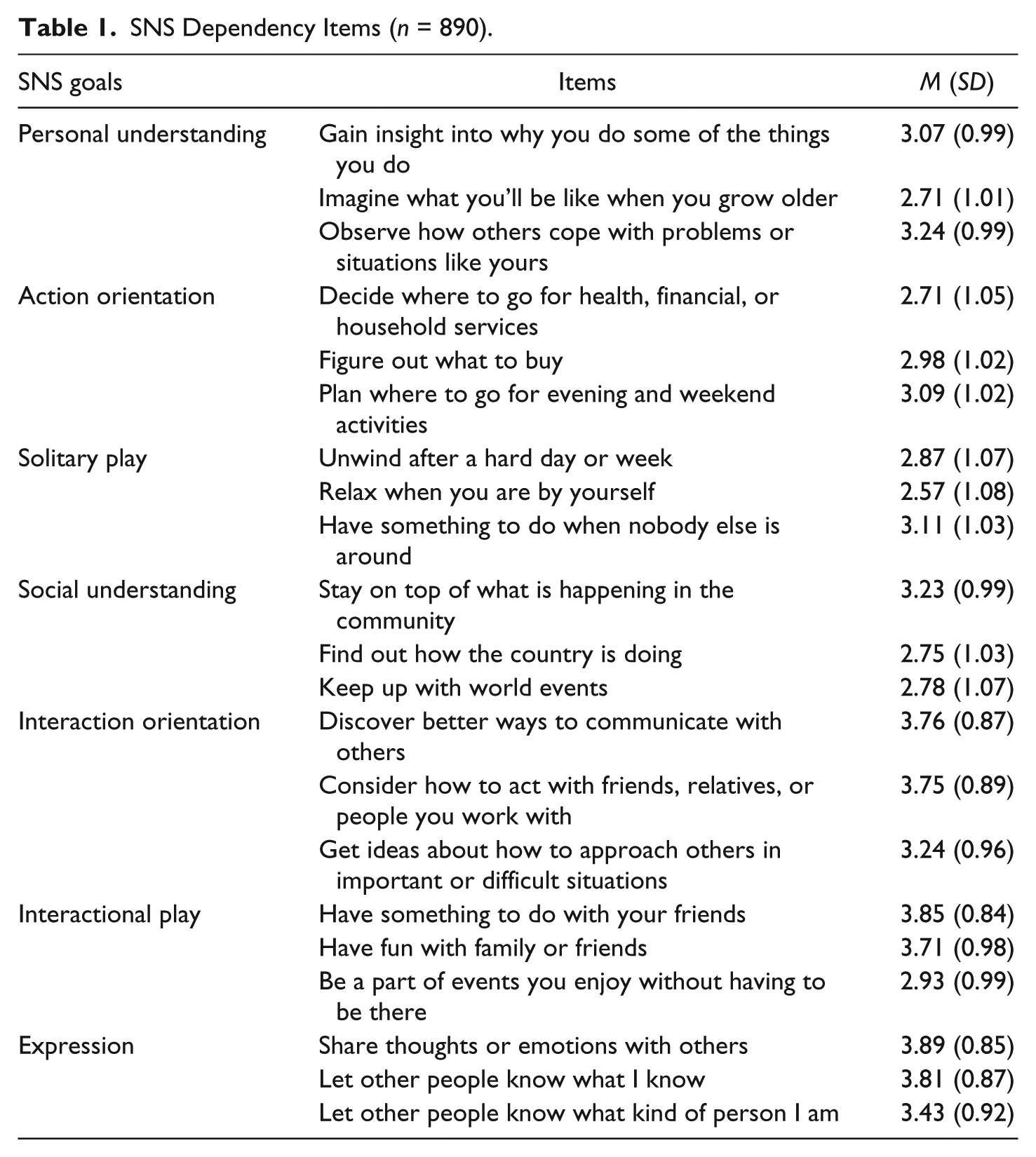
SNS dependency is composed of 21 items developed to cover the seven SNS goal dimensions explained in the previous sections (3 items per SNS use goal). Table 1 presents a list of these items. Before we asked questions related to SNS dependency, we asked the respondents to select the one SNS service that they used most often in their daily lives. Therefore, the answers for SNS dependency represent dependency on the SNS service most preferred by each respondent. For each item, respondents were asked about how useful they think this SNS has been in their everyday lives on a 7-point scale (1 = not at all useful, 7 = extremely useful). The primary reason for using an SNS dependency measure of seven dimensions is not assessing the unique effect of each of these goal dimensions on community engagement, but testing the effect of the degree to which SNSs are central to an individual’s everyday life as a whole. Our other study suggested based on confirmatory factor analyses that a one-factor model with these 21 items showed a better model fit than a seven-factor model (Y. C. Kim & Jung, 2014). Therefore, a composite variable created by calculating the mean score of the 21-item values (Cronbach’s α = .91, M = 3.21, SD = 0.59) was used to test our hypotheses.
SNS Dependency Items (n = 890).
Community storytelling network variables
Local media connectedness (LC)
Based on Y. C. Kim and Ball-Rokeach (2006b), LC was measured by asking “How often do you use this service to get local news and information?” for each of 15 local media channels including national newspapers, community newspapers, neighborhood weblogs, neighborhood SNS, and local radio stations (see the appendix for the complete list of the 15 local media channels). The respondents’ answers were collected using a 6-point scale (1 = not at all, 6 = always). For LC, the mean value of the 15-item scores was calculated (Cronbach’s α = .61, M = 1.43, SD = 0.42).
Intensity of interpersonal neighborhood storytelling (INS)
INS was measured by asking, “How often do you talk with your neighbors about anything related to your neighborhood?” (Ball-Rokeach et al., 2001; Y. C. Kim & Ball-Rokeach, 2006b). The respondents provided their answers on a 7-point Likert-type scale (1 = not at all, 7 = always; M = 2.90, SD = 1.23).
Scope of connection to community organizations (OC)
OC was measured by asking respondents whether they had memberships to each of eight types of community organizations including social clubs, home association meetings, religious organizations, hobby/interests groups, political organizations, educational organizations, volunteer organizations, and community development organizations (Y. C. Kim & Ball-Rokeach, 2006b). OC was created as a scope variable by counting the number of organization types to which a respondent belongs (M = 0.98, SD = 1.26, range = 0-8).
ICSN
We calculated ICSN using the formula from Y. C. Kim and Ball-Rokeach (2006b). The formula is expressed as follows:

where LC is local media connectedness, INS is intensity of interpersonal neighborhood storytelling, and OC is scope of connection to community organizations. As the scales we used for LC, INS, and OC were different, we standardized the scores to calculate ICSN (M = 8.98, SD = 3.07, range = 3.83-15).
Community engagement outcomes as dependent variables
Neighborhood belonging
Neighborhood belonging (Williams & Vaske, 2003) was measured with five statements, including “I identify strongly with my neighborhood,” and “My neighborhood means a lot to me” (see the appendix for the rest of the items). The conventional 5-point Likert-type scale was used (1 = not at all true, 5 = definitely true; Cronbach’s α = .89, M = 3.12, SD = 0.83).
Collective efficacy
Following Sampson, Raudenbush, and Earls (1997), we measured two collective efficacy variables: informal social control and social cohesion. Informal social control was measured with five items, such as “If there is a safety issue that makes people worry about walking at night in your neighborhood, how many of your neighbors participate in activities to solve this problem?” A 6-point scale was used for these items, ranging from 1 (no one will participate) to 6 (everyone will participate; Cronbach’s α = .87, M = 3.75, SD = 0.84). Social cohesion was measured by asking respondents how strongly they would agree with five statements, including “People in my neighborhood are willing to help one another,” and “People in my neighborhood share the same values.” A 5-point scale was used to measure the items, ranging from 1 (do not agree at all) to 5 (very strongly agree; Cronbach’s α = .88, M = 2.98, SD = 0.67). The appendix shows the complete lists of the items used for the two collective efficacy outcomes.
Community activity participation
Community activity participation was measured with a question asking, “How often do you attend neighborhood revitalization meetings held in your neighborhood?” The question was asked only if respondents previously answered “Yes” to the question “Do you know of any particular community-level projects to revitalize your neighborhood?” A 5-point Likert-type scale was used, ranging from 1 (not at all) to 5 (very frequently; n = 234, M = 2.64, SD = 1.04).
Control variables
Sociodemographic variables such as gender, age, education, and income were controlled for statistical adjustment in all analyses in the current study. As SNS use may also be correlated with Internet use and smartphone use, self-reported time for Internet use, time for smartphone use (measured using ordinal scales), scope of Internet use (measured by counting the number of activity types respondents do online), and scope of smartphone use (measured by counting the number of activities respondents do using smartphones) were controlled as well. In addition, we added a question about preferred SNS, as SNS dependency and its impact on community engagement could be influenced by what SNS service respondents most often use. For this, we asked the respondents, “What is the SNS service you most often use in your daily life?” One interesting finding was that the majority of Seoul respondents picked KakaoTalk 4 as the most preferred SNS (74%). About 11% selected Facebook and 4% selected Twitter. The extent to which one is interested in local issues, or local issues interest, was also included as a control variable. It was measured with a single question asking, “How much are you interested in what is happening in your neighborhood?” A conventional 5-point Likert-type scale was used for this question (1 = not at all interested, 5 = very interested; M = 3.15, SD = 0.86). A summary of the descriptive statistics of these control variables is presented in Table 2.
Descriptive Statistics of Demographic and Other Control Variables (n = 890).

Note. SNS = social networking service.
Monthly income was asked in Korean won, but reported here in U.S. dollars.
Analysis
We conducted four hierarchical regression analyses. Each of these ordinary least squares (OLS) regression analyses had a different community engagement outcome variable: neighborhood belonging, informal social control, social cohesion, or community activity participation. Predictors were entered as blocks. Control variables including sociodemographic variables, Internet/smartphone use variables, preferred SNS service, and local issue interest were entered first, followed by SNS dependency and ICSN. The interaction terms of SNS use and ICSN were entered in the third block.
Results
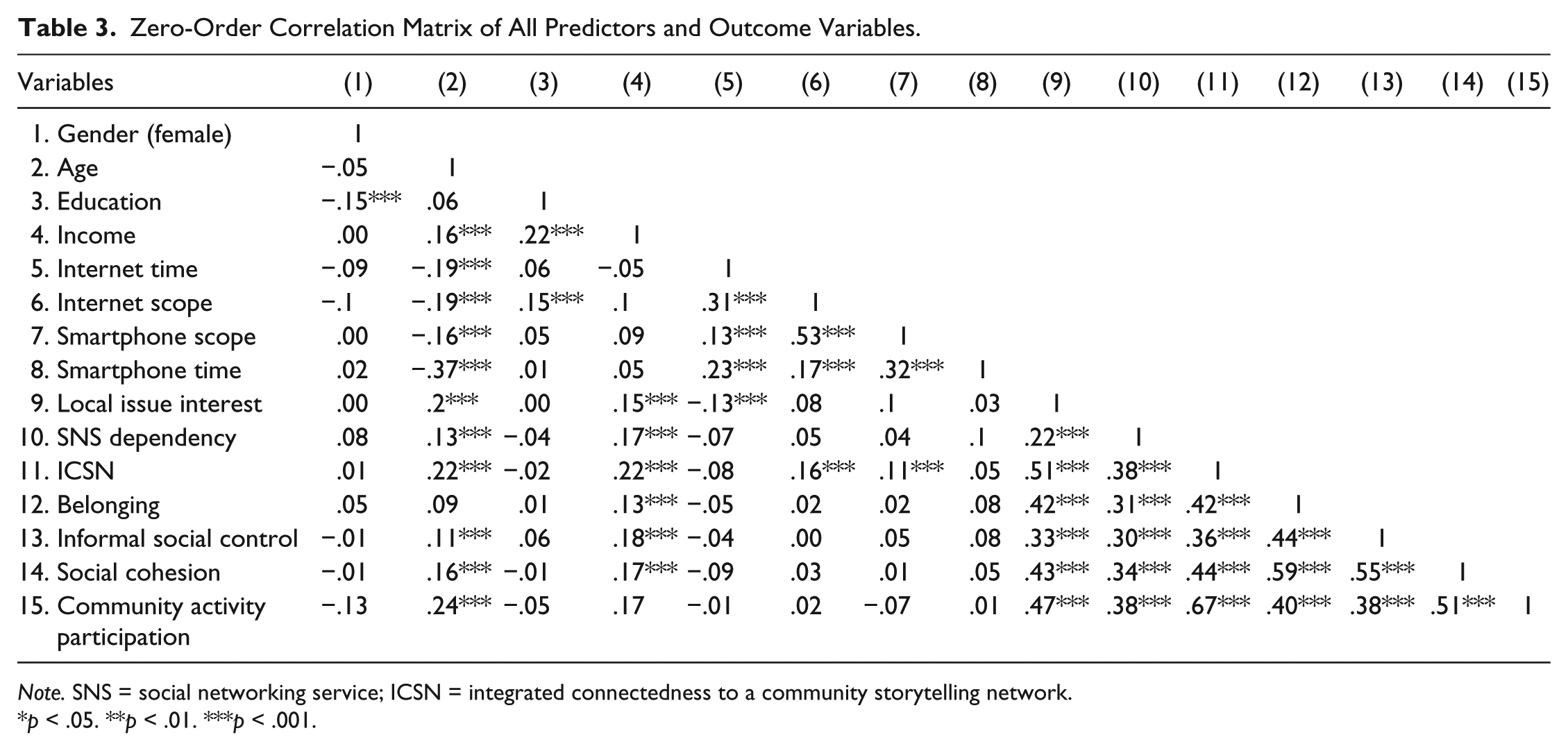
Before the main analyses, we conducted zero-order correlation analyses. The results are provided in Table 3. Neither gender nor education had any significant effects on SNS dependency and community engagement variables. Age and income were positively associated with SNS dependency and community engagement variables. SNS dependency was not correlated with any of the time measures for Internet and smartphone use. ICSN and SNS dependency were positively correlated (r = .38, p < .01). Both SNS dependency and ICSN were significantly positively correlated with all community engagement variables.
Zero-Order Correlation Matrix of All Predictors and Outcome Variables.
Note. SNS = social networking service; ICSN = integrated connectedness to a community storytelling network.
p < .05. **p < .01. ***p < .001.
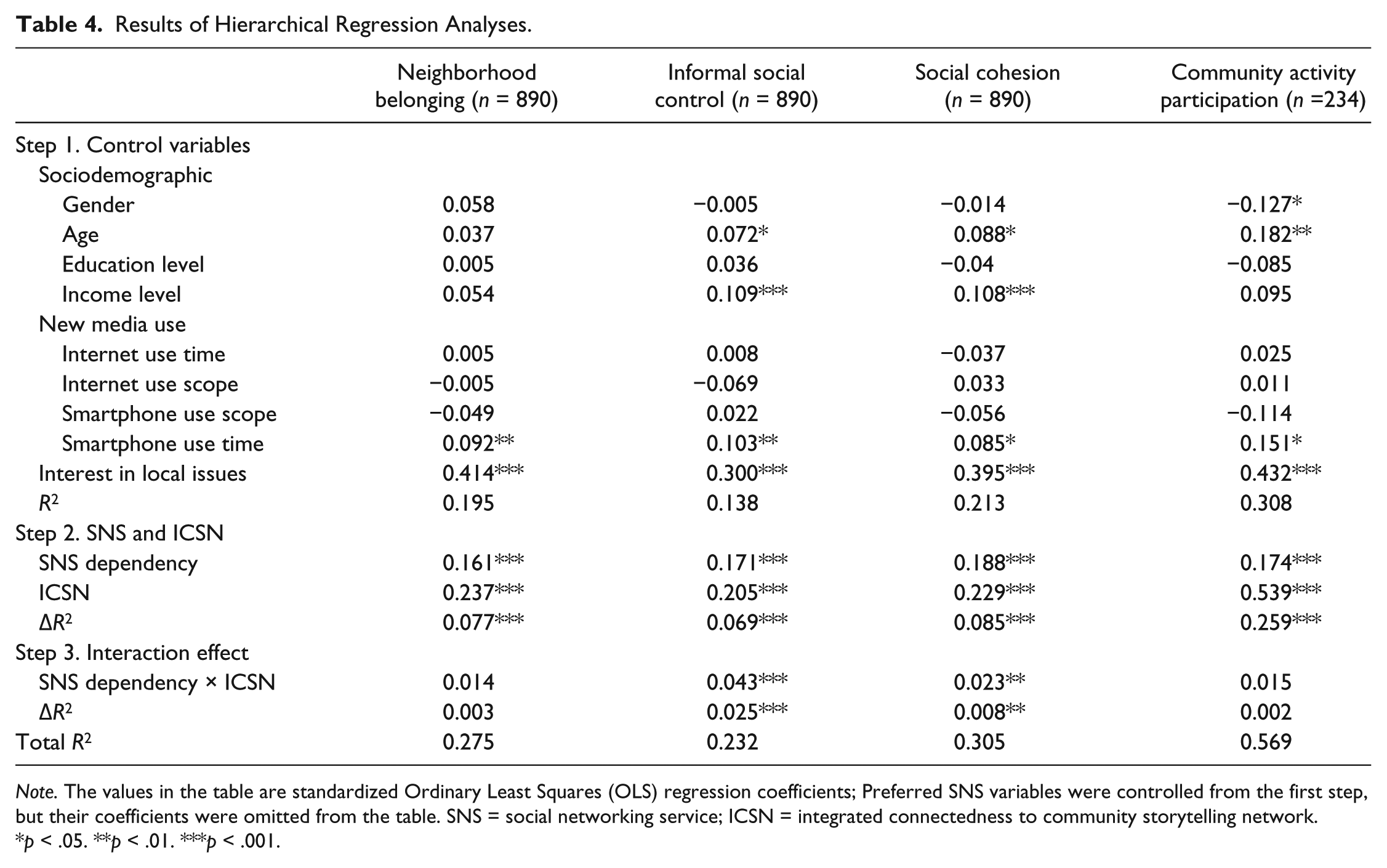
The first hypothesis assessed whether SNS dependency enhanced or reduced individual local community engagement. As shown in Table 4, our regression analysis results revealed that SNS dependency was significantly positively associated with community engagement. This positive association was found consistently for all of the community engagement variables included in this study: neighborhood belonging (β = .161, p < .001), informal social control (β = .171, p < .001), social cohesion (β = .188, p < .001), and community participation (β = .174, p < .001).
Results of Hierarchical Regression Analyses.
Note. The values in the table are standardized Ordinary Least Squares (OLS) regression coefficients; Preferred SNS variables were controlled from the first step, but their coefficients were omitted from the table. SNS = social networking service; ICSN = integrated connectedness to community storytelling network.
p < .05. **p < .01. ***p < .001.
Hypothesis 2 stated that ICSN would have positive associations with local community engagement variables. Table 4 shows that this hypothesis was confirmed for all of the community engagement variables we included as dependent variables in the regression analyses: neighborhood belonging (β = .237, p < .001), informal social control (β = .205, p < .001), social cohesion (β = .229, p < .001), and community participation (β = .539, p < .001).
The third hypothesis assessed the interaction effects of SNS dependency and ICSN on local community engagement variables. We determined whether the effects of SNS dependency on local community engagement would be greater among those high in ICSN than those low in ICSN. Table 4 shows the results. We found that the hypothesized interaction effects for the two collective efficacy variables were significant: β = .043, p < .001, for informal social control; β = .023, p < .01, for social cohesion; Figures 1 and 2). However, we did not find significant interaction effects of SNS dependency and ICSN for neighborhood belonging (β = .014, p = ns) or community participation (β = .015, p = ns).

Interaction effect of SNS dependency and ICSN on informal social control.
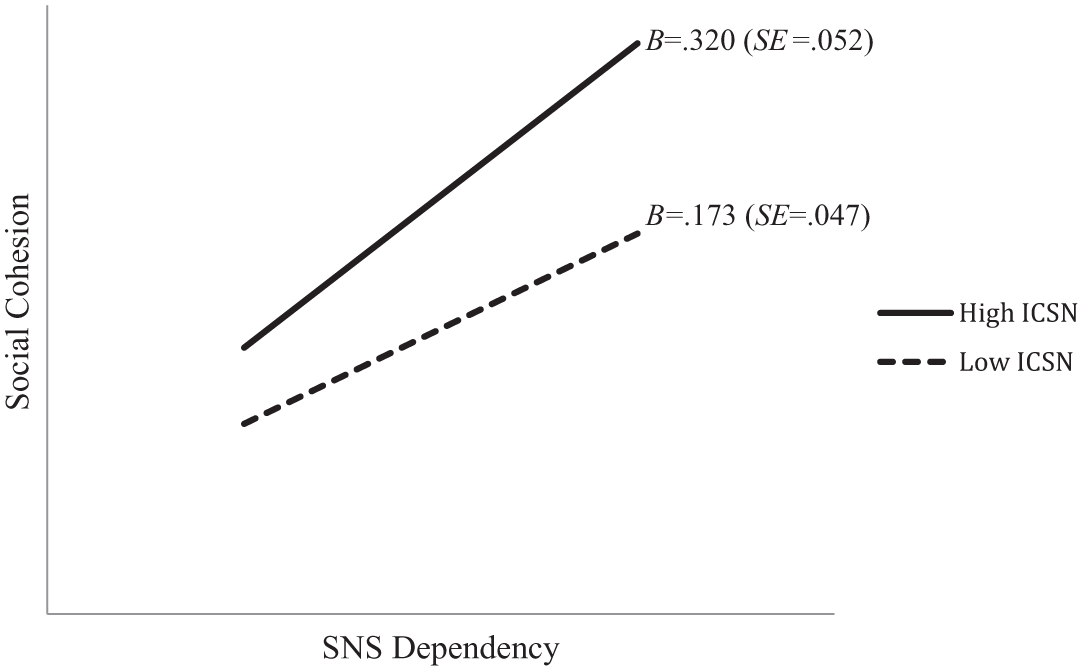
Interaction effect of SNS dependency and ICSN on social cohesion.
We had one research question asking if there was any significant difference among different SNS platforms (especially between open SNSs and closed SNSs) in terms of how much they were related to community engagement. We divided the respondents into three groups based on which SNS platform they chose as the most preferred: KakaoTalk (74%), Facebook (11%), other platforms (15%), including Twitter. In each of these three groups (KakaoTalk, Facebook, and Other), we conducted regression analyses—similar to the ones reported in Table 4—for main and interaction effects of SNS dependency on community engagement (see Table 5). Regarding the main effects of SNS dependency on community engagement, the results of the respondents who chose KakaoTalk or other SNS platforms demonstrated similar patterns to the results shown in Table 4, where preferred SNS was statistically controlled. However, for those who chose Facebook as the most preferred SNS platform, SNS dependency did not have a direct relationship with any of the four community engagement variables. Coefficient comparison test results (z) were also reported in Table 5: These test results confirmed that SNS dependency was associated with community engagement more likely among KakaoTalk and other SNS platform users than Facebook users. The results about interaction effects of SNS dependency and ICSN on community engagement did not show a consistent pattern: There were significant interaction effects on neighborhood belonging only in the Other group, on social cohesion in both the Facebook group and the Other group, and on informal social control in the KakaoTalk group and the Other group. There was no significant interaction effect on community activity participation in all of the SNS groups.
Comparisons of Regression Coefficients of SNS Dependency on Community Engagement in the Three SNS Groups: KakaoTalk, Facebook, and Others.

Note. The values in the table are unstandardized Ordinary Least Squares (OLS) regression coefficients with standard errors in parentheses. KakaoTalk (Facebook or Others) represents respondents who chose KakaoTalk (Facebook or Others) as the most often used SNS. Gender, age, education level, income level, Internet use time, Internet use scope, smartphone use scope, smartphone use time, local issue interest, and ICSN were included in the analyses, but their coefficient values were omitted from the table. SNS = social networking service; ICSN = integrated connectedness to a community storytelling network; KF = difference between the KakaoTalk group and the Facebook group; OF = difference between the Facebook group and the Others group; KO = difference between the KakaoTalk group and the Other group.
Coefficient comparison tests were conducted with the following formula: Z = (b1 − b2) / √(SEb12 + SEb22) (Paternoster, Brame, Mazerolle, & Piquero, 1998).
p < .05. **p < .01. ***p < .001.
Discussion
The purposes of the current study were (1) to examine the effects of SNS dependency on local community engagement among Seoul residents, (2) to determine whether ICSN had positive roles in local community engagement in Seoul, and (3) to investigate the moderating effects of ICSN between SNS dependency and local community engagement. We focused on four local community engagement outcomes as dependent variables: neighborhood belonging, two collective efficacy variables (informal social control and social cohesion), and community activity participation. We found that SNS dependency was positively associated with all of the local community engagement variables. In particular, SNS dependency showed the strongest association with community cohesion, a perceived sense of connectedness among local residents for local problem solving. ICSN showed positive associations with all of the local community engagement variables included in this study. We found moderating effects of ICSN between SNS dependency and local community engagement only for the two collective efficacy variables, informal social control and social cohesion. In addition, we found that closed SNSs (e.g., KakaoTalk) seem more likely to facilitate community engagement than open SNSs (e.g., Facebook).
The results of this study indicate that SNSs, especially closed SNSs, have the potential to be a facilitating factor in community engagement among Seoul residents. It is possible for individuals to use SNSs, either open or closed SNSs, to connect to nonlocal issues and nonlocal contacts, while bypassing immediate local places, issues, and neighbors. However, Seoul residents seem to have learned how to use SNS channels (especially closed SNSs) as venues to be more engaged in their neighborhoods. On the other hand, our data hint that Facebook may not be an effective platform for community engagement in the context of Seoul.
The results that the pull effects of SNSs are more salient among the users of KakaoTalk than Facebook users may imply that closed SNSs do not necessarily facilitate tele-cocooning (Kobayashi & Boase, 2014). Instead, these results suggest the potential of closed SNS services as an effective tool for mobilizing and facilitating place-based community engagement. Some recent studies have provided empirical bases for understanding these results. For example, some previous studies have found that people’s access to strong (vs. weak) ties on SNSs, which is expected more on closed SNSs such as KakaoTalk than on open SNSs, seems to lead to off-line behavioral outcomes, including civic engagement (M.-S. Park, Shin, & Ju, 2014; Skoric, Ying, & Ng, 2009). Other studies indicate that closed SNSs (especially KakaoTalk) may offer a stronger sense of presence than Facebook (H.-K. Lee, Lee, & Lee, 2013). Jin and Yoon (2016) described KakaoTalk as being “articulated with community-based local modes of communication and the rhythm of urban space.” The data presented in this study suggest that more research should be conducted to have better understanding of the potential of closed SNSs as effective tools for promoting community engagement in metropolitan areas.
One recent case from Bundang, a suburban middle-class city adjacent to Seoul, vividly demonstrates the power of a closed SNS, KakaoTalk. To protest the relocation of a probation office into their neighborhood, the residents of Bundang, particularly the mothers of schoolchildren, organized themselves for collective action in a single day in September 2013. Only 1 day after the relocation of the facility was announced, about 1,000 protesters showed up and blocked the probation office (Yoon, 2013). This rapid organization of residents for large-scale protests (Shirky, 2008) was made possible by the use of SNS channels, especially KakaoTalk. Our survey results, the case of Bundang, and other recent anecdotal cases in Seoul showing the organizing power of SNS channels suggest that SNSs, especially closed SNSs, have the potential to be used for collective actions and community engagement among local residents. SNSs and other interactive online forums can be utilized as channels for meeting neighbors and sharing interests, concerns, or a sense of community. These new media can be used for local or hyper-local activities (Chen et al., 2012).
There are at least three other points that should be underscored in terms of the positive impacts of SNS dependency on community engagement. First, we were able to apply a more nuanced and qualitative theory-based measure of how central SNSs are to the everyday life of individuals based on MSD measures (Y. C. Kim & Jung, 2014). This is the first attempt to use this multidimensional measure based on a systematic theory. Second, our data were collected from Seoul residents and are unique because we targeted the general population between the ages of 19 and 59 from 25 subdistricts of the city. Most previous studies on SNS use and community engagement have been conducted among college students living in relatively small college towns (e.g., Ellison et al., 2007, 2011; Hargittai & Shaw, 2013; Junco, 2012; J.-H. Lin et al., 2012; Stavrositu & Sundar, 2012; Valenzuela el al., 2009), with only a few exceptions (Enjolras et al., 2013; Gil de Zúñiga, 2012). Third, we included both open network SNSs (e.g., Facebook and Twitter) and closed SNSs (e.g., KakaoTalk) in our study. Most previous studies have focused on the effects of Facebook or Twitter. Our research is one of the first attempts to examine the effects of closed network SNSs as well as open SNSs.
Our findings on ICSN are consistent with those of previous studies based on CIT (Y. C. Kim & Ball-Rokeach, 2006a). In fact, ICSN showed stronger effects than SNS dependency on all of the community engagement variables, which may indicate the importance of connection to community storytelling resources over connection to new media technologies. These results also suggest that the effects of community storytelling on local engagement can be observed in places outside the United States, where most previous CIT studies have been conducted. CIT was originally developed in culturally and ethnically diverse U.S. cities, especially Los Angeles. The current study demonstrates that even in Seoul, a relatively homogeneous metropolitan city, the central proposition of CIT still holds true: Individual connectedness to the local storytelling network is critical for engagement in local communities. This suggests that community development in Seoul, as in other places, must focus on establishing community storytelling resources. When individuals are connected to local media, community organizations, and locally based social networks, they have a higher level sense of belonging and collective efficacy, and are more likely to participate in local activities.
We found that ICSN functions as a moderator of SNS dependency effects on two collective efficacy variables, informal social control and social cohesion. SNS dependency effects on informal social control and social cohesion were found only among individuals with high ICSN. These results suggest that individuals who have stronger connections to local storytelling resources may use SNSs to increase their perception that other people are involved in local problem-solving processes (informal social control) and that people in the local neighborhood are connected to one another in a significant way (social cohesion). Among those with low ICSN, SNS use did not significantly increase collective efficacy beliefs. Although we found no statistically significant interaction effects regarding other community engagement variables, separate post hoc analyses (data not shown) have consistently demonstrated that individuals with higher level ICSN show higher coefficients of SNS dependency for dependent variables than those with lower level ICSN. These results confirm one of the theoretical propositions of CIT regarding the role of new media technologies in local contexts: whether new media technologies have positive or negative influences on the local community depends on the quality of the community storytelling network and whether individuals use new media technologies to enhance, rather than reduce, their connections to local neighborhoods depends on their level of ICSN.
However, we still must ask why the moderating role of ICSN was more salient for the two collective efficacy variables than the other dependent variables. As one way to answer this question, we focus on the fact that collective efficacy is based on individuals’ beliefs about other community residents’ connection to the local community, while both sense of belonging and community participation are based on individuals’ evaluations of their own affective, cognitive, and behavioral connections to the local community. Among those individuals with low ICSN who are less engaged with community storytellers than others, there might have been a “third-person effect” making them think that the push effect of SNSs was strong for others (but not for themselves), and thus there should be a negative effect of SNSs on other community residents’ (but not their own) willingness to participate in community problem-solving activities (i.e., collective efficacy). Of course, this is mere conjecture and not based on any empirical evidence; however, third-person effects in this context could be an interesting research agenda for future studies.
Our results have important practical implications. Any community-based projects seeking to adopt new media technologies or services to improve community engagement and increase the sense of community among residents cannot depend solely on new media technologies, per se. New media technologies must become part of the existing community storytelling resources. Therefore, multilevel (especially meso-level and micro-level) connections need to be established between new media and existing community storytelling networks. In addition, while creatively adopting and using new media technologies such as SNSs, more effort should be invested in strengthening community storytelling agents (community organizations, community media, and residents) and their networks. Individuals need to have integrated connectedness to these storytelling agents in order to effectively use new media technologies, including SNSs, for discourse related to their local community rather than related to issues and relationships outside of their communities. The results of the present study also suggest designing closed SNS platforms for local community residents as a novel tool for effectively and efficiently facilitating community engagement.
There are several limitations to this study. First, any statements in this article suggesting causal relationships among variables should be interpreted with caution. As this study was based on cross-sectional data, our ability to address causality is limited. Future studies with randomized controlled research designs will increase confidence in the suggested causal relationships among key variables. We used online survey methods that systematically excluded Internet nonusers. However, because about 83% of the total population in Korea used the Internet in 2012 (this percentage should be even higher for a study population with our age and location constraints) and we only focus on SNS users, we believe this is not a serious problem for our study. Some of the variables (especially the INS variable) were measured with a single item. Although we followed the methods of previous studies for these single-item measures, future research should validate the reliability of these measures and, if necessary, develop multi-item measures.
Footnotes
Appendix
Declaration of Conflicting Interests
The authors declared no potential conflicts of interest with respect to the research, authorship, and/or publication of this article.
Funding
The authors disclosed receipt of the following financial support for the research, authorship, and/or publication of this article: This research was supported by the Ministry of Education of the Republic of Korea and the National Research Foundation of Korea (NRF-2011-327-B00923) and by the Korea Information Society Development Institute.