




Abstract
The potential impact of mass media has been virtually neglected in the study of adolescent fear of crime. This is remarkable, given adolescents’ heavy media consumption and developmental vulnerability. Music videos and soap operas have been completely overlooked in the TV-fear association, even though they have a large adolescent audience and contain a lot of violence. An online survey of 3,372 adolescents aged 12 to 18 years found that the relationship between exposure to soap operas and music videos on the one hand and fear of crime on the other hand was mediated by perceived personal risk of criminal victimization, perceived ability to control crime, and perceived seriousness of crime. Exposure to soap operas and music videos was associated with these cognitive factors of fear. Some relationships differed by age and sex. Our findings suggest that the age of 14 to 15 is pivotal for the development of media-induced fear.
There is a substantial amount of research on the relationship between television violence and fear of crime. Most of it looks at the relationship from the perspective of cultivation theory and is concerned with the question of whether prolonged exposure to TV messages might affect viewers’ real-world perceptions of crime and of the risk of becoming a victim of crime. Previous studies have generally focused on adults (e.g., Grabe & Drew, 2007; Kort-Butler & Sittner Hartshorn, 2011; Lane & Meeker, 2003). Research on the TV-fear association in adolescents is rare. There are, however, two important reasons why it is important to investigate the issue in this age group. First, it is well-documented that adolescents devote a large amount of time to mass media (Rideout, Foehr, & Roberts, 2010). Second, mass media serve as important socialization tools for adolescents. They play a considerable role in developing values and beliefs in adolescence (Arnett, 1995, 2007; Steinberg, 2002).
Criminological and psychological research has shown that perceived personal risk of criminal victimization, perceived ability to control crime, and perceived seriousness of crime are important predictors of fear of crime (e.g., Hale, 1996; Jackson, 2009, 2011; Killias & Clerici, 2000; O’Donovan, Devilly, & Rapee, 2007; Winkel, 1998). Research in adults has suggested that TV viewing is associated with these three cognitive predictors and is thus indirectly associated with fear (Custers & Van den Bulck, 2013). The current study aims to extend this model by testing whether the TV-fear association is mediated by perceived risk, perceived control, and perceived seriousness in adolescents as well. We will focus on exposure to music videos and soap operas, two TV genres that have been overlooked in prior research on the TV-fear association. Research has shown that they contain a considerable amount of violence and are widely viewed by adolescents. In addition, because of what is known as the gender-fear paradox and the finding that levels of adolescent fear of crime diminish by age (May & Dunaway, 2000; Schreck & Miller, 2003; Swartz, Reyns, Henson, & Wilcox, 2011), we will study whether the relationships between television viewing and the cognitive predictors of fear vary between boys and girls, and between different age groups.
Why Studying Media and Fear in Adolescents Matters
Most studies about adolescent fear of crime do not consider the mass media’s potential impact. There are, however, two reasons why it is important to include them. First, it is well-documented that adolescents consume a lot of mass media (Kirsh, 2010; Rideout et al., 2010; Roberts, 2000). According to the Kaiser Family Foundation (2010), 8- to 18-year-olds spend on average 7.38 hours per day using entertainment media. Although plenty of new media technologies have emerged, TV remains one of the most dominant and pervasive mass media among adolescents. In Flanders adolescents watch TV for about 2.2 hours per day (Van den Bulck & Beullens, 2007). Content analyses have shown consistently that TV entertainment programming contains a lot of violence (Hetsroni, 2007; Signorielli, 2003; Smith et al., 1998). A recent study by Bushman, Jamieson, Weitz, and Romer (2013) has shown there has been a threefold increase in gun violence in PG-13-rated movies since 1985. This means that more gun violence occurred in PG-13-rated movies than in the average R-rated movie.
Second, adolescence is a period in which important stages of identity development take place. This involves the gradual cultivation of values and beliefs and potential changes in self-conception (Adams & Berzonsky, 2003; Arnett, 1995; Steinberg, 2002). Changes in perceptions and beliefs about crime and fear of crime take place in adolescence too, in part because of gender socialization. Goodey (1997) has stated that “childhood and adolescence are put forward as crucial stages in identity development where one can begin to unpack the processes by which gendered meanings of fear and fearlessness become ‘fixed’” (Goodey, 1997, p. 401).
Gender Paradox
Differences in the socialization of men and women explain what is referred to as the gender-fear paradox (Cops & Pleysier, 2011; Goodey, 1997; May, Rader, & Goodrum, 2010). This paradox refers to the fact that women have higher fear of crime levels than men even though their objective risk of victimization is lower than that of their male counterparts (Hale, 1996). Deakin (2006) used survey data of young adolescents aged 9 to 16 years old from The Children and Young People’s Safety Survey and found that, on average, girls expressed more fears than boys did. The difference in fear levels became significant when they reached the ages of 10 to 13. This age period represented the beginning of a decrease in boys’ fear levels and coincided with an increase in girls’ fears (Deakin, 2006). May and colleagues (2010) suggested that greater parental concern for girls’ behavior and safety may contribute to the socialization of girls into individuals more aware of and more concerned about danger than boys. While boys are commonly socialized to become fearless, girls are socialized into fearful persons (Goodey, 1997). The idea that boys are taught to learn not to acknowledge or feel fear, while girls are taught to be fearful is only one explanation of differences in fear levels. Another explanation for these gender differences can be found in different perceptions of the nature of crimes boys and girls are likely to encounter and the risk of encountering them. This perspective is often referred to as the “shadow of sexual assault thesis” (Ferraro, 1996) which refers to the notion that girls’ or women’s higher levels of fear of victimization result from their concern of becoming victims of rapes and sexual assaults.
The Mediated Fear Model
Prior research in criminology has shown that fear of becoming a victim of crime is influenced by three cognitive components. First, it has been shown consistently that fear levels will be higher when individuals perceive their risk of becoming a victim of crime to be higher (e.g., Jackson, 2009, 2011; O’Donovan et al., 2007; Rader, May, & Goodrum, 2007). Second, fear levels tend to be higher when individuals perceive their ability to control a threatening event to be lower (Hale, 1996; Jackson, 2009, 2011; Killias & Clerici, 2000). Finally, when an individual perceives a specific crime to be particularly serious he or she will be more likely to feel afraid of becoming a victim of that particular crime (Jackson, 2009, 2011; Warr, 1987; Winkel, 1998).
Cultivation theory offered an early explanation of the processes by which TV exposure may affect levels of fear. The cultivation hypothesis states that prolonged exposure to TV gradually distorts viewers’ perception of the real world in the direction of TV reality (Gerbner & Gross, 1976). A meta-analysis of 82 cultivation studies with approximately 6,000 findings showed a small but consistent correlation (an average of .09) between television viewing and people’s perceptions and attitudes about reality (Morgan & Shanahan, 1997). Because TV content contains a lot of violent images (Hetsroni, 2007; Signorielli, 2003; Smith et al., 1998) Gerbner and colleagues believed heavy viewers were more likely to develop a “mean world syndrome” (Gerbner, Gross, Morgan, Signorielli, & Shanahan, 2002, p. 52). The cultivation of this mean worldview might lead to higher levels of perceived risk of personal victimization and elevated levels of fear of crime (Gerbner & Gross, 1976). This early theory on TV and fear is a precursor of a mediated fear model, as it hypothesizes that TV exposure may affect real-world perceptions and that changes in these perceptions may affect levels of fear.
Shrum’s (2009) heuristic processing model offers a hypothetical model for the mediated relationship between TV exposure and fear by perceived risk, perceived control, and perceived seriousness (Custers & Van den Bulck, 2011, 2013). Applied to risk perception, people usually use heuristics to construct judgments of probability. The availability heuristic (Tversky & Kahneman, 1973), for instance, is based on the ease with which they can retrieve examples from memory; the simulation heuristic (Kahneman & Tversky, 1982) is based on how easy it is for them to image certain alternatives. In the context of cultivation research, Shrum (2009) has argued that heavy viewers who are frequently exposed to TV’s repetitive set of often vivid examples of violence have access to more of these examples when they construct their judgment (Shrum, 1995, 2001; Shrum & O’Guinn, 1993). As a result, heavy viewers will be more likely to report higher crime risk judgments than light viewers (for a review, see Shrum, 2009).
Overview of Present Research
Early cultivation studies such as those of Gerbner and Gross (1976) focused on overall TV viewing, assuming that it was impossible for viewers to escape the recurring metanarratives of TV. More recently, however, cultivation researchers have started to focus on exposure to particular genres (see Bilandzic & Buselle, 2012). In the context of studying TV violence, such studies tend to focus on TV genres most commonly associated with the presence of violent images, such as crime drama shows (e.g., Eschholz, Chiricos, & Gertz, 2003; Heath & Petraitis, 1987), news (e.g., Weitzer & Kubrin, 2004), and reality shows portraying law enforcement (Eschholz et al., 2003). However, music videos (Aikat, 2004; Baxter, De Riemer, Landini, Leslie, & Singletary, 1985; DuRant et al., 1997; Greeson & Williams, 1986; Kalis & Neuendorf, 1989; Rich, Woods, Goodman, Emans, & DuRant, 1998; Smith & Boyson, 2002) and soap operas (Buerkel-Rothfuss & Mayes, 1981; Shrum, 1996; Sutherland & Siniawsky, 1982) contain a significant amount of violence as well and are popular among adolescents (Coyne & Archer, 2004). Therefore, the current study investigates whether soap opera and music video viewing is indirectly related to fear of crime through perceived risk, perceived control, and perceived seriousness.
The predictions differ according to TV genre and cognitive antecedents of fear. With regard to perceived risk of victimization, we hypothesize a positive relationship with both soap opera and music video viewing. Any genre containing a lot of violent images is likely to cause images of violent victimization to be more accessible in memory. Based on Shrum’s (2009) heuristic processing model (cf. infra), we expect that higher exposure to TV genres containing violent images will be related to higher estimates of the risk of criminal victimization. Therefore, we predicted the following:
Regarding perceived ability to control crime, we expect different relationships depending on the TV genre.
Music Videos
Content analytic studies of MTV programming showed that between 15% and 61% of music videos featured violence (Baxter et al., 1985; Greeson & Williams, 1986; Kalis & Neuendorf, 1989). Rich and colleagues (1998) found that 14.7% of the music videos across four channels (BET, CMT, MTV, VH-1) featured interpersonal violence, with a mean of 6.1 violent interactions per video. Similar results were obtained by Smith and Boyson (2002) who found that, on average, 15% of the music videos they studied featured violence, of which 80% depicted one violent act, 17% featured two, and 3% depicted three or more violent acts.
With regard to the context of the violence, nearly 70% of the violent acts in music videos, independent of channel, featured no portrayal of immediate suffering or pain. About 90% of the violent music videos were presented in a realistic setting (Smith & Boyson, 2002). More than half of the violent acts showed no harm done to the victims and about 80% of the violent acts remained unpunished (Smith & Boyson, 2002). The depiction of glamorized violence in music videos may teach adolescents that victimization is not associated with serious consequences. This suggests that violent crime is not particularly serious and that, in turn, may give some viewers the impression they would be able to cope with such violence. Therefore, we predicted the following:
Soap Operas
Prior research already showed that watching soap operas is related to higher prevalence estimates about the incidence of crime (Shrum, 1996) and the number of people who have committed a serious crime (Perse, 1986) in undergraduate students. In adolescents, soap opera viewing is associated with a higher estimated percentage of people who will die a violent death (Potter & Chang, 1990).
Soaps have been described as complicated, intertwining stories involving many characters that elicit different types of identification (Geraghty, 2005). Compared with other TV genres, soap operas focus much more on emotional relationships between TV characters (Geraghty, 2005; Stern, Russell, & Russell, 2005). Soap operas appeal to large audiences that follow the storylines for years (Perse, 1986), and generally maintain close relationships and emotional involvement with the soap opera characters. In this way, viewers become intimately involved with the characters’ lives (Buerkel-Rothfuss & Mayes, 1981; Phillips, 1982), which makes it more likely that viewers become immersed into the soap opera’s story and identify with some of the characters (cf. the Transportation-Imagery Model by Green & Brock, 2000). Because soap operas belong to TV’s melodrama genres and emphasize the emotional aspects of the lives of the soap’s characters (Geraghty, 2005), it is more likely that, when violence is shown in soap operas, the harm done to the victim and the consequences of the victimization for the victim’s life will be emphasized. Therefore, we predicted the following:
Building on the mediated fear model of which the central premise is that TV exposure is indirectly related to fear of crime through the cognitive predictors of fear, we expected the following:
Based on our hypotheses, the predicted model puts forward a number of paths (see Figure 1).
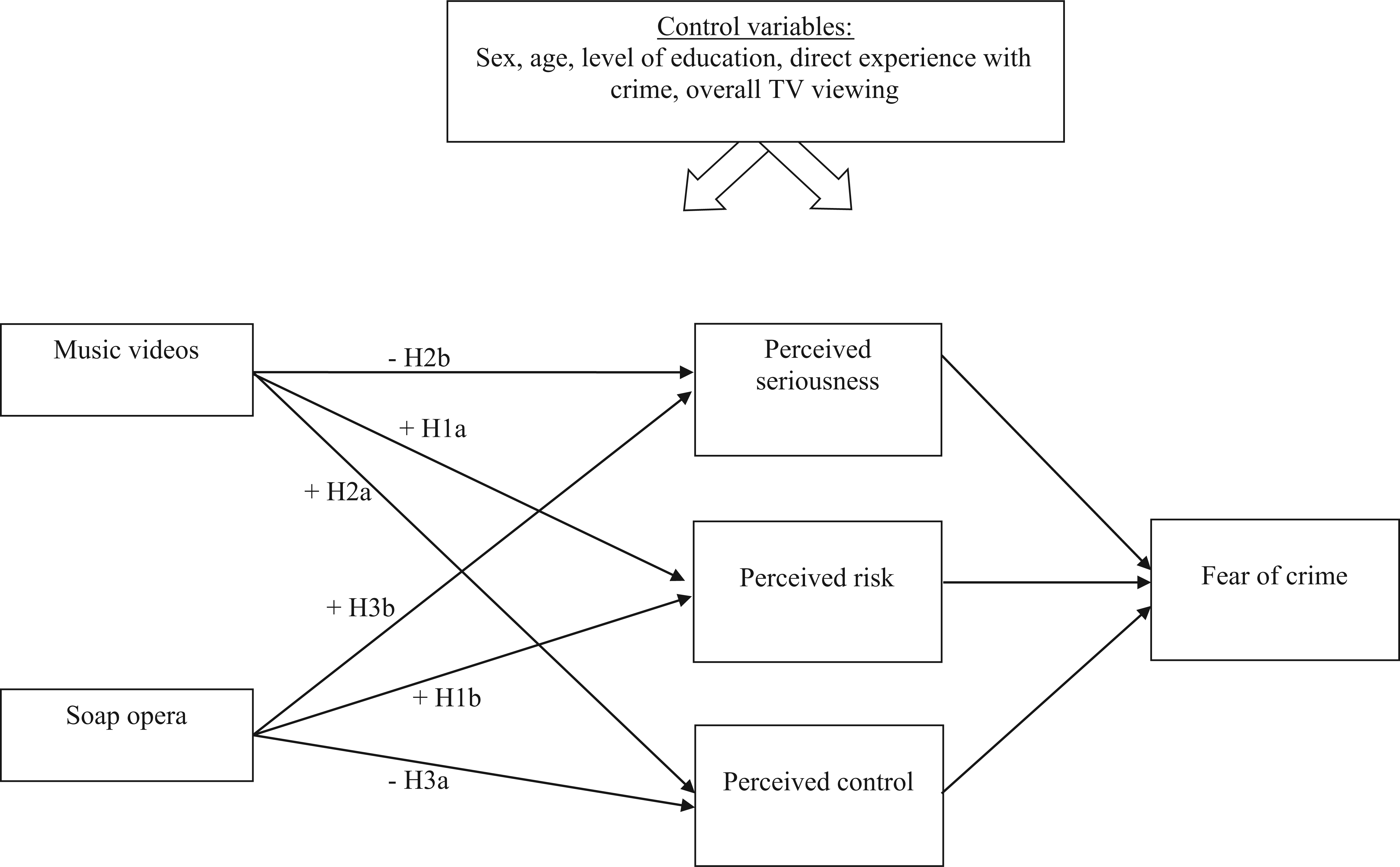
Total hypothesized model of the relationship between television exposure and fear of crime mediated by perceived risk, control, and seriousness.
Based on the view that girls and boys perceive risks and experience fear differently because of different socialization patterns, we predicted the following:
Given the important changes in adolescents’ perceptions across adolescence, age is also a potentially important moderator. Therefore, we expected the following:
Method
Sample
We used data of 3,372 adolescents who participated in the L-DIGITEENS study. The proportion of boys in our sample (41.6%) was slightly smaller than that in the population (51%). Consequently, the proportion of girls in the sample (58.4%) was slightly larger than that in the population (49%), χ2 (1, N = 3372) = 3.241, p = .07. It is plausible that boys tend to be less willing to participate in surveys than girls are and/or that truancy levels are higher among boys. The mean age was 14.93 (SD = 1.74), which was representative for the general population of adolescents in the studied age group, χ2(2, 3372) = 3.379, p = .19.
Procedure
Data were collected by means of an online survey. First, 129 secondary schools were randomly selected from the official list of secondary schools in Flanders. Secondary schools offer education for Grades 7 through 12. These schools were contacted with the invitation to participate in a large-scale study on crime perceptions among adolescents in the digital age; 54 schools agreed to participate in the study (response rate = 41.9%). When a school agreed to cooperate, all students were included in the sample. This procedure was repeated until a threshold of 3,000 respondents was exceeded.
Undergraduate students of a social sciences research methodology class visited the selected schools in order to explain the purpose of the study. Strict confidentiality was guaranteed. Informed consent was obtained from the legal guardians of the children. The survey was conducted in accordance with the ethical guidelines of the University of Leuven.
Survey Measures
Demographics
We included gender, age, and level of education.
Total TV viewing
Respondents were asked to estimate the number of hours they watched TV on a regular viewing weekday. A similarly worded question was asked regarding Saturday and Sunday. Response items were 6 hours or more, about 6 hours, 4 to 5 hours, 3 to 4 hours, 2.5 to 3 hours, 2 to 2.5 hours, 1.5 to 2 hours, 0.5 to 1 hour, less than 0.5 hours, and 0 hours. Weekdays were distinguished from the weekend because adolescents may have more unstructured time in the weekend and may therefore watch more TV. Total viewing was estimated by summing weekday and weekend viewing to obtain an average estimate of weekly viewing. Dividing this variable by seven produced an estimate of average daily viewing. On average, respondents watched TV for almost 2 hours a day (M = 1.91, SD = 1.20).
TV genre exposure
Respondents were asked to indicate how often they watched specific TV genres on a 7-point scale: (0) never, (1) a few times a year, (2) about once a month, (3) a few times a month, (4) about once a week, (5) a few times a week, (6) (almost) every day. Two TV genres were relevant for the current study: (1) soap operas (M = 3.27, SD = 2.57) and (2) music videos (M = 3.24, SD = 2.18).
Fear of crime
To measure fear of crime, we used measures commonly used to assess fear of crime in adolescents (Swartz et al., 2011; Tillyer, Fisher, & Wilcox, 2011) without limiting it to the school setting. The current measure aimed to examine adolescents’ general fear of crime. Therefore, respondents were asked, “During the past year, how often have you been afraid that the following things would happen to you?” The following offenses were listed: (1) being forced to give up your money or property; (2) being threatened by a knife or other weapon; (3) being touched by someone in a sexual manner without consent; (4) being intentionally hit or kicked by someone. Answers were reported on a 6-point scale ranging from 0 (never) to 5 (almost daily). Responses for the four types of crimes were summed to obtain a total score (α = .81, M = 2.58, SD = 3.39).
The descriptions of the offenses used in the fear of crime scale were matched with those which measured perceived risk, perceived control, and perceived seriousness.
Perceived risk of criminal victimization
To measure perceived risk of criminal victimization respondents were asked “During the next twelve months, how likely do you think it is that the following things will happen to you?” Answers were reported on a 6-point scale ranging from 1 (very low chance) to 6 (very high chance). Responses for the four types of crimes were summed to obtain a total score (α = .82, M = 8.87, SD = 3.83). This measure has been used in previous research on personal risk perception of criminal victimization in adolescents (Melde, Esbensen, & Taylor, 2009; Wilcox, May, & Roberts, 2006).
Perceived ability to control crime
To measure perceived control respondents were asked, “How well or how badly do you think you could defend yourself if you were involved in the following situations?” Answers were reported on a 6-point Likert-type scale ranging from 1 (very bad) to 6 (very well). Responses for the four types of crimes were summed to obtain a total score (α = .87, M = 14.23 SD = 4.87). This measure has been validated in previous research (Custers & Van den Bulck, 2011; Killias & Clerici, 2000).
Perceived seriousness of crime
To measure perceived seriousness of crime, respondents were asked, “How serious would you rate the following offenses to be?” Answers were reported on a 6-point scale ranging from 1 (not at all serious) to 6 (very serious). Responses for the four types of crimes were summed to obtain a total score (α = 75, M = 21.0, SD = 2.8). This measure has been used in previous research (Warr, 1984, 1987; Warr & Stafford, 1983).
Direct experience with crime (i. e., prior victimization)
Previous research on the TV-fear association has shown it is important to account for direct experience with crime. It has been put forward that television’s influence may be stronger when direct experience with crime is missing (e.g., Heath & Petraitis, 1987; Tyler & Cook, 1984). Cultivation theory’s resonance hypothesis, on the other hand, states that people with direct experience receive a double dose when being exposed to crime and violence on television (e.g., Gerbner, 1998), which suggests that those with experience are more likely to be influenced. Respondents were asked to indicate how often they had undergone a list of criminal acts that were matched with those described in the scales that measure fear of crime, perceived risk, control, and seriousness. Answers were reported on a 7-point Likert-type scale ranging from (1) never to (7) almost daily.
Results
Descriptive Analyses
The majority of the respondents indicated never having been forced to give up their money or property (95.5%), having been threatened by a weapon (97%), having been sexually assaulted (92%), or having been hit or kicked by someone (67%). Almost 24% indicated having been hit or kicked by someone a couple times in the past year, 4.1% claimed having been hit or kicked by someone once a month, and 5.4% claimed having been hit or kicked a few times a month or more often.
Zero-Order Correlations
The results of the zero-order correlations showed a positive relationship between perceived risk and fear of crime (r = .41, p < .0001) and a negative association between perceived control and fear of crime (r = −.18, p < .0001). There was no significant association between perceived seriousness and fear of crime. With regard to the television genres, the results showed that music videos and soap opera viewing were positively related to fear of crime (music videos: r = .06, p < .0001; soap operas: r = .06, p < .0001) and perceived risk (music videos: r = .09, p < .0001; soap operas: r = .07, p < .0001). Soap opera viewing was negatively related to perceived control (r = −.13, p < .0001), whereas exposure to music videos was positively related to perceived control (r = .07, p < .0001). Soap opera viewing was positively related to perceived seriousness (r = .11, p < .0001), whereas music video viewing was negatively related to perceived seriousness of crime (r = −.04, p < .05).
Test of a Multiple Mediation Model
To test whether the relationship between soap opera and music video viewing and fear of crime was mediated by perceived risk, perceived control, and perceived seriousness, a multiple mediation model was conducted. A bootstrapping procedure was used (as recommended by Hayes, Preacher, & Myers, 2011) to obtain 95% confidence intervals (CIs) based on 5,000 resamples with the aid of the SPSS macro PROCESS (Hayes, 2013). Two models were examined, one for each independent variable: exposure to music videos and soap operas. Fear of crime was entered as a dependent variable and perceived risk, perceived control, and perceived seriousness were entered as mediators. In each model, adolescents’ gender, age, and level of education were controlled for as well as overall TV viewing and direct experience with crime.
Figure 2 shows the results of the multiple mediation model. The control variables were omitted from the graphic representation, but the coefficients are those of the complete model and represent unstandardized beta weights. The unstandardized regression weights and standard errors of the control variables are shown in Table 1. About 24% (R2 = .24, p < .0001) of the variance in fear of crime was explained by the model.
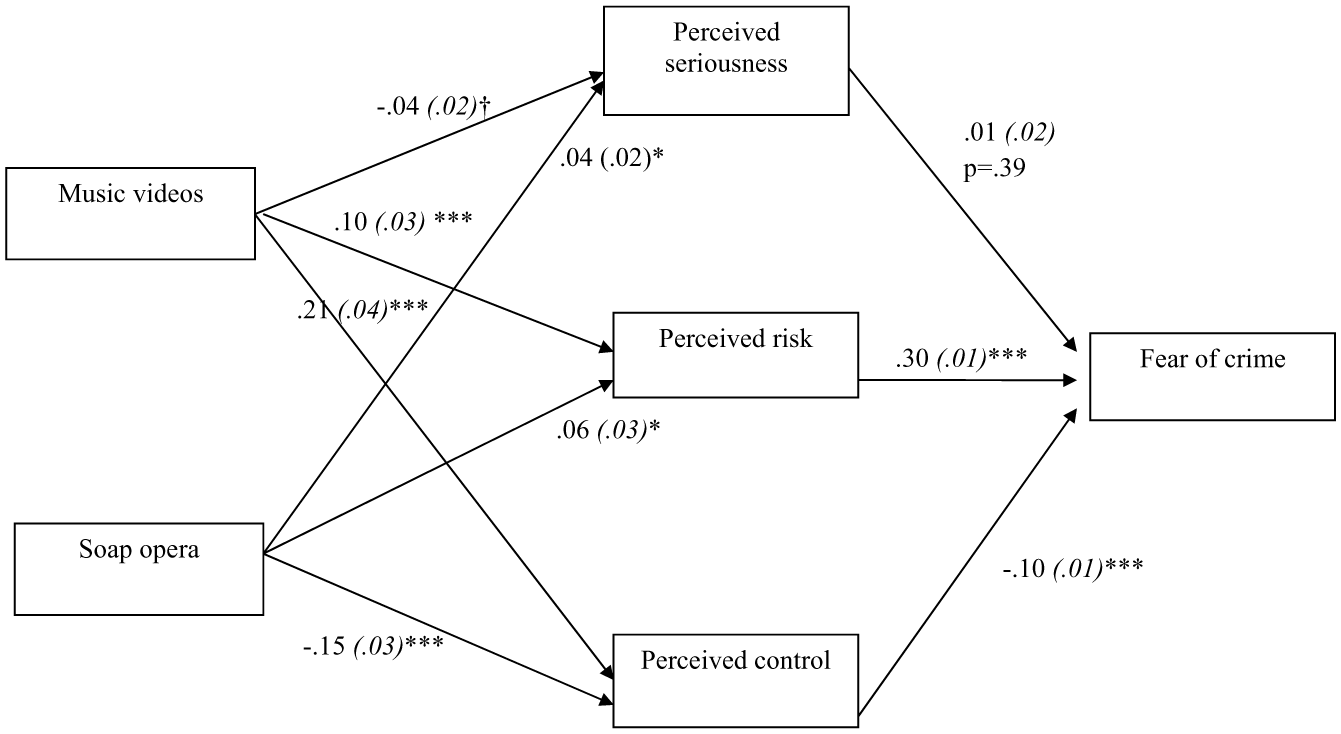
Multiple mediation model using the PROCESS Macro by Hayes (2013).
Unstandardized Betas in Full Model for Control Variables.

Note. Coefficients are reported as unstandardized coefficients (SE).
p < .05. **p < .01. ***p < .001.
As predicted, there was a significant positive association between soap opera and music video viewing and perceived risk of criminal victimization. The more frequently one watched music clips (b = .10, p < .001) and soap operas (b = .06, p = .05), the higher one perceived his or her risk of becoming a victim of crime to be. This means that H1a and H1b were supported.
As predicted, there was a positive relationship between music video exposure and the perception of one’s own ability to control crime. Watching music videos more frequently was associated with perceiving one’s ability to control crime to be higher, which was in line with H2a. As predicted in H2b, there was a negative relationship between music video exposure and perceived seriousness of crime, but this association was only marginally significant (p < .10).
As predicted by H3a, there was a negative relationship between soap opera viewing and perceived ability to control crime. Frequently watching soap operas was related to more negative perceptions of one’s own ability to control crime. As expected, there was a positive relationship between exposure to soap operas and perceived seriousness. Watching soaps frequently was related to perceive crime as more serious, which corroborated H3b.
In line with H4, the relationship between exposure to music videos and soap operas and fear of crime was mediated by perceived risk, perceived control, and perceived seriousness. With respect to music video exposure, the results showed that the total indirect effect of music videos on fear was not significant. However, bootstrap analyses showed that the specific indirect paths from music videos to fear through perceived risk (b = .03, SE = .01, 95% CI [.01, .05]) and perceived control (b = −.02, SE = .005, 95% CI [−.03, −.01]) were significant. The path through perceived risk was associated with increased levels of fear while the path through perceived control was associated with decreased levels of fear of crime. Another significant indirect path of music videos to fear passed through all three mediators and led to higher levels of fear (b = .001, SE = .0003, 95% CI [.0003, .002]). This means that H4 was supported.
Regarding the indirect effects of soap opera viewing on fear of crime, the results showed that the total indirect effect of soap opera viewing on fear of crime through all three components was significant (b = .03, SE = .009; 95% CI [.02, .05]). The indirect paths of opera viewing on fear through perceived risk (b = .02, SE = .008, 95% CI [.001, .034]) and perceived control (b = .02, SE = .004; 95% CI [.009, .02]) were significant and led to higher levels of fear. An indirect path from soap opera viewing to fear passed through both perceived seriousness and perceived risk (b = −.001, SE = .0007, 95% CI [−.003, −.0002]) and led to lower levels of fear. A final indirect path passed through all three factors and was associated with a decrease in fear of crime (b = −.0006, SE = .0002, 95% CI [−.001, −.0002]).
Test of Moderated Mediation Models
Moderation by gender
We conducted moderated mediation analyses using the SPSS macro PROCESS (Hayes, 2013) to test H5a and H5b. We used Model 7 which tests the conditional direct and indirect effects of soap opera and music video viewing on fear of crime through perceived risk, control, and seriousness. The moderated mediation models controlled for age, level of education, direct experience with crime, as well as overall TV viewing.
First, H5a predicted that the direct paths between both TV genres and the cognitive predictors of fear were moderated by gender. We found that, regarding soap opera viewing, only the direct path between soap opera viewing and perceived seriousness of crime was moderated by gender. The positive association between soap opera viewing and perceived seriousness was stronger in boys than in girls (b = .08, SE = .04, 95% CI [.00, .15]). Regarding music video exposure, we found that the direct path between music video exposure and perceived risk was moderated by gender. Watching music videos more frequently was related to higher levels of perceived risk in girls than in boys (b = −.20, SE = .06, 95% CI [−.32, .09]). The direct path between music video exposure and perceived control was moderated by gender too. The positive association between music video exposure and perceived ability to control crime was stronger in boys than in girls (b = .15, SE = .07, 95% CI [.009, .29]). This means that H5a was only partially confirmed.
Second, regarding H5b, which predicted that the indirect effects of both TV genres on fear through the cognitive predictors of fear was moderated by gender, we found that only the indirect paths through perceived risk and perceived control were moderated by gender. The indirect path between both TV genres and fear through perceived risk was only significant for girls (soap operas: b = .03, SE = .01, 95% CI [.007, .05]; music videos: b = .06, SE = .01, 95% CI [.04, −.09]). Only in girls, frequent exposure to soap operas and music videos was indirectly related to higher levels of fear through perceived risk. The indirect path between both TV genres and fear through perceived control was significantly stronger in boys (soap operas: b = .03, SE = .007, 95% CI [.015, .042]; music videos: b = −.04, SE = .008, 95% CI [−.05, −.02]) than in girls (soap operas: b = .01, SE = .006, 95% CI [.002, .024]; music videos: b = −.02 SE = .007, 95% CI [−.03, −.005]). Watching soap operas more frequently was associated with increased levels of fear through perceived control. Watching music videos more frequently was associated with decreased levels of fear through perceived control. Both indirect paths were stronger in boys than in girls. This means that gender moderated only the indirect paths between both TV genres and fear through perceived risk and perceived control, meaning that H5b was partially supported.
Moderation by age
To test whether age moderated the direct paths between both TV genres and the cognitive predictors of fear (H6a) the interaction of age was probed by using the Johnson-Neyman (J-N) technique, which detects the values within the range of age for which the association between TV exposure and the cognitive components were statistically different from zero (Hayes, 2013). To test whether age moderated the indirect paths between exposure to music videos and soap operas on fear through the cognitive predictors of fear (H6b), we probed the interaction at three values of age: one standard deviation below the mean (age = 13.23), the mean (age = 14.93), and one standard deviation above the mean (age = 16.64; Hayes, 2013).
First, regarding H6a which predicted that age would moderate the direct paths between both TV genres and the cognitive predictors of fear, we found that only the direct path between soap opera viewing and perceived seriousness of crime was moderated by age, b = .02, SE = .01, 95% CI [.004, .043]. The relationship between soap opera viewing and perceived seriousness was significant when respondents were 14.69 years old and older. In addition, regarding the direct paths between music video exposure and the cognitive predictors of fear, we found that the direct path between music video exposure and perceived seriousness of crime was significant only in respondents between 12 and 14.55 years old, b = .04, SE = .01, 95% CI [.02, .07]. This means that age moderated only the direct path between exposure to both TV genres and perceived seriousness, meaning that H6a was partially supported.
Second, H6b predicted that age would moderate the indirect paths between both TV genres and fear through the cognitive predictors of fear. Regarding soap opera viewing, the indirect path through perceived risk and perceived control was moderated by age. Frequent exposure to soap operas was indirectly related to higher levels of fear through perceived risk only in the mean age group, b = .017, SE = .008, 95% CI [.0004, .033]. Frequent exposure to soap operas was indirectly related to higher levels of fear through perceived control too. This indirect relationship became stronger when the respondents were older—the younger age group (−1 SD): b = .014, SE = .005, 95% CI [.005, .025]; the mean age group: b = .015, SE = .004, 95% CI [.009, .024]; the older age group (+1 SD): b = .017, SE = .005, 95% CI [.008, .028]. With regard to music video exposure, the indirect path through perceived risk was only significant in the mean age group (b = .03, SE = .01, 95% CI [.013, .052]) and the older age group (+1 SD: b = .05, SE = .01, 95% CI [.022, .076]). In addition, frequent exposure to music videos was associated with lower levels of fear through perceived control. This association became stronger when the respondents were younger—the younger age group (−1 SD): b = −.02, SE = .006, 95% CI [−.03, −.01]; the mean age group: b = −.02, SE = .005, 95% CI [−.03, −.01]; the older age group (+1 SD): b = −.019, SE = .006, 95% CI [−.03, −.008]. This means that age moderated only the indirect paths between both TV genres and fear through perceived risk and perceived control, meaning that H6b was partially supported.
Discussion
We aimed to contribute to the existing literature in two ways. First, prior research on the TV-fear association has overlooked adolescents. This is remarkable, considering the fact that adolescents consume a large amount of violent media. Even more important is the fact that adolescents are more vulnerable to media messages than adults due to transformations they go through during the transition from childhood to adulthood. Second, the current study examined two TV genres, soap operas and music videos, which have not yet been examined in prior research on the relationship between TV exposure and fear of crime.
Based on the findings of the current study, three conclusions can be drawn. First, it is important to take into account music videos and soap operas in the TV-fear association. Consistent with our hypotheses, soap opera and music video exposure were positively related to perceived risk of criminal victimization. This is in line with the heuristic processing model (see Shrum, 2009). Prior research already showed that watching soap operas is related to higher prevalence estimates about the incidence of crime (Shrum, 1996), the estimated percentage of people who will die a violent death (Potter & Chang, 1990), and the number of people who have committed a serious crime (Perse, 1986). Our results showed that soap opera viewing is associated with people’s perceptions of personal risk of victimization too. In addition, consistent with our predictions, soap opera and music video viewing were related to perceived control and perceived seriousness. Exposure to music videos was related to perceiving one’s ability to control crime to be higher, whereas soap opera viewing was related to perceiving one’s ability to control crime to be lower. Exposure to music videos was related to perceiving crime to be less serious, whereas soap opera viewing was associated with perceiving crime to be more serious. We hypothesized that the context of the violence may explain these opposing associations. Compared with other TV genres, music videos portray violence consistently without showing harm or suffering of the victim, and without punishment (Smith & Boyson, 2002; Smith et al., 1998). Repeated exposure to these glamorized and sanitized violent instances may cultivate perceptions of crime as less serious and therefore relatively easy to cope with. A key feature of soap operas, on the other hand, is their focus on the characters’ lives and their emotional relationships. This allows viewers to form strong bonds with the soap’s characters, which makes it more likely that viewers become immersed into the soap’s story and identify with some of the characters (cf. the Transportation-Imagery Model by Green & Brock, 2000). The melodramatic character of soap operas demands that if a character becomes a victim of a crime, this victimization and the seriousness of the consequences for the victim’s life will often be emphasized or even become a separate storyline of the soap. As a result, soap opera viewers may cultivate the perception of crime as more serious and the perception of one’s own ability to cope with crime as lower.
Second, this study supported the view of a mediated fear model which posited that television exposure is indirectly related to fear of crime through perceived risk, perceived control, and perceived seriousness. As predicted, our results showed that the relationship between soap opera and music video exposure on the one hand and fear of crime on the other hand was mediated by at least one of the three cognitive factors. Depending on the pathway, exposure to soap operas and music videos was associated with either decreased or increased feelings of fear.
Third, our findings showed that not all adolescents were equally vulnerable. Some relationships differed significantly depending on age and gender. Our findings suggest that the age of 14 to 15 is pivotal as this is when some relationships switched from being significant to being non-significant or the other way around. Some relationships were moderated by gender. Perceived risk appeared to play a bigger role in girls than it did in boys, while perceived control appeared to have a bigger effect in boys. This supports our hypotheses regarding differences in socialization. Many girls are still raised to be fearful and to perceive risks to be high and important, while boys tend to be raised to feel in control of risks and more able to deal with physical threats.
Limitations
The current study has a number of limitations. First, the analyses are based on cross-sectional data. It is therefore not possible to interpret our findings in terms of causal order. It is possible, for instance, that the relationship between TV exposure and the three cognitive components of fear should be interpreted in reverse order. In other words, those adolescents who estimate their ability to cope with crime to be higher may be more likely to watch music videos, whereas those who are less certain about their ability to control crime may be more likely to watch soap operas. Second, this study was based on self-reports. As remarked by Sutton and Farrall (2005), it is possible that boys in particular may have underestimated their risk of victimization and levels of fear while they may have overestimated their ability to cope with crime. The differences in gender socialization with respect to fear, as referred to throughout this article, might also apply to differences between boys and girls regarding their willingness to report feelings of fear and perceptions of risk.
Second, the current study refers to Shrum’s heuristic processing model to explain the relationships we found from a cultivation perspective. Shrum’s model argues that perceptions are constructed based on the information that is most accessible in memory rather than by systematically searching for all relevant information available in memory. However, the present study did not empirically test the heuristic processing of information. There was no attempt to manipulate the way in which respondents processed information. Shrum (2001) tested whether a (heuristical vs. systematic) processing strategy moderated the cultivation effect. He found no cultivation effect in those participants who were induced to process systematically. He did find similar cultivation effects in the control condition in which participants did not receive any manipulation and in the heuristic condition in which participants were asked to give the first answer that came to mind. Shrum’s (2001) research suggested that the methodology used by our study most likely leads to heuristic processing in most respondents.
Third, the model proposed in Figure 1 and the additional moderation analyses led to a considerable number of statistical tests. While it is customary to acknowledge the risks of multiple testing when ANOVAs are run with categorical variables, a similar, though usually unacknowledged, risk exists when large numbers of regression analyses are run and when many variables are entered (see O’Keefe, 2003). In summary, the multiple testing problem occurs when many analyses result in a number of significant results that are significant by chance, even though the null hypothesis is true. There is a lot of discussion on whether corrective measures should be taken, with some advocating complex statistical solutions (cf. Gelman, Hill, & Yajima, 2012) and others claiming that no correction is needed (Rothman, 1990). As it has been argued that the risk of false negatives is as detrimental for research as the risk of false positives or false discoveries (Moerkerke, Goetghebeur, De Riek, & Roldán-Ruiz, 2006), which is what communication scholars seem to worry about most, the extent to which the problem should be dealt with outside of ANOVA is far from clear. The current study attempted to minimize the risk of false discoveries by testing only those relationships predicted by the literature and the model based on that literature (cf. Jöreskog & Sörbom, 1993). Ultimately, the real test of a model must lie in repeated replication of its findings, to weed out the false positives as well as the false negatives from among the real relationships (Koole & Lakens, 2012)
Lastly, more research about the role and meaning of violence and victimization in soap operas and music videos would help develop further the hypotheses put forward in this article.
Conclusion
This study should be seen as an exploratory study that examines the role of TV exposure in adolescents’ fear of crime. It confirms the view that television is an important window to the world of crime for adolescents. Drawing on our findings, future research should investigate further the Mediated Fear Model in adolescents by focusing on other important moderating variables such as delinquent peer association and parental attachment, which have been shown to be associated with adolescent fear of crime (Cops, 2010; Swartz et al., 2011). Moreover, TV is no longer the only important distributor of stories about the real world. It has been argued that cultivation effects of video games should be studied as well (Van Mierlo & Van den Bulck, 2004). So far, most research on the effects of violent video games has focused on aggression. However, given that they offer players examples of how to control crime, violent video games might affect players’ perceptions regarding the ability to control real-life crime too.
Footnotes
Declaration of Conflicting Interests
The authors declared no potential conflicts of interest with respect to the research, authorship, and/or publication of this article.
Funding
The authors disclosed receipt of the following financial support for the research, authorship, and/or publication of this article: This research was funded by the Research Foundation Flanders.