



Abstract
The presence of non-humans in media narratives - for example, in the supernatural genre - may make salient that we are all human. According to the common ingroup identity model, the human superordinate category should influence attitudes toward lower-level outgroups. The present study examines this in the context of ethnic outgroups, specifically African Americans. Similarity of supernatural villains to humans was manipulated to influence whether “human” was a relevant superordinate group. Additionally, character race was varied to understand the influence of group diversity cues. Consistent with the common ingroup identity model, exposure to a Black human character fighting non-humans reduces prejudice toward African Americans, and this reduced prejudice generalizes to other minority groups. Results suggest a complex relationship between exposure to supernatural villains and diversity cues on attitudinal outcomes, with identity as human as one possible mechanism for reducing prejudicial attitudes.
The supernatural drama Sleepy Hollow premiered on September 16, 2013, with over 10 million viewers tuning in, the highest number for a FOX pilot in 7 years (Mitovich, 2013). Notably, Sleepy Hollow has garnered attention for not just its popularity and success but also the diversity of its cast; three out of six regular cast members and four out of nine recurring cast members are non-White actors. The success of Sleepy Hollow has been attributed to a mixture of its genre and diversity, the combination of which seems to be a winner with the audience (Deggans, 2013). Importantly, Sleepy Hollow is not the only example of the supernatural and science fiction genre to be an immensely popular hit; the Twilight series, The Walking Dead, Harry Potter, and Buffy the Vampire Slayer have all drawn large audiences. However, there has been little research on the supernatural genre and how it affects viewers.
Unfortunately, diversity in media is, for the most part, still lacking (Tukachinsky, Mastro, & Yarchi, 2015). A recent report on Hollywood diversity found that minorities and women are grossly underrepresented in film and television (Hunt, Ramon, & Price, 2014). This was the case both in front of and behind the camera. There was some variability across different genres, but in no sector of film and television were minorities or women proportionately represented (Hunt et al., 2014). Specific to African American representation, although their representation was on an upward trend in the 1980s and 1990s, depictions of African Americans have dropped in the last decade or so (Tukachinsky et al., 2015). Importantly, however, ethnic diversity in actors and actresses is starting to be seen by networks as good for business (Deggans, 2013). With what will hopefully be an increase in the representation of minorities and women in television and film in the near future, it will be important to understand how changes in diversity representations might influence viewers. One possibly important aspect of the supernatural genre, specifically, is that it contrasts traditional racial and ethnic group divides against a new divide between humans and supernatural creatures. This new, superordinate outgroup may influence ingroup-outgroup issues between lower-level identity groups such as racial and ethnic groups. And, these processes may have implications for our understanding of media effects on racism and prejudice, indicating that there may be important and as-yet untested genre effects involved.
Specifically, exposure to this new supernatural outgroup may make human ingroup status more relevant, leading people to at least temporarily change their most salient group categorizations and affiliations. When thinking about the ingroup in terms of “human,” ethnic groups under the “human” umbrella may seem more or less distinctive depending on whether the superordinate category of “human” is represented as homogeneous or diverse. If this is the case, we should expect a decrease in negativity toward racial outgroups when the relevant category of “human” is perceived as diverse (e.g., including minority groups) compared with when the relevant category of “human” is seen as homogeneous or “White.” The present experiment uses the common ingroup identity model as a lens for examining the effect of exposure to the supernatural genre on attitudes toward racial outgroups. In particular, we test whether the presence and distinctiveness of a non-human supernatural villain, coupled with the human characters being presented as homogeneous or diverse, affect attitudes toward African Americans and toward minority groups in general through the mechanism of strength of identification with the identity category of human.
The Supernatural Genre and Common Ingroup Identity
One potentially important aspect of the supernatural genre is that it tends to pit humans and supernatural creatures against one another. In some cases, the narrative is presented from the supernatural characters’ points of view, making non-supernatural humans the outgroup (e.g., True Blood, Harry Potter and non-magic “Muggles”). However, it is more typically the case that humans are the protagonists, with supernatural creatures playing the role of villain (e.g., Sleepy Hollow, The Walking Dead, and Supernatural). This conflict between humans and supernatural creatures is the focus of the present study. This is because this conflict should make being “human” the clearest ingroup that then acts as a viewer’s superordinate identity category.
Self-Categorization and Group Identities
There are three levels of identity according to self-categorization theory: personal, group, and human (Turner, Hogg, Oakes, Reicher, & Wetherell, 1987; Turner & Oakes, 1989). When personal identity is salient, personal roles and attributes are most predictive of behavior. On the second level, group membership is most salient, and identity is based on social groups (Hornsey, 2008; Stets & Burke, 2000). This level of self-categorization propels much of the research on race, ethnicity, and nationality, with a focus on how different groups view each other when those group-level identities are salient (Blascovich, Wyer, Swart, & Kibler, 1997; Mastro & Kopacz, 2006). When self-categorizing into a group-level identity, the self is perceived as more similar to ingroup members and less similar to outgroup members, and the ingroup is judged as superior to the outgroup (Hornsey, 2008; Turner et al., 1987).
The most abstract identity in self-categorization theory is labeling the self as human, in which the superordinate category of “human” subsumes other possible identities. When identity as human is salient, group and personal identities become secondary and therefore should have fewer effects on attitudes and behaviors (Hornsey, 2008; Turner et al., 1987). Previous work on intergroup relations and the human identity has found that reminders of human categorization can increase positivity toward outgroups, including forgiveness of groups that have done wrong in the past (Wohl & Branscombe, 2005). According to self-categorization theory, the human identity is always in the background of any identity situation. However, it is not typically the most salient identity unless something external makes it more salient (Hornsey, 2008). It is this superordinate human ingroup category that we focus on in the present study. The supernatural genre may be a unique media context that increases the relevance of the human identity. This is because supernatural creatures may constitute an overarching outgroup that lies in contrast to humans, making “human” the more relevant identity than lower-level groups.
Self-categorization emerged from work on social identity theory (SIT; Tajfel & Turner, 1986). SIT predicts that the presence of ingroups and outgroups will often predict ingroup favoritism. The theory has been applied to media effects in intergroup processes, largely finding support that SIT can help predict how people will react to outgroups in the media (Mastro, 2003; McKinley, Mastro, & Warber, 2014). However, although SIT is relevant to the present work as a precursor to self-categorization and the common ingroup identity model, the present experiment involves more specific theoretical predictions about identity category levels.
The common ingroup identity model
The common ingroup identity model is one perspective that focuses on the outcomes associated with changing identity categories (Gaertner, Dovidio, Anastasio, Bachman, & Rust, 1993; Gaertner et al., 2000; Nier et al., 2001). The model states that changes in environmental or perceptual cues can alter cognitive representations of groups (Gaertner et al., 2000). These cognitive representations can involve seeing people as just individuals (i.e., the personal identity level in self-categorization theory), as members of two groups (e.g., racial groups like Whites and Blacks), or as one group (e.g., humans; Gaertner et al., 2000). Importantly, this single group could be conceptualized as either a homogeneous ingroup (e.g., White humans), or as a heterogeneous group containing two or more subgroups (e.g., we are all humans but some of us are White and some of us are Black). According to the model, this dual identity where multiple subgroups remain salient within the larger group may be a key aspect of reducing prejudice toward target subgroups, as well as generalizing that reduction in prejudice to other minority subgroups (Gaertner et al., 2000). This occurs because the positive attitude toward the superordinate group representation provides a mechanism for the generalization of that positive attitude to the other subordinate groups. The transfer of a positive attitude to the subgroups occurs when the superordinate common ingroup category is the strongest identity, but other subgroups remain accessible within that representation (Gaertner et al., 2000). In addition, previous work on imagined contact has found a similar “secondary transfer” effect, where positivity toward the target group is also associated with positivity toward other minority groups (Harwood, Paolini, Joyce, Rubin, & Arroyo, 2011; Pettigrew, 2009). Thus, when the superordinate identity of human is relevant and diversity cues are present, the subgroups should remain salient and be included in the common ingroup of human. In this case, prejudice should be reduced. However, when the human category is not relevant, then the categorizations should remain at the level of separate groups, and prejudice should remain high.
Much of the work on the common ingroup identity model has used real interactions and non-narrative experimental interventions to test its predictions, such as White and Black survey recruiters (Nier et al., 2001), or task-based groups (Dovidio, Gaertner, & Validzic, 1998). However, we predict that mediated contact through a narrative will have similar effects as actual contact. This is based on research on the parasocial contact hypothesis, that generally finds mediated contact with outgroups facilitates attitude change in a similar way as real contact (Schiappa, Gregg, & Hewes, 2005, 2006). If mediated contact does work in a similar way to real contact, it indicates that media will be a valuable context for studying the processes in the common ingroup identity model.
Representing Minorities in the Media
The present work can be situated with other research on the effects of media on attitudes toward minority groups, particularly work that explores the factors that will ultimately lead to reductions in prejudice. Many other studies have focused on the role of diversity in media exemplars and prejudice reduction as an outcome from a variety of perspectives. Some approaches that are related to the present work include the parasocial contact hypothesis (Schiappa, Gregg, & Hewes, 2005), exemplar activation (Bodenhausen, Schwarz, Bless, & Wänke, 1995), and cultivation theory (Mastro & Behm-Morawitz, 2005; Mastro, Behm-Morawitz, & Ortiz, 2007). As previously mentioned, the parasocial contact hypothesis predicts that the same intergroup positivity created through real intergroup contact can also occur through mediated contact. Studies from a parasocial contact hypothesis framework generally find that positivity toward other groups is achieved through sustained and positive mediated contact (Schiappa et al., 2005, 2006).
However, mediated contact is not always positive, as demonstrated by research on exemplars and cultivation. Exposure to individual characters from other groups in the media can either enhance or reduce prejudice and stereotyping, depending on the prior exemplars activated by the viewer and the positivity of the portrayals (Bodenhausen et al., 1995). Further, exposure to stereotypical exemplars over time is associated with an increased adherence to the stereotypical portrayals, especially for those who have little real contact with the target group (Mastro et al., 2007). In general, therefore, the effect of mediated intergroup exposure on attitudes toward other groups is complicated, and more work is needed to further identify moderating contexts. The present experiment expands on these previous lines of work to examine the context of the supernatural genre and its portrayals of varying levels of ingroups and outgroups. Importantly, the predictions of the common ingroup identity model are in many ways different from these other research contexts. Specifically, the common ingroup identity model predicts that outgroups will only be seen as positive when they are included in the common group. But outgroups should be included in the common group when both their similarities and their differences are salient (i.e., a dual identity). The role of dual identity and inclusion or exclusion from the common ingroup is a nuance that is not well-explicated in the other approaches to media and prejudice.
Present Study and Hypotheses
The present study uses a narrative from the supernatural genre to test our hypotheses. The narrative depicts human characters who are fighting two villains to rescue another human character. Relevance of the human identity category is manipulated by presenting the villains in the narrative as humans or as supernatural creatures with high or low similarity to humans. When the villains are actually human, the superordinate category should not be relevant. This is because the human identity is not normally accessible (Hornsey, 2008), and so the lack of an outgroup to contrast against humans would mean that lower group-level identity categorization processes should remain dominant. When the lower-level groups are the most relevant ingroup-outgroup distinction, cognitive representations would be of separate groups. In the case of the present study, we focus on racial and ethnic groups. In contrast, when the villains are supernatural creatures, it shifts the “us versus them” representation from lower-level racial/ethnic groups to one of “humans” as the relevant ingroup and supernatural creatures as the relevant outgroup. This should remind people to include “human” in their cognitive representations. This is especially the case when the creatures are very dissimilar to humans, as the increased contrast should make being human even more relevant. Therefore, if people are reminded of the superordinate category of “human” because the outgroup is non-human, participants should report higher identification with the superordinate human identity group.
In addition to manipulating relevance of the human identity category, the race of the main character was also manipulated. This acted as a manipulation of racial/ethnic diversity cues, in that having all the human characters be White represents low ingroup diversity, while the addition of a non-White main character increases diversity. Therefore, for half of the participants, all characters were White, and for the other half, the main character was Black with the other characters remaining White. We expect that the presence of diversity cues will moderate the effects of human category relevance on identity with the human ingroup.
The way that diversity cues should influence the effect of human category relevance on the strength of the human identity is based in the common ingroup model’s hypothesized variations in the possible cognitive representations of the ingroup. As a reminder, in the common ingroup model people can be represented as individuals, as separate groups, as one group, and as subgroups within an overarching group (Gaertner et al., 2000). We can use these different types of category representations to predict how identity as human should fluctuate based on the cues available. Specifically, we focus on predicting what will happen in the critical condition of when non-humans are present (i.e., the human category is relevant) and when diversity cues are present. The presence of non-human characters, coupled with reminders of the existence of racial subgroups, should result in the cognitive representation of one human group with subgroups included in that categorization. Thus, identity with the common human identity group should be high under these circumstances, and the representation of the group will include diversity. However, when there are no non-humans present (i.e., the human category is not relevant), no common ingroup is created and reminders of the existence of other subgroups through the presence of diversity cues should predict lower identification with the human category. This is because identification should be at the level of racial/ethnic subgroups and not the overarching human group:
Previous research on the common ingroup identity model has demonstrated effects of common ingroup identity on attitudes toward a subgroup-level outgroup (Gaertner et al., 2000; Nier et al., 2001). Therefore, we tested the effects of our manipulations on attitudes toward African Americans and toward minorities in general. Because identifying with the superordinate ingroup is a hypothesized mechanism through which reminders about the human identity will influence attitudes toward a group-level outgroup (Gaertner et al., 1993; Gaertner et al., 2000), we test identification with the superordinate identity category of human as a mediator. According to SIT, and, by extension, the common ingroup identity model, participants should be motivated to bolster the ingroup and derogate the outgroup. Thus, when participants report higher identification with the common ingroup identity of “human,” they should bolster fellow common ingroup members (including lower-level groups that fit under the superordinate identity umbrella) and derogate the superordinate outgroup (i.e., supernatural creatures; Hornsey, 2008; Tajfel & Turner, 1986):
This positivity toward the target group of African Americans, who are the group depicted as fellow humans, should also then generalize to other minority groups that were not depicted. This is based in previous work on generalization in the common ingroup identity model (Gaertner et al., 2000), as well as in related work on secondary transfer effects (Harwood et al., 2011; Joyce & Harwood, 2014). Research in these areas has found that attitudes toward the target group will predict attitudes toward non-depicted outgroups, and we expect to replicate this effect:
These hypotheses lend themselves to an overall moderated mediation model (see Figure 1). Specifically, we predict that the relevance of the human identity category, as manipulated by villain similarity to humans, will predict the mediator of identification with the superordinate human identity group. Identifying with the superordinate human identity group will mediate the influence of relevance of the human identity and predict attitudes toward African Americans. Attitudes toward African Americans will then predict attitudes toward minority groups in general. The indirect path of the mediation model will also be moderated by diversity cues, manipulated through the race of the characters in the narrative. It is this moderated sequential mediation model that will be directly tested.

Hypothesized moderated mediation model.
Method
Participants
Participants were 141 undergraduates from a large Midwestern university in the United States, who participated in the study for extra credit. Because the purpose of the study is to test the common ingroup identity model using African Americans as the target group–level outgroup, participants who self-identified as Black or African American (n = 15) were removed from analysis, leaving 126 participants. 1 Eighty percent of the remaining participants were White, 14% identified as Asian, and 6% as other (entries were Hispanic/Latino, and biracial); race was included as a covariate in analysis but did not account for significant variance in predicting any outcomes. For the remaining 126 participants, the average age was 20.56 years, and 85 (67.5%) were female.
Design
The present study used a 2 (diversity cues: present, absent) × 3 (relevance of human identity: not relevant, low relevance, high relevance) between-subjects design, using random assignment to determine condition. Diversity cues were manipulated using the race of the main character and the use of photographs. Relevance of the human identity was manipulated with the similarity to humans of the villains (human, highly similar to human, highly dissimilar to human), using a combination of photographs and text. Human villains should make the human category not relevant, as there is no other category to contrast against. Villains that are not human but are highly similar to humans should weakly increase relevance of the human category (i.e., low relevance), while villains that are not human and are highly dissimilar to humans should strongly increase relevance of the human category (i.e., high relevance).
Procedure
Upon arrival to the laboratory, participants provided informed consent and were led to a laptop. They were told that the purpose of the study was to understand how horror and fantasy elements affect memory. They filled out a pre-test that included questions about their exposure to the supernatural genre and their sex and race. The survey software then presented photographs of the characters. Males were always shown male characters, and females were always shown female characters, based on previous findings that people identify more readily with characters of their own sex (Hoffner, 1996), and to decrease possible confounds due to gender diversity. Participants were told to familiarize themselves with the photographs to facilitate their understanding of the story. Half of the participants were shown a photograph for the main character of a White person; for the other half, it was of a Black person.
In order to avoid stimulus sampling issues (Wells & Windschitl, 1999), there were multiple possible photographs for each character. Each participant was exposed to one main character photo out of a possible three Black characters or three White characters (all of which were gender matched to the participant), dependent upon diversity cue condition. For each of the other human protagonists there were three possible photographs, all of which depicted a White person, and each participant saw one of those three photographs for each of those human characters (again, gender matched to the participant). For the two villains, there was only one possible photograph each for each of the supernatural creature types, selected based on pilot testing (still gender matched, see “Stimulus readings” section for more detail). Across all possible photographs, there were therefore 378 possible combinations of characters, between main characters, other human characters, and the seven possible villain types (three least similar to human creatures, three most similar to human creatures, and the actual humans). Not all villains had an observable skin color (e.g., werewolves were covered in hair), but when a skin color was present, it was always White. Every effort was taken to keep photographs as similar and consistent as possible within character. For example, the main character, regardless of sex or race, was a young adult wearing a black leather jacket, standing against a plain background and looking at the camera.
Participants were then asked to read the story. The software timed participants (M = 308.66 seconds, SD = 112.56 seconds, minimum = 73.61 seconds, maximum = 750.53 seconds) to ensure that they were spending enough time reading the story. Practice read-throughs indicated that at least 60 seconds were required to understand the story, a threshold that all participants met. After participants finished the story they filled out the post-test measures, and were debriefed before leaving the laboratory.
Pilot testing of villains
There were two issues to consider in choosing which types of supernatural creatures to use as villains. First, they needed to be easily separated into levels of similarity to humans, from actual humans to most similar to humans to least similar to humans, to manipulate relevance of the human identity category. From a list of all currently airing television shows (including syndication) involving supernatural creatures, 10 possibilities were selected for pilot testing. They were vampires, werewolves, witches/wizards, aliens, ghosts, demons, frankensteins, mermaids, wildmen (e.g., sasquatch, yeti), and zombies. Participants (n = 94) were asked to rate each creature for similarity to humans (0 = not at all similar to humans, to 10 = extremely similar to humans): vampires (M = 5.53, SD = 3.07), werewolves (M = 3.57, SD = 2.56), witches/wizards (M = 5.90, SD = 2.92), aliens (M = 2.95, SD = 2.49), ghosts (M = 4.66, SD = 2.85), demons (M = 3.53, SD = 3.01), frankensteins (M = 3.62, SD = 2.80), mermaids (M = 4.32, SD = 2.65), wildmen (M = 3.25, SD = 2.55), zombies (M = 4.55, SD = 3.08). They also rated for realism (0 = not at all realistic, to 10 = extremely realistic): vampires (M = 2.44, SD = 2.71), werewolves (M = 2.11, SD = 2.57), witches/wizards (M = 3.82, SD = 3.12), aliens (M = 4.54, SD = 3.28), ghosts (M = 5.13, SD = 3.40), demons (M = 5.01, SD = 3.30), frankensteins (M = 2.01, SD = 2.44), mermaids (M = 1.90, SD = 2.33), wildmen (M = 3.44, SD = 3.10), zombies (M = 2.88, SD = 2.82). Realism was included as a criterion because it was deemed possible that it could be confounded with similarity to humans, where participants could find the creatures that were higher in similarity to humans to also be more realistic. Realism has been previously associated with narrative comprehension and engagement (Busselle & Bilandzic, 2008), so it was important to ensure that this would not be a confounding factor. The three creatures that we determined had the best balance of high realism and high similarity to humans were chosen for the most human condition (vampires, ghosts, and witches/wizards), and the three that had the best balance of high realism and low similarity to humans were chosen for the least human condition (aliens, demons, and werewolves).
The second issue to consider was the exemplar of each supernatural creature, as there is considerable variability in the genre. In order to present the prototypical version that was most represented in the participants’ minds, the pilot test included six possible versions of each type of creature based on depictions in popular media (e.g., depictions of aliens ranged from “little green men” to looking just like humans). Participants were asked to choose the version that they felt most closely represented that creature type to them. In most cases, the choice was overwhelmingly clear and we used the version that was chosen by the vast majority of participants (>57%). However, in the case of demons and witches/wizards, there was no majority so we chose the version with a plurality of votes (demons = 27%, witches/wizards = 37%).
Character names
As previously mentioned, character sex was matched to participant sex. The names for the characters were selected from a list provided by the U.S. Social Security Administration (Top 5 Names in Each of the Last 100 Years, 2012) of the most popular names of the past century. The main character (who would be either White or Black) was named Michael for males and Ashley for females. The other two human protagonists, a father and son or mother and daughter pair, were named Andrew and Christopher and Sarah and Jessica, respectively. The villains were John and William for males and Mary and Helen for females.
Stimulus readings
The stimulus reading for all participants was a modified transcript from an episode of the television show Supernatural. The episode was chosen for its believable use of non-human characters, as well as the fact that the human characters were fighting some sort of “other.” The goal of setting up an “us versus them” scenario was to more directly test the predictions of the common ingroup identity model. In the story (Supernatural, Season 7 Episode 11, “Adventures in Babysitting”), a teenager’s parent has been kidnapped by a pair of villains. The teen teams up with the main character to rescue the parent. Participants read the transcript from the last few minutes of the episode, beginning with the main character and teenager in a car scoping out the place the villains are hiding, through their attack on the villains and the subsequent fight and rescue. The readings stayed consistent across condition, with small details changed based on the type of creature the villains were. For example, when the villains were vampires, their fangs descended, but when they were werewolves, their claws came out. Otherwise, the story was the same across all participants.
Measures
The following are the measures that participants completed in the course of the study. Questions within composite measures were presented in randomized order.
Strength of human identity
The mediator of how closely participants identified with the superordinate identity group of humans was a modified version of the inclusion of the ingroup in the self scale (Gómez, Tropp, & Fernández, 2011; Tropp & Wright, 2001). The original scale was developed for research in interpersonal closeness (i.e., inclusion of the other in the self; Aron, Aron, & Smollan, 1992) but has since been repurposed as a measure of closeness or identification with an ingroup identity (Tropp & Wright, 2001). Participants were asked to indicate how close or distant they felt from humans as a group, using seven pairs of circles that begin far apart and gradually come closer together until they overlap almost completely (M = 3.83, SD = 1.34). Conceptually, this measure means that the more overlap in the circles, the more strongly participants felt identified with the ingroup of humans.
Ratings of minority groups
Participants rated minority groups using “feeling thermometers” ranging from 0 (very negative) to 100 (very positive) for each group. The groups were atheists, homosexuals, African Americans, illegal immigrants, Muslims, and Latinos. The rating for African Americans was singled out for separate analysis, due to the specific use of a Black character in the manipulation of human diversity (M = 71.63, SD = 22.72, minimum = 12.00, maximum = 100.00). The ratings for the other five groups were averaged to create a general measure of attitudes toward minority groups (M = 57.92, SD = 16.74, Cronbach’s α = .81, minimum = 21.67, maximum = 100.00). The general measure is important because it provides information about whether participants are only changing attitudes toward the group presented in the stimulus, or if the effect can be generalized to other groups. Previous work on the common ingroup identity model has found that having a common ingroup with subgroups also influenced attitudes toward groups not explicitly mentioned (Gaertner et al., 2000), indicating that this generalized effect should be expected.
Genre exposure
Exposure to the supernatural genre was measured by providing participants with a list of all television shows with non-human characters that were currently airing (whether for the first time or in syndication) at the time of data collection (N = 23 shows, for example, Vampire Diaries, Sabrina the Teenage Witch, Teen Wolf). Participants were asked to select the shows of which they have seen at least one full episode, and the number of shows selected was summed to create a measure of genre exposure (M = 4.81, SD = 3.33, minimum = 1, maximum = 13). Prior exposure was used as a covariate. This is because the single-shot nature of the present experiment may be influenced by the level of chronic exposure participants have had to the genre in general. Controlling for prior exposure allows us to more accurately pinpoint the influence of the manipulations on outcomes while accounting for the influence of previous experience with similar materials.
Results
Hypotheses were tested using structural equation modeling in STATA. The relevance of the human identity variable was treated as conceptually quasi-interval for the purposes of regression assumptions. Regression coefficients are unstandardized, and confidence intervals reported are 95% confidence intervals (CIs) with 1,000 bootstrap samples. Participant race and prior exposure to the supernatural genre were included as covariates in the model by regressing each of the three outcome variables (strength of human identity, attitudes toward African Americans, and attitudes toward other minority groups) onto them and saving the residuals for use in the model. This allows for the inclusion of the influence of participant race and prior exposure without the added complexity of adding their paths to the estimation. Neither was a significant predictor in the regressions of any outcome variable of interest (human identity: race, b = 0.01(0.11), p = .90, and exposure, b = 0.02(0.04), p = .56; attitudes toward African Americans: race, b = −1.96(1.92), p = .31, and exposure, b = 0.45(0.68), p = .51; general minority attitudes: race, b = 0.78(1.50), p = .60, and exposure, b = 0.42(0.53), p = .44).
The model and path results can be found in Figure 2. Fit indices indicate good model fit, with χ2(4) = 7.10, p = .13, comparative fit index (CFI) = .97, and standardized root mean square residual (SRMR) = .03. 2 The model accounted for 10% of the variance in strength of human identity, for 8% of the variance in attitudes toward African Americans, and for 50% of the variance in attitudes toward other minority groups. Hypothesis 1 predicted that increased relevance of the human category (villain similarity to humans) would be associated with an increase in identifying with humans as a group, and Hypothesis 2 predicted that the presence of diversity cues (main character race) would moderate this effect such that diversity would be associated with an increase in identity as human as relevance of the human identity increased. There was not a significant main effect of relevance of the human identity on strength of the human identity, b = −0.09(0.18), p = .61, 95% CI = [−0.44, 0.26]. Therefore, Hypothesis 1 was not supported. There was, however, a significant interaction effect between relevance of human identity and diversity cues on strength of human identity, b = 1.27(0.36), p < .001, 95% CI = [0.56, 1.98]; see Figure 3). Probing the interaction reveals that when the human category is highly relevant (e.g., the villain is highly dissimilar to humans), participants exposed to diversity cues in the form of a Black main character feel significantly closer to humans than do participants not exposed to diversity cues, b = 0.68(0.34), p < .05, 95% CI = [0.002, 1.36]. Conversely, when the human category is not relevant (i.e., the villains are actually human), participants exposed to diversity cues feel significantly less close to humans as a group than do participants not exposed to diversity cues, b = −1.01(0.35), p < .05, 95% CI = [−1.72, −0.32]. There was not a significant difference by diversity cues for the slightly relevant human category condition (i.e., villains that were similar to humans), b = −0.17(0.24), p = .49, 95% CI = [−0.65, 0.32]. In addition, when diversity cues are present, the effect of human category relevance on strength of human identity is significant and positive, b = 0.48, p < .05, 95% CI = [0.02, 0.95]. In contrast, when diversity cues are absent, the effect of relevance of the human category on strength of human identity is significant and negative, b = −0.79, p < .01, 95% CI = [−1.32, −0.26]. Thus, Hypothesis 2 was supported.
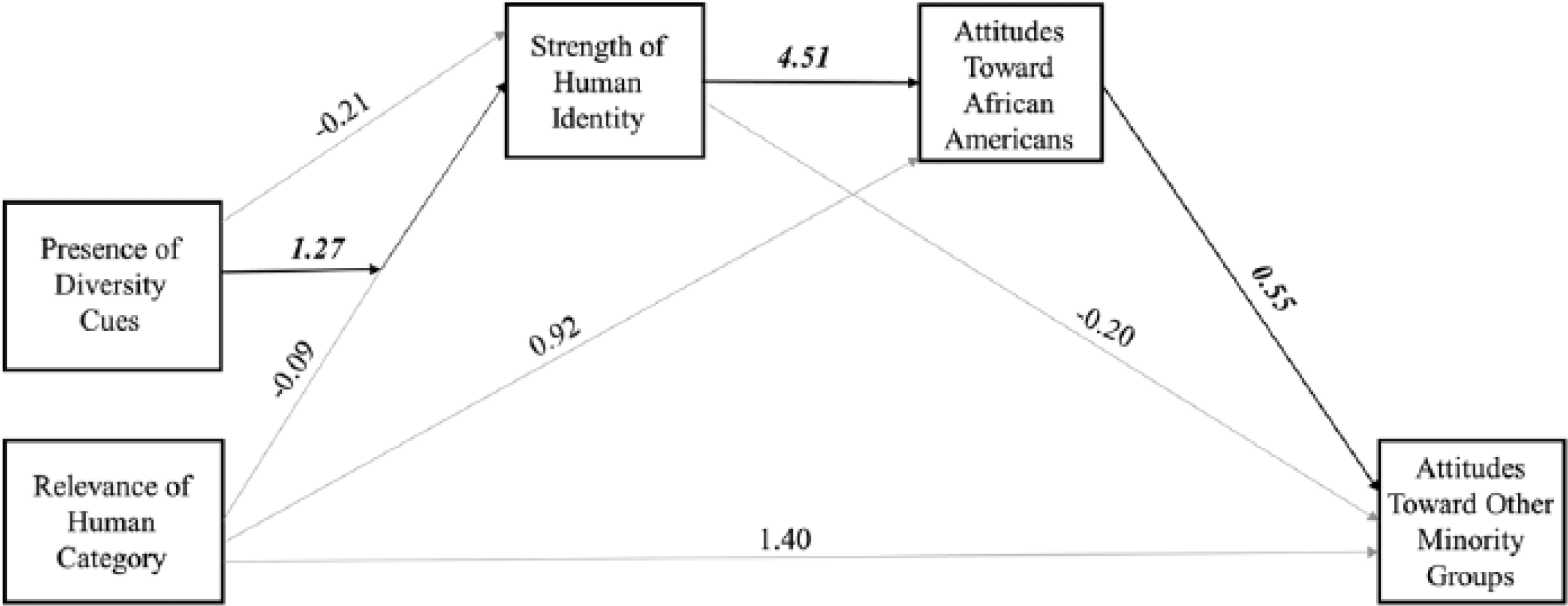
Moderated mediation model outcomes.

Interaction between human category relevance (villain similarity to humans) and diversity cues (character race) on strength of human identity.
Interestingly, the direction of this interaction indicates that lack of diversity cues in the form of exposure to all-White characters has the opposite effect as exposure to more diverse characters. This is the case in the all-human villain condition (low relevance of human category) as well as in the least-similar-to-humans condition (high relevance of human category). Consistent with the common ingroup identity model, when diversity cues were present participants felt less strongly identified with humans when the human category was not relevant, but more strongly identified with humans as a group when the human identity was relevant (i.e., the villains were highly dissimilar to humans). In the case of when the human group was not relevant because all characters were human, the presence of members of multiple groups without a common group to think about likely led participants to conceptualize people in terms of separate groups rather than as one group with many subgroups. Therefore, strength of identity with humans was reduced. However, when the villains were not human (reminding participants of the human category) and multiple groups were present, participants likely conceptualized humans as one group with many subgroups. Thus, strength of identity with humans was enhanced.
Hypothesis 3a predicted that identifying as human would mediate the effect of relevance of the human identity and diversity cues on attitudes toward African Americans, such that stronger human identity would be associated with decreased prejudice. Identifying with humans is a significant predictor of attitudes toward African Americans, such that the stronger the human identity, the more positive participants’ reported attitudes toward African Americans, b = 4.51(1.51), p < .01, 95% CI = [1.56, 7.47]. The direct effect of human category relevance on attitudes toward African Americans is not significant, b = 0.92(2.93), p = .76, 95% CI = [−4.82, 6.66]. The conditional indirect effect of the highest order interaction is significant, b = 5.73(2.23), 95% CI = [1.37, 10.09]. Breaking it down further, the conditional indirect effect of human category relevance on attitudes toward African Americans, through the mediator of identifying with humans and as moderated by diversity cues, is significant when diversity cues are present (i.e., the main character is Black), b = 2.18(1.22), 95% CI = [0.32, 5.29], and when diversity cues are absent (i.e., all characters are White, b = −3.54(1.57), 95% CI = [−7.57, −1.14]. A Black main character (presence of diversity cues) is associated with a positive impact of supernatural villains on identifying with humans and subsequently on attitudes toward African Americans, while a White main character (lack of diversity cues) is associated with a negative impact of supernatural villains on identifying with humans. Because the influence of identifying with humans on attitudes is positive, this negative effect on identification means that attitudes toward African Americans should end up affected negatively as well. Thus, Hypothesis 3a is supported.
Hypothesis 3b predicted that any change in attitudes toward African Americans would generalize to attitudes toward other minority groups. An effect on this outcome would indicate that these effects are not only important for attitudes toward the minority group specifically presented in the narrative, but also for multiple groups including those not explicitly referenced. Attitudes toward African Americans was a significant positive predictor of attitudes toward minority groups in general, such that an increase in positive attitudes toward African Americans was associated with an increase in positive attitudes toward other minority groups, b = 0.55(0.06), p < .001, 95% CI = [0.45, 0.66]. The direct effect of relevance of the human identity on attitudes toward minority groups in general was not significant, b = 1.40, p = .41. The indirect effect of the highest order interaction is significant, b = 3.18(1.23), 95% CI = [1.20, 6.22]. The conditional indirect effect of relevance of the human identity on attitudes toward minority groups in general, through the mediators of identifying with humans and attitudes toward African Americans, and as moderated by diversity cues is significant when diversity cues are present (i.e., the main character is Black), b = 1.21, 95% CI = [0.16, 3.14], and when diversity cues are absent (i.e., all characters are White), b = −1.96, 95% CI = [−4.28, −0.71]. A Black main character (presence of diversity cues) is associated with a positive impact of supernatural villains on identifying with humans, and thus on attitudes toward African Americans, and subsequently on attitudes toward minority groups in general. However, a White main character (lack of diversity cues) is associated with a negative impact of supernatural villains on identifying with humans. Because the influence of identifying with humans on attitudes is positive, this negative effect on identification means that attitudes toward African Americans are affected negatively, as are attitudes toward minority groups. This suggests support for the generalization effects of the common ingroup identity model (Gaertner et al., 2000) and for secondary transfer effects (Harwood et al., 2011; Joyce & Harwood, 2014; Pettigrew, 2009). Thus, Hypothesis 3b is supported.
Discussion
The present study tested the predictions of the common ingroup identity model in the context of the understudied supernatural media genre. The study focused on the supernatural genre because programs that feature supernatural creatures should create a superordinate outgroup against which the superordinate human identity category can be contrasted, and thus provide a test of the common ingroup identity model. This contrast should increase the likelihood that the superordinate ingroup category of “human” is made more relevant. Participants for whom the human category was made relevant through the presence of non-humans should feel closer to the superordinate human identity group, and, subsequently, may feel more positively toward lower-level racial outgroups that fit under the umbrella of “human.” However, diversity cues should moderate the influence of non-human presence on identifying with the superordinate human identity group. This is based in the predictions regarding cognitive representations of individuals in the common ingroup identity model (Gaertner et al., 1993; Gaertner et al., 2000). Specifically, when people are exposed to stories within the supernatural genre where the human ingroup is represented as diverse, people should be more likely to conceptualize racial groups as distinct subgroups within the common human ingroup. Their strength of identification with this common ingroup should then influence attitudes toward the subgroups that fit within the common group, making attitudes more positive. This was essentially the effect that was found in the present study. When the main character in the supernatural narrative was Black (i.e., diversity cues were present and the human category was highly relevant), participants reported stronger identification with the common ingroup of humans. This increase in identification with humans was associated with an increase in positivity toward African Americans, and this positivity also transferred to other minority groups.
However, it is important to note that diversity cues without the presence of a common ingroup actually predicted a decrease in viewers’ identification as human and therefore increased prejudice. This is presumably because participants had cognitive representations of separate racial groups instead of a representation of subgroups as part of a common human ingroup. According to the common ingroup identity model, it is this conceptualization of separate groups that contributes to prejudice (Gaertner et al., 2000). This cognitive representation could also potentially explain other negative effects of minority exemplars in the media (e.g., Mastro, 2009; Smith & Granados, 2009; Oliver, Ramasubramanian, & Kim, 2007). For example, in the case of media messages where multiple groups are shown but there are no human identity cues, the separate groups would most likely be conceptualized as distinct groups and prejudice should increase. Of course, negative effects of minority portrayals in media are more complicated than simply how ethnic groups are categorized (e.g., Bodenhausen et al., 1995). However, cognitive representations of groups as separate and without a common ingroup identity could contribute to negative media effects on prejudice.
It is also important to note that the results of the present study for attitudes toward African Americans also generalized to influence attitudes toward minority groups to which the participants were not directly exposed. In the present study, diversity was manipulated by the presence or absence of a Black character, but the effect of this manipulation was also seen on attitudes toward other minority groups that were not portrayed in the narrative, through the mediator of attitudes toward African Americans. This finding suggests that to the extent that the narrative influenced attitudes toward African Americans, those attitudes also influenced attitudes toward other minority groups. This indicates that many groups may benefit from the inclusion of a single minority group in supernatural narratives. This generalization effect is consistent with previous work on the common ingroup identity model (Gaertner et al., 2000). This effect is also consistent with previous work on secondary transfer and the contact hypothesis that has found that positive interactions (real or imagined) with outgroups are also associated with more positivity toward other groups (Harwood et al., 2011; Joyce & Harwood, 2014; Pettigrew, 2009). Unfortunately, when all characters in a supernatural narrative were White (representing a lack of diversity cues), all minority groups also suffered a subsequent increase in prejudice, attributable to the increase in prejudice toward African Americans.
It is important that in general, a positive change for one minority group can result in a positive change for other minority groups as well. Of course, proportional representation in media narratives for all minority groups is an important goal. However, the results of the present study indicate that, in the meantime, there may be some contexts where the inclusion of any minority group representation can benefit all. Future research should search for other media contexts where this might also be the case, and also pinpoint contexts in which the representation of an individual group is more important for determining attitudes toward that group.
Theoretical and Practical Implications
Theoretically, the results of the present study support and extend the common ingroup identity model (Gaertner et al., 1993; Gaertner et al., 2000). When people are reminded of a common superordinate ingroup and are reminded to include subgroups in their conceptualization of that ingroup, identification with the common ingroup is stronger and attitudes toward minority subgroups subsequently improve. But when there are no reminders of a common superordinate group, diversity cues have a negative influence. People are less likely to say they identify with the common ingroup, likely because they are categorizing people in terms of their distinct subgroups. This is then associated with more negative intergroup attitudes. Importantly, the present study extends the reach of the common ingroup identity model by applying it to a media context. The results indicate that the predictions of the common ingroup identity model are supported when contact is mediated, suggesting that real interactions are not necessary to influence cognitive representations of individuals and groups. This also, in effect, supports the parasocial contact hypothesis. The parasocial contact hypothesis states that intergroup contact in the media can have similar effects as real world contact. The present study provides more evidence for this hypothesis.
Practically, the results suggest important implications for the wide consumption of supernatural fiction, and for communication and media in general. As previously mentioned, the supernatural genre is popular. The results of this experiment suggest that steps can be taken on a practical level to harness the popularity of this genre to reduce prejudice toward minority groups. Specifically, although it is always important to strive for proportional representation in media for a variety of reasons, diversity may be especially important in the supernatural genre, or in any genre that creates superordinate identity groups. Content such as the supernatural drama Sleepy Hollow, with its introduction of an African American female as a protagonist and a diverse supporting cast, is a move in the right direction. However, diversity is lacking in many of the other popular supernatural franchises. In order to combat the potentially negative effects of supernatural narratives on attitudes toward group-level outgroups, leaders in the genre should take extra care to ensure a diverse cast of characters. The effects of the present study apply beyond the supernatural genre to media in general, as well. This is because the technological affordances of media mean that message producers can easily create real or artificial ingroups and outgroups that the common ingroup identity processes could apply to.
It is possible that the effects found in the present study are very short-lived in nature, and the practical recommendations we have provided would not actually have any long-term effects. This is because the higher-level human identity is not a natural category to maintain as most accessible, and people are likely to return to the lower-level identity categories eventually (Hornsey, 2008). If results like these only last during the program or shortly after, the importance of them is diminished. However, it is likely that these effects, even if short-lived on a one-shot basis, would build up across time. The chronic accessibility of concepts increases with the frequency and recency of activation (Roskos-Ewoldsen & Fazio, 1992). This means that the accessibility of the human category would likely increase over time for people who regularly watch a large amount of programming from the supernatural genre. Relatedly, the change in attitudes toward minority groups should also become more accessible across time.
Limitations and Future Research
The present study has some issues that limit the ability to draw conclusions. First, it is admittedly difficult to explain the effects when there were no diversity cues present (i.e., when all of the characters were White). In the case where the human identity category was not relevant (i.e., the villains were humans), it does make sense that identification as human would be lower for participants exposed to diversity because the diversity cues with no common ingroup present would make people more likely to categorize based on separate subgroups (i.e., Blacks and Whites). Thus, identity with the common group of humans should decrease as a result. This does not, however, explain why participants with no human category or diversity cues would be more likely to identify with the human category (and at the same level as those with both common group and diversity cues). It also does not explain why strength of human identity would decrease when participants were reminded of the human category and diversity cues were absent. It is possible that participants in this case only conceptualized people as a single group (White people) and not as humans in general, complete with subgroups. If this is the case, the jump to humans as a superordinate ingroup may not have been as strong. Work on the common ingroup identity model suggests that the common ingroup identity must be stronger than the subgroup identity in order to predict positive effects (Gaertner et al., 2000). Based on this, it is possible that participants in this condition held a weaker human identity and that was what was associated with increased prejudice. However, more research will be needed to determine what exactly is happening to the cognitive representations in those conditions.
Finally, measures meant to capture more spontaneous reactions (DeHouwer, 2006; Goodall, 2011) were not included in the present experiment. Therefore, any motivational biases that participants may have had could have affected their responses (Fazio, Jackson, Dunton, & Williams, 1995). However, the current experiment still found differences in participant responses to the explicit questions about the different minority groups. This indicates that there is something important happening even with motivation potentially influencing the results. Previous work on implicit and explicit measures has found that they predict different kinds of behavioral outcomes (Dovidio, Pagotto, & Hebl, 2011; Ewoldsen, Rhodes, & Fazio, 2014). For example, implicit responses are more likely to be associated with more automatic behavioral reactions, like nonverbal cues during interactions. Explicit responses, however, tend to predict more deliberative actions such as hiring decisions or mock jury verdicts. Therefore, both types of measures are important for predicting discriminatory behaviors. Future research should include implicit measures to examine this possibility.
Conclusion
Communication researchers have begun to examine the influence of genres on various outcomes (Bilandzic & Busselle, 2012), and the present study offers a new perspective for how the supernatural genre can affect attitudes toward minority groups. The results indicate that non-human villains in supernatural narratives have the potential to remind people of a common ingroup identity as human, and that process may be associated with changes in attitudes toward minority groups. The amount of diversity represented in the human ingroup further influences the effects of the supernatural villains. For the most part, a homogeneous White cast of characters in a supernatural narrative seems to enact more negative processes that bolster prejudice. But, when even a small level of diversity is introduced to a supernatural narrative (e.g., when one character is Black), it can reverse those processes. Prejudice against the group portrayed decreased as a result, and this decrease further predicted a decrease in prejudice toward other minority groups. Although television networks and film producers are beginning to agree that diversity in casting is a good thing (Deggans, 2013), diversity in media has historically been slow to catch on (Hunt et al., 2014; Tukachinsky et al., 2015). In the case of supernatural fiction, and of any narratives involving common ingroup identity processes, this new trend in favor of diversity is especially vital.
Footnotes
Declaration of Conflicting Interests
The authors declared no potential conflicts of interest with respect to the research, authorship, and/or publication of this article.
Funding
The authors received no financial support for the research, authorship, and/or publication of this article.