



Abstract
Isolating causal relationships is very difficult in natural discussion because discussion is, by nature, a causally complex interactive process. This study provides a novel approach to this problem by using simulated online discussion to experimentally manipulate message characteristics in a timed script that participants believed to be a discussion with other participants. In particular, we manipulated whether simulated online discussion partners expressed disagreement civilly or uncivilly. With this unique design, we examined how individuals differently react to opposing views in an online discussion setting depending on tone of disagreement expression. Our results showed that exposure to uncivil discussion results in increased negative emotions toward the other side, which in turn led to more closed-mindedness and more expression of disagreement with the discussion partner on the other side of the issue, although uncivil discussion and negative emotions are positively related to recall of the other side’s reasons.
Political deliberation is considered a “discursive system where citizens share information about public affairs, talk politics, form opinions, and participate in political processes” (J. Kim, Wyatt, & Katz, 1999, p. 361). Although advocates of deliberative democracy believe that political talk is at the heart of democracy, theorists assert that political talk itself cannot lead to the desirable outcomes of deliberation if it does not meet certain fundamental conditions (Bohman, 1999; Mansbridge et al., 2010; Thompson, 2008). In fact, to date, the findings from empirical studies on public deliberation seem to be mixed (e.g., Janssen & Kies, 2005; Ryfe, 2005). On one hand, numerous studies provide empirical evidence supporting the beneficial effects of political discussion especially on individual-cognitive reflection (e.g., Gastil & Dillard, 1999; Kim, Wyatt, & Katz, 1999; Price, Nir, & Cappella, 2006). On the other hand, however, studies have shown that public deliberation fails to produce beneficial effects especially on socio-intergroup-level variables such as lessening group conflict, increasing mutual understanding and tolerance, or promoting open-mindedness toward disagreement (Conover & Searing, 2005; Mendelberg & Oleske, 2000; Rosenberg, 2007).
Unfortunately, despite rich theoretical discussions in the literature about the necessary conditions for deliberation and the recent proliferation of empirical studies on deliberation, such mixed findings pose difficulties in understanding exactly why, how, and in what conditions political talks actually produce putative beneficial effects of deliberation. This is, in part, due to a lack of systematic empirical research isolating the effects of specific factors embedded in discussion. Although some survey-based studies provide valuable information about the effects of public deliberation by analyzing the consequences of participation in small group discussion over time (e.g., Price, Nir, & Capella, 2006), it is very difficult to identify what specific features of discussion are true causal factors for observed beneficial and/or detrimental outcomes of discussion because discussion is, by nature, a causally complex interactive process.
In this regard, Mutz (2008) argued that research on deliberative democracy needs to move from tests of normative deliberative theory per se, such as examination of whether public deliberation produces expected benefits, to development of “middle-range” theories that aim to test specific causal relationships between one or two conditions and outcome variables. Although such middle-range empirical research does not test deliberative theory per se, it can contribute to normative debates over positive and negative implications of political discussion by providing a common ground of empirical evidence and factual information about the effects of specific conditions.
In an effort to build and investigate “middle-range” theories of deliberation, this study offers a methodological innovation to identify and isolate causal relationships between conditions for deliberation and their outcomes. Using simulated online discussion in an experiment setting, we isolate the causal factors of interest from many possible confounds by controlling discussion contents and non-verbal cues. Among diverse factors, we empirically tested causal effects of two factors, exposure to disagreement and civility, which have been treated as core necessary conditions for deliberation (Mutz, 2008; Thompson, 2008). For this research goal, this study manipulates the reception of civil versus uncivil expression of disagreement within simulated online discussions and examines the effects of these received messages on emotions, cognitions, attitudes, and discussion behaviors to answer the questions whether, why, and how incivility has negative effects on deliberative processes independently and jointly with disagreement. More specifically, the focus of this study is on the role of negative moral emotions toward the uncivil attacker, which we term “moral indignation,” in explaining the erosive effects of discussion incivility on citizens’ minds, emotions, and behaviors.
Positive Versus Negative Consequences of Exposure to Disagreement
Hearing the other side has been considered as a necessary precondition for beneficial effects of deliberative discussion (Carpini, Cook, & Jacobs, 2004). In fact, prior studies have consistently shown that exposure to disagreement has positive effects on cognitive reflection at individual level, which in turn enhances sophistication of opinion, issue involvement, and participation (e.g., Ikeda & Boase, 2011; N. Kim, 2013; Price, Cappella, & Nir, 2002). However, successful deliberation, political talk among people who have differing views, contributes not only to individual-intrapersonal-level outcomes (e.g., opinion quality and political engagement) but also to socio-intergroup-level outcomes (e.g., favorable emotions, attitudes, behaviors toward disagreeable views or political outgroups), which are crucial indicators of a long-lasting deliberation process (Park, 2000). That is, favorable emotions, attitudes, and behaviors toward other citizens, especially those with different views, enrich diversity in political discussion by keeping individuals open to criticism of their opinions and their conduct, cultivating their ability to acknowledge differences of opinion and put a positive value on variations in opinion, and thus facilitating coordination and mutual understanding among citizens (Habermas, 1962/1989).
Despite its theoretical and practical importance, relatively few studies have investigated the effects of exposure to differing views on socio-intergroup-level outcomes. In addition, contrary to the expectations of deliberative theorists, empirical findings from research on message effects have consistently shown that counter-attitudinal messages often have corrosive effects on intergroup emotions and attitudes such as negative feelings toward the other side (De Dreu & van Knippenberg, 2005) and attitude polarization (Arceneaux, Johnson, & Murphy, 2012; Prior, 2013), instead of deliberative responses. Research on intergroup relation also shows that in some cases contact with outgroup members exacerbates conflicts and deepens intergroup confrontations (Mendelberg & Oleske, 2000).
Empirical findings about message effects and intergroup relations suggest that even though exposure to disagreeable views has beneficial effects on individual-cognitive reflection variables such as sophistication of opinion and political engagement, it does not necessarily mean that disagreement has an impact on socio-intergroup-level variables in the same, beneficial direction. Notably, research on disconfirmation bias suggests that hostile reactions to counter-attitudinal messages, which often lead to defensive bolstering and opinion polarization, can also increase systematic and in-depth processing of oppositional reasons (Edwards & Smith, 1996; Lee, Choi, Kim, & Kim, 2014; Taber & Lodge, 2006), which have been treated as central benefits of deliberation. For example, Taber and Lodge (2006) found that individuals took more time processing counter-attitudinal arguments than pro-attitudinal arguments. However, they also found that such effortful and in-depth processing of counter-attitudinal arguments led to hostile reactions to disagreeable views rather than deliberative responses by showing that the same individuals took more time denigrating, deprecating, and counter-arguing the incongruent arguments, which in turn led to defensive bolstering and opinion polarization.
Given that individual-intrapersonal outcomes such as awareness and knowledge of differing views may not differ between deliberative versus hostile responses to counter-attitudinal information, such findings suggest that whether hearing the other side in effect produces beneficial effects of deliberation may largely depend on whether it has beneficial or at least not detrimental effects on socio-intergroup-level variables (i.e., intergroup emotions, attitudes, and behaviors). Furthermore, these findings suggest that different psychological processes might shape individuals’ different reactions to disagreement. That is, both deliberative and hostile reactions to disagreement may lead to increased awareness of different opinions, but deliberative reactions are likely to result in open-mindedness to opposing views and favorable attitudes toward fellow citizens, while hostile reactions are likely to result in worsening inter-group antagonism and increased closed-mindedness. Unfortunately, however, the psychological processes underlying these two different reactions to disagreement have been a “black box” in deliberation studies (Mutz, 2008; Wesolowska, 2007). Although the research contexts have been quite different, theories and studies on social psychology provide valuable descriptions and explanations of the deliberative and hostile processes that might occur during discussion.
Theoretical support for the notion of these two different reactions to disagreement can be found in Kunda’s (1987, 1990) theory of motivated reasoning, which posits that people tend to use different reasoning processes depending on their motivation on a given occasion. According to this theory, the motives underlying all reasoning can broadly fall into two categories: accuracy goals, which motivate individuals to get accurate judgments and correct conclusions, and defensive goals (sometimes called directional or partisan goals), which motivate them to use their reason to defend or protect their prior attitudes and beliefs. Research on motivated reasoning has shown that accuracy goals lead to a more unbiased processing of information, whereas defensive goals lead citizens to engage in affective information processes that uphold the direction and strength of their biases (Strickland, Taber, & Lodge, 2011; Taber & Lodge, 2006).
When does defensive motivation prevail over accuracy motivation? What kinds of factors might prompt defensive motivation instead of accuracy motivation when individuals are exposed to disagreeable information? An identifiable source of defensive reasoning is perceived hostility. Research on defensive motivation suggests that opposing views may be seen as hostile against the self because one’s opinions have been incorporated into one’s self-concept. As a result, opposing views may prompt defensive motivation, resulting in less open-minded reasoning (Edwards & Smith, 1996) and more competitive or even retaliatory behavior instead of mutual respect (De Dreu & van Knippenberg, 2005).
The Role of Discussion Civility in Political Talk
Exposure to disagreement can have erosive consequences, especially when disagreement is expressed through unjustly attacking the opponents’ self or beliefs. Such attacks often “go beyond facts and differences, and move instead toward name-calling, contempt, and derision of the opposition” (Brooks & Geer, 2007, p. 1), which can be termed as “incivility.” To be more specific, incivility in the context of political discussion means expression of disagreement by denying and disrespecting the justice of the opposing views. For the purpose of this study, we term this “discussion incivility.” In contrast, discussion civility means expression of disagreement with an orientation toward understanding others’ views and respecting the rights of others (Kingwell, 1995). In the same vein, Mutz and Reeves (2005) distinguished incivility from civility of the discussion in their experiment study by inserting “gratuitous asides that suggested a lack of respect for and/or frustration with the opposition” (p. 5). Brooks and Geer (2007) operationalized incivility as use of words without respect for the opponent including “unthinking opponent,” “recklessly,” “dishonest,” “unprincipled,” “insensitive,” “heartless,” and “cowardly” in negative messages (p. 5). Based on this narrowly defined concept of incivility, we define incivility in this study as a violation of interactional social norms of politeness through expressing disrespect for, frustration with, and/or insults to an individual or a group that opposes one’s own views.
Civility as an interactional social norm represents a show of mutual respect between conflicting parties. Breaking the civility norm can generate negative emotions (Kingwell, 1995). In everyday life, people tend to respond with anger on receiving uncivil communication (Phillips & Smith, 2004). Because such emotions arise from a judgment of violation of interactional social norms, they are not only negatively valenced but also carry strong moral condemnation, which we label “moral indignation” in this study.
The concept of moral indignation can be linked to previous research on individuals’ emotional reactions to unjust hostile media content, referred to as “media indignation” by Hwang, Pan, and Sun (2008). Similar to media indignation, the concept of moral indignation includes anger, disgust, and contempt. As Hwang and his colleagues note, moral indignation has two characteristics regarding its cognitive antecedents. First, as the concept itself implies, moral indignation is rooted in certain moral judgments about the violation of normative or moral standards (Haidt, 2003; Tangney, Stuewig, & Mashek, 2007). According to cognitive appraisal theories, emotions are elicited by individuals’ subjective evaluations and interpretations of events (Frijda, 1988; Moors, Ellsworth, Scherer, & Frijda, 2013). In this sense, uncivil commentary by a discussion partner can be a key elicitor of moral indignation because it will be viewed as a violation of social and interpersonal norms. Previous studies have shown that others’ failure to adhere to the moral code elicits negative moral emotions such as anger, disgust, and contempt (e.g., Dalbert, 2002; Hafer & Correy, 1999). Thus, we predict that exposure to uncivil discussion will result in stronger moral indignation toward both like- and unlike-minded discussion partners than exposure to civil discussion (Hypothesis 1a [H1a]).
Second, in contrast to self-blaming moral emotions such as shame and guilt, moral indignation is a set of other-blaming moral emotions which are typically induced by others’ immoral behaviors, especially when such immoral behaviors are harmful to the perceiver’s interests and values (e.g., Haidt, 2003; Rozin, Lowery, Imada, & Haidt, 1999; Russell & Giner-Sorolla, 2013). In this sense, Izard (1977, 1993) clustered the three other-blaming moral emotions (anger, disgust, and contempt) as a “hostility triad” (see also Rozin et al., 1999). In the context of political discussion, unlike-minded discussants’ uncivil attacks on the perceiver’s opinion reflect not only immorality but also hostility, and thus may trigger stronger moral indignation than do like-minded discussants’ uncivil expression. In the inter-group context, acrimonious group conflict often intensifies group polarization and intergroup hostility, which leads to inter-group bias in emotions such as polarization of emotions toward ingroup versus outgroup members (Brewer, 2001; Hewstone, Rubin, & Willis, 2002). Therefore, we expect that moral indignation toward unlike-minded partner would be greater than moral indignation toward like-minded partner (Hypothesis 1b [H1b]) and such inter-group bias in indignation would be greater when participants are exposed to uncivil discussion than when they are exposed to civil discussion (Hypothesis 1c [H1c]).
Given that civility is an interactional social norm, uncivil attack targeting the self or ingroup can lead to strong moral condemnation, which erodes the justice or legitimacy of a discussion. In an experimental study, Ng and Detenber (2005) provided evidence for the effects of incivility on moral judgment of others. Reflecting civility as a social norm, their findings showed that incivility produces not only a hostile perception but also negative moral evaluations of online political discussants. These results suggest that incivility in the political discussion setting does have erosive consequences on one’s moral evaluations of other discussion participants, which leads to enhanced disconfirming expressions such as reduced expression of agreement and increased expression of disagreement with discussion partners. Thus, we expect that exposure to uncivil discussion will result in fewer expressions of agreement with both like- and unlike-minded discussion partners than exposure to civil discussion (Hypothesis 2a [H2a]) and greater expressions of disagreement with both like- and unlike-minded discussion partners than exposure to civil discussion (Hypothesis 3a [H3a]).
Kingwell (1995) pointed out that civility as moral justice rather than pure rationality reduces social friction, enabling persons with diverse interests to meet to talk with one another and reach collective decisions. In this sense, uncivil attacks may also have corrosive effects on intergroup communication behaviors by prompting inter-group hostility. In fact, previous research on the effect of uncivil expression in interpersonal relationship settings has consistently shown that verbal attacks targeting the self or ingroup produce consistent and strong hostile behavioral reactions (see Kinney & Segrin, 1998). Therefore, we expect that discussion incivility would have greater deleterious effects on discussion behaviors toward an unlike-minded partner than discussion behaviors toward a like-minded partner, so that participants would disconfirm an unlike-minded partner more strongly than a like-minded partner when they are exposed to uncivil discussion compared with when they are exposed to civil discussion. That is, participants would express agreement with unlike-minded partner less frequently than they would do with like-minded partner during discussion (Hypothesis 2b [H2b]) and such intergroup bias in agreement expression would be greater when participants are exposed to uncivil discussion than when they are exposed to civil discussion (Hypothesis 2c [H2c]). With a similar logic, we expect that participants would express disagreement with unlike-minded partner more frequently than they would do with like-minded partner during discussion (Hypothesis 3b [H3b]) and such difference would be greater when participants are exposed to uncivil discussion than when they are exposed to civil discussion (Hypothesis 3c [H3c]).
Hostile responses to uncivil attacks may have beneficial effects on individual-intrapersonal-level variables. For example, Brooks and Geer (2007) showed that uncivil attacks in political ads have some positive effects on political engagement. Other studies have also shown that uncivil negative information may grab receivers’ attention and thus enhance elaboration and recall of the information by showing that attack ads enhance message recall (e.g., Chang, 2001; Geer & Geer, 2003), knowledge about candidates (e.g., Niven, 2006), and interest in the campaign (e.g., Bartels, 2000). Thus, we expect beneficial effects of exposure to discussion incivility on recall of both like- and unlike-minded partners’ reasons such that exposure to uncivil discussion will result in a better recall of both like- and unlike-minded discussion partners’ reasons than exposure to civil discussion (Hypothesis 4a [H4a]).
Studies on confirmation bias and selective recall suggest that people are more likely to ignore, pay little attention to, or shallowly process counter-attitudinal information than pro-attitudinal information (Festinger, 1957; Hart et al., 2009). However, studies have also revealed that people can use more in-depth and effortful processing of counter-attitudinal information especially when they are highly motivated to defend their preexisting attitudes by disconfirming and/or counter-arguing oppositional views (e.g., Eagly, Kulesa, Brannon, Shaw, & Hutson-Comeaux, 2000). Disconfirmation of counter-attitudinal information resulting from strong defensive motivation typically requires enhanced elaboration of the information and thus leads to enhanced memory for it. Thus, we expect that participants would recall a like-minded partner’s reasons more correctly than an unlike-minded partner’s reasons (Hypothesis 4b [H4b]) and such confirmation bias in reason recall will be reduced in the incivility condition compared with the civility condition due to enhanced defensive motivation (Hypothesis 4c [H4c]).
Finally, civility as a foundation of one’s moral judgment of discussion partners or discussion procedure can also affect post-discussion attitudes toward disagreement. Studies have shown that individuals who feel that they are treated with respect and view decision-making procedures as just are more likely to be satisfied with the discussion and open-minded toward disagreeable views (Arvai, 2003; Colquitt, 2001; Weiner, Alexander, & Shortell, 2002). Thus, we expect that exposure to uncivil discussion would lead to less open-mindedness than exposure to civil discussion (Hypothesis 5 [H5]).
Moral Indignation as an Emotional Motivator for Reasoning and Discussion Behaviors
As suggested by the functional theory of emotions (Dasgupta, DeSteno, Williams, & Hunsinger, 2009; Frijda, 1988; Izard, 1977; Lazarus, 1991; Nabi, 1999, 2003), moral indignation in response to others’ uncivil discussion behaviors may spur an ego-defensive motivation to protect the beliefs that have been infringed on or damaged by such unjust hostile behaviors, which may lead to subsequent hostile responses toward the violator. When experiencing anger, for instance, there is a desire for revenge that may end up in an attack on the source of the anger (Izard, 1977; Lazarus, 1991; Nabi, 2002). Anger is believed to mobilize defensive or corrective behaviors for the purpose of defending oneself, defending one’s loved ones, or correcting some appraised wrong (Averill, 1982; Izard, 1977, 1993; Nabi, 1999, 2002). This is because anger serves an adaptive function related to psychological processes of ego-defense (Izard, 1977; Nabi, 2002; Pellitteri, 2002). Like anger, feelings of disgust often prompt defensive or hostile reactions such as withdrawing or breaking off contact with the offending party (Izard, 1977). Contempt also plays a motivational role in developing self- and ingroup-defense against the adversary such that it causes individuals to regard infringers as morally inferior, which sometimes results in prejudice toward social groups to which the infringers belong.
Following this conception, we argue that moral indignation resulting from uncivil attacks from an unlike-minded discussion partner may trigger a strong defensive motivation which leads to a disconfirmation bias in cognitive, attitudinal, and behavioral reactions to opposing views. First, we expect that moral indignation would spur people’s defensive discussion behaviors. Moral indignation resulting from perceived injustice is found to be a key motivating factor for actions, including actions to seek redress (e.g., Barclay, Skarlicki, & Pugh, 2005) and engaging in political activities aimed at correcting wrongs (Hwang et al., 2008; Pagano & Huo, 2007). In this regard, moral indignation invoked when beliefs or opinions are attacked in an uncivil way may result in a disconfirmation bias in discussion behaviors; disregarding or counter-arguing unlike-minded others’ arguments is seen necessary to right the opponent’s unjust hostile behaviors.
Second, we expect that moral indignation as a defensive motivator may increase attention to counter-attitudinal arguments, but at the same time stimulate closed-mindedness toward them. As Taber and Lodge (2006) noted, people’s hot cognitions charged by negative emotions toward a target motivate defensive goals that elicit in-depth processing of counter-attitudinal information. For example, people tend to engage in critical scrutiny of information which contradicts their prior beliefs and as a result spend more time processing attitudinally incongruent arguments than attitudinally congruent arguments. More germane to the current study, studies taking a functional approach to emotions have shown that experiencing message-induced anger and disgust often increases accurate recall of information (Nabi, 2002) and anger, disgust, and contempt also fuel negative attitudes toward the elicitors of those emotions (Lemerise & Dodge, 1993; Nabi, 2002).
In sum, moral indignation can be a useful concept for understanding when and how discussion incivility matters by providing a theoretical explanation about the effects of incivility on citizens’ cognitions, attitudes, and behaviors toward disagreement. That is, discussion incivility combined with disagreement can elicit moral indignation because uncivil attacks targeting individuals’ beliefs or opinions can be viewed as an unjust hostile behavior. In turn, such moral indignation as an emotional motivator can trigger disconfirmation bias in intergroup discussion behaviors, cognitions, and attitudes toward disagreeable views. Thus, we predict that moral indignation toward an unlike-minded partner mediates the effects of discussion incivility on the expression of agreement with the unlike-minded partner’s arguments (Hypothesis 6a [H6a]), the expression of disagreement with the unlike-minded partner’s arguments (Hypothesis 6b [H6b]), recall of the unlike-minded partner’s reasons (Hypothesis 6c [H6c]), and open-mindedness (Hypothesis 6d [H6d]).
Method
Experimental Design
A web-based experiment with participants enrolled in undergraduate courses at a large university was used for the study. The study was conducted in the spring of 2008. As the goal of the study was to explore individuals’ reactions to like- and unlike-minded discussion partners on the issue of withdrawal from Iraq, participants who reported that they did not have opinion or were neutral on the issue in the online registration process (n = 38) were asked to participate in an alternative study. A total of 230 individuals who had pro- or anti-withdrawal attitudes participated in the actual experiment. Participants who reported that the chat was not real (n = 17) and those who did not respond to key outcome variables (n = 2) were removed from the analyses (N = 211). ANOVA and cross-tabular analysis revealed no significant differences across experimental groups along any of the demographic and political orientation variables measured in the pre-experiment survey, including gender (75% of the participants were female), age (M = 20.21, SD = 2.24), party affiliation (M = 3.03, SD = 1.43, 1 = strong Democrat and 7 = strong Republican), and prior opinion about withdrawal (74.6% of the participants supported withdrawal, while 25.4% opposed withdrawal). Overall, the experiment consisted of a 2 (discussion partner: like-minded partner vs. unlike-minded partner) × 2 (discussion incivility: civil vs. uncivil) mixed factorial design, with the first factor varying within-participants and the other varying between-participants.
Participants first registered in a lab study session through an online registration process in which they were asked to report their opinion about withdrawing U.S. troops from Iraq, demographic information, and political orientations, and then to choose a time slot and a location for their study participation. One week after online registration, they participated in a scheduled session of the experimental study in a computer lab. On arriving in the lab, they first read a news article on the controversy over withdrawal of U.S. troops from Iraq. This was chosen as the topic of the chat room because it is a political question on which most people have preexisting opinions, yet is controversial enough that a chat room where the other two chatters take opposing views from one another (i.e., one supports withdrawal, the other opposes it) is plausible. The news article described the arguments of two conflicting sides of the issue in a balanced way. 1
After reading the news article, participants were randomly assigned to participate in 10 to 15 minutes of online chatting in which the issue covered in the news article was the topic of discussion. The online chat room was similar in appearance to a typical online chat room: Participants typed in comments, clicked a send button, and saw their comments appear in the chat window in sequence with other “chatters” (see Appendix A). In the chat room, participants saw instructions and comments ostensibly made by the moderator and other chatters, but the other “people” were in actuality a timed script in which the discursive civility was manipulated. To control discussion flow, participants were asked to follow the moderator’s instructions. Because the study was aimed at investigating participants’ reactions to other discussion partners’ expressions, the real participants were given their turns after the two simulated chatters’ turns. The simulated moderator first asked about the two simulated chatters’ thoughts about the issue in terms of whether withdrawal would be good for the Iraqi people, and then asked the same question to the participants. After the real participants finished their turn, the simulated moderator asked what the two simulated discussion participants thought about the costs and benefits of withdrawal, and then asked the same question to the experiment participant.
In order to control participants’ unwanted behaviors during the discussion and at the same time make participants believe the chat is real, several instructions were given to participants before their participation in a chat room. First, participants were told that chat participants joined the chat room from three separate study labs and participants should use their lab IDs (i.e., Mountain for the all participants, Sky and River for the two simulated chatters) as their nickname in order to keep the chat anonymous and protect participants’ privacy. Second, participants were told that they could not type and send messages during others’ turns as a way to encourage participants to read the others’ views carefully and not to interrupt others’ expressions.
After completing the online chat, participants were asked to answer questions about their emotional reactions toward each discussion partner (i.e., Sky and River), reasons for the two other chatters’ views, and their open-mindedness toward the opposing view on the issue.
Manipulation
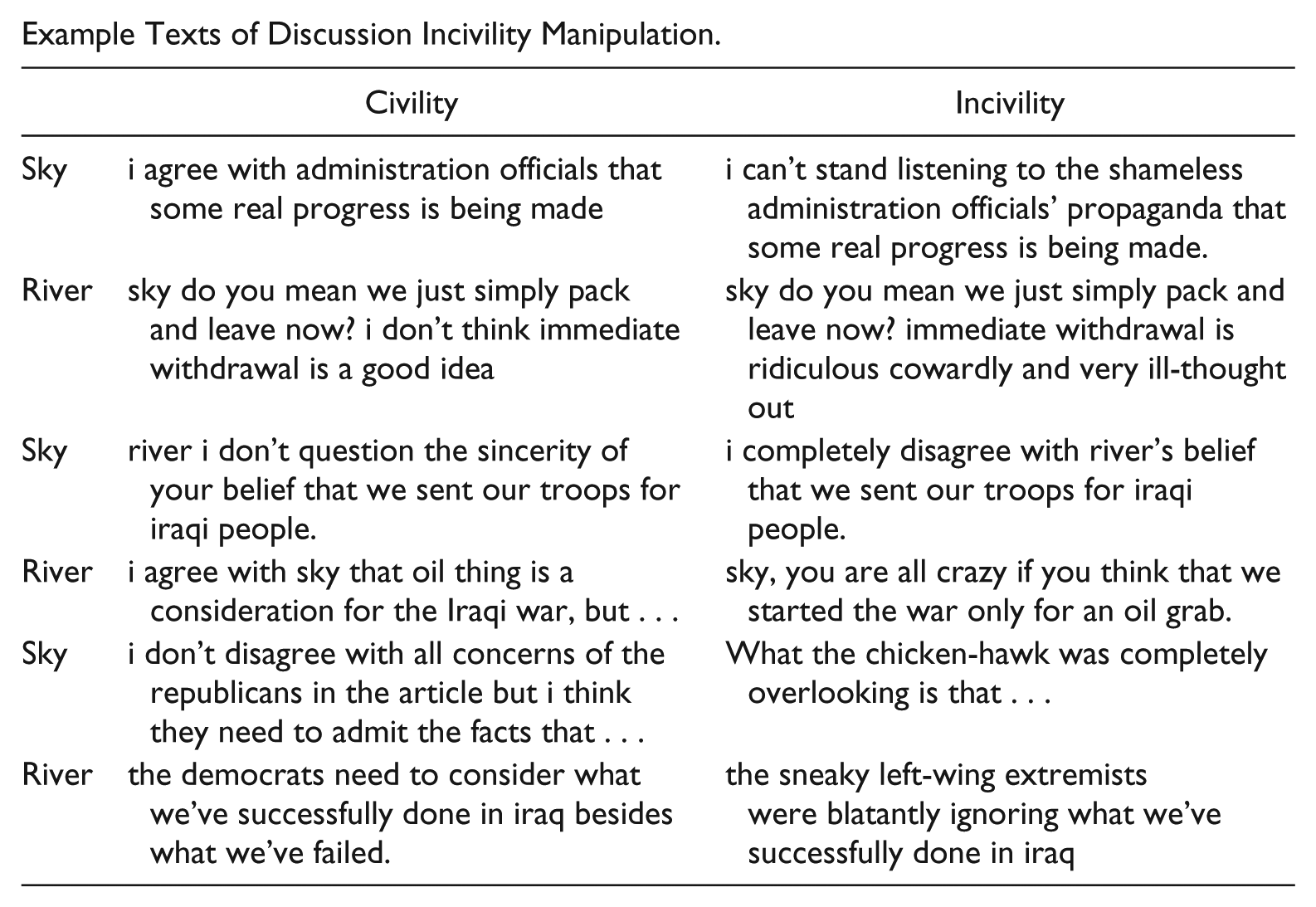
Online chat scripts that served as the stimuli for this study were crafted to manipulate discussion incivility (civility vs. incivility). The manipulations for discussion incivility were placed in the pre-programmed discussion scripts. The key arguments made in the timed scripts by the simulated chatters, Sky who supported withdrawal and River who opposed withdrawal, were equal across the experimental conditions except for a few phrases used to create the manipulations. In the civility version, the two simulated chatters were polite when they counter-argued with each other, inserting phrases such as “[discussant] raised an important issue, but I think . . .” and “I don’t disagree with all of [discussant], but . . .” before expressing their own thoughts. In the uncivil version, the two simulated chatters’ expressions included phrases showing a lack of respect for, frustration with, and insults to the oppositional views (see Appendix B for sample statements of manipulation). By holding the substance of the message constant for the civil and uncivil versions equal across the conditions while varying a few key words and phrases that captured experimental factors, the timed script presented reasons for the two simulated chatters’ arguments that are of similar length and depth (four reasons for each chatter). 2
Measures
Moral indignation
Moral indignation toward the unlike-minded discussion partner and the like-minded partner were measured with respondents’ indication of how strongly the two discussion partners’ commentary made them feel the following three emotions: anger, disgust, and contempt. Moral indignation toward the unlike-minded partner was constructed based on whether the simulated discussion partner’s view about the issue was inconsistent with the participants’ view which was measured in the pre-discussion survey. For example, for a participant who supported withdrawal, items for the simulated chatter who opposed withdrawal (i.e., River) were used for the measure of his or her moral indignation toward the unlike-minded partner, while items for the simulated chatter who supported withdrawal (i.e., Sky) were used for the measure of the participant’s moral indignation toward the unlike-minded partner. All three items were measured on an 11-point scale (0 = not at all, 10 = a great deal). The responses to these three items were averaged into a single index (M = 2.10, SD = 2.28, α = .94 for the like-minded partner; M = 4.89, SD = 2.87, α = .94 for the unlike-minded partner).
Reason recall
After reporting moral indignation toward the unlike-minded partner, participants were asked to list reasons why Sky supported withdrawal and why River opposed withdrawal. Each correct reason the respondent recalled was coded as one, while the answer which was not mentioned by the simulated chatters or merely restated the simulated chatters’ opinion was coded as zero. We assessed intercoder reliability between two coders on a subsample of 40 participants’ responses. Cohen’s kappa values were assessed for the two coders’ agreement above chance (κ = .83 for reasons of Sky’s view; κ = .86 for reasons of River’s view). Based on participants’ position on the withdrawal issue, reasons for the like-minded partner and reasons for the unlike-minded partner were counted (M = 2.67, SD = 1.49 for the like-minded partner; M = 2.08, SD = 1.24 for the unlike-minded partner).
Open-mindedness
The measures used in this study were adapted from Borah (2014). Respondents were asked to indicate on an 11-point scale (0 = strongly disagree, 10 = strongly agree) their level of agreement with each of the two statements: “After I participated in the discussion, (1) I felt more open to the views differing from my position on the issue; and (2) I got a better understanding of those who disagree with me on the issue.” These items were averaged into an index (M = 4.91, SD = 2.20, inter-item correlation = .50).
Expressed agreement and disagreement
Participants’ expressions during the online chat were used to measure expressed agreement and disagreement with the unlike- and like-minded partners. Two undergraduate students were trained as coders to analyze participants’ discussion expression with the two simulated chatters, Sky and River. The coders analyzed a total of 211 participants’ discussion scripts, sentence by sentence. Statements expressing explicit agreement with a simulated chatter or indicating a signal of support for ideas or reasons a prior simulated chatter expressed were coded either agreement with Sky or agreement with River. In contrast, a statement that indicated explicit disagreement with a simulated chatter or signaled opposition to something a prior simulated chatter said was coded as disagreement with either Sky or River (see Appendix C for the details on coding agreement and disagreement expressions). By comparing participants’ reported issue position in the pretest with their expressed agreement and disagreement with the two simulated chatters, we constructed the number of sentences of agreement and disagreement with the unlike-minded (M = 2.16, SD = 1.27, Cohen’s κ = .79, ranging from 0 to 8 for agreement; M = 2.78, SD = 1.47, Cohen’s κ = .82, ranging from 0 to 8 for disagreement) and the like-minded partner (M = 3.11, SD = 1.46, Cohen’s κ = .81, ranging from 0 to 9 for agreement; M = 1.40, SD = .93, Cohen’s κ = .82, ranging from 0 to 7, for disagreement). For example, for a participant who supported the withdrawal, expressed agreement and disagreement with River (who opposed to withdrawal) were recorded as expression of agreement and disagreement with the unlike-minded partner, respectively, while expressed agreement and disagreement with Sky (who supported withdrawal) were recorded as expression of agreement and disagreement with the like-minded partner.
Results
Manipulation Check
To examine if the manipulated simulated chatters’ expressions were perceived to be either uncivil or civil as intended, participants were asked about their perceptions of the incivility of the comments after manipulation. Participants were asked to rank their perceptions of the comments as being impolite on an 11-point scale ranging from 0 (strongly disagree) to 10 (strongly agree). An independent-samples t test established that participants in the incivility condition indeed perceived that the comments were significantly more impolite (M = 7.62, SD = 2.73) than those in the civility condition (M = 4.33, SD = 2.45; t(211) = 9.23, p < .001).
Effects of Discussion Incivility and Its Interaction Effects With Discussion Partners
A series of 2 (discussion partner: like- vs. unlike-minded partner) × 2 (discussion incivility: civil vs. uncivil discussion) mixed-design ANOVA was run on four dependent measures (i.e., moral indignation, agreement expression, disagreement expression, and reason recall), with the first factor varying within-participants and the other one varying between-participants. A one-way ANOVA was conducted for testing discussion incivility effect on open-mindedness. Means and standard deviations of dependent variables for each condition are summarized in Table 1.
Means and Standardized Deviations of Key Outcome Variables for Experimental Conditions.
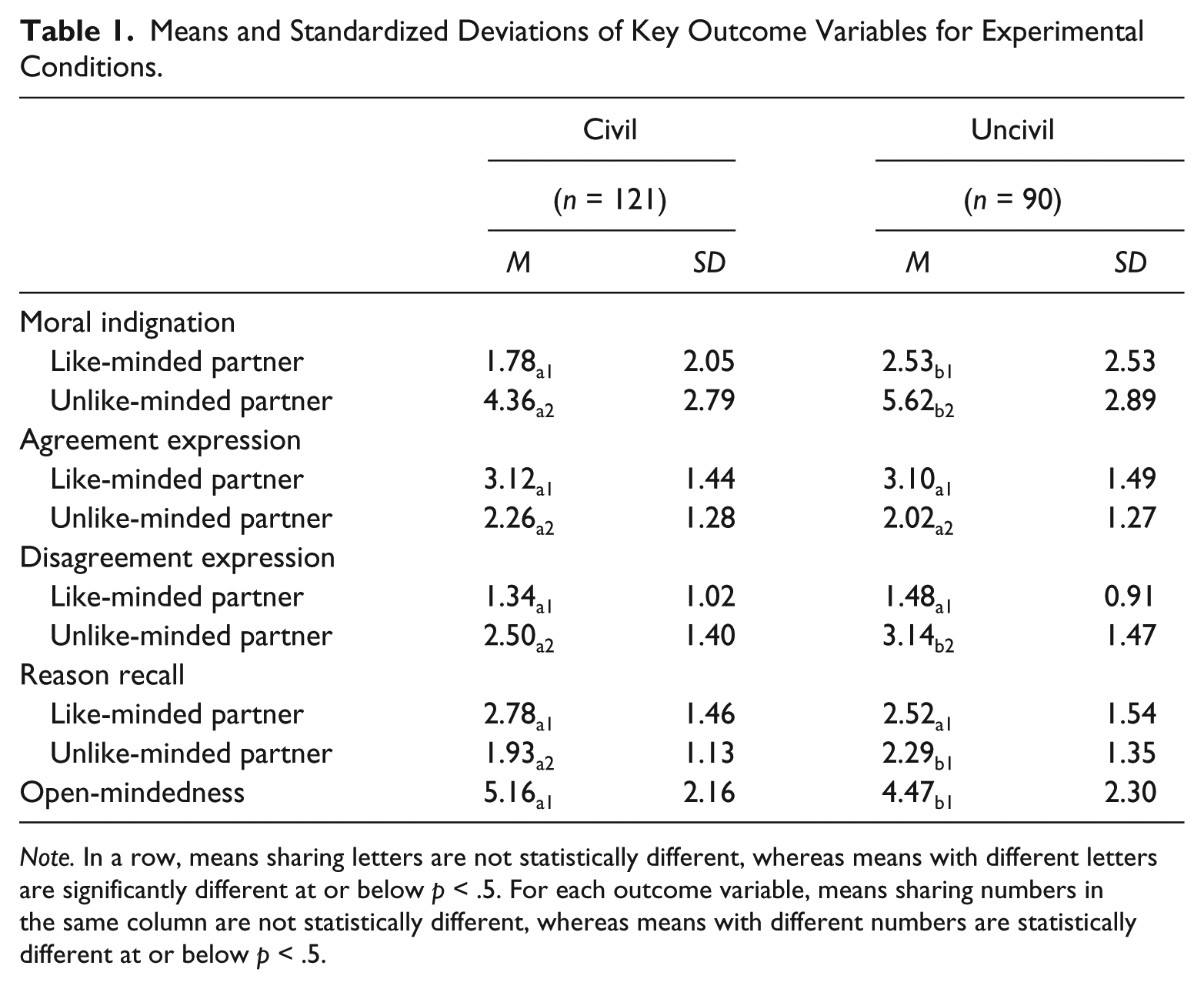
Note. In a row, means sharing letters are not statistically different, whereas means with different letters are significantly different at or below p < .5. For each outcome variable, means sharing numbers in the same column are not statistically different, whereas means with different numbers are statistically different at or below p < .5.
A 2 × 2 mixed-design ANOVA revealed a significant main effect of discussion incivility on moral indignation, F(1, 209) = 13.98, p < .001,
Two 2 × 2 mixed-design ANOVAs were run to examine H2a to H3c, which predicted main effects of discussion incivility and discussion partner and their interaction effects on discussion behavior variables (i.e., agreement expression and disagreement expression). The results showed that the main effect of discussion partner on agreement expression was statistically significant (M = 3.11, SD = 1.46 for the like-minded partner; M = 2.16, SD = 1.28 for the unlike-minded partner), F(1, 209) = 50.79, p < .001,
The results supported H3a: Participants expressed disagreement more frequently when they were exposed to the uncivil discussion than when they were exposed to the civil discussion, F(1, 209) = 11.59, p < .01,

Interaction effects of incivility and discussion partner on disagreement expression.
The results revealed that discussion partners had a significant main effect on reason recall (H4b), F(1, 209) = 20.82, p < .001,

Interaction effects of incivility and discussion partner on reason recall.
H5 predicted that exposure to uncivil discussion would result in decreased open-mindedness toward oppositional views compared with exposure to civil discussion. The results provide empirical evidence supporting H5, showing that participants in the uncivil discussion condition reported less open-mindedness after discussion (M = 5.16, SD = 2.16) than those in the civil discussion condition (M = 4.47, SD = 2.30), F(1, 209) = 4.89, p < .05,
Indirect, Direct, and Total Effects of Discussion Incivility on Reason Recall, Discussion Behaviors, and Open-Mindedness via Moral Indignation
H6a to H6d examine whether participants’ moral indignation toward the unlike-minded partner as an emotional motivator for inducing hostile responses mediates the effects of discussion incivility on reason recall, discussion behaviors (i.e., expression of agreement and disagreement with the unlike-minded partner), and open-mindedness. To examine whether moral indignation toward the unlike-minded partner served as a mediator for the relations between the manipulation of discussion incivility and the four outcome variables, we adopted the procedure proposed by Preacher and Hayes (2008). According to their procedure, there are three criteria to justify a mediation effect. First, the independent variable should be significantly correlated with the mediator variable. Second, after the effect of the independent variable on the dependent variable is controlled, the correlation between the mediator variable and the dependent variable should be significant. Finally, the indirect effect of the independent variable on the dependent variable must be significant. To test the mediation effects, we used the PROCESS macro for SPSS (Hayes, 2013) by entering the discussion incivility variable (0 = civil; 1 = uncivil) as an independent variable, moral indignation toward like- and unlike-minded partner as two mediator variables, and each of the four outcome variables as a dependent variable into four separate mediation tests. In the model, moral indignation toward like- and unlike-minded partners were treated as parallel mediators in order to control potential mediation effects of moral indignation toward the like-minded partner. Although we did not hypothesize mediation effects on outcome variables for the like-minded partner (i.e., recall of like-minded partner’s reasons, agreement with like-minded partner, and disagreement with like-minded partner), we also ran three additional mediation tests in order to explore whether moral indignation may have mediation effects on them. We used 95% bias-corrected bootstrap confidence intervals based on 1,000 bootstrap samples to test the significance of indirect effects: If the confidence interval does not contain zero then the indirect effect is considered to be statistically significant (Preacher & Hayes, 2008).
As seen in Table 2, experimental manipulation of discussion incivility had positive effects on both moral indignation variables (b = 1.82, SE = .35, p < .001, for like-minded partner; b = 1.03, SE = .40, p < .01, for unlike-minded partner) but did not have direct effects on any of the outcome variables after controlling the effects of mediators on outcome variables, suggesting that the two moral indignation variables might fully mediate the effects of incivility on outcome variables.
Regression Analyses: Effects of Incivility and Moral Indignation.

Note. Cell entries are unstandardized regression coefficients with standard errors in parentheses.
p < .05. **p < .01. ***p < .001.
Mediation effects on discussion behaviors
H6a and H6b predicted mediation effects of moral indignation toward the unlike-minded partner on the relationships between discussion incivility manipulation and hostile discussion behaviors such as reduced agreement expression and enhanced disagreement expression. The analyses supported H6a and H6b. As seen in Table 2, indignation toward the unlike-minded partner was not associated with expressions of agreement and disagreement with the like-minded partner, but it was negatively associated with expression of agreement with the unlike-minded partner (b = −.07, SE = .03, p < .05) and positively associated with expression of disagreement with the unlike-minded partner (b = .19, SE = .03, p < .001). In addition, the findings showed that the incivility manipulation had significant indirect effects on both agreement and disagreement with the unlike-minded partner through moral indignation toward the unlike-minded partner (effect = −.08, bootstrap SE = .06, 95% CI [−.23, −.01] for the indirect effect on expression of agreement with the unlike-minded partner; effect = .24, bootstrap SE = .09, 95% CI [.09, .43] for the indirect effect on expression of disagreement with the unlike-minded partner). In contrast, moral indignation toward the like-minded partner was not associated with the four expression variables. In sum, the findings suggest that emotional reactions toward the like-minded partner were not associated with discussion behavior variables, whereas indignation toward the unlike-minded partner triggered by exposure to uncivil discussion enhances defensive bolstering behaviors such as reduced agreement with the opposing views as well as increased disagreement with the opposing views.
Mediation effects on reason recall
As predicted in H6c, the results confirmed that moral indignation toward the unlike-minded partner had a mediating effect on recall of the unlike-minded partner’s reasons. The findings showed that moral indignation toward the unlike-minded partner was positively associated with recall of the reasons for the unlike-minded partner’s arguments (b = .14, SE = .03, p < .001). In addition, the incivility manipulation had a significant indirect effect on the outcome variable through moral indignation toward the unlike-minded partner (effect = .14, bootstrap SE = .06), as the bias-corrected bootstrap confidence interval for the indirect effect was entirely above zero (.04-.30). The findings also revealed that moral indignation toward the unlike-minded partner was positively associated with recall of the like-minded partner’s reasons (b = .17, SE = .04, p < .001), and the indirect effect via the moral indignation toward the like-minded partner was statistically significant (effect = .14, bootstrap SE = .06, 95% CI [.05, .36]). In contrast, neither of the two outcome variables of reason recall was significantly associated with moral indignation toward the like-minded partner, and the indirect effects on recall of the two partners’ reasons through moral indignation toward the like-minded partner were not significant. In sum, the findings clearly indicate that negative emotional reactions toward the unlike-minded partner spurred by discussion incivility elicit cognitive reflection on both sides of the issue, resulting in enhanced recall of the reasons for disagreeable views as well as the reasons for agreeable views.
Mediation effect on open-mindedness
As predicted in H6d, the findings confirmed a significant mediation effect of indignation toward the unlike-minded partner on the relationship between discussion incivility and decrease of open-mindedness. As Table 2 shows, an increase in indignation toward the unlike-minded partner led to a decline of open-mindedness toward oppositional views (b = −13, SE = .05, p < .05). The indirect effect of incivility on open-mindedness through indignation toward the unlike-minded partner was statistically significant (effect = −.14, bootstrap SE = .08, 95% CI [−.37, −.02]). Again, neither the direct effect of moral indignation toward the like-minded partner nor indirect effect through indignation toward the like-minded partner on open-mindedness was statistically significant. Taken together, the findings suggest that exposure to uncivil discussion leads to close-mindedness toward disagreeable views mainly through heightened moral indignation toward the one holding the opposite view rather than through indignation toward the one holding the supported view.
Discussion
Exposure to disagreement has both constructive and destructive potential for deliberative democracy. This study investigated under what conditions political discussion leads to hostile rather than deliberative reactions by experimentally manipulating the tone of other discussion participants’ expressions of disagreement with the opposing view. Focusing specifically on the motivational role of “moral indignation” as a mediator of the effects of uncivil discussion on disconfirmation bias in cognitions, attitudes, and discussion behaviors, this study examines whether, why, and how uncivil discussion has negative effects on deliberative processes.
Regarding cognitive effects of discussion incivility, our findings revealed that participants remembered more reasons for the like-minded partner’s arguments than reasons for the unlike-minded partner’s arguments and such recall of agreeable reasons was stable across incivility conditions. Consistent with prior studies on the effects of incivility and negative political campaign ads (Brooks & Geer, 2007; Chang, 2001), the results also showed that exposure to uncivil attacks during the discussion had some beneficial effects on participants’ cognitive reflection on disagreeable views by showing that participants in the incivility condition recalled significantly more reasons for the unlike-minded partner’s arguments than those in the civility condition.
Although exposure to uncivil attacks during the discussion can grab participants’ attention to the unlike-minded discussion partner’s arguments and thus increase recall and awareness of reasons for the opposing views, the overall results support scholars’ concerns about the detrimental effects of incivility on intergroup emotions, discussion behaviors, and attitudes. As we conceive of moral indignation as an emotional reaction to the violation of moral codes based on the cognitive appraisal theories of emotions, our findings indicated that participants felt stronger moral indignation (e.g., anger, disgust, and contempt) toward both the like- and unlike-minded discussion partners when they attacked the other side of the issue in an uncivil way. These findings have parallels to the literature on political attack ads that mudslinging can increase negative evaluations of both candidates (e.g., Fridkin & Kenney, 2004). The findings also showed that discussion incivility had corrosive effects on discussion behaviors toward the unlike-minded discussion partners (i.e., increased expression of disagreement and reduced expression of agreement) and decreased open-mindedness toward the opposing views, indicating that discussion incivility intensifies outgroup hostility. However, the findings indicated that neither agreement nor disagreement expression toward the like-minded partner were influenced by discussion incivility, suggesting that discussion incivility did have greater negative impacts on behaviors and attitudes toward outgroup members than ingroup members.
In line with the functional theories of emotions (see Nabi, 1999, 2002) and study findings on motivated reasoning and disconfirmation bias (Edwards & Smith, 1996; Kunda, 1987, 1990; Lee et al., 2014; Taber & Lodge, 2006), our findings also showed that moral indignation resulting from uncivil attacks spurs an individual’s defensive cognition, attitudes, and discussion behaviors. In terms of individuals’ cognitive reflection and attitudes, our findings revealed that moral indignation toward the unlike-minded partner was positively associated with recall of reasons for not only the unlike-minded partners’ arguments but also the like-minded partner’s arguments, suggesting that moral indignation heightens argument scrutiny and careful processing, in general. As we conceive that moral indignation is an emotional motivator for defensive goals based on the functional theory of emotions, such enhanced cognitive reflection and in-depth processing of information resulting from moral indignation seems to be a consequence of hostile reasoning rather than deliberative reasoning. In fact, our findings indicated that moral indignation toward the unlike-minded partner increased defensive bolstering in attitudes (i.e., decreased open-mindedness) and discussion behaviors (i.e., decreased expression of agreement with the unlike-minded partner and increased expression of disagreement with the unlike-minded partner). Analyses for mediation effects provided evidence showing mediating effects of moral indignation toward the unlike-minded partner on reason recall, discussion behaviors, and open-mindedness.
The findings concerning the relationships of moral indignation with discussion incivility and cognitive, attitudinal, and behavioral outcomes for deliberation will contribute to broadening our knowledge of the role of emotions in the deliberative process. The findings suggest that negative moral emotions may be potent psychological factors motivating citizens to take a hostile stance toward disagreeable views in response to uncivil behaviors of unlike-minded discussion partners. Furthermore, the findings provide implications that injustice-incited righteous anger, such as moral indignation, may give rise to social motives and actions of speaking for their views. Although the role of emotions in deliberative processes has been mostly ignored or even regarded as a negative force to be suppressed for effective deliberation, research on negative emotions such as moral indignation as well as other emotions such as enthusiasm and anxiety (e.g., Marcus, 2002; Marcus, Neuman, & Mackuen, 2000) can help our understanding of the psychological mechanisms that explain reactions to differing views during discussion.
Our findings about the different effects of exposure to uncivil attacks on internal cognitive reflection versus intergroup emotions, attitudes, and discussion behaviors are particularly noteworthy. It appears that exposure to uncivil discussion increases awareness of the other side’s reasons, which has been treated as an indicator of successful deliberation (e.g., Price et al., 2006). However, our findings also show that exposure to uncivil discussion may have detrimental effects on emotions, attitudes, and behaviors toward the other side. Given that exposure to opposing views does naturally increase awareness and/or knowledge about opposing views, these findings suggest that socio-interpersonal outcomes can serve as more conclusive indicators of whether the processing of opposing views is deliberative or hostile.
However, our findings must be viewed with caution. First, because they were obtained from a convenience sample, these findings may not be directly generalizable to the general public. Compared with the general public, undergraduate students may have different levels of party identity strength, interest in controversial issues such as the withdrawal from Iraq, and different stances on the issues, which may affect our estimates of the effect of exposure to uncivil debate on discussion behaviors and deliberative attitude. Over-representation of female participants and pro-withdrawal participants in our sample could also affect findings of the current study. For example, given that men and women are different in their communication styles and interactional norms (Basow & Rubenfeld, 2003), they may have different normative expectations and thus may judge and respond to others’ uncivil behaviors differently. In this regard, whether and how uncivil behaviors can be judged differently depending on individual factors including gender as well as contextual factors should be considered essential topics of interest for future related investigations.
Second, we should also admit that online discussion settings of the study did not approximate those of real political discussion in which participants interactively communicate with others. Although we intentionally created discussion settings in which expression of disagreement and incivility of the two simulated chatters were not directed at the experimental participants in order to control unwanted variability in received messages from discussion partners, the artificiality of such a controlled discussion setting can inevitably limit the generalizability of the study findings to real political discussion settings. Given that negative reactions are intensified when the uncivil expressions are targeting the self or ingroup (Kinney & Segrin, 1998), it may substantially change the dynamic of the discussion and the participants’ discussion behaviors if the simulated chatters directly commented on the participants’ views. In a similar vein, influences of uncivil expression attacking the like-minded partner may be contingent on participants’ identification with the like-minded people and/or importance of their issue attitude, which may increase the possibility that participants perceive the uncivil attacks on the like-minded partner’s views as personal attacks. Although we believe that absence of direct comments on the participants’ views might lead to underestimation rather than over-estimation of the hypothesized relationships, future related investigations testing the potential roles of direct comments on study participants’ views, group identity, and attitude importance are required to address these remaining questions.
Finally, the measurement of key variables such as open-mindedness and moral indignation is limited. With regard to the measure of open-mindedness, we used participants’ self-reported answers about change in open-mindedness after the discussion. Perhaps the best way to measure changes in open-mindedness would be to measure pre- and post-manipulation levels of open-mindedness and compare any changes in the values of the two measures. However, subject report of increase in open-mindedness has some validity in the current research context. Given that the main purpose of measuring change in open-mindedness is to test how participants’ discussion experience influenced their attitudes toward the opposing side, participants’ subjective feeling of change in open-mindedness has its own value for such purpose.
Despite some limitations and unsolved, nuanced questions, however, two features bolster the value of the present study. It provides a methodological innovation for testing causal relationships between deliberative conditions and outcomes. Deliberative theorists have argued that deliberation requires a host of conditions before it can offer its putative benefits for healthy democracy. Unfortunately, we still do not know what conditions are essential to effective deliberation due to lack of solid empirical evidence for the effects of theoretical conditions. In fact, past researchers have tended to assume deliberation is occurring because an effort has been made to create all of its theoretical conditions (Ryfe, 2005). The common problem of this approach is that when theoretical benefits are not found from the assumed deliberation settings of the research, researchers cannot identify what specific conditions lead to the null findings. Instead, such null or negative findings are easily attributed to failure of their efforts to create ideal conditions for deliberation without making a theoretical contribution to the understanding of when and how deliberation actually works (Mutz, 2008).
For this reason, this study employed the opposite approach, empirically testing the causal effects of two theoretical conditions (i.e., exposure to disagreeable views and exposure to uncivil expression) on deliberative outcomes emphasized by experimentally manipulating discursive incivility. Although the conditions manipulated in the studies are very crude and cannot capture everything that deliberative theories recommend, this simple manipulation does allow us to examine how exposure to discussion incivility from an opposing discussion partner causes hostile reactions instead of deliberative reactions. At the current stage of empirical research, we have many more questions than answers concerning conditions of deliberative democracy. As Mutz (2008) suggested, middle-range research such as the current study, which aims at isolating causal effects of conditions and determining how citizens interact with others, should greatly enhance our understanding of how and when deliberation actually works.
Furthermore, addressing concerns about the lack of explanation of the psychological mechanisms underlying the effects of conditions of deliberation (Mutz, 2008; Wesolowska, 2007), this study also attempts to theorize a linkage among discussion incivility, cognitions, attitudes, and behaviors based on theories and empirical studies on social psychology by looking at the mediating role of “moral indignation.” We believe that research efforts testing normative deliberative theory with empirical studies and theories in other fields such as group dynamics, persuasion, and information processing will broaden our knowledge and understanding of social and psychological mechanisms for explaining individuals’ cognitive, attitudinal, and behavioral reactions to fellow citizens’ views during discussion.
Although this study did not attempt to create an ideal situation for deliberation nor test deliberation theory per se, these findings have important implications for theories of deliberation specifically and political discussion generally. In sum, the study provided strong evidence that discussion incivility has negative effects on deliberative outcomes by spurring moral indignation rather than deliberative reactions to oppositional views. Of course, contention and competition between different voices are part and parcel of public deliberation. However, when such conflict and competition lead to moral indignation, political discussion may end up as acrimonious debate instead of deliberative discussion. Such moral indignation toward the other side of an issue formed by individuals’ personal experience in a specific discussion may lead to negative outcomes in future discussions with the other side. This is precisely the opposite of the “virtuous circle” of discussion, mutual understanding, and engagement. Future research using similar methods should explore how moral indignation resulting from a prior uncivil discussion experience also influences individuals’ reactions to disagreeable views in a later discussion process.
Footnotes
Appendix A
Appendix B
Example Texts of Discussion Incivility Manipulation.
| Civility | Incivility | |
|---|---|---|
| Sky | i agree with administration officials that some real progress is being made | i can’t stand listening to the shameless administration officials’ propaganda that some real progress is being made. |
| River | sky do you mean we just simply pack and leave now? i don’t think immediate withdrawal is a good idea | sky do you mean we just simply pack and leave now? immediate withdrawal is ridiculous cowardly and very ill-thought out |
| Sky | river i don’t question the sincerity of your belief that we sent our troops for iraqi people. | i completely disagree with river’s belief that we sent our troops for iraqi people. |
| River | i agree with sky that oil thing is a consideration for the Iraqi war, but . . . | sky, you are all crazy if you think that we started the war only for an oil grab. |
| Sky | i don’t disagree with all concerns of the republicans in the article but i think they need to admit the facts that . . . | What the chicken-hawk was completely overlooking is that . . . |
| River | the democrats need to consider what we’ve successfully done in iraq besides what we’ve failed. | the sneaky left-wing extremists were blatantly ignoring what we’ve successfully done in iraq |
Appendix C
Declaration of Conflicting Interests
The authors declared no potential conflicts of interest with respect to the research, authorship, and/or publication of this article.
Funding
The authors received no financial support for the research, authorship, and/or publication of this article.