



Abstract
This study examined whether a need for closure explains why people verbally brood and whether the support received when they verbally brood during a conversation reduces anxiety and cognitive brooding afterward. In two studies, friends came into the laboratory and were randomly assigned to be a subject or confederate. The confederate was trained to provide “good support” or “poor support” to the subject who talked about a stressor he or she could not stop thinking and talking about recently with that friend. The overall models suggested that individuals were more likely to verbally brood when they had a higher need for closure and were more likely to feel better and positively reframe the stressor when the friend was supportive rather than unsupportive, which reduced anxiety. However, if individuals did feel better and/or positively reframed their stressor, even if they received “poor support,” it reduced their anxiety. Finally, positive reframing of the stressor, rather than simply feeling better, helped subjects reduce their cognitive brooding 20 minutes after the conversation.
Keywords
When something stressful occurs, it is common and often productive for people to engage in reflective rumination where they ponder why it is happening and brainstorm solutions to cope (Haran, Mor, & Mayo, 2011). The harmful effects of rumination tend to reside with cognitive brooding or depressive rumination. Cognitive brooding is debilitating because it involves passive immersion in negative affect, depressive thoughts about one’s problems, and repetitively focusing on obstacles to overcoming them (Haran et al., 2011; Nolen-Hoeksema & Morrow, 1991). When people brood, they get caught in cyclical thought patterns where they fixate on harmful events that have happened to them in the past, overemphasize the negative aspects of their current situation, and are pessimistic about their future (Nolen-Hoeksema, 2000). This type of rumination has been associated with a host of mental health issues, such as anxiety, depression, post-traumatic stress disorder, and eating disorders (e.g., Abela & Hankin, 2011; Takano & Tanno, 2011; Zawadzki, Graham, & Gerin, 2012).
Because it can pose serious health problems, researchers have devoted considerable attention to understanding why people brood and how they can curtail it. Personality plays an important role in determining the extent to which someone broods. Even though stressful situations can stimulate brooding rumination (Nolen-Hoeksema & Morrow, 1991), research suggests that it is also a relatively stable personality trait (Nolen-Hoeksema & Davis, 1999). In particular, brooders often become more anxious than non-brooders because they are uncertain about situations being under their control (Nolen-Hoeksema, 2000). Consequently, brooders likely have a strong cognitive need for closure (NFC) to their problems so that they can stop ruminating. Unfortunately, it is often difficult for people to stop brooding because the negative affect impairs creative thinking and problem solving (Nolen-Hoeksema, 2000). Researchers focus on psychological interventions, such as distraction, emotion regulation, mindfulness, and reappraisal, to reduce cognitive brooding (e.g., Kemeny et al., 2012; Selby, Anestis, Bender, & Joiner, 2009; Takano & Tanno, 2011). While these interventions are helpful, they fail to fully recognize and capitalize on everyday interactions in which people talk about their problems.
People frequently seek social support from their friends and other loved ones when they are stressed, particularly when this stress is ongoing and unresolved (Rime, Philippot, Boca, & Mesquita, 1992). The disclosure of one’s stress often occurs through repeated conversations until the stressor is managed (Joseph, Afifi, & Denes, in press). As a result, cognitive brooding can translate into verbal brooding where people continually talk about their negative feelings related to a problem and potential consequences of the problem. Initially, friends and family might respond to verbal brooding with compassion and validation (Rime et al., 1992). Over time, however, social support can begin to wane when the same problem surfaces repeatedly and it becomes clear that well-intentioned support efforts cannot move a person beyond the brooding (Nolen-Hoeksema & Davis, 1999; Stroebe, Zech, Stroebe, & Abakoumkin, 2005).
The type of social support provided when someone verbally broods could help attenuate verbal and cognitive brooding or it could fuel even greater mulling and anxiety. Even though social support might be unhelpful and even make the brooding worse at times, identifying the aspects of social support that can help manage brooding is an important and relatively unexplored area of research. Social support could be a crucial gateway to helping people stop the cognitive brooding–verbal brooding cycle. In particular, support providers might be able to help brooders facilitate the reframing process. If the social support provider is able to help the person who is verbally and cognitively brooding positively reframe the stressor by shifting negative emotions to positive ones, it could break this unhealthy pattern (see also T. D. Afifi, Shahnazi, Coveleski, Davis, & Merrill, 2016). In order to understand how support exacerbates or ameliorates cognitive brooding and anxiety, it is important to understand how personality and social support work together to influence this process. That is, researchers must explore what individuals “bring” to the conversation in terms of personality traits like the NFC, how social support influences verbal brooding when it is occurring, and how the support influences cognitive brooding after a conversation ends.
In the current article, we contend that when individuals cannot stop mulling about a stressor and have an NFC, or when there is a desire for “an answer on a given topic, any answer . . . compared to confusion and ambiguity” (Kruglanski, 1990, p. 337), they are more likely to verbally brood about the stressor in an effort to feel better and subsequently reduce their brooding and anxiety—but primarily when they receive good support. People who have a high NFC tend to ruminate more in general than those with a low NFC, but especially about negative thoughts and failure events (Mikulincer, 1994). Individuals who have a high NFC likely verbally ruminate or talk repeatedly about their problem with others in order to find a solution to calm their repetitive, negative thoughts. Nevertheless, individuals’ desire to talk about their stress can be encouraged or stifled depending upon the type of support they receive. Support that is validating should provide a comforting environment for sensitive disclosures to occur and for solutions to be generated, reducing cognitive brooding and anxiety. Regardless of an NFC, when individuals receive poor support, it should diminish the likelihood that they want to continue to talk about their negative feelings, which could inhibit their ability to manage their anxiety and cognitive brooding. Finally, we investigate the underlying psychological mechanism that reduces cognitive brooding and anxiety. Specially, we explore whether it is simply feeling better about the stressor after a supportive conversation that mediates the connection between verbal brooding and cognitive brooding/anxiety or the positive reframing of the stressor.
Cognitive and Verbal Brooding
Personality plays an important role in cognitive brooding, with certain types of people being more prone to brooding than others. Brooding perpetuates anxiety and depression, but it is also characteristic of people with anxiety and depressive symptoms (Nolen-Hoeksema, 2000). Scholars commonly conceptualize brooding in terms of personality characteristics, comparing “brooders” to “non-brooders” or describing individuals as having a ruminative coping style (e.g., Abela and Hankin, 2011). For example, brooders tend to view situations more pessimistically and experience more negative emotions than non-brooders, resulting in intrusive thoughts about one’s problems (Nolen-Hoeksema, 2000). Brooding can be induced by specific events, but certain people are also more likely to brood than others.
When people become preoccupied with a stressor, their repetitive thoughts can sometimes translate into repetitive talk or verbal rumination (Rime et al., 1992). Similar to cognitive brooding, which involves repetitive focus on negative thoughts and emotions, verbal brooding involves repetitive talk about one’s negative feelings about a problem, its causes and (potential) consequences, and one’s failures related to it. While cognitive and verbal brooding often occur concurrently (Tait & Silver, 1989), they tend to be discussed and analyzed in separate bodies of literature. Yet given that the two processes likely affect each other and the successful management of one probably impacts the other, it is important to analyze them together (see also Nolen-Hoeksema & Davis, 1999). Much of the research suggests that when people cognitively brood, they often disclose their negative feelings to close others in an effort to remove themselves from their cyclical thought patterns (Nolen-Hoeksema & Davis, 1999; Rime et al., 1992).
Most research on verbal rumination focuses on co-rumination or two people continually talking about their problems together (Rose, 2002) rather than one person talking about his or her problems to another (or verbal rumination). The research on co-rumination operationalizes co-rumination as the frequency of discussing the problem, discussing the same problem repeatedly, speculation about parts of the problem that were not understood, and focusing on negative feelings (Rose, 2002). But most of the research on co-rumination and cognitive rumination has found that it is the continued focus on negative affect or brooding that is problematic and not reflection on the problem in general (see Byrd-Craven, Geary, Rose, & Ponzi, 2008; Nolen-Hoeksema, 2000). Therefore, it is important to distinguish between cognitive and verbal brooding rather than ruminative thought and talk more broadly.
The research on co-rumination has focused heavily on adolescent friendships (Rose, Carlson, & Waller, 2007; Schwartz-Mette & Rose, 2012; Stone, Uhrlass, & Gibb, 2010). Ironically, this research suggests that co-rumination can enhance relationship quality through mutual repeated disclosures, but simultaneously increase anxiety and depressive symptoms due to the reoccurring emphasis on negative emotions and problems (Calmes & Roberts, 2008; Hankin, Stone, & Wright, 2010; Smith & Rose, 2011; Starr & Davila, 2009; Stone, Hankin, Gibb, & Abela, 2011). Typically, self-disclosure is health promoting because it is cathartic (see T. D. Afifi, Caughlin, & Afifi, 2007; Pennebaker, 1989, 1995; Stiles, 1987; Stiles, Shuster, & Harrigan, 1992). Self-disclosure also helps build and maintain relationships due to the mutual sharing of private information, which deepens as relationships progress (see Altman & Taylor, 1973; Petronio, 2002; Wheeless, 1976). When disclosures are negatively valenced, however, it can still bring people closer emotionally, but simultaneously create anxiety due to continued focus on negative affect (see T. D. Afifi, Afifi, Merrill, Denes, & Davis, 2013). This may be especially likely if the disclosures occur frequently.
NFC, Verbal and Cognitive Brooding, and Social Support
While there may be numerous reasons why people verbally and cognitively brood, one personality characteristic that likely influences brooding is an NFC. People’s NFC differs predictably across individuals as well as situations (Kruglanski, Webster, & Klem, 1993). For example, situational constraints such as time pressure, the need for a quick judgment, or circumstances that render personal decision making arduous (e.g., noise, ego depletion) can intensify individuals’ NFC, leading them to rely on more stereotypical inter-group biases and information that confirms their pre-existing positions (Dijksterhuis, Knippenberg, Kruglanski, & Schaper, 1996; Kruglanski, Shah, Pierro, & Mannetti, 2002). Even though the NFC can be amplified by situational factors, there are also trait differences in people’s cognitive NFC that influence how people communicate and process information (see Webster & Kruglanski, 1994). As Kruglanski and Webster (1996) noted, individuals with a greater NFC “may ‘leap’ for judgment on the basis of inconclusive evidence and exhibit rigidity of thought and reluctance to entertain views different from their own” (p. 264). When they desire an answer to a problem and they seek information to solve it, they may have a tendency to “seize” information that supports their perspective and “freeze” or ignore information that contradicts it (Kruglanski & Webster, 1996).
While there is no current research linking the NFC to verbal rumination, people who have a higher NFC tend to brood more than those with a lower NFC (see Mikulincer, 1994). There is reason to believe that when people are currently cognitively brooding about a stressor and have a strong NFC, they will verbally ruminate about their stressor with close others in an effort to achieve relief from their brooding—but primarily when they are provided with good support. Individuals who have a high NFC become anxious in situations where there is an unresolved problem or stressor (Sollar & Vaneckova, 2012). They long for a solution to it and seek out information that will make them feel better and provide a sense of closure (Sollar & Vaneckova, 2012). People with a higher NFC are likely to seek out information that is confirming in an effort to reduce their discomfort and reduce their brooding (Sollar & Vaneckova, 2012). If their problem persists and they cannot stop thinking about it, they likely seek support that validates their perspective as a way to provide closure and stop brooding. As a result, they might only tend to verbally ruminate when they are provided with good support because the support provides them with comfort or a “safe haven” to seek information to provide closure. Once they are in that supportive conversation, people with a high NFC might continue to talk about their stressor even though their NFC has been realized because they enjoy the validation the social support provides. Once the conversation is over, hopefully their anxiety and brooding are reduced. If not, their cycle of brooding and verbal rumination might continue until they find closure. Individuals with a lower NFC probably do not feel a pressing need to continually talk about a stressor because they welcome the uncertainty their stressor creates and do not long to reduce it (see Dechesne & Kruglanski, 2009).
The NFC is a motivational or goal-driven desire to reach a resolution about an unresolved issue, and discussions with others can facilitate or hinder this goal achievement (Kruglanski & Webster, 1996; Webster & Kruglanski, 1994). For individuals who have a stronger NFC, engaging in conversations that move them toward the goal of achieving closure can facilitate positive emotions and engaging in discussions that threaten that goal can ignite negative emotions (Kruglanski & Webster, 1996). Good support likely facilitates this goal achievement and allows them to feel better, and correspondingly reduces anxiety and brooding, whereas poor support likely threatens this goal achievement. Specifically, high person-centered messages that validate, comfort, and elaborate on individuals’ thoughts about their stressor have been shown to induce positive affect (Burleson, 1982, 2008; Burleson & MacGeorge, 2002; Holmstrom, Burleson, & Jones, 2005). This positive affect may help stop the negative affect associated with brooding. Good social support is also nonverbally immediate (Guerrero, Jones, & Burgoon, 2000; Jones & Guerrero, 2001). High person-centered support should involve nonverbal immediacy cues, such as head nods, touch, eye contact, paralanguage, and body orientation (Guerrero et al., 2000; Jones & Guerrero, 2001). Together, these verbal and nonverbal behaviors promote an accepting environment in which to disclose negative feelings, which should make the person feel better, and subsequently reduce cognitive brooding and anxiety.
An important question to consider, however, is what the underlying psychological mechanism is that reduces the cognitive brooding and anxiety. Is it simply feeling better or is it the ability to cognitively reframe a stressor that interrupts the brooding process? Support that helps people reappraise their stressor in a different way could provide relief to individuals who are verbally brooding, in general, but particularly to those who want closure. Social support can foster meaning and sense-making in a stressful situation, which can provide alternative coping strategies (Burleson & MacGeorge, 2002; Denson, Spanovic, & Miller, 2009). According to Lazarus and Folkman’s (1984) theory of stress and coping and Burleson and Goldsmith’s (1998) theory of conversationally induced reappraisals, social support can help people reframe a stressor, which can improve people’s emotional states and provide a more hopeful interpretation of stressful situations (Jones, 2004; Jones & Guerrero, 2001; Jones & Wirtz, 2006; Lazarus & Folkman, 1984). Bippus (2000, 2001), for example, found that when people receive supportive messages that are other-oriented, and help them problem solve and reframe the stressor, they are less likely to cognitively brood and experience more positive mood and empowerment. Social support could help those who are verbally brood appraise the stressor differently—allowing them to sooth their anxiety and ruminative tendencies. This may be especially the case for those with a high NFC because talking about their problems and reappraising the stressor may provide a sense of resolution to the unknown. In particular, it might be the ability to positively reframe the stressor rather than simply thinking of the stressor in a different way (or cognitive reframing/reappraisal) that produces a psychological shift from negative emotions to positive emotions. This emotional transformation could facilitate problem solving and creative thinking.
In contrast, seemingly regardless of one’s NFC, when individuals are provided with poor support, they are less likely to continue to talk negatively about their stress, potentially increasing their cognitive brooding and anxiety. Unfortunately, what constitutes poor support is often more difficult to determine than good support. For example, some types of low person-centered messages (see Burleson, 1982, 2008) where the support provider dismisses the individuals’ thoughts (e.g., “you are better off without this person . . . just stop thinking about it”) could be perceived of as supportive and actually reduce a person’s mulling and anxiety (see also Nolen-Hoeksema & Davis, 1999). However, messages that blame the person for his or her own stress (rather than blaming external factors such as the problem or someone else) probably would be perceived as disconfirming and make ruminative tendencies worse.
Research also suggests that the social support people receive when they are disclosing is essential to whether the disclosure is health promoting. The beneficial nature of disclosure depends upon the validating nature of the response and the extent to which the support helped the person make sense of the stressor (T. D. Afifi et al., in press; Greene, 2009; Kelly, 2002; Kelly & Macready, 2009; Kelly & McKillop, 1996). For example, Lepore, Ragan, and Jones (2000) found that talking about a stressor alone or with someone who is validating reduced people’s cognitive brooding and stress. Likewise, when people are provided with poor support when they are brooding about a stressor, it tends to encourage even more cognitive brooding (e.g., Zoccola, Quas, & Yim, 2010). When people are faced with a significant life event (e.g., natural disaster) or chronic stressor (e.g., depression), people are sometimes unsupportive of others who repeatedly talk about their stress, which can further exacerbate the stress for everyone involved (W. A. Afifi, Afifi, & Merrill, 2014; Conway, Rancourt, Adelman, Burk, & Prinstein, 2011; Kaniasty & Norris, 1993; Rime et al., 1992). Therefore, it seems plausible that when people are verbally brooding about something that is bothering them and they are provided with poor support, it exacerbates their cognitive brooding and anxiety.
We present two studies to test our argument. In Study 1, same-sex and opposite-sex friends were asked to think about a stressor they could not get off their mind and that they could not stop talking about with the other person. We then asked them to continue the conversation about this topic, but one of the friends was trained to provide good or poor support to the friend who has been verbally and cognitively ruminating. After the conversation, however, we ask them to focus specifically on how much they verbally brooded during that conversation with their friend. This one conversation served as a continuation of other conversations they had about this topic with each other. When provided with good support, individuals who have a stronger need for cognitive closure should verbally brood more about their stressor, which should make them feel better after the conversation and subsequently reduce their anxiety and brooding about the stressor. When provided with poor support, this same process should not occur because even if the individuals had an NFC, they likely would not want to talk about their negative feelings extensively with the support provider because of the invalidating nature of the support provided. The support, then, does not make them feel better or reduce their anxiety and brooding. In Study 2, we replicate the same model with a group of same-sex friends but test the notion that being able to reframe the stressor, particularly positive reframing of the stressor, provides a stronger test of the model than simply feeling better after the conversation.
Method
Participants
Study 1
Two hundred thirty-one young adults and one of their friends came to the laboratory. The average age of the participants was 20 (range = 18-26) and most of them were female (n = 159 or 68%; males = 72 or 31%). When taking the friend into account, there were 112 (48%) female-female dyads, 35 (15%) male-male dyads, and 86 (37%) female-male dyads. The sample included White (n = 81; 35%), Latino (n = 46 or 20%), Black (n = 61 or 26%), Asian (n = 30 or 13%) and “Other” (n = 15 or 6%) ethnicities. Eighty-one (35%) of the participants were first-year undergraduates, 61 (26%) were sophomores, 55 (24%) were juniors, 30 (13%) were seniors, two were in graduate school, and four were not in college.
Study 2
One hundred fifty-two young adults and one of their friends participated in the second laboratory study. The age of the participants ranged from 17 to 23 (M = 19) and most were female (n = 100 or 66%; males = 52 or 34%). Unlike the first study, this study only consisted of same-sex friendship dyads. There were 108 (71%) female-female dyads and 44 (29%) male-male dyads. The sample was White (n = 61; 40%), Latino (n = 44 or 29%), Black (n = 36 or 24%), Asian (n = 9 or 6%), and “Other” (n = 2 or 1%) ethnicities. Sixty-one (40%) of the participants were first-year undergraduates, 36 (24%) were sophomores, 44 (29%) were juniors, 10 (7%) were seniors, and one was not in college.
Procedures
The procedures and measures were the same for both studies, except that Study 2 included measures of reframing/positive reframing after the interaction task and only included same-sex friendships. The participants registered online for the study as part of course credit requirements for communication courses at a West Coast University in the United States. They were told to bring a good (close) friend with them for one visit to the laboratory. The friends represented a variety of majors on campus (and some were not students). They were told that the friendship needed to be platonic. Before arriving at the laboratory, one of the individuals in the friendship was randomly chosen to be the subject (support recipient) and the other a confederate (support provider). The confederate was also randomly assigned to provide “good support” (Study 1: n = 107; Study 2: n = 71) or “poor support” (Study 1: n = 124; Study 2: n = 81).
Even though only the subject’s data were used, both the subject and the confederate were asked to write down up to three topics they currently found stressful, that they could not seem to get off their mind, and that they could not stop talking about with the friend who came with them to the laboratory. If they could not think of three topics, they were asked to list as many as they could. All of the participants generated at least one topic. They were told that the stressor should not involve their friendship specifically or something their friend said or did. They were also asked to choose something stressful that they felt comfortable talking about with their friend in the laboratory. For each topic listed, they also completed four Likert-type items that asked how much they currently mulled over the topic and the extent to which they could not stop talking about it with their friend. The researcher then informed the participants that they would be completing their surveys in another room for privacy. The researcher chose the topic that the subject tended to verbally ruminate most about and asked the subject to complete his or her first survey with this particular stressor in mind. The researcher refrained from choosing topics that were too sensitive to discuss (e.g., severe illness, death, body image).
After being placed in separate rooms, the subject began completing the first survey while the confederate was informed of the true purpose of the study and trained to provide either good or poor support. Good support was based on Burleson’s (1982) high person-centered messages and Jones and Guerrero’s (Guerrero et al., 2000; Jones & Guerrero, 2001) nonverbal immediacy cues. The confederates were trained nonverbally to orient their body toward the person, lean in slightly, maintain eye contact, use head nods, listen actively, and avoid distractions. Verbally, the confederates were trained to acknowledge and validate their friend’s stress/feelings, elaborate on the situation and his or her feelings, make the person feel good about themselves (esteem support), and to help the friend cognitively reframe the problem. They were also asked to keep the focus of the interaction on their friend’s stress, rather than focus on their own stress.
The confederates in the poor support condition were trained to provide support that was disconfirming. To enhance the believability of the support, they were trained to communicate normally at the beginning of the conversation and then engage in nonverbal communication patterns where they appeared bored, distracted, and uninterested in what their friend was saying by leaning back or forward, checking their cell phone, playing with their clothes, shoes, or hair, acting anxious to move on with their day and finish the conversation, and reducing eye contact. They then began to engage in verbal comments that blamed the person for his or her own stress, that were non-supportive of their friend’s discussion of his or her stressor, and that were disconfirming of their friend’s stressor and feelings. They were also told to simultaneously appear natural at times and to use disconfirming messages that would seem believable for that particular relationship. For both the poor support and good support conditions, the researcher role-played with the confederate using the subject’s topic that was going to be discussed in the upcoming conversation (which the confederate had already talked about before with the subject). The training lasted from 15 to 20 minutes, depending upon how much role-playing the participant needed to feel comfortable enacting the support. The poor support training tended to take longer than the good support training because it was more difficult for the participants to enact poor support and make it subtle, relationship specific, and believable.
The confederate and the subject were then brought back together and told that the subject’s topic was randomly chosen as the topic for discussion. They were asked to talk about the subject’s topic for as long as they wanted and to indicate to the researcher when they were finished. All of the interactions were videotaped. After the discussion, the friends were once again placed into separate rooms, and the subjects completed a 5-minute survey that asked about their anxiety, relationship satisfaction, and their perception of the support provided. The subject was then left alone for 15 minutes, without any reading materials or electronic devices, to promote cognitive brooding. At the end of the 15 minutes, the subjects completed the final survey, which assessed their brooding after the interaction, anxiety, and satisfaction. All of the dyads were debriefed at the end of the studies.
Measures
NFC
A shortened version of the NFC Scale (NFCS; Pierro, Schultz, & Kruglanski, 2008) that was adapted from the original NFCS by Kruglanski et al. (1993) was measured in both studies in the pre-interaction survey (T1). Sixteen items assessed subjects’ cognitive desire for closure in general along a 6-point Likert-type scale, ranging from 1 = none of the time to 6 = all of the time (e.g., “In cases of uncertainty, I prefer to make an immediate decision, whatever it may be”). Higher scores indicated a greater NFC. The Cronbach’s α was .73 for Study 1 and .80 for Study 2.
State anxiety
Anxiety was assessed with Spielberger, Gorsuch, Lushene, Vagg, and Jacobs’ (1983) state anxiety scale in both studies in the pre-interaction survey (T1) and immediate post-interaction survey (T2). Six items asked the extent to which the subject felt calm, tense, upset, relaxed, content, and worried, along a 4-point Likert-type scale with 1 being not at all and 4 being very much. Larger numbers indicated greater anxiety. Reliabilities for Study 1 were 82 (T1) and .89 (T2) and reliabilities for Study 2 were .81 (T1) and .86 (T2).
Cognitive brooding rumination
The degree to which the subjects brooded about their stressor was measured in both studies in the pre-interaction survey (T1) and in the follow-up post-interaction survey (T3) with the brooding items taken from the Ruminative Response Scale (RRS; Nolen-Hoeksema, 1987). The subjects were asked how much they mulled about the problem and their management of it since the conversation ended (e.g., “I continually thought about the problem and wondered why can’t I handle things better,” “Mulled over the problem and thought why do I have problems other people don’t have.”) in three items along a 5-point Likert-type scale (1 = strongly agree to 5 = strongly disagree). These items were reworded to reflect brooding about the problem in general for the T1. Larger numbers indicate greater brooding (Study 1: α = .77 [T1] and .85 [T3]; Study 2: α = .78 [T1] and .83 [T3]).
Verbal brooding rumination
A modified version of Rose’s (2002) co-rumination scale was used to measure the subjects’ perspective of how much they verbally brooded during the interaction (T2) in Study 1 and Study 2. Seven items, which ranged from 1 = not at all true to 5 = very true, from the original scale that were relevant to the subject’s verbal, brooding rumination to the friend, rather than co-rumination, were used. The sub-scale specifically focused on the subject’s emphasis on depressive or negative communication, which included repeated focus on what could go wrong and negative feelings about his or her problem (example items include “I tried to figure out every one of the bad things that might happen as a result this problem,” “I spent a lot of time talking about what bad things are going to happen because of this problem,” “I talked a lot about how bad I feel,” “I spent a long time talking about how sad or mad I feel”). These items were averaged to create one score, with larger numbers indicating greater verbal brooding (Study 1: α = .92; Study 2: α = .84).
Feeling better
A single item was used to measure the degree to which participants felt better about their problem immediately after the conversation (T2) in Study 1. The participants were asked, “How does the support provided by your friend make you feel (about your problem)?” They rated their response along a 1 to 7 scale with 1 being a lot worse and 7 being a lot better.
Cognitive reappraisal
Cognitive reappraisal was measured immediately after the conversation (T2) in two ways in Study 2: (1) as neutral, cognitive reappraisal and (2) as positive, cognitive reappraisal. Neutral cognitive reappraisal was measured with four items. Three of these items were from Jones and Wirtz (2006). Responses ranged from 1 (not at all) to 5 (very much). The items included “My friend made me think about the events I described during the conversation differently,” “I feel that I ought to re-evaluate the event now after the conversation,” and “After the conversation, I don’t really see the event in a different light” (reverse coded).” A fifth item was added to this scale that read, “After our conversation, I feel . . . ” 1 (I have a much worse understanding of the situation) to 5 (I have a much better understanding of the situation) (α = .86). Positive cognitive reappraisal was measured with three items along the same Likert-type scale. These items included “I feel more optimistic now that I have talked with my friend,” “My friend gave me hope with regard to my problem,” and “I feel more positive about the situation now after talking with my friend” (α = .93).
Realism
The realism or typicality of the conversation was measured with two items in the immediate post-interaction survey (T2). The items ranged from 1 to 7, with higher numbers representing a more normal and typical conversation. As a whole, the subjects found the discussions neutral (Study 1: M = 4.28, SD = 2.04, α = .80; Study 2: M = 4.24, SD = 2.16, α = .80). However, the participants found the poor support condition slightly abnormal/atypical (Study 1: M = 3.55, SD = 1.44; Study 2: M = 3.50, SD = 1.95), particularly when compared with the good support condition (Study 1: M = 5.18, SD = 1.32, F = 68.40, p < .001; Study 2: M = 5.74, SD = 1.10, F = 80.70, p< .001), which they found to be normal and typical.
Results
Manipulation Checks
The means, standard deviations, and correlations for the variables in the models for Study 1 and Study 2 are provided in Table 1. On average, the participants reported somewhat low levels of cognitive and verbal brooding and moderate levels of anxiety. As a manipulation check of the support conditions for both studies, participants completed an adapted version of Xu and Burleson’s (2001) received support scale and Ellis’ (2002) perceived parental confirmation scale immediately after the conversation (T2). The items measured high and low person-centered messages and confirming and disconfirming messages, which ranged from 1 = strongly disagree to 7 = strongly agree (e.g., “Expressed understanding of the situation that was bothering me,” “Discounted my feelings,” α = .90 for Study 1 and .88 for Study 2). This same set of items was then used as an observational coding scheme. Undergraduate research assistants (three female and two male for Study 1; two female and two male for Study 2) were trained extensively on the items by discussing how each item was operationalized in behaviors and then watching a random sample of the interactions. Throughout this process, discrepancies among the coders were discussed and resolved. Reliability was then determined with all of the research assistants coding another 15% of the data for each study, resulting in excellent reliability (inter-coder reliability = .95 for Study 1 and .89 for Study 2). Once reliability was established, the remaining videos were distributed equally among the research assistants and coded. The manipulation was successful, with participants in the good support condition perceiving their friends as providing better support (M = 6.20, SD = .64 for Study 1; M = 4.29, SD = 2.10 for Study 2) than the participants in the poor support condition (M = 3.90, SD = 1.14, F = 250.01, p < .001 for Study 1; M = 2.50, SD = 2.02, F = 28.82, p < .001 for Study 2). Coders also rated the confederates in the good support condition as providing better support (M = 6.75, SD = .68 for Study 1; M = 4.36, SD = .51 for Study 2) than those in the poor support condition (M = 2.56, SD = 1.32, p < .001 for Study 1; M = 1.85, SD = .88 for Study 2, F = 369.32, p < .001). For the observational coding for Study 2, the coding was changed to a 1 to 5 scale instead of a 1 to 7 scale.
Descriptive Statistics and Correlations for the Variables in the Models.
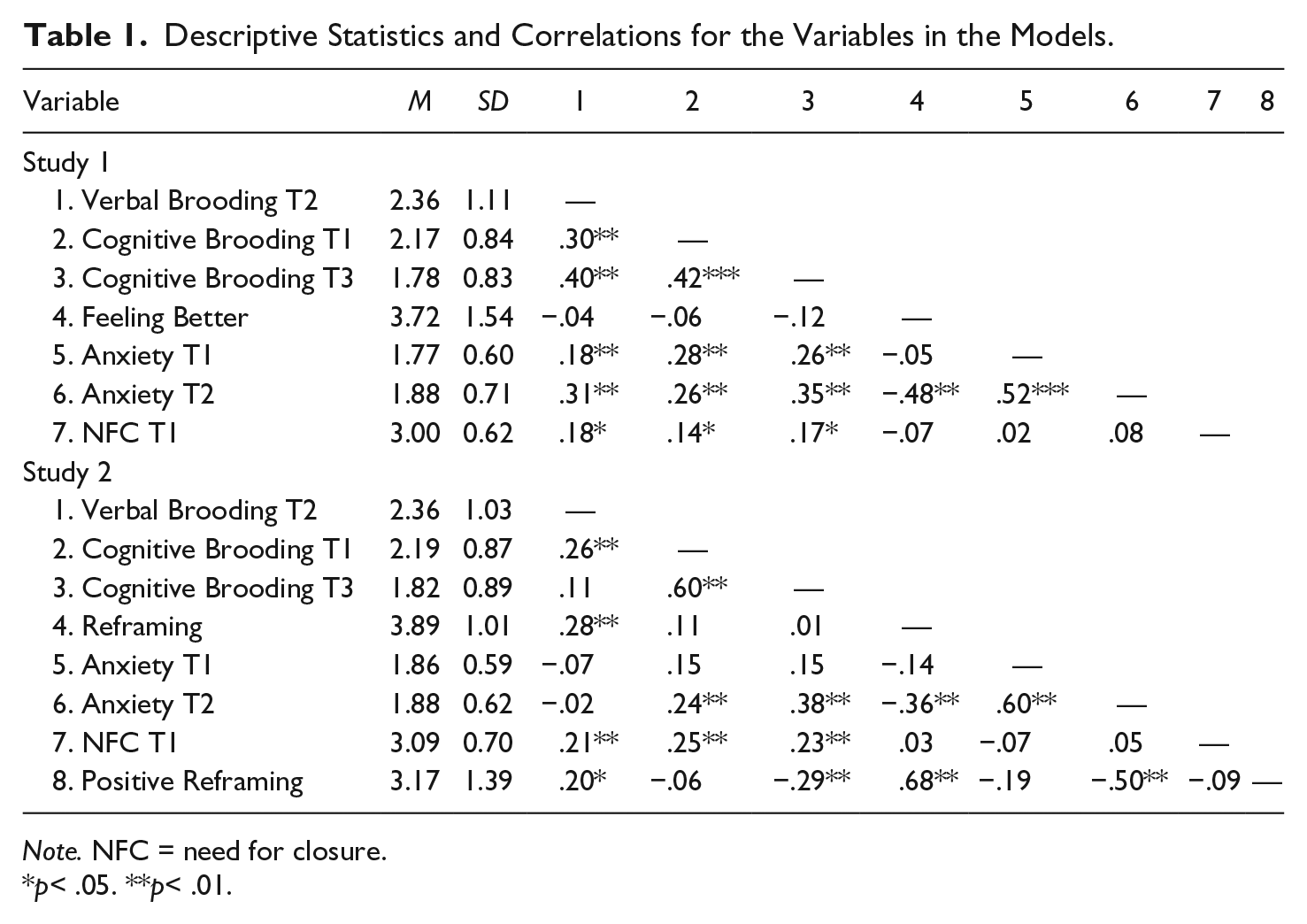
Note. NFC = need for closure.
p< .05. **p< .01.
The results from the primary measures also provide additional evidence of the success of the manipulation in Study 1 and Study 2 (see Table 2). Specifically, the participants in the good support condition reported being less anxious (at T2) and engaging in less cognitive brooding rumination (T3) after the conversation. Participants in the good support condition also reported feeling better (in Study 1) and engaging in more cognitive reframing and positive cognitive reframing (in Study 2). Participants in the good support condition did not report verbally brooding more during the conversation than those in the poor support condition. However, the conversations were longer for the participants in the good support condition (Study 1: M = 8.59 minutes, SD = 6.00) compared with the poor support condition (Study 1: M = 7.10 minutes, SD = 4.90), F = 3.67, p = .05. The conversations were also slightly longer in the good support condition (M = 10.01 minutes, SD = 5.40) and the poor support conditions for Study 2 (M = 8.09 minutes, SD = 3.88), F = 30.65, p .001 compared with Study 1.
Means and Standard Deviations of the Variables in the Models for the Poor and Good Support Conditions.
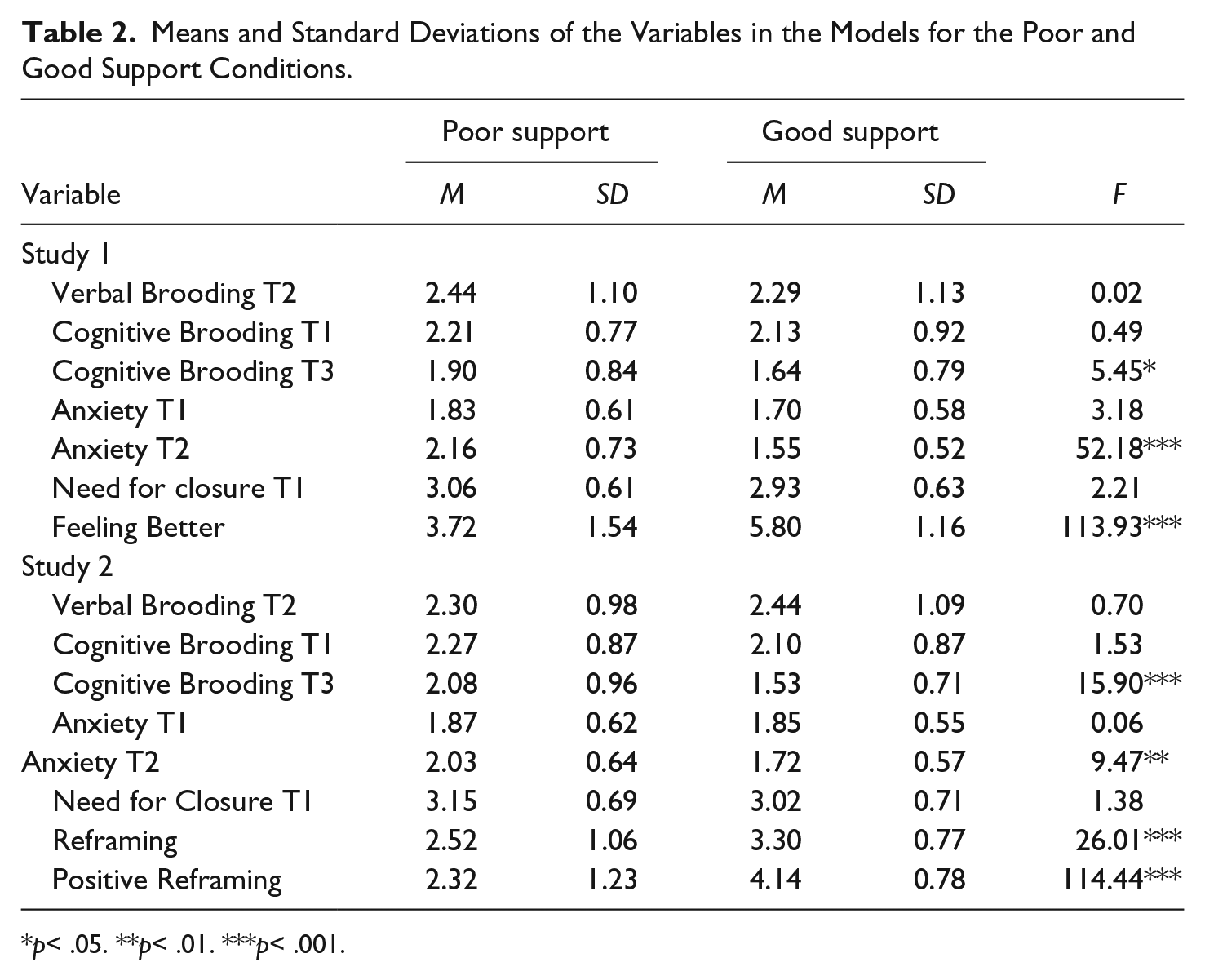
p< .05. **p< .01. ***p< .001.
Data Analysis Plan
Structural equation modeling (with AMOS, Version 22.0) with maximum likelihood estimation was used to estimate the hypothesized models. All of the parameters reported in the models are standardized. Individual items loaded highly onto their corresponding latent constructs, allowing us to form single composite variables or indicators for the latent variables (see Stephenson & Holbert, 2003). To control for measurement error and to help identify the models, the error variance for the observed indices for all of the latent constructs was fixed to (1 −α) × the variance of the indicator (see Bollen, 1989; Stephenson & Holbert, 2003). The subjects’ reports of interaction realism, ratings of closeness with the friend, and the dyad’s sex composition, were tested as possible control variables for both models. However, none of them significantly influenced the models and were therefore not included in the final models. The only control variables included in the models were anxiety (T1) and brooding (T1).
Study 1: Multiple Group Model for Good and Poor Support With Feeling Better
For Study 1 and Study 2, multiple group models were tested to determine the fit of the hypothesized model under good and poor social support conditions. The results for Study 1 are reported first. In order to explore differences between the good support and poor support conditions, the model was first applied to both groups simultaneously. In the process of fitting the measurement model, it was apparent that four correlational paths needed to be added to improve model fit: NFC to cognitive brooding (T1), cognitive brooding (T1) to anxiety (T1), verbal brooding to anxiety (T1), and anxiety (T2) to cognitive brooding (T3). The measurement model was a good fit to the data, χ2(11, N = 231) = 23.30, p = .05, comparative fit index (CFI) = .91, normed fit index (NFI) = .89, incremental fit index (IFI) = .90, root mean square error approximation (RMSEA) = .06. The unconditional structural model was also a good fit to the data, χ2(22, N = 231) = 32.94, p = .06, CFI = .94, NFI = .90, IFI = .95, RMSEA = .05. The chi-square was non-significant (Bentler, 1990; Browne & Curdeck, 1993) and the other fit indices were high (CFI, NFI, and IFI above .90; Bentler, 1990; RMSEA less than .08; Browne & Curdeck, 1993). The standardized estimates and significance levels for the parameters in the model are provided in Table 3. All of the composite variables loaded highly onto their corresponding latent constructs (range = .78-.92).
Comparisons of Parameters for the Hypothesized Model for Good and Poor Support Conditions.
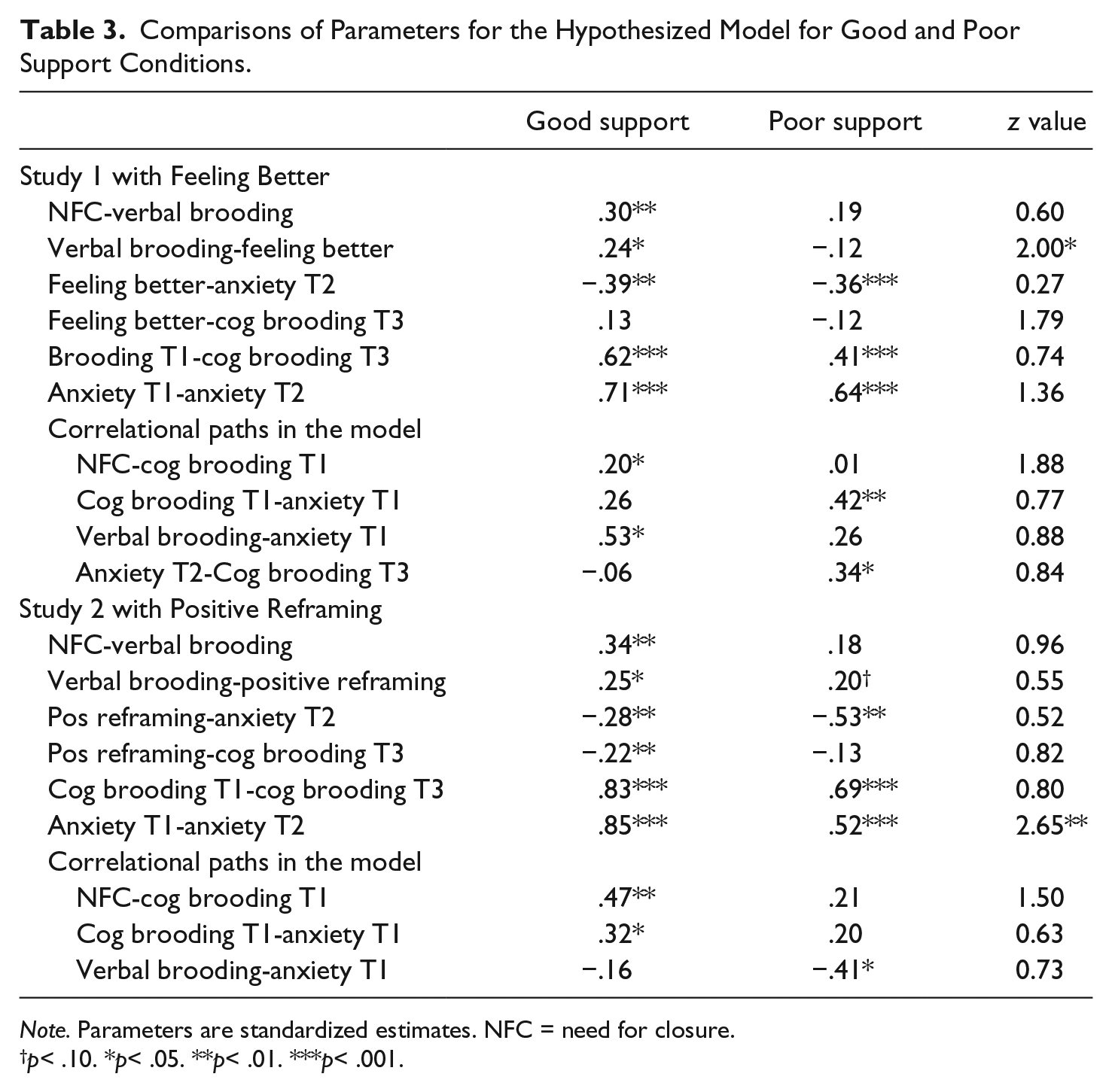
Note. Parameters are standardized estimates. NFC = need for closure.
p< .10. *p< .05. **p< .01. ***p< .001.
When the hypothesized model was computed separately for the good support and poor support conditions, the good support condition evidenced better fit indices, χ2 (11, N = 107) = 14.90, p = .19, CFI = .96, NFI = .90, IFI = .96, RMSEA = .06, than the poor support condition, χ2 (11, N = 124) = 18.04, p = .08, CFI = .91, NFI = .84, IFI = .93, RMSEA = .08. A chi-square test for differences in the good and poor support models was then computed by comparing the χ2 of the original unconstrained model with the χ2 of a fully constrained model. The difference between the chi-square for the constrained model (χ2 = 64.09; df = 34) and the unconstrained model (χ2 = 32.94; df = 22) was significant (p < .01), indicating that the good and poor support models were significantly different from each other. The fit indices of the constrained model (χ2 = 64.09; df = 34, p = .001; CFI = .82, NFI = .72, IFI = .84, RMSEA = .07), however, were not as good as those for the unconstrained model. Therefore, the unconstrained model was used to test for differences in the paths between the good and poor support models. The critical ratio of differences in AMOS was used to determine significant differences between the parameters (see Table 3).
All of the hypothesized paths were significant in the good support condition, except for the path from feeling better to brooding (see Figure 1). The more participants had an NFC about their stressor before the conversation with their friend, the more they verbally brooded about it during the conversation. When they verbally brooded and were provided with good support, the better they felt, which reduced their anxiety but not their cognitive brooding after the conversation. There were no significant direct paths from NFC to brooding or anxiety in the good support condition.
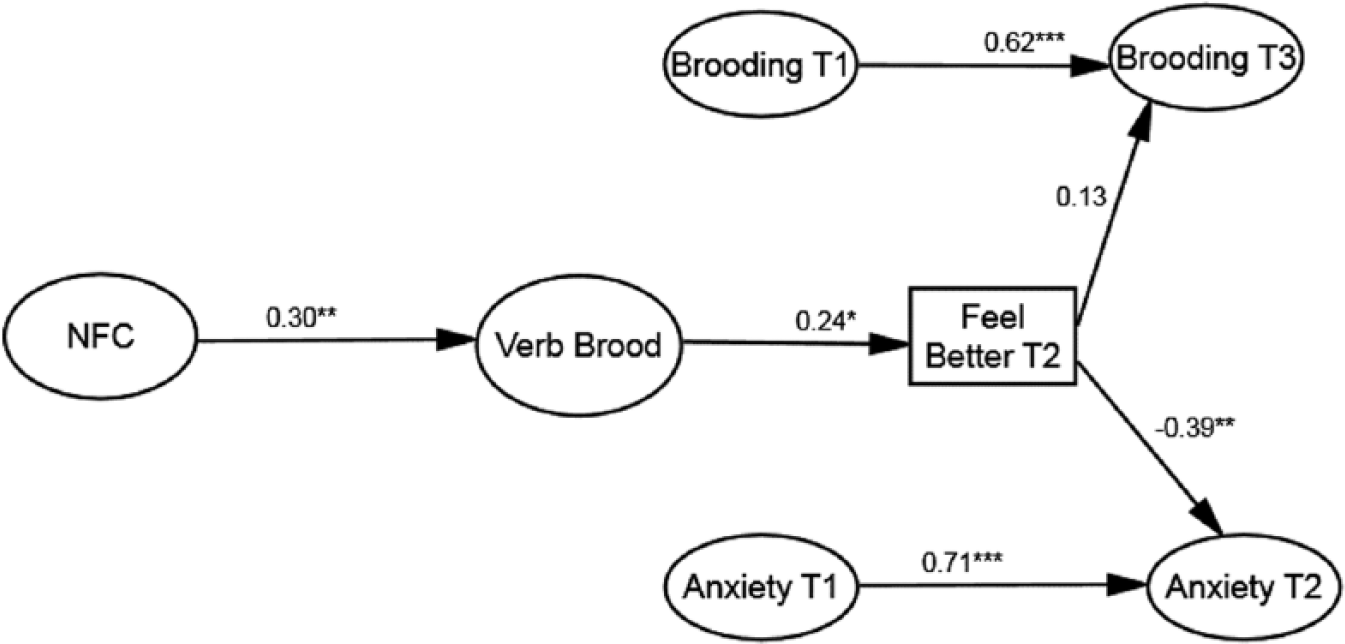
Study 1 results for good support.
The only hypothesized path that was significant in the poor support condition was feeling better to anxiety (see Figure 2). When participants were provided with poor support, their NFC did not predict their verbal brooding. Nevertheless, if the participants felt as if the support that was provided made them feel better, even if the confederate was trained to provide “poor support,” it reduced their anxiety. In both conditions, if the participants felt better as a result of the support, their anxiety was reduced. Even though the hypothesized paths from NFC to verbal brooding and verbal brooding to feeling better were higher in the good support condition than the poor support condition, only the path from verbal brooding to feeling better was significantly different between the two models (see Table 3).

Results for the hypothesized model for poor support.
To assess the possible mediating paths in the model, bootstrapping was used. Bootstrapping relies on the theoretical underpinnings of Baron and Kenny (1986) but tends to yield more reliable results. Similar to Baron and Kenny (1986), bootstrapping assesses (1) the independent variable’s effect on the dependent variable, (2) the independent variable’s effect on the mediating variable, (3) the effect of the mediating variable on the dependent variable, when controlling for the effect of the independent variable, and (4) the indirect path from the independent variable to the mediator to the outcome (or the mediating effect) (Preacher & Hayes, 2004). Unlike the tradition method of Baron and Kenny (1986), however, bootstrapping relies on theoretical sampling distribution and is “accomplished by asking a large number of samples of size n (where n is the original sample size) from the data, sampling with replacement, and computing the indirect effect, ab, in each sample” (Preacher & Hayes, 2004, p. 722). It is also useful with small samples and non-normality (Preacher & Hayes, 2004).
Bootstrapping was used to test for mediation. The mediating paths to brooding in the good and poor support models, however, were not examined for mediation because the path from feeling better to brooding was not significant (i.e., not meeting the guidelines for mediation set forth by Baron & Kenny, 1986). Bootstrapping was used to test the indirect effects between verbal rumination (predictor) and anxiety (outcome) through feeling better (mediator). Bootstrapping was conducted in the good support model only, however, because there was no significant direct path from verbal brooding to anxiety in the poor support model (eliminating the possibility of mediation in the poor support condition). Using AMOS, indirect effects were tested with 2,000 bootstrap replications and a 95% accelerated bias corrected and accelerated bootstrap confidence interval. If the indirect effects are significant, mediation has occurred (Mallinckrodt, Abraham, Wei, & Russell, 2006). Bootstrapping results revealed that feeling better did not significantly mediate the association between verbal rumination and anxiety (T2) (standardized indirect effect = −.01; ns). Rather, feeling better was directly associated with anxiety, as indicated by the path in the model.
Study 2: Multiple Group Model for Good and Poor Support With Reframing and Positive Reframing
Multiple group models were also tested in Study 2, with “reframing” replacing the variable “feeling better.” The model was first applied to good and poor support groups simultaneously. All of the composite variables loaded highly onto their corresponding latent constructs (range = .81-.90). Two correlational paths were added to improve the fit of the model: NFC to cognitive brooding (T1) and the NFC to anxiety (T1). Still, the overall unconstrained model did not fit the data well, χ2(26, N = 152) = 55.07, p < .001, CFI = .86, NFI = .78, IFI = .78, RMSEA = .08. In addition, when the hypothesized model was computed separately for the good support and poor support conditions, neither the good support condition, χ2(11, N = 71) = 35.78, p < .01, CFI = .87, NFI = .80, IFI = .79, RMSEA = .14, nor the poor support condition, χ2(13, N = 81) = 25.59, p = .02, CFI = .85, NFI = .76, IFI = .86, RMSEA = .11, evidenced a good fit to the data. Because none of the models for cognitive reframing were a good fit to the data, the coefficients are not interpreted.
Because we wanted to determine whether positive cognitive reframing produced stronger reductions in anxiety and brooding than neutral cognitive reframing, particularly in the good support condition, multiple group models were also tested with positive cognitive reframing instead of neutral cognitive reframing. The model was first applied to good and poor support groups simultaneously. Three correlational paths needed to be added to the model to improve fit: NFC to cognitive brooding (T1), cognitive brooding (T1) to anxiety (T1), and verbal brooding to anxiety (T1). The measurement model was a good fit to the data, χ2(12, N = 152) = 23.30, p = .06, CFI = .91, NFI = .90, IFI = .92, RMSEA = .05. The structural, unconstrained model also fit the data extremely well, χ2(24, N = 152) = 32.76, p = .11, CFI = .96, NFI = .90, IFI = .98, RMSEA = .04. All of the composite variables loaded highly onto their corresponding latent constructs (range = .72-.92).
When the hypothesized, unconstrained model was computed separately for the good support and poor support conditions, the good support condition, χ2(12, N = 71) = 18.77, p = .09, CFI = .95, NFI = .90, IFI = .95, RMSEA = .08, and the poor support condition, χ2(13, N = 81) = 13.98, p = .30, CFI = .98, NFI = .90, IFI = .98, RMSEA = .06, fit the data very well (see Figures 3 and 4). A chi-square test for differences in the good and poor support models was then computed by comparing the chi-square of the original unconstrained model with the chi-square of a fully constrained model. The difference between the chi-square for the constrained model (χ2 = 49.79; df = 28) and the unconstrained model (χ2 = 32.76; df = 24) was significant (p < .01), indicating that the good and poor support models were significantly different from each other. The fit indices of the constrained model (χ2 = 49.79; df = 28, p = .007; CFI = .90, NFI = .81, IFI = .90, RMSEA = .07), however, were not as good as those for the unconstrained model. Consequently, the unconstrained model was used to test for differences in specific paths. The critical ratio of differences in AMOS was then used to test for significant differences between the parameters in the good support and poor support models.
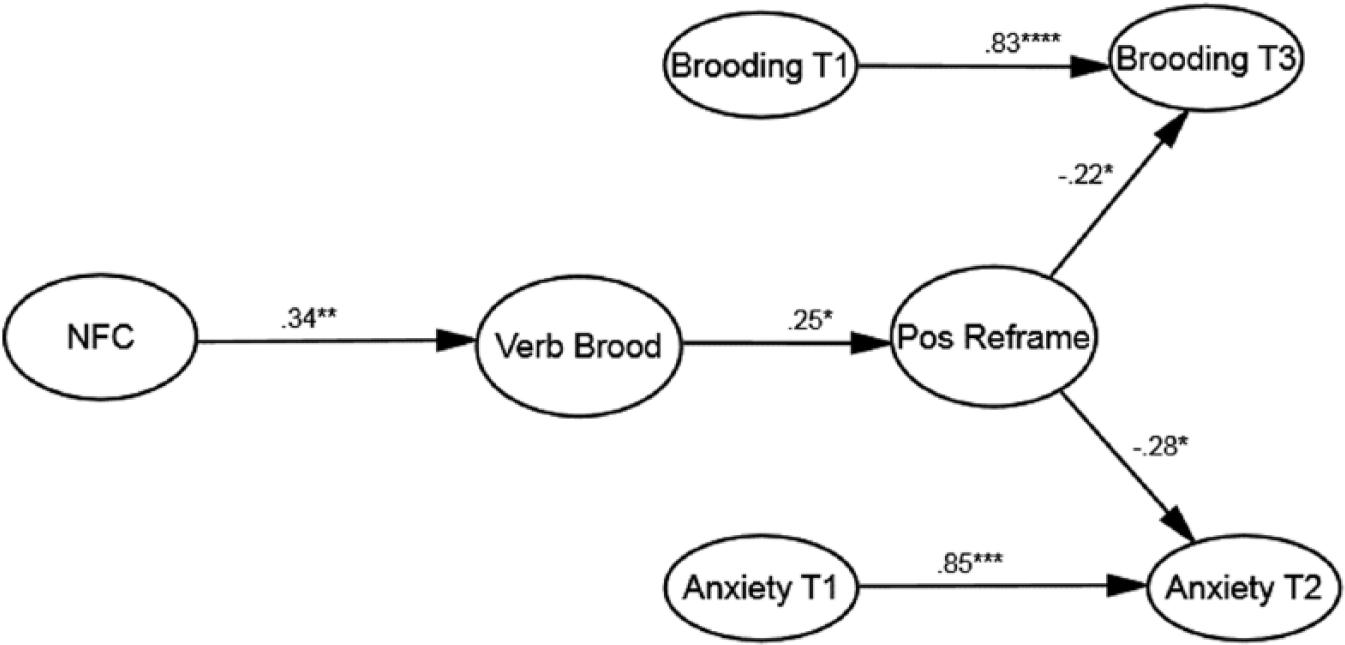
Study 2 results for positive reframing and good support.
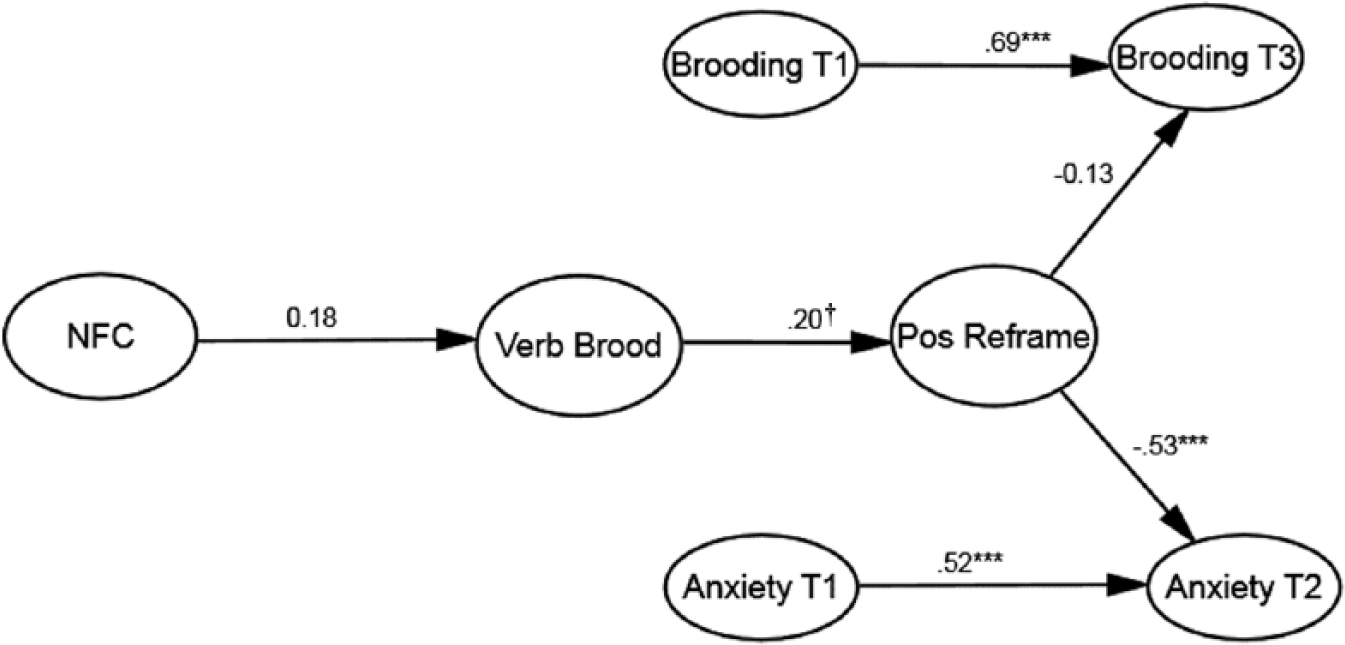
Study 2 results for positive reframing and poor support.
Even though the overall models for good and poor support were significantly different than each other and all of the parameters were stronger for the good support than poor support, except for the path from positive reframing to anxiety, none of the parameters between the models were significantly different from one another (see Table 3). In the good and the poor support conditions, the more participants felt an NFC before the conversation with their friend, the more likely they were to verbally brood about their stressor during the conversation (see Table 3). In addition, the more they verbally brooded, the more likely they were to positively reframe the stressor. This positive reframing was inversely associated with anxiety in both conditions. Unlike all of the other models and the poor support condition, however, positive reframing was only able to reduce significantly cognitive brooding when good support was provided. There were, however, no significant, direct paths from verbal brooding to anxiety or cognitive brooding when the other paths were included or removed from the models. Consequently, there were no significant indirect effects for verbal brooding on anxiety (standardized indirect effect = .01, ns) or brooding (standardized indirect effect = .04, ns) through positive reframing, but rather direct effects of positive reframing on anxiety and brooding.
Discussion
People often experience something stressful in their lives that they cannot seem to get off their mind. Sometimes these intrusive thoughts turn into repeated conversations with close friends. But even support from the most patient friends can dissipate if the same stressor surfaces in conversations continuously, particularly if those conversations involve depressive thoughts. Certain individuals might also be more likely than others to repeatedly talk about their negative thoughts than others. The goal of the current study was to examine how people’s NFC and social support work together to explain why people verbally brood and whether the support they receive when they verbally brood helps them reduce their cognitive brooding and anxiety afterward. In both studies, participants were asked to discuss a topic they could not stop thinking and talking about recently with their friend. In the overall models for Study 1, friends were more likely to verbally brood when they had a higher NFC, but primarily when they were provided with good support. Individuals with a higher NFC were also more likely to feel better about their stressor after they verbally brooded, but only when they talked about it with a friend who was socially supportive. Talking about their stressor helped them feel better, which reduced their anxiety but not the extent to which they mulled about the stressor 20 minutes after the conversation. In the models for Study 2, friends were more likely to verbally brood when they had a higher NFC. They were then able to reframe the stressor after the conversation, regardless of whether they were provided with good or poor support during it. When they were able to positively reframe the stressor, however, it reduced participants’ cognitive brooding when they were provided with good support. The models for neutral, cognitive reframing did not fit the data. What reduced cognitive brooding after the interaction was having a friend who provided good support and who helped reframe the stressor in a positive manner.
While being provided with poor support hindered the NFC and verbal brooding process and did not reduce cognitive brooding, it still might be effective for reducing anxiety if positive reframing occurs. In both data sets, when individuals received poor support from their friend, their desire for closure did not significantly influence the extent to which they verbally brooded. Verbally brooding also did not predict whether they felt better or positively reframed the stressor. Nevertheless, if individuals did feel better or positively reframed the stressor as a result of the support provided, even if it was “poor support,” it significantly reduced their anxiety. Good support during the conversation facilitated the disclosure process and allowed for positive reframing to occur, which reduced cognitive brooding afterward. Poor support hindered the disclosure process, but participants in this condition were still able to positively reframe the stressor. Therefore, receiving poor support might or might not make people want to verbally ruminate about their stress and the process of the talk itself may not make them feel better, but the messages provided in poor support situations can still help people positively reframe their stressor and reduce their anxiety. Even though an overwhelming amount of research has shown that individuals perceive high person-centered messages as more effective than lower person-centered messages (see High & Dillard, 2012 for review), sometimes individuals may not view low person-centered messages as poor support, but as good support. Positive reframing of the stressor when receiving good support, however, was the only way to reduce people’s brooding. These findings are elaborated upon below.
NFC, Verbal Rumination, and Social Support
The current study contributes to literature on the NFC by linking it to verbal rumination and social support. A considerable amount of research has examined how NFC is associated with information-seeking behaviors (see Dechesne & Kruglanski, 2009; Kruglanski & Webster, 1996; Sollar & Vaneckova, 2012), but not how an NFC influences disclosure patterns and how these disclosure patterns are affected by the type of support received when disclosing the negative feelings about one’s stress. One could argue that individuals with a low NFC might be more likely to verbally ruminate about their stress than those with a high NFC, perhaps because they are more comfortable gathering and receiving information that both supports and contradicts their feelings about their problem (see Dechesne & Kruglanski, 2009). However, people with a low NFC are unlikely to continually talk about their stressor because there probably is not an urgent need to resolve it. As we predicted, when people have a higher NFC they are more likely to continue to disclose their negative or depressive thoughts about their stressor, most likely because they long for a solution to their brooding and stress. People often cognitively brood because they feel like they lack control over a problem (Nolen-Hoeksema, 2000). This lack of control likely fuels the desire for a sense of closure for those with a higher NFC and subsequent control that the closure provides. Verbally brooding about their stressor allowed people to talk about their stress and provided a pathway for reducing their anxiety and cognitive brooding, but was moderated by the type of support provided.
In the overall models, people with a higher NFC were more likely to verbally brood when they received good support. Receiving good social support could provide a “safe haven” for those with a higher NFC to verbally brood about their stress, allowing the process of the depressive talk to be cathartic and health promoting. As the research on social support suggests (e.g., Burleson & Goldsmith, 1998; Burleson & MacGeorge, 2002; Holmstrom et al., 2005; Jones & Wirtz, 2006; Lazarus & Folkman, 1984), support that is high person centered and that helps people reframe their stressor can promote positive affect and provide alternative ways of thinking about a stressor. Individuals with an NFC are probably more likely to continue to talk about a stressor when their perspective is validated and others help them think about it in a more encouraging way, facilitating positive thinking and problem solving and ultimately allowing them to escape the cycle of brooding.
Good support facilitates the process of achieving closure with regard to one’s brooding through social relationships. Poor support seems to cut the process short—It inhibits verbal brooding when it sometimes might be necessary for some people (e.g., high NFC) to talk about their stress in order to resolve it. People with a higher NFC may want to verbally brood about their stress but refrain from doing it because their ideas and sense of self are invalidated. The only time when this process was facilitated was when individuals were able to positively reframe their stressor. One explanation for this finding could be that the process of positively framing infuses the conversation with more positive emotions rather than negative emotions (see also T. D. Afifi et al., in press). These positive feelings might promote disclosure, prompting a series of support-disclosure feedback loops. Future research should examine whether those who have a higher NFC are more disadvantaged than those with a lower NFC when provided with poor support because their need for certainty about their problem goes unresolved.
The aforementioned argument, however, might suggest that verbal brooding is always desirable and health promoting. Of course, volumes of research suggests the opposite—Talking too much about negative thoughts regarding one’s stress can have deleterious consequences for one’s health (e.g., Conway et al., 2011; Saxbe & Repetti, 2010; Stroebe et al., 2005). In fact, most of the research on co-rumination has found that it is anxiety-producing rather than anxiety-reducing (Calmes & Roberts, 2008; Starr & Davila, 2009; Stone et al., 2010). The research on co-rumination, however, typically fails to account for the type of support received when the co-rumination is occurring. It also focuses on a wide range of talk rather than only communication of negative and depressive feelings. Unlike co-rumination, when one person provides support to another who is verbally brooding, it may shift the focus of the problem talk toward more positive thoughts and feelings if effective support is provided.
The findings from the current study also suggest that poor support can still reduce people’s anxiety if it makes individuals feel better or helps them positively reframe their problem. Typically, “low person-centered” messages that fail to account for a person’s feelings and ideas are perceived of as less socially supportive and are associated with worse mental health than moderate and high person-centered messages (see Burleson, 1982, 2008; Burleson & MacGeorge, 2002). Even though we specifically trained the confederates to provide support that was distracted, inattentive, and that tended to blame the person for his or her stress (rather than dismiss the ideas per se), some people might still have perceived of this behavior as supportive (see also Nolen-Hoeksema & Davis, 1999). For some people, being told directly that their behaviors were problematic might have helped them assume more responsibility for the problem (perhaps helping them confront negative behaviors rather than enable them, or helping them realize they are being too negative), reducing their anxiety. Additional research is necessary that can better delineate conditions in which “poor support,” or what Burleson and colleague consider low person-centered messages, might be effective. The other possibility is that while the training was effective (given the significant manipulation checks), there is always the possibility that some of the confederates were not as unsupportive as they were trained to be, allowing those participants to feel better and less anxious after the conversation.
An important avenue of research is why anxiety was reduced and not brooding, except when friends were able to positively reframe the stressor. Individuals continued to brood after the conversation was over, unless they were provided with good support and were able to positively reframe the stressor. Cognitive reappraisal alone did not fit the data well, but positive cognitive reappraisal did. Future interventions with social support should focus on shifting the conversation to positive reframing of the stressor rather than simply making the person feel better or thinking of the stressor differently. Thinking of the situation more positively might allow individuals to cognitive shift their negative affect to positive affect, breaking the brooding cycle.
Final Thoughts
While the current investigation provides valuable insights regarding the associations among the NFC, verbal brooding, and social support, they should be tempered by its limitations. Even though we had participants focus on a problem they could not stop thinking and talking about with their friend, it is possible that the participants had already thought and talked about the problem so much that it was no longer as stressful as it was when it first arose. Another methodological approach might be to use diary logs to capture naturally occurring stressors and what happens when people verbally ruminate about them with close others. This naturalistic approach would also account for the somewhat artificial nature of the laboratory. We randomly assigned and trained one of the friends to provide support to avoid using hypothetical scenarios or trained confederates who are strangers. Because the confederate was a close friend, however, there is always the possibility that the friend’s poor support was somewhat unbelievable. Even though we trained the confederates to be natural in the way they provided poor support and to account for the context of the specific relationship, naturalistic settings likely still provide poor support situations that are more genuine than the laboratory. Alternatively, including friends who know each other, but who are not best friends (the friends in the current study were emotionally close, but varied in the length and strength of their relationship), could alleviate certain expectations due to the long-term history of the relationship.
Finally, participants’ perceptions of verbal brooding were used in the current article rather than their actual verbal brooding. As a result, some of the strength of the correlations among the psychological variables could be due to common method variance. An important avenue of future research would be to compare observational coding of verbal brooding with perceptions of it. Observational coding would also allow researchers to detect increases or decreases in verbal brooding over the course of the conversation. Even with these potential limitations, this investigation provides new insights linking the NFC to verbal brooding and how the type of support people receive when verbally brooding not only affects the extent to which they verbally brood, but how they feel afterward.
Footnotes
Declaration of Conflicting Interests
The authors declared no potential conflicts of interest with respect to the research, authorship, and/or publication of this article.
Funding
The authors received no financial support for the research, authorship, and/or publication of this article.