




Abstract
Research on online communities has emphasized the individual benefits of social support for members, but less is known about how such communities are regulated through organizing processes of support and control. Drawing on a survey of 214 members of a particular online message board community, we develop and test a model of social support, strength of ties, normative influence, and concertive control and their influence on members’ sense of virtual community (SOVC). We find that all four factors predict SOVC, but that normative influence and concertive control have the strongest effects. Furthermore, social support and concertive control mediate the effects of number of strong ties and normative influence (respectively) on SOVC. Finally, we find no association between SOVC and time-lagged posting frequency. Our findings have important implications for understanding the factors that lead to attachment in online communities, and they suggest that sense of belonging works through tandem communicative processes of support and control.
Keywords
Online communities have become a vibrant and vital means of initiating and maintaining social relationships among strangers. While meaningful social relationships have been found to form in online communities dating back to early Internet platforms such as Usenet, MUDs, and newsgroups (e.g., Baym, 2000; Parks & Floyd, 1996a), social media technologies (e.g., Twitter, Wikipedia, YouTube) and discussion forums are providing new sites of community that are more sophisticated technologically and socially richer (Rainie & Wellman, 2012; Ransbotham & Kane, 2011). While many social media tools are being incorporated seamlessly into users’ lives such that lines between offline and online lives are blurring (Hampton, 2016; Sessions, 2010; Shen & Cage, 2015), other online contexts such as discussion forums (which connect members with no prior offline relationship) continue to provide an oasis where users can get away from their offline lives. Online support groups, for example, provide sites of community in which users seek advice and support for coping with mental and physical health issues (Rains & Young, 2009). The anonymity of such contexts has been found beneficial in encouraging users to disclose intimate problems and concerns that they may not feel comfortable discussing with their friends and family (Scott, Rains, & Haseki, 2011).
However, online communities have been found to face challenges regarding member commitment and contribution (Kraut & Resnick, 2011); the social forces keeping people in an online community are likely weaker than those of conventional offline groups, interactions tend to be more fleeting, and even highly successful online communities may experience problems of attrition and undercontribution. In many online communities, less than 10% of members are responsible for more than 85% of contributions, and a large number fail due to lack of participation (Ling et al., 2005).
Scholars have turned to group attachment as a means of fostering commitment and contribution in online communities (Ren, Kraut, & Kiesler, 2007). One key concept that has been associated with the sustainability of online communities is members’ sense of virtual community (SOVC; Blanchard & Markus, 2004; Koh & Kim, 2004). While prior research has investigated antecedents of SOVC, it has not systematically integrated communicative processes of support and control to test their relative impacts. Largely separate research streams have investigated (1) SOVC and its antecedents (e.g., Blanchard, Welbourne, & Boughton, 2011), (2) the impacts of social support on individual health and well-being (for a review, see Rains & Young, 2009) and (3) control or regulation processes that bind members together and enable online communities to endure and cohere over time (e.g., Aakhus & Rumsey, 2010; Kraut & Resnick, 2011). We propose that online communities cohere around a combination of supportive communication and a powerful system of peer-based concertive control and normative influence that develops over time, and that both processes contribute to members’ SOVC. Concertive control has been found to increase cohesiveness, commitment, and conformity in self-organizing groups (Tompkins & Cheney, 1985), although it may end up being somewhat paradoxically more rigid and harsh than formal bureaucratic control (Barker, 1993).
Drawing on a survey of a particular online message board community that has endured for 15 years, we develop and test a model of strength of ties, social support, normative influence, and concertive control, finding that all four are predictors of members’ SOVC, but that control mechanisms of normative influence and concertive control (Barker, 1993) have the greatest influence. Our findings provide important contributions by (1) extending notions of online social support to include the role of negative and positive emotion as well as group-based outcomes, (2) challenging prevailing assumptions in the SOVC literature that influence is weaker in online communities, and (3) highlighting the role of concertive control processes in SOVC, which—along with social support and interpersonal ties—are important communicative mechanisms that bind members together and provide them with a sense of community.
Explaining SOVC
Ever since scholars first distinguished between geographical notions of community (e.g., neighborhood, town) and relational notions of community, which are concerned with the quality of relationships without reference to location (Durkheim, 1893/1964; Gusfield, 1975), sense of community has been viewed as a significant concept to understand how people define their community and develop a sense of belonging even when clear spatial boundaries do not exist. Community psychologists have long considered sense of community an important feature of face-to-face communities, as it has been found to lead to greater satisfaction, commitment to, and involvement in the community (Prezza, Amici, Roberti, & Tedeschi, 2001). Traditionally, sense of community has been defined as “a feeling that members have of belonging, a feeling that members matter to one another and to the group, and a shared faith that members’ needs will be met through their commitment to be together” (McMillan & Chavis, 1986, p. 9). The most influential conceptual framework for studying sense of community is that of McMillan and Chavis (1986), who outline four dimensions of it: membership, influence, fulfillment of needs, and shared emotional connection. Membership is a feeling of being a part of the community, which is determined by its boundaries and differentiates in-groups from out-groups. Influence encompasses both members’ influence on the community and the community’s ability to exert influence on its members, including pressures for conformity which increase member buy-in and commitment. Fulfillment of needs can be seen as a motivator of community behavior because members develop a positive sense of togetherness when their association with the group is rewarding; thus, meeting members’ needs is a primary function of a strong community. Finally, shared emotional connection can be created by a shared history, frequent contacts, interaction quality, and personal investment.
Virtual community scholars have extended this concept to online groups through the notion of SOVC (Blanchard et al., 2011; Koh & Kim, 2004; Tonteri, Kosonen, Ellonen, & Tarkiainen, 2011). SOVC is analogous to sense of community but refers to feelings of identity, belonging, and attachment that are formed specifically among members of virtual communities (Blanchard et al., 2011). Research that has explicitly compared sense of community in physical communities such as neighborhoods with SOVC in online groups such as chat rooms or fan communities (Obst, Smith, & Zinkiewicz, 2002; Roberts, Smith, & Pollock, 2002) has found that members of online communities experience a sense of community in line with the McMillan and Chavis (1986) framework, but with a few differences. Specifically, perceptions of membership and influence have been found to be weaker in virtual compared to physical communities. Members of an online newsgroup, for instance, reported little influence by or over other members, and their relationships with others were limited mainly to recognizing names of other members (Blanchard & Markus, 2004).
Other research on online communities, however, finds that group membership and influence processes play an important role in regulating community behavior. Thriving online communities have been found to develop shared expectations around normative (and non-normative) behaviors (Kiesler, Kraut, Resnick, & Kittur, 2011). Rather strict mechanisms of control have been demonstrated in online communities ranging from mothering message boards (Schoenebeck, 2013) to 4chan (Bernstein et al., 2011) to Wikipedia (Kane, Majchrzak, Johnson, & Chen, 2009). For instance, Wikipedia editors often face conflicts over what content to include that lead to “edit wars” in which editors repeatedly undo the changes of others in order to preserve their own preferred version of the article (Kittur, Suh, Pendleton, & Chi, 2007); this led to a three-revert rule stating that editors may only revert an article on Wikipedia 3 times per day. While some research focuses on regulating “bad” or anti-social behavior such as trolling or flaming (Kiesler et al., 2011) or the negative effects of sanctioning on SOVC (Blanchard et al., 2011), there is also evidence that normative control and sanctions may be prosocial and help to construct and regulate online communities (Aakhus & Rumsey, 2010). Similarly, it is possible that rather than alienating members from the community, exerting sanctions and disciplining members may actually bond them further to the group through establishing the boundaries of community membership and heightening their sense of attachment and investment. We draw on the notion of concertive control (Barker, 1993), which is a peer-based form of control that arises in self-organizing groups, to explain this process and its positive role in contributing to SOVC.
We theorize that SOVC is established through both processes of support and control, which work in tandem to bond members together through both interpersonal and group mechanisms. One path occurs through supportive interpersonal processes drawing on social exchange theories (strength of ties, social support) while another path occurs through group-based control processes and draws on identity theories (normative influence, concertive control). We develop a model to integrate and test these relationships with SOVC and then test its relationship to participation. Thus, we argue that normative influence, concertive control, social support, and number of strong ties will lead to SOVC, and that this will in turn be associated with members’ participation. We develop a conceptual model to explain this process (see Figure 1). In the following section, we develop a rationale for each hypothesis.
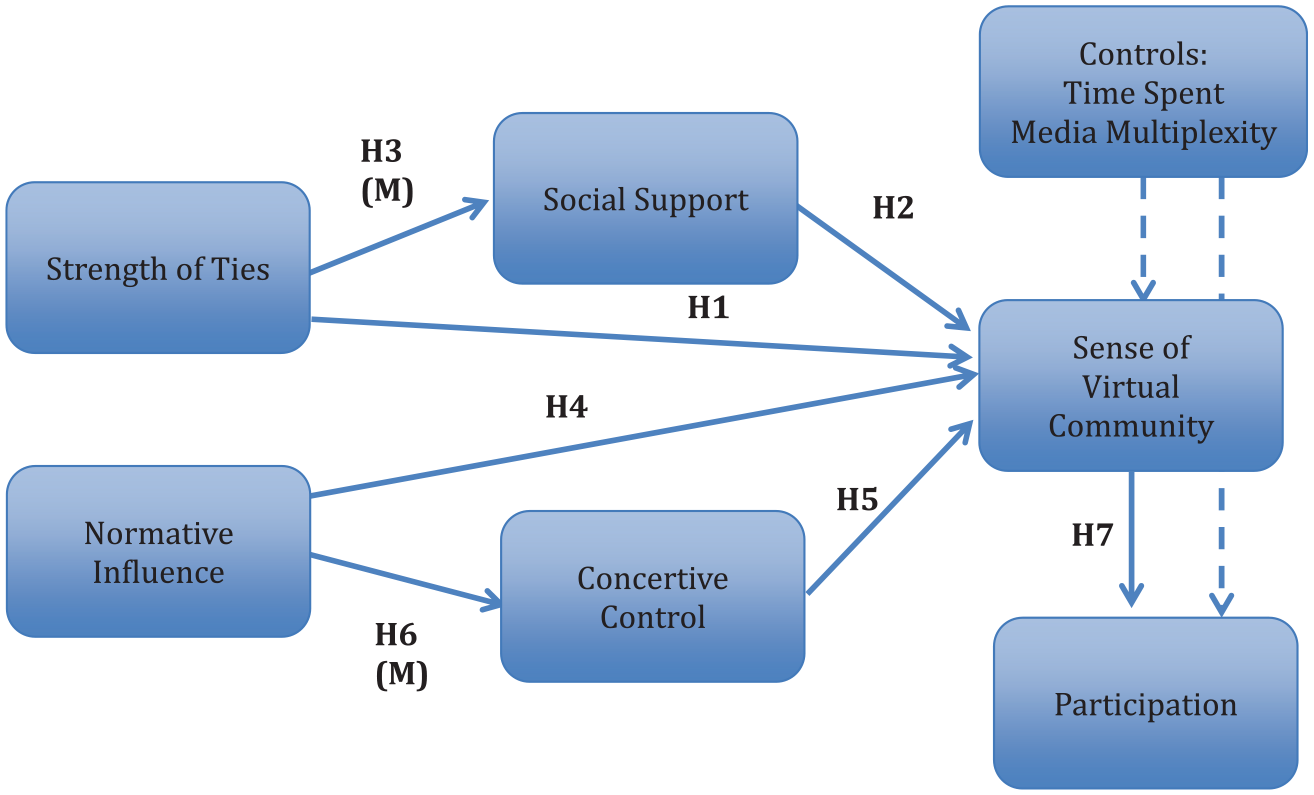
Conceptual model.
Strength of Ties and Social Support
Social support has been defined as “verbal and nonverbal communication between recipients and providers that reduces uncertainty about the situation, the self, the other, or the relationship, and functions to enhance a perception of personal control in one’s experience” (Albrecht & Adelman, 1987, p. 19). Highlighting the significance of social support in our social life, researchers have investigated the functions and outcomes of social support in a variety of contexts. Social support helps individuals mitigate depression and stress (Cohen & Wills, 1985; Goldsmith, 2004), increase self-efficacy to cope with adverse situations (Chen, Yeh, & Chao, 2006), and improve the quality of life (Lorig et al., 2002). In addition, online social support can be particularly beneficial when computer-mediated communication (CMC) enables individuals to interact with different groups beyond temporal and spatial boundaries (Braithwaite, Waldron, & Finn, 1999) and provides a safe communication environment based on anonymity (Walther & Boyd, 2002). Employing these features, members can glean social support from online community members, weak ties, and anonymous ties (Wright, Rains, & Banas, 2010). Scholars report that participation in online support groups generally has a positive impact on health outcomes (for a review, see Rains & Young, 2009).
Drawing on McMillan and Chavis (1986), we predict that strong ties among community members bring about greater emotional connection that is likely to lead to stronger attachment to the community as a whole. Prior scholarship on local communities has clearly demonstrated the impact of social relationships on sense of community. Community members who develop closer relationships with other community members are likely to show higher levels of sense of belonging and community involvement (Wellman, Quan-Haase, Witte, & Hampton, 2001). Similarly, members’ attachment to a community is greater when they have strong ties in the community (Kavanaugh, Carroll, Rosson, Zin, & Reese, 2005). Expanding these findings to the online context, we propose that those with more strong ties within the community will have a stronger sense of community belonging. This leads to H1:
Social support also has implications for community building. Chiessi, Cicognani, and Sonn (2010) reveal that social support is positively associated with adolescents’ sense of community in terms of their neighborhood as well as their peer groups. Pretty, Andrewes, and Collett (1994) investigate similar contexts to demonstrate that different types of social support, satisfaction with support, and number of supporters are positively related to sense of community. Vieno, Santinello, Pastore, and Perkins (2007) also confirm that social support from friends and family directly predicts one’s sense of community. These studies and others (Jason, Stevens, & Ram, 2015) consistently show a positive relationship between social support and sense of community.
We extend these findings to the online context by positing that reception of social support within online communities will give members a stronger sense of community by helping to meet their informational, emotional, and even material needs. Indeed, exchange of support is one of the primary reasons for the existence of many online communities (Baym, 2000; Rains & Young, 2009; Wellman & Guilia, 1999). Drawing on social exchange theory, Blanchard’s works have consistently found that exchanging support among members of virtual communities increases their SOVC (Blanchard, 2007, 2008; Blanchard et al., 2011). The norm of reciprocity motivates members to exchange support through sharing information, giving advice, offering reassurance, or cheering someone up. In addition, the public nature of this support exchange in online communities is likely to magnify perceptions of the supportive nature of the group as all members may benefit from reading supportive messages even if they are not active in sharing support (Wellman & Guilia, 1999). This collective process of support exchange is likely to increase members’ sense of belonging to the entire group. Thus we propose the following hypothesis:
We further propose that the amount of social support will mediate the relationship between the number of strong ties and one’s sense of community. Social support scholarship has consistently found that the size and quality of one’s support network are positively associated with social support exchange. Wright (2000) shows that size of the support network is positively associated with the number of supportive messages received from online support groups. Eastin and LaRose (2005) also argue that the size of one’s online network is significantly related to perceived social support. Specifically focusing on tie strength, Kim (2014) reveals that the number of strong ties has a positive association with the amount of received support online and offline. Furthermore, satisfaction with one’s supportive relationships in online groups leads to a reduction in life stress, indicating that the quality of connections also plays a significant role in receiving social support (Wright, 1999). Based on this, we predict an indirect effect in which members with more strong ties will have access to a greater amount of received social support, and this will in turn increase their sense of community belonging. This leads to our third hypothesis:
Normative Influence and Concertive Control
Since the theory of normative influence emerged in the 1950s (Deutsch & Gerard, 1955), it has been defined as the tendency to conform to the positive expectations of others (Burnkrant & Cousineau, 1975). As normative influence significantly affects a wide range of individual behaviors such as ethical judgment (Cherry, 2006), adoption of technologies (Green, 1998), brand choice decisions (Orth & Kahle, 2008), and community engagement (Hopper & Nielsen, 1991), scholars have examined different contexts to understand its antecedents and outcomes. Norms are regarded as an antecedent of sense of community in face-to-face communities, as members’ perception and adherence to norms increases their bonds to the group (McMillan & Chavis, 1986). Normative influence within a community has been understood as a process that is essentially grounded in members’ sense of connection with other group members (Yanovitzky & Rimal, 2006). Orth and Kahle (2008) argue that normative influence is closely related to one’s sense of community and emotional attachment to a social group. Rimal and Real (2003) also suggest that peer influence exerted through communication is likely to reinforce group identity.
This scholarship has been extended to online environments, demonstrating that normative influence also operates in CMC settings (Lee & Nass, 2002) and that members of naturally occurring online groups create and adhere to norms specific to the group (Postmes, Spears, Lee, & Novak, 2005). Online norms are argued to be fundamentally a group property and to play a key role in building and maintaining communities in mediated environments (Pankoke-Babatz & Jeffrey, 2002). Specifically, the social identity and deindividuation (SIDE) model (Postmes, Spears, & Lea, 2000; Postmes, Spears, Sakhel, & de Groot, 2001) suggests that normative influence online is intensified when a common group identity is salient. When visual anonymity obscures social categories such as gender and race, group identification can be triggered. This deindividuated nature of online communication may reinforce conformity to specific group norms that are associated with a shared social identity of online community members. Along these lines, Sukumaran, Vezich, McHugh, and Nass (2011) argue that online community members actively identify and conform to their norms, which are manifested through others’ behaviors or design features. Dholakia, Bagozzi, and Pearo (2004) also demonstrate that perceived group norms affect individuals’ online group identity and in turn their willingness to participate in such communities.
Norms have also been found to be a predictor of SOVC specifically, although they have been positioned as mediating the effects of identity and support on SOVC (Blanchard, 2008; Blanchard et al., 2011). Building on these findings, we posit that normative influence contributes to members’ sense of community since members who have internalized group norms are more likely to feel a sense of belonging to the community. Thus, we propose the following hypothesis.
McMillan and Chavis (1986) regard membership as involving needs for boundaries to protect their intimate social connections. Groups often use deviants as scapegoats to establish such boundaries by defining who is “in” and who is “out.” Participation in voluntary associations also gives members a sense of buy-in and ownership over the community, which in turn leads to greater conformity and cohesion (McMillan & Chavis, 1986). We propose that this occurs through a process of concertive control, which is a more unobtrusive form of peer-based influence that arises in self-organizing groups. Based on value consensus rather than explicit rules and regulations as in formal, bureaucratic control systems (Edwards, 1981), concertive control is more hidden and unobtrusive (Larson & Tompkins, 2005; Tompkins & Cheney, 1985). In concertive control systems, members develop normative standards through negotiation and internalization of shared norms, which they enforce by disciplining one another (Barker, 1999). Following this framework, Barker (1993) analyzed the processes of developing concertive control in self-managing teams to reveal that members collectively created a set of values and enacted disciplinary mechanisms to ensure that others complied with those norms. This type of control is particularly effective in groups with flat or decentralized structures.
Many online communities, in which codified rules or formal hierarchies tend not to exist, can be considered to be self-organizing groups with relatively flat, participatory structures. Although it may be the case that hierarchical roles and relationships develop among members, this is often emergent rather than designed into the formal structure. Moderators have some modicum of control, but they are often voluntary, perform largely administrative functions, and rotate over time. While online communities are likely to differ in important ways from managed organizations whose goal is to control workers through obtrusive or unobtrusive methods, online communities have nevertheless been found to develop processes of organizing and control in order to enable their collective activity (Aakhus & Rumsey, 2010; Faraj, Jarvenpaa, & Majchrzak, 2011). Formalization of norms is an effective means of control in managing online communities (Kollock & Smith, 1996). Furthermore, online community members are likely to control one another through voluntary interactions and implicit norms rather than by imposed rules (Baym, 2000; Burnett & Bonnici, 2003).
While research on SOVC has addressed the role of norms, it tends to conclude that influence through group conformity pressures is weak to non-existent in online communities (e.g., Blanchard, 2008; Blanchard et al., 2011). As such, control processes have not been explicitly linked with SOVC, with the exception of sanctioning of members. Blanchard et al. (2011) predicted and found that sanctioning had a negative effect on members’ SOVC; however, they measured sanctioning narrowly in terms of whether members had sanctioned others, been sanctioned by others, or observed others being sanctioned. Namely, their findings on the negative effect of sanctioning on SOVC are germane to the study’s emphasis on deviant or non-normative behavior. However, they acknowledge that sanctions may also have the opposite effect of reinforcing group norms and increase solidarity and SOVC “as the group coalesces around stopping this inappropriate behavior” (p. 94) and call for additional research to study the role of sanctioning further as it relates to SOVC. Drawing on the concertive control literature, we predict that the existence and enforcement of group norms will contribute positively to SOVC, as enforcing normative standards leads to enhanced group identification and solidarity (Barker & Tompkins, 1994; Sundstrom, De Meuse, & Futrell, 1990), even if sanctioning may be experienced negatively by individual members. By acting “in concert,” group members develop a sense of empowerment which can reinforce their sense of group belonging (Papa, Auwal, & Singhal, 1997). Thus, we argue that concertive control will increase SOVC, as members’ sense of appropriateness and internalization of group norms heightens their sense of belonging and accountability to the community. We propose the following hypothesis:
Implicit or informal forms of control have been found to constitute a more powerful form of normative influence than explicit or formal control because individuals have internalized norms as appropriate modes of conduct and choose to act in accordance with them (Sherif, 1935). This internalization of norms closely relates to the development of concertive control systems that exert powerful control over members (Barker, 1993). While perceptions of norms may vary among individuals and are not necessarily predictive of behavior, the internalization of norms about how members “ought” to act results in coercive pressures to conform by engaging in such behaviors. In this way, interpersonal processes of normative influence are likely to lead to group-based concertive control processes that in turn help to reinforce group identity and sense of community (which are threatened by violation of norms).
Drawing on the literature, we propose that members who are more susceptible to normative influence will be more likely to feel that concertive control exists (and more subject to it). While normative influence may be developed through interactions with particular individuals within the community, concertive control exists at the group level and helps to perpetuate a shared group identity that leads to a sense of belonging or community among members. Furthermore, concertive control involves not just a cognitive process of internalization of norms but resulting communicative behaviors to help enforce such norms and regulate members’ behavior. We assume that norms initially form through interpersonal interactions within the community and eventually result in the formation of concertive control systems that extend to the group as a whole. This process has been qualitatively investigated in prior research on online communities (Aakhus & Rumsey, 2010), which has explored how interactional norms and resulting conflict over them serve to organize and regulate the community. Thus, we propose the following hypothesis:
SOVC and Participation
Developing a sense of community among members is important as it is likely to influence their participation and contributions. To this end, a substantial amount of research has investigated the influence of sense of community on various types of community participation. In the interest of identifying catalysts for local action, Chavis and Wandersman (1990) examined relationships between sense of community, social relations, and participation in neighborhood associations and found that sense of community was positively associated with level of local participation. Sense of community also showed a positive relationship with civic engagement among adolescents (Albanesi, Cicognani, & Zani, 2007), implying that a sense of belonging may increase prosocial behaviors. Also, scholars have found that sense of community had a positive impact on political participation and discussion (Anderson, 2009), social participation such as group involvement and volunteering (Cicognani et al., 2008), and participation in community improvement activities (Liu & Besser, 2003). Overall, prior research suggests that sense of community is positively linked to community participation behaviors (for a review, see Talo, Mannarini, & Rochira, 2014).
Several studies of online communities have established a positive link between participation and SOVC in terms of both reading and posting messages (Tonteri et al., 2011) as well as posting and observing support messages (Blanchard & Markus, 2004; Blanchard et al., 2011). The rationale for this relationship is that as members participate in the community through exchanging information, providing support, and observing others provide support, they develop more positive feelings toward the community and a stronger attachment to it. While these studies have positioned participation as an antecedent to SOVC, we regard this as a recursive relationship in which SOVC in turn leads to greater participation in the community. Given the challenges of promoting contribution in online communities (Kraut & Resnick, 2011), we wish to examine whether members’ sense of belonging has an impact on their subsequent posting behavior. Thus, we propose the following hypothesis:
Method
Research Context
To test these hypotheses, data were gathered from members of a predominantly women’s online message board community of which the first author was a member. The community was initially formed in 2000-2001 on the forums of TheKnot.com, a popular wedding planning website. After discussing the minutiae of their wedding preparations for months and exchanging advice and emotional support, a group of brides found that they had become friends and decided to continue these relationships by forming a spin-off MSN group, which subsequently migrated to several other online platforms with its own moderators. Topics of discussion ranged from light-hearted banter about celebrities, makeup, and product recommendations to acerbic political debates and highly personal revelations about sensitive topics such as adultery and divorce, illness and death of loved ones, miscarriage, financial hardship, and mental illness. In this way, the community was similar to many online support groups in which members discussed stigmatized topics which they did not feel comfortable talking about face-to-face with friends or family members. Although several sub-boards were created for pregnancy and parenting, photography, houses and homes, books, running, garage sale, and weight loss, most interaction took place in the general forum.
This community was selected because it posed challenges to commonly held assumptions about online communities as involving fleeting membership and limited influence. It was characterized by a high level of not only informational and emotional support, but tangible support as well: Members who had never met in person often sent each other baby clothes, products, and gifts, and board collections were even taken up for members who fell on hard times (generating as much as several thousand dollars at a time). Although the community was tight-knit (with membership tightly controlled and ultimately closed) and highly supportive, it also developed a strict form of concertive control whereby members disciplined one another for violating implicit board norms (by bragging or exhibiting a lack of “situational awareness,” for example) in ways that were quite harsh and resulted in many members unsubscribing over the years. The observation of this seemingly paradoxical relationship between support and control inspired the authors to examine this relationship and the extent to which these opposing forces contributed to community belonging in a more systematic manner.
The community currently had a total of 380 members, of which 315 were active members (meaning they had logged in within the last 30 days). A quantitative analysis of postings over a typical week revealed that the forum was quite active, with approximately 650 posts (including both original posts and responses) per day. The current board platform (which dates back to March 2010) had a total of 40,904 threads and 889,483 posts on the main forum.
Procedure
The first author invited the community members to take a 15-minute online survey by posting a link on the message board. In support of the research, board moderators made the post “sticky” (making it stay at the top of the forum for the duration of data collection) to ensure it was visible to members. Data collection spanned a period of about one week. The web survey was hosted by SurveyMonkey.com, a survey construction and hosting website. Respondents were given the option of responding anonymously or entering their screen name to enable additional analysis linking their survey responses with their posting frequency and patterns (58% provided screen names). The data were exported into an Excel file, which eliminated potential data entry error, and then uploaded into SPSS, cleaned, and analyzed.
Sample
A total of 214 members responded (comprising a 68% response rate out of active members). Although most community members were at a similar life stage as they had married around the same time, they ranged in age from 30 to early 50s, with 46.5% being between 36 and 40 years. The majority of the sample was White or Caucasian (94%), 83.2% had a college degree or higher, 84.3% were currently married, 82.7% had children, and 56.8% worked full-time. Although gender was not explicitly measured, all but one of the active members were women, making the sample predominantly female.
Measures
The survey instrument was constructed using a combination of established scales and original items based on the literature on strength of ties, social support, normative influence, and concertive control. The survey contained questions about members’ community participation in terms of friends made and time spent, their perceptions of received social support, concertive control, normative influence, and sense of community, and demographics. Prior to data collection, the survey was pilot-tested with a subsample of members (n = 26) in order to validate scales and clarify question wording. Table 1 contains means, standard deviations, and reliabilities for the study variables.
Descriptive Statistics and Reliabilities of Study Variables.
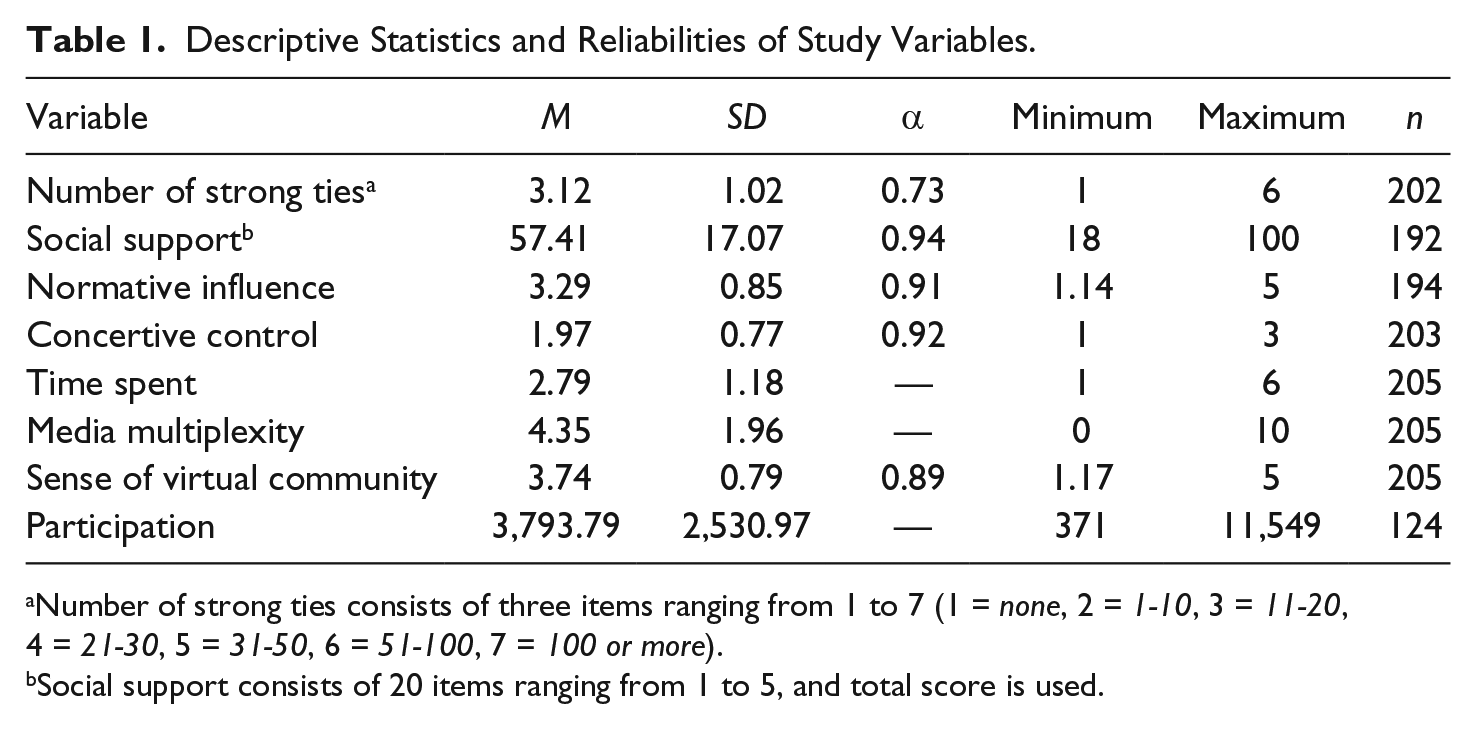
Number of strong ties consists of three items ranging from 1 to 7 (1 = none, 2 = 1-10, 3 = 11-20, 4 = 21-30, 5 = 31-50, 6 = 51-100, 7 = 100 or more).
Social support consists of 20 items ranging from 1 to 5, and total score is used.
The main study variables were operationalized using a variety of closed-ended Likert-type scales. All scales were validated through factor analysis (using varimax rotation with Eigenvalues set to 1.0) and reliability analysis using standardized Cronbach’s alpha. After confirming the unidimensionality and reliability of the scales, we created composite aggregate scores for each. The resulting measures are described below.
Sense of community
Although various specific measures for SOVC have been developed (e.g., Blanchard, 2007; Blanchard et al., 2011; Koh & Kim, 2004; Tonteri et al., 2011), they differ from study to study, and this lack of stability led us to concerns about its reliability across contexts. Furthermore, SOVC measures typically overlap strongly with sense of community measures, with additional items to measure differences in virtual communities (such as limited membership and influence). Given that we wish to assess these dimensions more centrally in our study, we opted to adapt a more traditional measure that addressed all four of McMillan and Chavis’ (1986) dimensions.
Our dependent variable was an established, commonly used six-item scale adapted from Bachrach and Zautra (1985) measuring members’ sense of community (α = .89). Items were measured on a 5-point scale ranging from 1 = strongly disagree to 5 = strongly agree. This scale was modified for the online context by personalizing it to the name of the online community. Sample items included “I feel I am an important part of [community name]” and “I feel I belong on [community name].” The scale items address the four dimensions of sense of community as outlined by McMillan and Chavis (1986): membership (feeling at home in the community, feeling a sense of belonging), influence (feeling an important part of the community), fulfillment of needs (satisfaction with the community, interest in what goes on in the community), and shared emotional connection (agreement with the opinions and values of others).
Number of strong ties
Tie strength has been measured in different ways, but strong ties are often distinguished by relational closeness and emotional support (Granovetter, 1983). The native meanings for closeness differ across relationship types (Parks & Floyd, 1996b). In particular, to maintain long-distance friendships, diverse communication modalities (both offline and online) are employed. Therefore, we created an original measure (validated through the pilot survey) to assess the aggregate strength of ties among community members. We measured the number of relationships maintained through different modes of communication such as the online community, social networking sites, and offline interaction. In addition, considering the findings that the number of “actual” friends and “total” friends on Facebook had different effects on one’s social capital (Ellison, Steinfield, & Lampe, 2011), we distinguished perceptions of “close” friends from the total number of online community members. Thus, this scale consisted of three items, asking approximately how many community members they (1) had met face-to-face, (2) were Facebook friends with, and (3) considered close friends (α = .73). The scales for each item ranged from 1 = none to 7 = 100 or more. This measure captures the degree to which members had formed close relationships within the online community as well as extending beyond it.
Social support
Social support is usually assessed in one of two ways: perceived support and received (enacted) support. Although perceived support is often used, it has been critiqued as measuring stable personality traits rather than actual received support (Goodwin, Costa, & Adonu, 2004). For this reason, we used the more behavioral measure of received support. Received support was measured using the Inventory of Socially Supportive Behaviors (ISSB; Barrera, Sandler, & Ramsey, 1981), which captures dimensions of informational, emotional, tangible, validation, and companionship social support. The initial scale had 40 items and required respondents to rate the frequency with which each of the items occurred during the past month.
Given the fact that not all items applied well to the online setting (e.g., “loaned you over $25”) and that frequency during the past month was deemed too restrictive to capture sometimes sporadic message board participation, a number of items were dropped during the pilot and survey validation processes, and the rating was changed to reflect how often members experienced each behavior in general on a 5-point scale (1 = never, 5 = all the time). Following the original ISSB scale that was originally designed to measure the frequency of enacted support, the researchers added the ratings of all items to calculate total social support scores. Sample items included “told you how he/she felt in a situation that was similar to yours” and “joked and kidded to try to cheer you up.” Also, a number of pilot survey respondents reported that some items in the original scale were too similar. To reduce survey fatigue, the researchers removed several items that were highly intercorrelated. After minimizing item redundancy, the final scale consisted of 20 items (α = .94).
Normative influence
Normative influence was measured using a seven-item scale measuring perceived subjective norms (Rimal & Real, 2003) that asked about the relative social influence of other community members, opinion leaders/influential members, and close friends within the community (α = .91). Items were assessed on a 5-point scale ranging from 1 = strongly disagree to 5 = strongly agree. Sample items included “I care a lot about what other members of this community expect me to do” and “I want to do what opinion leaders/influential members in this community expect me to do.” Since pilot feedback indicated that members were also quite susceptible to the product recommendations of others, an additional item was added to measure this: “I purchase products based on recommendations of other members of this community.”
Concertive control
Concertive control was measured using a 4-item scale adapted from Wright and Barker (2000; α = .92). Items were measured on a 5-point scale ranging from 1 = strongly disagree to 5 = strongly agree. Sample items included “there is a ‘way of doing things’ on [community name]” and “if a member violates the norms, they are likely to be disciplined by other members.” We also included two items measuring formal control (“[community name] has formal rules/policies” and “if a member violates the norms, they are likely to be disciplined by the moderator”) in the initial scale as a check on how much of a distinction members made between formal and informal control; as we expected, these two items did not hang together with the rest, so they were dropped from the scale. Furthermore, the mean score for concertive control (4.28) was significantly higher than the mean score for formal control (2.81), confirming the high degree to which this community was governed by concertive control. Although the wording of these items (e.g., use of the word “discipline”) was rather formal, feedback we received on the pilot survey from members indicated that the question wording was understood and that it resonated with their lived experiences on the board. In particular, the much higher scores for concertive control than formal control validated our qualitative observations of the high degree to which the community was governed by peer rather than formal or hierarchical influence. Given that the concertive control variable was highly negatively skewed, we collapsed this variable into three categories in order to create a more normal distribution.
Participation
We measured community participation in terms of overall frequency of posts. We gave the survey respondents the option of providing their screen name, and for the 58% of respondents who provided one, we tabulated the system-generated posting total at two points in time: at the time the survey was conducted and again about 20 months later. We used the posting frequency at the second point in time as a dependent variable to provide a behavioral (rather than self-reported) outcome measure. Using a time-lagged behavioral measure helps to overcome common methods bias as well as the limits of our cross-sectional survey design. In examining the distribution of posting frequency (which ranged from 371 to 11,549 posts), we noticed that one member had a significantly higher post count at 21,688. In order to prevent this outlier from skewing the findings, we recoded it to 11,549 to normalize the distribution.
Control variables
We controlled for two CMC-related variables: amount of time spent in the online community and media multiplexity. We measured time spent through a question asking about the frequency of time spent in the community per day over the past week. Responses ranged from 1 = less than 30 minutes to 6 = 5 or more hours. Since the interaction of community members often spilled over to other online and offline contexts, we measured media multiplexity drawing on Haythornthwaite’s (2005) notion of multiplexity to capture the total number of ways in which relationships extended beyond the community. As media multiplexity theory posits, the use of multiple means of communication is positively associated with the strength of ties, and thus we predicted it would influence members’ sense of community. We measured media multiplexity through a question asking which of the following additional ways members kept in touch beyond the community (Facebook, Twitter, email, text, phone calls, instant messaging, Pinterest, playing online games, My Fitness Pal, or other). We aggregated responses into an index measuring the total number of means of interaction.
Results
As a preliminary step, we computed bivariate correlations among all of our study variables to provide an initial picture of relationships specified in Figure 1 (see Table 2). As expected, SOVC was positively correlated with number of strong ties, social support, normative influence, and concertive control, and to a lesser extent with time spent and media multiplexity. Social support was positively associated with number of strong ties, normative influence, and media multiplexity, and to a lesser extent with concertive control and time spent. Normative influence was positively related to concertive control, number of strong ties, and media multiplexity, and to a lesser extent with time spent. Interestingly, participation was not associated with SOVC, although it was significantly associated with number of strong ties, time spent, and media multiplexity. All correlations were below the recommended threshold of .7 (Tabachnick & Fidell, 2001) so we concluded there were no issues with multicollinearity in our data.
Bivariate Correlations Among Study Variables (N = 205).
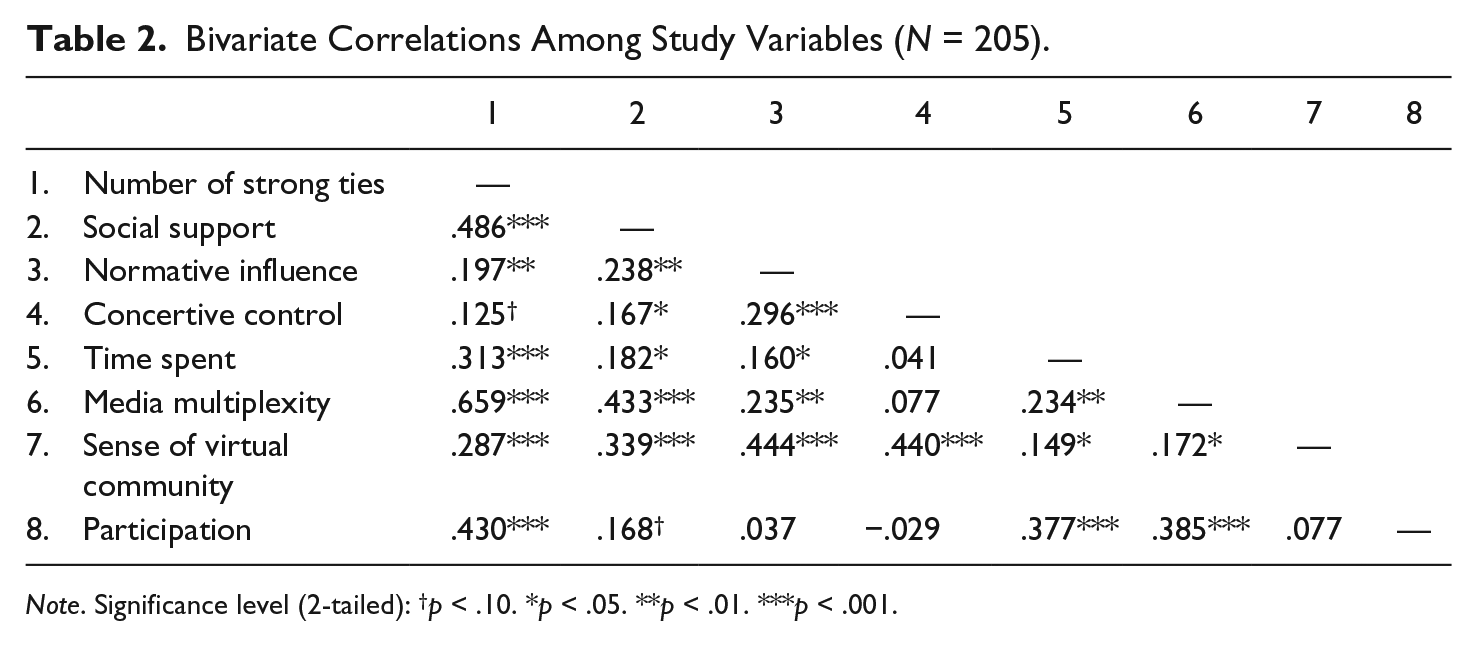
Note. Significance level (2-tailed): †p < .10. *p < .05. **p < .01. ***p < .001.
Regression Coefficients a for Sense of Community and Participation.
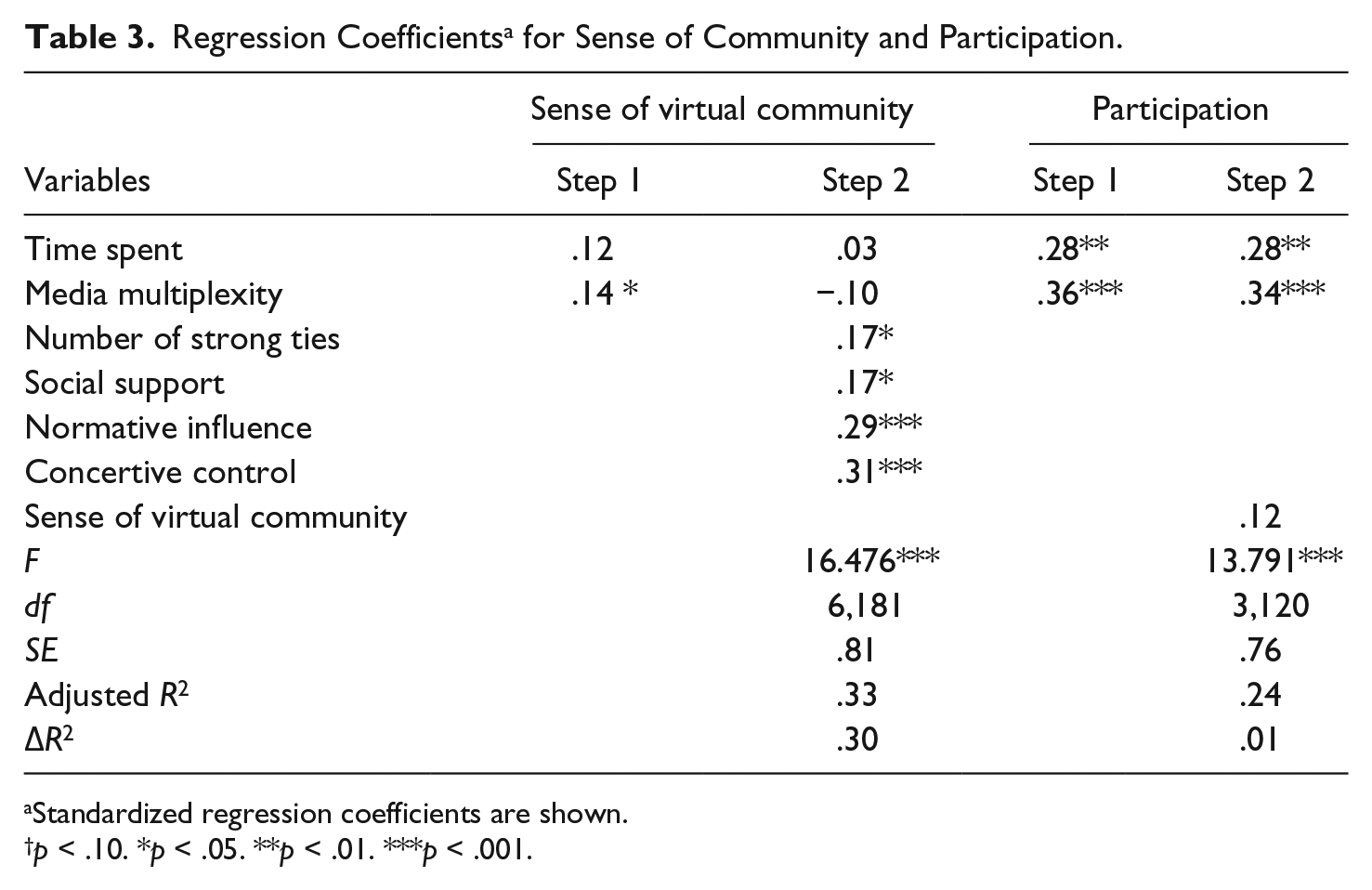
Standardized regression coefficients are shown.
p < .10. *p < .05. **p < .01. ***p < .001.
We then tested our hypotheses using hierarchical multiple regression analysis to test the direct effects and the bootstrapping method recommended by Preacher and Hayes (2008) to test the mediation effects. 1 We used standardized z scores for each variable in the regression analysis, to ensure that coefficients were comparable. To test H1, H2, H4, and H5, we entered time spent in the community and media multiplexity as control variables in a first step. In a second step, the independent variables—number of strong ties, social support, normative influence, and concertive control—were added through forced entry. We found that these four hypotheses were all supported. Number of strong ties (H1) (β = .17, p < .05) and social support (H2) (β = .17, p < .05) were both positively associated with sense of community. Similarly, normative influence (H4) (β = .29, p < .001) and concertive control (H5) (β = .31, p < .001) were also significantly associated with sense of community. Interestingly, the effects of normative influence and concertive control were substantially stronger than those of strength of ties and social support. This model explained 33% of the variance in sense of community.
We tested H7 through a second regression model. First, we entered the two control variables (time spent and media multiplexity) into the model in a first step. In a second step, we entered sense of community as an independent variable through forced entry. We found that sense of community was not significantly associated with community participation; thus, H7 was not supported. However, both time spent (β = .28, p < .01) and media multiplexity (β = .34, p < .001) were significantly associated with participation. This model explained 24% of the variance.
Next, we tested the mediation hypotheses (H3 and H6) using the bootstrapping procedure for indirect effects recommended by Preacher and Hayes (2008). This nonparametric method makes no assumptions about the distribution of indirect effects and is recommended over both the causal steps approach (Baron & Kenny, 1986) and the Sobel (1982) test or product-of-coefficients approach due to its higher power and better controlled Type I error rate (Hayes, 2009). We used the PROCESS macro using Model 4 (Hayes, 2013) and calculated indirect effects based on 5,000 bootstrap resamples, as recommended. The significance of such effects is determined by examining bias-corrected and accelerated 95% confidence intervals (CIs) which include corrections for both median bias and skew (Efron & Tibshirani, 1993); if the CIs do not include zero, the effect is considered significant. We used standardized z scores for each variable to ensure that coefficients were comparable, using mean substitution for missing cases.
Since the inter-item correlation matrix showed that several of the variables shared variance, we ran each bootstrapping analysis using the other predictor and mediator variables as covariates in the model. The bootstrapping results supported our mediation hypotheses. Social support (controlling for normative influence and concertive control) mediated the effects of number of strong ties on sense of community (indirect effect = .06, 95% bias-corrected and accelerated bootstrapping confidence intervals (BCa CI) = [.003, .124]), providing support for H3. Similarly, concertive control (controlling for number of strong ties and social support) mediated the effects of normative influence on sense of community (indirect effect = .09, 95% BCa CI = [.043, .145]), providing support for H6. The CIs did not include zero, so the indirect effects were considered to be significant. In both cases, the direct effects of the predictor variables remained significant, suggesting that other untested mediators may exist. To further bolster our analysis, we ran two alternative models switching the mediators to test (1) concertive control as a mediator of number of strong ties and sense of community and (2) social support as a mediator of normative influence and sense of community, controlling for the respective other two variables in each model. In each case, the indirect effect was non-significant, thus ruling out alternative indirect paths within the model.
Discussion
This study attempts to integrate diverse literatures on SOVC and its antecedents, communication processes in online social support groups, and normative control in online communities. We theorize that online community belonging works through separate paths of interpersonal support and group-based influence such that SOVC is developed through a combination of supportive communication and a powerful system of peer influence. We developed and tested a model of factors associated with SOVC on a sample of members of a particular online community. We found that members’ SOVC was predicted by a combination of strength of ties, social support, normative influence, and concertive control. Of these, normative influence and concertive control had the strongest associations. Furthermore, we found that social support and concertive control played important roles in mediating the effects of strength of ties and normative influence (respectively) on SOVC. Finally, we unexpectedly found that SOVC was not associated with actual participation in terms of posting frequency. Our findings have implications for research on SOVC, social support, and normative/concertive control.
Theoretical and Practical Implications
The findings have implications for our understanding of online communities and the factors as associated with community belonging. First, while prior research has given a great deal of attention to social support and its positive outcomes for individuals in online groups, our findings suggest that cohesive communities cohere not just around supportive communication, but also due to a powerful system of peer-based concertive control and normative influence in which their members internalize group norms and act in accordance with them. While finding that norms play an important role in SOVC, prior work has downplayed the role of group influence processes in favor of individualized supportive processes (e.g., Blanchard & Markus, 2004; Obst et al., 2002). Our findings highlight the important role of peer influence in contributing to SOVC, which is even stronger than social support. They also highlight that sanctioning may play a positive, rather than negative, role in SOVC. While this challenges prior findings of SOVC research (Blanchard et al., 2011), it is in line with other research that finds that conflict and flaming are not necessarily negative, but may be indicative of prosocial behaviors that construct and regulate online behavior (Aakhus & Rumsey, 2010; O’Sullivan & Flanagin, 2003). Similarly, although community members may enact harsh forms of discipline through concertive control (Barker, 1993), rather than alienating them from the community, this mechanism of normative control may also serve the purpose of bonding them further to the group through internalized norms and a heightened sense of accountability and investment.
This suggests that social support and concertive control may work together to galvanize community belonging, although the nature of this relationship bears further investigation. Although we hypothesized that they provide two separate paths to sense of community, we found a moderate but significant correlation between them. Furthermore, our qualitative observation of the message forum revealed that they may actually work together to produce a form of “tough love” within the community. Members made comments that suggested that support and control were intertwined and mutually constitutive, such as the following:
I kind of consider this a big family. I have my favorite cousins and uncles and what have you, and a couple family members I want to punch in the face really hard sometimes, and a whole lot of people I really like and enjoy seeing and talking to. Just like here. But they are all part of the larger family unit, even the ones I want to pound on sometimes, and that has value.
This quote explicitly relates the online community to a family and acknowledges that there is value in not always getting along. In this sense, the community was not unlike a close-knit family whose members fight not despite but because of the fact that they are so close. These processes of control and support thus worked to bond members in intimate ways that produced a strong sense of belonging and helped to regulate and maintain the community, similar to what other research has found (Aakhus & Rumsey, 2010).
Our findings also have implications for research on social support. They extend current research on online support groups by confirming the positive link between social support and SOVC, which works through strength of ties. This implies that social support is not beneficial for purely individual-based outcomes, but helps strengthen group belonging as well. Furthermore, we find that multiplexity of friendships (both within and beyond the community) leads to enhanced social support. In today’s Web 2.0-enabled communities, boundaries are likely to be more porous, with relationships spilling over to other online contexts, as well as face-to-face. Finally, our findings re-position social support as working in tandem with concertive control to produce a form of “tough love” and thus extend our understanding of the “dark side” of social support (Goldsmith, 2004; Sass & Mattson, 1999). Members noted that support was not always positive and did not always feel good, but that “tough love” or brutal honesty could be more helpful:
This is a very supportive group, but it’s also one where you can get unvarnished opinions and advice. I’ve been on the receiving end of it myself, and while it’s not fluffy kitties and lollipops, it’s helped me a lot, and I’d hate to have some sanitized, censored version of the support this board is capable of.
Finally, the strong normative influence in the community was evident in this last quote: “I love this place, too. I love that we have this whole network. But don’t intrude on our happy little place if you’re not a participating member.” These quotes all speak to the tension between support and control, suggesting that they may be two sides of the same coin.
While other studies have found that lack of emotional support predicts a higher dropout rate in online communities (Wang, Kraut, & Levine, 2012), our findings suggest that group commitment is more complicated than simply the presence or absence of positive emotional support. Through observations of our community of study, it was not lack of positive emotional support but excessive negative (or mixed positive and negative) support through the “tough love” of concertive control that caused members to drop out of the community, particularly those who had been harshly sanctioned for a norm violation. However, the same harsh sanctioning also created more commitment among the members who stayed (as evidenced by the quotes above). Future research should further explore the complexities of the relationship between support and control. It should also examine the differential effects of concertive control in more detail and the factors that account for them.
Our findings also suggest implications for normative influence and concertive control online. First, we find—in line with SIDE theory (Postmes et al., 2000)—that the relative deindividuation existing in an online community leads to strong group norms that work to enhance members’ SOVC. The relative anonymity of the online context is likely to work in tandem with the peer influence arising from self-organizing groups whose members both create and enforce informal rules, producing an even stronger form of concertive control than exists in offline contexts. This study is among the first to extend the theory of concertive control (Barker, 1993) to non-work, online contexts, finding that such organizing processes are indeed subject to concertive control and that this may even be enhanced by the relative anonymity of the online environment. The strong system of concertive control arising in this particular community is even more remarkable when considering that members came together initially as complete strangers, in voluntary relationships, and that most of them had never met face-to-face, yet they developed a strong sense of commitment to one another.
Finally, one of our most interesting findings was the lack of relationship between online participation and sense of community. We found no association between sense of community and subsequent posting behavior. This implies that more passive users or “lurkers” may feel a similar sense of belonging and investment in the community as more active posters. Although there were no true lurkers in this community, as they had been culled by the moderators over the years, there was still a great deal of variance in posting frequency. The fact that sense of community did not vary significantly across more and less active posters may be explained by the fact that most members had been with the community from the very beginning and may have felt invested due to their long shared history with other members. Online communities differ from offline communities in their affordances of persistence and searchability (boyd, 2007), in that the documented, archived, and searchable nature of posts enables community interaction to extend over time and space, giving all members a chance to observe the interaction among other members and participate in conversations either synchronously or asynchronously. Even if one only observes without contributing, the persistence of posts allows for a collective memory to form that increases a sense of connection to the community and its members.
This explanation is supported by prior research. One study demonstrated that in online cancer support group settings, lurkers showed an even higher level of functional well-being than posters (Han, Hou, Kim, & Gustafson, 2014). This implies that lurking in online communities is not necessarily dysfunctional, as unobtrusive observation is one of the stages of the community membership cycle (Wasko & Faraj, 2005). Another study (Tonteri et al., 2011) found that SOVC was associated with both active and passive participation, in the form of posting versus reading messages. While active participation is often emphasized, this highlights the value in lurking, as less active members may receive support and feel part of the group through spending time in the online community and reading messages, such that they are still able to develop an attachment and sense of community.
A second, more ill-boding, explanation may be that concertive control, while providing a sense of buy-in and ownership over community norms and behaviors, may stifle contributions to some extent due to social approval concerns. Li (2011) found that community affinity (similar to sense of community) had no effect on willingness to contribute information in online communities, whereas other dimensions of community attachment related to direct benefit and personal gain were significant predictors. The authors explained this lack of relationship in that feeling a sense of belonging with an online community may lead to more frequent use of the resources available in it, but not necessarily more contributions due to communication dilemmas about whether or not to share discretionary information. This was underscored by the fact that they also found that willingness to contribute information was most strongly influenced by perceived social approval. Social approval needs are hinted at by the negative (but non-significant) correlation we found between concertive control and participation, which suggests that mechanisms of social control may have a chilling effect on participation that leads members to self-censor and limit their contributions. Overall, our findings imply that less frequent participation does not pose threats to SOVC and ultimate community sustainability, but further research should explore the possibly negative effects of concertive control on participation and the ways in which this relationship is related to the concomitant social approval needs of members in more detail.
Our findings yield important practical implications as well. The fact that normative influence and concertive control had a stronger association with SOVC than did strength of ties and social support may be explained by prior research (Ren et al., 2012) finding that community features designed to foster group identity-based attachment (as in concertive control) had stronger effects than features designed to foster bond-based attachment (as in social support). Our findings imply that control mechanisms that draw on group identity as a trigger may be more effective in maintaining online communities than interpersonal relationships and interaction, although both work together to produce community attachment. The long endurance (about 15 years) and high levels of support and control of this community run counter to the fleeting, anonymous, and ephemeral depiction of online communities in the literature (Kraut & Resnick, 2011; Ling et al., 2005; Van Varik & Van Oostendorp, 2013). This reveals that it is indeed possible for high levels of control, support, and belonging to form among strangers who interact primarily online. These findings can contribute to design choices for building online communities. The organizers and designers of online communities may want to implement technical features that support effective achievement of member consensus (e.g., sophisticated discussion features, voting functions), which in turn facilitate the development of informal norms. Furthermore, online community managers (and members) should consider the positive role of control and normative influence in the processes of organizing. Online community managers often try to reduce conflicts or “bad” behaviors (e.g., Kiesler et al., 2011); however, allowing for conflict over norms and sanctioning of members is an important part of building a regulated community. Moreover, our findings demonstrate that the same conditions of community belonging that exist in offline communities may extend to online communities as well. This is significant as it reveals that online communities may have very “real” stakes and consequences for their members rather than being divorced from offline behavior.
Limitations and Future Research
Our findings have limitations that should be acknowledged. First, they are limited to one particular online community that was perhaps unusually active and close-knit. Indeed, most online communities have been found to be relatively inactive (Kraut & Resnick, 2011). In addition, this community was fairly homogeneous in terms of member demographics and life stage, as well as becoming closed to new members over time. As such, the findings may not generalize to other communities that are more anonymous, less active, shorter in lifespan, more frequent in turnover, and less predominantly female. Similar forms of control have, however, been demonstrated in other types of online communities, ranging from mothering message boards (Schoenebeck, 2013) to 4chan (Bernstein et al., 2011) to Wikipedia (Kane et al., 2009). Nevertheless, future research should test these relationships on a larger sample of communities of different types, to further explore the boundary conditions and whether they generalize to other types of communities in terms of gender, topic, and tenure. While we find important indirect effects of concertive control and social support, our findings suggest there may be other untested mediators that should be included in future research. Future research should also develop more nuanced measures of participation that better differentiate among active versus passive participation as well as type of contribution. Further insight can be gained from more systematic analysis of post content and the ways in which social support and concertive control are enacted through posting behavior.
Conclusion
This study adds to our knowledge of online communities by helping to explain what factors give members a SOVC. Our findings reveal different mechanisms or pathways through which this occurs. While strength of ties and social support are mechanisms that bind members together, our findings suggest that normative influence and concertive control provide even more important means of regulating and maintaining the community. Furthermore, these findings add nuance to discussions of social support that emphasize positive, supportive communication as the most beneficial kind. Although concertive control could be exerted in rather harsh ways to discipline community members, it seems to ultimately play a prosocial role in increasing their sense of belonging and investment (though not necessarily participation) in the community. As online communities continue to evolve and become more technologically sophisticated, understanding the ways in which support and control processes work in tandem will continue to be of great importance.
Footnotes
Authors’ Note
An earlier version of this article was presented at the National Communication Association conference in Washington, DC, in November 2013.
Declaration of Conflicting Interests
The authors declared no potential conflicts of interest with respect to the research, authorship, and/or publication of this article.
Funding
The authors received no financial support for the research, authorship, and/or publication of this article.