




Abstract
Using a sample of 14 television systems and 29 television stations, we investigate the effect of two media systems dimensions on sensational news coverage: the television system dependency on commercial revenues and audience fragmentation. At the aggregate level, both audience fragmentation and the dependence on commercial revenue yield significant effects on three forms of sensationalism. In more fragmented/competitive markets, sensationalism (1) in topics—for commercial channels—and (2) in formal features—for both channel types—is higher. However, the analysis reveals that (3) not fragmentation but rather dependency on commercial revenues stimulates the use of vivid storytelling. While the use of sensational formal features does not (significantly) depend on channel type, both topics and storytelling are clearly more sensational on commercial channels. The results shed light on the behavior of public broadcasters in various media systems contexts, pointing out their increased role and importance as counterbalance in highly fragmented systems.
Keywords
Introduction
The liberalization of West European television systems in the late 1980s and early 1990s is often linked to an increase of infotainment and sensationalism in television news coverage (cf. Thussu, 2007). Liberalization policies transformed media systems from public institutions into dual markets, where public channels coexist with commercial channels (Brants & De Bens, 2000; Siune & Hulten, 1998). This transformation is often thought to have been accompanied by the adoption of a more commercial approach, in which competition for advertising revenues and audiences determines the content of programs. The urge to “sell” the news in order to attract audiences and/or to make profit is believed to lead to low-quality news centered on infotainment, sensationalism, and human interest (e.g., Manning, 2001). Rather than as citizens who need to be informed and educated, television producers would consider their audiences as potential consumers, generating more entertainment-oriented news stories and news items that are “sensational” or “tabloid-like” (Blumler & Gurevitch, 1995; McManus, 1994).
Notwithstanding these claims, there are few empirical studies that have actually tested this assumed effect of market pressures on media content. Most studies addressing these effects focus on the differences between commercial and public channels (e.g., Chan & Lee, 2013). Yet, in order to test the effects of market pressures, one should also take into account structural features of the media systems in which these channels operate. This article makes two important contributions to the extant literature. First, we distinguish two dimensions of media systems, which are both related to the market pressures that TV channels are faced with: (1) audience fragmentation (competition) and (2) dependence on commercial revenues (commercialism). We argue that both dimensions are theoretically independent, so that their effects should be tested independently. Our conceptualization and operationalization of sensationalism build upon existing research. While we contribute theoretically to the understanding of the factors that determine the sensationalism of the news, we do not aim to contribute to the conceptualization of “sensationalism.” Our main contribution, however, is empirical. Drawing on data from 14 television systems and 29 private and public television stations, we investigate the effects of media system characteristics on sensationalism in news coverage. As far as we are aware, this is the largest cross-national study testing how media system characteristics affect the sensationalism of the news content. This study thus responds to the need for more cross-level research in communication studies (e.g., Slater, Snyder, & Hayes, 2006) and for more comparative studies of sensationalism in news coverage (Hendriks Vettehen, Zhou, Kleemans, D’Haenens, & Lin, 2012).
Theoretical Background
Characterizing Television Systems
Some scholars assume that, in commercially oriented media, news is considered as any other commodity and that it therefore inevitably loses its informative and educative value. For instance, McManus (1995) argues that “to the extent that the business goal of maximizing profit dominates . . . [competitors will offer] the least expensive content that guarantees the largest audience” (p. 85). He also asserts that the market rationale of minimizing costs and maximizing profits has produced trivial, superficial, and often inaccurate reporting.
McManus describes this process of competition in the almost totally commercially oriented media context of the United States. However, there are good theoretical reasons to argue that the degree of competition in a television system is a different phenomenon than the degree of commercialization. We can imagine a country in which the audience is fragmented across many television stations, but where the public television stations are generously subsidized by the state and jointly have a large market share. Such a television system with high levels of audience fragmentation would be very competitive but not altogether dependent upon commercial revenues. We can also imagine another country where the market is dominated by a few commercial stations. This television system would be less competitive but more dependent upon commercial revenues. So, while increased market competition is an important aspect of television stations, we argue here that one should distinguish (at least) two different aspects of these systems: (1) the dependency on commercial revenues which indicates the profit-making orientation of the whole system and (2) the degree of competition for audience shares.
Making such a distinction is especially important in West European television systems, which have undergone a historical shift since the 1990s from systems that were dominated by government-funded public (not commercially oriented) television monopolies (not competitive) to mixed revenue dual television systems in which public and private television coexist (Brants & De Bens, 2000; Siune & Hulten, 1998). One would thus expect the “business goal of maximizing profit” to be less dominant in European media systems because of the “mixed” competition between profit-oriented television channels and a non-profit public television. However, in most European countries public television stations are not fully publically funded, so that these stations have to broadcast commercials in order to survive. Moreover, a public television sector with low audience shares would risk losing its right to exist, perhaps not legally, but politically. Many people would question whether we should continue subsidizing channels that nobody watches. Like in the United States, in several European countries, television audiences have become fragmented across a large number of channels. So, even in European countries with a large publicly funded television sector, the competition for audience shares may be intense.
To understand the behavior of television stations and their choices to broadcast news in a more sensational way (which we will elaborate on below), it is not sufficient to only distinguish between public and commercial channels. It is equally important to look at the context in which they operate. Even a public television station with generous state subsidies could feel pressured to compete for audience shares in order to retain its position. This will be particularly the case if it operates in a system that is very competitive. So, even though we distinguish between public and commercial television stations, we also take into account the context in which they operate.
Before discussing the hypothesized relationships between on one hand competition and dependency on commercial revenues as characteristics of television systems and sensationalism on the other hand, we first discuss the concept of sensationalism in more detail.
Sensationalism in News Coverage
Early research on sensationalism in news coverage tended to operationalize sensationalism as an issue feature by making a dichotomous distinction between “proper” and entertaining or generally attention-grabbing news topics. Hendriks Vettehen, Nuijten, and Beentjes (2005) refer to the latter category as “basic needs content,” following in the footsteps of, for example, psychologists like Davis and McLeod (2003) who explain the power of these topics to attract people’s attention from an evolutionary perspective. Some topics such as sex, violence, scandals, and disasters serve “some adapted function in the Environment of Evolutionary Adaptedness” (Davis & McLeod, 2003, p. 209), so people’s “base instinct” to monitor their surrounding for elements related to safety (“survival value”) and reproduction draws their attention to these issues (Kleemans & Hendriks Vettehen, 2009; Shoemaker, 1996). Other scholars argued that sensationalism does not need to be a feature of specific news topics only but should be based on various content characteristics that are known to attract audiences because of their capacity to arouse them emotionally by addressing their human biological sensory system (Grabe, Zhou, & Barnett, 2001; Hendriks Vettehen, Beentjes, Nuijten, & Peeters, 2011). Kleemans, van Cauwenberge, d’Haenens, and Hendriks Vettehen (2008) argue that there is so much attention to sensationalist topics in various outlets that it is unlikely to (still) differentiate clearly between these outlets. Therefore, it is necessary to further differentiate between other aspects of sensationalism.
Following this literature, we conceptualize sensationalism as those characteristics of news that arouse audiences emotionally. We distinguish three categories of sensationalism. The first one is the topic. For instance, content about topics such as violence and sex are typically sensational issues. The second category is the storytelling perspective. In comparison to abstract information, using human exemplars giving concrete and/or emotional testimonies is considered to be salient information in news stories. Personalized exemplification exerts considerable (emotional) influence on viewers’ processing of the news (Bas & Grabe, 2015; Lefevere, De Swert, & Walgrave, 2012). Ordinary people appear in news as actors commenting on a story topic as a passer-by or as an eyewitness to “personalize and dramatize news” (Bek, 2010; Wang, 2012). For an ideal link with sensationalism, their human exemplars would tell personalized stories, but in a milder form the mere choice of the reporter to ask a common person for a comment, testimony, or opinion also makes the news more concrete and proximate to the viewers, increasing vividness (Hendriks Vettehen, Nuijten, & Peeters, 2008). Some studies revealed the use of this strategy by commercial television stations (Hvitfelt, 1994 for Sweden). Hendriks Vettehen et al. (2005) found that, between 1995 and 2001, the use of ordinary people increased in Dutch television news coverage, along with the increase of competition due to the emergence of more news programs.
The third category of sensationalism is the use of specific audio-visual features, often referred to as “formal features.” Using music and specific camera techniques arouses the attention of the audiences as it directly affects the human sensory system (Grabe, Lang, & Zhao, 2003; Hendriks Vettehen, Nuijten, & Beentjes, 2005). These sensational features include a fast editing pace, an eyewitness camera perspective, zoom-in camera lens movements, reenactment of news events, the use of music, and voice-over narration (Wang, 2012). The separation of these three categories of sensationalism will allow us to assess which of the strategies described above are affected most as competitive and commercial pressures increase.
Hypotheses
Most studies on sensationalism are conducted at the channel level, and often in a single-country context (e.g., for Germany, Donsbach & Büttner, 2005; for Belgium, Sinardet, De Swert, & Dandoy, 2005; for the Netherlands, Hendriks Vettehen et al., 2011; for Turkey, Bek, 2004, etc.) or even a local context (e.g., Ryu, 1982; Slattery & Hakanen, 1994). Recently, some cross-country comparative studies have been conducted, suggesting that sensationalism is stimulated by higher competition (Hendriks Vettehen et al., 2012; Kleemans et al., 2008; Wang, 2012). Our study is, to our knowledge, the first one to study cross-level effects between channel characteristics and the systemic context.
The profit motive of media and the ability of sensational news to attract the attention of the audience are often cited as the main drivers of sensational news (Grabe et al., 2001). At the aggregate level, the tendency to “sell news for profit” differs between television systems because some systems rely more on commercial revenues than others, and are thus more commercially oriented. The use of sensationalism would thus be higher the more television systems depend on commercial revenues.
The effect of “wanting to sell news for profit” may be cancelled out when various channels use opposing strategies. Webster (2005) shows that as a consequence of the increased competition in the United States, these channels increasingly focused on specialized niche markets. So, the increased audience fragmentation across a wide variety of channels did not lower the quality. However, for television news, possibilities for product differentiation are more limited than for regular products, or general broadcaster profiles. We do not think that what Webster describes for the United States is very comparable to the European dual system within (generally) quite small countries with various languages, leaving relatively little room for news differentiation. Research in European contexts leads us to expect that in the context of increased competition, various channels will choose the same strategy and start imitating the successful ones (Van der Wurff & Van Cuilenburg, 2001). Previous research generated some evidence showing that competition affects television programming and news content (Atwater, 1984; Powers, Kristjansdottir, & Sutton, 1994). 1 Competition prompts media outlets to cater to the prejudices of their readers; the more competition, the more aggressive catering to these prejudices there will be (Mullainathan & Shleifer, 2005). In a longitudinal study analyzing the effects of competition on the Dutch television market, Van der Wurff and Van Cuilenburg (2001) found that under conditions of extreme competition, an excessive sameness of low-quality programming occurs. A study of various television systems in Europe also suggests that competition intensity in television markets has resulted in decreased quality and a “dumbing down” of media content (OSI, 2005).
Based on these studies, we can expect sensationalism to be higher in television systems where audiences are highly fragmented because of, or leading to, intense competition.
Due to the lack of cross-nationally comparative data, most prior studies addressed the relationship between characteristics of television systems and media content by testing the differences between private and public television (for a review, see Schaap & Pleijter, 2012). This is based on the idea that public service and commercial channels have different goals (Holtz-Bacha & Norris, 2001). While providing the necessary information for an informed citizenry is an important goal for public service broadcasting, commercial broadcasters need to prioritize ratings for their survival, involving a “greater responsiveness to popular pleasures” (Curran, 2000, p. 143; Curran, Iyengar, Lund, & Salovaara-Moring, 2009). The costs of sensational news topics such as accidents and crime are relatively low, while its impact on attracting audiences is considered to be high (McManus, 1992). Covering more crime stories is thus attractive for commercially driven media outlets (Esser, 1999). Several studies found that commercial channels air more soft and sensational news than public broadcasters (Hvitfelt, 1994; Norris, 2000; Powers et al., 1994). That is why we expect news coverage in commercial television to be more sensational in news topics selection, storytelling perspective, and formal features of sensationalism in comparison with public television news coverage.
However, also the programming of publicly owned channels is likely to be affected by the competition they face and the political pressure to reach a significant audience to legitimize their existence. The realization of the ideals of public “service” television (e.g., Curran et al., 2009) may not be fully achieved in situations where public television has to cope with strong competition from other channels. Although most studies found that European public broadcasting generally produces a more varied and educational programming than commercial (private) television (McQuail, 1998; Pfetsch, 1996), signs of convergence in programming between commercial and public broadcasters have also been noted (e.g., De Bens, 1998; Pfetsch, 1996).
Theoretically, one commercial channel may choose to lower quality in order to maximize profit, while another competing commercial channel might go for higher quality in order to reach particular niche audiences. Although the studies above suggest that competition may lead to convergence of various channels toward similar low-quality programming, it is possible that some commercial channels choose to compete with public television while imitating the quality standards of public television. Such choices for a particular competitive strategy are likely to depend on both channel characteristics and competition intensity in the entire media system. Hence, public and private channels are both likely to be influenced by the larger media context, and convergence between news coverage of public and private channels is more likely to happen in a more fragmented (more competitive) television context.
Data
Sensationalism in News Coverage
To measure the dependent variables, the three categories of sensationalism, we rely on a content analysis of a sample of 29 daily newscasts on public and private television stations from 14 television systems. This sample is taken from two existing datasets, which provide data on all variables for 14 media systems: Belgium (where we distinguish between the French and Dutch media systems), Canada, France, Germany, Ireland, Italy, the Netherlands, Norway, Poland, Portugal, Switzerland, Turkey, and the United Kingdom (Cohen, Hanitzsch, & Stepinska, 2013; De Swert, 2011). This is in some ways a convenience sample but the countries all meet one crucial criterion: They have dual systems combining non-trivial commercial and non-trivial public broadcasters. Of course, there are also large differences between these countries, but these differences are also needed to obtain the variation necessary to test our models.
For Italy, Poland, Portugal, and Switzerland, the sampling period is January 2008-March 2008 (Cohen et al., 2013). For the other countries, the sample was taken between December 2006 and April 2007. These periods were selected as in none of the countries elections were called. Fortunately, no major news events dominated the international news agenda during that period. The exact same days were coded in all countries during the two sampling periods to avoid that specific events would bias the data and make them non-comparable between countries.
In almost all countries, we included the newscast that had the largest audience share of one commercial channel and one public broadcaster. In total, 812 broadcasts and 13,444 news items were analyzed and coded. Appendix Table A1 contains a description of the distribution of the news items across television stations. The total number of items is large, and we believe the amount of items per country and per station is sufficient to be able to analyze sensationalism both at the country and channel levels.
The sample is partially a convenience sample. Availability of newscasts online and of native-speaking coders played a role, as well as the availability of data on audience shares and public versus commercial revenues. However, we consider the sample to be sound on theoretical grounds because the selected countries, while culturally varied, share similar traditions of public broadcasting, and they all experience a liberalization process of their television systems.
The various measures of the dependent variables in this study are derived from two projects that had different main objectives: investigating objectivity and investigating foreign news. We therefore had to select those indicators of sensationalism that were present in both studies. We realize that some categories of “sensationalism” are not fully represented, and we will elaborate on the limitations of this study in the concluding section. Yet, fortunately, various important categories of sensationalism are measured by means of the same indicators in both projects, 2 thus enabling us to obtain valid estimators on the extent to which the media systems affect those aspects of sensationalism.
Drawing upon a detailed issue codebook containing more than 200 different issue codes, coders could attribute up to three issue codes to a single news item. In many cases, coders only gave one code, and the average number of issue codes per item is 1.47. We recoded these original codes to construct a variable that indicates sensational news topics versus non-sensational news topics: If at least one of these three issue codes referred to crime, corruption, misconduct, violence, disasters, accidents, terrorism, sex, drugs, or celebrities, we considered the item to be about a sensational topic (see Hendriks Vettehen et al., 2011; Hendriks Vettehen et al., 2005).
We measure sensationalism in storytelling by investigating the use of personalized exemplification in news coverage, assessing the frequency of appearance of ordinary people as actors. In news items, an actor is coded if she or he is interviewed or quoted in the news item, or when she or he is the subject of the news item. In this study, only one type of actor is targeted: individual, “ordinary” citizens (bystander, witnesses, victims, and perpetrators). Items that contain at least one of these “ordinary” actors above are defined as sensational news items.
To measure formal features of sensational news coverage, we focus on specific characteristics that stimulate the human sensory system (Grabe et al., 2001). Each news item was scored on the presence of any of these sensational characteristics and, if one was present, the news item was counted as sensational (on this formal features category). This was the case for less than a quarter of all news items. Because of limitations in the original data, we distinguish only two types of formal features: sensationalism in images and in sounds. Sensationalism in these formal features is measured by the use of background music in the news item; the use of special effects in images (slow motion, speed-up motion, repetition of visuals, close-ups, soft focus); and the use of pictorial or graphic representation (Chan & Lee, 2013; Hendriks Vettehen et al., 2005; Wilke & Heimprecht, 2013).
The intercoder-reliability scores for the media-content variables used in this study are satisfactory. Reliability test scores were obtained from the two projects the data originate from. We requested the original reliability datasets in order to report scores, specifically for the variables we use in this article. The first dataset was gathered by one centralized team, and reliability was tested for all countries at the same time: Reliability of the presence of ordinary actors was Krippendorff’s alpha = .70, for presence of sensational formal features defined in this article the Krippendorff alpha was .72, while for sensational topic Cohen’s kappa was .79 (De Swert, 2011). For the second dataset (Cohen et al., 2013), reliability was calculated per country team, which means that scores need to be calculated for each country team separately. Topic reliability varied between .72 (Switzerland) and .84 (Poland and Portugal), sensational formal feature’s reliability varied between .61 (Switzerland) and .77 (Portugal), and reliability of the presence of ordinary actors varied between .62 (Poland) and .76 (Portugal; all Krippendorff’s alpha values). Reliability of the formal features coding is on the low side, which is something also other studies encountered doing similar coding (Hendriks Vettehen et al., 2005). However, we consider these values acceptable when used as we do in this study. 3 Moreover, we conducted extensive robustness checks to assess whether the results of our analyses are sensitive to the inclusion of specific countries. These analyses demonstrated that the inclusion countries with low reliability scores on specific dimensions of the dependent variable did not substantially change any of our results, so that we are confident that the validity of our conclusions is not threatened. The obvious limitations connected to this are discussed in the concluding section of this study, since this needs the attention of future researchers on this matter. For more info and examples of the present data being used in earlier studies, see, for example, Cohen et al. (2013) and Lee, De Swert, and Cohen (2015).
We analyze the relationship between the three categories of sensationalism to see whether they can be seen as three variables underlying one unique dimension of sensationalism. At the channel level, the only Spearman correlation coefficient that is significant is the one between sensational news topics and the use of formal features (rho = .59). At the channel level, the correlations between the different categories of sensationalism we distinguished do not reach a level suggesting that they measure a unique dimension. At the item level, the Pearson correlations between the three variables are even lower, the highest being the one between the presence of sensational news topics and ordinary citizens (r = .13). As a consequence, we consider these three variables as three different categories of sensationalism, which should be analyzed separately.
Television System Variables
To measure our two independent variables, the degree of competition and television systems’ dependency on commercial revenues, we relied on official statistics as documented in various media handbooks (European Audiovisual Observatory, 2008). These provide information about revenues and audience shares of different channels.
The dependency on commercial revenues at the television system level is contingent to the audience share of commercial television stations as well as to the proportion of commercial revenues for public broadcasters. The larger the public sector is, and the more the public sector is funded by public resources, the less the television system as a whole depends on commercial revenues. Assuming that the commercial stations do not receive any public funding, we may thus measure the systems’ dependency on commercial revenues with the following formula:

When the public sector has an audience share of 100% and if the proportion of public funding is 1, the dependence on commercial revenues is 0. If, however, the public sector would get no public funding or would have no audience, the dependence on commercial revenues would be 1.
We measure competition intensity by assessing audience fragmentation across channels. The more the television sector is dominated by one or few channels, the less competitive it is. The index is not only determined by the number of channels but also by the distribution of their market shares. We use a Herfindahl-Hirschman Index (HHI =

In this formula, i is the index for television channels (from 1 to n), and mi stands for the audience market share of a television channel i (expressed as fractions). 4
One could suspect that the two aspects of television systems are positively correlated. More competitive systems might have more commercial channels, and thus depend more on commercial revenues. Moreover, audience shares are included in both formulas, which could mechanically lead to a positive correlation between the two measures. However, this is not the case. Pearson’s r between the two measures is .36, which means that the two variables only share 13% of their variance. So, in this small sample of countries, high degrees of audience fragmentation (competition) do not necessarily coincide with a high dependence on commercial revenues. So, this supports our theoretical argument that these two variables should both be included in a model as different (and separate) aspects of media systems.
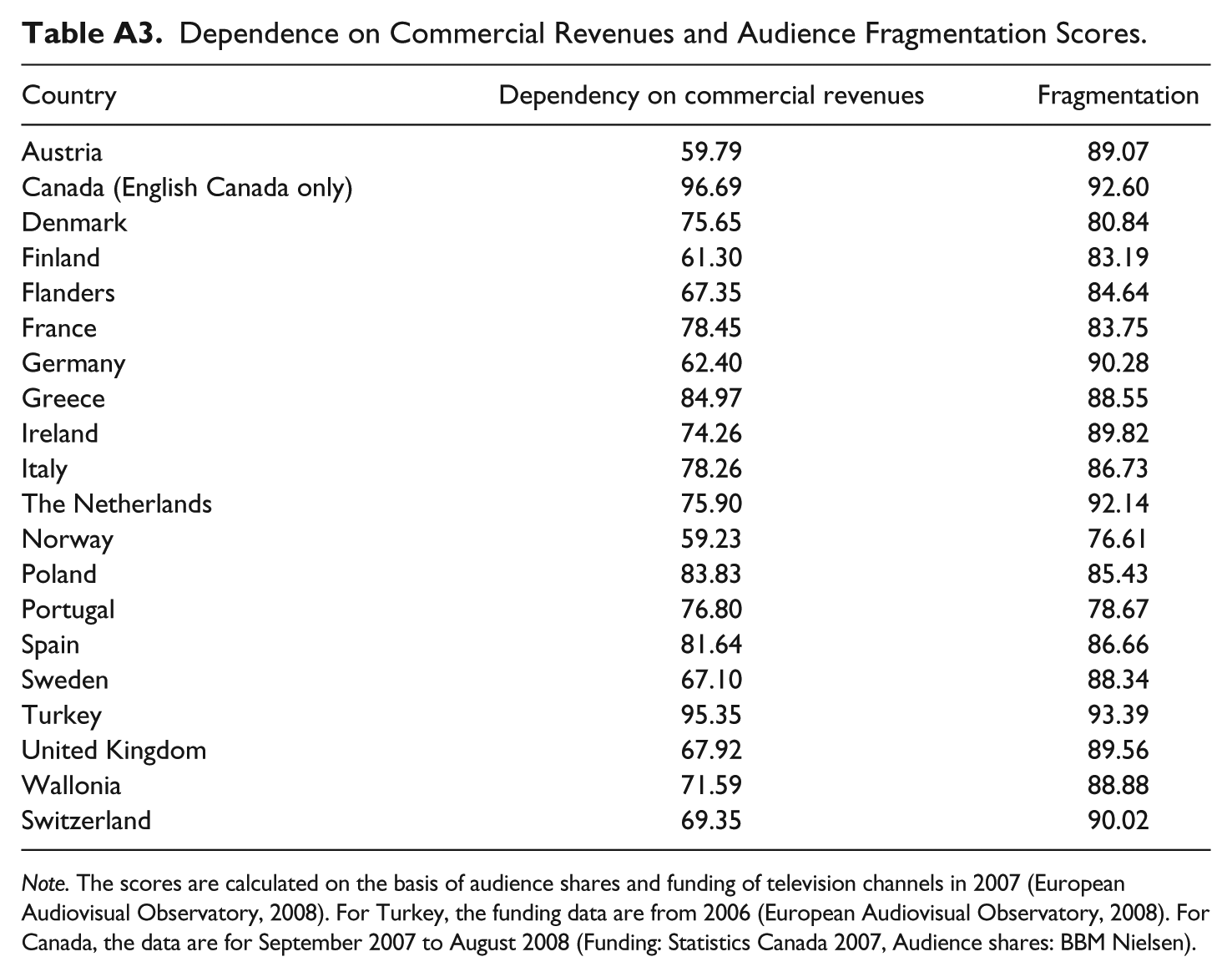
A separate appendix provides a descriptive overview of the presence of the three categories of sensationalism which form our three dependent variables per broadcaster and per country (Appendix Table A2). It also describes in more detail the distribution of the two main independent variables across the 14 countries.
Results
In order to explain the variation in the proportion of sensationalism (in topic, storytelling, and formal features), we estimate random intercept logistic multilevel models with three levels using the log link function for binominal distributions (Hox, 2002). The news items (N = 13,444), our Level 1 unit of analysis, are first nested in television channels (N = 29), the Level 2 unit of analysis, which are nested in television systems (N = 14), the third level. In our analyses, we proceed to test our hypotheses as follows: In Model 1, we test the television system and channel-level variables, and in Model 2 we add the effect of the cross-level interaction. 5
Sensationalism in News Topics
Model 1 in Table 1 shows that audience fragmentation only has a small, close to significant (p = .062) positive effect on sensationalism, while the effect of commercial revenue dependency is insignificant. Commercial channels cover sensational news topics more often than publicly owned channels. This difference between commercial and public channels is important. The odds ratio for commercial channels covering sensational news topics is 1.23 (log odds = 0.21), meaning that on commercial channels, there is 23% more chance for a story to be sensational than on public channels. Model 2 includes the cross-level interaction between fragmentation and the channel type. This interaction is positive and significant, which implies that fragmentation strengthens the effect of channel type: Commercial channels in a more than average competitive television system tend to cover significantly more sensational news topics than commercial channels in a less than average competitive television system. Public channels are not significantly affected by the level of competition, although the direction of the effect of audience fragmentation on public channels is positive (0.01, see Model 2).
A Three-Level Random Intercept Logistic Regression Model Explaining Sensationalism in Topic News Selection.
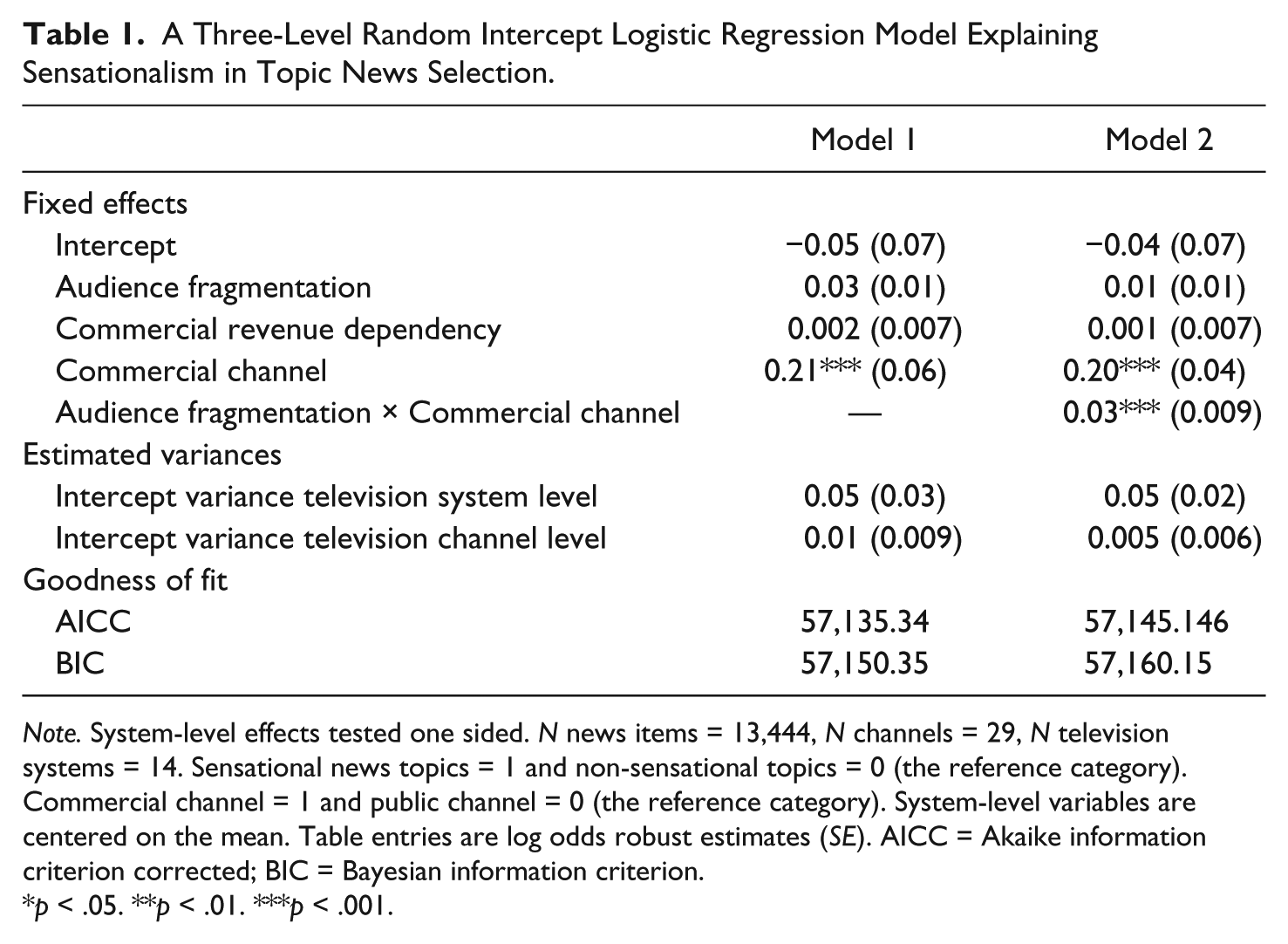
Note. System-level effects tested one sided. N news items = 13,444, N channels = 29, N television systems = 14. Sensational news topics = 1 and non-sensational topics = 0 (the reference category). Commercial channel = 1 and public channel = 0 (the reference category). System-level variables are centered on the mean. Table entries are log odds robust estimates (SE). AICC = Akaike information criterion corrected; BIC = Bayesian information criterion.
p < .05. **p < .01. ***p < .001.
To see whether our results are robust, we performed a jack-knife test in which we excluded one country at a time (results not shown, but available upon request). We found that in all cases, the effects of the channel type and the cross-level interaction were significant and had the same direction as shown in the table. This was also the case if we excluded the two main “outliers,” Canada and Turkey, at the same time. Moreover, the non-significant positive main effect of audience fragmentation always remained positive.
In sum, our results tentatively support the hypothesis that audience fragmentation stimulates sensational news topic selection but also show that it does not depend on the level of commercial revenue dependency of the television system. 6 H1a is thus rejected, and H1b is supported. As commercial channels have a clear preference for selecting sensational news topics in comparison to publicly owned channels, H1c is fully supported. H1d is not supported, and we cannot speak about convergence of public and commercial channels under influence of stronger competition. As television systems are more competitive, commercial channels tend to provide even more coverage for sensational topics than they already do irrespective of audience fragmentation. Public channels are not significantly affected by audience fragmentation; neither positive nor negative. So, audience fragmentation does not push them to distinguish themselves by offering less sensational topics. We conclude that the results do not indicate convergence between private and public channels as competition becomes more intense but they also do not suggest that public television is opting for distinction. Nevertheless, because commercial television covers sensational topics more than public television and they do that even more as competition becomes intense, we can conclude that the gap between both channels increases in highly competitive television systems.
Sensationalism in News Storytelling: The Use of Ordinary People
Model 3 in Table 2 shows that television systems that depend more on commercial revenues have a significantly higher use of “ordinary actors” in news coverage. Contrary to our expectations, in competitive television systems this strategy is used significantly less. Commercial channels use ordinary people significantly more in news storytelling than public channels do. Model 4 suggests that the negative effect of fragmentation of audiences is related to the behavior of public television. Because the interaction effect is included in Model 4, the main effect of audience fragmentation can be interpreted as the effect on the sensationalism of public channels only. This effect is negative and significant (−0.06). The positive and significant interaction effect (0.05) means that the negative main effect is neutralized. So, audience fragmentation has no effect on the extent to which commercial television stations present ordinary actors in their news stories. Again, we performed a jack-knife test to test the robustness of these results, and they always yielded very similar coefficients in, without exception, the same direction. In a few cases, however, for the models in Tables 2 and 3, the significance threshold was (just) not made.
A Three-Level Random Intercept Logistic Regression Model Explaining Sensationalism in News Storytelling.

Note. System-level effects tested one sided. N news items = 13,444, N channels = 29, N television systems = 14. Sensational storytelling = 1 and no sensational storytelling = 0 (the reference category). Commercial channel = 1 and public channel = 0 (the reference category). System-level variables are centered on the mean. Table entries are log odds robust estimates (SE). AICC = Akaike information criterion corrected; BIC = Bayesian information criterion.
*p < .05. **p < .01. ***p < .001.
A Three-Level Random Intercept Logistic Regression Explaining Sensationalism in Formal Features.
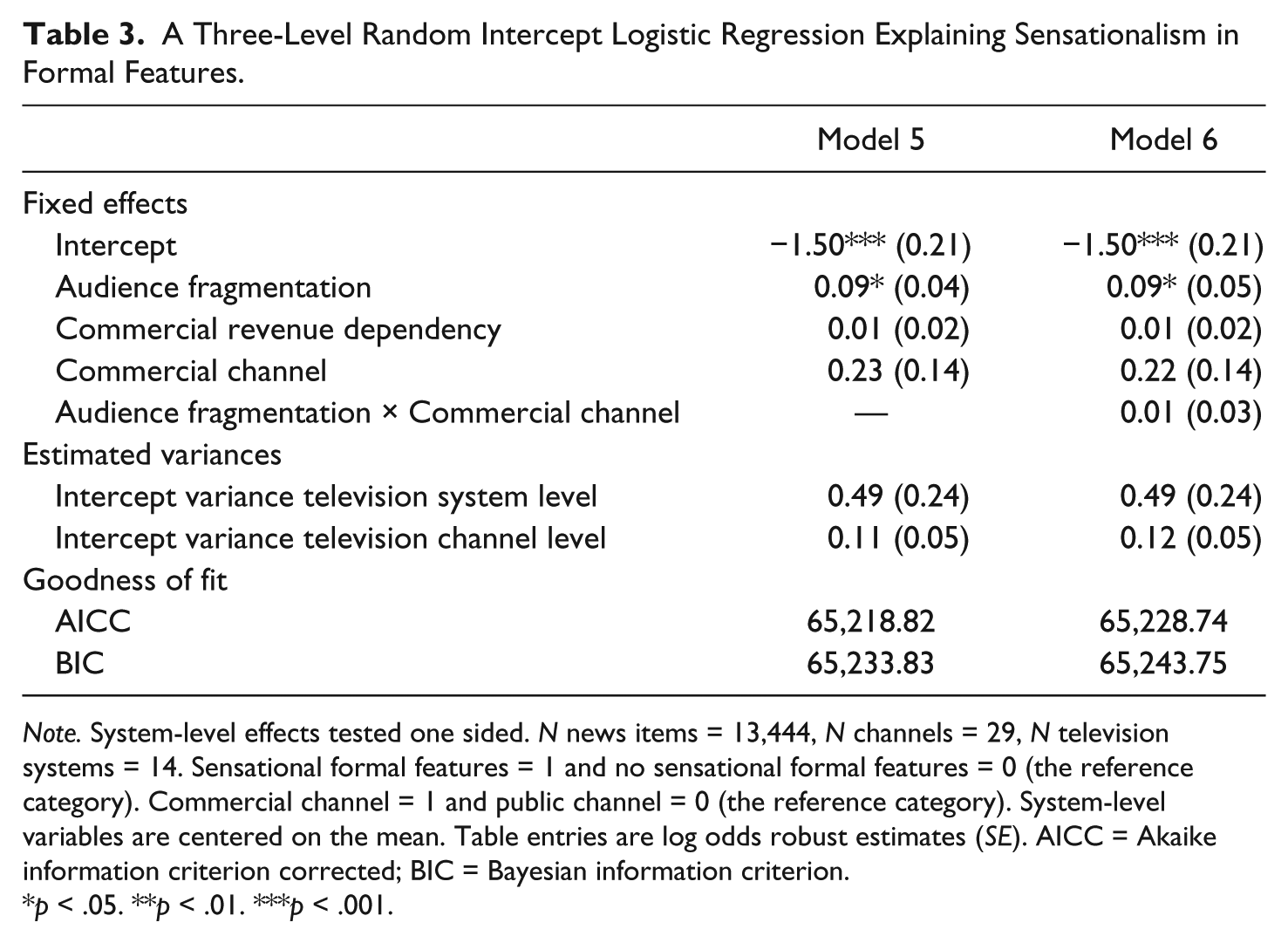
Note. System-level effects tested one sided. N news items = 13,444, N channels = 29, N television systems = 14. Sensational formal features = 1 and no sensational formal features = 0 (the reference category). Commercial channel = 1 and public channel = 0 (the reference category). System-level variables are centered on the mean. Table entries are log odds robust estimates (SE). AICC = Akaike information criterion corrected; BIC = Bayesian information criterion.
p < .05. **p < .01. ***p < .001.
We should thus reject our hypothesis that audience fragmentation leads to the increased use of ordinary people as actors in news storytelling (H2b), although commercial revenue dependency does lead to more sensationalism in storytelling. H2a is thus supported. The effect of commercial revenue dependency is positive and does not depend on the channel type, indicating that in highly commercially dependent television systems, both commercial and public television make more use of ordinary people in news storytelling. Commercial television uses ordinary people in storytelling significantly more frequently than public television (H2c). The empirical results do not support the hypothesis of convergence between commercial television and public television. Instead, the results suggest that in competitive television systems, public television distinguishes itself from commercial television by using ordinary people significantly less often than they already do in less competitive systems. So, in competitive television systems the distance between commercial television and public television becomes larger instead of smaller. H2d is therefore rejected.
Sensationalism in Formal Features
Model 5 in Table 3 shows that only fragmentation of audiences correlated (significantly) positively with the use of sensational formal features, while system-level commercial revenue dependency did not. This means that H3b is supported and H3a is rejected as well as H3c and H3d. Contrary to the other categories of sensationalism, the results concerning the presence of formal features do not reveal any significant channel-level effects. This indicates that both commercial and public channels apply sensational formal features equally in their news coverage.
Discussion
This study aimed to contribute to existing knowledge on sensationalism by studying how sensationalism in the news is affected by two characteristics of television systems: the dependency on commercial revenues and the audience fragmentation. We combine different data sources from 14 different television systems. The effort proved to be fruitful, since the results showed that the two characteristics of television systems both affect sensationalism of the news, although not necessarily the same elements of sensationalism. Because of these differences, our findings support the position of scholars such as Grabe et al. (2001; Grabe et al., 2003) and Hendriks Vettehen et al. (2005) who initiated a turn in sensationalism research toward a differentiation and extension of the concept of sensationalism, beyond mere attention-grabbing “basic need”-related issue content.
On sensational issue content, the results tentatively showed that the more television systems are fragmented (and thus competitive), the more sensational issues are prioritized above non-sensational issues. This is in line with the expectations (and findings) of earlier sensationalism scholars who included some kind of longitudinal comparison (Hendriks Vettehen et al., 2005; Hjarvard, 2000; Hvitfelt, 1994). However, most previous research came to this conclusion based on results from single-country studies and did not have the opportunity to provide a formal test of this effect. Moreover, unlike our study, previous studies could not distinguish between the increased dependence upon market forces and dependence upon commercial revenues on one hand, and audience fragmentation on the other. It proves fruitful that the present study is able to do so, because on the other elements of sensationalism, the picture is a bit more nuanced. The empirical analysis showed that audience fragmentation (but not the dependency on commercial revenues) also stimulates sensationalism in news coverage in formal features irrespective of the channel type. As this variable measures a “technical” dimension of sensationalism, it may indicate an effect of technical professionalism in news production, some kind of “journalistic craftsmanship.” More competitive television systems may see the use of this sensational format as an integral part of standard journalistic routines which might explain the fact that public and commercial channels do not differ on this aspect (contrary to the other two aspects).
For the proximity aspect, measured by the use of ordinary citizens in the news, it was found that television systems that depend more on commercial revenues have a significantly higher use of “ordinary actors” in news coverage. The use of ordinary people by commercial channels in news storytelling is significantly more frequent compared to public channels; however, this does not depend on audience fragmentation. Moreover, in competitive television systems, public television uses this strategy less than commercial channels, leading to an aggregate negative effect of audience fragmentation on the use of this aspect of sensationalism. These findings help contextualize earlier found tendencies in European broadcasting systems (Hendriks Vettehen et al., 2005; Hjarvard, 2000; Hvitfelt, 1994) showing commercial channels to broadcast more sensational news and public broadcasters to adapt (but only partly and not to the same extent) to the journalistic culture of newer commercial broadcasters. From the results of this study, for example, not following tendencies to add more proximity to the news by means of ordinary citizens appears to be a way for public channels to respond to increased competition in a television system. This is an indication for a “distinction strategy” of public television, which becomes stronger as competition becomes more intense. Contrary to our expectations, the divergence between public channels and commercial channels is larger when competitive forces in the television environment are stronger.
Even if the data did not provide support for it across the board, these findings generally lend support to the main argument in the literature (e.g., Brants, 1998; McManus, 1995) that the increasing importance of market mechanisms in broadcasting has indeed resulted in more sensational news coverage in some ways. Because the study is cross-sectional and not longitudinal, it does not allow for conclusions about the consequences of changes in television systems in absolute terms. However, since the most fragmented and commercially dependent television systems display the most sensational news coverage, it seems plausible that sensationalism in news coverage has increased as a consequence of the increasing relevance of market mechanisms in the television environment. Yet, particularly in systems where competitive forces are strong, dissimilarity between commercial and public television grows. The explanation for this is that commercial television is more affected by the level of audience fragmentation than public television. As the television systems become more competitive, commercial television makes extensive use of sensationalism which increases the distance between the level of sensationalism between commercial and public channels. Commercial television stations are relatively more prone to using sensationalism in order to gain a competitive advantage. These findings suggest that public television may be most “needed” in a media environment where competitive pressures are highest. In a market with many commercial players, the public stations offer the least sensational news coverage, which thus contributes to the diversity of the news coverage. The findings also suggest that the use of some categories of sensationalism does not always depend on the channel type but seems to be a “system”-dependent feature of news coverage. Also, some aspects of sensationalism can be “channel type” dependent and are not related to the system characteristics.
Although this is one of the first studies using a comparative cross-level design to study how characteristics of media systems affect sensationalism in news coverage, the limited number of broadcasting systems included is a clear limitation of our study. This precludes the investigation of other relevant macrolevel variables, such as cultural differences between countries. To get to the current number of broadcasters, several data imperfections needed to be accepted in this study, not in the least the need to bring data from two different projects together. Moreover, the measurement of, in particular, sensational format characteristics was far from ideal, for example, missing a key variable such as the pacing of the news stories, and future studies could learn from our imperfections to be able to better account for the reliability of these features in all countries studied. Also, the measurement of vividness and storytelling could be refined. In line with, for example, Kleemans, Schaap, and Hermans (2015), we believe that including what human exemplars are actually saying would be a considerable step forward in this field. Nevertheless, this study has shown that different types of channels react differently to the media context in which they operate. As the number of channels increases, audiences have increasing opportunities to choose the channels that appeal to their preferences, taste, and predispositions. Future research on sensationalism in news coverage would therefore need to consider differences between audiences in their individual as well as collective “taste” for sensationalism in news coverage.
Footnotes
Appendix
Dependence on Commercial Revenues and Audience Fragmentation Scores.
| Country | Dependency on commercial revenues | Fragmentation |
|---|---|---|
| Austria | 59.79 | 89.07 |
| Canada (English Canada only) | 96.69 | 92.60 |
| Denmark | 75.65 | 80.84 |
| Finland | 61.30 | 83.19 |
| Flanders | 67.35 | 84.64 |
| France | 78.45 | 83.75 |
| Germany | 62.40 | 90.28 |
| Greece | 84.97 | 88.55 |
| Ireland | 74.26 | 89.82 |
| Italy | 78.26 | 86.73 |
| The Netherlands | 75.90 | 92.14 |
| Norway | 59.23 | 76.61 |
| Poland | 83.83 | 85.43 |
| Portugal | 76.80 | 78.67 |
| Spain | 81.64 | 86.66 |
| Sweden | 67.10 | 88.34 |
| Turkey | 95.35 | 93.39 |
| United Kingdom | 67.92 | 89.56 |
| Wallonia | 71.59 | 88.88 |
| Switzerland | 69.35 | 90.02 |
Note. The scores are calculated on the basis of audience shares and funding of television channels in 2007 (European Audiovisual Observatory, 2008). For Turkey, the funding data are from 2006 (European Audiovisual Observatory, 2008). For Canada, the data are for September 2007 to August 2008 (Funding: Statistics Canada 2007, Audience shares: BBM Nielsen).
Acknowledgements
The authors wish to thank Prof. Dr. Stefaan Walgrave (University of Antwerp) for his ideas and valuable input and Prof. Dr. Akiba Cohen (Tel Aviv University) and his network of scholars of the Foreign News Project for providing part of the data for this study.
Declaration of Conflicting Interests
The authors declared no potential conflicts of interest with respect to the research, authorship, and/or publication of this article.
Funding
The authors received no financial support for the research, authorship, and/or publication of this article.