



Abstract
Over the last few years, significant research has been conducted to examine the impact of web interactivity. However, mixed results have been found regarding why and how web interactivity could affect users’ attitudes and other psychological responses. This meta-analysis reviewed prior research that examined the extent to which web interactivity could affect various psychological outcomes and how such effects would differ due to several moderating variables. Our analysis of the results in 63 studies (N = 13,484) suggested that across studies, web interactivity was significantly correlated with user enjoyment, positive attitudes, and desirable behavioral intentions. However, interactivity did not necessarily increase cognitive elaboration, knowledge acquisition, and information recall. While modality interactivity appeared to be more effective than source interactivity and message interactivity, perceived interactivity was significantly more effective than objective interactivity. Furthermore, extremely high levels of web interactivity were not as effective as have been anticipated.
The use of interactive features on website interfaces has significantly expanded the reach and strength of computer-mediated messages. A message on an interactive website can be drastically different from a print message as various interactive functions “transform the nature of the message so significantly that the sheer existence of interactive features can serve as a persuasive message” (Sundar, Oh, Kang, & Sreenivasan, 2013, p. 389). As the defining characteristic of computer-mediated technologies (McMillan, Hoy, Kim, & McMahan, 2008), web interactivity has been extensively researched in recent years. Scholars have found that it offers several benefits including reciprocal and synchronous interactions (Gu, Oh, & Wang, 2013; Liu, 2003), involvement (Sicilia, Ruiz, & Munuera, 2005), sense of control (S. Kim, 2011), and choice (Song & Bucy, 2007). All these can help users develop positive attitudes and behavioral intentions toward associated websites.
However, a growing number of studies have also produced conflicting findings regarding the effects of web interactivity. While some studies found web interactivity ideal for message elaboration and recall of information (Gao, 2011; Sicilia et al., 2005), others suggested that it could cause cognitive overload, frustration, and disorientation (Bucy, 2004c; Warnick, Xenos, Endres, & Gastil, 2005). Furthermore, scholars also have warned that too much interactivity can overwhelm users (Sundar, 2004).
There are several causes for such mixed findings. First, interactivity is an elusive concept with multiple dimensions (Bucy, 2004b; Bucy & Tao, 2007) and scholars have operationalized it using various approaches (Rafaeli & Ariel, 2007; Walther, Gay, & Hancock, 2005). Even for studies subscribing to a similar approach, findings differ from each other as researchers manipulated or measured interactivity in different ways, from noninteractivity versus interactivity (Amichai-Hamburger, Fine, & Goldstein, 2004), low versus high interactivity (Jiang, Chan, Tan, & Chua, 2010), to low versus medium versus high interactivity (Seal, Przasnyski, & Leon, 2010). Furthermore, different studies in the past have measured the effects of web interactivity using different outcome variables such as cognition, enjoyment, attitudes, recalls, and behavioral intentions. As distinct constructs, we would expect the variables measured not to act in a uniform fashion but show unique patterns of influence depending on the type of interactivity tested.
As interactive technologies continue to transform the nature of communication by increasingly erasing the boundaries between source and receiver as well as the ones between message and medium (Sundar et al., 2013), a large number of studies have been done to test the effects of interactivity and the variables that moderate such effects. However, no systematic research has been done to quantify prior research results and identify the conditions under which the effects of interactivity might vary. A systematic meta-analytic review, therefore, is much needed. As Hunter and Schmidt (2004) suggested, meta-analysis, by investigating the effect sizes across studies, could help remove errors and bias produced in individual studies. The goal of this research is to use meta-analysis to examine the influence of web interactivity across a range of moderating conditions and identify future directions for additional research regarding the effects of interactivity.
Conceptual Background
Interactivity refers to “technological attributes of mediated environments that enable reciprocal communication or information exchange, which afford interaction between communication technology and users, or between users through technology” (Bucy & Tao, 2007, p. 647). As the defining characteristic of computer-mediated technologies, interactivity evolves with the development of website interfaces. Through embedded interactive features such as hyperlinks, feedback, and multimedia displays, website users can provide their responses and preferences. Such a synchronized and reciprocal communicative process differs from the traditional, unidirectional information flows such that users could not only be affected by messages conveyed on websites but also by interacting with interactive features online (Sundar, 2007; Sundar et al., 2013).
Although interactivity has spread from websites to newer mediated environments like mobile apps, virtual reality (VR) products, and the Internet of Things (IoT), this study will focus on web interactivity, which has been the focus of most prior studies on interactivity effects. Web interactivity—interactive features embedded on computer website interfaces that allow reciprocal user-to-system or user-to-user communication—is still the basic means through which users can obtain information online.
Effects of Web Interactivity
Early research on interactivity has been mainly concerned with conceptualizing the typologies and classifications of different interactive technologies (see Bucy, 2004b). These efforts paved the way for the subsequent academic inquiries that have significantly advanced interactivity research, going beyond merely describing interactivity to empirically testing and predicting its effects in various contexts, including politics (Song & Bucy, 2007; Tedesco, 2007), journalism (Bucy, 2003; Sundar, 2000; Sundar & Constantin, 2004), advertising (Jee & Lee, 2002; Macias, 2003; Sohn, Ci, & Lee, 2007), and education (Sun & Hsu, 2013). A review of the literature suggests that most prior studies measured interactivity’s effects on cognition, enjoyment, attitudes, and behavioral intentions (see Table 1 for details).
Summary of Web Interactivity Effects.
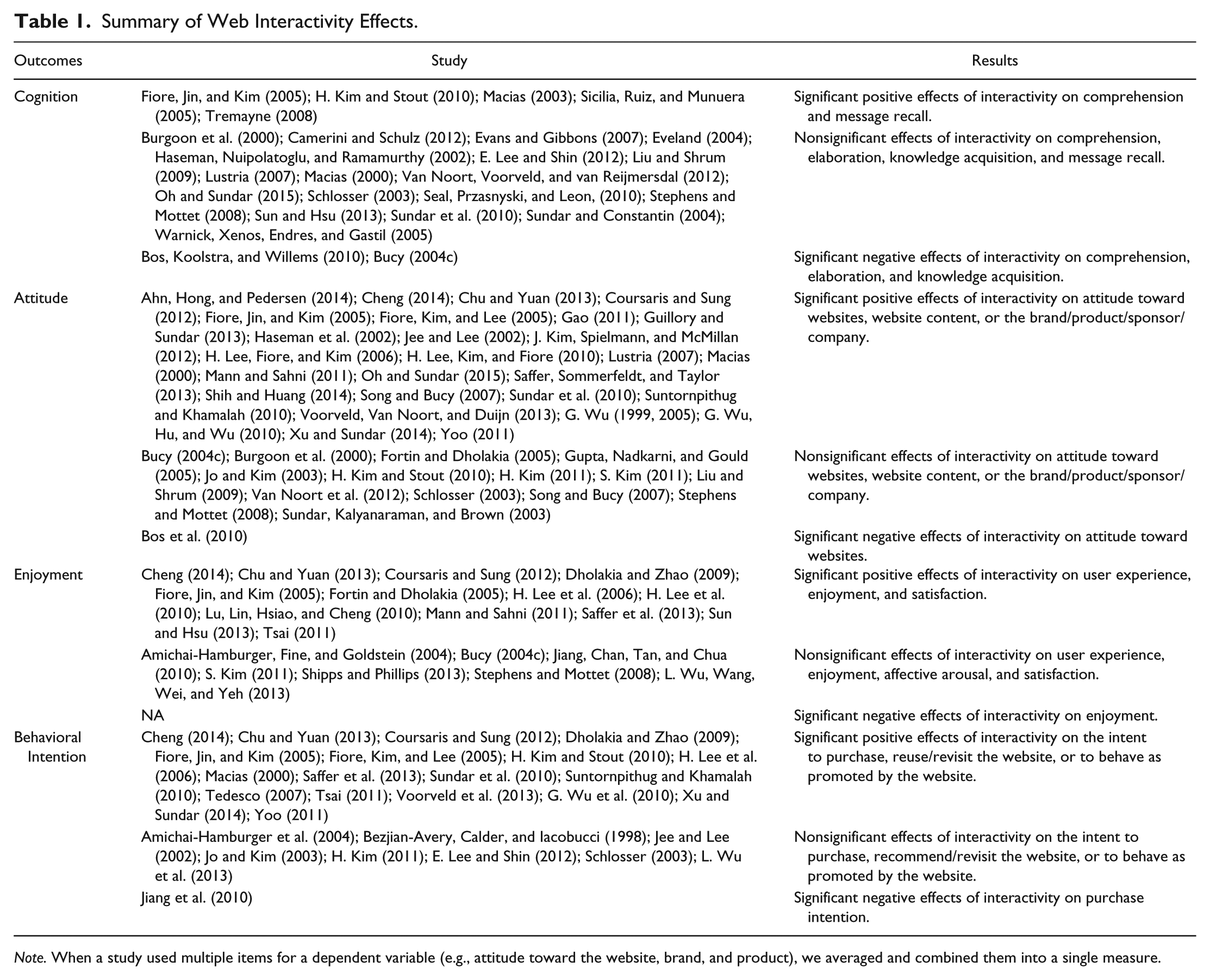
Note. When a study used multiple items for a dependent variable (e.g., attitude toward the website, brand, and product), we averaged and combined them into a single measure.
Cognition
The impact of web interactivity on cognition—the mental activities of information processing, knowledge acquisition, or message recall (Neisser, 2014)—has long been debated. While some research suggested that web interactivity could help users better process information, obtain knowledge, and enhance message recall (Gao, 2011; Macias, 2003; Sicilia et al., 2005), others found no effects (H. Kim & Stout, 2010; Lustria, 2007) or exactly the opposite effects of web interactivity (Bucy, 2004c; Sundar, 2000; Sundar & Constantin, 2004). For instance, Warnick et al. (2005) found that people recalled less information when presented with interactive ads than with text-based static ads. While some interactive features may be beneficial, too much interactivity can be overwhelming and may lead to poor information processing (Liu & Shrum, 2002).
Enjoyment
Most prior research has identified a positive effect of web interactivity on affect, mainly in generating enjoyment—the pleasure and satisfaction users obtain from website use (Amichai-Hamburger et al., 2004; Cheng, 2014; Fiore, Jin, & Kim, 2005; Sun & Hsu, 2013). Compared with traditional static websites, interacting with interactive features like parallax scrolling can not only trigger the heuristics of coolness, fun, and playfulness but can also offer vivid presentation of website information (e.g., 3D display vs. static, plain text) and sense of control online (S. Kim, 2011; Stephens & Mottet, 2008), thereby increasing users’ satisfaction and enjoyment.
Attitude
Attitude refers to individual affective orientations toward a certain object, usually in the form of favor or disfavor (Eagly & Chaiken, 1993). By enabling connectedness (Gupta, Nadkarni, & Gould, 2005), two-way communication (Tsai, 2011), and agentic content creation (Sundar & Nass, 2001), web interactivity has been found to have generated various favorable attitudes (Guillory & Sundar, 2013; Lustria, 2007; Macias, 2000; Song & Bucy, 2007; Sundar et al., 2010; Teo, Oh, Liu, & Wei, 2003) even when users felt overwhelmed and disoriented by interactive features. For example, Bucy (2004c) identified the phenomenon of “interactivity paradox”—the contradictory impact of web interactivity on attitude as opposed to cognition, such that even when users rated an interactive news website as significantly more complex and hard to follow, they still reported favorable attitudes toward the website (also see Bos, Koolstra, & Willems, 2010; Haseman, Nuipolatoglu, & Ramamurthy, 2002).
Behavioral intention
Behavioral intention has been commonly discussed as a predictor of actual behaviors. As expected, prior literature has mostly supported that web interactivity could positively influence behavioral intention (e.g., intention to purchase or revisit the website) the same way as it would impact attitude (Coursaris & Sung, 2012; Dholakia & Zhao, 2009; Jiang et al., 2010; Tedesco, 2007; Tsai, 2011). For example, L. Wu, Wang, Wei, and Yeh (2013) found that users of interactive websites were more likely to revisit and recommend the websites. Based on a survey of 1744 respondents, Suntornpithug and Khamalah (2010) also noted interactions with either other users or the websites online significantly promoted purchase intention as a result of favorable attitudes.
Potential Moderators
Studies on web interactivity effects have often produced different results. Based on our review of the published studies, we identified three potential moderators that have implications for interactivity effect research: operationalization, locus, and level of interactivity.
Operationalization of interactivity
In the past, scholars have treated interactivity as either a medium or message feature (see Bucy, 2004a, 2004b; Stromer-Galley, 2004; Sundar, 2004). The medium-centered approach views interactivity as an attribute of the technology that affords user-to-user or user-to-system interactions (Sundar, 2004) such as hyperlinks (Amichai-Hamburger et al., 2004; Sundar, Kalyanaraman, & Brown, 2003; Voorveld, Van Noort, & Duijn, 2013), mouseover (Sundar & Constantin, 2004; G. Wu, 2005), and richness of message presentation (image, video, audio, etc.; Burgoon et al., 2000; Sundar, 2000). The message-centered approach treats interactivity as a process of continuous message exchanges through which users interact with each other or with the system (see Bucy & Tao, 2007; Stromer-Galley, 2004).
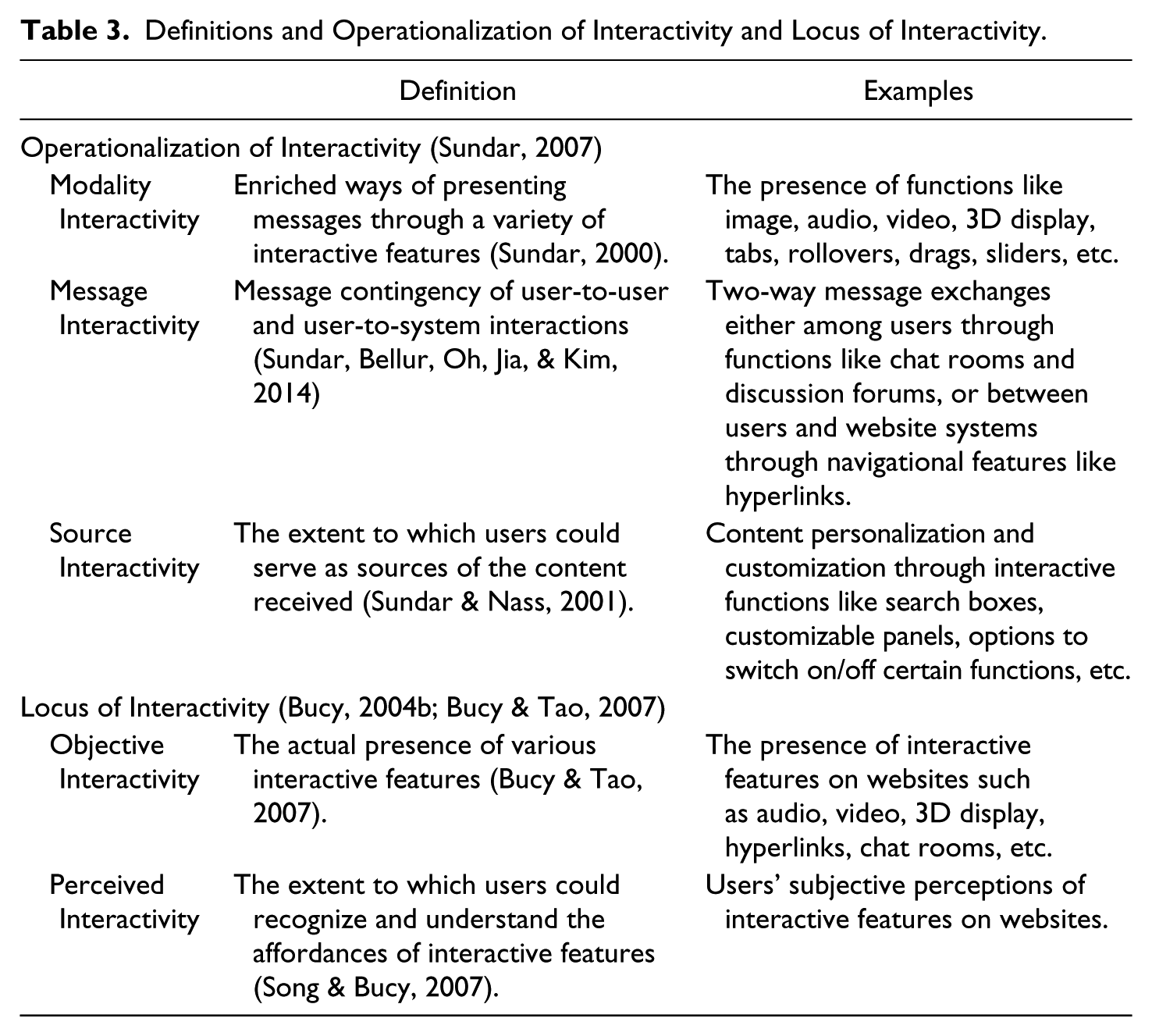
Sundar (2007) added another dimension and conceptualized interactivity as having three components: modality (medium feature), message (message feature), and source (source feature; see Table 2). Modality interactivity refers to the vividness and richness of message presentation. Compared with static texts, presenting messages through images, audios, videos, and other interactive features has been found more persuasive to website users (Sundar, 2000; Sundar et al., 2010). Conversely, message interactivity refers to message contingency, that is, the “systems’ output is contingent upon the user’s output” (Sundar, Bellur, Oh, Jia, & Kim, 2014, p. 3). Online two-way communication enabled by interactive functions like chat rooms is an example of message interactivity (Jiang et al., 2010; Tedesco, 2007). Furthermore, as more websites allow for content personalization and customization, the extent to which websites’ users could serve as the source of online content—source interactivity—has increasingly become a key to enhancing user enjoyment, favorable attitudes, and intentions (Mann & Sahni, 2011; Shipps & Phillips, 2013). As modality, message, and source interactivity touch upon distinct dimensions of interactivity, we expect the effects of web interactivity to vary depending on which aspect of interactivity is emphasized in each study (Fortin & Dholakia, 2005).
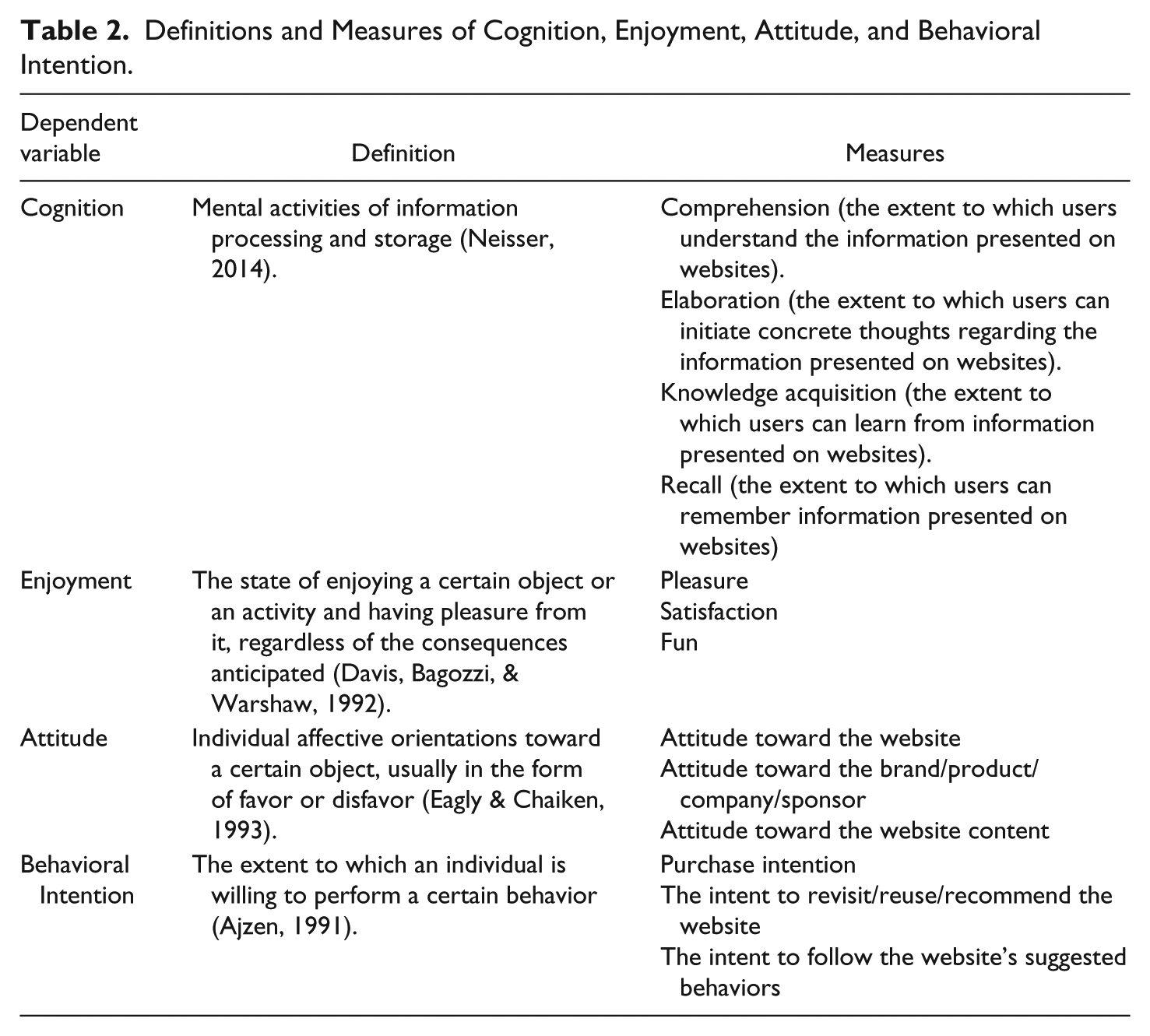
Definitions and Measures of Cognition, Enjoyment, Attitude, and Behavioral Intention.
Locus of interactivity
One major limitation of viewing interactivity as the medium- or message-centered is the omission of users’ subjective perceptions of and experience with interactive features (Bucy & Tao, 2007). As interactivity research advances, scholars have increasingly noticed the discrepancy between objective and perceived interactivity. They suggested that a distinction needed to be made between interactive media attributes and users’ perceived interactivity in experimental research because the mere appearance of interactive features does not necessarily guarantee that users would perceive the same level of interactivity (Bucy & Tao, 2007; Voorveld, Neijens, & Smit, 2011). In other words, we cannot always assume more interactive features would produce greater perceived levels of interactivity (Tao & Bucy, 2007).
According to Song and Bucy (2007), perceived interactivity outweighs objective interactivity because “users may perceive a communication or a medium as interactive even when it lacks sufficient amount of interactive elements in both the media system and messages” (p. 6). Such an argument has been empirically supported by other studies (Chu & Yuan, 2013; G. Wu, 2005). Research also suggests that perceived interactivity mediates the relationship between objective interactivity and its outcomes (Song & Bucy, 2007). Thus, the extent to which web interactivity can be effective depends on the locus of interactivity (objective vs. perceived) tested in each study.
Level of interactivity
Besides operationalization and locus of interactivity, previous studies have also examined how different levels of interactivity affected user responses. This refers to the number of levels (e.g., three vs. two) of interactivity that has been manipulated in prior studies. Some studies found a linear relationship between web interactivity and user responses (Xu & Sundar, 2014). For example, Teo et al. (2003) found users in the highest interactivity condition reported more favorable attitudes than those in the low and medium interactivity conditions. Others found that too much interactivity could backfire and lead to negative consequences (Bucy, 2004b; Liu & Shrum, 2002; Sundar et al., 2003). This means that an initial increase of interactivity might generate positive effects. However, after an optimal point has been reached, additional increases of interactivity would only cause negative effects like cognitive overload and frustration (Bucy, 2004c). Sundar et al. (2003), for example, manipulated interactivity at three levels (low vs. medium vs. high) and found that in the context of a political campaign, participants in the moderate interactivity condition showed more positive attitudes toward the website and the political candidates than the low and high interactivity conditions. Therefore, the impact of web interactivity might vary depending on how interactivity is manipulated or measured in each study.
Research Expectations
Prior studies found positive associations between web interactivity and user enjoyment, attitudes, and behavioral intentions. But the results regarding the influence of web interactivity on user cognition were mixed. In light of these findings, we expect that web interactivity will most likely have a positive effect on user enjoyment, attitudes, and behavioral intentions, but not on cognition. Furthermore, we also expect interactivity’s effects will be moderated by different operationalizations and levels of interactivity. In addition, consistent with prior research, we expect that perceived interactivity will be significantly more effective than objective interactivity across different studies.
Method
Search Process and Sampling Frame
In order to identify all relevant studies on interactivity and its effects, we searched multiple databases, including ScienceDirect, ProQuest, EBSCO, Communication and Mass Media Complete, ACM, Google Scholar, SpringerLink, SAGE, Taylor Francis, Wiley Online Library, Pubmed, and PsycINFO. We included “interactivity” or “web interactivity” along with keywords such as “attitude,” “cognition,” “enjoyment,” and “intention” in the same query to search for relevant studies. Reference lists of review articles on interactivity were also checked (e.g., Kiousis, 2002; Rafaeli & Ariel, 2007).
The initial search yielded 260 papers including conference papers, journal articles, and dissertations. Papers were selected based on the following inclusion and exclusion criteria. First, because this research mainly focuses on the effects of web interactivity on cognition, enjoyment, attitudes, and behavioral intentions, studies that did not measure the relevant variables were excluded (e.g., Ha & James, 1998). Second, to systematically examine the effects of interactivity, a study must be either a field or lab experimental research with quantifiable data. Studies using other methods as well as conceptual or qualitative review pieces were excluded (e.g., Stromer-Galley, 2004). In addition, if a study appeared as a conference paper and then later was published, we used the journal publication as its final version. Last, as meta-analysis requires certain data such as means, mean differences, and standard deviations to compute the effect sizes (Hunter & Schmidt, 2004), papers without these essential data were excluded.
A total of 63 studies were identified to meet all the inclusion criteria and were used in the final sample. Excluded from our analysis were 120 studies that used nonexperimental methods, 39 studies that had irrelevant dependent variables, four conference papers that were duplicates of their journal publications, and 34 studies without the required data for meta-analysis.
Treatment of Dependent Variables
This meta-analysis focuses on four dependent variables that are most commonly examined in previous interactivity literature. Table 2 provides the definitions and measurements of the four outcome variables. When a study included multiple measures of a focal outcome variable, each of them was examined separately and then averaged into a single effect-size measure of the focal dependent variable. For example, in examining the effects of web interactivity on attitudes, Macias (2003) studied attitudes toward the website, the advertisement, and the related brand, which we then averaged into a single attitude measure in our analysis.
Apart from examining the four outcomes of web interactivity, this meta-analysis also tests its overall effectiveness by combining the four measures into an overall index.
Classification of Moderating Variables
The operationalization of interactivity was classified using Sundar’s (2007) framework of modality, message, and source interactivity (see Table 3). The locus of interactivity was coded as either objective or perceived interactivity based on how interactivity was manipulated or measured in each study. Table 3 also lists the definitions and examples of objective and perceived interactivity. When a study (e.g., Song & Bucy, 2007) examined both objective and perceived interactivity, we calculated their effect sizes separately.
Definitions and Operationalization of Interactivity and Locus of Interactivity.
Another moderating variable is the level of interactivity, which was also identified based on how interactivity was specifically manipulated or measured in each study. Some studies tested the effects of web interactivity by manipulation, in which case interactivity was varied either at two levels (low vs. high) or three levels (low vs. medium vs. high). Alternatively, other studies measured web interactivity as a continuous variable in experimental research, as they mainly focused on the effects of perceived rather than objective interactivity. For studies manipulating interactivity at three levels with two pairs of mean comparisons (Sohn et al., 2007; Sundar & Constantin, 2004; Sundar et al., 2003), we selected the low- vs. high-level pairs for comparison purposes.
Computation of Effect Size
The unit of analysis for effect size is an experimental pair, which includes the means of a low and a high interactivity condition. As a result, the 63 studies generated a total of 405 experimental pairs. As different studies reported results in different formats such as mean differences, correlations, t statistics, chi-square statistics, and F statistics, we used the formulas and recommendations by Borenstein, Hedges, Higgins, and Rothstein (2014) in converting all reported statistics into a uniform set of metrics—correlations (r), p values, and Q statistics. The r value was then converted into standardized mean difference (d), which is used to compare effect sizes. The Q statistics test the significance of variance of either within- and between-group differences.
Results
This meta-analysis investigated the effects of web interactivity by computing the correlations (rs) for all experimental pairs based on the random effects model. As we accumulated data from published articles by different researchers, we cannot assume a common effect size for all studies. Therefore, the effect sizes were estimated using the random effects model (see Borenstein et al., 2014; Shen, Sheer, & Li, 2015). Table 4 lists the effect sizes, sample sizes, key outcome variables, and moderating variables for all studies included. Effect sizes and other basic statistics of all studies by the three moderator variables (i.e., the operationalization of interactivity, locus of interactivity, and level of interactivity) are reported in Table 5.
Effects of Interactivity on Cognition, Enjoyment, Attitudes, Behavioral Intentions, and Its Overall Effects.
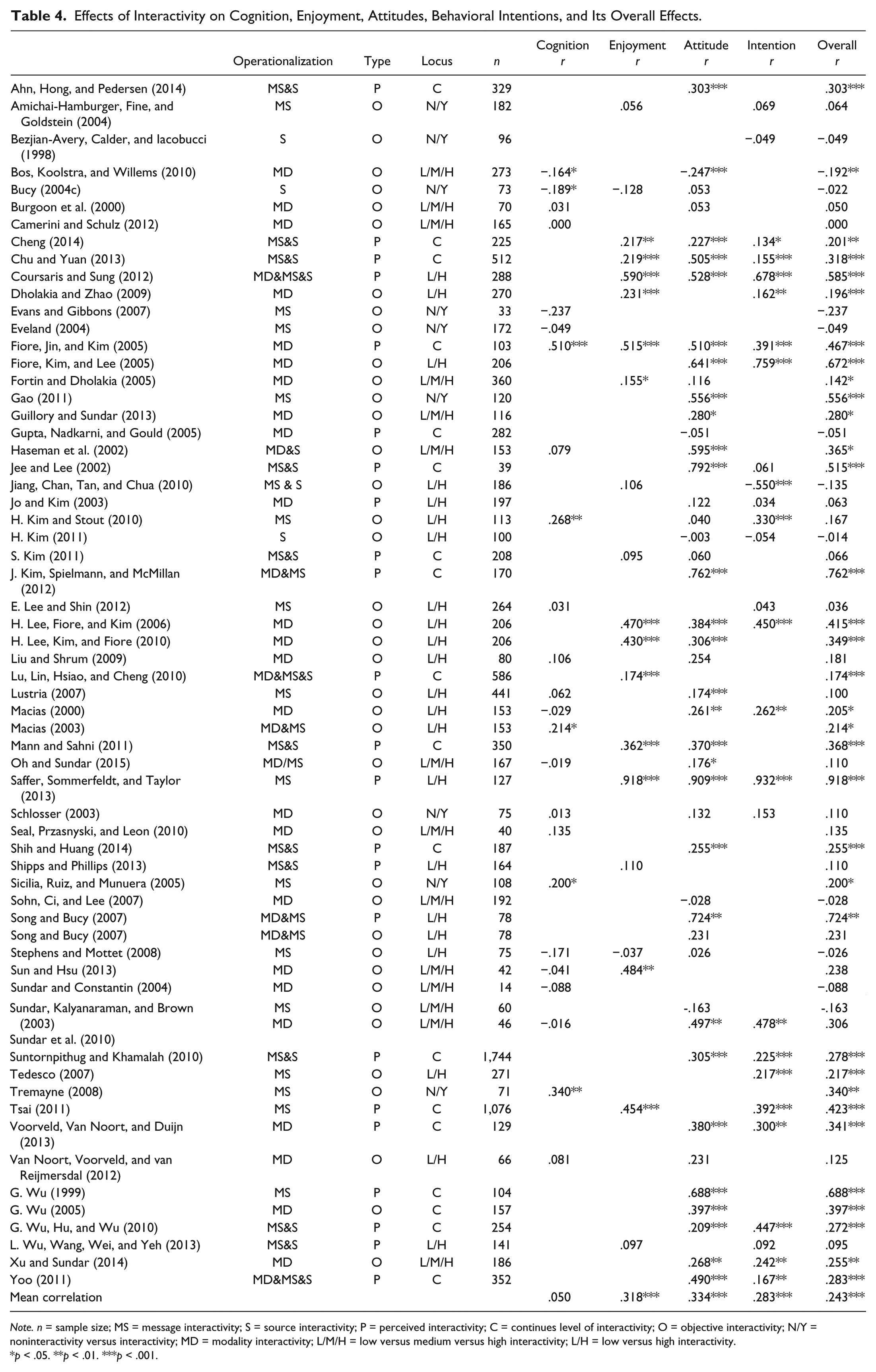
Note. n = sample size; MS = message interactivity; MD = modality interactivity; S = source interactivity; P = perceived interactivity; C = continues level of interactivity; O = objective interactivity; N/Y = noninteractivity versus interactivity; MD = modality interactivity; L/M/H = low versus medium versus high interactivity; L/H = low versus high interactivity.
p < .05. **p < .01. ***p < .001.
Moderation Effects of Interactivity: Operationalization, Locus, and Level.
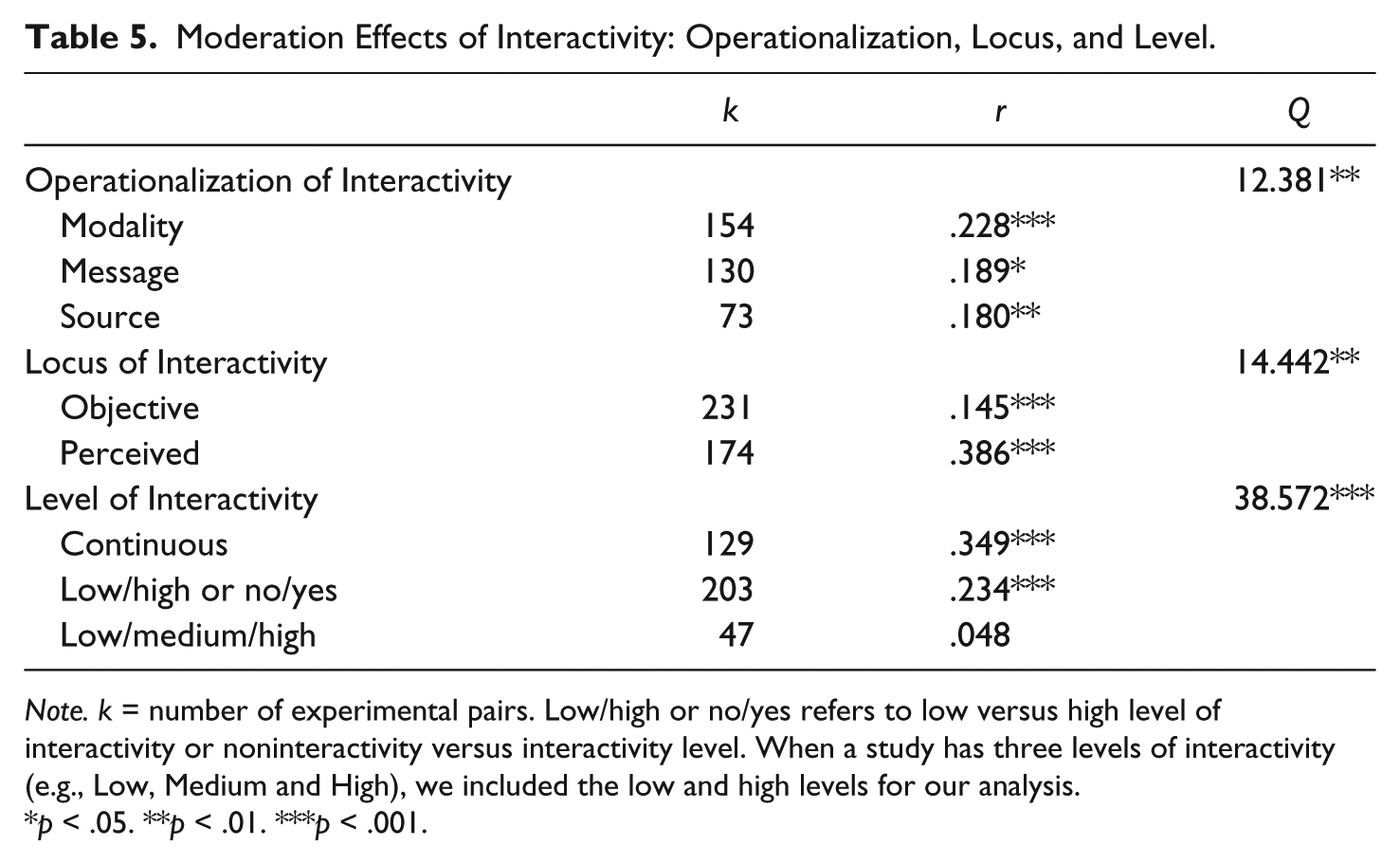
Note. k = number of experimental pairs. Low/high or no/yes refers to low versus high level of interactivity or noninteractivity versus interactivity level. When a study has three levels of interactivity (e.g., low, medium and high), we included the low and high levels for our analysis.
p < .05. **p < .01. ***p < .001.
Across all studies, web interactivity has a significant positive effect (r = .243, p < .001) on all the outcome variables. When converted into the standardized mean difference (d value), the r value is equal to a d value of .507 (p < .05). According to Cohen’s (1992) classification of effect sizes, it can be concluded that web interactivity has a medium-to-large-size effect in general.
Effects of Web Interactivity
As expected, our analysis suggested that web interactivity significantly enhanced user enjoyment (r = .318, p < .001). When converted into the standardized mean difference, the r value is equal to a d value of .692—a large effect size. In addition, web interactivity led to significantly more favorable attitudes (r = .334, p < .001). When converted into the standardized mean difference, the r value is equal to a d value of .715, which is a large effect size (Cohen, 1992). Similarly, web interactivity had a significant positive impact on behavioral intention (r = .283, p < .001). When converted into the standardized mean difference, the r value is equal to a d value of .612, indicating a large effect size of web interactivity on behavioral intention.
Unlike the fairly consistent findings regarding web interactivity’s impact on user enjoyment, attitudes, and behavioral intentions, we found a much more complex relationship between web interactivity and user cognition. Our analysis showed a nonsignificant relationship between web interactivity and cognition (r = .050, p = .25). Further analyses suggested that web interactivity did not have significant effects on comprehension, elaboration, knowledge acquisition, and a small negative effect on message recall. These findings indicated that web interactivity did not necessarily benefit user cognition.
Testing Moderation Effects
A significant moderation effect of the operationalization of interactivity was obtained in the meta-analysis with significant heterogeneity of between-group difference (Q = 12.381, p < .01). Modality interactivity had the largest effect size (r = .228, p < .001) in comparison with message (r = .189, p < .05) and source interactivity (r = .180, p < .01). When converted into the standardized mean difference, the r value of modality interactivity is equal to a d value of .475, a medium effect, whereas the r values of message and source interactivity generate d values of .403, and .372, respectively.
Results of this meta-analysis as shown in Table 5 support that perceived interactivity has a much larger effect size (r = .386, p < .001) than objective interactivity (r = .145, p < .001). When converted into the standardized mean difference, the r value of perceived interactivity produces a d value of .828, which is a large effect size. However, the r value of objective interactivity produces a d value of .300—only a small to medium effect size compared with perceived interactivity. Test of heterogeneity of between-group difference is significant (Q = 14.442, p < .01).
Different levels of interactivity also moderated the effects of web interactivity as expected (Q = 38.572, p < .001). When manipulated or measured at the continuous level or at two (i.e., noninteractivity vs. interactivity, the low vs. high interactivity) levels, interactivity significantly increased positive psychological responses such as enjoyment, attitudes, and intentions (r = .349, p < .001, and r = .234, p < .001, respectively). However, such a benefit of web interactivity disappeared when an even greater degree of interactivity was added at the third level (r = .048, p = .45). Converting the r values of the continuous-level and the two-level of interactivity generates d values of .729 (large effect size) and .495 (medium effect size), respectively. Yet the r value of the three-level interactivity is only equal to a d value of .103 (p = .42), a nonsignificant, small-size effect of web interactivity.
Discussion
This meta-analysis examined the effects of web interactivity on user cognition, enjoyment, attitudes, and behavioral intentions. Results from this research confirmed that web interactivity could lead to increased user enjoyment, positive attitudes, and as well as favorable behavioral intentions. These findings suggest that incorporating interactive features on websites can effectively engage website users, who usually rate interactive websites as more involving, entertaining, participatory, and responsive (S. Kim, 2011). However, we have also found that web interactivity did not necessarily benefit user cognition, as increased levels of interactivity did not necessarily enhance information processing, knowledge acquisition, or message recall. As Bucy (2004c) discussed, this lack of influence of web interactivity might be due to the limited cognitive capacity of users. Interacting with too many interactive features can cognitively overload some website users and subsequently deprive them of the ability to systematically process website information. Several prior studies have provided evidence in support of this argument. Liu and Shrum (2009) identified need for cognition (NFC) as an important variable in moderating the effects of web interactivity, such that web interactivity was particularly effective to people with higher NFC for fulfilling their needs for effortful thinking. However, the reverse was true for those with lower NFC as the increasing cognitive efforts demanded for dealing with web interactivity only caused frustration, confusion, and disorientation (also see Jee & Lee, 2002).
Even though interactivity might not necessarily be advantageous to user cognition, it can nevertheless induce positive user attitudes toward associated websites. Bucy (2004c) referred to these different effects of web interactivity on attitudes, enjoyment, and cognition as the “interactivity paradox.” This discrepancy suggests that there might be two different psychological routes—cognitive and affective—through which users can be affected by web interactivity (Liu & Shrum, 2009). Web interactivity, although not beneficial to user cognition, is more effective in tapping into users’ affective responses such as enjoyment. In other words, web interactivity can act as an affective heuristic for users, who in turn will develop favorable attitudes and behavioral intentions.
As Sundar (2008) discussed, interactivity as the most distinctive affordance of computer-mediated technologies could cue different user heuristics. This might also help explain the relatively larger effect size of modality interactivity revealed in this meta-analysis. As the amount of information available online explodes, website users are faced with the challenge of information overload more than ever before (Jones, Ravid, & Rafaeli, 2004). As a result, users often rely on heuristics in processing online information. Compared with message and source interactivity, modality interactivity—the use of interactive functions to present information vividly—is oftentimes the most visible to website users as soon as they get on a website. However, message and source interactivity require more time and effort to recognize or interact with. As such, modality interactivity, being easy to recognize and stand out, is more likely to invite positive attitudes and behavioral intentions.
This study also confirmed that perceived interactivity was much more effective than objective interactivity, highlighting the importance of user perceptions. This is consistent with prior research on the importance of perceived interactivity (Bucy, 2004b; Bucy & Tao, 2007; Chu & Yuan, 2013; Kiousis, 2002; Song & Bucy, 2007; G. Wu, 2005). Furthermore, the curvilinear relationship between levels of web interactivity and its effectiveness provides support for the potential downside of excessive web interactivity (Bucy, 2004c; Sundar et al., 2003). By analyzing studies of three levels of interactivity, we found that extremely high levels of interactivity were less effective than moderate levels of interactivity. Given the difficulty in pinpointing a universally appropriate “moderate level” of interactivity for website users (as each study manipulated it differently), more research is needed to specifically investigate the optimal level of interactivity.
Interestingly, this finding contradicts those studies measuring interactivity at a continuous level, which usually found a positive linear relationship between web interactivity and its effects. However, such a linear relationship might be due to the fact that a linear regression model was uniformly employed in these studies. As this meta-analysis revealed that the effectiveness of web interactivity did not always increase as the level of interactivity grows, fitting a linear model may have failed to capture the true impact of web interactivity on users’ psychological responses. Instead, a nonlinear model needs to be considered when examining the effects of web interactivity measured at a continuous level. Evidence for this possibility can be found in the study by Gupta et al. (2005) who fitted a quadratic model and confirmed a curvilinear relationship between the level of interactivity and its effects.
Our study has contributed to the existing literature by quantifying the impact of web interactivity that has been studied over the years. In doing so, our analysis has identified the conditions under which different forms of web interactivity features can impact user cognition, enjoyment, attitudes, and behavioral intentions. Furthermore, this meta-analysis expanded previous literature by confirming the disconnection between effects of web interactivity on attitudes and cognition as well as the potential curvilinear relationship between levels of web interactivity and its effectiveness. We found that the operationalizations of interactivity and their effects varied significantly across different studies. As a result, effectiveness of interactivity often meant different outcomes for different studies. Future research on interactivity as well as other technology-related topics should, therefore, provide greater consistency in conceptualizing and operationalizing the key concepts and measuring their impact.
Our findings also have practical implications. Given the positive influence of web interactivity on enjoyment, attitudes, and behavioral intentions, web interactivity clearly has important benefits for users. Interactivity is therefore recommended for websites designed for entertainment and recreational purposes. Even for commercial and informational websites, interactive features can still be useful, as they can enhance enjoyment and positive attitudes (Chu & Yuan, 2013). However, excessive web interactivity should be applied with special caution as adding too many interactive features might distract users from effectively processing information, gaining knowledge, and strengthening recall (Evans & Gibbons, 2007).
The large effect size of perceived interactivity suggests that users’ perception should be an important consideration in website or interface design. When interactive features are built into websites, it is important to understand user responses to these features through user-experience tests. As we discussed earlier, given the nonsignificant impact of very high levels of web interactivity, web designers should exercise caution before adding too many interactive features. While moderate use of interactive features may be beneficial, excessive use of it can be distracting as well as detrimental to learning (Bucy, 2004b).
This study is not without limitations. First, although we made a genuine attempt to include all relevant studies, some studies might have been missed due to their unavailability in online databases (e.g., unpublished thesis and dissertations). Second, this meta-analysis only investigated four major psychological outcomes of web interactivity. We, therefore, are not able to draw conclusions about users’ other psychological responses (e.g., psychological involvement). Last, due to limited studies available, this meta-analysis cannot explore the moderation effects of individual differences on web interactivity. Future research should consider investigating how individual difference variables (gender, NFC, computer skills, etc.) could moderate the effects of web interactivity when the number of relevant studies abounds.
Footnotes
Declaration of Conflicting Interests
The authors declared no potential conflicts of interest with respect to the research, authorship, and/or publication of this article.
Funding
The authors received no financial support for the research, authorship, and/or publication of this article.