



Abstract
Scholarly attention to the nature and extent of negative campaigning in nonmajoritarian multiparty systems is steadily growing. While prior studies have made commendable progress in outlining the conditions and consequences of negative campaigning, they have typically disregarded the complex interdependencies of multiactor communication environments. The present study focuses on network-structural determinants of negative campaigning. It does so by relying on unique data from the 2013 Austrian federal election and using exponential random graph models to investigate patterns of mediated negative campaigning. We find that—above and beyond common determinants of negative campaigning—indicators of network structure are important predictors of campaign communication. This suggests that network models are crucial for accurately representing campaign communication patterns in multiparty systems.
Keywords
In advanced democracies, political actors have a vital interest in activating their supporters, convincing undecided voters, and undermining opponents during election campaigns (Lau, Sigelman, Heldman, & Babbitt, 1999). It is a widely held conviction among political consultants and candidates alike that negative campaigning in particular may serve such functions (Lau & Rovner, 2009).
Scholars have previously focused on the corrosive effects of exposure to negative campaigning such as voter demobilization (Ansolabehere, Iyengar, Simon, & Valentino, 1994; Lau & Pomper, 2004) or negative attitudes toward politics in general (Jackson, Mondak, & Huckfeldt, 2009). By contrast, only a small body of research has considered why and how actors decide to go negative in the first place (e.g., Haynes & Rhine, 1998; Peterson & Djupe, 2005). Moreover, due to its U.S.-centric perspective, a systematic inquiry of how the complexities of a multiparty environment affect mediated negative campaigns has received far less attention. In this study, we confront these shortcomings by focusing on the network-structural features of a multiparty campaign environment while reconsidering established determinants of negative campaigning. Moreover, we investigate whether dynamic network processes add to our understanding of negative campaigning as it unfolds throughout the campaign.
The present study attempts to advance the existing literature in two important ways: First, we provide a coherent theoretical framework of mediated negative campaigning in a multiparty system based on both static and dynamic network processes, such as reciprocity, structural balance, and transitivity. Our study thus seeks to extend network-centric approaches on mediated electoral campaigning (De Nooy & Kleinnijenhuis, 2013; Kleinnijenhuis & de Nooy, 2013), while speaking to an emerging research agenda on negative campaigning in multiparty systems (Elmelund-Præstekær, 2010; Walter, 2014). Second, in contrast to party-centric approaches (e.g., De Nooy & Kleinnijenhuis, 2013; Ennser-Jedenastik, Dolezal, & Müller, 2017), we focus on attack patterns among individual actors in order to systematically investigate the sources and targets of negative campaigning and their determinants. Employing inferential techniques for network data, we find that—above and beyond established determinants of negative campaigning—indicators of network structure are important predictors of campaign communication. We find this to be the case in both static and dynamic network models. Overall, the findings suggest that network models are crucial for accurately representing negative communication patterns in multiparty systems and campaign communication more generally.
Defining Mediated Campaign Negativity
Although new forms of communication have altered the way citizens and political actors interact during elections, electoral campaigns still heavily rely on mass media coverage, and negative campaigning is no exception. Moreover, unlike other channels such as campaign ads or party press releases (Dolezal, Ennser-Jedenastik, & Müller, 2016), mediated campaigning is often outside of political actors’ direct control (Haynes & Rhine, 1998). Politicians have to strategically react to other politicians’ reported campaign behavior as “both the voters and the other parties take into account the party’s actions as they are presented in the mass media” (Kleinnijenhuis & de Nooy, 2013, p. 169). Mediated campaigning hence not only reflects the campaign as experienced by the public (Lau & Pomper, 2004) but also tracks actual interaction patterns among politicians (Kleinnijenhuis & de Nooy, 2013). Thus, we focus on mediated negative campaigning. As this study only considers mediated campaign communication, it does not speak to other means of campaign communication that are either under the direct control of political actors or allow nonmediated interactions (e.g., political advertising or social media).
Scholars of negative campaigning have employed rather diverse definitions of the concept (Lau & Rovner, 2009). Nevertheless, there seems to be a general consensus that it involves attacks or criticisms directed at one’s opponents (Walter, 2014). Scholars also broadly agree that such directional definition of negative campaigning (e.g., “intermediated anti-rival statements”: Haynes & Rhine, 1998, p. 695) is superior to an evaluative definition in terms of precision and reliability (Lau & Rovner, 2009; Walter & Vliegenthart, 2010). In line with this insight, we consider a negative campaign event referring to an actor statement that involves an attack, critique of, or confrontation with competing actors (Walter & van der Brug, 2013).
Toward a Network Model of Negative Campaigning in Multiparty Systems
Negative campaigns are primarily aimed at lowering support for opponents (Haynes & Rhine, 1998; Lau et al., 2007). Prior research also points out that negative campaigning may mobilize supporters as a result of being (counter)attacked by one’s opponents (Jackson & Carsey, 2007). Yet, negative campaigning may backfire and increase negative impressions of the attacker (Lau et al., 2007). Therefore, most existing accounts have assumed a strategic calculus of rational actors who choose to go negative only if the demobilizing effects on opponents outweigh backfire effects on the sponsor (Lau & Pomper, 2004; Skaperdas & Grofman, 1995).
Recently, there has been a growing attention to the nature and extent of negative campaigning in European multiparty systems with a particular focus on how actors’ cost-benefit structures may vary compared with two-party systems (Elmelund-Præstekær, 2010; Walter & van der Brug, 2013). Yet, previous studies have often ignored that negative campaign in multiparty contexts is inherently interdependent (but see Kleinnijenhuis & de Nooy, 2013) as multiple actors compete with one another to win over voters. Such contexts beget situations where an actor’s decision to attack is shaped by other actors’ attacks as well, giving rise to complex dependency structures. Yet, such interdependencies are not well accounted for in the extant research (e.g., Elmelund-Præstekær, 2010; Walter & van der Brug, 2013). Relying on recent theoretical and empirical advances in network science, we therefore focus on important, but often ignored network-structural determinants of negative campaigning in multiparty contexts.
Reciprocity: Retaliation or “Tit for Tat”
It is often regarded that social relation tends to evolve from an asymmetric to a symmetric relationship (Snijders, 2011; Wasserman & Faust, 1994). This intuitive notion of reciprocity fits particularly well for some of the existing perspectives on negative campaigning, as political actors are more likely to go negative toward opponents that have previously attacked them (Damore, 2002; Lau & Rovner, 2009). Reciprocity is expected to govern the decision calculus of political actors if a failure to counterattack invites the perception that the target of negative campaigning is less competent and less credible (Lau & Pomper, 2004). Also, it is suggested that retaliation against competitors enables those being attacked to offset the relative losses by damaging the competitors’ standing (Dolezal et al., 2016). Yet, the notion of reciprocity has rarely been considered in the previous literature (Lau & Pomper, 2004; but see De Nooy & Kleinnijenhuis, 2013). This leads to the following hypothesis:
Structural Balance: Attacking “Friend’s Enemies” or “Enemy’s Friends”
A second fundamental principle that governs human behavior is the concept of structural balance (Cartwright & Harary, 1956; Heider, 1946). The notion of structural balance suggests that an even number of attacking dyads create balanced states in a triad, where a triad is defined as a set of all possible relationships among three “nodes” in a network (i.e., i-h, i-j, and j-h relations). In the present context, a group of three actors is considered in a balanced state if two of these actors are in the following scenarios: (a) they have a positive relation with each other and jointly attack a third actor (“attacking my friend’s enemy”), or (b) they have a negative relation with each other and only one of the actors attacks a third actor (“attacking my enemy’s friend”). Hence, actor i’s relation with actor j, and their relation with actor h are mutually interdependent. In other words, friends can make common enemies, and common enemies can make friends. The principle of structural balance captures how endogenously driven dynamics could lead to a different cost-benefit calculus compared with a two-party system, as demonstrated in De Nooy and Kleinnijenhuis’s (2013) seminal investigation of the 2006 Dutch national election campaign. Their analysis suggests that the decision to go negative is at least partly governed by the principle of “supporting your friends’ friends and attacking your friends’ enemies” (De Nooy & Kleinnijenhuis, 2013, p. 123). Yet, to the best of our knowledge, this empirical regularity has not been replicated in a different multiparty electoral context. We thus conjecture the following:
Transitivity: Hostility “Roll-Over”
Network analyses often entail the concept of transitivity (“closing the triangle”), such that a tie between an actor i and an alter j is more likely given ties between actor i and actor h, and h and j (Snijders, 2011; Wasserman & Faust, 1994). With a specific view on negative campaigning, this implies that a group of three or more actors is more likely to attack one another, creating triads that consist of all negative signs. From the perspective of the initial attacker (e.g., actor “i” in an i → h → j triad), attacking one’s opponents (e.g., i → h attack relation) might unintentionally help the other competitor j, as disaffected voters (who initially supported h) may turn toward j rather than the initial attacker (Elmelund-Præstekær, 2008; Walter, 2014). In other words, in a multiparty system, an enemy’s enemy is not necessarily a friend. Such a situation creates incentives for actors to go negative toward multiple opponents—including the enemy’s enemy (e.g., i → j as well as i → h attack). Also, from the point of view of the attackee (e.g., actor “h” in an i → h → j triad), to the extent that attacking other candidates (e.g., h → j attack relation) is more effective in compensating the relative losses than retaliating the initial attacker, such “roll-over” or “transitivity” of negativity may be preferable (e.g., Dolezal et al., 2016).
Empirically, a considerable number of transitive triads are not uncommon in networks with negative relations, especially when actors face uncertainties and competing interests among multiple competitors (e.g., Maoz, Terris, Kuperman, & Talmud, 2007). Much like negative campaigning in a multiactor environment, transitive triads within such a setting can potentially maximize the short-term gains of individual actors through their strategic actions. We therefore suggest that, controlling for other factors, transitivity is an integral aspect of negative campaigning in multiparty contexts:
Preferential Attachment: “Cumulative Hostility”
Empirical studies of social networks have frequently shown that a small subset of influential actors are highly connected with others, whereas a large number of actors have few connections, resulting in a power-law distribution of degrees (“preferential attachment”; Barabási & Albert, 1999; Newman, 2001; Snijders, 2011). We expect a similar preferential attachment structure in negative campaign networks but only for incoming attacks. That is, few actors receive multiple attacks, whereas there is no tendency to disproportionately send out attacks. Extensive attacks over a large number of actors are susceptible to backlash and retaliation (Lau & Rovner, 2009), and potentially detrimental to postelection bargaining processes common in multiparty contexts (Elmelund-Præstekær, 2010). Therefore, initiating a large number of attacks is comparatively unappealing, rendering it unlikely that a particular actor dominates the attacks. Conversely, and in line with the analysis of Skaperdas and Grofman (1995), attacks are often concentrated on few candidates (see also Djupe & Peterson, 2002; Haynes & Rhine, 1998). From an attacker’s perspective, any attack directed at important and, hence, more visible candidates is more likely to be covered by news media (e.g., Haynes & Rhine, 1998). Consequently, we expect preferential attachment to be a significant predictor of tie formation in a mediated attack network, such as follows:
Temporal Dynamics of Negative Campaigning
A detailed view on how negative campaigning evolves over time further illuminates the underlying logic of negative campaigning. Our general expectation here is that the “network of previous statements . . . provide[s] the context for new statements” (De Nooy & Kleinnijenhuis, 2013, p. 112). This is based on the assumption that politicians would react to other politicians’ attacks in a “timely” fashion. Moreover, such behavior is likely not to take into account the complete history of their competitors’ prior attacks but to rely on the most recent interactions (e.g., Dolezal et al., 2016; Kleinnijenhuis & de Nooy, 2013). Likewise, we expect a tendency toward structural balance and transitivity only when a sequence of attacks followed by support (for structural balance) or attack (for transitivity) among two actors is sufficiently recent to warrant a reaction (De Nooy & Kleinnijenhuis, 2013). Therefore, with regard to the temporal sequence of endogenous dynamics in an attack network, we predict the following:
We present substantive interpretations and visualizations for each of the hypothesized network structures predicting the attack instances in mediated negative campaign networks, in terms of both their static forms (H1-H4) and their dynamic versions (H5-H7) in Table 1.
ERGM/TERGM Parameters, Associated Configurations, and Interpretations.

Note. The thick lines represent the focal attack relations being modeled. All black lines represent “attack” relations, whereas blue lines represent “support” relations. Solid lines represent relations at a given time point (t), and dashed lines represent relations formed at t − 1. ERGM = exponential random graph model; TERGM = temporal ERGM.
From Party Politics to Mediated Negative Campaigning of Politicians
The conventional wisdom holds that electoral campaigns are fundamentally shaped by party strategies. Recent accounts, however, have emphasized a growing importance of individual candidates even in party-centered democracies (Zittel, 2015; Zittel & Gschwend, 2008). Given a trend toward the personalization of politics (e.g., Karvonen, 2010) and concurrent media coverage (Boumans, Boomgaarden, & Vliegenthart, 2013; van Aelst, Sheafer, & Stanyer, 2012), we expect individual characteristics to play a considerable role in mediated negative campaign dynamics.
Prior studies indicate that female candidates are expected to rely less on negative campaigning (Kahn & Kenney, 2000; Maier & Jansen, 2015; Walter, 2013). Studies also agree that challengers use more and more intense negative campaigning than front runners (Lau et al., 2007), while incumbents can focus on their achievements and, therefore, less rely on negative campaigning (Elmelund-Præstekær, 2010; Hansen & Pedersen, 2008). It is less clear, however, how party-level electoral prospects would translate into mediated attacks of individual politicians. One possibility is that negativity disproportionally focuses on actors with better electoral prospects. In a closed-list proportional representation (PR) system, politicians’ chances of winning a mandate depend on their position on the party list relative to their party’s expected number of seats (Gallagher & Mitchell, 2005). Given that list placements tend to reflect candidate importance and, by extension, candidates’ news values, we expect candidates to receive more media coverage, including instances of negative campaigning, as their placement on the party list increases. Therefore, we propose the following hypothesis:
Although these characteristics serve as control variables for the network-based predictions, they also offer a parallel investigation of the effects reported by Walter (2013), Elmelund-Præstekær (2010), and de Nooy and Kleinnijenhuis (2013).
Data and Method
The 2013 Austrian National Election Study (AUTNES) provides a comprehensive content analysis of media coverage featuring eight popular daily newspapers (Kleinen-von Königslöw et al., 2015). The 2013 Austrian election was held on September 29, 2013, and although the incumbent grand coalition parties, the Social Democrats (SPÖ) and the Austrian Peoples Party (ÖVP), both lost votes, they were able to retain the majority of seats in parliament. The election was characterized by losses for the populist right-wing party BZÖ, who got voted out of parliament, and the success of the newcomer parties Team Stronach (TS) and a new liberal party (NEOS) who both achieved representation in parliament. The campaign focused on the economy and domestic politics more generally, while the immigration issue gained surprisingly little prominence during the campaign (Kleinen-von Königslöw et al., 2015).
Coding of Campaign Coverage and Construction of the Mediated Attack Network
All of the campaign coverage appearing in eight newspapers—three quality papers (Der Standard, Die Presse, Salzburger Nachrichten), two midrange papers (Kurier, Kleine Zeitung), and three tabloids (Kronen Zeitung, Österreich, Heute)—was collected daily starting from August 19th until Election Day (on September 29, 2013) from a database provided by the Austrian Press Agency (APA). Campaign communication during this 6-week period constitutes the bulk of campaign-related interactions. The content of the newspapers was coded at the sentence level, including political actors (parties and individuals), as the subject and object of each statement, and the “topic” of the statement (Van Atteveldt, 2008), alongside the valence of statements that reflects the relationship between the actors (i.e., positive, neutral, or negative). For instance, the statement, “(Frank) Stronach accused (Werner) Fayman of having ‘sold out the workers to the banks’ and to be responsible for higher unemployment” was coded as follows: Frank Stronach is the object actor, Werner Fayman is the subject actor, and their relationship (from Stronach to Fayman) is −1 (“attack”). We provide additional examples of how actual sentences are coded in Online Appendix A. The manual coding of the data was performed by seven native German-speaking coders who were extensively trained on sample material. Intercoder reliability was satisfactory with Krippendorf’s alpha scores of .87 for the subject actor, .87 for the object actor, and .76 for the valence of statements (see Kleinen-von Königslöw et al., 2015).
As we control for party affiliation and list placement to establish a plausible baseline, we limit the analysis to actors with known party affiliations, resulting in 5,968 negative statements out of all 10,720 eligible statements (corresponding to 1,919 unique news articles out of 2,963) and 2,319 positive statements made either by party organizations or by individual politicians. Among 5,968 negative statements, 3,899 statements were dropped as they did not reference individual politicians. The remaining 2,069 negative statements were used to create the final attack network. This accounts for 796 unique articles (M = 18.95, SD = 9.05), with an average of 49.26 attack instances (SD = 34.82) per day. (The daily trends are visualized in Figure A1 in Online Appendix A.) A supplementary analysis of attack relations involving party entities (presented in Online Appendix B) did not substantially change the main conclusions.
Based on the 2,069 negative statements, we derived the mediated “attack” relations as an actor-actor attack matrix, featuring individual politicians who appear in the media coverage (N = 164). As there were only few cases of dyads (N = 164) with more than one attack instance (out of 164 × 163 = 26,732 possible pairs), we define the mediated attack network as binary, such that the cell entry of an attack dyad Xij is 1 (=presence of an attack) and 0 for otherwise. 1 While the density of a count-based attack network is 0.076, the density of the dichotomized network is 0.011, thus dichotomizing the data does not greatly alter the underlying matrix. Nevertheless, readers should bear in mind that our binary conception of mediated attacks may have some nontrivial implications for understanding the phenomenon in question (see the Discussion section). Figure 1 below presents the cross-sectional network of attack patterns, and attack patterns based on reciprocity, structural balance, and transivity are presented in Online Appendix A.
Analysis Strategy
We employ an exponential random graph model (ERGM) to investigate several and potentially competing determinants of the mediated attack networks. ERGMs allow modeling the interdependence structure of the data, where each network tie is treated as a “random” variable xij = 1 if observed or xij = 0 otherwise (Lusher, Koskinen, & Robins, 2013; Robins, Pattison, Kalish, & Lusher, 2007). The central idea of this modeling strategy is to assume the observed network to be a single realization out of all possible networks with the same nodes. The probability of a network tie is expressed as a function of substantive dependence structures (Lusher et al., 2013; Robins et al., 2007), or network statistics (as represented in Table 1 above), that collectively differentiate between the possible networks of the same size that could have been observed and the empirically observed network. For instance, if the theory implies that reciprocity or transitive triads exist in a network, then we can compare the respective network statistics from the observed network to the distribution of the same network statistics from simulated networks (Desmarais & Cranmer, 2012). If the hypothesized dependency structures re-produce the global structural properties of the observed network in such simulated distributions, then the hypothesized mechanisms are regarded as the accurate and plausible representations of the underlying tie-generating processes.
We first investigate whether our static representation of the endogenous network structures (H1-H4) predict the negative campaigning patterns over the entire time frame using a cross-sectional ERGM. Next, in order to explore the temporal dynamics (H5-H7), we move to a temporal ERGM (TERGM), a time-series extension of the ERGM framework (Desmarais & Cranmer, 2012; Hanneke, Fu, & Xing, 2010). For TERGM, we create a longitudinal panel series of mediated attack networks by subsetting all of the mediated attack instances to weekly (N = 6 weeks) and daily (N = 42 days) observations. In applying TERGM, we assume that each observation at time t is conditionally dependent upon the network at time t − 1 but not on any other previous networks. Analyses were implemented using the ergm package (Handcock et al., 2013; Hunter, Handcock, Butts, Goodreau, & Morris, 2008) and the xergm package (Leifeld, Cranmer, & Desmarais, 2016).
Measures
We operationalize the reciprocity by whether a pair of actors has mutual “attack” ties, where a directed attack from actor i to actor j, as well as a counterattack from actor j to actor i, exists at the same time. For its temporal version, delayed reciprocity is defined as a situation where a competitor i initiates an attack on actor j at time t − 1, and actor j retaliates at time t (Leifeld et al., 2016). For structural balance, we derive a summary measure of two paths between a pair of nodes i and j through h (i.e., the existence of the two paths through i → h → j), where only one of its constituent paths is a positive tie (e.g., i → h or h → j) and the other is a negative tie (see Table 1 for the respective diagrams). For its temporal version, we use the identical configuration but measured at time t − 1, expecting that such relationships would increase the likelihood of an attack from i to j at time t. Transitivity was operationalized using the geometrically weighted edgewise shared partner (GWESP) statistic (Robins et al., 2007; Snijders, Pattison, Robins, & Handcock, 2006), which represents the tendency of direct attack ties to have multiple shared third attacking relations. Similar to the transitivity, the preferential attachment is operationalized using a geometrically weighted in-degree (GWD-in) and geometrically weighted out-degree (GWD-out) distribution statistic, which signify differential attack activities across the network (for details, see Hunter, 2007). We fixed the decay parameters of each geometrically weighted term to 1.5 (GWESP), 1.8 (GWD-in), and 0.1 (GWD-out), respectively, to reduce the computational burden. These values were obtained by iteratively optimizing the model fit based on Akaike information criterion (AIC)/Bayesian information criterion (BIC), and the goodness-of-fit test. Lastly, for the temporal measure (delayed transitivity), the number of multiple shared attack relations at time t − 1 is used to predict the probability of ties at time t.
Next, we define politicians’ electoral prospects (and therefore their chances of being featured in media) by calculating the difference between candidates’ list placements and their respective parties’ expected number of seats (M = −0.106, SD = 0.626, ranged from −1 to 1). 2 The variable is equal to 1 if a candidate is placed first on his or her party’s list and becomes negative if a candidate is outside of the expected range of winning seats. Dummy variables for gender (1 being “female,” 21.89%), whether politicians were running for election or not (1 running for election, 81.66%), and incumbency status (1 being in the national parliament, 34.91%) were also created. In addition, we control for party leader (1 being “party leader,” 3.55%) as they are more likely to be the targets as well as the sponsors of negative appeals (Tresch, 2009).
We control for two dyadic-level homophily: one based on party-level ideology and the other based on politicians’ regions of origin. In order to tap ideological distance, we employ the parties’ left-right placements from a survey of parliamentary candidates (Müller, Eder, & Jenny, 2014). Politicians were assigned their respective parties’ mean scores (BZÖ: 7.64, FPÖ: 8.96, Grüne: 2.13, ÖVP: 6.40, SPÖ: 3.10, Team Stronach: 7.06), and ties were regarded as more homophilous if attacker-attackee dyads have smaller differences in their ideology. 3 It is expected that actors with a greater ideological distance are more likely to attack one another (De Nooy & Kleinnijenhuis, 2013; Lau & Rovner, 2009; Walter, 2014). Likewise, based on the candidates’ regions of origin, we define regional homophily as the attacker-attackee dyads in the same federal region. Our expectation is that politicians from the same region are more likely to attack one another, or at least that such attacks are more likely to receive media coverage. 4
Finally, we control for affiliation with current governing parties. One of the most consistent findings in the literature is the effect of coalition potential and proximity to governmental power (Elmelund-Præstekær, 2010; Walter & van der Brug, 2013), which suggests that parties with greater coalition potentials (previous government experience and larger parties) are less likely to attack others, whereas smaller, less established parties are more likely to rely on negative campaigning. In the Austrian context, the two largest, catch-all parties (ÖVP and SPÖ) have frequently been in a “grand coalition” in the postwar period. Therefore, we expect that politicians of ÖVP and SPÖ are more likely to be attacked by other politicians, whereas they are less likely to attack politicians of other parties.
Results
We begin with a brief description of the attack patterns in our network, as presented in Figure 1 (Table A1 in Online Appendix A presents the number of attack and support statements among individual politicians aggregated to their respective parties). While Figure 1 reveals that there are only few nodes that receive a large number of attacks, Table A1 presented in Online Appendix A shows that politicians of current government coalition parties (ÖVP and SPÖ) collectively receive more attacks than attacking other politicians of smaller parties.
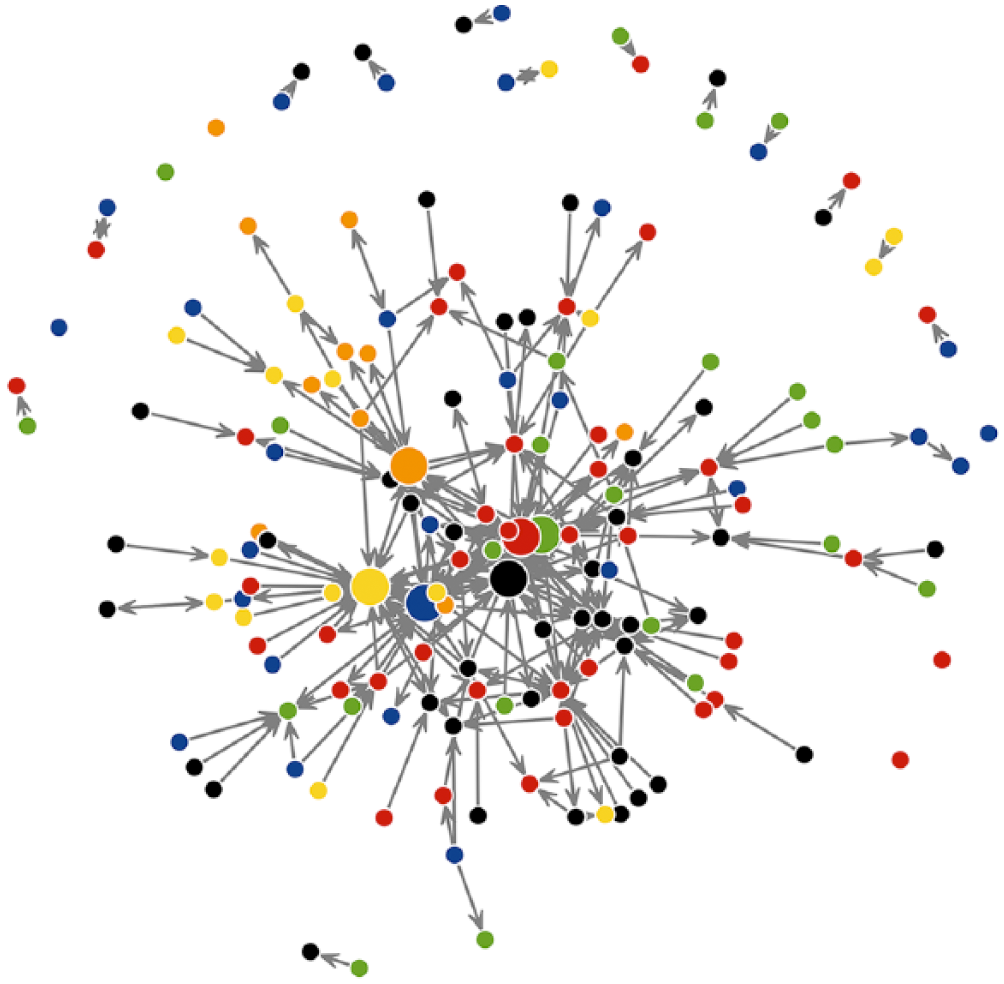
Visualization of the mediated attack network.
Departing from the aggregate picture, we now examine individual-level dynamics, which are presented in Table 2. The key interest here is whether the structure of the mediated attacks is systematically governed by network-endogenous factors, above and beyond what would have been expected on the basis of established determinants of negative attacks. Starting from the predictors-only model, a series of increasingly complex models are developed and tested (full results are presented in Online Appendix B). The sample goodness-of-fit (gof) diagnostics for the fully specified models (Models 3, 4, and 5) are presented in Online Appendix C, which suggests that our models well reflect the underlying social processes that produce the observed network. We also provide several model robustness checks in Online Appendix B, including an analysis of “mixed-mode” attack networks incorporating the organizational entities as actors.
Estimates of the Exponential Random Graph Models.

Note. Full results including Model 1 (control only), Model 2 (endogenous terms only), and TERGM models with additional edge autoregression are presented in Tables B2 and B3 of Online Appendix B. All models control for governing party (or actual party affiliations with ideological distance), running for elections or not, being a party leader, being female (for incoming ties), being a member of the National Parliament (for incoming ties), party list placement (for incoming ties), and regional homophily. Models 4 and 5 additionally control for in- and out-2-degree terms. MCMC-MLE SE and bootstrapped 95% CIs in parentheses. MCMC-MLE: Markov Chain Monte Carlo Maximum Likelihood Estimation; CI = confidence interval; Parliament = politicians currently member of the National Parliament; list placement = electoral prospects based on party list placement; GWESP = geometrically weighted edgewise shared partner distribution, which represents a positive trend toward transitivity; GWD-in/out = geometrically weighted (in/out) degree distribution, which represents antipreferential attachment; ERGM = exponential random graph model; TERGM = temporal ERGM; AIC = Akaike information criterion; BIC = Bayesian information criterion.
p < .05. **p < .01. ***p < .001.
We argued that network-endogenous mechanisms systematically affect the probability of ties in the attack network. This is strongly supported by the data. In the modified specification (Model 4), reciprocity (H1: b = 3.116, SE = 0.253, p < .001), structural balance (H2: b = 1.112, SE = 0.133, p < .001), and transitivity (H3: b = 0.115, SE = 0.041, p < .05) all significantly and positively predict the probability of ties. Even after controlling for party affiliation and ideological distance, as well as several other individual characteristics, politicians are still more likely to retaliate when subjected to attacks (H1: conditional odds ratio = 22.55) and more likely to attack a third actor in conjunction with other actors (H2), especially when such attacks increase the structural balance in the triad (“attacking enemy’s friends” or “attacking friend’s enemy”), although the magnitude of this effect is rather moderate (conditional odds ratio = 3.04). Ties that result from an unbalanced triad (or a “transitive closure”: H3), which were also moderate in magnitude, were about 12% more likely (conditional odds ratio = 1.12) than would have been expected if such mechanisms were absent in the network. These results largely remain consistent in the original (Model 3) and another modified specification (Model 5), where we switch the governing party indicator with the actual party affiliations of politicians.
Preferential attachment (H4) is also a significant predictor of ties in the network. As the negative incoming degree distribution parameter indicates (H4: Model 3, b = −2.230, SE = 0.262, p < .001), the incoming attacks are concentrated toward individuals who already have a high number of incoming attack ties, producing an uneven distribution of incoming degrees across the network. As positive gw-degree statistics represent even distribution of degrees (i.e., opposite of preferential attachment), the negative gw-in degree statistics mean that there is a significant trend toward preferential attachment (Levy, Lubell, Leifeld, & Cranmer, 2016), supporting H4. The empirical pattern (detailed in Figure B1 of Online Appendix B) suggests that the probability of receiving at least one additional tie (given the number of already existing ties) increases by approximately 4.5% until an in-degree of 8. This significant “preferential attachment” pattern of in-degrees also remains consistent in the modified specifications (Models 4 and 5).
While our static ERGM specification appears to fit the data well, TERGM results shed additional light on the question when mediated attack relations are governed by endogenous network dynamics (H5-H7), which are reported in the last two columns of Table 2. While delayed reciprocity (H5) was not significant in the weekly model (in TERGM Model 1), in the daily model it significantly predicted attack ties (in TERGM Model 2: b = 0.993, 95% confidence intervals [CIs] = [0.571, 1.131]). The same is true for delayed transitivity (H7) in the daily model (in TERGM Model 2: b = 0.003, 95% CIs = [0.001, 0.018]), although this effect was rather small compared with other predictors. In contrast, delayed structural balance (H6) does not significantly predict network ties, neither in a weekly nor in a daily model (all 95% CIs straddle 0).
We additionally incorporate the influence of previous attack ties (e.g., i → j attack ties at time t − 1) on the probability of attack ties at time t (“edge autoregression”; full results are presented in Online Appendix B). We find substantial and significant influence of such dynamics, such that politicians are significantly more likely to attack the same competitors consistently at daily or weekly intervals. Yet even after accounting for the effect of previous attack ties, the effects of network-endogenous factors remain largely consistent.
In addition to the network-endogenous predictions, there are few results that deserve attention as per our last set of hypotheses (H8-H10). First, gender (H8) does not influence the likelihood of attacking other politicians (Model 3 in Table 2). We also find that incumbency status (H9) had no statistically significant effect on the probability of attacking other politicians (all p > .05), which runs counter to our expectations. The electoral certainty based on the national list placements had a positive impact on ties in the mediated attack network, supporting H10. Specifically, the list placements had a positive and statistically significant impact on outgoing ties (b = .386-.411, all p < .05).
Second, assuming that the incumbent coalition parties at the time of the election (SPÖ and ÖVP) have the highest coalition potentials, we find that politicians affiliated with parties that have high coalition potentials are more likely to be attacked by others rather than attacking. Actors from these two governing parties (ÖVP and SPÖ) were approximately 54% more likely to be attacked by others (b = 0.436, SE = 0.120, p < .001, conditional odds ratio = 1.54), whereas the likelihood of receiving attacks is significantly low for candidates from other smaller parties. Yet contrary to the results for “incoming” attacks, there were no discernable differences in the likelihood of “sending out” attacks based on incumbency status (b = −.236, p = ns) nor based on a politician’s party affiliation (all p = ns). In addition, the party-level ideological distance becomes significant (b = 0.074, SE = 0.033, p < .05), suggesting that the two coalition parties (SPÖ and ÖVP) are no less likely to attack one another.
Moving to the other individual-level determinants, we find that regional homophily significantly increases the probability of attack relations, in that attacks within a region are approximately 52% more likely than attacks across regions (the third column in Table 2: b = 0.527, SE = 0.163, p < .001). Being a party leader has a consistent impact on the likelihood of being attacked (b = 0.489-0.546, all p < .05), and they are consistently more likely to be featured in the media as attacking other actors (b = .517-.568, all p < .05).
Discussion
The present study demonstrates that network-endogenous processes, representing campaign dynamics in multiparty communication environments, are highly predictive of negative campaign patterns above and beyond established party- and individual-level predictors. Our results suggest that politicians’ decisions when and whom to attack are shaped by the attack behavior of their competitors. It is striking that these factors are significant predictors even in a fairly conservative model of negative campaigning, controlling for a range of established factors such as politicians’ electoral prospects or whether they belong to governing parties.
While the literature on negative campaigning in the United States has emphasized actors’ competitive standing as one of the decisive factors for negative campaigning (Lau & Pomper, 2004; Skaperdas & Grofman, 1995), empirical evidence for Western Europe has highlighted the effect of incentives flowing from electoral systems with a specific view on party competition (Walter, 2014). In two-party systems, political actors are primarily concerned with potential boomerang effects of going negative toward opponents, whereas in multiparty systems, political actors additionally face potential spillover concerns, such that an attack toward a competitor may benefit neutral bystanders rather than benefiting the attacker. In addition, multiactor contexts bring about complex attack dynamics among multiple actors that need not be considered in simpler two-actor contexts. While such differences are often theoretically assumed in existing studies, they tend to fall short of providing convincing evidence for such endogenous dynamics.
This contribution is among the first to provide direct empirical evidence for endogenous dynamics among politicians, providing a more nuanced picture of negative campaigning in a multiparty context. Our results suggest that, in addition to the effect of common determinants such as electoral prospects (Kahn & Kenney, 2000; Lau & Rovner, 2009) and other individual-level characteristics (Maier & Jansen, 2015), politicians are more likely to retaliate against an attacker or attack a third actor in conjunction with other actors (H1). They are more likely to attack “enemy’s friends” or “friend’s enemies” (H2), while they also do not shy away from attacking an “enemy’s enemy” (H3), although the magnitude of such a dynamic appears to be fairly moderate. Moreover, there is a tendency of actors to accumulate even more number of attacks based on their already existing number of attacks once they become the target of attacks (H4). This is an important addition to our understanding of individual politicians’ campaign behavior. Our study thus supports an understanding of individual campaigns as interdependent, not solely relying on self-determined strategies but reactive toward the behavior of others.
While our findings regarding attack dynamics based on reciprocity (“retaliation”) and structural balance (“attacking your friends’ enemies or attacking your enemies’ friends”) are quite intuitive, other results warrant further discussion: First, we find strong support for structural balance (“attacking an enemy’s friend”), while there was modest support for attacks based on transitivity (“attacking an enemy’s enemy”). While such seemingly contrary dynamics would be quite impossible to observe in a two-party system, it provides an integral aspect of campaigning in a multiparty context. In a multiparty system, there is a fair chance that negative campaigning benefits neutral bystanders (Elmelund-Præstekær, 2008). In other words, actors in multiparty systems must compete for votes not only with one but also many opponents. Therefore, politicians have ample incentives to turn negative toward an enemy’s enemy as well.
Second, we found a tendency of few actors being disproportionately attacked by others. Political actors generally possess little incentive to go negative toward a large number of opponents, as such extensive attacks may result in backlash and counterattacks from many opponents. Interestingly, attacks tend to be disproportionately targeted at few visible actors, resulting in asymmetric attack patterns (i.e., everybody sending out similar numbers of attacks, but only few receiving such attacks). For preferential attachment on a daily basis, however, there is no discernable tendency of attacks directed toward few actors. One possibility is that this may be due to a systematic long-term visibility bias in newspapers, such that certain actors repeatedly appear throughout the campaign period, whereas other actors only appear once in a while (Eberl, Boomgaarden, & Wagner, 2017) creating preferential attachment patterns only in cumulative coverage.
Similarly, we have found evidence illuminating the possible nature of temporal dynamics underlying the various network-endogenous attack patterns. While delayed reciprocity significantly predicted the attack ties in our daily model, it was not significant in the weekly model. This suggests that politicians are less likely to be reactive toward the behavior of others when initial attacks are further apart. In contrast, delayed structural balance (involving more than two actors with both positive and negative relations at the same time) was no significant predictor of network ties in either a weekly or a daily model. This may suggest that more complex attack patterns, such as the one based on structural balance among three or more politicians, are likely to follow longer cycles than daily or weekly intervals. In contrast, it appears that simple dyadic relations (i.e., delayed reciprocity) appear to be based on much shorter cycles.
Limitations and Future Research
Throughout the article, we highlighted the notion that there are important structural effects in multiparty campaign environments compared with their two-party counterparts. While the analysis has important implications for our understanding of the nature of negative campaigning in multiparty systems, it is worth revisiting several methodological details and limitations of the current approach. First and foremost, while we acknowledge that our study relies on a single case that is not necessarily representative of all other electoral contexts, it should be noted that the theoretical predictions and empirical approaches are not bound to the specific context of the study, not least as Austria is often considered a fairly ordinary case of a European multiparty system (Müller, 2006). To be sure, only a replication beyond this particular context would provide firm evidence on the generalizability of our findings, but we are confident that these empirical regularities should stretch beyond the political system of Austria (e.g., De Nooy & Kleinnijenhuis, 2013). Future studies would benefit from a comparative perspective that employs a network model across different electoral contexts and over time.
Second, it should be noted that in “mediated attack networks,” individual politicians, political parties, and media are jointly responsible for producing attack patterns (De Nooy & Kleinnijenhuis, 2013). While identifying how media systematically and disproportionally misrepresent the direction and extent of negative campaigning is an important topic of study (Ridout & Smith, 2008), doing so requires nontrivial assumptions regarding the availability of data and the soundness of inferential logic underlying such analyses. Ideally, one would wish to systematically compare the mediated attack behavior (media coverage) and their “unmediated” counterparts (the source of such media coverage) for a set of political actors, thus assessing levels of disproportionality.
Third, following our theoretical focus, our analysis considered negative campaigning instances only among individual politicians. Given a nonnegligible share of attack relations that involve party entities, this appears to have nontrivial implications for the current analyses. Yet, a supplementary analysis (presented in the Online Appendix) suggests that we find similar evidence of endogenous dynamics even for attacks involving different “modes” of actors (a mix of individuals and party entities), largely confirming the conclusions reported here.
We close by acknowledging that our binary conception of attack instances limits our understanding of the endogenous dynamics of negative campaigning to a certain degree. Our theoretical account and analysis assume that any number of attacks is essentially identical with each other compared to “no attacks at all.” Although this may seem counterintuitive—especially as media attention toward attacks or support relations among politicians varies quite dramatically—readers should bear in mind that we are interested in “why” politicians attack their competitors and “when” such attacks are reported. This is mirrored in our use of the ERGM/TERGM framework, which generally aims to explain the principle of network partner “selection” and their temporal dynamics. To be sure, attacks among politicians vary in their level of severity, yet we expect the underlying logics of “why” and “when” they attack to not differ by the amount of attacks.
Overall, our analysis lends support to the notion that negative campaigning in multiparty systems is complex and interdependent. Traditional accounts of attack patterns during election campaigns have emphasized individual politicians’ or parties’ strategic calculus to maximize their electoral gains and minimize negative consequences. While our theoretical perspective and empirical analysis do not imply that such factors are not important, our analysis highlights the need for developing a more nuanced understanding that takes into account complex interdependencies to advance our understanding of negative campaigning. Our study thus speaks to the question of how politicians’ decisions to attack are shaped by others’ attack behavior. Taking such interdependencies into account sharpens our understanding of candidate behavior and may inform strategic decisions of political actors.
On a more practical level, recent accounts suggest that while media coverage of party-based electoral competition is declining in Western Europe (e.g., Garzia, 2013), individual candidates and their characteristics have increasingly become the focus of electoral campaigns (Zittel, 2015; Zittel & Gschwend, 2008), not least because individual campaigns have become a viable option in the age of social media (Hermans & Vergeer, 2013). While incentives for engaging in negative campaigning that result from the nature of the electoral competition systematically structure interaction patterns among individual actors, this study has provided evidence that individual political actors are political entities in their own right—even in party-centered political systems. Therefore, understanding individual candidates’ campaign behavior vis-à-vis party-level explanations becomes increasingly important.
Footnotes
Declaration of Conflicting Interests
The authors declared no potential conflicts of interest with respect to the research, authorship, and/or publication of this article.
Funding
The authors disclosed receipt of the following financial support for the research, authorship, and/or publication of this article: This research is conducted under the auspices of the Austrian National Election Study (AUTNES), a National Research Network (NFN) sponsored by the Austrian Science Fund (FWF; S10908-G11).