




Abstract
Children’s prosocial television shows include moral lessons in their narratives, but research suggests that children struggle to comprehend and transfer these lessons to other situations. The social intuitionist model of moral judgment, however, argues that dimensions of morality can be made more salient through environmental exposure. Using data collected from 101 parent-child dyads (children ages 4.5-6.5), we explore if children’s existing moral intuitions about fairness and care may be made salient following exposure to moral lessons in a children’s television show, and if parent presence and mediation aid this process. Results demonstrate that, compared with children in the control group, children who viewed the moral message either alone or with a parent experienced improvements in perspective-taking, which in turn influenced their moral judgments and moral reasoning. Thus, children’s morality can be positively influenced by prosocial television exposure via promoting perspective-taking, fairness, and care.
Recent work has argued that the literature on children’s media effects is unbalanced, with a substantial number of studies examining the negative effects of media exposure; far fewer studies examine the positive, prosocial influences of media on children (see de Leeuw & Buijzen, 2016). This unbalance may have resulted from the amount of violent and otherwise negative portrayals in previous decades’ television programming for children. In the past decade, however, many children’s television shows have removed cartoon violence from their narratives, replacing it with prosocial curricula designed to promote a number of social skills (Wilson, Kunkel, & Drogos, 2008), all of which concern positive social behaviors including moral thought. Whereas some research suggests that children can learn important prosocial skills from television (see Mares & Woodard, 2005), such as helping behaviors (Friedrich & Stein, 1975), not all of the research is conclusive (Mares, Bonus, & Peebles, 2016). Therefore, more research is needed to fully explore the effects of this growing body of prosocial children’s media. Doing so through the rich theoretical lens of moral reasoning is particularly appropriate because this is an area clearly linked to prosocial learning.
The small body of work that does exist on prosocial media depictions of morality suggests that children are generally unable to understand the moral lessons in children’s television, and struggle to transfer them beyond the immediate context of the show (Mares & Acosta, 2008). Research does demonstrate, however, that prosocial television exposure relates to prosocial behaviors among children more broadly (Mares & Woodard, 2005). This research on prosocial media and moral judgment, however, has not considered two important factors that may influence child outcomes: children’s perspective-taking abilities and the role of parent presence and mediation during children’s viewing experiences. First, research has suggested that children’s perspective-taking ability is key in explaining moral development among children (Gibbs, 2013; Selman, 1971). In short, children’s ability to imagine the perspective of another enables them to feel morally engaged and prosocial toward another person. However, it is unclear if exposure to a televised prosocial moral message can influence preschool-aged children’s perspective-taking in a positive way. It is important to note that while perspective-taking is a necessary condition to experience empathy, or an affective response to others, perspective-taking and empathy are separate processes (Eisenberg & Strayer, 1987).
Second, research has clearly indicated that parent presence and mediation during television exposure can aid children’s content comprehension (Nathanson, 1999) with implications for their abilities to transfer learned content to new situations. Thus, the purposes of the present experiment are to examine whether exposure to a moral lesson in a prosocial television episode influences children’s moral judgments and moral reasoning and whether these changes occur via increases in perspective-taking ability as a function of exposure. This study also examines the influence of parent mediation during television exposure on children’s abilities to transfer an observed moral message to their judgments of a novel situation.
Theories of Moral Development
Previous research on media and children’s moral development has typically relied on children’s age as a proxy measure for their stage of moral development (e.g., Krcmar & Cooke, 2001), given Kohlberg’s (1984) argument that moral development typically follows a predictable path, resulting from cognitive gains due to age, and not from cultural or environmental factors. As a function of their cognitively less advanced perspective-taking abilities, Kohlberg (1984) argued that children younger than age 7 are generally not interested in the motivations of others or provocation when judging an act to be right or wrong. Rather, they are interested in the outcome of the act (e.g., will the act be punished?) and/or whether it affects them personally (e.g., was there a bad outcome for them from the action?).
Kohlberg (1984), however, has been critiqued for focusing narrowly on children’s cognitive development without fully considering the role of the child’s environment on moral judgment and reasoning (e.g., Gibbs & Schnell, 1985). More recently, Haidt and colleagues have argued in both their social intuitionist model (SIM) of moral judgment (Haidt, 2001) and their related moral foundations theory (MFT; Haidt & Joseph, 2004, 2008), that certain considerations of moral thought are innate, and that social experiences, including media exposure, can affect individuals’ morality by influencing the salience of certain innate moral intuitions stemming from six moral foundations.
Haidt and Joseph (2004, 2008) theorized that there are at least six innate moral foundations that influence individuals’ moral judgments and moral reasoning. These foundations are care/harm, fairness/cheating, loyalty/betrayal, authority/subversion, purity/sanctity, and liberty/oppression (see Graham et al., 2013, for a description). These six moral intuitions directly influence individuals’ moral judgments and moral reasoning, which are viewed as related, yet distinct processes (see Haidt, 2001; Haidt & Joseph, 2004, 2008).
In partial support of these contentions, previous work has suggested that very young children demonstrate different dimensions of moral thought, including those related to fairness (Geraci & Surian, 2011) and cooperation (Henderson & Woodward, 2011). However, and interestingly, this occurs even if they cannot verbally articulate their reasons for acting in these ways (see Hamlin, 2013). Thus, while Mares and Acosta (2008) found that preschool-aged children could not correctly articulate the moral lesson to be accepting of others with disabilities in a particular Clifford episode, it is possible that exposure to a prosocial narrative may have influenced the salience of certain moral intuitions, even in absence of the child’s ability to articulate them. Thus, under what circumstances might prosocial media influence children’s moral judgments and their ability to reason through those judgments?
Television Exposure and Children’s Moral Judgments
Haidt (2001) proposed, via the “social persuasion” link in the SIM, that individuals’ intuitions are influenced by the moral judgments of others, potentially including media. Indeed, Tamborini, Weber, Eden, Bowman, & Grizzard (2010) found that repeated exposure to certain television content influenced individuals’ subsequent moral judgments across different scenarios, indicating that exposure to television content itself can affect moral judgments. Furthermore, Krcmar and Valkenburg (1999) utilized a developmental moral reasoning approach and found that exposure to violent television programming was related to more positive judgments of violence as a solution to problems. Therefore, the depicted judgments present in television programming may have an effect on individuals’ intuitions independent of the reasoning behind them. This would occur by making a particular moral intuition more salient through exposure to judgments that relate to that intuition (see Haidt, 2001).
In terms of the influence of media on the moral judgments of very young children, we know that preschool-aged children typically struggle with perspective-taking, as the cognitive gains necessary for such a skill do not arrive until around age 7 or 8 (Piaget, 1952). In addition, research demonstrates that perspective-taking abilities are used with variable ability at first (e.g., Kurdek & Rodgon, 1975), but it is likely that certain variables, such as environmental factors, could either trigger or suppress perspective-taking tendencies. Thus, perspective-taking is a challenge, but one that can be overcome as children approach age 7.
In addition, and as discussed earlier, very young children do have certain basic expectations about fairness and notice when fairness is violated (see Geraci & Surian, 2011; Schmidt & Sommerville, 2011). Young children also have considerations about harming and caring for others, and prefer others who act prosocially compared with those who act in an antisocial manner (e.g., Hamlin & Wynn, 2011; Hamlin, Wynn, & Bloom, 2010). All of these are consistent with both the SIM and MFT. Consequently, under a social intuitionist view of moral judgment, if children are exposed to moral content on television that promotes the consideration of others’ thoughts and feelings in general, and promotes consideration of whether actions were fair and caring, these judgments can make those basic intuitions relating to fairness and caring even more salient in children’s minds. They can become triggered.
More specifically, if children are exposed to a television show that presents moral judgments about fairness, caring for others, and consideration of others’ thoughts, the SIM and MFT would both predict that exposure to such a judgment would activate related moral intuitions, which would directly influence their subsequent moral judgments. Thus, the television representation would act as the social persuasion link in the model (see Graham et al., 2013; Haidt, 2001; Haidt & Joseph, 2004, 2008). In this way, children who watch a television show highlighting fairness and caring for others will judge provoked actions to be more correct than unprovoked actions, because their intuitions relating to both fairness and to caring will have been made more salient through exposure. Considering provocation of actions involves considerations of fairness, and responding to provocation involves considerations of whether the initial action harmed someone or the degree to which it did. Those who were not exposed to a fairness message will make less of a distinction in their judgments between the two types of actions because these intuitions will not be as salient. Therefore,
In addition, the SIM argues that moral judgment should be studied as an interpersonal process (Haidt, 2001). Although television can provide social persuasion because it offers an interpersonal-like stimulus, thus making salient one moral intuition over another, true interpersonal communication can also play a role. Specifically, parent mediation can influence children’s experiences with media (e.g., Nathanson, 1999, 2001). In the context of prosocial media content, literature suggests that mediation influences child attention to prosocial content, with benefits for content comprehension (see Valkenburg, Krcmar, & De Roos, 1998). In addition, research demonstrates that parent mediation that is active and promotes autonomy relates positively to children’s prosocial behaviors (Valkenburg, Piotrowski, Hermanns, & de Leeuw, 2013). Finally, Rasmussen et al. (2016) found a positive association between prosocial television exposure and prosocial outcomes, especially for children coming from active mediation homes. Thus, via parental mediation, parents can also make moral judgments about what they are viewing with their child on television, or call attention to the moral judgments present in the television show itself. Furthermore, work suggests that mere parent presence in the form of co-viewing can influence children’s perceptions of mediated content, as children take parent presence as tacit support of mediated content (Nathanson, 1999). Thus, even if the parent does not actively add their own moral judgments, children may assume that through their presence, their parent is endorsing the moral judgments present in the narrative. In this way, via the social persuasion link in the SIM, both the television show itself and the parents viewing the show with the child can influence children’s subsequent moral intuitions and moral judgments. Therefore,
Television Exposure and Children’s Moral Reasoning
In addition to linking exposure to moral messages with individuals’ moral intuitions, and subsequently, individuals’ moral judgments, Haidt (2001) also places weight on what he calls the “reasoned persuasion” (p. 815) link in the model: the link between the reasoning one person offers for their moral judgment and the subsequent moral intuition(s) of another person. Thus, the model predicts that one person, when faced with a moral situation, will experience a rather immediate moral intuition based on at least one moral foundation, make a moral judgment (i.e., whether the viewed situation was right or wrong), and come up with post hoc reasoning to explain, to themselves or to other individuals, why they made that moral judgment. After all, when there is ambiguity, people look to others to help interpret the situation (Haidt & Bjorklund, 2007). This is especially so for children. Haidt (2001) hypothesized that the strength or logic of the reasoning does not influence the moral intuitions of the listener; rather, the reasons themselves trigger certain intuitions in the listener, based on the moral intuition referenced in the reasoning (e.g., “that was wrong because they could have gotten hurt” compared with “that was wrong because they did not deserve it”).
Thus, the moral reasoning offered by an individual (or a television show) to explain one certain moral judgment can influence the intuitions of another individual by making them more salient in an individual’s mind. Therefore, if children are exposed to moral reasoning, or moral explanations in a television show that promotes fairness and care for others, the SIM would predict that such exposure would make these intuitions more salient and, thus, more accessible at an earlier age. As a result, when children are asked to provide reasons for their own moral judgment, they would be more likely (again, at an earlier age) to call upon more advanced moral reasoning strategies. Recall, too, that the fairness/cheating and care/harm foundation both promote the consideration of others’ perspectives, and that perspective-taking is a hallmark of developmentally advanced moral thought (e.g., Kohlberg, 1984). Therefore,
Parents can also offer moral reasoning while watching the show with their children, perhaps explaining to children why actions they witnessed in the television narrative were right or wrong. In addition, through mediation, parents can call attention to the reasoning offered by characters in the show. In this way, parents’ own moral reasoning and mediation can also influence children’s subsequent moral intuitions via the reasoned persuasion link in the SIM, and thus, their subsequent moral reasoning after making a moral judgment. As before, however, children can perceive parent presence as approval of the moral reasoning in the show. Therefore,
The Role of Child Perspective-Taking
Previous work by Mares and Acosta (2010) has considered the mediating role of narrative comprehension in the link between exposure and the moral outcome of inclusiveness, finding that children’s interpretation of the viewed content did indeed act as a mediator. The SIM and MFT, however, suggest that media exposure can influence moral judgments and reasoning in the absence of comprehension, so long as the narrative and/or any extra parent mediation make certain intuitions in the child either more or less salient. One way this could occur is through perspective-taking.
Recall that a large body of work has suggested that perspective-taking itself is a key mechanism that explains moral development among children (Gibbs, 2013; Selman, 1971). Research indicates that considerations of fairness can occur at a very young age (e.g., Geraci & Surian, 2011), but that perspective-taking abilities are used with variable ability at first (e.g., Kurdek & Rodgon, 1975). Thus, if a child watches a television show that includes a message about considering others’ points of view, this itself may encourage perspective-taking. Considering the point of view of another individual may in turn make fairness/cheating and care/harm intuition more salient. After all, fairness and care as concepts require at least two individuals—someone must receive (or not) an equitable outcome from someone else or someone must take care of another person (or not). In this way, perspective-taking abilities would mediate the relationship between exposure to the treatment episode that promotes fairness and children’s moral judgments, as well as their moral reasoning.
For example, Vieira (2014) found that prosocial video game play was positively related to perspective-taking among adolescent girls, and that perspective-taking mediated the link between game play and moral judgments. Similarly, in the present study, we suggest that if taking another’s perspective and considering the fairness of an action are presented and modeled in a children’s television show, these ideas could make intuitions relating to fairness/cheating and care/harm more salient. In turn, this would influence children’s moral judgments and reasoning, thus allowing children’s perspective-taking to mediate the link between exposure, moral judgments, and moral reasoning, but only among those children who watched the treatment episode. This mediating relationship could be further moderated by the amount of parent-child discussion of moral judgments, moral reasoning, and perspective-taking during the viewing experience. Thus,
Method
Participants
Originally, 107 parent-child dyads participated in this research study. We dropped six dyads due to the child’s inability to follow instructions. Therefore, the final sample consisted of 101 dyads. Children’s average age was 65.91 months (SD = 8.10), with a range from 49 to 83 months. Slightly over half of the sample of children were female (n = 57). The sample was 79.2% White (n = 80), 7.9% (n = 8) African American, 6.9% (n = 7) Asian American, and 3.3% (n = 4) Hispanic/Latino/a. The average age of parent participants was 37.48 (SD = 5.20) and just over 88% (n = 89) of parents were female.
Experimental Design
We randomly assigned participants to one of four experimental conditions featuring an episode of Arthur, a popular children’s television show in the United States. In the control condition, (1) the child watched an episode of Arthur alone, titled Looking for Bonnie, which did not feature a moral message. There were three treatment conditions in which the child watched a different episode of Arthur, titled When Carl Met George, which featured a moral lesson. The three treatment conditions differed as a function of viewing experience: (2) the child viewed the episode alone, (3) the parent viewed with the child while using natural mediation (acting as they would at home), and (4) the parent viewed with the child while using active mediation.
Stimulus Episodes
Both episodes came from the same season of Arthur to maintain consistency in terms of videography, and both featured the same main character (George). Both episodes were 12 minutes and 30 seconds in length. The treatment episode, When Carl Met George (Season 13, Episode 6), features George and Carl, a new character who has Asperger’s syndrome. At the midway point in the episode, George scares Carl by showing him his puppet. During the next 5 minutes, George decides to change his behavior because he is not sure why Carl was so upset. Other characters teach George to consider Carl’s thoughts and feelings when interacting with him, and in the last minute of the episode, they become friends. The show promotes considerations of fairness (e.g., George goes to another planet and experiences life through the eyes of Carl, learning that many of the ways that people interact with Carl are not fair) and care toward others (e.g., George leaves his puppet at home so that he does not scare Carl a second time). The control episode, Looking for Bonnie (Season 13, Episode 10), features the characters George and Buster. When a musician brings his allegedly magical guitar to George’s father for repair, the boys think that they will become magical simply by touching it. In the end, they learn that the guitar is not magical, but music can be.
To assess the complexity of the presented moral message, college students (N = 151), blind to the purposes of the study, watched the episodes and reported their perceptions of the moral message embedded in the narrative. All of those who watched Looking for Bonnie reported that there was either no moral message or that the message was that music can be magical. When presented with a listing and explanation of the moral foundations, 96% of those who watched When Carl Met George reported that the moral message either involved fairness to others, taking care of people, or both.
Procedure
We recruited dyads from an existing participant database. These parent-child dyads (n = 61) participated at a campus lab space. Participants were also recruited from a local community center (n = 46). Both rooms were furnished with the same couch, beanbag chairs, a television stand, and a flat-screen television. Parents consented and children provided their verbal assent prior to the beginning of the study. The entire study was video and audio recorded for later coding. Children completed the perspective-taking pretest prior to viewing the episode. In the child-only conditions (both control and treatment), the parent was asked to not interact with their children while they sat in the corner of the room and completed a demographic questionnaire. In the parent mediation conditions, a researcher read a script describing how the parent should mediate the experience, either naturally or via active mediation. In the natural mediation condition, we told parents to interact with their child as they would at home. In the active mediation condition, we told parents to discuss content to their children and help explain or point out important concepts or lessons. Once complete, the parent watched the episode with their child. In all conditions, after the show was complete, the children completed the posttest measures with a researcher while parents finished the questionnaire. Once both the parents and children completed the study, children selected a book and parents received a US$20 gift card.
Measures
Perspective-taking (pretest and posttest)
Children completed a perspective-taking measure (Krcmar & Vieira, 2005). We did not use one vignette, and two were slightly edited because they included school concepts with which children may have not had experience. Two vignettes were used as the pretest, and two were used as the posttest. These vignettes were rotated randomly to control for order effects. The researcher read short hypothetical stories to the child (e.g., “You get a brand new bike for your birthday. Your friend wants to borrow it.”). After each story, the child was asked “what are you thinking?” and “what do you think your [friend] is thinking?” In total, eight responses were recorded for each child (two per each of the four stories). Responses were coded using the following scheme: Children received a 0 for no answer, a 1 for providing an answer that used information that could not be known by the individual (e.g., “My friend will know I don’t want to share the bike”), a 2 for adequate perspective-taking (e.g., “My friend would have fun riding my new bike”), or a 3 if the child demonstrated metaperspective-taking, or the use of two different perspectives at once (e.g., “If my friend asks me, I might not want to share the bike, but I know that it will make them happy, so I will”). A trained undergraduate research assistant coded children’s responses and 25% were reliability coded by the first author (all kappas > .95).
Comprehension
We created a 10-item comprehension measure for the treatment and the control episode using similar methods to Collins, Wellman, Keniston, and Westby (1978). Specifically, college students (N = 151) watched both episodes and listed the 10 plot points most central to understanding the narrative, character motivations, and character emotions. We chose the top 10 plot points across all responses and created a question about each. Each question had three response options, and each option had an associated visual, taken from the episode itself. Sample items include “Why did Dean come to George’s house?” “What did George accidentally take from Carl?” and “How did Carl feel when he couldn’t find the last puzzle piece?” We summed correct answers to create an overall measure of narrative comprehension.
Moral interpretations of interpersonal violence (MIIV)
Following exposure, the child completed the MIIV (Krcmar & Valkenburg, 1999). We chose this measure specifically because the vignettes are about different scenarios from what the children saw in the stimulus episodes. Therefore, this measure allows salient intuitions to influence children’s moral judgments and reasoning in different contexts, as predicted by MFT (Graham et al., 2013). The researcher read four stories to the child in which the main character uses violence; two stories exhibit unjustified violence and two exhibit justified violence, although the violent acts themselves are the same. After hearing the story, the child was asked if the character in the story was “right,” “wrong,” or “in the middle.” Based on their response, a researcher directed them to the appropriate end of a 7-point scale so that they could indicate the extent of how right or wrong the character was (e.g., a little right/wrong, very right/wrong, and very, very right/wrong). This portion of the measure serves as children’s judgment of the moral situation. We averaged children’s responses to the two unjustified stories to compute an “unjustified violence” score and responses to the two justified violence stories were averaged to compute a “justified violence” score. Children’s judgment difference was computed by subtracting their unjustified violence judgment from their justified violence judgment.
Next, we asked the child to explain their response, and their answers were written down verbatim. This measure serves as children’s reasoning about their previous moral judgment. The responses were coded with the original coding scheme by Krcmar and Valkenburg (1999): 0 = no response, or “I don’t know”, 1 = mention of authority/punishment (“He’s bad because he will get a time out”), 2 = stereotypical reasoning (“You shouldn’t kick”), 3 = hedonism (“He was right to get the purse back, because there might be money in it”), 4 = needs-oriented (“He’s wrong because kicking can hurt”), 5 = perspective-taking (“He’s wrong because it isn’t right to kick someone, even a thief”), and 6 = human rights (“He was wrong to not give the man money because he was poor”). These data were treated as continuous, as per previous treatments of this measure (see Krcmar & Valkenburg, 1999, for an explanation). Children’s responses were coded by a trained undergraduate research assistant and 25% were reliability coded by the first author (all kappas > .92).
Coding Scheme
Members of the research team transcribed the entire parent-child interaction. A different member of the research team subsequently coded 100% of the interactions. A third member of the research team further coded a random 25% of all codes. We coded parent-child verbal interactions in two different ways.
First, we coded for talk about perspectives. We coded for whether each utterance, if applicable, referred to the perspective of the child (“Is that your favorite color?”), a character in the show (e.g., “He’s scared of the giraffe”), or another person (not the child or a character; for example, [speaking about people with Asperger’s syndrome] “They can be friendly but it’s just harder for them, right?”). This code was reliable (kappa = .91). We summed these to create the perspective talk variable (M = 13.60, SD = 16.80). Finally, we coded each utterance for whether it mentioned feelings or emotions (e.g., “How do you think that he felt?”) or moral judgments or reasoning (e.g., “That wasn’t very nice, was it?”). This code was also reliable (kappa = .86). We summed these to create the moral talk variable (M = 4.58, SD = 7.30). These two codes were not mutually exclusive; thus, one utterance could be coded for referring to both an individuals’ perspective and their emotions. As such, and considering that the two variables were highly correlated (r(50) = .64, p < .001), we combined them into one variable, parent-child talk (M = 18.18, SD = 22.21; α = .69).
Results
Preliminary analyses suggested that gender and race/ethnicity were not related to any of the variables of interest. In addition, age was not related to any outcome variables except for the developmental level of children’s verbal moral reasoning. Considering these findings, we examined age as a moderator in the relationship between experimental condition and children’s moral reasoning strategies. In addition, we examined differences in children’s comprehension and posttest perspective-taking as a function of condition. An ANOVA suggested no main effect of condition on children’s comprehension (F(3, 97) = 2.61, p = ns;
Mean Differences Between Viewing Conditions on Target Variables.
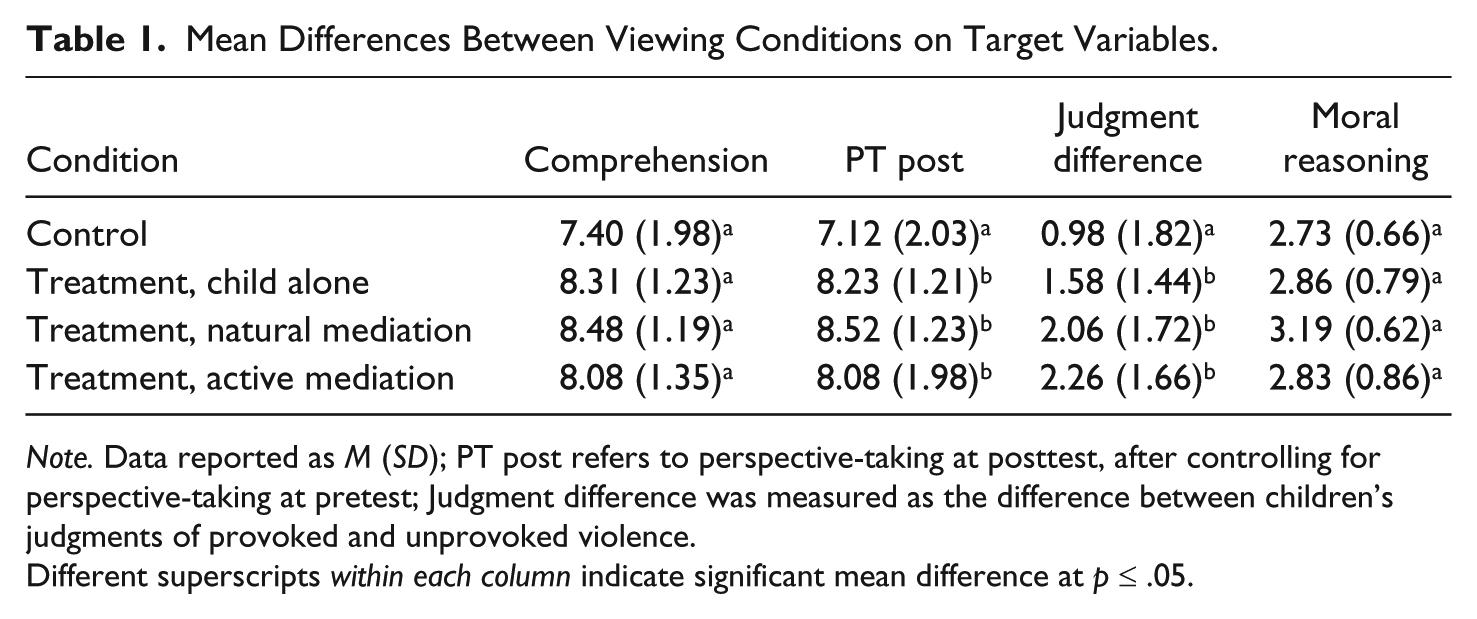
Note. Data reported as M (SD); PT post refers to perspective-taking at posttest, after controlling for perspective-taking at pretest; Judgment difference was measured as the difference between children’s judgments of provoked and unprovoked violence.
Different superscripts within each column indicate significant mean difference at p ≤ .05.
The first hypothesis (H1a) predicted that children who viewed the treatment video would differ in their judgments of provoked and unprovoked violence compared with the control condition, and that this difference would be greater for children who watched with a parent (H1b). An ANOVA indicated a main effect of condition on children’s moral judgment difference (F(3, 97) = 2.94, p = .04;
Next, we tested H2a and H2b, which predicted that children in the treatment video conditions would use more developmentally advanced moral reasoning following exposure compared with the control (H2a), and that children in the mediation conditions would use more developmentally advanced moral reasoning following exposure compared with children who watched the treatment alone (H2b). Considering the preliminary finding that age was related to moral reasoning, age was added to the model as a moderator. An ANOVA indicated no main effect of condition (F(3, 93) = 1.85, p = .14;
The final set of hypotheses predicted that perspective-taking would mediate the link between experimental condition and (H3a) the difference between children’s moral judgments, as well as the link between experimental condition and (H4a) the developmental level of children’s verbal moral reasoning, but only among children in the treatment video conditions. We tested these hypotheses using Model 4 in the PROCESS macro for SPSS (see Hayes, 2013), which allows for tests of mediation with a multi-categorical independent variable. The macro tests the indirect effect of the independent variable on the dependent variable via the mediator based on different combinations of experimental conditions, in this case specifically comparing the three treatment conditions with the control condition, as well as the two parent mediation treatment video conditions with the child-alone treatment video condition. After 5,000 bootstrapped samples, the output provides a 95% bias-corrected and accelerated confidence interval (CI) for the indirect effect via the mediator; if the CI does not include “0,” this indicates a significant mediating relationship at p < .05 (see Hayes, 2013).
In addition to the significant direct effect demonstrated above for the first two sets of hypotheses, PROCESS analysis also indicated a significant indirect effect of condition via children’s posttest perspective-taking on the difference between children’s moral judgments, after controlling for pretest perspective-taking and age, but only for children in the treatment conditions (95% CI = [.01, .44]; indirect effect = .15). There was no difference between children who watched the treatment episode with a parent and those who watched the treatment episode alone (95% CI = [−.02, .25]; indirect effect = .05). To consider whether comprehension also served as a mediator, we used data from the three treatment conditions (n = 76), as children in the control condition completed a different comprehension measure based on the different episode. We added children’s comprehension scores to the model. Results suggested that comprehension did not significantly mediate the relationship between condition and the difference between children’s moral judgments (95% CI = [−.01, .01]; indirect effect = .00). Therefore, H3a is supported: perspective-taking mediates the relationship between experimental condition and the difference between children’s judgments of provoked and unprovoked violence, but only for children who viewed the treatment episode either alone or with a parent. Importantly, comprehension does not significantly mediate this relationship.
We used same analysis for H4a as well. Recall that there is no direct effect of condition on the developmental level of children’s verbal moral reasoning. PROCESS analysis indicated, after controlling for age and pretest perspective-taking, a significant indirect effect of condition via children’s posttest perspective-taking on the developmental level of children’s verbal moral reasoning, but only for children who watched the treatment episode (95% CI = [.01, .21]; indirect effect = .08). There was no difference between children who watched the treatment episode with a parent and those who watched the treatment alone (95% CI = [–.01, .12]; indirect effect = .03). Comprehension was not a significant mediator (95% CI = [–.02, .01]; indirect effect = .00). Therefore, H4a is supported: perspective-taking mediates the relationship between experimental condition and the developmental level of children’s verbal moral reasoning, but only among children who viewed the treatment episode. Comprehension did not mediate these relationships.
Finally, we used Model 8 (Hayes, 2013) to test if parent-child talk moderated the mediating relationship for children’s judgment difference (H3b) or the developmental level of children’s moral reasoning (H4b). This model also tests if parent-child talk moderates the direct paths between experimental condition and the outcome variables. The analysis produces a 95% bias-corrected and accelerated CI for these direct and indirect effects. If the CI does not include “0,” this indicates a significant moderating relationship at p < .05 (see Hayes, 2013). For these analyses, we used data from the two parent mediation conditions (n = 50). Results suggested that parent-child talk did not moderate the indirect or direct paths between experimental condition and children’s judgment difference (all intervals included “0”). Similarly, parent-child talk did not moderate the indirect or direct paths between experimental condition and the developmental level of children’s moral reasoning (all intervals included “0”). Thus, H3b and H4b are not supported.
Discussion
Summary of Results
Overall, results indicate that moral lessons on prosocial television can influence children’s moral judgments and the developmental level of their moral reasoning. Exposure to the treatment episode, either alone or with a parent, had a direct, positive effect on the difference between children’s moral judgments of provoked and unprovoked actions. In terms of children’s verbal moral reasoning, exposure to the treatment video did not have a direct effect on the developmental level of children’s verbal moral reasoning, although there was a direct effect of age, with older children understandably reasoning at a higher level.
We also explored whether children’s perspective-taking ability mediated the relationship between condition and children’s moral judgments, as well as between condition and the developmental level of their moral reasoning. Importantly, we had predicted that perspective-taking, and not comprehension of the message, would mediate this link. Results indicated that, for those who saw the treatment episode, perspective-taking, and not comprehension, mediated the link between condition and both moral judgments and moral reasoning. Interestingly, watching with a parent versus watching alone did not influence these relationships. Overall then, comprehension may not be a necessary condition for positive effects from children’s prosocial television; however, improved perspective-taking may encourage positive effects. In other words, a particular intuition can be activated in advance of the child’s ability to fully comprehend it. This makes a certain instinctive sense. We understand that something is harmful, for example, before we can quite grasp why that may be the case. Finally, parent-child talk about perspectives and moral judgments did not moderate these direct or indirect relationships, suggesting that children who watched the treatment episode alone performed as well as those who watched with a parent.
Theoretical Implications
To our knowledge, this study is among the first of its kind to examine the SIM and MFT in the context of young children’s television use. Why is this important? Previous research by Krcmar and Vieira (2005) demonstrated that exposure to certain types of content, in that particular case, cartoon violence, decreased children’s perspective-taking abilities, and those decreases in perspective-taking were associated with less developmentally advanced moral reasoning among preschoolers. Using a different sample of girls between the ages of 7 and 15, however, Vieira (2014) found that prosocial video game play positively influenced perspective-taking abilities. Thus, media exposure can shift perspective-taking both positively and negatively, although positive advances have been demonstrated only among older children in existing literature.
As noted, perspective-taking abilities among preschool-aged children, while present (Killen, Pisacane, Lee-Kim, & Ardila-Rey, 2001), are used with variable ability (Kurdek & Rodgon, 1975). If, however, the cognitive structures necessary to consider questions of fairness, reciprocity of actions, and care are at least partially present in very young children’s minds, as predicted by the SIM and MFT (Haidt, 2001; Haidt & Joseph, 2004, 2008), and demonstrated by Geraci and Surian (2011) and Hamlin and Wynn (2011), then televised presentations which promote perspective-taking can help to fill in those partially constructed cognitive structures, making those particular moral foundations even more salient. The findings of the current study provide support for this conclusion: exposure to the treatment episode related to perspective-taking gains, and these gains mediated the relationship between condition and moral judgments, and condition and moral reasoning. Thus, this article adds to the literature by demonstrating that prosocial television lessons can positively influence perspective-taking at an age where perspective-taking is used with varying ability (Kurdek & Rodgon, 1975), and that these gains can positively influence children’s subsequent moral judgments and moral reasoning.
These findings are also among the first to demonstrate positive effects of prosocial children’s television on children’s moral reasoning. For example, Mares and Acosta (2010) found null and negative effects of prosocial television shows on children’s inclusiveness toward others, unless special inserts were included to help explain the narrative. Therefore, they demonstrated prosocial effects, but only with the addition of extra-narrative inserts. They also found that the ways in which children interpreted the content mediated the link between exposure and prosocial outcomes. Results from the present study demonstrate prosocial effects, even among children who watched an episode alone, and that these effects occur regardless of comprehension.
For example, Mares and Acosta (2008) found that kindergarteners were unable to comprehend the moral message they witnessed in an episode of Clifford or fully generalize the moral lesson to humans, instead literally generalizing the message only to dogs and other animals. Similarly, we found that comprehension did not influence effects, but that perspective-taking did. Thus, comprehension may not be a necessary condition for effects of prosocial media exposure, at least in the case of moral judgments and reasoning. Instead, there may be other pathways to prosocial effects, such as perspective-taking, and basic intuitive or instinctive responses. Indeed, our results also suggest that parent-child talk about others’ perspectives and moral judgments did not influence these results. Very recent research has also considered how primes might influence children’s prosocial behaviors regardless of narrative comprehension, although these results were inconclusive (Mares et al., 2016). More work is necessary in this area. The present study adds to the literature, however, by demonstrating that embedding moral messages that promote fairness, care toward others, and perspective-taking in children’s television content may be effective in influencing children’s moral judgments and reasoning, and that comprehension of the lesson or narrative might not be necessary for these effects to occur.
These findings provide evidence for, and help to clarify, the persuasion links in the SIM of moral judgment theorized by Haidt (2001). It appears from these data that the moral judgments and reasoning children hear in a prosocial television program can influence their subsequent moral judgments directly and indirectly via perspective-taking gains. They are not strong enough to directly influence their verbal moral reasoning; moral reasoning is influenced via perspective-taking gains that occurred as a function of exposure to the treatment episode as well as age. In addition, this occurs regardless of children’s level of narrative comprehension. Rather, it appears that through making certain intuitions more salient, prosocial television shows can influence children’s perspective-taking and subsequent moral judgments and moral reasoning.
Interestingly, there was largely no difference between the two parent mediation conditions and the child view-alone condition in terms of children’s moral judgments or the level of their moral reasoning. Although parents did talk to their children about moral judgments, reasoning, and perspectives, it is possible that the mediation experience did not last long enough to boost children’s responses significantly from those children who watched alone. Our results regarding parent mediation are similar to those of Rasmussen et al. (2016). Those researchers were also successful in manipulating active mediation, but found that active mediation did not significantly influence child outcomes of interest; rather, general household active mediation was significantly associated. In any case, more research is needed to explore this link and to understand if manipulated active mediation in experimental lab settings can influence child outcomes.
Practical Implications
Does demonstrating a difference in children’s judgments of provoked and unprovoked violence indicate a practical, moral gain? Recall that the actual violence in the provoked and unprovoked violence vignettes was the same: characters kicked and punched. Thus, the fact that there were differences between children’s judgments of provoked and unprovoked violence, that these differences were significantly greater for children who viewed the treatment episode, and that perspective-taking mediated this relationship indicate that children who viewed the treatment episode exhibited more nuance or complexity in their moral thought. An examination of the mean scores on this measure demonstrates that children found all violence to be at least somewhat wrong; there was nuance, however, in exactly how wrong they found it to be as a function of whether it was provoked or not. Nuance and complexity in moral thought, in considering the reciprocity of actions, and the thoughts and feelings of others, is a hallmark of more developmentally advanced moral thinking (e.g., Kohlberg, 1984). Therefore, we argue that these findings should be viewed as positive, moral gains among young children as a function of prosocial television exposure.
In addition, these findings have important implications for the design of prosocial television shows for young children. These data indicate that adding moral lessons to children’s prosocial television shows may have positive effects in terms of children’s perspective-taking abilities and moral judgments. Importantly, while it is crucial to design shows that include moral messages that children can understand in terms of their own development, for example, presenting messages literally rather than metaphorically (see Mares, 2013), complete comprehension may not always be necessary for positive effects. These results suggest that children can be exposed to prosocial messages somewhat in advance of their ability to comprehend them while still benefiting from such exposure. In addition, promoting parent-child co-viewing would help to increase the likelihood of children being influenced, although the findings do suggest that children’s moral judgments were influenced even if they viewed the show by themselves. Thus, while mediation may encourage benefits of prosocial television, as previously suggested by several authors (e.g., Nathanson, 1999), it is not always necessary when the prosocial media is properly designed. In fact, a pop-out explanation may serve a similar purpose as an active co-viewing parent. Overall, this study supports the idea that the inclusion of moral messages and lessons in prosocial television can have adaptive effects on children and that this practice should continue.
Strengths, Weaknesses, and Directions for Future Research
Despite these interesting and important theoretical and practical implications, there are limitations. First, we only used two episodes from one television show. We chose these two shows specifically because they were similar in nature other than the inclusion of a moral lesson: they were the same length, featured similar main characters, and aired on television at the same time, thus looking the same in terms of videography. It is possible, however, that the manner of presentation, and thus these findings, may not be generalizable to other prosocial television shows. As noted, this is a key opportunity for future research to examine how the presentation of a moral lesson in a television show may influence the effects of exposure, and whether different moral lessons have differential influences on children’s morality. In addition, this sample featured relatively highly educated parents, which may influence the generalizability of results. It would be interesting to know if these findings would hold among a less educated sample. It is possible that the effect of parental mediation could be stronger among children coming from less educated and lower socio-economic status households. Finally, the nature of the design only allowed us to measure children’s moral judgments and reasoning immediately following exposure. It is unclear how long these effects might last. Theoretically, we would imagine that repeated exposure to such messages make certain moral intuitions more salient and accessible. This is an open question, however, that deserves research attention as well.
This study, however, used an experimental design to examine the effect of exposure to moral lessons on prosocial television on children’s subsequent perspective-taking, moral judgments, and moral reasoning. The findings are important theoretically, demonstrating general support for the SIM and MFT among a sample of young children. Importantly, these effects occurred among children who watched the treatment episode with a mediating parent as well as alone. Finally, these findings demonstrate that embedded moral lessons in prosocial television can have positive effects in terms of children’s moral judgment. In all, this study helps to clarify the nature of the effect of television exposure on children’s moral judgments and moral reasoning.
Footnotes
Acknowledgements
The authors would like to thank the participating children and parents, and Megan K. Olsen and Francesca Pietrantonio for their assistance in collecting and coding the data.
Declaration of Conflicting Interests
The authors declared no potential conflicts of interest with respect to the research, authorship, and/or publication of this article.
Funding
The authors disclosed receipt of the following financial support for the research, authorship, and/or publication of this article: This research was generously supported by the Mister Rogers Memorial Scholarship for Research.