



Abstract
The purpose of this study was to investigate (a) how allegations of gender discrimination affect consumers’ relationship with the brand in question, and (b) individual-level factors that affect consumers’ negative affective response to the allegations and eventually, consumer-brand relationships. Findings from a survey conducted among 473 Americans indicate that individuals’ relational perceptions with a corporate brand whose products/services they consume are negatively affected by allegations of misconduct, in this case, gender discrimination. Results revealed that individuals’ moral orientation and anticorporate sentiment predicted their perceptions of moral inequity of corporate behavior, which in turn affected their negative affective response to the allegations. Such negative affective response then affected individuals’ consumer–corporate brand relationships.
Keywords
On February 19, 2017, Susan Fowler, a former employee of Uber, published a blog on her personal website. In this blog, Fowler wrote about the systemic sexism that she had faced at Uber, alleging a culture of discrimination and harassment against female employees among engineering teams at Uber. The engineering team workforce that was more than 25% women when Fowler joined went down to a meager 3% by the time she left, a mere year later, allegedly due to the sexist culture. The blog led to an uproar against Uber, prompting CEO Travis Kalanick to open an internal investigation into the allegations (Isaac, 2017).
Revelations about Uber’s toxic corporate culture were only one instance of workplace gender discrimination among many that came to light in 2017, leading some to deem 2017 the “Unexpected Year of the Woman” (Dvorak, 2017, para. 2). From the Women’s March held the day after President Donald J. Trump’s inauguration, to the #MeToo movement that inspired thousands of women across the globe to speak out about their experiences with sexual harassment, what started out as a seemingly dismal year for gender equality instead turned out to be one of many milestones (Dvorak, 2017). The corporate world was certainly not bereft of the effects of these milestones; indeed, corporations were at the very center of it, as accusations of discrimination and sexual harassment against high-profile figures, most notably, Harvey Weinstein, continue to rock corporate America, leading to upheavals within several corporations including Ford (Ferris, 2018) and Google (Bergen & Huet, 2017).
Although various literatures have examined and contributed to theorizing on gender discrimination in the workplace, most such research tends to focus on internal factors, attitudes, and consequences (e.g., Deem, 2003). How allegations of gender discrimination levied against a corporation may affect its consumers’ perceptions of the organization is an area of research that deserves attention, particularly as consumers are increasingly more willing to punish brands and corporations for perceived misdeeds and misbehavior (Hollenbeck & Zinkhan, 2006). This study is an attempt to address this gap. In this study, we investigate (a) how allegations of gender discrimination affect consumers’ relationship with the brand in question, and (b) individual-level factors that affect consumers’ negative affective response to the allegations and eventually, consumer-brand relationships. Of particular interest is the notion of perceived moral inequity (Lindenmeier, Schleer, & Pricl, 2012; Reidenbach & Robin, 1990), which we adopt and conceptually define in this study as individuals’ perceptions of behaviors or actions of a relational partner being unethical, unjust, and/or morally wrong. In this study, we explore antecedents of consumers’ perceptions of moral inequity of corporate behavior in one specific context and investigate its impact on consumers’ affective response and their relational perceptions. The next section presents a review of the literatures in which this study is situated, and the hypotheses and research questions that guide this examination.
Literature Review
Perceived Moral Inequity of Corporate Behavior
The notion of inequity, or the lack of equity, justice, or fairness, comes primarily from equity theory literature. Theories of social and workplace equity, in particular, Adams’ (1963) equity theory, have received extensive attention from organizational psychology literatures (Vecchio, 1981). Equity theory theorizes on human motivation in the workplace, and conceptualizes motivation as individuals’ perceptions of their own inputs (quantity and quality of performance) and outputs (compensation, benefits) in relation to others (Ryan, 2016). Individuals’ perception of inequity in the workplace based on their inputs and outputs, such as compensation, fair treatment, and so forth, compared with others affect their motivation to produce inputs, as posited by equity theory (Vecchio, 1981), eventually affecting a business’s productivity and performance. Equity theory then calls upon businesses to reduce actual and perceived inequities between employees’ input and output, as well as inequities among employees to ensure organizational effectiveness.
However, as the lines between corporations’ internal and external environments continue to blur, corporations’ internal, employee-related issues have the potential to affect their external environments, requiring corporations to be cognizant not only of their internal publics’ perceptions of inequity, but also those of external publics. Consumer activism stemming from irresponsible corporate action, including negative word of mouth behaviors, boycotts, and so forth (Grappi, Romani, & Bagozzi, 2013), in particular deserves scholarly attention. Corporations’ moral transgressions, both ethical (harming workers or consumers) and social (violating social norms and/or expectations) transgressions (Grappi et al., 2013) affect how their external publics, consumers in particular, perceive the corporations and their behaviors.
In particular, scholars have discussed how corporate violations of consumers’ moral expectations and norms through ethical and social transgressions have negative consequences for the corporation (e.g., Lindenmeier et al., 2012). Experimental studies on corporations’ ethical and social transgressions have found differentiated effects of the nature of transgressions on consumers’ affective and behavioral responses toward a corporation (e.g., Grappi et al., 2013). Still missing in the literature, however, are conceptualizations of consumers’ perceptions of the corporate behavior, particularly as they relate to perceived moral violations.
To capture the perceptual dimension of moral violations, we turn to Reidenbach and Robin’s (1990) moral equity dimension of business ethics. Reidenbach and Robin (1990) proposed and tested a multidimensional scale to measure individuals’ evaluations of business ethics. Drawing from literatures on ethics, morality, and philosophy, among others, Reidenbach and Robin (1990) articulated three dimensions of business ethics, that is, the moral equity dimension, the relativistic dimension, and the contractualism dimension. Since then, scholars have reframed Reidenbach and Robin’s (1990) operationalization of the moral equity dimension as perceived moral inequity (e.g., Lindenmeier et al., 2012) to understand individuals’ reactions to specific corporate transgressions. In this study, we adopt this terminology and further present a conceptual definition of the term. Based on the literature reviewed, we define perceived moral inequity as individuals’ evaluations of behaviors or actions of a relational partner being unethical, unjust, and/or morally wrong. Specifically, in this study, we examine perceived moral inequity of corporate behavior, conceptualized as consumers’ evaluations of corporations’ actions being unethical, unjust, and/or morally wrong. Assumed in this definition of perceived moral inequity of corporate behavior is the existence of a relationship between a consumer and the corporation whose products/services he or she consumes, which will be further discussed later.
In situations where corporate misconduct may give rise to perceived moral inequity among consumers, it is important for corporations (and other organizations such as governments, nonprofits, etc.) to understand the antecedents and consequences of consumers’ perceptions of their (mis)behavior. In the sections that follow, we discuss the consequences and antecedents of perceived moral inequity of corporate behavior upon which we focus in this study.
Consequences of Perceived Moral Inequity of Corporate Behavior
Negative affective response
Recent years have seen growing calls from communication scholars to investigate the role of affect and emotions, particularly in times of crisis (Jin, 2010). Drawing from Lazarus’s (1991) cognitive appraisal theory, Jin, Pang, and Cameron (2007) proposed the integrated crisis mapping model, which maps publics’ affective responses to a crisis on a continuum of organizational issue engagement and publics’ coping strategy. Affective response refers to “the general psychological state of an individual, including but not limited to emotions and mood, within a given situation” (Haile, Gallagher, & Robertson, 2015, p. 29).
In cases of corporate misconduct, which may or may not lead to a crisis for the corporation, the role of emotions in individuals’ evaluations of and behavioral intentions toward the corporation too has been investigated (e.g., Lindenmeier et al., 2012). Corporations’ transgressions, both ethical and social, elicit negative emotional responses, such as contempt, disgust, and anger from individuals (Grappi et al., 2013), which in turn have been linked to consumers’ punitive behaviors against the corporation (e.g., protest and negative word of mouth behaviors). It is important, therefore, for corporations to understand the affective responses engendered by their (the corporations’) behavior and why they may happen, particularly among their consumers. Cognitive appraisal theory of emotion and cognitive emotion theory may offer some answers. Cognitive appraisal theory of emotion (Lazarus, 1991) posits that individuals’ emotions are triggered when they evaluate a set of circumstances to be personally relevant to them (cognitive appraisal; So, Kuang, & Cho, 2016). Similarly, cognitive emotion theory (Ortony, Clore, & Collins, 1988) discusses how “moral emotions require interpretation and appraisal before they can be elicited” (as cited in Lindenmeier et al., 2012, p. 1365). These theories point to the pivotal role played by an individual’s cognitive evaluation of a given situation in his or her affective response to it. Furthermore, crisis communication scholars have articulated and tested the link between individuals’ situation-specific perceptions and affect. For instance, Coombs and Holladay (2007) examined the linkages between crisis perceptions and affect, and found perceived crisis attribution to predict individuals’ anger about the crisis. Given that anger is “basically a moral concept” (Averill, 1993, p. 190), individuals’ perceptions of a behavior being morally iniquitous may be expected to lead to the triggering of negative affect, including anger. The following hypothesis is therefore posited:
Consumer-corporate brand relationship
Organization-public relationships have been central to public relations scholarship for decades, particularly as Ferguson (1984) argued that the study of relationships as the central context of public relations research “would greatly enhance the probability of productive theory development” (p. 23). In the three decades since this call, several public relations theorists have focused on relationships as the central construct of public relations research (e.g., Huang, 2001; Ledingham & Bruning, 1998). As part of these developments in public relations scholarship, researchers have articulated conceptualizations of a variety of organization-public relationships, including foreign public-government relationships (e.g., Lee & Jun, 2013), employee-employer relationships (e.g., J.-N. Kim & Rhee, 2011), and university-student relationships (e.g., Shen, 2017).
A subtype of organization-public relationships that does not get as much attention from public relations scholars is consumer-brand relationships, despite consumers being a crucial public for an organization, particularly during a crisis, on whom the organization’s financial future depends. Although public relations scholars have focused on consumers’ reactions to organizations’ crisis responses (e.g., Choi & Lin, 2009; Grappi & Romani, 2015), such research has primarily focused on consumers’ affective and emotional response to corporate crises, rather than their relational perceptions, with a few exceptions (e.g., Sohn & Lariscy, 2015).
And yet, marketing scholars have long agreed about the importance of consumer-brand relationships (e.g., Aggarwal, 2004; Duncan & Moriarty, 1998), conceptualizing brands and corporations as active relational partners in a consumer-brand relationship (Fournier, 1998). Marketing scholarship and practice has complicated the notion of a brand by conceptualizing corporate brands as “a brand that spans an entire company (which can also have disparate underlying product brands). Conveys expectations of what the company will deliver in terms of products, services, and customer experience. Can be aspirational” (Argenti & Druckenmiller, 2004, p. 369). Consumers, therefore, may perceive relationships not only with individual brands under a corporate umbrella, but also with the broader corporate brand representing the umbrella. Consumer-brand relationships have been shown to have significant impact on an organization and its functioning, including greater sales and better financial outcomes (e.g., Duncan & Moriarty, 1998), as well as arguably insulating organizations from the negative effects of negative brand information or brand failure (e.g., Ahluwalia & Gürhan-Canli, 2000).
Communication scholars, therefore, should focus on consumer-brand relationships, particularly in situations involving organizational (corporate) misconduct. How consumers’ relational perceptions change in light of corporate crisis or corporate misconduct, and what individual-level factors might influence relational change, have not received much scholarly attention. Although scholars have investigated how consumer-organization relationships affect individuals’ attributions in times of organizational failure (e.g., Hess, Ganesan, & Klein, 2003), how corporate failure affects consumers’ relational perceptions is yet to be investigated. Furthermore, crisis situations often require a corporate-level response rather than a brand-level response, potentially affecting consumer–corporate brand relationships.
Although the impact of workplace gender discrimination on consumer–corporate brand relationships has not, at least to our knowledge, specifically been investigated, extant crisis communication literature provides several clues that point to the state of consumers’ perceived consumer–corporate brand relationship in the event of crises. A preponderance of empirical evidence suggests various negative outcomes for companies facing allegations of misconduct and/or crises, ranging from negative word-of-mouth behaviors (Coombs & Holladay, 2007), protests (Grappi et al., 2013), reduced purchase intentions (Coombs & Holladay, 2007), and boycott intentions (Lindenmeier et al., 2012). It would follow, therefore, that allegations of corporate misconduct, in addition to eliciting negative behavioral intentions from consumers, would also lower their evaluations of their consumer–corporate brand relationships. The following hypothesis is therefore posited:
Investigations into consumers’ responses to corporate issues and crises have so far primarily focused on their responses to corporate crises. Specifically, scholars have discussed how consumers’ negative emotional responses mediate how effective a corporation’s crisis communication strategy is (e.g., Grappi & Romani, 2015) as well as how negative affective responses of anger negatively affects corporate reputation (Choi & Lin, 2009). Others have discussed negative affective responses in terms of the predictability and controllability of a crisis (e.g., Jin, 2010). Furthermore, negative affect has been shown to mediate the relationship between effectiveness of crisis strategies and consumers’ attitudes and intentions toward the corporation (e.g., Grappi & Romani, 2015). In situations of immoral corporate misconduct, scholars have shown how individuals’ negative emotions may induce consumers to engage in antibrand behaviors such as boycotts (Romani, Grappi, Zarantonello, & Bagozzi, 2015). However, how such negative affective responses affect consumers’ perceptions about the corporation in light of the crisis, particularly relational perceptions, has not yet been articulated clearly. Based on previous studies that show that consumers’ negative affective response negatively affects corporate reputation (Choi & Lin, 2009) as well as their perceptions about the corporation (Grappi et al., 2013), the following hypothesis is posited:
Antecedents of Perceived Moral Inequity of Corporate Behavior
Moral orientation
Individuals’ moral identity and values influence their decision-making and moral behavioral intention (Aquino, Freeman, Reed, Lim, & Felps, 2009) and their ethical company/brand perceptions (Brunk, 2010). For example, ethically minded consumers have been shown to demonstrate intentions to boycott corporations that they deem socially irresponsible and/or engaging in morally problematic corporate practices (Sudbury-Riley & Kohlbacher, 2016). Although previous studies have indicated that perceived violation of moral standards leads to moral outrage (e.g., Grappi et al., 2013; Lindenmeier et al., 2012), few studies have investigated how individuals evaluate whether an organization’s (mis)behaviors violate their moral orientation and norms. The impact of specific types of moral orientations on emotional reactions should be further investigated as it may help provide further insight into the intersections between moral values and attitudes and responses toward corporations.
In this regard, deontological and consequentialist principles may be useful frameworks to gauge the effects of individual ethics and predict behavioral intentions such as word-of-mouth behavior (Shim, 2013). These principles help explain why people have different views on ethicality and how they decide what constitutes ethical/unethical behavior (Hunt & Vasquez-Parraga, 1993). In simple terms, deontological and consequentialist principles help individuals decide the morality of actions, choices, intentions, and/or behaviors. While consequentialists evaluate morality based on the “value that is produced” by it (Spielthenner, 2005, p. 217) or “the state of affairs they produce” (Scanlon, 2001, p. 40), deontologists tend to evaluate ethicality and/or morality of choices and/or behaviors based on how well they conform to moral norms.
Deontology, then, follows Kant’s Categorical Imperative (Velasquez, 2015) in that an action may be considered moral or immoral regardless of its (good or bad) consequences. Individuals guided by the deontological principle consider one’s duties, obligations, and responsibilities important for evaluating ethicality (De George, 1986; Hunt & Vasquez-Parraga, 1993). The intrinsic characteristics of a behavior decide whether it is morally right or wrong (Hunt & Vasquez-Parraga, 1993). In contrast, those with consequentialist or utilitarian principles, which draw from teleological notions of ethics, believe that producing the greatest benefit for the individual and society is most morally ethical (Hunt & Vasquez-Parraga, 1993) and that the consequences decide the ethicality of one’s behavior (Velasquez, 2015), rather than the behavior itself. Teleological ethical theories suggest that it is the “relative amount of goodness or badness of the consequences of a behavior that determines its rightness or wrongness” (Hunt & Vasquez-Parraga, 1993, p. 78). Therefore, the behavior is morally right “only if it produces for all people a greater balance of good over bad consequences than other available alternatives” (Hunt & Vasquez-Parraga, 1993, p. 79).
A logical extension of these arguments may be that the perceived ethicality of organizational actions may depend on their publics’ and stakeholders’ differing moral orientations regarding organizational behavior; that is, consumers may evaluate corporate action differently based on their moral orientations regarding what they believe is an organization’s moral imperative when making a decision or enacting a behavior. However, when deliberating the ethicality of organizational action, a discussion of what constitutes an optimal consequence of such action deserves attention. Although Mill’s (1979) original articulation of utilitarianism posited happiness as the optimal consequence of an action, such an articulation may not necessarily resonate as the desired consequence of organizational behavior. That is, it may not be accurate to assume that companies make decisions with the goal of bringing about happiness. Furthermore, although some teleological theorists may argue that companies strive to satisfy multiple stakeholder groups by maximizing positive consequences and minimizing negative consequences of their behaviors or decisions on stakeholders, which consequences are intrinsically good or bad may be a point of argument. As companies cannot realistically satisfy all stakeholders (S. Kim, J.-N. Kim, & Tam, 2015), they may face the dilemma of prioritizing one stakeholder group over another. For the purpose of this study, therefore, we focus on the primary goal of business, per capitalist norms, which is to satisfy economic goals rather than social ones, that is, to make a profit (Flew, 1976). It would therefore make sense to assume that the optimal consequence of organizational behavior to be maximization of profit. Therefore, this study takes a limited conceptualization of consequentialism, that is, profit-based or economic consequentialism.
When individuals evaluate the ethicality of corporate behavior, they compare it with their norms or reference standards (Lindenmeier et al., 2012), and high degrees of deviations result in perceived moral inequity and outrage. Deontologically oriented people may perceive corporate misconduct to be morally wrong or deontologically unethical, regardless of economic gain (i.e., the consequence) that may have resulted from it as these individuals evaluate the morality and ethicality of the behavior based on the process and motivations behind it rather than the end result. We argue that deontologists would consider it an organization’s moral duty to treat its employees fairly and equitably, following Tuleja’s (1985) call for organizations to treat all their stakeholders, including employees, fairly. A corporation deliberately discriminating against employees based on their gender is therefore posited to be considered morally unethical to those deontologically oriented as such individuals may evaluate the behavior based on its unfair, discriminatory nature rather than economic benefit derived from it. Kantian belief holds discrimination based on gender or race to be morally wrong (Velasquez, 2015) and such a moral orientation is conceptualized to result in higher perceptions of moral inequity of corporate behavior, and hence the following hypothesis is posited:
On the other hand, consequentialism-oriented or utilitarianism-oriented individuals focus on the generation of the greatest positive consequences for the greatest number people as a result of the behavior, or on the end instead of the means of achieving the end. For the purposes of this study, maximizing economic benefit serves as the optimal positive consequence of organizational action. Such individuals may consider any business activities aimed at maximizing the bottom-line as a company simply fulfilling its economic responsibility, as long as the business maximizes positive outcomes for the maximum number of people (e.g., majority of employees and shareholders vs. a small group of discriminated people). Such an (economic) consequentialist orientation may lead individuals into thinking that workplace gender discrimination is a natural outcome of profit maximization and therefore irrelevant in light of positive economic outcomes. Therefore, gender discrimination, when reported to have been conducted to maximize profit and optimize financial gain, may not be perceived as being morally wrong by (economic) consequentialism-oriented individuals. We posit the following hypothesis:
Anticorporate sentiment
Negative sentiment and criticism toward big corporations are not new (Pew Research Center, 2012). Scholars of anticorporate sentiment (e.g., Chomsky, 1999) have asserted that corporations control the world and that they wield excessive power. As Chomsky (1999) contended, “the corporatization of America has been an attack on democracy” (p. 132). Such scholarly opinions are echoed in the general population, as a recent Gallup (2016) survey tells us that people’s confidence in big business has been decreasing steadily for the last four decades, since 1973.
Although the degree to which societies report anticorporate sentiment varies, its significant impact on business and society remains consistent. Antibrand movements in online communities are good examples of the impact of consumer publics’ anticorporate sentiment (Hollenbeck & Zinkhan, 2006). Yet, publics’ anticorporate sentiment is not clearly defined. The term anticorporate sentiment has been used by several scholars to explain publics’ negative perceptions of, or attitude toward, big business (e.g., H. J. Kim, Cho, & Kang, 2013). Although debates about whether anticorporate sentiment is emotion or cognition (Choi, 2011) continue, in many definitions, cognition and emotion are mixed (e.g., H. J. Kim et al., 2013).
There are two main approaches to understanding anticorporate sentiment. First, anticorporate sentiment may be seen as publics’ situational emotional reactions to actual problems or issues related to corporations. These emotions reflect their situational affective state regarding those problems. Under this approach, anticorporate campaigns can be understood as those targeting an organization to address a variety of social issues caused by it (Sadler, 2004). Situational theorists argue that hostile active publics can arise against corporations when they perceive or are negatively affected by problems or issues caused by corporate behavior and/or decision making (J.-N. Kim & Grunig, 2011). As a result, they may engage in aggressive retaliatory behavior such as boycott or negative word-of-mouth behavior (Grégoire & Fisher, 2008).
Another way of looking at anticorporate sentiment is to consider it as part of publics’ dispositional traits that develop over time. Under this view, anticorporate sentiment is a long-held, generalized belief and negative inclination toward big corporations. Specifically, it is one’s general or conventional beliefs or perceptions toward corporate entities (Kim & Shim, in press), defined as “opposition to the dominance and power of multinational corporations over national states and citizens” (Sadler, 2004, p. 853). It is publics’ inclination to question, distrust, and have negative feelings toward big corporations and evolves from publics’ repeated experiences of corporations’ problematic behavior and social issues and their societal consequences. For scholars who adhere to this approach, anticorporate movements/campaigns result from publics’ long-held negative view or belief about giant corporations rather than from their temporal or issue-based emotional reaction or their behavioral intention toward big business (Kim & Shim, in press). This study uses Kim and Shim’s (in press) definitions of anticorporate sentiment as a personal inclination accumulated from an individual’s consistently negative perceptions about large corporations. Individuals’ negative beliefs about big business are created and maintained over time and such repeated negative appraisals of giant corporations may lead to perceptual bias or inherent attitudes.
We posit that when individuals have anticorporate sentiment, they may also perceive moral inequity of an organization’s behavior. As such individuals are already biased about corporations’ behaviors, and inclined to judge and evaluate corporations negatively even before a crisis occurs, such a relationship makes logical sense. The occurrence of unethical corporate behavior may serve simply to confirm such individuals’ worldview and beliefs about corporations, and such events may therefore elicit stronger, negative reactions to unethical (mis)conduct from organizations than from those who are not predisposed negatively toward corporations in general.
The interconnections between cross-situational (individual or trait-based) and situational (situation-specific) variables has been of particular interest to scholars in recent years (e.g., J.-N. Kim, Kim, Kim, Jun, & Krishna, 2012; Krishna, 2018). Individuals often develop and absorb values and beliefs from their social surroundings (Velasquez, 2015); such values and beliefs are enduring, and often affect individuals’ perceptions. Although situational theorists (e.g., J.-N. Kim & Grunig, 2011) consider the impact of enduring personal traits to be limited, there have been increasing efforts to understand the joint effects of situational and cross-situational variables in predicting publics’ perceptions and behaviors. In this study, we are interested in how three cross-situational variables (i.e., deontological orientation, economic consequentialist orientation, and anticorporate sentiment) are connected with individuals’ issue-specific perceptions (i.e., situational variable) and with affective response (negative affect).
Preexisting perceptions and values, such as religious beliefs (Brossard, Scheufele, Kim, & Lewenstein, 2009), trust in information sources (Krishna, 2018), and political ideology (Wood & Vedlitz, 2007), affect individuals’ situational perceptions of and behavior toward certain issues (J.-N. Kim et al., 2012). For instance, individuals’ political ideology has been found to dictate their issue interest (Wood & Vedlitz, 2007) and their supportive action for a specific issue or policy (Slovic, Peters, Finucane, & MacGregor, 2005). Meanwhile, Schwarz and Clore (1996) argued that people exhibit emotions as “the consequences of ongoing, implicit appraisals of situations with respect to positive or negative implications for goals and concerns.” (p. 434). More importantly, when organizational crises occur, consumers’ moral foundations affect their crisis attribution (Shim, 2013) and such crisis attribution leads to emotional response (Antonetti & Maklan, 2014). A logical extension from these findings and extant cognitive theories (e.g., Lindenmeier et al., 2012; So et al., 2016) is that individuals’ situational perceptions, that is, situational appraisal of corporate misconduct (perceived moral inequity) in this study, mediate between their personal enduring beliefs or views such as moral orientations and anticorporate sentiment, and negative affect. Therefore the following hypothesis is posited:
Method
To test the proposed hypotheses, survey data were collected using an online research panel through Qualtrics, whose panels encompass over 2 million Americans. The survey was conducted in December 2016, among Americans, before the Uber gender discrimination issue came to light. A total of 473 individuals responded to the survey, of whom 103 were between the ages 18 and 29, 108 participants were aged between 30 and 39 years, 93 were aged between 40 and 49 years, 95 individuals were aged between 50 and 59 years, and 74 participants were older than 60 years of age. Of the participants, 241 self-reported being male and 232 said they identified as female, reflecting the population distribution of the United States.
Survey Procedures
This study focused on users’ perceptions of corporations’ behaviors, specifically related to allegations of gender-based discrimination in the workplace. Respondents were first asked to choose one of four corporate brands, Adidas, Nestle, Apple, and Dell, that they regularly use. These four brands were chosen based on a variety of reputation indices, including Forbes, Business Insider’s reporting on the most ethical companies, among others. If respondents reported using none of the above, they were eliminated from this analysis. After choosing a corporate brand, respondents were asked a series of questions about their perceptions of the corporation, including the measures from the Organization-Public Relationship Assessment (OPRA) scale (Huang, 2001) and loyalty. Preexposure consumer–corporate brand relationship was measured by trust, satisfaction, commitment, and loyalty, following Sohn and Lariscy’s (2015) operationalization. Upon completing these measures, participants were exposed to a vignette, developed based on Trump’s (2014) work, which alleged that the respondent’s chosen company was one of many accused of intentionally discriminating against women employees “to save costs and maximize profits.”
The participants were given 25 seconds to read the vignette 1 after which they were asked to respond to statements about their perceptions about the issue. Before exiting the survey, participants were reminded that the statements they had been exposed to in the survey were fictitious and asked to confirm that they understood the corporate brands had not actually been accused of gender discrimination.
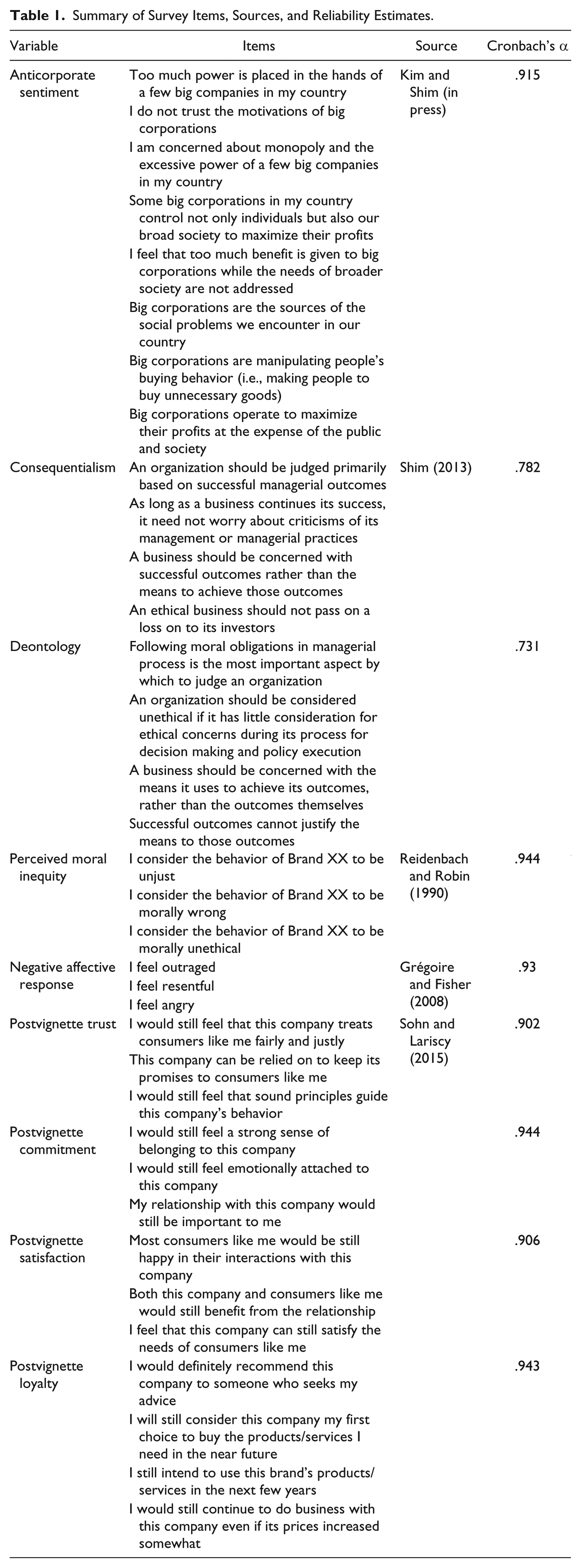
Current literatures guided the design of the survey and operationalization of the various constructs studied in this research. All items were measured on a 1 to 5 Likert-type scale running from strongly disagree to strongly agree (see Table 1 for all items, sources, and reliability estimates).
Summary of Survey Items, Sources, and Reliability Estimates.
Data Analyses
Data were analyzed using Stata IC/14. First, Cronbach’s alpha for all observed variables were calculated to ensure reliability of the measurement items. All variables were found to have a Cronbach’s alpha of >.70, with the lowest being .731 and the highest being .944. As there were no validated scales for anticorporate sentiment, we performed exploratory factor analysis (EFA) using principal component analysis (PCA) and Oblimin rotation, followed by confirmatory factor analysis (CFA), to check the validity and reliability. The same procedure was followed for the two moral orientations as Shim (2013) noted that existing scales of moral orientation tend to report low reliability. Then, a CFA was used to confirm Sohn and Lariscy’s (2015) operationalization of consumer–corporate brand relationship. Following this analysis, the models in Figures 1, 2, and 3 were tested using structural equation modeling (SEM). To assess data fit, Hu and Bentler’s (1999) joint-criteria, one of the more conservative fit evaluation criteria, was used, whereby comparative fit index (CFI) >.95, standardized root mean square residual (SRMR) ⩽ .10, or root mean square error of approximation (RMSEA) ⩽.06 and SRMR ⩽.10 is considered a good model. Standardized coefficients are reported. To test the mediation hypothesized in H6, Holmbeck’s (1997) procedure was adopted, such that three models were tested. The first model did not contain the mediator at all (Figure 1), the second model contained a full mediation (Figure 2), while the third model was a partial mediation model (Figure 3).
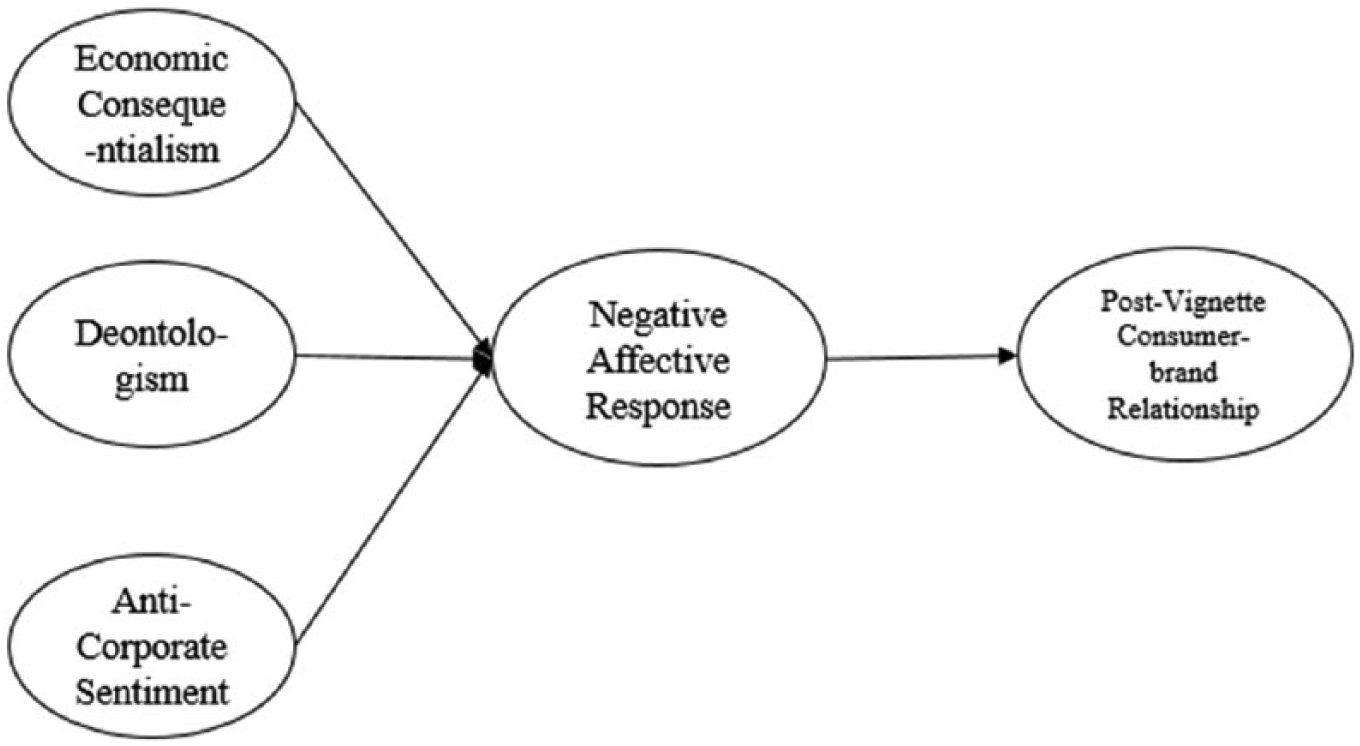
Model with no mediator.
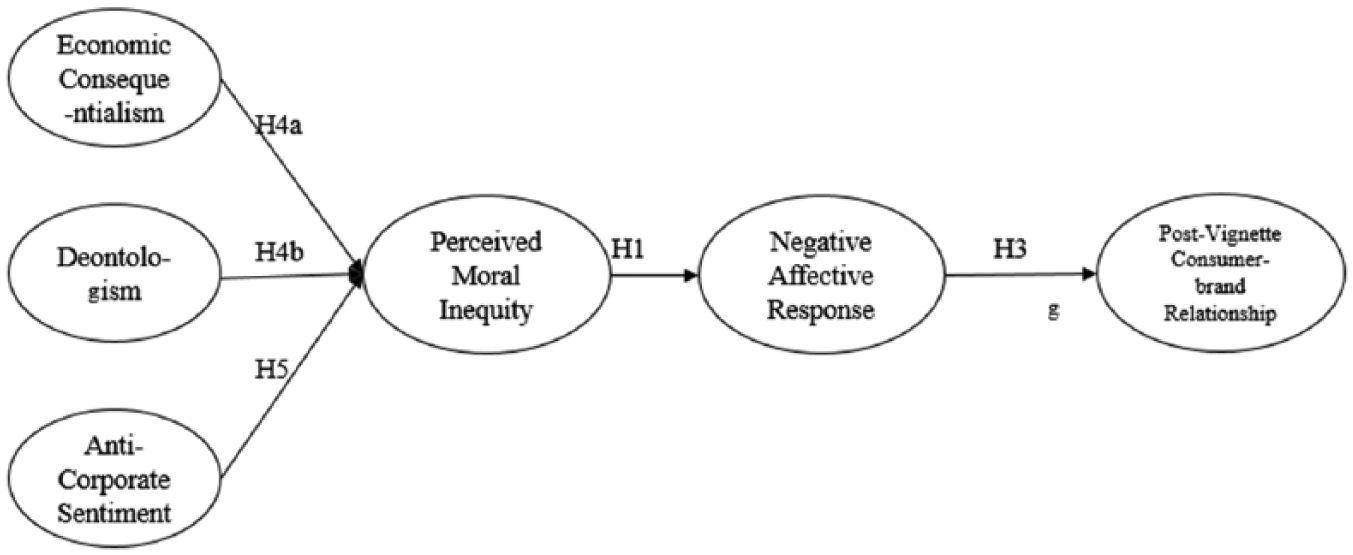
Full mediation model for hypothesis testing.

Partial mediation model for hypothesis testing.
Results
First, the eight items of anticorporate sentiment were subjected to EFA using PCA. The Kaiser–Meyer–Olkin value was .935 for the PCA of anticorporate sentiment. Bartlett’s Test of Sphericity (Bartlett, 1954) reached statistical significance, χ2(28) = 2217.008, p < .001, supporting the factorability of the correlation matrix. PCA of anticorporate sentiment revealed the presence of one component with eigenvalue exceeding 1, explaining 63.327 of the variance. 2 Regarding validity, 63.33 % of total variance suggests that this scale has sound explanatory power in explicating anticorporate sentiment. Standard factor loadings range from .72 to .85. CFA results showed that the scales were good indicators of the measured variable, χ2(20) = 83.605; CFA = .971, SRMR = .032, RMSEA = .082.
The four items of consequentialist orientation and four items of deontological orientation were subjected to PCA. The Kaiser–Meyer–Olkin value was .747. Bartlett’s Test of Sphericity (Bartlett, 1954) reached statistical significance, χ2(28) = 997.821, p < .001. PCA of moral orientation revealed the presence of two components with eigenvalues exceeding 1, explaining 35.57% and 23.12%, of the variance, respectively, which contributed to 58.69% of the total variance. Standard factor loadings ranged from .63 to .84. CFA revealed that the items were good indicators of the measured variables as fit statistics were found to be at acceptable levels, χ2(19) = 78.652 (p < .001); CFI = .939, SRMR = .053, RMSEA = .082.
Results of the CFA indicated that trust, satisfaction, loyalty, and commitment were all good indicators of consumer-corporate relationship for both pre- and postexposure to scenario. The model for the prescenario had the following fit indices: χ2(2) = 10.80 (p = .0045); CFI = .990, SRMR = .019; RMSEA = .096. For the postscenario measures, the following fit indices were found: χ2(2) = 24.68 (p < .001); CFI = .986, SRMR = .015, RMSEA = .155. Based on these fit indices, the CFA for consumer-corporate brand relationship was found to have good fit and was adopted for hypothesis testing.
Two-sample t tests (with equal variances) were conducted to identify whether consumers’ relational perceptions with the corporate brand underwent a change after exposure to the vignette (H2). Given the high levels of reliability of these measures, composites were created just for the conduct of the t tests. Prevignette trust (M = 4.15, SD = 0.88) was signifantly different (t = 14.000, p < .001, df = 472, Cohen’s d = .774) from postvignette trust (M = 3.33, SD = 1.20). Similarly, prevignette commitment (M = 3.13, SD = 1.07) was significantly higher (t = 9.000, p < .001, df = 472, Cohen’s d = .415) than postvignette commitment (M = 3.62, SD = 1.25). Prevignette satisfaction (M = 4.15, SD = 0.75) too was significantly higher (t = 12.559, p < .001, df = 472, Cohen’s d = .679) than postvignette satisfaction (M = 3.49, SD = 1.14), as was prevignette loyalty (M = 4.06, SD = 0.79) compared with postvignette loyalty (M = 3.32, SD = 1.23; t = 13.740, p < .001, df = 472, Cohen’s d = .715). On all four indicators of consumer–corporate brand relationships, consumers’ self-reported perceptions decreased after exposure to the vignette, indicating that allegations of gender discrimination affected consumers’ relational perceptions with the corporate brand, thereby supporting H2.
To test the rest of the hypotheses, the measurement model that included all the measures of the analyzed variables was tested and yielded good fit indices, χ2(304) = 778.68, p < .001; CFI = .944, SRMR = .051, RMSEA = .057. Gender was used as a control variable.
Then, Holmbeck’s procedure to test for mediation, as outlined earlier, was followed. The first tested model, without perceived moral inequity as the mediator, was tested and did not fit and was therefore rejected. A model containing full mediation (see Figure 2) was then tested and found to have good fit, χ2(558) = 1436.83, p < .001; CFI = .936, SRMR = .094, RMSEA = .058. Finally, the model in Figure 3 containing a partial mediation was tested and too was found to have good model fit, χ2(555) = 1415.23, p < .001; CFI = .938, SRMR = .098, RMSEA = .057. The fit indices for the model in Figure 3, that is, the partial mediation model, were slightly better than the one for Model 2; Figure 3 was therefore accepted for further analyses.
Hypotheses 1 and 3 through 6 were then examined. H1 predicted a positive relationship between perceived moral inequity and negative affective response and was supported (β = .81, p < .001). H3 too was supported as negative affective response was found to negatively associate with consumer-corporate relationship (β = −.31, p < .001). Moral orientation was found to affect perceived moral inequity as degree of economic consequentialism was associated negatively with perceived moral inequity of corporate action (H4a: β = −.11, p < .05) and being deontologist positively predicted perceived moral inequity (H4b: β = .19, p < .01). Furthermore, participants’ gender was significantly related to degree of self-reported economic consequentialism (β = −.17, p < .01). Women reported lower levels of economic consequentialism compared with men but were no different when it came to deontological oerientation and anticorporate sentiment. Perceived moral inequity was also found to be predicted by individuals’ anticorporate sentiment (H5: β = .33, p < .001).
H6 predicted that perceived moral inequity would mediate the relationship between (a) economic consequentialism, (b) deontology, (c) anticorporate sentiment (independent variables) and negative affect (dependent variable). Partial support was found for H6a, as perceived moral inequity partially mediated the effect of economic consequentialism and negative affect; a significant direct relationship was found between economic consequentialism and negative affect although the effect size of the direct relationship was small (β = .08, p < .05). H6b was supported, as the relationship between deontology and negative affect was found to be mediated by perceived moral inequity, with the direct path between deontology and negative affect being nonsignificant. Finally, similar to economic consequentialism, the relationship between anticorporate sentiment and negative affect was partially mediated by perceived moral inequity (see Figure 4). H6c was therefore partially supported.

Results of hypothesis testing.
In addition, participants’ reported moral inequity about allegations of workplace gender discrimination was significantly predicted by their gender (β = .01, p < .05). Given the significant association between gender and consequentialism, and gender and perceived moral inequity, post hoc moderation analyses were conducted to examine the interaction effect of gender and consequentialist orientation on perceived moral inequity. However, no significant interaction effect on moral inequity was found between gender and consequentialist orientation.
Discussion
The purpose of this study was twofold—to investigate (a) how allegations of gender discrimination affect consumers’ relationship with the brand in question, and (b) individual-level factors that affect consumers’ negative affective response to the allegations and, eventually, consumer-brand relationships. Findings from a survey conducted among individuals in the United States indicate that individuals’ relational perceptions with a corporate brand whose products/services they consume are negatively affected by allegations of misconduct, in this case, gender discrimination. Furthermore, results revealed that individuals’ moral orientation and anticorporate sentiment predicted their perceptions of moral inequity of corporate behavior, which in turn affected their negative affective response to the allegations. Such negative affective response then affected individuals’ consumer–corporate brand relationships. The implications of this work are discussed next.
Advancing a Theoretically Grounded Model of Consumers–Corporate Brand Relationship
By explicating a theoretically grounded model of consumers’ responses to corporate (mis)behavior, this study helps advance communication theory-building in many ways. First, although much communication scholarship focuses on publics’ reactions to organizational (corporate, in this case) behavior, much of this work focuses primarily on publics’ reactions to organizational crisis response rather than the crisis itself (e.g., Brown & White, 2010). This study served to capture individuals’ responses immediately upon learning of the crisis, and further advance our understanding of individuals’ cognitive and affective responses to crisis situations at different time points in the crisis life cycle.
Second, this study builds on current research that focuses on consumer publics (e.g., Choi & Lin, 2009; Klein & Dawar, 2004) by identifying how individuals react to news of corporate misconduct enacted by corporate brands they use. Consumers have been shown to be more willing to punish corporations for misbehavior through boycotts and protest behaviors (Hollenbeck & Zinkhan, 2006), making it even more important for corporations to understand the perceptual, cognitive, and affective mechanisms that might lead them to do so. This study explicated consumers’ cognitive and affective responses to corporate misconduct, demonstrating the relational impact of news of corporate misbehavior. Consumers’ perceived moral inequity of corporate behavior elicited a negative affective response, which in turn lowered consumers’ relational perceptions, echoing previous findings of consumers’ negative affective response negatively affecting reputational and relational perceptions (Choi & Lin, 2009). Conceptually, active consumer publics may be different from active nonconsumer publics, just as the nature of consumers’ relationships with a corporation is different from those of nonconsumers (Sohn & Lariscy, 2015), differences that future research may seek to unpack.
Third, the results of this study add further nuance to discussions of relationships in communication research. Crucial as the notion of relationships has been to the discipline of communication writ large, particularly centralized in interpersonal communication (e.g., Merolla & Harman, 2018), organizational communication (e.g., Park, Kim, & Krishna, 2014), and public relations (e.g., Ledingham & Bruning, 1998), relationships between organizations and their various constituencies tend to remain limited to general discussions of publics and/or stakeholders. In this study, we further explored a specific subtype of organization-public relationships, that is, consumer–corporate brand relationships, adopting Sohn and Lariscy’s (2015) operationalization of the conceptualization. In doing so, we advance research on relationships by providing support for the operationalization of consumer–corporate brand relationships, as well as unpacking cognitive and affective factors that influence such relationships.
Understanding Impact of Cross-Situational Factors
The popularity and utility of situational theories in public relations and communication literature, that is, the situational crisis communication theory (Coombs, 2007), and the situational theory of problem solving (J.-N. Kim & Grunig, 2011; J.-N. Kim & Krishna, 2014), has resulted in an extensive body of scholarship that investigates the impact of situational factors, such as crisis type, crisis history (Coombs, 2007), problem perceptions, and situational motivation (e.g., J.-N. Kim & Grunig, 2011; Krishna, 2017), on publics’ crisis reactions and behaviors. Equally important to understand, however, is how individuals’ inherent characteristics and attitudes, which we refer to as cross-situational factors, affect their situation-specific perceptions and affective responses. This study follows the tradition of several bodies of scholarship in the social sciences that have investigated how general attitudes and beliefs influence individuals’ perceptions and behaviors (e.g., Castelli & Carraro, 2011) and explicates how individuals’ moral orientation and anticorporate sentiment operate to affect consumers’ perceptions and affective responses to corporate (mis)behavior.
Notably, the mediation tests revealed key points of interest for communication scholars. Contrary to expectations, the relationship between cross-situational variables and affect was only partially mediated by situational perceptions. Indeed, economic consequentialism and anticorporate sentiment were found to directly affect negative affect. The positive relationship between anticorporate sentiment and negative affect does intuitively make sense as reading about workplace gender discrimination may confirm individuals’ preexisting sentiment about corporations and trigger negative emotions about the company. However, the positive relationship found between economic consequentialism and negative affect is unexpected, given that, from a conceptual standpoint, allegations of workplace gender discrimination would likely not trigger economic consequentialists’ anger as such actions would align with their views of what the focus of a company should be. Although this effect size was small, it was significant and therefore deserves our attention. It may be possible that although corporate misconduct does not trigger economic consequentialists’ perceptions of moral inequity, it may still trigger their anger not because of the action itself but for other reasons. One may conjecture that economic consequentialists may consider the media coverage of the alleged misconduct to be a distraction from doing business and making profit and therefore may be upset with the company. Although this is pure conjecture, future research may seek to understand why economic consequentialists may be upset with companies in cases of misconduct.
Unpacking Consumer Responses to Gender Discrimination
Besides the theoretical implications discussed so far, the results of this study also provide concrete evidence that reports of gender discrimination by a corporation only result in negative responses from consumers. As revealed through the results of this study, reports of gender discrimination even against companies that are generally counted among the most reputable and ethical corporations in the world elicited a negative affective response from consumers of those companies and lowered those consumers’ relational perceptions of the company. At a time when individuals around the world continue to fight for gender equality, equitable representation and treatment in the workplace, equal pay for equal work, and other such workplace issues, studies such as the one presented in this article help strengthen the arguments against corporations engaging in such discriminatory practices and upholding their moral responsibility to their employees. These results show that beyond negatively affecting the employees (Roscigno, 2007), gender discrimination also affects consumers’ perceptions of the corporation and negatively affects their relational perceptions with the corporation.
These findings also echo those of other studies that have investigated consumer responses to morally dubious cases of corporate conduct such as use of child labor (Grappi et al., 2013), among others. Indeed, Romani et al. (2015) discussed how corporate misconduct evaluated by consumers as immoral tend to induce more feelings of hate among consumers than does misconduct not related to morality or moral violations. It would seem, based on our results, that gender discrimination may induce similar reactions among consumers as a type of misconduct that is morally iniquitous. Notably, these results are based on a survey conducted in December 2016, months before the allegations against Uber and, indeed, against several other companies had been made public, making these findings of consumers’ affective responses even more interesting. Perhaps findings from more recent studies conducted after 2017’s milestone movements may reveal different, even stronger negative reactions from consumers. Or perhaps the overwhelming number of cases of gender discrimination may engender in consumers an exhaustion of having to keep up with almost daily allegations among corporations, and may serve to normalize such corporate misconduct in consumers’ minds. Indeed, by November 2017, Uber’s sales in the United States had seen a recovery after the #deleteUber movement (Bhuiyan, 2017). Consumers’ cognitive exhaustion resulting from repeated cases of corporate misconduct may be a worthy area of investigation.
For communication managers and the corporate world at large, we offer two broad implications of this study. First, the results of this study offer substantive evidence for senior management that workplace gender discrimination has not only internal but also external consequences. Therefore, companies should proactively monitor warning signs, with a special emphasis on internal issues. As the results of this study indicate, internal discriminatory practices will cost a company, at least relationally. Recognizing questionable policies and aspects of internal corporate culture may be a good starting point for companies to improve their working conditions and to prevent their internal issues from spilling over into the external environment and causing financial and reputational harm, as was the case with The Weinstein Company.
Second, for corporations to recover from such crises, it is crucial for them to understand the beliefs held by their consumers. Workplace gender discrimination is no longer confined to being an internal human resources issue; instead, such allegations gain widespread traditional and social media coverage. Corporations must pay careful attention to consumers who hold strong beliefs about corporations and their place in our society and use these beliefs as frames to evaluate corporate (mis)conduct. Such beliefs often develop from individuals’ social interactions and are generally enduring (Velasquez, 2015) and therefore are hard for companies to influence or manipulate. Such beliefs make it difficult for companies to change consumers’ perceptions of corporate misconduct without a clear understanding of these beliefs. Instead, companies must make focused efforts on understanding their consumers’ core beliefs, identify potential consumer reactions, and plan accordingly. Companies whose consumers tend to hold more deontological views of the role of business may need to devise strategies that address such consumers’ concerns regarding their conduct. Certainly, for such consumers, mere apologies without substantive, concerted efforts from the corporation to rectify such issues would not be enough. Studies such as the one presented in this article help provide support for corporations to pay close attention to their consumers’ attitudes toward corporations in general, as well what they consider important when evaluating (un)ethical behavior.
Although this study did not focus on behavioral intentions, opting for a relational approach instead, extant literature provides insight on the associations between individuals’ beliefs and traits (cross-situational variables) and (un)supportive behavior (e.g., Slovic et al., 2005). Companies should therefore be mindful of potential behavioral consequences that may emerge from consumer publics’ beliefs and values, for example, punitive actions (Romani, Grappi, & Bagozzi, 2013). Interestingly, consumers’ punitive actions may not necessarily be negative. Some consumers engage in constructive punitive actions to push companies to change wrong policies or practices while hoping to continue their relationship with those companies if they fix their wrongdoings (Romani et al., 2013). For example, people with a strong deontologist orientation may want companies to fulfill their moral obligations and may be willing to forgive the company if it engages in corrective actions. However, people with high levels of anticorporate sentiment may want to cause harm on the company (destructive action) with an intention to punish. Therefore, investigating the motives behind consumers’ punitive actions may be a valuable area of future research.
Important as the findings of this study are, there are a few limitations associated with it. First, we did not utilize a control group and therefore make no causality claims. Second, the use of real brand names in the vignette might have caused confusion among participants. However, to avoid this risk, a debriefing statement was provided before participants exited the survey. Real brand names were necessary in the survey to gauge consumer-brand relationships. Third, although we included four corporate brands with strong reputations, we acknowledge other potential factors that may affect consumers’ appraisal of their relationships with brands or their behavioral intention, such as duration and strength of the relationship (Huber, Vollhardt, Matthes, & Vogel, 2010), quality and availability of alternatives, and relationship investment (Breivik & Thorbjornsen, 2008). Fourth, our analyses are limited to individuals’ profit-related consequentialism. We encourage scholars to investigate how individuals’ corporate responsibility–related expectations affect their perceptions of corporate misconduct. This focus on economic consequentialism also guided the framing of the vignette. However, gender discrimination may take place for a variety of other reasons, including a weak corporate culture. Future research should also investigate the impact of such allegations on consumers’ behavioral intentions toward the company. Despite these limitations, we believe that the findings reported in this study have important implications.
Corporate behavior that violates ethical and moral tenets held by society raises an important question—What is the role of business in today’s sociopolitical climate, economic benefit, or social good? How does the business world writ large view its own role in the broader society? These are some questions that we hope are inspired through this work. We do caution readers not to interpret our findings as reporting one moral orientation as being superior to the other. Indeed, consequentialism has immense value in serving as a checkpoint for decision makers or policy makers as it asks them to look at the consequences of decisions or policies on their publics. Predicting negative consequences of behaviors or decisions on their publics in advance affords organizations the opportunity to revise these behaviors to minimize negative outcomes. This is where deontological orientation may be useful as a guideline. Therefore, both moral orientations complement each other, as the deontological orientation help organizations consider their moral obligations and responsibilities for stakeholders and society, beyond gauging positive and negative consequences.
Footnotes
Declaration of Conflicting Interests
The authors declared no potential conflicts of interest with respect to the research, authorship, and/or publication of this article.
Funding
The authors disclosed receipt of the following financial support for the research, authorship, and/or publication of this article: This research was supported by the Singapore Ministry of Education (MOE) Academic Research Fund (AcRF) Tier 1 grant.
