




Abstract
One of the most dominant ways of covering politics in the media is by focusing on politicians’ strategies for gaining public support and their positions at the polls. The conventional wisdom is that this tendency—usually referred to as strategic, horse race, or game coverage—has negative consequences for democracy because it increases political alienation. Others argue, however, that the public’s attraction to strategic coverage improves knowledge about issues and encourages civic engagement. This study examines the consequences of strategic coverage by performing a meta-analysis of published and unpublished studies. Based on 54 findings from 32 studies and 38,658 respondents, I show that across studies and contexts, strategic coverage increases political cynicism (d = 0.32), reduces substance-based political knowledge (d = −0.31), and discourages positive evaluations regarding the news items (d = −0.22). However, there is no evidence that this coverage erodes participation. These findings correspond with scholars’ previous concerns.
Journalistic coverage of politics often focuses on politicians’ strategies and tactics as well as their campaign performance and position at the polls. This news routine is referred to as “strategic game frame” (Aalberg, Strömbäck, & de Vreese, 2012), “game schema” (Patterson, 1993), “strategy schema” (Jamieson, 1992), or “strategy frame” (Cappella & Jamieson, 1997). Studies show that strategic coverage of politics is prominent across different contexts (e.g., countries and media types; see Jamieson, 1996; Sheafer, Weimann, & Tsfati, 2008) and has generally increased over the years (Binderkrantz & Green-Pedersen, 2009; Patterson, 1993; but see Benoit, Stein, & Hansen, 2005).
This focus on politicians’ strategies and self-interest may have important implications for citizens who usually get their political information from the media. The conventional wisdom is that strategic news coverage has negative consequences for citizens in democracies. In their seminal work, Cappella and Jamieson (1997) found that this coverage increases political cynicism (i.e., lack of trust in politicians and political institutions) because citizens’ attention is directed mostly at the politicians’ strategic attempts to gain public support rather than their concerns for the common good (Patterson, 1993).
Although scholars tend to agree on the specific damaging effect of strategic news on cynicism, effects on other outcomes remain controversial. Some researchers report that strategic coverage undermines the public’s knowledge of substantive issues (Pingree, Scholl, & Quenette, 2012; Valentino, Beckmann, & Buhr, 2001), whereas others argue that it can increase issue knowledge because concepts of winning, losing, and strategy are more memorable and thus help individuals process complex political information (Zhao & Bleske, 1998; see also Baum, 2002). Evidence for the effects of strategic news on demobilization and civic involvement also is mixed. For instance, some argue that journalists’ increasing emphasis on strategy frames has encouraged political engagement over the years (Norris, 2000; see also Adriaansen, Van Praag, & de Vreese, 2012), but others find that it erodes intention to participate (Borah, 2014a) as well as actual turnout (Lengauer & Höller, 2012).
In other words, although scholars are usually concerned about strategic news coverage—the dominant way of covering politics—the literature lacks clarity about whether its implications for democracy are entirely negative or may also benefit the public. Moreover, because studies have reported varying and contradictory results—even related to political cynicism (e.g., Adriaansen, Van Praag, & de Vreese, 2010; Cappella & Jamieson, 1997)—it remains unclear whether the effects of strategic news hold true across contexts and under different conditions. To address these issues, the current study examines the effects of strategic news coverage on various outcomes through a meta-analysis that statistically integrates 54 findings from 32 studies.
Strategic News Coverage of Politics
One of the most common journalistic routines used to cover politics is focusing on battles between politicians, their strategic motivations for increasing public support, and their position at the polls (Cappella & Jamieson, 1997). Scholars also relate this mode of coverage to war and sports terminology and a focus on who is leading and who is trailing behind (Patterson, 1993). Some distinguish between strategy frames, which focus on the motivations behind politicians’ policy preferences or their campaign style, and game frames (or horse race frames), which focus on who is winning at the polls (Aalberg et al., 2012; Valentino, Beckmann, & Buhr, 2001). Either way, strategic news coverage is often compared with issue coverage, which focuses on substance, politicians’ issue stances, and how they accomplish their policies.
Previous studies show that strategy and game frames are widely used by journalists in different contexts, mainly when covering election campaigns (Benoit et al., 2005; Patterson, 1993; Sheafer et al., 2008; Strömbäck & Dimitrova, 2006) but also during routine coverage of internal political debates or foreign political affairs (de Vreese, 2004; de Vreese & Semetko, 2002). The three main reasons for the prominence of strategic and horse race frames in the news are as follows. First, they correspond with news values such as drama, negativity, and personal focus (Aalberg et al., 2012; Galtung & Ruge, 1965), which generally attract audience attention (Iyengar, Norpoth, & Hahn, 2004; Jang & Oh, 2016; Trussler & Soroka, 2014). Second, the professionalization of political campaigns over the years has led journalists to constantly try to uncover politicians’ hidden strategies of image building and media managing (Patterson, 1993). Finally, strategy-focused stories are easier and less time-consuming to produce, as they require fewer resources than covering the more complex and substantive dimensions of issues (Fallows, 1997).
Strategic coverage varies in its intensity under different contexts. It is more dominant in commercialized media systems (Strömbäck & Dimitrova, 2006) as well as in competitive party systems (Aalberg, de Vreese, & Strömbäck, 2017). However, evidence of increasing use of strategic coverage over time is mixed. Although some studies found a linear trend (Patterson, 1993), others reported that game frames were always part of the news coverage and thus the linear trend was more modest (Sheafer et al., 2008). Some even detected a decreasing trend (Benoit et al., 2005). When comparing across contexts, Binderkrantz and Green-Pedersen (2009) found an increasing linear trend only during election campaigns but not in routine times. Nonetheless, it is clear that strategic coverage is a dominant way for journalists to cover politics, and thus its implications for democracy are of great importance.
Effects of Strategic News Coverage
Many scholars associate strategic news coverage with the concept of media malaise, whereby modern news reporting contributes to civic disengagement from politics (Cappella & Jamieson, 1997; de Vreese & Semetko, 2002; Robinson, 1976). This is because strategy and horse race frames can lead the public to interpret the issues or policies at stake as driven mainly by electoral considerations rather than by concerns for the common good (Patterson, 1993). However, others argue that citizens may benefit from strategic coverage, as it has a “catalytic effect” (Meyer & Potter, 1998): Citizens are much more interested in such coverage and therefore become more interested in the issues at stake and become even more engaged (Norris, 2000). The following sections introduce an overview of the main outcomes of strategic coverage and pose the hypotheses that will be tested in the meta-analysis.
Political Cynicism
Perhaps the most discussed effect of strategic news coverage is its influence on levels of cynicism (i.e., lack of trust in political actors and institutions). The common claim is that the media’s emphasis on politicians’ strategies and positions at the polls “turns off voters, contributes to cynical and negative public attitudes toward and alienation from the political process” (Elenbaas & de Vreese, 2008, p. 550). This scenario may occur because strategic coverage directs citizens’ attention to politicians’ strategic or tactical motives for gaining power rather than realizing substantive policy goals and looking after the common good, which increases the importance citizens attach to these strategic motives (Patterson, 1993).
While some researchers did not find evidence to support this effect of strategic news coverage on cynicism (e.g., Adriaansen et al., 2010), others suggested that it is moderated by different factors. At the individual level, for example, strategic coverage was found to increase cynicism only among nonpartisans (Valentino, Beckmann, & Buhr, 2001) or among those less politically involved (Adriaansen et al., 2012; but see de Vreese, 2005). From a system-level perspective, the effect of strategic news is prominent mainly in political systems with high quality of governance (Schuck, Boomgaarden, & de Vreese, 2013). However, ever since Cappella and Jamieson’s (1997) seminal study in the field, it has been widely claimed that strategic news coverage induces political cynicism (e.g., de Vreese & Semetko, 2002; Shehata, 2014). As opposed to the majority of previous studies, which examined the effect on cynicism in a single context, I test it across various contexts, countries, and designs.
Substance-Based Political Knowledge
The public’s interest in news involving conflicts, negativity, and drama is one of the reasons that strategy and horse race frames are so common (Iyengar et al., 2004; Trussler & Soroka, 2014). Scholars suggest that this interest may have positive implications for citizens’ political knowledge by assisting them in processing complex political information. Entertainment-oriented elements in news coverage—such as terminology of winners, losers, and political strategies—reduce the cognitive costs of processing substantive information (Baum, 2002; Zhao & Bleske, 1998). Others suggest that strategic news coverage has a “catalytic effect,” as citizens find much more interest in such news and therefore become more interested in the issues at stake (Meyer & Potter, 1998).
However, these positive implications have rarely been confirmed empirically. Although framing politics through a strategic lens can attract more audiences, the information acquired by each citizen is far from the democratic ideal because this reporting approach focuses less on substance and more on politicians’ self-interests (Aalberg et al., 2012). The reason for this is that strategic news activates only strategy-related constructs from memory, whereas issue coverage activates mostly issue-related ones (Pingree et al., 2012). Various studies have reported that citizens acquire less substantive information about the covered issues when framed strategically, and they mostly recall the strategic elements from the story (e.g., Cappella & Jamieson, 1997; Rhee, 1997; Valentino, Buhr, & Beckmann, 2001).
Evaluations of News Stories
Hopmann, Shehata, and Strömbäck (2015) reported that strategic coverage not only increases citizens’ distrust of political institutions, but that this distrust also extends to the entity that delivers the political information—the media. Cappella and Jamieson (1997) refer to this effect as “contagious cynicism.” Strategic coverage also affects how citizens evaluate a news story: whether it is credible, interesting, or of high quality (Borah, 2013, 2014b; Pingree, Hill, & McLeod, 2013). Citizens tend to give less positive evaluations to strategy-framed news stories, perhaps because they are considered less objective, than to issue-based stories (Borah, 2013). In other words, although citizens are attracted to negativity and strategy, they can also be more critical of such stories (see also Trussler & Soroka, 2014).
Political Participation
Most studies have examined the effect of strategic news coverage on political attitudes, whereas few have examined the effect on citizens’ behavior in terms of participation and turnout. Some researchers argue that in the long run, the media’s increasing emphasis on strategy and conflict has not eroded political engagement and may have even increased it because it can lead to more public interest in politics (Norris, 2000). However, the common claim is that strategic coverage reduces the will to participate and vote. This is because strategy-focused coverage creates “a public disillusioned with its electoral choices and less confident that participating will produce meaningful changes when they are dissatisfied” (Valentino, Beckmann, & Buhr, 2001, p. 352; see also Elenbaas & de Vreese, 2008).
Possible Moderators
The discussion of possible moderators will focus on the effects of strategic coverage on political cynicism because this outcome was examined by the largest number of studies. Most of the literature on the effects of strategic coverage is focused on single cases (e.g., a specific election campaign) and therefore mainly highlights individual-level moderators rather than comparing the effect across contexts (e.g., periods, systems). Specifically, an individual’s political involvement is regarded as an important moderator of media effects. In our context, citizens with less political knowledge are more susceptible to strategic coverage, as they are exposed to “behind-the-scenes information that describes strategic moves of political actors that they did not presuppose” (Schuck et al., 2013, p. 291). However, empirical tests of this claim have yielded mixed results (e.g., Adriaansen et al., 2012; de Vreese, 2005; de Vreese & Elenbaas, 2008). Nonpartisans are also more likely to be affected compared with partisans (those who identify themselves with a certain party) because they hold less stable attitudes regarding the parties’ ability to properly represent them (Jackson, 2009; Valentino, Beckmann, & Buhr, 2001). As for demographic variables, scholars often emphasize citizens’ age. Because younger populations are inexperienced with the political process and have less stable orientations, their understanding of politics can be strongly shaped by strategic coverage (Elenbaas & de Vreese, 2008). However, this moderating effect has also received mixed support (Adriaansen et al., 2010; Valentino, Beckmann, & Buhr, 2001). The research questions (RQs) related to these moderators addressed in this study are as follows:
Because this meta-analysis examines effects beyond a single context, I am able to test three additional groups of moderators: system level, media level, and context level. First, from a system-level perspective, Schuck et al. (2013) found that the effect of strategic news on cynicism is stronger in countries with a higher quality of governance. However, their study is limited to a single context (European Parliamentary elections), which makes it necessary to expand our cross-sectional understanding of the effect. I suggest that commercialization of the media can moderate the effect. Although commercialization is considered a catalyst for the dominance of strategic coverage (Patterson, 1993), it is less clear how different media systems can moderate the effects of strategic coverage. For example, citizens exposed to more commercialized media systems are expected to be more strongly affected by strategic coverage. Because they already evaluate the political domain from a cynical perspective due to strategy-focused local coverage (de Vreese, 2004), strategic coverage will resonate with their preexisting schemas of interpreting politics and will thus have a stronger impact on them (Cacciatore, Scheufele, & Iyengar, 2016) compared with citizens in less commercialized media systems. On the contrary, citizens exposed to less commercialized media systems, who are less politically cynical, may be more influenced by strategic coverage. This is because presenting politics as primarily driven by strategies will be more unusual in a news environment that is mainly issue focused and thus it will be more influential (see also Schuck et al., 2013).
Second, the medium can play a role. Studies of whether television focuses more on strategy compared with newspapers have produced mixed results (Elenbaas & de Vreese, 2008; Strömbäck & Van Aelst, 2010), but a direct comparison between media types has rarely been conducted in the context of the effects of strategic coverage. Cappella and Jamieson (1997) reported stronger effects for televised strategic coverage than for textual coverage, but it is less clear whether the change was due to the different issues presented or the different experimental settings. Similarly, Elenbaas and de Vreese (2008) found that exposure to strategic news on television increased cynicism compared with news presented in newspapers. However, it is unclear whether this was the result of the medium type or due to the televised environment, which was more enriched with strategic coverage than the examined newspapers.
Third, context-level factors can also moderate the effect on cynicism. Some studies have examined whether different policy issues (Adriaansen et al., 2012; de Vreese & Elenbaas, 2008) or the tone of the message (Borah, 2013; Pedersen, 2012b) moderate the effect, but few direct comparisons between election and nonelection stories have been made. This is surprising in light of previous comparisons of the dominance of strategic news coverage during elections and routine times (Aalberg et al., 2012; Binderkrantz & Green-Pedersen, 2009; Lawrence, 2000). I have no strong expectations regarding the direction of the moderating effect for cynicism. On the one hand, citizens may ideally expect the coverage of routine policy debates to focus more on substance than on power ambitions (Trussler & Soroka, 2014). Therefore, framing routine issues as driven by power aspirations may contradict the public’s expectations and thus lead to higher levels of cynicism than news reported in election contexts (Schuck et al., 2013). On the other hand, the election context is essentially the ultimate arena for strategic battles. Therefore, portraying election campaigns from a strategic perspective will already resonate with the public’s preexisting perceptions and will be more influential (Cacciatore et al., 2016; de Vreese & Semetko, 2002).
Method
Meta-analysis is a procedure that statistically synthesizes results from previous studies in order to examine the magnitude and consistency of an effect (Borenstein, Hedges, Higgins, & Rothstein, 2009). One of its main advantages is the ability to integrate previous findings and execute moderator analyses beyond a single context. It thus increases the generalizability of the results, even compared with comparative studies, which examine the same effect within different countries or political systems but usually under the same context (see Schuck et al., 2013). The meta-analytic approach has become increasingly common in the political communication literature over the years (e.g., Lau, Sigelman, & Rovner, 2007; Matthes, Knoll, & von Sikorski, 2018). In this study, I conducted several meta-analyses to test the effects of strategic news coverage on four dependent variables (political cynicism, substance-based political knowledge, evaluations of news stories, and political participation) across varying periods, issues, countries, media types, and study designs.
Data Collection
To retrieve all relevant articles, I conducted searches in Web of Science and Google Scholar for various combinations of keywords. 1 I also searched for relevant studies in various review articles about framing and strategic news. Moreover, because published studies usually contain significant results, I contacted 141 scholars in the field of strategic news and media effects for additional unpublished papers in order to reduce this publication bias. This yielded several more studies. In the case of papers that did not provide all necessary information needed for the meta-analysis, I e-mailed the authors and requested missing information. In total, these searches yielded 45 published and unpublished potentially relevant studies.
Inclusion Criteria
The inclusion of studies in the meta-analysis was based on several criteria. First, regarding the independent variable (strategic news coverage), I included all cases in which respondents were exposed to the following strategic and game (horse race) components from any medium: motivations behind policy preferences, campaign styles, politicians’ position at opinion polls, or a language of war and sports (e.g., winners or losers). 2 I did not include studies that examined how fluctuations in polls influence citizens because my main focus was on the way that politics is covered in the media and not on the candidates’ position in polls.
Second, I used rather broad conceptual definitions for each of the four main dependent variables. For political cynicism, studies generally use the definition of Cappella and Jamieson (1997): lack of trust in politicians and political institutions. Three studies measured political trust instead of using the term cynicism. Because both concepts are similar in terms of common theoretical and operational definitions (Mishler & Rose, 2001; Pedersen, 2012a), they were included in the analysis. 3 I also included studies that analyzed cynical attitudes from open-ended answers (Schenck-Hamlin, Procter, & Rumsey, 2000).
Studies examining whether respondents acquired substantive political knowledge about the covered issue included both objective and perceptual knowledge variables. The first measures correct recall of facts, relevant arguments, and answers to knowledge questions about the specific context in the news item (rather than general political knowledge). Measures of perceptual learning ask the respondents whether they think they learned something and are less common in the literature (Jackson, 2009; Oxley & Hall, 2012). Both measures were included in the meta-analysis.
Due to relatively low number of studies that examined evaluations of news stories and political participation, I used a broad definition for each one. Positive evaluations of news stories consisted of various perceptions of a news story (its credibility, level of interest, and perceived quality). Political participation included dimensions of collective activity, contacting officials, voting, and so on (Verba, Schlozman, & Brady, 1995). Several sensitivity analyses were performed to eliminate possible biases due to the measurements of the dependent variables (described in the “Results” section).
The meta-analysis included both experimental and observational studies. In experiments, studies had to include effects of two experimental conditions: strategic and issue coverage. 4 In observational studies, in cases where overall media exposure was used as an independent variable (as opposed to direct exposure to strategic coverage), the criterion for including the effects was that respondents had been exposed to a media environment enriched with strategic coverage. 5 Otherwise, it could not be considered to be a “strategic condition” and was not comparable with the other studies.
In total, 54 effect sizes from 32 studies met the inclusion criteria (descriptions of each study are provided in Online Appendix A). 6 The total sample for the meta-analysis was 38,658 respondents. An additional 51 results captured 19 other dependent variables affected by strategic news (e.g., attitude certainty, open-mindedness). Because each of these effects was examined no more than 4 times (many times by the same researchers), I believe they are less central in the literature. This may also decrease their generalizability. Thus, I did not formulate specific hypothesis for them and I will address them in the “Results” section.
Moderating Variables
As mentioned above, I performed moderator analyses only on one outcome (political cynicism), as it was examined by the highest number of studies. Moreover, due to the relatively low number of effects in the meta-analysis of political cynicism (k = 26), testing continuous moderators with a meta-regression would lead to very few observations within each category of the covariate, to a nonnormal distribution, and to lower statistical power (Gonzalez-Mulé & Aguinis, 2018). Therefore, all moderators were coded as binary variables.
Individual-level moderators
In order to perform a moderator analysis on political knowledge and partisanship, I was dependent on whether the studies themselves performed such an analysis (e.g., directly compared the effects between partisans and nonpartisans). I describe in Online Appendix B the full details of the moderators’ operationalization and the strategy for the analysis, which consisted of relatively few studies. For age, I could not directly compare young and adult respondents because only one study examined this (Adriaansen et al., 2010). Therefore, for each study, I coded 1 if the sample consisted of only younger subjects (respondents who are not older than 26 years) or 0 for samples that consisted of a wider range of ages (15-92 years). 7
Commercialized media systems
The coding of each country was based on Hallin and Mancini’s (2004) typology of media systems. Liberal media systems—characterized by higher levels of market orientation—were coded 1 (the United States and the United Kingdom), whereas all other countries were coded 0 (Austria, Denmark, Netherlands, Sweden). Because Argentina’s media system is closer to those of the United States and the United Kingdom in various features (Downey & Stanyer, 2010), it was coded 1. China was coded 0 due to strong state intervention in the media (Zhao, 2012).
Visual or textual medium
Studies in which respondents were exposed to strategic coverage via television were coded 1, whereas those whose respondents were exposed to texts (e.g., newspapers, written transcripts) were coded 0. 8
Election context
Stories concerned with elections at any level (e.g., local or national elections and referendums) were coded 1, and nonelection stories (e.g., about health issues or tax policies) were coded 0.
Analysis Strategy
For every study in the meta-analysis, Cohen’s d was computed as the effect size of exposure to strategic coverage. 9 In correlational studies, Pearson’s r was transformed into Cohen’s d. If information about r was missing, I transformed standard beta coefficients 10 into r (see Peterson & Brown, 2005) and then to Cohen’s d. For logistic regressions, I used Chinn’s (2000) approach for converting odds ratios into effect sizes. Some studies provided more than one effect size for the same concept. However, taking into account multiple effects based on the same sample violates the assumption of independence of effect sizes and leads to biased estimates. To deal with this common issue, I averaged the effects into a single estimate using pooled within-groups standard deviations (Borenstein et al., 2009).
The estimation of the overall effect was based on random-effects models for each dependent variable. Random effects models assume that the effect size varies between each study and that the true effects of all studies are normally distributed (Borenstein et al., 2009). In our context, the mean of the distribution of true effects of strategic coverage on each dependent variable was the overall effect size. Moderator analyses were performed by using subgroup analyses with a mixed-effects model: The average effects within each group of the moderator were first estimated by a random-effects model and then a fixed effect model was used to compare the average effects between each subgroup. 11
Results
Political Cynicism
Table 1 presents a summary of the meta-analysis results for the four dependent variables. H1 posited that strategic news coverage increases political cynicism. Based on 26 effect sizes and 30,053 respondents, the results show a positive, moderate, and significant effect across all studies (d = 0.32; p < .001; confidence interval (CI) = [0.23, 0.41]). 12 Thus, I confirm H1.
Effects of Strategic News Coverage on Different Outcomes (Ordered by Number of Studies).
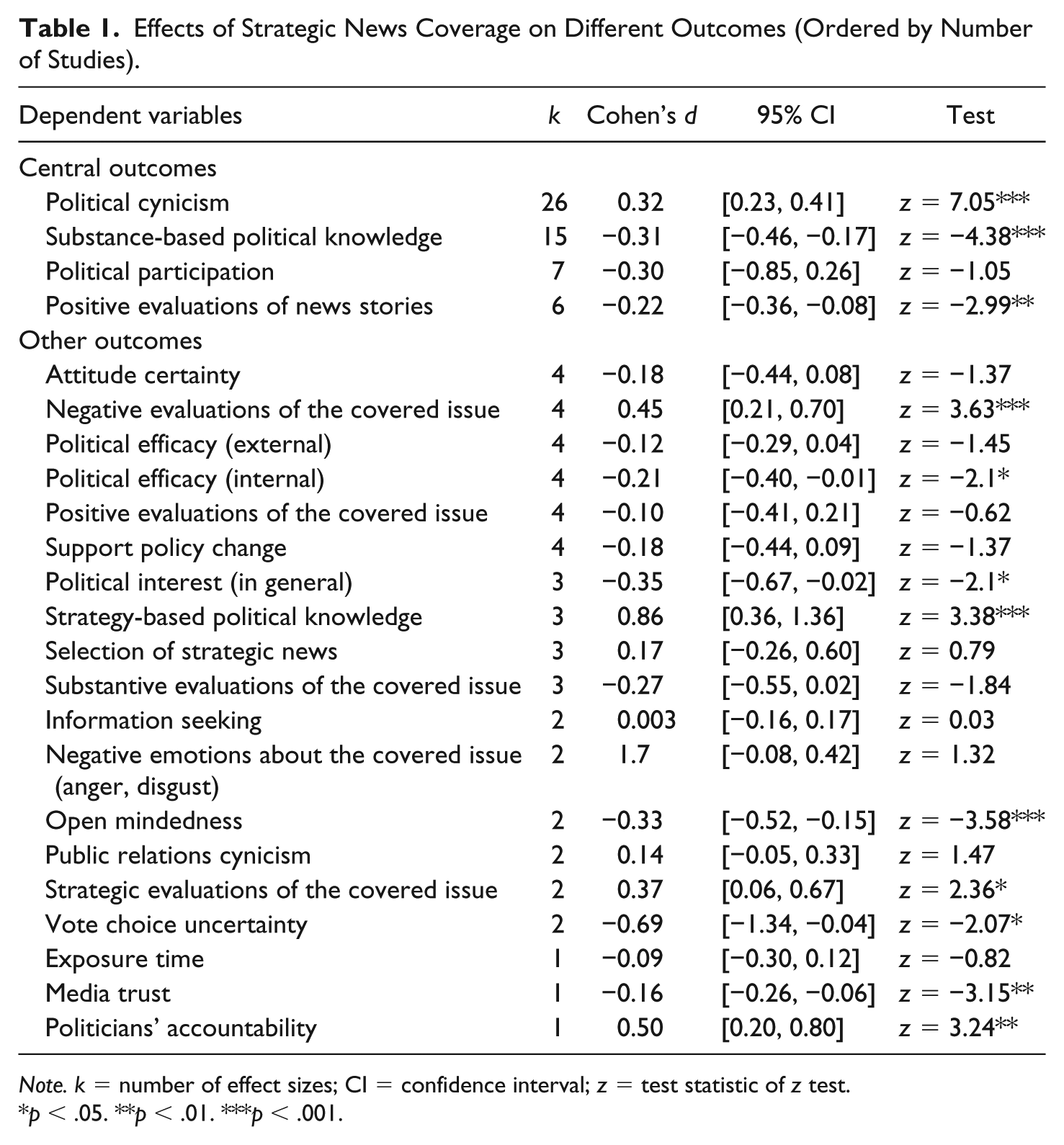
Note. k = number of effect sizes; CI = confidence interval; z = test statistic of z test.
p < .05. **p < .01. ***p < .001.
Figure 1 presents a forest plot for all effect sizes in the meta-analysis of the effect of strategic news coverage on political cynicism, along with the overall effect size at the bottom (presented by a diamond). The figure shows that most studies found a positive effect (squares are to the right of the zero line), except for one study that yielded a negative but nonsignificant effect (CI crosses the zero line).
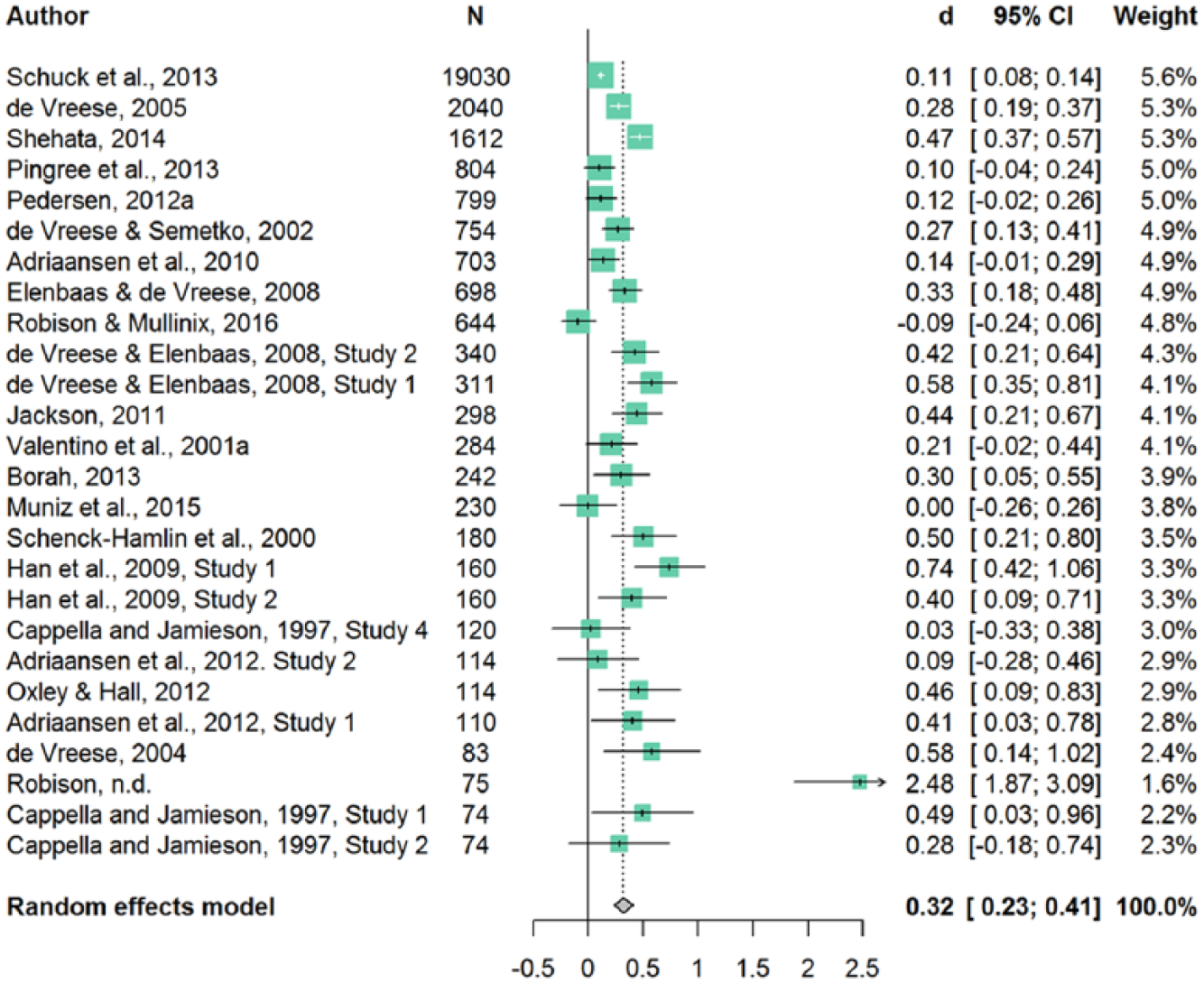
Forest plot of the effects of strategic news coverage on political cynicism (ordered by sample size) with 95% CIs.
Substance-Based Political Knowledge
According to H2, strategic news coverage leads to lower levels of substantive political knowledge about the covered issues compared with issue coverage. Results in Table 1, which are based on 15 effect sizes and 2,564 respondents, confirm this hypothesis. When journalists stress the strategic and game elements of political issues, citizens have significantly less substantive knowledge about those issues (d = −0.31; p < .001; CI = [−0.46, −0.17]; see Online Appendix B for forest plots of H2-H4).
Evaluations of News Stories
H3 posited that strategic coverage decreases positive evaluations of news stories. The results, based on six effect sizes and 2,724 respondents, confirm H3. Strategy and game frames affect the way citizens perceive the news by significantly decreasing their positive evaluations of the items (d = −0.22; p < .01; CI = [−0.36, −0.08]).
Political Participation
According to H4, strategic coverage decreases political participation. The results, based on seven effect sizes and 3,317 respondents, do not confirm this hypothesis. Although the meta-analysis revealed a negative relationship between strategic coverage and participation, this effect was not significant across studies (d = −0.30; p = .29; CI = [−0.85, 0.26]).
Moderator Analyses
I examined whether the effect of strategic news coverage on cynicism is moderated by several factors: political knowledge, partisanship, age of respondents, commercialized media systems, medium type, and election context. Among them, only partisanship and age had a significant moderating effect on cynicism (full results are available in Online Appendix B 13 ). The effect on cynicism among nonpartisans is significantly larger than among partisans (Q(1) = 7.50; p < .01), and the effect is significantly larger for younger samples compared with samples consisting of all ages (Q(1) = 4.04; p < .05). 14
Effects on Other Dependent Variables
In addition to the four main dependent variables, 19 other outcome variables were examined in the literature no more than 4 times. In total, they produced 51 additional effect sizes. Table 1 presents the results for these variables. As expected, strategy-based coverage increases citizens’ knowledge about the strategic motivations of politicians (d = 0.37; p < .05; CI = [0.06, 0.67]), reduces internal efficacy (d = −0.21; p < .05; CI = [−0.40, −0.01]), and increases negative evaluations and thoughts about the covered issue (d = 0.45; p < .001; CI = [0.21, 0.70]). Moreover, although people prefer consuming more strategy stories, the effect is not significant (d = 0.17; p = .43; CI = [−0.26, 0.60]).
Publication Bias
One threat to the accuracy of meta-analysis estimates is publication bias. A main reason for this systematic bias is that studies with insignificant results are not often published, which can lead to a biased mean effect that may not represent its size in real life. To address this concern, I contacted scholars to ask for unpublished manuscripts and used two approaches to correct for publication bias: Trim and Fill (Duval & Tweedie, 2000) and p curve (Simonsohn, Nelson, & Simmons, 2014). No evidence of substantial publication bias was found for any of the four main dependent variables, and all results led to the same original conclusions (full results are presented in Online Appendix C).
Sensitivity Analyses
To examine whether the overall effects of strategic framing are robust to specific decisions carried out during the meta-analysis, I performed several sensitivity analyses (full details are available in Online Appendix D). First, I performed a subgroup analysis to see whether there is a difference between observational and experimental studies, which were combined in the meta-analysis of cynicism, substance-based knowledge, and participation (the analysis of news stories evaluation included only experiments). No significant difference was found between experiments and observational studies for cynicism and participation. For substance-based knowledge, a significant difference between the two was detected (Q(1) = 13.29, p < .001). However, only one study was observational (Druckman, 2005), and the original effect was small and insignificant; therefore, I am cautious about making wider inferences.
Second, no significant differences were found between studies that referred to the first outcome variable as either cynicism or trust. Moreover, some scholars make a distinction between issue-specific cynicism about the covered issue and global cynicism, which relates to general attitudes about political actors and institutions (Jackson, 2011). I found that the effect of strategic coverage on both types of cynicism was practically identical. Results of additional sensitivity tests (described in Online Appendix D) also support the original results.
Discussion
The impact of mass media on citizens in democracies has been widely discussed over the years. Specifically, the way journalists cover the political domain has gained much attention, both normatively and empirically. Across varying contexts, political news tends to focus on strategy frames and horse race coverage (Aalberg et al., 2012; Cappella & Jamieson, 1997; Patterson, 1993). Because of its dominance, scholars are often concerned about the possible negative consequences of strategic news coverage for democracies.
The conventional wisdom is that the journalistic focus on political strategies and horse race features has negative consequences, especially by increasing political cynicism and alienating citizens so they become less politically engaged (Elenbaas & de Vreese, 2008). However, because political strategies, drama, and negativity attract audiences’ attention, some argue that strategic coverage may yield positive outcomes: It can increase citizens’ interest in political news stories and, as a result, it can lead to more political knowledge and more civic engagement (Meyer & Potter, 1998; Norris, 2000; Zhao & Bleske, 1998).
To address this ongoing debate about the consequences of strategic news coverage for democracy, I conducted a meta-analysis that statistically integrated the results of previous studies. The results, based on 54 findings from 32 studies with varying contexts and designs, confirm that previous concerns about the media’s emphasis on political strategies and horse race features are valid.
First, I find that strategic coverage increases the levels of public cynicism toward politics in general and toward specific issues in news stories. In other words, this coverage leads to a specific public perception of politics that is dominated by a focus on political actors’ motivations for gaining power rather than their substantive concerns for the common good. This finding has important implications for democracy in the long run. Because the public depends on the media as both an information source and an interpreter that puts facts into context, a spiral of cynicism may develop (Cappella & Jamieson, 1997). Journalists and politicians will keep focusing on nonsubstantive issues, as they believe this is what the citizens want. This will fuel the public’s distrust in political elites, which eventually might be translated into lack of confidence in the entire political process.
Because most of the literature has tested the effect of strategic coverage on cynicism in a single context, previous studies mainly focused on individual-level moderators. This meta-analysis, in contrast, was able to compare the effect across varying studies and therefore tested four groups of moderators: individual-level, system-level, media-level, and context-level factors. Results show no evidence that the effect is moderated by media system, medium type, and election context, which points to the generalizability of this effect beyond a specific context. It also leads to some discouraging conclusions. For instance, the effect was similar in both election and nonelection contexts. This finding is troubling due to the media’s tendency to “depoliticize” policy issues into dramatic political conflicts. Because citizens get a similar news diet during elections and nonelections in terms of strategy focus (Lawrence, 2000; Patterson, 1993), their perception of politics is expected to be cynical in both cases.
From an individual-level perspective, the effect of strategic news on cynicism was moderated by the age of the respondents. Because young citizens are less experienced with the democratic process and have less stable orientations, they are more susceptible to strategic coverage—the dominant way of covering politics—which shapes their perception of the political realm (Elenbaas & de Vreese, 2008). This finding has important implications because the belief systems and political orientations of younger generations are formed, to a great extent, during their initial years in the political process (Neundorf & Niemi, 2014). If they are more affected by strategic coverage during this period, they may develop deep feelings of mistrust toward political elites, which will persist throughout their adult lives.
A common argument is that citizens are attracted to negative and conflictual news stories that focus, inter alia, on political strategies. The interest in such news can assist the public, as entertainment-oriented elements (e.g., strategies, terminology of winners and losers) can reduce the cognitive costs of processing substantive information (Baum, 2002; Zhao & Bleske, 1998). However, the results of this meta-analysis agree with previous conclusions that the information acquired by citizens is far from the democratic ideal, as the coverage distracts them from substance and stresses politicians’ self-interests instead (Aalberg et al., 2012; Valentino, Buhr, & Beckmann, 2001). I find that across studies, exposure to strategy and horse race coverage leads to lower levels of substantive knowledge about the issues to which citizens’ are exposed—whether these issues concern policies or candidates’ issue positions. This finding erodes the media’s informative value because journalists cultivate a specific knowledge about politics that fosters political alienation rather than helping citizens make rational decisions based on substantive information. In other words, strategic coverage inhibits the development of an informed citizenship because the public is mostly familiar with the political rivalries instead of actually knowing what the substantive debate is about. This has important implications for democracy at both the individual and the macro levels. Because journalists are not expected to stop focusing on strategy and horse race elements, individuals will continue being exposed to less substance and fewer alternative viewpoints and therefore will form less reasoned opinions, which may eventually lead to less effective democracy (Feldman & Price, 2008; Price, Cappella, & Nir, 2002).
The results of this meta-analysis reveal a gap between citizens’ attitudes and their actual behavior. Previous studies stressed that strategic news coverage has the ability to erode the connection between the public and its representatives not only through attitudes (increasing cynicism) but also through behavior (decreasing turnout, participation in rallies, etc.; for example, Elenbaas & de Vreese, 2008; Patterson, 1993). Although this meta-analysis revealed a negative association between strategic coverage and participation, it was not statistically significant. A possible explanation for this finding is that media coverage alone is not the only factor that shapes actual participation in politics; it may be part of a wider set of variables that influence participation, such as personal resources, political attitudes, and interpersonal networks (Dalton, 2013; Verba et al., 1995).
A gap between citizens’ preferences for strategic news, on the one hand, and scholars’ and journalists’ expectations, on the other hand, may also be present. The common claim is that “the horse race sells” and therefore is more prominent in the media (Iyengar et al., 2004; Patterson, 1993). However, the meta-analytic results clearly show that citizens exposed to such coverage are more critical of news stories and consider them to be less credible, interesting, and of low quality. This gap may be a cause of concern because strategic coverage will continue to be a part of the news diet but in parallel will lead citizens to develop higher levels of cynicism and criticism not only toward politicians but also toward the media (Hopmann et al., 2015).
Looking back on the literature from the past three decades, I encourage future studies to go beyond the effects of strategy-framed politics in traditional media sources. Social media now are a central source for accessing political information (Newman, Fletcher, Kalogeropoulos, Levy, & Nielsen, 2017). It is therefore important to examine how strategy and horse race depictions of politics are being translated onto these platforms, which are less constrained by news editors, and what effects this has on citizens. For example, the increasing exposure to news via algorithms of social media and search engines (Newman et al., 2017) raises the question of whether we can really escape the spiral of cynicism, as these algorithms are a new dominant entity for spreading a less substantive discourse. These algorithms enable the public to be exposed to stories that do not require much cognitive effort, which is an important factor in a social media environment in which information abounds (Messing & Westwood, 2014). There is also a question of how this spiral may affect the public’s political knowledge, as we know that citizens learn less about politics from social media compared with traditional news (Shehata & Strömbäck, 2018).
The current study has several limitations. First, although previous research identified individual-level variables that can moderate the effects of strategic news, my ability to examine such moderators in a meta-analysis was limited because most individual-level moderators were examined by too few studies (specifically political knowledge and partisanship). Therefore, I am more cautious regarding the generalizability of the results for these two moderators. Second, the small number of countries in the meta-analysis partly limits the generalizability of the conclusions to other countries. Third, although most of the moderators of political cynicism were statistically insignificant, the between-studies variance was relatively high (see Online Appendix B), which means that the main effect of strategic news coverage on cynicism is probably moderated by other factors. Therefore, one must be cautious about interpreting the overall effect of strategic coverage on cynicism as robust regardless of any context. Future comparative studies could shed more light on different contexts (other than individual-level variations) that moderate the overall effect. Despite these limitations, I believe that the results presented herein constitute meaningful evidence for the negative implications of strategic news coverage on citizens in democracies.
Supplemental Material
Online_Appendix_revised_20180927 – Supplemental material for The Consequences of Strategic News Coverage for Democracy: A Meta-Analysis
Supplemental material, Online_Appendix_revised_20180927 for The Consequences of Strategic News Coverage for Democracy: A Meta-Analysis by Alon Zoizner in Communication Research
Footnotes
Declaration of Conflicting Interests
The author declared no potential conflicts of interest with respect to the research, authorship, and/or publication of this article.
Funding
The author received no financial support for the research, authorship, and/or publication of this article.
Notes
Supplemental Material
Supplemental material for this article is available online.
Author Biography
References
Supplementary Material
Please find the following supplemental material available below.
For Open Access articles published under a Creative Commons License, all supplemental material carries the same license as the article it is associated with.
For non-Open Access articles published, all supplemental material carries a non-exclusive license, and permission requests for re-use of supplemental material or any part of supplemental material shall be sent directly to the copyright owner as specified in the copyright notice associated with the article.
