



Abstract
Scholars suggest that hostile media perception (HMP) and third-person perception (TPP) can motivate people to take political action to counteract the unwarranted influence of slanted media. Little research has been undertaken, however, regarding how HMP and TPP relate to political participation in partisan media settings in which news media hold specific partisan or ideological inclinations. This study explored HMP and TPP of partisan media and their associations with political participation in South Korea, which has a strongly partisan media system. Findings indicate that partisans tend to have strong HMP and TPP of antagonistic partisan media. Interestingly, progressives’ HMP and TPP of hostile conservative media were stronger than conservatives’ HMP and TPP of progressive media. Accordingly, HMP and TPP of conservative media were more strongly associated with political participation than HMP and TPP of progressive media. The political and media contexts of a specific country that might shape the relationships among HMP, TPP, and political participation are discussed.
Keywords
Scholars have found that not only the use of news media, but also attitudes toward news media can affect people’s political behavior and participation. Studies drawing on hostile media perception (HMP) and third-person perception (TPP) have reported that individuals who perceive a media bias against their own predispositions and believe that slanted media have a negative influence on others tend to take political action to neutralize or correct the undue effects of biased and misleading media (e.g., Barnidge, Sayre, & Rojas, 2015; Feldman, Hart, Leiserowitz, Maibach, & Roser-Renouf, 2017; Hwang, Pan, & Sun, 2008; Rojas, 2010; Wei, Chia, & Lo, 2011). Although those studies illuminate the potential mobilizing functions of HMP and TPP of the news media in general, relatively little research has been conducted on the political consequences of HMP and TPP of partisan media. This lack of scholarly attention is understandable given the prevalence of the objectivity model of journalism in the United States, where most HMP and TPP research has been conducted. Comparative research on media systems, however, suggests that the objectivity model is not a norm and that news organizations and outlets take partisan stances in many Western societies (Hallin & Mancini, 2004). Even in the United States, news sources with partisan leanings and inclinations have become prominent on cable TV, talk radio, and the Internet (Hollander, 2008; Prior, 2013; Project for Excellence in Journalism, 2013).
This study examines the perceptions of media bias and influence in a partisan media environment and the associations of those perceptions with political behavior. Specifically, we investigate how rival partisan voters differently perceive the bias and influence of partisan media groups favoring and opposing their own political opinions and preferences. We also probe whether partisan voters’ relative perceptions of partisan media bias and influence could encourage them to participate in politics to counteract the allegedly negative influence of partisan media at odds with their own predispositions. Based on the broader literature on people’s opinion formation about media (e.g., Ladd, 2012; Watts, Domke, Shah, & Fan, 1999), we expect that partisan voters’ HMP and TPP of partisan media from ideologically opposing camps will be affected by their own partisan involvement, contextual factors such as public discourse about partisan media bias, and the real-world balance or lack thereof between rival partisan media groups in a given national media system. Given the asymmetry between rival partisan media in terms of relative power and claims of bias and influence, opposing partisans might have different levels of HMP and TPP of competing partisan media, which could in turn affect their political participation to varying extents.
We collected survey data in South Korea, which provides an excellent ground for our purposes because of Korea’s relatively strong partisan media system. Korean news media, especially newspapers and news programs on cable TV, typically align their editorial positions with either the conservative or progressive side of Korean politics. Elite and public accusations of media partisan bias and its unwarranted influence on public opinion and policy making are common and could affect people’s perceptions of bias as well as the presumed influence of partisan media. In Korea, the conservative media dominate the nation’s media market, and the public outcry against conservative media’s undue influence is stronger than the criticism against progressive media outlets. The apparent imbalance between conservative and progressive media in terms of presumed influence and the intensity of public accusations can provide important insights regarding HMP and TPP and their relationships with political participation in a partisan media context.
HMP in a Partisan Media Environment
HMP posits that partisans tend to perceive media hostility or bias against their own positions even when media reports are relatively neutral. Many studies have confirmed HMP in various topical and media contexts. Scholars explain that HMP occurs because individuals who are highly involved in a controversial issue or topic tend to process relevant information from media in a biased and defensive manner (for a review, see McLeod, Wise, & Perryman, 2017; Perloff, 2015; Tsfati & Cohen, 2013). Although most HMP research has focused on bias perception toward relatively balanced or neutral news reports, scholars have also probed audience judgments of clearly biased media content, and they reported that HMP also happens for one-sided news reports. That phenomenon, termed relative hostile media perception, suggests that partisans evaluate the bias of slanted messages relatively, judging them as less favorable or more unfavorable than disinterested individuals and especially than rival partisans on the other side of an issue (Gunther & Chia, 2001; Gunther & Christen, 2002; Gunther, Christen, Liebhart, & Chia, 2001).
Relative HMP has growing theoretical significance in a partisan news media environment in which news organizations and sources frequently take specific partisan stances and tones. Previous empirical experimental studies on relative HMP focused mainly on the perception of bias in a single news report or program rather than a general perception of bias in partisan news media organizations or outlets. In this respect, they have not fully applied the concept of relative HMP to partisan audiences’ assessments of particular partisan news organizations or media groups—a group of media organizations sharing similar partisan orientations—at large. In media systems with a high level of media–party parallelism (Hallin & Mancini, 2004), however, people are likely to recognize news organizations’ and outlets’ partisan tendencies and categorize them as either agreeing or disagreeing with their own ideological or partisan positions.
In the United States, for example, Turner (2007) found that partisan viewers distinguished the ideological orientations of individual news outlets, such as Fox News and CNN, especially when the outlets’ presumed ideological leanings disagreed with their own political perspectives. Coe et al. (2008) also reported that partisan viewers of cable TV news believed that programs disagreeing with their existing political predispositions had stronger bias than those that agreed with their predispositions. Scholars found that the presumed partisanship of news outlets could influence people’s bias perceptions of individual news stories. Arpan and Raney (2003) discovered that college football fans, when given the same balanced story about their team, perceived stronger hostility when the story was attributed to the rival university or neutral-town newspaper than when it was attributed to the hometown paper. Baum and Gussin (2007) suggested that the partisan reputations of individual news outlets, such as CNN and Fox News, could function as heuristics to determine the bias perception of an individual news story. They confirmed their conjecture in an experiment by demonstrating that participants tended to judge a neutral campaign story attributed to CNN and Fox News to be biased in the direction consistent with their existing assessment of those outlets’ partisan orientations. Overall, the basic thesis of HMP suggests that strong partisans should perceive relatively stronger bias in disagreeing partisan media than individuals holding weaker partisan tendencies. Therefore, we formulate the following two hypotheses:
TPP in a Partisan Media Environment
TPP postulates that people tend to estimate that media exert a stronger influence on others than they do on themselves (Davison, 1983). Because enhancing one’s ego is a major motivation of TPP, it tends to occur more consistently when media messages are deemed to be socially undesirable rather than desirable (Perloff, 1999; Sun, Pan, & Shen, 2008; Tsfati & Cohen, 2013). This notion of undesirability or negativity as a content moderator for TPP can help to explain how partisan audiences evaluate partisan media influence on themselves and others. When news media pursue neutrality and balance, based on the objectivity model of journalism, audiences might feel less concerned about the negative influence of news media. A partisan audience might judge balanced coverage to be less harmful than clearly slanted coverage against her own position. Fico, Richardson, and Edwards (2004) found experimentally that participants tended to believe that structurally imbalanced news about controversial issues was more biased than balanced news, and the respondents judged the newspapers apparently publishing the imbalanced stories to be less credible than the newspapers responsible for the balanced news. Gunther, Edgerly, Akin and Broesch (2012) used the childhood vaccination issue in the United States and also demonstrated that both neutral and antivaccination partisan audiences found balanced stories to be less biased than imbalanced stories supporting vaccination.
Conversely, when media take overt partisan positions against audiences’ own partisan perspectives, they might not only perceive strong media bias, but also estimate strong TPP because they believe that slanted and thus undesirable media can exert a harmful influence on other gullible individuals. Whether ideologues believe antagonistic partisan media to be undesirable or negative requires further examination. Given the diversity of content examined in TPP research, the undesirability or negativity of content could depend on the nature of the issue or topic in question. However, some studies examining the TPP of political content, such as news and political ads, at least implicitly connect content unfavorable to one’s own political preferences and viewpoints with undesirability or negativity. For example, conservative respondents held strong TPP toward negative news reports about then-Republican House Speaker Newt Gingrich (Price, Huang, & Tewksbury, 1997). People also believed attack ads against their preferred candidates to be more influential on others than on themselves (Cohen & Davis, 1991). Similarly, supporters of a losing candidate assigned less credibility to news reporting of poll results (Tsfati, 2001) and held stronger TPP about the poll reports than supporters of a winning candidate (H. Kim, 2015). Studies of relative HMP also found that perceptions of biased media content tended to raise concerns about its negative influence on other people (Gunther et al., 2001; Gunther & Schmitt, 2004). Based on those prior studies, it stands to reason that strong partisans will not only perceive unfavorable bias from hostile partisan media, but also be wary of the negative influence that antagonistic partisan media might have on others and expect that risk to be greater for others than for themselves. Therefore, we propose the following hypotheses:
Asymmetry in HMP and TPP in a Partisan Media Environment
Although people’s perceptions of media bias and influence are affected by individual factors, they are also associated with contextual and structural conditions. In this regard, the broader literature on media attitudes suggests that HMP and TPP in a partisan media context could be closely related to two contextual characteristics: public discourse about bias and the influence of partisan media and the relative power held by rival partisan media in a specific media system. A study by Watts et al. (1999) suggests that opinion leaders’ publicly expressed concerns about and criticism of media bias can shape individuals’ assessments of media bias because people take cues from political elites and other opinion leaders when forming their own opinions. Ladd (2012) found that the influence of elites’ criticism on people’s negative assessment of news media was especially strong among people who shared political beliefs with the accusing elites. In addition, presumed or actual media influence can affect an individual’s perception of media bias. Various studies have observed that bias perception is closely associated with influence assessment (Gunther & Liebhart, 2006; Gunther & Schmitt, 2004; Perloff, 1989; Tsfati, 2007; Wei et al., 2011). Particularly, Gunther and associates introduced the idea of the presumed reach of media, conceptualized as the potential audience size of a certain media outlet (Gunther & Liebhart, 2006; Gunther & Schmitt, 2004). They hypothesized that mass media’s ability to reach many people invokes partisan concerns about harmful media effects on numerous and vulnerable others, which in turn prompts partisans to use defensive information processing, which facilitates HMP. Confirming the notion, their experiments demonstrated that HMP was stronger when a message was attributed to mass media than when the same message was attributed to student essays.
The two points made in prior research imply that HMP and TPP might be closely related to discourse about media bias and media influence—presumed or actual. Regarding public discourse about news media, it should be noted that the distribution of elite cues can vary across different media systems. Watts et al. (1999) noted that in the United States, conservative elites’ claims of liberal media bias were much more common than liberal elites’ charges of conservative media bias. Accordingly, conservatives and Republicans might perceive stronger mainstream media bias in a disagreeable direction than liberals and Democrats, and empirical research indeed found that conservatives and Republicans were more likely than liberals and Democrats to distrust news media (T. T. Lee, 2005) and hold strong HMP about election reporting (Hoffner & Rehkoff, 2011; Oh, Park, & Wanta, 2011). Because partisans’ media bias perceptions can raise concerns about media influence on others (Perloff, 1989; Tsfati, 2007; Wei et al., 2011) or vice versa (Gunther & Liebhart, 2006; Gunther & Schmitt, 2004), Republicans tend to perceive that campaign coverage has a stronger influence on outgroup voters than Democrats (Hoffner & Rehkoff, 2011), and conservatives also tend to have stronger TPP about election coverage than liberals (Banning, 2006).
Although prior research conducted in the United States focused on news media in general rather than partisan media, the same reasoning can be applied to explain HMP and TPP in a partisan media setting such as South Korea. In a particular media system, the distribution of public discourse and the assumed or actual power of partisan media from opposing camps can be asymmetrical. Inequality between rival partisan media at large can lead opposing partisan groups to hold different levels of HMP and TPP toward partisan media unfavorable to their positions. Specifically, when elite criticism of one partisan group of media is more intense than that directed toward the other group, the former should reasonably generate stronger HMP. In addition, perceptions of opposing partisan media bias and influence can vary depending on the power of those ideologically opposed media, as suggested by the concept of reach (Gunther, Miller, & Liebhart, 2009). In a partisan media context, people might believe that partisan media with a greater reach are more influential than those with less reach. Hence, when one partisan media group dominates the national news media market, the audience will assign a stronger influence to it than to its counterpart on the opposite ideological side.
In South Korea, this study’s setting, the balance between conservative and progressive media in terms of reach is clearly tilted in favor of the former. Three conservative newspapers dominate the nation’s newspaper market, occupying the top three positions in circulation numbers (Korea Audit Bureau of Circulation, 2017). Those conservative newspapers also operate cable TV channels whose news programs hold the same conservative inclinations, whereas no progressive-leaning news organizations own cable TV channels. This advantage of the conservative press often evokes concerns and criticism among progressive leaders and citizens. Accusations against the conservative press are much stronger than those aimed at the progressive press. The pejorative term, “Cho-Joong-Dong” (combining the first syllables of the top three conservative news organizations in Korea), coined by progressive critics to criticize the three organizations’ allegedly excessive conservative bias and harmful influence, has become widely used by the public.
The popular criticism against powerful conservative media is closely intertwined with the rise of progressive politics and political polarization in South Korea. The imbalance between the conservative and progressive press in terms of audience size and potential political influence has been evident since the early phase of the democratic transition in the late 1980s. According to Korean media scholars (e.g., Kang, 2004; Park & Chang, 2000), news media in the earlier authoritarian military dictatorship were subject to tight government control, but during that time, they accumulated the capital necessary to develop into larger media businesses. To gain media cooperation to help maintain the regime, the authoritarian government protected compliant media companies’ business interests in various ways, including limiting the entry of new businesses into the media market. Amid the democratic transition, the leading newspapers, Chosun Ilbo, Dong-A Ilbo, and JoongAng Ilbo, quickly consolidated dominant market positions by drawing on the readership and financial resources they obtained during the authoritarian era. At the same time, those newspapers aligned their editorial positions with the conservative politics embraced by large corporations and the conservative middle-class populace. Rhee (2005) interpreted the leading newspapers’ swift move toward the conservative side as a strategy to maximize their business and political gains in the conservative-leaning social structure and atmosphere that formed in the authoritarian period and carried over into the early stages of the democratic transition. On the other hand, progressive media began late with the creation of Hankyoreh in 1988, later joined by Kyunghyang and Ohmynews. These progressive outlets lacked the opportunity to build an audience base and financial resources, which put them in underdog positions in both the public sphere and the media market.
With the growth of progressive politics, as evidenced by the election of the first progressive president in 1998, progressives began to challenge the conservative press establishment. Accusations that biased conservative media harm the public by favoring conservatives’ vested interests poured from progressive leaders, press, and citizens. The progressive media criticized the conservative media’s harmful influence on the Korean public sphere and larger society through regular media reporting and intermittent investigative series. Nam (2009) noted that Hankyoreh, the leading progressive newspaper, started the first regular media beat in Korea, followed by other progressive media, and they targeted mainly the conservative press. In a special section celebrating its 30th year of publication, Hankyoreh (2018) acclaimed its expose of the conservative press’ social harms as one of its major journalistic achievements. 1
Progressive political leaders also strongly criticized the detrimental influence of the conservative press, accusing it of bias against progressive politics. Korean scholars (J. H. Choi & Han, 2012; Nam, 2009) documented that the relationship between progressive leaders and the conservative press deteriorated visibly when Kim Dae-Jung, the first progressive president, took a series of actions, including a tax investigation of media organizations, which undermined the business interests of the conservative media. The conservative press strongly accused the progressive government’s move of impeding press freedom and responded with critical coverage of the government’s overall policies. The confrontation between the conservative press and progressive leaders climaxed with the election of the second progressive president, Roh Moo-Hyun, who accused the conservative press of being a reactionary establishment and attempted press reform that could further weaken the conservative press’ dominant position. The antagonism continued throughout his presidency, and some Korean media scholars (e.g., Kang, 2004; Nam, 2009) called the conflict a “media war.” As the progressive government and conservative press engaged in a full-scale confrontation, progressive citizens joined the progressive leaders and press in criticizing the conservative press. The spread of the Internet opened up new discursive spaces for progressive citizens to express their disaffection and organize campaigns against the conservative press. 2 S. Kim (2016) summarized the progressive citizens’ action repertoire against conservative newspapers, including boycotting conservative newspapers, pressuring advertisers, and boycotting progressive newspapers. On the other hand, criticism toward progressive news media bias is relatively weak and at most sporadic, and no organized actions have been taken against progressive news organizations.
Therefore, in Korea, where rival partisan media at large receive unequal amounts of bias accusations and hold asymmetrical reach, the public might have different levels of HMP and TPP toward partisan news media from opposing camps. To our knowledge, this conjecture has not yet been tested, but a few studies undertaken in South Korea suggest that voters’ HMP and TPP might be moderated by one partisan group’s position relative to the opposing partisan group. For example, the supporters of a losing presidential candidate in Korean elections held stronger TPP of opinion polling reports (H. Kim, 2015) and HMP and TPP of election coverage in general (Y. Lee, Jeong, & Min, 2013). Although those studies were concerned with political candidates, we suspect that the relative advantage of one partisan media group over the other will play a similar role in shaping partisan voters’ HMP and TPP.
We expect that HMP and TPP toward antagonistic partisan media will be stronger among progressive citizens than among conservatives. The lopsided advantage that conservative media enjoy in terms of reach, indicated by audience size, is expected to raise stronger HMP among progressives. The high-reach conservative press will also increase progressives’ concerns about its undesirable influence on the vulnerable masses, leading to TPP. At the same time, progressives will form higher HMP based on the larger number of available public cues against the conservative press compared with those accusing the progressive press. Because the discourse against the conservative press connects the bias of the conservative press with its powerful and negative influence on Korean society, TPP of the conservative press among progressives is likely to be higher than that of the progressive press among conservatives. Therefore, we propose the following two hypotheses:
HMP, TPP, and Political Participation in a Partisan Media Environment
Scholars have examined the behavioral consequences of the perception of media bias and influence in politics. They suggest that HMP and TPP can motivate people to take political action to counteract or correct the unwarranted influence of negative or biased media (e.g., Barnidge et al., 2015; Feldman et al., 2017; Hwang et al., 2008; Rojas, 2010; Wei et al., 2011). Supporting that notion, HMP has been found to be positively associated with both civic and electoral aspects of political participation, such as discursive engagement (Hwang et al., 2008) and general political activity (Barnidge et al., 2015; Rojas, 2010). Similarly, TPP has been reported to be positively associated with various forms of political engagement, such as voting (Cohen & Tsfati, 2009; Golan, Banning, & Lundy, 2008), and general political participation (Rojas, 2010). However, the mobilizing influence of HMP and TPP is still being debated because other studies have failed to find supportive evidence for it. For example, Banning (2006) found that TPP of election coverage was negatively associated with voting in a U.S. presidential election. Wei et al. (2011) discovered that HMP was not related to campaign discursive activities, and Ho et al. (2011) reported mixed results, finding that HMP was positively associated with issue-specific participation but negatively related to general political participation.
This lack of consensus could arise for many reasons, including the specific political issues in dispute, behavioral types, and the political contexts involving HMP and TPP. Focusing on a partisan media environment, however, we assume that HMP and TPP of partisan media, particularly antagonistic media, will be positively associated with political participation. Although little research has been done on the effects of bias and influence perception in partisan media on political engagement, the literature does suggest that partisan media use can promote political participation by strengthening existing partisan attitudes, beliefs, and identity (e.g., Levendusky, 2013; Stroud, 2011). Given that both the use and perception of news media in general can promote political participation, we expect that not only the use but also the perception of partisan media at large could have similar mobilizing effects. In addition, we expect the motivation to counteract biased media influence will be stronger for hostile partisan media than for general media because the obvious bias of antagonistic partisan media would increase partisan voters’ negative assessment of it. Therefore, our next hypotheses are as follows:
Finally, we expect that the relative power held by rival partisan media in a particular country will affect the behavioral consequences of HMP and TPP. People who perceive the dominant partisan media to have bias and influence should have a stronger corrective motivation than those who attribute bias and influence to partisan media presumed to have relatively little influence in the public sphere. As explained above, conservative media dominate the national media market in South Korea, which might lead people to perceive that conservative media have a greater reach than progressive media. Conservative media also receive more intense charges of bias and negative influence than progressive media, and thus we expect that individuals’ motivation to counteract hostile partisan media should be stronger among voters holding HMP and TPP of conservative media than those having HMP and TPP of progressive media. Therefore, our final hypotheses are as follows:
Figure 1 is a visual presentation of the hypothesized relationships discussed above.

Visual presentation of research hypotheses.
Method
Data
The data for this study were collected in South Korea. A national online survey was conducted in early April 2016, before the national election to elect members of the National Assembly on April 13, 2016. Study participants were sampled from an online panel of about 1 million registered participants maintained by a South Korean survey company. The company randomly emailed panel members who were qualified to participate in this study. Participants received compensation (e.g., cash or a coupon) from the survey company. If the qualified members agreed to participate, they filled out an online questionnaire. If certain predetermined quotas had already been met, participants who belonged to those groups were screened out. We initially set quotas for gender and a specific age range by region, based on census data. The final sample size subjected to analysis contained 1,733 individuals. Among them, gender was quite evenly distributed (49.7% female), and the age of participants ranged from 20 to 69 years (M = 42.78, SD = 12.73). About 55.1% of participants reported that they had some college education or were college graduates. The average monthly household income was between 3,500,000 and 3,990,000 won. Table 1 compares our study sample with the overall population in terms of age, gender, household income, and education. As shown in Table 1, our study sample was slightly younger and more educated than the general population. However, the household income and gender distributions were comparable with the population.
Sample Characteristics.
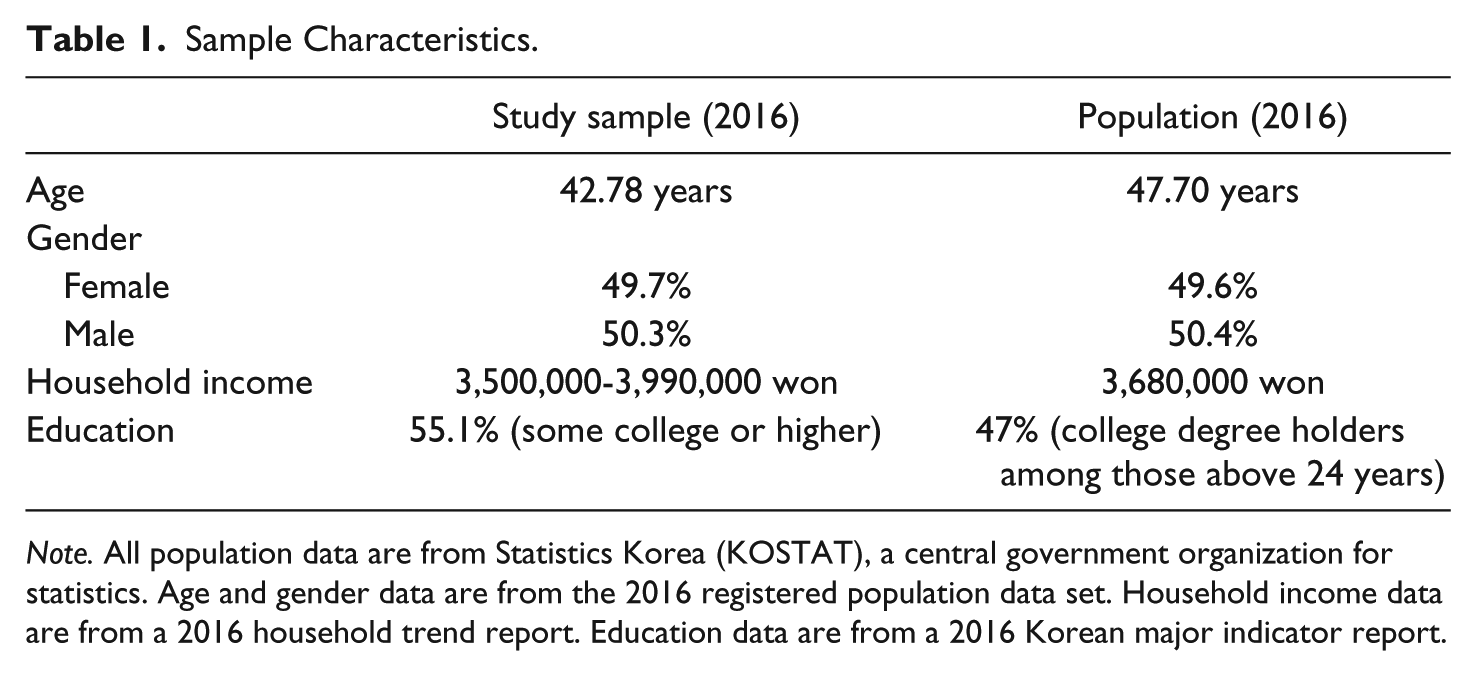
Note. All population data are from Statistics Korea (KOSTAT), a central government organization for statistics. Age and gender data are from the 2016 registered population data set. Household income data are from a 2016 household trend report. Education data are from a 2016 Korean major indicator report.
Measures
Political ideology
Political ideology was assessed by asking respondents to report their own political ideology on a 7-point scale (1 = very conservative, 7 = very progressive). The average political ideology of the final sample was 4.34 (SD = 1.56). The average political ideology after deleting those who expressed their political ideology as neutral was 4.50 (SD = 1.87).
Conservative media HMP
HMP was gauged using the absolute distance measure from previous studies exploring the relationship between HMP and political participation (Barnidge et al., 2015; Rojas, 2010). 3 HMP of conservative media was calculated based on the difference between respondents’ political ideology and their evaluation of conservative media’s political ideology. Respondents were asked to place their own political ideology on a 7-point scale (1= very conservative, 7 = very progressive). Then, they were asked to judge the political ideology of the three representative conservative newspapers using the same 7-point scale. We averaged those three scores to calculate respondents’ overall judgment about the political ideology of conservative media (M = 2.58, SD = 1.25, α = .90). To create a conservative media HMP scale, we subtracted each respondent’s averaged conservative media political ideology score from their own political ideology and then converted the result into an absolute value (M = 2.27, SD = 1.71). The three representative newspapers were Chosun Ilbo, Dong-A Ilbo, and JoongAng Ilbo. According to the Korea Audit Bureau of Circulation (2017), they ranked as the top three daily newspapers in circulation in 2016, with Chosun Ilbo selling 1,254,297, Dong-A Ilbo 729,414, and JoongAng Ilbo 719,931 copies daily.
Progressive media HMP
The same method was used to calculate HMP of progressive media. The political ideology attributed to three representative progressive news outlets was averaged (M = 4.71, SD = 1.21, α = .79), subtracted from each respondent’s own political ideology, and then converted into an absolute value (M = 1.53, SD = 1.35). Of the three progressive news outlets used in the survey, two were daily newspapers, Hankyoreh with a daily circulation of 202,484 and Kyunghyang Shinmun with a daily circulation of 165,133 (Korea Audit Bureau of Circulation, 2017), and the third was OhmyNews, an online-only news service.
Conservative media TPP
To measure TPP of conservative media, we asked two questions. First, to measure the perception of media influence on others, we asked, “To what extent do you believe conservative media will affect voters’ candidate choice other than yourself?” Next, to measure the perception of media influence on self, we asked “To what extent do you believe conservative media will affect your candidate choice?” Both items were measured using a 7-point scale (1 = no influence at all, 7 = a great deal of influence). The perception of conservative media influence on self (M = 3.61, SD = 1.61) was subtracted from the perception of conservative media influence on others (M = 4.49, SD = 1.37). The mean of the scale of conservative media TPP was .87 (SD = 1.73).
Progressive media TPP
The same procedures were used to establish TPP of progressive media. The perception of progressive media influence on self (M = 3.95, SD = 1.47) was subtracted from the perception of progressive media influence on others (M = 4.25, SD = 1.27). The mean of the scale of progressive media TPP was .30 (SD = 1.26).
Political participation
Political participation was assessed using seven dummy variables based on respondents’ participation in various types of political activities. Specifically, participants were asked to report whether they had participated in each of the following activities during the preceding year: writing or phoning a government official, donating money to a campaign, signing a petition for a political cause, persuading others to vote for a specific candidate or party, persuading others not to vote for a specific candidate or party, boycotting or buycotting for political causes, and taking part in a protest or demonstration. Later, answers were summed to build a composite index of political participation (M = .84, SD = 1.44).
Control variables
Four basic demographic variables, gender, age, education, and household income, were controlled. In addition, three political variables were measured to control for (a) political interest, (b) political knowledge, and (c) internal political efficacy. To measure political interest, the following two items were rated on a 7-point scale: interest in politics in general and interest in the upcoming election. Responses were combined and averaged to build a composite measure of political interest (r = .78, p < .01, M = 4.53, SD = 1.49). The index for political knowledge was created by adding the number of correct answers to four political knowledge questions (M = 2.09, SD = 1.28). Internal political efficacy was assessed on a 7-point scale using three items, including “I have the ability to understand political matters” and “I have the ability to talk about and participate in public affairs.” The responses to those three questions were averaged to create a composite measure of internal political efficacy (M = 3.84, SD = 1.30, α = .89).
Results
Descriptive Statistics and Model Testing
The full correlation matrix of key variables is presented in Table 2. The correlation coefficients mostly fall within the range of weak and moderate magnitudes, with the strongest correlation between political ideology and conservative media HMP (r = .66, p < .001). Structural equation modeling, using AMOS 21.0, was conducted to examine the hypothesized relationships among the variables. 4 After checking the data normality, we analyzed the sample variance-covariance matrix using the maximum likelihood minimization function.
Zero-Order Correlations.

Note. HMP = hostile media perception; TPP = third-person perception.
p < .001. ***p < .001.
The model presented in Figure 1 showed inadequate fits based on commonly used criteria (Hu & Bentler, 1999): χ2(5) = 150.27, p < .001, comparative fit index (CFI) = .97, normed fit index (NFI) = .97, root mean square error approximation (RMSEA) = .13. Based on modification indices, we controlled the error terms between conservative media HMP and conservative media TPP, after which the model fit statistics improved: χ2(4) = 20.58, p < .001, CFI = 1.00, NFI = 1.00, RMSEA = .05. A chi-square difference test showed a statistically significant difference between the two nested models (Δχ2 = 129.69, Δdf = 1; p > .001).
Research Hypotheses
The first pair of hypotheses supposed that the more progressive (H1a) or conservative (H1b) a respondent is, the more strongly that respondent would hold HMP toward antagonistic partisan media. As shown in Figure 2, there was a positive association between political ideology (where bigger numbers represent more progressive political ideology) and HMP of conservative media (β = .63, p < .001), supporting H1a. Likewise, the more conservative a respondent was, the more strongly that respondent perceived bias in progressive media (β = –.45, p < .001), supporting H1b.
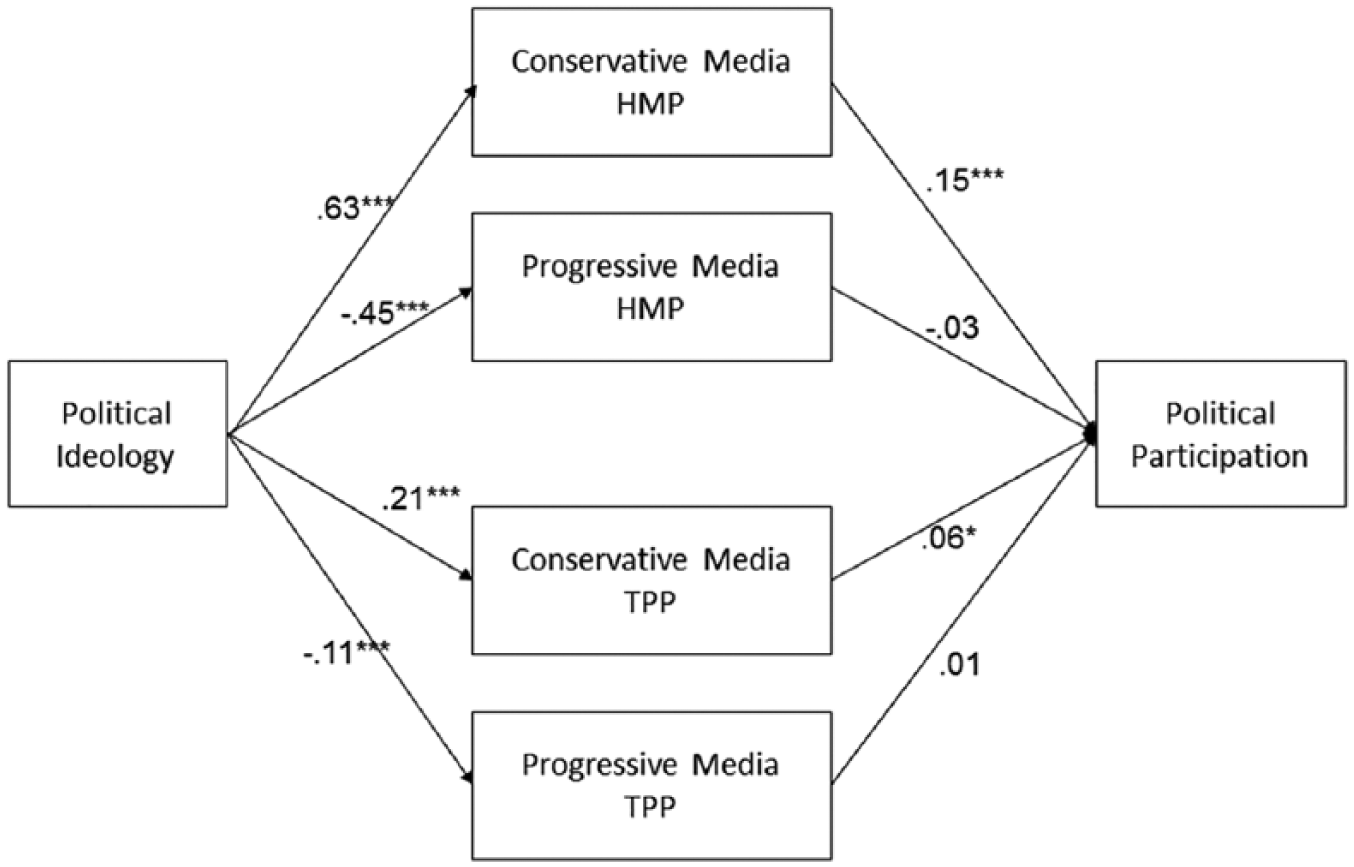
Regression weights of hypothesized paths.
The second pair of hypotheses predicted that more progressive (H2a) or conservative respondents (H2b) would hold stronger TPP toward media at odds with their political ideology. As expected, more progressive respondents perceived stronger conservative media influence on others than on themselves (β = .21, p < .001), and therefore H2a was supported. In addition, more conservative respondents perceived stronger progressive media influence on others than on themselves (β = –.11, p < .001), which supported H2b.
H3a predicted that progressives would hold stronger conservative media HMP than conservatives hold progressive HMP. To test that hypothesis, we first excluded respondents who reported their political ideology as neutral. A total of 557 responses (32.1% of total respondents) were deleted from the full sample for this analysis. Then, we used an independent sample t test to compare the HMP that progressives and conservatives had toward antagonistic partisan media. We excluded respondents with neutral political ideology only for this test of hypotheses H3a and H3b. The results show that progressives had stronger HMP of conservative media (M = 3.67, SD = 1.35) than conservatives had of progressive media (M = 2.89, SD = 1.45), which supported H3a, t(1174) = −9.24, p < .001. H3b predicted that progressives would also hold stronger TPP of conservative media than conservatives hold of progressive media. We used a procedure similar to that used to test H3a and found that progressives had stronger conservative media TPP (M = 1.41, SD = 2.01) than conservatives had progressive media TPP (M = .53, SD = 1.39). Therefore, H3b was also supported, t(1174) = −8.00, p < .001.
H4a predicted a positive association between HMP toward partisan media and political participation. As shown in Figure 2, only conservative media HMP was positively associated with political participation (β = .15, p < .001). In contrast, HMP toward progressive media was not associated with political participation (β = –.03, ns). Therefore, H4a was partially supported. H4b also predicted a positive association between TPP of partisan media and political participation. Again, the results show that only conservative media TPP was positively associated with political participation (β = .06, p < .05), whereas progressive media TPP was not (β = .01, ns). Therefore, H4b was also partially supported.
H5a predicted that HMP of conservative media would be more strongly associated with political participation than HMP of progressive media. Similarly, H5b predicted that TPP of conservative media would be more strongly associated with political participation than TPP of progressive media. We tested this last pair of hypotheses using Wald tests by comparing the size of the regression weights. The results show that the relationship between conservative media HMP and political participation (β = .15) was stronger than the relationship between progressive media HMP and political participation (β = –.03; Wald test = −5.086, p < .05). Therefore, H5a was supported. Likewise, the analysis indicates that TPP of conservative media was more strongly associated with political participation (β = .06) than TPP of progressive media and political participation (β = .01; Wald test = 2.660, p < .05). Therefore, H5b was also supported.
Discussion
In the current research, we have interrogated perceptions of media bias and influence and their associations with political participation in South Korea. We assumed that South Korea would provide useful insights into HMP, TPP, and their political effects in a partisan media setting because of the country’s strong partisan media system and the imbalance between rival conservative and progressive media in terms of intensity of criticism and assumed power in the public sphere. First, our analysis indicates that strong partisans tend to hold large HMP and TPP toward partisan media at odds with their own ideological orientations. We also found that progressives’ HMP and TPP of hostile conservative media were much stronger than conservatives’ HMP and TPP of antagonistic progressive media. The results support our conjecture that conservative media’s relative advantage over progressive media in audience size and the more intense accusations of bias and influence leveled against conservative media compared with progressive media would yield those differences.
We also discovered that disparities in the level of HMP and TPP toward rival partisan media were differently associated with political participation. In line with prior research (Hwang et al., 2008; Rojas, 2010; Wei et al., 2011), we assumed that HMP and TPP would motivate people to participate in politics to counteract or correct unwarranted media influence. Extending the notion to a partisan media setting, we expected that different levels of HMP and TPP toward rival partisan media would have different relationships with political participation. We supported that prediction by demonstrating that HMP and TPP toward conservative media were associated with political participation, but we found no such relationships between HMP and TPP toward progressive media and political participation.
The current research expands knowledge about HMP and TPP in two significant ways: offering new findings about HMP, TPP, and their political consequences in a partisan media environment and demonstrating that structural conditions unique to different media and political settings can differently affect HMP and TPP. The investigation of HMP and TPP toward partisan media has been largely neglected, although media organizations and outlets in many democracies have particular partisan or ideological orientations. We speculate that the lack of research is because prior research has been mainly, though not exclusively, conducted in the United States, which has a long tradition of the objectivity model of journalism. However, the existence of established partisan media systems in European countries and the rise of partisan media in countries such as Korea and the United States make it important to scrutinize perceptions of partisan media and their political effects. Addressing that gap in prior research, we have provided evidence that HMP and TPP develop uniquely and relatively in a partisan media context, such that partisans perceive that partisan media with which they disagree display stronger bias and greater influence than the media on their side. The finding of stronger TPP toward antagonistic rather than friendly media is significant because TPP, with HMP, can cause a variety of attitudinal and behavioral outcomes, including political participation. Specifically, this study found a new path from partisan media to political participation by showing that perceptions of partisan media could promote political activities.
More significantly, this study documents that HMP and TPP are associated with the distinctive political and media factors of a particular national setting. Prior research has focused mainly on individual predispositions that cause and moderate HMP and TPP. We argue that the structural conditions particular to an individual country also affect people’s media perceptions. In this research, we focused on the potential moderating functions of the intensity of media criticism and presumed media power in the public sphere, which are unequally distributed between conservative and progressive media in Korea. Given that the imbalance between rival partisan media arises from unique political and media arrangements that developed in Korea since its democratization, our findings reaffirm the need to consider the larger political and media landscapes that affect individuals’ HMP, TPP, and subsequent behaviors. In summary, this study contributes to existing scholarship by examining media perceptions and their consequences in a uniquely partisan media environment outside the United States. Our findings invite future research to explore the similarities and differences in the formation of HMP and TPP across diverse national contexts, including both countries with a long history of partisan media traditions and countries such as the United States that are experiencing growing partisan media trends.
Normatively, this study raises some questions about the role of media in political participation in a partisan environment. Studies from the United States provide evidence that partisan media use can lead to ideological and affective polarization, which in turn positively relates to participation (e.g., Iyengar & Krupenki, 2018; Stroud, 2011). Our findings indicate that in addition to partisan media use, the perceptions of bias in partisan media and the influence they wield might also encourage people’s political activities. Further research is required to determine whether negative perceptions toward antagonistic partisan media drive ideological and affective polarization and subsequent political activity or whether partisan media perceptions themselves are an indication of polarization. However, it seems clear that the role of media as a public space in which to seek for solutions to common problems across partisan differences might weaken when news media outlets themselves became a target of partisan criticism and even animus. Also, when citizens are motivated to participate because of partisan animosity against opposing media rather than as a result of receiving trustworthy and credible information from the media, the normative expectation that news media foster informed participation seems to be on shaky ground. Moreover, political polarization could be further intensified if partisan leaders and media strategically attack antagonizing media to galvanize in-group partisan support and participation.
This study’s limitations should be acknowledged. First, it is necessary to consider alternative explanations. In this instance, we cannot rule out the possibility that the electoral context itself might have produced our results. The 2016 legislative election was held under a conservative presidency, and before the election, the ruling conservative Saenuri Party had a majority in the National Assembly over the progressive Minjoo Party. About a month prior to the election, a minor faction in the Minjoo Party, after intense intraparty conflicts, seceded and officially started its own People’s Party. Amid that division within the progressive camp, preelection opinion polls asking for respondents’ party support suggested an outright win for the conservative party. Conservative media could have highlighted the progressive party conflicts and opinion environment hostile to the progressive side, which might have caused progressive opinion leaders and voters to worry about antagonistic conservative media bias and its influence on other voters. The progressive concerns could have been expressed and shared through their offline and online networks, which could have increased progressives’ motivation to participate in politics.
Second, our assumption about the role of reach in HMP and TPP requires a caution. We presumed that the perceived reach or audience size of a particular outlet would affect people’s perceptions of that outlet’s bias and influence. Although we supposed that conservative media had higher reach than progressive media based on the actual circulation size, we did not test whether the real gap in audience size translated into a perceived reach gap that could moderate HMP and TPP toward the rival partisan media.
Third, it is important to recognize the limitations of the data we used in this study. Specifically, we used online panel data not based on the probability sampling method, which means that we cannot ensure the representativeness of our study findings. In addition, the cross-sectional nature of the data significantly restricts our capacity to test causal claims, so the findings that imply causal claims should be read with caution. Some of our measures also had limitations. In particular, because we collected the data during the general election campaign, it would have been better to measure participation in election-specific activities, instead of general political actions. We also considered only traditional offline political participation, but many people engage in politics through online and social media. Considering that both partisan media messages and media criticism also circulate online, future research needs to explore the functions of HMP and TPP in the diverse forms of online political participation.
Footnotes
Declaration of Conflicting Interests
The authors declared no potential conflicts of interest with respect to the research, authorship, and/or publication of this article.
Funding
The authors received no financial support for the research, authorship, and/or publication of this article.