




Abstract
Whether agenda-setting effects occur and how strong they are appear to be strongly context-dependent. The baseline public and media salience of an issue and the extent of abrupt changes in salience have been mentioned as potential contingent conditions, but without any empirical follow-ups. First, this study demonstrates how agenda-setting effects unfold on a day-to-day basis, finding that only one fourth of the results (p < .05) are in line with the original agenda-setting hypothesis. Second, it tests how (a) the baseline intensity of public and media salience and (b) strong temporary increases (“spikes”) in public and media salience impact the likelihood and strength of agenda-setting effects. Higher baseline public salience and stronger spikes in media salience systematically influence the likelihood and strength of agenda-setting effects. Agenda-setting scholars should systematically check, report, and possibly control for baseline intensity and spike momentum of media and public salience, which is also easy to implement.
Keywords
Agenda-setting research of the natural history type (or “type III” in the “Acapulco typology”: McCombs, Danielian, & Wanta, 1995) suffers from two major research gaps that give rise to this study: (1) Time lags in agenda-setting studies are typically years (Funkhouser, 1973), months (Stone & McCombs, 1981), or weeks (Brosius & Kepplinger, 1990). From a theoretical viewpoint, these intervals may be too long to capture the true temporal dynamics between agendas and identify causal directions in a convincing fashion (Geiß, 2013). The current study uses daily intervals to alleviate that research gap. (2) Multi-issue studies usually find media-induced agenda-setting effects on the public agenda in some, but not in all issues, and we do not know why. The conditions for agenda-setting effects are only explored rudimentarily. The few empirical studies seeking to find explanations for the lack of theory-compatible effects had only limited success. Both research gaps are connected: First, it is necessary to establish time lags in a precise fashion to know which issues exhibit agenda-setting effects and which do not. Second, the conditions under which agenda-setting effects are more likely can be explored.
Context contingency of agenda-setting effects is usually attributed to “issue characteristics” such as the differential accessibility and relevance of real-world indicators for citizens (Demers, Craff, Choi, & Pessin, 1989) or citizens’ sensitivity for issues (Rössler, 1999). In contrast, this study focuses on the dynamics of media and public salience toward an issue (i.e., properties of the underlying time series themselves), which has been discussed as a contingent condition for agenda-setting effects (Brosius & Kepplinger, 1990), but with no empirical follow-ups. The rationale is that issues with high media attention and strong peaks in media attention may have a greater potential to exhibit agenda-setting effects compared with issues with low media attention and no or only weak peaks. The same goes for the public agenda: If public salience is above a certain threshold (Neuman, 1990) or if there are pronounced peaks in public salience, the likelihood and extent of agenda-setting effects of media coverage may change.
This study examines whether the average salience (“baseline”) and abrupt upsurges in salience (“spikes”)—both in media salience and public salience—influence the likelihood and strength of agenda-setting effects using 88 day-by-day time series of media and public agendas regarding 22 issues during the 2009 and 2013 federal election campaigns in Germany. The study uses a framework for analyzing the dynamics of media salience of issues (Geiß, 2018), which is also applied to public salience.
Puzzles in Agenda-Setting From the Natural History Perspective
The agenda-setting tradition uses multiple research designs to answer different questions: Despite the advantages of experiments (Iyengar & Kinder, 1987) and cognitive portrait studies (Geiß, 2015; Rössler, 1999) to study psychological processes in agenda-setting, aggregate-level studies can capture more structural patterns and factors in the interaction between the media salience and the public salience of issues (Brosius & Kepplinger, 1990).
In over 45 years of agenda-setting research, important deviations from the original agenda-setting hypothesis (McCombs & Shaw, 1972) emerged: Positive effects of media salience on public salience proved conditional rather than univeral. It holds only in some issues some of the time. However, the question is still, “What are the exact conditions under which the original hypothesis holds more reliably, that is, the contingencies of the media’s agenda-setting power?”
Time Lag Puzzle: Media-Led, Public-Led, and Instantaneous Issue Salience Changes
Classical agenda-setting research assumed that media salience would change first and public salience would follow suit (media-led change). Convincing evidence from longitudinal studies shows this temporal order (Wanta & Hu, 1994). But constellations where media salience induces changes of public salience are obviously only one part of the story. Longitudinal agenda-setting studies have repeatedly found a substantial number of cases in which (a) media salience and the public salience change instantaneously and the direction of influence is ambiguous, and (b) changes in public salience precede changes in media salience (Brosius & Kepplinger, 1990). Methodological limitations of the studies may be responsible for the inconsistent findings to some degree: The temporal resolution for testing time lags is usually between 1 week and 1 year. But actual time lags between exposure and public reaction may be much shorter, as experimental evidence (Iyengar & Kinder, 1987; Pingree & Stoycheff, 2013) and diffusion studies (e.g., Kepplinger, Levendel, Livolsi, & Wober, 1987) suggest. While media content is usually time-stamped and can easily be analyzed with greater temporal resolution, survey data are usually the limiting factor.
There are several studies in the agenda-setting tradition and adjacent fields that have used daily or even greater temporal resolution, but they use proxies rather than conventional survey-based measures of the public agenda. For instance, studies have sought to relate media salience changes to Google search volume (Granka, 2010; Scharkow & Vogelgesang, 2011) or to viewing and editing issue-related Wikipedia entries (Geiß, Leidecker, & Roessing, 2016). Generally, the audience’s search behavior responded much more quickly to media stimuli than responses to the MIP question change, within a few minutes or hours (Geiß et al., 2016). Also, studies of intermedia agenda-setting have explored shorter time lags, for example, daily intervals with regard to newspapers and TV news (Geiß, 2013; Haim, Weimann, & Brosius, 2018) and exact publication time stamps for online media and blogs. For instance, Leskovec, Backstrom, and Kleinberg (2009) studied how phrases (quotes, text bites) diffuse through news media and blogs. The bulk of blogs followed around 2.5 hours after the peak of media coverage. Harder, Sevenans, and Van Aelst (2017) used 6-hour intervals for their time series analysis.
To overcome these shortcomings, the current study uses conventional survey-based measures of public salience: Rolling cross-section (RCS) survey data (Johnston & Brady, 2002) allow for high temporal resolution, with time lags of as short as 1 day. In addition, this study tests a large number of “accruing” time series (n = 88) with no selection bias (i.e., it did not select issues in a systematic fashion). Thereby, this study allows for a rough estimate as to how frequent media-led, instantaneous, and public-led salience changes are during election campaigns. This is an important step forward, increasing the level of precision such that researchers’ decisions or the structure of available data do not artificially limit the possibilities of what could be found.
Second Puzzle: Positive or Negative
Even if media salience changes first and changes in public salience follow, some studies document a negative relationship between media and public salience: more (less) coverage led to lower (greater) public salience (Brosius & Kepplinger, 1990; Schönbach & Semetko, 1992). Scholars have discussed various reasons why media coverage even decrease public salience of an issue: (1) the media may have published positive news from which citizens conclude that the issue has become less pressing (Schönbach & Semetko, 1992); (2) citizens may be fed up with an issue and devaluate the issue’s importance even if media salience increase (Downs, 1996; Geiß, 2015); (3) the media may lose interest in covering an issue while the public salience of the issue remains high (“echo effect”: Brosius & Kepplinger, 1992); and (4) the media may try to raise public salience of issues they perceive as underrated. The evidence on the relative frequency of positive, negative, and null effects is yet unsatisfactory: single studies usually feature a low number of issues (=cases) and meta-analyses or literature reviews (Wanta & Ghanem, 2007) suffer from publication bias.
Given the lack of knowledge, this study will explore conditions affecting the likelihood of positive, media-led relations between media and public salience, and try to account for variations in strength of media-induced agenda-setting effects. Currently, the best estimate we have is from Brosius and Kepplinger’s (1990) study of weekly data of 16 issues over 1 year that identified significant, positive media-led effects on public salience for two issues (or three to four issues if marginal statistical significance is counted). This gives the rough estimate that around 12.5% to 25% of issues may cause agenda-setting effects in the sense of positive, media-led changes in the public agenda. With 88 time series and the daily measurements, the current study will provide a more solid assessment of the relative frequency of positive, negative, or null effects.
Contingency on Issue Salience Dynamics
Contingent Conditions for Agenda-Setting Effects
The dominant account of why scholars usually find agenda-setting effects in some but not in all instances is that the direction and strength of relationships between media and public salience of issues is context-dependent: it varies between issues and within issues over time (Brosius & Kepplinger, 1990). But the nature and cause of context conditions of agenda-setting rarely received the attention they deserve (but see Vliegenthart & Walgrave, 2008). To come to grips with context variables that may affect the direction and strength of agenda-setting effects, it is helpful to distinguish between a few general classes of context variables that researchers have discussed to make sense of context-dependent agenda-setting effects: (1) Issue characteristics, (2) between-issue relationships, and (3) issue salience.
Issue characteristics are actual or perceived features that describe the nature and substance matter of the issue. Different issue characteristics (and public attitude toward issues) have been investigated in some empirical studies, for example, obtrusiveness (Demers et al., 1989), issue sensitivity (Rössler, 1999), need for orientation (Matthes, 2008), and loadedness with news factors (Schulz, 1982). These studies show that issue characteristics condition agenda-setting effects, but they fail to account for cases in which the same issue exhibits strong agenda-setting effects at one point in time and no or reverse agenda-setting effects at a later point in time.
Issue relationships designate the reinforcement and displacement (competition) processes between issues and the overall degree of competition between different issues on the agenda, plus its change over time (e.g., “busy” versus “lazy” news days). Brosius and Kepplinger (1995) emphasize that particular issues (“killer issues”) stably displace other issues (“victim issues”), while others conceptualize the roles of issues as more variable (Geiß, 2011). Empirical studies (Brosius & Kepplinger, 1995; Geiß, 2011) show that issue competition significantly influences media and public salience. However, neither empirically nor theoretically does it provide a comprehensive explanation of context dependency in agenda-setting.
An important part of the explanation for puzzling findings and nonfindings in agenda-setting research may lie in the development of media and public salience itself. A particularly promising explanation for puzzling findings in agenda-setting studies concerns whether and how media and public salience of an issue changes in the first place: The development of media salience over time differs strongly between issues, as does the development of public salience (Brosius & Kepplinger, 1990; Geiß, 2018); and some kinds of issue evolution may be more likely to trigger agenda-setting effects than others. Brosius and Kepplinger (1990) stress that the extent of agenda-setting effects varies over time: the media agenda and the public agenda fitted well in some months and strongly diverged in other months (within-issue variation). They advise to “classify the nature of issues generating agenda-setting effects and the period in which they are likely to occur” (Brosius & Kepplinger, 1990, p. 203). In addition, they provide evidence what features of issues may underlie such a classification: [a]n influence of [. . .] coverage on problem awareness was likely [. . .] when coverage of an issue was intense [. . .] and when relative variation [over time] was large [. . .]. Intensity and variation can be regarded as prerequisites for television effects [. . .]. (Brosius & Kepplinger, 1990, p. 204, emphasis added)
However, these accounts have not received any empirical follow-ups until now. Both aspects of issue salience dynamics, intensity and variation, will be explored in more detail in this study, in their effects and their antecedents.
Intensity: Baseline
Rationale and hypotheses
The importance of intensive coverage and substantial public awareness as contingent conditions is already implicitly acknowledged in the field: Agenda-setting case studies tend to select issues with high media or public salience. On one hand, this reflects the attempt to find issues with great social significance. On the other hand, the latent belief that “bigger issues” are more prone to exhibiting agenda-setting effects underlies issue selection.
There are two main reasons why higher baseline of media and public salience should increase the likelihood of finding agenda-setting effects: (1) If public salience is already high, large parts of the public will already be aware of the issue; the issue is beyond the “threshold of public attention” (Neuman, 1990) and is less likely to be overlooked. The same applies to greater media salience—An issue covered massively is more likely to be in the “relevant set” of issues that might be important. The effect that more coverage may be needed to raise awareness in the first place (acceleration effect) or that the public will react more strongly to the first news stories and less strongly to later stories (inertia effect) (Brosius & Kepplinger, 1992) does not apply. Hence, the public should more linearly respond to changes in media salience. (2) If media and/or public salience is already high, no floor effects are to be expected, so downward trends are possible in both media and public salience. In addition, empirical assessments by Brosius and Kepplinger (1990) point in the direction that issues with higher baseline salience are more likely to experience agenda-setting effects. I hypothesize: The media salience baseline (H1) and the public salience baseline (H2) of an issue (a) affect the likelihood and (b) affect the strength of agenda-setting effects; more specifically, higher media salience baseline (c) increases the likelihood and (d) increases the strength of agenda-setting effects.
H1c and H1d—that the effect of media and public salience baseline will be positive—is tied to the condition that baseline salience has not yet reached a level where public salience cannot get any higher or growth in public salience (ceiling effect). In the same vein, the fact that an issue is already established on the public and/or the media agenda may in itself limit the agenda-setting capability because the element of surprise and novelty of an issue is lower and most audience members will already have considered whether they find the issue important or not.
Factors affecting baseline salience
If higher media salience baselines are in fact related to greater likelihood and strength of media agenda-setting effects, the question emerges why some issues have higher media salience and public salience baselines than others, and what it means.
A high media salience baseline represents issues that receive constant intense news coverage during the period of study. News organizations deem it newsworthy either for its general characteristics (e.g., its general relevance for the audience/the public) or at least temporarily due to an ongoing debate or series of events/happenings. For instance, the regular activity of diplomats and state visits to other countries will continuously generate a more or less stable number of reports about international relations and foreign policy (Geiß, 2018). A high baseline may also result from continuous public relations efforts (Gandy, 1982). It is not sufficient to consider baseline media salience a mere correlate of “continuous relevance” as the underlying causal factor, however. The “continuous relevance” needs to be communicatively constructed—in “negotiation” with the public. This is why the public salience baseline has to be considered as a separate factor affecting the likelihood of agenda-setting effects: Issues with a continuously high importance rating among the audience seem to resonate with the audience already. This can be the consequence of recent media coverage, but also the “echo effect” of coverage a long time ago (Brosius & Kepplinger, 1992), or the consequence of other cues (e.g., “real-world cues” such as gas prices).
Variation: Spike Momentum
Rationale and hypotheses
More prominent issues may also be more prone to exhibit strong variation of media and public salience, that is, the time series include abrupt spikes or peaks. In media salience, such peaks soundly fit the definition of a news wave following a key event. A news wave is a temporary increase in the amount of news coverage about a particular issue (Geiß, 2011, 2018; Vasterman, 2005). The momentum or intensity of such a wave or spike in media (public) salience is the higher the more news coverage (public salience) increases above the baseline of coverage (public salience) and the longer this increase lasts. Such stronger and more long-lasting increases (“shock,” spike, peak, news wave, key event) are easily recognized by the entire public (mostly independent of their news use), while weaker and shorter increases may be overlooked by a substantial number of citizens. It is likely that a “shock” in media coverage motivates many people at the same time to prioritize that issue (or at least consider to do so). Still, the individual may decide to respond to that observed upward trend or not; but if an upward swing in media salience is widely noticed, the chances for a corresponding upward swing in public attention increases. The salience and lucidity of the development—the upward trend in the media—makes effects more likely and possibly stronger. Also, observing abrupt and strong changes in public salience of an issue provides optimal conditions for tracing this “spike” back to the factors that triggered it, where changes in media salience are a likely candidate. Conversely, lack of variation in the dependent or independent variable (“frozen issue salience”) is a condition under which agenda-setting effects are unlikely. For instance, a “frozen public salience” may indicate that the audience has already decided to rate an issue as important or unimportant and does not respond to media salience. Hence, ceiling and floor effects would materialize as “frozen” public or media saliences. I hypothesize: The momentum of spikes in media salience (H3) and in public salience (H4) of an issue (a) affects the likelihood, and (b) affects the strength of agenda-setting effects. More specifically, higher momentum of spikes in media salience (c) increase the likelihood and (d) increase the strength of agenda-setting effects.
Factors affecting spike momentum
What are the factors leading to greater spike momentum? Real-world changes in the seriousness or urgency of a problem are likely causes of spikes in media salience and prevent “freezing” of media salience. Particularly, a series of newsworthy events is conducive to a spike in media salience (Baumgartner & Jones, 2002; Geiß, 2018; Kepplinger & Habermeier, 1995). However, real-world changes pass through the lenses and filters of perception. Most of the filtering mechanisms in the mass media are the result of (1) the need to maximize interestingness and informativeness for the audience (relevance, suspense, novelty, influential actors: Harcup & O’Neill, 2017), (2) to get reliable information with high efficiency and low risk of criticism (source preferences: Fishman, 1980; objectivity “rituals”: Tuchman, 1972); in addition—as a consequence of uncertainty and economic pressure—they will (3) closely follow the coverage of their competitors and high-reputation media (“routine reliance”) (Boczkowski & de Santos, 2007; Reinemann, 2004). This stimulates intermedia agenda-setting and reinforces spikes in media salience. A series of newsworthy happenings and events (staged and genuine, causally connected or reconstructed) about which reliable information is available from authoritative sources is most likely to lead to spikes in media salience (Brosius & Eps, 1995; Geiß, 2018; Kepplinger & Habermeier, 1995). Spikes in media and/or public salience may be caused by other cues such as “real-world cues” (e.g., rising consumer prices). Usually, there will be a mixture of the three processes in aggregate-level studies. Figure 1 illustrates the concept of issue baseline and spike momentum, and the factors shaping the baseline and spike momentum of an issue.
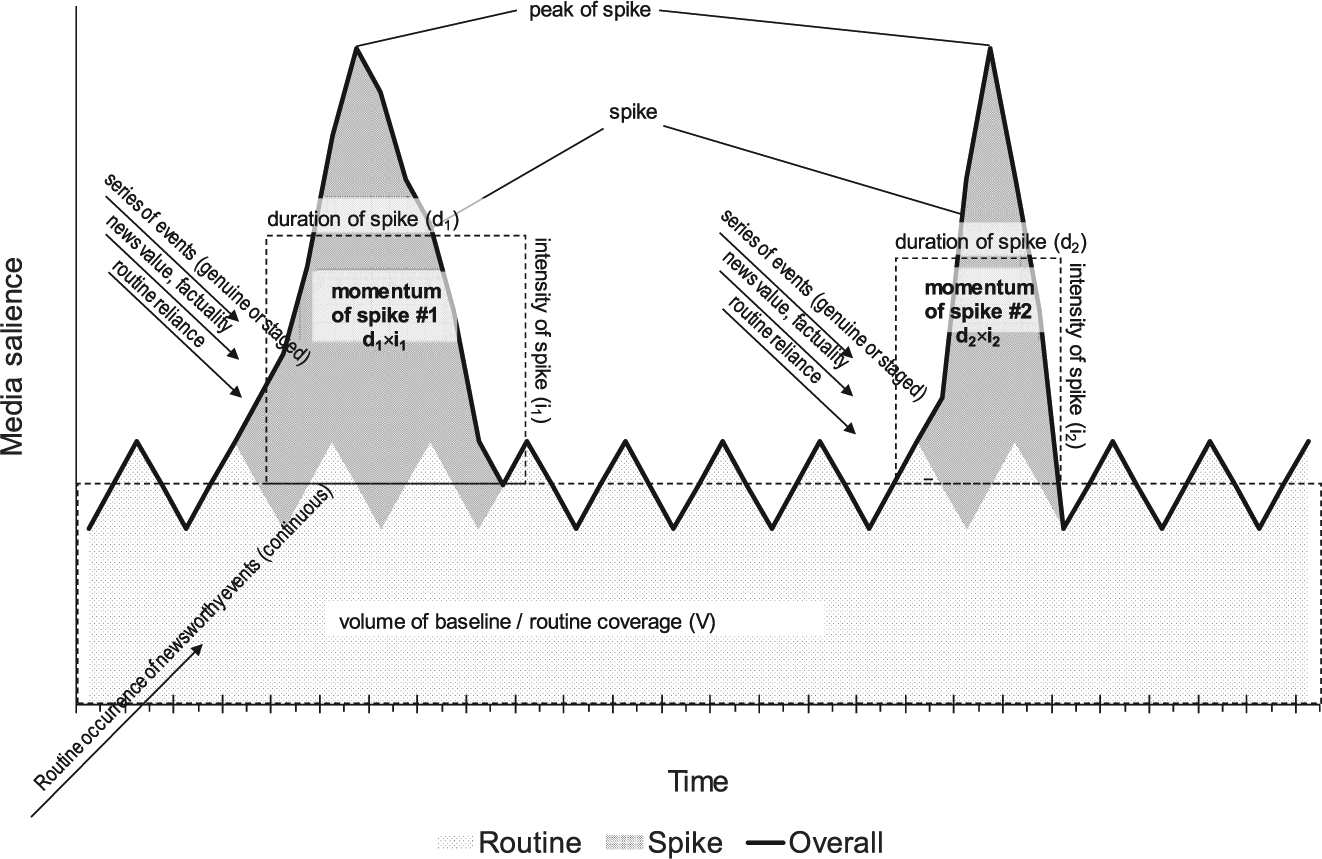
Detection and mapping of issue and spike descriptives.
Measuring Structure and Dynamics of Issue Salience
An intensive analysis of the shapes of news waves (Geiß, 2010) and the development of issues over time (Geiß, 2018) used a set of 12 indicators to capture the most important features of issue time series as visually observed. The typical development of coverage (five issue-level indicators) and the typical shape of news waves or spikes (spike-level indicators, aggregated to seven issue-level indicators). Factorizing these 12 indicators leads to four latent dimensions which describe the basic shape of media attention time series of an issue: (a) spike momentum, (b) issue baseline, (c) spike frequency, and (d) spike oscillation. Spike frequency and spike oscillation are not used here; spike frequency is negligible because in the time frame of 60 or 75 days of pre-election coverage, barely more than one or two news waves will occur, and their number is hardly informative. Spike oscillation is dropped as the property it describes—the degree of variability and abruptness of the development within spikes—is of no theoretical significance in this study and is not expected to affect the likelihood or strength of agenda-setting effects.
Spike momentum and issue baseline—being the most central features of issue time series—resonate with various themes from the agenda-setting literature, particularly with speculations about how the intensity (issue baseline) and variation (spike momentum) of media coverage may influence the likelihood and extent of agenda-setting effects. The same framework can be applied to any time series of salience data, so it is possible to use the same procedure both for media salience data (H1, H3) and public salience data (H2, H4).
Method
This study uses data from the German Longitudinal Election Study (GLES) 2009, 2013.
Survey
Design and procedure
The RCS survey component (Rattinger, Roßteutscher, Schmitt-Beck, Weßels, & Wolf, 2014) is based on the first wave of a two-wave panel survey spanning the last 60 (2009) or 75 (2013) days before the election. On each day, about 100 respondents were interviewed (CATI) and make up small random samples of the entire body of 6,008 (2009) and 7,882 (2013) respondents. The samples were generated using random digit dialing according to the so-called Gabler-Häder method. It changes the last two digits of blocks of telephone numbers that are in use to create the list from which numbers are sampled, leading to a high hit rate and at the same time equal chances for each true number to end up in the sample. Target persons were identified using the last birthday method. The response rate (RR1) was at 20%. The data were weight using the combined sociodemographic (post-stratification) and transformation (design) weights computed for each weekly sample. The number of respondents varied slightly in 2009 (M = 100.13; SD = 26.26; Min = 22; P10 = 73.8; Mdn = 103.5; interquartile range [IQR] = 27.25) and 2013 (M = 103.71; SD = 18.65; Min = 49; P10 = 82.5; Mdn = 100.5; IQR = 21.75).
Measures
The cognitive salience of issues was measured for each individual using a variant of the most important problem (MIP) question: “When thinking about the current political situation: What is, according to your opinion, the most important political problem in Germany today?” If respondents named at least one issue as most important problem, they were probed for another issue: “And what is, according to your opinion, the second-most important problem in Germany today?” The answers to the open-ended questions were coded using the same list of issues applied in coding the issues in newspaper and television news stories (see below).
Per individual the number of issue mentions was counted, counting issues named as “most important” as a full mention (1.0) and issues mentioned as “second-most important” as a half mention (0.5). Each participant could contribute one “full” issue mention, meaning that those who mentioned only one issue put the full score into one issue (weight 1.0), whereas participants mentioning multiple issues split their “vote.” For instance, a person who mentioned 2 issues as most important and 3 issues as second-most important split their “vote” into 29% (1/3.5) for the two issues mentioned as most important and 14% (0.5/3.5) for each of the three issues mentioned as second-most important, summing up to a total weight of 1.0 as well. Those individuals who do did not mention any issues were removed from the data (182 in 2009 and 605 in 2013). The unit for measuring the public agenda is “issue mentions per person.”
Content Analysis
Sample, design, and procedure
The content analysis (Rattinger, Schmitt-Beck, & Wolf, 2015) media sample consists of media with high penetration, high influence in the media system, or both. The newspaper sample comprises five daily national quality papers, spanning the political spectrum from left to right: Die Tageszeitung (strongly left) and Frankfurter Rundschau (left) Süddeutsche Zeitung (center/left), Frankfurter Allgemeine Zeitung (center/right), Die Welt (right). In addition, one tabloid newspaper with high penetration (Bild) was included. In the quality newspapers, the front-page (plus all jumps on the front-page) and opinion pages were analyzed; in Bild, the politics-centered second page was analyzed in addition given the number of political articles on page one. The TV newscast sample comprises the primary newscasts of the two main public service networks in Germany, DasErste (Tagesschau), ZDF (Heute), plus two important private TV networks, RTL (RTL aktuell), and Sat1 (Sat1 Nachrichten). All news stories on the pages and newscasts sampled were recorded, and all issues in political news stories were coded. The data span from June 29, 2009 to September 26, 2009, and June 24, 2013 to September 21, 2013, (last 90 days before the election, respectively), but only the last 60 (2009) and 75 (2013) days are used to match the survey data. In 2009, 1,561 newspaper articles and 2,485 TV news stories were included in the final analysis. In 2013, it was 2,403 newspaper articles and 1,775 TV news stories.
Measures
For each news story, one polity issue (concerning political system’s design, structure and institutions), one politics issue (concerning the process of political decision-making), and one policy issue (concerning the substance matter of policymaking, i.e., the problems and their treatment) could be coded. Policy and politics issues were most common, whereas polity issues were rarely mentioned. Overall, 215 different policy issues, 73 politics issues, and 29 polity issues were coded across campaigns. Reliability of coding (using Krippendorff’s αK) was satisfactory, with all policy codings reliable at .72 or greater, all politics codings at .71 or greater; and polity issues (which were rarely mentioned) at .86 or greater except for TV news in 2009 (.57) (Supplemental Table A1).
To obtain meaningful time series with a sufficient number of stories devoted to the issue per day, the issues were reassigned to 25 broader issue categories, of which three were dropped because they were almost never used. More general categories are only used if no more specific categories apply (e.g., stories on the “economic crisis” are counted as “economic crisis” but not as “economy” story, although “economic crisis” could be conceived as a sub-issue of “economy”). Supplemental Table A4 provides the counts of the various issues for the two campaigns and the two media channels. The large dominance of the political alienation issue is worthy of explanation. The category subsumes issues that refer to political scandals, charges of corruption, politicians’ (overly high) parliamentary allowances, (inefficient) bureaucracy, (overly strong) influence of lobbyists, (dis-)satisfaction with politicians, or citizens’ (lack of) political power. As all codes subsumed under this label were in the politics-issue (rather than policy-issue) category, they could be chosen in addition to a probably more dominant policy issue—increasing the likelihood of coding a story as related to political alienation. Dropping political alienation did not affect the coefficients substantially, so it was kept.
Issue Salience Dynamics
The preliminary media salience baseline is the average number of news stories published about an issue in the respective campaign per day; after finding the spikes, those news stories attributed to spikes are no longer considered in the calculation of the final media salience baseline. The media salience spike momentum of media coverage is calculated in three steps: First, a threshold is defined: how intensive must coverage be to be interpreted as a spike. In the current study, the threshold is defined as the change rate of issue coverage (i.e., the average absolute change of number of news stories about the issue from one day to another) or one news story, whichever is lower. Second, the time series is scanned for phases during which coverage is continuously above the preliminary media salience baseline. These are regarded as potential spikes. To count as a spike, above-average coverage needs to be either (a) higher than the threshold on at least 1 day of the potential spike, or (b) its total volume needs to exceed 3 times the threshold. Third, the volume of spike-related coverage above the media salience baseline level is recorded as the spike’s volume. The average volume of all spikes that belong to the same issue is calculated and used as indicator of spike momentum. The same procedure is used to find the public salience baseline and spike momentum. The unit is, however, not news stories, but the share of public attention devoted to the issue. The threshold is defined as .05 (5.0% of the whole public attention) or the change rate of the issue, whatever is lower. Figure 1 visualizes the procedure, and Supplemental Table A3 shows an example calculation; Supplemental Table A5 shows the scores for spike momentum and issue baseline for the issues under study.
Data Analysis
Replicate Puzzles 1 and 2
Time series analyses are conducted to replicate the two puzzles (coexistence of positive, negative, and null relations; coexistence of media-led, public-led, and simultaneous relationships) and quantify the relative frequency of the different kinds of relationships between agendas. The RCS design allows computing day-by-day time series models with lagged predictors. The data have high temporal resolution but testing long-term lags of several weeks would lead to losing lots of data. Therefore, time lags of ±14 days are tested.
Procedure
First, the time series were smoothed by Kalman filtering, which tries to approximate the true score by considering the current observation, and adjusting it by surrounding observations; the surrounding observations get more weight the higher the uncertainty of the current observation is, which again is based on the amount of variation (Grewal & Andrews, 2014). To deal with issues of autocorrelation, stationarity, and collinearity in lagged time series models, I conducted ARIMA(1,1,0)-cleaning of the time series data before analysis (Hyndman & Khandakar, 2008). For testing agenda-setting effects, I computed vector autoregression (VAR) models. These models are used for testing for Granger causality between media and public attention time series (Pfaff, 2008). I present the findings using cumulative impulse-response functions (cIRFs). They illustrate the progression of the total effect on public salience (“response”) triggered by one news story (“impulse”) over time following the impulse.
Example
Figure 2 illustrates the procedures used. Looking at “international conflicts” (2009, TV), the lower left graph shows that public attention increases in the last ca. 25 days of the time series (raw data: dots; Kalman-filtered data: dark gray; ARIMA[1,1,0] residuals: light gray); media salience of the issue had already increased some days before (top left graph). The top right and bottom right graphs illustrate the results of the VAR models by transforming the results into cIRF. There is a positive response of the public salience after TV news story impulses, reaching the maximum cumulated effect after 4 days; after that, the agenda-setting effect recedes. In contrast, changes in public salience did not lead to significant changes in TV salience.
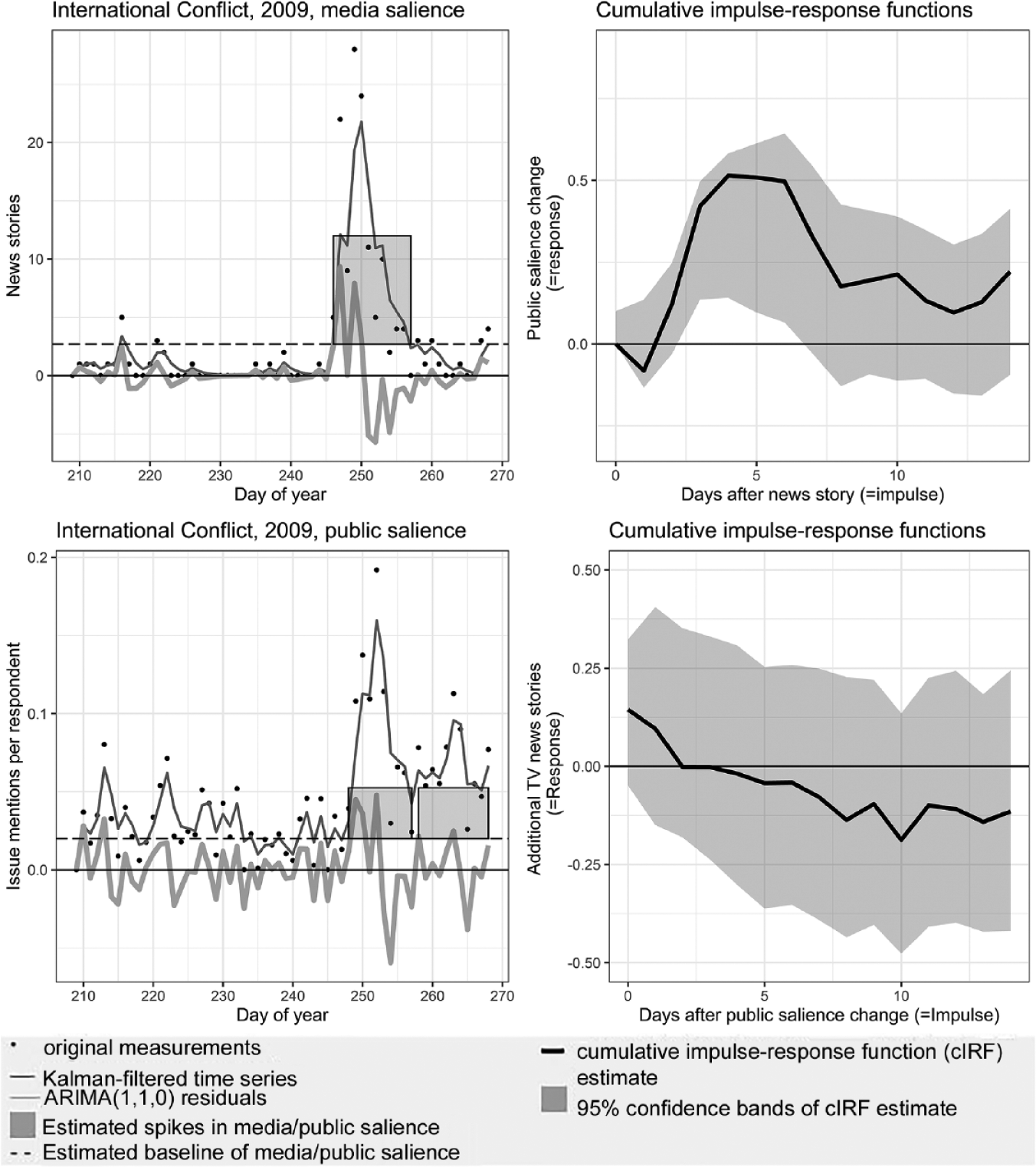
Preprocessing of data and test of agenda relations for issue “international conflict” (2009, TV): Raw data, Kalman-filtered time series, ARIMA (1,1,0)-residuals (left), and cumulative impulse-response functions (right) resulting from vector autoregression models.
Occurrence of agenda-setting effects
I regarded agenda-setting effects (in line with the original agenda-setting hypothesis) to be existent if two conditions were met: (a) Granger causality tests show a significant media-led effect on the public salience (p < .01), and (b) the maximum absolute value of the cIRF is positive (positive effect). The 88 time series (22 issues × 2 media × 2 elections), were scored “1” if this was the case; otherwise, they were scored “0.” A generalized linear mixed-effects model was specified to predict whether agenda-setting effect occurred in a time series or not. 22 issues,’ two media types,’ and two election years’ random intercepts were used as variance components. Years were treated as being nested in issues (resulting in two random intercepts for media types, 22 for issues, and 44 for year-issue combinations) in all models; however, the results were robust against changing the formulation of the variance component structure. Model 1 is a null model without fixed predictors. Model 2 introduces the (logarithmized) baseline and spike momentum of media salience. Model 3 adds the baseline and spike momentum of public salience on top. The reverse order, first including public salience dynamics (Model 2b) and then media salience dynamics, was checked for consistency but will only be mentioned in passing since it confirmed the results reported below.
Strength of agenda-setting effects
The strength of agenda-setting effects was defined using the cIRF for each issue and year (see Figure 2): the maximum (positive) cumulative effect of a news story on the public salience of an issue served as the strength of agenda-setting score; it was also used if the relationship fell short of statistical significance. For instance, “International conflict” (displayed in Figure 2) was scored 0.539 in 2009 for newspapers (lag = 3) and 0.514 for TV (lag = 4). After finding these raw scores (ranging between 0 and 0.748), I divided them by the maximum value and multiplied them by 99, and added 1, leading to a range between 1 (no agenda-setting effect) to 100 (strongest agenda-setting effect). Due to some meaningful outliers, agenda-setting strength was logarithmized for analysis. A linear mixed-effects model was specified and estimated with restricted maximum likelihood; otherwise, the procedure was similar to the models of occurrence of agenda-setting effects.
Time lags
To check the typical time lags observed, the cIRFs for the time series with positive, media-led effects were aggregated and plotted to check for any differences between newspaper and TV and between the 2009 and 2013 election.
Results
Longitudinal Agenda-Setting Effects: Replicating Puzzles 1 and 2
Temporal sequence and direction
The analysis of all 88 time series reveals that in 65 time series (74%), there were significant (p < .05) relations between media salience and public salience. In 33 (38%) cases (= time series) the media led and the public followed. In 28 (32%) cases, media salience and public salience changed instantaneously, that is, it was not possible to find out who led and who followed or the relationship was reciprocal. In 29 (33%) cases, public salience granger-caused media salience (Figure 3). Media-led are predominant, but the number of public-led and instantaneous relationships is considerable. Please note that the same time series was tested for all three kinds of relationships, so there is some overlap where one time series displays more than one kind of relation between media and issue salience. If the media lead, positive effects (in line with the basic agenda-setting hypothesis) clearly outnumber negative effects (24 to 9); the same is true, though to a lesser extent, for instantaneous (16 to 12) relationships; public-led relationships exhibit a similar rate of positive and negative relations (15 to 14). Nevertheless, there were some cases where upswings in media salience were associated with downswings in public salience. Overall, only 24 out of 88 issues (27%) fit the original agenda-setting hypothesis: positive, media-led relationships.
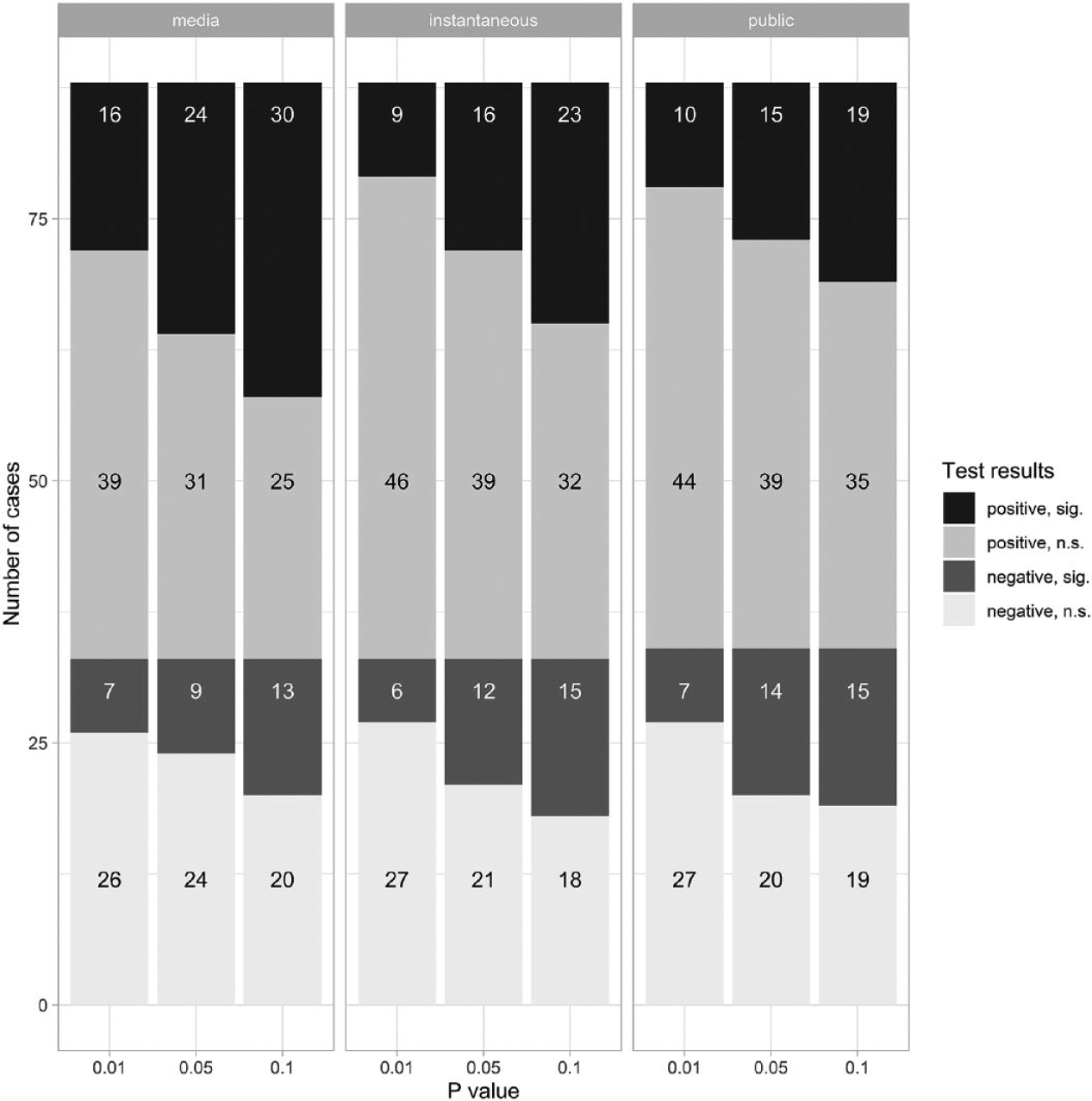
Share of media-led, public-led, and simultaneous salience changes (n = 88) with p < .01, p < .05, or p < .10 as statistical significance cutoffs, respectively.
Plotting how public salience responded to impulses in media salience (cIRFs of the 23 issues with positive media-led effects) shows that the agenda-setting effects typically reach their maximum after 7 to 8 days before they start to fade slowly. But there are substantial differences between TV and newspapers: cumulative newspaper effects increase until the 10th day and slowly recede thereafter; TV effects reach their maximum effect earlier and start to fade faster. This may be considered “serendipity evidence” of the so-called “spotlight effect” of television versus the more lasting agenda-setting effects of newspaper coverage (McCombs, 1977). The cIRFs of time series are idiosyncratic to some extent, however. The plot in Figure 4 gives a rough average, while Supplemental Figure A2 gives the case-specific envelopes for the 24 time series with positive, media-led effects.
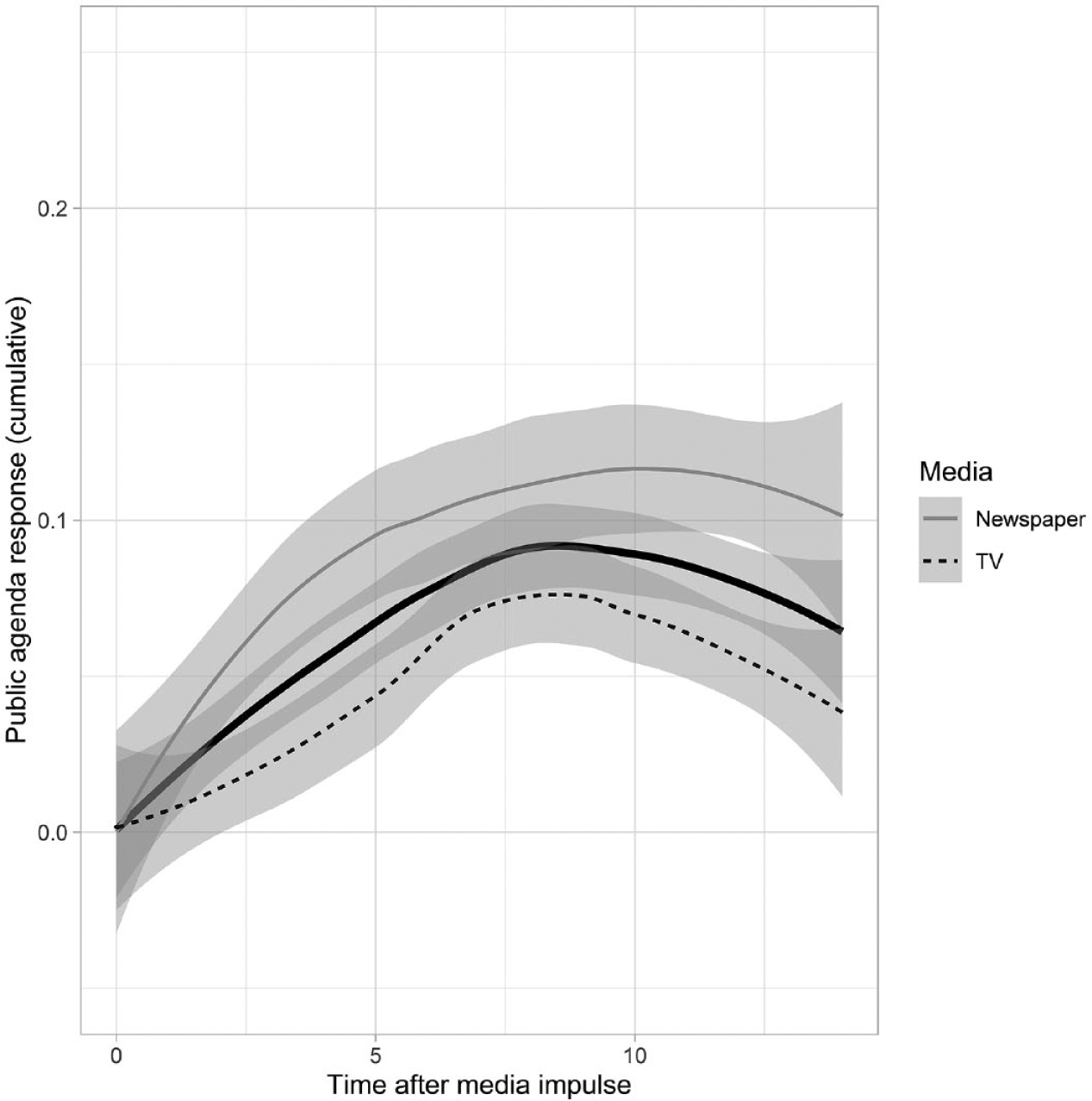
Cumulative impulse-response functions for the 23 issues with positive, media-led agenda relations, aggregated by media type and globally.
This replicates the Puzzles 1 and 2. However, under which conditions can positive media-led relationships between media and public salience be expected? I will test whether the dynamics of media salience and public salience can contribute to explaining these differences.
Issue Salience and Likelihood of Agenda-Setting Effects
Media and public salience
Momentum of spikes and the baseline level of media and public salience were calculated for each issue, separately for the campaigns of 2009 and 2013. Facing the very high correlation between TV and newspaper salience (Supplemental Table A2), I lumped them together. This also enhances the reliability of the spike detection procedure because single news stories are less likely to change the outcome of the procedure in issues with little coverage.
Media salience (H1a, H1c, H3a, H3c)
Taken together, baseline and spike momentum of media salience facilitate predicting the occurrence or non-occurrence of agenda-setting effects, ΔDeviance(Model 2, Model 1) = χ² (df) = 8.282 (2); p =.016, even when controlling for public salience dynamics, ΔDeviance(Model 3, Model 2b) = χ² (df) = 10.206 (2); p = .006. Media salience dynamics alone contribute R²marginal (R²m) = .080 to explaining the variation in occurrence of agenda-setting effects (Model 2b); joint with public salience dynamics, R²m = increases to .179 (Model 3). I use the full model (3) to test the hypotheses (Table 1). A greater baseline of media salience depresses the likelihood of agenda-setting effects (odds ratio [OR] = 0.227; bootstrapped 95% confidence interval [CI] = [0.008, 0.772] with 1,000 runs; p = .030). H1a (effect) is supported but H1c (positive effect) is rejected (Table 1). The spike momentum of media salience increases the likelihood of agenda-setting effects significantly (OR = 10.182; bootstrapped 95% CI = [2.576; 1022.942]; p = .008). This positive effect supports H3a and H3c (Table 1, Figure 5 [top left]).
Impact of Issue Salience Baseline and Spike Momentum on Occurrence and Strength of Agenda-Setting Effects.
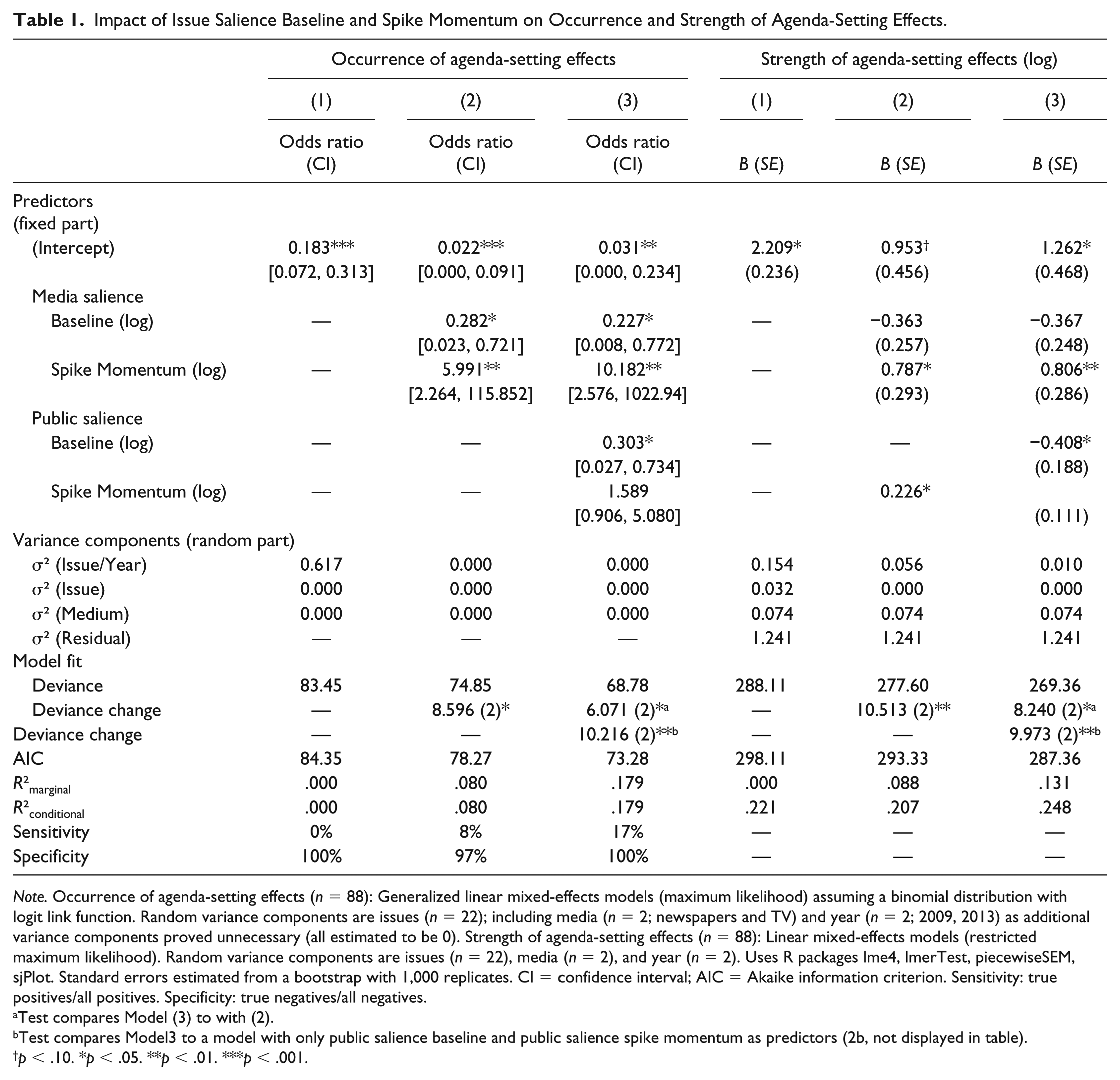
Note. Occurrence of agenda-setting effects (n = 88): Generalized linear mixed-effects models (maximum likelihood) assuming a binomial distribution with logit link function. Random variance components are issues (n = 22); including media (n = 2; newspapers and TV) and year (n = 2; 2009, 2013) as additional variance components proved unnecessary (all estimated to be 0). Strength of agenda-setting effects (n = 88): Linear mixed-effects models (restricted maximum likelihood). Random variance components are issues (n = 22), media (n = 2), and year (n = 2). Uses R packages lme4, lmerTest, piecewiseSEM, sjPlot. Standard errors estimated from a bootstrap with 1,000 replicates. CI = confidence interval; AIC = Akaike information criterion. Sensitivity: true positives/all positives. Specificity: true negatives/all negatives.
Test compares Model (3) to with (2).
Test compares Model3 to a model with only public salience baseline and public salience spike momentum as predictors (2b, not displayed in table).
p < .10. *p < .05. **p < .01. ***p < .001.

Effects of spike momentum in media (left column) and public salience (right column) on likelihood (top row) and strength (bottom row) of agenda-setting effects.
Public salience (H2a, H2c, H4a, H4c)
The dynamics of public salience (baseline and spike momentum combined) only significantly related to the likelihood of agenda-setting effects when controlling for dynamics of media salience (ΔDeviance (Model 3, Model 2) = χ² (df) = 6.071(2); p = .048), but not when omitting media salience dynamics (ΔDeviance(Model 2b, Model 1) = χ² (df) = 4.146(2); p = .126). Public salience dynamics alone contribute R²m = .142 to explaining the variation in occurrence of agenda-setting effects (Model 2b, not displayed); joint with media salience dynamics, R²m = increases to .222 (Model 3). Looking at the coefficients in Model 3, the baseline of public salience has a significant but negative effect on the likelihood of agenda-setting effects (OR = 0.303; 95% CI = [0.027, 0.734]; p = .028). H2a (effect) is supported, but H3c (positive effect) gets rejected (Table 1). The spike momentum of public salience is not significantly related to the likelihood of agenda-setting effects (OR = 1.589; 95% CI = [0.906, 5.080]; p = .123); hence, H4a and H4c are rejected. Supplemental Figure A3 illustrates the sensitivity (true positives out of all positives) and specificity (true negatives out of all negatives) of the predictions, depending on the cutoff value for predicting a positive case. With a cutoff at 25% probability, for example, sensitivities for Models 0, 1, and 2 are 0.00, 0.30, and 0.43, while specificities are 1.00, 0.89, and 0.85, respectively.
Issue Salience and Strength of Agenda-Setting Effects
Media salience (H1b, H1d, H3b, H3d)
Media salience dynamics were significantly associated with agenda-setting effects (ΔDeviance(Model 2, Model 1) = χ² (df) = 9.622 (2); p = .008), even when controlling for public salience dynamics (ΔDeviance(Model 2b, Model 3) = χ² (df) = 10.474(2); p = .005). Media salience dynamics alone explain R²marginal = .103 or 10.3% of variation in strength of agenda-setting effects (Model 2); joint with public salience dynamics, it explains R²marginal = .148 or 14.8% (Model 3) (Table 1). I use Model 3 for testing the hypotheses. A higher baseline media salience of an issue was associated with weaker agenda-setting effects. The coefficient of log-log B(SE) = −0.367 (0.248), t(~39) = −1.479, p = .147 is not statistically significant. The findings do not match H3b and H3d which predicted a (positive) effect (Table 1). There is a positive impact of media salience spike momentum on the strength of agenda-setting effects that proves statistically significant: If the spike momentum of an issue’s media salience doubled (+100%), the strength of the agenda-setting effect increased by 81%, log-log
Public salience (H2b, H2d, H4b, H4d)
Public salience dynamics were only (marginally) significantly associated with agenda-setting effects when controlling for media salience dynamics (ΔDeviance(Model 3, Model 2) = χ² (df) = 5.119 (2); p = .077). When neglecting media salience dynamics, public salience dynamics did not significantly contribute to explaining the strength of agenda-setting effects (ΔDeviance(Model 2b, Model 1) = χ² (df) = 4.267 (2); p=.118). Public salience dynamics has little explanatory power in itself (R²marginal = .047 or 4.7%); jointly with media salience dynamics, it accounts for R²marginal = .148 or 14.8% of variation in strength of agenda-setting effects (Table 1). A higher baseline public salience of an issue was associated with weaker agenda-setting effects. The coefficient of log-log B(SE) = −0.408 (0.188), t(~39) = −2.177, p = .035 proves statistically significant. If the baseline of public salience of an issue increases by 100%, the strength of agenda-setting effects will decrease by 41%. The findings match H3b (there was an effect) but not H3d (the effect was negative rather than positive) (Table 1). There is a positive impact of public salience spike momentum on the strength of agenda-setting effects that proves statistically significant: If the spike momentum of an issue’s media salience doubled (+100%), the strength of the agenda-setting effect increased by 23%, log-log
Figure 5 displays how a greater spike momentum of media and public salience boosts the likelihood of agenda-setting effects and the strength of agenda-setting effects. Supplemental Figure A1 illustrates how a greater baseline of media and public salience depresses agenda-setting effects.
Discussion
Starting off from the puzzling and multifaceted findings concerning agenda-setting effects, the study used a very versatile data set to (1) recap these puzzles with more current data and higher temporal resolution; (2) analyze the patterns of development of media and public salience as a possible correlate of unexplained patterns of agenda-setting effects; (3) test whether issues’ dynamics of media and public salience affects the likelihood and strength of agenda-setting effects.
It is important to better understand these contingencies because the media’s agenda-setting power has considerable implications for the relation between media and public opinion more generally: Media-driven agenda-setting focuses and synchronizes attention to key issues, a pivotal mechanism against fragmentation of the public sphere (Geiß, 2015; Moeller, Trilling, Helberger, Irion, & De Vreese, 2016) and its capacity to exert pressure on politicians. Conversely, knowing the conditions under which there is no (or a negative) response of the public to increasing media salience would help understand the limits of the media’s agenda-setting power; for example, when the audience perceives an issue as worn-out, exaggerated, or detached from reality (Downs, 1996).
Collecting the Puzzles Pieces
One important extension of the state of the art is that this study used daily data, allowing for fine-grained conclusions about the temporal relations between changes in media and public salience. The results hint at the relative frequency of positive and negative relationships, and of media-led, public-led, and instantaneous salience changes based on a comparatively large sample of issues (n = 88). In line with earlier research, the media agenda’s capability in shaping the public agenda is far from universal. In many cases, media and public agenda were just unrelated (26%). Besides media-led relations (39% of all cases) and instantaneous linkage (32%), there was also a substantial number of issues in which the public salience of an issue changed and its media salience followed afterward (33%). Instantaneous changes give no clue as to whether media coverage shapes the public agenda or the other way around; this pattern of instantaneous causality was frequent despite the high temporal resolution of the data. It seems that reactions of the public (media) to changes in the media (public) salience often happen within 1 day’s time (Geiß et al., 2016).
Looking at the media-led relationships, increasing (decreasing) media coverage most of the time push issues upward (downward) on the public agenda (24 out of 33 cases) as expected. However, there were nine instances where more (less) media coverage pushed public salience of the issue downward (upward), in line with previous empirical studies. This replication part of the study shows that puzzling patterns in previous studies were no artifacts and persist (Figure 3), despite methodological innovations and pervasive changes in people’s information environments. In the 24 time series in which agenda-setting effects (positive, media-led agenda relations) were identified, the time lag between media impulse and the maximum public response ranged between 1 and 14 days (which were the minimum and maximum lags possible); despite a lot of variation, agenda-setting effects typically peaked after 7 to 8 days; TV news came into effect faster, but also wore out more quickly than newspaper effects (Figure 4; Supplemental Figure A2).
A qualitative inspection of the issues that more frequently and reliably exhibited positive, media-led agenda-setting effects shows that issues that had been covered and/or had been in the spotlight of public attention for a long time were least prone to exhibiting media-driven agenda-setting effects. The media’s agenda-setting power may be tied to the surprise and novelty of an issue and often occurred for unobtrusive issues with no real-world cues available. For instance, no media-induced agenda-setting was observed for labor (including unemployment) and for economic crisis (i.e., financial crisis 2007 onward). Rather, among others, political extremism, international conflicts, defense/military, and intelligence services were the issues where multiple instances of media-induced agenda-setting effects were observed. Political extremism was driven by several actual or attempted terrorist attacks by Islamist or right-wing extremists (both 2009 and 2013); in 2013, specifically, the killings by the right-wind terrorist organization “National Socialist Underground” (NSU) and the failure of security agencies to discover their activities earlier led to spikes in news coverage. Intelligence services were a topic in 2013 following the so-called “NSA affair”: Former NSA employee Snowden had leaked evidence on comprehensive NSA espionage in Germany. There were also salient events driving the international conflict issue and the defense/military issue: In 2009, both issues were driven by a U.S. air strike requested by a German army officer that led to heavy civilian casualties in Afghanistan. In 2013, the failure of the military drone project “Eurohawk” led to spikes in media salience. But this study went beyond such ad hoc, ex-post assessments of probable reasons for the (non-)occurrence of agenda-setting effects. It systematically inquired how the dynamics of media and public salience relate to their likelihood and strength.
Toward Solving Some Puzzles
How to solve these puzzles? Why does media salience lead public salience only some of the time? Why is the relationship between media coverage and public salience sometimes positive and negative at other times? There is certainly not a single simple solution. The structure and development of media and public attention toward issues has only been addressed in passing in previous research and has never been tested empirically yet. So, doing this for the first time is the unique contribution of the current study. The study demonstrated the usefulness of standardized measures of media and public attention dynamics (Geiß, 2018) to predict agenda-setting effects.
If the media cover an issue intensely on a regular basis (high media salience baseline) and large parts of the population are already concerned about the issue (high public salience baseline), agenda-setting effects are less likely and weaker. The negative effect of these salience baselines was unexpected. Nevertheless, there are good arguments for such an effect: Higher public salience baselines increases the risk of a “ceiling effect” or indicate that the public has already taken note of the issue and will not react strongly to changing media salience; higher baselines may mean less “surprise” and “novelty,” and therefore less public reaction. Higher media salience baselines may create the impression that this is the “normal” extent of media attention and only deviations from this “norm” necessitate adjusting issue salience. Any agenda-setting effects of high media salience baselines may serve to stabilize the current level of public salience rather than increasing the level of public salience.
In line with the expectations, greater spike momentum—abrupt increases in media and public salience—stimulates media agenda-setting; it grows more likely and stronger. The most likely reason is that lucid, strong, and sudden variation in media salience incites many respondents to reconsider the issue’s salience simultaneously in the same direction. They would interpret the upswing as the result of higher relevance, surprise, and novelty. This inference reflects the trust in the news media that they would not increase the intensity of coverage for no or for arbitrary reasons (Pingree & Stoycheff, 2013). Greater spike momentum in public salience means that there is meaningful change in public salience. Such a sudden change increases the chance that the time series analyses detect effects. It is possible, however, that these effects of media attention spike momentum are limited to aggregate-level agenda-setting studies and that they primarily influence the likelihood of discovering agenda-setting effects rather than the strength of individual-level agenda-setting effects. Under the conditions of abrupt change, individual changes will often be in the same direction and, in concert, cause a clear collective shift in issue salience visible in aggregate-level analyses. But even if this is the case, strong motion of public salience into a particular direction is itself an important phenomenon because it will exert pressure on political decision-makers to devote attention to an issue; baselines and spike momentum therefore figure as important mechanisms in the agenda-setting process even if they play out at the aggregate and not at the individual level.
Despite high correlation (R = .393-.867) and moderate collinearity (variance inflation factor = 3.82-4.21) between the four measures of media and public salience dynamics, they independently contribute to explaining agenda-setting effects. Baselines and spikes of salience are important puzzle pieces and preconditions for media agenda-setting to occur; including them in a prediction is a step forward. For instance, Model 2 allows finding 15% of cases of agenda-setting effects at the expense of making only a single false positive prediction (98% specificity); if the model should identify 50% of the cases with agenda-setting effects (sensitivity), it would generate more false positives as well (78% specificity) (Supplemental Figure A3). This demonstrates the predictive capacity, but also the limitations and ambiguities of these models. There is still a lot of unexplained variation in likelihood and strength of agenda-setting effects. Dynamics of media and public attention are far from providing a comprehensive explanation by themselves. There is even skepticism that aggregate-level agenda-setting effects are induced or can be predicted based on studying traditional news media. Information environments are and grow more complex than they used to be. One reviewer for this article commented that this study may be “one of the last of its kind” and that “online communication will force us to re-think the theory and change the concept [of agenda-setting, S.G.] fundamentally.” Certainly, aggregate-level agenda-setting studies have limitations and their usefulness may change with changes in information use habits. However, aggregate-level studies are important because large-scale aggregate-level changes are more likely to have political reverberations. This study suggests that there is still such a thing as a public sphere where mainstream media attention can stimulate public attention for an issue; the rate of approximately one fourth of issue time series exhibiting classical agenda-setting effects is like the rate found for the 1980s by Brosius and Kepplinger (1990). Therefore, we should not jump to conclusions as to whether the media’s (aggregate-level) agenda-setting capacity erodes in the face of the changing information environments. Rather, this is an important question facing agenda-setting scholars in the future.
But what kinds of issues have higher baselines and spike momentum? Spike momentum seems to be first and foremost related to identifiable events (Geiß, 2011, 2018) that fit the media’s shared criteria of newsworthiness (Harcup & O’Neill, 2017), their need for efficient information gathering/sourcing, coupled with routine reliance (Figure 1). For instance, the major spikes in media salience reflected major international conflicts, intelligence service scandals (2013: NSU and NSA scandals), and economic crises (2009: bailout of Opel and Karstadt/Arcandor; Geiß, Weber, & Quiring, 2017). An issue’s media salience baseline is a function of the number of newsworthy routine events that fall into the issue’s scope; a high baseline of public salience reflects that large shares of the public are concerned about the issue even without further stimulation.
Limitations and Outlook
There are four main caveats: (1) This study did not look at individual-level effects of media stimuli. Rather, it tracks temporal relations between (aggregate-level) changes on the media and the public agenda. (2) The high temporal resolution—itself a unique strength of this study—leads to a shorter overall time frame (60-75 days); lags of more than 14 days began to lead to estimation problems. The focus is on short-term agenda correspondence in election campaign contexts and not on the regular development of issue salience over months or years. (3) The study strongly focused on the structure and development of public and media attention as contingent conditions, neglecting issue characteristics and issue competition. (4) The study is limited in temporal and spatial context, hampering generalizability; most importantly, the data are several years old and focus on TV and newspapers, such that the data do not speak to the role of expanding and changing information environments in agenda-setting processes. I see three major avenues for future research this study points to: First, earlier studies can be reanalyzed regarding the structure and development of public and media attention of the issues under study. The measures of baseline and spike momentum can easily be applied to such time series. The number of issue time series analyzed this way could thereby be extended to several hundred, collected by various research groups, strengthening the robustness of findings and the precision of estimates. Second, studies comparing the influence of different contingent conditions of agenda-setting would deepen the understanding of the relative importance of these conditions and their interrelation. Third, the amount of coverage and the sharpness of news waves may play a significant role as conditioning factors in various mechanisms of media effects. Related approaches such as attribute agenda-setting, network agenda-setting, priming, and issue ownership are likely candidates. But also spirals of silence, cultivation processes, or framing processes may depend on strong news waves which focus the attention of large parts of the audience. Researchers usually acknowledge this by picking highly salient issues such as natural disasters, or major controversies/campaigns. Exploring this in a variable-based fashion would, in the long run, help to understand the way the dynamics of media salience preconditions changes in public opinion.
Supplemental Material
CR874968_Online_Appendices_CLN – Supplemental material for The Media’s Conditional Agenda-Setting Power: How Baselines and Spikes of Issue Salience Affect Likelihood and Strength of Agenda-Setting
Supplemental material, CR874968_Online_Appendices_CLN for The Media’s Conditional Agenda-Setting Power: How Baselines and Spikes of Issue Salience Affect Likelihood and Strength of Agenda-Setting by Stefan Geiß in Communication Research
Footnotes
Author’s Note
This study uses data from the German Longitudinal Election Study as a secondary analysis. All data are freely available from the GESIS data archive (ZA5703, ZA5705, ZA5706, ZA5303, ZA5306, ZA5307).
Declaration of Conflicting Interests
The author declared no potential conflicts of interest with respect to the research, authorship, and/or publication of this article.
Funding
The author received no financial support for the research, authorship, and/or publication of this article.

Supplemental Material
Supplemental material for this article is available online.
Author Biography
References
Supplementary Material
Please find the following supplemental material available below.
For Open Access articles published under a Creative Commons License, all supplemental material carries the same license as the article it is associated with.
For non-Open Access articles published, all supplemental material carries a non-exclusive license, and permission requests for re-use of supplemental material or any part of supplemental material shall be sent directly to the copyright owner as specified in the copyright notice associated with the article.
