




Abstract
Minorities often express dissatisfaction and frustration with media depictions of their ingroup motivating them to engage in strategies that can restore a positive group identity. Based on the dual model of collective action and relying on two studies, we examined if exposure to negative news media can motivate collective action among Muslim Americans through increases in collective efficacy and group-based anger. Data from a four-wave longitudinal survey revealed that Time 1 self-reported exposure to negative news about Muslims increased Time 4 collective action intentions through increases in Time 3 efficacy, but not anger. Experimental results revealed that perceived news accuracy moderates these effects. Specifically, exposure to negative news about one’s ingroup motivates collective action when the news is perceived as biased but dampens these efforts if perceived to be accurate. These findings reveal how and under what conditions exposure to negative news coverage can lead to collective action among minorities.
Minorities are often under- or negatively represented in mainstream American media (Behm-Morawitz & Ortiz, 2013; Tukachinsky, Mastro, & Yarchi, 2015). The quantity and quality of minority media representation provide valuable insight to minority members about how their group is perceived and their status vis-à-vis the majority group (Abrams & Giles, 2007; Fujioka, 2005; Harwood & Roy, 2005). As such, minorities are often concerned about mainstream media’s coverage of their group as well as the potential of this coverage to influence majority members’ attitudes (Banjo, 2013; Fujioka, 2005; Tsfati, 2007). Indeed, exposure to negative media portrayals is known to increase prejudice and generate negative behaviors toward depicted group members (Mastro, 2009).
For minorities, negative media depictions, like other situational cues, can highlight that their group is devalued and under threat, leading to coping behaviors aimed at restoring a positive group identity (Appiah, Knobloch-Westerwick, & Alter, 2013; Harwood & Roy, 2005; Saleem & Ramasubramanian, 2017). Although communication scholars have examined many coping behaviors, such as avoidance of mainstream media (Abrams & Giles, 2007) or seeking alternative media sources that more positively depict minority groups (Appiah et al., 2013; Harwood & Vincze, 2015), the extent to which exposure to negative media depictions motivates minorities to improve their group’s image by engaging in collective action has not been well studied. This is surprising as collective action can lead to long-term improvement in the status and position of the minority group within the larger society (Tajfel & Turner, 1979; Wright, 2009).
In this project, we argue—and empirically show—that exposure to negative media coverage of minorities (Muslim Americans in our case) will motivate them to engage in collective action efforts aimed at improving the position and status of Muslims in America. We examine this link in the context of news media as it is the main source of information about Muslims for the majority of Americans (Council on American-Islamic Relations, 2006; Pew Research Center, 2007) and represents Muslims in an overwhelmingly negative light (Ahmed & Matthes, 2017; Dixon & Williams, 2015). Furthermore, based on the dynamic dual pathway model of collective action (Van Zomeren, Leach, & Spears, 2012), we attend to the psychological mechanisms underlying this effect, positing that one’s intentions to engage in collective action occur through enhanced group-based anger and collective efficacy. These predictions are tested within a four-wave longitudinal survey and an experimental study providing robust and consistent evidence for long- and short-term effects.
Testing these effects and their underlying processes is important theoretically and practically. Work on media effects on minorities, and on collective action efforts more specifically, is limited. Some scholars suggest that exposure to negative media depictions may motivate minorities to engage in collective action (e.g., Abrams & Giles, 2007; Fujioka, 2005); however, few studies empirically test this notion and none, to our knowledge, specifically examine how and under what conditions this process may unfold. It is thus unknown if and how, that is, through which underlying psychological mechanisms, exposure to negative media depictions encourages minorities to undertake actions correcting their group image and status in mainstream society.
Practically, the need to study this in the context of Muslim Americans is critical given that (a) the majority of Americans rely on media, and especially on polarizing news media, for information about Muslims (e.g., Calfano, Djupe, Cox, & Jones, 2016); (b) news depictions of Muslims are overwhelmingly negative (e.g., Dixon & Williams, 2015); and (c) exposure to negative news about Muslims increases anti-Muslim attitudes and support for public policies harming Muslims (e.g., Saleem et al., 2016, 2017). Moreover, Muslim Americans often report frustration and dissatisfaction with mainstream media depictions of their ingroup and a desire to change the image of Muslims in America (Pew Research Center, 2007; Sirin & Fine, 2008). Examining if and how exposure to negative news media coverage motivate Muslim Americans’ collective action intentions is therefore important for understanding Muslim and non-Muslim relations, especially in the current political climate, as discussed below.
How Media Influence Minorities: Insights From Existing Research
During the 2016 U.S. presidential election, which forms the context for the present study, then candidate Donald Trump made several pernicious remarks about Muslims, including plans to: a) restrict immigration for Muslim countries, b) increase surveillance of mosques in America, and c) create a registry of Muslims living within the United States (Johnson & Hauslohner, 2017). These comments and their subsequent media coverage made Muslim stereotypes more salient in news media, supporting content analyses showing that Muslims are negatively represented across American media outlets (Alsultany, 2012; Dixon & Williams, 2015; Powell, 2011).
Exposure to negative portrayals of one’s ingroup threatens one’s social identity and leads to adverse consequences for minorities (Schmuck, Matthes, & Paul, 2017; Tajfel & Turner, 1979). Indeed, such exposure is associated with low individual self-esteem (Schmader, Block, & Lickel, 2015; Ward, 2004), low perceived group worth, and low group esteem among minorities (Banjo, 2013; Fujioka, 2005), and also generates a range of negative emotions, including anger (Schmader et al., 2015; Schmuck et al., 2017). These reactions are warranted because exposure to negative media depictions, like other negative social contexts, can challenge minorities’ positive group distinctiveness (Appiah et al., 2013; Davies, Spencer, Quinn, & Gerhardstein, 2002; Tajfel & Turner, 1979). Furthermore, minorities are concerned about the impact of media on majority members’ attitudes toward them given that the (largely negative) news media are a primary source of information about minority groups (Fujioka, 2005; Mutz & Goldman, 2010). In short, negative media depictions reflect a state of collective disadvantage minorities have in society vis-à-vis the majority group.
Germane to this project, minorities often respond to such negative or threatening contexts with coping behaviors aimed at restoring a positive social identity (Major & O’Brien, 2005; Tajfel & Turner, 1979). Examples of coping strategies include both dis-identification and greater identification with the threatened identity, avoidance of threatening environments, seeking alternative comparison groups and/or environments that reflect positively on the threatened identity, and also collective action (Major & O’Brien, 2005). In the context of media, research finds that minorities cope with negative media portrayals by avoiding mainstream media and/or turning to niche media sources that portray their ingroup more favorably (Abrams & Giles, 2007; Appiah et al., 2013; Harwood & Vincze, 2015). Elsewhere (Saleem et al., 2019), we find that exposure to negative news media coverage of Muslims decreases Muslim Americans’ identification as Americans and, indirectly, their trust in the American government. In fact, we find that such exposure exerts stronger effects than personally experienced discrimination.
Notwithstanding the contribution of this work, there is limited work examining the relation between exposure to media coverage about minority groups and more constructive efforts that directly challenge collective disadvantages, such as collective action (cf. Fujioka, 2005). Examples of collective action can include petitions, demonstrations, or protests aimed at improving the group’s image or status as well as the use of non-normative actions such as violence and terrorism for a group-specific goal or motive (Wright, 2009). Whereas avoidance of mainstream media and/or seeking out alternative media may be useful in the short term to restore a sense of positive identity, collective action aims to produce long-term change in how one’s ingroup is valued and positioned within the larger society (Wright, 2009).
Thus, the first aim of the present study is to examine if exposure to negative news about Muslims influences Muslim Americans’ intentions to engage in collective action. We argue that contexts that negatively reflect upon one’s group identity, negative media depictions of one’s ingroup included, are critical in motivating collective action. This is because these negative contexts serve as salient markers for minorities, highlighting and reinforcing the ways in which their group is at a disadvantage compared to the majority group, thereby motivating efforts aimed at alleviating the disadvantageous status (Hayward, Tropp, Hornsey, & Barlow, 2018). In the same vein, media depictions representing minorities in a negative light signal to minorities that their ingroup is not positively valued, thereby enhancing perceptions of group discrimination and collective disadvantage (Abrams & Giles, 2007; Fujioka, 2005; Harwood & Roy, 2005). Finally, minorities are likely to perceive negative mediated depictions of their ingroup as inaccurate and biased, consistent with the hostile media effect (Fujioka, 2005; Tsfati, 2007; Tsfati & Cohen, 2005), and perceptions of unjust treatment are especially likely to motivate collective action efforts (Tajfel & Turner, 1979; Wright, 2009).
Dynamic Dual Pathway Model of Collective Action
The second aim of this project is to examine the theoretical mechanisms through which exposure to negative news depictions spurs collective action. Guided by the dynamic dual pathway model of collective action (Van Zomeren et al., 2012), we focus on collective efficacy and group-based anger as the psychological mechanisms that can underlie the tested effects. According to this model, the decision to engage in collective action in response to collective disadvantage is based on both cost-benefit calculations of available resources and ability (i.e., seen as the cognitive route) and emotions (i.e., the affective route; Van Zomeren et al., 2012). Specifically, whereas an increase in collective efficacy is considered to be a problem-focused response, increases in group-based anger constitute an emotion-focused response to collective disadvantage (Van Zomeren et al., 2012), and both can motivate collective action.
Collective Efficacy
Group efficacy is a belief based on cost-benefit calculation that one’s group can solve a group problem through collective efforts (Bandura, 1997). Higher group efficacy beliefs reflect a sense of collective power and strength (Drury & Reicher, 2005). These beliefs motivate individuals to think that they are capable of changing their group’s image and status in society (Mummendey, Kessler, Klink, & Mielke, 1999). When minorities frequently experience social identity threats, such as discrimination or stereotypical media coverage of their group, individual actions to combat these disadvantages are seen as too costly and likely to be unsuccessful, and thus group involvement may seem like the only viable option to create real change (Grant, Abrams, Robertson, & Garay, 2014). In this context, high group efficacy beliefs give group members the confidence that their group has the resources and capability to combat the collective disadvantage (Van Zomeren, Postmes, & Spears, 2008). Because group efficacy beliefs mobilize individuals for the direct purpose of changing their group’s circumstances, this is considered to be a problem-focused, or cognitive, response of dealing with collective disadvantage (Van Zomeren et al., 2008).
Group-Based Anger
In turn, group-based anger is an emotion-focused response against the source of collective disadvantage (Van Zomeren, Spears, Fischer, & Leach, 2004). When social identity is salient, people experience emotions not because they are personally affected by a hostile social context, or by negative media depictions in the case of this project, but because their group is being targeted by the situation (Mackie, Devos, & Smith, 2000). Contexts threatening one’s identity or devaluating it are known to increase anger (Mackie et al., 2000). Supporting this claim, research finds that minorities who are exposed to negative media depictions of their ingroup report feelings of anger (Schmader et al., 2015; Schmuck et al., 2017). Anger, in turn, activates approach behaviors which increase the likelihood of action-oriented behaviors (Carver & Harmon-Jones, 2009; Wright, 2009; but see Iyer, Schmader, & Lickel, 2007; Smith, Seger, & Mackie, 2007, for exceptions), such as collective action.
Importantly, the dual pathway model does not view these cognitive and affective routes toward collective action as competing alternatives, but rather as complementary forms of coping with contexts that are negative toward or threaten one’s ingroup (Van Zomeren et al., 2012). Several studies and a meta-analysis establish collective efficacy and group-based anger as significant predictors of collective action (Ellemers & Barreto, 2009; Mummendey et al., 1999; Shi, Hao, Saeri, & Cui, 2015; Van Zomeren et al., 2008). Both of these mechanisms are tested in this project as both can explain the effects of exposure to negative news depictions on minorities’ collective action intentions, to our knowledge the first study of this kind.
Overview of the Present Studies
This research examines (a) if and how exposure to negative news media coverage of one’s ingroup influences collective action efforts among Muslim Americans, and also (b) the role of collective efficacy and group-based anger as psychological mechanisms underlying these effects. These processes are tested within a longitudinal survey and an experimental study to provide robust, multi-method evidence for our theoretical predictions.
Study 1
Study 1 tests these hypotheses in a longitudinal survey conducted over 9 months before and after the 2016 U.S. presidential election, a time period in which negative news involving Muslims was very frequent and salient (Johnson & Hauslohner, 2017).
Participants
Muslim Americans were recruited through various cultural student organizations at a large Midwestern university in exchange for monetary compensation. This method is preferred over recruiting from religious sites as it allows for greater variation in religious identification (see Amer & Bagasra, 2013, for a detailed critique on mosque recruitments). Only participants who self-identified as Muslim in a preliminary demographic questionnaire were included in the main analyses. Of the 244 participants, 147 self-identified as female and 97 as male, mean age was 24.34 (SD = 5.98). The majority of participants reported being born in the United States (n = 140, 57.4%). Of those who were not born in the United States, the majority reported living in the United States for 15 and 20 years (n = 39, 16%), followed by between 21 years or more (n = 38, 15.6%), and between 7 and 14 years (n = 18, 7.4%), and between 1 and 6 years (n = 9, 3.7%).
Timeline
The data discussed here are part of a larger ongoing longitudinal survey on young Muslim Americans involving multiple waves pre and post the 2016 U.S. presidential election. Parts of these data have been published in previous work focusing on different outcomes and mechanisms (Saleem et al., 2019). The data analyzed for this project were collected over the course of 9 months in four waves (Wave 1—September 2016, Wave 2—November 2016, Wave 3—December 2016, Wave 4—April 2017). Consistent time gaps in between waves could not be achieved due to winter and spring breaks. There was a fairly low level of attrition on the final outcome between Time 1 (T1) and Time 4 (T4) across the 9 months (16%). Given the length of the survey and the goal of acquiring multiple waves of data across time, it was not possible to assess all measures at all waves. However, careful effort was made to assess at least two assessments of all constructs to assess changes across time and test the directionality of the hypothesized effects.
Materials
Table 1 displays descriptive statistics and correlations of key measures. See Online Appendix A for a list of items included in each measure.
Descriptive Statistics and Bivariate Correlations for Key Measures (N = 244).

Note. N = 244, ***p <.001, **p <.01, *p <.05, T1 = Time 1, T2 = Time 2, T3 = Time 3, T4 = Time 4.
Exposure to negative news media coverage of Muslims (assessed at Time 1 [T1], Time 4 [T4])
In Study 1, we focused on self-reported exposure to news media coverage perceived as negative toward Muslims, and specifically on the perception that the coverage depicts Muslims as perpetuating violence. Three items validated in previous research were used (Saleem et al., 2017) (e.g., “How often have you seen news stories of Muslims perpetrating violence?”). Participants responded on a scale ranging from 1 (never) to 6 (almost every day) (T1 α = .91, T4 α = .86).
Collective efficacy (assessed at Time 2 [T2], Time 3 [T3])
Collective efficacy was assessed using three items from previous work (Glasford & Calcagno, 2012) (e.g., “Muslims in America can work together to improve their status and position in American society”). Participants responded on a scale ranging from 1 (strongly disagree) to 5 (strongly agree) (T2 α =.92, T3 α = .90).
Group-based anger (assessed at Time 2 [T2], Time 3 [T3])
Participants rated to what extent they feel angry, hostile, irritable, and frustrated at how Muslims are treated in America (adapted from Mackie et al., 2000) on a 1 (not at all) to 5 (extremely) scale (T2 α = .76, T3 α = .78).
Collective action intentions (assessed at Time 3 [T3], Time 4 [T4])
Because it is difficult to assess actual collective action, we used willingness to engage in various collective efforts as a proxy for collective action (van Zomeren et al., 2012; van Zomeren et al., 2008; van Zomeren et al., 2004). Research reveals that the intention to engage in collective action is a good predictor of actual participation (Moskalenko & McCauley, 2009). Four items assessed willingness to take collective action to improve the status of Muslims in America (Glasford & Calcagno, 2012; e.g., “I would participate in a demonstration with the goal of improving the position of Muslims in America”). Participants responded on a scale ranging from 1 (strongly disagree) to 5 (strongly agree) (T3 α = .89, T4 α = .88).
Study 1 Results and Discussion
Analysis Strategy
The study hypotheses were tested in a path analysis using Mplus 8.0. Autoregressive paths from baseline assessments to the mediators and outcomes were included in order to assess residual change as a function of the hypothesized predictors. Because Muslims born in the United States are more likely to be aware of and dissatisfied with collective disadvantages due to the “integration paradox” (Sirin & Fine, 2008; Verkuyten, 2016), we controlled for birth status (1 = born in the United States; 0 = not born in the United States). Correlations among T1 exogenous variables were freely estimated along with all correlations among the residuals for T2 and T3 variables.
Checks for attrition indicated that 47 participants did not answer the primary dependent variable at T4. Those who completed the survey were not significantly different in terms of our predictors, mediators, outcomes, and demographic controls from those who did not. Missing data were handled using maximum likelihood (ML). We tested the statistical significance of the model parameters not only with traditional parametric tests using ML estimation but also with the bootstrap method, which is known to alleviate issues of non-normality and better account for indirect mediation effects (Preacher & Hayes, 2008). Reported parameter estimates, standard errors, indirect effects, and associated confidence intervals are based on 1,000 bootstrap samples.
Preliminary Analyses
Results of the full path analysis testing the hypothesized effects are displayed in the supplementary analyses (Appendix A). A simplified model is presented in Figure 1. Overall model fit was determined by using the fit statistics recommended by Hu and Bentler (1999). The fit indices indicated a good fit, χ2(5) = 8.76, p = .12, comparative fit index (CFI) = 0.98, and root mean square error approximation (RMSEA) = .06. As expected, autoregressive paths revealed that the mediators and the outcome variable were positively and strongly associated with their earlier assessments. Specifically, T4 collective action intentions were positively associated with T3 collective action intentions, β = .23, p < .05. Similarly, T3 beliefs in collective efficacy and anger at the treatment of Muslims were positively and strongly associated with their T2 assessments, βs = .43, .40, p < .001, respectively. U.S. born participants were less willing to engage in collective action than those born abroad, β = −.17, p < .01. Birth status did not significantly affect T3 collective efficacy or T3 anger.
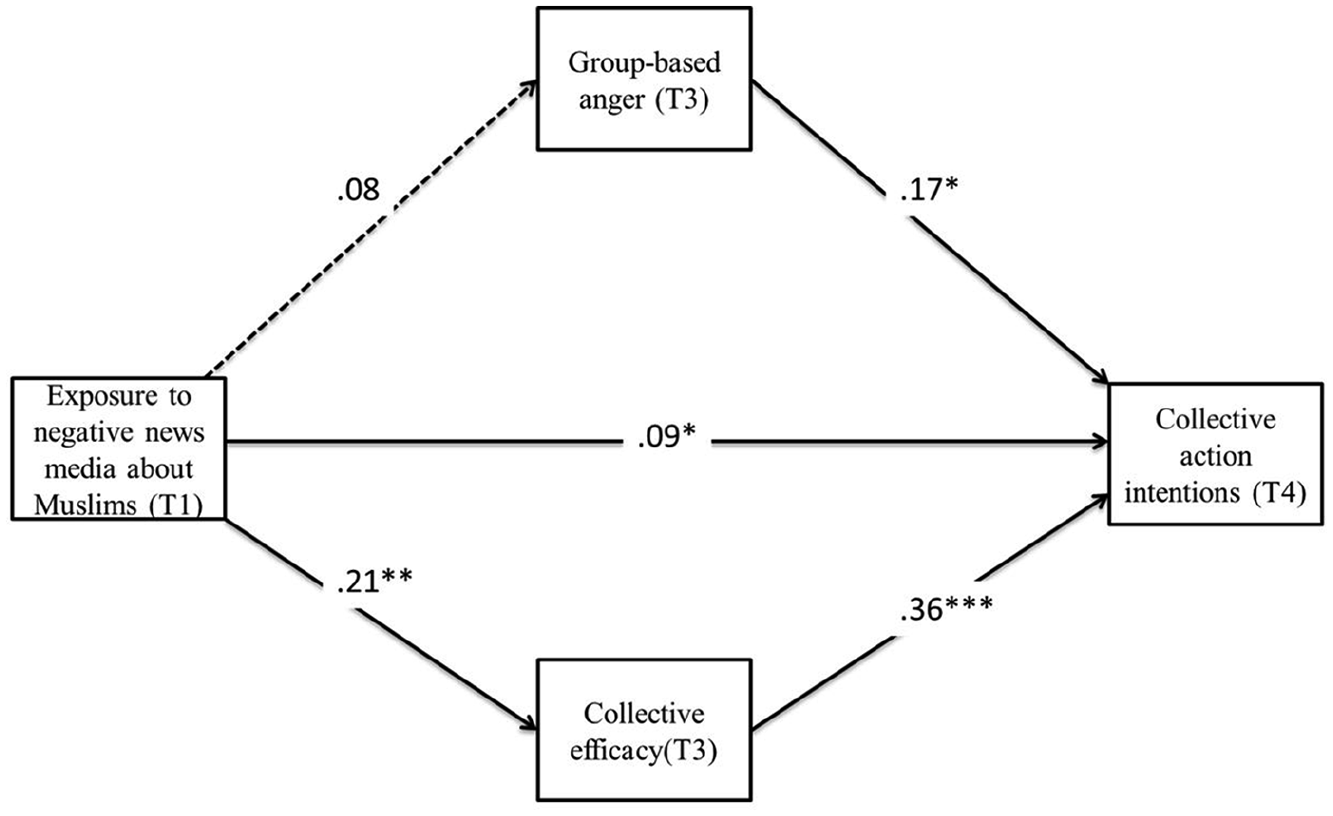
Hypothesized model testing the indirect effect of T1 exposure to negative news media coverage about Muslims on T4 collective action intentions through T3 anger at how Muslims are treated and T3 collective efficacy (N = 244).
Test of Hypotheses
As shown in Figure 1, the direct effect of T1 self-reported exposure to negative news media coverage of Muslims on T4 collective action was positive and significant, β = .09, p = .02, supporting H1. Next, we examined the relation between reported negative news and the tested mediators. T1 self-reported exposure to negative news increased T3 collective efficacy beliefs, β = .21, p = .01 (H2a supported), but not T3 group-based anger, β = .08, p = .32 (H2b rejected).
Both, T3 collective efficacy beliefs, β = .36, p < .001, and T3 group-based anger, β = .17, p = .01, increased T4 collective action intentions, supporting H3a and H3b. The indirect effect of T1 self-reported exposure to negative news media coverage of Muslims on T4 collective action intentions was tested simultaneously through both mediators. The indirect effect was significant through collective efficacy (b = .08, 95% confidence interval [CI] = [.02, .15], SE = .03, p = .02; H4a supported), but not anger (b = .01, 95% CI = [–.01, .06], SE = .02, p = .40; H4b rejected).
To increase our confidence in the causal chain tested (from news exposure to anger and efficacy to collective action), we tested a post hoc model predicting self-reported exposure to negative news media coverage of Muslims at T4 from collective efficacy, anger, and collective action at T3. Changes in T4 reported negative news coverage were not significantly associated with T3 anger, β = .02, p > .05; efficacy, β = .04, p > .05; or collective action intentions, β = .03, p > .05. These results, along with establishing temporal precedence and controlling for earlier assessments of the mediators and outcome, provide support for the causal chain tested in Figure 1. In short, self-reported news exposure is the antecedent, rather than the consequence, of efficacy, anger, and collective action.
Study 1 Discussion
Study 1 provides longitudinal support for the claim that self-reported exposure to negative news coverage about one’s ingroup can motivate minorities to engage in collective action. This link may be due to increased collective efficacy beliefs. An important limitation of this study is that we relied on self-reports of exposure, which are often inaccurate (e.g., Prior, 2013) as people may over-report exposure to negative content in particular (i.e., negativity bias, Ito, Larsen, Smith, & Cacioppo, 1998, and hostile media effect, Vallone, Ross, & Lepper, 1985). In addition, Study 1 focused on normative rather than non-normative collective actions, such as the use of violence to achieve group means. Although non-normative actions are rare relative to normative actions, there are instances when groups respond to collective disadvantage with non-normative actions. Previous work highlights important differences in the conditions and mechanisms that lead to normative versus non-normative behaviors emphasizing the importance of distinguishing them in collective action research (Tausch et al., 2011).
Study 1 was also limited as it focused on self-reported exposure to negative news media depictions of Muslims and cannot shed light on whether positive news coverage also has mobilizing effects. Lastly, Study 1 did not examine whether respondents perceived the reported negative news coverage about Muslims to be accurate or biased, a factor that should moderate the tested effects, as noted below. In order to address these limitations as well as to establish the robustness of the effects obtained in Study 1, we conducted an experiment.
Study 2
Study 2 provides an experimental test of the hypothesized effects and also examines whether perceived accuracy of news about one’s ingroup moderates the effect of negative news exposure on efficacy, anger, and collective action. In general, individuals tend to perceive news that counteracts their existing attitudes as inaccurate or biased (Gunther & Schmitt, 2004), a phenomenon that also emerges among racial and ethnic minorities who view negative representations of their ingroup as unfair, biased, and inaccurate (e.g., Fujioka, 2005; Tsfati, 2007; Tsfati & Cohen, 2005). Social identity theory suggests that collective action is especially likely when the disadvantage of one’s social group is seen as illegitimate or unfair (Tajfel & Turner, 1979; Wright, 2009). Thus, the perception of media accuracy versus bias should moderate the effect of exposure to negative media depictions of one’s ingroup on minorities’ collective action efforts. We predict that exposure to such depictions will motivate collective action when minorities perceive the news to be biased but not when they perceive it to be accurate. Study 2 examines these processes experimentally by randomly exposing participants to negative, mixed, or positive news about Muslims, assessing perceived accuracy of this news, and examining both normative and non-normative collective action intentions.
Participants
Young Muslim Americans were recruited through the same procedure as in Study 1. Of the 343 participants, 209 self-identified as female, 129 as male and five did not respond, mean age was 20.61 (SD = 2.76). The majority of participants reported being born in the United States (n = 274, 80.0%). Of those who were not born in the United States, the majority reported living in the United States for between 13 and 18 years (n = 23, 6.7%), followed by between 1 and 6 years (n = 22, 6.4%), between 7 and 12 years (n = 15, 4.4%), and between 19 and 21 plus years (n = 9, 2.6%). In terms of political affiliation, the majority of participants identified as liberal (n = 205, 59.8%), followed by moderate (n = 105, 30.6%) and conservative (n = 33, 9.6%).
Experimental Stimuli
Participants were randomly assigned to read one of three news articles about Muslims in the United States (see Online Appendix B). These fictional news articles were designed to either portray Muslims negatively, positively, or in a mixed fashion (e.g., containing both positive and negative information). The articles covered the growing population of Muslim immigrants in the United States and the implications of this growth. The negative article outlined such negative implications as the increased risk of domestic terrorism and concerns for the safety of the United States. The positive article discussed the positive implications for the U.S. economy (e.g., Muslims joining science, technology, engineering, and mathematics [STEM]–based careers) and charitable donations made by Muslims. The mixed article discussed the positive (increase in STEM-based careers) and negative (terrorism and safety concerns) implications. All the information related to Muslim population growth was kept the same across conditions, with articles only differing on the implications of this growth. Similarly, the design and the word length of articles was the same across all three conditions.
Post-Experimental Manipulation Measures
Table 2 displays the descriptive statistics and correlations of key measures. Collective efficacy (α =.88), group-based anger (α = .79), and collective action intentions (α = .86) were assessed using the same scales as in Study 1. In addition, the post-test measured perceived accuracy of the news article and non-normative collective actions using the scales below.
Descriptive Statistics and Bivariate Correlations for Key Measures in Study 2 (N = 343).

p < .05. **p < .01. ***p < .001.
Perceived accuracy
After reading the article, participants evaluated the extent to which it was “accurate,” “biased” (reverse-scored), “trustworthy,” and “credible.” These four items were averaged to create an index of perceived accuracy (α = .88).
Non-normative collective action intentions
Participants were told that “sometimes people think that extreme actions are necessary or justified to change the ways in which their group is treated in the larger society.” Then they were asked “to what extent would YOU be willing to engage in the following actions if they were part of a protest or demonstration aimed at changing the way Muslims are treated in American society.” Five non-normative actions were assessed (e.g., “I would be willing to engage in violent acts as part of this protest.”) Participants responded on a scale ranging from 1 (strongly disagree) to 5 (strongly agree) (α = .94; see Becker, Tausch, Spears, & Christ, 2011).
Study 2 Results and Discussion
Preliminary Analyses
Manipulation check
After exposure, participants rated the extent to which the article presents Muslims in a “positive manner” and “favorable way” (r = .91, reverse coded). A one-way (article: negative, mixed, positive) ANOVA confirmed that the articles were perceived as intended: The article negative toward Muslims was seen as depicting Muslims more negatively (M = 4.16) than the mixed (M = 3.26) or the positive (M = 1.89) articles, F(2, 339) = 162.10, p < .001. All three conditions were significantly different from one another, ps < .001, suggesting that the manipulations were successful.
Main Analyses
All main analyses tested the overall effects of exposure to the three articles as well as the hypothesized moderating effect of perceived article accuracy (standardized) on exposure for each of the outcomes using Proc generalized linear model (GLM) in SAS 9.4. Significant interactions were further probed with simple effects analyses testing the effect of perceived accuracy within each condition.
Collective efficacy
ANCOVA results revealed no significant effect of condition on collective efficacy, F < 1, p> .10. There was, however, a marginally significant interaction between condition and perceived article accuracy, F(2, 334) = 2.84, p = .06 (see Figure 2). Perceived accuracy yielded a significant effect in the negative condition, b = −.22, F(1, 112) = 6.02, p = .02, suggesting that those who read the negative article reported lower collective efficacy if they perceived the article as accurate. Perceived article accuracy did not moderate the effects of the positive and mixed articles, Fs < 1, ps > .10.

Collective efficacy beliefs as a function of assigned news article and perceived accuracy of news article in Study 2.
Group-based anger
Similarly, there was no main effect of condition on group-based anger, F < 1, p > .10. However, the significant interaction between perceived article accuracy and condition, F(2, 335) = 3.22, p = .04 (see Figure 3), revealed that perceived accuracy significantly moderated the effect in the negative condition, b = −.34, F(1, 112) = 15.94, p < .001, and the mixed condition, b = −.28, F(1, 108) = 9.17, p < .01, but not the positive condition. Participants in both the negative and mixed conditions felt less anger at the treatment of Muslims if they perceived the article as accurate.
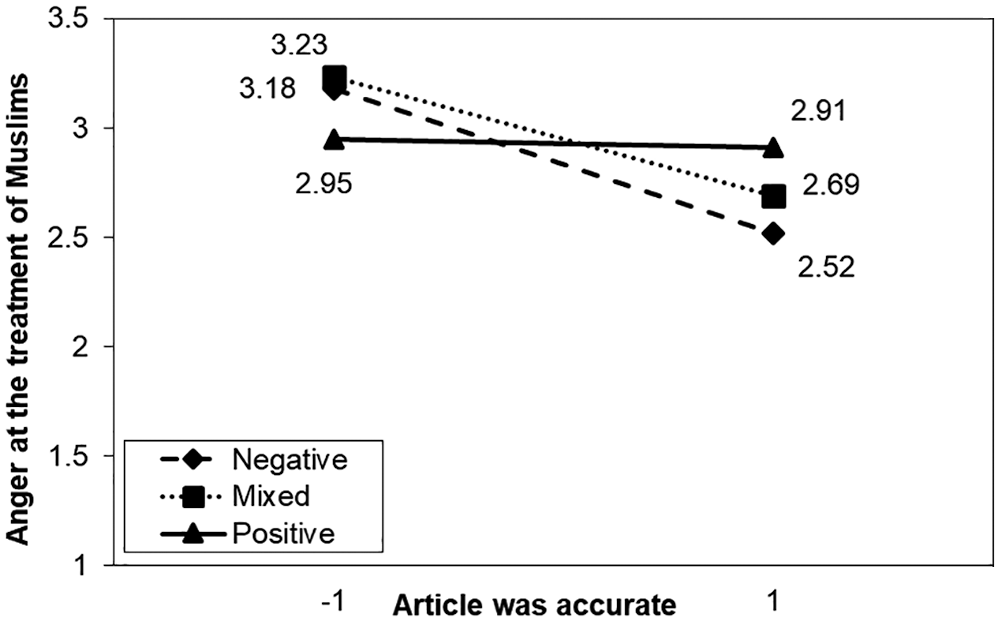
Anger at the treatment of Muslims as a function of assigned news article and perceived accuracy of news article in Study 2.
Normative collective action intentions
The main effect of condition on normative collective action intentions was non-significant, F < 1, p > .10. Again, the interaction between condition and perceived article accuracy was significant, F(2, 334) = 4.81, p < .05 (see Figure 4), with accuracy significantly moderating the effect of the negative condition, b = −.22, F(1, 112) = 6.62, p < .05. Participants who read the negative article were less likely to engage in normative forms of collective action if they perceived it as accurate. There were no parallel effects in the positive and mixed conditions.
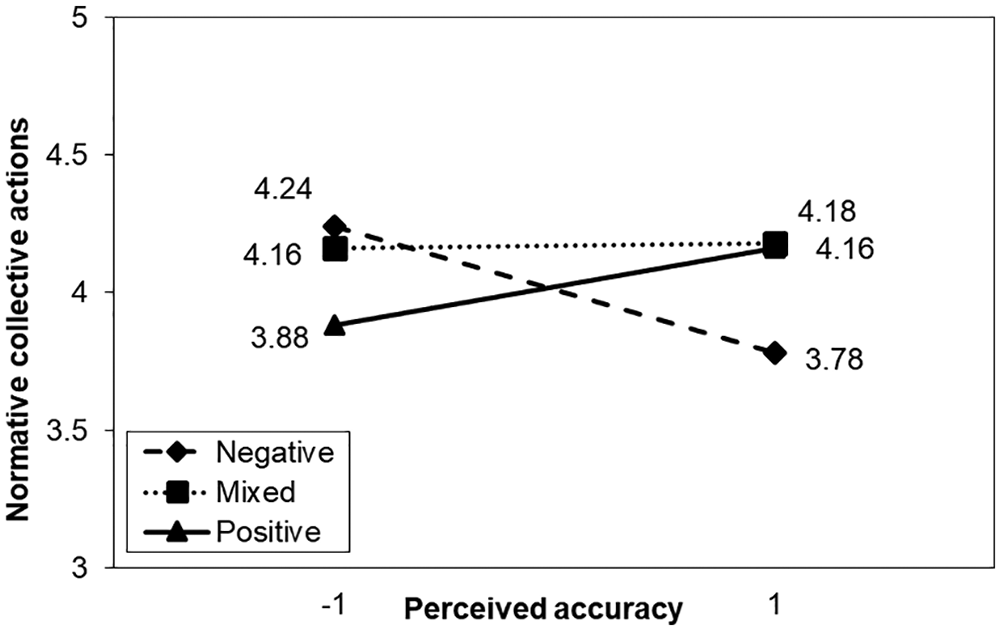
Normative collective actions as a function of assigned news article and perceived accuracy of news article in Study 2.
Non-normative collective action intentions
As above, there was no significant main effect of condition on non-normative forms of collective actions, F < 2, p > .10. Again, the significant interaction between condition and perceived accuracy, F(2, 334) = 5.71, p < .01 (see Figure 5) found that accuracy yielded a significant effect in the negative, b = .20, F(1, 112) = 6.90, p < .05, and positive conditions, b = −.25, F(1, 113) = 5.38, p < .05, but not the mixed condition, F < 2.50, p> .10. Unlike in the models above, those who read the negative article and perceived it as accurate were more likely to engage in non-normative forms of collective actions. This effect was reversed in the positive article condition, such that seeing it as accurate led to lower intentions to engage in non-normative actions. Caution should be taken when interpreting these results given the skewed and non-normal distribution of this measure. 1
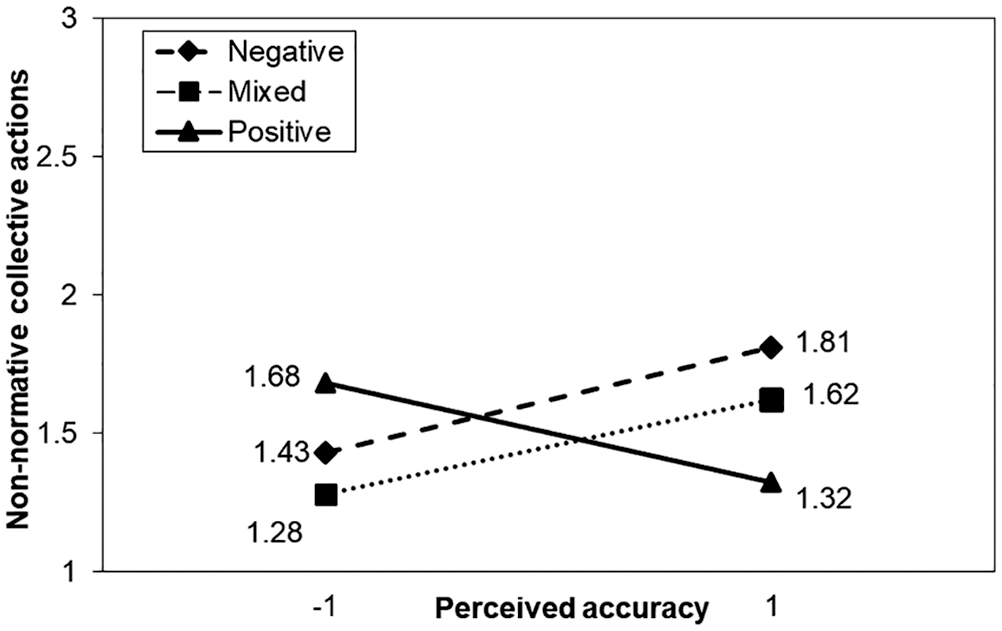
Non-normative collective actions as a function of assigned news article and perceived accuracy of news article in Study 2.
Moderated mediation
Recall that the dual model of collective action posits that collective efficacy and group-based anger explain the link between collective disadvantage and collective action. Study 2 further examines whether perceived accuracy of news media coverage moderates these effects. A moderated mediation analysis simultaneously tested for all of these processes (Model 8 PROCESS; Hayes & Preacher, 2014). Dummy variables were created to represent each of three news article conditions with the mixed condition being a reference group. Group-based anger and collective efficacy were included as simultaneous mediators and perceived article accuracy as a moderator. Analyses were run separately for normative and non-normative collective actions. As recommended, we report unstandardized coefficients (Hayes & Preacher, 2014).
Normative collective action
In the negative, relative to mixed, article condition, there was a significant indirect effect of the highest order interaction through collective efficacy, b = −.11, SE = .05, 95% CI = [–.21, –.03], but not group-based anger, b = −.03, SE = .02, 95% CI = [–.09, .004]. Conditional indirect effects at different percentiles of perceived accuracy revealed a significant effect of collective efficacy at 90th percentile of perceived accuracy in the negative, relative to mixed, conditions, b = −.20, SE = .11, 95% CI = [–.43, –.01]. In the positive, relative to mixed, article condition, there was a significant indirect effect of the highest order interaction through group-based anger, b = .05, SE = .03, 95% CI = [.01, .12], but not collective efficacy, b = .10, SE = .06, 95% CI = [–.005, .23]. Conditional indirect effects at different percentiles of perceived accuracy revealed a significant effect of group-based anger at the 75th, b = .04, SE = .02, 95% CI = [.002, .10], and the 90th percentiles, b = .07, SE = .03, 95% CI = [.02, .15].
Substantively, these results show that relative to the mixed condition, participants who read the negative article were less willing to engage in normative collective action due to reduced collective efficacy when they perceived the article as highly accurate (90th percentile perceived accuracy). In contrast, participants in the positive, relative to mixed, condition reported higher willingness to engage in normative collective actions due to increased anger when they saw the article as very accurate.
Non-normative collective action
In the negative, relative to mixed, article condition, the indirect effect of the highest order interaction through collective efficacy was significant, b = .05, SE = .03, 95% CI = [.01, .12], but not through group-based anger, b = .01, SE = .02, 95% CI = [–.02, .04]. Conditional indirect effects at different percentiles of perceived accuracy found a significant mediational effect of efficacy at the 90th percentile of accuracy, b = .09, SE = .09, 95% CI = [.01, .22]. The positive, relative to mixed, condition also shows a significant indirect effect of the highest order interaction through efficacy, b = −.04, SE = .03, 95% CI = [–.12, –.002], but not anger, b = −.01, SE = .02, 95% CI = [–.06, .04]. Conditional indirect effects found a significant mediational effect of efficacy at the 90th percentile of accuracy, b = −.05, SE = .03, 95% CI = [–.14, –.001].
These results find that, relative to the mixed condition, reading the negative article increased willingness to engage in non-normative collective action due to increased collective efficacy when participants saw the article as highly accurate (90th percentile perceived accuracy). In contrast, reading the positive, relative to mixed, article decreased participants’ willingness to engage in non-normative actions by reducing collective efficacy when the article was perceived as highly accurate. Again, however, these results need to be interpreted with caution given the skewed distribution of the non-normative collective action measure.
Discussion
Minorities are often dissatisfied with and frustrated by the ways in which mainstream media represent their ingroup (Schmader et al., 2015; Schmuck et al., 2017), and often wish to change the image of their group in society (Sirin & Fine, 2008). Yet, to date, few studies have systematically and empirically examined this relationship. The present project addressed this gap by examining whether and how exposure to negative news media depictions influence Muslim Americans’ collective action intentions in the long and short terms. Guided by the theoretical framework of the dynamic dual model, we tested the role of group-based anger and collective efficacy as psychological processes underlying this effect. We further examined whether perceived accuracy of news influences these effects, testing normative and non-normative collective actions as the key outcomes.
Longitudinal results from Study 1 revealed that self-reported exposure to negative news media coverage of Muslims increased efficacious beliefs of changing the status of Muslims in America, assessed at T3. It was through this increased collective efficacy that our Muslim American participants became more willing to engage in normative collective action efforts, gauged at T4. Interestingly, this cognitive mediating mechanism was stronger than the affective mechanism, such that the effects of exposure to negative news media coverage on collective action did not emerge through group-based anger.
Adding theoretical nuance to these effects, experimental results from Study 2 highlight the important role of perceived news accuracy in the tested effects. Muslim Americans who read a negative article about their ingroup and thought that the article was accurate felt lower collective efficacy and group-based anger, and also expressed lower willingness to engage in normative collective actions. That said, those participants reported greater willingness to engage in non-normative actions such as joining violent protests and demonstrations. These findings suggest that the effects of exposure to negative news media coverage of one’s ingroup observed in Study 1 were likely due to participants questioning the accuracy of reported negative news about Muslims. In other words, even though Muslim American participants reported seeing negative news about their ingroup, they may have dismissed such news as biased. This perception may have made them more efficacious and motivated them to engage in collective actions aimed at improving the status and position of their ingroup.
Conversely, acceptance of negative news about one’s ingroup as accurate decreased efficacy, anger, and normative collective action intentions. We speculate that this may have happened by enhancing system-justifying beliefs which lead minorities’ to accept their disadvantageous status as legitimate and fair, thereby reducing any desire to engage in collective action (Jost, Becker, Osborne, & Badaan, 2017). This is consistent with past work on minorities showing that there is a positive association between perceived accuracy of media representations of one’s ingroup and legitimacy of disadvantageous status (Oritz & Behm-Morawitz, 2015). Unfortunately, we did not measure system-justifying attitudes, and future research is needed to corroborate this notion. It is worth emphasizing, however, that perceiving the negative news as accurate increased the willingness to engage in non-normative forms of collective actions, perhaps because reading negative news about Muslims, specifically news about increased concerns of terrorism, and interpreting such news to be accurate may lead people to justify or be more sympathetic toward such actions, and thus more willing to consider similar non-normative actions to be viable. As mentioned earlier, caution should be taken when interpreting these results, because the measure of non-normative collective actions was highly positively skewed (i.e., consistent with past work, e.g., Becker et al., 2011; Tausch et al., 2011).
Across both studies, exposure to negative news about one’s ingroup did not increase group-based anger. This may be because anger is more likely to be evoked in situations reflecting blatant rather than subtle prejudice and when an external agent can be blamed for the event (Ellemers & Barreto, 2009; van Zomeren et al., 2008). The present project, and especially Study 2, focused on news pertaining to Muslims engaging in violent and terrorist actions and—although negative—such news is unlikely to be attributed to an external agent. It is possible that stronger effects on anger would have been detected had we studied exposure to negative depictions of Muslims within entertainment media and/or political commentary that collectively blames all Muslims for terrorist acts. Interestingly, Study 2 shows that the participants who read the positive, relative to the mixed, article and saw it as accurate were more willing to engage in normative collective actions because they became angry at the treatment of Muslims in America. This suggests that group-based anger may play a role in motivating collective action when individuals believe that their ingroup benefits and contributes to the society at large, and yet is still at a disadvantage vis-à-vis the majority group. More research is needed to understand if and what kinds of media representations evoke feelings of anger in minorities, and with what subsequent effects on people’s attitudes, cognitions, and behaviors.
Implications
Together, these two studies have important theoretical and practical implications. First, although exposure to negative media coverage is usually linked with deleterious outcomes for minorities (e.g., Saleem et al., 2019; Schmader et al., 2015; Schmuck et al., 2017), our findings suggest that such exposure may influence collective actions under certain conditions. Although scholars and non-governmental organizations often call for more positive and balanced representations of minorities within mainstream media (e.g., Joyce & Harwood, 2014; Ramasubramanian, Doshi, & Saleem, 2017), the possibility that such representations will be as frequent as those of the majority group seems unlikely in the near future. In the meantime, this project points to a silver lining, suggesting that minorities may be able to collectively organize and counter the ways in which their group is portrayed.
Although we considered non-media-based collective actions aimed at improving one’s group status, these effects can generalize to media-based collective actions as well (see Appendix E of supplementary analyses). Indeed, the presence of social media has allowed many minority groups to share their grievances and perspectives (Carney, 2016), increasing collective action among ingroup members and solidarity efforts among majority members (Howard et al., 2011; Lane, Coles, & Saleem, 2019). Ultimately, this is a more proactive, beneficial, and empowering strategy of coping with identity threats as it challenges the status quo relative to avoiding mainstream media and/or seeking alternative media that more positively reflects one’s ingroup (Abrams & Giles, 2007; Appiah et al., 2013; Harwood & Roy, 2005).
Importantly, this is not to suggest that mainstream media creators and producers be excused for the lack of racial/ethnic diversity in their media content. However, given that in the current media landscape racial/ethnic minorities are negatively represented, actively challenging these misrepresentations through collective action may be more socially and psychologically beneficial for minorities as opposed to some of the more passive coping strategies discussed above. In addition, media literacy interventions can focus on teaching minority members’ effective individual and collective coping strategies in response to media-based social identity threats. In the context of media, collective action could also take the form of media activism so that community-based organizations could use media as a tool for amplifying the voices of under-resourced and under-represented minority groups. These community organizations for minority groups could provide resources for developing critical media literacy skills that help minority group members challenge and counter-argue with negative media images of their group at the individual level.
Second, our results reveal the role of collective efficacy as a crucial psychological mechanism explaining the effects of negative news coverage on collective action efforts. This adds to and extends existing work on how minorities’ cope with negative media representations, much of which is focused on affective mechanisms (e.g., Schmader et al., 2015). In contrast, collective efficacy is considered to be a problem-focused response to addressing group disadvantages, predicting collective efforts aimed at working within the system through conventional channels of political influence (see Wright, 2009, for a review).
Third, Study 2 highlights the importance of considering perceptions of accuracy in understanding minorities’ reactions to negative media depictions of their ingroup. Because racial and ethnic minorities are negatively represented in mainstream media, perceiving these portrayals as accurate is likely to lead to adverse social and psychological consequences for minorities, including perceiving one’s disadvantageous group status as legitimate (Oritz & Behm-Morawitz, 2015). In this context, perceiving negative news about one’s ingroup as hostile and biased, as consistent with the hostile media effect (Vallone et al., 1985) or as inaccurate (Fujioka, 2005; Tsfati, 2007) may be more beneficial for minorities as it protects their self- and group esteem and can potentially motivate them to engage in collective action efforts aimed at improving their group status. This is in line with social identity theory which suggests that minorities are most likely to organize when they see their collective disadvantage as unjust and illegitimate (Tajfel & Turner, 1979). Ultimately, these findings highlight the importance of considering perceptions of accuracy in future research examining minorities’ reactions to media representations of their ingroup.
Limitations and Future Directions
Despite these contributions, some limitations and unanswered questions deserve attention. We cannot determine that the respondents in fact engaged in the tested collective activities. Inasmuch as willingness and intentions to engage in collective action are good predictors of actual participation (e.g., Moskalenko & McCauley, 2009), the participants may not have joined the various activities studied. At the same time, we recognize that joining collective action is not only a matter of individual willingness, but certain structural opportunities have to be present (e.g., a protest organized in one’s proximity). Research including questions on actual behaviors, and (ideally) examining long-term effectiveness of these various behaviors is needed to shed light on these important issues.
Another limitation is our focus on news in both studies rather than other types of media. This was done because Americans mostly rely on news for information about Muslims, and the depiction of Muslims in American news is especially negative (Dixon & Williams, 2015; Nisbet et al., 2009; Powell, 2011). It is possible that depictions of Muslims are different in other types of media, such as entertainment TV, movies, and/or video games, and—consequently—that the effects from those other media formats are distinct from those of news media. Future work can test the generalizability of our results across other media formats and examine how content features such as frames and narratives affect these results.
Also, the studied sample included mostly college-aged participants. Although the U.S. Muslim population is generally younger than the non-Muslim population—a third of Muslim Americans are between the ages of 18 and 29 (Pew Research Center, 2007)—it is likely that the tested effects could be different among older Muslim Americans. Similarly, though educational level was not specifically assessed, sampling from a university setting likely resulted in a highly educated sample. Future work on more representative samples is needed to determine the generalizability of these results.
Relatedly, it is important to test these processes for other minority groups given that different cultural, religious, historical, economic, and political contexts make each minority group unique. The way in which individuals and groups cope with media representations of their ingroup may differ from one minority group to another. For example, Asian Americans cope with identity threats by seeking individual mobility, presumably due to perceptions of boundary permeability given their high status relative to other minority groups in America (Cheryan & Monin, 2005). Indeed, the extent to which a minority group faces discrimination and the status of that group vis-à-vis the majority group is known to influence coping strategies (Tajfel & Turner, 1979). Thus, more work is needed to better understand how negative media environments affect individual and group-based coping strategies among different minority groups.
Conclusion
Overall, the present research makes an important contribution by showing when and how negative news can influence minorities’ collective action. Especially when perceived as inaccurate, such depictions may lead minorities to believe that their ingroup has the power to enact change and in turn engage in collective efforts aimed at challenging and/or correcting the group’s status in society. These results are encouraging and provide a greater understanding of how minorities and Muslim Americans more specifically navigate and cope with mainstream media’s tendency to under- and negatively represent their ingroup.
Supplemental Material
Supplementary_Analyses_final_RandR2 – Supplemental material for When and How Negative News Coverage Empowers Collective Action in Minorities
Supplemental material, Supplementary_Analyses_final_RandR2 for When and How Negative News Coverage Empowers Collective Action in Minorities by Muniba Saleem, Ian Hawkins, Magdalena E. Wojcieszak and Jessica Roden in Communication Research
Footnotes
Authors’ Note
Magdalena E. Wojcieszak is also affiliated with the University of Amsterdam, The Netherlands.
Declaration of Conflicting Interests
The author declared no potential conflicts of interest with respect to the research, authorship, and/or publication of this article.
Funding
The author received no financial support for the research, authorship, and/or publication of this article.

Supplemental Material
Supplemental material for this article is available online.
Notes
Author Biographies
References
Supplementary Material
Please find the following supplemental material available below.
For Open Access articles published under a Creative Commons License, all supplemental material carries the same license as the article it is associated with.
For non-Open Access articles published, all supplemental material carries a non-exclusive license, and permission requests for re-use of supplemental material or any part of supplemental material shall be sent directly to the copyright owner as specified in the copyright notice associated with the article.
