




Abstract
The current study investigates parasocial relationships as the underlying mechanism explaining prejudice reduction following extended exposure to mediated outgroups. Heterosexual participants viewed a fictional television series for 10 weeks depicting outgroup (gay) characters in which the outgroup attribute (sexuality) was accentuated or sanitized. Parasocial relationships with outgroup characters grew significantly over the course of the study regardless of condition. White participants and participants who reported the strongest pretest prejudice experienced the most intense growth. Outgroup prejudice decreased significantly over time for participants in both experimental conditions. Parasocial relationships predicted both prejudice reduction over time and behavioral responses to the outgroup. Parasocial relationships with an ingroup character engaged in intergroup contact did not contribute to prejudice reduction beyond parasocial relationships with outgroup characters. This research suggests that audiences can develop socioemotional bonds with outgroup television characters that can influence attitudes and behaviors much the same as direct, interpersonal intergroup contact.
Intergroup contact theory predicts that positive interpersonal engagement with an outgroup can reduce prejudice (Allport, 1954). Though the theory was developed and has been primarily tested with face-to-face intergroup contact, exposure to outgroups in the media can function similarly (Park, 2012). Prejudice reduction following exposure to mediated outgroups may be driven by parasocial relationships (PSRs): socioemotional bonds that audiences develop with fictional characters and celebrities similar to real-life friendships (Horton & Wohl, 1956). If individuals’ onscreen outgroup “friends” are akin to real-life outgroup friends, they may also evoke prejudice reduction (Schiappa et al., 2005). However, studies assessing PSRs as the underlying mechanism explaining postexposure prejudice reduction have relied heavily on data obtained from cross-sectional surveys.
The objective of the present study was to track the development and influence of PSRs in an effort to further dissect how mediated contact with an outgroup can generate prejudice reduction. A three-group pretest-posttest longitudinal design was executed to investigate the growth of audiences’ PSRs with previously unknown outgroup television characters, prejudice reduction over time, and differences based on the salience of the outgroup attribute in the media narrative. In line with vicarious intergroup contact (Ortiz & Harwood, 2007), the influence of an ingroup television character engaged in intergroup contact was also examined. This study is among the first longitudinal experiments to measure the growth of PSRs with television characters over time and to test for pretest-posttest differences in prejudice after an extended period of parasocial contact.
Sexual minorities were chosen as the study outgroup, and sexual prejudice was selected as the dependent variable. Sexual prejudice, defined as negative attitudes toward sexual minorities, can induce harassment that can have detrimental consequences for the psychosocial and physical health of sexual minorities (Herek & McLemore, 2013). Investigating the means through which sexual prejudice could be lessened is critical to alleviating harassment directed toward sexual minorities and, ultimately, to improving their health and well-being. Moreover, media messages about sexual minorities may be particularly meaningful resources for heterosexual audiences given that 20% of American adults report having no interpersonal interactions with gay 1 individuals (GLAAD, 2018).
Intergroup Contact
Intergroup contact can reduce outgroup prejudices and improve intergroup relations (Allport, 1954), especially if the intergroup experience conflicts with established attitudes, if the contact is sustained, and if the outgroup is judged as typical (Rothbart & John, 1985). A meta-analysis of over 500 studies found that the theory can be applied across contexts and groups and has been markedly predictive in explaining outgroup attitudes even when optimal conditions are absent (Pettigrew et al., 2011). With regard to the study outgroup, Herek and Glunt (1993) surveyed nearly 1,000 heterosexual adults and found that interpersonal contact was a stronger predictor of attitudes toward gay men than any other demographic or social psychological variable included in the models. Though research studies finding support for the intergroup contact theory are prevalent, intergroup experiences can be challenging.
Engaging with an outgroup member can cause anxiety and hostility that can lead to negative experiences and increase perceived threats that reinforce rather than challenge established prejudices (Stephan & Stephan, 2013). Many of the hinderances to effective face-to-face intergroup contact could be mitigated if the contact occurred indirectly. For example, simply imagining contact with an outgroup member has been shown to reduce prejudice (Dovidio et al., 2017). Media messages may indirectly facilitate intergroup contact as well (Park, 2012). The assertion that viewing positive depictions of outgroup members onscreen improves outgroup attitudes might be explained by the development of PSRs between audiences and outgroup media personae (Schiappa et al., 2005).
PSRs
PSRs are affective bonds audiences foster with media characters and celebrities that last beyond episodic exposure (Dibble et al., 2016; Horton & Wohl, 1956). PSRs parallel real-life social relationships, but are unique in that they lack reciprocity. Audiences may interact and associate with characters, but the reverse is rarely true. Much like real-life social relationships, individuals are more likely to report PSRs with characters they perceive to be similar to themselves, socially attractive, and authentic (Cohen, 2009). Research also suggests that PSRs are initiated, maintained, and dissolved in much the same way as real-life friendships (Eyal & Dailey, 2012; Kanazawa, 2002).
The primary assumption of PSRs is that audiences are capable of developing affective ties with characters known to them only through screens. Such an assumption is reasonable given that audiences rarely put forth the cognitive effort to differentiate between real-world interactions and those onscreen and cognitively respond to mediated interactions as if they are involved in the narratives playing out onscreen (Tukachinsky & Stever, 2019). Substantial evidence shows that audiences develop PSRs with media personae (see Cohen, 2009), and some studies suggest audiences are capable of developing affinity for outgroup television characters (Schiappa et al., 2005). As such, it is hypothesized here that (H1) PSRs with outgroup television characters will undergo significant growth over time.
Face-to-face intergroup contact is less effective when ingroup members develop intergroup anxiety or perceive outgroups as threatening to the status of the ingroup (Stephan & Stephan, 2013). Though the indirect nature of mediated contact may dull these threats, PSR development could still be hindered by intergroup anxiety or perceived threats most likely to manifest in situations where stereotypes and perceived dissimilarity are pronounced. Audiences who report the strongest prejudice may experience more intergroup anxiety and perceived threats when exposed to outgroup television characters than participants with weaker prejudice, which in turn may handicap PSR growth with outgroup characters. Thus, it is predicted that (H2) the magnitude of PSR growth will be greater for individuals who report weaker pretest prejudice than for those who report stronger pretest prejudice.
The salience of the outgroup attribute may also alter the development of PSRs with mediated outgroups. Audiences may develop weaker PSRs with characters whose outgroup attributes are accentuated in the storyline than with characters whose outgroup attributes are sanitized and less important to the character arc. Given that perceived similarity is a fundamental predictor of PSR development (Tukachinsky & Stever, 2019), perpetual reminders of outgroup differences may stifle audiences’ abilities to find similarity with outgroup characters, which could lead to an increase in intergroup anxiety and perceived threats. In turn, (H3) the magnitude of PSR growth will be greater for individuals exposed to outgroup television characters sanitized of their outgroup attribute than for those exposed to outgroup characters accentuating their outgroup attribute.
Perceived similarity can take many forms. Given that the present study focuses on sexual minorities as the outgroup, certain demographic variables that have historically predicted sexual prejudice should be considered. In most Western cultures, race and gender are strong demographic predictors of sexual prejudice (Calzo & Ward, 2009). Largely due to religious norms, beliefs about masculinity, and cultural customs, racial minorities and males are far less likely to be supportive of sexual minorities than White individuals and females, respectively. Racial minorities and males are more likely to experience intergroup anxiety and perceived threats when presented with gay television characters, such that (H4) the magnitude of PSR growth will be greater for White individuals than for racial minority individuals, and for females than for males.
Parasocial Contact
Parasocial contact predicts that exposure to outgroups in the media may be analogous to face-to-face intergroup interactions. Intergroup contact is most effective in intergroup friendships, when intimacy is developed beyond basic contact (Dovidio et al., 2017; Pettigrew et al., 2011). A sense of closeness with an outgroup member deepens bonds and builds empathy, maximizing the potential impact of contact. The parasocial contact hypothesis addresses the importance of intimacy by blending PSRs into the assumptions of intergroup contact theory (Schiappa et al., 2005). Parasocial contact has been negatively correlated with prejudice and negative outgroup attitudes in studies investigating immigrants (Visintin et al., 2017), Muslims (Moyer-Gusé et al., 2019), racial minorities (Fujioka, 1999), and individuals with mental health challenges (Hoffner & Cohen, 2012). Exposure to gay television characters has been negatively correlated with prejudice (McLaughlin & Rodriguez, 2017), perceived social distance (Ortiz & Harwood, 2007), and homonegativity (Sink & Mastro, 2018), and positively correlated with endorsement of gay equality (Bond & Compton, 2015).
The survey research that has employed the parasocial contact hypothesis to predict and explain findings cannot speak to causality; every cross-sectional survey study cited here mentions causality as a limitation. Several experiments have found that participants’ attitudes toward outgroups become more accepting after exposure to onscreen outgroup characters (Levina et al., 2000; Murrar & Brauer, 2018), though some studies suggest that exposure increases prejudicial attitudes (Gillig & Murphy, 2016). Duration of exposure could explain these contradictory findings given that experimental tests of parasocial contact have almost exclusively exposed participants to only one outgroup-inclusive message at one point in time (Gillig & Murphy, 2016; Levina et al., 2000). Parasocial contact, however, requires sustained intergroup contact for the audience to develop a sense of intimacy with the outgroup characters (Dovidio et al., 2017).
Only the study that advanced the parasocial contact hypothesis has examined exposure to outgroup characters onscreen over time. Schiappa et al. (2005) found that attitudes toward gay men significantly improved after viewing episodes of the gay-inclusive television series Six Feet Under over 5 weeks. Though this study suggested a causal relationship between exposure and outgroup attitudes, PSRs were not operationalized. Instead, participants reported variables that the authors argued were indicative of parasocial responses such as social attraction and perceived homophily. The character affinity variables were only measured once in the posttest, preventing the authors from analyzing changes over time. Schiappa and colleagues (2005) recommended that future research studies more extensively explore the “qualities of mass mediated content required to induce attitudinal change” (p. 111). The present study advances the work on PSRs with outgroup characters by not only quantifying PSRs over time, but by examining how the salience of outgroup attributes influences the positive effects of parasocial contact.
Parasocial contact with outgroup characters accentuating their outgroup attribute may reinforce established stereotypes, create intergroup anxiety, or increase perceived outgroup threats, thereby inhibiting the positive effects of parasocial contact (Rothbart & John, 1985; Stephan & Stephan, 2013). Exposure to characters whose outgroup attributes are sanitized rather than accentuated may allow audiences to find greater similarity with the characters and increase the positive effects of parasocial contact. Regardless, any intergroup exposure should create more attitudinal change than no exposure, a hypothesis that no previous longitudinal experiment employing parasocial contact has tested (Schiappa et al., 2005). As such, (H5) individuals in a sanitized condition will report significantly greater decreases in prejudice than those in an accentuated condition, and both experimental conditions will report significantly greater decreases in prejudice than a no-exposure control.
The crux of the parasocial contact hypothesis lies in the development of PSRs. Participants who develop strong PSRs with outgroup characters are afforded the opportunity to vicariously connect with the characters as emotionally substantive others. PSRs may provide audiences with outgroup “friends” needed to alleviate outgroup prejudices, such that (H6) individuals who develop the strongest PSRs with outgroup television characters will report significantly greater decreases in prejudice than individuals who develop weaker PSRs with outgroup television characters.
Criticisms of intergroup contact research often center around the limited outcomes measured and the generalizability of findings, though studies suggest that when outgroup members are seen as typical, the effects of intergroup contact are more likely to be generalized beyond the individual outgroup member to attitudes about the outgroup as a whole (Joyce & Harwood, 2014). In an effort to move the needle forward, a jury simulation task was included in the present study as a posttest measure of intergroup-related generalized behavior that was adopted from seminal research on desensitization effects of mediated violence (Linz et al., 1984); (H7) prejudice should predict sentencing severity when participants are presented with a hate crime against an outgroup victim, and the strength of their PSRs with an outgroup character should moderate that relationship such that participants who developed stronger PSRs will report more severe punishment for those who perpetrated hate against the outgroup.
Vicarious Intergroup Contact
The parasocial contact hypothesis is but one adaptation of intergroup contact theory that emphasizes media exposure as a channel for intergroup contact. Outgroup prejudices can be reduced not just because of affinity for outgroup members, but because audiences establish connections with ingroup members and learn attitudes and behaviors toward outgroups from the intergroup interactions that occur between onscreen ingroup and outgroup characters (Ortiz & Harwood, 2007). Such a proposition injects social cognitive theory into the intergroup contact sphere by asserting that audiences learn outgroup attitudes by observing ingroup models, similar to the extended intergroup effect that claims negative outgroup attitudes can be reduced when an individual is made aware that a liked ingroup member has a relationship with an outgroup member (Wright et al., 1997). In essence, exposure to media depicting positive intergroup interactions normalizes the outgroup for the audience.
Moyer-Gusé and colleagues (2019) found support for vicarious intergroup contact when participants in their study reported less anti-Muslim prejudice after exposure to a television show highlighting the interplay between Muslim and non-Muslim protagonists. In line with vicarious intergroup contact, (H8) PSRs with an ingroup television character engaged in positive intergroup contact will undergo significant growth over time and will function similar to PSRs with outgroup television characters in reducing prejudice.
Method
Participants
Participants were recruited from introductory courses at a West coast university to complete an online pretest measuring previous exposure to the experimental stimulus, sexual prejudice, and demographic variables. Those reporting no previous exposure to the experimental stimulus were invited to complete the study. Participants were randomly assigned to one of three conditions: the accentuated condition (n = 40), the sanitized condition (n = 40), or the no-exposure control (n = 40). Four participants in each experimental condition were lost to attrition. The final sample (N = 112) consisted of heterosexual female (60%) and male (40%) late adolescents (Mage = 18.11, SD = 0.31). Recruitment targeted late adolescents because attitudes and values about sexual identities are often formalized during this stage of the lifespan (Calzo & Ward, 2009). The sample was racially diverse: 52% White, 18% mixed race, 15% Latino/a, 10% Asian American/Pacific Islander, and 5% African American. There were no differences in gender, age, race, or pretest prejudice by condition.
Experimental Stimulus
Queer as Folk (Folk) was a popular television series (Showtime, 2000-2005) that followed the lives of Michael and his closest friends, a group of gay young adults attempting to find themselves and their purpose. The only reoccurring heterosexual character was Michael’s mother Debbie, a sharp-tongued woman with a colorful personality who was unapologetically supportive of the gay community. The series became well-known for its brazen, unvarnished depiction of gay culture in America, as well as vivid depictions of same-sex sexual behavior (Streitmatter, 2009). Folk was selected as the experimental stimulus for several reasons. First, the series was popular with heterosexual viewers when it originally aired, suggesting that the development of PSRs with characters was plausible (Streitmatter, 2009). Second, although the protagonists on the series were all White, they were diverse in many other respects, including their personalities, communication styles, physical appearance, and sexual aptitude. For example, Emmett was a stereotypically flamboyant gay man who was often campy and witty, bringing comic relief to the series. Ted, on the other hand, was a conservative gay man who worked as an accountant and often felt ostracized from the gay community because of his rather common physical appearance. The varied representation of gay characters increased the likelihood that heterosexual viewers would deem at least one gay character typical of the outgroup, thereby increasing the likelihood that intergroup contact would be effective (Rothbart & John, 1985). Third, Folk producers were able to balance sophisticated character development and complex storylines with sexually explicit content. Each episode could be edited to remove visually explicit sexual content while retaining character development and storyline progression. Final cuts of the edited, sanitized episodes were between 5 and 14 minutes shorter than the unedited, accentuated versions.
A content analysis of the Folk episodes was conducted by two independent coders to determine meaningful differences between the accentuated and sanitized versions beyond sexual explicitness. Variables that could influence parasocial liking were defined using previous codebooks (e.g., Bond, 2014) and dichotomously coded (0 = absent, 1 = present) for each of the primary characters in each scene (Scott’s pi = .90 to .96). Chi-square analyses are presented in Supplemental Table A1. Differences were found for frequency of sexual talk and sexual behavior. No differences were found for any other measured variable, verifying that sexual explicitness was the only significant difference between conditions.
The content analysis also attested to the value of investigating PSRs with Debbie as vicarious intergroup contact. For PSRs with the ingroup character to influence outgroup attitudes, the ingroup character must be portrayed engaging in intergroup interactions with outgroup characters (Joyce & Harwood, 2014; Park, 2012). The ingroup character in Folk was depicted interacting with an outgroup character in 90% of her scenes.
Procedure
Exposure to the experimental stimulus began two weeks after the pretest. Participants in the two experimental conditions were emailed two links every Monday for 10 weeks. The first link provided participants with one episode of Folk. Allowing participants to view the episodes on their own time and on their preferred devices increased the ecological validity of the study. Those in the accentuated condition viewed the episodes unedited as they originally aired on television; those in the sanitized condition viewed the edited versions. The second link sent participants to an online questionnaire to complete after viewing the episode. The weekly questionnaire was utilized as a manipulation and attention check. The questionnaire also included a measure of PSR for each of the eight primary characters after the first (T1), fourth (T2), seventh (T3), and tenth (T4) episodes.
Two weeks following the 10-week exposure period, all participants completed the posttest measuring sexual prejudice and responses to a jury simulation task. Participants in the experimental conditions also reported their favorite and least favorite characters from Folk. 2 Participants in the experimental conditions were paid an hourly minimum wage for their participation in the study; participants in the no-exposure control were paid US$20 for completing the pretest and the posttest.
Manipulation check
After viewing each episode, participants used sliding scales to rate the episode on storyline fluidity (1 = choppy/incoherent, 20 = clear/coherent) and sexual explicitness (1 = not at all sexual, 20 = very sexual). Fluidity mean scores did not differ by condition, F(1, 70) = 0.28, p = .60, d = 0.12. However, participants in the accentuated condition found the episodes significantly more sexually explicit (M = 13.09, SD = 2.86) than participants in the sanitized condition (M = 10.98, SD = 3.41), F(1, 70) = 8.07, p < .01, d = 0.67. The sexual explicitness differed by condition without harming the cohesiveness of the narrative, suggesting that the manipulation was successful.
Attention check
An attention check was conducted after each episode by asking participants to respond to five factual recall questions. Over 90% of participants correctly answered at least four of the five recall questions each week, and no participant answered fewer than four correctly more than once over the 10-week period. Participants attended to Folk in line with the study design. No participant was removed from the study for inattention.
Measures
PSRs
The 10-item parasocial scale (Rubin & Perse, 1987) was used to measure PSRs. Evidence suggests that the scale is a valid measure of long-term socioemotional connectedness to mediated personalities (Dibble et al., 2016). Sample items include “Brian makes me feel comfortable, as if I’m with a friend” and “Debbie is the kind of person I would like to hang out with.” Participants responded on 5-point scales ranging from 1 (strongly disagree) to 5 (strongly agree). The items in the scale showed high internal consistency; all 32 alphas (8 characters × 4 measurements) = .85 to .96. Higher scores on the parasocial scale equated to stronger PSRs. PSRs with outgroup characters were analyzed using the PSR scores for the gay character who received the highest T4 PSR mean for each individual participant. PSRs with an ingroup character were analyzed using the PSR means for Debbie, the sole heterosexual reoccurring character on Folk. For certain analyses and data visualization, PSR was recoded into ordinal groups: stronger (>+1 SD), moderate (±1 SD), and weaker (<−1 SD).
Prejudice
Sexual prejudice was operationalized using the modern homonegativity scale (Morrison & Morrison, 2002). The scale improves on previous measures of sexual prejudice by incorporating social, political, and economic aspects of sexuality (Sink & Mastro, 2018). The scale consists of two 12-item subscales that measure negative attitudes toward gay men and lesbians separately. Three items on the two scales are identical so participants were only asked to respond to those items once. Example items include “Gay men should stop complaining about the way they are treated in society and simply get on with their lives” and “Lesbians have become far too confrontational in their demands for equal rights.” Participants responded on 7-point scales ranging from 1 (strongly disagree) to 7 (strongly agree). Higher scores equated to stronger sexual prejudice. The same 16 items factored together in both the pretest (e = 7.77, 49% explained variance) and posttest (e = 9.05, 56% explained variance). Preliminary analyses also revealed that the gay and lesbian subscales functioned identically as dependent variables, serving as further justification for collapsing the scales. Mean scores were created for the 16 items that factored together in the pretest (α = .92) and the posttest (α = .93). For certain analyses and data visualization, pretest sexual prejudice was recoded into ordinal groups: stronger (>+1 SD), moderate (±1 SD), and weaker (<−1 SD).
Jury simulation task
Participants were presented with three written narratives of fictional court cases. Two cases were distraction items, but the third case described a landlord who had been found guilty of anti-gay discrimination. Participants were asked to determine the most appropriate punishment to accompany the guilty verdict. Participants were presented with five sentencing options that ranged in severity from 1 (a warning) to 5 (a significant fine accompanied by probation). Higher scores in the jury simulation task represented more severe punishments for the defendant found guilty of anti-gay discrimination (M = 3.89, SD = 0.76). The jury simulation task was only administered in the posttest due to concerns that a single-item dependent variable may be vulnerable to testing effects.
Results
Descriptive analyses revealed that 84% of participants reported the character whom they assigned the strongest PSR at T4 as their favorite, and 82% reported the character whom they assigned the weakest PSR at T4 as their least favorite. The character assigned the strongest PSR at T1 also matched the self-reported favorite character at T4 for 66% of participants, suggesting that first impressions are important and lasting influences on PSR development. 3 Debbie (36%) and Michael (33%) were most frequently selected as favorite characters, while Justin (43%) and Brian (29%) were most often cited as least favorite characters. Chi-square analyses revealed no differences in favorite character, χ2(6, N = 72) = 3.73, p = .71, V = 0.22, or least favorite character, χ2(6, N = 72) = 5.42, p = .49, V = 0.27, by condition, suggesting that sexual explicitness did not predict characters being selected as favorite or least favorite.
PSR Development
Latent growth curve analysis was used to assess the development of PSRs over time. AMOS was used to specify the models, and covariates were mean-centered for inclusion. To increase the interpretability of the parameters, the slope of T1 was constrained to 0 and the slope of T4 was constrained to 1 in all models. Centering the data at T1 is a standard approach in latent growth curve modeling (Duncan et al., 2006).
H1 predicted that audiences’ PSRs with outgroup characters would undergo significant growth over time. The baseline model was a good fit, χ2(3) = 4.09, p = .25, comparative fit index (CFI) = .99, root mean square error of approximation (RMSEA) = .05 (see Supplemental Table A2). The intercept mean was significantly different from 0 (3.89) and the positive slope mean was significant (0.50), suggesting that PSRs at T1 were above the midpoint and that they intensified across the four measurements. The nonsignificant covariance indicated that initial PSR scores were unrelated to changes in PSRs over time. A nested model was also analyzed that fixed the slopes for T2 and T3 to expected values (T2 = 0.33, T3 = 0.66). The observed values (T2 = 0.47, T3 = 0.78) did not differ significantly from the expected values, Δχ2(2) = 3.58, p = .17. The nested model provides further evidence that PSR growth was linear: MT1 = 3.89 (0.69), MT2 = 4.13 (0.57), MT3 = 4.29 (0.60), MT4 = 4.40 (0.57).
To further illustrate the strength of PSRs with outgroup characters, the T4 PSR scores were compared with previous studies using college-aged samples and 5-point scales to measure PSRs with favorite media characters. PSRs with outgroup characters were significantly stronger in the present study than PSRs with favorite characters in four of the six sampled studies (see Table 1). Such a comparison provides strong evidence that PSRs did not just grow linearly over time, but that participants developed strong, meaningful PSRs with at least one gay character on Folk. H1 was supported.
Parasocial Relationship Comparison to Previous Research.
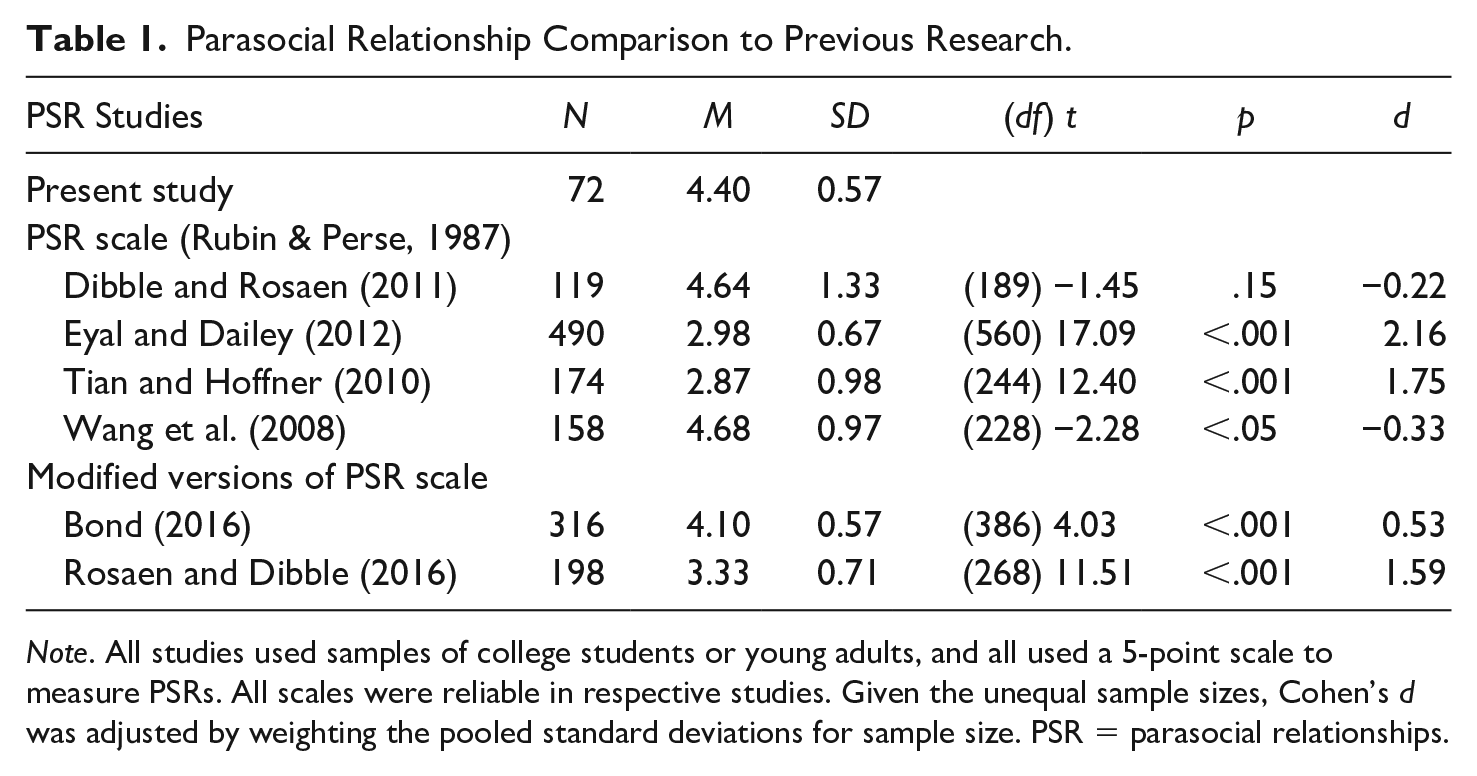
Note. All studies used samples of college students or young adults, and all used a 5-point scale to measure PSRs. All scales were reliable in respective studies. Given the unequal sample sizes, Cohen’s d was adjusted by weighting the pooled standard deviations for sample size. PSR = parasocial relationships.
The intercept and slope variances in the baseline model were significant, suggesting that individual differences in PSRs were nontrivial (Duncan et al., 2006). A follow-up conditional model was specified to included pretest sexual prejudice, race, sex, and experimental condition as covariates. The model indicated a good fit, χ2(17) = 10.34, p = .89, CFI = 1.00, RMSEA = .00 (see Supplemental Table A2). The magnitude of PSR growth was predicted to be greater for those with weaker prejudice (H2), those in the sanitized condition (H3), and those who identified as White or female (H4). The slope for sexual prejudice (0.18) was significant. Contrary to H2, the magnitude of growth was greater for those with stronger sexual prejudice. H2 was not supported. The slope for experimental condition was not significant. H3 was not supported. The slope for sex was not significant, but the slope for race was significant (−0.47). White individuals’ PSRs with outgroup characters developed with greater intensity than racial minority individuals. H4 was partially supported. Significant differences are visualized in Supplemental Figure A1.
Effects of Parasocial Contact
Repeated-measures analyses of variance (ANOVAs) were used to examine changes in sexual prejudice by condition and PSRs. The omnibus F test was the most appropriate to report for interpreting the results because the dependent variable was only measured in a pretest and posttest, alleviating potential sphericity assumption concerns. H5 predicted that participants in experimental conditions would report significant decreases in sexual prejudice that would not exist for the no-exposure control group, and that such decreases would be stronger for the sanitized condition than the accentuated condition. A repeated-measures ANOVA was conducted with sexual prejudice as the repeated measure (pretest, posttest), condition (accentuated, sanitized, control) as the between-subjects factor, and race and sex as covariates. The interaction between time and condition was significant, F(2, 107) = 9.28, p < .001, d = 0.79, suggesting that differences in sexual prejudice from the pretest to the posttest varied by condition. A simple main effects analysis revealed that posttest sexual prejudice differed by condition, F(2, 109) = 8.80, p < .001, d = 0.84. Bonferonni post hoc procedures suggested that posttest sexual prejudice did not differ between the accentuated condition (M = 2.54, SD = 1.02) and the sanitized condition (M = 2.68, SD = 0.96), but that both experimental conditions reported weaker sexual prejudice than the no-exposure control (M = 3.45, SD = 1.07). Pairwise comparisons showed that sexual prejudice significantly decreased from the pretest to the posttest for the accentuated condition, t(35) = 5.21, p < .001, d = 1.76, and the sanitized condition, t(35) = 3.41, p < .01, d = 1.15. Sexual prejudice did not significantly change for the control, t(39) = −0.88, p = .38 (see Supplemental Figure A2). H5 was partially supported.
H6 predicted that participants who developed stronger PSRs with outgroup characters would report greater decreases in prejudice than those who developed weaker PSRs. Only the participants in the experimental conditions were used to test H6 (n = 72). PSR strength was added as a covariate in the repeated-measures ANOVA. The only significant interaction was between time and PSRs, F(1, 67) = 22.95, p < .001, d = 1.14. A simple main effects analysis revealed differences in posttest sexual prejudice by PSR strength, F(2, 69) = 4.97, p < .05, d = 0.52. Bonferonni post hoc procedures suggested that posttest sexual prejudice did not differ between those who developed the strongest (M = 2.27, SD = 0.74) or more moderate PSRs with outgroup characters (M = 2.56, SD = 0.97), but that both reported weaker sexual prejudice than those who developed weaker PSRs with outgroup characters (M = 3.29, SD = 1.11). Pairwise comparisons showed that sexual prejudice significantly decreased from the pretest to the posttest for those participants who developed stronger PSRs with outgroup characters, t(25) = 8.31, p < .001, d = 3.32, and those who developed moderate PSRs, t (30) = 3.38, p < .01, d = 1.23. No such decrease occurred among those who developed weaker PSRs, t(14) = −0.11, p = .92 (see Supplemental Figure A3). H6 was supported.
H7 predicted that sexual prejudice would be correlated with participants’ sentencing severity in an outgroup-related hate crime jury simulation task, and that the negative relationship between these variables would be moderated by PSR strength. Only participants from the experimental conditions (n = 72) were included in the linear regression used to test H7. Sexual prejudice, PSRs, and their interaction were entered as predictors. The model was significant, F(3, 68) = 3.95, p < .05. However, only PSRs contributed to sentencing severity (β = 0.27, p < .05). Neither sexual prejudice (β = −0.12, p = .33) nor the interaction term (β = 0.22, p = .09) reached significance. Such a finding suggests that it was the strength of PSRs with outgroup characters that predicted participants’ desire for outgroup-related social justice rather than their general outgroup attitudes. H7 was not supported.
H8 predicted that PSRs with an ingroup character engaged in positive intergroup contact would develop and have similar effects as PSRs with outgroup characters, a prediction rooted in vicarious intergroup contact. Analyses were replicated using participants’ T4 PSR scores for Debbie, the sole reoccurring heterosexual character on Folk. The baseline growth curve analysis model was a good fit, χ2(3) = 2.19, p = .53, CFI = 1.00, RMSEA = .00; the growth of PSRs with the ingroup character mirrored that of outgroup characters. The conditional model was also a good fit, χ2(17) = 11.72, p = .82, CFI = 1.00, RMSEA = .00. The intensity of PSR growth with the ingroup character was stronger for White participants than for racial minority participants, but growth did not differ by sexual prejudice (see Supplemental Table A2). When T4 PSR scores with the ingroup character were used in the repeated measures ANOVA, a significant interaction emerged between time and PSRs, F(1, 56) = 17.81, p < .001, d = 1.14. However, when PSR scores with outgroup characters were added as a covariate, the only significant interaction was between time and PSR with the outgroup character, F(1, 55) = 4.84, p < .05, d = 1.14. The interaction between time and PSR with the ingroup character was moved to nonsignificance, F(1, 55) = 3.19, p = .08, d = 1.14. Though PSRs with an ingroup character underwent significant growth over the course of the study, the strength of those PSRs did not predict decreases in sexual prejudice above and beyond the strength of PSRs with outgroup characters. H8 was partially supported.
Discussion
The objective of the present study was to longitudinally test the parasocial contact hypothesis by conducting a detailed analysis of PSR growth with outgroup television characters, examining differences in PSR development by outgroup attribute salience, and applying PSRs as the function through which mediated intergroup contact reduces prejudice. Heterosexual participants developed PSRs with gay characters that significantly grew in a linear fashion over time. PSR strength was the only variable that significantly predicted sexual prejudice reduction from the pretest to the posttest, and the sole predictor of outgroup-related behaviors in a jury simulation task.
Participants not only established PSRs with outgroup characters, but T4 PSR scores mirrored PSRs with favorite media personae in previous research. This serves as compelling evidence that PSRs with gay characters did not just grow significantly, but developed into meaningful connections. The Folk characters who garnered the strongest PSR scores after the first episode were most participants’ favorite characters 12 weeks later, suggesting that first impressions are important markers for the development of PSRs with outgroup characters. PSRs with Folk characters grew with the greatest intensity for White participants, but there were no gender differences. Perceived similarity may explain these findings, as the degree to which audiences find similarity with media personae significantly contributes to PSRs (Cohen, 2009). The Folk protagonists were diverse in many respects, including sex. Five male protagonists and three female protagonists composed the primary cast. Though females tend to be more accepting of sexual minorities (Calzo & Ward, 2009), the gender diversity of the cast may have influenced PSR development among male participants. However, the series lacked racial diversity. All protagonists were White. White participants may have more easily perceived similarity with White characters. Such a finding speaks to the importance of similarity even, or especially, within mediated intergroup contact. When outgroup attributes are apparent during parasocial contact (e.g., sexuality), other attributes that are deemed similar (e.g., race) may play an even greater role in influencing audiences’ connections with outgroup others. Audiences may search for similarities when faced with outgroup characters to overcome intergroup anxiety or perceived threat brought forth by the outgroup attribute.
Established sexual prejudices also influenced PSR growth. Contrary to the hypothesis, participants who reported the strongest pretest sexual prejudice had the most intense PSR growth. One line of intergroup contact research suggests that contact might be most beneficial for those with the highest levels of initial prejudice toward the outgroup, as they are least likely to have previously engaged with outgroup members and most likely to experience dissonance between held beliefs and contact experiences (Lytle et al., 2017). Survey studies on parasocial contact support this premise (Bond & Compton, 2015; Fujioka, 1999). The current study bolsters the assertion that individuals with the strongest outgroup prejudices have the most to gain from parasocial contact. Supplemental Figure A1 reveals that participants with stronger pretest prejudice had lower PSR scores in the early weeks of the study, but their PSRs with outgroup characters progressed to commensurate with PSRs among those with moderate or weaker pretest prejudice. Parasocial contact may pacify intergroup anxiety and dull perceived threats associated with face-to-face intergroup contact, allowing the screen to serve as a safe medium through which to develop affinity for an outgroup other.
The salience of the outgroup attribute was expected to not only influence the development of PSRs, but to also affect prejudice reduction. No differences by experimental condition were found in any analyses. Participants were able to develop PSRs with gay characters regardless of the sexual explicitness of their depictions. Moreover, the same characters were reported as the most likable and least likable in both the accentuated and sanitized conditions, implying that attributes beyond the outgroup attribute determined character likeability. Audiences may advance affective bonds with outgroup characters based on other qualities that viewers deem similar to themselves, socially attractive, or authentic (Cohen, 2009). For example, the lead Folk protagonist is Michael, an altruistic gay man who struggles with romance, must constantly navigate his overbearing mother, and finds happiness in his friendships and comic books. A heterosexual viewer could easily find similarity, attraction, or authenticity in Michael’s altruism, relationship with his mother, love of comics, or any number of characteristics not related to his sexuality.
Beyond character attributes, production features may have also contributed to PSR development. For example, Michael breaks the fourth wall by narrating the beginning and ending of each episode of Folk. Michael was also the gay character with the highest T4 PSR score and was among the most liked characters, supporting research that suggests breaking the fourth wall and directly addressing the audience can craft the illusion of a face-to-face interaction and thereby intensify PSR development (Tukachinsky & Stever, 2019). Future research should consider the factors, in both content and production, that strengthen or weaken intergroup PSRs beyond the attribute that classifies a character as an outgroup on one particular dimension.
The absence of differences by experimental condition also refutes recent experimental research suggesting that sexualized gay television characters increased negative gay attitudes (Gillig & Murphy, 2016). Gillig and Murphy (2016) wrote at length about the one-time exposure design as a limitation to their study, imploring future research to examine audiences’ responses to complete storylines rather than clips spliced together for experimental purposes. Results of the current study suggest that duration is an important consideration. Participants in the present study were exposed to the same characters in complete, complex storylines over a 10-week period, affording participants the opportunity to develop socioemotional bonds necessary for parasocial contact to induce attitudinal change (Dovidio et al., 2017).
Participants in the present study who developed stronger or moderate PSRs with outgroup characters reported a significant decrease in sexual prejudice that was not found for participants who developed weaker PSRs or those in a no-exposure control. Having an outgroup “friend” who contradicts preconceived stereotypes or prejudicial beliefs fosters dissonance that is effectively remedied through prejudice reduction (Schiappa et al., 2005), especially if contact is sustained, the outgroup is judged as typical, and a sense of closeness with the outgroup builds intimacy (Dovidio et al., 2017; Rothbart & John, 1985). In the present study, contact was sustained over 10 weeks, participants were exposed to seven sexual minority characters in a variety of complex, realistic storylines, and participants developed meaningful PSRs with at least one outgroup character. It stands to reason that prejudice reduction can be attributed to participants’ desires to alleviate dissonance between their positive parasocial experiences with their Folk “friend” and their previously held beliefs. Moreover, the strength of PSRs with outgroup characters was the only variable that predicted participants’ sentencing severity in a jury simulation task. General attitudes about sexual minorities did not predict how heterosexuals would act when placed into a hypothetical situation where they needed to instill justice for an outgroup other, but feelings about one Folk outgroup character did predict how they would act. Individuals with stronger PSRs reported more severe sentencing for the perpetrator of anti-gay discrimination. This speaks to the power of PSRs, much like real-life intergroup friendships, to create optimal conditions for positive contact effects.
The final hypothesis considered the potential influence of an ingroup character on prejudice reduction as predicted by vicarious intergroup contact (Ortiz & Harwood, 2007). Debbie, the lone ingroup protagonist on Folk, was the most liked character on the series, and participants developed PSRs with Debbie that mimicked their PSRs with outgroup characters. Sexual prejudice did not moderate PSR growth with Debbie as it did with outgroup characters, but participant race did have a moderating effect. Perceived similarity explains these differences. Debbie was a sexual ingroup member for all participants, but a racial outgroup member for racial minority participants, further highlighting the crucial role of similarity in the development of PSRs with media personae. PSRs with the ingroup character did not predict prejudice reduction beyond PSRs with outgroup characters. Though modeling ingroup others who are observed interacting with outgroups can alter attitudes toward outgroups (Ortiz & Harwood, 2007), the present study suggests that PSRs with outgroup characters have greater influence on outgroup attitudes than PSRs with ingroup characters depicted in intergroup interactions onscreen.
The lack of significant findings regarding PSRs with Debbie is particularly telling because most studies offering empirical support for vicarious intergroup contact have measured identification with the ingroup character rather than PSRs (e.g., Joyce & Harwood, 2014; Moyer-Gusé et al., 2019). Identification requires viewers to suspend their own perspective and take the role of the character, whereas PSRs are likened to pseudo-friendships that provide emotional or social benefits but allow audiences to retain their own sense of self. Identifying with outgroup characters may be a cognitively onerous task for audiences given that dissimilarity is at the core of outgroup representation. Developing PSRs with outgroup others may be more tenable, as PSRs require audiences to overcome fewer cognitive hurdles than identification. In essence, making friends with outgroup others is easier than envisioning oneself as part of the outgroup. It is possible, then, that identification with ingroup characters and PSRs with outgroup characters function in tandem to reduce prejudice.
Various methodological questions in parasocial research are also addressed in the present study. The validity of scales that claim to quantify PSRs has sparked significant debate in the mass communication literature (Dibble et al., 2016; Park, 2012; Schiappa et al., 2005). Considerable criticism has been levied against studies operationalizing PSRs as unidimensional. At the same time, one of the first published parasocial scales (Rubin & Perse, 1987) is still the prevailing method of quantifying PSR strength in modern research. In the present study, favorite and least favorite Folk characters matched the characters for whom most participants assigned the strongest and weakest PSRs, respectively. The scores on the parasocial scale also predicted decreased prejudice as expected. These findings build on Dibble and colleagues’ (2016) assertion that the parasocial scale validly measures some form of enduring socioemotional affinity for television characters. Nonetheless, future research should continue to dissect the validity of PSR measures to create scholarly consensus on parasocial operationalization.
A sizable number of studies investigating audiences’ PSRs have asked participants to list their favorite media personae and subsequently respond to PSR scales with said favorite media personae in mind (see studies cited in Table 1). The present study suggests that parasocial research move beyond the study of participants’ favorite characters and celebrities. Almost 40% of participants did not report an outgroup character as their favorite, but those participants were still influenced by PSRs with an outgroup character. PSRs with various media personae can yield effects, regardless of their status as favorite or not.
Results could also have practical application for the media industry. Content creators and their advertisers have traditionally feared that depicting gay characters would offend heterosexual audiences. In the intensely competitive contemporary media market, however, portraying diverse characters may reign in the highly sought after young adult demographic (Becker, 2006). These competing economic ideologies have created a media landscape whereby sexual minority characters are in a representational purgatory: gay characters may be depicted, but they are often only gay by proclamation, void of any authentic representation of their own sexualities (Bond, 2014). The present study may serve as evidence that fears about depicting realistic gay characters are misguided. Young heterosexual media consumers are capable of developing socioemotional bonds with gay characters even when those characters’ sexualities are accentuated in the narrative.
This study is not without limitations. The sample consisted of late adolescents, and the experimental stimulus was a single dated television series depicting only White sexual minorities. Though strong rationale existed for sample age and stimulus selection, the generalizability of the findings should be considered with caution. Future research should consider greater variance in participant age and should employ a multiple-message design to determine whether the results reported here can be replicated. Future research should also attempt to reproduce the findings with other outgroups such as racial minorities, religious minorities, or transgender individuals to better illuminate the generalizability and limitations of parasocial contact.
Intergroup anxiety and perceived threats are mentioned throughout the literature review as potential mediating variables in the relationships between exposure, PSRs, and prejudice, but neither of these variables are measured in the present study. Attention to these variables may provide insight into how PSRs operate and in what contexts they are most effective at reducing prejudice. Similarly, the data reported here do not speak to other attributes of outgroup characters that might alter PSR development. Media depictions of marginalized groups like sexual minorities are often fraught with stereotypes (Bond, 2014), making it even more worthy of an undertaking to test outgroup character qualities that increase or decrease the strength of participants’ PSRs with the respective outgroup characters.
The study design could have intensified prejudice reduction that may not have been found in more naturalistic settings. Authority support establishes norms of acceptance, functioning as an important prerequisite for attitudinal change following intergroup contact (Pettigrew et al., 2011). Participants were undergraduate students recruited on campus and tracked by a research team affiliated with their university. Participants could have perceived that the Folk characters were, thus, endorsed by their university. This could have created an artificially high level of perceived authority support for parasocial contact with gay characters. Future research should manipulate authoritative support to examine the importance of this contextual variable on the effects of parasocial contact.
Conclusion
The value of intergroup contact has been established by decades of empirical research. The results of this study reinforce the proposition that intergroup contact does not have to occur in direct, face-to-face interactions to have an effect on people’s attitudes and behaviors toward outgroup others. Parasocial contact made between ingroup audiences and outgroup media personae can also be influential. Media audiences are capable of developing PSRs with fictional outgroup characters that then become the basis for judgment about the outgroup more generally. The conclusions drawn here suggest that the media industry become ever more diligent in depicting authentic, socially attractive characters of varying backgrounds and identities to assist audiences in developing socioemotional connections with media personae that have the ability to alter negative attitudes toward others and contribute to a more inclusive, empathetic society.
Supplemental Material
Online_Appendix_V3 – Supplemental material for The Development and Influence of Parasocial Relationships With Television Characters: A Longitudinal Experimental Test of Prejudice Reduction Through Parasocial Contact
Supplemental material, Online_Appendix_V3 for The Development and Influence of Parasocial Relationships With Television Characters: A Longitudinal Experimental Test of Prejudice Reduction Through Parasocial Contact by Bradley J. Bond in Communication Research
Footnotes
Acknowledgements
The author thanks Jacqueline Lefevre and Carolyn Massey for their coding assistance.
Declaration of Conflicting Interests
The author declared no potential conflicts of interest with respect to the research, authorship, and/or publication of this article.
Funding
The author disclosed receipt of the following financial support for the research, authorship, and/or publication of this article: This work was supported by a grant from Villanova University’s Waterhouse Family Institute for the Study of Communication and Society.

Supplemental Material
Supplemental material for this article is available online.
Notes
Author Biography
References
Supplementary Material
Please find the following supplemental material available below.
For Open Access articles published under a Creative Commons License, all supplemental material carries the same license as the article it is associated with.
For non-Open Access articles published, all supplemental material carries a non-exclusive license, and permission requests for re-use of supplemental material or any part of supplemental material shall be sent directly to the copyright owner as specified in the copyright notice associated with the article.
