




Abstract
The hostile media phenomenon (HMP) refers to a process in which supporters and opponents of an issue perceive the identical coverage to be biased against their own views. Despite the relevance of visual communication in our field, scholars have treated hostile media perceptions as a text-based phenomenon ignoring the unique role of visuals. This paper makes the case for a visual hostile media phenomenon (VHMP). The VHMP posits that completely balanced pictures are perceived as biased both by opponents and supporters of an issue. Two experimental studies on the Israel–Palestine conflict provide clear evidence for this reasoning. Study 1 shows that Palestine (Israel) supporters perceived a balanced photo series as biased toward Israel (Palestine) irrespective of the series’ reach. This effect was also visible for clearly slanted pro-Israel and pro-Palestine pictures (i.e., relative VHMP). Study 2 replicates these findings and sheds some first light on the underlying mechanism. Theoretical and methodological implications are discussed.
With the increasing polarization of the electorate, research on perceived news media biases is more important and timelier than ever before (Perloff, 2015). One key explanation for why strong partisans perceive the news media as biased is the so-called hostile media effect, or hostile media phenomenon (HMP). The HMP refers to a process in which supporters and opponents of an issue perceive the identical coverage of that issue to be biased against their own views (Vallone et al., 1985). The HMP may have severe undesirable consequences such as loss of confidence in conventional politics, increased polarization of extreme groups or even alienation from democratic processes (Gunther, 2008). Since the seminal study by Vallone et al. (1985), researchers from around the globe have accumulated strong evidence for the HMP, covering numerous issues, demonstrating the effect for all types of news media, examining moderators as well as mediators, and showing an overall medium-sized effect with meta-analysis (see for a review, Perloff, 2015; for meta-analysis, Hansen & Kim, 2011).
One common element of this line of research is the focus on text as the defining source of hostile media perceptions. In a typical experimental HMP study, partisans are exposed either to textual stimuli or to audiovisual stories and their bias perceptions are measured afterwards (e.g., Gunther et al., 2001; Schmitt et al., 2004; Vallone et al., 1985). Correlational studies typically observe the effect by asking about the use of mainstream media, that is, TV and newspapers (e.g., Matthes, 2013; Matthes & Beyer, 2017; Tsfati, 2007; Tsfati & Peri, 2006). In fact, the meta-analytic data by Hansen and Kim (2011) suggest that about half of the research on the HMP has worked with newspaper articles, the other half with audiovisual materials such as TV excerpts. The meta-analysis revealed that there is no evidence to assume that the media format (i.e., newspaper or television) influences the extent to which the HMP is evoked. Therefore, it can be assumed that for both media types, newspapers and TV, the story is guided by the textual information. In the seminal study by Vallone et al. (1985), for instance, pro-Israeli and pro-Palestinian participants watched CBS, NBC, and ABC news footage of the 1982 war in Lebanon. Typically, such TV news stories involve spoken information about an event, its causes and consequences. More importantly, the spoken information is key for the understanding of the news message (Brosius, 1989). The text transports the arguments that are conveyed by the message, and these arguments are perceived as biased. It therefore seems fair to say that extant research on the HMP has a clear textual focus and that the role of visuals has been ignored. Since TV reports combine textual and visual elements, we do not know whether visuals themselves can produce the HMP. Comparing media formats (e.g., newspaper and TV, Hansen & Kim, 2011) does not answer this important question. From the available body of knowledge, we, therefore, cannot say whether hostile media perceptions also occur for visuals, for example, photographs used in journalism, and we have no knowledge whatsoever about the underlying mechanisms. Thus, research focusing on visuals as main source of information is warranted.
Thus far, there is compelling evidence that exposure to visual information can systematically influence news reception processes and may impact public opinion (e.g., Geise & Baden, 2015; Powell et al., 2015; von Sikorski & Ludwig, 2018). Visuals have distinctive features compared to text, they are processed and decoded by individuals in different ways (Geise & Baden, 2015). What is more, it is often assumed that visuals used in journalism mirror the reality out there, so “seeing is [. . .] believing” (Graber, 1996, p. 87). Despite this clear evidence, most of our knowledge on how people use and are affected by news stimuli is still based on verbal or textual information. As a consequence, effects of visual stimuli remain understudied, as scholars in the field have repeatedly pointed out (e.g., Barnhurst & Quinn, 2012; Geise & Baden, 2015; Grabe & Bucy, 2009; Graber, 1990, 1996; von Sikorski, 2021). This is also true for the HMP. There is no study that has demonstrated the HMP for visuals.
Against this background, this paper makes the case for a visual hostile media phenomenon (VHMP). The VHMP posits that completely identical pictures are perceived as biased by opponents and supporters of an issue. In what follows, we first review research on the HMP and the relative HMP. We then provide a theoretical account for why the HMP should occur for visual information and we derive specific hypotheses for the VHMP as well as the relative VHMP. We then present two studies that clearly demonstrate the VHMP as well as the relative VHMP. In study 2, we also explore the underlying mechanisms.
The Hostile Media Phenomenon
In their seminal study, Vallone et al. (1985) showed that both pro-Israeli and pro-Arab individuals perceived the identical news coverage of the Beirut massacre as biased against their group. Also, they perceived the personal views of the editors as responsible for news coverage as biased. In other words, no matter how balanced a respective news story is, strong prior views and identification with a particular party may result in the perception of journalistic bias. In the subsequent years following Vallone et al.’s study, findings from numerous studies suggest that the effect is robust and occurs for all kinds of issues (Hansen & Kim, 2011; Perloff, 2015). For instance, Perloff (1989) replicated Vallone et al.’s (1985) findings also using the Israeli–Palestinian conflict as a study context. Furthermore, Gunther (1992) showed that the hostile media effect can generally be understood as a function of individuals’ partisan or group involvement. That is, the stronger an individual’s own group identification, the more likely that he or she perceives mediated information to be biased against his or her own side (see also Choi et al., 2009; Gunther et al., 2009).
A large share of research has tested for hostile media effects by using partisan participants stemming from particular societal, political, or religious groups (e.g., pro-Israel, pro-Palestinian groups). Yet, other research also finds hostile media effects in samples with lower levels of partisanship. Giner-Sorolla and Chaiken (1994), for instance, employed a student sample with less extreme partisans in their study. Their results revealed that the HMP could be replicated for the Middle East conflict, but with less extreme partisans. Supporting this line of research, Dalton et al. (1998) as well as Gunther and Christen (2002) showed that the HMP extends to various issues (such as presidential elections) and manifests in the general U.S. population as well as individuals that can be described as moderate partisans. Furthermore, Hansen and Kim (2011) conducted a meta-analysis examining a total of 34 studies on the HMP showing an overall robust effect with a moderate effect size of r = .296.
The original assumption of the HMP is that partisans from different camps regarding a particular issue judge the identical balanced and neutral news coverage as biased against their own side. By contrast, the relative HMP posits that hostile media perceptions may also occur under conditions in which people are exposed to slanted and rather one-sided news (Gunther et al., 2001; see also Coe et al., 2008; Feldman, 2010; Gunther & Christen, 2002). In this context, Gunther et al. (2001) exposed participants to experimentally manipulated news articles that, for instance, reported favorably about the controversial issue of primate research. Primate researchers perceived these articles as, indeed, more favorable toward primate research. Yet, their perceptions were substantially less favorable compared with those of the opposing group (i.e., animal rights partisans). Gunther and Christen (2002) replicated this relative HMP with survey data using various controversial issues. More recently, experimental research further showed that the relative HMP occurs even in the context of clearly opinionated and biased news (i.e., US cable news television, Feldman, 2010; see also Coe et al., 2008).
Underlying Mechanisms
Three theoretical mechanisms have been proposed. First, according to the selective categorization mechanism (Gunther & Liebhart, 2006), partisans that oppose or support an issue interpret the valence of the content in different ways. That is, partisans perceive respective contents as hostile to their own position. However, tests of this mechanism have been criticized because the items used to measure the mechanism are very similar or identical to the outcome variable itself (Reid, 2012). Second, according to the selective recall mechanism, partisans perceive information that opposes their views to be more salient and thus remember these contents in better ways. Vallone et al. (1985) argued that the hostile media phenomenon may be explained with selective recall. Yet, Giner-Sorolla and Chaiken (1994), as well as Schmitt et al. (2004) found no support for this assumption. However, this may be different in the context of visual communication. Visual information is memorized in different ways compared to textual information. Also, due to the multivalent quality of visual information, it is relatively more open to interpretation compared with verbal information (Messaris & Abraham, 2001). Especially, vivid visual information highlighting aspects that counter a partisan’s own view may be better remembered because these images may appear particularly salient to a partisan news consumer. Individuals may selectively remember aspects that counter their own views.
Third, according to the different standards mechanism, partisans from different camps generally agree on content and valence. Yet, biased assimilation plays a crucial role in this context. Biased assimilation describes the phenomenon that individuals rather uncritically accept information which confirms their pre-existing views, while at the same time ignoring contrary information (Lord et al., 1979). Thus, over time their particular worldviews increasingly polarize and partisans develop different standards for what constitutes a fair representation (i.e., an even-handed story is biased because individuals rarely see evidence for the opposing side). However, it has been criticized that different standards is only a partial explanation of the hostile media effect (Vallone et al., 1985), because “the different standards approach explains the hostile media effect by appealing to yet another bias, biased assimilation” (Reid, 2012, p. 382). Studies explicitly comparing the three mechanisms are scarce, but the available empirical evidence points to selective categorization (Schmitt et al., 2004).
The Visual Hostile Media Phenomenon
Scholars from different areas of communication research have repeatedly criticized that the importance of visual information is not adequately taken into account (e.g., Barnhurst & Quinn, 2012; Geise & Baden, 2015; Grabe & Bucy, 2009; Graber, 1990, 1996). In fact, this comes with some surprise, because the amount of visual information available in our news environments has dramatically increased over the last years (e.g., Grabe & Bucy, 2009; see also Barnhurst & Quinn, 2012). Also, journalists increasingly use visually oriented multimedia formats including so-called photo galleries or photo series to cover political issues in visual ways in online news media around the world (i.e., The Guardian, New York Times, Der Spiegel, Boston Globe, etc.). In fact, previous research shows that photo series are highly popular and are regularly among the most liked contents on news sites (Caple & Knox, 2012). Conceptually, these photo series can be considered as news, when they are produced by major news organizations. More specifically, Caple and Knox (2012, p. 233) do not categorize online photo series as a stand-alone genre, but as an alternative “storytelling space” for news organizations.
More germane to the purposes of this paper, visuals are not just means to illustrate journalistic text, they may be crucial for the interpretation and framing of issues and they may transport messages that cannot be conveyed by texts (Geise & Baden, 2015). In fact, visuals play a key role for our understanding of media effects, and they do that in various ways. First of all, the available body of evidence suggests that news visuals may significantly affect reception processes (Keib et al., 2018; Sargent, 2007; Zillmann et al., 2001), and may thus influence how we understand and evaluate issues (e.g., Powell et al., 2015; Schmuck & Matthes, 2017). Research also shows that visuals are attention-grabbing, and eye-tracking studies revealed that news consumers regularly use images as an entry point into a reception process (Garcia & Stark, 1991; see also Keib et al., 2018). In line with that, news visuals are highly relevant in affecting selective exposure to mediated information (Keib et al., 2018; Sargent, 2007; Zillmann et al., 2001). Furthermore, it has been shown that visuals (compared to textual information) play a key role in triggering physiological (e.g., Bradley et al., 2001) as well as emotional responses in news consumers (Graber, 1996; Iyer & Oldmeadow, 2006). These respective responses may then affect individuals’ interpretation of an event or issue (Iyer & Oldmeadow, 2006).
Yet, to our knowledge, previous research has entirely neglected the role of visuals for the HMP. The key question is, therefore, whether the HMP can be found for news visuals as well. In fact, textual and visual information are fundamentally different and are processed differently (Eco, 1975; Geise & Baden, 2015; Messaris & Abraham, 2001). Compared to textual information, visuals are directly accessible to viewers and can be processed relatively easily (Barry, 1997). Also, as described by the picture superiority effect, images are regularly better recalled than textual information due to the rather concrete imagery they generate (Paivio, 1991; see also Graber, 1990). Related to that, “photographs come with an implicit guarantee of being closer to the truth than other forms of communication are” (Messaris & Abraham, 2001, p. 217), or, as Graber (1996) pointedly put it, “seeing is [. . .] believing” (Graber, 1996, p. 87).
Yet, if “seeing is believing,” one may argue that visuals may not be suited for the HMP. That is, when pictures directly relate to the objects they represent and thus directly mirror the reality out there, then partisan viewers may not perceive them to be biased. However, as Wittgenstein (1922) as well as other scholars (e.g., Geise & Baden, 2015; Messaris & Abraham, 2001) have emphasized, pictures are neither true nor false and they are multivalent due to the missing syntax. It follows that visuals—even if true reflections of reality—are open to interpretation and are therefore perfectly suited to convey and support political views. More precisely, due to the implicit and multivalent nature of visuals individuals draw on prior views and partisanship when interpreting visual information. As stated by Geise and Baden (2015), the “decoding of visuals involves an interactive process driven by the stimulus, the recipient’s intuitive interpretation, and the use of his/her applicable knowledge, and is situated in individual, social, and cultural contexts” (p. 52). As a consequence, visuals allow multiple meanings and these meanings may differ from person to person. Compared to text, there is a higher ambiguity in visuals and consequently, “the identification of a central organizing idea integrating the available information is less homogeneous, and less predictable for visual frames” (Geise & Baden, 2015, p. 60). This makes visuals perfectly suited for hostile media perceptions.
This paper therefore makes the case for a Visual Hostile Media Phenomenon (VHMP), defined as the tendency of highly involved individuals from opposing camps to perceive visuals as biased against their own views. Since visuals are open to several interpretations (Geise & Baden, 2015) and classic experimental research on the HMP employs neutral or balanced texts by assigning an equal number of arguments or words to both sides, testing the VHMP can be regarded a methodological challenge. More specifically, we need to carefully elaborate on the definition of a “neutral” or “balanced” visual. Framing theory offers a way to theorize “balance” in texts and visuals: Following Entman’s (1993) seminal definition of a news frame, a news story suggests a specific problem definition, causal interpretation, treatment recommendation, and moral evaluation. Such frames can be conveyed by text and visuals. As Messaris and Abraham (2001) have put it, the “special qualities of visuals—their iconicity, their indexicality, and especially their syntactic implicitness—makes them very effective tools for framing and articulating ideological messages” (p. 220). The elements of frames can be expressed as arguments, as for instance, by blaming an actor, defining an issue as a threat, calling for an action to remedy a situation, etc. Overall, news stories tend to suggest arguments in favor or in opposition of a political or societal view. Although most societal issues are highly complex and nuanced, one could argue that a balanced news story presents both, an overarching frame in favor and one in opposition of an issue, and gives equal weight to both of these main frames. That is, a news story can cover opposing frames with completely different interpretations.
Yet for a visual, the situation is more complicated. Visuals have been suggested to be connected to strategic frames, that is, they support a specific side of an issue (Geise & Baden, 2015). For most issues, visuals can be selected from the perspectives of opponents or supporters. Visuals belonging to the perspective of opponents of an action or policy will—all else equal—depict negative problem definitions (i.e., harm, suffering, etc.), causal interpretations related to negative outcomes and treatment recommendations against the action or policy. Visuals belonging to the perspective of supporters, by contrast, will convey positive problem definitions, causal interpretations related to benefits and treatment recommendations in favor of the action or policy. Now, if a visual does not explicitly show one of those perspectives, it may not be explicitly related to the respective frame. For instance, a picture may simply show two opposing sides discussing at a table, or an iconic picture may summarize a conflict without showing any visual information that would support either side. For such images, we should nevertheless expect hostile media perceptions. More specifically, we expected that similar to the findings of Vallone et al. (1985) and many others (see Perloff, 2015) supporters from both sides would perceive balanced visuals of the Israel–Palestine conflict (i.e., a balanced photo series) to be biased against their own group. Based on this reasoning, we formulated our first hypothesis.
H1: Compared to Palestine (Israel) supporters, Israel (Palestine) supporters will perceive a balanced photo series as favoring the Palestinian (Israeli) side.
Neutral news reporting is not a necessary prerequisite for the hostile media effect to occur. That is, even when news coverage is slanted, the relative HMP has been demonstrated (Coe et al., 2008; Feldman, 2010; Gunther & Christen, 2002; Gunther et al., 2001). Rephrased, although supporters and opponents perceive bias in a consistent direction, partisans perceive less bias in news coverage that favors their position, than do their opponents. For ideologically congruent content, individuals may not fully recognize or acknowledge the bias and overestimate bias for incongruent content. However, the mechanism behind this effect is not clear to date.
Yet based on the available evidence (Feldman, 2010; Gunther & Christen, 2002; Gunther et al., 2001), we can theorize that clearly unbalanced visual stimuli—that is, those congruent in terms of group identification—may also trigger a (relative) visual HMP. We tested this notion by specifically looking at the perceived bias toward those pictures that either favored the Palestine or the Israel perspective. We expected that those clearly unbalanced visuals will still be perceived as biased, both from Israel and Palestine supporters. Based on this theorizing, we formulated our second hypothesis:
H2: In case of clearly unbalanced visual stimuli, supporters of Israel and Palestine perceive bias in a consistent direction, but Israel (Palestine) supporters perceive the pro-Israel visuals as more unfavorable to their own position relative to the other group.
Study 1
In Study 1, we aimed at testing H1 and H2 using a within-subjects experimental study. As an additional factor, we also manipulated the reach of the source. Sources that reach a wide audience were found to produce a larger effect than sources with low reach (Gunther & Liebhart, 2006). There is clear evidence, for instance, that only a newspaper article, but not a student essay, produces the HMP (Gunther & Liebhart, 2006; Gunther and Schmitt, 2004). The same could be assumed for visual stimuli. Although this assumption has not been tested in prior research, we nevertheless predict that the VHMP and the relative VHMP are stronger for high- as compared to low-reach sources.
H3: The effects of (a) H1 and (b) H2 will be stronger for a photo series with higher reach.
Procedure
The study was conducted in a U.S. news context (USA Today), whereas participants were exposed to a photo series consisting of six news visuals, two balanced, two favoring the Palestine side and two favoring the Israeli side. As an additional between-experimental factor, we manipulated reach of the source (Gunther & Liebhart, 2006). To manipulate reach, participants were either told that the photo series was published on the news portal USA Today or in a visual student essay that was prepared for presentation in a small seminar only. A total of 171 participants (36% female, Mage = 47.88, SDage = 20.92; 0.6% without high school degree, 7.5% high school degree, 91.8% some college degree) took part in the study. Participants were recruited via U.S. American Israeli and Arab social media groups as well as Jewish and Muslim organizations based in the U.S. 1 Of those participants, 32% indicated to be born abroad and 28% indicated that at least one of their parents was born abroad. With regard to the religious affiliation, 30.4% indicated that their religion was Jewish and 23.9% indicated to be Islamic Sunnite or Islamic Shiite, the rest indicated no or another religion. Participants indicated their political predisposition (M = 2.86, SD = 1.68; 1 = rather left to 7 = rather right).
Stimulus Material
In line with the classic HMP paradigm, we exposed self-identified Israel and Palestine supporters to a photo series consisting of six photographs displaying scenes from the Israeli–Palestinian conflict (see Supplemental Appendix). Such photo series can be commonly found in online news media around the world (i.e., The Guardian, New York Times, Der Spiegel, Boston Globe, etc.). We told participants that these photographs were press images part of a photo series about the Israeli–Palestinian conflict. The photo series with the high reach (reporter) was in the USA Today layout, while the photo series with the low reach (student) contained a footer referring to a political communication seminar in Fall 2017 (see Supplemental Appendix). The photo series resembled a typical photo series from an online newspaper with six images and very short captions. Among the six images, two images displayed the damage and suffering on the Israeli side (i.e., biased toward Israel), two images displayed similar scenes on the Palestinian side (i.e., biased toward Palestine), and two balanced images showed neutral scenes. More specifically, among the Israeli images, the first image showed a mourning Jewish couple and the second a Palestinian rocket attack on Israel. Among the Palestinian images, the first image displayed a mourning Palestinian Muslim woman and the second showed Israeli bomb attacks on Palestinian villages. The first balanced image showed peaceful protests with an equal amount of Israeli and Palestinian non-violent protesters while the second showed negotiations between the Israeli and Palestinian heads of state. Balanced photos are those which do not explicitly suggest a particular frame, so no side is explicitly favored. The balanced pictures are typical examples based on existing news reports. With two balanced as well as two non-balanced visuals from each side, the entire photo series was completely balanced overall. All pictures are easily understandable by partisans. We presented the photographs similar to a real photo series to ensure high external validity. That is, participants received an introduction stating that they would see a photo series consisting of six photographs. Participants were then instructed to click through the complete photo series. They saw each photograph separately on the screen and could switch to the next photograph by clicking a button. After clicking through the whole photo series, participants were redirected to the questions regarding the entire photo series. Upon completing those questions, participants were asked to rate each photograph separately in order to assess the relative VHMP.
Pilot Testing of Stimulus Material
We conducted a pilot test with a student sample to select the images (N = 53, 81% female, age M = 23.64, SD = 8.23). The mean value of group identification was M = 4.23, SD = 0.85 on a scale from 1 = identification with the Israeli side and 7 = identification with the Palestinian side suggesting that group identification was overall neutral in the pilot test. Nevertheless, we controlled for group identification in all further analyses. For each image, participants answered on a 7-point Likert scale (1 = “I do not agree at all,” 7 = “I totally agree”) whether they perceived the image in favor of Israel or in favor of Palestine. Using a within-subjects design, our results revealed a main effect for the within-subjects factor bias in favor of Israel, F(1.78,90.59) = 14.45, p < .001, partial η2 = .22. As expected, pro-Israel images were perceived more strongly in favor of Israel (M = 5.43, SD = 1.19) compared to the pro-Palestine images (M = 1.62, SD = 0.02, F(1,52) = 20.76, p < .001, partial η2 = .29) and the neutral images (M = 1.86, SD = 1.06, F(1,52) = 14.56, p < .001, partial η2 = .22). The pro-Palestine images and the neutral images did not differ with regard to perceived bias in favor of Israel, F(1,52) = 1.01, p = .321, partial η2 = .02. Similarly, we found a significant main effect of the within-subjects factor bias in favor of Palestine, F(1.78,90.85) = 32.24, p < .001, partial η2 = .39. In line with our intended manipulation, pro-Palestine images were perceived as more strongly biased in favor of Palestine (M = 5.31, SD = 1.60) compared to the pro-Israel images (M = 1.62, SD = .86, F(1,52) = 40.190, p < .001, partial η2 = .44) and the neutral images (M = 1.73, SD = .80, F(1,52) = 39.69, p < .001, partial η2 = .44). No significant difference emerged between neutral and pro-Israel images with regard to perceived bias in favor of Palestine, F(1,52) = .07, p = .795, partial η2 = .00. Overall, the pattern of findings suggest that the two Israel images are clearly pro-Israel, while the two Palestine images are clearly pro-Palestine, with the neutral images in between.
Additionally, we asked participants to rate the credibility (1 = “not credible at all,” 7 = “very credible”) and trustworthiness (1 = “not trustworthy at all,” 7 = “very trustworthy”) of each image. The results revealed no significant effects for the perceived credibility of image pairs, F(1.76,89.50) = 0.94, p = .425, partial η2 = .02, suggesting that all images were perceived as equally credible (pro-Palestine images: M = 5.11, SD = 1.46, pro-Israel images: M = 5.00, SD = 1.47, neutral images: M = 5.50, SD = 1.59).We found no significant effect for perceived trustworthiness of the image pairs, F(2,104) = 1.61, p = .205, partial η2 = .03 (pro-Palestine images: M = 4.86, SD = 1.46, pro-Israel: M = 4.58, SD = 1.51, neutral: M = 4.87, SD = 1.51).
Measures
Group identification
Based on their responses on three items, 42 participants were grouped as Israel supporters and 127 as Palestine supporters. The three items were assessed on a 7-point-Likert scale (“Which of the two conflicting parties do you rather feel connected to?,” “How is your attitude toward the Israeli side?,” “How is your attitude toward the Palestinian side?,” Cronbach’s α = .94, M = 5.26, SD = 2.03) and combined to a mean index with high values indicating support for Palestine. Participants who scored below 4 on that scale were grouped as Israel supporters and those who scored above 4 as Palestine supporters. Those participants who had exactly the value 4 (N = 2) were excluded. This approach has been employed in several studies (e.g., Gunther et al., 2001; Gunther & Liebhart, 2006; see also Vallone et al., 1985). All findings replicate when using group identification rather than group.
Perceived bias of the photo series
We assessed perceived bias of the photo series with three items based on Gunther and Schmitt (2004) (“In my opinion, the photo selection by the journalist/reporter creates the impression that primarily one side is responsible for the conflict, namely the. . .,” “Would you say that the journalist/reporter responsible for the selection of photographs for this photo series was strictly neutral, or was he or she biased in favor of one side or the other?”; “I think that other media users, who viewed the photo series, come to the following conclusion: The journalist/reporter was biased in favor of . . .”). The items were combined into a mean index with high values indicating bias in favor of Palestine and low mean values indicating bias in favor of Israel (Cronbach’s α = .77, M = 3.92, SD = 1.14).
Perceived bias of single images
We assessed perceived bias of each image with one item (1 = “is biased in favor of the Israeli side”; 7 = “is biased in favor of the Palestinian side”) based on Vallone et al. (1985). We computed a mean index of two items for each image pair (pro-Israel images: α = .67, M = 2.65, SD = 1.39; pro-Palestine images α = .71, M = 5.03, SD = 1.52; neutral images: Cronbach’s α = .61, M = 3.66, SD = 1.01) with high values indicating perceived bias in favor of Palestine and low values indicating bias toward Israel.
Covariates
We controlled for gender, age, and place of living (see Gunther & Liebhart, 2006; Tsfati, 2007). As previous research suggests that prior beliefs about media bias influence hostile media perceptions (Giner-Sorolla & Chaiken, 1994), we assessed trust in the media outlet USA Today with one item (“How would you evaluate the news coverage of USA Today overall? 1 = “not trustworthy at all,” 7 = “very trustworthy,” M = 2.92, SD = 1.48). Additionally, because knowledge about the Israeli–Palestinian conflict has been found to be an important influence factor for hostile media perceptions (Vallone et al., 1985), we assessed knowledge about the Israeli–Palestinian conflict with a small quiz including five multiple-choice questions referring to geographical and political knowledge about the Israeli–Palestinian region (formative measure, e.g., “What is the so-called Iron Dome”?; “Who is the current Israeli prime minister?”; “Where is the city of Ramallah located?,” M = 3.83, SD = 1.27).
Manipulation check
A repeated-measurement ANOVA revealed a significant difference between image type F(1.50,382.307) = 192.48, p < .001, partial η2 = .55). Overall, pro-Palestine images (M = 5.09, SD = 1.40) were perceived as most biased in favor of Palestine, followed by neutral images (M = 3.64, SD = 1.00), and pro-Israel images (M = 2.67, SD = 1.36). Simple contrasts revealed a significant difference between the pro-Palestine and pro-Israel images, F(1,157) = 241.19, p < .001, partial η2 = .61), between the neutral images and the pro-Palestine images F(1,155) = 174.22, p < .001, partial η2 = .53, and between the neutral images and the pro-Israel images, F(1,157) = 95.77, p < .001, partial η2 = .38. Thus, the images were perceived as intended.
Regarding the experimental factor reach, participants correctly identified the source as a student in the student condition, χ2(2,130) = 90.58, p < .001, and as a reporter in the reporter condition, χ2(1,129) = 97.11, p < .001. Additionally, we tested whether the manipulation of the experimental factor reach was successful by asking participants how many people they think the photo series reached (M = 3.85, SD = 2.02, ranging from 1 = “hardly any people” to 7 “an extremely large number of people”). In line with the manipulation, participants in the reporter group (M = 4.68, SD = 1.76) perceived the reach of people significantly higher than participants in the student group (M = 3.01, SD = 1.89), F(1,148) = 31.25, p < .001, partial η2 = .17.
Data Analysis
The dataset and analysis scripts can be found on the Open Science Framework (OSF) (https://osf.io/nwyqm/). We ran univariate ANCOVA to investigate the effect of group identification and reach on perceived bias regarding the entire photo series. Second, we ran a mixed-design ANCOVA with group identification and reach as between-subjects factors and perceived bias of the different image pairs as within-subjects factor (pro-Israel vs. neutral vs. pro-Palestine). We controlled for gender, age, place of living, trust in the media outlet USA Today, and knowledge about the Israeli–Palestinian conflict in all analyses. Excluding these covariates did not change the results.
Results
First, testing our first hypothesis (H1), we investigated whether or not there are differences between the two groups with regard to perceived bias about the photo story (see Figure 1). A univariate ANCOVA (Levene’s test, F(3,140) = 0.41, p = .749) revealed a highly significant difference between Israel and Palestine supporters, F(1, 136) = 12.18, p = .001, partial η2 = .08. Thus, Israel supporters (M = 4.57, SD = .97) perceived the photos as significantly more biased in favor of Palestine than Palestine supporters (M = 3.74, SD = 1.10), and vice versa. Thus, H1 was fully supported. With regard to reach, we found no significant main effect, F(1,136) = 1.87, p = .173, partial η2 = .01 or interaction effect, F(1,136) = 1.41, p = .235, partial η2 = .01, with group identification on perceived reporter bias. Thus, H3a found no support.

Effect of group identification on perceived bias of the photo series in Study 1. Gender, age, place of living, trust in the media outlet USA Today, and knowledge about the Israeli–Palestinian conflict were included as covariates.
To investigate the relative VHMP, we ran a mixed-design ANCOVA with image type as within-subjects factor and group identification and reach as between-subjects factors. Results showed a significant main effect of image type, F(1.56, 330.619) = 3.60, p = .040, partial η2 = .03. Simple contrasts revealed a significant difference between the pro-Palestine and pro-Israel images, F(1,137) = 4.71, p = .032, partial η2 = .02), but not between the neutral images and the pro-Israel images F(1,137) = 2.59, p = .110, partial η2 = .02, or between the neutral images and the pro-Palestine images, F(1,137) = 2.32, p = .130, partial η2 = .02. Additionally, the results again revealed a strong significant effect for the between-subjects factor difference between Israel and Palestine supporters, F(1, 137) = 29.502, p < .001, partial η2 = .18 (Figure 2). There was no significant interaction effect of image type with support for Palestine or Israel, F(1.56, 330.619) = 0.05, p = .913, partial η2 = .00, suggesting that all participants judged the pro-Palestine images as most biased in favor of Palestine followed by neutral and pro-Israel images. These findings are in line with H2a and H2b: That is, the difference in perceived slant between Palestine supporters and Israel supporters is equally present for all pictures, those neutral and those pro-Israel and pro-Palestine. Furthermore, there was no significant effect for reach, F(1,137) = 2.58, p = .111, partial η2 = .02, and also no significant interaction effect of image type and reach, F(1.56, 330.619) = 2.94, p = .068, partial η2 = .02. Thus, H3b also had to be rejected.
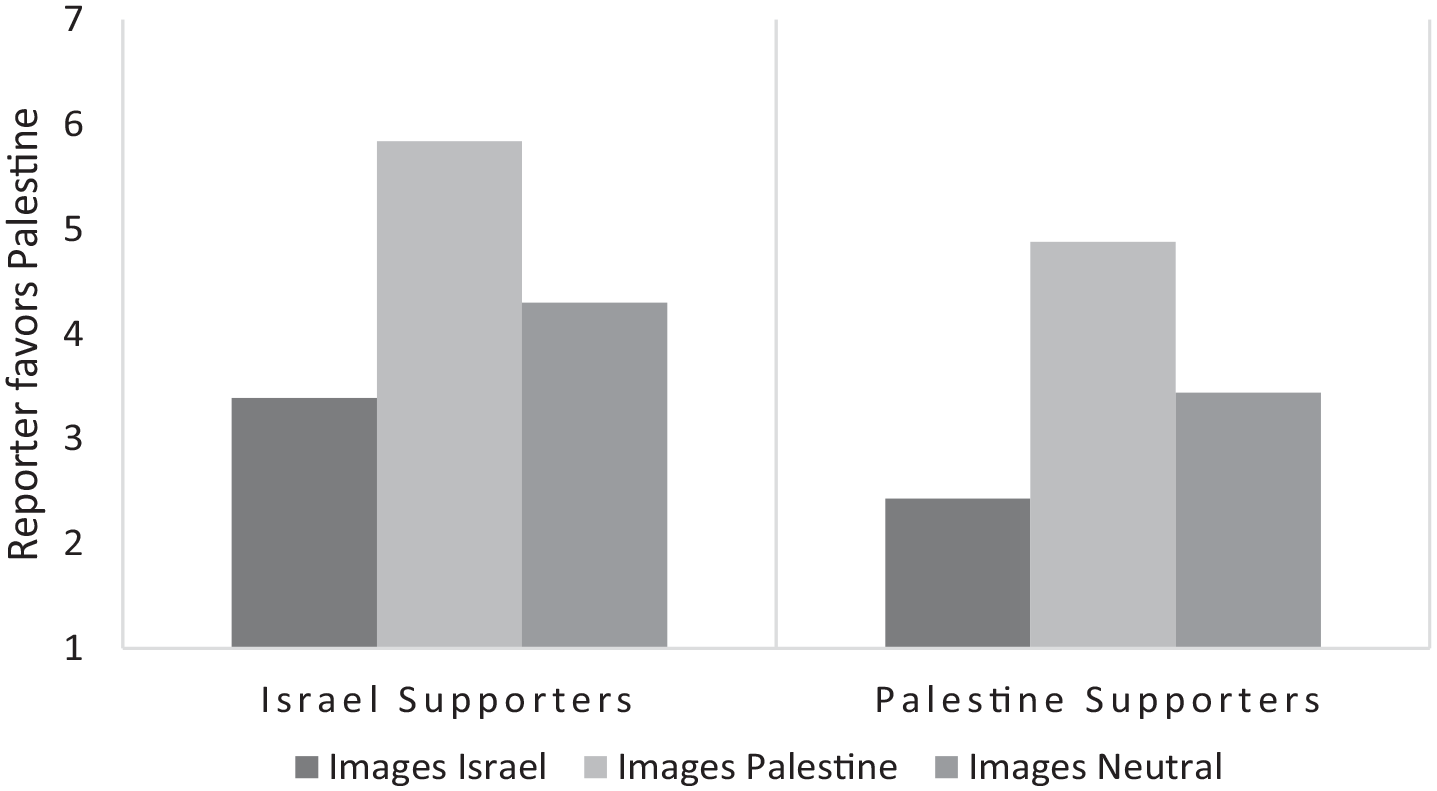
Mixed-design ANCOVA with group identification as between-subjects factor and perceived bias of image pairs as within-subjects factor in Study 1. Gender, age, place of living, trust in the media outlet USA Today, and knowledge about the Israeli–Palestinian conflict were included as covariates.
Additional analyses
We also investigated the effect on perceived bias of the photo series using separate scales for perceived bias in favor of Israel in percentage (M = 5.37, SD = 2.91, ranging from 1 “0% of the portrayals were biased in favor of Israel” to 11 “100% of the portrayals for biased in favor of Israel”) and in favor of Palestine in percentage (M = 4.89, SD = 2.94, ranging from 1 “0% of the portrayals were biased in favor of Palestine” to 11 “100% of the portrayals for biased in favor of Palestine”).
We found that the perceived degree of bias in favor of Israel was significantly higher among Palestine supporters (M = 5.87, SD = 2.80) compared to Israel supporters (M = 3.64, SD = 2.32), F(1,136) = 16.56, p < .001, partial η2 = .11, while the perceived degree of bias in favor of Palestine was significantly higher among Israel supporters (M = 6.17, SD = 3.22) compared to Palestine supporters (M = 4.52, SD =2.68), F(1,136) = 8.19, p = .005, partial η2 = .06. Additionally, we found that reach was related to bias in favor of Israel, F(1,136) = 5.54, p = .020, partial η2 = .04, with higher perceived bias in favor of Israel in the reporter condition (M = 5.93, SD = 2.84) than in the student condition (M = 4.71, SD = 2.76). We found no other significant main effects or interaction effects in these analyses. Furthermore, we tested whether attitude extremity moderated the effects of group identification by folding the scales of the two attitude questions identification with the Israeli side or the Palestinian side and merging them in a mean index (M = 2.17, SD = 0.84, 0 = no extreme attitude to 3 = extreme attitude, see Barnidge et al., 2020; Van der Meer et al., 2020). A multiple regression analysis revealed a significant interaction effect of group identification and attitude extremity on perceived bias of the photo series (b = −0.50, SE = 0.23, p = .030) indicating that with higher attitude extremity Israel supporters perceived more bias of the photo series in favor of Palestine and vice versa.
Discussion
In line with the VHMP. Israel and Palestine supporters perceived a balanced photo story to be biased in favor of the opposing side. Remarkably, hostile media perceptions were also present for clearly unbalanced pictures. Additional analyses revealed that these effects were more pronounced with rising levels of attitude extremity. In contrast to prior research, the VHMP and the relative VHP were not stronger for high-reach as compared to no-reach sources. This stands in contrast to research on textual stimuli. Based on statistical power, if reach had an effect, it should be clearly visible for Palestine supporters, because sample size was large enough to detect a moderate effect. Clearly, additional research is needed to examine the role of reach for visual stimuli. However, the present study did not reveal any information about the underlying mechanisms. One may speculate that both Israel and Palestine supporters differ in what they see in those pictures. Both sides may decode the pictures differently depending on their predispositions (Geise & Baden, 2015). In the HMP literature, this is termed selective categorization (Gunther & Liebhart, 2006; Schmitt et al., 2004). Alternatively, both camps may memorize the pictures differently (i.e., selective recall), or decode them in similar ways while applying different standards when evaluating them. We used a quasi-experimental approach that needs to be validated, ideally in a different (non-U.S.) cultural context. We therefore conducted a replication study in a European context, shedding some first light on the underlying mechanisms.
Study 2
The aims of study 2 were to replicate Study 1 in a different cultural context and to explore the underlying mechanism. Although visuals and text have distinctive features, it is important to explore the established mechanisms in the visual context. Both selective recall and selective categorization would suggest that partisans perceive and store the content differently (i.e., recall or categorize the arguments differently). By contrast, different standards would imply that partisans from both sides agree on the depicted content and recall the content in similar ways, but they differ in their judgments about the appropriateness of this content. As the first study to shed light on the underlying mechanisms, we explicitly test selective recall versus selective categorization. As we will elaborate on in more detail in the General Discussion section, different standards is difficult to prove with memory measures because it refers to individuals’ expectations about what the pictures should depict. This is, in fact, closely related to prior opinion and thus another measure of the HMP itself (Reid, 2012). Yet, by directly testing selective recall and selective categorization, we may be able to infer different standards by ruling out the first two. That is, since all three mechanisms are theoretically competing (Gunther & Liebhart, 2006; Schmitt et al., 2004), we can infer that different standards may take place, in case we are able to falsify selective recall and selective categorization. The reason is that different standards is the only mechanism predicting that partisans from both camps perceive and recollect the visual content in identical ways. Since we have no prior knowledge on each of the three mechanisms in the context of the VHMP, we can only formulate a general research question.
RQ1: Which underlying mechanism (i.e., selective categorization, selective recall, or different standards) is most likely to explain the VHMP?
Procedure and Stimulus Material
Study 2 was a conceptual replication of Study 1 with a sample (N = 177) of German speaking residents (Mage = 33.33, SDage = 14.97; 56.5% women; 5.1% vocational school, 38.4% college degree: 56.5% university degree; place of living: 41% Austria, 6% Switzerland, 43% Germany, 10% other). Reach was, however, not manipulated in Study 2. Participants were recruited via Israeli and Arab social media groups as well as organizations based in Austria, Germany, or Switzerland. Country of origin did not affect the findings. Some 25.0% indicated to be Jewish and some 36% to be Islamic Sunnite or Islamic Shiite, the rest indicated no or another religion. Participants also indicated their political predisposition (M = 3.01, SD = 1.58; 1 = rather left to 7 = rather right). We raffled five 20-Euro Amazon vouchers. We employed the same stimulus material and presentation mode as in Study 1. 2 In Study 2, the online media outlet Spiegel Online was used (see Supplemental Appendix). 3
Measures
Group identification
Analogous to Study 1, participants were grouped into Israel and Palestine supporters based on the same three items (Cronbach’s α = .91, M = 4.00, SD = 1.91) (7-point Likert-scale). Participants who scored lower than 4 on this index were grouped into Israel supporters (n = 89) and participants who scored higher than 4 on this index were grouped into Palestine supporters (n = 71). As in Study 1, 17 participants scoring 4 were excluded.
Perceived bias of the photo story
As in Study 1, three items based on Gunther and Schmitt (2004) were used (Cronbach’s α = .85, M = 4.22, SD = 1.32, 7-point Likert scale).
Perceived bias of single images
Analogous to Study 1, we computed a mean index of two items for each image pair (pro-Israel images: Cronbach’s α = .79, M = 3.10, SD = 1.38; pro-Palestine images: Cronbach’s α = .78, M = 5.33, SD = 1.33; neutral images: Cronbach’s α = .64, M = 4.01, SD = 0.88) with high values indicating perceived bias in favor of Palestine.
Selective categorization
Selective categorization was only assessed for the neutral images (see for this, Vallone et al., 1985). The pro-Israel and the pro-Palestine images were too obviously slanted in order to allow for a measure of selective categorization. We used ideologically biased descriptions about what could be seen on the pictures. For instance, while the neutral picture showed peace negotiations with Barack Obama, we used statements that categorized the content differently (e.g., Barack Obama was favoring Israel/Palestine in the peace negotiations). Specifically, we used two items for each neutral image, which could be answered with 0 = “not correct” and 1 = “correct.” The first neutral image showed Barrack Obama, Benjamin Netanjahu, and Mahmud Abbas at peace negotiations. We used two items, “Barack Obama stands up for the Israelis at peace negotiations in New York” (M = 0.06, SD = .24), and “Barack Obama stands up for the Palestinians at peace negotiations in New York” (M = 0.05, SD = .21). The second neutral image showed a peaceful protest with a balanced number of Israeli and Palestinian protesters (items: “The image portrayed a violent demonstration with predominantly Palestinian demonstrators” (M = 0.04, SD = .20), “The image portrayed a violent demonstration with predominantly Israeli demonstrators” (M = 0.03, SD = .17).
Selective memory of images
We measured participants’ memory of the images with multiple-choice questions. For each image, one item was correct (e.g., “The image portrayed a mourning Israeli couple”). We computed a summative index of two items for each pair of images (i.e., two items measured correct memory of the pro-Israel images (r = .35**, M = 1.70, SD = 0.58), two items measured correct memory of the pro-Palestine images (r = .26**, M = 1.48, SD = 0.68), and two items measured correct memory of the neutral images (r = .15*, M = 1.55, SD = 0.62). Thus, the score for each image pair ranged between 0 (i.e., no correct answer) and 2.
Covariates and data analysis
The dataset and analysis scripts can be found on the Open Science Framework (OSF) (https://osf.io/nwyqm/). We gauged socio-demographic variables, trust in the media outlet Spiegel Online (“How would you evaluate the news coverage of Spiegel Online overall? 1 = “not trustworthy at all,” 7 = “very trustworthy,” M = 3.40, SD = 1.46), and knowledge about the Israeli–Palestinian conflict with a 5-item quiz (M = 3.55, SD = 1.38).
Results
There was a significant difference between Israel and Palestine supporters with regard to perceived bias, F(1, 153) = 36.86, p < .001, partial η2 = .19 (Levene’s test: F(1,158) = 2.15, p = .145). Supporting the findings of Study 1 as well as H1, Israel supporters (M = 4.88, SD = 1.23) significantly perceived the photo series as more biased in favor of Palestine than Palestine supporters, and vice versa (M = 3.50, SD = 1.11) (Figure 3). We then conducted a mixed design ANCOVA. Results revealed a significant main effect for the within-subjects factor image type, F(1.398, 213.961) = 6.39, p = .006, partial η2 = .04). In line with Study 1 and H2, the pro-Palestine images (M = 5.38, SD = 1.34) were perceived as most biased in favor of Palestine followed by the neutral images (M = 4.04, SD = 0.88) and pro-Israel images (M = 3.10, SD = 1.40) (Figure 4). Simple contrasts showed that perceived bias in favor of Palestine differed significantly between the pro-Israel and pro-Palestine images, F(1,153) = 7.73, p = .006, partial η2 = .05, and between the pro-Israel and neutral images, F(1,153) = 6.22, p = .014, partial η2 = .039. The difference between the pro-Palestine and neutral images was only close-to-significant, F(1,153) = 3.59, p = .060, partial η2 = .02. In line with H1, the between-subjects factor again revealed a significant effect, F(1,153) = 51.70, p < .001, partial η2 = .25. We found that Israel supporters (M = 4.54, SE = 0.07) significantly perceived the photo series as more biased in favor of Palestine than Palestine supporters, and vice versa (M = 3.72, SE = 0.08). As in Study 1, no significant interaction effect emerged between Israel and Palestine supporters and image type, F(1.398, 213.961) = 1.10, p = .316, partial η2 = .01, suggesting that pro-Palestine images were perceived as more biased in favor of Palestine than neutral and pro-Israel images across groups.
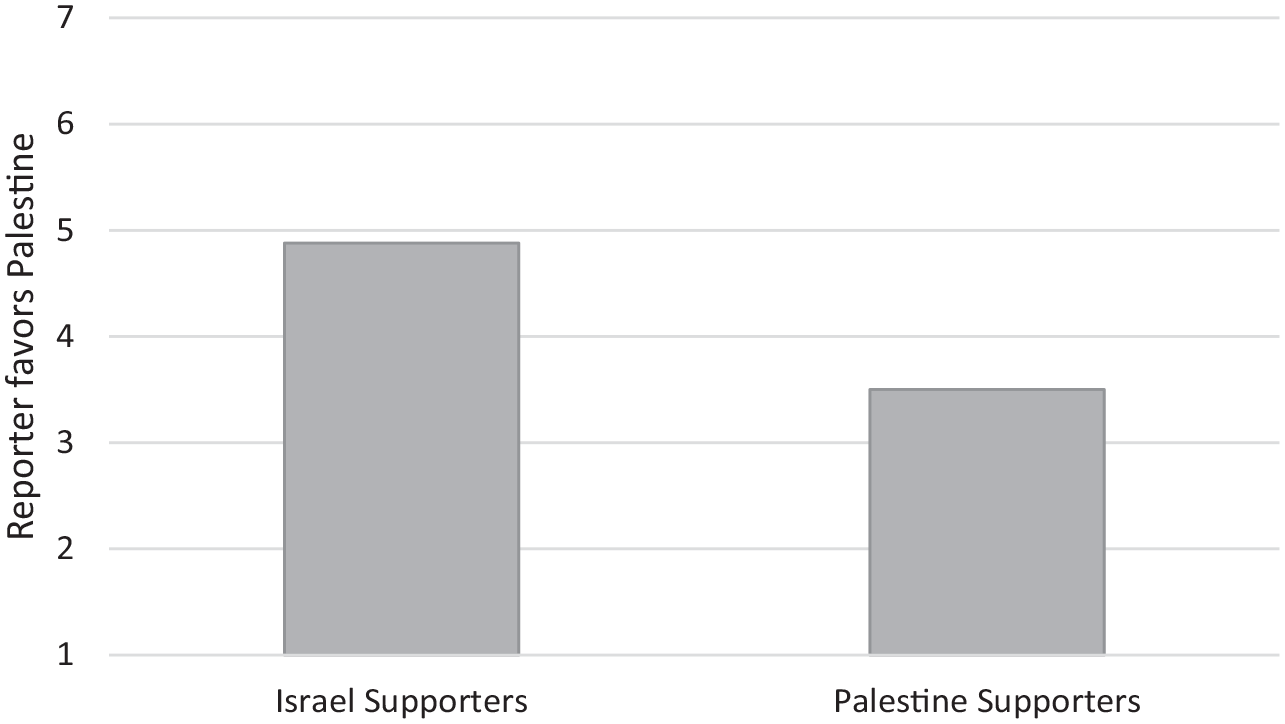
Effect of group identification on perceived bias of the photo series in Study 2. Gender, age, place of living, trust in the media outlet Spiegel Online, and knowledge about the Israeli–Palestinian conflict were included as covariates.
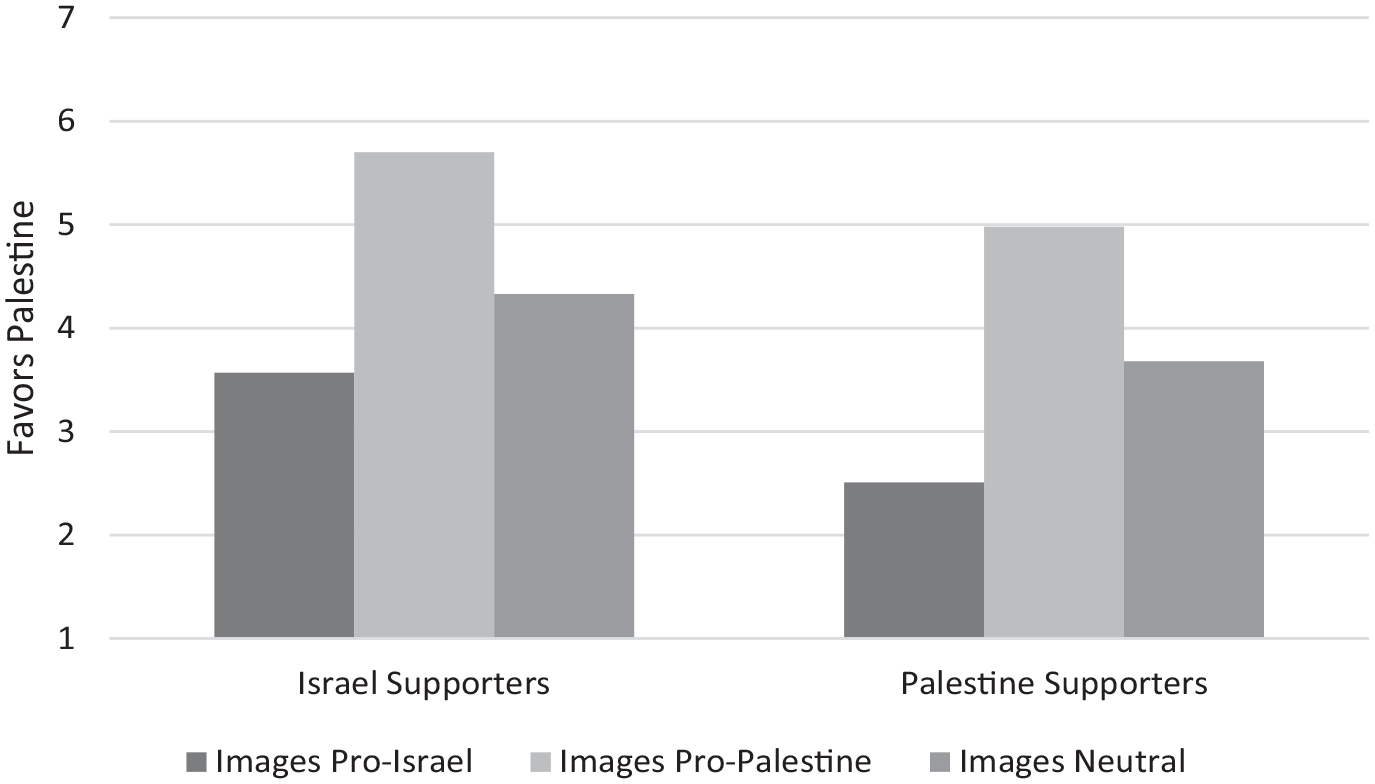
Mixed-design ANCOVA with group identification as between-subjects factor and perceived bias of image pairs as within-subjects factor in Study 2. Gender, age, place of living, trust in the media outlet Spiegel Online, and knowledge about the Israeli–Palestinian conflict were included as covariates.
With regard to the selective categorization score, we tested whether individuals interpreted the valence of the neutral images in different ways. Contradicting this assumption, we found no significant between-subjects effect between Israel and Palestine supporters on the perception that the first image portrayed a violent protest with predominant Palestinian protesters, F(1,153) = .10, p = .751, partial η2 = .00. Similarly, there were no significant effects between the groups with regard to the perception that the image portrayed a violent protest with predominant Israel protesters, F(1,153) = .71, p = .401, partial η2 = .01. By the same token, the groups did not differ with regard to whether they perceived Barack Obama to stand up for the Israelis, F(1,153) = .00, p = .973, partial η2 = .00, or Palestinians, F(1,153) = .14, p = .705, partial η2 = .00, in the second image. Thus, selective categorization did not serve as an explanation for perceived bias of the images in our study. 4 The Levene’s test revealed that homogeneity of variances could be assumed for all analyses of selective categorization (p > .05).
To investigate selective memory, we tested whether there was a significant interaction effect of the between-subjects factor and image type, which would indicate that individuals perceive information that opposes their views to be more salient and thus remember these contents in better ways. Contradicting this assumption, we found no significant interaction effect between Israel and Palestine supporters and image type on selective memory of the images, F(1.02,293.11) = 2.35, p = .099, partial η2 = .02. The results thus suggest that selective memory of the images did not depend on group identification. However, there was a close-to-significant main effect of image type on selective memory, F(1.92,293.11) = 3.00, p = .053, partial η2 = .02, indicating that participants remembered the pro-Israel images (M = 1.72, SD = 0.56) slightly better than the neutral images (M = 1.56, SD = 0.61), and the pro-Palestine images (M = 1.50, SD = .0.65). No between-subjects effect emerged between the two groups with regard to the selective memory score, F(1, 153) = .08, p = .778, partial η2 = .00.
Additional analyses
We tested the effects of group identification on perceived bias using separate scales for degree of bias for the photo series in favor of Israel (M = 3.99, SD = 2.99) and in favor of Palestine (M = 4.29, SD = 2.89) in percentage using the same items as in Study 1. In line with expectations, the perceived degree of bias in favor of Israel was significantly higher among Palestine supporters (M = 5.30, SD = 3.18) compared to Israel supporters (M = 2.90, SD = 2.39), F(1,153) = 16.61, p < .001, partial η2 = .10, while the perceived degree of bias in favor of Palestine was significantly higher among Israel (M = 4.97, SD = 3.14) as compared to Palestine supporters (M = 3.49, SD = 2.44), F(1,153) = 9.05, p = .003, partial η2 = .06. We also tested whether attitude extremity moderated the effects of group identification and found again that with higher attitude extremity, Israel supporters perceived more bias of the photo series in favor of Palestine and vice versa (b = −0.67, SE = 0.22, p = .003).
Discussion
As in Study 1, both partisan sides regarded the balanced photo series as biased against their own side. This effect was even present for clearly unbalanced pictures. This replication is important, because attitudes toward the Israel–Palestine conflict are much more polarized in the U.S. than in German speaking countries. This is also visible when comparing the mean difference of attitudes toward Israelis and Palestinians (Study 2: ΔM = 0.18; Study 1: ΔM = 2.55). When it comes to the underlying mechanisms, the data speak against selective recall and selective categorization. Israel-supporters and Palestine supporters did not differ in their memory of the pictures and they categorized the neutral pictures in identical ways. As further discussed below, these findings are suggestive of the different standards mechanism. However, this mechanism was not explicitly tested. Furthermore, there may be other mechanisms for visual as compared to textual stimuli, limiting the contribution of this work. In fact, the theoretical mechanisms considered in this work were drawn from research on texts, not visuals.
General Discussion
Journalism is not thinkable without visuals, and almost any political and social story told in the news these days is transported by images. Visuals are often theorized to provide the audience with the impression that the reality out there is mirrored, and in many cases, visuals go far beyond the notion of merely illustrating the news. By contrast, visuals tell the story (Geise & Baden, 2015). Yet despite the undisputed relevance of visuals, most research on the effects and reception of news has primarily dealt with text. This is also true for research on the HMP. In two studies, we have provided clear evidence that completely balanced pictures are perceived as biased both by opponents and supporters of an issue. In addition, such a VHMP was also observed for clearly slanted pro-Israel and pro-Palestine pictures (i.e., relative VHMP).
Why is this insight important? Obviously, without clarifying the role of visuals, our understanding of the HMP remains incomplete. Most if not all news is accompanied by visuals, so if we ignore their role, we can’t fully explain why and how hostile media perceptions are created in modern media environments. Of course, visuals are seldom used in isolation from text. Visuals may not only illustrate news text, they may also transport meanings not present in the text, and because of that, they play a crucial role for the effects of news media. Given our findings, one may assume that hostile media perceptions are based on both parts, the textual part and the visual part. If we ignore the visual part, we may underestimate the power and effectiveness of the HMP.
Our second study also provided some very first insights about the underlying mechanisms. We found that individuals from both camps categorized and recalled the identical content, which clearly speaks against the selective recall and selective categorization mechanisms. Findings therefore suggest, but do not prove, a different standards account of VHMP. It can be theorized that images will automatically activate related concepts and knowledge stores. This is necessary in order to understand the visual. For instance, the picture showing two opposing sides discussing at a table (i.e., not taking any sides) will activate partisans’ thoughts and considerations about the conflict at hand. Then, viewers will automatically compare the activated thoughts and considerations with the picture they see. More specifically, viewers will automatically determine whether the visual matches with their knowledge store and considerations, that is, with their expectations about what the picture should show in order to represent their own perspective. For instance, the picture with two parties at a table discussing the Israel–Palestine conflict may not represent what a Palestine follower would expect to be shown (i.e., harm done by the opposing side). There is thus a mismatch of the reality shown in the visual with the reality perceived by the individual. Yet, the more involved a viewer is, the higher is the likelihood of such a mismatch. In fact, additional analyses in both studies revealed that the VHMP rises with higher levels of attitude extremity, suggesting that degree of involvement drives the effect in addition to group membership.
Limitations and Future Research
Future research should follow up on these findings and test the underlying mechanisms of the VHMP. Such a test is far more complex for visuals compared to text. The reason is that texts can be manipulated easily. For visuals, different standards may be gauged by asking partisans about the content they would expect for an adequate visualization of a conflict. Then, the distance between this assessment and the partisans’ interpretation of the visual should be measured. Theoretically speaking, a higher distance between expectation and interpretation should then directly explain the VHMP. Needless to say, the fact that respondents’ reactions to visuals need to be verbalized to measure them provides an additional empirical challenge. Related to this, it is important to note that we cannot rule out alternative, unknown mechanisms, which are specific for visuals only and were not tested in Study 2. Since information processing differs for visuals and text (Geise & Baden, 2015), the mechanisms explaining the VHMP might also differ from those explaining the HMP. Thus, more research and especially theory building is necessary to explain the VHMP in more depth.
Future research should also test the VHMP with different topics. We have chosen the Israel–Palestine conflict because of its prominence in prior HMP research (e.g., Giner-Sorolla & Chaiken, 1994). Clearly, the depiction of the conflict was oversimplified in our stimuli and analyses, not doing justice to the complexity of the topic. Yet compared to other frequently used topics such as abortion or biotechnology, the Israel–Palestine conflict is especially suited because it allows an internally valid manipulation of images. For other topics, it is difficult to find clearly one-sided or clearly neutral pictures. This may limit the generalizability of the VHMP and it is important to stress that our findings only relate to the Israel–Palestine conflict.
Future research should investigate the interplay of texts and visuals. The state of inner arousal or alertness activated by images raises the accessibility and applicability of cognitive information processing (Geise & Baden, 2015, p. 50). Therefore, news media portrayals, which combine images and text may lead to even stronger hostile media perceptions than text or image alone. In line with this, findings by Powell et al.’s (2015) suggest that the inclusion of images increases the salience of and the attention to the accompanying text. Therefore, images may not only be perceived as biased, but may also increase perceived biases for accompanying text. Finally, one may even speculate that hostile media perceptions are stronger for visuals as compared to texts, because visuals are more ambivalent, that is, preexisting knowledge stores are more important for the decoding of visuals as for the decoding of texts. Yet, preexisting knowledge stores are the key driver of the HMP (Choi et al., 2009; Gunther et al, 2009). We controlled prior knowledge and the findings remain the same, with or without this control. Yet additional knowledge measures should be considered.
The ideal design would be to manipulate partisanship prior to exposure. 5 However, for a highly polarized issue, prior attitude may be a shield against any experimental manipulation. It therefore comes as no surprise that most, if not all research on the HMP has sampled opposing camps to observe the effect (see Perloff, 2015). Finally, it is important to note that the visuals used in the present study used short figure captions, as it is common for photo series. One could speculate that the captions were driving the effect, not the visuals. We believe this is highly unlikely. The questions in the survey did explicitly ask about the visuals, not the caption. More specifically, we asked about the content and selection of the visuals. Also, the captions alone hardly provide any information and they are thus unlikely to drive the effect. Needless to say, it is not possible to employ visuals without any additional textual information. This would not only irritate viewers, but also be highly externally invalid. Additionally, Caple and Knox (2012) argue that although captions can complement the images of a photo series, they usually stand alone and exert their meaning or purpose independently of the accompanying text. However, future research could systematically vary the congruence or match between caption and visual. This could indicate the relevance of the caption for the processing of the images.
Conclusion
The aim of this paper was to make a case for a VHMP, that is, the effect that partisans from opposing camps perceive balanced pictures as biased against their own views. We believe our findings on the Israel–Palestine conflict not only underline the importance of visual communication for this research area, they open up entirely new avenues for research, ultimately aiming at a more nuanced and externally valid understanding of how bias perceptions are formed for journalistic media.
Supplemental Material
sj-pdf-1-crx-10.1177_00936502211018596 – Supplemental material for In the Eye of the Beholder: A Case for the Visual Hostile Media Phenomenon
Supplemental material, sj-pdf-1-crx-10.1177_00936502211018596 for In the Eye of the Beholder: A Case for the Visual Hostile Media Phenomenon by Jörg Matthes, Desirée Schmuck and Christian von Sikorski in Communication Research
Footnotes
Declaration of Conflicting Interests
The authors declared no potential conflicts of interest with respect to the research, authorship, and/or publication of this article.
Funding
The authors received no financial support for the research, authorship, and/or publication of this article.

Supplemental Material
Supplemental material for this article is available online.
Notes
Author Biographies
References
Supplementary Material
Please find the following supplemental material available below.
For Open Access articles published under a Creative Commons License, all supplemental material carries the same license as the article it is associated with.
For non-Open Access articles published, all supplemental material carries a non-exclusive license, and permission requests for re-use of supplemental material or any part of supplemental material shall be sent directly to the copyright owner as specified in the copyright notice associated with the article.
