




Abstract
This study examined how individuals’ goals and inferences about partners’ goals vary moment-by-moment during romantic conflicts. Seventy romantic couples discussed a current relational conflict for 7 minutes. Participants individually reviewed video recordings of their discussion, rating the importance of their own goals and inferences about the importance of those goals for their partner during each minute. Individuals demonstrated mixed accuracy when inferring partners’ goals. We observed evidence of goal projection, as the more important a goal was to oneself, the more one inferred it was important to the partner. We also observed evidence of goal contagion, as inferences about a partner’s goals mediated several associations between the partner’s previous goals and individuals’ subsequent goals. Furthermore, inferences about partners’ goals also mediated associations between individuals’ own prior goals and their goals at the next minute.
Keywords
Relational conflict occurs because partners perceive their goals as incompatible (Canary, 2003). Goals are defined as “mental representations of desired end states” (Palomares, 2014, p. 93). Communicators in conflict attend to multiple interaction goals (Ohbuchi & Tedeschi, 1997) that may change in salience during a conflict discussion (Worley & Samp, 2018a). Furthermore, changes in one partner’s interaction goals often precipitate changes in the other’s goals (Keck & Samp, 2007; Samp, 2013). Recent work documents individuals’ goal changes and influences of a partner’s goal changes on individuals’ conflict outcomes (Worley & Samp, 2018b). In addition to individuals’ perspectives of their own goals, people also try to understand their partner’s thoughts and feelings (Palomares, 2015). Accurately inferring a partner’s goals is crucial to understanding one’s interaction and interaction partner (Palomares, 2015) and to managing conflict competently (Lakey & Canary, 2002). Yet research on marital conflict suggests partners are often quite inaccurate in their inferences about one another’s intentions and behaviors. Discerning a partner’s perspective while balancing the complex demands of real-time interaction can be challenging under the best circumstances, and conflict negativity and relational strain can exacerbate this challenge (Sillars et al., 2000).
Understanding consequences of (in)accurate goal perceptions on individuals’ own goal adoption can shed light on couples’ unproductive conflict patterns that perpetuate negative communication and repetitive arguing (see Fincham & Beach, 1999). In addition, because perceptions of goal progress and goal interference can shape cognitive and affective outcomes (Carver & Scheier, 1998), understanding momentary appraisals of goals can help explain conflict outcomes. Although recent research has examined partners’ global inferences about one another’s goals prior to a conflict episode (Carson & Ackerman, 2018). Sillars et al. (2000) noted that “the qualities of in vivo thought during [. . .] conflict are not necessarily apparent from cognitive processes studied apart from interaction” (p. 495). Moreover, previous studies of goal perceptions have often assigned strangers to discuss topics provided by researchers (e.g., Palomares, 2009; Palomares et al., 2015). Goal perception processes may function somewhat differently during bona fide conflicts between partners in established relationships. On one hand, extended interaction history may provide close partners with greater insight into one another’s motivations. On the other hand, self-defensive motivations—whether to justify oneself (Sillars, 2002) or to preserve positive views of the relationship (Simpson et al., 1995)—may encourage inaccurate inferences about a partner’s goals. Furthermore, because serial arguments (repeated arguments about the same topic; Trapp & Hoff, 1985) often become predictable (Johnson & Roloff, 2000), partners might impose perceptions of past argument episodes onto new episodes, regardless of whether those perceptions accurately describe the current episode. For these reasons, we examine goal inferences and goals shift over time during “live” discussions of repetitive conflicts (i.e., serial arguments) in established romantic relationships.
This study considers the role of actor-partner goal inferences in explaining within-persons goal shifts during romantic conflict discussions. We propose that the aforementioned dynamic by which individuals’ goals shift in response to a partner’s (actual) goals (Keck & Samp, 2007) is rooted in their inferences about the partner’s goals. 1 Specifically, we integrate perspectives of goal projection and goal contagion to understand how dyadic goal dynamics unfold within conflicts. This dyadic interaction study examines romantic partners’ accuracy in judging each other’s momentary interaction goals, their goal shifts in response to inferences about a partner’s momentary goals, and the mediational role of goal inferences in explaining goal shifts in conflict interactions.
Goal Shifts During Conflict
Interaction goals can be classified in different ways (e.g., Clark & Delia, 1979; Dillard et al., 1989), and at various levels of abstraction versus specificity (Dillard, 1997). Goal specificity has been identified as an important component of goal perceptions during conversation. Specifically, people are more likely to infer and adopt the goals of a conversational partner when those goals are abstract (e.g., “find out personal information about my partner”) rather than highly specific (e.g., “find out your partner’s reasons for their religious affiliation”) (Palomares, 2013). For this reason, we focus on four types of goals that are abstract enough to be potentially inferred by one’s partner (and likely to generalize across individuals, relationships, and conflicts; Canary et al., 1988), but specific enough to permit meaningful change from 1 minute to the next during a conflict discussion. Conflict goals can be classified as instrumental, self-oriented, other-oriented (partner), and relationship-oriented goals (Keck & Samp, 2007). In the conflict context, instrumental goals are concerned with convincing a partner to adopt one’s position. Self-identity goals focus on maintaining one’s sense of self or defending one’s identity. By contrast, other-identity goals focus on supporting one’s partner in the midst of the conflict. Finally, relational goals are concerned with maintaining the relationship between the parties while the conflict occurs. Although conflicts are ostensibly defined by instrumental goals, identity and relational goals can be highly salient in conflicts between close relationship partners, at times even more salient than instrumental goals (Samp & Monahan, 2011; Worley & Samp, 2018b).
Despite the common assumption among communication scholars that communicators’ goals can change as conversations unfold (e.g., Caughlin, 2010), only a few studies have empirically investigated the frequency and reasons for moment-by-moment goal shifts. These studies—although few—are enlightening. One study of initial interactions observed that around 30% of the time, interactants’ goals changed in 30-second increments (Waldron, 1997). In more intimate contexts, romantic partners’ goals shifted in 1-minute increments about 66% of the time during conflict discussions (Keck & Samp, 2007) and about 75% of the time during discussions about a partner’s problematic behavior (Samp, 2013).
Past research has highlighted features of actors’ messages as predictors of their partners’ goal adaptation. Changes in one’s momentary conflict tactics (Keck & Samp, 2007) and the momentary grammatical focus of one’s verbal messages (i.e., as self-, relationship-, partner-, or task-focused; Samp, 2013) have predicted changes in a partner’s goals during the next minute. Whereas previous research has focused on message features that predict goal shifts, our study highlights goal inferences as a potential reason for goal shifts. In the next section, we explain how two processes related to goal inferences—namely, goal contagion and goal projection—can shed light on patterns of mutual influence in the adoption of conflict goals.
Goal Inferences in Conflict
The meanings and consequences of communication behaviors depend on perceptions of underlying goals (Palomares & Derman, 2019). Forming perceptions of others’ goals appears to be both innate (Southgate et al., 2008) and automatic (Hassin et al., 2005) in human interaction. Although goal inferences are sometimes implicit, being asked (by oneself or another) to articulate the rationale behind others’ behaviors can move inferences from implicit to conscious (Palomares, 2015). Goal inferences are believed to be primarily shaped by (a) communicative situations (such as conversational and relational context) and (b) a partner’s behavior (Palomares, 2011). In the current study, the communicative situation can be considered relatively invariant: all interactions are conflict discussions between romantic partners (as opposed to, say, information-seeking in initial interactions). Thus, the most relevant consideration for the current study is how partners in conflict attribute goals to one another’s behaviors. This is also the element of goal understanding that is most likely to change from moment to moment.
Partners in conflict often differ in their perceptions of one another’s goals (Bevan et al., 2006). In a recent study of serial arguing, people overestimated the importance of a partner’s negative conflict goals and underestimated the partner’s endorsement of positive conflict goals (Carson & Ackerman, 2018). Conflict communication reflects individuals’ goals and their judgments about their partners’ goals (Bevan, 2014), and perceptions of a partner’s arguing behaviors are more predictive of a conflict’s perceived resolvability than are the partner’s actual behaviors (Bevan, 2014; Johnson, 1998). In conversation more broadly, inferring antisocial goals of a partner’s message is associated with negative evaluations of the partner and interaction, affect and communication (Gasiorek, 2013; Gasiorek & Giles, 2012). By contrast, inferring prosocial goals of a partner’s message encourages positive evaluations, affect, and communication—regardless of a partner’s actual goals (Gasiorek, 2013; Gasiorek & Giles, 2012).
Thus, past work suggests inferences about a partner’s goals are central to the conflict process. Previous research has utilized cross-sectional, global assessments of goals and goal inferences for an entire argument episode (e.g., Bevan, 2014; Carson & Ackerman, 2018). Yet goal inferences can occur on a momentary basis (Van Overwalle et al., 2012), likely changing throughout interactions and as individuals observe their partners’ behaviors. Our study examines how communicators’ goals and goal inferences are linked on a moment-by-moment basis during conflict discussions.
Studies of empathic accuracy have shown that partners can make somewhat accurate inferences about what a spouse is feeling and thinking during a conflict (Papp et al., 2010; Simpson et al., 2011). As partners often misunderstand one’s intentions during conflict (Sillars et al., 2000), goal inference accuracy seems unlikely to be pronounced. Nevertheless, because understanding others’ goals is central to both survival and interaction management (Berger, 2000), the accuracy of individuals’ inferences about their partners’ goals for a given moment should be greater than chance. Thus, we offer our first prediction:
H1: The importance a partner places on a goal at 1 minute is positively associated with actors’ inferences of the importance the partner places on that goal at the same minute.
Having posited that individuals infer their partners’ goals at greater-than-chance levels, we now consider the implications of goal inferences for goal dynamics in conflict. We posit that previously observed effects of a partner’s goal shifts on one’s own subsequent goals (Samp, 2013) can be explained in light of two goal inference processes, namely, goal projection and goal contagion. In the following section, we explain these processes and offer related hypotheses.
Goal Projection
Goal projection refers to the tendency to perceive others as pursuing the same goals we are (Kawada et al., 2004; Oettingen et al., 2014). Indeed, inferences about a partner’s goals are often more related to individuals’ own goals than to those their partners are actually pursuing (Dunlop et al., 2018). Kawada et al. (2004) found that people with competitive goals in negotiation tended to perceive others as also having competitive goals. Goal projection may be particularly impactful in conflict, as it has been posited to complicate negotiation (Palomares, 2012). Goal projection in romantic conflict has been investigated in only one study of which we are aware (Carson & Ackerman, 2018). In that study, romantic partners preparing to discuss a serial argument perceived their counterpart’s argument goals as more similar to their own than they actually were (Carson & Ackerman, 2018). Although that study provided preliminary evidence of goal projection in romantic conflict, it considered goals at a global level in a hypothetical case, based on anticipated goals and goal inferences for an entire interaction. The current study focuses on moment-by-moment sequences of goal adoption and goal inferences during “live” conflict discussions, to better understand how and why conflict interactions unfold from 1 minute to the next. Via the principle of goal projection, we expect individuals’ own goal importance to be associated with inferring the importance of that same goal to one’s partner at the same minute. Partners tend to display some dyadic synchrony in their momentary goals (Samp, 2013), suggesting that couples may share similar cognitions. Thus, it is important to assess the impact of one’s own goals on inferences about a partner’s goals while controlling for the partner’s actual goals at that moment, which helps distinguish partner effects from actor effects. Accordingly, we propose:
H2: Actors’ own goal importance is positively associated with their concurrent inferences of the importance a partner assigns to the same goal (controlling for the partner’s own goal importance at that minute).
Goal Contagion
Goal contagion is the counterpart of goal projection. Whereas projection reflects how we use our goals in making judgments of another’s goals, contagion reflects how inferring another’s goals can encourage one to adopt that goal for oneself (Aarts et al., 2004; Laurin, 2016). The standard two-step model of goal contagion is as follows: Inferring that a conversational partner is pursuing a goal is posited to increase one’s accessibility of that goal, which in turn increases the likelihood of adopting that goal (Palomares, 2013). When people infer change in a partner’s goal importance, their own goals should be more likely to shift toward this inferred goal, regardless of actual change in partner’s goals. Conversely, people should be less likely to change their own goals in spite of actual change in partner’s goals if they do not perceive the change. Nevertheless, although goal inferences (accurate or inaccurate) may shape individuals’ subsequent goals, true goal contagion requires accurate inferences (Palomares, 2014).
Despite the model’s intuitive appeal, evidence for the two-step mediational goal contagion process is inconclusive. First, goal inferences, the presumed mediator, are not always tested in goal contagion studies (see Corcoran et al., 2020). Second, some recent studies explicitly testing the two-step mediational model of goal contagion have found weak or non-existent evidence that goal inferences explain goal contagion (Brohmer et al., 2019; Corcoran et al., 2020), whereas others have observed evidence consistent with the two-step mediation model (Palomares, 2013). There is, accordingly, debate about the extent to which goal inferences shape goal contagion. Finally, most research on goal contagion has focused on observations of strangers’ behaviors, such as in written vignettes or videos (e.g., Aarts et al., 2004; Corcoran et al., 2020; Dik & Aarts, 2008). Investigations of goal contagion in conversation are rare and focus on how unacquainted conversationalists infer a single goal for their counterpart (Palomares, 2013; Palomares et al., 2015). Relational closeness may make goal contagion more likely, since individuals who perceive themselves as interdependent and sharing a collective identity (such as romantic partners) may both have greater ability and motivation to understand and adopt one another’s goals (Laurin, 2016; Laurin et al., 2016). However, as noted previously, other research has found romantic partners rarely understand one another’s concurrent cognitions during conflict (Sillars et al., 2000). Thus, there is a need to better understand goal contagion in close relationships, such as between romantic partners.
One aim of this study is to test the two-step mediational model of goal contagion in interactions between close relational partners, on a moment-by-moment basis, during a conversational task (conflict) which tends to be laden with multiple and dynamic goals. Momentary goal contagion is less likely to be driven by normative expectations about goals (e.g., O’Keefe, 1988) in this conversational context for two reasons, First, goals are more complex in close relationships, particularly in conflict (Keck & Samp, 2007). Second, partners are asked to report on multiple goals at many time points, rather than infer only a single goal at one time point.
Available evidence describes goal adoption during conflict as contagious and reciprocal (Keck & Samp, 2007; Samp, 2013). This reflects the notion that goal inferences can influence both partners’ goals and encourage both partners’ goals to converge over time during interaction (Palomares, 2015). Importantly, “convergence” does not necessarily mean “compatibility”: identical goals may be compatible, such as when partners mutually pursue relational maintenance, or incompatible, such as when they compete for a finite resource (see Palomares, 2011). In prior research (Keck & Samp, 2007; Samp, 2013), people’s self-focused goals led to self-focused and distributive messages, which predicted greater likelihood of a partner’s self-focused goal importance in the next minute. Instrumental or task-focused goals led to task-focused and/or distributive messages, which predicted a partner’s greater likelihood of prioritizing task-focused and/or instrumental goals along with identity- and self-oriented goals. Other-focused goals encouraged partner-oriented and integrative messages, which related to a partner’s tendency to emphasize other-focused goals in the next minute. Finally, relationship-focused goals generated relationship-focused messages, which predicted increased likelihood of a partner considering relational goals as important in the next minute. Although these studies did not explicitly test individuals’ own goals as predictors of partners’ subsequent goals, they demonstrate an indirect relationship between individuals’ goals and their partners’ subsequent goals. Since each individual is both an actor and a partner in the interaction, these studies suggest an implicit sequence of a partner’s goal shift encouraging one’s own goal shift in the same direction at greater-than-chance levels. Thus, we hypothesize:
H3: A partner’s goal importance at 1 minute is positively associated with actors’ goal importance for the same goal type at the next minute.
Goal Inferences as Mediators of Sequential Goal Shifts
Next, as we argued previously, we expect that inferences of a partner’s goals contribute to explaining goal shifts over time. H3 implies that when an individual’s goals shift, their partner’s goals are likely to follow suit. H1 and H2 specify that both a partner’s (actual) goals and one’s own goals, respectively, influence concurrent inferences of the partner’s goals. Together, these hypotheses generate two further predictions. First, based on the reciprocal nature of goal adoption in past research (e.g., Samp, 2013), we expect inferences of partners’ goal importance at 1 minute will predict individuals’ own increased importance of the same goal type(s) at the next minute. Second, in light of the reciprocal nature of goal adoption and the rationale for H1, we expect that goal inferences will mediate links between a partner’s actual goals at 1 minute and one’s own goals at the next minute. In this way, we advance existing research by explicitly testing momentary goal inferences as a mediational mechanism explaining systematic patterns of goal shifts between partners. Formally:
H4: Actors’ inferences about the importance a partner assigns to a goal at 1 minute are positively associated with actors’ own importance of the same goal type at the next minute.
H5: Actors’ inferences about the importance a partner assigns to a goal at 1 minute mediate the links between the partner’s actual goals at that minute, and actors’ goals at the next minute.
Finally, although individuals’ own goals are likely to show some consistency from 1 minute to the next (Samp, 2013), we have also argued that individuals’ own goals may shape their perceptions of partners’ concurrent goals (H2). To the extent that goal projection occurs (H2), individuals’ own goals should bias their inferences of a partner’s goals. Subsequently, to the extent goal inferences are biased due to goal projection and shape individuals’ subsequent goals (H4), individuals may enter a feedback loop of sorts, in which biased goal inferences perpetuate the subsequent adoption of the same goals. Although we do not forward specific predictions about the relative strength of one’s own goals versus a partner’s actual goals in predicting one’s goal inferences, our hunch is that links between a partner’s actual goals and perceptions of a partner’s goals are likely to be stronger than the links between one’s own goals and perceptions of a partner’s goals. Nevertheless, it is possible that one’s own goals might influence one’s subsequent goals indirectly, by shaping perceptions of the partner’s goals. By directly estimating the indirect effect (rather than simply examining how well goal perceptions predict individuals’ goals, controlling for their previous goals), we can assess the extent to which goal consistency from 1 minute to the next may be shaped by goal projection. If it is, this would provide evidence of a specific mechanism explaining consistency in goals during conflict, beyond simply the general notion that “past behavior predicts future behavior.” To assess this possibility, we advance the following research question:
RQ: Do inferences about the importance a partner assigns to a goal at 1 minute mediate the links between actors’ own goals at that minute, and actors’ goals at the next minute?
Our overall conceptual model is summarized in Figure 1. Following standard usage, “lag-0” in the figure and results tables refers to individuals’ concurrent ratings of their goals and goal perceptions at a given minute, whereas “lag-1” refers to ratings at the previous minute (Bakeman & Quera, 2011). Notably, if a lag-1 variable in the figure predicts another lag-1 variable (e.g., lag-1 goals predicting lag-1 inferences), that path is functionally a lag-0 path because the processes are concurrent.
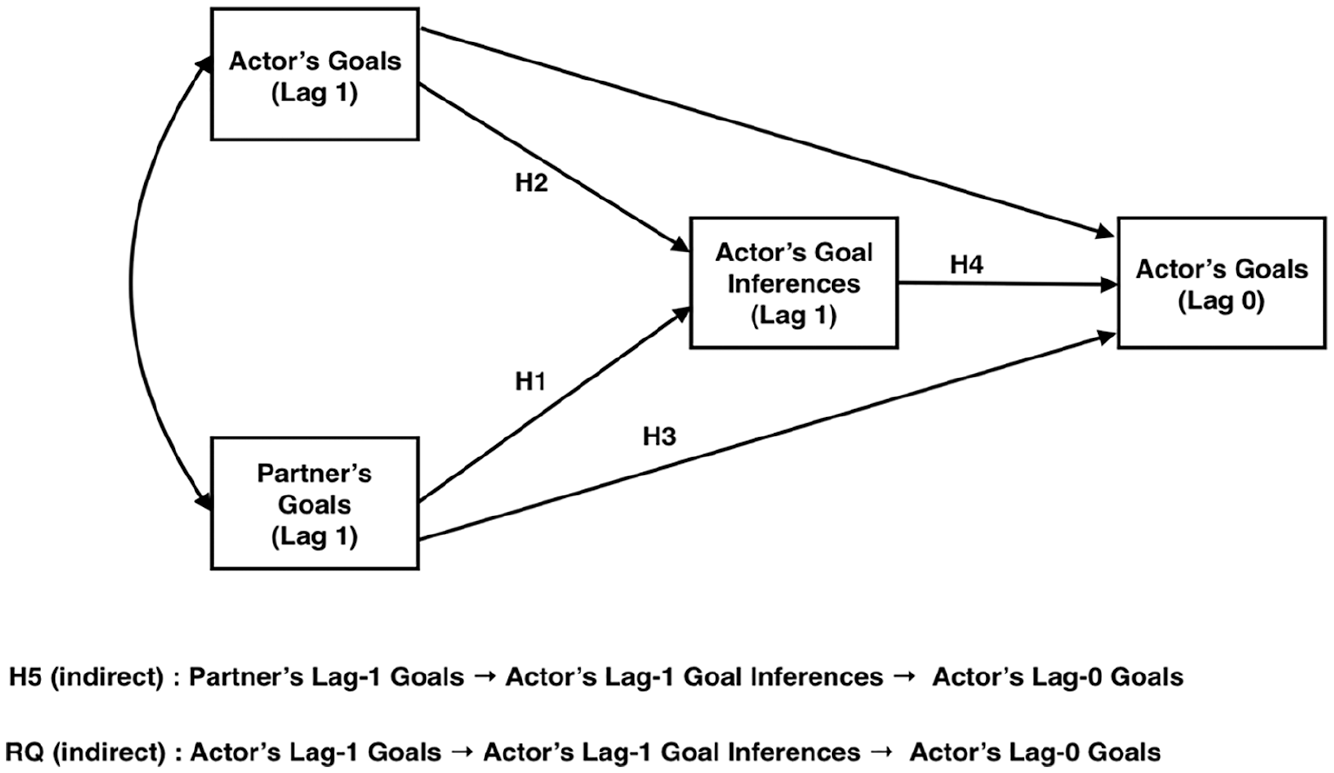
Conceptual model of actor and partner goals, actor’s goal inferences, and actor’s subsequent goals.
Method
Participants
A total of 72 romantic couples (144 total participants) were recruited using the undergraduate research pool in the communication department at a large public university in the northeastern U.S. Participants enrolled in a public speaking course received extra credit for participating in the study session with their romantic partner. Ninety-six percent of couples (n = 69) were opposite-sex, 4% (n = 3) were same-sex, and relationships averaged 15.43 months in length. Two couples were removed due to technical difficulties that prevented completing the survey, yielding a final sample of 70 couples. Overall, participants were fairly satisfied with their relationships (M = 7.19 out of 9; SD = 1.51). Selected conflicts averaged 8.03 months in duration (SD = 8.38) and averaged eight discrete episodes.
Procedures
After arriving at the lab, romantic partners were separated and asked to list up to five topics of unresolved, repeated conflicts in their relationship. They were instructed to discuss their topic lists together and jointly choose an unresolved topic that they would be comfortable discussing on camera. Topics ranged in severity (e.g., room cleanliness and jealousy). On average, participants perceived issues as moderately severe (M = 4.39 out of 7; SD = 1.60). Partners then engaged in a 7-minute conversation about the issue, with the goal of resolving it.
Once participants mutually concluded the conversation or were stopped by research assistants at the 7-minute mark, they were separated and completed a video-assisted recall activity. Videos were uploaded into software that automatically stopped the video at 1-minute intervals. At each minute, participants were prompted to rate their own goal importance and perceptions of their partner’s goal importance for that minute of conversation. Next, partners were jointly debriefed with a brief “happy times interview” (Roberts, 2005), a discussion of positive aspects in their relationship aimed at reducing any potential lingering negative affect. Couples received contact information for the campus counseling center as an optional resource.
Measures
Goal importance
During the video recall task, participants assessed their own goal importance at 1-minute intervals using items from Keck and Samp (2007). Participants were prompted, “at this point in the conversation, it was important for me to. . .” On a Likert scale (1 = strongly disagree; 7 = strongly agree), participants rated their own goal importance: (a) convince my partner of my position (instrumental; M = 4.90, SD = 1.66); (b) restore or maintain my sense of self (self-identity; M = 4.81, SD = 1.39); (c) support my partner (other-identity; M = 5.23, SD = 1.47); and (d) maintain our relationship (relational; M = 5.70, SD = 1.36). These measures allowed for focusing on specific goals without being too taxing for participants to report.
Inferences about partner’s goals
Participants also reported inferences of partner goal importance during the same minute (“at this point in the conversation, my partner felt it was important to. . .”). Items for perceptions of a partner’s goals were: (a) convince me of his/her position (instrumental; M = 5.13, SD = 1.58); (b) restore or maintain his/her sense of self (self-oriented; M = 4.99, SD = 1.35); (c) support me (partner-oriented; M = 4.98, SD = 1.35); and (d) maintain our relationship (relational; M = 5.59, SD = 1.44).
Results
Analytic Strategy
Bivariate correlations are reported for descriptive purposes in Table 1. We tested our hypotheses using cross-lagged multilevel regression analysis (Kenny et al., 2006) in the nlme package for R (Pinheiro et al., 2018). All variables were person-mean centered by subtracting each individual’s scores at each minute from their within-person mean on that variable. We also entered each person’s mean goal rating and/or goal inference scores as covariates in the models. In doing so, the person-mean centered variables reflect how much individuals’ goals or goal inferences vary from their typical values. Within-person lagged variables assessed how goals and goal perceptions at one time predict goals at the next minute. Based on findings of predictable consistency in goals between 1-minute segments (Keck & Samp, 2007; Samp, 2013), we tested a first-order model with lags limited to the previous minute. Additionally, because opposite-sex couples were conceptually distinguishable by sex, we performed tests of empirical distinguishability. 2 Preliminary analyses indicated sex did not moderate the modeled associations. Accordingly, our hypothesis tests included sex as a covariate, estimating indistinguishable models when actor and partner effects were distinguished by role; these effects were not further distinguished by sex (see Kenny et al., 2006). Tables 1 to 5 summarize the results. As is conventional for reporting and interpreting multilevel models, all estimates are unstandardized coefficients (Hayes, 2006).
Bivariate Correlations of Individuals’ Goals and Inferences With Their Own and their Partners’ Goals and Goal Inferences.
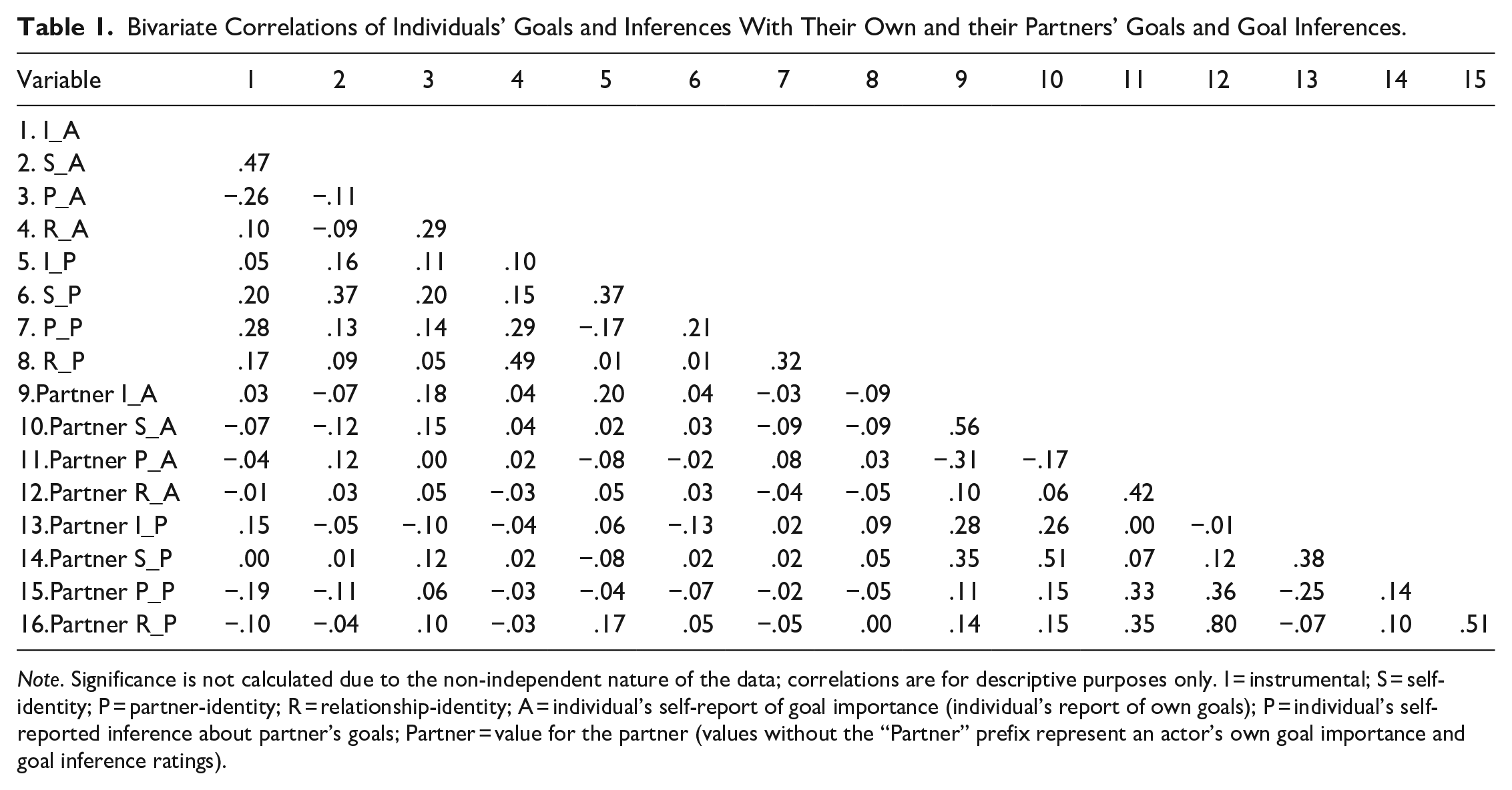
Note. Significance is not calculated due to the non-independent nature of the data; correlations are for descriptive purposes only. I = instrumental; S = self-identity; P = partner-identity; R = relationship-identity; A = individual’s self-report of goal importance (individual’s report of own goals); P = individual’s self-reported inference about partner’s goals; Partner = value for the partner (values without the “Partner” prefix represent an actor’s own goal importance and goal inference ratings).
H1: Partner’s Lag-0 Goals Predicting Actor’s Lag-0 Inferences About a Partner’s Goals.
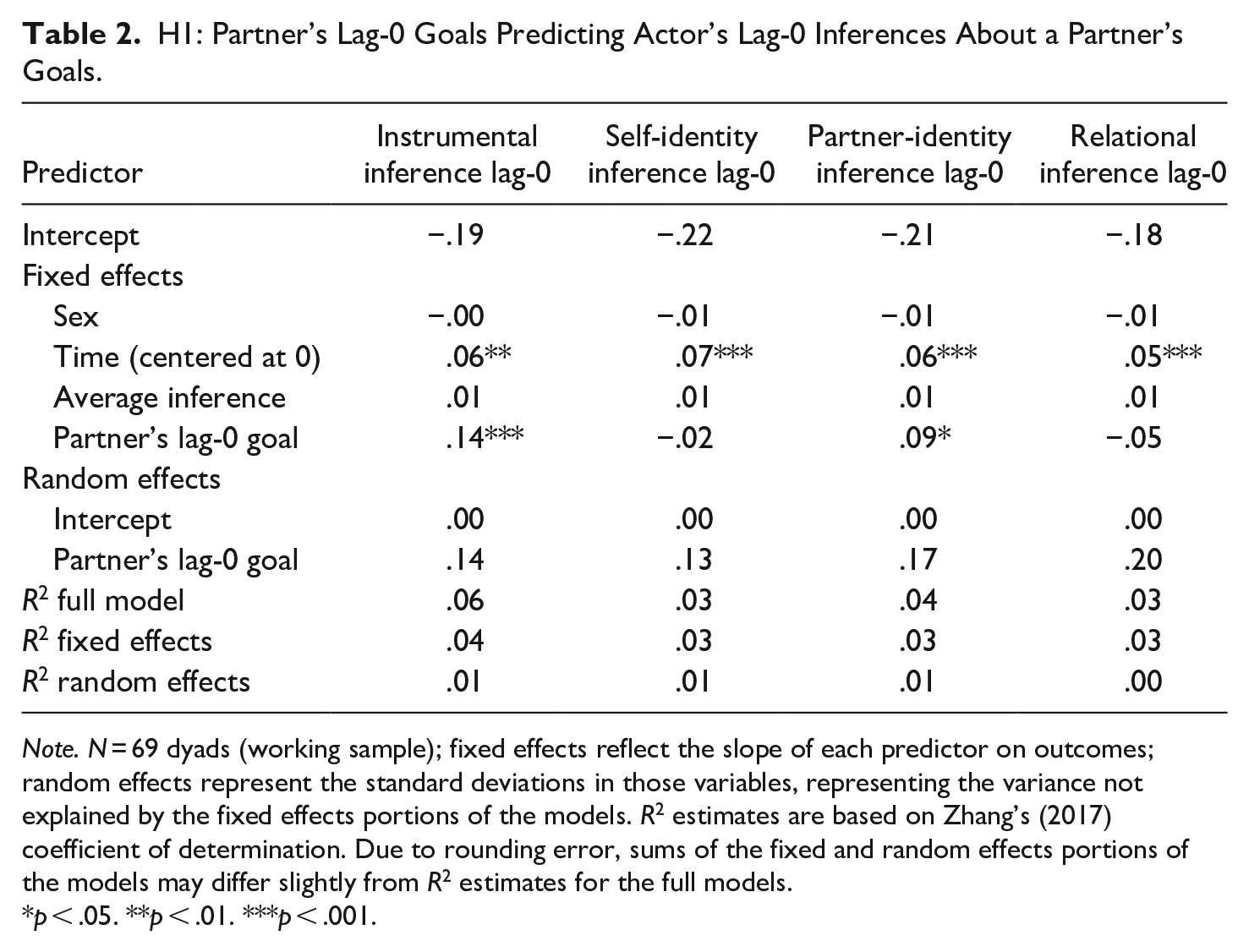
Note. N = 69 dyads (working sample); fixed effects reflect the slope of each predictor on outcomes; random effects represent the standard deviations in those variables, representing the variance not explained by the fixed effects portions of the models. R2 estimates are based on Zhang’s (2017) coefficient of determination. Due to rounding error, sums of the fixed and random effects portions of the models may differ slightly from R2 estimates for the full models.
p < .05. **p < .01. ***p < .001.
H2: Actor’s Lag-0 Goals Predicting Actor’s Lag-0 Inferences About a Partner’s Goals.
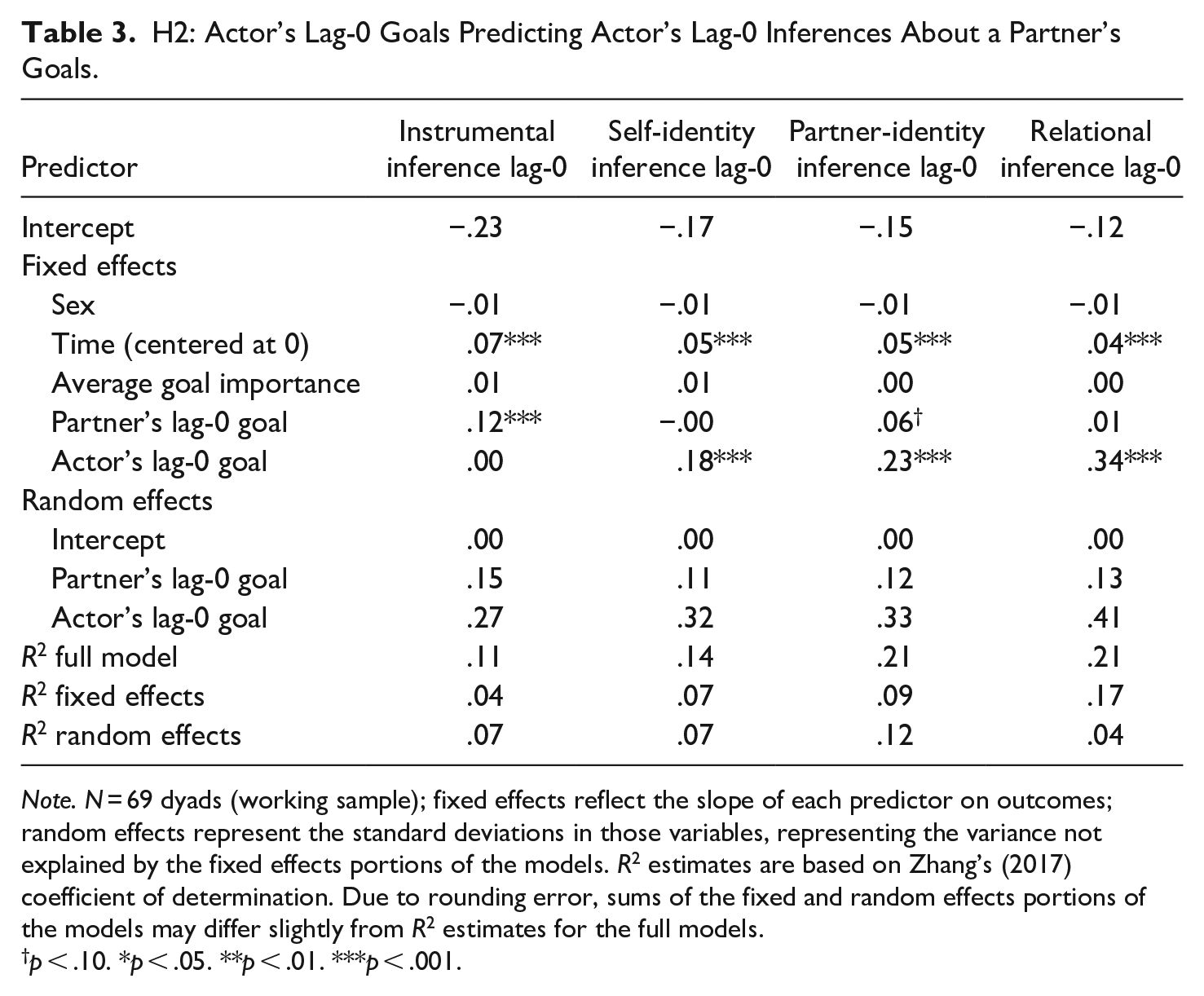
Note. N = 69 dyads (working sample); fixed effects reflect the slope of each predictor on outcomes; random effects represent the standard deviations in those variables, representing the variance not explained by the fixed effects portions of the models. R2 estimates are based on Zhang’s (2017) coefficient of determination. Due to rounding error, sums of the fixed and random effects portions of the models may differ slightly from R2 estimates for the full models.
p < .10. *p < .05. **p < .01. ***p < .001.
H3: Partner’s Lag-1 Goals Predicting Actor’s Lag-0 Goals.
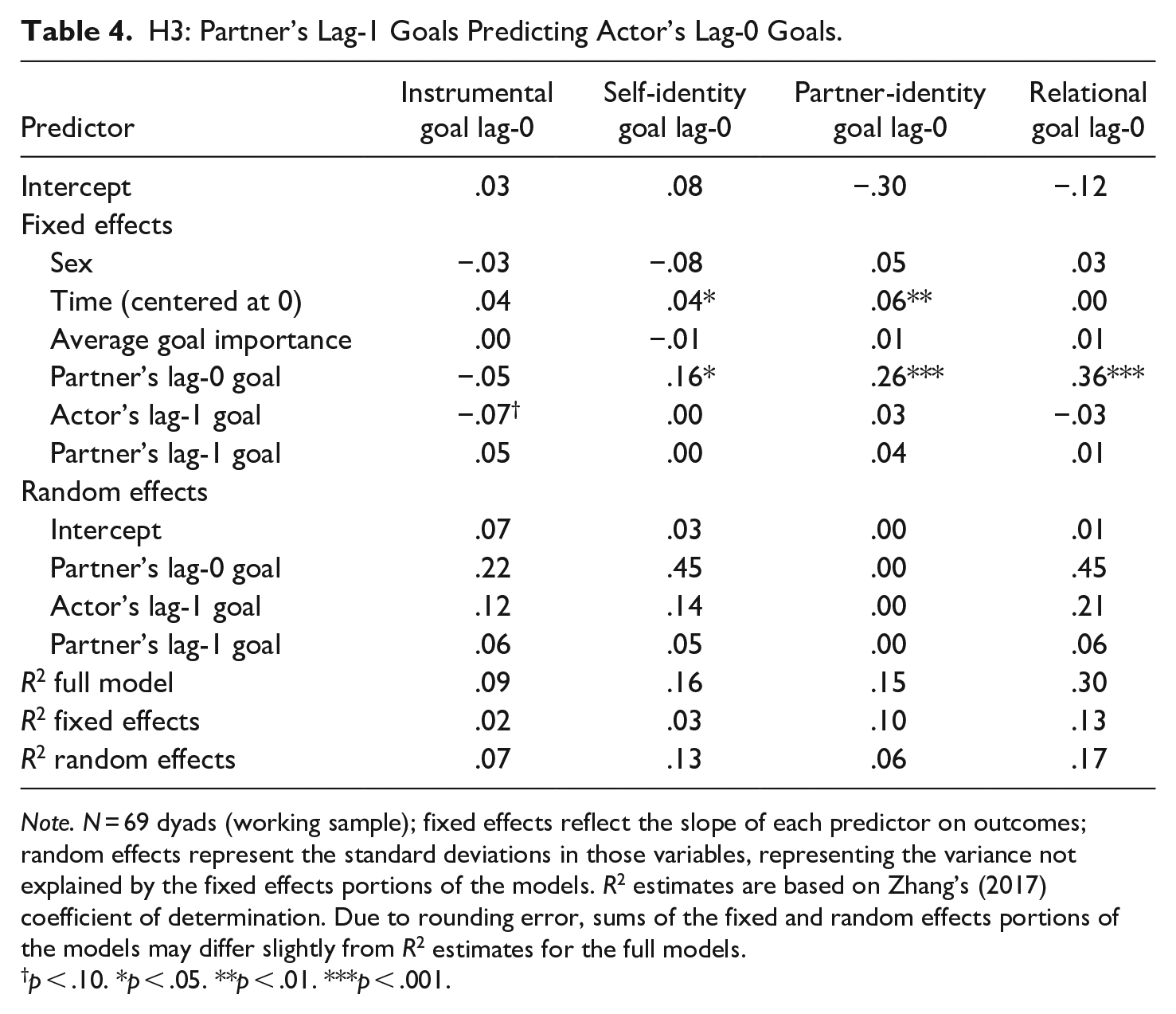
Note. N = 69 dyads (working sample); fixed effects reflect the slope of each predictor on outcomes; random effects represent the standard deviations in those variables, representing the variance not explained by the fixed effects portions of the models. R2 estimates are based on Zhang’s (2017) coefficient of determination. Due to rounding error, sums of the fixed and random effects portions of the models may differ slightly from R2 estimates for the full models.
p < .10. *p < .05. **p < .01. ***p < .001.
H4: Actor’s Lag-1 Inferences About a Partner’s Goals Predicting Actor’s Lag-0 Goals.
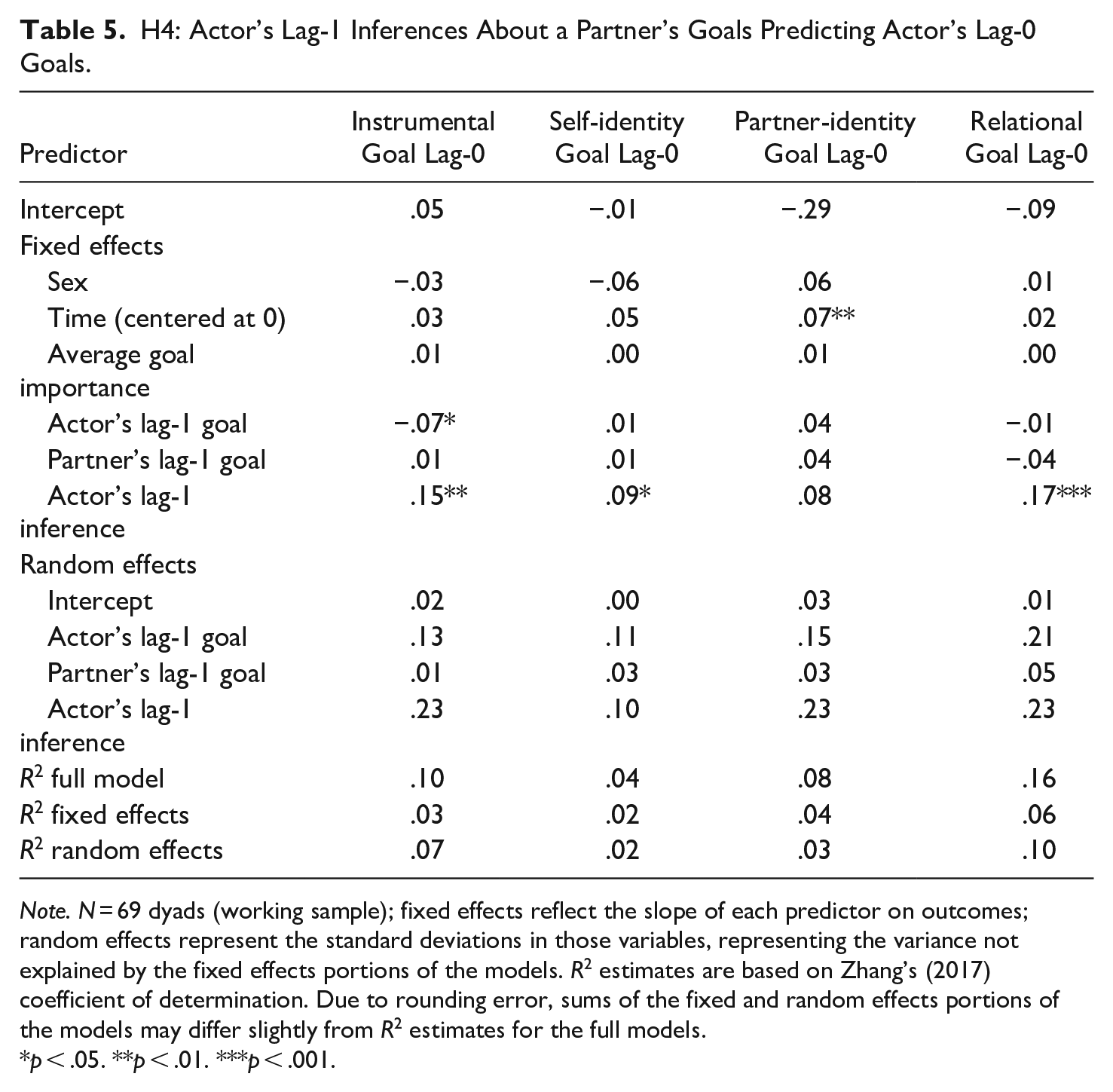
Note. N = 69 dyads (working sample); fixed effects reflect the slope of each predictor on outcomes; random effects represent the standard deviations in those variables, representing the variance not explained by the fixed effects portions of the models. R2 estimates are based on Zhang’s (2017) coefficient of determination. Due to rounding error, sums of the fixed and random effects portions of the models may differ slightly from R2 estimates for the full models.
p < .05. **p < .01. ***p < .001.
H1: Goal Inference Accuracy
H1 posited a partner’s actual goals would predict actors’ concurrent inferences of the importance a partner assigned to those goals, at greater-than-chance levels. A partner’s actual instrumental and other-identity goal importance were positively associated with actors’ concurrent inferences of the importance a partner assigned to those goals (Table 2). However, the importance of a partner’s self-identity and relational goals did not predict actors’ concurrent goal inferences. H1 received mixed support.
H2: Goal Projection
H2 proposed actors’ goals at 1 minute would be positively associated with their concurrent inferences about the importance of the same goal for their partners (controlling for the partner’s actual goals at that minute). H2 was supported for all goals except instrumental goals (Table 3). The more important that actors considered self-identity, other-identity, and relational goals at 1 minute, the more they concurrently inferred these goals as important to their partner. Thus, H2 was mostly supported.
H3 to H5: Goal Contagion
H3 specified a partner’s goal importance at 1 minute would be positively associated with actors’ own goal importance at the next minute. All tests controlled for the autoregressive effect of actors’ goal importance ratings at the previous minute on their subsequent goal ratings at the current minute. We also controlled for partners’ concurrent goals, which could be correlated with actors’ concurrent goals. Contrary to predictions, a partner’s goals at the previous minute goals did not predict any of the actor’s subsequent goals at the current minute (Table 4). The lack of support for H3 was qualified by several significant indirect effects 3 (see H5 below).
H4 proposed actors’ inferences about the importance a partner placed on a particular goal at 1 minute would be positively associated with actors’ own goal importance at the next minute. Our model used actors’ goal inferences at the previous minute to predict actors’ own goal importance at the current minute, controlling for actors’ importance of that goal at the previous minute and inferences about the partner’s goal importance at the current minute. Consistent with H4, inferring a partner placed higher importance on instrumental, self-identity, and relational goals in a given minute predicted actors’ own increased importance of those same goals during the next minute (Table 5). However, inferring higher importance of an other-identity goal to one’s partner during 1 minute did not predict increased importance of the other-identity goal for actors at the next minute. In all, H4 was mostly supported.
H5 examined the role of goal inferences in mediating links between a partner’s prior goals and actors’ subsequent goals. Specifically, H5 proposed inferences about a partner’s goals at 1 minute would mediate between the partner’s concurrent actual goals and actor’s subsequent goals. We assessed mediation with the MLmed macro for SPSS 4 (Rockwood, 2017), using Monte Carlo simulation with 10,000 resamples to estimate 95% confidence intervals for indirect associations (Table 6). Our focus on within-persons mediation provides better inferences of mediation in multilevel contexts than does cross-sectional, between-persons mediation (Ram, 2017). Because actors’ and partners’ concurrent goals were likely to be correlated, our analyses included the non-focal individuals’ goals at the previous minute as covariates. Specifically, for H5, we controlled for actors’ previous goals when estimating the indirect association between partners’ previous goals and actors’ current goals.
H5 and RQ: Indirect Associations of Partners’ and Actors’ Lag-1 Goals with Actors’ Lag-0 Goals.
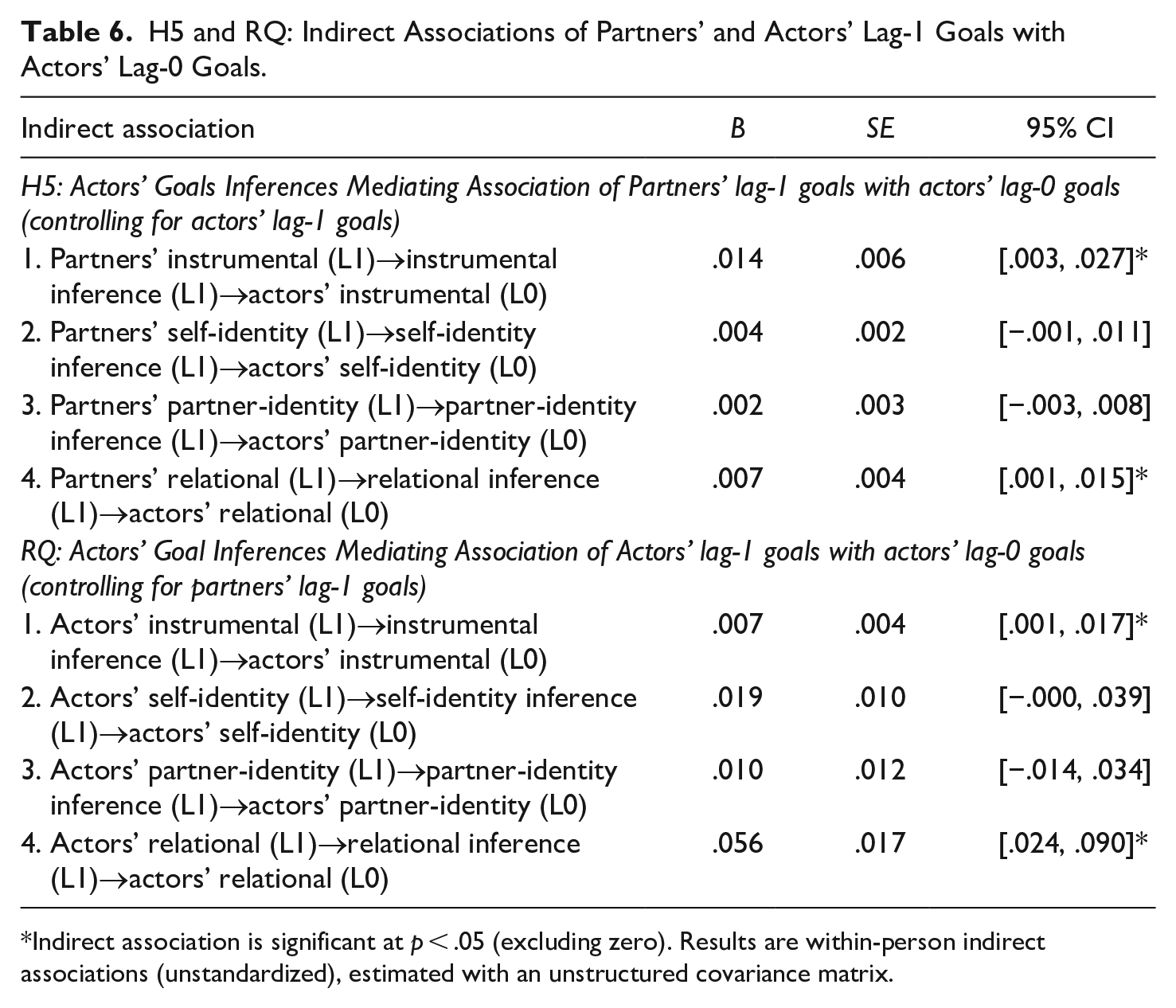
Indirect association is significant at p < .05 (excluding zero). Results are within-person indirect associations (unstandardized), estimated with an unstructured covariance matrix.
Consistent with H5, partners’ instrumental goals at the previous minute had a positive indirect association with actors’ instrumental goal importance during the current minute. As partners’ instrumental goal importance increased at 1 minute, actors concurrently inferred their partners’ instrumental goals as more important; in turn, actors’ inferences that a partner prioritized instrumental goals at 1 minute predicted actors’ own increased instrumental goal importance in the next minute. Partners’ relational goals also had a positive indirect association with actors’ subsequent relational goals. As partners prioritized relational goals in 1 minute, actors were more likely to infer partners did so; in turn, increased inferences that a partner prioritized relational goals predicted actors’ own subsequent increased priority of relational goals. Contrary to H5, partners’ self-identity and other-identity goals did not have significant indirect associations with actors’ own subsequent self-identity nor other-identity goals. H5 received partial support.
RQ: Inferences Mediating Within-Persons Goal Consistency
Our RQ asked whether actors’ inferences about a partner’s goals mediate links between their own goals at 1 minute and the next, controlling for the partner’s previous goals. In essence, this examines whether goal projection (H2) promotes consistency of individuals’ own goals from 1 minute to the next. We examined this question using MLmed, as described above. Results are summarized in Table 5. We controlled for partners’ previous goals when estimating the indirect association of actors’ own previous goals on their current goals for that minute.
As actors prioritized instrumental and relational goals in 1 minute, they inferred their partners also prioritized those goals more. In turn, inferring that a partner prioritized those goals made it more likely actors would prioritize those goals in the next minute. Inferences about a partner’s self-identity and other-identity goals, however, did not mediate between actors’ previous goals and current importance of those goals.
Discussion
Previous research has noted the dynamic nature of goal adoption in conflict (Keck & Samp, 2007; Samp, 2013; Waldron, 1997). Although these studies support the idea that people have multiple goals that shift in importance, and that a partner’s behavior influences these goal shifts, they did not account for inferences of a partner’s goals influencing one’s goal shifts across the interaction. Understanding how inferences about a partner’s goals influence and are influenced by a person’s own goals is an important next step in this area of research.
The present study examined dyadic goal change over the course of a conflict by examining the influence of one romantic partner’s goals on the other’s goal importance across a conflict episode. Specifically, we were interested in illuminating how accurately people judge their partners’ goals within each minute of a conflict episode, and whether these judgments were biased by their own goals (i.e., goal projection). Furthermore, we examined whether inferences about a partner’s goals may subsequently impact one’s own goals in the following minute, mediating between actors’ and partners’ previous and subsequent goals (i.e., goal contagion). Support for predictions was mixed. Twelve of our 24 hypotheses were directly supported (with two indirectly supported via the mediation analyses) at a statistically significant level. However, the effect sizes for most associations were small. In the following sections, we unpack these results in greater detail.
Goal Inference Accuracy During Conflict Varies by Goal Type
Our first hypothesis posited that people would infer the importance of their partner’s goals at statistically significant levels at each minute of a conflict interaction. Because goals can be reciprocal (Keck & Samp, 2007), it makes sense that a partner’s actual goals would predict the other person’s perception of these goals. This hypothesis was supported for both instrumental and other-identity goal importance. The effect sizes were small, however, with partners’ instrumental and other-identity goals explaining 3% and 4% of the variance, respectively, in counterparts’ concurrent inferences about these goals. Moreover, partners’ self-identity and relational goal importance did not significantly predict counterparts’ inferences about those goals at the same minute. This suggests inaccuracy is more the rule than the exception, when attempting to infer a partner’s momentary goals during conflict.
General patterns of inference inaccuracy notwithstanding, people appear slightly more accurate in inferring a partner’s goals to show concern for them or persuade them, than in inferring a partner’s goals to maintain the relationship or attend to the partner’s identity needs. These results are consistent with a recent study (Hinnekans et al., 2016) in which partners who were attempting to influence their partner were more likely to accurately infer their partner’s thoughts and feelings. When desiring to influence a partner, accurately inferring the partner’s goals may help individuals more effectively adapt to their partner’s reactions. However, when a partner’s feelings and thoughts seem threatening to the relationship, people can be motivated to be less accurate in their inferences (Simpson et al., 2003).
Such awareness could also reflect the rating of instrumental goals as one of the most important in conflicts (Keck & Samp, 2007), which may prime attention to cues indicating instrumental intentions. Interestingly, other-identity and instrumental goal inferences appear conceptually similar to the affiliation-disaffiliation and dominance-submission frames, respectively, that guide interpretations of others’ relational intentions (Dillard et al., 1999). Future research should explore how activation of affiliation and/or dominance frames might explain variations in goal inferences and goal inference accuracy during conflict.
Goal Projection: It’s All About Me
In light of work suggesting people tend to project their goals onto interaction partners (Palomares, 2012), our second hypothesis posited that this tendency would be biased by their own concurrent goals in a conflict. This hypothesis was supported for self, partner, and relationship-focused goals but not for instrumental goals. The effect sizes, though not large, were somewhat greater for goal projection than for goal inference accuracy, with individuals’ own goals explaining between 4% and 12% of the variance in their inferences about a partner’s goals. Controlling for their partner’s actual goal at each minute, people’s own goals predicted their concurrent inference that a partner prioritized the same goals to a greater extent. This is consistent with research on misperceptions in negotiation, showing assumptions of greater similarity to a negotiation partner in terms of issue importance, resulting in overestimating (underestimating) a partner’s interests based on their most (least) important issue (Chambers & De Dreu, 2014).
Our third hypothesis predicted that in response to a partner’s actual goal importance at 1 minute, a person would adjust their importance of the same goal in the next minute. We did not find direct effects supporting this hypothesis. Instead, we found modest indirect effects of a partner’s previous instrumental and relational goals on one’s subsequent instrumental and relational goals (see below). In retrospect, the lack of support for direct goal contagion might not be surprising. If goal contagion is an inferential process (Palomares, 2013), one’s prior goals and a partner’s subsequent goals might not always be directly linked. Our mediation analyses in the next section were consistent with the inferential view of conversational goal contagion. Moreover, the fact that the non-significant direct associations between partners’ instrumental and relational goals (H3) and individuals’ subsequent instrumental and relational goals became significant in the mediation analyses (H5) suggests suppression due to the exclusion of the mediators (i.e., inferences about partners’ goals) from the models. This further supports the importance of goal inferences for shaping dyadic goal dynamics in conflict.
Goal Shifts: It’s What I Think You’re Doing That Moves Me
Our fourth hypothesis predicted that, beyond a partner’s actual goal importance in the previous minute, a person’s concurrent inferences of their partner’s goals would invoke subsequent shifts in importance for the same goals. This hypothesis was supported for most of the goals, except for other-identity goals. When people perceive that a partner is attempting to resolve the issue or to confirm and validate the relationship, they respond by making more of an effort to do the same. Alternatively, when perceiving partners as focused on their own objectives in the conflict episode, people respond with a similar focus. On one hand, this suggests that attributing positive relational intentions to a partner can motivate one to pursue relationship-affirming aims. On the other hand, perceiving a partner’s selfish intent tends to increase one’s own self-centered goal focus.
This reciprocity was not supported for other-identity goals, meaning that perceiving a partner’s validation and support did not inspire a similar response. This could reflect the nature of partner-supportive goals. Goals tend to shift toward supporting a partner who is perceived to be in distress (Youngvorst & High, 2018). When receiving support, this distressed partner may focus more on their own feelings and identity, indicators of distress that elicits the other’s partner-supportive goals. Thus, other-identity goals seem more likely to be pursued in a complementary, rather than reciprocal, fashion over the course of conflict interactions. Consistent with this notion, recent research has suggested that prosocial goals may be less contagious than other, more instrumental goals (Brohmer et al., 2019).
Not only did inferences about a partner’s goals predict shifts in actors’ subsequent goals, but they mediated shifts in instrumental and relational goals. Whereas prior studies observed that a partner’s goal shifts predict shifts in one’s own goals (Keck & Samp, 2007; Samp, 2013), ours is the first to explicitly test a mediational explanation for goal shifts in response to partners’ conversational goal shifts. Relational and instrumental goal inferences mediated between a partner’s actual goals at 1 minute and one’s own greater likelihood of subsequently pursuing those goals (H5). Similarly, goal inferences mediated between actors’ previous instrumental and relational goals and actors’ subsequent importance of those goals (RQ).
We note that the effect sizes for the indirect effects were modest. This is in line with recent investigations testing mediational models of goal contagion, which have found mixed evidence for the view that goal inferences mediate goal contagion (Brohmer et al., 2019), though mediation effects are stronger for more abstract goals (Palomares, 2013). A recent meta-analysis of goal contagion studies observed relatively small average goal contagion effects (Hedges g = 0.30) (Brohmer, 2020). Further, there was evidence of publication bias, with an average effect of approximately zero among unpublished and preregistered studies. Moreover, it was estimated that there were around five unpublished goal contagion studies for every published study, suggesting a “file drawer” effect could be at work in the goal contagion literature. Publication-bias corrected estimates suggested the true goal contagion effect size might be closer to Hedges g = 0.15 (Brohmer, 2020).
Our mediation results integrate previously distinct research streams on goal projection (e.g., Palomares, 2012) and goal contagion (e.g., Aarts et al., 2008; Palomares, 2013), showing that goal inferences can play a role in explaining both within-person and between-person sequential goal dynamics. Goal inferences can tie both one’s own and a partner’s prior instrumental and relational goals to one’s subsequent adoption or reinforcement of those conflict goals, though the effects are generally modest. Over time, however, even modest “nudges” in goal adoption could have meaningful cumulative effects on conflict dynamics. This could help explain a challenge of persuasion in conflict. Intrapersonally, actors’ goals bias their inferences (goal projection), and these inferences in turn bias actors’ subsequent goals. People pursuing instrumental goals appear more likely to view their partners as instrumentally-minded, which could lead to doubling-down on one’s own instrumental intentions and ensuing escalation (Keck & Samp, 2007). Of course, this is balanced with the recognition that people pursuing positive relational goals are more likely to believe the best about their partners’ relational intentions, reinforcing their own efforts to positively manage the relationship. In this way, goal projection can reinforce negative and positive goal patterns over time. Interpersonally, a person’s instrumental and relational goal focus seems to promote the same in their partner by an inferential process (goal contagion), which could lead to instrumental escalation or pro-relational synchrony.
What Else Might Drive Dyadic Goal Processes in Conflict?
Overall, partners were not very accurate in inferring one another’s goals during conflict; goal inferences were more strongly influenced by one’s own goals (i.e., goal projection) than by a partner’s actual goals; and goal inferences and projection inconsistently and weakly account for between- and within-persons goal shifts during conflict. Although goal inferences and projection appear to play a role in dynamic goal shifts during conflict, the mixed and relatively weak patterns of results suggest other mechanisms are also at work when arguers’ goals and goal inferences shift.
Prior research has identified conflict tactics (Keck & Samp, 2007) and verbal content (Samp, 2013) as predicting goal shifts within and between partners. Presumably, this process is shaped by one’s inference of the goals behind these message features, though this expectation has not been explicitly tested to date. Similarly, nonverbal cues may “leak” information about individuals’ internal states (Ekman & Friesen, 1969), and could accordingly influence dyadic goal perceptions and shifts. Beyond message features, relational features and conflict history may shape goal inferences and shifts. In serial arguments (the type of conflicts investigated in this study), argument processes and outcomes change over time as a function of relational progression (Vanderbilt, 2020) and argument frequency (Johnson & Roloff, 2000). Notably, the observation that predictability of arguments increases with argument frequency (Johnson & Roloff, 2000) suggests individuals could project goal perceptions from previous conflict episodes into a current episode. In this way, partners’ expectations about each other’s goals could become self-fulfilling prophecies over time. Finally, as attachment orientations shape accuracy in predicting the goals a partner will pursue in an impending serial argument episode (Carson & Ackerman, 2018), they may also shape the accuracy of momentary goal inferences, individuals’ propensity to project their own goals onto a partner, and actor-to-partner goal contagion.
Conclusion
As with all studies, ours had strengths and weaknesses. A strength was the intensive moment-by-moment dyadic reporting of goals and goal inferences during conflict. The overwhelming majority of knowledge about goals during interaction relies on global, retrospective reports of goals for an entire interaction. Our study joins a few others (e.g., Keck & Samp, 2007; Waldron, 1997; Worley & Samp, 2018b) that provide a richer understanding of the sequential dynamics of momentary goal, particularly during conversations about conflict.
Furthermore, we examined momentary goals and goal inferences in actual relational conflicts between established romantic partners. This approach contributed to greater external validity compared to studies of strangers engaging in conflict about researcher-defined topics. That said, much of the research on sequential goal dynamics during conflict has focused on romantic contexts (e.g., Samp, 2013; Worley & Samp, 2018b), or more rarely, between friends (Keck & Samp, 2007). Yet other contexts and relationships/roles seem ripe for investigation.
For instance, how communicators sequence the solicitation and provision of advice is important for how recipients evaluate it (Goldsmith, 2000). Advice conversations can be face threatening for both parties, and success depends in part on recipients’ perception of advisors as sensitive to their face goals (MacGeorge et al., 2016). As global inferences about an advisor’s goals predict advice outcomes (Guntzviller et al., 2019), it would be useful to assess the extent to which goal inferences and goal projection influence advice recipient’s own goals during advice interactions. Assessing moment-by-moment advisors’ and recipients’ instrumental and face goals and goal inferences during advice conversations could illuminate variations in responses to advice and/or support, as well as the mutual influences of advisors and recipients on each other’s conversational goals. Other contexts include relationship initiation and de/escalation (Wilson et al., 2009), or sexual initiation and resistance (Lannutti & Monahan, 2004), in which people infer each other’s goals and decide how to respond to those perceived intentions.
Furthermore, goal contagion research has recently been critiqued for assuming contagion proceeds via a purely cognitive process, with less attention given to potential affective processes that might encourage the adoption of others’ goals (Corcoran et al., 2020). Future work should examine the extent to which emotional contagion might promote goal contagion, independent of goal inferences. As research suggests that the degree of volatility versus stability in partners’ goals (Worley & Samp, 2018a) and emotions (Luginbuehl & Schoebi, 2020) predict conflict outcomes, it would be interesting to assess how momentary fluctuations in emotions predict goal inferences as well. Moreover, because goals are linked to specific behavioral plans in individuals’ mental networks, observing a partner’s behavior might activate cognitive pathways from that behavior to similar goals in one’s own mind (Greene, 2020). This could, perhaps, lead to genuine goal contagion even in the absence of goal inferences. Further work is needed to evaluate these possibilities. Finally, our goal measures assessed goals at a relatively high level of abstraction, focusing on broad classes of goals (i.e., instrumental, self- and other-identity, and relational). It is possible that partners could display insight or co-occurrence of a class of goals without necessarily pursuing the same content goals. For instance, two partners could both report the other-identity goal of “supporting my partner,” yet focus on different aspects of this aim (e.g., offering emotional support versus providing tough love). Measuring goals at a more content-specific level would have made the analyses substantially more complex. However, it is quite likely that accuracy in inferring a partner’s goals might have been even lower with content-specific goal measures. Future research should consider more granular goal assessments to explore this possibility.
Overall, we observed mixed and rather weak support for people’s ability to infer romantic partners’ momentary goals during a conflict episode. Nevertheless, inferences about a partner’s momentary goals (regardless of whether these were accurate or inaccurate) generally shaped people’s own goals, and in some cases mediated the impact of a partner’s goal shifts on one’s own subsequent goals. Future research should consider the interplay of these sequential influences of goal inferences and a partner’s communication behaviors on a person’s own goals and message strategies in a wider array of communicative contexts.
Footnotes
Acknowledgements
The authors wish to thank David Barger, Nicholas Alico, and Cory Steinle for their assistance with data collection. They also thank Miriam (Mimi) Brinberg for her statistical advice.
Author Note
Timothy Worley is now affiliated with the University of North Alabama.
Declaration of Conflicting Interests
The authors declared no potential conflicts of interest with respect to the research, authorship, and/or publication of this article.
Funding
The authors received no financial support for the research, authorship, and/or publication of this article.
