



Abstract
In this study, we examined whether adolescents helped others during the COVID-19 pandemic and how stories in the media inspired them in doing so. Using an online daily diary design, 481 younger adolescents (M = 15.29, SD = 1.76) and 404 older adolescents (M = 21.48, SD = 1.91) were followed for 2 weeks. Findings from linear mixed effects models demonstrated that feelings of being moved by stories in the media were related to giving emotional support to family and friends, and to helping others, including strangers. Exposure to COVID-19 news and information was found to spark efforts to support and help as well and keeping physical distance in line with the advised protective behaviors against COVID-19. Moreover, helping others was related to increased happiness. Overall, the findings of this study highlight the potential role of the media in connecting people in times of crisis.
Keywords
All over the world, people have been working together in the battle against COVID-19. In this study, we examined whether adolescents contributed to this by helping others and how stories in the media inspired them to do so. The propensity to support and help others is apparent throughout the life span, but the development of complex social–cognitive skills and an expanding social world make adolescence particularly important for contributing to society (Crone & Fuligni, 2020; Dahl et al., 2018; Fuligni, 2019). Adolescence is an important developmental period for social cognitive processing, in which sensitivity to the perspective of others grows (Crone & Dahl, 2012; Crone & Fuligni, 2020; Dahl et al., 2018). It is a life phase that may even represent a sensitive period for the onset of taking risks when helping others (Blankenstein et al., 2020). Given this window of opportunity, the pandemic provides adolescents with possibilities to meaningfully contribute to those around them.
For adolescents to unleash their potential to help others, it is important that they have positive role models (Dahl et al., 2018). Previous work has shown that witnessing acts of moral beauty can lead to feelings of being moved, which can increase our openness toward others (for reviews, see Pohling & Diessner, 2016; Thomson & Siegel, 2017). Moral beauty can be witnessed in stories in the media and can include acts of love, kindness, bravery, or any other strong display of character strength. Witnessing moral beauty inspires people to do “good” for others—even for strangers (Pohling & Diessner, 2016; Thomson & Siegel, 2017). Research on these positive experiences among adults has blossomed, but less is known about younger viewers. Moreover, most current insights are based on laboratory research. Given the key role of media in the lives of young people (Obviously, 2020), it is important to know how stories in the media can inspire young people in a more natural and realistic context. This study focused on adolescents between 10 and 25 years, covering the full developmental stage of adolescence (Sawyer et al., 2018). The daily diary study design of this study illuminated what exactly inspired adolescents in everyday life and what they did themselves to help. This approach enhances ecological validity and helps to understand whether the relation between feelings of being moved and altruistic behaviors occurs outside the lab, in the highly relevant real-world context of a crisis.
A Positive Media Psychology Perspective on Adolescents During a Crisis
As a theoretical framework, we adopted a positive media psychology perspective on adolescents during a crisis. Positive media psychology is a growing line of research devoted to how media can contribute to well-being and flourishing of both individuals and society (Oliver, 2022; Raney et al., 2020). In this line of research, insights from positive psychology are applied to the context of the media. What is innovative about this study is that we integrated these insights with knowledge from social neuroscience in an aim to extend the research line of positive media psychology to adolescence. Adolescence is characterized by a strong need to do good (Crone & Fuligni, 2020; Dahl et al., 2018; Fuligni, 2019), which makes it likely that adolescents are sensitive to stories in the media that portray moral beauty.
Helping others can strengthen social bonds within society but can also be beneficial for young people themselves as doing good can result in positive emotions (Dunn et al., 2008; Lyubomirsky et al., 2005; Weinstein & Ryan, 2010). Positive emotions can buffer against depressive feelings and can even fuel thriving despite adversity (Fredrickson et al., 2003; Waters et al., 2022). Another important path to growth during hard times is experiencing meaning in life (Baumeister et al., 2013; Ryan et al., 2008; Waters et al., 2022). Based on Aristotle’s philosophy on eudaimonia (350 BCE/2002) and contemporary insights from positive psychology and self-determination theory, meaningfulness can be described as experiencing that one’s life has purpose and pursuing human virtue (Baumeister et al., 2013; Ryan et al., 2008; Waters et al., 2022). Adversity can help to discover and apply character strengths, and to live a meaningful life that is characterized by turning to others which is also valuable for society at large (Baumeister et al., 2013; Ryan et al., 2008; Waters et al., 2022). In sum, in this study we applied insights from positive psychology—including the broaden-and-build theory, and insights from self-determination theory to the context of the media. These insights were integrated together with findings from social neuroscience, to shed light on how stories in the media inspire adolescents to help others and with that increase their well-being. In doing so, we examined how prosocial behaviors and happiness are related, whether witnessing moral beauty can lead to prosocial behavior, and what portrayals of moral beauty adolescents encountered in the media.
Prosocial Behaviors and Happiness
Helping others not only leads to stronger feelings of happiness (Dunn et al., 2008; Lyubomirsky et al., 2005; Weinstein & Ryan, 2010), but happy people are also more likely to be altruistic, generous, and charitable (Lyubomirsky et al., 2005; Peterson & Seligman, 2004). Feeling good is found to predict stronger involvement with societal issues as well (Kushlev et al., 2019). Happy people are even more likely to comply with the physical distancing measures against the spread of COVID-19 (Krekel et al., 2020), which has been appealed to as an important way of helping others as it can limit the spread of the COVID-19 virus and break the chain of transmission (Ghebreyesus, 2020). Most young people are not at high risk for hospitalization or death due to COVID-19, so for them adhering to such measures could be considered as other-oriented prosocial behavior.
In other words, there is robust evidence that both “do good, feel good” and “feel good, do good” apply, which can be explained by the broaden-and-build theory (Fredrickson et al., 2003). The broaden-and-build-theory posits that positive emotions, such as happiness, can help expand people’s attention toward others, encourages them to help, and with that create an upward spiral of kindness and happiness (Layous et al., 2017). However, most research is limited in terms of how prosocial behaviors and feelings of happiness are exactly related to each other from day to day. To our knowledge, the bidirectional relations between positive affect and prosocial behavior have only been examined among adults (Sin et al., 2021; Snippe et al., 2017), indicating that prosocial behavior and positive affect influence one another in daily life. In line with the assumptions of the broaden-and-build theory, it is expected that adolescents who feel happy are more open to connect to and help others during the COVID-19 pandemic. In addition, when they support and help others, this leads to increased happiness despite the challenges that come along these hard times:
H1: Adolescents with higher levels of happiness are more likely to act prosocially during the COVID-19 pandemic. More specifically, happy adolescents are more likely (H1a) to keep physical distance in line with the advised protective behaviors against COVID-19, (H1b) to provide emotional support to family and friends, and (H1c) to help others during the COVID-19 pandemic.
H2: The relation between happiness and prosocial behavior is bidirectional and, therefore, adolescents who help others during the COVID-19 pandemic are more likely to have increased levels of happiness.
Another positive emotion that can expand our openness toward others and encourages us to help is the experience of moral beauty (Diessner et al., 2013; Pohling & Diessner, 2016). Witnessing others who display acts of moral beauty can lead to the experience of feeling moved or touched, which is a key component of moral elevation. Moral elevation gives rise to the desire to be a better person (Diessner et al., 2013; Pohling & Diessner, 2016; Thomson & Siegel, 2017) and this desire can lead to actual increased helping (Pohling & Diessner, 2016; Schnall et al., 2010; Thomson & Siegel, 2017; Van de Vyver & Abrams, 2015). Moral elevation overlaps with kama muta—a positive social emotion evoked by sudden intensifications of communal sharing relations (Zickfeld et al., 2019). Kama muta is Sanskrit for feeling “moved by love,” and this emotion is also related to a stronger motivation to care for others.
During the COVID-19 pandemic, countless acts of moral beauty were performed everywhere (Avaaz, 2020). These acts of helpfulness, kindness, and love are shared with the world through stories in the media. Due to the overall increased online engagement, especially in areas that are in lockdown (Common Sense Media, 2020; Obviously, 2020; Noel, 2020), it is expected that people are more likely to see these stories. In addition to encountering these stories in the media, it is possible that young people are notified about such stories by others as uplifting news stories are more often shared with others (Ji et al., 2018; Oliver, 2022).
During adolescence, the brain undergoes structural and functional changes in the “social brain network,” a network of regions important for understanding social situations as understanding other’s mental states and perspective-taking (Crone & Dahl, 2012; Crone & Fuligni, 2020; Dahl et al., 2018), which is important for experiencing moral beauty (Pohling & Diessner, 2016). The present study contributes to existing knowledge by examining not only the extent to which adolescents are moved by moral beauty, but also whether they act upon this feeling by supporting and helping others. With that, this study expands the pioneering field of positive media psychology. In line with previous insights indicating that experiences of moral beauty can broaden thought-action repertoires by motivating to affiliate with others and prompting prosocial behavior (Diessner et al., 2013; Pohling & Diessner, 2016), we hypothesized that:
H3: Adolescents who experience higher levels of being moved by media are more likely (H3a) to keep physical distance in line with the advised protective behaviors against COVID-19, (H3b) to provide emotional support to family and friends, and (H3c) to help others during the COVID-19 pandemic, which subsequently leads to increased feelings of happiness.
Given that experiencing moral beauty recruits the more advanced cortical regions of the brain (Cheng et al., 2020; Diessner et al., 2008)—which are under development during adolescence (Crone & Dahl, 2012; Crone & Fuligni, 2020; Dahl et al., 2018)—not all good deeds that adolescents encounter in the media are experienced as moral beauty. Instead, these will be experienced as moral goodness (Cheng et al., 2020; Diessner et al., 2008). However, these can still be meaningful and contribute to being well-informed about what is going on in the world (Bandura, 2001). News is an important way to gain information about significant events and facilitates our functioning as active citizens in society (de Vreese & Boomgaarden, 2006; Livingstone & Markham, 2008). Stories can prompt us to take the perspective of others and expand our circle of empathy (Pinker, 2011).
In the case of the pandemic, stories in the media can help us understand what COVID-19 patients, doctors, and others are going through. Given that most young people reach out for COVID-19 news, it is likely that this exposure makes them more knowledgeable about what is going on, makes them more empathic toward others in need, and aids them in knowing what they can do to help. Drawing on insights from Aristotle (350 BCE/2002), positive psychology (Baumeister et al., 2013; Waters et al., 2022), and self-determination theory (Ryan et al., 2008), a meaningful life is characterized by reflecting on life’s challenges, so it is plausible that news stories make adolescents think about others. Previous findings have revealed that adolescents indeed increased their levels of perspective taking during the beginning of the first lockdown (van de Groep et al., 2020). For this study, we followed the broader definition of news, which includes news and information on social media (Tully et al., 2021) as online news and social media are the main sources of news for young people (Lauf et al., 2021). Altogether, we expected that:
H4: Adolescents with a higher exposure to COVID-19 news are more likely (H4a) to keep physical distance in line with the advised protective behaviors against COVID-19, (H4b) to provide emotional support to family and friends, and (H4c) to help others during the COVID-19 pandemic.
Portrayals of Moral Beauty That Spark Prosocial Behavior
An important question in positive media psychology concerns the type of stories that lead to feelings of being moved outside the lab. From previous work on social media, it is known that heart-warming content with portrayals of human connectedness and love are often found to be inspiring (Oliver, 2022). Therefore, stories about how love always finds a way—even given the challenges of the COVID-19 pandemic—are expected to be the stories that lead to feelings of being moved. Other uplifting stories of humanity’s inherent goodness (Avaaz, 2020), such as stories about kindheartedness, could lead to feelings of being moved as well. Kindness is the character strength about being compassionate, caring, and generous with others (Peterson & Seligman, 2004). Stories that give hope are expected to lead to feelings of being moved as well (Oliver, 2022). In their pioneering work, Peterson and Seligman (2004) classified 24 strengths of moral character and, therefore, it could be that next to love, kindness, and hope, other strengths are portrayed as well. For instance, in meaningful films, portrayals of bravery are often appreciated (Oliver & Hartmann, 2010). Being brave means facing one’s fears (Peterson & Seligman, 2004), and it is possible that the stories of the heroes on the front lines, who risk their lives to save others (Avaaz, 2020), induce feelings of being moved or touched as well. Most previous work on being moved by moral beauty is experimental by “assigning” people to watch an inspiring video, which leads to the question whether these individuals would have watched such content themselves (Oliver, 2022; Pohling & Diessner, 2016). The present study aimed to shed light on what acts of moral beauty managed to move young people in their daily lives and what they did themselves to help others around them. According to the self-determination theory, only prosocial behavior that is sparked by one’s own initiative leads to improved well-being (Weinstein & Ryan, 2010), which highlights the importance of examining how young people are motivated to help others. Therefore, we examined:
RQ1: Which acts of moral beauty in the media are most likely to move adolescents? And which prosocial behaviors do they engage in themselves?
Methods
Sample Characteristics
In this online daily diary study, 481 younger adolescents aged 10 to 18 years (M = 15.29, SD = 1.76; 34.27% male) and 404 older adolescents aged 17 to 25 years (M = 21.48, SD = 1.91; 18.09% male) participated. Most participants were Dutch (81.2%). Of the younger adolescents, 36.2% had a (side) job, of which 14.7% was designated as a “vital profession”—jobs that are crucial to keep society going during the COVID-19 outbreak, such as food chain jobs and jobs in (child) care. Among the older adolescents, 49.3% had a (side) job, of which 19.5% were vital.
Design and Procedure
Younger adolescents in high schools in the area of Rotterdam were invited to participate. Older adolescents were approached through the Erasmus University Rotterdam website, email, and social media platforms. Based on their moment of application, participants were assigned to one of the two batches (starting on May 4 or May 11, 2020). The participants were then followed for 2 weeks with daily online questionnaires, except for the weekends. Initially, 511 potential participants signed up for the study among the younger adolescents and 449 for the study among the Erasmus University Rotterdam students. In line with our preregistered exclusion criteria, 26 younger adolescents and 8 older adolescents were excluded because they did not complete any of the questionnaires. Among the younger adolescents, four participants were excluded because they were older than 18 years old and among the older adolescents, 37 participants were excluded because they were older than 25 years old.
The data collection took place near the end of the first wave of the COVID-19 pandemic. Participants were then in a lockdown with the following governmental restrictions: stay at home as much as possible, keep 1.5 m physical distance from others, avoid crowds, wash your hands often, do not shake hands, cough and sneeze into your elbow, use paper tissues, do not have gatherings outside the family context, and stay at home in case of symptoms. In addition, high schools and universities were closed. This study was approved by the ethics committee at Erasmus School of Social and Behavioural Sciences, Erasmus University Rotterdam. The hypotheses, the design plan of the study, including a description of the measures with all items, and the plan of analyses are preregistered at the Open Science Framework (https://osf.io/m4gr9). At the time of data collection, there were substantial differences between the younger and older adolescents in terms of daily circumstances at this stage of the pandemic. Given that the measures against COVID-19 had especially far-reaching consequences for the older adolescents—by being more limited in what to do outdoors, we decided to analyze these two groups separately. Making this distinction is also justified by insights from the developmental psychology literature, which assume important developmental growth during adolescence (Crone & Dahl, 2012; Crone & Fuligni, 2020; Dahl et al., 2018). Findings for the total sample are available as supplementary materials at the Open Science Framework (https://osf.io/zvfcy/).
Measures
Physical distancing
The extent to which the participants adhered to the advised protective behaviors against COVID-19 by keeping distance from others was measured with two questions: “To what extent have you been trying to stay home in the past 24 hours because of the coronavirus measures?” with the response options ranging from 1 = Not at All to 6 = All Day and “In the past 24 hours, how often did you try to keep 1.5 m away from others?” with the response options ranging from 1 = Never to 6 = Always. In the preregistration, we also described the question: “How much have you been outside your home in the past 24 hours?” However, we excluded this question as it did not appear appropriate as participants had good reasons to go outside, for instance, because they had a vital profession or needed to walk their dog. We also excluded the question: “In the past 24 hours, how often did you manage to keep 1.5 m away from others?” as keeping physical distance does not depend only on one’s own behavior.
The two questions that were included were treated as separate outcomes as the correlations indicated weak to moderate relations between both behaviors over the different days (varying between r = .38, p < .01 and r = .55, p < .01 among the younger and between r = .35, p < .01 and r = .58, p < .01 among the older adolescents). In the final questionnaire, younger adolescents were also asked: “Did you follow the 1.5 m distance rule in the past two weeks. . .” followed by: “. . . because it helps other people?”, “. . . because you help yourself by doing so?”, and “. . . because you have to and otherwise you will be punished or fined?” The response options varied from 1 = Not at All to 4 = Very much. Adolescents could add other reasons, which enabled us to examine the extent to which adolescents considered physical distancing as prosocial behavior.
Providing emotional support to family and friends
Providing emotional support to family and friends was measured with the Opportunities for Prosocial Actions (OPA; Do et al., 2017). This scale consists of the following three questions for both family and friends: “I reassured a family member/friend today,” “Today I did my best to spend my time on my family/friends,” and “Today, I called and/or sent a message to a family member/a friend.” Response options ranged from 0 = Not at All to 5 = A Lot. Both were included as separate outcomes to shed light on potential differences between helping family or friends because adolescents become increasingly oriented toward their friends (Crone & Dahl, 2012; Dahl et al., 2018). Cronbach’s alpha for supporting family over the days ranged between .738 and .824 for younger and between .696 and .773 for older adolescents, and for supporting friends between .738 and .788, and between .591 and .779, respectively.
Helping others
The extent to which participants helped others was assessed with the following questions: “I have been committed to society for the past 24 hours,” “I have helped others in the past 24 hours,” and “I’ve been working for the people around me for the past 24 hours.” Response options ranged from 1 = Totally Disagree to 7 = Totally Agree. Cronbach’s alpha ranged between .739 and .873 for younger and between .728 and .890 for older adolescents. In addition, the following open question was asked: “What did you exactly do?” The answers were analyzed for content.
Happiness
To assess happiness, the Faces Scale was used (Holder, 2012). This scale is presented as a horizontal sequence of seven faces varying from 1 = Very Sad to 7 = Very Happy. Participants were asked daily to indicate how they felt at the current moment.
Moved by media
Being moved by media stories was measured daily with: “Something I encountered in the media moved me,” along with response options ranging from 1 = Not at All to 7 = Definitely True. This measure was based upon two moral elevation scales (Oliver et al., 2012; Schnall et al., 2010) and the KAma Muta MUltiplex Scale (KAMMUS; Fiske et al., 2017; Zickfeld et al., 2019). If participants indicated being moved to at least some degree, they were also asked an open question: “What exactly in the media moved you?” Two independent coders classified all written responses into categories, which were largely derived from the literature on positive psychology, in particular, the character strengths uncovered in this field (Peterson & Seligman, 2004). The first coder identified the following character strengths: Love, Kindness, Bravery, and Hope. Descriptions of cute babies, little children, and animals, which can evoke kama muta (Knutsen Steinnes et al., 2019; Zickfeld et al., 2019) were coded as Cuteness. In addition to these categories, the first coder identified responses involving feelings of being moved with a negative valence. Therefore, an additional category, Opposite of beauty, was created. Finally, the categories Other forms of beauty, including descriptions of beauty that did not fit into the other categories, and Unknown were added. After the first coder, the second coder also coded all open answers using the categories defined by the first coder. In-depth descriptions of the codes and their prevalences are available on the Open Science Framework (https://osf.io/zvfcy/). The Krippendorff’s alpha test was used to estimate the inter-rater reliability between the two coders (Hayes & Krippendorff, 2007). The inter-rater reliabilities were good (ranging between α = .894 and 1.000 across days among the answers of the younger, and between α = .932 and 1.000 among the answers of the older adolescents).
Exposure to COVID-19 news and information
Every day the participants were asked: “How much have you heard or seen about the coronavirus in the past 24 hours on social media? (For instance, Instagram, WhatsApp, Snapchat, YouTube, Facebook, TikTok)” and “How much have you heard or seen about the coronavirus through other media in the past 24 hours? (e.g., television, radio, newspaper, news apps, websites)”. Response options ranged from 1 = Not at All to 4 = Very Much.
Covariates
In all analyses, we controlled for the participants’ sex and age (Crone & Dahl, 2012; Dahl et al., 2018). Among the younger adolescents, we also included levels of family support as they often live with their parents and feeling loved by them is related to happiness (Baumeister & Leary, 1995). Family support was measured with the Childhood Trauma Questionnaire—Short Form (CTQ-SF; Gerdner & Allgulander, 2009), which included five items, such as “I feel loved” with response options ranging from 1 = (Almost) Always to 7 = (Almost) Never. Items were reversed so that a higher score indicated higher levels of family support. This scale was included in the first weekly questionnaire (α = .842) and the final questionnaire (α = .869). Only the first measurement was included. Due to a human mistake this measure was not included for the older adolescents.
Strategy of Analyses
After calculating descriptive statistics, the hypotheses were examined as preregistered with multilevel modeling (MLM; Snijders & Bosker, 2011). More specifically, linear mixed effects (LME) models were used to examine the relations among happiness, prosocial behavior, being moved, and exposure to COVID-19 news and information within days (H1–H4). In these analyses, random intercepts per participant were added to control for the clustering of data in a participant. To examine whether the relations between happiness and prosocial behavior were bidirectional (H1 and H2), we conducted random intercept cross-lagged panel models (RI-CLPMs; Hamaker et al., 2015). These analyses helped to gain insight into how happiness and prosocial behavior were related from day to day, while controlling for stable between-person differences, associations between both variables each day, and the stability of the variables over the days. To examine whether being moved led to prosocial behavior and subsequently to happiness (H3), additional causal mediation analyses (CMA) were conducted. All data were analyzed in R 4.0.2 (R Core Team, 2020). The research question was answered by coding the responses to the open questions. Detailed reports of all analyses can be found at the Open Science Framework.
Results
Descriptive Statistics
Descriptive findings indicated that the younger adolescents were, on average, quite happy, with Mgrand = 5.23 on a scale of 1–7 (SDgrand = 0.981). This is comparable to the general report mark in the Netherlands before the pandemic (Helliwell et al., 2019). Older adolescents indicated lower rates of happiness, with Mgrand = 4.68 (SDgrand = 0.86). On average, younger adolescents sometimes tried to stay at home, while older adolescents often tried to this (see Table 1 for descriptive findings on all model variables). Both younger and older adolescents often tried to keep 1.5 m distance. They helped others most of the time and sometimes provided support to family and friends. Feelings of being moved by media portrayals turned out to be relatively rare experiences as the participants who indicated having at least some or even strong feelings of being moved varied over the days, ranging between 2.9% and 18.3% among younger adolescents and between 9.3% and 38.4% among older adolescents. Finally, descriptive analyses revealed that almost all younger adolescents indicated that they adhered to the 1.5 m distance rule to help others (94.4%), suggesting that keeping distance is prosocial behavior for most of them.
Descriptive Statistics of All Model Variables.
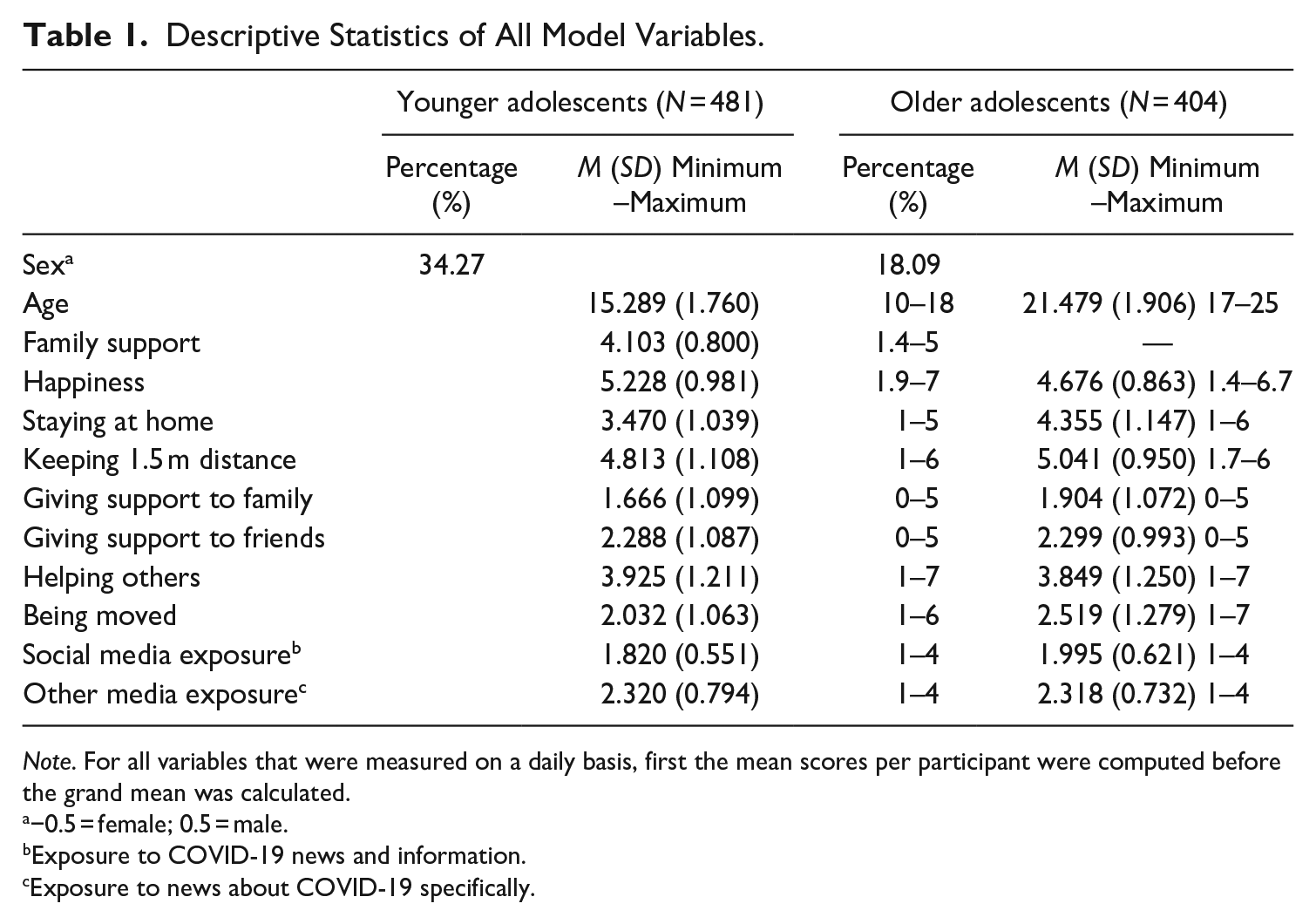
Note. For all variables that were measured on a daily basis, first the mean scores per participant were computed before the grand mean was calculated.
−0.5 = female; 0.5 = male.
Exposure to COVID-19 news and information.
Exposure to news about COVID-19 specifically.
The Relation Between Happiness and Prosocial Behavior
Findings from the LME models indicated that happiness and helping were associated. More specifically, helping others was found to predict happiness on the same day among younger adolescents (β = .05, t[2,509.61] = 2.59, p = .010) and older adolescents (β = .07, t[2,524.72] = 2.99, p = .003). Giving support to friends was also related to happiness among younger adolescents (β = .06, t[2,493.97] = 2.78, p = .006). However, giving support to family was not related to happiness among either younger or older adolescents. Staying at home was related to lower levels of happiness among both younger (β = −.05, t[2,515.39] = −2.25, p = .025) and older adolescents (β = −06, t[2,497.18] = −2.52, p = .012). Findings from the LME models are presented in Table 2. Data as well as the in- and output of all LME analyses are available on the Open Science Framework (https://osf.io/zvfcy/).
Findings of All the Linear Mixed Effects Models.
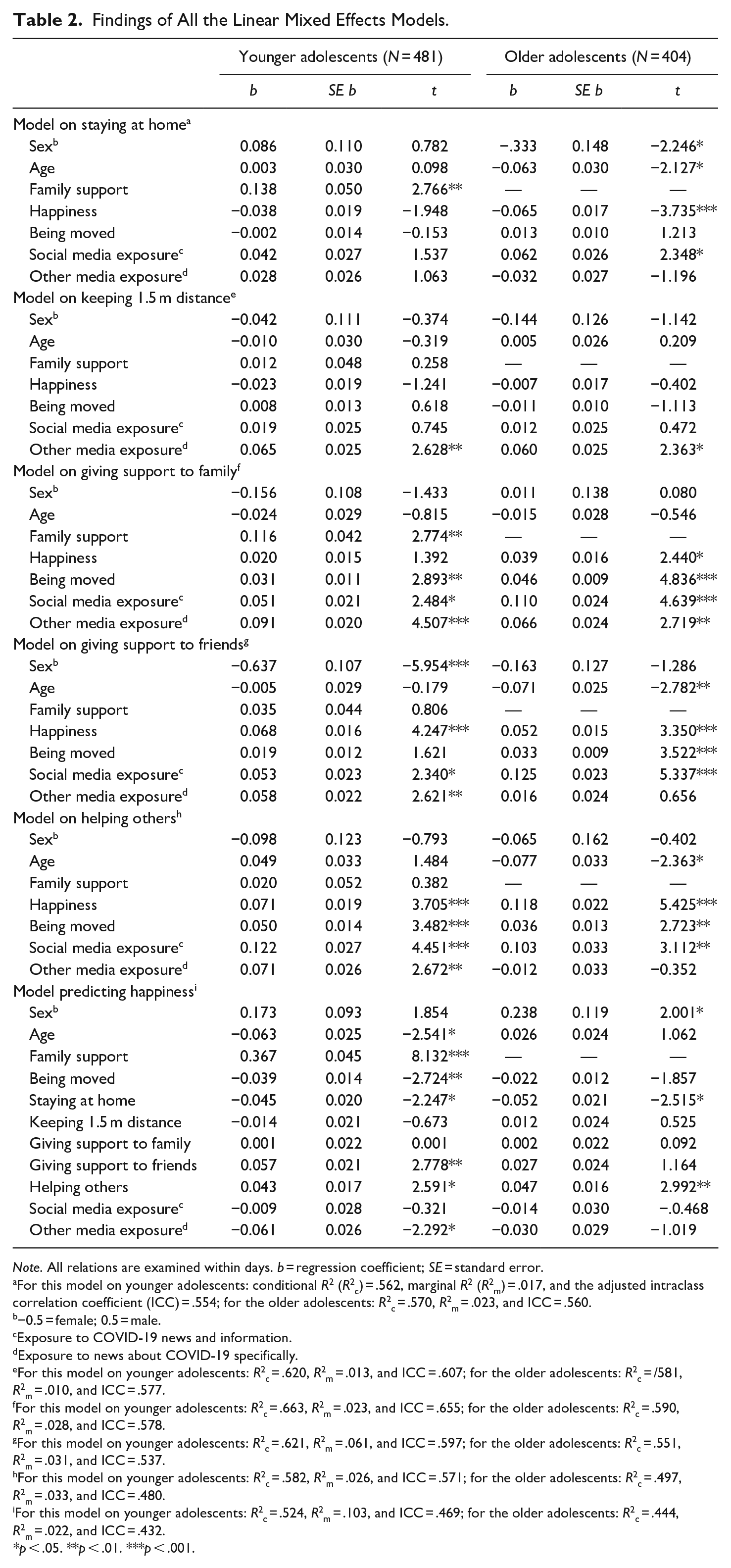
Note. All relations are examined within days. b = regression coefficient; SE = standard error.
For this model on younger adolescents: conditional R2 (R2c) = .562, marginal R2 (R2m) = .017, and the adjusted intraclass correlation coefficient (ICC) = .554; for the older adolescents: R2c = .570, R2m = .023, and ICC = .560.
−0.5 = female; 0.5 = male.
Exposure to COVID-19 news and information.
Exposure to news about COVID-19 specifically.
For this model on younger adolescents: R2c = .620, R2m = .013, and ICC = .607; for the older adolescents: R2c = /581, R2m = .010, and ICC = .577.
For this model on younger adolescents: R2c = .663, R2m = .023, and ICC = .655; for the older adolescents: R2c = .590, R2m = .028, and ICC = .578.
For this model on younger adolescents: R2c = .621, R2m = .061, and ICC = .597; for the older adolescents: R2c = .551, R2m = .031, and ICC = .537.
For this model on younger adolescents: R2c = .582, R2m = .026, and ICC = .571; for the older adolescents: R2c = .497, R2m = .033, and ICC = .480.
For this model on younger adolescents: R2c = .524, R2m = .103, and ICC = .469; for the older adolescents: R2c = .444, R2m = .022, and ICC = .432.
p < .05. **p < .01. ***p < .001.
The RI-CLPMs testing the bidirectional relations between happiness and prosocial behavior (H1 and H2) revealed no clear bidirectional relations between prosocial behaviors and happiness. Of the two physical distancing measures, only trying to stay at home was related to happiness the next day among younger (b = 0.12, p < .001) and older adolescents (b = 0.13, p < .001), indicating that trying to stay at home increased happiness the following day. Moreover, giving support to friends was related to happiness the next day among both younger (b = 0.13, p < .001) and older adolescents (b = 0.13, p < .001), indicating that supporting friends boosted feelings of happiness the following day. For helping others and happiness, none of the cross-lagged paths were significant. The stability paths for giving support to friends and family and for helping others were significant, indicating that these constructs were relatively stable over the days. To keep this article succinct, findings from these analyses are presented at the Open Science Framework (https://osf.io/e6zbc/).
The Relation Between Being Moved and Prosocial Behavior
Findings from the LME models on being moved by media stories as a predictor of prosocial behavior on the same day (H3) revealed that feelings of being moved were related to providing emotional support to family among both younger (β = .04, t[3,540.32] = 2.89, p = .004) and older adolescents (β = .07, t[3,174.55] = 4.84, p < .001), which is in line with H3b. Older adolescents also provided more emotional support to their friends when experiencing higher levels of being moved (β = .05, t[3,208.48] = 3.52, p < .001). In line with H3c, both younger (β = .05, t[3,632.80] = 3.48, p < .001) and older adolescents (β = .04, t[3,247.59] = 2.72, p = .007) with higher levels of being moved were more likely to help others during the COVID-pandemic. However, in contrast to H3a, feelings of being moved did not predict whether adolescents tried to stay home or tried to keep 1.5 m distance.
The causal mediation analyses testing whether being moved led to prosocial behavior and subsequently to happiness yielded a small indirect effect of being moved by media on happiness via helping others (b = 0.003, p < .001 for younger adolescents and b = 0.004, p < .001), indicating that feelings of being moved upon stories in the media led to helping others, which subsequently led to increased happiness (H3). This was not found for supporting others. A complete report of these analyses can be found at the Open Science Framework (https://osf.io/e6zbc/).
The Relation Between Exposure to COVID-19 News and Prosocial Behavior
Overall, the findings from the LME models of exposure to COVID-19 news and information on prosocial behavior (H4) demonstrated that adolescents with a higher exposure to COVID-19 content are, indeed, more inclined to keep physical distance (H4a), provide emotional support to family and friends (H4b), and help others (H4c). Interestingly, the source was found to be related to different prosocial behaviors: Whereas exposure to COVID-19 content on social media appeared to help older adolescents try to stay at home (β = .04, t[3,180.80] = 2.35, p = .019), more traditional news media helped both younger and older adolescents keep 1.5 m distance (β = .05, t[2,799.85] = 2.63, p = .009 and β = .05, t[2,498.84] = 2.36, p = .018, respectively). However, among younger adolescents, exposure to content concerning COVID-19 on neither social media nor other media was related to staying at home. For providing support to family, exposure to COVID-19 content on both social media and other media appeared to be inspiring for younger (β = .03, t[3,447.91] = 2.48, p = .013 and β = .07, t[3,652.70] = 4.51, p < .001, respectively) and older adolescents (β = .08, t[3,158.89] = 4.64, p < .001 and β = .05, t[3,306.00] = 2.72, p = .007, respectively). For providing emotional support to friends, exposure to COVID-19 content on social media appeared to be inspiring for both younger (β = .03, t[3,503.69] = 2.34, p = .019) and older adolescents (β = .09, t[3,191.75] = 5.34, p < .001), while news in other media only inspired younger adolescents (β = .04, t[3,705.62] = 2.62, p = .009). For helping others, exposure to COVID-19 content on social media appeared to be inspiring for both younger adolescents (β = .07, t[3,532.54] = 4.45, p < .001) and older adolescents (β = .06, t[3,228.54] = 3.11, p = .002), while once again news from other media was only inspiring for younger adolescents (β = .05, t[3,727.08] = 2.67, p = .008).
Finally, concerning the covariates, it is important to highlight the findings on family support. In the model on trying to stay at home, among younger adolescents, family support was the only significant predictor (β = .08, t[1,244.06] = 2.77, p = .006), indicating that adolescents who feel close to their family were more likely to stay at home. Moreover, family support predicted how much emotional support younger adolescents provided to their family (β = .07, t[1,945.48] = 2.77, p = .006), indicating that adolescents who feel loved are also loving toward their family. Higher levels of family support were related to increased feelings of happiness as well (β = .24, t[882.06] = 8.15, p < .001).
Qualitative Analyses: Portrayals That Led to Feelings of Being Moved and What Participants Did to Help Others
To examine what media content led to feelings of being moved and what type of prosocial acts the participants displayed (RQ1), the answers to the open questions were coded. Findings concerning the question “What exactly moved you?” indicated that portrayals of the character strengths love, kindness, hope, and bravery were most often mentioned. The following is an example of a story about the strength love: “A video of a girl with cancer being able to hug her dad for the first time again since he did not have to go to work anymore so he would not risk his daughter’s health when hugging her.” Concerning kindness, several participants described the story of Captain Tom, who raised millions of dollars for health care workers. Hopeful stories included news about the bright side of the lockdown measures for nature and news about the decreasing number of new infections and deaths, but also included remarkable stories, such as the 113-year-old woman who became the oldest person to recover from COVID-19. A couple of older adolescents even indicated that they knowingly followed pages on social media that posted stories about the bright side of the pandemic. Stories portraying bravery were often about the frontline workers. In addition to the character strengths defined by Peterson and Seligman (2004), participants also indicated that they were moved by portrayals of cuteness, while 33.83% of the feelings of being moved came from stories with a negative valence. Finally, the analyses of the open-ended question “What did you exactly do [to help others]?” indicated that the participants most often helped and supported close others, but volunteered, shared, and donated as well. Findings from these analyses are presented in Tables 3 and 4.
Portrayals That Led to Feelings of Being Moved.
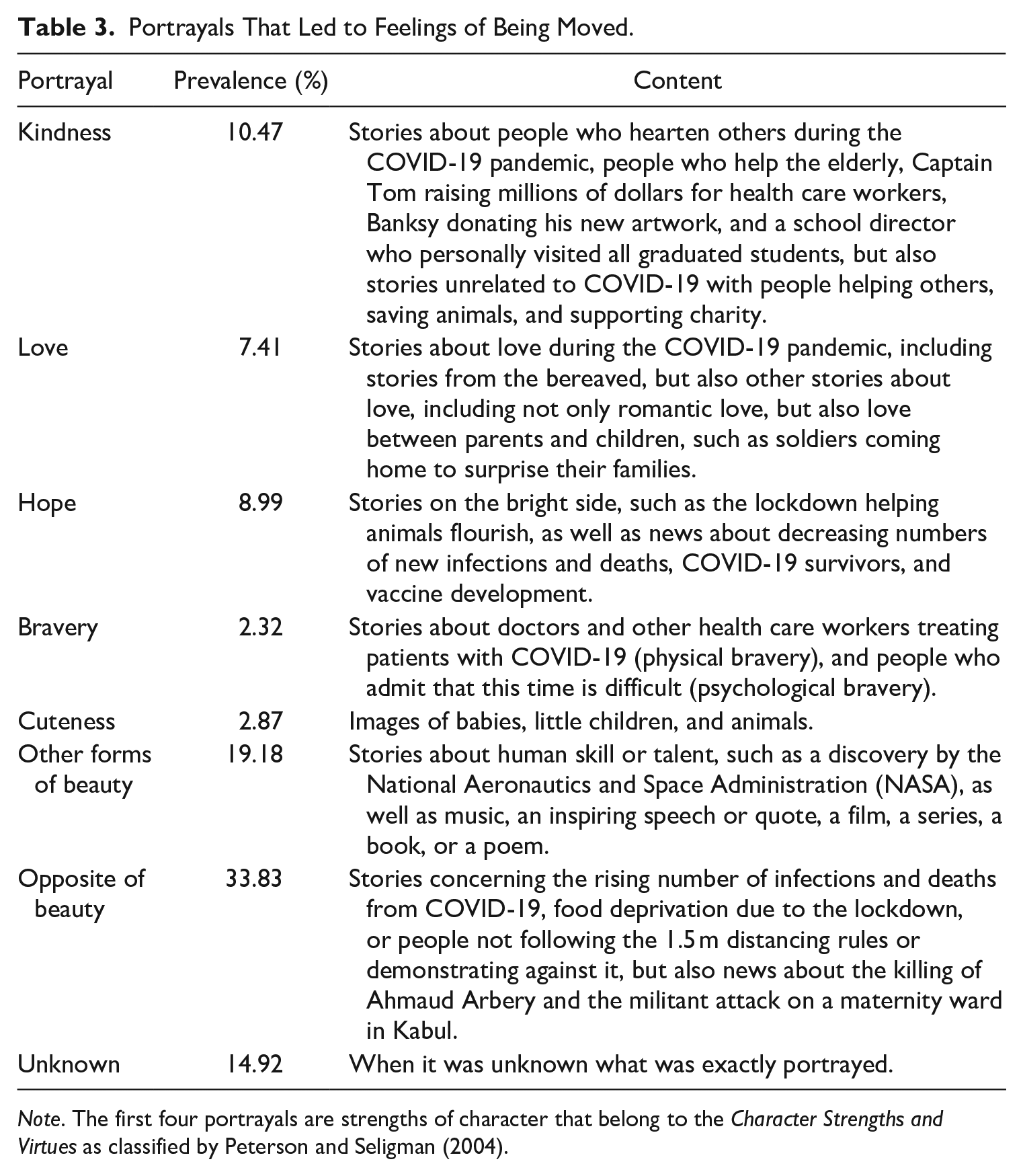
Note. The first four portrayals are strengths of character that belong to the Character Strengths and Virtues as classified by Peterson and Seligman (2004).
What Adolescents Did to Help Others during the COVID-19 Pandemic.
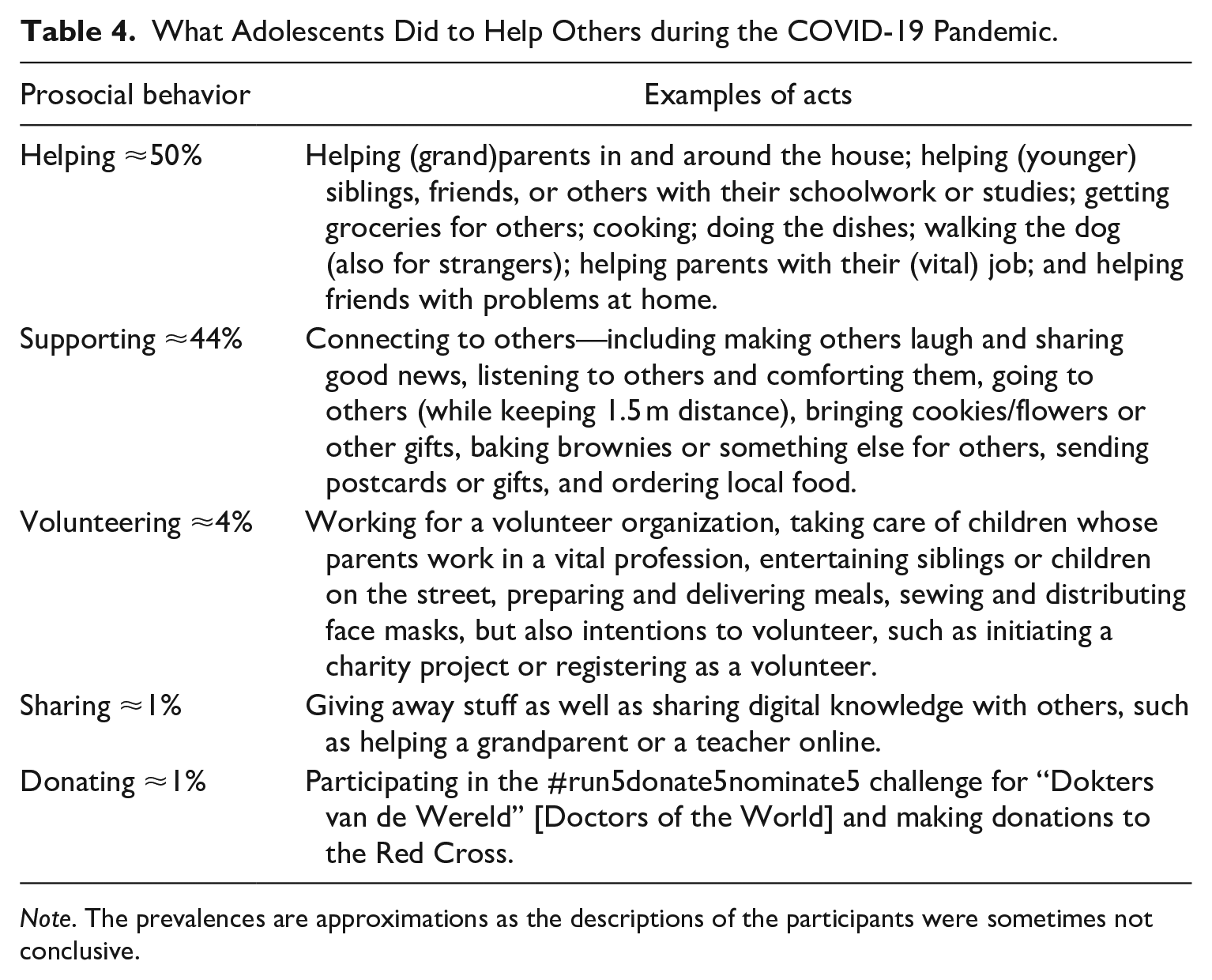
Note. The prevalences are approximations as the descriptions of the participants were sometimes not conclusive.
Discussion
This study paints an optimistic picture of young people during the COVID-19 pandemic and the consequences of what they saw in the media. The findings reveal that young people made positive contributions to society by often helping others. Stories in the media—about COVID-19 in general, but also stories portraying moral beauty—inspired them to do so. The study builds upon previous theoretical insights by demonstrating that the relation between feelings of being moved upon witnessing moral beauty and altruistic behaviors exists outside the lab (Pohling & Diessner, 2016; Schnall et al., 2010; Thomson & Siegel, 2017; Van de Vyver & Abrams, 2015), among adolescents in a real-world crisis.
Reflection on a Positive Media Psychology Perspective on Adolescents During a Crisis
The integrated theoretical perspective of this study helped to illuminate how stories in the media can inspire prosocial behaviors in adolescents during times of crisis. Our findings indicate that exposure to crisis-related news and information can inspire adolescents to support and help others, not only by making them knowledgeable about what is going on in the world (de Vreese & Boomgaarden, 2006; Livingstone & Markham, 2008), but also by bringing them moral beauty. Previous findings have indicated that—in line with the broaden-and-build theory—witnessing acts of moral beauty can open one’s heart to others, which can in turn spark a desire to do good (Pohling & Diessner, 2016). Insights from the present study add to this knowledge that already in adolescence, portrayals of moral beauty can lead to feelings of being moved and a desire to do good. Although the effect sizes were small, these findings are promising given the high media exposure of young people (Common Sense Media, 2020; Noel, 2020). In addition to providing a developmental perspective on experiencing moral beauty, our study expands knowledge to the stories that inspire prosocial behavior and refines the notion on the complex relation between happiness and prosocial behaviors: Happiness is related to prosocial behavior, but prosocial behavior does not always lead to more happiness, nor does increased happiness always lead to more prosocial behavior.
A developmental perspective on being moved by moral beauty
Feelings of being moved upon witnessing moral beauty in the media appeared to be rather uncommon, especially among younger adolescents. This indicates that being moved by moral beauty becomes more prominent when growing older. During adolescence, developmental changes occur in the social brain network, including the medial prefrontal cortex (mPFC; Crone & Dahl, 2012; Crone & Fuligni, 2020; Dahl et al., 2018). The mPFC is an important zone in which cognition, social processing, and affect become integrated (Crone & Fuligni, 2020). For experiencing moral beauty, the mPFC appears to be particularly important (Pohling & Diessner, 2016). A moral good deed may be cognitively experienced as good, but it can only be experienced as moral beauty when the viewer feels moved and uplifted (Diessner et al., 2008; Pohling & Diessner, 2016). Consequently, it could be that the young participants encountered moral beauty more often, but that they did not experience it as such. Altogether, these findings expand the knowledge on being moved by moral beauty in the media by demonstrating that the ability to experience this is already present in young adolescents. Moreover, our findings indicate that these feelings probably become more sophisticated during adolescence. A promising avenue for future research is to further examine the development of these feelings and to examine at what age emotions as moral elevation and kama muta start to emerge.
Feelings of being moved did not help the participants follow the physical distancing guidelines. It has been argued that elevation is “a calmer emotion which seems to increase openness and warmth toward others; it may not lead to immediate altruistic action when such action is difficult” (Algoe & Haidt, 2009, p. 24). Physical distancing is often difficult because it conflicts with our basic psychological need to belong (Baumeister & Leary, 1995; Ryan et al., 2008), which makes following the guidelines more demanding and not volitional (Weinstein & Ryan, 2010). The idea that feelings of being moved may lead to openness and warmth toward others who are near can also explain why these feelings were only related to supporting friends among the participating older adolescents as they more often live with friends whereas younger adolescents mostly live with their parents.
Insights in stories in the media that spark prosocial behavior
Findings from the qualitative analyses on the open-ended questions helped us to refine and expand the current state of knowledge on what portrayals can lead to feelings of being moved. Stories in the media that led to feelings of being moved and motivated to help were often about the character strengths love and kindness (Peterson & Seligman, 2004). Stories concerning love were often related to COVID-19, including stories from the bereaved. Stories about soldiers coming home to surprise their families were also mentioned, which is in line with previous work showing that feelings of being moved can emerge upon seeing people reuniting after a difficult separation (Zickfeld et al., 2019). The stories about kindness portrayed people who hearted others and helped others in need, but there were also other stories about helping others, saving animals, and supporting charity. Another often portrayed character strength was hope, which is a strength of the virtue transcendence (Peterson & Seligman, 2004). Portrayals of hope included stories on the bright side—such as a lockdown helping animals to flourish, and positive perspectives about the future. Previous findings indicated that hope is a positive emotion that can undo lingering negative emotions and build resiliency during crises (Fredrickson et al., 2003; Waters et al., 2022). This highlights the importance of pursuing the research on hope (Oliver, 2022; Prestin & Nabin, 2020), which is yet understudied in the positive media psychology field.
In addition to the character strengths defined by Peterson and Seligman (2004), participants also indicated being moved by images of cuteness. These findings are in line with recent work on the emotion kama muta, which can be evoked by cuteness (Knutsen Steinnes et al., 2019; Zickfeld et al., 2019). Findings of the present study expand insights by demonstrating that cute images are meaningful for adolescents, which makes cuteness, along with the emotion kama muta, worth it to further investigate among this age group.
Finally, there were also media images that led to feelings of being moved with a negative valence, which we labelled as the Opposite of beauty. In our participants, we recognized feelings of disgust, which is the antipode of experiencing moral beauty (Pohling & Diessner, 2016; Thomson & Siegel, 2017), but also feelings of righteous anger, which are feelings of outrage when witnessing injustice toward others (Pohling & Diessner, 2016; Van de Vyver & Abrams, 2015). Anger is associated with fairness and the protection of rights (Horberg et al., 2011). These findings contribute to the current insights that watching the opposite of moral beauty can be also meaningful. When George Floyd was killed a global movement was sparked, which indicates that anger can be “motivational fuel” to pursue human rights. For future theory development, it would be interesting to disentangle how different feelings of being moved can have unique effects on prosocial behavior.
Helping others can boost happiness
Findings from the LME models revealed that helping others was related to increased happiness at the end of the day. This contributes to the existing knowledge that turning to others can help not only adults (Dunn et al., 2008; Lyubomirsky et al., 2005; Sin et al., 2021; Snippe et al., 2017), but also younger adolescents to experience positive feelings despite hard times. These findings are also in line with the idea that engaging in meaningful activities is related to happiness (Baumeister et al., 2013; Ryan et al., 2008). From a self-determination theory perspective, it appears to be important that behaviors are volitional (Weinstein & Ryan, 2010), and the analyses of open answers implied that many of the prosocial behaviors were indeed initiated by the adolescents themselves. Our findings also contribute to the current knowledge that stories in the media can inspire to help others, which subsequently leads to increased happiness.
However, findings from the RI-CLPMs indicated that helping others did not change happiness the next day, which indicates that the effect of helping is short-lived. Giving support was not related to increased happiness in the LME models, only supporting friends was related to happiness on the same day among younger adolescents. Findings from the RI-CLPMs indicated that supporting friends boosted feelings of happiness the following day among both younger and older adolescents, but these patterns were not consistent over time. Findings from both the LME models and RI-CLPMs indicated that giving support to family did not boost happiness. An explanation for why giving support hardly led to increased happiness could be that listening to others and comforting them do not make us happy out of feelings of empathy. Supporting friends could be an exception because supporting can be a two-way street: when giving support to friends, young people feel connected with them, which is important given the developmental stage they are in (Crone & Dahl, 2012; Dahl et al., 2018). In sum, our findings nuance the current insights by indicating that prosocial behavior can indeed lead to happiness, but that this depends on the situation. For instance, when helping or supporting others is fun, it can lead to happy feelings, but when helping or listening to a beloved one with problems, it will not lead to happiness.
Lastly, a third variable, such as gratitude, could explain both the higher levels of happiness and prosocial behavior (Jiang, 2022; Peterson & Seligman, 2004). Higher levels of gratitude are found to be related to higher levels of positive emotions, life satisfaction, and helping and supporting others. It is conceivable that grateful participants were both happier, and more supporting of and helpful to others in need. Another character strength that is relevant for this study is engagement with beauty (Diessner et al., 2013; Thomson & Siegel, 2017). Engagement with beauty involves the regularly and often intense appreciation of moral beauty, which has also been described as “trait-elevation” (Diessner et al., 2008, 2013). Engagement with moral beauty is strongly related to love of all humanity and empathy (Pohling & Diessner, 2016). It is conceivable that the participants who scored higher on engagement with beauty were not only more inclined to help others, but also more likely to see the beauty around them as well as in the media.
Strengths, limitations, and more future challenges
The strengths of this study are the integration of various theoretical perspectives and the daily diary design, which allowed the extension of knowledge on positive media psychology outside the lab and to younger people. However, there are important points to keep in mind when interpreting the findings. The present study was conducted at the relative start of the pandemic. At the onset of a disaster, strong feelings of connectedness and altruism are often experienced, and this phase is known as the “honeymoon period” (Mirabito, 2017). However, after this phase, the disillusion phase starts, in which the reality of the damage must be faced and resolved. The question is, therefore, whether the current findings also apply during later phases of a disaster. Another important point is our limited way of examining the experience of moral beauty. Although feeling moved is a key component of both moral elevation (Pohling & Diessner, 2016; Thomson & Siegel, 2017) and kama muta (Zickfeld et al., 2019), other responses characterize the emotional experience as well. For future research, it is important to include all physiological and psychological reactions that capture the experience, like moist eyes or tears and having a lump in the throat.
In hindsight, our measure to assess momentary happiness—at the end of the day—is particularly appropriate as an outcome of prosocial behavior during that day, but not as a predictor of prosocial behavior on that day. Therefore, we were able to demonstrate that “do good, feel good” applies to young people. However, to better understand whether “feel good, do good” also applies to them and even set into motion an upward spiral of kindness and happiness (Layous et al., 2017), more research is needed. Another shortcoming is that we were not able to shed light on what COVID-19 news and information our participants were exposed to. Given the prevalence of fake news on social media, it is likely that our participants were also exposed to messages that were not prosocial in nature—or even call for rebelling against the COVID-19 measures.
Another important point is that the sample was not representative. Most participants in this study were female and highly educated. Related to this, it is important to keep in mind that not all young people are able give support or help. For many, the COVID-19 pandemic brought problems, such as the death of a loved one, financial stress, and severe challenges concerning school (Noel, 2020). In such situations, being an adolescent can backfire, especially when emotions can be experienced as more intense (Crone & Dahl, 2012; Crone & Fuligni, 2020; Dahl et al., 2018). In other words, adolescence is a phase of opportunity, but also a life phase characterized by a host of vulnerabilities and risks.
A promising step for future research is to conduct an intervention study in which adolescents are challenged to do acts of kindness (Nelson et al., 2016), combined with encouraging them to engage with beauty (Pohling & Diessner, 2016). Given that adolescents experienced a decrease in opportunities to help others during the COVID-19 pandemic (van de Groep et al., 2020), we think it is important that governments include young people in their strategies to control societal challenges. Intervention strategies that match developmental changes (Dahl et al., 2018) will be a win–win situation for both young people and those around them. We hope that our findings are helpful for governments, policy advisors, youth welfare organizations, and parents when preparing for other pandemic and disaster situations.
Key Takeaways
The key takeaways of this study are that stories in the media inspired adolescents to help others during the COVID-19 outbreak, and that this helping led to increased happiness. Not only exposure to COVID-19 news and information inspired them, but also stories that led to feelings of being moved. Compared to younger adolescents, feelings of being moved were more prevalent among older adolescents, which could be explained by brain maturation with older adolescents being more capable of experiencing good deeds as moral beauty. Altogether, the findings indicate that when bad things happen, a meaningful lifestyle can be stirred (Baumeister et al., 2013), in which young people are inspired to put their strengths of love and kindness into action. To illustrate this with a quote from a participant: “This is a good time to get along with ourselves, we can have better ideas about what we want or not, I appreciate it very much, and for us to know what our strengths are. [. . .] A great and rare challenge for us all, treasure it.”
Footnotes
Acknowledgements
We would like to thank the participating schools and all participants for contributing to this study.
Declaration of Conflicting Interests
The authors declared no potential conflicts of interest with respect to the research, authorship, and/or publication of this article.
Funding
The authors disclosed receipt of the following financial support for the research, authorship, and/or publication of this article: This study is part of a project that has been funded by the NWO Spinoza Prize awarded to Prof. Dr. Eveline A. Crone.
