




Abstract
Racial microaggressions are a significant source of stress for people of color. This study identified two support message features for disarming the effects of racial microaggressions and tested reasons for their effectiveness. In a between-groups design, Black/African Americans (n = 387), and Asian Americans (n = 374) evaluated a support message crafted by a friend in response to one of six racial microaggressions. Participants perceived high person-centered, racial identity-affirming, and combination support messages as more effective and collective self-esteem enhancing than low quality message versions. Person-centered emotional support and combination messages were partly related to enhanced collective self-esteem through cognitive reappraisal and reattribution, while racial identity affirmation message quality was partly related to enhanced collective self-esteem through reattribution. Conditional process analyses determined that indirect effects were not contingent on participants’ race. Practical and theoretical implications of studying support messages to address racial microaggressions are discussed.
Keywords
In the year 2020, along with the COVID-19 pandemic the United States witnessed increasing hatred and racism toward communities of color. The killing of George Floyd, Ahmaud Arbery, Breonna Taylor, and the anti-Asian sentiments sparked by COVID-19 exacerbated racial tensions in the United States (Lee & Waters, 2021). Since the COVID-19 outbreak a Pew Research survey has found that Asian Americans and Black/African Americans are more likely than other racial groups to report negative interactions because of their race or ethnicity (Ruiz et al., 2020). People of color frequently encounter covert forms of racism or “racial microaggressions” that negatively affect their overall well-being (Sue, 2010; Wong et al., 2014). Racial microaggressions are “brief and commonplace daily verbal, behavioral, or environmental indignities, whether intentional or unintentional, that communicate hostile, derogatory, or negative racial slights and insults toward people of color” (Sue et al., 2007, p. 271). Eliminating racial microaggressions requires efforts to tackle systemic racism as well as effective communication practices to support targets of microaggressions. Sue et al. (2019) have identified interventions for racial microaggressions at the individual, institutional, and societal levels, like challenging stereotypes with offenders and calling out institutional inequities.
Interpersonal communication scholars have also begun to explicate specific types of support relevant for recipients of racial microaggressions in interpersonal encounters (Davis, 2019; Davis & Afifi, 2019; Harris et al., 2019). To build upon this literature, we focus on how Black/African Americans and Asian Americans evaluate support messages from their friends who intend to provide effective support for coping with racial microaggressions. We contend that disarming the effects of racial microaggressions involves addressing two threats, recipients’ emotional distress and the attack on their racial identity, both of which may implicitly threaten their collective self-esteem, or the self-worth that emanates from one’s racial group or identity (Crocker et al., 1994). Consistent with these two threats, we theorize that the quality of person-centered emotional support, racial identity affirmation, and messages that combine these message types are positively related to enhanced collective self-esteem. Furthermore, we expect that relationships between these support message types, and collective self-esteem are indirectly accounted for by the social cognitive processes of reappraisal or ways people make sense of stressful events and the cognitive process of reattribution, or people’s reasoning about the causes of problematic events. Our findings advance the study of supportive communication by identifying relevant message features that can support individuals experiencing racial microaggressions.
Racial Microaggressions and Their Impact
Black/African Americans and Asian Americans regularly experience microaggressions that express stereotypes and prejudice. In their interviews Sue et al. (2008, 2009) have found that both groups experience similar microaggressions, including instances when offenders question whether African and Asian Americans are foreigners or acceptable Americans, or when intellectual inferiority or superiority is linked to race, that Black and Asian communication styles are abnormal, or that all Asian Americans or Black/African Americans are the same. Other Black/African American microaggressions include making assumptions about athletic ability or criminality, ignoring, or excluding African Americans, or devaluing African American appearance with Eurocentric beauty standards (Gadson & Lewis, 2022; Harris et al., 2019). Other Asian microaggressions include hyper-sexualizing Asian women, stereotyping Asian men as weak and asexual, or avoiding both Asian men and women in the context of COVID-19 (Endo, 2015; Wang et al., 2011).
Researchers have categorized these microaggressions into several typologies (Feagin, 1991; Harris et al., 2019; Sue, 2010). Overall, racial microaggressions are considered a type of speech act that expresses a permissibility to maintain the dominance of a privileged racial group over a marginalized racial group, with an illocutionary force that casts group members as inferior based upon their race (Graumann & Wintermantel, 1989). Using this conception and prior findings three types of microaggressions surface: exclusion, derogation, and categorization (Feagin, 1991; Sue, 2010). Exclusion conveys an unwillingness to engage in physical and social contact with people of color. Derogation expresses the superiority of privileged group members over members of discriminated groups. Categorization expresses stereotypical assumptions about a person’s race. Examples of these types of microaggressions are in the Supplemental Materials.
Numerous studies have documented the negative effects of microaggressions. A narrative review of studies published between 2002 and 2020 found that racial microaggressions are associated with recipients’ stress, anxiety, low self-esteem, depressive symptoms, and suicidal ideation (Spanierman et al., 2021). A meta-analysis of 72 studies (Lui & Quezada, 2019) found that racial microaggressions are positively correlated with stress and negative emotions (r = .175). Studies have also documented the negative impact of racial microaggressions and discrimination on a person’s collective self-esteem, both for Asian Americans and Black/African Americans (Branscombe et al., 1999; Thai et al., 2017). Taken together, the findings suggest that racial microaggressions evoke two tasks for social support: legitimizing the recipient’s feelings and perspective to alleviate emotional distress and affirming the recipient’s racial identity to enhance their collective self-esteem. We next review research that has examined the role of friends in providing support to address racial microaggressions.
Friendship Support for Coping With Racial Microaggressions
Friendships represent an important source of social support that help individuals make sense of and cope with experiences of racial discrimination and microaggressions (Ayres & Leaper, 2013; Davis & High, 2019). A few studies have identified specific types of support messages that friends provide to address racial discrimination. Ayres and Leaper (2013) interviewed California adolescent girls about their discrimination experiences and found that helpful support from friends shared similar stories, provided emotional reassurance, discussed discrimination, and derogated the offender. Davis (2019; Davis & Afifi, 2019) studied social support among Black women’s friendship groups and found that coping with microaggressions included various levels of person-centered communication, efforts to highlight the support-seeker’s strengths, and discussion about ways to address racial injustice for all Black women. Harris et al. (2019) found that students of color cope with racial microaggressions by ignoring the microaggression, using spirituality to understand the microaggression, or seeking support from family and same-race friends. Friendship characteristics such as relational closeness (Holmstrom et al., 2015), sex and gender (Holmstrom, 2009) and cultural/racial identities (Samter & Burleson, 2005) can also affect the evaluation of support messages; Davis and High (2019) have found that women expect and receive more support from friends of the same race compared to friends of a different race. These studies provide insight into the types of support behaviors that are frequently provided in the context of racial microaggressions. Using these studies, we next describe the types of support messages that we expect are associated with the distinct tasks needed to address racial microaggressions and help enhance recipients’ collective self-esteem.
Racial Microaggressions and Collective Self-Esteem
Our theorizing is focused on understanding support seekers’ collective self-esteem in the context of racial microaggressions. We pose that support messages can facilitate coping with racial microaggressions when they validate a support seeker’s perspective, alleviate emotional distress, and affirm the seeker’s identities in ways that enhance the support seeker’s collective self-esteem. Messages can vary in how they enhance collective self-esteem or the positive self-worth derived from the one’s racial group (Crocker et al., 1994). Since microaggressions may also threaten state self-esteem, the cognitive-emotional theory of esteem support messages is also a relevant framework (Holmstrom & Burleson, 2011). However, Crocker and her colleagues have distinguished personal self-esteem from collective self-esteem (Crocker et al., 1994; Fischer & Holz, 2007). Both types of self-concept and self-esteem are moderately related, but their distinctiveness becomes relevant when identity threats are focused on marginalized social identities. Microaggression experiences are related to both personal and collective self-esteem, but perceived interpersonal racism is not always related to personal self-esteem once collective self-esteem is accounted for, which suggests that “collective self-esteem may lessen the negative impact of perceived racism on individual self-esteem” (Tawa et al., 2012, p. 355; Thai et al., 2017).
Racial microaggressions are a reminder of the historical and ongoing subjugation of one’s racial group which can impact one’s collective self-esteem (Branscombe et al., 1999; Sue et al., 2019; Thai et al., 2017; Wang et al., 2011). Microaggressions may involve some level of ambiguity that can be strategically used by offenders to deny any association with racial prejudice, which can lead people of color to feel conflicted about the incident and question the validity of their own perspective (Sue, 2010).
Person-Centered Emotional Support for Coping With Racial Microaggressions
Interpersonal communication researchers have accumulated substantial evidence that effective emotional support is associated with less emotional distress and increased coping (Burleson, 2003b; MacGeorge et al., 2011). One feature of effective emotional support messages is verbal person-centeredness, a communication quality that legitimizes and explicates individual perspectives and emotional states (Applegate & Delia, 1980; Burleson, 1982). Consisting of three levels, low person-centered messages condemn or deny people’s feelings, dismiss perspectives, or tell others how they should act or feel. Moderate person-centered support messages implicitly recognize people’s feelings such as by diverting attention, expressing conventional responses, or providing non-feeling centered explanations of the situation. High person-centered messages explicitly acknowledge, legitimize, and explicate the person’s feelings in a wider context.
Employing experimental, survey and longitudinal designs, communication researchers have documented that emotional support messages high in person-centeredness are often perceived to be more sensitive and effective than low person-centered messages (High & Solomon, 2016; MacGeorge et al., 2011; for a meta-analysis see High & Dillard, 2012). Person-centered support is particularly relevant for addressing racial microaggressions because recipients are likely to be distressed yet uncertain if they have misinterpreted the situation or not know how to respond. Sue et al. (2019) assert that effective support should validate recipients’ perspectives and affirm their personal identities. Since highly person-centered emotional support messages legitimize and explicate the recipient’s perspective, we expect that participants will evaluate these messages higher than low person-centered support messages with respect to general message effectiveness, (i.e., conceived as the message being helpful, supportive, appropriate, and effective; Bodie et al., 2012; Goldsmith et al., 2000). Given that emotional support by community members is related to higher collective self-esteem (Nguyen, 2017), we also expect that highly person-centered emotional support compared to lower message equivalents are positively related to recipients’ collective self-esteem. In the context of racial microaggressions we expect:
H1: High person-centered emotional support messages compared to low person-centered emotional support messages are perceived by support recipients as higher in (a) general message effectiveness and (b) enhanced collective self-esteem.
Racial Identity Affirmation for Coping With Racial Microaggressions
Racial identity affirmation is also believed to be important for coping with racial microaggressions (Sue et al., 2019). Davis’ (2019) work with Black women has identified that the enhancement of collective self-esteem is an important support outcome, and collective identity appeals have been found to enhance collective self-esteem (Marmarosh & Corazzini, 1997). We expect that racial identity affirmation helps recipients uphold a positive view of their racial identity despite experiencing an identity-threatening microaggression. Three interconnected features of racial identity affirmation messages are likely associated with collective self-esteem: affirming important attributes or value of the racial identity in question, altercasting the support seeker as a positive embodiment of that racial identity and rejecting and recasting the offender’s behavior.
Various studies have shown that identity affirmation practices can buffer identity threats and enhance collective self-esteem. Using social affirmation theory, Sherman and colleagues (Sherman et al., 2007; Steele, 1988) have found that when one’s social identity is threatened, affirming important values of that identity can buffer the effects of identity threats. The socialization literature further documents that parenting practices which emphasize cultural history, heritage, and reasons for group pride are positively associated with children’s ethnic identity (Hughes et al., 2006). Together these lines of research suggest that a first feature of racial identity affirmation is to articulate important attributes or values of the racial identity in question. Racial identity affirmation includes acclaiming the achievements and virtues of the racial group and emphasizing a consensus about the group’s achievements.
A second feature of racial identity affirmation is to altercast the support recipient as a valuable member of the racial group (Weinstein, 1966). Racial identity affirmation acknowledges and endorses the talents and abilities of the support recipient as a proud member of the racial group and celebrates positive aspects of the racial identity. Such identity affirming practices enable recipients to refute attributions created by the offender’s microaggression; that the support recipient’s behavior is defective, caused by the nature of the recipient and unlikely to change. Thus, a third feature of racial identity affirmation is to address the attributions created by the offender’s microaggression.
Racial identity affirmation messages may vary in embracing all three features: affirming important values of one’s racial group, altercasting the support recipient as a valued member of the group and rejecting invalid attributions in the microaggression. Messages high in racial identity affirmation likely address multiple aspects of all three features, while low racial identity affirmation addresses fewer features and causal attributions. Messages that address all three features are most likely to be viewed as more generally effective and associated with higher collective self-esteem. Therefore, for addressing racial microaggressions we hypothesized:
H2: High racial identity affirmation messages compared to low racial identity affirmation messages are perceived by support recipients as higher in (a) general message effectiveness and (b) enhanced collective self-esteem.
Communication scholars also recognize that different types of social support are combined and integrated within and across messages (e.g., Feng, 2014). Behavioral complexity theory (O’Keefe & Delia, 1982) contends that effective messages address multiple interaction goals relevant in the communication situation. In addition to combining different features, effective support would also include a high-quality version of each message type. Therefore, we expect that combining high quality versions of both message types would constitute more effective support than combining low quality of both message types:
H3: Messages that combine high person-centered emotional support with racial identity affirmation compared to messages with low levels of the combined message types are perceived as higher in (a) general message effectiveness and (b) enhanced collective self-esteem.
Mediators of Support Messages for Enhancing Collective Self-esteem
The second aim of the study is to determine if the effects of support message quality on enhancing collective self-esteem are indirectly accounted for by cognitive reappraisal and reattribution. Appraisal theory (Lazarus, 1999) proposes that appraisals are people’s initial construals of an event, with emotional distress resulting from appraisals of events that are initially construed as harmful for oneself. Reappraisal is the cognitive activity of redefining initial construal to alter how the event is relevant to one’s well-being. Recipients engage in reappraisal as they interpret the situation and source of distress in ways that help them feel that their emotions are valid. Reattribution is the social cognitive process of reformulating causal attributions about a distressful event, with recipients determining whether the causes of the event are internal/external, stable, controllable, and global (Weiner, 1986).
Scholarship on the mediators of effective social support messages has found that cognitive reappraisal and reattribution each mediate the effects of support message quality on recipients’ emotional improvement (Crowley & High, 2019; Jones & Wirtz, 2006) and state self-esteem (Holmstrom & Kim, 2015). Jones and Wirtz (2006) tested the appraisal-based comforting model proposed by Burleson and Goldsmith (1998) and found that highly person-centered messages encouraged support seekers to verbalize their thoughts and emotions, which facilitated a cognitive reappraisal of the stressful event and led to emotional improvement. Holmstrom and Kim (2015) have also verified that reattribution and reappraisal mediate the effects of emotion message quality on state self-esteem, because “state self-esteem is a product of attributions and appraisals about esteem-relevant events” (Holmstrom & Burleson, 2011, p. 329). Similarly, in the case of racial microaggressions we posit that high quality person-centered and racial identity-affirming messages facilitate cognitive reappraisal and reattributions about discriminatory behaviors that lead to enhanced collective self-esteem.
Most racial microaggressions are ambiguous and offenders tend to deny associations of racism with them (Sue et al., 2019). Therefore, effective support to disarm the effects of racial microaggressions should facilitate a reappraisal of the situation in ways that validate the recipient’s experience and emotions. High quality messages also help support seekers attribute the microaggression to the offender’s ignorance and to feel more positively about their racial identity. Thus, in the context of racial microaggressions high person-centered emotional support and racial identity affirmation would also invite recipients to produce reattributions about the causes of the incident and the identities of participants that would, in turn, enhance collective self-esteem. Reattributions to address racial microaggressions reinforce that microaggressions can be attributed to causes that do not mar the recipient’s positive racial identity. Thus, both reappraisal and reattribution likely function as parallel mediators of the relationship between message quality and enhanced collective self-esteem. This conception is illustrated in Figure 1, with the following hypotheses pertaining to the context of racial microaggressions:
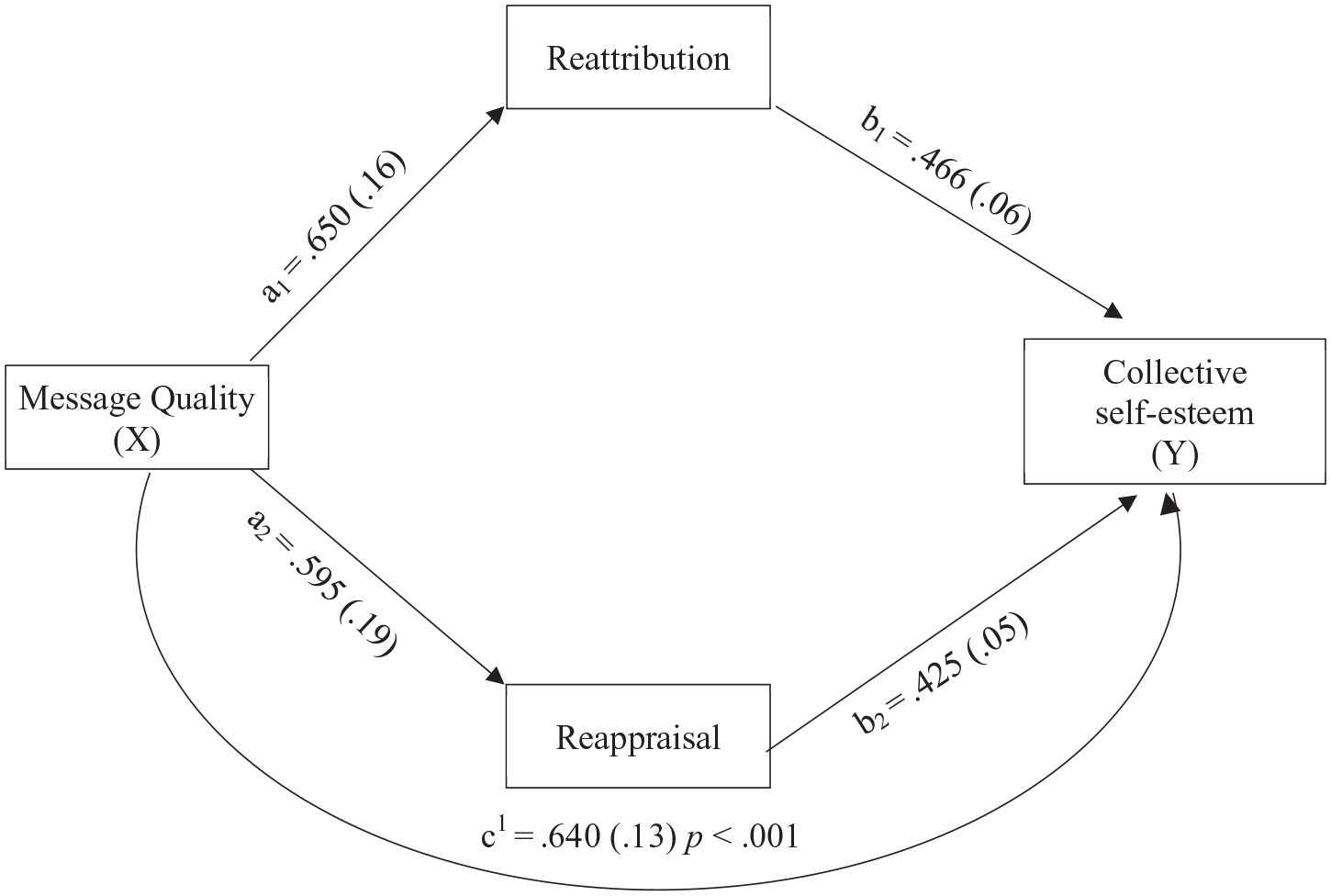
Mediation analyses of message quality on enhanced collective self-esteem through reappraisal and reattribution (combination message analysis is depicted)
H4: Person-centered emotional support message quality indirectly enhances collective self-esteem and general message effectiveness through cognitive (a) reappraisal and (b) reattribution.
H5: Racial identity affirmation message quality indirectly enhances
collective self-esteem and general message effectiveness through cognitive (a) reappraisal and (b) reattribution.
H6: The quality of combination-feature messages indirectly enhances
collective self-esteem and general message effectiveness through cognitive (a) reappraisal and (b) reattribution.
Finally, reviews of the supportive communication literature have found cultural differences in the value placed on emotional support, preference for certain types of support, and what goals are pursued in social support situations (Burleson, 2003a). For instance, Samter and colleagues (Samter et al., 1997) examined same-sex friendships and found that European Americans considered highly person-centered comforting messages to be more sensitive than did Asian Americans or Black/African Americans. Burleson and Mortenson (2003) also found that Chinese same-sex friends were more likely to pursue problem management goals in social support situations than North Americans who preferred to pursue emotion-focused goals. Chinese participants also viewed low person-centered messages to be more sensitive than high person-centered message, compared to North Americans. Together these studies suggest that Black/African Americans and Asian Americans may vary in their evaluations of support for coping with racial microaggressions. That is, participants’ racial identity may moderate the effects of support message quality on collective self-esteem through the proposed mediators of reappraisal and reattribution. To understand the role of racial identity on the proposed hypotheses we posed a final research question:
RQ1: Does participants’ racial identity moderate the quality of support message types on collective self-esteem through cognitive reappraisal and reattribution?
Method
Participants and Procedures
Participants were 761 adults (374 women, 387 men) recruited through the panel provider, Qualtrics.com, to complete an online questionnaire. Participants were members of a participant pool who complete research studies for monetary incentives. For this study participants were over 18 years of age, U.S. citizens and self-identified as either Asian American (n = 374) or Black/African American (n = 387). The final sample consisted of individuals who passed two attention filter checks. We also eliminated 24 participants who completed the survey in less than 5 min; the average completion time for the final sample was 26 min. Participants ranged from 18 to 80 years of age: 34.0% (n = 259) were 18 to 29 years, 28.1% (n = 214) were 30 to 49 years, 32.7% (n = 249) were 50-69 years and 5.1% (n = 39) were 70 years or older. Participants also ranged in education level: 33.6% (n = 256) of the participants had a high school degree or less, 51.7% (n = 394) had an associate or bachelor’s degree, and 14.6% (n = 111) had completed a graduate degree. Nearly half of the participants had never married (47.0%, n = 356), with others married (37.5%, n = 285), cohabitating (3.5%, n = 27), or widowed, separated, or divorced (12.0%, n = 91).
After reporting their demographic information participants were randomly assigned to read one of six racial microaggression scenarios. Participants were cast as the target of the discriminatory behaviors described in the scenario, which they had described to a friend. Then they read a message expressed by the friend whose picture was included with the message. Photographs were randomized for race and matched for gender based on the participants’ self-identified gender. Participants evaluated the scenario and the message.
Study Design and Development of Stimuli
The study employed a 3 × 2 × 3 × 2 between-groups experiment to examine four factors: the type of racial microaggression scenario (avoidance, derogation, categorization), situations for each scenario type (two instances), message type (person-centered emotional support, racial identity affirmation, combination of message types) and message quality (high, low). We developed scenarios for three types of racial microaggressions and two situations for each scenario type. Given stereotypes about the two racial groups, different categorization scenarios were created for Black/African American and Asian American participants.
Six microaggression scenarios were developed using prior research (Sue, 2010; Sue et al., 2008, 2009) and examples from a pre-study (open-ended questionnaire) involving Black/African American (n = 10) and Asian American (n = 14) participants. Messages were then created for the microaggression scenarios, which were subsequently pre-tested with a convenience sample who evaluated the realism and wording of each scenario and message. From their responses we developed final versions of the messages used in the study.
In the primary study participants were randomly assigned to read one of the microaggression scenarios and imagine they were the target of the microaggression incident. After evaluating the scenario, participants were randomly assigned to evaluate one of 48 support messages that responded to the microaggression scenario. The messages were of similar length (100–112 words) and represented high- and low-quality levels of the three support message types: person-centeredness, racial identity affirmation, and a combination of these two message types. Messages high in person-centered support explicitly legitimized the recipient’s perspective and feelings by recognizing, explaining and/or helping the recipient to see their feelings in relation to a broader context. Low person-centered messages ignored, challenged, or condemned the other person’s feelings. Messages high in racial identity affirmation ascribed value to the recipient’s racial identity and reasoned that the discrimination is a specific, transient, external, and controllable problem. Low racial identity affirmation messages did not express special value for the recipient’s racial identity and cast discrimination as either an uncontrollable, obdurate, or internal problem. Combination messages integrated high- and low-quality features of person-centeredness and racial identity affirmation.
Measures
Participants assessed features of the scenarios and message types, followed by assessments of general message effectiveness, collective self-esteem, cognitive reappraisal, and cognitive reattribution. Except for message effectiveness participants completed items on 7-point Likert scales (1 = strongly disagree; 7 = strongly agree).
The realism of the discrimination scenarios and support messages was measured with three and two items each that have been used in previous research (e.g., “This scenario/message is believable,” Feng & Burleson, 2008). Responses were averaged to form measures of scenario realism (α = .92) and message realism (Spearman-Brown coefficient = .72). Two averaged items also measured the degree that “the scenario was upsetting,” which were averaged (Spearman-Brown coefficient = .80). Manipulation checks assessed person-centeredness with four averaged items (Jones & Wirtz, 2006; e.g., “The message validated my feelings”; α = .93). Racial identity affirmation was assessed with three averaged items (Cissna & Sieburg, 1981; Crocker et al., 1998; e.g., “This message addressed what I was thinking about my racial/ethnic group by making me ‘feel that I am a respected member of my racial group’”; α = .89). Combination messages were assessed with the averaged items that assessed person-centeredness and racial identity affirmation.
Participants next assessed outcomes and mediators of the support message. Collective self-esteem was measured with five averaged items adapted from Luhtanen and Crocker’s (1992) measure (e.g., “This message would make me feel proud about belonging to my racial/ethnic group”; “This message would make me feel good about the race/ethnicity I belong to”; α = .93). General message effectiveness was measured with four 7-point semantic differential scales adapted from Bodie et al. (2012; Goldsmith et al., 2000): unhelpful-helpful, unsupportive-supportive, inappropriate-appropriate, and ineffective-effective. Responses were averaged (α = .95). Cognitive reappraisal assessed the extent the support message brought about a positive reappraisal of the situation with three averaged items from Jones and Wirtz (2006; e.g., “This message made me re-evaluate how I feel about the incident”; α = .93). Cognitive reattribution was assessed with four averaged items adapted from Holmstrom and Kim’s (2015) approach (e.g., “This message made me think that I was not the cause of this problem”; α = .78). A measurement model specified the mediators and outcomes (reappraisal, reattribution, message effectiveness, collective self-esteem; descriptive statistics are in Table S1 Supplemental Materials), and assessed its fit with a confirmatory factor analysis using a comparative fit index (CFI) of approximately .95 and a root mean square error of approximation (RMSEA) of .06 (Hu & Bentler, 1999). The model fit was appropriate, χ2 (95) = 390.95, n = 761, p < .001, CFI = .975, RMSEA = .064 (90% CI = .058, .071), after correlating error terms involving two self-esteem items.
Finally, several variables served as covariates in the study. Scenario severity was measured with four items averaged from Holmstrom’s (2012) scale to assess the extent participants found the scenario problematic (e.g., “upsetting,”; α = .90, M = 4.42, SD = 1.57). Support provider-recipient race matching was a categorical variable that indicated whether the participant read a support message from a photograph of a similar or different race person. Ethnic identification was measured with Phinney’s (1992) ethnic identity scale, with its 12 items averaged (α = .91, M = 2.24, SD = .462). Biological sex was a final covariate in the study.
Analysis Plan
Our analyses proceeded in three stages. We conducted multivariate and univariate analyses of variance to assess high versus low person-centered emotional support, racial identity affirmation and combination messages on general message effectiveness and collective self-esteem (H1–H3). MANOVAs were conducted for each message type, with type of micro-aggression (3), situation (2), and message quality (2) entered as fixed factors, biological sex entered as a covariate, and message effectiveness and enhanced collective self-esteem entered as dependent variables. We then examined if reappraisal and reattribution mediated the impact of message quality on collective self-esteem enhancement and general message effectiveness (H4-H6). Parallel mediation analyses were conducted using ordinary least square path analysis with PROCESS Model 4 (Hayes, 2018). Bias corrected bootstrap confidence intervals for indirect effects were used based on 10,000 bootstrap samples and with message realism, scenario severity, ethnic identification, biological sex, and support provider-recipient race matching entered as covariates. Finally, conditional process analyses (Model 59; Hayes, 2018) determined if participants’ racial identity moderated the mediation of reappraisal and reattribution on support message types and the outcomes, general message effectiveness and collective self-esteem.
Results
We conducted several preliminary analyses before the main analyses. Participants considered the scenarios and messages to be realistic, with mean responses significantly higher than the midpoint (4) of each measure (scenario realism M = 5.54, SD = 1.29; message realism M = 5.54, SD = 1.27, t[760] = 33.01, 33.47, respectively, both p < .001). Two ANOVAs also showed that the types of scenario and support messages did not produce significant differences in the perceived realism of the scenarios, respectively (F[2, 752] = .814, .746, p = .444, .475), or the perceived realism of the messages, respectively (F[2, 752] = 1.99, 1.09, p = .136, .334). Participants also perceived the scenarios to be problematic, with their mean responses (M = 4.52, SD = 1.64) higher than the midpoint, t(760) = 8.83, p < .001. Manipulation checks further showed that the three message types were perceived as intended: high quality versions of person-centered emotional support, racial identity affirmation, and combination messages were perceived to have more theorized message features than low quality versions of the message types (Table S2 in Supplemental Materials presents the t-test findings).
Finally, regression analyses showed that the covariates, message realism and ethnic identity, were associated with collective self-esteem (realism R2 = .200, F (1, 759) = 190.12, b = .448, p < .001; ethnic identity R2 = .060, F (1,759) = 48.72, b = .246, p < .001). Biological sex, scenario severity and ethnicity matching were not associated with collective self-esteem, respectively (all df = 1, 759; F = 4.37, p = .056; F = .236, p = .627; F = 3.16, p = .076).
Effects of Support Message Types on Message Effectiveness and Collective Self-Esteem
Hypotheses one through three examined if high quality versions of each message type are perceived as generally more effective and collective self-esteem enhancing than low quality message types. Estimated marginal means are reported to adjust for the covariate, biological sex.
H1 on person-centered emotional support was supported, as the MANOVA produced a significant multivariate effect for message quality, F(2, 231) = 36.342, p < .001, Wilks Λ = .761,
The findings of a second MANOVA on racial identity affirmation supported H2, F(2, 236) = 10.07, p < .001, Wilks Λ = .921,
Finally, H3 was supported, F(2, 252) = 42.08, p < .001, Wilks Λ = .750,
In sum, high person-centered emotional support, racial identity affirmation, and combination support messages were viewed as more effective and better at enhancing collective self-esteem than low quality versions of these support types. The findings were consistent across multiple situations that enacted three different types of racial microaggressions.
Indirect Effects of Support Message Types and Collective Self-Esteem
Hypotheses four through six examined if support message types for addressing racial microaggressions are perceived to be more generally effective and collective self-esteem enhancing through the processes of cognitive reappraisal and reattribution. Mediation analyses for collective self-esteem are presented in Figure 1 and Table 1, with Supplemental Materials containing a correlation table and results for message effectiveness.
Indirect Effects of Support Message Quality on Collective Self-Esteem and Message Effectiveness through Reappraisal and Reattribution.
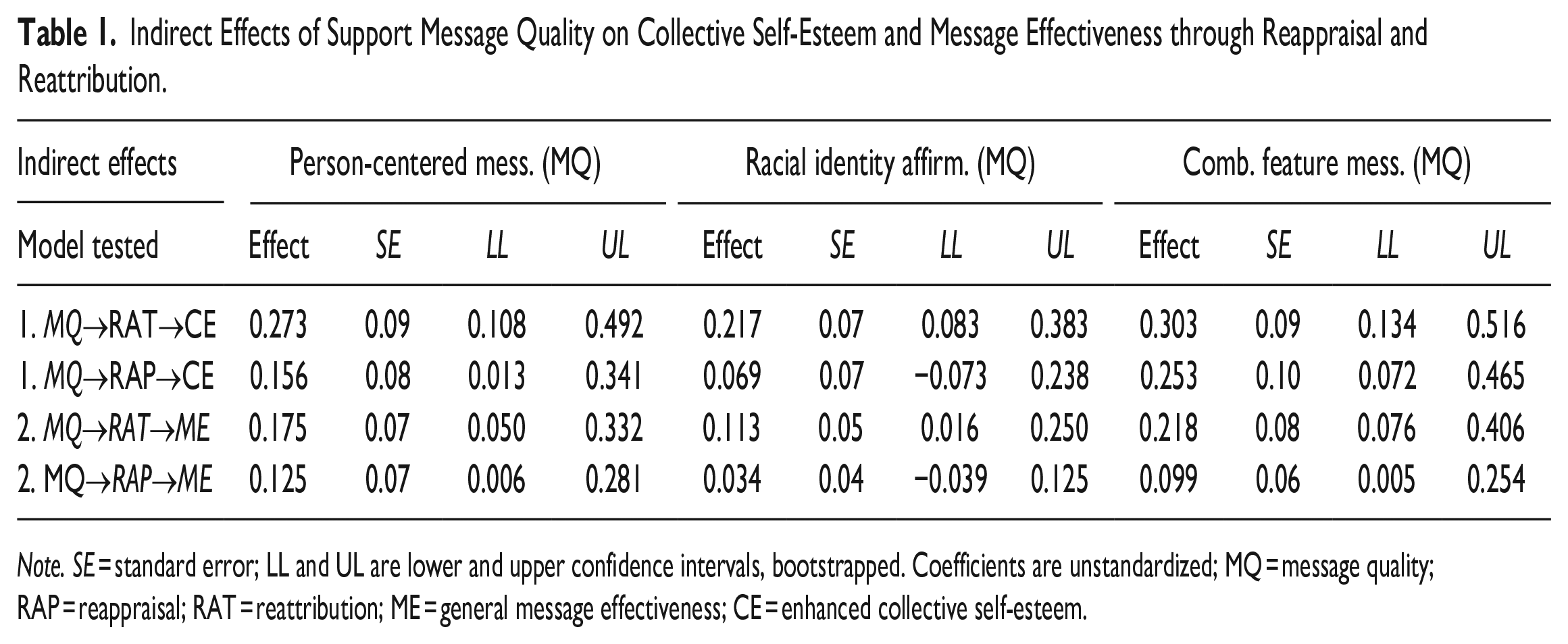
Note. SE = standard error; LL and UL are lower and upper confidence intervals, bootstrapped. Coefficients are unstandardized; MQ = message quality; RAP = reappraisal; RAT = reattribution; ME = general message effectiveness; CE = enhanced collective self-esteem.
H4 was supported, as cognitive reappraisal and reattribution each mediated the effect of person-centered message quality on collective self-esteem (abs = 0.11, 0.23). However, the direct effect of person-centeredness on collective self-esteem remained significant, indicating that other factors also account for this relationship. Similarly, both cognitive reappraisal and reattribution mediated person-centeredness on general message effectiveness (abs = 0.12, 0.17, but the direct effect of person-centeredness on collective self-esteem also remained significant.
H5 predicted that racial identity affirmation quality is also associated with general message effectiveness and collective self-esteem through cognitive reappraisal and reattribution. H5 was partly supported as only cognitive reattribution, not cognitive reappraisal, produced indirect effects for racial identity affirmation on collective self-esteem and general message effectiveness (abs = 0.21, 0.11). Both direct effects of racial identity affirmation on message effectiveness and collective self-esteem remained significant, indicating that other unidentified factors also account for these relationships.
H6 predicted that the quality of combination feature messages on general message effectiveness and collective self-esteem also occurs indirectly through cognitive reappraisal and reattribution. As expected, both cognitive reappraisal and reattribution (abs = 0.25, 0.30) mediated combination message quality on collective self-esteem, with the direct effect of combination message quality on collective self-esteem remaining significant. Similarly, both reappraisal and reattribution (abs = 0.09, 0.21) partially mediated combination message quality on general message effectiveness, with the direct effect of combination message quality on message effectiveness remaining significant.
In sum, person-centered emotional support and combination support messages are partly associated with message effectiveness and enhanced collective self-esteem through cognitive reappraisal and reattribution. Racial identity affirmation is partly related to message effectiveness and collective self-esteem through cognitive reattribution.
Moderating Role of Racial Identity in Conditional Process Analyses
Our research question asked if Asian Americans and Black/African Americans differed in their perceptions of support message types and message outcomes through cognitive reattribution and reappraisal. We employed conditional process analysis and the index of moderated mediation (IMM) to examine group differences for each message type on collective self-esteem and message effectiveness (Model 59, Hayes, 2018; Tables S2 & S3 in Supplemental Materials present our findings). Model 59 tests the moderating role of racial identity for each mediator’s indirect effects (a & b), as well as for the direct effect between each message type and message outcome (c1).
Analyses for person-centered emotional support showed that the mediating effects of cognitive reappraisal were not moderated by racial identity on message effectiveness or collective self-esteem, respectively (IMM = −0.006, −0.004). Cognitive reattribution was a significant mediator for Black/African American participants’ person-centered emotional support on their perceived message effectiveness and collective self-esteem, respectively (ab = .246, .388), but reattribution was not a significant mediator for Asian participants, although the IMM showed no relative significant difference between each group’s attribution effects on each outcome (IMM = −0.154, −0.240). Both groups had significant conditional direct effects for each message outcome (c1 = 0.672, 0.676), indicating that person-centeredness was associated with message effectiveness and collective self-esteem beyond the effects accounted for by cognitive reappraisal and reattribution.
The second analyses involved racial identity affirmation messages and the two message outcomes. The mediation effect of cognitive reappraisal was not significantly different for either racial group on message effectiveness or collective self-esteem (IMM = 0.054, 0.102). By contrast, cognitive reattribution was a significant mediator of racial identity affirmation on message effectiveness and collective self-esteem for both Black/Africans and Asian Americans (abs = .193, .249); reattribution was a mediator of racial identity affirmation on collective self-esteem for African Americans (ab = .136). However, the IMM showed no significant relative differences for reattribution effects for either outcome, and both groups had significant conditional direct effects for racial identity affirmation and the message outcomes (c1s = .636 to .871), suggesting that other factors also account for these relationships.
The third analyses involved combination message types and the message outcomes. Cognitive reappraisal mediated combination feature messages on collective self-esteem for both Black/African American and Asian American participants (abs = .233, .303), but not for message effectiveness. Cognitive reattribution was a significant mediator for Black/African American participants for both collective self-esteem and message effectiveness, respectively (abs = .299, .378); reattribution was only significant for Asian participants’ perceptions of collective self-esteem (ab = .186). However, the IMM again showed no significant relative differences between the ethnic groups for reattribution on either outcome, and the direct effects for each group remained significant for both message outcomes, indicating that other factors also account for these relationships (c1s = .425–1.29). In sum, there were no significant relative differences between Black/African American and Asian Americans in the way they accounted for support message types on collective self-esteem and message effectiveness through cognitive reappraisal and reattribution. However, unlike Asian American participants who perceived cognitive reattribution as only mediating racial affirmation and combination messages on collective self-esteem, Black/African American participants perceived cognitive reattribution as mediating all three support message types on both message effectiveness and enhanced collective self-esteem.
Discussion
Our findings extend supportive communication scholarship by identifying three types of support messages (person-centered emotional support, racial identity affirmation, and combination support messages) that constitute perceived effective support in a relatively understudied context, racial microaggressions. Across six types of racial microaggressions participants perceived high quality person-centered messages, racial identity affirmation messages and combination support messages as more effective and better at enhancing collective self-esteem than low quality versions of the message types. Our findings on person-centered messages support document the impact of person-centeredness (High & Dillard, 2012; Jones & Wirtz, 2006) in a new interpersonal context. The effectiveness of racial identity affirmation messages and combination support messages provide new insights about what type of support might mitigate the racial identity threat evoked by racial microaggressions.
Mediation analyses confirmed that enhanced collective self-esteem was indirectly related to person-centered emotional support through cognitive reappraisal and cognitive reattribution, to racial identity affirmation through reattribution, and to combination support messages through reappraisal and reattribution. The mediation analyses fit existing findings on the role of cognitive reappraisal and reattribution as mediators in support message research. Jones and Wirtz (2006) found that reappraisal partially mediated the effect of person-centered messages on affective improvement, similar to our findings with person-centered messages and enhanced self-esteem. Holmstrom and Kim (2015) found that cognitive reappraisal and reattribution completely mediated the effect of emotion focused messages on state self-esteem; we similarly found that both reappraisal and reattribution were significant mediators, but the cognitive processes only partly mediated the effects of combination support messages and collective self-esteem. One consistent finding was that cognitive reappraisal and reattribution did not completely account for the effect of support message types and collective self-esteem. For each supportive message type, the direct effect of support message quality and collective self-esteem remained significant, which indicates that other mediating factors should be identified. Social cognitive activities like empathy and perspective-taking are at the core of person-centered messages and racial identity affirmation messages and could be examined as mediators to enhance our understanding about how particular features of support message evaluations affect message outcomes like collective self-esteem enhancement.
Finally, there were no substantial or consistent differences between Black and Asian Americans in moderating the effects of support message types on collective self-esteem through reappraisal and reattribution. Both groups saw cognitive reattribution as a significant mediator of racial identity affirmation on collective self-esteem. In four instances Black/African American participants, unlike Asian Americans, perceived that cognitive reattribution mediated support message types on collective self-esteem or message effectiveness, but in each case the index of moderated mediation showed no significant relative difference between the indirect effects. These findings differ from the previously documented racial differences in support evaluations (e.g., Burleson, 2003; Burleson & Mortenson, 2003; Samter et al., 1997). The lack of significant differences could be attributed to that fact that racial microaggressions represent a collective identity threat, a context that has not been examined in cross-racial comparisons of support message evaluations.
Theoretical Contributions and Practical Implications
In addition to validating the effectiveness of person-centered messages in a new interpersonal context, our study also developed features of racial identity affirmation messages, a support message type that has not been conceptualized by interpersonal communication scholars. We identified message characteristics that may counter racist beliefs and attributions of offenders by articulating the important values of the racial group and applying these values to the support recipient’s character and achievements as a valued member of the group. Racial identity affirmation also involves recasting the microaggression as a problem that is not caused by the support recipient but is associated with support providers’ efforts to help the recipient reason about the causes of the aggression by attributing the offender’s behavior to factors that are s external to the recipient. The combination of racial identity affirmation message features may be relevant for understanding what constitutes effective support in other situations involving threats to a recipient’s marginalized group identity.
Besides theoretical advances, our findings have important practical implications. Microaggression researchers have called for more research to discover the interpersonal communication strategies that can help disarm the impact of microaggressions and address racial identity threats (Sue et al., 2019). Our study answers this call by providing examples of effective and ineffective forms of support for Black/African American and Asian Americans to address racial microaggressions. Given the continued frequency of racial microaggressions, friends, family members, co-workers, and neighbors who want to be better support providers can benefit from knowing what constitutes effective support and what practices should be avoided to prevent further harm. The findings provide concrete examples of effective message practices for people who provide support to others who have experienced racial microaggressions. Person-centered messages explicitly recognize and elaborate the individual’s feelings, provide an explanation of feelings, and help the person see their feelings in relation to the broader context. Racial identity affirming messages validate a positive image of the support recipient’s racial group and attribute responsibility of microaggressions to the offenders’ ignorance. Finally, high quality combination messages seem to accomplish multiple support goals by providing emotional comfort as well as identity affirmation which seems to facilitate the cognitive reappraisal and reattribution of the situation that can lead to changes in collective self-esteem.
Since people of color believe that others’ avoidance of these conversations further silences their lived experiences, knowing the best communication practices to legitimize their perspectives, and address racial identity implications may increase communication efficacy (Sue et al., 2019). Thus, the findings, scenarios and messages presented in the Supplemental Materials could be used as resources to facilitate race talk workshops to help people understand how seemingly innocuous expressions may enact racial identity threats. For people who are hesitant to engage in conversations about race, our findings provide examples for what could be said or not said on these occasions.
Limitations of the Study and Future Research
Several changes to the study design can improve the theoretical and practical implications of these findings. Future studies could have participants engage in conversations to provide more ecologically valid data about the way supportive responses to microaggressions are expressed and interpreted. Future studies could also employ experimental or longitudinal designs to validate the mediators as relevant processes and the durability of support message effects. Studies could also examine how support processes might be influenced by the relationship of the targeted individual with the support provider as well as with the offender. Laboratory interactions involving a confederate could provide insights about how disclosure of microaggressions is addressed by support providers, or how support messages varying in quality are utilized by support recipients. Following other studies testing message features (e.g., Feng, 2014), the sequencing of informational support and advice-giving could be examined for the context of microaggressions. Incorporating moderate levels of message quality in addition to low and high levels, as well as testing various permutations of message features and levels would determine their relative benefit to cope with the distress and identity threats invoked by microaggressions.
Addressing the issue of microaggressions also requires a focus on the offenders of microaggressions and their interactions with people of color. Future research should examine communication practices pertaining to the offenders of microaggressions. Finally, since evaluation of support can vary based on source and recipient characteristics, future studies could focus on understanding the experiences of participants that represent different racial or ethnic groups, age groups, and nationalities.
Overall, eliminating microaggressions may require anti-racist efforts at individual, institutional, and societal levels (Sue et al., 2019). Addressing racism at all these levels will help individuals to understand and disarm racial microaggressions in their environments. From the perspective of Black/African Americans and Asian Americans, effective support messages can help address the emotional hurt and the racial identity threats evoked by microaggressions. Thus, these findings may benefit friends, co-workers, neighbors, or anyone needing to provide support to individuals who have experienced a racial microaggression.
Supplemental Material
sj-docx-1-crx-10.1177_00936502231151740 – Supplemental material for The Role of Social Support in Disarming the Effects of Racial Microaggressions
Supplemental material, sj-docx-1-crx-10.1177_00936502231151740 for The Role of Social Support in Disarming the Effects of Racial Microaggressions by Uttara Manohar and Susan L. Kline in Communication Research
Supplemental Material
sj-docx-2-crx-10.1177_00936502231151740 – Supplemental material for The Role of Social Support in Disarming the Effects of Racial Microaggressions
Supplemental material, sj-docx-2-crx-10.1177_00936502231151740 for The Role of Social Support in Disarming the Effects of Racial Microaggressions by Uttara Manohar and Susan L. Kline in Communication Research
Footnotes
Declaration of Conflicting Interests
The authors declared no potential conflicts of interest with respect to the research, authorship, and/or publication of this article.
Funding
The authors received no financial support for the research, authorship, and/or publication of this article.

Supplemental Material
Supplemental material for this article is available online.
Author Biographies
References
Supplementary Material
Please find the following supplemental material available below.
For Open Access articles published under a Creative Commons License, all supplemental material carries the same license as the article it is associated with.
For non-Open Access articles published, all supplemental material carries a non-exclusive license, and permission requests for re-use of supplemental material or any part of supplemental material shall be sent directly to the copyright owner as specified in the copyright notice associated with the article.
