




Abstract
The literature on heterosexual adolescents’ television viewing and its over-time impact on attitudes and behaviors regarding LGBTQ+ is limited. The current study aims to fill this gap in the literature by using three-wave data from 338 heterosexual adolescents (Mage = 15.29, SD = 1.48, 68.6% girls). We explored relations between adolescents’ perceived exposure to sex-positive television messages, their respectful approach to different sexual expressions, and their endorsement of supportive behavior regarding LGBTQ+. A Random Intercept Cross-Lagged Panel Model (RI-CLPM) showed that, at a between-person level, perceived exposure to sex-positive television messages was related to the endorsement of supportive behavior regarding LGBTQ+. Yet, results revealed that an increased perceived exposure to sex-positive television messages was not associated with respectful approach to different sexual expressions and endorsement of supportive behavior regarding LGBTQ+ at the individual level. No sex or traditional gender role orientation differences were found. Our findings hopefully encourage sexual media research to further distinguish between-and within-person relations and to consider potential testing effects that mask true within-person change.
Keywords
Introduction
The victimization and stigmatization of lesbian, gay, bisexual, transgender, and questioning (i.e., LGBTQ+) youth is a pressing issue in contemporary society. Compared to their heterosexual peers, LGBTQ+ youth experience victimization at higher rates within several developmental contexts (e.g., family, peers) (Kosciw et al., 2020). Such experiences can compromise healthy psychosocial development as studies point to links with poor mental well-being and academic performances (e.g., Baams & Russell, 2021). Hence, scholars urge the exploration of factors that mitigate LGBTQ+ youth’s victimization and, in general, support positive social change (Marx & Kettrey, 2016).
In this view, scholars point to the essential role of adolescent (12–18 years old) “heterosexual allies” (Marx & Kettrey, 2016). Developmental and sexology literature highlight the significance of heterosexual adolescents’ formation of supportive attitudes and behaviors as adolescence is a crucial phase during which individuals’ beliefs and attitudes regarding sexuality are created (Abreu & Kaiser, 2016). At the same time, it can also greatly benefit the LGBTQ+ community (Maes et al., 2023). Yet, the literature generally points to heterosexual youth’s rather negative attitudes and behaviors toward LGBTQ+ (e.g., Collier et al., 2015). Therefore, identifying factors that can foster ally attitudes and behaviors in heterosexual adolescents seems crucial.
One of these factors, next to peers and parents, may include television messages (Ragsdale et al., 2014). Indeed, recent content analyses have demonstrated the increasing promotion of positive messages about LGBTQ+ (Gay & Lesbian Alliance Against Defamation [GLAAD], 2021), especially in television series targeted at youth (Maes & Vandenbosch, 2022a). Yet, the literature is limited on socially desirable sexual outcomes of adolescents’ television exposure (Gillig & Murphy, 2016), especially regarding the longitudinal nature of these processes (for an exception, see Bond, 2021). Attention to such positive outcomes will present a more balanced view on sexual media effects, as already shown in the domain of pornography research (e.g., Wright & Randall, 2014; Wright & Tokunaga, 2022).
As such, grounded in the main principles of the script acquisition, activation, and application model (3AM) (Wright, 2011), we examined the over-time, reciprocal dynamics between heterosexual adolescents’ perceived exposure to sex-positive television messages, respectful approach to others’ sexual expressions, and endorsement of supportive behavior regarding LGBTQ+. To our knowledge, this study will thus be the first to test the potential of theoretical principles of Wright’s (2011) model for explaining the positive sexual socialization processes of television viewing. Attention was paid to adolescents’ sex and traditional gender role orientation, two factors that have the potential to moderate sexual media effects (Coyne et al., 2019; Ward et al., 2014). When exploring these suggested dynamics, we distinguish between-and within-person level relations. Attention to these two processes will present us with a more complete view of the suggested sexual media use dynamics.
Heterosexual Allies
Heterosexual or “straight” allies are described as heterosexual persons who support and/or accept the LGBTQ+ community and the rights of its members (Goldstein & Davis, 2010). There is already compelling evidence of heterosexual youth’s alliances with the LGBTQ+ community mitigating the marginalization and victimization of this community. Particularly, the meta-analytical work of Marx and Kettrey (2016) explains how the presence of gay-straight alliances at school significantly contributes to a reduction of homophobic victimization, LGBTQ+’s fear for safety, and hearing of homophobic remarks.
Even though adolescent heterosexual allies play an imperative role in positive social change, surprisingly little is known about the formation of such allyship. Of the body of research exploring how heterosexual allies are formed, a predominant focus has been laid on (young) adult samples (Knepp, 2022; Schmitz & Tyler, 2018). This research mainly points to the importance of the social context, such as intergroup contact between heterosexual young adults and LGBTQ+ peers (Knepp, 2022). As of yet, there has been little attention to LGBTQ+ allyship in adolescents (e.g., Poteat, 2015). To our knowledge, one of the few exceptions is the research of Poteat (2015), pointing to the significance of individual psychological factors (e.g., self-reflection) and interpersonal factors (e.g., having LGBTQ+ friends). The limited attention to the development of LGBTQ+ allyship in heterosexual adolescents is surprising, though, as adolescence is a crucial life stage during which individuals’ attitudes regarding their social context are created (Abreu & Kaiser, 2016).
Literature implies that ally attitudes are reflected in heterosexual adolescents’ so-called respectful approach to different sexual expressions. This component reflects “adolescents’ understanding that sexual expressions and orientations are a product of change and growth, but also that they are unique for each individual” (Maes et al., 2023, p. 12). In a broader sense, it mirrors adolescents’ recognition and respectful approach to sexual orientations that deviate from the “heterosexual norm.” Canvassing the literature on the victimization of LGBTQ+ youth, behavioral support by adolescent heterosexual allies can then more explicitly be expressed in two contexts: the peer and institutional context (e.g., Fantus & Newman, 2021; Hatzenbuehler, 2017). Victimization of LGBTQ+ youth mainly takes place in a school-based environment via peers’ bullying behaviors (e.g., verbal harassment, social isolation) (Fantus & Newman, 2021). Scholars then specifically suggest how engagement in active bystander behavior (e.g., standing up for the person being bullied) can be critical to promoting respectful and affirming norms among peers (Poteat & Vecho, 2016). LGBTQ+ youth can then further be victimized at an institutional level, via the promotion of heterosexual norms in society, manifested in many forms including the absence of policies to prevent stigmatization (Hatzenbuehler, 2017). In this view, heterosexual allies’ support of campaigns that stand up for the sexual rights of others contribute to the recognition of the LGBTQ+ community (Lapointe, 2015).
For many years, research has shown that (e.g., Collier et al., 2015), on average, heterosexual adolescents’ attitudes toward LGBTQ+ are rather negative, though. Also, the engagement in supportive behavior is rather rare in adolescents, especially in the peer context. Despite many adolescents observing bullying of LGBTQ+ youth, only a smaller proportion of these adolescents intervene. Such disconnections can be framed by social psychological processes including the diffusion of responsibility (Pozzoli & Gini, 2013) and adolescents’ coherence with group heteronormativity (Poteat & Vecho, 2016).
At the same time, most recent studies do point to a positive evolution regarding heterosexual adolescents’ attitudes and endorsement of behaviors toward LGBTQ+ (Santona & Tognasso, 2018). Indeed, the level of negative attitudes and behaviors toward LGBTQ+ is progressively decreasing in Western countries. Growing support for the LGBTQ+ community may be explained by a generational shift, meaning that older, more conservative generations are slowly being replaced with a younger and more progressive population. Yet, the rather slow nature of this evolution should be underlined. Hence, attention to socio-environmental factors that could nourish allyship among heterosexual adolescents is highly necessary. One such factor may be television messages.
The 3AM Model and Positive Sexuality Messages on Television
Next to peers and parents, media are believed to play a powerful socializing role in the formation of attitudes and behaviors regarding sexuality. Adolescents are still pervasive television viewers with recent reports (Rideout et al., 2022) demonstrating that they spend more than an hour a day watching television, mainly via streaming services. When watching television, adolescents are highly likely to come across messages about sexuality (Malacane & Martins, 2017).
In his script acquisition, activation, and application model (3AM), Wright (2011) explains the socializing potential of sexual messages on television. The model integrates previous cognitive, behavioral, and media theories (e.g., social cognitive theory, Bandura, 2001), yet is informed most directly by the development of sexual script literature (Simon & Gagnon, 1986). Sexual scripts are described as culturally shared social norms that offer guidelines for normative, appropriate, and desirable sexual attitudes and behaviors (Simon & Gagnon, 1986). Wright (2011) explains that exposure to sexual content on television can provide viewers with scripts that they are unaware of (i.e., acquisition), prime scripts they are already aware of (i.e., activation), and encourage (or discourage) the utilization of these scripts (i.e., application) by portraying them more or less as normative (or non-normative), acceptable (or unacceptable), or rewarding (or punishing). The 3AM further underlines the role of audience factors and suggests that individual aspects of the viewer (e.g., gender, age) can guide (i.e., moderate) viewers’ responses to and engagement with television messages.
Traditionally, content analyses have mainly pointed to the biased and underrepresented portrayals of LGBTQ+ characters in sexual scripts on television (e.g., Fouts & Inch, 2005; Kim et al., 2007). Yet, findings of more recent content analyses point to rather positive progress when it comes to the depiction of different sexual expressions. Specifically, representations of non-heterosexual characters are significantly increasing with the latest Where We Are on TV report of GLAAD (2021) demonstrating that 9.1% of the regular characters on television identify as part of LGBTQ+. Moreover, recent content analyses even point to the promotion of television messages in which characters accept their sexuality and manifest a respectful approach to different sexual expressions (Kinsler et al., 2019; Maes & Vandenbosch, 2022a). Positive messages about sexual orientation appeared to be present alongside messages that can be considered harmful to the LGBTQ+ community, such as characters being mocked for their sexuality (Kinsler et al., 2019; Maes & Vandenbosch, 2022a).
These content analyses highlight how adolescents are not exclusively exposed to messages that promote heteronormative beliefs, but in fact, also come across positive messages that are supportive of LGBTQ+ when watching television. Following the tenets of Wright’s (2011) 3AM model, such positive television messages may then potentially impact heterosexual adolescents’ ally attitudes, reflected by a respectful approach to different sexual expressions. A limited body of studies hint at this socializing process with cross-sectional (e.g., Bond & Compton, 2015; Calzo & Ward, 2009; Gillig & Murphy, 2016) and experimental research (e.g., Bonds-Raacke et al., 2007) demonstrating that television viewing fosters young viewers’ acceptance of homosexuality and support of LGBTQ+. To illustrate, the research of Bond and Compton (2015) demonstrated a positive relationship between emerging adults’ exposure to on-screen gay characters and gay equality endorsement. They found that this relation was stronger for participants who had no or few interpersonal relationships with openly gay individuals than those participants who had. Lacking from the literature is an exploration of these dynamics among a population of heterosexual adolescents, and—at the same time—an investigation of its long-term nature (one exception is the recent 10-week experimental research of Bond, 2021). With this study, we aim to fill these two gaps in the literature and test the following hypothesis:
H1: Heterosexual adolescents’ perceived exposure to sex-positive television messages positively predicts a respectful approach to different sexual expressions over time.
Wright (2011) further suggests that the acquisition and/or activation of sexual scripts stimulates individuals to act upon these scripts in real life. A rich body of work has demonstrated such dynamics with scholars consistently reporting how sexual attitudes are mediating, explaining mechanisms between sexual media uses and individuals’ sexual behaviors in real-life (e.g., Ward et al., 2014; Wright, 2020). Yet, this line of research traditionally focused on the socializing potential of sexual media from a negative perspective by, for example, focusing on the development of risky sexual behaviors (O’Hara et al., 2012). Hence, research on television’s role in adolescents’ positive sexual behaviors, reflected in the endorsement of supportive behaviors for LGBTQ+, is quasi non-existent. Following the 3AM model (Wright, 2011), the following hypothesis will thus be tested:
H2: Heterosexual adolescents’ perceived exposure to sex-positive television messages positively predicts their endorsement of supportive behavior toward LGBTQ+ over time, via a respectful approach to others’ sexual expressions.
Attitudes, behavior, and media use are further theorized to be reciprocally related, as hypothesized in the 3AM Model (Wright, 2011) and Reinforcing Spirals Model (Slater, 2015). One of the mechanisms explaining the reciprocity between specifically media use and attitudes and behaviors were first explained in Zillmann and Bryant’s (1985) selective exposure hypothesis. This hypothesis refers to individuals’ tendencies to select content that matches their prior attitudes and behaviors. The selective exposure hypothesis gained support by longitudinal research focusing on sexual media effects (e.g., Aubrey, 2007; Peter & Valkenburg, 2009). For instance, Peter and Valkenburg (2009) found that a stronger acceptance of the notion that women are sex objects predicted more exposure to online pornography among male but not female adolescents. Other, longitudinal studies however have not been able to find support for such media selection processes (van Oosten et al., 2015; Wright, 2021b).
In the context of the current study, it may be possible that heterosexual adolescents who hold a respectful approach to different sexual expressions and endorsement of supportive behavior regarding LGBTQ+ are more inclined to view positive messages regarding LGBTQ+ on television. Further, following prior literature on sexuality-related attitudes and behaviors, it can be expected that ally attitudes and behaviors are reciprocally related over time (Harden, 2014). Therefore, this study further examines the following hypothesis:
H3: Heterosexual adolescents’ perceived exposure to sex-positive television messages, a respectful approach to different sexual expressions, and the endorsement of supportive behavior toward LGBTQ+ are reciprocally related over time.
Moderating Role of Adolescents’ Sex and Traditional Gender Role Orientation
To fully grasp for whom the suggested dynamics are most influential, Wright (2011) points to the role of audience factors in the activation, acquisition, and application of sexual scripts depicted in media. As suggested by Wright (2011) and demonstrated in sexual media effects (Coyne et al., 2019; Ward et al., 2014), one of the most influential audience factors is viewers’ biological sex. For instance, studies show that relations between television viewing and positive LGBTQ+ attitudes are stronger among women than among men (Bonds-Raacke et al., 2007). This dynamic can be explained by young men, on average, holding more negative attitudes toward LGBTQ+ in comparison to young women (e.g., Prati et al., 2011). Scholars explain that LGBTQ+ may be interpreted as a threat to masculine identity and that men are more afraid to be seen as gay themselves (Birkett & Espelage, 2015). Hence, it may be possible that adolescent boys’ perceived exposure to sex-positive television messages leads to a rejection of LGBTQ+. Whereas among women, they may be more inclined to embrace the positive messages depicted and manifest this acceptance in their ally attitudes and behaviors. Likewise, following selective exposure hypothesis (Zillmann & Bryant, 1985), it is possible that girls will be more strongly inclined to view television messages that match their positive attitudes and behaviors toward LGBTQ+ in comparison to boys. Yet, longitudinal research is missing that examines sex differences in the suggested reciprocal dynamics, especially with regards to the endorsement of congruent behaviors. Therefore, we aim to test the following hypotheses:
H4a: The link between adolescents’ perceived exposure to sex-positive television messages and their endorsement of supportive behavior toward LGBTQ+ over time, via a respectful approach to others’ sexual expressions is stronger among heterosexual girls in comparison to boys.
H4b: The reciprocal relations between perceived exposure to sex-positive television messages, a respectful approach to different sexual expressions, and the endorsement of supportive behavior toward LGBTQ+ over time are stronger among heterosexual girls in comparison to boys.
Next to individuals’ sex, scholars highlight the necessity to consider individuals’ traditional gender role orientation when studying sexual media effects (e.g., Vandenbosch & van Oosten, 2017; van Oosten et al., 2017). Traditional gender role orientation reflects the degree to which adolescents understand themselves in relation to culturally feminine and masculine meanings attached to being a man (e.g., being dominant) or a woman (e.g., being sensitive) (Murnen & Byrne, 1991). Such concepts of gender roles are rooted in heteronormative beliefs and, thus, appear to be closely linked to negative attitudes and behaviors toward LGBTQ+ (e.g., homophobic name-calling, aggression) (Whitley, 2001). In this way, traditional gender role orientation may be a significant indicator of the conditional boundaries of the suggested dynamics. Particularly, it is likely that adolescents’ with a high gender role orientation perceived exposure to sex-positive television messages leads to a rejection of LGBTQ+. Whereas among adolescents with lower traditional gender role orientation, they may be more inclined to accept the positive messages depicted and manifest this acceptance in their ally attitudes and behaviors. Likewise, following selective exposure hypothesis (Zillman & Bryant, 1988), it is possible that low to middle gender role orientated adolescents will be more strongly inclined to view television messages that match their more positive attitudes and behaviors toward LGBTQ+ in comparison to high gender role orientated adolescents. Hence, current study finally aims to test the following hypothesis:
H5a: The link between adolescents’ perceived exposure to sex-positive television messages and their endorsement of supportive behavior toward LGBTQ+ over time, via a respectful approach to others’ sexual expressions, is stronger among heterosexual adolescents with low and middle traditional gender role orientation in comparison to adolescents with high traditional gender role orientation.
H5b: The reciprocal relations between perceived exposure to sex-positive television messages, a respectful approach to different sexual expressions, and the endorsement of supportive behavior toward LGBTQ+ over time are stronger among heterosexual adolescents with low and middle traditional gender role orientation in comparison to adolescents with high traditional gender role orientation.
Attention to Within-and Between-Person Level Relations
When exploring these suggested dynamics, the current study will distinguish between-and within-person level relations. Within-subject effects reflect fluctuations in the level of an outcome for a single person over time. Between-subject effects are more stable, trait-like differences between individuals (Hamaker et al., 2015). This distinction is important because these two sources of information reflect fundamentally different processes. Specifically, communication scholars point to the so-called “Simpson’s paradox” (te Poel & Baumgartner, 2016). At the between-person level, it may be true that adolescents who more frequently view positive messages about LGBTQ+ also are more likely to have a heightened ally attitude and more often engage in ally behaviors than adolescents who view positive messages about LGBTQ+ less regularly. Within individuals however, the opposite can also be true, in that a more frequent perceived exposure to sex-positive television messages is associated with less ally attitudes and behaviors. In other words, people who generally view more positive messages than others also demonstrate more ally attitudes and behaviors compared to others (between-person process). However, an individuals’ increase in the frequency of perceived exposure to sex-positive television messages over time can be related to a decrease in their ally attitudes and behaviors over time (within-person process). This fictional example illustrates how between-person differences may substantially differ from within-person processes, which leads to different conclusions based on the same data. Thus, the need to disentangle between-person from within-person level effects becomes clear, wherefore this study will analyze the hypothesized dynamics using RI-CLPM. The hypothesized model can be found in Figure 1.
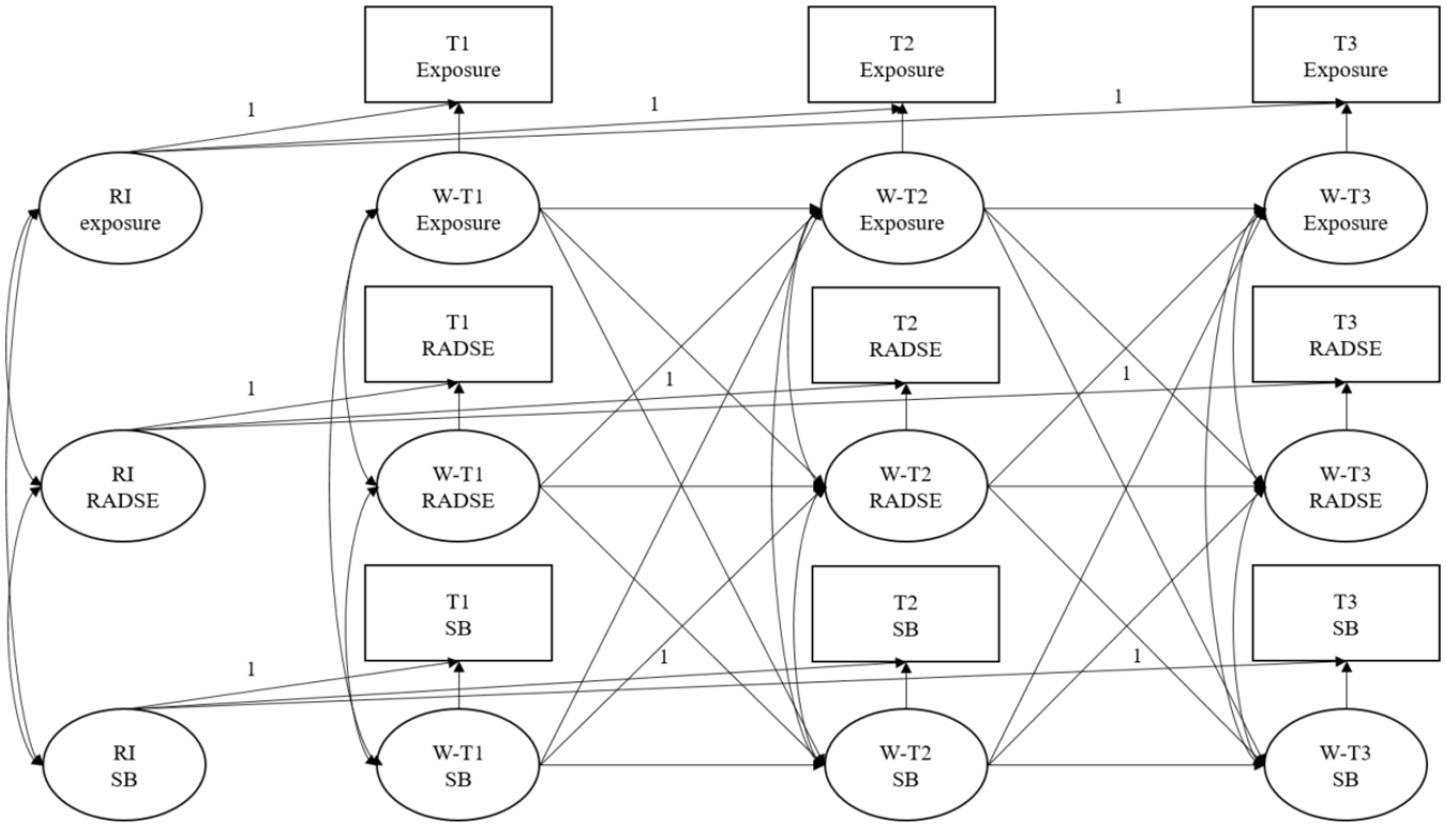
Hypothesized model.
Method
Open Science Commitment
Our deidentified study data, preregistration, syntaxes, and outputs are freely available on OSF (https://osf.io/jzc9t/). This study was part of the “Positive Body and Sex Project.” More information about this project can be found on OSF (https://osf.io/c5g6p/). Other related, published studies that are part of this project can be found on OSF as well (https://osf.io/usfhv/, https://osf.io/bnefs/, https://osf.io/wjs4c/, https://osf.io/52qab/, andhttps://osf.io/g3tq5/).
Sample and Procedure
The present study uses a three-wave panel study that was conducted among a representative sample of adolescents (aged between 12 and 18) from Flanders, Belgium between January 2020 and October 2020. A total of 100 Flemish schools were randomly selected from an overview provided by the Flemish government and were contacted by the first author via e-mail and/or telephone with the request to participate in the study. Of these 100 schools, 16 agreed to participate in the study.
In total, 667 respondents filled in in a paper-and-pencil survey during class hours at baseline. Of these respondents, 629 (Mage = 15.36, SD = 1.41) filled in the variables of interest and, thus, 40 surveys were deemed incomplete and were discarded. A small majority of the sample (51.9%) were boys. In the second wave (i.e., June 2020), 406 respondents (Mage = 15.38, SD = 1.38) filled in the variables of interest via an online survey. Of this sample, 69.5% were girls. A drop-out rate of 35.45% reflects the change in data collection methods as a response to physical distancing measures operative in June. In the third wave (i.e., October 2020), 325 respondents (Mage = 15.38, SD = 1.28) (drop-out rate of 19.95% since W2) filled in the online survey of W3. The majority of this sample were girls (71.1%).
Data were used of respondents who participated in at least two of the three study waves and of respondents who identified as heterosexual (74 participants did not identify as heterosexual of the participants who participated in at least two waves of the study). The total analytical sample consisted of 338 heterosexual respondents of which the majority (68.6%) were girls (Mage = 15.30, SD = 1.34). Following the Belgian secondary school system division, 52.7% of the respondents were in the first education level (i.e., in which they were being prepared for college education), 39.9% were in the middle education level (i.e., in which they were being taught primarily technical skills), and 6.8% were in the third education level (i.e., leading to professions, such as a baker).
Using a multivariate logistic regression analysis with two groups of participants as dependent variables (1 = included in this study, 0 = excluded in this study), a possible attrition bias was assessed. Three significant differences emerged between adolescents who were included in this study and who were excluded from this study. In particular, boys, exp(B) = 2.81, B = −1.03, p < .001, older adolescents, exp(B) = 1.17, B = .16, p < .001, and adolescents of second and third educational level, exp(B) = 1.99, B = .69, p < .001, were more likely to be excluded.
Written active (i.e., from parents whose adolescents were older than 16 years old) and passive parental consent (i.e., from parents whose adolescents were younger than 16 years old) was obtained. Given the change in the data collection method from W1 to W2 and W3, parents were asked to give additional passive consent at W2 and W3. The respondents were assured that the survey would be processed confidentially and anonymously and active consent was obtained at the outset of the survey. The respondents received a monetary incentive for their participation of respectively 5 and 7 euros at W2 and W3 in the form of a gift certificate. The study was approved by the ethical committee of KU Leuven, Belgium.
Measures
Socio-Demographic Variables
Age, sex (0 = boy, 1 = girl), sexual orientation (1 = heterosexual, 2 = homosexual, 3 = bisexual, 4 = I do not know yet), and educational school track were questioned at W1 (1 = first educational level, 2 = second educational level, 3 = third educational level). For the study’s purposes, only participants whose sexual orientation indicated heterosexuality were retained.
Perceived Exposure to Sex-Positive Television Messages
Based on the content-based media exposure scale (C-ME2, Den Hamer et al., 2017), literature on positive sexuality (Maes et al., 2023), and the aforementioned content analysis of positive sexuality messages on television (Maes & Vandenbosch, 2022a), we created four items to measure perceived exposure to sex-positive television messages (“A character experiments with their sexuality [e.g., they explore what turns them on, who they can fall in love with],” “A character expresses their sexuality [e.g., coming out of the closet, a girl saying she has never kissed before] and this is accepted by other characters” “Characters resist sexual stereotypes” “Characters talk openly and respectfully about relations and sexuality”). At W1, the meaning of sexual stereotypes was explained to the respondents by giving examples of stereotypes, including the stereotype that “boys can only fall in love with girls, and girls can only fall in love with boys.” This example was also included in the online surveys at W2 and W3. In the three waves, a 5-point scale was used to measure how often adolescents were exposed to these messages on television (movies and television series) over the past 5 months (1 = Never to 5 = (almost) always). A Principal Components Analysis (PCA) supported the one-dimensional factor structure of the items (range explained variance W1−W3 = 40.88%−58.97%). The measure was stable across the three waves, r = .29−.39, p < .001. 1 Cronbach’s coefficients alpha’s ranged from .60 to .78 over the three waves. Mean scores were used at each wave with higher the scores representing a greater perceived exposure to sex-positive television messages (MW1 = 2.81, SDw1 = 0.72, MW2 = 2.85, SDw2 = 0.57, MW3 = 2.79, SDw3 = 0.79).
Respectful Approach to Different Sexual Expressions
The other-oriented subscale of the Positive Sexuality among Adolescents Scale (PSAS) was used (Maes et al., 2023). Specifically, adolescents rated four items using a 7-point Likert scale (1 = Strongly disagree to 7 = Strongly agree): “I respect that two people of the same gender can fall in love,” “Boys can only fall in love with girls, and girls can only fall in love with boys” (reverse), “ I understand that some people don’t know yet who they are attracted to (e.g., attracted to a boy, a girl or both),” “Everyone has different sexual desires (e.g., some people are turned on by individuals of the same gender), this is unique for every person and should be respected (e.g., you shouldn’t laugh at this person)”. A Confirmatory Factor Analysis (CFA) confirmed the one-dimensional factor structure of the items over the three waves, χ2 (51) = 235.15, p < .001, RMSEA = 0.10 (90% CI = [0.09, 0.182]), CFI = 0.94, TLI = 0.92. The measure had a strong stability across the three waves, r = .68–.73, p < .001. In this study, the Cronbach’s coefficients alpha’s ranged between .88 and .92 across the three waves. Mean scores were used, with higher scores representing a higher respectful approach to different sexual expressions (MW1 = 5.76, SDw1 = 1.17, MW2 = 5.92, SDw2 = 1.31, MW3 = 6.01, SDw3 = 1.21).
Endorsement of Supportive Behavior for LGBTQ+
Based on the Measure of Prosocial Tendencies for Adolescents (Carlo et al., 2003), the literature on positive sexuality (Maes et al., 2023), and victimization of LGBTQ+ in the peer and institutional context (Fantus & Newman, 2021; Hatzenbuehler, 2017), we created three items: “I think it is important to stand up for someone who is being bullied for their sexual orientation,” “When a friend is being bullied for their sexual behavior (e.g., a girl is being called a slut, a boy/girl is being called out for kissing another boy/girl), I stand up for them,” “I support campaigns that stand up for sexual rights and pay attention to sexual issues (e.g., gay pride parade).” Adolescents rated these three items using a 7-point Likert scale (1 = Strongly disagree to 7 = Strongly agree). The PCA supported the one-dimensional factor structure of the items (range explained variance W1–W3 = 66.98%−71.32%). The measure had a strong stability across the three waves, r = .61–.68, p < .001. In this study, the Cronbach’s coefficients alpha’s ranged between .74 and .76 across the three waves. Mean scores were used, with higher scores representing greater endorsement of supportive behavior for LGBTQ (MW1 = 5.07, SDw1 = 1.09, MW2 = 5.27, SDw2 = 1.16, MW3 = 5.38, SDw3 = 1.09).
Traditional Gender Role Orientation
Traditional gender role orientation was measured at W1 using the short version of the Bem Sex-Role Inventory (Bem, 1981) validated among adolescents in the study of Fontayne et al. (2000). The Sex-Role Inventory was developed to capture the degree to which respondents identify with traits that characterize traditional masculinity and femininity and has been used in prior research to measure respondents’ hyper masculinity and femininity (Maes & Vandenbosch, 2022b). Using a 7-point Likert scale (1 = strongly disagree; 7 = strongly agree), all respondents rated 20 items reflecting feminine and masculine traits such as “I am dominant” (i.e., masculine) and “I am a warm person” (i.e., feminine). Then, PCAs were conducted separately for boys and girls. Among both boys and girls, two factors emerged with 10 items representing masculine traits (e.g., “I am a born leader”) and nine feminine traits (e.g., “I am a sensitive person”), αgirls = .79, αboys = .82. One item was deleted because it did not load on any of the factors (“I do not easily follow someone else’s orders”). For girls, the scores on the 10 feminine traits were used, while for boys the scores on the nine masculine traits were used. Thus, the higher the mean scores, the more girls identified themselves as “feminine,” and the more boys identified themselves as “masculine” (M = 5.44, SD = 0.76). Since RI-CLPM do not allow for moderation tests with the variable in its continuous form, respondents were categorized into “low gender role orientation” (N = 119), “moderate gender role orientation” (N = 98), and “high gender role orientation” (N = 110) according to their traditional gender role orientation scores with cutoffs at the 25th and 75th percentiles.
Data Analysis
Descriptive analyses and correlations were calculated using SPSS 26.0. Intraclass Correlation Coefficients (ICCs) were then computed for all study variables. A high ICC (>0.50) indicates proportionately higher between-group variance while a low ICC (<0.50) indicates proportionately higher within-person variance. The reciprocal relations between perceived exposure to sex-positive television messages, a respectful approach to different sexual expressions, and endorsement of supportive behavior toward LGBTQ+ were tested through a RI-CLPM in Mplus 8.7, and full information maximum likelihood estimation (FIML) was used to deal with missing data. A description of the construction of the RI-CLPM can be found in Supplemental Materials. Monte Carlo power analyses suggested that the sample size was sufficiently large to detect small effects (i.e., 0.10, Funder & Ozer, 2019) in the RI-CLPM.
The significance of potential mediation effects was tested using a bootstrapping procedure (1,000 bootstrap samples): The given sample size was randomly resampled 1,000 times with replacement, and then 1,000 estimations of the mediation effect were calculated. If the 95% confidence interval for the indirect effect estimate did not include zero, we concluded that the indirect effect was statistically significant at the .05 level. Control variables were also included in the bootstrapping analyses. To test the sex and traditional gender role orientation differences, multiple group comparisons were conducted. Particularly, a model in which the cross-lagged and autoregressive paths were allowed to differ between girls and boys and between adolescents with low, moderate, and high traditional gender role orientation was compared to the fit of a model in which these paths were constrained to be equal. If the chi square difference test of these two models was significant, difference parameter tests were then conducted. Model fit was evaluated using three goodness-of-fit-indices: the root mean square error of approximation (RMSEA), the Bentler Comparative Fit Index (CFI) and the Tucker-Lewis Index (TLI) (Hu & Bentler, 1999). CFI and TLI values between 0.90 and 0.95 and RMSEA values between 0.05 and 0.08 indicate an acceptable model fit, and CFI and TLI values larger than 0.95 and RMSEA values smaller than 0.05 indicate good model fit (Kline, 2012). In line with recommendations of Wright (2021a) and Wright et al. (2022), results from the parsimonious models (i.e., focal predictors only) and of the models adjusted for demographic variability (i.e., focal predictors and demographic covariates) will be reported. This approach is used to avoid a confounding scenario, since age, sex, and educational level can be linked to sexual media uses and sexuality components.
Results
Descriptive Statistics
Zero-order correlations, means, and standard deviations for the variables at the different time points are presented at Table 1. Adolescents reported on average that they sometimes were exposed to positive television messages about LGBTQ+ across the three waves, and they showed high levels of a respectful approach to different sexual expressions and endorsement of supportive behavior regarding LGBTQ+ across the three waves. The ICCs were 0.38 for perceived exposure to sex-positive television messages, indicating that 35% of the variance is explained by between-person differences and 65% by differences over time within persons. The ICC for respectful approach was 0.72, indicating that 72% of the variance is explained by between-person differences and 28% by differences over time within persons. Lastly, the ICC for supportive behavior regarding LGBTQ+ was 0.64, meaning that 64% of the variance is explained by between-person differences and 36% by differences over time within persons.
Descriptive Statistics and Correlations.
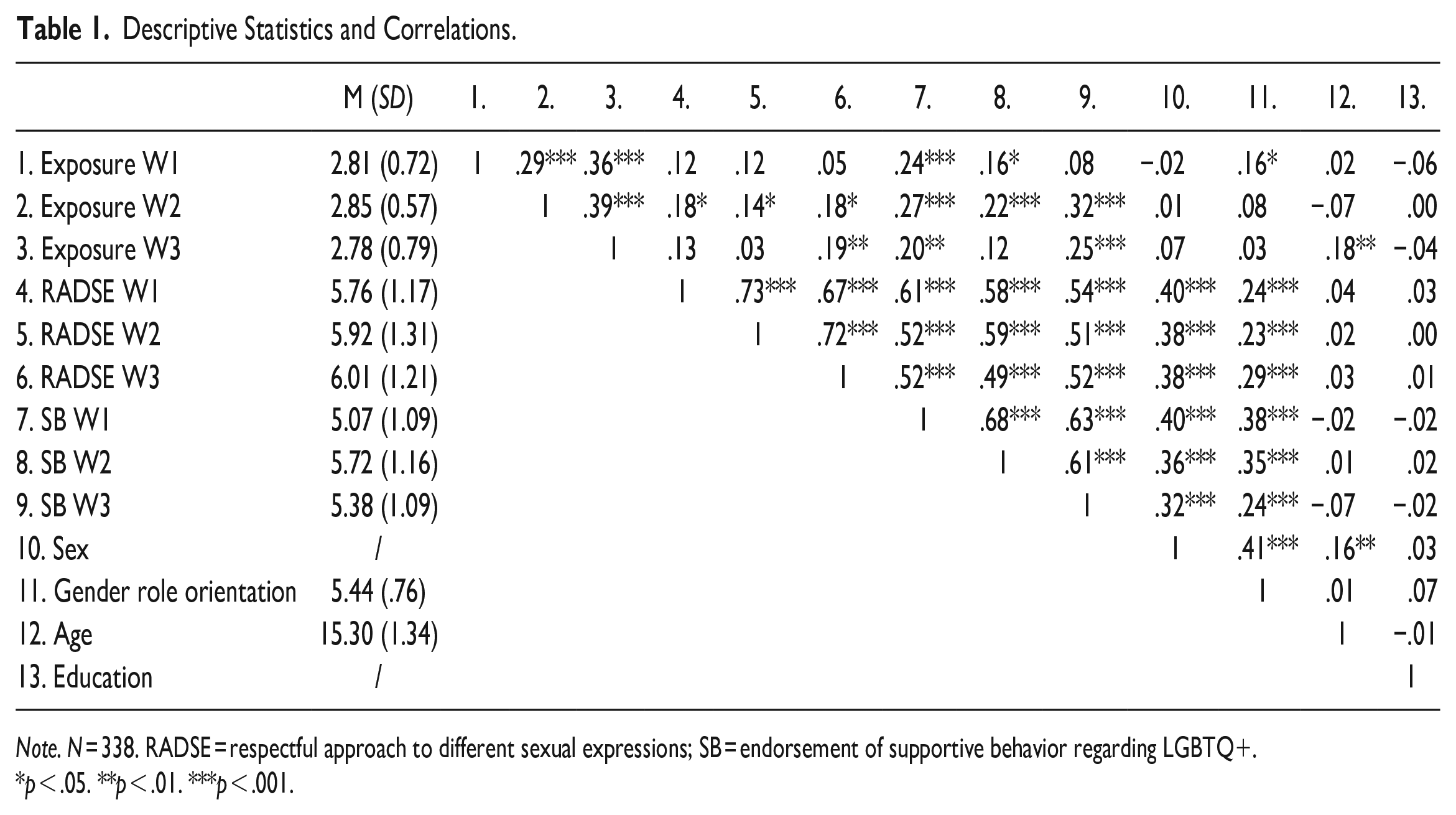
Note. N = 338. RADSE = respectful approach to different sexual expressions; SB = endorsement of supportive behavior regarding LGBTQ+.
p < .05. **p < .01. ***p < .001.
RI-CLPM
The RI-CLPM as hypothesized in the current study showed an excellent fit to the data, χ2 (2) = 1.61, p > .05, RMSEA = 0.00 (90% CI = [0.00, 0.10]), CFI = 1, TLI = 1. 2 As shown in Table 2, between-person level relations emerged. Particularly, the random-intercept factors of perceived exposure to sex-positive television messages and endorsement of supportive behavior regarding LGBTQ+ correlated significantly, r = .43, p < .001. This result means that, across waves, heterosexual adolescents who were exposed to positive messages about LGBTQ+ more often than average, more often endorsed supportive behavior toward LGBTQ+. Further, respectful approach to different sexual expressions and endorsement of supportive behavior regarding LGBTQ+ also correlated significantly at a between-person level, r = .74, p < .001. Heterosexual adolescents who had a higher respectful approach to different sexual expressions than average, also more often endorsed supportive behavior. No significant correlations were found between perceived exposure to sex-positive television messages and respectful approach to different sexual expressions at a between-person level, p > .05.
Parameter Estimates for the RI-CLPM.
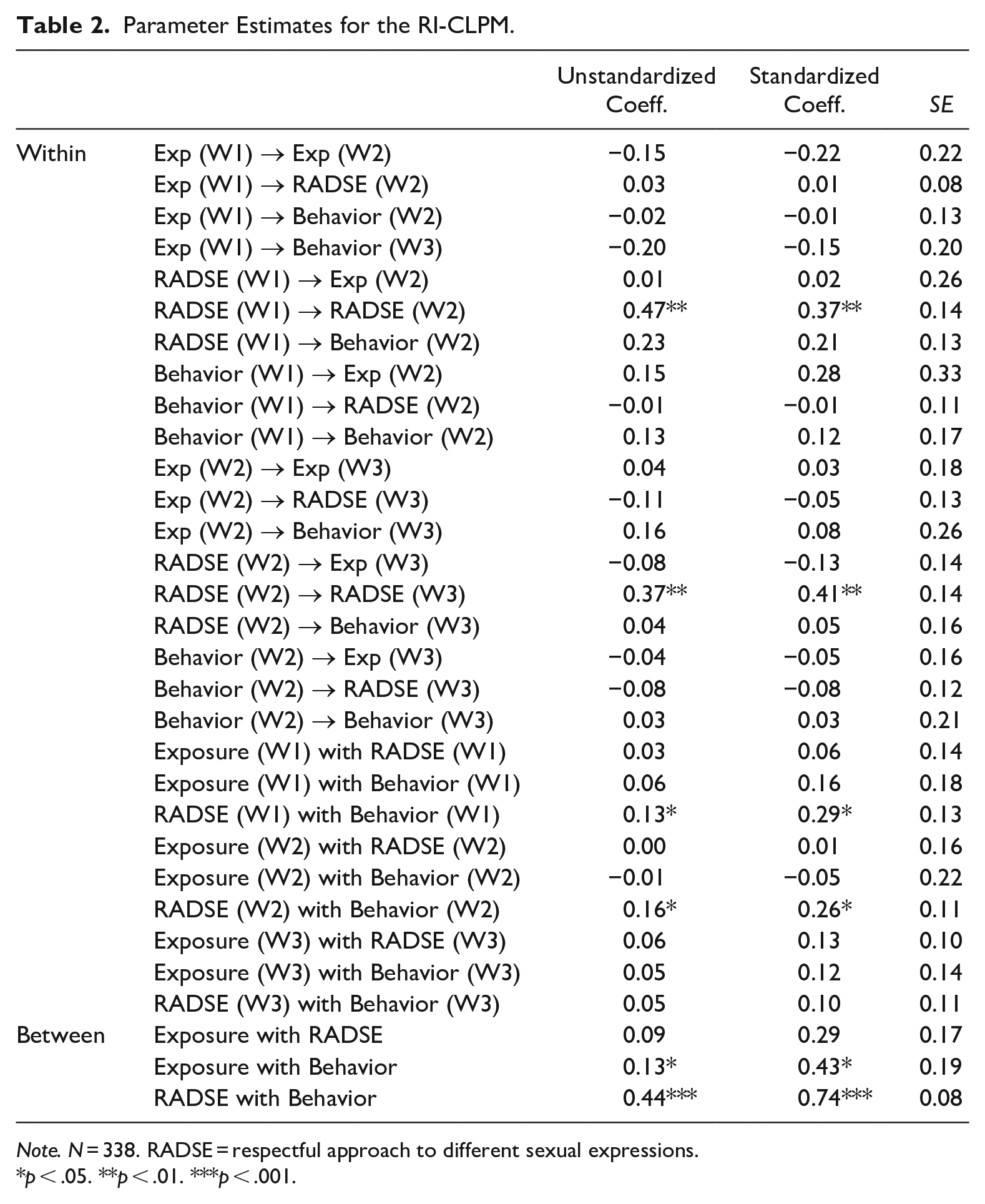
Note. N = 338. RADSE = respectful approach to different sexual expressions.
p < .05. **p < .01. ***p < .001.
Table 2 also shows that at a within-level, only autoregressive relations emerged between heterosexual adolescents’ respectful approach to different sexual expressions at W1 and W2, B = 0.47, β = .37, SE = .14, p < .01, and at W2 and W3, B = 0.37, β = .41, SE = .14, p < 0.01. This result thus indicates that for heterosexual adolescents who experience an increase in their personal level of a respectful approach to different sexual expressions at a certain time point, this level will further increase at a subsequent time point. No autoregressive within-person change was found for e perceived exposure to sex-positive television messages, p > .05, and for the endorsement of supportive behavior toward LGBTQ+, p > .05. Further, no within-person relations were found between perceived exposure to sex-positive television messages, respectful approach to different sexual expressions, and endorsement of supportive behavior toward LGBTQ+. Also, indirect paths of “perceived exposure to sex-positive television messages (W1) → respectful approach to different sexual expressions (W2) → supportive behavior regarding LGBTQ+ (W3)” were tested at a within-person level and indicated non-significance (95% CI = −0.01, 0.01]). Hypothesis one, addressing the over-time relation between perceived exposure to sex-positive television messages and respectful approaches to different sexual expressions was thus not supported at both a between-and within-person level. Hypothesis two, assuming the presence of an indirect relation between perceived exposure to sex-positive television messages with the endorsement of supportive behavior toward LGBTQ+ via a respectful approach toward different sexual expressions was also not supported. Yet, we did find between-group differences for heterosexual adolescents’ perceived exposure to sex-positive television messages and their endorsement of supportive behavior toward LGBTQ+. Further, hypothesis three was not confirmed since no reciprocal relations were found between the main variables of the study.
Sex and Traditional Gender Role Orientation
The chi square difference test pointed to a significant difference in the model’s estimates between boys and girls, Δχ2(36) = 61.01, p < .01. Exploring the path-by-path differences, analyses showed a difference between boys and girls for the link between endorsement of supportive behavior regarding LGBTQ+ at W1 and W2, p < .05. Specifically, this link was only present among boys, B = 0.69, β = .66, SE = 0.24, p < .01, and not among girls, B = −0.36, β = −.29, SE = 0.22, p > .05. Differences between boys and girls for other relations were not found. As for traditional gender role orientation differences, the chi square difference test showed no significant difference between the unconstrained and the constrained RI-CLPM, Δχ2(72) = 70, p > .05. Hence, no differences emerged between adolescents with low, middle, and high traditional gender role orientation regarding the hypothesized model. Contrary to what we assumed in hypothesis 4 (a and b) and hypothesis 5 (a and b), our suggested dynamics between perceived exposure to sex-positive television messages, respectful approach to different sexual expressions, and the endorsement of supportive behavior toward LGBTQ+ were not stronger among girls and among adolescents with low and middle traditional gender role orientation.
Discussion
With the current study, we aimed to fill a notable gap in empirical research regarding the impact of positive television messages about LGBTQ+ over time, particularly in the context of heterosexual adolescents’ formation of ally attitudes and behaviors. It is the first known study to distinguish within-and between-person level relations when exploring these suggested dynamics. At a between-person level, it appears that heterosexual adolescents’ perceived exposure to sex-positive television messages was moderately related to their endorsement of supportive behavior regarding LGBTQ+, but not to their respectful approach to different sexual expressions. The latter was correlated with supportive behavior at a between-person level, though. Thus, our results demonstrate that adolescents who were more regularly exposed to positive messages about LGBTQ+ are more likely to endorse supportive behavior regarding LGBTQ+ than adolescents who watch positive messages less frequently. These findings generally align with a body of studies suggesting that viewing positive television messages positively relates to the integration of the LGBTQ+ community via heterosexual adolescents’ positive approaches to this community (e.g., Bond, 2021; Calzo & Ward, 2009; Gillig & Murphy, 2016) and partially supports Wright’s acquisition and application hypothesis of the 3AM model (2011).
Within-person, cross-lagged estimates shed additional light on these findings. Only autoregressive paths emerged of respectful approach to different sexual expressions, meaning that a heterosexual adolescent who scored above their expected score on this ally attitude at a certain point in time, will experience a further increase in this cognition at a subsequent time point. Yet, there were no associations between heterosexual adolescents’ perceived exposure to sex-positive television messages and ally attitudes and behaviors at a within-level. These findings appear to reflect emerging tendencies in media effect studies, in which within-person change processes appear to be absent in media-related processes that have previously been demonstrated in studies applying between-person analyses (e.g., Coyne et al., 2020). For instance, in their 8-year longitudinal study Coyne et al. (2020) only found positive relations between social media use and mental health challenges at a between-person level but not at a within-per level. Between-and within-person sources of information reflect distinct processes in the current study. The presence of a between-person relation and the absence of within-person relations suggests that there may be other processes at play that more likely explain these findings.
A first explanation may lie in the possibility of a ceiling effect (Wright & Tokunaga, 2015). The non-significant autoregressive paths of perceived exposure to sex-positive television messages and behaviors that support LGBTQ+ point to a form of stability and, thus, an absence of variation in adolescents’ viewing experiences and engagement with supportive behavior. In this view, Slater (2007, p. 289) argues how mutual reinforcement between television effects and selection is ongoing but “will rarely lead to extremes of attitude or behavior.” Instead, media use and associated outcomes remain stable over time. Heterosexual adolescents may thus have become accustomed to positive messages about LGBTQ+ being present on television, which may explain why such messages do not affect changes in their ally attitudes and behaviors. Moreover, adolescents’ levels of respectful approaches to different sexual expressions and endorsement of supportive behavior regarding LGBTQ+ were already relatively high, which likely makes the additional impact of perceived exposure to sex-positive television messages rather minimal. It may be possible that such effects will occur earlier in life when children are younger (e.g., tweens) and are transitioning to adolescence over a longer time than the current study’s 1 year period. Tween television viewers are assumingly more receptive to the impact of positive messages about sexuality (Dajches & Aubrey, 2020). Tweens’ beliefs about LGBTQ are just emerging, and their encounters with LGBTQ+ characters will gradually increase when entering adolescence. Content analytical work shows how LGBTQ+ characters in programs and movies targeted at tweens are still rare (Signorielli & Bievenour, 2015), pointing to a great contrast with the presence of LGBTQ+ characters and positive messages regarding this community in television content targeting adolescents (Maes & Vandenbosch, 2022a). Thus, when tweens transition to adolescence and, thus, view televised content targeted to adolescents, there might be a heightened variation in their perceived exposure to sex-positive television messages. The latter may then result in more prominent changes in these young viewers’ attitudes and behaviors regarding LGBTQ+ youth. Scholars are therefore encouraged to explore the suggested dynamics of this study in a tween sample, transitioning to adolescence over a longer time period.
A second explanation then stems from recent critiques on the uses of RI-CLPM when analyzing changes happening over a long period of time and somewhat contrasts our prior suggestion that the windows of the time studied were too small. Indeed, Lüdtke and Robitzsch (2021) and Orth et al. (2021) point to RI-CLPM redefining the causal estimator at the within-person level by focusing on fluctuations around a person stable mean. Therefore, they suggest that within-person relations may not be detectable over longer time periods. Instead, they may only be present for short-term relations with limited time lags between days or weeks (at most). These two contrasting explanations (i.e., too short time window vs. too long time window to detect within-person effects) highlight how we still need to reach to more conclusive perspectives on the uses of RI-CLPM in longitudinal communication research. We therefore further recommend future research to further apply RI-CLPM in short term data using experience sampling methods in order to more effectively detect possible fluctuations at an intra-individual level between adolescents’ television uses and ally attitudes and behaviors.
Another, possibly crucial factor that needs to be accounted for, is the presence of negative and biased information regarding LGBTQ+ on television (e.g., Kim et al., 2007). With this study, we only paid attention to perceived exposure to sex-positive television messages and thus followed approaches from the previous line of literature singling out exposure to positive or negative television messages regarding sexuality in their studies (e.g., Bond 2021). Though, as shown from recent content analyses, adolescents are not exclusively exposed to positive messages about sexuality when viewing television, nor are they only exposed to negative messages regarding this topic (Kinsler et al., 2019; Maes & Vandenbosch, 2022a). On the contrary, adolescents come across complex and often contradictory messages about LGBTQ+. Messages that can be considered harmful for the LGBTQ+ community, such as characters being mocked for their sexuality, were often followed by characters showing resilience against the mocking (Maes & Vandenbosch, 2022a) and were even part of the storyline challenging negative stereotypes regarding LGBTQ+ communities (Kinsler et al., 2019). Thus, we can question whether singling out exposure to either positive or negative messages truly grasps viewers’ experiences with television.
Attention to Content Heterogeneity
The current television landscape invites researchers to examine content heterogeneity, instead of assuming that in every television program and movie and, even in separate scenes, messages are distributed that are homogenous in their positive and negative value for adolescents’ sexuality. This perhaps even calls for an imperative shift in sexual media effects research in which we acknowledge content heterogeneity and its impact on media users. This heterogeneity approach is not only relevant for sexual television effects research, but can even be applied in communication studies in general, investigating the impact of media forms other than television (e.g., social media, pornography) and topics other than sexuality (e.g., body image, political views). To illustrate, the emerging research efforts of Trekels and Eggermont (2021) delve into the presence of content heterogeneity regarding appearance ideals in media and its impact on adolescents’ ideas of beauty.
When exploring the impact of heterogeneous content on adolescents’ attitudes and behaviors, the literature suggests that scholars need to more closely examine selective attention (Treisman, 1969) and interpretation processes (Steele, 1999). Indeed, the literature indicates that individuals allocate attention to specific content in environments with rich and competing information in order to “make sense”’ of the given information (Treisman, 1969). Further, heterogeneous content is likely to trigger a myriad of interpretations. To illustrate, when exposing students to the same video clips in which sexual messages were embedded, Ward (2002) demonstrated how these clips were generally interpreted in two or three differing and even contradictory ways (e.g., ranging from the promotion of sexual stereotypes to depicting vulnerability of men). Thus, in the context of the current study, how heterosexual adolescents’ ally attitudes and behaviors are affected after viewing heterogeneous messages about LGBTQ+ may be explained by the part of the message the viewer selectively paid attention to and the meaning the viewer chooses. For example, heterosexual adolescents are exposed to a storyline in which a character is being mocked for their sexual orientation, but the mocking is contextualized by the character showing resilience and challenging the negative stereotyping of their sexual orientation. It may be possible that then some adolescents only pay attention to the “mocking” part of the storyline and interpret the storyline about LGBTQ+ in a heteronormative way, which may then negatively affect the construction of ally attitudes and behaviors. Similarly, some adolescents then might pay attention to the contextualizing part in which heteronormativity is countered and interpret the storyline about LGBTQ+ in a progressive way, which may positively affect the construction of ally attitudes and behaviors.
When studying these processes, scholars may further benefit from recognizing what viewers bring to the situation. The main principles of the more recent biographic resonance theory (Klimmt & Rieger, 2021) argues that attention and interpretation are dependent on which element of the content resonates with a viewer’s biography. Heterosexual adolescents’ pre-existing beliefs and past behaviors with regard to LGBTQ+ may play a crucial role in the formation of selective attention and interpretation processes when studying the impact of television content on LGBTQ+. More specifically, the literature points to the significant role of heterosexual adolescents’ closeness of relationships with LGBTQ+ individuals (Collier et al., 2012). Particularly, Collier et al. (2012) show how intergroup contact fosters heterosexual adolescents’ positive attitudes regarding homosexuality and equal rights of LGBTQ+ (Collier et al., 2012). Research is thus advised to especially pay attention to heterosexual adolescents’ intergroup contacts with LGBTQ+ as a potential moderating factor in LGBTQ+ -related television effects.
Further, adolescents’ socio-demographic variables (e.g., sex, gender, educational school track) may also play a crucial role in the formation of selective attention and interpretation processes. In the current study, we recognized viewers’ biographies by exploring sex and gender identity differences and concluded that no differences emerged between boys and girls, and adolescents with low, moderate, and high traditional gender role orientation. The emergence of such non-significant differences appears to be in line with the rich body on sexual media effects demonstrating inconsistencies regarding the conditional nature of sex and traditional gender role orientation (Coyne et al., 2019, Ward et al., 2014). Some studies report sex differences while others report no sex differences (Coyne et al., 2019; Ward et al., 2014). It may be possible that these inconsistencies may be explained by sex and gender identity differences perhaps being more relevant at the level of interpretation and selective attention processes.
Even more, it may perhaps be necessary to acknowledge that each adolescent is unique in their interpretations of and responses to heterogeneous sexuality-related content. The recent emergence of person-specific approaches (Beyens et al., 2021) in communication research address that a focus on group-level differences (e.g., based on gender, and sexual attitudes) can gloss over more unique and subtle individual differences between people. Hence, a person-specific approach that stems from the N = 1 idea might allow researchers to more in-depth identify each adolescent’s unique experiences with media. It should be noted that these reflections are merely suggestive and scholars are encouraged to in-depth examine the role of selective attention and interpretation processes regarding the impact of LGBTQ+ content on television, and its dynamics with viewers’ personal biographies.
Limitations
The current study addresses important gaps in the literature and has a number of strengths, including a rigorous analytical technique and the use of over-time data. Yet, it is not without limitations. First, as previously addressed, the nature of the sample limits the generalizability of the results. The sample was predominantly female (68.6% were girls) and this imbalance can be expected as girls are more likely to participate in longitudinal studies than boys (e.g., Post et al., 2012). The sex imbalance may pose a bias on our sample and limit the generalizability of the current study’s results. Therefore, future work may anticipate the fallout of male respondents by contacting more boys to participate. Relatedly, this study was conducted in Flanders, Belgium, and, therefore, the generalization of the findings in other cultural contexts may be limited. Belgium is known to be a liberal and progressive country with regard to the rights of LGBTQ+, while non-Western countries appear to be more traditional and heteronormative (Poushter & Kent, 2020). Thus, it may be possible that different dynamics emerge when television viewing and ally attitudes and behaviors of a non-Western sample are explored. Additionally, the study relies on self-reported data to measure perceived exposure to sex-positive television messages. Scholars highlight that the uses of self-report data are appropriate when focusing on viewers’ perceived exposure rates (e.g., Verbeij et al., 2021). Yet, when scholars are interested in viewers’ actual exposure rates, it is possible that participants can experience difficulties recalling how frequently they had been exposed to such messages. As such, future research may implement an experimental design to accurately assess actual exposure to sex-positive messages on television and determine the media effect per se. Experience sampling research may further be an interesting venue due to its lower memory bias in reporting about media exposure experiences. We encourage researchers to utilize this method to examine fluctuations in adolescents’ exposure to sex-positive messages and their related attitudes and behaviors.
Conclusions
At a between-person level, it appears that heterosexual adolescents who are more often exposed to positive television messages about LGBTQ+ had a higher endorsement of supportive behavior regarding LGBTQ+, but not higher or lower levels of a respectful approach to different sexual expressions. The within-person results then shed additional light on the data and show that heterosexual adolescents’ own increases/decreases in perceived exposure to sex-positive television messages do not covary with fluctuations in their ally attitudes and behaviors over time and vice versa. Other processes may be at play that more than likely account for the between-person associations. No significant differences were found according to adolescents’ sex and traditional gender role orientation for the suggested relations. Future research is advised to further distinguish between-and within-person level relations when studying sexual media effects and account for the heterogeneity of content.
Supplemental Material
sj-docx-1-crx-10.1177_00936502231191830 – Supplemental material for Longitudinal Relations Between Heterosexual Adolescents’ Perceived Exposure to Sex-Positive Television Messages and Their Supportive Attitudes and Behaviors Toward the LGBTQ+ Community
Supplemental material, sj-docx-1-crx-10.1177_00936502231191830 for Longitudinal Relations Between Heterosexual Adolescents’ Perceived Exposure to Sex-Positive Television Messages and Their Supportive Attitudes and Behaviors Toward the LGBTQ+ Community by Chelly Maes and Laura Vandenbosch in Communication Research
Footnotes
Declaration of Conflicting Interests
The authors declared no potential conflicts of interest with respect to the research, authorship, and/or publication of this article.
Funding
The authors disclosed receipt of the following financial support for the research, authorship, and/or publication of this article: This work was supported by Bijzonder Onderzoeksfonds under grant number C14/18/017.

Supplemental Material
Supplemental material for this article is available online.
Notes
Author Biographies
References
Supplementary Material
Please find the following supplemental material available below.
For Open Access articles published under a Creative Commons License, all supplemental material carries the same license as the article it is associated with.
For non-Open Access articles published, all supplemental material carries a non-exclusive license, and permission requests for re-use of supplemental material or any part of supplemental material shall be sent directly to the copyright owner as specified in the copyright notice associated with the article.
