



Abstract
Sexualization is a prominently studied dimension of how media content contributes to problematic outcomes for women (e.g., self-objectification). In video game contexts, scholars have debated whether portrayals of powerful characters may disrupt undesirable outcomes of sexual objectification. In two studies, we experimentally manipulated sex appeal cues and strength cues in female characters. Participants reported their impressions in terms of key person perception outcomes and liking of the characters. We also aimed to understand how interactivity shapes impression formation by comparing viewing (Study 1) to playing (Study 2) contexts. Results indicated that sex appeal cues and strength cues interacted to shape character impressions but did so differently depending on the type of interaction participants had with the character. In both studies, sexual appeal cues produced greater disliking of the characters. Our discussion considers the findings with respect to character design in video games and other media entertainment.
In entertainment media, portrayals of female characters often emphasize appearance in ways that can encourage their sexual objectification (e.g., Vandenbosch & Eggermont, 2012; Ward, 2016). Critics have long argued that video games often centralize the sex appeal of female characters to the exclusion of characters’ personalities and narratives (e.g., Sarkeesian & Petit, 2019). Moreover, many video games portray female characters with personalities and narratives that include gender stereotypes (e.g., the beautiful damsel in distress; Dill & Thill, 2007; Perreault et al., 2018). When combined with appearance-focused cues, portrayals can characterize female characters in pejorative ways (e.g., Beasley & Collins Standley, 2002) that may contribute to the development or maintenance of sexism (Begue et al., 2017; Blackburn & Scharrer, 2019). For example, games emphasize the sex appeal of secondary female characters more often than they do in depictions of lead characters (Lynch et al., 2016). Such patterns may contribute to impressions of women and girls as having minimal contributions to the game beyond their appearance (e.g., Behm-Morawitz & Mastro, 2009).
However, like other types of popular entertainment media (e.g., superhero action films; Pennell & Behm-Morawitz, 2015), video games often centralize female characters’ physical capabilities. Jansz and Martis (2007) coined the term the Lara Phenomenon, identifying a constellation of characteristics embodied by Tomb Raider’s Lara Croft. They argued that her tough, dominant characterization may appeal to players and contribute to positive impressions of women, potentially even mitigating issues introduced by her sexualized appearance.
Video games do tend to portray physically capable female game characters with sexualized appearances (Lynch et al., 2016). Despite the prominence of these associations in female game character designs, scant research has delved into understanding how cues of strength and sex appeal combine to influence audience’s perceptions of characters. Here we engage and aim to build on theorizing and findings in this area of media psychology and adjacent fields (e.g., Behm-Morawitz & Mastro, 2009; Couture Bue & Harrison, 2019; Pennell & Behm-Morawitz, 2015; Skowronski et al., 2021). In two studies, we experimentally examined how viewers (Study 1) and players (Study 2) perceive female characters in video games that feature the most egregiously sexually objectified characters (i.e., fighting games; Lynch et al., 2016). Within each study, we aimed to understand whether sex appeal cues and strength cues would interact to influence audience perceptions of characters and character liking. Across the two studies, we aimed to understand whether audience perceptions and liking of the characters differed based on the individual’s orientation to the character (i.e., as a viewer versus player).
Female Video Game Character Depictions and Player Perceptions
When encountering onscreen characters, people use cues from the characters’ appearance and behavior to form an impression of them (Lee, 2007; Sanders, 2010). Lee and Sanders ground these processes in social psychological work on person perception (e.g., Cuddy et al., 2008). Person perception typically involves an individual’s observation of the facial features, bodies, voices, and other characteristics of another person. From those cues, people evaluate others, categorize them, and make inferences about their motivations and future behaviors. These perceptual processes inform gestalt impressions that fuel and contextualize social exchange (see Moskowitz & Gill, 2013). Here, we consider two primary cues that we argue heavily shape perceptions of female video game characters; sex appeal cues and strength cues.
Sex Appeal as a Cue for Impression Formation
Video games often present female characters with visual cues that emphasize their sex appeal (e.g., depicting them partially nude, accentuating breasts; Downs & Smith, 2010; Lynch et al., 2016). This tendency contributes to patterns of sexualization. Sexualization “occurs when a person’s value comes only from his or her sex appeal or behavior, to the exclusion of other characteristics; a person is held to a standard that equates physical attractiveness (narrowly defined) with being sexy; a person is sexually objectified—that is, made into a thing for others’ sexual use, rather than seen as a person with the capacity for independent action and decision making; and/or sexuality is inappropriately imposed upon a person” (American Psychological Association [APA], 2007, p. 1). Following the APA’s (2007) definition, in the current work, we conceptualize perceived sexualization as a potential outcome when visual cues emphasize the sex appeal of the character and contribute to their sexual objectification.
Fredrickson and Roberts’ (1997) argue that “when objectified, women are treated as bodies—and, particularly, as bodies that exist for the use and pleasure of others” (p. 175). Playable video game characters are, fundamentally, digital objects that exist for audience use (Lynch et al., 2022). However, when sexually objectified, deleterious outcomes may follow with implications for the social groups the characters portray. For example, Behm-Morawitz and Mastro (2009) experimentally examined how sexual objectification of a female video game character influenced players’ short-term beliefs about women’s capabilities. Their results indicated that time spent playing with a character who had a sexualized appearance predicted less favorable judgments of women’s cognitive abilities. Furthermore, among women in their sample, playing as a character whose appearance emphasized sex appeal undermined women’s beliefs about their own and other women’s physical abilities.
Scholars continue to study character representations in media partly because character portrayals can influence attitudes towards represented social groups (Saleem et al., 2023). Media influence attitudes most powerfully when audiences recognize the portrayed character as typical of the group (Hewstone & Brown, 1986). This category-based process occurs when characters have qualities that facilitate grouping with similar others and audiences see that character as representative of the group (Zillmann, 1999). Audiences who encounter a female character and perceive her as congruent with their expectations of women would engage in category-based impression formation with group-relevant outcomes potentiated (Sanders, 2010).
Women who others perceive as aligning with expectations of their social group may be described as feminine. How societies understand and form expectations of men and women comprises its definitions of masculinity and femininity, respectively (Bem, 1981). Fredrickson and Roberts (1997) argue that “the sexual objectification of the female body has clearly permeated our cultural milieu” (p. 177) making it a commonality of how others evaluate and view women. Thus, depictions of female characters that emphasize their sex appeal function in two ways. First, emphasizing secondary sexual characteristics such as breasts and narrow waists paired with wide hips signals female anatomy unambiguously (Lynch et al., 2016). Second, sex appeal cues convey alignment with idealized femininity in a “culture saturated with heterosexuality” (Fredrickson & Roberts, 1997, p. 175). Together, more sex appeal cues in female video game character portrayals should encourage impressions of the character’s femininity.
Yet, incorporating sex appeal cues may discourage acceptance of character portrayals. Contemporary audiences seem to dislike content rife with the sexual objectification of women, despite its prominence in video games. This dislike seems especially true for women themselves, some of whom avoid games entirely for this reason. For instance, in an experiment comparing preferences for games featuring sexualized and non-sexualized female protagonists, Hartmann and Klimmt (2006) reported that women reported greater dislike of the game with the sexualized character. Character liking is an important predictor in potentiating effects from encounters with media characters (e.g., Nathanson et al., 2002; Raney, 2004). Mixed evidence exists regarding how much audiences like characters depicted in ways that emphasize overgeneralized attributes thought to be indicative of an entire social group (i.e., stereotyped characters). For instance, Bonus et al. (2022) had mothers read an educational story about occupations to their children. The stories featured either a male or female protagonist who was interested either in a science, technology, engineering, or math (STEM) or health, early education, and domestic role (HEED) career. The results indicated that mothers viewed the STEM stories more favorably when the protagonist was female. The authors concluded that these counter-stereotypical portrayals (i.e., a girl interested in STEM) generated character liking. Here, we anticipate that emphasis of female video game characters’ sex appeal would produce a similar effect in that people will view it as stereotypical and dislike characters portrayed in this way.
To summarize, cues that emphasize the sex appeal of female video game characters contribute to their sexual objectification. Sex appeal cues also shape perceptions that characters align with the heterosexual norms that undergird culturally dominant conceptions of femininity, but likely produce less liking of these characters. Accordingly, we predict that, compared to characters with few sex appeal cues, participants will perceive characters with many sex appeal cues as more sexualized (H1a), more feminine (H1b), and less likable (H1c).
Strength as a Cue for Impression Formation
Many video games incorporate themes of power, dominance, and capability into their portrayals of female characters (Jansz & Martis, 2007). Here we summarize the terms scholars often invoke to describe a female character’s power (e.g., capability, strength) using the sociobiological concept of formidability (Gilbert et al., 2023; Parker, 1974). Formidability nests under the broader construct of dominance, which itself is one form of the superordinate construct of power (cf. Burgoon et al., 1998). Humans are well adapted to accurately recognize and use strength cues to assess another person’s formidability (Sell et al., 2008). In video games, formidability is defined as characters’ apparent physical strength, force, or power; signaled through bodily cues (e.g., musculature; relative size) and body augments (e.g., armor, weapons; Gilbert et al., 2023).
Formidability is just emerging as a theoretical concept in communication and most work in the field has considered its relevance in men’s representations. However, researchers outside of communication have applied the concept to study perceptions of women. Palmer-Hague et al. (2018), for example, used formidability cues of female professional fighters to predict judgments of the fighters’ aggressiveness and likelihood to win bouts. Sell et al. (2008) demonstrated across multiple studies that participants could accurately estimate a target individual’s strength when given photos of them regardless of whether the targets were men or women.
Thus, because strength cues signal important information about a character’s physical abilities, they should contribute to impressions of character formidability. Although formidability is applicable to women, this concept has relatively greater alignment with dominant cultural notions of masculinity. Many gender stereotypes align women/femininity with personality characteristics of communion (e.g., nurturance) and men/masculinity with agency (e.g., self-reliance; Hsu et al., 2021). Indeed, the agentic dimension of Bem’s (1974) taxonomy evokes qualities closely aligned with formidability (e.g., athleticism, dominance, aggressiveness).
If strength cues contribute to perceptions of a less feminine character, then it is likely that audiences would perceive strong characters as less stereotypical. Following Bonus et al.’s (2022) logic, less stereotypical portrayals of female characters may prompt character liking. Depictions that signal a character’s ability to engage in physical feats may give impressions of an empowered character who cannot be thwarted by physical challenges or dominated by others. Indeed, women game players have reported liking strong female characters (Royse et al., 2007).
To summarize, visual cues that emphasize the strength of a video game character should contribute to their formidability. Strength cues also shape perceptions of a character’s departure from the heterosexual norms that undergird culturally dominant conceptions of femininity, but likely produce more liking of these counterstereotypical characters. Accordingly, we predict that, compared to characters with few strength cues, participants will perceive characters with many strength cues as more formidable (H2a), less feminine (H2b), and more likable (H2c).
Interactions of Sex Appeal Cues and Strength Cues on Character Perceptions
Audiences initially process information conveyed in digitally mediated channels similarly to non-digital channels. Sanders (2010) proposes that, when perceiving characters, audiences form initial impressions based on appearance cues. New information delivered through encounters with a character incorporates into character impressions with two potential outcomes. First, new information may align with the perceiver’s initial categorization leading to confirmatory, category-based impressions. However, if new character information does not correspond with the category, then the perceiver would engage in more elaborative processing of the information. In this situation, Sanders proposes that audiences attempt to reconcile the new information with the original impression. It remains unclear how audiences reconcile information that simultaneously offers competing cues for impression formation.
Drawing from Nussbaum’s (1995) identification of properties through which objectification occurs, Roberts et al. (2018) write that “women portrayed in sexualized ways are denied subjectivity, agency, and qualities of personhood” (p. 256). Formidability cues, instead, contribute to perceptions of a target as capable of action and feats of strength (Sell et al., 2008). Thus, strength cues may reduce objectification by enhancing perceptions of agency and minimizing other perceptions such as the character’s violability (i.e., treatment of a person as a thing to violate; Nussbaum, 1995). With respect to how they shape character perceptions, both sex appeal and strength cues have relevance as they signal potential opportunities and threats, respectively.
Research by Pennell and Behm-Morawitz (2015) offers insights on how these cues may interact. Specifically, they experimentally tested how viewing sexualized female characters cast as either a victim or a heroine in an action film affected viewers’ subsequent gender role beliefs and body cognitions. Those who viewed a sexualized victim demonstrated less egalitarian gender role beliefs compared to participants in a control condition who did not view media (Pennell & Behm-Morawitz, 2015). To put this finding in our terms, the lack of strength conveyed through the victim role contributed to perceptions of a less formidable character. Also, participants who viewed a sexualized heroine felt that body competence (e.g., strength) was an important aspect of their self-concept compared to participants in the control condition. The authors argued that the characters’ strength cues may have primed viewers to perceive the character as competent and promoted positive outcomes for viewers (Pennell & Behm-Morawitz, 2015).
Critical scholars have advanced a different line of argumentation about the interaction of sex appeal cues and strength cues that may bear out in empirical observations. Heldman and Cahill (2007) coined the term fighting fuck-toy (FF-T) to describe the “contemporary female protagonist [who] is strong, autonomous, independent, and able to ‘kick ass’ and kill” (p. 9). Unlike the empowering Lara Phenomenon (Jansz & Martis, 2007), the FF-T is problematized as legitimizing hypersexuality through (superhuman) power. Heldman and Cahill (2007) argue that the ostensibly positive themes of power (i.e., strength) would compound objectification caused by emphasizing the character’s body in a sexual way. Other authors have advanced similar arguments, likening powerful characters’ bodies to weapons in and of themselves (Tompkins et al., 2020). If this were the case, we would expect that sex appeal cues and strength cues would interact to enhance perceptions of sexualization and diminish perceptions of formidability even if strength cues were present. Given the diverging predictions regarding these interactions, we pose our first research question: Will sex appeal cues and strength cues interact to predict perceptions of character sexualization (RQ1a) and formidability (RQ1b)?
It seems likely that sex appeal cues and strength cues will also shape perceptions of femininity. Equating biological anatomy and gender undergirds idealized notions of gender (Glick & Fiske, 2001); accordingly, sex appeal cues should contribute to perceptions of femininity and strength cues (e.g., emphasized muscle tone) should detract from perceptions of femininity. How these factors interact is less clear. Content designers often portray characters to encourage audiences toward specific and consistent impressions based on cues (Sanders, 2010). Most female character depictions provide cues (e.g., names, clothing) beyond their bodies to signal gender. However, physically strong women are often portrayed with emphasis to their sex appeal, possibly “to balance their masculine traits of physical capabilities” (Pennell & Behm-Morawitz, 2015, p. 214). Thus, it may be the case that these cues interact to balance one another out with respect to perceived femininity.
Like perceptions of femininity, it seems possible that sex appeal and strength cues will interact to distinguish character liking. Certainly, advertisers have hoped to capitalize on images of sexy, empowered women. In work motivated by the presence of such themes, Couture Bue and Harrison (2019) conducted two experiments aimed at understanding women’s potential empowerment after viewing messages emphasizing women’s empowerment (i.e., overtly challenging gender stereotypes), messages emphasizing appearance (i.e., overtly endorsing beauty ideals), or non-advertising controls. Of specific relevance to our current research, Couture Bue and Harrison had research assistants evaluate participants’ apparent empowerment during a speech-giving task after the participants had viewed an experimental stimulus. The assistants reported that the participants who had viewed empowering, beauty-oriented ads exuded more confidence (e.g., greater command) than those who had seen traditional (i.e., not empowerment focused) beauty-oriented ads. Thus, seeing ostensibly empowering images of women even with emphasized sex appeal may contribute to positive outcomes. Yet, as with perceptions of their femininity, it is unclear whether strength cues will simply balance out the presence of sex appeal cues.
To summarize, sex appeal and strength cues likely interact to differentiate perceptions of characters, but it is not entirely clear how. Thus, we ask: Will sex appeal cues and strength cues interact to predict perceptions of character femininity (RQ2) and character liking (RQ3)?
Introduction of Studies: Contexts of Viewing Versus Playing
A robust body of evidence supports that objectifying entertainment media can influence perceptions of targets in problematic ways both for the groups represented and individuals in the audience (see Ward et al., 2023 for review). However, evidence is mixed on the consistency of these effects for video games. For instance, in an experiment that manipulated cognitive load in addition to the sexualized appearance of avatars, Read et al. (2018) found no differences in self-objectification for participants who played as sexualized compared to non-sexualized avatars. The cognitive load manipulations also did not differentiate self-objectification. Similarly, Skowronski et al. (2021) did not detect differences in self-objectification outcomes when experimentally manipulating the sexualized appearance of researcher-provided or participant-customized avatars. In both the Read et al. (2018) and Skowronski et al. (2021) studies, the authors speculated that strong or capable characterizations combined with the “active handling of the character” (Skowronski et al., 2021, p. 8) may have disrupted rather than potentiated self-objectification. Other scholars have also conjectured that strong portrayals could offset negative effects of interaction with sexualized characters (e.g., Behm-Morawitz & Mastro, 2009; Jansz & Martis, 2007; Matthews et al., 2016), yet to our knowledge this possibility remains untested.
One of Sanders’ (2010) central premises in how audiences form impressions of characters is that there are two distinct parties involved: the perceiver (audience) and the target (character). However, playable video game characters complicate this distinction. Video games feature high opportunities for interactivity, in which players co-create experiences (Klimmt & Possler, 2019). Furthermore, many video games translate player agency into a character’s digitally rendered body (i.e., an avatar; Lynch et al., 2022). This translation of agency can reduce the player’s sense that the character is a distinct entity and encourages psychological merging of the self and the character (Klimmt et al., 2009). Accordingly, it is possible that perceptions of the character when played as may be distinct from contexts in which the character is viewed.
In the past, it was relatively rare that people would experience video game characters without directly controlling them. Such instances were largely limited to times of co-playing or co-viewing (Consalvo, 2017). However, today this distinction is highly relevant because of the popularity of watching others play video games via streaming (e.g., Twitch) and video-hosting repositories (e.g., YouTube) online. So, across both studies, we ask: Will the interactive context of character presentation distinguish character perceptions (RQ4a) and liking (RQ4b)?
Study 1 Methods
Participants
An a priori power analysis using G*Power stipulating ANOVA; Repeated measures, within-between interaction F-test with an alpha probability of .05, power of .80, two groups, four measurements, .5 correlation among repeated measures, and a nonsphericity correction ε of .5 indicated that 222 participants would be sufficient to detect small effects (f = .10). Undergraduate students (n = 265) in a communication program at a large, public university in the Midwestern United States participated in this study in exchange for course credit. We removed participants who did not complete the study (n = 15), who were extreme outliers for time to complete the study (n = 6), and who exceeded three standard deviations above the average viewing time for the stimuli (i.e., Mseconds = 290.68, SD = 86.54; n = 5). The final sample included 239 participants whose ages ranged from 18 to 51 years (M = 20.07, SD = 3.39). Most participants self-identified as women (nwomen = 174, nmen = 64, nno response = 1). Participants indicated their primary race as Eastern Asian (n = 56), South Asian (n = 8), Black/African descent (n = 14), Hispanic/Latina/o/x (n = 6), Middle Eastern (Arab; n = 1), Middle Eastern (Non-Arab; n = 2), White/European descent (n = 147), or other (n = 5).
Design and Procedure
We used a 2 (sex appeal: few cues, many cues) × 2 (strength: few cues, many cues) experiment with multiple character design messages (×2). Sex appeal was a between-subjects factor with random assignment (nfew sex appeal cues = 123, nmany sex appeal cues = 116). Strength and character design messages were within-subject factors. Participants completed the study online via Qualtrics. After consenting, participants received an explanation of the protocol. They then viewed four randomly presented videos. Depending on which randomly assigned sex appeal cues condition the participant received, they either saw characters with many sex appeal cues or few sex appeal cues. Within that assigned manipulation, the participants saw two character designs with few strength cues and two character designs with many strength cues. They answered corresponding questions after each video. Following the video viewing portion, we asked them to evaluate the game featured in the video. Next, they selected one of eight characters (i.e., all the characters created for this study) presented in still images that they would select if they could play the game at that moment. Finally, participants responded to demographic questions, provided feedback if desired, and exited the study.
Stimuli
To increase generalizability and reduce the likelihood that a single media message produced the observed outcomes, we created two versions of each condition’s characters (e.g., two characters with few strength cues and few sex appeal cues) using the custom character design tool in SOULCALIBUR VI (SCVI). The criteria established by Lynch et al. (2016) guided the sex appeal manipulations. Characters with many sex appeal cues appeared with disproportionately large breasts, lower hip-to-waist ratios, and more revealing dress (e.g., cleavage exposed) than the characters with few sex appeal cues. Similarly, we followed the criteria established by Gilbert et al. (2023) for the strength manipulations. Characters with many strength cues appeared with larger bodies, emphasized musculature, taller height, and larger weapons than characters with few strength cues. Images of the characters appear in Figure 1. Research assistants recorded themselves playing one round of the fighting game. In each round, one assistant used a customized female character and the other used a default male character. In all conditions, the assistant using the female character won the round. Each round lasted approximately 1 min. An example image taken of the video appears in Figure 2, but examples of every character’s appearance in the video are available as online supplements (https://osf.io/ryt7v/?view_only=1354655435784194aa55198b4d1150a8).

Study 1 images of stimuli and descriptives for dependent measures by condition.
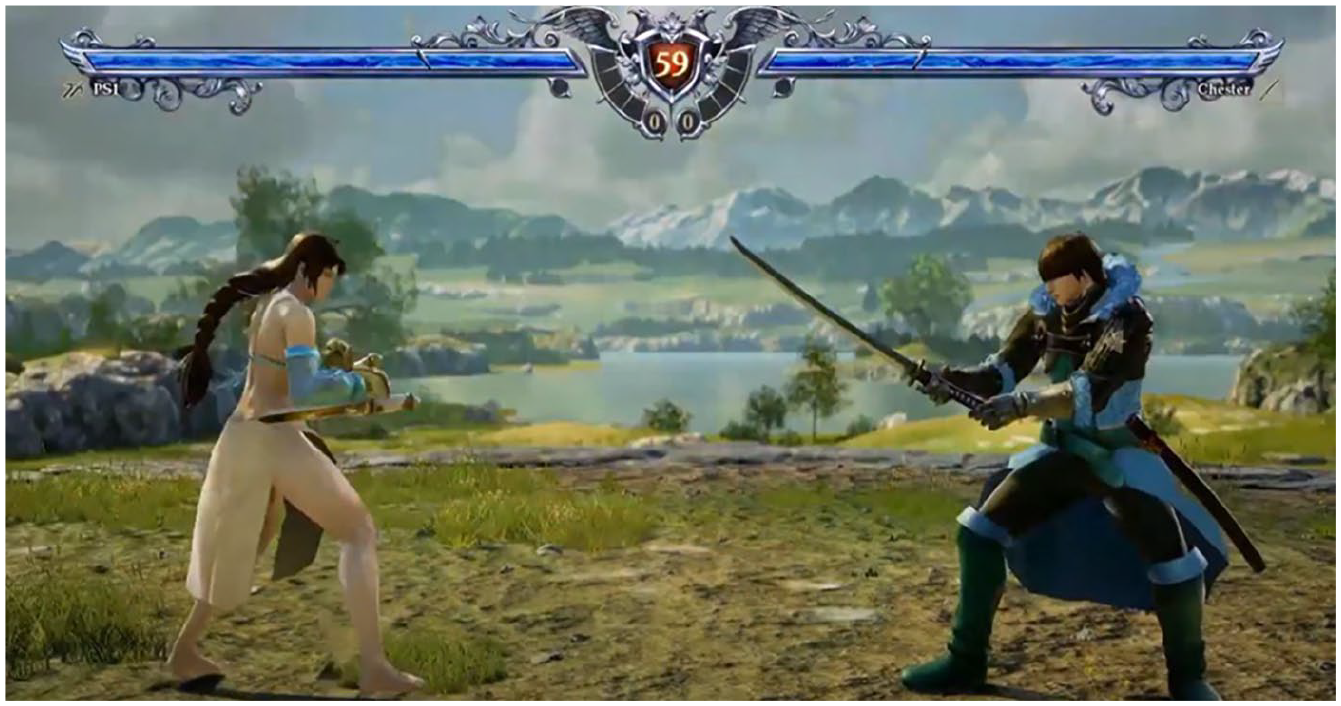
Example image of Study 1 video stimulus.
Measures
Figure 1 includes means, standard deviations, counts, and reliabilities for the measures. Participants reported their perceptions of characters’ sexualization by responding to four items (e.g., the female character’s clothing was revealing), perceptions of characters’ formidability by responding to four items (e.g., the female character was strong), and perceptions of characters’ femininity by responding to four items (e.g., the female character appeared quite feminine) on 1 (strongly disagree) to 7 (strongly agree) scales. Complete measure items for all character perceptions are available as an online supplement available here: https://osf.io/ryt7v/?view_only=1354655435784194aa55198b4d1150a8. For both the sexualization and femininity measures one item in each measure reduced reliabilities and, accordingly, we removed those items. We used two outcomes to assess character liking. First, we asked participants to respond to two items (e.g., I would like to play as this character) on a 1 (not at all) to 5 (very much) scale. Second, we assessed liking by asking participants to select a character. We gave participants a prompt stating “Now, imagine that you have the chance to actually play the game that you just finished watching videos from. Which of the eight characters below would you select to play as if we asked you to play the game right now?” Participants then selected the character by clicking a radio button just below an image of the character (0—not selected; 1—selected). We collapsed the eight characters into the four conceptual categories produced by the cues manipulations and summed selections to produce a ratio-level outcome variable.
Participants self-reported their age, gender, and race. Participants also reported the number of hours they spent playing video games each day of the week, which we averaged across the seven days (1—less than one hour to 7—six or more hours). Participants reported spending minimal time playing video games on average during the week (M = 1.64, SD = 0.91).
Study 1 Results
Analysis Plan
We conducted a series of mixed factorial, repeated measures ANOVA to test hypotheses and answer the research questions. These models included the sex appeal cues condition as a between-subjects factor and both strength cues condition and message as within-subjects factors. We entered participants’ self-reported gender in the model as a covariate and examined differences in reports between self-identified women and men when gender emerged as significant.
To examine interactions, we calculated estimated marginal means for outcomes observed based on the interactions of the sex appeal and strength cues factors for post hoc pairwise comparisons using Bonferroni adjustment. Because the message factor did not produce any significant main effects, we do not interpret distinctions by message in our results. Accordingly, the estimated marginal means reported represent the average calculated across message conditions for each interaction of the primary experimental factors. To address hypotheses and research questions assessing the character selection operationalization of character liking, we conducted frequency and chi-square analyses.
Findings
Our first analysis examined if our sex appeal cue manipulations would predict perceived sexualization (H1a) and if sex appeal cues would interact with strength cue manipulations to predict perceived sexualization (RQ1a). Supporting H1a, we observed a main effect of sex appeal cue manipulations on perceived sexualization, F(1, 233) = 204.06, p < .001, η2 = .252. Participants who saw characters with many sex appeal cues perceived them as more sexualized (M = 4.70, SE = .08) than those participants who viewed characters with few sex appeal cues (M = 3.08, SE = .08). Answering RQ1a, the cue manipulations interacted to influence perceived sexualization, F(1, 233) = 20.99, p < .001, η2 = .005. Pairwise comparisons indicated that each condition was significantly distinct in shaping perceptions of sexualization (all ps < .008). Specifically, participants who viewed characters with many sex appeal cues perceived those with many strength cues as more sexualized (M = 4.81, SE = .09) than those with few strength cues (M = 4.60, SE = 0.09). Similarly, participants who viewed characters with few sex appeal cues perceived those with few strength cues as more sexualized (M = 3.21, SE = 0.09) than those with many strength cues (M = 2.94, SE = 0.09). Driven by the main effect of sex appeal cues, differences emerged in perceptions of sexualization across this between-subjects factor such that participants reported those with many sex appeal cues and many strength cues as the most sexualized followed by those with many sex appeal cues and few strength cues, then those with few sex appeal cues and few strength cues, and finally few sex appeal cues and many strength cues (see Figure 3).

Study 1 perceived sexualization by experimental condition.
Our next analysis examined if our strength cue manipulations would predict perceived formidability (H2a) and if strength cues would interact with sex appeal cue manipulations to predict perceived formidability (RQ1b). Supporting H2a, we observed a main effect of our strength cue manipulations on perceived formidability, F(1, 234) = 5.48, p = .020, η2 = .001. Irrespective of the sex appeal cues conditions, participants reported perceiving characters with many strength cues as more formidable (M = 6.07, SE = 0.05) than characters with few strength cues (M = 5.63, SE = 0.05). Answering RQ1b, the manipulations did not interact to influence perceptions of formidability, F(1, 234) < 1, p < .77, η2 < .001.
Our next analysis examined if our sex appeal manipulations (H1b), strength cue manipulations (H2b), or their interaction (RQ2) would predict perceived femininity.
Supporting H1b, the sex appeal cue manipulations produced a main effect on perceptions of character femininity, F(1, 235) = 41.93, p < .001, η2 = .06. Participants who viewed characters with many sex appeal cues perceived the character as more feminine (M = 4.10, SE = 0.08) than those with few sex appeal cues (M = 3.37, SE = 0.08). Although nearing significance, the data did not support H2b. Strength cue manipulations did not have a main effect on perceptions of character femininity, F(1, 235) = 3.10, p = .080, η2 = .001. Answering RQ2, the cue manipulations interacted to influence perceived femininity, F(1, 235) = 5.28, p = .02, η2 = .002. Specifically, participants who viewed characters with many sex appeal cues perceived characters with few strength cues as more feminine (M = 4.44, SE = 0.09) than those with many strength cues (M = 3.76, SE = 0.09). Similarly, participants who viewed characters with few sex appeal cues perceived those with few strength cues as more feminine (M = 3.86, SE = 0.09) than characters with many strength cues (M = 2.88, SE = 0.09). Differences in characters’ perceived femininity also emerged between participants who saw characters with few and many sex appeal cues. Specifically, participants who saw characters with many sex appeal cues and few strength cues perceived them as more feminine than both those who saw characters with few sex appeal cues and few strength cues and those who saw characters with few sex appeal cues and many strength cues. Finally, participants who saw characters with many sex appeal cues and many strength cues perceived them as more feminine than those who saw characters in the few sex appeal cues condition with many strength cues. Each of these pairwise comparisons emerged as significant (all ps < .001; see Figure 4). Characters featuring few sex appeal cues and few strength cues and those with many sex appeal cues and many strength cues did not produce distinct perceptions of femininity (p = 1.00).

Study 1 perceived femininity by experimental condition.
Our next analysis examined if our sex appeal manipulations (H1c), strength cue manipulations (H2c), or their interaction (RQ3) would predict character liking. Supporting H1c, the sex appeal cue manipulation produced a main effect on character liking, F(1, 235) = 6.23, p = .013, η2 = .011. Participants who saw characters that had few sex appeal cues reported greater liking of these characters (M = 3.17, SE = 0.09) than those with many sex appeal cues (M = 2.85, SE = 0.09). Support did not emerge for H2c; strength cue manipulations did not differentiate character liking, F(1, 235) = 2.78, p = .097, η2 = .001. Answering RQ3, the cues manipulations did not interact to distinguish participants’ liking of the characters, F(1, 235) < 1, p = .565, η2 < .001.
Participant gender emerged as a significant factor in the model of character liking, p < .001, η2 = .020. Accordingly, we conducted a follow-up analysis splitting the dataset by gender to determine whether this factor differentiated the patterns we observed. This follow-up analysis indicated that, although both men and women preferred characters with few sex appeal cues (Mmen = 2.80, SE = 0.15; Mwomen = 3.30, SE = 0.11) compared to characters with many sex appeal cues (Mmen = 2.51, SE = 0.17; Mwomen = 2.98, SE = 0.11), this effect was driven by women, F(1, 172) = 4.59, p = .034, not by men, F(1, 62) = 1.63, p = .201. No other differences emerged when considering the patterns by gender.
In a final analysis of character liking, we explored if the sex appeal and strength cue manipulations would interact to predict character selection. Participants selected characters with many strength cues and few sex appeal cues most frequently (n = 72; 30.3%). Participants selected characters with many sex appeal cues and few strength cues second most (n = 65; 27.3%) and then characters with few sex appeal cues and few strength cues (n = 50; 21%). They selected characters with many sex appeal cues and many strength cues least often (n = 47; 19.7%). Considering gender differences in character liking, we also considered these selection patterns by gender. A chi-square analysis indicated that participant gender differentiated selection patterns, χ2(1, 234) = 9.77, p = .021 (see Figure 5). Specifically, when considering proportions of selections within gender group, men tended to select characters with few sex appeal and many strength cues (45.3% selected) and tended not to select characters with many sex appeal and few strength cues. Women tended to select characters with many sex appeal cues and few strength cues more than other character types (29.9% selected).
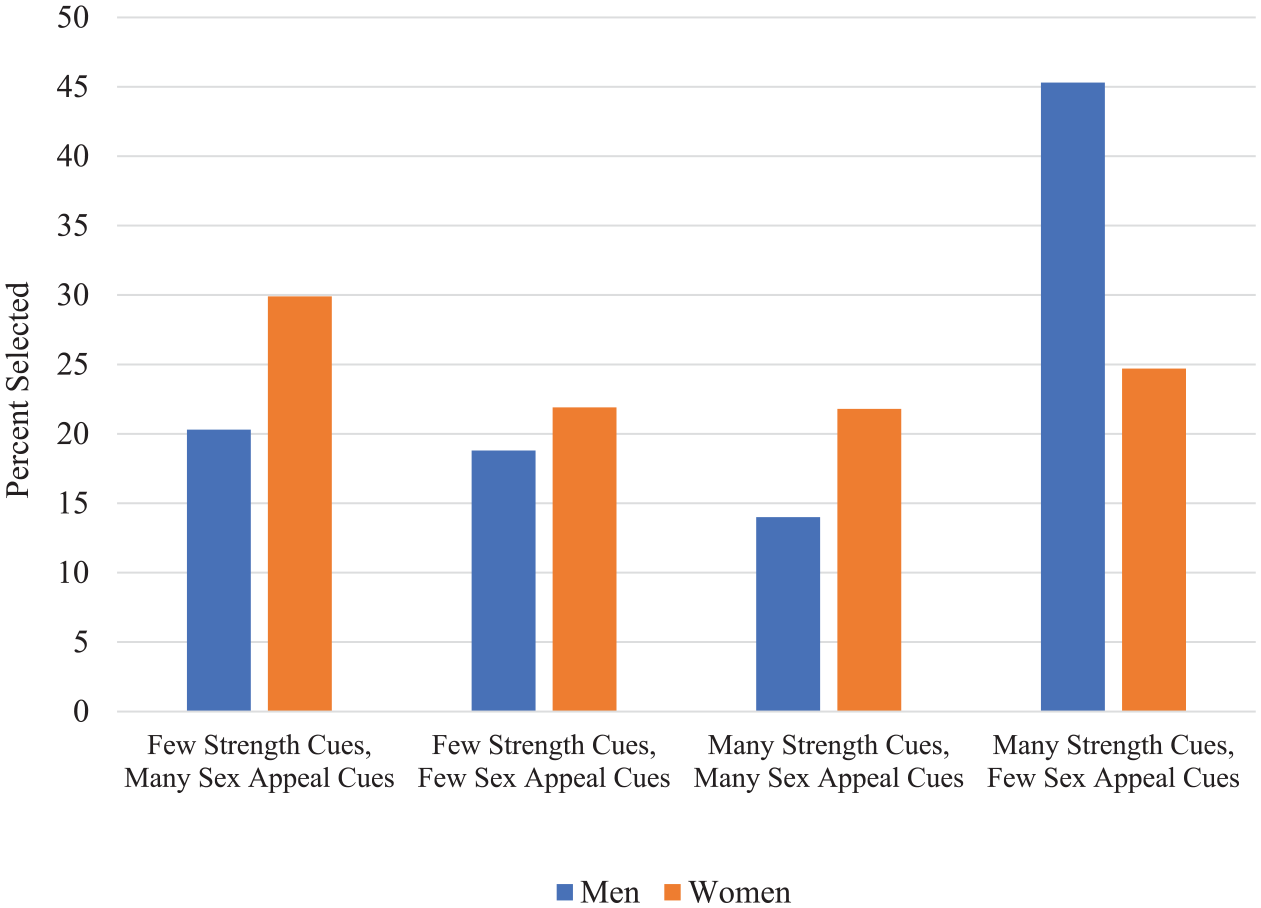
Study 1 selection of characters by women and men.
Study 1 Discussion
The data from Study 1 provided evidence that when viewing characters, sex appeal and strength cues have expected main effects on perceived sexualization and formidability. This set of findings validates the frameworks advanced through content analyses aimed at identifying video game cues of sexualization (i.e., Lynch et al., 2016) and formidability (i.e., Gilbert et al., 2023). Specifically, as compared to character designs that include few of these cues, participants perceived characters with many of the cues as distinctly portrayed. The cues also interacted to distinguish perceptions of sexualization, but not formidability. Notably, participants perceived characters with many sex appeal cues and many strength cues as the most sexualized of all characters, even compared to those characters with many sex appeal cues but few strength cues. Scholars have argued that the strong portrayals of female characters in video games may serve to offset deleterious outcomes caused by their emphasized sex appeal (e.g., Jansz & Martis, 2007). Our results, however, suggest that the incorporation of strengths cues does not offset and, instead, emphasizes perceptions of sexualization. At least when viewing these characters, strength cues seem to encourage perceptions of the character that align more with heightened objectification (i.e., a fighting fuck-toy; Heldman & Cahill, 2007).
Sex appeal cues influenced perceptions of the characters’ femininity and, although there was not a main effect of strength cues on perceptions of character femininity, the cues did interact in meaningful ways. The data support the argument that scholars (e.g., Pennell & Behm-Morawitz, 2015) have made about how the inclusion of sex appeal cues might function with respect to strong female characters. Specifically, participants perceived characters portrayed via our manipulations as strong and lacking overt sex appeal as the least feminine. Yet, the inclusion of sex appeal cues in their portrayal contributed to perceptions of their femininity. Participants perceived strong characters with obvious sex appeal as more feminine. Thus, it seems that sex appeal does function to encourage perceived alignment with traditional gender norms.
Sex appeal cues, but not strength cues, predicted character liking and participants (especially those identifying as women) reported less liking of characters who were sexualized in this way. Strength cues also did nothing to offset the disliking participants reported of characters with overt sex appeal cues in their portrayal. However, when given a variety of characters to choose from, women tended to select characters featuring many sex appeal cues and few strength cues. Men, on the other hand, tended to avoid these characters and opted instead for strong characters lacking overt sex appeal. It is possible that women were simply opting for characters they perceived as the most feminine or otherwise normatively aligned with their affiliated social group. Men in the sample had played video games more often in the past compared to women. 1 It is possible that men, accordingly, applied heuristics with greater frequency than women in selecting a strong character for the fighting game (Gilbert et al., 2023).
In Study 2, we had participants embody characters as avatars to determine whether the experience of playing as them would produce distinct patterns in perceptions of them. Because of the differences noted here by participant gender, we opted to consider gender as a moderator rather than control for it in our models in Study 2. We also aimed to extend our observations in Study 1 by adding warmth and competence as characteristics that might vary and contribute to character perceptions.
Digitally presented video game characters are not human, but often appear as approximations of humans and with human-like features (Banks, 2017). Accordingly, variations in their attributes may influence perceptions of their personhood (e.g., their warmth and competence; Fiske et al., 2002). People perceive others’ warmth by determining their intentions and their competence as their capacity to enact those intentions (Cuddy et al., 2008). Warmth predicts the valence of interpersonal judgements (Wojciszke et al., 1998) and is associated with traits such as morality, trustworthiness, and kindness (Cuddy et al., 2008). Competence, on the other hand, predicts the extremity of interpersonal judgements (Wojciszke et al., 1998) and is associated with efficacy, skill, and confidence (Cuddy et al., 2008).
Objectified individuals are denied qualities that contribute to perceptions of them as a person (e.g., having a mind, being capable of feeling; Nussbaum, 1995). This tendency seems relatively easy to evoke; indeed, presenting participants with prompts to focus on appearance can reduce perceptions of a target’s warmth and competence compared to performance-focused prompts (Heflick et al., 2010). Similarly, Loughnan et al. (2010) found that compared to a non-objectified control, sexually objectifying a target reduced perceptions of her personhood by diminishing attributions of her mind, experiences, and agency. Eye tracking data has revealed that emphasizing a person’s sexual appearance encourages attention away from regions of the body that convey social and emotional information (i.e., the face), rendering the target as more object-like than human-like (Gervais et al., 2013; Hollett et al., 2020).
Accordingly, cues that contribute to sexual objectification should reduce perceptions of characters’ warmth and competence (Harris & Fiske, 2006; Heflick et al., 2010). Because strength cues contribute to perceptions of formidability, which signals someone’s perceived ability to physically dominate others, we would anticipate strength cues to decrease perceptions of warmth and increase perceptions of competence. However, highly dominating characterizations may render a character and her body to the status of an (albeit dangerous) object (e.g., Heldman & Cahill, 2007; Tompkins et al., 2020). When combined with sexualization, this effect may be pronounced. Accordingly, the question of how strength cues would influence perceptions of personhood by way of warmth and competence remains open.
Thus, in Study 2 we advance an additional set of hypotheses and a research question regarding warmth and competence perceptions. We predict that, compared to characters with few sex appeal cues, participants will perceive characters with many sex appeal cues as less warm (H3a) and less competent (H3b). We predict that, compared to characters with few strength cues, participants will perceive characters with many strength cues as less warm (H4a) and more competent (H4b). Finally, we ask whether sexual appeal cues and strength cues will interact to predict perceptions of warmth (RQ5a) and competence (RQ5b).
Study 2 Methods
Participants
We conducted an a priori power analysis using G*Power. We stipulated ANOVA; Fixed effects, special, main effects, and interactions F-test with an alpha probability of .05, power of .80, numerator df of 1, and eight groups. The analysis indicated that 403 participants would be sufficient to detect small effects (f = .14). Undergraduate students (n = 438) uninvolved in Study 1 from the same institution participated in this study in exchange for course credit. Participants were 18 to 37 years of age (M = 19.83, SD = 2.26) and predominately identified as women (nwomen = 295; nmen = 140). Participants indicated their primary race as Asian (Eastern; n = 91), Asian (Southern; n = 20), Black/African descent (n = 44), Hispanic/Latina/o/x (n = 13), Middle Eastern (Arab; n = 4), Middle Eastern (Non-Arab; n = 2), White/European descent (n = 251), or other (n = 7). Three participants declined to provide gender or race. Participants reported spending minimal time playing video games on average during the week (M = 1.54, SD = 0.93).
Design and Procedure
We used a 2 (sex appeal: few cues, many cues) × 2 (strength: few cues, many cues) between-subjects experiment conducted in a physical lab. We randomly assigned participants to experimental condition (nfew sex appeal cues, few strength cues = 108; nfew sex appeal cues, many strength cues = 96; nmany sex appeal cues, few strength cues = 120; nmany sex appeal cues, many strength cues = 114). After providing consent, the researcher explained the protocol and provided a brief overview of how to play the game along with a sheet explaining the game controller. The researcher then answered any questions, provided a set of headphones, and instructed participants to play the game for 10 min. At the end of that duration, the researcher interrupted the participant and moved them to an adjacent computer station in the lab to complete a series of questionnaires. Upon completion, the researcher debriefed participants, thanked them, and dismissed them.
Stimuli
Participants played SOULCALIBUR VI (SCVI), a fighting game in which the player’s character competes in a simulated fight against another player or computer opponent in a series of timed rounds. We randomly assigned participants to play as 1 of 4 characters produced by crossing the sex appeal and strength cue factor levels. We created new characters using SCVI’s custom character creation tool for Study 2, but followed the same conceptual criteria that guided the character creation in Study1 (see Figure 6). An example image of what participants experienced during gameplay is shown in Figure 7, but examples of every character in the game are available as supplements in an online repository (https://osf.io/ryt7v/?view_only=1354655435784194aa55198b4d1150a8).
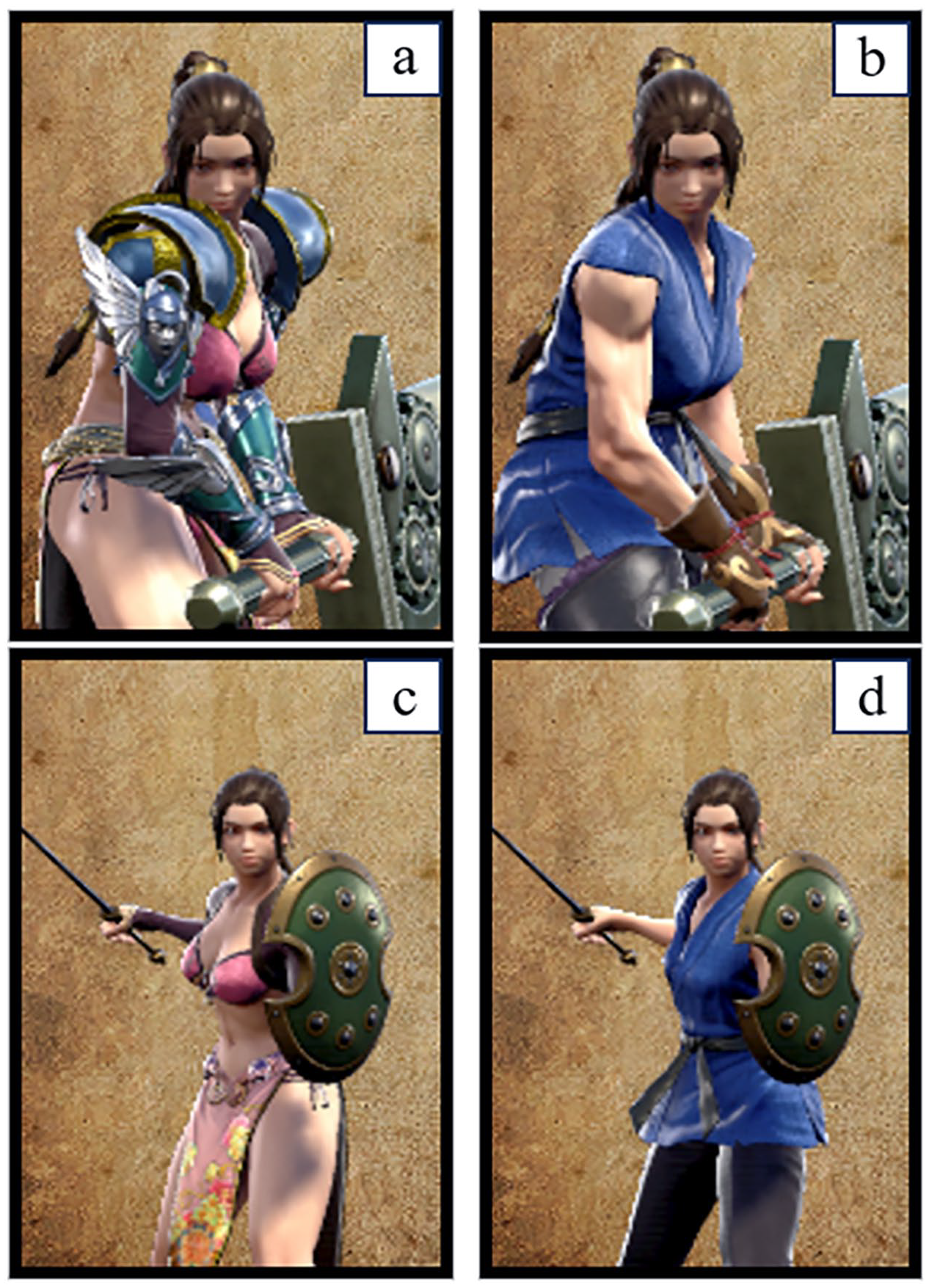
Study 2 stimulus characters.
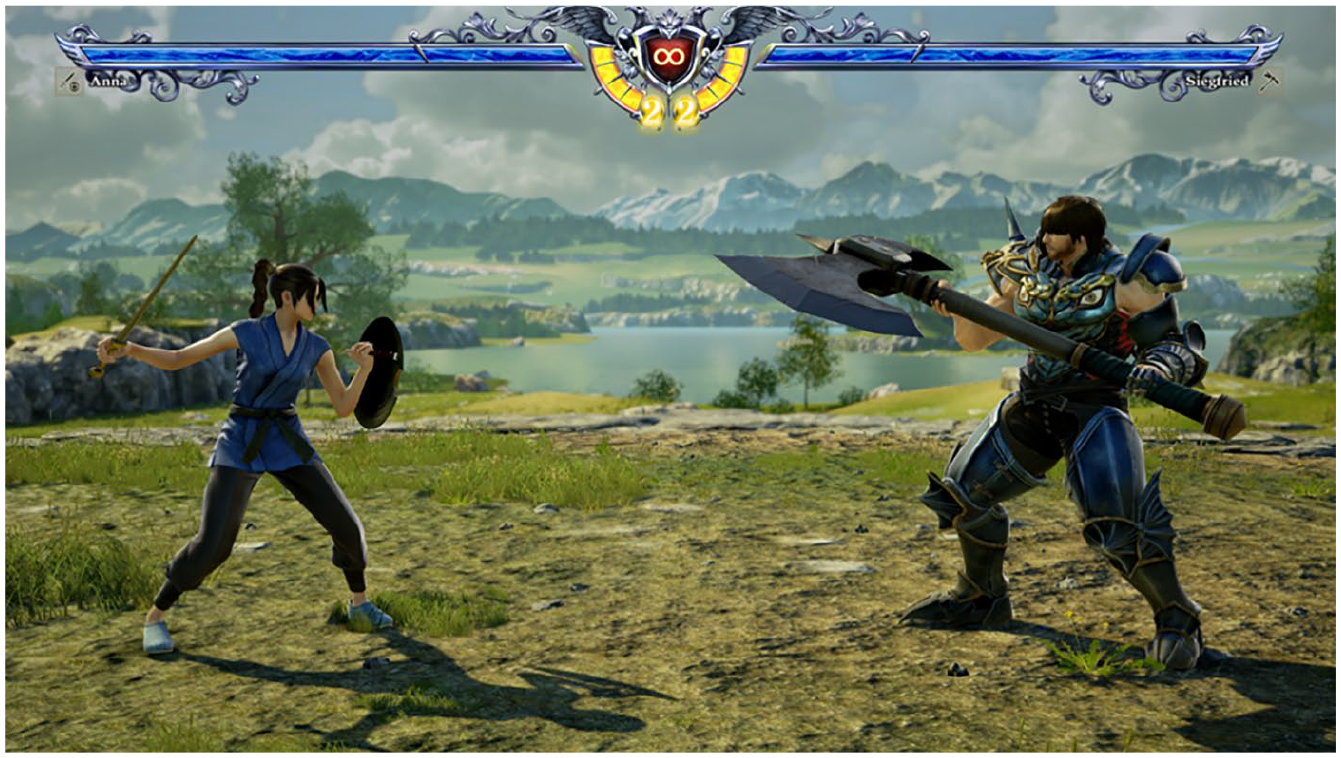
Example image of Study 2 stimulus.
Measures
We utilized the same measures from Study 1. We again had participants report their perceptions of characters’ sexualization (McDonald’s Ω = 0.74; M = 4.22, SD = 1.45), formidability (Ω = 0.85; M = 5.94, SD = 1.03), femininity (Ω = 0.76; M = 4.75, SD = 1.31) and character liking (ρ = .65, p < .001; M = 5.35, SD = 1.33), and time spent per day playing video games.
We measured perceptions of characters’ warmth using a seven-point semantic differential response presentation anchored between cold and warm (full measure details available in the character perception supplement referenced for Study 1). We assigned values to the ends of the response options (1—cold; 7—warm) for analyses (M = 4.02, SD = 1.56). We measured perceptions of characters’ competence using a seven-point semantic differential response presentation anchored between incapable and capable as well as unintelligent and intelligent. We assigned values to the ends of the response options (1—incapable/unintelligent; 7—capable/intelligent). The items significantly correlated (ρ = .54, p < .001) so we averaged them (M = 5.74, SD = 1.15).
Participants self-reported their age, gender, race, and average daily time spent playing video games.
Study 2 Results
Analysis Plan
We conducted a series of 2 (sex appeal: few cues, many cues ) × 2 (strength: few cues, many cues) × 2 (participant gender: woman, man) between-subjects factorial ANOVA to test our hypotheses. To examine interactions, we calculated estimated marginal means for post hoc pairwise comparisons using Bonferroni adjustment. We controlled for participants’ average weekly time spent playing video games in the model and filtered out participants (n = 3) who did not self-identify as men or women to maintain power for group comparisons.
Findings
Our first analysis examined if our sex appeal cue manipulations would predict perceived sexualization (H1a) and if sex appeal cues would interact with strength cue manipulations to predict perceived sexualization (RQ1a). Supporting H1a, we observed a main effect of sex appeal cue manipulations on perceived sexualization, F(1, 426) = 427.30, p < .001, η2 = .498. Participants reported perceiving characters with many sex appeal cues as more sexualized (M = 5.19, SE = 0.07) than those with few sex appeal cues (M = 3.08, SE = 0.07). Answering RQ1a, the manipulations did not interact to influence perceived sexualization, F(1, 426) = 2.20, p = .139, η2 = .003. Participant gender did not have a main effect on perceptions of character sexualization, nor did it interact with any other factors to differentiate this outcome (all ps > .249).
Our next analysis examined if our strength cue manipulations would predict perceived formidability (H2a) and if strength cues would interact with sex appeal cue manipulations to predict perceived formidability (RQ1b). Supporting H2a, we observed a main effect of strength cues on perceived formidability, F(1, 426) = 26.76, p < .001, η2 = .059. Participants perceived characters with many strength cues as more formidable (M = 6.21, SE = 0.08) than characters with few strength cues (M = 5.67, SE = 0.07). Answering RQ1b, the manipulations did not interact to influence perceived formidability, F(1, 426) < 1, p = .552, η2 = .001. Participant gender did not have a main effect on perceptions of character formidability, nor did it interact with any other factors to differentiate this outcome (all ps > .350).
Our next analysis examined if our sex appeal manipulations (H1b), strength cue manipulations (H2b), or their interaction (RQ2) would predict perceived femininity. Supporting H1b, the sex appeal cue manipulations produced a main effect on perceptions of character femininity, F(1, 430) = 43.33, p < .001, η2 = .073. Participants perceived characters with many sex appeal cues as more feminine (M = 5.05, SE = 0.08) than those with few sex appeal cues (M = 4.30, SE = 0.08). Supporting H2b, the strength cue manipulations produced a main effect on perceptions of character femininity, F(1, 426) = 109.57, p < .001, η2 = .185. Participants perceived characters with many strength cues as less feminine (M = 4.07, SE = 0.09) than those with few strength cues (M = 5.27, SE = 0.08). Answering RQ2, the cue manipulations interacted to influence participants’ perceptions of femininity, F(1, 426) = 5.43, p = .020, η2 = .009. Pairwise comparisons indicated that all experimental groups significantly differed in their perceptions of the characters’ femininity (ps < .048; see Figure 8). Participants perceived characters with few sex appeal cues and many strength cues as the least feminine (M = 3.56, SE = 0.12) followed by characters with many sex appeal cues and many strength cues (M = 4.58, SE = 0.12), then characters with few sex appeal cues and few strength cues (M = 5.03, SE = 0.11), and finally perceived characters with many sex appeal cues and few strength cues (M = 5.51, SE = 0.11) as the most feminine. Participant gender did not have a main effect on perceptions of character femininity, nor did it interact with any other factors to differentiate this outcome (all ps > .177).

Study 2 perceived femininity by experimental condition.
Our next analysis examined if our sex appeal manipulations (H1c), strength cue manipulations (H2c), or their interaction (RQ3) would predict character liking. Supporting H1c, the sex appeal cue manipulation produced a main effect on character liking, F(1, 426) = 10.14, p = .002, η2 = .023. Participants generally reported greater liking of characters that had few sex appeal cues (M = 5.58, SE = 0.10) than those with many sex appeal cues (M = 5.15, SE = 0.09). Support did not emerge for H2c as the strength cues manipulation did not differentiate character liking, F(1, 426) = 1.87, p = .172, η2 = .004. Answering RQ3, the experimental manipulations did not interact to distinguish character liking, F(1, 426) < 1, p = .702, η2 < .001. Participant gender did not have a main effect on character liking, nor did it interact with any other factors (all ps > .156).
Our next analysis examined if our sex appeal manipulations (H3a), strength cue manipulations (H4a), or their interaction (RQ5a) would predict perceptions of character warmth. No support emerged for H3a, F(1, 426) < 1, p = .674, η2 < .001. Supporting H4a, we observed a main effect of the strength cues manipulation on perceptions of character warmth, F(1, 426) = 26.37, p < .001, η2 = .056. Participants perceived characters with many strength cues as less warm (M = 3.66, SE = 0.11) than those with few strength cues (M = 4.45, SE = 0.10). Answering RQ5a, the interaction of the cues did not emerge as significant, F(1, 426) < 1, p = .700, η2 < .001. However, a main effect of participant gender emerged for perceptions of character warmth, F(1, 426) = 4.25, p = .040, η2 = .009. Men perceived the characters as warmer (M = 4.22, SE = 0.13) than did women (M = 3.88, SE = 0.09). Participant gender did not interact with any other factors to distinguish perceptions of warmth.
Our final analysis examined if our sex appeal manipulations (H3b), strength cue manipulations (H4b), or their interaction (RQ5b) would predict perceptions of character competence. No support emerged for H3b, F(1, 426) < 1, p = .570, η2 = .001. Supporting H4b, we observed a main effect of the strength cues manipulation on perceptions of character competence, F(1, 426) = 5.40, p = .021, η2 = .012. Participants perceived characters with many strength cues as more competent (M = 5.86, SE = 0.09) than those with few strength cues (M = 5.59, SE = 0.08). Answering RQ5b, the interaction of the cues was not significant, F(1, 426) < 1, p = .788, η2 < .001. We did not observe a main effect of participant gender on character competence perceptions, F(1, 426) < 1, p = .630, η2 = .001. However, participant gender did interact with the strength cues manipulation, F(1, 426) = 7.11, p = .008, η2 = .016. Specifically, women who played as characters with many strength cues perceived them as more competent (M = 6.05, SE = 0.10) than women who played characters with few strength cues (M = 5.46, SE = 0.10). This difference did not emerge for men and no other pairwise comparisons reached significance (all ps > .227).
Study 2 Discussion
In Study 2 we sought to assess whether sex appeal cues and strength cues influenced character perceptions and liking when participants were playing as them rather than viewing them. The data provided evidence that the contexts of viewing and playing did distinguish perceptions, which we consider in our general discussion. Notably, we observed minimal influence of participant gender in Study 2. Men accounted for substantially fewer of the total participants compared to women, opening the possibility that we were simply underpowered in our ability to detect effects of their identity as influencing outcomes. However, in the playing context, men may have experienced temporary states of psychological merger with the female character. Men in the sample did have greater experience playing games than women 2 and experience playing is theorized to facilitate the psychological state of feeling a diminished sense of self and heightened sense of the character identity (Klimmt et al., 2009; Lynch et al., 2022). If this were the case, it is possible that one’s personal gender identity may have been diminished, thereby mitigating differences caused by gender.
Consistent with Study 1, we observed anticipated main effects of sex appeal cue manipulations on perceptions of sexualization and strength cue manipulations on perceptions of formidability. However, the manipulations did not interact to influence perceptions of sexualization or formidability. As in Study 1, the inclusion of many sex appeal cues contributed to greater perceptions of femininity whereas strength cues contributed to lower perceptions of femininity. The cues also interacted and produced distinctions between all four conceptual types of characters in terms of their perceived femininity. Specifically, strength cues had a more pronounced effect on player perceptions than those observed on viewer perceptions in Study 1. The inclusion of many sex appeal cues was the only factor that predicted character liking, with participants reporting greater dislike of these characters compared to those with few sex appeal cues. Finally, sex appeal cues did not predict perceptions of characters’ warmth and competence; however, the inclusion of many strength cues did predict perceptions of less warmth and more competence. Accordingly, it seems that in the context of playing as a character who is perceived as sexualized, but formidable, there is minimal evidence that their personhood is denied.
General Discussion
Despite conjectures that female video game characters’ powerful and dominant characterizations may mitigate socially undesirable outcomes caused by sexual objectification (e.g., Jansz & Martis, 2007), scant work has empirically tested how these qualities combine to influence audience perceptions. To address this gap, we conducted two experiments that manipulated characters’ appearances and had participants evaluate characters along key person perception outcomes. Taking this approach also allowed us to determine whether playing as the character, differentiates perceptions from those in which participants viewed the character. Accordingly, our findings contribute to the literature on objectification and character perceptions both in video games and in less interactive contexts.
In both studies, we followed the analytic schemes advanced by Lynch et al. (2016) and Gilbert et al. (2023) to produce characters with systematically manipulated cues we expected to contribute to audience perceptions of sexualization and formidability. To the best of our knowledge, this is the first experimental work that validates those frameworks. Specifically, across both studies, participants perceived characters with many sex appeal cues and many strength cues as greater in sexualization and formidability, respectively, than those with few of these cues. Notably, stronger effect sizes of the manipulations emerged in the second (playing) study than in the first (viewing) study. In the viewing context, strength cue manipulations did not produce effect sizes large enough to warrant practical significance. Although it is possible that we were encountering ceiling effects, as means for all characters’ perceived formidability exceeded the midpoint of the measure, we still encountered notable patterns.
Our findings suggest that strength cues (e.g., muscle tone, size) shaped perceptions most when participants could translate them to onscreen actions in the playing condition. To elaborate, Gilbert et al. (2023) explain that weapons augment perceptions of formidability by biasing perceptions of the target’s embodied formidability. Our findings allow us to advance on this theorizing. In the context of playable video game characters, the usage (rather than mere presence) of strength cues such as weapons can augment a character’s formidability. Potentially, then, these cues might contribute to positive outcomes for players such as feelings of empowerment. Moreover, these cues may explain why self-objectification does not always occur when playing as a sexually objectified character (e.g., Read et al., 2018; Skowronski et al., 2021).
For viewers, strength cues also interacted with sex appeal cues meaningfully. Specifically, when viewing a character with many sex appeal cues, the inclusion of many strength cues led to perceptions of greater sexualization. It is possible that strength cues may have emphasized the salience of the character’s body in a gestalt way. Strength cues draw attention to the body for assessments of fighting ability (Sell et al., 2008) and given the stimuli (i.e., a fighting game), it seems likely that people would have attended to strong characters’ bodies. However, when viewing a character with few sex appeal cues, the presence of many strength cues did not contribute to greater perceptions of sexualization. If strength cues encourage attention toward the body, then in the absence of overt sex appeal cues, it is likely that people perceive other characteristics (e.g., athleticism) rather than sexualization. Thus, when viewing a female character, the simultaneous inclusion of sex appeal and strength cues may render her to the status of an object—that being what Heldman and Cahill (2007) refer to as a fighting fuck-toy.
This sort of portrayal is often critiqued (Sarkeesian & Petit, 2019). We observed in both studies that participants reported greater dislike of characters with many sex appeal cues included in their portrayals. In fact, these cues were the only predictor in both studies of character liking. Consistent with prior research (e.g., Hartmann & Klimmt, 2006), women viewers especially disliked these characters. Yet, when offered varied playable characters, women selected more sexualized, less formidable characters. Men, on the other hand, opted for minimally sexualized, highly formidable characters. It is possible that men were driven by a desire to embody a character with gender normative cues (i.e., strength) and avoid signaling that they approved of a sexualized female character. Women may have explicitly rejected pejorative characterizations of their ingroup while simultaneously desiring to affiliate with gender-normative-characteristics. To elaborate, women may have perceived selected characters’ sex appeal as a desirable quality in a culture that often conflates a woman’s appearance with her value (Fredrickson & Roberts, 1997).
Strength cues, however, did not predict nor did they interact with sex appeal cues to predict character liking among men or women in either study. Thus, another explanation for women’s selection of sexualized characters is that they perceived these characters as more feminine. Across both studies, overt sex appeal cues strongly influenced perceptions of femininity. This effect likely occurred as our manipulations emphasized secondary sexual characteristics that signal female anatomy (Lynch et al., 2016) and thereby facilitate gender categorization. Researchers have argued that gender congruence is a factor that can exacerbate media effects. For example, Vandenbosch et al. (2017) examined whether gender congruity of a sexualized avatar would amplify self-objectification effects in a sample of adolescent video game players. However, they did not observe the expected pattern of amplified effects for gender congruent compared to incongruent avatars. Because our study was not investigating self-relevant outcomes (e.g., self-objectification), it was unclear whether gender congruence would shape perceptions of the characters. Our data suggest that a desire to embody a feminine character guided women participants’ selections, even if they disliked these characters.
Importantly, strong characters were not liked any less than weaker characters. Scholars (e.g., Lynch et al., 2016; Pennell & Behm-Morawitz, 2015) have advanced the argument that the inclusion of sex appeal cues may bring otherwise strong characters in line with dominant femininity norms—making them more palatable in a heteronormative culture. Our findings in the viewing context lend support to this notion. Specifically, participants perceived characters portrayed with many strength and sex appeal cues to be as feminine as characters lacking these qualities. However, for players, strength cues contributed to relatively lower level of perceived femininity irrespective of how many sex appeal cues were present. It is possible that audiences perceived physically strong female characters as less aligned with acculturated expectations of women. This may especially be the case, again, for players who can translate that perceived formidability into onscreen action.
When playing, minimal evidence emerged to support that participants were rendering the characters to the status of an object. Participants did not differentially perceive characters’ warmth or competence based on the amount of sex appeal cues in their portrayal. Participants did view characters with many strength cues as less warm—arguably due to their relatively greater formidability. Importantly, women viewed characters with many strength cues as more competent than those lacking these cues. These findings suggest that participants were not clearly objectifying the characters. Unfortunately, because we did not capture warmth and competence perceptions in the viewing study, we are limited in our ability to make claims here. Future research could determine whether people are more likely to deny characters personhood when they are viewing them onscreen as a separate entity rather than merging with them as a playable character (Klimmt et al., 2009).
Limitations and Considerations for Future Research
Several limitations of the current studies offer productive grounds for future research. First, the game we used in both studies (i.e., SOULCALIBUR VI) offered significant experimental control over developing the stimuli. However, this game represents only one type of game in which female characters appear. Fighting games tend to feature the most sexualized and powerful representations of female characters (Lynch et al., 2016), which in combination with the sophisticated character creation tool featured in SCVI was why we opted to use this content. Future research should determine whether formidability, with its direct relevance to fighting, is an influential characteristic in impression formation beyond this genre.
This study is also limited in the conclusions we can draw related to perceptions of personhood across interactive contexts. The findings of our first study led us to include warmth and competence perceptions in the second study. However, without similar observations across studies we cannot make any statements about how interactivity may influence perceptions along these dimensions. It may be the case that warmth and competence impressions form distinctly when viewing another who is never merged with the perceiver, as scholars argue occurs when interacting with avatars (Klimmt et al., 2009; Lynch et al., 2022).
Finally, the characteristics of our sample constrain our ability to generalize our findings across different populations. We relied here on undergraduate student samples, which are notably homogenous in terms of their age, race, and level of education. These factors certainly influence the type of media content that individuals select and the sorts of experiences they have with that content. We drew our samples from an undergraduate program that emphasizes instruction regarding social scientific research in communication science. Accordingly, our participants may be more aware than the average population of the deleterious outcomes of sexual objectification and sexualization, more generally. Our results may, thus, reflect the perceptions of individuals sensitized to the way entertainment media portray women and may explain the rejection of highly sexualized characters. Future work could determine whether this pattern of results holds in the broader population.
Concluding Remarks
Understanding how cues of strength and sex appeal influence perceptions of characters is important for understanding audience interactions with game content and its effects. Following Jansz and Martis’ (2007) identification of the Lara Phenomenon and Lynch et al.’s (2016) confirmation of its existence in content, this work examined whether portrayals of powerful, yet sexualized characters would predict impressions or liking of these characters. Studying these phenomena are important as they contribute to broader manifestations of sexualization (APA, 2007).
The case for strong portrayals as a solution to the harms of sexualization is still not clear. People see strong female characters as less typical of their gender group (i.e., women). These characters may thus have less influence over audience perceptions than more typical characters. Strong female characters are also not liked any more than weaker characters. At least when viewing, strength cues can also enhance perceptions of sexualization. Thus, strength characterizations do not seem to be a clear antidote to the harms of sexual objectification. Women opted to play as characters with emphasized sex appeal, despite reporting they disliked these character portrayals. However, women also reported perceiving strong characters they used as avatars as more competent, suggesting that these portrayals could positively resonate with female players in some contexts.
The intertwining of sex appeal and strength in female video game characters presents unique conceptual considerations that we argue may advance theorizing on character perceptions, objectification, and interactivity. Indeed, these two qualities seem inseparable in depictions of female characters and substantively shape audience impressions. Whether the influence of these cues translates beyond perceptions about a character to affect audiences feelings about themselves and women more generally remains to be seen.
Footnotes
Acknowledgements
The authors thank the anonymous colleagues who reviewed this work for their collegial and thoughtful recommendations.
Authors’ Note
All authors have agreed to the submission of this article and no other journal is currently considering this work for publication. The lead author’s Institutional Review Board reviewed and approved conduct of this work.
Declaration of Conflicting Interests
The authors declared no potential conflicts of interest with respect to the research, authorship, and/or publication of this article.
Funding
The authors received no financial support for the research, authorship, and/or publication of this article.
