



Abstract
As more pregnant women are incarcerated, states are forced to determine the most cost-efficient methods of addressing childbirth and motherhood in prison. Traditionally, newborn babies are removed from the prison setting, and their mothers, within a few days. Research shows that women who are allowed to keep their babies with them in the correctional setting have reduced recidivism rates. This study explores perceptions of the prison nursery as a form of correctional programming. Correctional administrators from all 8 states currently operating nursery programs were interviewed, as were administrators from 20 states that do not have prison nurseries (N = 28). Findings indicate that barriers to the implementation of prison nursery programs include a lack of knowledge about these programs and the impact they have on recidivism rates, concerns about legislative budgeting given current economic conditions, and for a small number of administrators, the consequences of housing infants within the prison environment.
Keywords
Allowing incarcerated mothers to have and keep their babies in prison is not a new phenomenon. In fact, many western European, Asian, and South American countries allow women to keep their babies with them in the correctional setting. Germany, for example, allows children to stay with their incarcerated mothers until the age of 4 or 6, depending on the facility (Quaker Council, 2007). The United States is one of a few larger countries that routinely separates incarcerated mothers from their babies (Caddle, 1998, Quaker United Nations Office, 2005). This was not always so. It is reported, although documentation is scarce, that many U.S. states previously allowed newborn babies to remain with their incarcerated mothers as recently as the 1950s. A national survey in 1948 indicated that 13 states in the United States allowed inmates to keep their babies with them, whereas the other states opted to return pregnant inmates to local jails or transfer them to community coresidence alternative sites for the duration of their pregnancies and a portion of time postpartum rather than incarcerate newly delivered women without their infants (Shepard & Zemans, 1950). Costs and lack of need, along with the fact that most babies could be placed with family members, were cited as reasons for the closures of early American prison nursery programs (Kauffman, 2001; Shepard & Zemans, 1950).
There are now more women incarcerated in the United States than ever before. At the start of 2007, more than 112,000 women were imprisoned in state and federal correctional institutions throughout the United States (Harrison & Beck, 2007). There has been a continued increase in the number of women who either are incarcerated just after having a child or give birth while in prison. A 2004 survey titled Medical Problems of Prisoners (Maruschak, 2008) indicated that 4.1% of state women inmates and 2.9% of federal women inmates were pregnant at the time of confinement.
Although the family remains the basic unit of society, it has undergone a series of challenges. In earlier years, babies easily may have been placed with family, but this has become more of a problem with the breakdown of functional family units. When a baby cannot be placed in the home of a family member, the state may have no option but to place the infant in foster care. Foster care can present an economic drain on the state. According to Snell and Morton (1994), foster care is the ultimate placement for 10% of infants born to women in prison across the nation. In 2007, a report by Children’s Rights, the National Foster Parent Association, and the University of Maryland School of Social Work indicated that average monthly foster care rates ranged from a low of $226 in Nebraska to a high of $869 in the District of Columbia. The report concluded that “on average, across the U.S., current foster care rates must be raised by 36% in order to reach the Foster Care Minimum Adequate Rates for Children (MARC)” (DePanfilis, Daining, Frick, Farber, & Levinthal, 2007).
As of January 2011, eight states (Illinois, Indiana, Nebraska, New York, Ohio, South Dakota, Washington, and West Virginia) allow incarcerated mothers to keep their babies for 12 to 36 months. It should be noted that the policies in South Dakota differ in several ways from those of the other seven states, which operate nursery programs 1 (Carlson, 2009; Porterfield, 2007; Radosh, 2002; Stern, 2004; Villanueva, From, & Lemer, 2009). A number of states, including Texas, Kansas, Alaska, Utah, and Oklahoma, have expressed interest in exploring the possibility of establishing nursery programs. The state of California approved the establishment of a prison nursery program, but due to the recent recession, preparations to implement the program were suspended in 2009.
To better understand why some states have opted to implement prison nurseries, it is important to understand the current programs. New York State has the oldest ongoing prison nursery program in the United States, established in 1902. The second-oldest program is in Nebraska. It was started in 1994 and was modeled after the New York system. Since 1994, six additional states have launched nursery programs rooted in the practices established in New York and Nebraska. In most cases, an expectant mother is allowed into the nursery program if she meets the following eligibility criteria: 2 The inmate
must have a tentative release date of no more than 18 to 24 months after the birth of the child; 3
cannot have an extensive history of violence;
cannot have prior convictions involving serious child abuse;
must sign a program agreement stating she will be the primary caregiver of the child on release;
often must sign a waiver releasing the facility from any responsibility if her child becomes sick or injured; and
must complete prenatal and Lamaze classes before the birth of the child, if possible (Carlson, 1998, 2009; Villanueva et al., 2009).
In addition to meeting the eligibility criteria, the inmate must follow the institution’s rules, avoid misconduct reports, and complete specified infant care and development classes if she wishes to remain in the program. It is expected that she will be the primary caregiver for her child while at the institution and that she will meet her work or educational responsibilities (Carlson, 1998).
A woman is usually considered a successful participant or graduate of the program if she is able to remain in the program and leave the institution with her baby. Nursery programs are separate from child visitation programs, which only allow children to visit and in some cases remain overnight.
At the current time, nursery programs can be contracted out by the state, such as in the New York program, or they can be administered by the state’s Department of Correctional Services, such as in Nebraska. In some states, there is a sharing of responsibilities between both. No research was found identifying the most cost-effective method of administering prison nursery programs.
The most common stated purpose of a nursery program is to establish bonding between mother and child (Carlson, 2009; Villanueva et al., 2009). Separating incarcerated mothers from their newborn babies, in this case due to confinement, compounds issues such as weakened attachment, impaired bonding, and eventual abandonment of the children (Travis, Cincotta, & Solomon, 2003). Female inmates perceive that when they are released from prison they will be reunited with their children and serve as their children’s primary caregivers (Carlson, 1998; Crawford, 1990; Radosh, 2002). In research by Johnson (1993), 11% of those children separated from their incarcerated mothers experienced at least two additional changes in caregivers during the mothers’ incarceration. If there is constant change of caregivers, positive bonding and attachment may be limited outside of prison nurseries.
Bonding is the process of forming an attachment. It involves a set of behaviors on the part of both the mother and the baby that leads to an emotional connection (attachment). Activities such as holding, rocking, smiling, kissing, and laughing are bonding activities that produce attachment between the mother and newborn (Perry, n.d.).
The word attachment is used frequently by mental health, child development, and child protection professionals. In the field of infant development, attachment refers to a special bond characterized by the unique qualities of maternal–infant or primary caregiver–infant relationships. The attachment bond has several key elements: (a) An attachment bond is an enduring emotional relationship with a specific person; (b) the relationship brings safety, comfort, and pleasure; and (c) loss or threat of loss of the person evokes intense distress. These special relationships are important for the future development of the child. Many people think that the maternal–child attachment provides the working framework for all subsequent relationships. A solid and healthy attachment with a primary caregiver appears to be associated with a high probability of healthy relationships with others, whereas poor attachment with the mother appears to be associated with emotional and behavioral problems later in life (Rutter, 1995). The ultimate outcome of prison nursery program participation is that bonding in the first weeks of the infant’s life will result in healthy attachment, subsequently reducing the child’s chances of committing criminal offenses and lessening the risk for a continued cycle of incarceration.
Research funded by the Women’s Prison Association (Villanueva et al., 2009) found that the profiles of women accepted into prison nursery programs were nearly identical to those of women accepted into community-based residential treatment programs in which they were allowed to keep their babies with them. Researchers also found that by keeping mothers and infants together, both community-based and prison nursery programs allowed for the formation of mother–child bonds during a critical period of infant development (Villanueva et al., 2009).
The most recent study to consider the level of attachment between mothers and babies while in prison was completed in the New York prison nursery system by Byrne, Goshin, and Joestl in 2010. Results indicate that 71% of the babies achieved secure attachment with their own mothers while in the prison nursery setting. This is a higher percentage than is reported by most low-risk community children whose mothers have no criminal history or involvement. This strengthens the argument that prison nursery programs create environments conducive to attachment’s occurring. A more in-depth review of attachment literature can be found in the writings of Byrne et al. (2010) and Goshin and Byrne (2009).
Although fostering positive attachment between mother and child is extremely important, prison nursery programs have a number of additional objectives. Although these goals may vary from one program to the next, there are commonalities. An example of goals for a prison nursery program (in this case, Nebraska’s) is the following:
to provide an opportunity for bonding between the inmate mother and her infant from the time of birth through approximately 18 months of age;
to facilitate the change of the inmate mother to a responsible parent;
to aid in the development of realistic expectations the inmate mother has for herself and her infant;
to provide for prenatal and infant health; and
to provide intervention in breaking the cycle of generational abuse and incarceration (Clark, 1993).
The Benefits of Nursery Programs
With the above goals in mind, prison nursery programs provide incarcerated mothers with a variety of services designed to foster successful parenting, including prenatal, parenting, infant care, and child development education; hands-on training; and development and coordination of community resources available for the inmate mother during her incarceration and on her release (Clark, 1993).
In addition to providing a positive mother–child bonding experience and increased attachment, the reduction of recidivism has now become one of the major objectives of nursery programs. A published study comparing women with babies in the nursery program to women (with and without children) in the general population has been released from New York; it indicates a 50% lower 3-year recidivism rate among nursery program participants (New York State Department of Correctional Services, 1993). In addition, unpublished data obtained by the authors from prison staff in Washington (2009) and Ohio (2010) indicate that recidivism was reduced 28.0% and 18.6%, respectively, when comparing women in the nursery program with those in general population (S. M. Alley, personal communication, September 30, 2010). It is noted that one limitation of these findings is the comparison of nursery program participants with those in the general population. It is recognized that it is difficult to construct a sample of inmates who were forced to give up their babies to truly compare recidivism rates. However, a 10-year longitudinal study in Nebraska showed a significant reduction of recidivism among those inmates who participated in the nursery program compared to women who were forced to give up custody of their babies for the 3 years prior to implementation of the nursery program. The research revealed a 50% recidivism rate for those who had to give up their infants, compared to only 16.8% for those who were allowed to keep their babies with them—an overall reduction in recidivism of 33.2% (Carlson, 2009). Although this study confirms that women who participate in the nursery program are less likely to recidivate, more research in this area is recommended to substantiate the above findings.
Taxpayers experience monetary savings for each woman who does not recidivate. Based on the Nebraska Department of Correctional Services’ 2010 statistical report, the cost of incarcerating one woman inmate per year was $39,472. For each woman who does not return to prison, there is a significant cost saving to the taxpayers. Advocates for prison nursery programs also anticipate that program participation will interrupt the cycle of incarceration, saving taxpayers the expense of incarcerating these infants when they reach adulthood and criminally offend. However, data to validate these claims are not available. In the majority of states with nursery programs, those babies who remained with their mothers in the prison facility have not yet reached adulthood. In the two states wherein prison nursery infants have reached adulthood, no follow-up studies have been conducted to ascertain their criminal offending habits.
A reduction in inmate misconduct reports for those women who enter the nursery program is an added benefit of program participation. Data collected during the first 2 years of the Nebraska nursery program, 1994 to 1996, showed a 13% decrease in misconduct reports for inmates who initially lived in the general population and then moved to the nursery unit (Carlson, 1998).
Finally, positive media coverage for prison nursery programs has been consistent. There have been numerous television specials featuring the programs in Nebraska, Washington, and most recently Illinois in 2010. Senior administrators in Nebraska indicate there has not been any negative press about the nursery program since its inception in 1994. About the four newer prisons opened since 2006, media coverage has been consistently positive (Haddock, 2006; Illinois Department of Corrections, 2008; Indiana Department of Corrections, 2008).
Although the research available on prison nursery programs indicates that they have a positive impact on both recidivism and inmate misconduct rates, programs that allow incarcerated mothers and their infant children to cohabitate in the prison environment remain rare. The primary focus of the current research project was to understand perceptions of prison nursery programs among those who work directly with the female correctional population.
Method
Participants
To assess more clearly the perceptions of nursery programs at the state level, we constructed a sample comprised of senior administrators from women’s facilities around the United States. Administrators were specifically chosen with the reasoning that they would have the greatest understanding of facility-wide programming issues and philosophies. We constructed a sample of women’s correctional facilities from each of the 50 states, including the contact information for each facility’s warden or superintendent. Although the majority of states operate only one women’s facility, a smaller number of states operate multiple women’s facilities. In the event that a state possessed more than one women’s facility, only one administrator was randomly chosen to be interviewed. Approval to conduct this study was received from the University of Nebraska at Kearney Institutional Review Board, and during a 9-month period we attempted to contact each warden or superintendent by telephone. In some states, we were directed to speak with deputy wardens or assistant superintendents directly involved with the programs offered in the women’s prison. In 1 state, we were directed to the Department of Corrections to speak with the director of women’s programming for multiple women’s facilities. The final sample comprised administrators from 20 states without nursery programs and 8 states with nursery programs, representing a total of 28 states, for a response rate of 56%. The sample included wardens or assistant wardens in all 8 states in which nursery programs are currently being operated. Only in these 8 states had there been previous research relationships based on prior studies involving their nursery programs. Administrators in a number of states declined to participate in the research. Although some of those contacted provided no reason for refusing to participate in the interview, others expressed that they did not want to be involved in a survey or that they were not authorized to participate. Several administrators explained that they did not have time to dedicate to the interview process.
Procedures
The interview questions were developed by the researchers. To ensure validity, the researchers consulted two wardens who provided feedback on both the survey questions and the data collection process. As a result of these discussions, it was determined that response rates would be increased if the method of data collection were a telephone interview rather than a questionnaire administered through the mail. Both wardens recommended that the confidentiality of research participants be protected by identifying respondents by region rather than by state. Thus, the researchers elected to categorize the data based on the standard geographical regions of Northeast, South, Midwest, and West. This method maintained the promised confidentiality and allowed for a geographical comparison of administrator views.
The final interview format consisted of three open-ended questions in which prison administrators were asked the following:
Does your facility currently operate a nursery program?
How familiar are you with the prison nursery program concept? and
What is your perception of prison nursery programs?
Each telephone interview began with the researchers’ introducing themselves and explaining the purpose of the research. All participants were advised of their rights as human participants and guaranteed confidentiality as research participants. As a condition of the interview, the researchers agreed not to identify the participants by name, state, or position held. Participants were not asked demographic questions as this information could be used to identify them. Interviews were conducted only by the two researchers. The interviews were informal, allowing the researchers the opportunity to ask follow-up questions and clarify information as necessary and to answer any questions the respondents had regarding prison nursery programs. To ensure interrater reliability, the researchers discussed at length the scoring of subjective responses from participants on Questions 2 and 3 and then together reviewed the categorization of responses from each research participant. Each interview lasted approximately 10 to 20 minutes. Additional information regarding nursery programs was emailed to more than half of the research participants, on their request, once the interview process had been completed.
Results
A total of 28 correctional administrators participated in the research. Each administrator represented women’s corrections in a different state, allowing the researchers to capture views about nursery programming in more than half of the United States. Institution sizes and classification levels varied widely (see Table 1), with the most frequent institution population size being between 501 and 1,000 inmates (34.6%). Respondents were selected from all regions of the United States. Nine (32.1%) of the represented institutions were located in the Northeast, five (17.9%) were located in the South, seven (25%) were located in the Midwest, and seven (25%) were located in the West. These data are presented in Table 2.
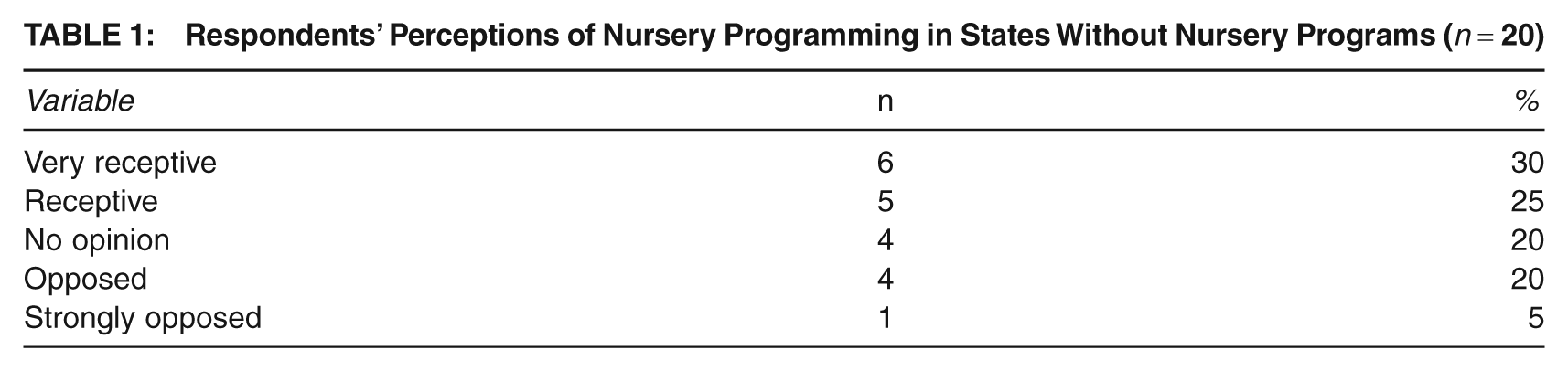
Respondents’ Perceptions of Nursery Programming in States Without Nursery Programs (n = 20)
Size of Inmate Population in Participating Institutions (n = 26)
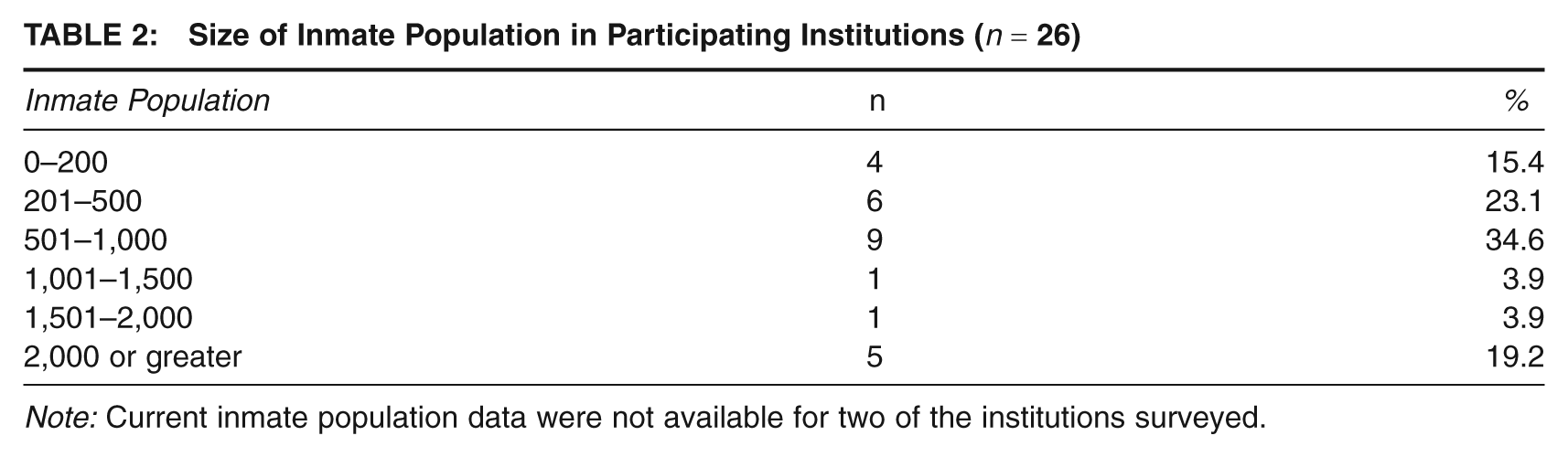
Note: Current inmate population data were not available for two of the institutions surveyed.
Of the 28 correctional administrators who were interviewed, 8 reported operating some form of nursery program in their women’s correctional facilities. This represents a 100% response rate from states with nursery programs. Correctional administrators from 20 states reported that nursery programs were not available for incarcerated mothers at their facilities. When considering only the 42 states without nursery programs, this represents a response rate of 48%. From the states not currently operating nursery programs, 10 respondents (50%) reported being unfamiliar with the concept entirely; 8 respondents (40%) had some familiarity with the nursery concept and had discussed programs like this at the administrative level. The remaining 2 (10%) respondents described pending plans to launch nursery programs at their facilities. This information is presented in Table 3.
Respondent Familiarity With Nursery Programming in States Without Nursery Programs (n = 20)

Among those respondents who reported that they did not currently operate nursery programs in their states, perceptions of such programs varied. Participant responses were collapsed into one of five categories: very receptive, receptive, no opinion, opposed, and strongly opposed. Of the respondents, 6 (30%) were subsequently categorized as being very receptive to the nursery program concept, whereas 5 (25%) expressed some interest in learning more about the process. A total of 4 respondents (20%) candidly explained that they were not familiar with the prison nursery concept at all and therefore had no opinions regarding the value of such programs. The remaining 4 (20%) respondents reported being opposed to nursery programming altogether. Finally, 1 (5%) respondent went so far as to describe himself or herself as being “strongly opposed” to nursery programming. Table 1 summarizes these responses.
Respondents who reported opposing prison nurseries had a number of concerns with these programs. The most common concern expressed by respondents (30%) was that in their view nursery programs were simply cost prohibitive in these difficult budgeting times. As 1 respondent explained, “I’m not sure what a nursery program is, but it doesn’t matter anyway—we don’t have the funding to support new programs at this time.” Another respondent reported that whereas the state had considered opening a nursery program, ultimately the venture was perceived as being simply too expensive. The second concern respondents had with nursery programming involved lack of information. Of respondents, 20% in states without nursery programs explained that they simply did not have enough information about nursery programs to even consider implementing one. This was true in several states where administrators responded that whereas they were unfamiliar with the programs, they were “very interested” in learning more about the nursery concept. A third concern involved the ability to allocate space for a nursery within the existing facility. Wardens simply could not find the space to house such programming. A fourth concern centered on public support for nursery facilities. This was a concern particularly in the southern United States, where multiple wardens and administrators felt citizens would strongly oppose housing infants with their mothers in correctional facilities. In one state, the women’s facility had operated a nursery program in the 1950s, and the venture was viewed as unsuccessful by the correctional administrator interviewed from that state. It was the administrator’s interpretation that recidivism among the female inmate population was inevitable and that the impact of a nursery program would be minimal. Ultimately, it was the administrator’s view that the nursery concept was not one the state was willing to revisit. Finally, 1 participant felt that the nursery program concept itself was inappropriate in the correctional setting as incarcerated women do not possess strong parenting skills or serve as positive role models for their minor children. This coincided with remarks made by 1 respondent who requested more information about nursery programs but expressed concern that most female inmates would not be eligible due to the length of their sentences.
Although it would have been informative to statistically analyze the data collected on these items, the small sample size allows only for descriptive statistics. In addition, the study was limited on participant demographics to protect the confidentiality of the research participants. Although specific states could not be identified, participating institutions were categorized by region. In the northeast part of the United States, none of the states consulted, with the exception of New York, had any prior information regarding nursery programs. All of those interviewed, however, were extremely receptive to the concept, and several asked the researchers for more information about this type of program. When reviewing the responses provided by those correctional administrators working in the southern United States, some respondents were familiar with the concept, but 75% were opposed to offering nursery programs in their own states. It should be noted that of the nursery programs currently operating in the United States, only one (the newest) is located in the South. In the Midwest, respondents were evenly split. One half of the administrators interviewed reported their states were familiar with the nursery program concept and were eager to implement similar programming. The other half of those respondents reported that they had either no interest or no plans to investigate nursery programs in their states. Finally, in the western United States, respondents were generally receptive. In this region, 67% of participating administrators reported being familiar with the nursery program concept and receptive to this type of programming in their women’s facilities. At least two states in the western United States had taken substantial steps to implement nursery programs in their women’s institutions, and only 1 administrator reported no interest in pursuing nursery programs. Geographical analysis of participant responses is presented in Table 4.
Respondents’ Perceptions of Nursery Programming in States Not Operating Nursery Programs, by Region (n = 20)

Note: Values in parentheses represent summary data for each region.
Discussion and Conclusion
Despite the research available in support of prison nursery programs, not all states plan to implement similar programs; in fact, nursery programs operate in a limited number of facilities. The goal of this research was to communicate with senior corrections officials in women’s prisons to ascertain their views about prison nursery programs, their feasibility, and the obstacles to their implementation. In states where prison nursery programs are not in place, why has this type of programming not been pursued? To that end, 28 senior corrections administrators, representing 28 states, were interviewed.
Perhaps the most striking finding to emerge from this research was simply the lack of information about nursery programs among administrators. Of the administrators interviewed, 50% reported having no information about nursery programs and their benefits in the correctional setting. To our disappointment, continuing the interviews with these respondents became extremely difficult. Although we had anticipated exploring administrator views on nursery programs, administrators with no knowledge of prison nurseries were often hesitant to respond to additional questions that required them to comment on the prison nursery concept. Many of these administrators, once the conversation was initiated, reported they were both interested in and receptive to exploring nursery programs in their own states. This suggests that a distinct division still exists between academic discussions of correctional programming and correctional practices in the field. It is possible that research published in academic journals may not be reaching practitioners and correctional administrators as hoped. Researchers should develop more effective methods of communicating research findings to the field, rather than through the traditional method of publishing in academic journals. Methods of sharing information could include newsletters or emails either from organizations such as the National Institute of Corrections or from authors themselves. Although some correctional administrators indicated that conferences and workshops are cost prohibitive, it is unclear which resources they most heavily rely on for learning about new developments in the field. Follow-up research to determine which delivery method is most effective for practitioners is warranted.
In addition to lack of information, one of correctional administrators’ greatest concerns regarding prison nursery programs was the perceived expense. Many respondents (30%) felt that they simply lacked the monetary and/or physical resources to support nursery programming. Unfortunately, research on the cost effectiveness of nursery programs is limited. Programs are administered differently among the eight states that currently allow infants to remain with their incarcerated mothers. Some states operate the nursery program themselves, whereas others contract it out. To date, it is unclear which method is most cost effective.
Among the 20 respondents from states without nursery programs, several indicated that their states do offer community-based residential parenting programs, or community alternate residences, which provide services to pregnant mothers and their babies. As pointed out by Byrne (2010), little is known about comparison between prison nurseries and community alternative programs. Research that compares the targeted program participants (crime of conviction, length of sentence, etc.), respective cost, and recidivism rates should be examined.
Goshin and Byrne (2009) have suggested that there has been renewed interest in the development of prison nurseries in recent years. New York opened its nursery program, the first in the nation, in 1902. Nebraska opened its program 92 years later, and the remaining seven programs opened in quick succession after 1999. One of the goals of this research was to determine the likelihood that states without programs would be initiating nursery programs in the future. On reflection, respondents with women’s facilities located in the northeastern and western parts of the United States were the most receptive to prison nursery programs, regardless of facility population size or classification. Respondents in the southern United States were the most opposed, without qualification. This would appear to indicate that correctional cultures and programming priorities vary considerably from one region of the country to the next. Further examination of this deviation appears warranted to determine if incarcerated women are viewed differently based on geographical region. Furthermore, is there a distinction in services provided to incarcerated women based on the geographic region in which they are incarcerated?
It should be noted that whereas the majority of states in the United States do not offer nursery programs, a wide variety of parenting programs are available in women’s institutions. Administrators were quick to recognize the importance of the mother–child bond in the context of successful reintegration. Programs currently being operated in the responding institutions included an array of initiatives ranging from parenting classes to programs allowing for overnight visits. Some states have opted for the use of community-based residential parenting program centers for incarcerated pregnant women and their newborns. This indicates a willingness among administrators to explore parenting programs and emphasizes the importance of providing administrators current research on correctional programs.
Despite the uncertain economic conditions that correctional administrators currently face, it is anticipated that the development of nursery programs, whether in the prison system or as community-based residential programs, will continue to increase. There are a number of benefits of participation in nursery programs, including reduced recidivism, a reduction in costs for taxpayers, improved bonding and attachment between mother and infant, and the potential disruption of incarceration cycles. Currently, the level of familiarity administrators have with nursery programs varies widely, with 50% of administrators in states without nursery programs having no information at all about this type of programming. As research on correctional programming is disseminated, it is important that those findings reach prison administrators guiding policy and practice in the field. Only then can we most effectively address the needs of incarcerated women.