




Abstract
This research examined the effect of therapeutic community delivered in multiple sites on the likelihood of rearrest and reconviction for males up to 4 years after release from prison. With relevant covariates controlled in the analysis, completing therapeutic community had a significant effect on reducing the likelihood of rearrest for inmates with moderate probabilities of being classified as in need of therapeutic community programming. Therapeutic community did not have significant effects on reducing reconvictions. An explanation for the latter finding in sentencing policy and charging practices is provided.
Inmates have a high prevalence of substance abuse problems. The magnitude of this issue has been exacerbated for corrections personnel by the skyrocketing number of persons sentenced to prison for drug offenses as a result of the decades-long War on Drugs. Unfortunately, few inmates in need of professional substance abuse treatment receive it (Mumola & Karberg, 2006).
The majority of the research on in-prison therapeutic communities (TCs) has concluded that it reduces the recidivism of former inmates with substance abuse problems (see Aos, Miller, & Drake, 2006; Mitchell, Wilson, & MacKenzie, 2006; Welsh, 2007). However, several of the prior studies have a number of methodological limitations.
The objective of the present study is to add to this body of research by examining the effect of TC treatment on the rearrest and reconviction of males for up to 4 years after release from prison and to address a number of the methodological limitations of the previous research. The sample includes inmates in three public prisons and one private prison in the state of Idaho.
Review of Research
A meta-analysis (Mitchell et al., 2006) and a benefit–cost analysis (Aos et al., 2006) have found TC to be an effective treatment for reducing recidivism (also see Aos et al., 2011; Inciardi, Martin, & Butzin, 2004). However, the research on TCs has largely been limited to three sites in Delaware (see Inciardi, Martin, Butzin, Hopper, & Harrison, 1997), Texas (see Hiller, Knight, & Simpson, 1999), and Amity in California (see Wexler, Melnick, Lowe, & Peters, 1999). As Welsh (2007) pointed out, these studies contain a number of methodological limitations. These limitations include selection (e.g., inmates in the Amity TC program were volunteers), attrition from treatment, few statistical controls, small sample sizes, dissimilar outcomes, including that some studies only used self-reports, and treatment migration (see Welsh, 2007, pp. 1484-1485, for a discussion of the methodological limitations of the previous research). We add to this list of methodological limitations single-site studies and the use of recidivism data from only the state in which the TC was located.
Welsh (2007) studied the effects of TC on rearrest, reincarceration, and drug relapse for up to 2 years after release from prison in the state of Pennsylvania. The sample was taken from five prisons with varying levels of security. The sample consisted of 217 TC inmates and a comparison group of 491 inmates who were eligible for TC placement but did not participate in the treatment because of a shortage of space.
The Welsh study found that completion of TC significantly reduced rearrest and reincarceration, with other relevant variables controlled in the analyses. TC did not have a significant effect on drug relapse. Unlike the previous research regarding TCs in Delaware and Texas, TCs in these Pennsylvania prisons had a significant effect on reducing recidivism without an aftercare component in the community.
Welsh (2007) also overcame several of the methodological limitations of the previous research. The research had controls for selection and attrition. In addition, this research assessed multiple outcomes across multiple sites, had a relatively large sample size, utilized statistical controls, and included outcomes similar to several of the previous studies. Limitations of the research are that the follow-up period was shorter than in the three previous major studies of TC effectiveness and that the recidivism data appear to be from Pennsylvania only.
More recently, Zhang, Roberts, and McCollister (2011) published an evaluation of the single-site California Substance Abuse Treatment Facility (SATF) TC program. They examined the effects of TC on rearrest and return to prison at approximately 5 years after release. The recidivism data used in this study appear to be from the state of California only. The TC program was provided by two private contractors, and participation in TC-related aftercare was encouraged but not required. The aftercare component was delivered by a number of private providers.
The sample consisted of 395 TC participants and 403 untreated case-matched comparisons. Analyses of the comparison groups showed that they were similar on most background variables but were significantly different on age and having held full-time employment during the 6 months before incarceration. The TC group was significantly older than the comparison group and significantly less likely to have been employed full-time within the 6 months prior to incarceration. In addition, a selection bias appears to exist in the sampling procedure because only 76% of the potential comparisons agreed to participate in the study (see Zhang et al., 2011, p. 98). The authors also do not specify whether or not all the TC participants completed the program. It is methodologically preferable that TC noncompleters are included as a separate category in the analyses so that the outcomes of dropouts are not conflated with those of completers.
The researchers used a statistical technique to adjust the observed differences between the groups, but this technique is not discussed (see Zhang et al., 2011). The authors stated that since the results of the calculations using raw values were so similar to those of the analysis that statistically adjusted observed differences between the groups, the results of the recidivism outcomes were presented using the raw values.
There were no statistically significant differences in rearrest or reincarceration rates between the TC group and the comparisons approximately 5 years after release from prison in the Zhang et al. (2011) study. In addition, the voluntary aftercare component made no difference in these long-term outcomes. The authors attribute the lack of significant effects of TC to the possibility of problems in programmatic integrity as implemented at SATF. These findings are in agreement with those of Prendergast, Hall, Wexler, Melnick, and Cao (2004) that found no statistically significant effects of the Amity TC program on reincarceration, heavy drug use, or employment at 5 years after initial release from prison, with other influential predictors controlled in the analyses.
Thus, further research on the effectiveness of TC is needed. The majority of the research on TCs finds that they are successful in reducing recidivism, yet two studies of single-site TCs find no statistically significant effects at long-term follow-ups. The present research adds to this growing body of literature by studying the effects of TCs in multiple institutions, utilizing propensity score analysis to achieve rigorous statistical controls, eliminating self-selection into treatment, including inmates who participated in a TC but did not complete the program in the analyses, expanding the number of studies using rearrest as an outcome, studying a relatively large sample, and using nationwide recidivism data.
Program Description
In-prison TC can be conceptualized as a rehabilitative, or a habilitative, treatment program for persons with substance abuse problems and law-violating behaviors. TC is grounded in the principles of social learning theory. For those individuals who have a history of positive ties in the community, the rehabilitative goal of TC is to assist the person to relearn or reestablish healthy functioning, skills, and values as well as attain physical and emotional health (National Institute on Drug Abuse, 2002). For other individuals who have never lived functional lives, the goal of TC is habilitation. That is, they should become socialized for the first time into the behavioral skills, attitudes, and values associated with conventional life (National Institute on Drug Abuse, 2002). When a TC program has been successfully completed, the likelihood that these individuals will desist from, or at a minimum reduce, substance abuse and criminal behaviors increases.
TCs in Idaho prisons target offenders with chronic criminal and substance abuse histories. At the time of this research, inmates were assigned to TCs by Idaho Department of Correction (IDOC) personnel based on several criteria, including having a sixth grade reading level or above; a Level of Service Inventory–Revised (LSI-R; Andrews & Bonta, 2003) total score of 21 or greater; moderate or higher LSI-R scores on the domains of criminal history, criminal attitudes, and substance abuse; and no sex offenses. TC eligibility for inmates with a LSI-R aggregate score above 35 were decided on a case-by-case basis. Case supervisors had discretion in referral to TC placement. Individuals were referred to a TC only if they planned to be released on parole. Occasionally, referrals to TC were made by the Parole Commission without considering the IDOC assessment of the inmate. These cases were not identifiable in the IDOC electronic files. It is important to note that inmates are not allowed to volunteer for participation in TCs in Idaho prisons; they are referred to TC placement by case supervisors.
TC units are separated from the main populations of the institutions. The TCs use “a hierarchical model of treatment stages reflecting increased levels of personal and social responsibility. Peer influence, mediated through a variety of group processes, is used to help individuals learn and assimilate social norms and develop more effective social skills” (IDOC, 2000–2003, p. 1). The primary agents of change are the treatment staff and inmates in recovery. TC participants interact in structured and unstructured ways to influence each other’s attitudes, perceptions, and behaviors on a daily basis (IDOC, 2000–2003).
The average range of stays in Idaho TCs until completion of the program was 9 to 12 months. All efforts were made to place eligible inmates in a TC within 12 months of their projected release date.
The Idaho TC aftercare component consists of open-ended process groups with the goal of reinforcing the concepts and skills developed in the TCs as they apply to everyday life. Trained facilitators work with the groups. All TC graduates are required to enroll in TC aftercare immediately on release and incorporate their relapse prevention plans into their daily lives. TC aftercare is 1 year in duration.
Method
Participants
The sample in this research consists of all male inmates released from the four Idaho prisons in 2004. Three of these prisons are publicly operated, and one is privately operated. 1 One of the public prisons is maximum security, one is medium security, and one houses minimum, medium, and maximum security inmates. The privately operated prison houses minimum and medium security inmates.
The total number of male offenders released in 2004 was 1,396. In this study, we excluded individuals who had died or had admission errors in their electronic IDOC files. In addition, we excluded those individuals detained by U.S. Immigration and Customs Enforcement. These persons either were incarcerated or had been deported and thus were not free in the community to commit a criminal offense.
Individuals who had only parole violation rearrests or revocations were also excluded from these analyses because rearrests and parole revocations resulting from parole violations can be the result of a noncriminal offense (i.e., a technical violation). Given the data in the IDOC electronic files, we could not distinguish technical violations from violations that alleged a criminal offense. Other individuals were excluded from the analyses because of missing data on the independent variables. The resulting sample size is 725.
Measures
Dependent variables
The dependent variables in this research are rearrest and reconviction after release from prison. The recidivism data were obtained from the National Crime Information Center (NCIC) database for offenses in all states. The recidivism data represent up to a 4-year follow-up after release from prison, depending on an individual’s release date (i.e., we estimate that individuals released in January 2004 had approximately 4 years of postrelease recidivism data).
Independent variables
The independent variables entered in the analyses are the categories of TC need and participation. These categories are no need for the program; need but no participation; need, participation, but not completed the program; and need and completed the program. The need but no participation group is a result, at least in part, of the shortage of spaces needed to accommodate all eligible inmates. The groups labeled “need but no participation” and “need and completed” are our primary comparison groups. Completion of the TC program was defined by IDOC staff as successful completion of the stages of TC as specified in the National Institute on Drug Abuse model. These data were retrieved from the IDOC electronic files.
Statistical Analyses
The statistical technique used in the following analyses is logistic regression. Arrest and conviction have been treated as dichotomous variables in these analyses. When the arrest data were examined, it was found that multiple arrests often appeared to be related to one event. Thus, we did not treat arrest as a continuous variable.
Propensity Scores
When random assignment cannot be used, such as in the present study, quasi-experimental designs are preferred (see Campbell & Stanley, 1963; Sherman et al., 1997). The present research utilizes a nonequivalent control group design. When using this quasi-experimental design, it is assumed that scores on the covariates among the respondents in the treatment group and the control group are similar, although not equivalent.
Inspections of the data on participation in TC showed that a large number of individuals were classified as in need of this treatment but did not participate in it. When the mean scores on the covariates were compared between the “need but no participation” and the “need and completed” groups, considerable differences were found on three variables: most serious offense resulting in the current incarceration, LSI-R total score, and number of instant convictions. Therefore, it was important to balance the “need no but participation” group and the “need and completed” group on the covariates. The propensity score technique was used in these analyses to control for this methodological limitation (Rosenbaum, 1995).
To achieve a higher degree of equivalence on the covariates, a propensity score was calculated for each individual. The propensity score is the conditional probability of classification by IDOC staff as “needing the treatment” given the known covariates. It has been shown that when propensity scores are grouped together in strata (e.g., highest scores, middle scores, and lowest scores), individuals within a stratum tend to have the same covariate distribution (Jones, D’Agostino, Gondolf, & Heckert, 2004; Rosenbaum, 1995).
The propensity score was obtained through a logistic regression analysis. All demographic and criminal history variables available to the researchers were used as independent variables to calculate the probability that an individual would be classified by IDOC staff as “needing therapeutic community programming.” The covariates entered into the propensity score analyses were marital status, ethnicity/race, most serious crime for this incarceration, age at entry to prison, number of convictions for this incarceration, number of previous incarcerations, number of previous convictions, number of previous paroles, high school graduate or attained a GED, LSI-R total score, and the following LSI-R domain scores: criminal history, education/employment, financial, family/marital, accommodation, leisure/recreation, companions, alcohol/drugs, emotional/personal, and attitudes/orientation. These data were obtained from the IDOC electronic inmate files. Valid measures of other eligibility criteria for participation in TC were not available (e.g., reading scores; G. Sali, personal communication, December 15, 2008).
The classifications by IDOC staff as to whether an individual is in need or not in need of TC are the dependent variables in the propensity score analysis. The propensity score is the probability that an individual is classified as “needing therapeutic community programming” based on all of the relevant predictor variables contained in our data file. The propensity scores range from 0.0 to 1.0. An individual with a score near 1.0 was highly likely to be classified as needing TC programming.
Once the propensity scores had been calculated for all individuals, the individuals were grouped into three equal-sized strata. These strata are low probability of being classified as needing TC, moderate probability of being classified as needing TC, and high probability of being classified as needing TC.
Subsequent ANOVA analyses showed that within a propensity score stratum (i.e., low, moderate, high), the differences on the covariates between individuals in the four treatment categories (i.e., no need, need but no participation, need and participation but not completed, and need and completed) were more equivalent or balanced between these groups than before this analytical technique was utilized. 2
Results
Therapeutic Community Programming and Rearrest
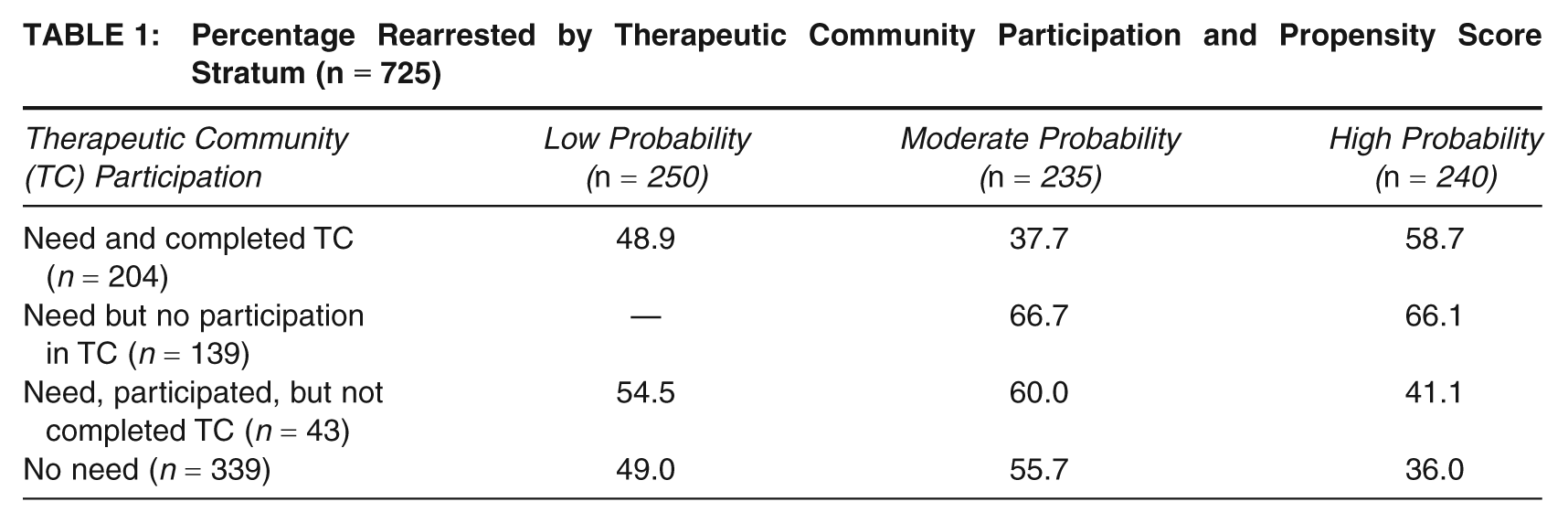
The percentages of individuals rearrested by TC participation and propensity score stratum are presented in Table 1. Among those individuals in the lowest probability stratum who were classified as needing TC and completed the program, 48.9% were rearrested up to 4 years following release from prison. There were no cases in the category of need but no participation in TC, so a comparison with the need and completed category was not possible.
Percentage Rearrested by Therapeutic Community Participation and Propensity Score Stratum (n = 725)
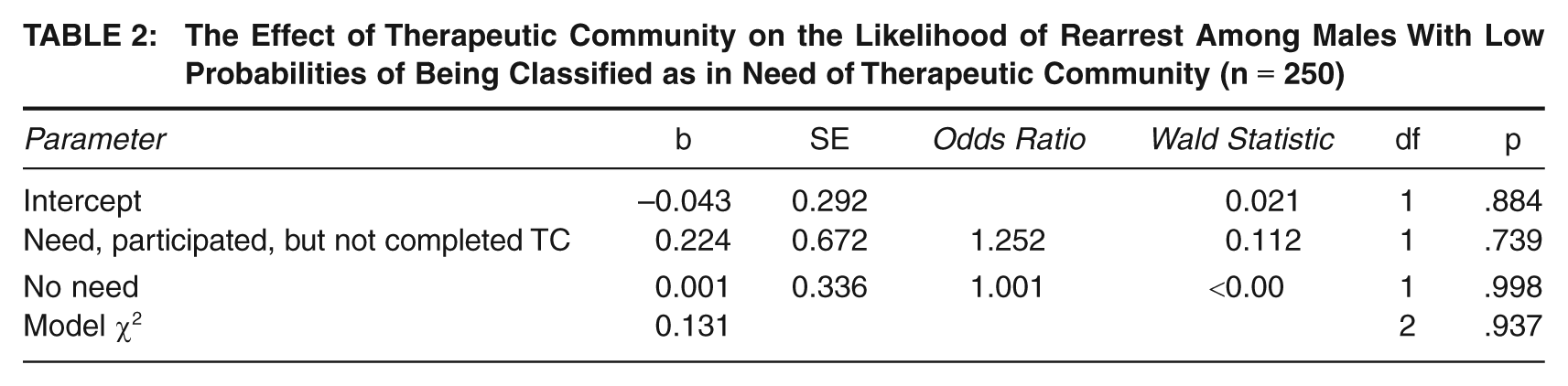
The findings for the effects of TC on the likelihood of arrest after release from prison for males with low probabilities of being classified as in need of this treatment are presented in Table 2. The full model is not statistically significant (p = .937). There were no statistically significant differences in rearrests between any of the need for TC and program participation categories.
The Effect of Therapeutic Community on the Likelihood of Rearrest Among Males With Low Probabilities of Being Classified as in Need of Therapeutic Community (n = 250)
The percentages of individuals rearrested in the moderate probability stratum are presented in Table 1. Those persons who were classified as needing TC and completed the treatment had a rearrest rate of 37.7%. In contrast, those individuals who were classified as needing TC programming but did not participate in the program had a rearrest rate of 66.7%.
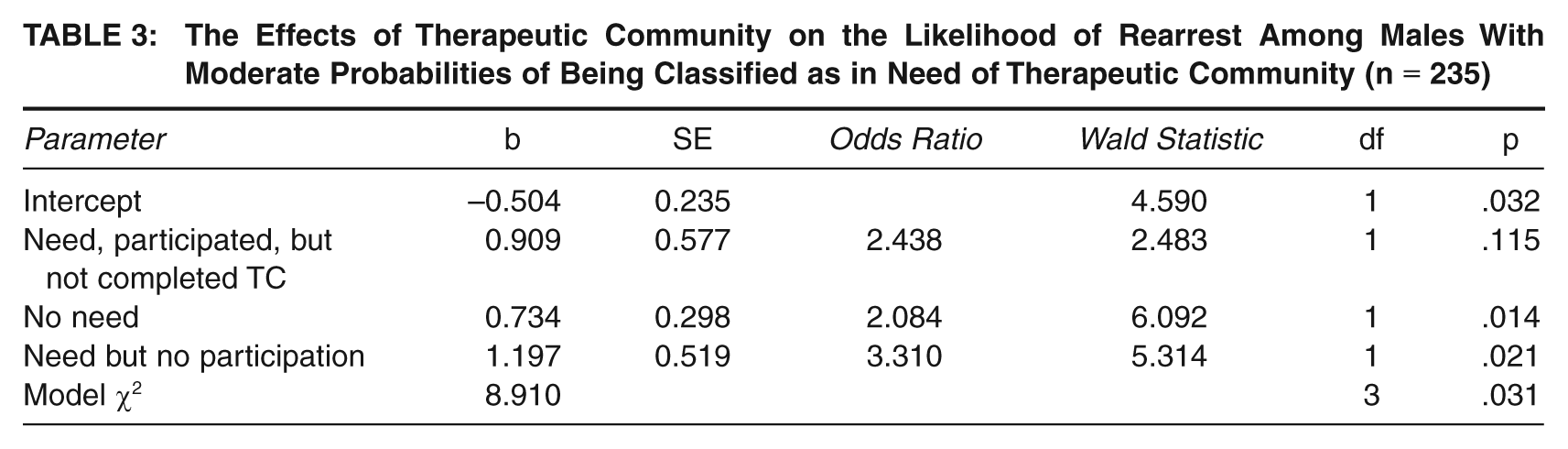
The findings for the effects of TC on rearrest for males with moderate probabilities of being classified as in need are presented in Table 3. The full model is statistically significant (p = .031). Those individuals who were classified as needing but not participating in TC were significantly more likely to be rearrested than those individuals who completed the program (p = .021). The odds ratio for this comparison is 3.31. Thus, those who needed but did not participate in TC were more than 3 times more likely to be rearrested than were individuals who needed and completed the TC program with covariates controlled in the analysis. In addition, individuals who were classified as not needing the TC program were significantly more likely to be rearrested than were those who needed and completed the program (p = .014). The difference between individuals who attempted, but did not complete the TC program and those who needed and completed the program was not significant (p = .115).
The Effects of Therapeutic Community on the Likelihood of Rearrest Among Males With Moderate Probabilities of Being Classified as in Need of Therapeutic Community (n = 235)
The percentages rearrested for those individuals in the high probability stratum are reported in Table 1. The need and completed TC group had a rearrest rate of 58.7%. The need but no participation in TC group had a rearrest rate of 66.1%.
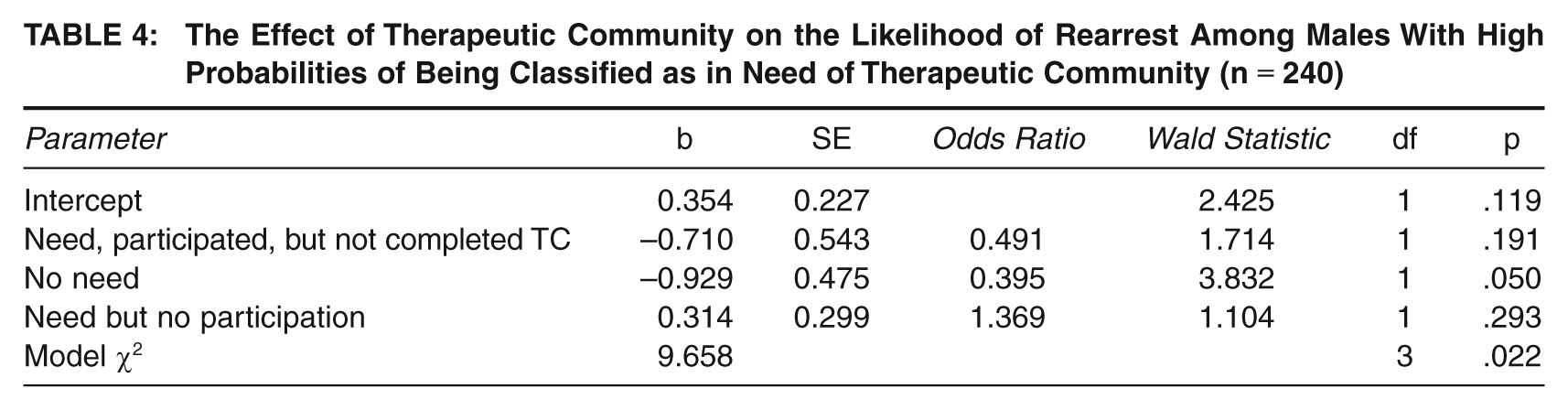
The results for the effects of TC on the rearrest of those who had the highest probability of being classified as in need of this program are presented in Table 4. The full model is statistically significant (p = .022). The significant finding in this model is that those individuals who were classified as not needing TC had a much lower rearrest rate than did those individuals who completed the program (p = .050). Individuals who needed but did not participate in the TC program in this propensity score group were not significantly more likely to be rearrested than those who need and completed the program (p = .293).
The Effect of Therapeutic Community on the Likelihood of Rearrest Among Males With High Probabilities of Being Classified as in Need of Therapeutic Community (n = 240)
Therapeutic Community Programming and Reconviction
The percentages of individuals reconvicted by TC participation and propensity score stratum are presented in Table 5. Among those individuals in the lowest probability stratum who were classified as needing TC and completed the program, 45.4% were reconvicted up to 4 years following release from prison. There were no cases in the category of need but no participation in TC, so a comparison with the need and completed category was not possible.
Percentage Reconvicted by Therapeutic Community Participation and Propensity Score Stratum (n = 636)
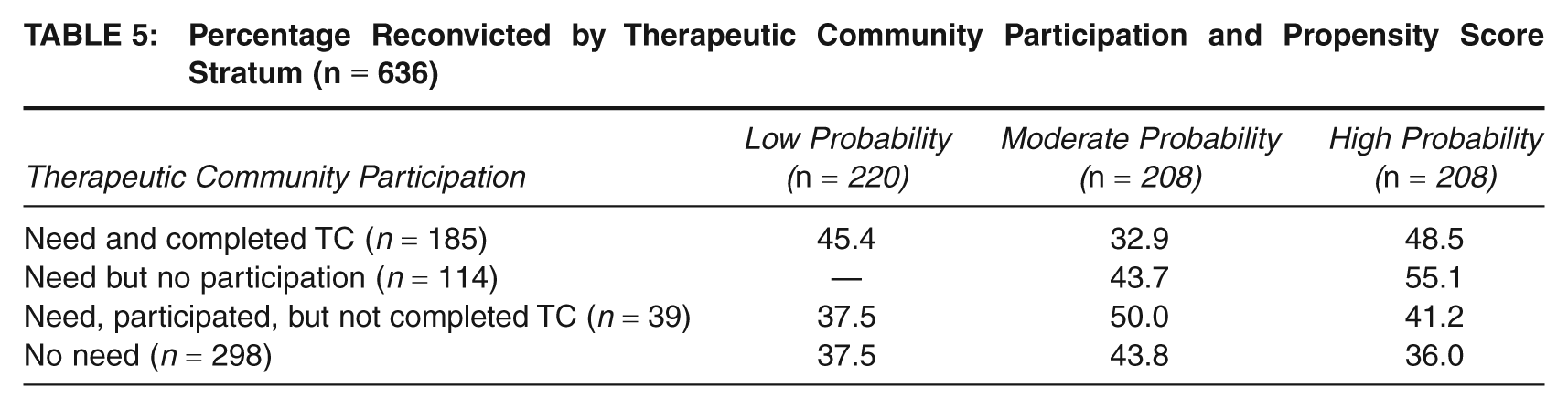
The sample size for reconvictions is smaller than that for rearrests because of missing data on convictions after release from prison in the NCIC database. For 81 individuals the conviction status was listed as “unknown,” and for 8 individuals the conviction status was listed as “pending.”
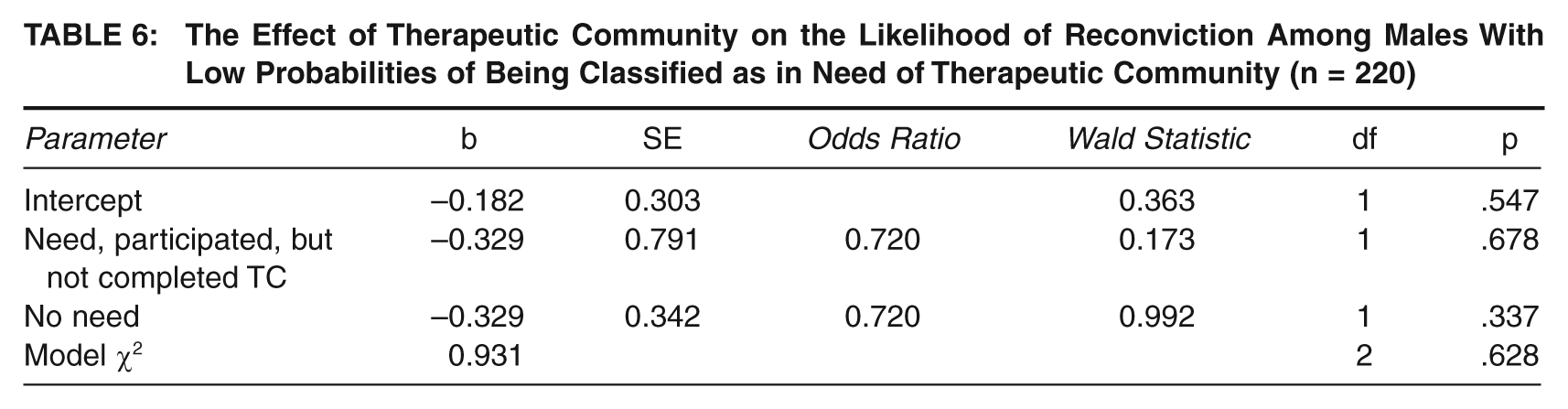
The results of the analysis of the effects of TC on reconvictions for males with low probabilities of being classified as in need of TC are presented in Table 6. The full model is not statistically significant (p = .628). There were no statistically significant differences in reconvictions between any of the need for TC and program participation categories.
The Effect of Therapeutic Community on the Likelihood of Reconviction Among Males With Low Probabilities of Being Classified as in Need of Therapeutic Community (n = 220)
The percentages of reconvictions among those with a moderate probability of being in need of TC are presented in Table 5. Those who were classified as needing TC and completing the program had a reconviction rate of 32.9%. Those who were classified as needing TC but who did not participate in the program had a reconviction rate of 43.7%.
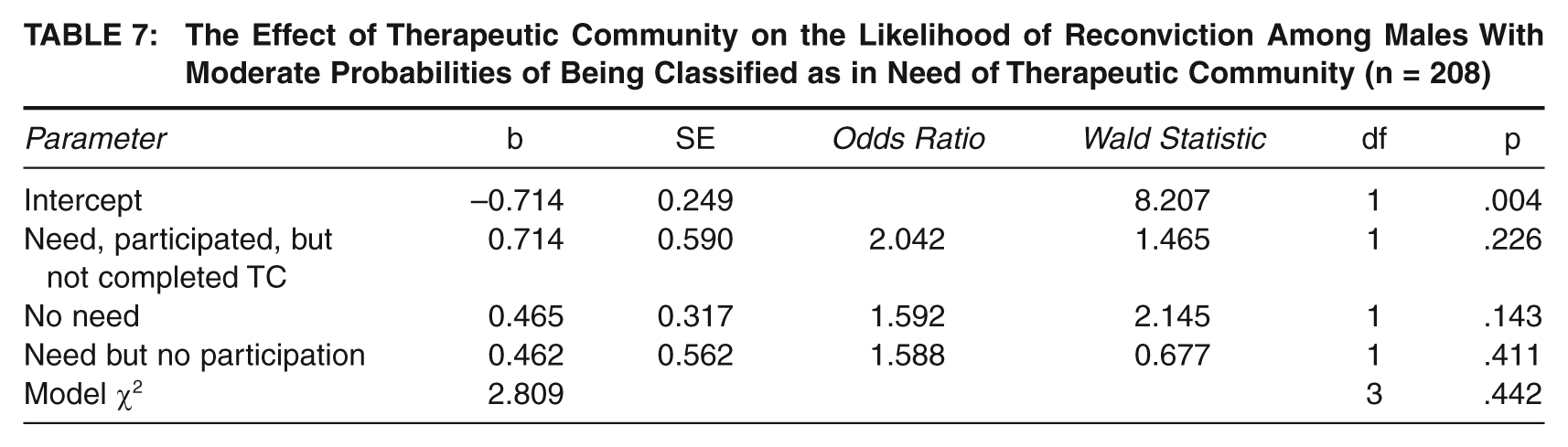
The results of the analysis of the effect of TC on reconvictions for males with a moderate probability of being classified as in need of TC programming are presented in Table 7. The full model is not statistically significant (p = .422). There were no significant differences in reconvictions between any of the need for TC and program participation categories.
The Effect of Therapeutic Community on the Likelihood of Reconviction Among Males With Moderate Probabilities of Being Classified as in Need of Therapeutic Community (n = 208)
The percentages of those reconvicted in the high probability of being classified as in need stratum are shown in Table 5. The need and completed group had a reconviction rate of 48.5%. The need but no participation group had a reconviction rate of 55.1%.
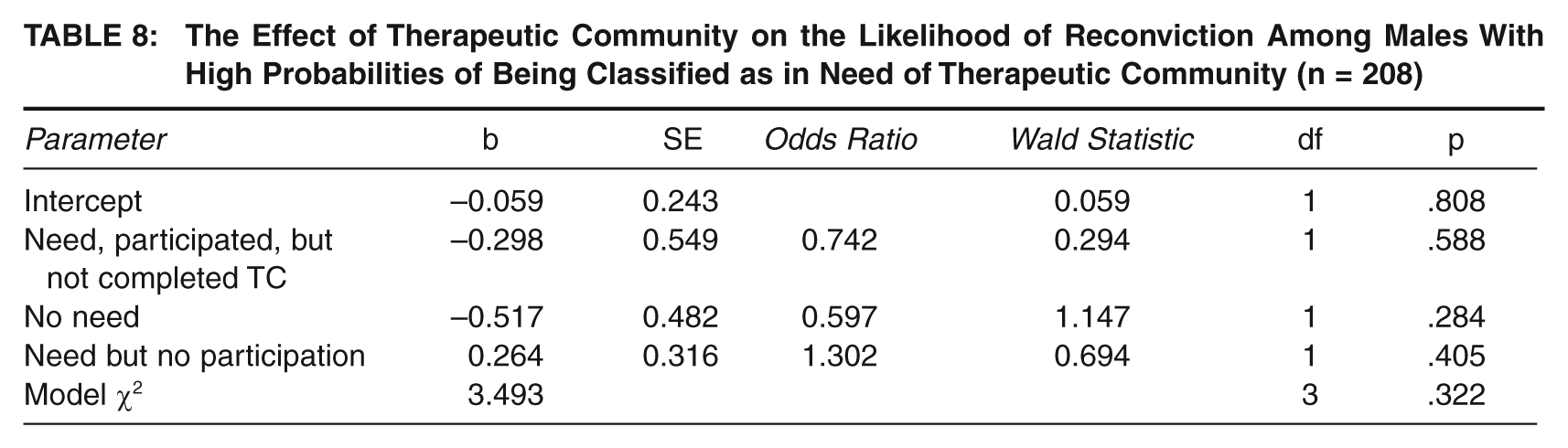
The results of the analysis on the effects of TC on males with high probabilities of being classified as in need of TC are presented in Table 8. The full model was not statistically significant (p = .322). There are no significant differences in reconvictions between any of the TC need and program participation categories.
The Effect of Therapeutic Community on the Likelihood of Reconviction Among Males With High Probabilities of Being Classified as in Need of Therapeutic Community (n = 208)
Discussion
Therapeutic Community Completion and Recidivism
The results of this research partially confirm findings of the majority of previous studies of the effects of in-prison TC programming on recidivism. The completion of a TC is significantly associated with a lower likelihood of rearrest for up to 4 years after release from prison for males in the moderate probability of being classified as in need of TC stratum. Individuals in this stratum who were classified as needing TC but did not participate in it were 3.3 times more likely to be rearrested than were persons who completed TC with covariates controlled in the analysis. An examination of the LSI-R total scores of the individuals in this propensity score group shows that they are medium–high and medium risk. The individuals who successfully completed a TC were required to participate in aftercare for a minimum of one year.
The completion of a TC did not have significant effects on rearrest for individuals with low or high probabilities of being classified as in need of TC programming, however. An examination of the LSI-R total scores of the persons in the high probability stratum shows that they are higher risk than are those individuals in the moderate probability of being classified as in need of TC.
In addition, TC did not have significant effects on reconviction for individuals with low, moderate, or high probabilities of being classified as in need of TC by IDOC personnel. Significant effects of TC completion on rearrest for individuals with moderate probabilities of being classified as in need of this treatment and a lack of effects on reconviction for these individuals seemed to be incongruent until sentencing policies and charging practices were examined with criminal justice professionals.
A possible explanation for the lack of effects of TC on reconviction involves criminal charging policies in Idaho. Interviews with criminal justice system personnel revealed that prosecutors are likely to exercise their discretion by proceeding with the aggressive prosecution of individuals who have served time in prison, whereas they may have declined prosecution or charged an individual with a lesser offense if that individual did not have a prior criminal record. In addition, prosecutors are likely to view having completed a TC as an aggravating factor in deciding how to charge the individual. That is, if the individual has completed the most intensive form of treatment that the Idaho criminal justice system has to offer and is alleged to have committed another crime(s), that individual will be prosecuted aggressively, including the persistent violator charge whenever possible.
In addition, and more important for the present research, the prosecution is likely to allege that individuals with two or more prior felony convictions are “persistent violators” if they have been rearrested. If the charges for which they have been rearrested are proven in court, the persistent violator charge “enhances” the defendant’s sentence by a prison term of not less than 5 years and up to life in prison.
The prosecutor will often then offer to dismiss the persistent violator enhancement if the defendant agrees to plead guilty to the offense for which he or she has been rearrested. For defendants experienced with the criminal justice system, the threat of the persistent violator sentencing enhancement is a serious one. They may choose to plead guilty to the rearrest charge to avoid the possibility of a much longer prison sentence under the enhancement. This may result in a higher reconviction rate because—had these individuals not been faced with the persistent violator enhancement—they may have been more inclined to take the rearrest charge to trial with the possibility of being found not guilty.
Strengths of the Present Study
This research addresses a number of the design and analysis limitations of the previous evaluations of TCs. We studied a relatively large sample of individuals. These individuals participated in TCs in multiple institutions and at varying levels of security. Three of these prisons are publicly operated, and one is operated by a private corporation. We excluded individuals who had died. We also excluded individuals who were being detained by U.S. Immigration and Customs Enforcement. These persons either were incarcerated or had been deported and were not free in the community to commit a criminal offense. We also excluded individuals who had only parole violation rearrests or revocations. Given the content of IDOC electronic records, we were not able to distinguish between technical violations (i.e., noncriminal) and rearrests or revocations for criminal offenses.
The recidivism data were obtained from the NCIC database. The recidivism data used in this research are from the entire nation. In addition, the recidivism data are for up to 4 years after release from prison.
Selection was not an issue since inmates are assigned to TCs. Inmates cannot volunteer for TC programming in Idaho as in some of the states examined in previous studies. Attrition from treatment was overcome because we included individuals who participated in TCs but did not complete them in the analyses. Regarding dissimilar outcomes, we expanded the number of studies using rearrest as an outcome. The use of propensity score analysis overcame the problem of few statistical controls.
Limitations of the Present Study
The major limitation of this research is lack of random assignment. Random assignment to TCs was not possible in this study.
Another limitation of this research is missing data. Of the 1,356 former inmates remaining in the sample after excluding those who had died, those individuals who were being detained by U.S. Immigration and Customs Enforcement, and those with admissions errors in their electronic records, 349 were missing data on relevant variables in the IDOC electronic files. Data on these variables were required for the multivariate analyses. The most frequent sources of missing data were the number of prior convictions and the family/marital score on the LSI-R.
Conclusions and Policy Implications
In conclusion, as implemented in the state of Idaho, in-prison TC and mandatory aftercare significantly reduced the rearrests of medium–high and medium risk males for up to 4 years after release from prison. This finding is in general agreement with the TC research in Delaware and Texas. The Pennsylvania research found positive effects of TC on reducing rearrest and reincarceration without aftercare (Welsh, 2007).
We encourage corrections personnel to implement TC programming in prisons that house offenders who can benefit from it. In further support of the effectiveness of TCs, in a previous publication we found that among TC completers who were rearrested, TC had a highly significant effect on delaying time to first rearrest for up to approximately 2 years after release from prison (Jensen & Kane, 2010). In addition, the TCs should be closely monitored by qualified supervisory staff to ensure that they are operating according to evidence-based standards. Continuing TC programming during aftercare is also recommended, although more research is needed on this subject.
Finally, we encourage policy makers to expand community-based alternatives to in-prison substance abuse treatment for minor offenders. These alternatives could include drug courts (see Jensen, Parsons, & Mosher, 2007), in-community substance abuse treatment (Caulkins, Rydell, Schwabe, & Chisea, 1997; also see MacCoun & Reuter, 2001), and community-based TC programming (see De Leon, 2001; Ravndal, 2001). Alternatives to incarceration for minor offenders reduce financial costs, avoid the deleterious stigma of ex-inmate, and allow the individual to maintain or establish conventional ties in the community (see Sampson & Laub, 1993; also see Aos et al., 2011).
Footnotes
Authors’ Note:
This research was conducted with funding from the Idaho Department of Correction. The opinions expressed in this report are those of the authors, not necessarily those of the Idaho Department of Correction. Special thanks to Megan Herrett for her assistance in unraveling the puzzle. We would also like to thank the following persons for their contributions to this research—in alphabetical order: John M. Adams, Dave Dokken, Shane Evans, Dr. Tony Grange, Steve Nelson, Dr. Gerhard Jans Ploeg, Dr. Gary E. Reed, Greg Sali, Bill Thompson, and Sean Walsh.