




Abstract
This article provides a discussion of assessments of youth relevant to forensic decisions. The latter include decisions relating to legal processing within the judicial system and the treatment of youth following adjudication. The article begins with a discussion of general issues relating to forensic assessments and a review of the different objectives of forensic assessments. This is followed by a review of relevant ethical and legal considerations. Examples of specific assessment instruments and procedures are presented.
This article provides a discussion of assessments of youth relevant to forensic decisions. The latter include decisions relating to legal processing within the judicial system and the treatment of the youth following adjudication. These decisions may involve the youth’s suitability for a precharge diversion program, the validity of a decision to waive Miranda rights, the need for pretrial detention, competence to participate in the adjudicative process, waivers to adult court, and dispositions following a finding of guilt. Ultimate decisions about these issues generally rest with the court, although other professionals such as prosecutors and probation officers may also be in a position to make decisions.
Some Considerations Regarding Assessments
The term forensic assessment is used in this article to refer broadly to any assessment employed to inform a forensic decision. The terms psychological assessment and mental health assessment are also used to refer to the underlying assessments. Forensic assessments are normally conducted by a mental health professional such as psychologist or psychiatrist, although other professionals within the justice or correctional system may also conduct the assessment (e.g., probation officer).
A wide variety of assessment tools and procedures are used in forensic assessments. These may include tests of cognitive functioning, personality tests, structured interview formats, or behavioral ratings or checklists. These are discussed further below. One important distinction is between clinical and standardized assessments. Clinical assessments generally involve informal, unstructured interviews where the final assessment or diagnosis is based on the training or experience of the professional conducting the assessment. Many decisions within juvenile justice systems are based on clinical assessments conducted by mental health professionals or other decision makers (e.g., police, prosecuting attorneys). On the other hand, standardized assessments involve structured formats or procedures and standardized scoring rules. The Wechsler Intelligence Scale for Children–4 (WISC-4; Wechsler, 2004) is an example of a standardized test of cognitive functioning. The Minnesota Multiphasic Personality Inventory–Adolescent (MMPI-A; Butcher et al., 1992) is another example of a standardized measure, this designed to measure aspects of personality.
Research in a wide variety of areas has shown that decisions based on standardized measures supported by reliability and validity research are superior under most circumstances to those based on clinical assessments (e.g., Grove & Meehl, 1996; Grove, Zald, Lebow, Snitz, & Nelson, 2000). As well, as discussed below, court testimony based on standardized instruments often carries more credibility than that based solely on clinical procedures (Faigman & Monahan, 2009).
Another distinction is between screening and assessment instruments and procedures. Screening instruments are designed to provide initial information about some aspect of the youth’s functioning. They are generally short, easy to administer, and easy to interpret. The Massachusetts Youth Screening Instrument–Version 2 (MYSI-2; Grisso & Barnum, 2000) is an example of the type of screening instrument sometimes used as youth enter pretrial detention. It provides preliminary information about the presence of a mental health issue. Where symptoms are identified, a more comprehensive assessment is conducted. Screening instruments can often be employed by non–mental health providers with training in the procedure.
Assessments, or psychological assessments, involve the collection of more extensive information and a more in-depth exploration of characteristics of the youth and his or her circumstances. These are normally conducted by a mental health professional and generally involve the use of standardized instruments and procedures. A decision about adjudicative competence to stand trial, for example, might involve administration and interpretation of a set of instruments assessing cognitive competencies and emotional or behavioral functioning. This information would then be used to formulate a conclusion about the youth’s ability to participate knowledgeably and rationally in the judicial process. That conclusion would be communicated to counsel.
It is important to note a distinction between forensic assessments and therapeutic assessments. The former are conducted to inform forensic decisions and the latter to aid in formulating a therapeutic treatment program. We will see that these two types of assessments differ in some important respects, including freedom to refuse participation and confidentiality rules.
Several cautions should be noted at the outset regarding the conduct of forensic assessments, particularly those involving youth. First, it is important to recognize that youth are going through a developmental process and that the functioning of the youth in many areas is less advanced than that of adults (Scott & Steinberg, 2008; Steinberg, 2011; Vincent & Grisso, 2005). The limits exhibited by youth in reasoning abilities and the capacity to interpret and regulate emotional states, function in social relations, and engage in the decision process have direct relevance to forensic decisions. For example, it is generally recognized that the validity of a youth’s confession to a crime depends on the young person’s ability to assess the short- and long-term consequences of the action. The ability of youth to problem solve in this kind of situation is limited. An important role of forensic assessments of youth is the documentation of the cognitive and emotional limitations of the youth.
The situation with respect to development is further complicated by the fact that development does not proceed at the same pace. Not all 14-year-olds are at the same level of development or maturity. Furthermore, different aspects of cognitive and emotional functioning youth may develop at different rates within the youth. The 14-year-old may be sexually mature but very limited in cognitive reasoning abilities. Competencies are neither predictable nor stable across adolescence. These developmental considerations must be taken into account in making forensic decisions, particularly those involving cognitive or emotional functioning.
A second complication is that legal and procedural guidelines for forensic decisions are sometimes ambiguous and may vary across jurisdictions (Grisso, 1998a; Grisso & Schwartz, 2000; Heilbrun, 2001; Melton, Petrila, Poythress, Slobogin, 2007). For example, most jurisdictions in the United States provide due process protections relating to adjudicative competence. However, the specific guidelines differ across jurisdictions. This often complicates the design of assessment batteries.
The third caution is that a clear and direct link does not always exist between an assessment and the forensic decision (Heilbrun, 2001, 2010). For example, a decision regarding competence to waive Miranda rights and to proceed with the legal proceedings may be informed by information about the youth’s intelligence, reading ability, and attentional capacities collected through standardized assessment tools. Under some circumstances, though, this information may in itself not answer the specific question of competence raised in the case. Often, as we will see, a clinical judgment is required to make the connection with the ultimate forensic questions. However, and as we will see below, empirical research is beginning to appear in which the actual relevance of assessments for forensic decisions is being explored. Instead of asking how a given assessment outcome relates to the forensic decision, this research is asking which aspects of functioning are actually relevant to a decision. Once that is established, a more valid choice can be made among assessment alternatives.
The importance of intelligent decisions about the assessments informing a forensic decision is emphasized throughout the article. The primary recommendation is that forensic assessments should be conducted by trained and certified professionals using the best standardized assessment tools available. Decisions made about the youth at all stages of the judicial process are extremely important to the youth and to society, and it is imperative that those decisions be made in an optimal manner.
Focus of Assessments
The field of psychological assessment is a broad one, and the focus in this section is on those areas of assessment most relevant to forensic decisions. The way in which the assessments relate to specific forensic decisions will be discussed in the next section, as will research on competency–decision links. This section is organized under the following headings: cognitive and academic competencies, emotional and behavioral competencies, amenability to treatment, totality of circumstances, risk for reoffending, and criminogenic needs. We will see that these are somewhat overlapping categories.
A comment should be made at this point on the term maturity, which often arises in connection with forensic decisions. In many cases the forensic decision about the youth is to be based on judgments about his or her maturity, with this referring sometimes to cognitive functioning, sometimes to emotional functioning, and sometimes to both. The concept of maturity is particularly relevant to decisions about fitness to stand trial, transfers to adult court, and mental status at the time of the offense. Maturity is also sometimes a consideration in disposition decisions. Unfortunately, neither a legal nor a psychological definition of maturity exists (Grisso, 1998a, 2003, 2009). In practical situations, the judgment is often arrived at by examining a broad range of information about the youth’s cognitive and emotional functioning and then a clinical inference regarding the youth’s maturity level. The latter requires some sort of demonstration of a direct link between the definition of maturity in the particular case and the decision in question. Some research on this topic is discussed in the later section on assessment contexts.
Cognitive and Academic Competencies
The youth’s cognitive capacities are relevant to a broad range of forensic decisions, including adjudicative competence, transfer to criminal court, and postsentence dispositions. For example, a youth’s reasoning and memory abilities as well as reading competencies have a direct bearing on aspects of adjudicative competence since they relate to the youth’s ability to understand court procedures, communicate with counsel, and read relevant documents.
Fortunately, psychologists have developed considerable expertise in measuring cognitive and academic capacities (Sattler, 2001). Valid and reliable tests of cognitive functioning (IQ tests) are available that provide estimates of the youth’s comprehension, reasoning, memory, and other cognitive abilities. The latter often include assessments of executive functioning, involving abilities to engage in logical analysis, self-monitoring, and short- and long-term planning. An example is the WISC-4 (Wechsler, 2004), widely used in forensic and therapeutic assessments. Subscales of this measure provide indices of verbal comprehension, perceptual organization, and freedom from distractibility. Standardized tests of academic competencies relating to reading and other abilities are also available.
A large body of research has now established that adolescents are, on average, limited in cognitive functioning relative to adults (Scott & Steinberg, 2008; Vincent & Grisso, 2005). In fact, these limitations have been directly linked with neurological changes taking place over the childhood and adolescent years. While these limitations can be identified through psychological assessments, they must be directly linked with the forensic issue to be useful in court. The issue is relatively simple in the cases of severe developmental delay but more complicated where the level of functioning is normative for an age group. This issue will be explored more fully in the discussion of specific forensic decisions in the next section.
Emotional and Behavioral Competencies
Some forensic decisions require judgments about the emotional or behavioral functioning of the youth. This is the primary focus of decisions such as transfer to criminal court and mental status at the time of the offense, but, as we will see later, it may also form part of the judgment in the case of waiver of rights, adjudicative competence, and disposition decisions. Standardized measures of emotional and behavioral functioning are available in the forms of structured interview schedules, personality tests, and standardized rating scales (Hoge, 1999; Sattler & Hoge, 2006).
The way in which emotional and behavioral competencies are conceptualized within the various measures varies. In some cases the construct refers broadly to mental health and often this is defined by the terminology of the Diagnostic and Statistical Manual of Mental Disorders (American Psychiatric Association, 2000). This document, widely recognized by courts, provides a description of the individual in terms of diagnostic categories represented as symptoms of dysfunction or pathology. The disorders most relevant to youth involved with the judicial system include conduct, attention-deficit hyperactive, and oppositional-defiant disorders. Mood, anxiety, and substance abuse disorders are also commonly identified in these youth.
Dysfunctional emotional and behavioral conditions may also be described in dimensional or behavioral terms. For example, a standardized personality test such as the MMPI-A (Butcher et al., 1992) yields scores reflecting dimensions such as depression and psychopathic deviance. A behavioral checklist measure such as the Child Behavior Checklist (Achenbach & Rescorla, 2001) is scored in terms of dimensions such as anxious-depressed and aggressive behavior.
These diagnostic categories and pathological dimensions are sometimes relevant to forensic decisions such as adjudicative competence, validity of confessions, and transfers to criminal courts. They are also relevant to case planning within postsentencing disposition decisions. However, and as was the case with the cognitive assessments, these assessments of emotional and behavioral functioning must be related directly to the forensic decision. For example, a demonstration that a youth is within the clinical range on anxiety and depression may not be sufficient to argue against a transfer to criminal court. This issue is explored further later in the article.
Amenability to Treatment
Another construct that sometimes arises in connection with forensic decisions is that of amenability to treatment. This is particularly relevant to decisions about transfer to criminal court and postsentence dispositions. Under some circumstances the court will avoid a transfer to criminal court if it can be demonstrated that the youth is amenable to treatments available within the juvenile system. As well, a custody sentence might be avoided if it can be demonstrated that the criminogenic needs of the youth can be met in a community-based treatment (e.g., diversion, probation).
Relatively little progress has been made developing instruments or procedures for assessing amenability to treatment in youth (Kruh & Brodsky, 1997; Mulvey & Iselin, 2008). In many cases the conclusion will be based on a clinical judgment arrived at on the basis of an examination of file information and the results of standardized cognitive and personality tests. For example, a history of failure to participate in treatments and scores indicating low levels of cognitive functioning and high levels of anger/hostility may suggest limits on the youth’s amenability to treatment. One clinical instrument, the Risk–Sophistication–Treatment Inventory (RSTI; Salekin, Salekin, Clements, & Leistico, 2005) is in development. This is composed of an interview schedule and rating scales designed to assess risk for reoffending, cognitive and emotional maturity, and likelihood of responsivity to treatment. This would normally be completed in combination with standardized test scores.
Totality of Circumstances
The term totality of circumstances is sometimes used in connection with decisions regarding the validity of confessions and waivers of Miranda rights. This is a recognition that the latter forensic decisions are to be based not only on characteristics of the youth but also circumstances under which the confession or waiver was obtained. A universal definition of totality of circumstances does not exist, and no single instrument is available for assessing the construct (Grisso, 2003, 2009). However, one battery of clinical tools is available. The Instruments for Assessing Understanding and Appreciation of Miranda Rights (Grisso, 1998b) are designed to assist in collecting information on the totality of circumstances prevailing at the time of waiver.
Risk for Reoffending
The youth’s risk for committing another offense is an important consideration in pretrial detention, transfer, and postsentence disposition decisions. Detention prior to trial is usually reserved for youth who have committed serious crimes and/or are judged at risk for committing a new offense. The same considerations generally apply to decisions about transfers to the criminal courts. Risk assessments may also be relevant to postcharge referrals to alternative measures programs and sentencing or disposition decisions. A judge, for example, may sentence a youth to custody based on information that the youth is at high risk for reoffending.
Assessments of risk for reoffending may focus on the commission of any new offense or a specific type of offense such as violent or sexual offending. The term dangerousness is sometimes used in connection with risk of violent offending. Research on factors associated with general, violent, and sexual reoffending among youth has a long history, and we now have considerable information about characteristics of the youth and his or her circumstances associated with persistence of criminal activity (Farrington & Welsh, 2006; Hoge & Andrews, 2010; Hoge, Vincent, & Guy, in press; Loeber & Farrington, 1998, in press; Thornberry & Krohn, 2003).
Assessments of risk for criminal activity are commonly based on informal evaluations conducted by police, prosecutors, or others within the juvenile system. However, a number of well-validated measures of risk for reoffending have been developed for juveniles (see Hoge & Andrews, 1996, 2010; Hoge et al., in press; Vincent, Terry, & Maney, 2009). These are generally in the form of checklists designed for completion by a mental health professional or other workers within the juvenile system (e.g., intake officers, probation officers). Some of these measures include only historical or static factors (e.g., age at first arrest, number of arrests, parole violations). These are treated as static variables because they are not subject to change. An example is the Colorado Security Placement Instrument, composed of seven items reflecting the youth’s history of antisocial behavior and contacts with correctional and mental health institutions. Other risk instruments, also termed risk/need instruments, include both static and dynamic items. The latter are risk factors that are subject to change and, if changed, reduce the probability of future offending. These are referred to as criminogenic needs.
Criminogenic Needs
The risk/need/responsivity model is one paradigm guiding the treatment of youth within judicial and correctional settings (Andrews & Bonta, 2010; Hoge & Andrews, 2010). A key assumption of this model is that interventions with youth who violate the law should focus on the criminogenic needs of the youth, that is, the factors directly contributing to engagement in the antisocial activities. If the youth’s actions are primarily associated with dysfunctional parenting, association with antisocial peers, and drug abuse, then these should be the targets of the intervention. Considerable empirical research is now available demonstrating that systems based on this principal are effective in reducing the incidence of reoffending, particularly where compared to purely punitive sanctions (Andrews & Bonta, 2010). Furthermore, research has also demonstrated that rehabilitative strategies focusing on the specific needs of the youth are cost-effective, again particularly in comparison to punitive sanctions involving incarceration (Drake, Aos, & Miller, 2009).
The role of assessments of criminogenic needs in forensic decisions has not received a great deal of legal attention. However, these assessments may be relevant to decisions about transfers to criminal court. A demonstration that a youth has specific needs that might be met in the juvenile system may influence such a decision. Assessments of need factors play a particularly important role in precharge diversion and postsentence disposition decisions. Again, where a rehabilitative goal exists in the system, the identification of the specific needs of the youth will play an important role in determining the services needed by the youth.
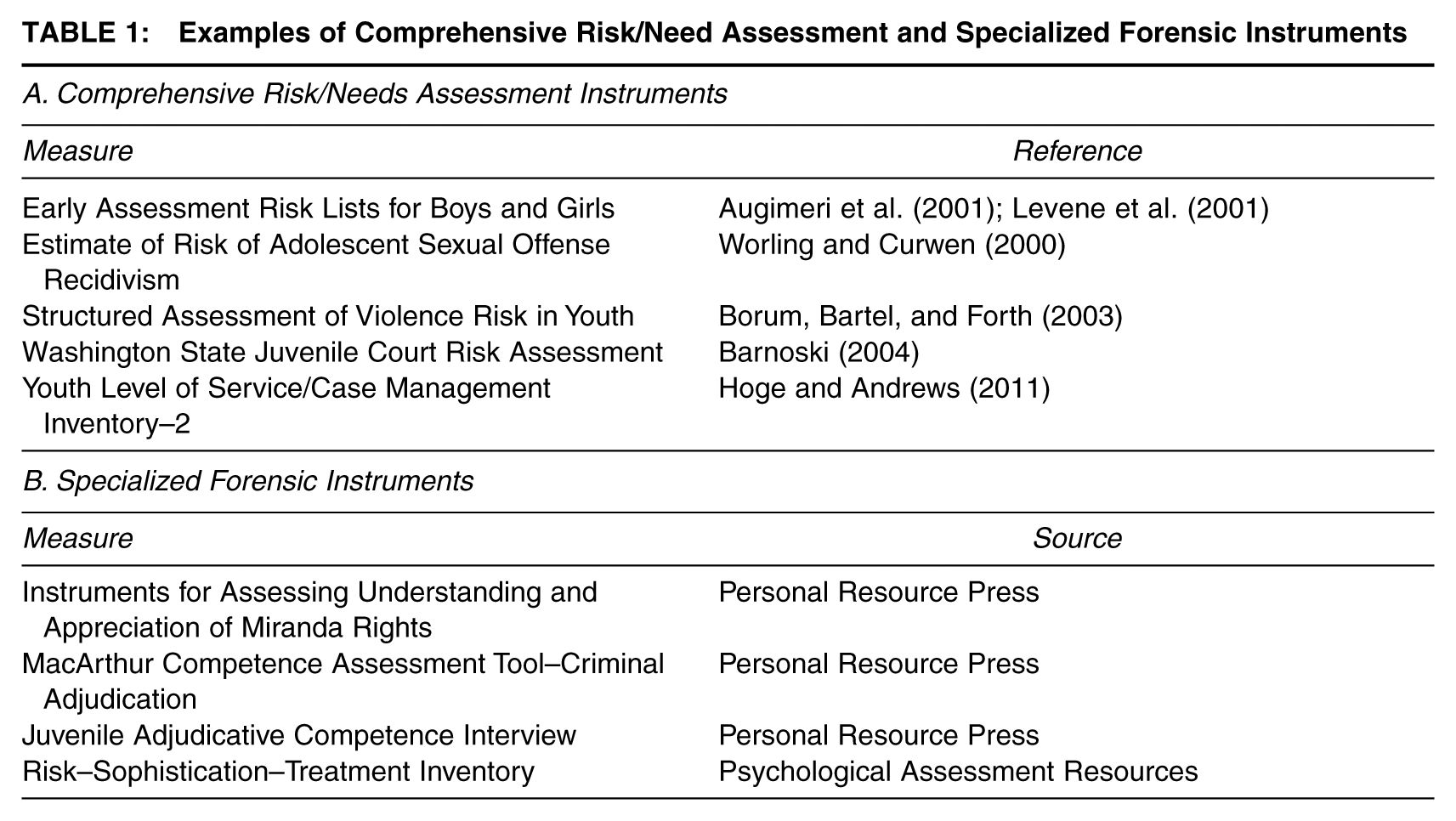
The Youth Level of Service/Case Management Inventory–2 (YLS/CMI-2; Hoge & Andrews, 2011) is an example of a standardized risk/needs assessment tool particularly designed to assist in postsentence disposition decisions. The instrument is designed for completion by mental health professionals, probation officers, or youth workers. It provides an estimate of risk and needs in a variety of areas (e.g., family dynamics/parenting, peer group associations, substance use, and attitudes). It also assists in developing case plans. Part A of Table 1 identifies a number of these standardized risk/needs assessment tools.
Examples of Comprehensive Risk/Need Assessment and Specialized Forensic Instruments
Specialized Forensic Assessment Instruments and Procedures
Most of the assessment instruments and procedures mentioned above have been developed for general use within psychological assessments. As shown, these often have a role in guiding forensic decisions. As well, a number of specialized measures have been developed to assist certain of these decisions. The most important of these for the juvenile level are identified in Part B of Table 1. Their relevance for specific decisions is discussed below.
Forensic Contexts
This section provides an overview of legal and extralegal contexts in which forensic assessments are employed. The types of assessments relevant to the contexts are noted, as is research on direct links between the decisions and assessments. The overview does not provide comprehensive discussions of legal issues associated with the various contexts, and the reader is referred to Grisso (1998a, 2003, 2009), Grisso and Schwartz (2000), Heilbrun (2001), and Melton et al. (1997) for more thorough discussions of the relevant legal decisions.
Pre- and Postcharge Diversion
Although not strictly speaking a forensic decision, some form of precharge diversion is a very common action taken for juveniles apprehended by police (along with dismissal and dismissal with warning). Diversion efforts are designed to avoid further involvement in the police and judicial systems. Access to the diversion option generally depends on the youth’s acceptance of responsibility for his or her actions. Precharge decisions are generally made by the police, although in some cases prosecutors or specialist services might be involved. In most cases the rules governing these decisions are informal and arbitrary, although in some jurisdictions formal guidelines may exist. Legal counsel is generally not involved in these decisions.
Diversion of the youth from the judicial system postcharge occurs in some jurisdictions as well. In this case an effort is being made to avoid the full adjudication process. The available actions are the same as for precharge actions: dismissal, dismissal with warning, or referral to a community intervention. These decisions are nearly always made by prosecutors in consultation with police. Legal counsel may be involved.
Eligibility for diversion, whether pre- or postcharge, generally depends on the nature of the offense, the youth’s acceptance of responsibility for actions, and the youth’s level of risk. Within formal diversion programs, community-based services may be available to address the factors placing the youth at risk. As indicated, diversion decisions are often made by police or prosecutors in an informal manner. However, a number of diversion models exist where formal assessment procedures are used to assess risk and need factors and where a formal intervention program is designed.
The broad-based risk/needs assessment instruments noted above are particularly useful to guide diversion decisions. They provide information about the level of risk for reoffending presented by the youth as well as specific need areas that should be addressed in the diversion program. These are sometimes in the form of short screening instruments or measures allowing for a more in-depth assessment of the youth such as the YLS/CMI discussed above.
Pretrial Detention
Three choices are normally available once a youth has been charged with a crime: release on own recognizance, release with bail or other conditions, or detention. This decision will depend on part on the nature of the offense, but it will also depend in some cases on judgments about the youth’s mental status and risk for reoffending during the interval before trial. Where significant mental health issues are detected, a more thorough assessment will be appropriate. Legal counsel may be involved in this decision.
The initial interview with the youth may be informal, but many systems now employ a standard screening procedure for all youth entering the system charged with a crime. The procedure may be administered by probation officers or special intake officers and may take place as soon as the youth is arrested or at a later prearranged date. This may involve a risk screening instrument or a mental health screening tool such as the MAYSI-2 (Grisso & Barnum, 2000). This information would be used to decide whether pretrial detention is appropriate or whether mental health interventions may be needed. As noted below, caution must be exercised in the use of these instruments since the information could affect the later adjudication process.
Competence to Waive Miranda Rights
A variety of court decisions have presented guidelines regarding a youth’s competence to waive his or her Miranda rights (e.g., Fare v. Michael C., 1979; In re Gault, 1967). The general rule is that the youth must have made the waiver voluntarily and have the intelligence and knowledge to make a competent decision. As well, the circumstances associated with the waiver must be considered. Considerable variability is observed in the interpretation of this rule across jurisdictions (Grisso, 1998a, 2003, 2009; Melton et al., 1997). Legal counsel may be involved in issues relating to this waiver.
Age of the youth, intellectual competence, comprehension and reading skills, and behavioral and emotional functioning are among the factors that may be relevant to a judgment about the youth’s competence to waive Miranda rights. Scores from tests of cognitive functioning may indicate a limited ability to comprehend abstract concepts, whereas scores from a test of emotional functioning may indicate anxiety and depression scores within the clinical range that could affect the ability to make an informed decision. A wide range of psychological assessment instruments and procedures may be relevant to evaluations of the validity of these waivers. These include intelligence, neuropsychological functioning, achievement, and personality tests. An assessment conducted by a mental health practitioner will employ a battery of these instruments as well as information from interviews and file reviews. One of the standardized instruments for evaluating a juvenile’s competence to make voluntary, intelligent, and knowledgeable decisions in this case is listed in Table 1. The clinical Instruments for Assessing Understanding and Appreciation of Miranda Rights (Goldstein, Condie, & Kalbeitzer, 2005) are designed to evaluate the youth’s understanding of the implications of the waiver.
Some research is emerging from the social science literature on the specific areas of functioning associated with competence to waive these rights (e.g., Redlich, Silverman, & Steiner, 2003; Viljoen & Roesch, 2005; Woolard, Fried, & Reppucci, 2001). This research has shown clearly that age and cognitive and emotional maturity are directly linked with the youth’s understanding of the implications of the waiver of Miranda. For example, Viljoen and Roesch (2005) demonstrated that youth with deficits in cognitive verbal ability and attention-deficit/hyperactivity disorders are handicapped in understanding the full implications of a waiver of rights. This research should lead to better assessments relevant to this particular decision.
As indicated above, the youth’s competencies are not the only consideration in evaluating the acceptability of these waivers. The conditions under which the waiver was obtained must also be considered. Relevant factors in this case involve the presence of a parent, the length of interrogation, and the personnel conducting the interrogation. Because both the competencies of the youth and the conditions under which the waiver was obtained must be considered, final decisions about the legal acceptability of the waiver will depend on the “totality of circumstances” prevailing at the time of the waiver (Grisso, 1998a, 2003, 2009).
Validity of Confessions
Evaluating the validity of a confession involves much the same considerations as discussed in the previous section on waiver of Miranda rights. The assessment in this case should provide information about whether the youth has the cognitive and emotional competencies to judge the full implications of a confession.
Adjudicative Competence
Although some variability is observed in the specific definition of adjudicative competence, the legal criteria are those specified in Dusky v. United States (1960). Two somewhat separate aspects of the youth’s competence to stand trial are identified (Bonnie & Grisso, 2000): (a) the youth’s capability of consulting with counsel and of understanding judicial proceedings and (b) the youth’s competence to enter a plea. The legal criteria for making these decisions are similar, as are assessments relevant to the issues. Legal counsels are nearly always involved in decisions regarding adjudicative competence.
Although judicial proceedings have provided some guidelines regarding criteria for judging adjudicative competence, applications of those guidelines are complicated (Grisso, 1998a, 2003; Grisso & Schwartz, 2000; Melton et al., 1997). Note first that two considerations can be eliminated. Neither the age of the youth nor his or her general level of cognitive and emotional competence can serve as absolute guides for determining competence to stand trial. Rather, it must be demonstrated that the youth lacks the specific abilities and knowledge to effectively participate in the legal process. A 12-year-old youth may display cognitive and emotional immaturity but still may be judged to have the ability to understand and participate in the proceedings. The situation is further complicated by the fact that, even where limitations directly related to participation are observed, the proceedings may be stayed only until the limitations can be addressed. This is particularly true where the issue of limited knowledge is involved.
Certain deficits are generally recognized as relevant to decisions regarding adjudicative competence (Grisso, 1998a, 2003, 2005, 2009; Melton et al., 1997). These include moderate to severe intellectual deficits and limited reading and comprehension abilities. However, these deficits must be shown to be directly related to the inability to participate in the judicial process. Mental illness expressed as serious emotional and/or behavioral problems may also be considered relevant to the decision. Research noted in the earlier section on waiver of Miranda rights is also relevant here.
A comprehensive assessment of the youth’s competence to stand trial would be based on interviews with the youth and collaterals (e.g., parents, police), reviews of file information, and the use of standardized assessment tools, including intelligence, personality, and other tests. Demonstrations of limitations in cognitive functioning or signs of emotional or behavioral problems would then be related to the youth’s capacity to participate in the judicial proceedings. Two of the instruments identified in Table 1 are relevant this assessment: the Juvenile Adjudicative Competence Interview (Grisso, 2005) and the MacArthur Competence Assessment Tool–Criminal Adjudication (Poythress et al., 1999). Both provide information about factual understanding of legal proceedings.
Transfer to Criminal Court
Transferring the case of a juvenile to criminal court for adjudication is mandatory for certain crimes in some jurisdictions. However, in other cases, the transfer decision depends on judicial discretion. A number of factors may enter into these decisions. First, transfers are generally reserved for more serious crimes. Second, the likelihood of a transfer is increased if the young person is perceived as at a high risk for reoffending, particularly violent reoffending. Amenability to treatment is a third consideration in some cases. Finally, the presence of a significant cognitive developmental delay or mental illness will often lead to the decision to retain the case in the juvenile court or refer to the mental health system.
Assessments conducted by mental health professionals often play an important role in these transfer decisions. As we have seen, standardized risk/needs instruments are available that provide quantitative estimates of the likelihood of reoffending. Also, as indicated above, a wide range of standardized instruments are available for evaluating the presence of developmental delays and pathological psychological states. Assessing amenability for treatment presents a somewhat more difficult challenge since fewer efforts have been made to develop assessments. The exception noted earlier is the RSTI (Salekin et al., 2005), a clinical tool for evaluating likely responsivity to treatment.
Postsentence Dispositions
The most common dispositions following an adjudicative finding of guilt involve dismissal, probation (with various conditions), or some form of custody. The length of a sentence and the nature of the disposition will generally be influenced by the nature of the crime and the youth’s history of contact with the judicial system. Within some systems, though, treatment goals may be included in the postsentence disposition. These dispositions are usually at the discretion of the court, although judges may be influenced by predisposition reports prepared by probation officers or other court officials. Legal counsel may be involved in this phase of the process.
Juvenile judicial and correctional systems including rehabilitative goals will generally design the dispositions to reflect the needs of the youth and the services available within the system. For example, where the youth’s criminal activity was associated with dysfunctional parenting within the home, substance abuse, and association with antisocial peers, the judge may direct that services to meet those specific needs should be provided within the probation disposition. Similarly, if significant mental health issues are exhibited by the youth, a referral to relevant psychological services might be indicated.
Cases where some indications of significant cognitive or emotional disabilities are present, a full psychological assessment conducted by a mental health professional may be indicated. This may be required in some jurisdictions or may be a matter of policy in others. These assessments will be based on appropriate standardized and clinical procedures.
A full mental health assessment is generally not required for most youth receiving a finding of guilt. Nevertheless, and again particularly where a rehabilitative ideal is present, some guidance is required to recommend the level of monitoring required within either probation or custody and appropriate services. This guidance will normally be provided by a probation officer through the predisposition reports. In many cases these reports are based on informal clinical procedures. However, standardized screening and assessment instruments are available to assist this process. This may involve one of the risk screening instruments described earlier. These provide some information about the youth’s likelihood of engaging in another criminal act. A more satisfactory course is to use one of the standardized risk/needs instruments described earlier. These provide information about the youth’s risk level and also areas of need to address to reduce the level of risk. Some of these, such as the YLS/CMI-2 (Hoge & Andrews, 2011), also provide guidance in case planning and management. Some of those instruments are appropriate for use by non–mental health professionals such as probation officers or youth workers who receive special training in use of the measures.
Legal and Ethical Guidelines
Legal decisions, such as those offered in Kent v. United States (1996), In re Gault (1967), and Fare v. Michael C. (1979), provide some broad guidelines regarding forensic decisions about juveniles in the United States. As well, guidelines and procedures may be established at the state and local levels. However, and as we have seen, considerable variations occur across jurisdictions in these guidelines, and considerable latitude often exists in their application. As an example, variability is observed in the way in which the construct of “maturity” is applied to decisions about adjudicative competence. These variations in legal and procedural rules for arriving at forensic decisions complicate developing rules regarding the assessments underlying the assessments. Nevertheless, guidelines based on legal and professional considerations do have a bearing on the design and conduct of the assessments.
In addition to legal guidelines that may affect forensic assessments, ethical guidelines and rules will apply to the mental health professionals conducting the assessments. To carry out forensic assessments, the professional must be certified by his or her profession and, in some cases, must have certification specific to the conduct of forensic assessments. Examples of ethical guidelines governing mental health professionals include Standards for Educational and Psychological Testing (American Educational Research Association, 1999), Specialty Guidelines for Forensic Psychologists (Committee on Ethical Guidelines for Forensic Psychologists, 1991), and Ethical Guidelines for the Practice of Forensic Psychiatry (American Academy of Psychiatry and the Law, 2006). These guidelines will have a direct effect on the professional’s conduct of the forensic assessments.
Some of the major issues arising in the conduct and reporting of forensic assessments are discussed below. These are important from the point of view of conducting fair and valid assessments and are also important from the point of view of providing accepted testimony within legal proceedings. More extended discussions of these issues are also available from Faigman and Monahan (2009), Grisso (1998a, 2003, 2009), Grisso and Schwartz (2000), Heilbrun (2001), Hoge and Andrews (2010), and Melton et al. (1997).
Focus of Responsibility
Some of the issues raised below, including that relating to informed consent and confidentiality, are complicated by the issue of focus of responsibility. The focus in the case of assessments conducted for therapeutic purposes is the client. The goal is to develop a valid assessment of the youth to create an appropriate treatment program. The focus is somewhat different in the case of forensic assessments. Here the referral is from a third party (the court or counsel), different rules apply to confidentiality, and the focus is on a legal issue and not the mental health of the youth. In fact, assessments conducted for therapeutic or treatment purposes may not be appropriate for forensic decisions.
Focus on the Legal Question
The forensic assessment must be designed to address a specific legal issue such as, for example, the necessity for pretrial detention or adjudicative competence. Reporting information or conclusions relevant to other issues may represent a violation of the due process rights of the youth. For example, reporting a youth’s risk for committing a violent offense in connection with an assessment focusing on adjudicative competence may violate the youth’s right to a fair hearing in the judicial proceedings. Similarly, reporting the presence of certain criminogenic needs such as drug abuse or gang membership prior to a sentencing hearing may result in an inappropriate sentence. A particular problem arises where a mental health screening or assessment is conducted prior to adjudication. These are sometimes required for all youth entering the system following arrest or on entry to pretrial detention. However, revealing that information to the court may violate the youth’s due process rights. It is important to ensure that the assessment focuses narrowly on the ultimate legal question, and it is also important to have policies in place to ensure that potentially prejudicial information is not revealed inappropriately (Grisso & Vincent, 2005; Heilbrun, 2001, 2010).
Informed Consent and Confidentiality
Closely related issues concern whether a youth must consent to an assessment and the limits on revealing the information collected in the forensic assessment. Where an assessment is ordered by the court, the youth’s consent may not be required. However, the purpose of the assessment should be revealed and the potential implications of information revealed in the assessment. It is important for the youth to understand that the information revealed could influence the judicial proceedings. Developmental level must be considered when evaluating the young person’s capacity to fully understand the implications of participation.
Other circumstances exist where the screening or assessment reflects agency policy (e.g., a mental health screening conducted on entry to pretrial detention) or is requested by defense counsel. Normally the youth has a right to refuse to participate in these assessments. In any case, where these are requested, the youth should be fully informed about the purpose of the assessment and the potential uses of the information revealed.
Designing the Assessment
In addition to the ethical and legal guidelines noted above, a variety of more general rules should be observed in planning and conducting the forensic assessments. First, the assessments should be conducted by qualified individuals. The latter should involve not only professional qualifications but also a familiarity with the laws and policies of the jurisdiction and a knowledge of adolescent psychology.
A variety of rules should be observed in selecting the assessment instruments and procedures. The information revealed by the latter should be relevant to the legal issue addressed. Furthermore, the instruments and procedures should be appropriate to features of the youth and his or her situation. The latter may involve considerations of age, gender, and ethnic or cultural background. The instruments selected must be supported by reliability and validity evidence, and that evidence must be relevant to the characteristics of the youth. Finally, the assessment must be conducted in a professional manner. Conclusions presented in the report of the assessment must be shown to relate directly to the forensic decision. The conclusions should also be presented in a language comprehensible to all potential recipients.
Concluding Statement
Information collected about youth involved in the juvenile system, in the form of either screening or assessment instruments and procedures, plays an important role in the judicial process. That information can help guide decisions about diversion from the system, pretrial detention, referrals to criminal court, adjudicative competence, sentencing, and postsentence dispositions. These are important decisions for society and for the youth, and the quality of the information and conclusions provided by assessments is critical to ensuring that fair and effective decisions are made. One other consideration should be noted. Ensuring effective decision making within the juvenile justice system is important, but it is also important to keep in mind that we are dealing with young people. Our larger goal should be promoting the well-being of the youth and assisting them in becoming mature and well-adjusted adults.