



Abstract
Previous research has shown negative affect and emotion dysregulation to be significant predictors of adverse outcomes. Because justice-involved adolescents have demonstrated more negative emotionality and fewer adaptive emotion regulation strategies than their non-justice-involved peers, they may be particularly susceptible to maladaptive behavior. The current study investigated the extent to which negative affect and facets of emotion dysregulation were associated with violence and risky sexual behavior. Participants included 94 justice-involved adolescents who were recruited while waiting for their court date and asked to complete several questionnaires. Results suggest that global negative affect and emotion dysregulation are not associated with violence or risky sexual behavior. However, specific aspects of negative affect (anger) and emotion dysregulation (impulse control difficulties) did predict violence. Examination of conditional effects also suggested that negative affect is significantly associated with violence and risky sexual behavior in adolescents who have specific difficulties regulating their emotions (e.g., poor emotional clarity and limited access to emotion regulation strategies). This study demonstrates the utility of examining negative affect and emotion regulation as heterogeneous constructs that interact in specific ways to predict violence.
Negative affect is a broad dimension reflecting subjective distress that typically involves a variety of aversive mood states, such as anger, guilt, fear, and nervousness (Watson, Clark, & Tellegen, 1988). Similarly, trait negative affect represents the tendency to experience these negative mood states (Watson, Clark, McIntyre, & Hamaker, 1992). Although there is less agreement on how to define emotion regulation and dysregulation (Gratz, Rosenthal, Tull, & Lejuez, 2006), most broad conceptualizations indicate they are multifaceted constructs. For example, Gratz and Roemer (2004) asserted that emotion dysregulation be considered a multidimensional construct, which includes
[l]ack of awareness, understanding, and acceptance of emotions; lack of access to adaptive strategies for modulating the intensity and/or duration of emotional responses; an unwillingness to experience emotional distress as part of pursuing desired goals; and the inability to engage in goal-directed behaviors when experiencing distress. (Gratz et al., 2006, p. 850)
From this perspective, emotion dysregulation is a multifaceted construct that incorporates the subjective experience and behavioral consequences associated with managing negative emotions.
Both negative affect and emotion dysregulation have been linked to adverse outcomes in adolescents. For example, negative affect has been associated with delinquency (Langhinrichsen-Rohling, Arata, Bowers, O’Brien, & Morgan, 2004) and risky sex (Lucenko, Malow, Sanchez-Martinez, Jennings, & Devieux, 2003; Schrier, Harris, Sternberg, & Beardslee, 2001), whereas emotion dysregulation has been associated with suicidal ideation, eating disorders, substance use, aggression, delinquency, and risky sex with strangers (Messman-Moore, Walsh, & DiLillo, 2010; Neumann, van Lier, Gratz, & Koot, 2010; Weinberg & Klonsky, 2009). Although negative affect has garnered attention for its prediction of adverse outcomes, results are inconsistent across general negative affect and specific types of negative affect (e.g., depression, anxiety, anger, guilt). For example, Windle and Mason (2004) found that depression obtained only small relations to minor deviance, vandalism, theft, and person offenses. However, other studies found depression and anger to be moderately associated with delinquency (Langhinrichsen-Rohling et al., 2004) and negative affect to be significantly associated with conduct problems (McBurnett et al., 2005). With respect to risky sexual behavior, a meta-analysis found little evidence that negative affect predicts sexual promiscuity (Crepaz & Marks, 2001). Still, this meta-analysis included only one study with an adolescent sample, and some research on adolescents suggest negative affect and risky sexual behavior are significantly related (Schrier et al., 2001; Schrier et al., 2009), particularly in adjudicated samples (Lucenko et al., 2003).
One explanation for previous inconsistent results may be that negative affect bears more complex relations to adverse outcomes. Indeed, several studies suggest that relations between negative affect and sexual risky behavior may be better understood following a successful search for moderators (see Crepaz & Marks, 2001; Kalichman & Weinhardt, 2001; Walch & Rudolph, 2006). Similarly, some have suggested that the relationship between negative affect and antisocial behavior, such as violence (Eisenberg et al., 1997) and risky sexual behavior (Briere & Runtz, 2002), may be mediated by maladaptive coping or dysfunctional emotion regulation strategies. Westen (1994) found evidence that people who experience persistent and intense negative emotions tend to use maladaptive, avoidant coping strategies to regulate their emotions.
One approach to modeling these relations is Cooper and colleagues’ motivational model of personality and adverse outcomes (Cooper, Agocha, & Sheldon, 2000; Cooper, Frone, Russell, & Mudar, 1995; Cooper, Wood, Orcutt, & Albino, 2003). In the original model, which relied on hierarchical moderated regression and path analysis techniques, the consumption of alcohol was posited as a coping strategy used to regulate negative affect (Cooper et al., 1995). Cooper and colleagues later utilized longitudinal methods to extend this model to include other adverse outcomes as coping strategies, including delinquency and risky sex (Cooper et al., 2003), which appear to operate similarly to alcohol use (Bancroft et al., 2003; Bushman, Baumeister, & Phillips, 2001; Frolich & Meston, 2002; Musher-Eizenman et al., 2004). That is, engaging in delinquent behaviors and risky sexual behavior may provide a means for adolescents to escape aversive affective states. Although the direction of causality is unclear, there is strong evidence supporting an association between negative affect and emotion dysregulation. For example, negative affect has obtained strong and consistent relations to maladaptive coping (Cooper et al., 2003), and chronic anxiety has demonstrated moderate to strong relations with several forms of emotion dysregulation, including poor acceptance of emotions and poor utilization of effective emotion regulation strategies (Salters-Pedneault, Roemer, Tull, Rucker, & Mennin, 2006. Despite these findings, the extent to which other specific forms of negative affect (e.g., anger, guilt) and general negative affect converge with specific emotion dysregulation processes remains unclear, particularly in adolescent populations.
Conditional Relations With Adverse Outcomes
Over the past few decades, evidence has grown suggesting that together, negative affect and emotion dysregulation may be a particularly potent pathway to adverse outcomes. Baumeister and Scher (1988) explained the link between negative affect and adverse outcomes by positing that one’s proneness to experiencing negative affect increases one’s favoring of immediate and perhaps maladaptive responses to alleviate negative mood states. Similarly, Cooper and colleagues (2000) mapped the pathway to adverse outcomes indirectly from personality (e.g., neuroticism) through motives to decrease negative affect. Specifically, Cooper and colleagues (2003) contended negative affect and maladaptive coping strategies play distal and proximal roles in predicting problematic behaviors among adolescents, respectively. In fact, evidence has indicated negative affect and emotion dysregulation interact to predict increased behavioral problems in children (Eisenberg et al., 1995). Paired with inconsistent findings for negative affect and neuroticism as predictors of delinquency and risky sexual behavior (Beyers & Loeber, 2003; Cooper et al., 2000; Cooper et al., 2003; Crepaz & Marks, 2001; Le Corff & Toupin, 2009; Mason, Hitch, & Spoth, 2009; Schroder, Johnson, & Wiebe, 2009; Windle & Mason, 2004), these results provide some support for a conditional model. That is, engagement in maladaptive behaviors may be contingent on the presence of both negative affect and the absence of, or unwillingness to implement, adaptive emotion regulation strategies.
Despite the importance of negative affect and emotion regulation as correlates of adverse outcomes, comparatively few studies have utilized multidimensional measures of emotion dysregulation (Cohn, Jakupcak, Seibert, Hildebrandt, & Zeichner, 2010; Hessler & Katz, 2010; Phillips & Power, 2007; Silk, Steinberg, & Morris, 2003; Weinberg & Klonsky, 2009), and more complex models incorporating negative affect and emotion dysregulation have almost exclusively focused on one aspect: maladaptive coping. As a result, little is known about other emotion dysregulation processes (e.g., lack of emotional awareness, impulse control difficulties, limited access to emotion regulation strategies) as they relate to negative affect and how these two constructs may interact in their associations with adverse outcomes in adolescents. In addition, justice-involved adolescents have received little attention in the context of negative affect and emotion dysregulation, despite their relevance for investigating violence and their high probability of engaging in risky sexual behavior (DiClemente, 1991; Lucenko et al., 2003; Morris, Baker, Valentine, & Pennisi, 1998).
Current Study
The current study is a preliminary search for moderators of the relation between negative affect and maladaptive behaviors among adolescents. The goal is to extend previous research on negative affect and emotion dysregulation by reexamining their co-occurrence with multidimensional measures. That is, we attempt to clarify whether a general or specific process or deficit (e.g., negative affect, anger, lack of emotional awareness) is associated with violence and risky sexual behavior (i.e., infrequent condom use) and inform previous models by examining the conditional relationships between forms of negative affect and emotion dysregulation in a sample of justice-involved adolescents. Specifically, we test the following hypotheses: (a) negative affect and emotion dysregulation will be positively associated with violence and risky sexual behavior; (b) specific aspects of negative affect and emotion dysregulation will interact such that high levels of both negative affect and emotion dysregulation will predict violence and risky sexual behavior beyond what is expected on the basis of additive effects.
Method
Participants
Participants were 94 justice-involved adolescents recruited from the same facility in a large, Midwestern city in the United States while waiting for an appointment with their probation officer or for a scheduled court appearance. Participants were between the ages of 12 and 18 (M = 16.02, SD = 1.34), 58% male, 47% African American, 43% Caucasian, 6% Latino, and 4% multiracial.
Procedure
Following approval from the university’s institutional review board, participants were recruited from the waiting area of a local urban probation facility and juvenile court. Youth and their parents were approached in the waiting areas by a research assistant for possible study recruitment. In addition, recruitment posters were placed in the waiting areas. Study inclusion was limited to participants who spoke English and were between the ages of 12 and 18. The research assistant asked the parent and youth if they were willing to participate in an hour-long interview specific to adolescent health behavior and relationships. Interested participants (and parents) were taken to a separate area to read the consent form (or have it read to them) and sign the form to participate. Written informed consent was obtained from all participants and parents included in this study. After informed consent was received, the research assistant conducted a face-to-face structured interview with participants in the absence of their parents, which included questions about their past delinquency and sexual behavior, followed by administration of the Positive and Negative Affective Schedule (PANAS) and Difficulties in Emotion Regulation Scale (DERS). After completion of the assessment, participants were compensated $20 for their participation.
Measures
Negative affect
Negative affect was assessed using the Negative Affect scale of the PANAS (Watson et al., 1988). The PANAS was developed through a principal-components analysis of 60 terms thought to be a comprehensive sample of the affective lexicon. Watson et al. (1988) settled on 10 items: distressed, upset (distressed content category), hostile, irritable (angry content category), scared, afraid (fearful content category), ashamed, guilty (guilty content category), nervous, and jittery (jittery content category). Each of these items was rated on a 5-point Likert-type scale ranging from 1 = very slightly or not at all to 5 = extremely. The Negative Affect scale has consistently demonstrated good internal consistency (α = .85; Crawford & Henry, 2004; Watson et al., 1988). In the present study, participants were asked to rate their moods during the last week; the Negative Affect scale obtained a Cronbach’s α of .81. In addition, we rationally created three subscales according to Watson et al.’s (1988) content categories, including “Angry” (hostile + irritable), “Guilty” (guilty + ashamed), and “Anxious” (distressed + scared + nervous + jittery + afraid) subscales, which obtained Cronbach’s α of .44, .59, and .80, respectively. These groupings were consistent with Watson et al.’s angry and guilty content categories, with the exception of our Anxious scale, which combined items from the distressed, fearful, and jittery content categories to maximize scale reliability.
Emotion dysregulation
Emotion dysregulation was measured using the DERS (Gratz & Roemer, 2004). The DERS is a self-report instrument that measures emotion dysregulation and contains six scales, including nonacceptance of emotional responses (6 items; e.g., “When I’m upset, I feel guilty for feeling that way”), difficulties engaging in goal directed behavior (5 items; e.g., “When I’m upset, I have difficulty getting work done”), impulse control difficulties (Impulse; 6 items; e.g., “When I’m upset, I lose control over my behaviors”), lack of emotional awareness (Awareness; 6 items; e.g., “I am attentive to my feelings” [R]), limited access to emotion regulation strategies (Strategies; 7 items; e.g., “When I’m upset, it takes me a long time to feel better”), and lack of emotional clarity (Clarity; 5 items; e.g., “I am confused about how I feel” and “I have difficulty making sense out of my feelings”). Although the DERS was originally developed on a sample of adults, it has recently been validated for use with adolescents, and the Impulse, Awareness, Strategies, and Clarity scales have all demonstrated good internal consistencies (α = .88, .77, .89, and .76, respectively; Weinberg & Klonsky, 2009). Scores are coded such that high scores indicate greater emotion dysregulation. In the current study, we utilized only the latter four scales because of time limitations; items were rated on a 5-point scale ranging from 1 = almost never to 5 = almost always. Participants were asked to rate each item based on how well the statements applied to them. The Impulse, Awareness, Strategies, and Clarity scales obtained Cronbach’s α of .93, .87, .81, and .78, respectively.
Adverse outcomes
Participants were asked one question about their sexual history: “What percentage of the time would you say you and your partner used a condom when having intercourse?” Since approximately 48% of participants reported having had intercourse, this question did not apply to 52% of participants. Thus, analyses involving this question included only the 48% that reported having intercourse. Participants also completed a 14-item measure that identified delinquent acts (e.g., damaging property, shoplifting, lying to parents, burglary, selling drugs, and car theft) they had committed in the past 12 months. Items were rated on a 4-point scale (never, 1 or 2 times, 3 or 4 times, and 5 or more times) and developed through the National Longitudinal Study of Adolescent Health (Udry & Bearman, 1998). For the purposes of the current study, three items pertaining to violent acts (e.g., fighting, sending someone to the hospital, threatening someone with a weapon) were summed to form a composite score of violence. The three-item violence scale obtained a Cronbach’s α of .75.
Data Analyses
First, we examined frequency distributions for all variables to ensure there were no outliers. Because 82% of the sample who had had sexual intercourse reported that they used condoms either 0% or 100% of the time, condom use percentage was dichotomized using a median split. Next, we examined mean differences in males and females for all variables using independent-samples t tests. Then, we calculated zero-order correlations to examine relations among negative affect, emotion dysregulation, and violence. For dichotomous outcomes (e.g., condom use percentage), we used point-biserial correlations. Finally, to test for conditional effects we first created interaction terms by centering continuous predictor variables and setting dichotomous predictors to 0 and 1. Then, each pair of terms was multiplied and entered after the main effects in either hierarchical linear regression (continuous outcomes) or binary logistic regression (dichotomous outcomes). Significant interactions were probed according to procedures suggested by Aiken and West (1991). Although our sample included both males and females, we did not examine gender interactions because of insufficient power.
Results
Relations Between Affective Constructs and Maladaptive Behaviors
The means and standard deviations for the independent and dependent variables are as follows (M/SD): PANAS NA Total (13.55/8.10), Anxiety (6.92/5.16), Guilt (1.83/2.11), Anger (3.08/2.06), DERS Total (68.95/15.79), Poor Awareness (21.33/6.26), Poor Clarity (12.97/4.57), Poor Impulse (17.33/7.53), Poor Strategies (17.37/6.19), Violence (2.76/2.42), and Condom Use % (0.54/0.51). After examining outliers on all variables, three cases that had values greater than three standard deviations above their respective means were deleted.
With respect to associations between negative affect and aspects of emotion dysregulation, results indicated that negative affect correlated moderately with poor overall emotion dysregulation (DERS Total), Clarity, Impulse, and Strategies and modestly with good Awareness (see Table 1). Negative affect and emotion dysregulation exhibited few significant relations to adverse outcomes (see Table 1). However, Anger, DERS Total, and Impulse were significantly associated with violence. Although general emotion dysregulation was also significantly related to violence, a post hoc simultaneous regression analysis partialing out its Impulse component reduced this association to nonsignificance (β = −.03, p = .87).
Zero-Order Correlations Among Independent Variables
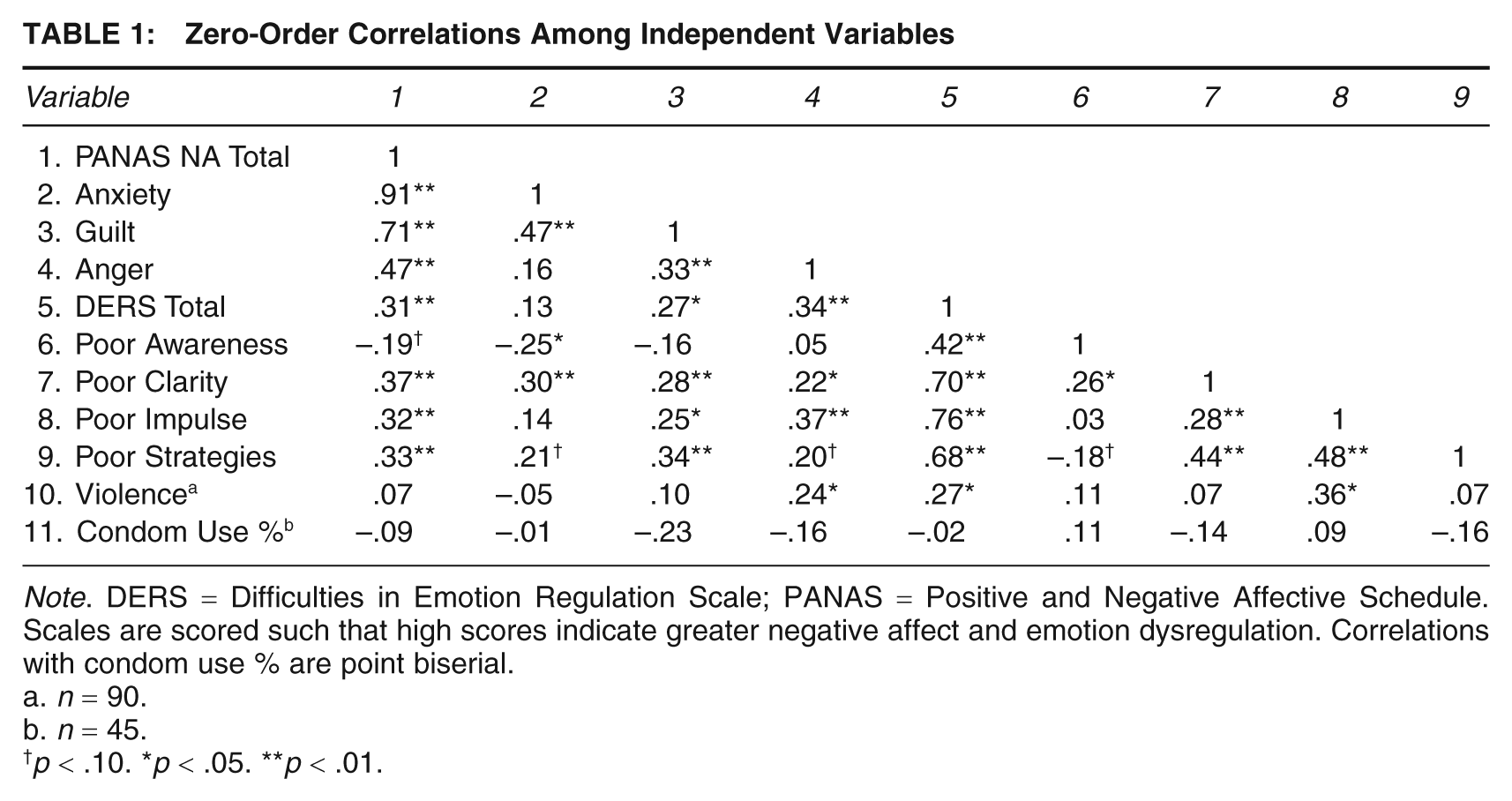
Note. DERS = Difficulties in Emotion Regulation Scale; PANAS = Positive and Negative Affective Schedule. Scales are scored such that high scores indicate greater negative affect and emotion dysregulation. Correlations with condom use % are point biserial.
n = 90.
n = 45.
p < .10. *p < .05. **p < .01.
Conditional Relations With Adverse Outcomes
Several interactions between negative affect and emotion dysregulation were also associated with adverse outcomes (see Figures 1–3). Specifically, in adolescents with poor emotional clarity, negative affect was significantly related to violence (B = .015, SE = .007, β = .27, p < .05, ΔR2 = .05). With respect to specific negative affect, in adolescents with poor emotional clarity, anxiety was significantly related to violence (B = .022, SE = .010, β = .25, p < .05, ΔR2 = .06). In adolescents with poor emotion regulation strategies, anxiety was significantly related to less frequent condom use (B = −.025, SE = .013, Δχ2 = 6.12, p < .05, OR = .975).
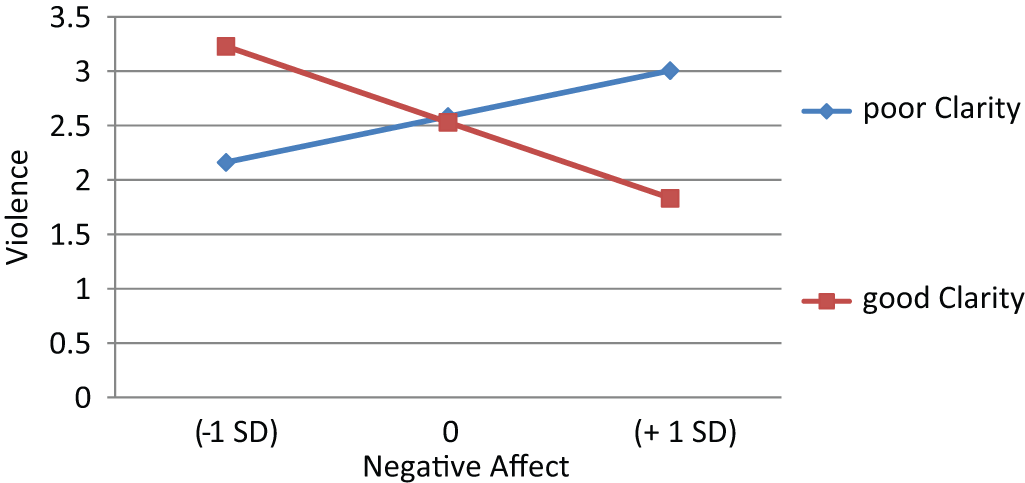
Negative Affect and DERS Clarity Predicting Violence
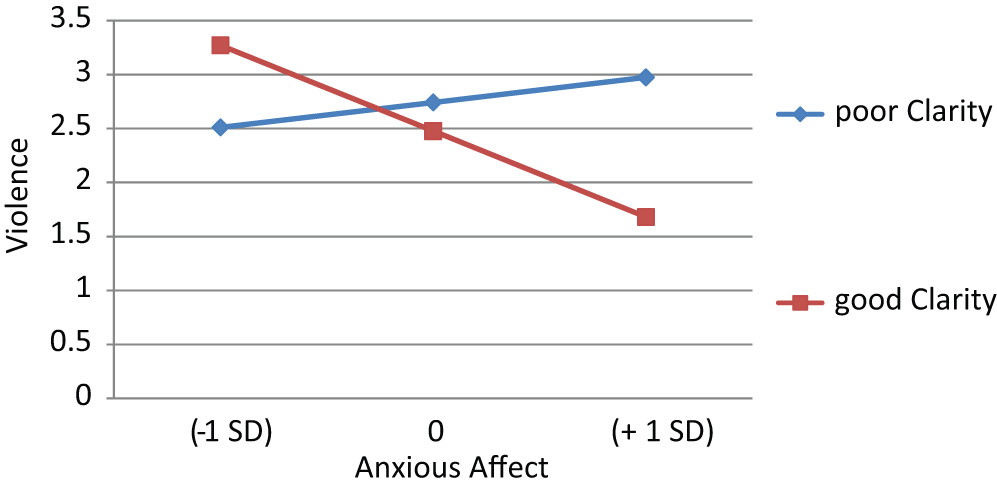
Anxious Affect and DERS Clarity Predicting Violence
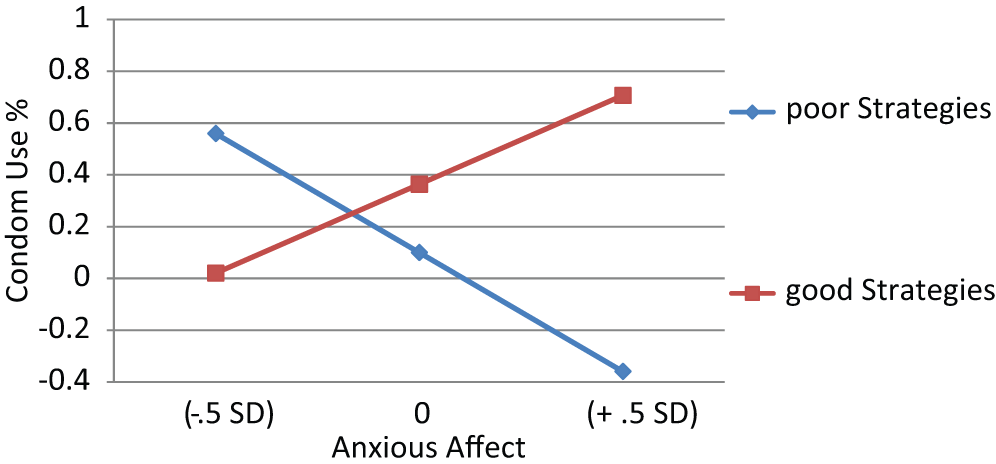
Anxious Affect and DERS Strategies Predicting Condom Use %
Discussion
Several previous studies have shown negative affect and emotion dysregulation to be associated with violence and risky sexual behavior (Langhinrichsen-Rohling et al., 2004; Lucenko et al., 2003; Schrier et al., 2009). Unfortunately, results have been inconsistent, and few efforts have been made to clarify these relations, particularly within justice-involved adolescents. The current study addressed previous inconsistencies by examining more specific facets of negative affect and emotion dysregulation as they relate to violence and risky sexual behavior, as well as exploring conditional relations between negative affect and emotion dysregulation based on previous models of adolescent risk-taking behaviors (see Cooper et al., 2003). Overall, there were three main findings: First, negative affect was not significantly related to violence or sexual risk taking, but emotion dysregulation was significantly related to violence; second, specific aspects of negative affect (i.e., anger) and emotion dysregulation (i.e., poor impulse control) were significantly related to violence; and third, negative affect bore conditional relations to violence and infrequent condom use, moderated significantly by poor emotional clarity and regulation, respectively.
Consistent with Crepaz and Marks’s (2001) recent meta-analysis of negative affect and risky sexual behavior, results indicated general negative affect, by itself, was not strongly associated with violence or risky sexual behavior. However, different relations observed between specific forms of negative affect and emotion dysregulation and violence suggested null relations between general affective constructs and violence may be misleading. The fact that specific forms of negative affect and emotion dysregulation, by themselves, were related to violence highlights the importance of demarcating specific facets of affective constructs.
Despite the increased associations of violence offered by anger and poor impulse control, the inclusion of specific aspects of negative affect and emotion dysregulation generally did not increase relations with condom use frequency by themselves, which is consistent with Crepaz and Marks’s (2001) meta-analysis finding that specific forms of negative affect did not appreciably differ in their prediction of condom use. As Crepaz and Marks concluded, there are several possibilities. First, specific forms of negative affect and emotion dysregulation, like their broader counterparts, may not influence (or are not influenced by) adolescents’ decisions to use or not use condoms. Second, there may have been methodological limitations (e.g., small sample size, low internal consistency) that hindered our power to detect significant associations. Last, forms of negative affect may only be associated with violence and condom use frequency in adolescents who also have problems regulating their emotions. In fact, our results provide some support for the latter possibility. Specifically, adolescents who report experiencing negative affect and anxiety, yet also report being confused about the emotions they are experiencing, may be more prone to commit violent acts. One way to understand these conditional relations is in the context of cybernetic models of affect regulation (see Larsen, 2000). Cybernetic models of affect regulation posit that individuals with deficient emotional clarity fail to sufficiently recognize their escalating emotions such that they neglect to initiate the down-regulation of the undesirable affective state (Larsen, 2000; Wilkowski & Robinson, 2008). Thus, adolescents who wait to down-regulate their negative affect may get to a point where they feel that their only option is to behave violently. However, by this logic one would expect anger to interact with emotional clarity to predict violence as well. Thus, replication is necessary to provide more conclusive evidence for this conditional effect. Conversely, adolescents who report high negative affect and who also believe that little can be done to regulate emotions may be more prone to infrequent condom use. One possible explanation for this finding is that these adolescents infrequently use condoms to avoid embarrassment (see Hingson, Strunin, Berlin, & Heeren, 1990). Alternatively, having unprotected sex may cause adolescents who lack emotion regulation strategies to experience increased negative affect if they fear becoming pregnant or contracting a sexually transmitted disease.
The current results provided additional support for a conditional model similar to that developed by Cooper and colleagues (2003) involving negative affect and emotion dysregulation as predictors of adverse outcomes among adolescents. Furthermore, it suggests emotion dysregulation may be a moderator worth exploring when examining relations between negative affect and maladaptive behavior among adolescents.
Limitations and Future Directions
There are several limitations of the current study. First, the cross-sectional nature of the study precluded any conclusions regarding causality. As noted previously, the causal pathway among negative affect, emotion dysregulation, and adverse outcomes remains unclear. As such, there is a need for research that utilizes longitudinal designs to determine causal directionality. Second, the measures used in the current study were self-report and relied on retrospective reporting. As a result, it is possible that adolescents underreported, overreported, or inaccurately recalled their past adverse outcomes. Furthermore, respondents were asked to recall emotions and behaviors from different time periods (e.g., negative affect over the past week and violent offenses committed in the past year), which may have reduced the generalizability of findings. Third, our measure of negative affect was quite brief, which compromised the reliabilities and weakened the predictive power of the subscales that were created; as such, our results should be viewed as preliminary pending future research utilizing lengthier measures of affect (e.g., PANAS-X) that have more reliable subscales. Last, our sample of justice-involved adolescents was small enough to preclude an examination of gender interactions and lacked a non-justice-involved comparison group. Future studies would benefit from larger samples and the inclusion of a comparison group to better delineate their differences in negative affect, emotion dysregulation, and adverse outcomes.
This study also had several strengths. In particular, it is the first study to examine associations between specific aspects of affect and delinquency in justice-involved youth. These constructs were examined in a particularly at-risk population with the purpose of exploring their unique and conditional relations and resolving previous inconsistencies. Indeed, results demonstrated the importance of demarcating specific aspects of negative affect and emotion dysregulation, as information appeared to be lost at the global level of several constructs. In addition, results provided additional support for conditional models of risk taking (e.g., Cooper et al., 2003), suggesting that a multifaceted assessment of justice-involved youth may be useful for understanding the associations among negative affect, emotion dysregulation, and adverse outcomes.
Footnotes
Authors’ Note:
This research was supported by grants from the Indiana University School of Medicine Center for AIDS Research and NIH/NIMH (KO1MH 66666, Matthew C. Aalsma, Principal Investigator). The authors would like to thank the reviewers for their helpful comments. The authors would also like to thank Chris Ball and Kevin Riley from the Division of Juvenile Probation at Marion County Superior Court for their help and support in completing this project.