



Abstract
The current study investigates the offending trajectories of juvenile sex offenders (JSOs) across and beyond adolescence. In doing so, the study examines the number, the rate, and the shape of nonsexual and sexual offending trajectories in a sample of JSOs followed retrospectively and prospectively from late childhood to adulthood. Using semiparametric group-based modeling, the study reveals the presence of five distinctive nonsexual offending and two sexual offending trajectories: adolescent-limited and high-rate slow desisters. The study does not find strong evidence of synchronicity between nonsexual and sexual trajectories, suggesting that the current taxonomy of antisocial behaviors may offer a limited perspective on sex offender types. Furthermore, sexual trajectories do not differ much across sex offender types, suggesting that the findings might be generalized to child and peer abusers. The study findings offer supporting evidence for the presence of two distinct JSO types with important implications for theory, research, and interventions.
In recent years, policy-making decisions have often been based on the assumption that today’s juvenile sex offenders are tomorrow’s adult sex offenders. This assumption is in sharp contrast to the one prevailing among clinical research in the field of sexual violence and sexual abuse. It is generally assumed by researchers and practitioners that juvenile sexual offending and adult sexual offending are two distinct phenomena requiring distinct explanatory and descriptive models (e.g., Barbaree & Marshall, 2006). In some countries such as the United States and the Netherlands, the continuity hypothesis has been used for policy development despite compelling empirical evidence supporting the discontinuity hypothesis (e.g., Hendriks, 2006; Miner, 2007; Zimring, 2004). The discontinuity hypothesis stipulates that most juvenile sex offenders (JSOs) do not continue their sexual offending in adulthood, whereas the continuity hypothesis stresses that JSOs persist beyond the period of adolescence. It is argued here that the gap between policy development and clinical research is in part the result of the lack of an organizing framework that incorporates the continuity and discontinuity hypotheses and related findings. It is further argued that a developmental framework is necessary to organize this knowledge and to assist and guide policy developments. Few conceptual frameworks have been proposed to explain sexual offending from a developmental perspective (e.g., Lalumière, Harris, Quinsey, & Rice, 2005; Lussier, Leclerc, Cale, & Proulx, 2007; Lussier, Proulx, & LeBlanc, 2005; Seto & Barbaree, 1997). Corresponding to this, few empirical studies have examined the developmental course of sexual offending in sexual offenders (Hendriks, van den Berg, & Bijleveld, 2012; Lussier & Davies, in press; Lussier, Tzoumakis, Cale, & Amirault, 2010). The current study addresses these gaps between policy development and the available scientific literature on sexual offending in JSOs (Carpentier, Proulx, & Leclerc, 2011; Hendriks et al., 2012; Van Wijk, Mali, Bullens, & Vermeiren, 2007). More specifically, using longitudinal data of a large sample of JSOs followed well into adulthood, the continuity and discontinuity hypotheses of sexual offending are empirically tested. The current study bridges gaps among the empirical research on the heterogeneity of juvenile offenders, existing classification models, and the findings stemming from the study of sexual recidivism in JSOs. We first review the current state of knowledge on the heterogeneity of JSOs, offending trajectories, and the risk of reoffending.
Literature Review of Within-Group Heterogeneity in Juvenile Sex Offenders
The heterogeneity of JSOs has long been recognized in clinical research (e.g., Groth, 1977). Although some researchers have concluded that the “typical” JSO does not exist (Miccio-Fonseca & Rasmussen, 2009), clinical and empirical research provides evidence of a number of distinct groups of offenders, and several classification schemes have been proposed (e.g., Becker, 1998; Becker & Hicks, 2003; Veneziano & Veneziano, 2002). The proposed classification schemes have been based on (a) personality profiles (Worling, 2001); (b) offending characteristics, such as victim age, use of violence, and presence of co-offenders (Bijleveld & Hendriks, 2003; Graves, Openshaw, Ascione, & Ericksen, 1996; Hunter, Figueredo, Malamuth, & Becker, 2003; Långström & Grann, 2000); (c) offending history, such as the presence of nonsexual delinquency (e.g., Butler & Seto, 2002); and (d) underlying motivation of the sex offences (e.g., Knight & Prentky, 1993). Early classification models have been seriously criticized on conceptual and methodological grounds (Weinrott, 1996), and these criticisms may also apply to more recent models. Some researchers employ a more inductive approach using one or few indicators, whereas others use a more deductive and empirically driven approach such as statistical analysis of a combination of indicators. The point remains that few of these classification models have been subjected to empirical testing of their reliability and validity. Those classification schemes that have been empirically tested are often based on small samples, raising issues about their stability and generalizability.
There has been no systematic attempt to classify JSOs using a developmental perspective by focusing on the longitudinal pattern of offending. 1 A developmental perspective on sexual offending focuses on between-individual and within-individual changes of offending over time and associated factors responsible for its onset, course, and termination (Lussier, 2005; Lussier & Cortoni, 2008). Although no theoretical and empirical framework has been proposed to explain juvenile sex offending from a developmental perspective, some empirical studies have presented findings highlighting the importance of adopting a developmental approach to clarify the behavior of JSOs. For example, Butler and Seto (2002) studied 114 male offenders, including 32 JSOs. The researchers distinguished JSOs (n = 22), who had been charged only with sex crimes (referred to as sex-only), from JSOs (n = 10), who had been charged with sex crimes and other crimes (referred to as sex-plus). The two groups of JSOs were then compared with another sample of youth offenders with no sex crimes in their criminal history. Looking at a series of developmental behavioral indicators, Butler and Seto found few significant differences between JSOs and nonsexual juvenile offenders. They did find, however, that on many indicators members of the sex-plus group were more similar than the sex-only group to the nonsexual offenders. The sex-only group had fewer conduct problems, more prosocial attitudes and beliefs, and a lower expected risk of future delinquency than the sex-plus JSOs. The study was based on retrospective data and did not provide a life course view of their sexual offending.
The nondevelopmental approach taken by Butler and Seto (2002) approach raises several questions about the unfolding of JSOs’ behavior over time. For example, is it possible that JSOs in the sexual-only category were late-onset nonsexual offenders? The absence of a longitudinal study did not allow these researchers to capture the developmental course of the behavior. In the Van Wijk et al. (2007) study, the most likely offences of JSOs who reoffended were, in order of importance, nonviolent property offences, vandalism/public order offences, and nonsexual violent offences. Therefore, with a follow-up study, is it possible that the sexual-only group of Butler and Seto would have emerged as following a path where sexual offending is followed by nonsexual offending? Similarly, is it possible that the group of JSOs Butler and Seto refer to as the antisocial type would have become more specialized in their sexual offending over time? The dynamic processes and the developmental aspects of the JSOs’ offending patterns cannot be adequately captured with cross-sectional data, which are often used in classification studies with JSOs. Most important, however, the Butler and Seto study highlighted the significance of distinguishing sexual and nonsexual offending to distinguish the heterogeneity of offending patterns characterizing JSOs. In sum, there has been no attempt to classify JSOs based on the developmental course of sex offending across adolescence and adulthood. A life course view using a person-oriented approach is however necessary for understanding the heterogeneity of developmental patterns of JSOs.
A Life Course View of Juvenile Sex Offenders
A person-oriented approach to sex offending
Although between-group and within-group differences have been the focus of clinical and empirical research with JSOs, little attention has been given to within-individual changes over time or patterns of development. Criminal career researchers (e.g., Blumstein, Cohen, Roth, & Visher, 1986) and developmental criminologists (e.g., Loeber & LeBlanc, 1990) have called researchers’ attention to the need for and importance of studying within-individual changes in offending, but their call has not been taken up in the field of research of juvenile sexual offending until very recently (Hendriks et al., 2012). To study within-individual changes in offending, a longitudinal view of the sequence of crimes committed by an individual is required. Such a sequence is characterized by an onset (activation phase), a plateau where escalation and aggravation may occur, and desistance manifested in a slowing down of the activity before eventual termination (Lussier, 2005). Time and change are thus two components of a developmental approach to juvenile sex offending that require a longitudinal approach with repeated measurement of offending. This approach, referred to as the person-oriented perspective (Bergman & Magnusson, 1997), can help to capture distinctive patterns of onset, course, and desistance with distinct correlates and risk factors that may guide case management and clinical intervention (Lussier & Davies, in press). The aim is to disaggregate summary information about individuals and then identify patterns of individual development with the understanding that some patterns may be more prevalent than others (Bergman & Magnusson, 1997). Current empirical research aimed at explaining the offending behaviors of JSOs has mainly relied on a variable-oriented perspective. The variable-oriented perspective typically uses aggregate data and average series, which can obscure individual patterns of development (Von Eye & Bogat, 2006). As such, conclusions from the variable-oriented approach may apply to few individual cases, if not at all, or may be completely invalid. 2 For the past two decades, a developmental person-oriented view of juvenile offending has been one of the most influential perspectives in the field of criminology and psychiatry.
Dual taxonomy of antisocial behavior
The dual taxonomy of juvenile offenders proposed by Moffitt (1993) is an example of a person-oriented approach. The dual taxonomy has been the subject of numerous empirical examinations generally supportive of the model (e.g., Piquero & Moffitt, 2005), but also subject to reformulation (e.g., Moffitt, Caspi, Harrington, & Milne, 2002), comments, and critiques (e.g., Sampson & Laub, 2005; Skardhamar, 2009). Moffitt’s (1993) taxonomy distinguished a group of life course persisters (LCPs) and a group of adolescent-limited (AL) offenders. The taxonomy includes several predictions about developmental antecedents, individual differences, and familial environment, but also the course of delinquency and crime (e.g., Lussier, Farrington, & Moffitt, 2009). More specifically, Moffitt (1993) argued that LCPs represented about 5% to 10% of a male birth cohort. On one hand, the LCPs had a childhood onset of conduct disorder, an earlier onset of delinquency, a more pronounced pattern of offending versatility and aggravation, a tendency to specialize in person-oriented offences (e.g., assault, intimate partner abuse), and a much greater likelihood to persist into adulthood than the AL group. Members of the AL group, on the other hand, were described by a late onset of offending with a tendency to specialize in property and statutory offences, and they typically desisted from offending by late adolescence. Moffitt (1993) convincingly argued that during adolescence, the LCP and AL groups might be virtually undistinguishable in terms of their offending, thus creating a challenge for clinicians and practitioners involved in the case management and treatment of these youth. It is likely that a similar situation may characterize JSOs, which has contributed to the proliferation of risk assessment tools to guide clinicians distinguishing the sexual recidivists from the nonrecidivists (e.g., Viljoen, Elkovitch, Scalora, & Ullman, 2009).
Longitudinal studies have shown that the dual taxonomy might be too restrictive and should be expanded to account for other patterns, such as common offenders and the low chronic offenders. In fact, longitudinal studies of offending patterns of youth have generally found between three and five trajectories of offending (Piquero, 2008; Tzoumakis, S., Lussier, P., LeBlanc, M., & Davies, G. 2011). Of importance for the current study, Moffitt’s LCP group were hypothesized to be most likely to escalate to rape and sexual assault (also see Lalumière et al., 2005). Moffitt (1993) argued that for LCPs, rape and sexual assault would be another manifestation of their antisociality through a complex process of heterotypic continuity (also see Lussier et al., 2007). This is reminiscent of the antisocial JSO group identified by Becker (1998) and Butler and Seto (2002). The LCP syndrome is unlikely to characterize all JSOs. Research suggests that no more than 40% of JSOs meet the criteria of a conduct disorder (e.g., France & Hudson, 1993; Långström & Grann, 2000; Seto & Lalumière, 2010). The proportion of child-onset and adolescent-onset conduct disordered JSOs remains unknown. Whether the other three-fifths of JSOs would be characterized as AL is questionable on several grounds but deserves some consideration for the current study. The AL group was initially described as adolescent-onset offenders who were involved in crimes that matched their desire for an adult status (e.g., driving without a license, property theft) rather than violent or person-oriented offences. This prediction is therefore counterintuitive to the idea of AL offenders committing sex crimes. Some researchers have objected to this view (Lalumière et al., 2005; Seto & Barbaree, 1997), arguing that members of the AL group may escalate their antisocial behavior to sexual coercion by, among other things, mimicking the behavior of LCP offenders. Based on this hypothesis, it would be expected that a relatively high proportion of AL offenders would be involved in gang rape.
Although the study of general offending careers is informative, it does not completely solve the issue of the association between nonsexual and sexual offending. Said differently, are the two taxa proposed by Moffitt (1993) adequate representations of the offending patterns of JSOs? Furthermore, although Moffitt’s taxonomy was aimed at describing patterns of antisocial behaviors, it is unclear whether the dual taxonomy also describes sexual offending patterns. Lussier and Davies (2011) examined the (nonsexual) violent and sexual offending trajectories separately for a group of adult sex offenders. There was much synchronicity between violent and sexual offending at the low-rate but not at the high-rate of offending. Thus, low-rate violent offenders were also low-rate sex offenders, but high-rate violent offenders were not high-rate sex offenders, and vice versa. This study suggested that high-rate sex offending might be a distinct phenomenon apart from high-violent offending. It appears, therefore, that synchronicity of offending between different types of crime becomes less significant and less important as the volume and rate of a particular form of crime increase. This point was also shown in the Lussier, LeBlanc, and Proulx (2005) study of adult sex offenders where synchronicity varied across offender types: The rapists charged for the most sex crimes were also those charged for the most property and violent crimes. This finding was not replicated for child molesters, where the most prolific sex offenders were not the most prolific in other crime types. This suggests that the criminal activity of chronic child molesters was more specific to sex crimes against children. It is unclear, however, whether the same findings apply to JSOs. Taken together, these findings raise questions as to whether or not the LCP group identified by Moffitt (1993) are also high-rate persistent sex offenders and whether the sex offending of the AL group is also limited to the period of adolescence.
Dual taxonomy and juvenile sex offenders
Moffitt’s (1993) taxonomy of antisocial and criminal behaviors represents a starting point for the elaboration of a classification model of juvenile offenders. This taxonomy draws from several themes: (a) that sexual offences committed by youth are first and foremost crimes and not necessarily manifestations of sexual deviance (Smallbone, 2006), (b) that there is a significant presence of conduct disorder, antisocial personality, and delinquency in the youths’ backgrounds (e.g., Butler & Seto, 2002; France & Hudson, 1993; Seto & Lalumière, 2010; Van Wijk et al., 2006); (c) that JSOs who recidivate are more likely to be rearrested for a nonsexual crime (Caldwell, 2002; Hendriks & Bijleveld, 2008; McCann & Lussier, 2008); and (d) that the criminal behavior preceding and following a sex crime is mainly nonsexual in nature (Van Wijk et al., 2007). Accordingly, sex crimes committed by JSOs are more often than not committed in isolation as part of a more general nonsexual offending pattern. The extent to which the taxonomy represents both the nonsexual and sexual offending trajectories remains unclear. In that regard, van den Berg, Bijleveld, and Hendriks (2011) and Hendriks et al. (2012) established that the dual taxonomy does not account for general offending trajectories of JSOs in the Netherlands. More precisely, their research found empirical evidence of five general offending trajectories in a sample of Dutch JSOs; (a) low chronic (33%), (b) AL (50%), (c) high declining (4%), (d) late-onset AL (6%), and (e) high chronic (8%). The AL somewhat mirrored the pattern of AL as hypothesized by Moffitt in terms of the rate of offending from early adolescence to adulthood. This group, however, accounted for only 50% of the sample of convicted JSOs. Of interest, the findings also showed that child abusers were more likely to follow an AL track of delinquency as opposed to peer abusers, suggesting a link between the type of sex offence committed and general offending trajectory. The AL track of offending and child abuse is counterintuitive to portraying AL offending as more transitory and contextual (Moffitt, 1993) whereas child molestation in youth has often been associated with cognitive deficits and poor outcomes (e.g., Worling & Långström, 2006). None of these studies found evidence of a LCP group. Although the findings are interesting, they do not inform about the patterns that are specific to sexual offending as the van den Berg et al. (2011) and the Hendriks et al. (2012) study did not examine sexual offending trajectories separately from nonsexual offending. Hence, the extent to which the sexual offending trajectories of JSOs follow the taxonomy remains unclear.
Aim of the Current Study
The current research expands this area of investigation by examining, in conjunction, the nonsexual and sexual offending trajectories of JSOs in adolescence into adulthood. The investigation aims to determine how many sexual and nonsexual offending trajectories best characterize this group of juvenile offenders. This is important, considering that greater attention to nonsexual offending by JSOs has been given by several researchers in recent years (e.g., Caldwell, 2002; McCann & Lussier, 2008; Smallbone, 2006; Van Wijk et al., 2007). By adopting a person-oriented approach in the current study, the researchers seek to determine the number and the shape of the offending trajectories characterizing JSOs, as well as whether there are any differences across sex offender types, such as child and peer abusers. The examination of sexual and nonsexual offending trajectories separately allows exploring whether there is synchronicity between sexual and nonsexual offending trajectories. Synchronicity is defined for the current study as reaching the same level of nonsexual and sexual offending at a particular point in the individual’s life (LeBlanc & Kaspy, 1998). Hence, a synchronous pattern would characterize individuals exhibiting the same offending pattern irrespective of age. Synchronicity in nonsexual and sexual offending implies that both crime types would more or less start at the same time, grow at the same rate, reach more or less the same level in terms of frequency and chronicity, and slow down at the same pace. This allows us to determine if the LCP offenders as described in Moffitt’s dual taxonomy are also following an LCP track in terms of their sexual offending. It also allows us to determine whether the AL group identified by Moffitt is also following a similar track in terms of their sex offending.
Method
Participants
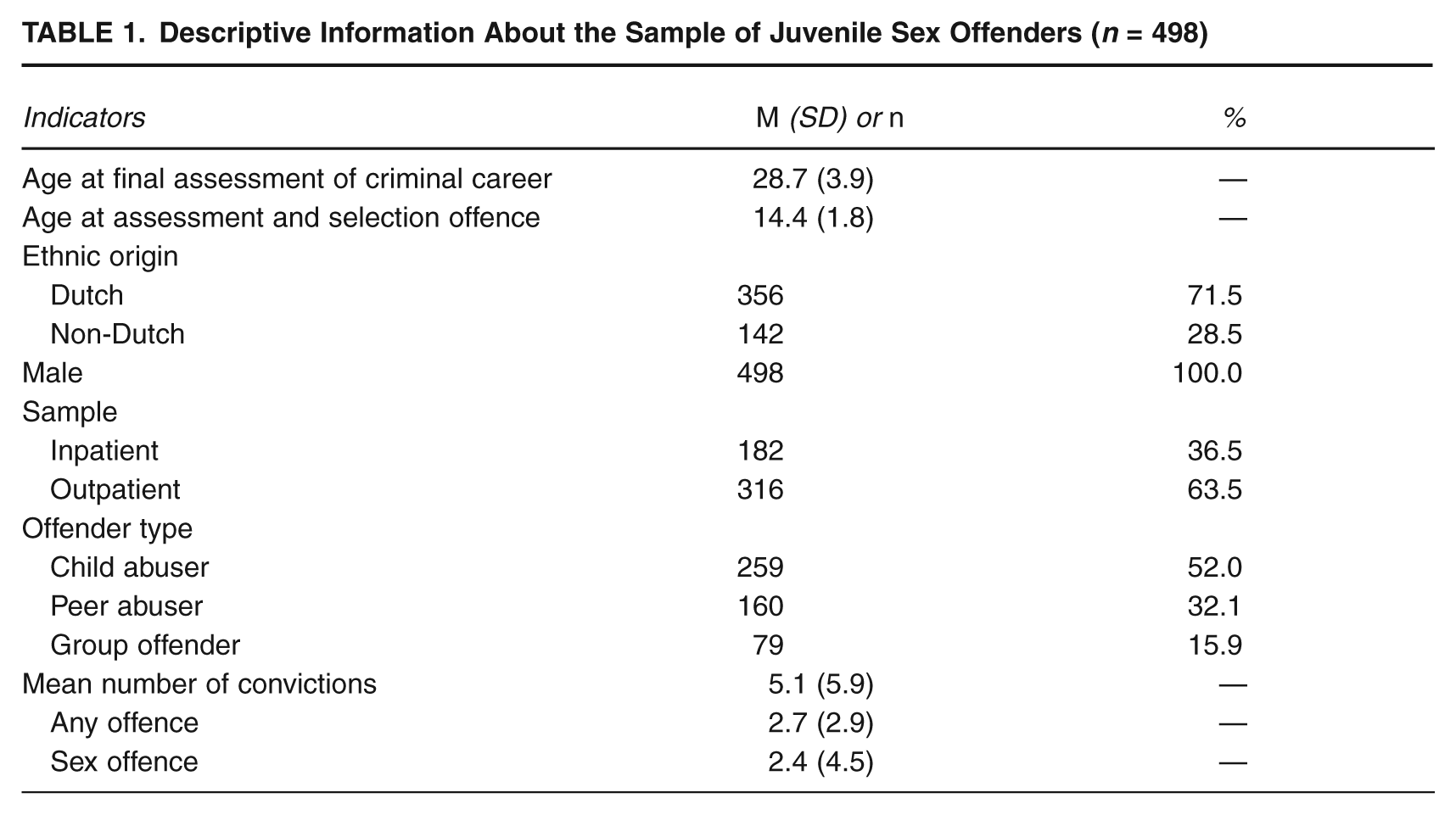
The research group studied here consists of 498 Dutch male JSOs. All had been convicted of a hands-on sex offence or confessed to it between 1988 and 2001. All were sent to specialized institutions for assessment. Basic descriptive information about the sample is presented in Table 1. The average age of these offenders at the time of the sampling offence was 14.4 (SD = 1.8). The research group studied here cannot be regarded as a representative sample of all Dutch JSOs over the sampling period. As all had been assessed, mostly at the request of the criminal justice authorities, they should be regarded as a group at elevated risk of psychological problems, trauma, and recidivism. At the time of the sampling offence, just more than half (52%) of this group of offenders had abused a child, that is, a prepubertal victim at least 5 years younger, about a third (32%) had abused a peer, and the remaining 16% had committed the abuse with at least one co-offender. All had played an active role in the offence. These youth were followed for more than 14 years on average. Therefore, at the time that their criminal career data were last collected, they were close to 29 years on average (range = 20–40).
Descriptive Information About the Sample of Juvenile Sex Offenders (n = 498)
Procedures
The Ministry of Security and Justice gave formal consent for the study. All JSOs had been assessed by psychologists and/or psychiatrists, and from these assessments victim and offence characteristics were taken. In 2009, recidivism data were requested for all JSOs in the sample from the so-called Judicial Documentation, the Dutch database of offender information containing “rap sheets.” This database contains information on all cases that are registered for prosecution. Information about the date of perpetration, type of offence, conviction, and sentence is included.
Measures
As noted above, official records were used to examine offending trajectories. To investigate the rate and shape of offending trajectories over the study period, a 20-year window period was created based on the offender’s age at the time of commission of the offence. This study window starts at age 12—the minimum age of criminal responsibility in the Netherlands—and ends at age 32. Both prospective and retrospective offending data were used to compute the offending trajectories. Hence, the offending data include all prior records before the conviction during which they were sampled for this study (retrospective data), data on the offence for which they were sampled (index offence), and data on all subsequent convictions having occurred after the index offence (also see Van Wijk et al., 2007). For more on the data set and its measures, see Hendriks et al. (2012). Convictions for both sexual and nonsexual offences were coded. All offences were classified according to Statistics Netherlands’ standard classification. In accordance with the Dutch criminal code, a hands-on sex crime is defined here as the following: rape, indecent assault, and sexual offences against children (see Bijleveld, 2007). For each offender, there is a timeline from age 12 to the maximum age at follow-up that lists each crime committed by commission age. As the Netherlands does not have plea bargaining, the data have the advantage that the charges and crimes for which participants were convicted can be assumed to be a fairly accurate reflection of their offending behavior. Finally, the analyses were conducted by taking into account sex offender types based on characteristics of their index offence. Hence, the whole sample was divided into three groups: (a) child abusers, (b) peer abusers, and (c) group offenders. This three-part classification has been used in past research (e.g., Hendriks & Bijleveld, 2008). The current study did not examine recidivism the same way it is typically done in recidivism studies. Typically, recidivism studies present a proportion (or a rate) of JSOs being rearrested or reconvicted after some given time point (e.g., after being discharged or released). This approach does not take into account the whole criminal career. In the current study, sexual recidivism refers to JSOs with at least two registrations for a sex crime.
Analytical Strategy
The criminal careers of the 498 men were analyzed, for nonsexual and sexual offending separately, using semiparametric group-based trajectory models (Nagin, 2005). Analyses ran until age 32 as the number of respondents dwindled over the time span and including later ages made the analyses unstable. Offending trajectories were modeled as offences per person per age year, using a zero-inflated Poisson model (Böhning, 1998; Lambert, 1992). Best-fitting models were selected on the basis of Bayesian Information Criterion (BIC) values. Incarceration was controlled for by computing exposure per year as,

for every person j and age i (e.g., Van der Geest, Blokland, & Bijleveld, 2009). Among the research group, 7 people died and 14 emigrated, after which they were coded as missing.
Results
Nonsexual Offending Trajectories
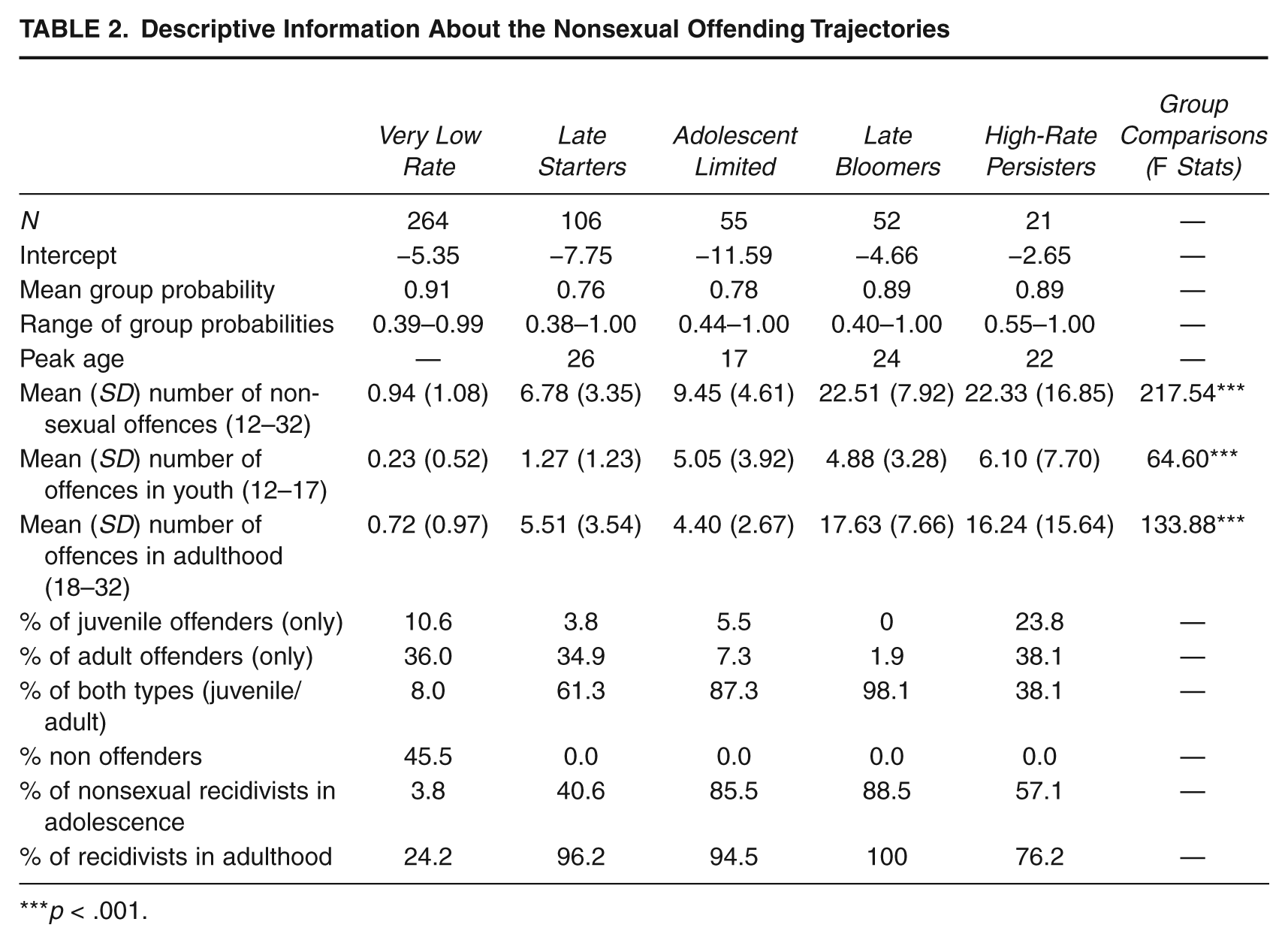
A five-group solution yielded the best model and was retained for further analysis. The intercept, mean group probabilities (and range), and offending characteristics for the five groups are presented in Table 2. The mean group probabilities were all superior to .75, indicating that the analysis was well able to classify offenders into trajectories. Based on the rate and shape of the nonsexual offending during the study period (Figure 1), the five trajectories were labeled as follows: (a) very low rate offenders, (b) late starters, (c) AL offenders, (d) late bloomers, and (e) high-rate offenders. Clearly, the majority of JSOs were characterized by a trajectory of a very low rate of nonsexual offending (n = 264, 53.0%). This group kept an average rate of nonsexual offending close to zero throughout the study period. In fact, their criminal career data show that this group was convicted only once (on average) for the whole study period. It is not surprising, therefore, that this group also included the smallest proportion of recidivists. Only 8% of this group offended in both youth and adulthood—the lowest proportion among the five identified trajectories. The second group in size, the late starters (n = 106, 21.3%), were also not very active in youth, as reflected in their mean number of convictions (1.27). Their nonsexual offending gradually increased, peaking in their early to mid-20s. Specifically, although 41% of this group were nonsexual recidivists in youth, almost all were recidivists in adulthood (96.2%). Taken together, for almost three quarters of the sample of JSOs, the nonsexual offending in youth was not chronic but instead occasional and sporadic.
Descriptive Information About the Nonsexual Offending Trajectories
p < .001.

Nonsexual Offending Trajectories of Juvenile Sex Offenders (n = 498)
The next three trajectories of nonsexual offending reflected a significant involvement in nonsexual offending in youth. First, the AL offenders (n = 55, 11.0%) were characterized by a rapid increase in nonsexual offending in youth, which peaked at 17, gradually decreasing afterward and reaching, by age 25, the same level of offending as the very low rate offenders. Hence, their offending was not limited to the period of adolescence per se, but soon after turning 17 their offending rate was on the decline. They averaged 9.5 convictions during the whole study period, with just more than 5.0 having occurred between 12 and 17 years old. Second, the high-rate group (n = 21, 4.2%) were early starters and had a level of nonsexual offending in youth that was the highest among the five groups found. These youth were chronic offenders, as shown by their average of 23 convictions during the study period. More than half of the sample were nonsexual recidivists in youth, whereas more than three quarters were so in adulthood. Their offending followed an inverted U shape, typical of the age–crime curve. After peaking in their early 20s, their level of offending gradually decreased, closing the gaps in the early 30s with the late-starter group and the very low rate offenders. Of importance, the high-rate group (comparable to Moffitt’s LCP trajectory) and the AL group (comparable to Moffitt’s AL trajectory) accounted for just more than 15% of the offenders. Finally, the late bloomers (n = 52, 10.4%) mirrored the high-rate group in terms of both their rate and shape of offending. Their offending started and peaked later, however, than among the high-rate group. Most of the juvenile offenders following the late-blooming trajectory were nonsexual recidivists in youth as well as in adulthood.
Sexual Offending Trajectories
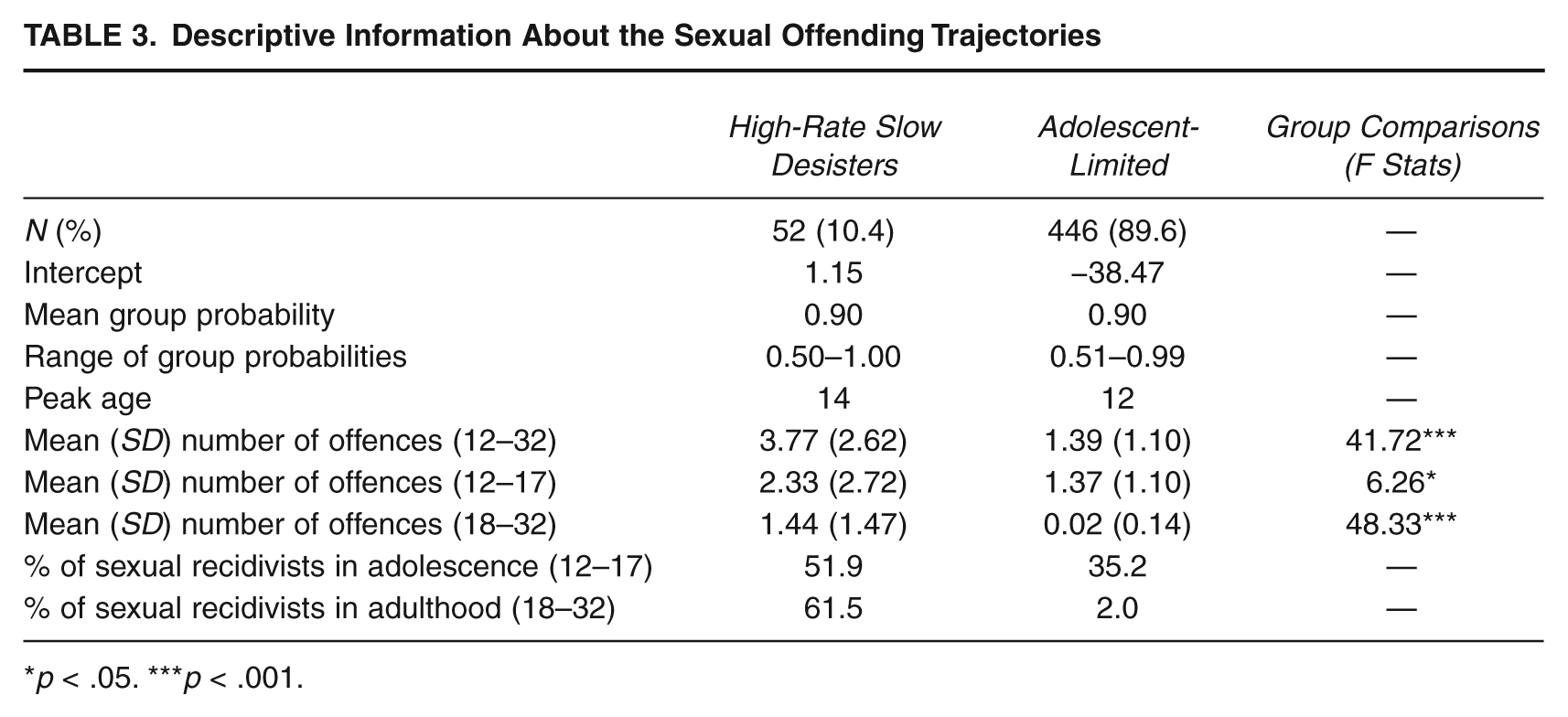
The group-based analysis of sexual offending produced a two-trajectory solution as the best fitting model. The intercept, the mean group probabilities (and the range), and descriptive criminal career statistics of the two-group solution are presented in Table 3. The mean group probabilities were very high at .90. The first trajectory, labeled high-rate slow desisters (HRSD), characterized 52 JSOs or 10.4% of the sample. The second group, the AL group, included the remaining 446 offenders, thus representing the vast majority of this sample (89.6%). A graphical representation of the two sexual offending trajectories can be seen in Figure 2. The HRSD started their sexual offending young, peaking at age 12, when our window of observation starts. Their level of sexual offending went down from that point on, but at a very slow pace, reaching the same level of sexual offending of the second group around their 30s. During the study period, this group had an average of close to four convictions for a sex crime (M = 3.77, SD = 2.62). Half of this group sexually reoffended in youth, whereas just more than 60% offended in adulthood. The AL started their sexual offending later, peaking at age 14. After peaking, the level of sexual offending rapidly decreased in youth, terminating by the end of adolescence (about age 19–20). The sexual offending of this group was restricted to youth and was mainly incidental. Still, 35% of this group sexually reoffended in youth, but only 2% did in adulthood. Hence, juvenile sexual recidivists were found in both trajectories, but the small group of HRSD were at much higher risk of persisting in adulthood.
Descriptive Information About the Sexual Offending Trajectories
p < .05. ***p < .001.
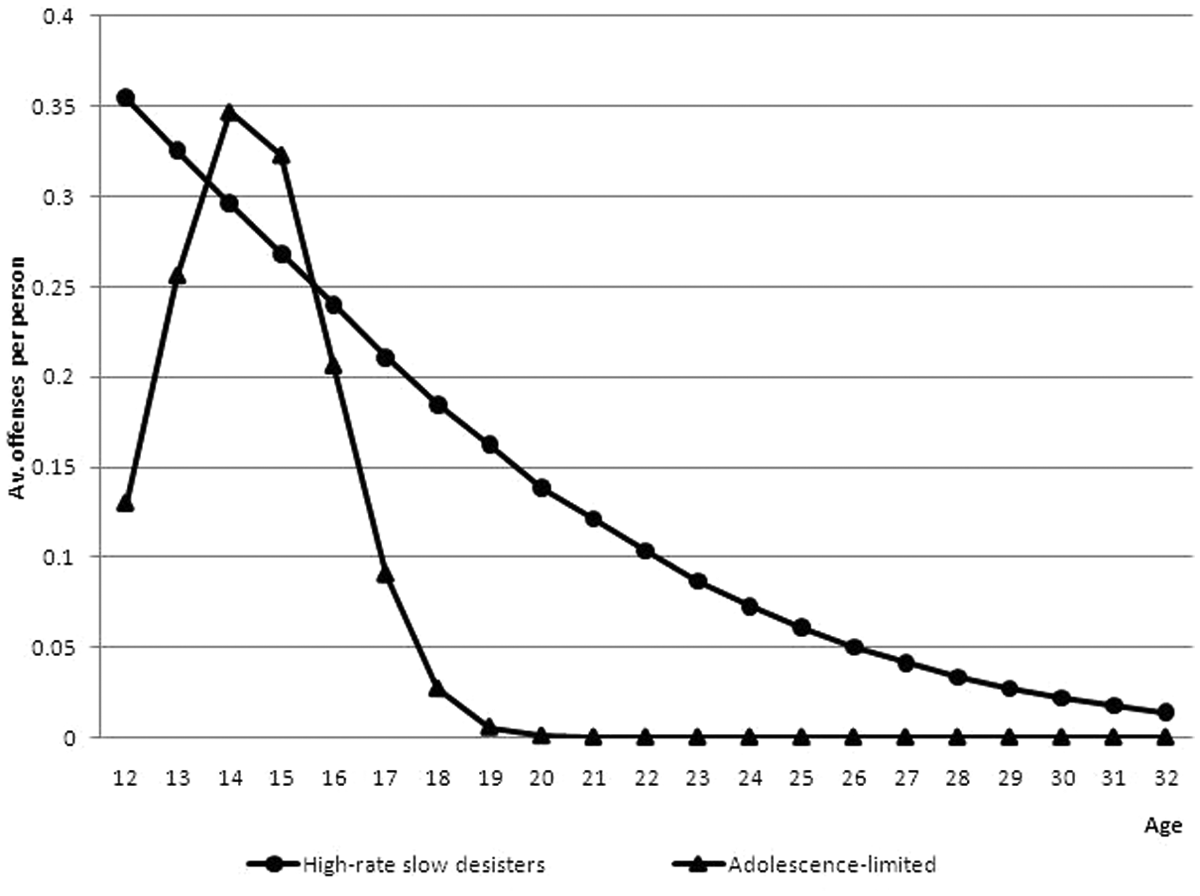
Sexual Offending Trajectories of Juvenile Sex Offenders (n = 498)
Offending Trajectories and Sex Offender Type
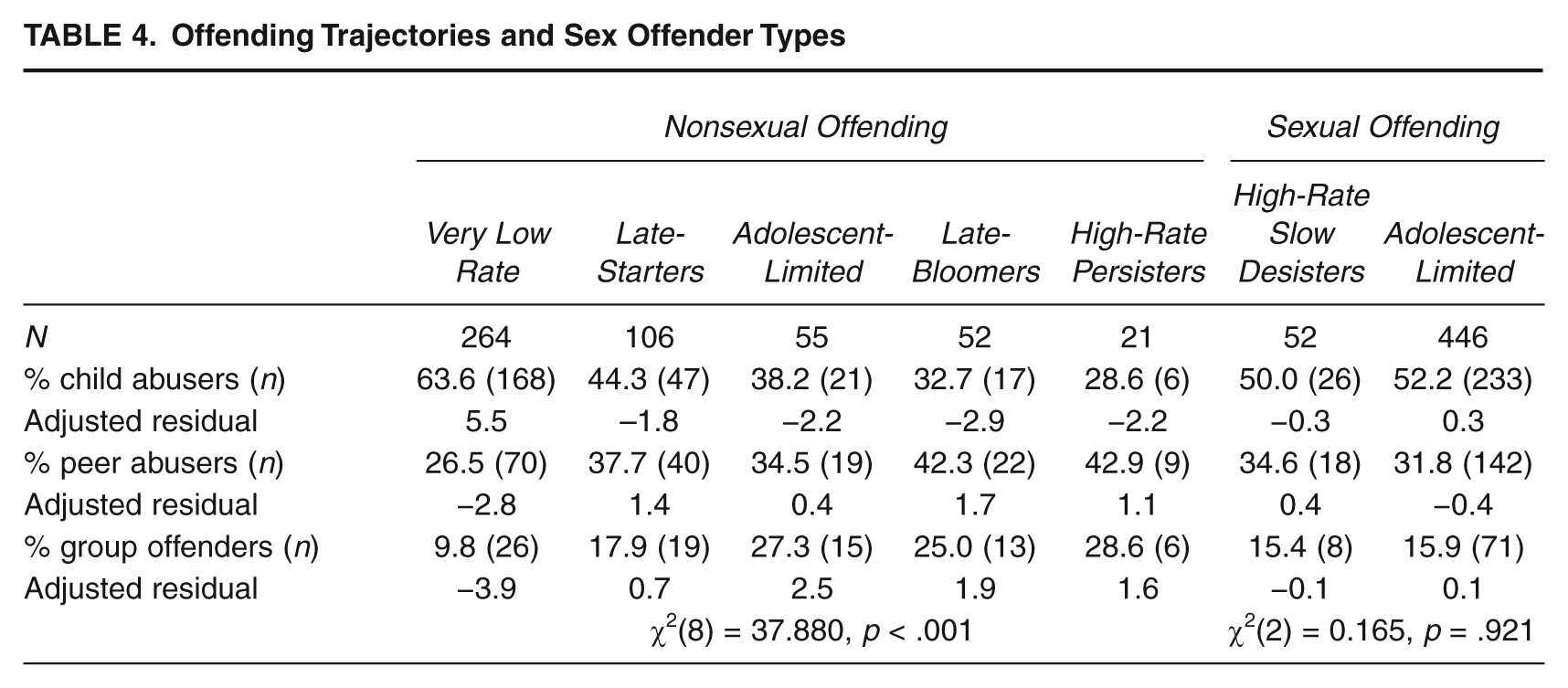
Table 4 presents information about the prevalence of child abusers, peer abusers, and group offenders for each of the nonsexual and sexual offending trajectories. We examined whether a specific subtype of JSO was best characterized by a certain offending trajectory. Several interesting results emerged. First, looking at nonsexual offending trajectories, we found a statistical association between group membership and sex offender type (p < .001). Certain nonsexual offending trajectories were more typical of a specific subgroup of sex offenders. This observation was particularly true for child abusers. Indeed, the very low rate group had the highest proportion of child abusers (64%), with the late starters having the second largest proportion of child abusers (44%). Second, in spite of such an association, all sex offender types had a sizeable number of offenders in each of the nonsexual offender trajectories. This is especially true for peer abusers, whose proportion varied between 27% (i.e., very low rate) and 43% (i.e., high-rate persisters) across nonsexual offending trajectories. Third, the highest proportions of group offenders were found in the three nonsexual offending trajectories that were most active in youth (i.e., AL, late bloomers, and high-rate persisters). Fourth, and most important, there was no statistical association between sex offender type and group membership for the sexual offending trajectories. More specifically, the two sexual offending trajectories yielded more or less the same proportion of child, peer, and group offenders. Taken together, sex offender types differed as to their nonsexual pattern but not their sexual offending pattern.
Offending Trajectories and Sex Offender Types
Association between Sexual and Nonsexual Offending Trajectories
The question of synchronicity between the two types of offending was examined next. The association between nonsexual and sexual offending trajectories is presented in Figure 3, and the findings highlight the complexities of the association between the two. Several key patterns emerged from the cross-tabulation of the two sets of offending trajectories. First, in each of the nonsexual offending trajectories, the vast majority of JSOs followed a track of AL sexual offending. Indeed, the proportion of AL sexual offending varied between 75% and 100% across nonsexual offending tracks. Therefore, independent of the nonsexual offending track the youth is following, there is a higher likelihood that the sexual offending is limited to the period of adolescence. Second, the proportion of HRSD across nonsexual offending trajectories varies between 0% and 25%. None of the juvenile offenders following a track of high-rate nonsexual offending were HRSDs. This is clearly an indicator of nonsynchronicity between sexual and nonsexual offending, as the most nonsexual delinquent youth were all characterized by sexual offending limited to the period of adolescence. However, late bloomers included the highest proportion of HRSDs.

Synchronicity of Nonsexual and Sexual Offending Trajectories
Third, 27 of the 52 HRSDs (51.9%) were characterized by a very low rate of nonsexual offending trajectory. Hence, the majority of the most active JSOs at most risk of persisting their sexual offending in adulthood were showing a more modest involvement in nonsexual delinquency and adult criminality. This confirms that crime specialization in sexual offenders is present but characterizes a very small proportion of all these youth—that is, only 27 out of 498 offenders (5.4%). Fourth, 52 out of the 55 youth (94.5%) characterized by a trajectory of AL nonsexual offending were also following a track of AL sexual offending. This finding is evidence of synchronicity between sexual and nonsexual offending. Finally, 92% of the individuals who started their nonsexual criminal activity in adulthood (late starters) were showing a pattern of sexual offending limited to the period of adolescence. This result is important given that these JSOs were not, for the most part, adult sexual offenders, but they were adult criminals. Thus, the nonsexual offending appeared to follow rather than precede sexual offending.
Discussion
Our research focused on the longitudinal sequence of sexual offending from age 12 to age 32 in a relatively large sample of JSOs. By disaggregating the longitudinal offending data using a person-oriented perspective, the current study examined the criminal activity of a large sample of JSOs in the Netherlands well into adulthood. This study has several key features that set it apart from other sexual recidivism studies. These features include (a) an extended follow-up period well beyond adolescence, (b) inclusion of the entire criminal activity, not just the next crime following the sampling offence, (c) examination of the yearly number of convictions over a 20-year period from late childhood, and (d) the use of semiparametric group-based modeling to disentangle patterns for nonsexual and sexual offending. The findings provide new insights into the longitudinal course of offending in JSOs. The current study highlights several points. First, there is relatively limited heterogeneity in the longitudinal course of sexual offending in these youth. Second, this limited heterogeneity can be conceptualized under two broad sexual offending patterns. Third, such limited heterogeneity in sexual offending contrasts with the wider range of nonsexual offending patterns. Fourth, desistance from sexual offending is clearly the norm in JSOs. Taken together, these findings provide a developmental life course framework for the classification of JSOs. We argue in the next section that the study findings provide evidence for two metatrajectories of JSOs: (a) the AL and (b) the HRSD. These two sexual offending trajectories showed significant between-individual and within-individual changes in offending over time that may have important implications for prevention and intervention. We now review these findings and their implications for research, prevention, and treatment.
A Life Course View of JSOs: An Agenda for Theory, Research, and Treatment
Existing classification schemes of JSOs (e.g., Becker & Hicks, 2003; Bijleveld & Hendriks, 2003; Butler & Seto, 2002; Graves et al., 1996; Groth, 1977; Knight & Prentky, 1993; Långström & Grann, 2000; Worling, 2001) are not well suited for a developmental life course perspective. Furthermore, the presence of much nonsynchronicity in the development of nonsexual and sexual offending emphasized the importance of studying both types of offending separately. Existing developmental taxonomies of antisocial behavior (i.e., Moffitt, 1993) may be of limited value to describing the development of sexual offending in juvenile offenders. Becker (1998) hypothesized that JSOs could be categorized into a three-track model: (a) the dead-end path where no further crimes are subsequently committed, (b) the delinquency path where the sexual offending is part of a versatile offending pattern, and (c) the sexual-interest pattern, which consists of sexual recidivists at risk of developing deviant sexual interests and paraphilia. This model has never been tested before, and although our findings do not necessarily refute these three patterns hypothesized by Becker, they show that the empirical reality may be more complex. For example, the hypothesized delinquency path is difficult to reconcile with the five patterns of nonsexual offending trajectories found, three of which characterize relatively serious involvement in delinquency, with some of them more involved in sexual offending than others. Also, the sexual interest path is hard to reconcile with the fact that the two sexual offending trajectories we found include sexual recidivists. The same conclusions could be drawn when comparing the study findings to the classification proposed by Butler and Seto (2002), which distinguishes a sex-only and a sex-plus group of JSOs without linking these two types of long-term outcomes or long-term patterns of offending. The findings raise fundamental questions with respect to sexual recidivism in youth, persistence into adulthood, crime specialization, and desistance from sexual offending. The two meta-trajectories found in the current study may serve as an organizing framework to stimulate future research on these matters.
Taxonomy and the onset of sexual offending
The patterns of sexual offending suggest that the two offending trajectories can be differentiated in terms of the onset of sexual offending. The findings showed that HRSD JSOs had an earlier onset than those found in the AL group. The pattern of onset found for the two groups is intriguing given that age of onset in sexual offending has not been subjected to much empirical scrutiny in the scientific literature. Recently, using retrospective data in a large sample of JSOs, Carpentier et al. (2011) found that early starters (i.e., onset prior age 12) were more likely to exhibit violent behaviors in early childhood as well as child sexual problems such as voyeurism, frottage, and compulsive masturbation prior to the onset of sexual offending. These youth were also more prone to aggressive behavior during adolescence as opposed to late starters. The highest rate of sexual offending for the HRSD was found at the earliest point analyzed, that is, at age 12. We suspect that the group showing an earlier onset of sexual offending might be characterized by childhood sexual problems. More precisely, sexual offending of the HRSD group might be in continuity with sexual problems in the preceding developmental periods (i.e., prior age 12) not analyzed in the current investigation. Few empirical studies have examined the developmental course of sexual behaviors in children (e.g., Friedrich & Trane, 2002). Recent research with preschoolers revealed that boys from low-income families who present clinical symptoms associated with an externalizing spectrum disorder (e.g., ADHD) and who are more physically aggressive have a higher frequency of various forms of sexual behaviors (Lussier & Healey, 2010). The co-occurrence of high levels of physical aggression with child sexual problems could be among the developmental precursors of an early onset of JSOs. Research has shown that such behaviors are affected by pre- and perinatal risk factors. For example, substance use during pregnancy, and pregnancy and birth complications, are related to higher levels of offspring physical aggression and sexual behaviors (Lussier, Tzoumakis, Healey, Corrado, & Reebye, 2011). More research is needed to link the developmental course of sexual behaviors and the developmental course of sex offending.
Taxonomy and sexual recidivism in youth
Empirical studies have not produced convincing evidence that sexual recidivism in youth can be predicted efficiently using current risk assessment methods (Caldwell, 2002; McCann & Lussier, 2008; Viljoen et al., 2009). One explanation is that the presence of two different types of juvenile sexual recidivists may have confounded the findings of previous sexual recidivism studies. Indeed, both the HRSD and AL JSOs include youth at risk of sexually reoffending during the period of adolescence. This highlights difficulties and challenges associated with clinical assessment of juvenile offenders. More precisely, among juvenile sexual recidivists, some offenders will desist from sexual offending after reaching adulthood (AL) whereas others will persist beyond that point (i.e., HRSD). Hence, the current findings suggest that there might be two types of sexual recidivists among JSOs. Prior recidivism studies have not examined whether the predictors of sexual recidivism among the AL JSOs are similar to or different from those of the HRSD group. Therefore, it is possible that persisting transitory risk factors associated with adolescence may increase the risk of sexual recidivism in youth for the AL group, whereas the accumulation of early deficits may increase the risk of sexual recidivism for the HRSD. In that regard, Lalumière et al. (2005) distinguished the young male syndrome from the LCP and psychopathy groups of sexual aggressors. From this model, those with the young male syndrome may resemble our AL group in that their sexual offending may be driven by temporary difficulties finding a consenting sexual partner. For the LCP and the psychopathy group, as with our HRSD, sexual assault may be reflecting a stable predisposition and more stable individual differences. Sexual recidivism studies are of limited value in informing case managers, risk assessors, and treatment providers about the offending trajectories of these youths. The difficulty for these practitioners in differentiating the AL and the HRSD is further reinforced by the fact that both groups are found among child abusers, peers abusers, and group offenders. Future empirical studies should examine the predictors of sexual recidivism in adolescence for both groups and determine whether risk assessment protocols are as effective for HRSD and AL offenders.
Taxonomy and persistence in adulthood
Our findings demonstrated that sexual recidivism in youth and criminal persistence in adulthood are two separate aspects of criminal activity of JSOs. Indeed, although both the AL and the HRSD groups included juvenile sexual recidivists, only the latter group persisted sexual offending as adults. The proportion of JSOs following a track of HRSD (about 10%) is in line with sexual recidivism studies that follow youth well into adulthood (e.g., Hagan, Gust-Brey, Cho, & Dow, 2001; Hendriks & Bijleveld, 2008). This finding underscores once again the limitations of current sexual recidivism research with JSOs, in which such a distinction is rarely made (McCann & Lussier, 2008). Considering the case of the HRSD, it is unclear whether risk factors that are associated with sexual reoffending in youth (e.g., Hendriks, 2006; Kenny, Keogh, & Seidler, 2001; Prentky, Harris, Frizzell, & Righthand, 2000; Worling & Långström, 2006) are the same factors that contribute to the persistence of sexual offending into adulthood. In that regard, Knight, Ronis, and Zakireh (2009) recently demonstrated that JSOs who persist in adulthood were more likely than nonpersisting juvenile offenders to show evidence of sexual preoccupation and compulsivity, poor perspective taking, (adult/child) pornography use, hostility toward women, and superficial charm and grandiosity. Their study also demonstrated that youth who did not persist had more problems at school, showed less guilt, and experienced the same level of angry thoughts and fantasies as compared to the persisters. Hence, the AL sex offending track may include JSOs presenting state-dependent features (e.g., risk taking, entitlement, and strain) that are exacerbated during the transitory period of adolescence, whereas the HRSD group may present trait-like features (e.g., callousness, hostility, hypersexuality) that are more likely to persist into adulthood (also see Lalumière et al., 2005; Seto & Barbaree, 1997).
It is interesting that a subgroup of youth following the AL track of sex offending continued to offend as adolescents, but only for nonsexual crimes. Lack of persistence in sex offending is not necessarily indicative of a lack of persistence in other forms of criminal activity. It could by hypothesized that for some members of the AL group, the conviction for a sex crime in youth had long-lasting negative consequences such as a criminal record and involvement with other adjudicated youth, which may have led to nonsexual criminal involvement in adulthood (see Figure 3). This hypothesis raises issues about focusing solely on the risk of sexual offending in adulthood as an outcome measure for JSOs. Previous recidivism studies with JSOs have found that if these youth do reoffend, it is most likely a nonsexual crime (e.g., Caldwell, 2002; Hendriks, 2006; McCann & Lussier, 2008; Nisbet, Wilson, & Smallbone, 2004). Our findings reinforce this finding. Of the 112 AL sex offenders in our study with a pattern of nonsexual offending in youth (late bloomers, high-rate offenders, and AL offenders), 60 (53.6%) persisted their nonsexual offending in adulthood. Hence, in spite of desisting from sexual offending, their nonsexual offending persisted. Their sexual offending might have been more transitory, but not their delinquency. Similarly, of the 16 HRSD with a pattern of nonsexual offending in youth, 13 (81.3%) persisted their nonsexual offending in adulthood. The study, therefore, suggests that an intervention scheme that does not take into consideration both their delinquent involvement and their sexual offending may not have the desired effect in preventing recidivism (also see Hendriks, 2006). Future studies should examine the risk factors of persistence in nonsexual crimes for both AL and HRSD offenders.
Taxonomy and crime specialization
It is generally accepted among criminologists that sex offenders do not tend to specialize in sex crimes (e.g., Carpentier et al., 2011; Lussier, 2005; Smallbone, 2006; van den Berg et al., 2011; Van Wijk et al., 2007; Zimring, Piquero, & Jennings, 2007). Specialization in sexual offending refers to the presence of a sustained pattern of offending where sex offences are predominant (e.g., see LeBlanc & Fréchette, 1989). Hence, an individual having committed one sex crime without having been involved in other forms of offending (sometimes referred to as the sexual-only type) does not constitute a pattern of crime specialization. Our findings suggest that AL offenders are less likely to become sex crime specialists. In fact, 237 of the 446 (53%) AL sex offenders are characterized by a low level of sexual criminal activity limited to the period of adolescence and a very low rate of nonsexual criminal activity until their 30s. The second most important group among the AL sex offenders (n = 97, 22%) are characterized by a late start of their nonsexual offending in adulthood, suggesting that although they persist in their offending, it is characterized by crime switching (i.e., from sexual offending to nonsexual offending). The group most at risk of specializing in sex offending can be found in the small group of HRSD offenders. Indeed, for half of this group (27 out of 52, or 52%), their offending was limited to sexual offending. Therefore, if trait-like features were responsible for the offending behavior of HRSD, it is reasonable to think that it would have been a trait more specific to sexual offending. HRSD offenders may include youth at risk of developing trait-like features associated with the propensity to commit sexual crimes, such as deviant sexual interests, sexual compulsivity, and sexualization (Lussier et al., 2005). Research has shown that sex crime specialists are responsible for a higher number of sex crime events; they offend against a higher number of victims and are more skilled at avoiding detection and apprehension (Lussier, Bouchard, & Beauregard, 2011). To keep this in perspective, this pattern of high-rate sex offending and crime specialization was found for 27 cases out of a sample of 498 convicted JSOs (5.4%). These cases are clearly not the norm. The presence of AL offenders whose sexual and general offending is very limited, combined with the presence of a specialization pattern found in the HRSD group, might explain Seto and Lalumière’s (2010) observation that JSOs, as a group, have less extensive general criminal records than juvenile nonsexual offenders. More research is needed to understand this small subgroup of JSOs at risk of specialization in sex crimes and factors that may contribute to specialization in sexual offending.
Taxonomy and desistance
Desistance from sexual offending remains an understudied area of investigation (e.g., Kruttschnitt, Uggen, & Shelton, 2000; Laws & Ward, 2011). In support of the discontinuity hypothesis (e.g., Hendriks, 2006; Miner, 2007; Zimring, 2004), the current longitudinal study highlighted that desistance from sexual offending is the norm in the vast majority of JSOs. More specifically, the study highlighted how desistance occurred in both AL and HRSD groups, but both groups desisted at a different pace and at different time points. These findings suggest that the AL and HRSD groups may be desisting for different reasons under different circumstances. For the AL group, sexual offending may be attributable to more transitory and circumstantial factors that may not persist beyond adulthood. The HRSD group, however, may be characterized by specific stable individual factors that can persist beyond adolescence and into adulthood and continue to put these individuals at risk of committing a sex crime. Empirical research has identified several areas of investigation (such as self-regulation deficits, sexual regulation, cognitive distortions supportive of sex offending, insecure attachment, etc.; e.g., Beech & Ward, 2004), but these traits do not explain why, and under which circumstances, individuals characterized by such predisposing factors may desist from sexual offending. Empirical research should investigate the factors that are operating for both AL and HRSD offenders, including both stable as well as dynamic characteristics such as employment, romantic relationships, addiction, and the like.
A life course perspective may be warranted here as their desistance occurs at two different points in their lives, that is, around 18 years old for the AL group and in the early 30s for the HRSD group, which is where our timeline stops. This is reminiscent of Moffitt’s (1993) dual taxonomy of antisocial behavior distinguishing a group of AL young offenders desisting when reaching adulthood from a group of LCPs persisting well beyond that point. The study findings showed much nonsynchronicity between patterns of sex offending and nonsexual offending, suggesting that a general model of desistance from delinquency may not apply to sex offending. Said differently, desistance from nonsexual offending may not necessarily mean that an individual will desist from sex offending. Moffitt’s taxonomy does not inform about the factors operating on different crime types, providing instead an explanation for the desistance pattern of AL offenders. Some JSOs desisted from sexual offending in adolescence but persisted their nonsexual offending in adulthood, whereas other youth desisted from nonsexual offending in adolescence but persisted their sexual offending in adulthood. Such patterns cannot be explained by Moffitt’s dual taxonomy. Different turning points and life events may affect the course of their sexual offending. For example, life events in late adolescence and emerging adulthood (e.g., entry in college/university, labor market) may provide new social environments and social opportunities such as prosocial male and female peers who may trigger self-identity change and, in turn, act as protective factors for the AL group, but likely not for the HRSD group (Laws & Ward, 2011; Sampson & Laub, 2005).
Limitations and Conclusions
The current study examined nonsexual and sexual offending trajectories of a large sample of medium- to high-risk JSOs in the Netherlands. The results may not be generalizable to all JSOs in the Netherlands or elsewhere. Therefore, replication is needed with other samples of JSOs. Only official data were used to measure offending; different findings might have been observed had we used self-reported data instead. Although the nonsexual offending trajectories we identified are in keeping with prior research, such a claim cannot be made with respect to the sexual offending trajectories, as we are not aware of any other empirical studies having examined offending trajectories using self-report data. Obtaining self-report data on sex crimes poses ethical issues in many jurisdictions, which limits this type of investigation. Under such conditions, it also raises validity issues of self-report information. Furthermore, the current study was exploratory and did not aim to explain the patterns found. Hence, it remains to be examined whether JSOs following distinct offending trajectories have distinct individual, familial, or peer characteristics. The heterogeneity characterizing JSOs has been well documented in prior clinical and empirical research but has not guided policy development or the criminal justice response to the issue of JSOs. Instead, risk assessment studies have emphasized the presence of juvenile sexual recidivists (e.g., Prentky et al., 2000), whereas critics of criminal justice policies have stressed that their number is too low to justify current interventions (e.g., public notification, sex offender registry) based on the dubious assumption that JSOs are tomorrow’s adult sex offenders (e.g., Miner, 2007; Tewksbury & Jennings, 2010; Zimring, 2004; Zimring et al., 2007).
The current investigation found empirical evidence supporting the presence of two distinct groups of JSOs differentiated by their distinctive pattern of onset, persistence, plateau, and desistance from sex offending. The vast majority of JSOs fall into a pattern of sex offending limited to the period of adolescence, whereas a small subset is characterized by a higher rate of offending that gradually decreases over time. The findings also showed that these two offending trajectories can be generalized to different sex offender types (i.e., child/peers abusers). Hence, desistance from sexual offending is the norm, and the person-oriented perspective used suggests that virtually all JSOs will desist from sexual offending, but at a different rate. Although the study of criminal desistance has received considerable attention in recent years (e.g., Sampson & Laub, 2005), it has only recently attracted interest in the field of research of sexual offending (Laws & Ward, 2011). The current study is presented as an organizing research framework for developmental life course investigations of JSOs and to improve prevention and intervention programs. It raises specific questions about differential paths that JSOs follow and the factors influencing these two paths. It also raises questions about treatment efficacy and the differential impact that treatment may have for AL and HRSD offenders. Future studies should examine the role of treatment on the sexual and nonsexual offending trajectories of AL and HRSD offenders.
Footnotes
Authors’ Note:
The authors would like to thank Peter van der Voort at the Netherlands Institute for the Study of Crime and Law Enforcement for his assistance on this project as well as to Dr. Brian Burtch for his editorial comments and recommendations. We are also extremely grateful to Dr. Jesse Cale, Dr. Elizabeth Letourneau, Dr. James Worling, Dr. Curt Bartol, and the anonymous reviewers for comments made on an earlier version of this study. The study was conducted while the first author, Dr. Patrick Lussier, was a visiting fellow at the Netherlands Institute for the Study of Crime and Law Enforcement in Amsterdam. Parts of this study were presented at the 2012 annual meeting of the Academy of Criminal Justice Sciences in New York as well as at the 2012 annual meeting of the Association for the Treatment of Sexual Abusers in Denver