




Abstract
The term suicide by cop (SbC) is used commonly for police-involved shootings that could be considered suicides because of the subject’s precipitated actions that demonstrate suicidal intent. The intent of the subject’s actions is often complicated and rarely understood. Using Lord and Sloop’s revised SbC decision model, the current study used a legal intervention incidents subset within the National Violent Death Reporting System data established by the Centers for Disease Control and Prevention to examine the intent of subjects who were reported to have died violently through the involvement of law enforcement. The study’s results support the importance of multiple points of data to make decisions of SbC. Based on the current model, certain personal characteristics, history of suicide attempts, a domestic dispute in progress, and refusal to surrender significantly contributed to the strength of association. Factors considered indicators of irrational thought were not found to be significant predictors.
Annually in the United States, suicide results in more than 34,600 reported deaths, and homicide accounts for about 18,000 more (Centers for Disease Control and Prevention, 2011). Cause of death and intent are traditionally determined by coroners and medical examiners with help from detectives and crime lab investigators, whose skills and training vary, and whose resulting conclusions sometimes are subject to error (Drylie, 2006; Jobes, Casey, Berman, & Wright, 1991). Although the findings of most homicides and suicides are obvious, the criteria for the substantiation of suicide, or self-inflicted death, are likely to exclude a number of actual suicides by labeling them as accidents or police-involved shootings.
The act of suicide affects more than the individual. Family members agonize over what they should have done differently and the reasons their loved ones chose to surrender to life’s stresses through death. When individuals make the police instrumental in their death by provoking officers to shoot, a larger circle of people are involved reviewing, judging, condemning, and redressing. Often the judgment is directed toward the involved police officers rather than the suicidal subject, and civil action against the police agency and the individual officer becomes likely (Flynn & Homant, 2000). No matter the outcome from the civil action, it places a weighty emotional toll on individual officers. Police officers’ first duty is to protect life, so shooting a citizen, even when legally justified, is felt deeply and can be devastating (Allen, 2004; Klinger, 2001; McKenzie, 2006).
In an effort to standardize the operational criteria used by coroners and medical examiners to certify deaths as suicides, the Centers for Disease Control convened the Working Group on Determination and Reporting of Suicide, whose membership included experts from the American Association of Suicidology, National Association of Medical Examiners, and American Academy of Forensic Sciences (Rosenberg, Davidson, & Smith, 1988). This group developed the Operational Criteria for the Determination of Suicide (OCDS). The 22 criteria of the OCDS revolved around intent and evidence of self-infliction to distinguish suicide from accidental deaths. Criteria surrounding intent included statements by witnesses, psychological evidence (e.g., observed behavior, lifestyle, and personality), experience of serious depression or mental disorder, explicit nonverbal expression of intent to kill self, previous history of suicide attempts, effort to procure or learn about means of death, and suicidal thoughts. Additional studies continue to increase OCDS’s validity and reliability (Jobes et al., 1991; Timmermans, 2005).
It is not surprising that efforts to examine intent are difficult given the complexities of suicide. Much of the research on intent relies on self-report of suicide attempters or the comparison of individual characteristics among those individuals who commit suicide and other populations (Brezo et al., 2007; Brown, Steer, Henriques, & Beck, 2005; Forman, Berk, Henreques, Brown, & Beck, 2004; Fushimi, Sugawara, & Saito, 2006; Jollant et al., 2005; Keilp et al., 2006; Wyder & DeLeo, 2007; Zalsman et al., 2006). Silverman, Berman, Sanddal, O’Carroll, and Joiner (2007), through a review of the nomenclature surrounding suicide, conclude that
the presence of intent assumes (1) the desire or wish to end life as a conscious experience (2) knowledge (accurate or inaccurate) of risk associated with a behavior, (3) some perception that means or methods are available to achieve the desired outcome, and (4) some knowledge about how to use the means or methods. (p. 255)
They further conclude that information must come from a variety of sources to establish intent. Without establishing intent, it is impossible to distinguish between suicide-related behaviors and other forms of self-injurious behavior (Silverman et al., 2007).
In the instances of police-involved shootings that might be considered subject-precipitated, the criterion of self-infliction vanishes, so the actions by the subjects must be carefully analyzed to assess the possibility of the subjects’ intent to die. The term suicide by cop (SbC) is used commonly for police-involved shootings that could be considered suicides because of the subject’s precipitated actions that demonstrate suicidal intent through words or behaviors (Homant & Kennedy, 2000; Hutson et al., 1998; Lord, 2000, 2004; Parent & Verdun-Jones, 1998). These cases are difficult to classify because they involve many of the complexities surrounding the study of suicide including no living subjects. The intent of the subject’s actions is often complicated and rarely understood, and the factors for SbC incidents must include the additional complication of at least one other person’s interaction with the subject. Psychological autopsies, the procedures for investigating an individual’s death through reconstructing what the person thought, felt, and did preceding his or her death by gathering information from personal documents, interviews with family and friends, and police and medical records, are frequently conducted by local police investigators or state investigators in cases that include legal intervention especially if there is a chance of civil litigation. Although the results of these autopsies should be interpreted cautiously, collecting information over a period of time preceding the alleged SbC incident rather than considering just data collected at the one point in time is critical (McKenzie, 2006).
Several researchers have expanded the one-dimensional definition of SbC to include a broader model of indicators. Best, Quigley, and Bailey (2004) developed a decision tree comprising primary, secondary, state, and minimal indicators to attempt to assess the suicidal intention of police shooting incidents. Lord and Sloop (2010), using a modification of Best and colleagues’ decision tree on 356 cases from the Hostage Barricade Data System (HOBAS) of the FBI Crisis Negotiation National Data, examined whether indicators of the decision tree significantly discriminated between self-inflicted suicides and SbC subjects. Using National Violent Death Reporting System (NVDRS) data, the current study advances the examination of subjects’ degree of intent to use SbC and factors that affect that degree of intent by using Best and colleagues’ (2004) decision tree as modified by Lord and Sloop (2010).
Literature Review
Although theories surrounding a subject’s motivation to die have evolved, the capability to measure plausible intent remains out of reach. As noted by Silverman and colleagues (2007), even defining the differences between motivation and intent are blurred in the literature. They conclude that although intent implies action that it might or might not occur, motivation is the driving force behind the intent.
Given the difficulties around the concept of intent, the field of suicidology concentrates on the identification of risks that strengthen and protective factors that weaken the association between suicide intent and suicidal attempts (Brezo et al., 2007; Brown et al., 2005; Forman et al., 2004; Fushimi et al., 2006; Jollant et al., 2005; Keilp et al., 2006; Suicide Prevention Resource Center & Rodgers, 2011; Wyder & DeLeo, 2007; Zalsman et al., 2006; Zhang & Lester, 2008). The internal struggle between the wish to die and the wish to live is dynamic. Even with a wide range of helping organizations, to live or die is a personal decision incorporating the associations between strain and suicide ideation at conscious or subconscious levels (Brown et al., 2005; McKenzie, 2006).
The literature surrounding risk and protective factors is examined at the individual, family, and community levels. Some characteristics, such as demographics, are stable, whereas others, such as certain psychological disorders, are modifiable (Suicide Prevention Resource Center & Rodgers, 2011). Demographic characteristics in general appear stable with suicides completed at the highest rate by White older males (National Vital Statistics System, 2007) and suicide attempts by teens, young adults, women, and African Americans (Spicer & Miller, 2000). Other studied risk factors besides previous suicide attempts include maladaptive personality traits such as impulsivity and aggression (Brezo et al., 2007; Wyder & DeLeo, 2007); psychiatric diagnoses such as bipolar disorder and schizophrenia (Fushimi et al., 2006; Hamlin, 2004; Keilp et al., 2006); psychological factors such as depression, hopelessness, social problem-solving deficits, and cognitive distortions (Pollock & Williams, 2004; Yufit & Lester, 2005); experiential trauma such as child physical or sexual abuse (Brezo et al., 2007); and drug abuse/dependence (Brezo et al., 2007; Hamlin, 2004). Sher and colleagues (2007) conclude that individuals who are diagnosed with depression and alcohol-use disorders have a high degree of aggression and impulsivity, so their suicide attempts often result in higher rates of lethality compared to other groups without alcohol-use disorders. Given the risk of previous suicide attempts, research by Forman and colleagues (2004) revealed that multiple attempts were behavioral markers for severe psychopathology; however, those individuals who attempt multiple times usually possess several of the recognized risk factors, so it is impossible to isolate the influence of multiple attempts from the other risk factors.
Deaths that appear to be accidental such as certain one-car accidents and accidental workplace fatalities are beginning to attract attention and are sometimes labeled “hidden suicides” depending on additional information that might point toward the intent of the victim to die (Homant & Kennedy, 2000). Researchers, especially those who study the phenomenon of SbC, might consider certain police shootings as hidden suicides, but again intent becomes one of the issues. Introduced to the academic world in 1992, SbC is a phenomenon that has been known by law enforcement officers for decades (Geller & Scott, 1992; Noesner & Dolan, 1992). Geberth (1993) defined SbC as “incidents in which individuals, bent on self-destruction, engage in life-threatening and criminal behavior in order to force the police to kill them” (p. 105). Hutson and his colleagues (1998) expanded the definition to include more observable details and a process and also to focus on the individual’s intent:
. . . intentionally engage in life threatening and criminal behavior with a lethal weapon or what appears to be a lethal weapon to gain attention of law enforcement officers. . . . These suicidal individuals then intentionally escalate the potential for a lethal encounter by threatening officers or members of the civilian population. . . . This forces officers to use deadly force by shooting the suicidal individual. (p. 666)
Kennedy, Homant, and Hupp (1998) described the suicidal intent of SbC as situations where subjects use “words or gestures or they confront the police with a dangerous weapon despite having no way to escape, virtually forcing the officer to shoot” (p. 22). Lord (2000, 2004) added specific gestures such as pointing a weapon at the officers or hostages, running at officers with weapons directed toward officers, or throwing weapons at officers. McKenzie (2006), who preferred to use the term police-involved, victim-provoked shooting, included the adjectives deliberately and intentionally and required the involvement of others in danger.
There are a number of individual and situational factors that are distinctive for SbC subjects and incidents (Drylie, 2006; Homant & Kennedy, 2000; Lord, 2000, 2004; Parent & Verdun-Jones, 1998). SbC subjects often initiate the law enforcement involvement with an “outrageous act” such as committing or stating they are committing a violent crime (Drylie, 2006; Lord, 2004; Lord & Sloop, 2010; Mohandie & Meloy, 2000). Unique to SbC is the subject’s voicing to other people his or her desire to die by forcing police officers to shoot and/or the subject’s lethal type of behavior toward the police or toward other citizens that then comes to the attention of the police (Hutson et al., 1998; Lord, 2002; Lord & Sloop, 2010; Parent & Verdun-Jones, 1998). SbC subjects are rarely solitary individuals; a majority of SbC subjects possess a support system. In fact, the disruption of a relationship and critical family issues often are the precipitating events (Lord, 2002, 2004; Lord & Sloop, 2010). There are SbC factors similar to other types of suicides. These characteristics include suicide ideation, a history of mental illness, abuse of drugs and/or alcohol, and past suicide attempts (Best et al., 2004; Klinger, 2001; McKenzie, 2006). As noted by McKenzie (2006), the research on SbC is insufficient for assessing suicidal intent; however, he concluded, “[A]ssessment of intention is core to equivocal death analysis . . . intent (or intention) may be assessed by building up a picture of what are technically known as ‘chains’ of behavior rather than a single behavior” (p. 22).
Police-involved shootings in general should not be categorized as SbC. Rational thinking as well as intent are important factors (Violanti & Drylie, 2008). McKenzie (2006) argued subjects may not consciously plan to die, but instead other factors such as mental illness or substance abuse may contribute to subjects’ confusion or irrational thinking that in turn leads to actions that could be confused for SbC. Providing an assessment tool to aid officers and others who must make these critical determinations would be highly beneficial.
As noted, SbC has been defined in slightly varying ways (Homant & Kennedy, 2000; Hutson et al., 1998; Kennedy et al., 1998; Lord, 2000; McKenzie, 2006; Parent, 2001; Violanti & Drylie, 2008), but all include criteria of verbal or behavioral threats by the individual as perceived by police officers that either provoke the police officers to use force to subdue the subject or, at a minimum, protect themselves and others while negotiation with the subject is attempted. Most SbC data comprise officers’ reports of the events. Either the officers heard the subjects’ verbal threats themselves or received information from the subjects’ significant others that the subjects were threatening to act in such a way as to induce officers to shoot. The subjects’ behavior also often appeared to be life threatening to the officers and/or others. Sometimes, although rarely, the individual left evidence of planning the incident. As noted by Flynn and Homant (2000), most SbC incidents are highly dangerous, usually including lethal force by the subject.
Although intent plays an important role in explaining the “suicidal” component of SbC, it is complex and needs to be broken down into its own concepts and categories. The “chains of behavior” as described by McKenzie (2006) can be used to form a supposition; to determine whether an individual was intending to use SbC, as many factors as possible need to be considered, and some are more important than others. Best and colleagues (2004) were among the first researchers to examine a model consisting of a set of observable indicators centered on four categories to help assess the suicidal intentions of a subset of SbC incidents within a set of police shootings. These four categories were (a) primary evidence of suicidal intent: verbal or nonverbal communication of intent to be killed by officers and/or contact with police engineered; (b) secondary indicators of suicidal intent: previous suicide attempts and/or use of unloaded or replica weapon; (c) state-based indicators of irrationality: intoxication, mental illness, or domestic dispute-related incidents; and (d) minimal evidence of suicidal intentions: refusal to give up weapon and/or confrontation with armed police (p. 352). If one or more of the primary indicators were present, then suicidal intent was highly likely. One or more of the secondary indicators accompanying a primary indicator increased the probability of suicidal intent. The presence of one or more of the indicators of irrational thought without accompanying primary indicators would constitute a questionable motive for suicide. With minimal evidence alone, it is highly unlikely that the subject’s intent was suicide.
Lord and Sloop (2010) then replicated Best and his colleagues’ (2004) study, slightly revising their model. Primary evidence of suicidal intent was classified as planned, showed, or communicated intent. Secondary indicators of suicidal intent were previous suicide attempts or interruptions in the commission of a crime or domestic dispute. State-based indicators were renamed “evidence of irrational thought” and included intoxication at time of incident, mental illness, addiction, and interpersonal crises. Minimal evidence of suicidal intentions remained as refusal to surrender and a criminal history. Using FBI HOBAS, they examined the impact of these indicators on designated SbC cases.
With Lord and Sloop’s (2010) revised model, the current study uses a legal intervention incidents subset within the NVDRS data established by the Centers for Disease Control and Prevention (CDC) to examine the intent of subjects who were reported to have died violently through the involvement of law enforcement. The current study defined operationally Lord and Sloop’s primary indicators as degrees of intent of SbC ranging from no intent to strong intent. The following research questions were examined:
Do the personal characteristics of subjects and the related situational characteristics vary significantly across different degrees of intent?
What impact do personal and situational characteristics have on the degree of intent?
Method
Participants
Begun in 2004, NVDRS operates in 17 states, compiling data on violent deaths from a variety of sources rather than the voluntary reporting used by data sources such as FBI’s HOBAS. The NVDRS gathers information from death certificates, medical examiner reports, and law enforcement reports. The NVDRS system
Links records to describe in detail the circumstances that may contribute to a violent death Identifies violent deaths occurring in the same incident to help describe the circumstances of multiple homicides or homicide-suicides; Provides timely preliminary information on violent deaths; and Better characterizes the relationship of the victim to the suspect. (CDC, 2011)
In July 2010, the NVDRS data set contained 12,550 reported incidents for the 6 years between 2003 and 2008. The researchers requested 100 fields of data that incorporated the medical examiner and police-accompanying narratives of the incident. The data fields include cause of death, tested results of the presence of a variety of drugs, demographics, geographical information, related contributors to the violent death, and weapon used.
The data set was queried by manner of death. This field listed suicide, homicide, unintentional firearm, legal intervention, undetermined intent, unintentional nonfirearm, pending investigation, natural, and unknown. Cases listed under legal intervention (N = 918) were selected for use in the current study. Content analyses were conducted on the narratives of these cases, allowing additional information to be incorporated, especially focusing on the subject’s background and the sequence of events leading up to and involving the situation.
The average subjects were single White males between the ages of 25 and 34. For a large percentage of cases, education, mental health, and alcohol or drug addictions were not directly reported (see Table 1). Through content analysis of the narratives, some additional information could be included, but for example, if the reported information did not directly note mental illness or use of drugs or alcohol, it was listed as unknown.
Demographics of Sample

Dependent Variable
Through content analysis of the narratives, the cases were sorted by level of intent. As noted earlier, intent of SbC was defined operationally as the presence of the primary indicators defined in Lord and Sloop’s (2010) study and ranged from no intent to strong intent. If the narratives of the cases did not state any verbal, behavioral, or planned indication of SbC, then the case was designated as “no intent.” If the narratives included reports of the subject stating to law enforcement officers or to family or friends a desire to be killed by police or that the police would have to kill him or her rather than surrendering, verbal intent was noted. Behavioral intent was indicated if the subject used life-threatening behaviors with a lethal weapon or what appeared to be a lethal weapon toward law enforcement officers or toward others while exposing himself or herself to law enforcement officers’ weapons. An example of a behavior toward others would be a subject who attacked another person with a knife in the presence of police officers and refused to stop even when commanded by the police. Planned intent was noted if the subject left a note detailing his or her actions, deliberately engineered contact with police by direct telephone contact with police, or carried out an “outrageous act.” Outrageous acts were criminal actions, serious traffic violations, or suicidal actions that were conducted so that they were observed by the police or involved the police. For example, a subject phoned a neighbor to state that he was holding his family hostage, and he was armed with several weapons. Cases could include more than one of the three indicators. More than one indicator was considered moderate intent, and the presence of all three indicators was considered strong intent.
Once the cases were sorted and their frequency analyzed, some of the levels were merged because of a small number of cases. The final degrees of intent included no intent, behavior intent only (low), behavior and verbal intent or behavior and planned intent (moderately strong), and behavior, verbal, and planned intent (strong).
Independent Variables
The independent variables included the indicators defined by Lord and Sloop (2010) that were considered secondary SbC factors (suicide attempts or interrupted crimes or domestic disputes), evidence of irrational thought (intoxication at the time of incident, mental illness, addiction or interpersonal crises), or minimal indicators of suicidal intent (refusal to surrender and a criminal history). All of the independent variables were merged into dichotomous variables (1 = indicated, 0 = not indicated). Gender (0 = male, 1 = female), race (0 = non-White, 1 = White), education (0 = less than high school, 1 = high school and above), marital status (0 = not married, 1 = married), and age (continuous) also were examined.
Results
Do the Independent Variables and Personal Characteristics of Subjects Vary Significantly Across Different Degrees of Intent?
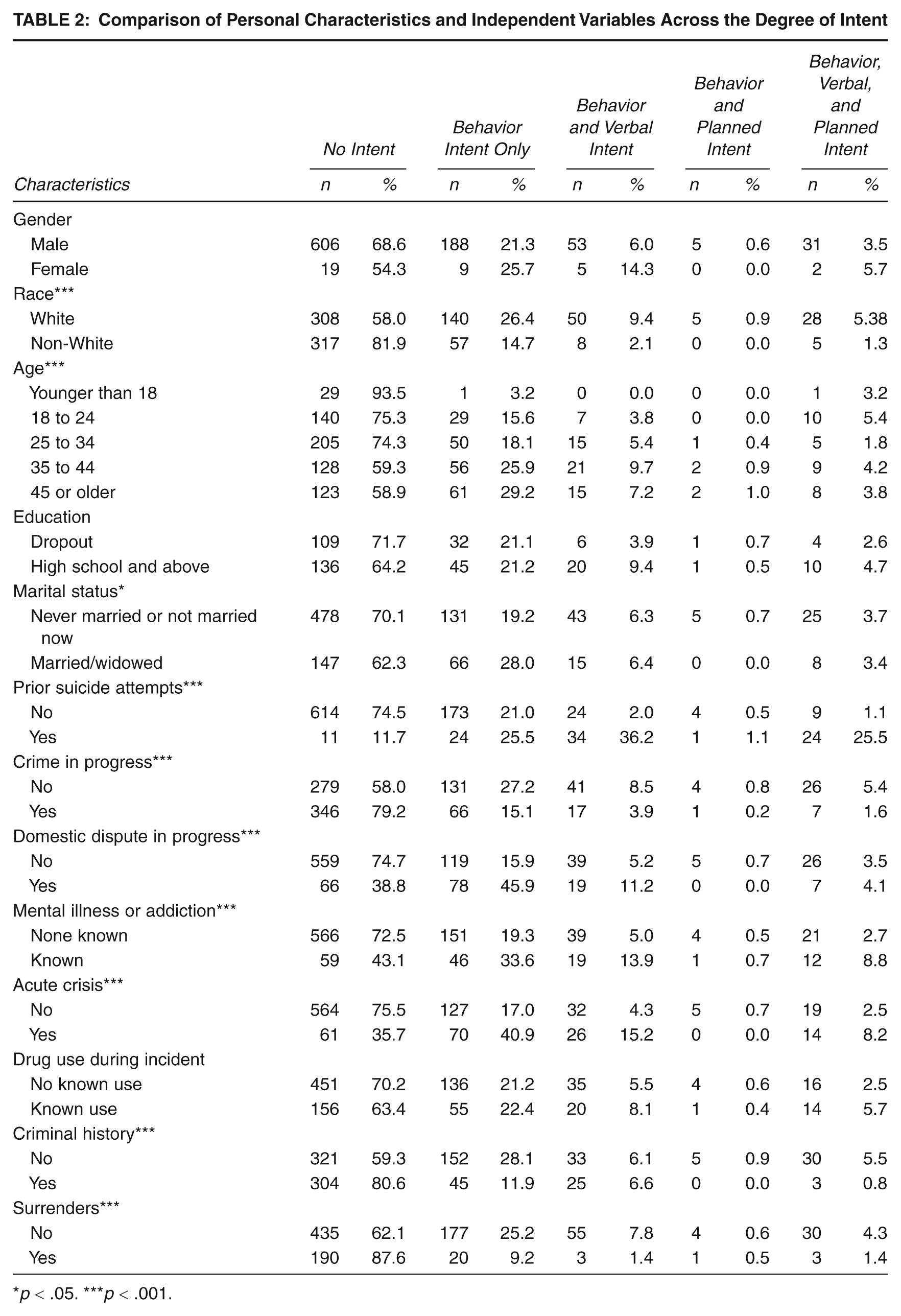
Chi-square analysis was conducted among the degrees of intent and personal characteristics, secondary SbC indicators, indicators of irrational thought, and minimum indicators of suicidal thought (Table 2). With the exception of gender and education, the personal characteristics varied significantly across the different degrees of intent. Non-White subjects were more likely to reveal no intent, whereas White subjects disclosed higher degree of intent (χ2 = 65.568, p < .001). Older subjects were more likely to exhibit behavior only and behavior and verbal indicators of intent than younger subjects, who were more likely to disclose no intent (χ2 = 43.381, p < .001). Married or widowed subjects were more likely to present behavioral indicators of intent than unmarried subjects, who had a higher percentage of no intent (χ2 = 9.601, p < .01).
Comparison of Personal Characteristics and Independent Variables Across the Degree of Intent
p < .05. ***p < .001.
All of the secondary SbC indicators varied significantly across the degrees of intent. Those subjects who previously attempted suicide were more likely to display a stronger degree of intent (χ2 = 338.1, p < .001). Except for planned indicators of intent, subjects immersed in domestic disputes also were more likely to display a stronger degree of intent (χ2 = 93.314, p < .001). On the other hand, subjects interrupted in criminal activity were less likely to exhibit intent to use SbC than those subjects not involved in crimes in progress (χ2 = 49.304, p < .001). Two of the three indicators of irrational thought were significant. Known mental illness or addiction and interpersonal crisis were likely to be indicators present at all degrees of intent (χ2 = 52.4, p < .001; χ2 = 109.3, p < .001, respectively). Whether or not a subject was intoxicated at the time of the incident was not significantly related to the degree of intent. It is interesting that the minimal indicators of suicidal intent also were significant. Subjects with a criminal history were less likely to exhibit indicators of intent to commit SbC (χ2 = 59.37, p < .001), whereas those subjects who refused to surrender to law enforcement were more likely to reveal indicators of intent than subjects who surrendered (χ2 = 50.542, p < .001).
What Impact do the Independent Variables and Personal Characteristics Have on the Degree of Intent?
Multivariate analysis was conducted to simultaneously analyze the impact of the independent variables and personal characteristics on the degree of intent of subjects. Evidence of intoxication during the incident, gender, and education were not significantly related to intent in the bivariate analysis, so they were not included in the regression analysis. Ordinal regression was selected because the dependent variable, the degree of intent of subjects, had responses that could be ranked, although the distance between each response was not known; in general, the more indicators, the greater the degree of intent. Ordinal regression, unlike discriminate analysis, does not require normal distribution among the responses of the independent variables. It provides information on the fit of the model, the strength of the associations, and the significant contributions of independent variables’ impact on the outcome, or dependent variable (Menard, 1995). The ordinal regression model assumes that the location parameters are equivalent across the degree of the outcome variable. This assumption is not violated if the test of parallel lines returns a finding of nonsignificant. In other words, there is no significant difference between the model where the regression lines are constrained to be parallel for each level of the ordinal dependent variable compared to the model where the regression lines are allowed to be estimated without a parallelism constraint (Mertler & Vannatta, 2002). The results of the parallel test were found to be nonsignificant, so the assumption was not violated.
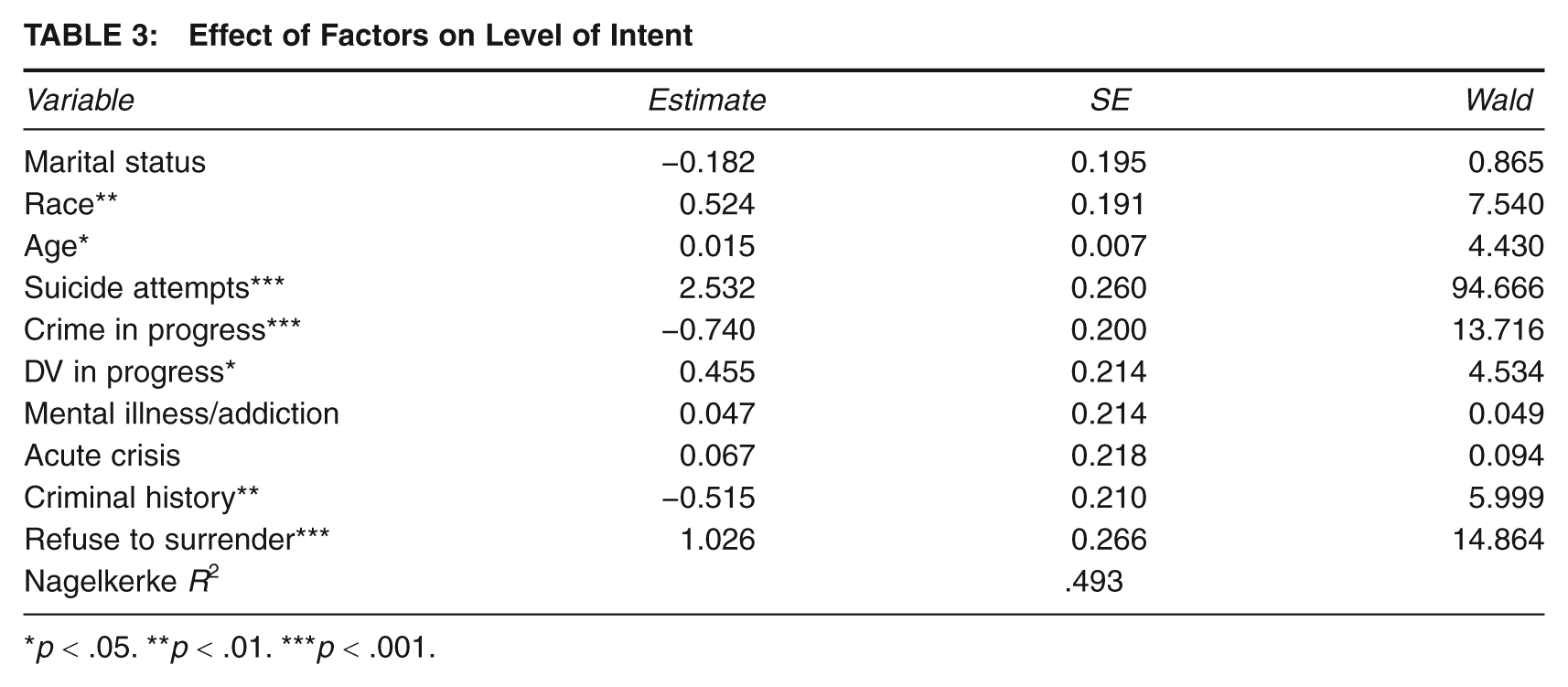
The model chi-square was significant, indicating the model with the independent variables provided a better fit than the model with no independent variables. Two personal characteristics (race and age) and five significant predictors (suicide history, domestic dispute during the incident, criminal act during the incident, criminal history, and refusal to surrender) significantly contributed to the strength of association (Nagelkerke R2 = .493; Table 3). Unlike ordinary least squares (OLS) regression, pseudo-R2 must be used and cannot be used to minimize variance. Although different pseudo-R2 calculations arrive at different values, Nagelkerke’s R2 was selected because of its similar scale range to OLS R2 (0 to 1). The regression model indicated that older White subjects were significantly more likely to exhibit a higher degree of intent to be killed by SbC. The secondary SbC indicators, history of suicide attempt and involvement in a domestic dispute when the police officers arrived, appeared to support a greater degree of intent to be killed by police officers than when those secondary indicators were not present. On the other hand, subjects involved in crimes at the time of the law enforcement intervention were less likely to exhibit behaviors that reflect intent to be killed by law enforcement. The indicators that were designated as evidence of irrational thought did not provide significant evidence of intent to be killed by police officers. Refusal to surrender, one of the two variables that were considered minimal supports of suicidal intent, provided significant indication of intent. In summary, for predicting the degree of SbC intent, there was support for two personal characteristics, the secondary SbC indicators, and one of the minimal indicators, but not the indicators of irrational thought.
Effect of Factors on Level of Intent
p < .05. **p < .01. ***p < .001.
Discussion
The current study first expanded the operational definition of intent by using Lord and Sloop’s (2010) primary indicators as degree of intent of SbC ranging from no intent to strong intent. Using bivariate analysis, it then examined the relationships between degree of intent and variables that consistently have been reported as predictors of SbC, such as subjects’ demographics, suicide attempts, interrupted crimes or domestic disputes, intoxication at the time of incident, mental illness, addiction, interpersonal crises, refusal to surrender, and a criminal history. Finally, through multivariate analysis, it examined the impact that these same variables have on the degree of intent.
Many of the bivariate relationships found significant in the current study support the SbC literature. Race and age are two personal characteristics supported in the literature, although the average age in the current study was slightly older (Hutson et al., 1998; Lord & Sloop, 2010; McKenzie, 2006; Mohandie, Meloy, & Collins, 2009). As noted consistently by the SbC literature, a history of suicide attempts, mental illness or addiction, acute crisis, involvement of a domestic dispute, and refusal to surrender have significant relationships with SbC intent (Drylie, 2006; Homant & Kennedy, 2000; Hutson et al., 1998; Lord, 2000; Mohandie et al., 2009; Parent & Verdun-Jones, 1998; Wilson, Davis, Bloom, Batten, & Kamara, 1998). In addition, the current study was able to note not only a significant positive relationship with SbC intent, but also the degree of intent such that mental illness or addiction, acute crisis, domestic dispute in progress, and refusal to surrender indicated low to moderate intent whereas a history of suicide attempt was more likely to indicate strong SbC intent.
Some of the variables found significantly related to SbC intent in other studies were not significant in the current study. Previous SbC literature concluded single individuals were more likely to instigate SbC incidents (Lord, 2000, 2004; Lord & Sloop, 2010; Mohandie et al., 2009); however, the current study found that married individuals were more likely to exhibit behavioral indicators of SbC than individuals who were single. To use a dichotomous measure, the current study merged individuals who were widowed and divorced into “not married.” Other SbC studies have used more categories for marital status, so it is not clear if the different results are an artifact of the merged responses. Also, previous research has found drug use during the incident related to SbC intent (Lord, 2000; McKenzie, 2006; Mohandie et al., 2009; Wilson et al., 1998); the current study did not.
The current study concluded that crimes in progress and subjects’ criminal history were not likely to indicate SbC intent, which supported some of the SbC literature (Lord & Sloop, 2010; Mohandie et al., 2009), but not other studies (Hutson et al., 1998; Mohandie & Meloy, 2000).
When ordinal regression was used to analyze the simultaneous impact of the independent variables and personal characteristics on the degree of intent of subjects, the model with the predictors was significantly a better fit, with several variables contributing to the strength of the association. Of great interest was the fact that the variables that designated evidence of irrational thought were no longer significant. As argued by McKenzie (2006), there is a need to separate those subjects who were not thinking rationally because of the influence of drugs or alcohol or mental illness from those subjects whose actions were truly directed toward an intent for law enforcement to end their lives. According to the current model, the greatest degree of intent to be killed by SbC was revealed with behaviors, verbalization, and some indication of planning. If only two indicators were observed, there was a moderate degree of intent, and one indicator reflected a weak degree of intent. Those elements that might have suggested irrational thinking rather than an individual’s intent to be killed by law enforcement were less likely to be predictors of strong degree of SbC intent. In fact, they were not significant predictors at all in the current model. This finding was particularly intriguing and should be further examined.
McKenzie (2006) illustrates SbC intent based on the subject’s interaction with police officers, ranging from a clear determination to live, as demonstrated when the subject complies with officers’ commands, to indifference to living, as when officers’ commands are ignored or carried out casually, and to suicidal intent, as when the subject’s behaviors constitute active solicitation for police to shoot, threats to kill, and overt hostility to the police and others. Refusal to surrender to the police even when it is evident that there is no avenue of escape is a significant indicator of SbC intent in the current study and in some of the previous research (Mohandie et al., 2009). McKenzie’s categories of indifference to active solicitation may explain the significance of refusal to surrender.
In conclusion, as the growing number of researchers agree, to reach a decision about individuals’ intent to commit SbC, more than one point of data should be considered. During the incident, the more behavioral, verbal, or planned indicators, the more likely the subject intends to be killed by law enforcement. Based on the current model, if the subject is White and from the mid to late 30s in age and has a history of suicide attempts, if the acute situation is a domestic dispute, and if the subject refuses to surrender, there is a probability that he or she will intentionally consider SbC as a method to commit suicide. Factors considered indicators of irrational thought were not found to be significant predictors, a finding of great importance that merits further study.
Footnotes
Author’s Note:
Special thanks to Dr. Beth Bjerregaard and Dr. John Fisher, UNC Charlotte. This research uses data from NVDRS, a surveillance system designed by the Centers for Disease Control and Prevention’s (CDC) National Center for Injury Prevention and Control. The findings are based, in part, on the contributions of the 17 funded states that collected violent death data and the contributions of the states’ partners, including personnel from law enforcement, vital records, medical examiners/coroners, and crime laboratories. The analyses, results, and conclusions presented here represent those of the author and not necessarily those of CDC.