



Abstract
The social order of a prison arises from the combined effects of the prison’s institutional capacity for control and the effectiveness of prison management. Prior research suggests that the criminogenic characteristics of the inmate population, the security level of the prison, and the prison environment are three structural characteristics of prisons that define each prison’s institutional capacity for control, as reflected in the aggregate-level measures of inmate misconduct, and prison environment is expected to moderate the effects of inmate population characteristics on inmate misconduct. This study of 50 state prisons for men provides support for the hypothesized direct effects of institutional capacity for control on the level of violent and nonviolent inmate misconduct and for the contextual effect of prison environment. The findings are discussed in terms of the management environment created among prisons by variations in the institutional capacity for control.
The principal goal of prison management is social control. Institutional security and the personal safety of staff and inmates are prerequisites to a well-managed prison, where both the level of routine misconduct by individual inmates and the occurrence of episodic group disturbances signal the breakdown of management’s ability to exert effective control within these coercive organizations (DiIulio, 1987; Reisig, 2002; Steiner, 2009; Useem & Kimball, 1989; Useem & Piehl, 2006; Useem & Reisig, 1999). In light of this, it is not surprising that there has been an ongoing discussion and debate for more than 50 years regarding prison management styles and the types of control that are best suited to establish and maintain control of the prison (e.g., Barak-Glantz, 1981; Clemmer, 1940; Colvin, 1992; Cressey, 1961, 1965; DiIulio, 1987; Franklin, Franklin, & Pratt, 2006; Huebner, 2003; Irwin, 1980; Jacobs, 1976, 1977; McCleery, 1957; Reisig, 2002; Sparks, Bottoms, & Shaw, 1996; Sykes, 1958; Useem & Kimball, 1989; Useem & Reisig, 1999; Wright, 1994).
Background
Like any social organization, prisons depend on effective social regulation to curb misconduct. Management uses a blend of formal and informal controls, some more dynamic than others, but these efforts to exert control have to be viewed within the context of a prison’s institutional capacity for control. Variations in the structural characteristics of prisons will result in variations in the effectiveness of administrative efforts to use formal and informal controls. Collectively, these structural features of a prison define each prison’s institutional capacity for control. To date, attention has been directed to the relationship between inmate misconduct and three of these structural characteristics of prisons. One element of the institutional capacity for control is the size and composition of the inmate population. According to this perspective, the pre-institutional roles, cultural norms, and experiences of criminal offenders form risk factors or internal predispositions toward violent and nonviolent misconduct, and there is substantial research to document the relationship between the individual-level characteristics of inmates and the frequency of their misconduct in prison (e.g., Bottoms, 1999; Cunningham & Sorensen, 2007; Ellis, Grasmick, & Gilman, 1974; Gover, Perez, & Jennings, 2008; Griffin & Hepburn, 2006; Harer & Steffensmeier, 1996; Kerley, Hochstetler, & Copes, 2009; Lahm, 2008; Steiner & Wooldredge, 2009a, 2009b). Within this perspective, administration’s major responsibility is to identify and isolate or otherwise manage those high-risk inmates who are the source of the problem.
A second element of a prison’s institutional capacity for control is the security level of the prison. When used appropriately, differential security levels are designed to provide differential levels of risk management: Higher-risk inmates are placed in more secure prisons, where social control is enhanced by greater physical and social restraints. Despite this effort to control the increased levels of criminal propensity by assignment to increased levels of prison security, and with few exceptions (C. Camp & Gaes, 2005; Tischler & Marquart, 1989), the level of inmate misconduct has been found to be greater in higher-security prisons (see Gover et al., 2008; Harer & Steffensmeier, 1996; Huebner, 2003; Steiner & Wooldredge, 2008; Worrall & Morris, 2011).
The third element of institutional capacity for control is the prison environment. Relative to the composition of the inmate population and the security level of the prison, the prison environment is more dynamic and better reflects the legitimacy of the prison administration (Useem & Reisig, 1999). Correctional treatment programming, staff training and turnover, officer–inmate ratio, and crowding are examples of environmental factors that have been found to influence the level of prison misconduct (e.g., C. Camp & Gaes, 2005; Franklin et al., 2006; French & Gendreau, 2006; McCorkle, Miethe, & Drass, 1995). One explanation for this effect on inmate misconduct emerges from the deprivation model of inmate conduct (see Gaes & McGuire, 1985; Sykes, 1958; Thomas, 1977), which asserts that the physical and social conditions of confinement can exacerbate the “pains of imprisonment” that manifest themselves in various adaptations, including rule infractions and violent misconduct. Equally important, adverse environmental conditions, such as crowding and staff turnover, also undermine management’s reliance on such social controls as communication, surveillance, and rule enforcement.
In addition to the independent effects that each of these three elements of institutional capacity for control has on the overall level of inmate misconduct within a prison, there is evidence that these structural features of a prison moderate the effects of individual-level variables on inmate misconduct. The racial composition of the inmate population, the security level of the prison, and the degree of crowding, for instance, have been found to condition the individual-level effects of inmate age, criminal history, and other measures of criminal propensity on the individual’s involvement in violent and nonviolent misconduct (see, for example, C. Camp & Gaes, 2005; Gaes & McGuire, 1985; Gover et al., 2008; Lahm, 2008, 2009; Reisig, 2002; Steiner, 2009; Steiner & Wooldredge, 2008, 2009a, 2009b, 2009c; Wooldredge, Griffin, & Pratt, 2001; Worrall & Morris, 2011). Studies of this type are important in ongoing efforts to explain the effect of individual-level factors on the variability of misconduct observed among inmates, but they are of limited value in explaining variations in the level of misconduct that occur among prisons.
A more complete understanding of the institutional capacity for control requires an analysis of the independent and combined effects of aggregate-level measures of inmate population characteristics, security level, and prison environment on aggregate-level measures of inmate misconduct between prisons. Because prison environment is more amenable to administrative influences than either security level or inmate characteristics, two other research questions arise. First, does prison environment have an effect on the level of inmate misconduct independent of the effects of the aggregated characteristics of the inmate population and the security level? Second, does prison environment create a contextual effect such that greater or lesser degrees of the capacity for control by the prison environment will moderate the relationship between the characteristics of the inmate population and the level of prison misconduct? The answers to these questions will inform the broader discussion regarding prison management’s ability to maintain control of the prison.
Inmate Population Characteristics and Prison Misconduct
According to the importation model, prison misconduct is a direct result of the attitudes, values, and prior experiences that each inmate brings into the prison (Irwin, 1981; Irwin & Cressey, 1962). Those characteristics of persons known to be directly related to crime and misconduct in the community are assumed to be the same characteristics of inmates that are directly related to acts of violence and other misbehaviors in the prison. According to this perspective, individual rates of misconduct among inmates are greater among those inmates who are younger, who are non-White, and who have a history of exploitative and violent behavior (Bottoms, 1999; Gendreau, Goggin, & Law, 1997; Gover et al., 2008; Griffin & Hepburn, 2006; Jiang & Fisher-Giorlando, 2002; Lahm, 2008, 2009), and the collective level of prison misconduct will increase as the composition of the inmate population becomes increasingly younger, non-White, and more predatory (S. Camp, Gaes, Langan, & Saylor, 2003; Ellis et al., 1974; Harer & Steffensmeier, 1996; Steiner & Wooldredge, 2009a, 2009b). The source of the problem, then, resides in the characteristics of the inmates confined within the prison, and the rate of prison misconduct reflects the composition of that inmate population.
The empirical evidence in support of this hypothesized relationship between characteristics of the prison population and the level of prison misconduct is inconclusive. A person’s age is inversely related to his or her likelihood of committing a crime in the community (Hirschi & Gottfredson, 1983), and an inmate’s age has been found to be associated with his or her likelihood of violent and nonviolent prison misbehaviors (S. Camp et al., 2003; Cunningham & Sorensen, 2007; Fernandez & Neiman, 1998; Gendreau et al., 1997; Griffin & Hepburn, 2006; Huebner, 2003; Lahm, 2009, Steiner & Wooldredge, 2009a), so it appears reasonable that the age distribution of the prison’s inmate population would be a significant predictor of the level of misconduct that occurs in that prison. There is some evidence that the likelihood of violence (Lahm, 2008, 2009; Mabli, Holley, Patrick, & Walls, 1979) and other disciplinary infractions (Ellis, 1984; Ellis et al., 1974) is greater among younger inmate populations, but other researchers (S. Camp, Gaes, Klein-Saffran, Daggett, & Saylor, 2002; Gaes & McGuire, 1985) found that the age of the inmate population was unrelated to the level of prison misconduct.
Similarly, to the extent that race and ethnicity reflect cultural differences imported into the prison (Harer & Steffensmeier, 1996; Steiner & Wooldredge, 2009a, 2009b) or serve as a proxy for differences in situational backgrounds, such as in socioeconomic status and education levels (Gaes & McGuire, 1985), then the racial or ethnic composition of the inmate population may be an important predictor of the level of prison misconduct. The hypothesized effects of the inmate’s race, as an individual-level factor, or the prison’s racial composition, as a prison-level variable, are challenged by the results of several studies, however. A positive relationship between the inmate’s race and his or her level of violent misconduct has been found by some (Gaes, Wallace, Gilman, Klein-Saffran, & Suppa, 2002; Harer & Steffensmeier, 1996; Steiner & Wooldredge, 2009a; Wooldredge, 1998) but not by others (S. Camp et al., 2003; Griffin & Hepburn, 2006; Lahm, 2009), and the inmate’s race has been found to be either unrelated to or negatively associated with the inmate’s level of nonviolent misconduct (Gaes et al., 2002; Harer & Steffensmeier, 1996; Huebner, 2003; Steiner & Wooldredge, 2009a, 2009b).
Similar inconsistencies are noted among studies of the effects of the prison’s racial composition on the level of violent and nonviolent misconduct in the prison. Ellis et al. (1974) and S. Camp et al. (2003) found that the racial-ethnic composition of the inmate population had no effect on the level of inmate misconduct within a prison, Lahm (2008, 2009) and Steiner (2009) found that the rate of inmate assaults increased as the non-White percentage of the inmate population increased, and Gaes and McGuire (1985) found that increased percentages of non-White inmates were associated with a reduced rate of assaults. Harer and Steffensmeier’s (1996) analysis of the relationship between racial composition and prison misconduct in 58 federal prisons discovered no association with prison violence and an inverse association with drug or alcohol misconduct. More recently, Steiner and Wooldredge (2009b) examined this hypothesized link between the racial composition of the inmate population and prison misconduct among 8,566 male inmates located in 175 state prisons and concluded that the racial composition of the inmate population was unrelated to the prevalence of assaults on other inmates and staff but that lower levels of assaults occurred among those prisons with higher levels of heterogeneity among both the inmates and the staff. In contrast, Steiner’s (2009) analysis of 512 state prisons for men concluded that the level of inmate assaults was positively associated with the level of racial heterogeneity among inmates and staff.
Criminal history, especially the history of violent behavior, also represents a set of background experiences that are imported into the prison by each inmate, and the composition of the inmate population can be defined in terms of what S. Camp et al. (2002) refer to as its “collective criminal propensity.” Two commonly discussed measures of the population’s criminal propensity are the proportion of inmates with a history of violent crimes (S. Camp et al., 2002; Reisig, 2002) and the proportion of inmates who have been incarcerated previously (S. Camp et al., 2002; Harer & Langan, 2001; Wright, 1991), but few studies have empirically examined the effect of either of these two measures of the criminal propensity of the inmate population on the level of prison misconduct. S. Camp et al. (2002) and Steiner and Wooldredge (2008) found that violent misconduct was greater in those prisons that had a greater proportion of inmates with a violent history, but a significant effect on nonviolent misconduct was noted by only Steiner and Wooldredge (2008). The proportion of the population that had been incarcerated previously was found to have a positive effect on the level of misconduct within the prison by Harer and Langan (2001) and Steiner and Wooldredge (2008), but Gaes and McGuire (1985) found no relationship between the proportion with a prior incarceration and the level of misconduct within the prison.
Preprison affiliation with street gangs is a third measure of the inmate’s criminal history that often is considered relevant to prison misconduct levels (Davis & Flannery, 2001), and the little research conducted to date suggests that those prisons with a higher proportion of the inmate population that had been affiliated with street gangs prior to incarceration will experience greater levels of prison misconduct (C. Camp & Camp, 1988; G. Camp & Camp, 1985; Griffin & Hepburn, 2006; Krienert & Fleisher, 2001; Reisig, 2002; Shelden, 1991).
Prison Environment and Prison Misconduct
In contrast to the inmate population model, what has been referred to as institutional capacity (Gaes & McGuire, 1985), the prison regime (C. Camp & Gaes, 2005), the prison context (Franklin et al., 2006), environmental factors (Steiner & Wooldredge, 2008; Wright, 1991), and environmental strain (Morris, Carriaga, Diamond, Piquero, & Piquero, 2012) focuses attention on the effects of the structural features of the prison environment, independent of the social and physical constraints that are reflected by security level itself. As already noted, the prison environment contributes to the pains of imprisonment that arise from the physical and social deprivations of confinement. In addition, the prison environment often poses significant challenges to management’s efforts to create a safe and orderly prison.
Salient characteristics of the prison environment
One measure of the prison environment is staffing, or the degree to which the prison is operating with its full complement of correctional officers (COs; McCorkle et al., 1995; Reisig, 2002). High turnover rates among COs are a chronic problem (C. Camp & Camp, 2002), and vacancies within the workforce challenge prison administration to identify the major problem areas and allocate existing staff appropriately. At minimum, higher levels of staff vacancies result in a reduction in the numbers of officers capable of exercising control over inmates. Typically, higher levels of staff vacancies also signal the loss of officers experienced at supervising and controlling inmates.
Social density, or the extent to which the inmate population meets or exceeds the prison’s designated capacity (based on cell space, beds available, or physical space per capita), is a structural feature of prisons that increases inmate deprivation and lessens administrative control. The Commission on Safety and Abuse in America’s Prisons (2006) argued that crowding “fuels violence” in prisons (p. 23). Populations far in excess of the designated capacity of the prison increase physical and social interactions among inmates; create administrative problems for the routine management of the inmate population through existing work, education, and housing assignments; and reduce the ability of staff to monitor the activities of the inmate population. Increased inmate crowding was found to be associated with increased levels of prison misconduct by Gaes and McGuire (1985), Harer and Steffensmeier (1996), Wooldredge et al. (2001), and Lahm (2008), but Ekland-Olson (1986), S. Camp et al. (2002), and Steiner (2009) reported that crowding had no effect on misconduct rates. A comprehensive review of studies of the relationship between crowding and prison violence in the past 20 years by Steiner and Wooldredge (2009c) linked the inconsistencies in findings to the inconsistencies in methodologies employed to date.
The ratio of inmates to COs is another component of the prison environment that affects both inmates’ conditions of confinement and management’s ability to maintain control over the institution. The rate of violent misconduct was found by Gaes and McGuire (1985) and Steiner (2009) to be positively affected by the ratio of inmates to officers, but Harer and Steffensmeier (1996) and Lahm (2008) found that the inmate–officer ratio had no effect on the rate of violent misconduct. Harer and Steffensmeier did find, however, that the inmate–officer ratio was associated positively with the level of nonviolent misconduct.
Another important measure of prison environment is the presence of officially prohibited inmate organizations, or prison gangs. Prison gangs use violence, or the threat of violence, to gain power and privilege within the prison, and gang-affiliated inmates are more likely than other inmates to engage in prison misconduct (C. Camp & Camp, 1988; Gaes et al., 2002; Griffin & Hepburn, 2006; Huebner, 2003; Scott, 2001; Shelden, 1991). The greater the number of prison gangs and the greater the number of inmates who are affiliated with these gangs inside the prison, the less effective the administrative controls over inmate behavior in the prison (Fleisher & Decker, 2001; Kalnich & Stojkovic, 1985; Ralph, 1997; Ralph & Marquart, 1991). Prisons with higher levels of gang activity or gang membership have been found to have higher rates of nonviolent misconduct (Gransky & Patterson, 1999; Rivera, Cowles, & Dorman, 2003) and violent misconduct (Reisig, 2002), although Harer and Steffensmeier (1996) found that the amount of gang activity had no effect on the level of inmate violence.
The independent and contextual effects of prison environment
In addition to the direct effects of both aggregated inmate population characteristics and prison environment on the level of inmate conduct, there is reason to hypothesize that prison environment will moderate the effects of aggregated prisoner population characteristics on the level of inmate misconduct (Gendreau et al., 1997; Harer & Langan, 2001; Hochstetler & DeLisi, 2005; Lahm, 2008, 2009; Steiner, 2009; Steiner & Wooldredge, 2008, 2009a, 2009c; Wooldredge et al., 2001). When the prison environment is characterized by high levels of staffing vacancies, inmate crowding, inmate-to-officer ratios, and prison gangs, these structural features aggravate the personal risk factors of the inmate population while reducing administrative controls. In such situations, the effect of aggregated inmate population characteristics is less restrained, and the level of inmate misconduct increases. Conversely, prison environments characterized by low levels of staffing vacancy, inmate crowding, inmate-to-officer ratios, and prison gangs will create an environment that is less stressful to the inmates and more manageable by the administration, thereby suppressing the etiological effects of aggregated inmate characteristics on the level of inmate misconduct. Harer and Langan (2001), for instance, argued that high levels of control, such as is often found in a maximum-security prison, will suppress the effects of specific inmate characteristics on prison violence, and the research of Gaes and McGuire (1985), Bonta and Gendreau (1990), and Franklin et al. (2006) suggests that crowding can increase the effect of the inmate population’s age on the level of inmate misconduct.
Research Problem
The underlying hypotheses of this study are grounded in the findings of prior research, but there are inconsistencies in those findings, as noted above. One reason for the inconsistencies is that whereas most studies have focused on state prisons, others have examined federal prisons (most notably S. Camp et al., 2002; Gaes & McGuire, 1985; Harer & Steffensmeier, 1996; Mabli et al., 1979). There is greater variation in administrative style and control, as well as in policies and rules, among state prisons than among federal prisons, and persons convicted of violent crimes represent a much larger proportion of inmates in state prisons than in federal prisons (Harrison & Beck, 2003; Steiner & Wooldredge, 2008). The observed inconsistencies in findings also can be attributed to differences in the indicators used to measure the independent and dependent variables, especially the measures of prison environment and inmate misconduct. 1 Yet another explanation for the inconsistent findings is the quite variant degree to which multivariate analyses have been used to isolate the effects of one independent variable when controlling for the possible effects of other factors thought to predict inmate misconduct and/or to examine the effects of individual-level factors, such as age and ethnicity, when controlling for prison-level factors, such as density or the ratio of inmates to staff (see, for example, S. Camp et al., 2002; Harer & Steffensmeier, 1996; Steiner, 2009; Steiner & Wooldredge, 2008; Wooldredge et al., 2001; Worrall & Morris, 2011).
This study uses official designations of security level and official prison-level measures of the characteristics of the inmate population, the prison environment, and the prison’s levels of violent and nonviolent misconduct to examine the effect of a prison’s institutional capacity for control on inmate misconduct. On the basis of previous research, the structural features of a prison’s inmate population characteristics, security level, and prison environment are hypothesized to have a significant effect on the level of inmate misconduct in the prison. Second, it is hypothesized that variations in the prison environment, because such variations create greater or lesser degrees of social control, will condition the aggregated effects of the inmate population characteristics on the level of inmate misconduct.
Method
This examination of the hypothesized effects of the institutional capacity for control on levels of inmate misconduct relies on a secondary analysis of official data gathered for other purposes by the Arizona Department of Corrections. At the time of the data collection, the Department of Corrections in this southwestern state managed 50 semiautonomous prisons for adult men; each of the 50 prisons was physically isolated from the others by perimeter gates and walls, and each had its own administrative staff, security staff, and other employees who supervised and controlled the adult male inmates assigned to that unit. These prisons varied considerably in security level and in the size and characteristics of the inmate population. Misconduct data were derived from official reports of major misconducts for the 4-month period from May 1 to August 31, 2000, and all measures of the inmate population and prison environment were obtained for the midpoint of this observational period, June 30th.
Measures of Prison Misconduct
Official reports of formally adjudicated major misconduct violations were used to create two measures of prison misconduct. 2 In each case, the number of major misconduct reports during the 4-month observation period was standardized by the number of inmates confined in the prison unit on June 30th, thereby creating a major misconduct report rate per 100 inmates. Violent prison misconduct was measured by the number of major misconducts that occurred for any violent behavior (e.g., homicide and physical assault of inmates or staff, sexual assaults, fighting, physical threats or extortion, and possession of a weapon) per 100 inmates; nonviolent prison misconduct was measured by the number of major misconducts for any nonviolent violation (e.g., possession of drugs or other contraband, property destruction or loss, theft of property from an inmate or staff, and tampering) per 100 inmates.
Characteristics of the Inmate Population
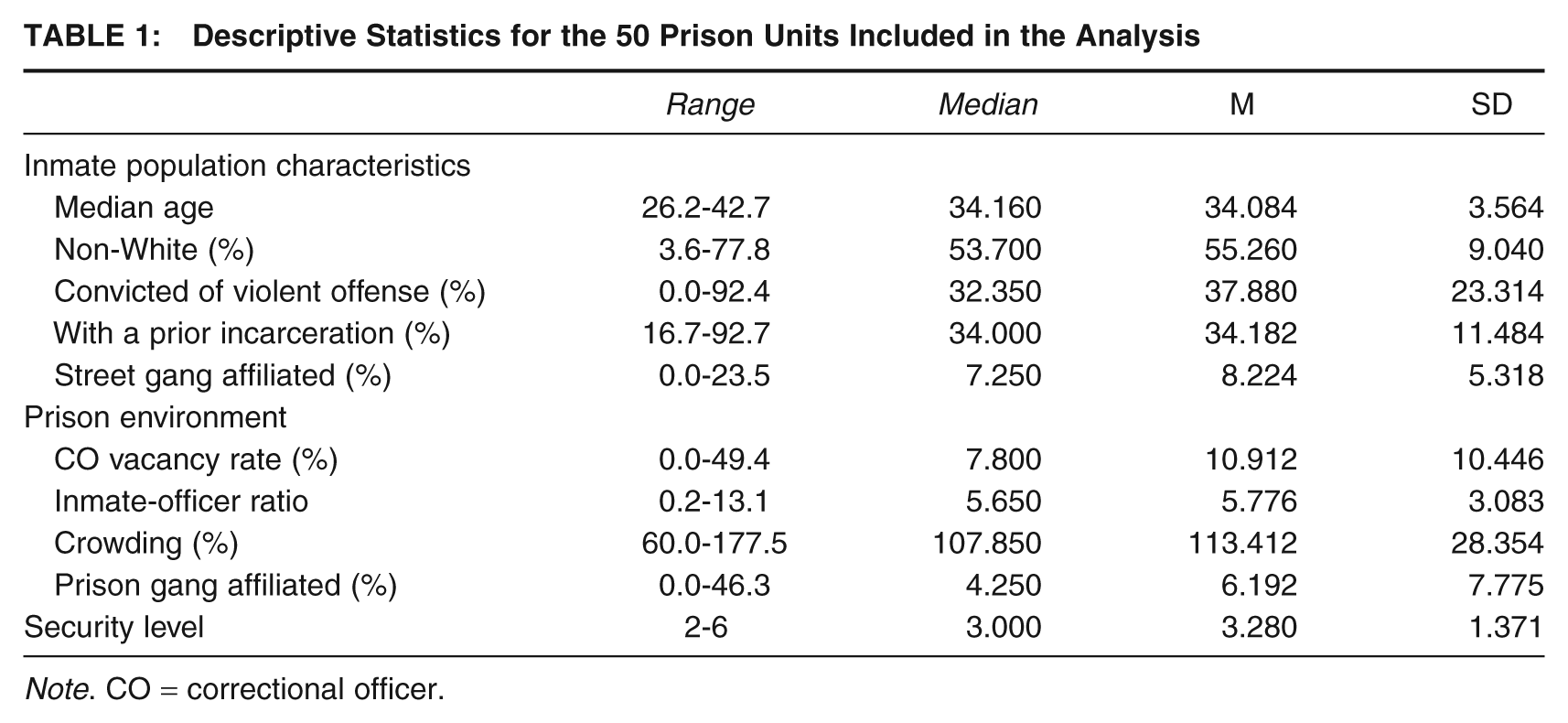
Table 1 presents descriptive information on each of the five factors that were used to measure the characteristics of the inmate population at each of the 50 prison units. The median age of the population at each unit varied from a low of 26.2 years to a high of 42.7 years (M = 34.08, SD = 3.56), and the percentage non-White varied from 33.6% to 77.8% (M = 55.26, SD = 9.04). The data reported in Table 1 indicate that there was considerable variation among the prison units in the percentage of the unit’s population that was serving a sentence for a violent offense; percentage violent offense ranged from 0% at two of the units to a high of 92.4% at one unit (M = 37.88, SD = 23.32). There also was considerable variation across the units in the proportion of the population that had been incarcerated one or more times previously. Percentage prior incarceration ranged from 16.7% to 92.7% (M = 34.18, SD = 11.48). Finally, percentage street gang reports the degree to which the prison’s population was composed of persons who had been affiliated with street gangs prior to imprisonment, as determined by presentence reports or at initial assessment and classification. This final measure of the risk level of the inmate population at importation varied from a low of 0% to a high of 23.5% (M = 8.22, SD = 5.31).
Descriptive Statistics for the 50 Prison Units Included in the Analysis
Note. CO = correctional officer.
Measures of Prison Environment
Information on each of the four measures of the prison environment also is summarized in Table 1. The CO vacancy rate measured the degree to which the prison unit was understaffed. A CO vacancy rate of zero, which existed at four of the prison units, indicated that the unit had no vacant CO positions. The highest CO vacancy rate was 49.4%, which indicated that nearly half of the CO positions allocated to that prison were vacant at the time of data collection. Physical density of the population, or the degree of crowding, was captured by a measure of the extent to which the unit’s population neared its rated inmate capacity. Crowding varied from a low of 60% of capacity to a high of 177.5% of capacity, with a mean of 113.4% (SD = 28.35). The inmate-to-officer ratio varied from a low of 0.2 inmates to every officer (at one of the maximum-security special management unit [SMU] prisons) to a high of 13.1, with a mean of 5.78 (SD = 3.08). Last, prison environment was operationalized in terms of the percentage of the inmate population that was known to be affiliated with a prison gang. 3 Prison gang affiliation varied from less than 1% of the inmate population at seven prison units to a high of 46.3% of the inmate population at a maximum-security unit (M = 6.19, SD = 7.78).
Security Level as a Control Variable
Security level is a rather consistent control variable in studies of inmate misconduct. Although Tischler and Marquart (1989) reported that rates of inmate assault were higher in minimum-security prisons and C. Camp and Gaes (2005) found no relationship between security level and inmate misconduct, most studies have found that rates of both violent and nonviolent misconduct are greater in higher-security-level prisons (Fernandez & Neiman, 1998; Gaes et al., 2002; Gover et al., 2008; Harer & Steffensmeier, 1996; Huebner, 2003; Jiang & Fisher-Giorlando, 2002; Steiner, 2009; Steiner & Wooldredge, 2008; Worrall & Morris, 2011). Because security level represents important differences between prisons in the physical and social restraints on inmate behavior, as well as important differences in the personal risk factors of the prison’s inmate population, security level often serves as a control variable in the study of the effects of personal risk factors on the likelihood of an inmate’s misconduct (see, for example, S. Camp et al., 2002; Gaes et al., 2002; Harer & Steffensmeier, 1996; Steiner & Wooldredge, 2009b). At the time of the study, there were no Level 1 security prisons (e.g., farms or camps) operating in this state, so security level varied from Level 2 (minimum) to Level 6 (SMU) prisons (M = 3.28, SD = 1.37). 4
Population Characteristics, Security Level, Prison Environment, and Multicollinearity
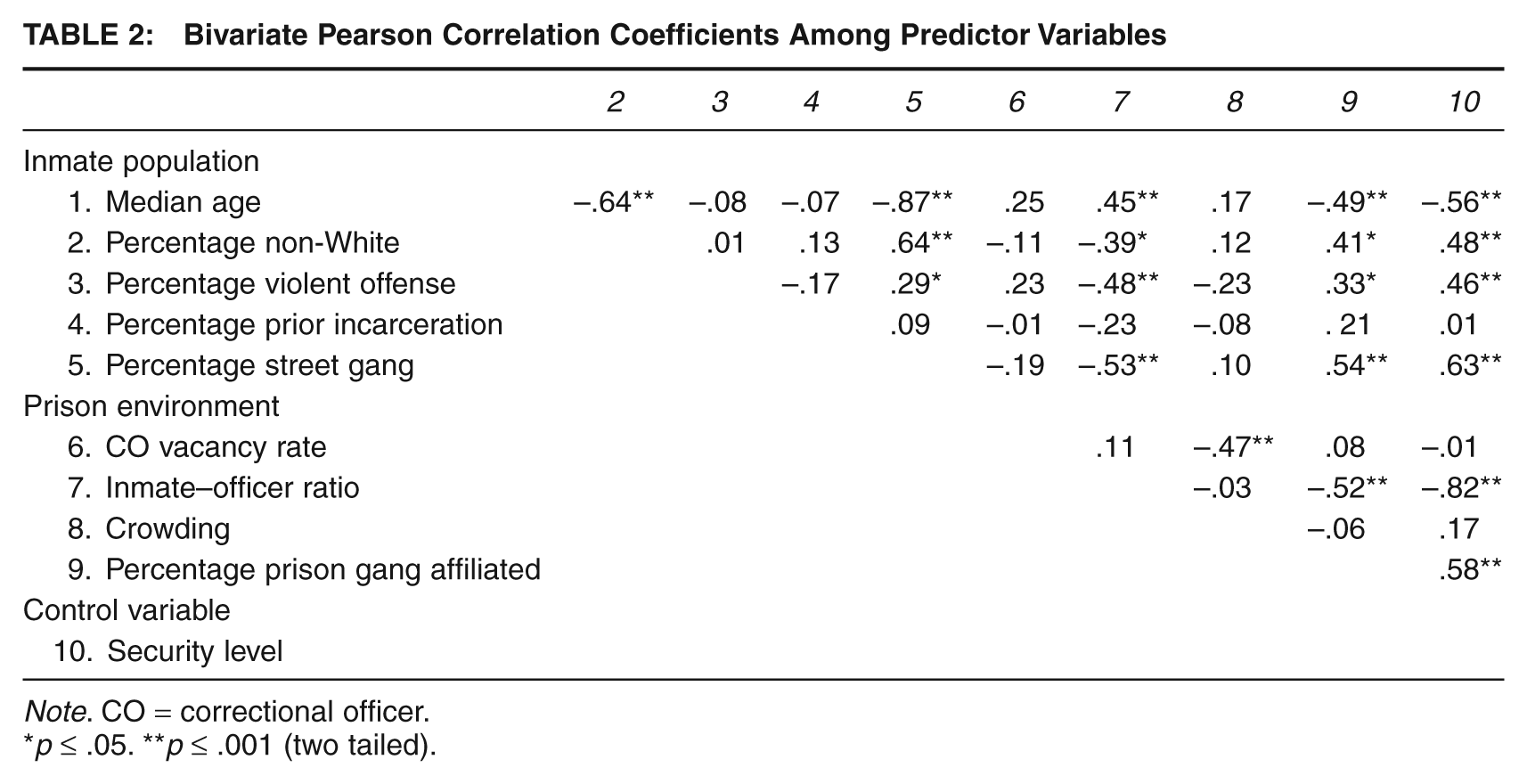
The bivariate relationships among the five measures of the inmate population, which are presented in Table 2, indicate that there was a likelihood of multicollinearity among these explanatory variables. 5 This was evident in the finding that the younger the inmate population of a prison unit, the higher the population’s percentage non-White. The possibility of multicollinearity also is raised by the finding that the higher the unit population’s percentage of street gang affiliates, the younger the population, the more non-White the population, and the higher the percentage convicted of a violent offense. These strong correlations among the measures of the inmate population apparently occurred because younger, non-White, street gang–affiliated, and violent offenders were more likely to be confined in higher-security prison units. Similarly, there was a high degree of multicollinearity among the four measures of the prison environment. The greater the unit’s crowding, the lower the unit’s officer vacancy rate and the lower the unit’s percentage prison gang affiliated. Also, the higher the security level of the prison unit, the lower the ratio of inmates to officers and the higher the percentage of the population who are prison gang affiliated.
Bivariate Pearson Correlation Coefficients Among Predictor Variables
Note. CO = correctional officer.
p ≤ .05. **p ≤ .001 (two tailed).
Whenever multicollinearity exists among the explanatory variables, it is not possible to use ordinary least squares (OLS) multiple regression to determine the effect of any one variable, such as the median age of the population, while statistically controlling for the effects of each of the other variables in the model. Unable to disaggregate the independent effect of each variable while holding constant the effects of the other variables, an alternative strategy was used in this analysis to assess the relative contributions of the characteristics of the inmate population and the prison environment on prison misconduct: With controls for security level, the analysis examines only the total, or additive, effect of population characteristics on inmate misconduct levels and the total, or additive, effect of prison environment measures on inmate misconduct levels. Although the weighted effect of each measure of the inmate population, or of each measure of the prison environment, on inmate misconduct is precluded, the examination of the aggregated effects of these structural factors on levels of inmate conduct is consistent with the first hypothesis.
A test of the second hypothesis, that prison environment moderates the relationship between population characteristics and the level of misconduct, required the creation of a dichotomized measure of prison environment: those prisons with more environmental control over inmates and those prisons with less environmental control over inmates. In light of the finding that security level was so highly correlated with the other measures of environmental control, it was important to control for security level in any effort to classify the level of environmental control of each prison. Furthermore, inmate–officer ratio is so highly interdependent with the level of security and with both the prison’s CO vacancies and degree of inmate crowding that it was omitted from the indicators used to create a dichotomous measure of environmental control.
High and low levels of environmental control reflect the extent to which each of the 50 units was above (low control) or below (high control) the median for all other units at the same security level on the three measures of percentage staff vacancies, percentage crowding, and percentage gang affiliation. Those units that were below the median level of all facilities of the same security level had a lower percentage of staff vacancies, a lower percentage of inmate crowding, and a lower percentage of gang-affiliated inmates, and units that were low on any two (n = 22) or on all three (n = 2) of these measures were defined as having a high level of environmental control. Conversely, units that were low on none (n = 4) or only one (n = 22) of these three measures were defined as having a low level of environmental control. As constructed, this distinction between the 26 high-environmental-control prison units and the 24 low-environmental-control prison units was used to test the hypothesis that prison environment moderates the effect of the aggregated characteristics of the inmate population on levels of inmate misconduct.
Results
Aggregated Effects of Alternative Models
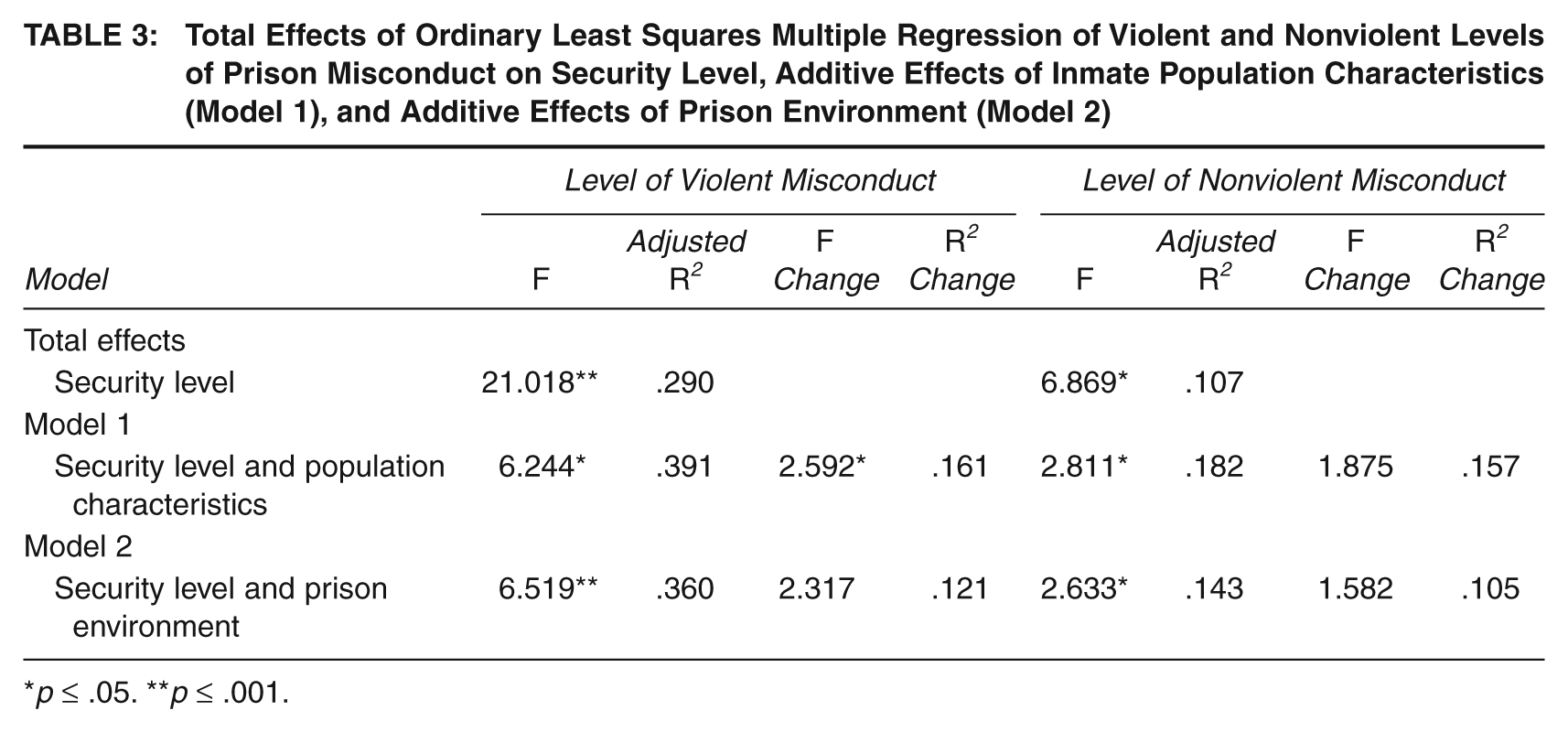
Although the presence of multicollinearity prevents the use of multiple regression analysis to identify the individual effects of each variable in a model, independent of the effects of the other variables in that model, multiple regression can be used to identify the sum of the effects of the variables in each model. By combining the effects of the five measures of the inmate population into an “inmate population characteristics” model and the effects of the four measures of prison environment into a “prison environment” model, the analysis provides a test of the first hypothesis. The results of the multiple regression analyses are presented in Table 3.
Total Effects of Ordinary Least Squares Multiple Regression of Violent and Nonviolent Levels of Prison Misconduct on Security Level, Additive Effects of Inmate Population Characteristics (Model 1), and Additive Effects of Prison Environment (Model 2)
p ≤ .05. **p ≤ .001.
Not surprisingly, security level was a significant predictor of prison misconduct. The levels of both violent and nonviolent misconduct were greater in more secure prisons. The issue, however, is the extent to which population characteristics and/or administrative control have a significant effect on the level of prison misconduct after the effects of security level are taken into account. Model 1 presents the total effect of security level and the five inmate population characteristics on violent and nonviolent misconduct. As is evident in Table 3, the addition of the inmate population characteristics to security level resulted in a significant improvement over security level alone in the ability to predict the level of violent, but not nonviolent, prison misconduct. The total effect of security level and the four prison environment variables also was a significant predictor of prison misconduct, as observed for Model 2, but the prison environment variables did not significantly improve the prediction of either violent misconduct or nonviolent misconduct beyond that which was predicted by security level alone.
Contextual Effects
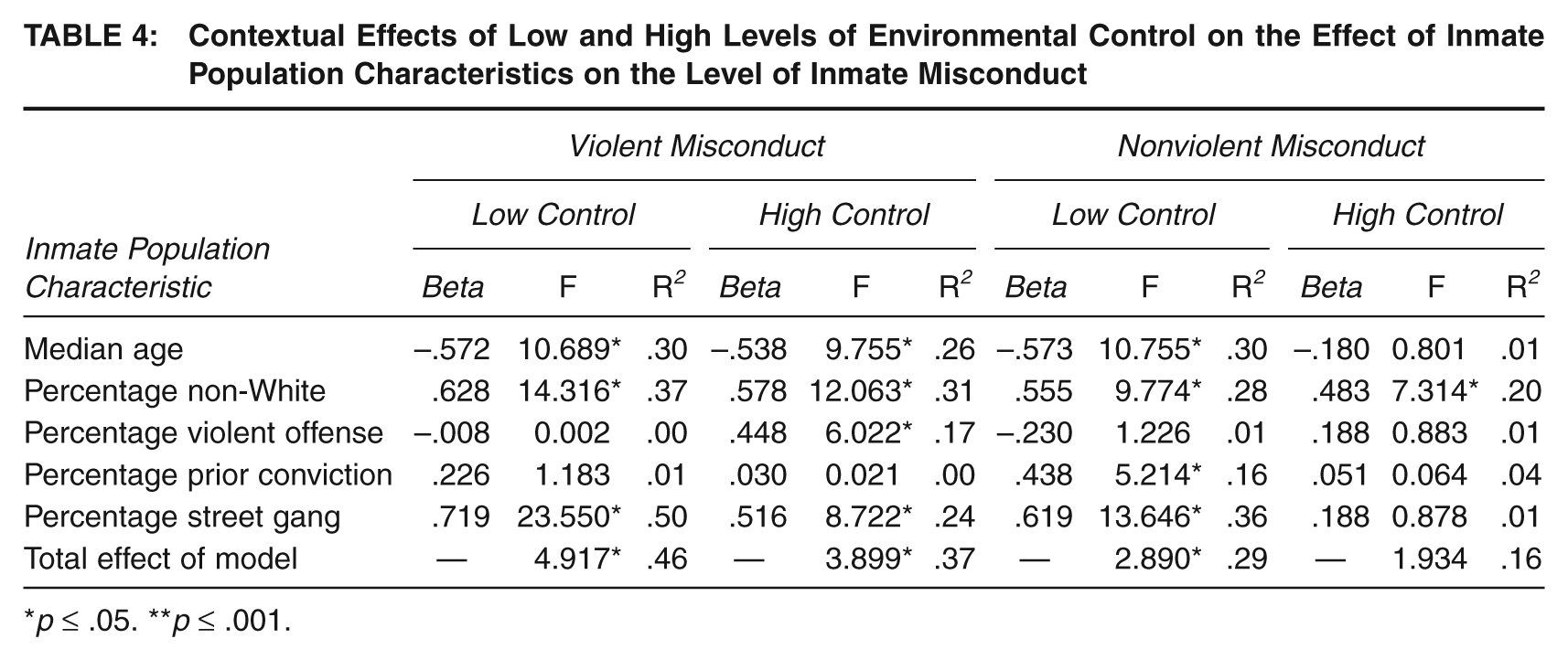
Finally, the contextual effect of prison environment on the ability of inmate population characteristics to influence the level of inmate misconduct is assessed by the differences observed in the bivariate relationships reported in Table 4. These results indicate that the distinction between low and high environmental control did not moderate the effect of the inmate population’s median age, percentage non-White, or percentage with a prior conviction on the level of violent misconduct. Median age and percentage non-White were significant predictors of the level of violent misconducts in both low-environmental-control and high-environmental-control prisons, and there was little difference by level of environmental control in the amount of variance explained by these two characteristics of the population. The percentage with a prior conviction failed to predict violent misconducts, regardless of the level of environmental control.
Contextual Effects of Low and High Levels of Environmental Control on the Effect of Inmate Population Characteristics on the Level of Inmate Misconduct
p ≤ .05. **p ≤ .001.
By contrast, the effects on violent misconduct of both the percentage with a street gang affiliation and the percentage convicted of a violent offense did differ by level of environmental control. The population’s percentage with street gang affiliations had a positive effect on the level of violent misconduct, but the effect was substantially greater in prisons with low environmental control than in prisons with high environmental control. Conversely, the proportion of the population convicted of a violent offense had a positive effect on the level of violent misconduct in prisons with high environmental control but no effect on the level of violent misconduct in those prisons with low environmental control.
These findings suggest that the prison environment may moderate the effect of the population’s violent background and street gang affiliation on the level of violent misconduct within the prison, but there was no apparent effect of environmental factors on the degree to which violent misconduct in the prison is affected by the population’s age, percentage non-White, or percentage with a prior conviction. Also, it is evident in Table 4 that there was no moderating effect of environmental control on the total effect of the population characteristics on the level of violent misconduct. The additive effect of the five population characteristics on the level of inmate violent misconduct was significant in conditions of both low (R2 = .46) and high (R2 = .37) environmental control.
The moderating effects of environmental control on the relationship of inmate characteristics and nonviolent misconduct were mixed. Percentage non-White had a significant positive effect on the level of nonviolent misconduct in both low-control and high-control prisons, and the percentage of the population with a violent offense had no effect on nonviolent misconduct regardless of the level of environmental control. In comparison, however, the level of environmental control did condition the effects of median age, percentage with prior convictions, and percentage with street gang affiliation on the level of nonviolent misconducts. In each case, these population characteristics were found to be significant predictors of the level of nonviolent misconduct in prisons with low environmental control and to have no effect on nonviolent misconduct in prisons with high environmental control. Given these differences, there is a significant total effect of the five characteristics of the inmate population on the level of nonviolent misconduct only in those prisons in which environmental control is low.
These results offer partial support for the hypothesis that prison environment will condition the effect of inmate population characteristics on the level of prison misconduct. Characteristics of the inmate population explained more of the variance in both violent and nonviolent inmate misconduct when the level of environmental control was low than when the level of environmental control was high. With the single exception of the finding that percentage with a violent offense was a significant predictor of violent misconduct only in the context of high environmental control, each of the other predictors explained as much or more of the variance in both violent misconduct and nonviolent misconduct when environmental control was low than when environmental control was high.
Discussion and Conclusions
A prison’s institutional capacity for control creates the structural environment within which management must design an effective network of controls. Variations in security level represent variations in restraints, surveillance, and discipline. Effective use of a continuum of security levels should increase the homogeneity of the inmate population within each prison while assuring that those inmates with higher levels of criminal propensity are confined in more secure prisons. Whether it is attributable to the concentration of the higher-risk inmates in higher-security prisons, the higher levels of deprivation created by the higher-security prisons, and/or the increased monitoring and rule enforcement that occurs in those prisons, higher levels of inmate misconduct are observed in more secure prisons (Fernandez & Neiman, 1998; Gover et al., 2008; Huebner, 2003; Steiner & Wooldredge, 2008; Worrall & Morris, 2011). In this study, security level had a significant direct effect on the level of inmate misconduct, accounting for nearly 30% of the observed variation in the level of violent misconduct and 11% of the observed variation in nonviolent misconduct.
Two additional elements of the institutional capacity for control that affect levels of inmate misconduct are the characteristics of the inmate population (S. Camp et al., 2002; Harer & Steffensmeier, 1996; Lahm, 2008, 2009; Reisig, 2002; Steiner & Wooldredge, 2009c) and the prison environment (Gaes & McGuire, 1985; Gransky & Patterson, 1999; Harer & Steffensmeier, 1996; Lahm, 2008; Reisig, 2002; Rivera et al., 2003; Steiner, 2009; Wooldredge et al., 2001). In this study, the combined effects of security level and inmate population characteristics had a significant positive effect on the levels of violent and nonviolent inmate misconduct. Moreover, the additive effects of population characteristics resulted in a significant improvement over security level alone in predicting the level of violent (but not nonviolent) misconduct. In comparison, the joint effects of security level and prison environment on levels of both violent and nonviolent misconduct, although significant, did not represent a significant improvement over the effects observed for security level alone. These findings suggest that prison environment and inmate characteristics may be important to a discussion of the levels of prison misconduct but that neither is as important as security level.
Importantly, the hypothesized contextual effect of prison environment was supported. Inmate population characteristics had a greater effect on the level of both violent and nonviolent inmate misconduct in prisons with a low level of environmental control than in prisons with high environmental control. This finding is consistent with the earlier reports that prison disorder is affected by crowding, officer–inmate ratio, and other environmental features of the prison (Franklin et al., 2006; Gaes & McGuire, 1985; Harer & Steffensmeier, 1996; Huebner, 2003; Lahm, 2008; McCorkle et al., 1995; Reisig, 2002; Wooldredge et al., 2001) and that the environmental features of the prison can suppress or enhance the effect of individual risk factors on an inmate’s likelihood of prison misconduct (S. Camp et al., 2002; Harer & Langan, 2001; Harer & Steffensmeier, 1996; Hochstetler & DeLisi, 2005; Steiner & Wooldredge, 2008; Wooldredge et al., 2001).
Limitations
The reliance on official data, although a common practice, always raises questions about the validity and reliability of such measures as street gang affiliation, prison gang affiliation, and major misconducts. As noted already, the fact that all the prisons were located in the same state had the advantage that they shared a common set of policies and procedures for defining these terms and for processing misconducts, but it also had the disadvantage that the state and its prisons may not be representative of state (or federal) prisons elsewhere. In addition, the generalizability of the findings may be questioned in light of the fact that this secondary analysis uses data obtained for other purposes, during a limited observation period, and more than a decade ago. On the other hand, secondary analyses of official data are not uncommon in prison research, and there is no reason to believe the passage of time has rendered the findings irrelevant to the research questions. A third limitation is that the sample size was large enough to enable the analysis presented, and the inferences obtained, but a sample of 50 prisons is far too small to permit more sophisticated statistical analyses. Harer and Steffensmeier’s (1996) analysis relied on only 58 prisons, but more recent studies have been based on much larger numbers of prisons (for example, 178 prisons for Steiner and Wooldredge, 2009b, and 512 prisons for Steiner, 2009). With a larger sample, for instance, the issue of multicollinearity can be addressed more aggressively, such as the use of multivariate OLS regression with robust clusters by security level. A larger sample size also would have permitted an analysis of possible interaction effects, such as the interaction of age and crowding or of crowding and prison gang affiliation. Finally, the absence of individual-level data precludes the possibility of the kind of hierarchical linear modeling that would permit controls for relevant characteristics of the inmates while examining the relationship between these structural-level characteristics of the prisons. Because of these limitations, the findings and conclusions regarding the impact of the institutional capacity for control on levels of inmate misconduct must be considered as more suggestive than definitive.
Implications
Within these limitations, the findings do provide a rare opportunity to examine the direct and contextual effects of structural factors of the prison environment on the level of prison misconduct. Characteristics of the prison’s inmate population are important determinants of the level of prison misconduct, but their impact is conditioned by the level of environmental control (Bottoms, 1999). Inmate crowding, a high inmate-to-officer ratio, inadequate staff training and high staff turnover, prison gangs, inadequate classification procedures, few programs and activities for inmates, and similar structural deficits of the prison environment will exacerbate the “pains of imprisonment” (Sykes, 1958) caused by the physical and social deprivations of confinement and the stress of living and working with other inmates (Barak-Glantz, 1983; Bottoms, 1999; Gendreau & Keyes, 2001; Kalnich & Stojkovic, 1985). These deficits simultaneously reduce management’s ability to regulate inmate behaviors by surveillance and discipline. DiIulio (1987) and others (e.g., Reisig, 2002; Steiner, 2009) attribute low levels of environmental control to ineffective prison management.
Effective prison management relies on a network of controls to coordinate and regulate inmate behavior. Differences in the amount and type of passive and dynamic controls among prisons create differences among prisons in the network of controls as well as in the total amount of control over inmate behaviors (Tannenbaum, 1968). These observed differences in controls emerge as management responds to variations in the prisons’ institutional capacity for control. In light of these differences in the management environment of prisons, it seems unlikely that a single style of management will be effective in all prisons. Etzioni’s (1961) distinction between coercive and remunerative controls in organizations has yielded a healthy discussion of alternative management models for prisons. Barak-Glantz (1981) suggested a typology comprising four prison management styles: authoritarian, bureaucratic-lawful, shared-powers, and inmate control. DiIulio (1987) dismissed any notion of shared powers or inmate self-governance, which he referred to as the responsibility model of prison management, and advocated a control model based on maximum security, high surveillance, escorted movement, complete and decisive rule enforcement, and the liberal use of both rewards and sanctions to manage inmates. Wright (1994) countered with a citizenship model of effective leadership built on management’s assurance to inmates of the rights to safety, care, dignity, work, self-improvement, and a future. Most recently, Huebner (2003) advocated management’s use of remunerative controls. If, as both DiIulio (1987) and Reisig (2002) assert, the quality of prison life for both inmates and staff depends on effective prison management, then further research is needed to identify the management model that works most effectively within the constraints of each prison’s institutional capacity for control. Indeed, the ongoing dialogue regarding prison management styles and strategies should examine the broader issue of what network of formal and informal controls (both passive and active, both coercive and remunerative) can most effectively be developed within the limitation of variations in a prison’s institutional capacity for control. That is, how does management increase the total amount of administrative control in prison when faced with challenges or limitations created by a prison’s capacity to create control? Until adequate attention is given to such issues, prison management will, as Reisig (1998) notes, continue to “muddle through” in its ongoing effort to develop and maintain an effective network of controls.
Footnotes
Initial data collection effort was supported by Research Grant 99-CEVX-0004 from the National Institute of Justice and was made possible with the cooperation of the Arizona Department of Corrections. The authors appreciate the assistance of Daryl Fischer, research director at the Arizona Department of Corrections, in providing the data used for this secondary analysis. The interpretation of data and the conclusions expressed are those of the authors and do not necessarily represent the position of either the National Institute of Justice or the Arizona Department of Corrections.