



Abstract
The measurement of violence is a major challenge in aggression research. Because of the heterogeneous nature of violent behavior, problems arise when applying blanket measures to inherently distinct subtypes of aggression. Incidents of intersibling violence (ISV) exacerbate these problems because siblinghood represents a unique offender–victim situation. This research explored whether an existing two-factor model for severe violence found in a sample of 250 adult offenders (age M = 26.8, SD = 5.9) could be generalized to deliberate severe ISV in a sample of 111 young offenders (age M = 14.83, SD = 1.45). Exploratory factor analysis revealed a two-factor model encompassing severe ISV perpetration with weapon use (Factor 1) and severe ISV perpetration without weapon use (Factor 2). The results provide strong empirical support for the two-factor model of violence severity previously established with adult offenders. This analysis demonstrates construct validity of the severity measures among the different types of offenders studied and provides support for generalization across populations.
No longer at the periphery, intersibling violence (ISV) is increasingly being recognized as a pervasive form of family violence (Caspi, 2012). Prevalence data suggest that violence committed by brothers and/or sisters against siblings is the most common form of physical aggression within any familial context (e.g., Federal Bureau of Investigation [FBI], 1998; Finkelhor, Ormrod, Turner, & Hamby, 2005; Straus & Gelles, 1990; Straus, Gelles, & Steinmetz, 1980). This is reflected in recent childhood and adolescence ISV rates that range between 83.0% and 86.3% for victimization and perpetration, respectively (see Mackey, Fromuth, & Kelly, 2010; Reese-Weber, 2008). These figures establish sibling violence as an ubiquitous problem experienced by many young people within the confines of an interpersonal relationship.
It is not surprising that there are many negative outcomes associated with ISV victimization. Child victims report loneliness (Duncan, 1999), anxiety, and depression (Stocker, Burwell, & Briggs, 2002) and display severe behavioral problems (Rosenthal & Doherty, 1984; Stormshak, Bellanti, & Bierman, 1996), including a range of trauma symptoms (Caffaro & Conn-Caffaro, 1998; Finkelhor, Turner, & Ormrod, 2006). In adulthood, ISV victims report eating disorders (Wiehe, 1997), substance and alcohol misuse (Button & Gealt, 2010), high levels of anxiety (Graham-Bermann, Cutler, Litzenberger, & Schwartz, 1994), depression, and suicide attempts (Wiehe, 1997). ISV is also linked with antisocial and violent behavior in adolescence and adulthood (e.g., Button & Gealt, 2010; Gully, Dengerink, Pepping, & Bergstrom, 1981; Hendy, Burns, Can, & Scherer, 2011; Noland, Liller, McDermott, Coulter, & Seraphine, 2004; Rothman, Johnson, Azrael, Hall, & Weinberg, 2010; Simonelli, Mullis, Elliot, & Pierce, 2002). Despite these findings, explanatory and exploratory research into ISV perpetration and victimization has started to appear in the literature only relatively recently (e.g., Eriksen & Jensen, 2006; Hoffman, Kiecolt, & Edwards, 2005; Kettrey & Emery, 2006; Linares, 2005; Pike, Kretschmer, & Dunn, 2009; Raffaelli, 1992).
As a result of these studies, the prevalence of intentional ISV is being recognized in academic research (e.g., Finkelhor et al., 2006; Khan & Cooke, 2008), and theoretical frameworks that draw from evolutionary (Archer, 2012), feminist, conflict, and social learning theories (Hoffman & Edwards, 2004), as well as macro-systems analysis, family stress, and social resource models (Eriksen & Jensen, 2009), have been applied to explain the motives underpinning sibling violence. However, the patterns and degree of severity for specific acts of ISV have not been established in the sibling violence literature to date (Eriksen & Jensen, 2009). These are important aspects of ISV severity to evaluate. An enhanced understanding of the dynamics underlying different subtypes of violence should lead to clearer research findings and better focused risk management strategies (Cooke, Michie, De Brito, Hodgins, & Sparkes, 2011; Kingsbury, Lambert, & Hendrickse, 1997).
The classification of violent behavior according to severity is already a topic of debate in both the aggression literature (e.g., Michie & Cooke, 2006) and the legal literature (e.g., Kenny & Press, 2006). Often this is because research does not explicitly distinguish between milder and more serious acts of violence. A frequently used measure in family violence research, the Conflict Tactics Scale (CTS; Straus, 1979, 1990), for example, is criticized for employing formulaic classifications to differentiate “minor” and “severe” violence (Dobash, Dobash, Wilson, & Daly, 2005). However, empirical evidence supports the differentiation of mild from severe marital violence using the CTS (see Barling, O’Leary, Jouriles, Vivian, & MacEwen, 1987; Hornung, McCollough, & Sugimoto, 1981). Pan, Neidig, and O’Leary (1994) initially criticized this severity differentiation because of the low levels of physical aggression exhibited by couples employed in these samples. Subsequently, Pan et al. established a distinction between mild (e.g., “threatened to hit or throw something” and “thrown something at”) and severe (e.g., “choked or strangled” and “beat up”) marital violence, using the CTS on a predominantly male military personnel sample, comprising more than 800 participants. Their findings validate distinctions between mild and severe acts when using the CTS to measure martial violence.
The CTS is also used widely in sibling violence research (e.g., Goodwin & Roscoe, 1990; Hardy, Beers, Burgess, & Taylor, 2010; Hendy et al., 2011; Mackey et al., 2010; Mangold & Koski, 1990; Noland et al., 2004; Roscoe, Goodwin, & Kennedy, 1987; Simonelli et al., 2002). However, when applying the marital violence severity construct to intentional ISV, it is important to recognize the diversity in the etiology of, and risk factors for, various forms of violence: Different mechanisms may underpin different types of physical aggression (Michie & Cooke, 2006; Monahan & Steadman, 1994). Previous investigations into ISV perpetration demonstrate specific risk factors for distinct forms of physical violence committed against brothers and/or sisters. In a community sample, Khan and Cooke (2004) found the most robust predictor for “overall ISV perpetration” (including accidental and intentional acts) to be “severity of ISV victimization.” Within a youth forensic sample, data revealed “low sibling empathy,” “animal abuse,” and “physical and verbal abuse against school staff” as risk factors for “intentional severe ISV perpetration” (Khan & Cooke, 2008). The different risk factors for these two types of ISV highlight the need to define specific forms of violence according to population as well as intent to harm so they are behaviorally specific, not only in terms of predictors but also in terms of structure. Accordingly, accuracy of prediction and model development should be increased (Pan et al., 1994), thus enabling improved and targeted measurement of these oft-intangible acts of aggression.
Perhaps the most compelling reason for developing a model that distinguishes between levels of ISV severity is its potential impact on research, practice, and policy. A structured model of ISV severity could serve to improve communications and debate across disciplines by providing a conceptual framework within which to discuss and resolve inconsistencies in sibling violence research. An empirically driven model of severity ought to challenge current classification methods in which different levels of ISV incidents are typically combined in measurement. This amalgamation of different types of ISV impedes attempts at pinpointing critical factors associated with different levels of violent behavior (Eriksen & Jensen, 2009; Kenny & Press, 2006; Khan & Cooke, 2008; Kingsbury et al., 1997).
In addition, an increased uniformity in coding ISV severity has the potential to improve accuracy of risk assessment. When mental health and correctional service professionals are involved in identifying people at risk for different types of violence, assessment tools have become a standard protocol in guiding judgments of risk (Hegar, Zuravin, & Orme, 1994; Milner, 1994). However, to date, no reliable and validated screening mechanisms specifically target intentional severe ISV. Although empirically sound measures are available (e.g., Structured Assessment of Violence Risk in Youth [SAVRY]; Borum, Bartel, & Forth, 2002), they are more applicable to the assessment of general aggressive and violent behavior in young offenders. Thus, available screening mechanisms do not directly assess risk of intentional physical violence perpetrated against siblings in a familial context (Stock, 1993).
Finally, professionals (e.g., child care staff, school teachers, and youth workers) who are in contact with perpetrators and victims of intentional ISV and are in a position to detect and prevent this form of familial abuse may not be immune to the effects of social normalization (Kettrey & Emery, 2006; Phillips, Phillips, Grupp, & Trigg, 2009). The physical abuse of siblings is often minimized (Finkelhor et al., 2006; Steinmetz, 1977), and severe injuries intentionally inflicted by siblings may be disregarded as a result of accidental harm or horseplay (Caffaro & Conn-Caffaro, 2005; Wiehe, 1997). Therefore, an improved understanding of the dynamics that underpin different types of violence should lead to more valid and reliable screening mechanisms (Cooke et al., 2011; Kingsbury et al., 1997), which are an important adjunct to violence management policies used to guide child and adolescent abuse-prevention strategies (Baker, Cunningham, & Harris, 2011; Gelles & Cornell, 1990).
Stages of Model Development
Michie and Cooke (2006) collected data from 250 adult male offenders using the MacArthur Community Violence Screening Instrument. They employed 18 items to record violent behaviors committed against any other person (with acts ranging from the least severe to the most severe) after the age of 18 years. Michie and Cooke distinguished two factors underlying severity of violent behavior in this sample, namely, weapon use in violence and non–weapon use in violence. The present article details analysis of data from a sample of young offenders that has led to the development of a preliminary model of severe ISV perpetration. Here, the emphasis is on a description of the analytical procedure used to build the initial structure model. The aim of this investigation is to explore the underlying dimensions of intentional severe ISV perpetration using factor analysis.
Method
Sampling
As investigations into ISV are typically conducted on participants from general populations, young offenders with a history of antisocial and/or aggressive behavior were considered an important group to study. To generate a sample, 15 institutions across Scotland with potential to provide access to volunteers who might fulfill the participant selection criteria were invited to participate. From these, three secure units and two residential schools agreed to participate. Recruitment posters detailing the study’s aims were placed around common rooms in these institutions. There were two participant selection criteria. First, participants had to have lived with siblings for most of their childhood, prior to being placed in care or being detained. Second, as this research focused specifically on predictors of intentional nonsexual severe ISV acts, participants with convictions for incest or other sexually related offences were excluded.
Participants
A total of 111 young offenders volunteered to take part in the study; no compensation or benefits were offered for participation. Because more males were placed at participating institutions at the time of these interviews, there was a sex imbalance. Thus, the final sample consisted of 91 males and 20 females aged between 10 to 19 years of age (M = 14.83, SD = 1.45, mode = 15).
Participants in this sample were raised as part of a sibling dyad (18.9%), triad (33.3%), quad (17.1%), or quintuple (17.1%). The remaining participants had resided with either six (10.8%) or seven siblings (2.7%). Almost half the participants were raised alongside genetically unrelated siblings (45.9%); these comprised stepsiblings (45%), adopted siblings (2.7%), and foster siblings (1.8%). Two participants had been raised with a step and adopted sibling, and another participant had resided with a step and foster sibling.
The majority of participants were the eldest sibling (43.2%). The sample also comprised second-positioned (26.1%), third-positioned (18.9%), and fourth-positioned (1.8%) siblings. Two participants held fifth- and sixth-birth position (1.8%, respectively). Less than one half of the sample was raised by both their birth parents (46.8%). Approximately one quarter of the sample was raised by their birth mother (24.3%), whereas an equal number were raised by either their birth father (2.7%) or grandparent(s) (2.7%). A number of participants were raised by a birth parent and stepparent (19.8%) or were placed in a children’s home or in foster care (3.6%).
Participants were being held for miscellaneous charges (13.5%), absconding (2.7%), theft/breaking and entering (8.1%), drug offences (11.7%), criminal negligence (8.1%), assault (52.3%), and attempted murder/manslaughter (3.6%).
Procedure
Initially 120 youths volunteered to be interviewed for the study, but 9 interviews were terminated prematurely. In all, 7 youths withdrew because of impromptu meetings, and 2 others requested to leave before the midway point of the interview. Although the information provided was recorded anonymously, limits of confidentiality were adhered to (i.e., if disclosures of a sensitive nature were made, participants were encouraged to discuss this with their key worker). This occurred on one occasion. Codes of ethics were explained in detail before informed consent was obtained. All participants were interviewed by the same researcher using a study-specific interview schedule; this comprised 10 measures of severe sibling violence perpetration.
Measures
The following 10 items, based on Straus et al.’s (1980) study, were employed to measure intentional severe ISV perpetration: (a) “Have you kicked or bitten your sibling(s) with force?” (b) “Have you punched your sibling(s) forcefully?” (c) “Have you thrown a heavy/sharp object at your sibling(s)?” (d) “Have you beaten/battered your sibling(s) badly?” (e) “Have you attempted to strangle your sibling(s)?” (f) “Have you threatened your sibling(s) with a knife?” (g) “Have you wounded your sibling(s) with a knife?” (h) “Have you threatened your sibling(s) with a gun?” (i) “Have you fired a gun at your sibling(s)?” and (j) “Have you used other forms of severe ISV (e.g., hanging or burning)?”
For each of the these items, participants were asked to indicate (a) the number of times they had ever perpetrated that act against a sibling while residing with them and (b) if they had intended to cause harm or injure their sibling by committing that act. Concerns regarding the CTS’s lack of clarity in discriminating between violent intent and threat in the context of violence (e.g., Dobash et al., 2005; Pan et al., 1994) were also addressed. Thus, in the present study, participants were asked if they had committed these acts of severe violence with the intention of causing actual harm to their sibling(s). Incidents that occurred as a result of accidental harm or self-defense were not included in this data set. Participants who reported committing any acts of severe violence against any of their siblings with intention to cause harm or injury were classified as having intentionally perpetrated severe ISV.
Results
Of the current sample, only 10.8% (n = 12) claimed that they had never committed an act of severe ISV against their sibling with intention of causing them serious harm. Table 1 shows the frequencies and percentages for the severity of injury inflicted on siblings for each act of severe ISV perpetration. Minor injuries related to wounds that did not need major medical treatment such as bruising and scratches, whereas serious injuries included burns and puncture wounds that required medical treatment as well as broken limbs. Life-threatening injuries referred to critical and lasting injuries that required hospitalization.
Frequencies (and percentages) of Participants According to Severity of Injury Inflicted on Siblings for 10 Acts of Severe Intersibling Violence (ISV) Perpetration Committed

Exploratory Factor Analysis
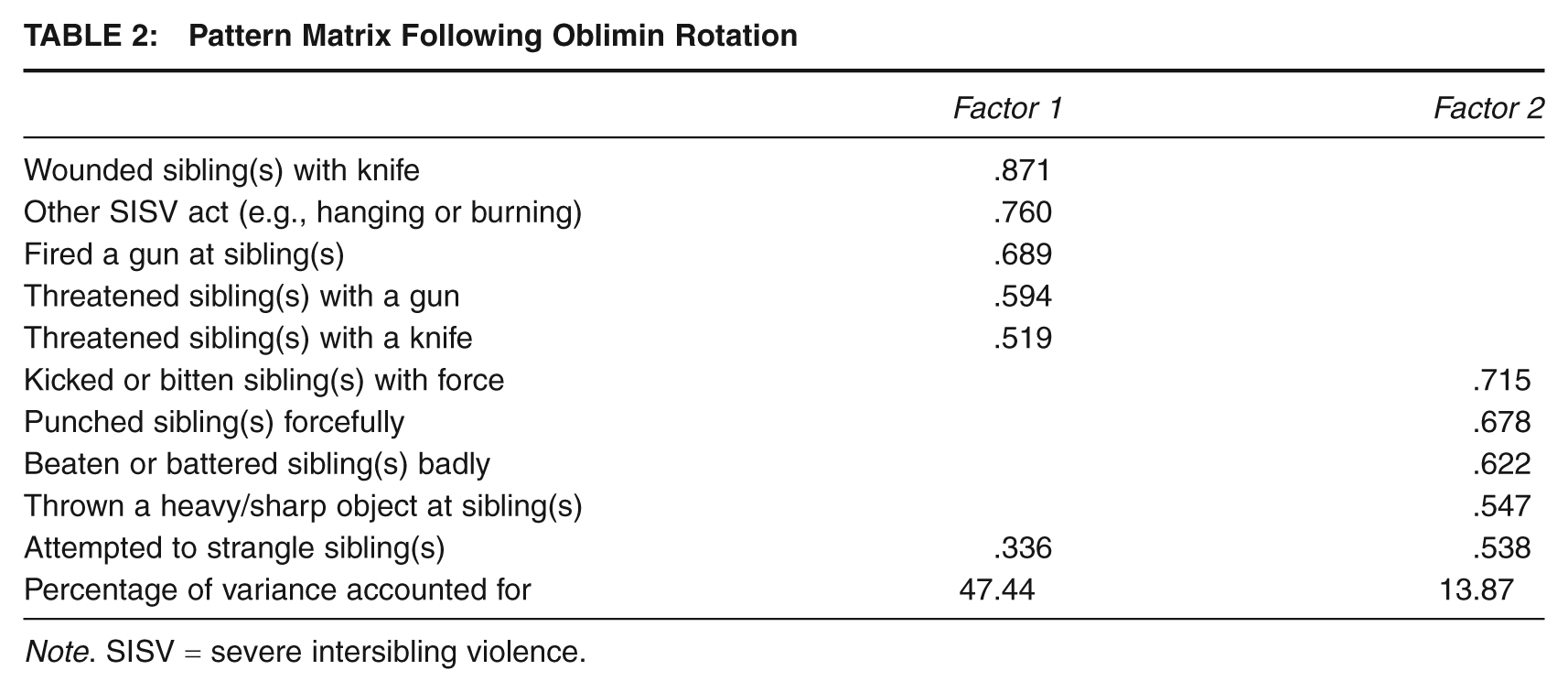
Exploratory factor analysis was conducted to examine the dimensionality of 10 intentional severe ISV perpetration items using the SPSS 15 program. Because of a large range of frequencies across the severe 10 ISV items, these data were recoded. Similar to Michie and Cooke’s (2006) analysis on adult offenders (in which frequency data were recoded to obtain three categories according to whether the violent behavior had never occurred or if it had occurred lower or higher than the median frequency score), frequency scores here were recoded to provide binary data to denote whether participants had ever committed any of the 10 severe acts of ISV with intent to cause harm or not. The binary data pertaining to the 10 severe ISV measures fulfilled the criterion of 10 respondents per item suggested for factor analysis (Kline, 1994) and were thus employed for analysis. Direct Oblimin rotation was used because several components of the violent acts were expected to be correlated. The Kaiser–Meyer–Olkin test (0.87) revealed a lack of diffusion in the pattern of correlations, and the Bartlett test of sphericity indicated correlations between the variables (χ2 = 478.47, df = 45, p < .000). Both the Kaiser (Kaiser, 1960) and Scree (Cattell, 1966) criteria signified that a two-factor solution was appropriate. The pattern matrix following Oblimin rotation is presented in Table 2.
Pattern Matrix Following Oblimin Rotation
Note. SISV = severe intersibling violence.
Factor 1 consisted of six items with factor loadings ranging from .34 to .87 that explained 47.4% of the total variance. One of the items on Factor 1 (Item 10: attempted to strangle a sibling(s)) also loaded onto Factor 2, where it had a higher factor loading. Factor 2 contained five items, including the common item with Factor 1, with loadings ranging from .54 to .72. The explained variance was 13.9%. The items on Factor 1 were labeled severe ISV with weapon use, whereas those on Factor 2 were labeled severe ISV without weapon use. The component correlation matrix revealed a correlation of .53 between the two factors. Scale scores were computed as the average rating for all items that loaded on the same factor (attempted strangulation was assigned to the severe ISV without weapon use scale).
Confirmatory Factor Analysis
This two-factor model of severe ISV perpetration was examined more closely with a confirmatory factor analysis procedure using the EQS 6.1 program. In this instance, confirmatory factor analysis was used to assess the fit between a specified factor structure and the data using structural equation modeling.
The Bentler–Bonnett non-normed fit index (NNFI; Bentler, 1980), the Bentler comparative fit index (CFI; Bentler, 1980), and the root mean square error of approximation (RMSEA; Steiger & Lind, 1990) were utilized to evaluate the fit of the model to the data. Following criteria proposed by Hu and Bentler (1999), adequate fit required an NNFI value greater than .90, a CFI value greater than .95, and an RMSEA value less than .08. The initial confirmatory factor analysis model consisted of a “pure-factor” model, in which each item was allowed to load on only one factor. All 10 severe ISV perpetration items were assigned to one of two factors, based on the results of the exploratory analyses. Factors were allowed to correlate. This “pure factor” first model provided an almost adequate fit, χ2(34, N = 111) = 62.56, p = .002, NNFI = .92, CFI = .94, RMSEA = .09. However, the RMSEA value was .01 higher than the acceptable value of .08, and the CFI value was .01 lower than the acceptable value of .95.
Next, the Lagrange multiplier test (for adding parameters) and the Wald test (for dropping parameters) were examined to identify any parameters that could be added or dropped to improve the fit of the model. The Lagrange multiplier test indicated that the fit of the model could be improved substantially by allowing one item to load on both factors: “threatened sibling(s) with a knife.” Conceptually, this item could be related to assault using a weapon because of the intentionality of this act, as well as violence without a weapon because it uses only the threat of violence. Consequently, one parameter was added in the matrix of relationships between items and factors, so this item loaded on both factors. As a result of adding this parameter, the new two-factor model attained adequate levels of fit in terms of the Hu and Bentler (1999) standards (NNFI = .94, CFI = .96, RMSEA = .06). In summary, the confirmatory factor analysis supported the original two-factor model produced by the exploratory factor analysis of the 10 intentional severe ISV perpetration items: Factor 1 represented severe ISV with weapon use, and Factor 2 represented severe ISV without weapon use. The standardized estimates of the final two-factor model for the 10 severe ISV items are illustrated in Table 3.
Confirmatory Factor Analysis: Standardized Factor Loadings

Note. SISV = severe intersibling violence.
Discussion
The current study examined the structure of severe ISV perpetration in a sample of young offenders in care for their antisocial and criminal behavior. Exploratory factor analysis indicated that intentional severe ISV perpetration captured two dimensions of behavior, severe ISV with weapon use and severe ISV without weapon use. The severe ISV perpetration with weapon use factor encompassed a dimension of behavior that included the following intentionally harmful acts of violence against siblings: wounded with a knife, fired and threatened with a gun, and serious acts such as hanging or burning with the intention to cause harm. The severe ISV perpetration without weapon use factor captured a dimension of behavior that focused on intentional severe acts of ISV that incorporated the following acts of violence against siblings: beaten or battered, attempted to strangle, kicked or bitten, punched, and thrown a heavy or sharp object at them with the aim of causing harm. Confirmatory factor analysis validated the acceptability of this two-factor model. Correlated error variances were not added in the final model as the factor structure appeared to fit the data best when one item (i.e., threatened sibling with a knife) was loaded onto both factors.
These findings partially support research that makes distinctions between more severe and less severe acts of violence in marital relationships (Barling et al., 1987; Hornung et al., 1981; Pan et al., 1994) in that they indicate explicit dimensions underlying acts of violence used against family members. More pertinently, however, these results lend empirical support to research that has distinguished acts of sibling-perpetrated violence in terms of severity (e.g., Eriksen & Jensen, 2009). To the authors’ knowledge, this is the first report of a structural model regarding the order of severity for intentional ISV perpetration. It is also significant that this model is structurally comparable to the two-factor model (violence based on weapon use and violence without weapon use) developed by Michie and Cooke (2006) in a very different sample, thus demonstrating a degree of generalizability across populations.
The importance of developing this two-factor severity model is best demonstrated in context with sibling assault offence demographics. Krienert and Walsh (2011) extracted sibling violence data (N = 33,066) from the National Incident-Based Reporting System maintained by the FBI and identified 5,044 cases (15%) that could be legally classified as “aggravated assault” using criminal justice orientated definitions. Aggravated assault was defined as “an unlawful attack by one person upon another wherein the offender uses a weapon or displays it in a threatening manner, or the victim suffers obvious severe or aggravated bodily injury involving apparent broken bones, loss of teeth, possible internal injury, severe laceration, or loss of consciousness” (FBI, 1992, p. 79, cited in Krienert & Walsh, 2011, p. 336). Although hands and feet were the main weapon used (n = 22,808, 69%), severe ISV with weapons comprising guns, knives, and other objects were reported in 3,413 (10.4%) cases.
In addition, this two-factor model has previously determined risk factors for severe ISV utilizing a sample of young offenders in care of the Scottish youth justice system (see Khan & Cooke, 2008): A series of multiple regression analyses determined robust predictor variables of intentional severe ISV perpetration with weapon use and severe ISV without weapon use. This finding boosts the validation of the preliminary two-factor severe ISV model.
Implications for future research lie in developing this model for measuring intentional severe ISV perpetration across different populations and its influence on sibling violence management. Cross-sectional studies could apply the present paradigm to adult offender and nonoffender samples to cross-validate this two-factor model with a view to test the severity structure of intentional severe ISV. Alternatively, community youth samples could also be further investigated. Previous research using nonoffending samples (e.g., Khan & Cooke, 2004) is restricted by the use of questionnaires, but interviews could be employed in future studies to increase the reliability of methodologies employed (DeKeseredy & Ellis, 1997).
This empirically driven two-factor model can help researchers and clinicians categorize violent behavior perpetrated by siblings and determine which risk factors might be associated with different levels of violence severity, namely severe ISV with weapon use and severe ISV without weapon use (see Khan & Cooke, 2008). Increased precision in assessments of ISV risk can guide and assist in planning and delivery of treatment interventions, leading to better informed detection, prevention, and management strategies with the aim of reducing recidivism. This ISV severity classification also has implications for preventative measures used by schools, child/family welfare agencies, and social workers to develop antiviolence policies and interventions in fulfilling child protection services’ duty of care for child and adolescent victims of family violence.
Because of the absence of legal safeguards for ISV victims, authorities may be less likely to take action to protect physically victimized siblings, even if they are severely injured, unless instigated by a parent (Wiehe & Herring, 1991). This highlights the importance of raising awareness of different levels of ISV severity in combating the normalization and minimization that shrouds the physical abuse of siblings (Kettrey & Emery, 2006). If parents are better able to detect detrimental sibling interactions, professional intervention is more likely to be sought (Stock, 1993). Thus, a key application of these findings is in developing strategies to guide parental caregivers on how to take precautionary measures to protect their children from ISV within the familial context.
Parallels can be drawn between ISV and other forms of family violence. For example, like spousal assault over 50 years ago, ISV victimization, even when it is extremely injurious, is typically minimized and normalized (Phillips et al., 2009). In the same vein, there needs to be a shift in prevailing archaic attitudes toward ISV; recognition of the seriousness of this form of family violence from researchers and practitioners is a first step toward achieving this (Eriksen & Jensen, 2009; Omer, Schorr-Sapir, & Weinblatt, 2008) and will allow measurement, assessment and management of severe ISV to be addressed in a more consistent way (Gelles & Cornell, 1990; Stock, 1993).
It is imperative that the specificity of the measured outcome (i.e., intentional severe ISV perpetration) takes point of precedence when considering these findings. We are mindful of attempting to generalize this model to a broader population of violent siblings who have not been through criminal and legal systems for their offending behavior. Thus, the present results should be treated with caution when applying them to the behavior of a broader population of nonoffending sibling subsets, or they will suffer from being forcefully extrapolated on a nonmatched sample. We are also aware that as a consequence of this specificity, the two-factor model is unlikely to fully encapsulate the range of aggressive acts that might be committed as part of severe ISV. It is not uncommon for physical ISV to be associated with psychological abuse and/or sexual violence. To this effect, the emotionally abusive element of ISV perpetration might explain why one of the items (i.e., “threatened sibling(s) with a knife”) loaded onto both factors in this model. A positive outcome of focusing solely on physical violence is that it allowed generalizations to be made with Michie and Cooke’s (2006) two-factor model of nonsexual violent behavior in adult offenders, using a young offender sample.
Another methodological limitation of the present study is its employment of 10 severe ISV items based on the CTS (Straus et al., 1980) in light of the contention that it represents a weak operational definition of severity (Dobash et al., 2005). Straus (2007), however, contested such criticisms as erroneous arguing they are empirically unsound, ideological critiques. In addition, the ISV measures used provided nominally coded data. Michie and Cooke’s (2006) comparable study utilized 9 items pertaining to frequencies of any extreme violent behaviors committed by their adult male prison sample. Michie and Cooke’s measures were recoded to provide categorical data, on which the structure of violent behavior is examined through hierarchical analysis; this permits a more thorough analysis of the construct of violent behaviors in their sample. Moreover, the 10 items in the present study are given equal weighting so each act is considered to carry the same base weight in terms of severity. Future studies will benefit by having each of the items evaluated by independent raters to ascertain the relative weight of each item. In addition, the model developed is informed by an exploratory analysis of the data that it is not exclusively driven by theory. Although other researchers (see Essau, Sasagawa, & Frick, 2006) have adopted this method, it is desirable to replicate the confirmatory model in a separate sample in the same sense that it is desirable to replicate empirical research in general.
Other limitations relate to the study’s sample composition (i.e., a 10- to 19-year-old, mixed-gender sample). Although other investigations employed participants from widely distributed ages to explore ISV perpetration (e.g., Finkelhor et al., 2005; Rothman et al., 2010), larger sample sizes enabled differentiations to be made for acts of violence across age groups. This might be especially salient to the present study, as weapon carrying has been found to be most predominant for young people in the 13- to 16-year-old age range (DuRant, Krowchuck, Kreiter, Sinal, & Woods, 1999). In addition, despite inconsistent evidence for the influence of gender on ISV perpetration (see Minnett, Vandell, & Santrock, 1984; Roscoe et al., 1987), it is widely acknowledged that differences exist between adolescent males and females, for their use of both physical violence and weapons (Brennan & Moore, 2009). It is noteworthy that female siblings have been reported as more likely to commit severe and injurious ISV acts (akin to aggravated assault) against their sisters, and use knives in comparison to their male counterparts (Krienert & Walsh, 2011).
Sibling violence research using CTS measures tends to gauge frequency of violence during a 12-month period prior to completing the questionnaire. However, as the young offenders in this sample were interviewed at different time periods into their placement in their secure settings (ranging from 1 month to 72 months), ISV incidents committed at any time prior to being detained (while residing with siblings within a familial setting) were recorded. Also, experiences of ISV perpetration were consolidated so distinctions were not made between different sibling targets’ victimizations. Although this line of inquiry was beyond the scope of the present study, the limitations of retrospective data should be taken into consideration. Wilson and Fromuth (1997) reported that recollections of childhood sibling violence experiences were often “softened,” possibly because of the normalization of ISV. In addition, as data were self-report, social bias and memory dysfunction may have contributed to this young offender sample overreporting use of severe violence against siblings during interviews (Hollin, 1990).
Despite these limitations, this study’s findings deal with an important and often overlooked area in aggression research. The two-factor structure for severe ISV provides a useful distinction between intentional acts of interpersonal physical violence in sibling relationships. Ultimately, this research reinforces calls for severe sibling violence to be recognized for its potential to be as harmful as the violence perpetrated in any other dyadic relationship.