




Abstract
The “successful psychopath” is thought to evade scientific study because most forensic psychopathy research is limited to incarcerated—putatively unsuccessful—samples. By redefining criminal success as the proportion of past undetected crimes, the present study tested the hypothesis that psychopathic traits are associated with criminal success within an incarcerated sample (N = 307). Psychopathy was assessed using the Hare Psychopathy Checklist–Revised. Criminal history was assessed retrospectively for 24 violent and nonviolent crimes via self-report using a confidential semistructured interview. Controlling for social desirability score, greatest criminal success was associated with moderate to high psychopathy scores, particularly for violent crimes. At the trait level, antisocial lifestyle and behavioral psychopathic traits predicted increased criminal success, whereas affective psychopathic traits predicted decreased criminal success. These results suggest that criminal success can be meaningfully evaluated using an incarcerated sample and can inform models of psychopathy.
One of the best predictors of violent criminal recidivism is a diagnosis of psychopathy (Dolan & Doyle, 2000), a personality disorder characterized by glibness, manipulation, impulsivity, and a lack of empathy and remorse among other traits (Hare, 2003). However, accurate estimates of psychopathic recidivism rates are notoriously difficult to measure because of concerns that many psychopathic offenders may evade arrest, conviction, and punishment, earning the provocative title of the “successful psychopath” (Babiak & Hare, 2006; Skeem & Cooke, 2010). Because of this measurement problem, prison settings are often considered unfit for the study of successful psychopathy for the obvious reason that they describe only those who have failed in their criminal pursuits (Gao & Raine, 2010; Ishikawa, Raine, Lencz, Bihrle, & LaCasse, 2001; Widom, 1977). As criminologist J. A. Mack (1972) said of prison sampling, perhaps we are pursuing “not a study of criminality but of ‘catchability’” (p. 53).
Although the prison sampling bias presents an important concern, the inference that incarcerated offenders are categorically criminally unsuccessful may neglect important variation in the historic success rates of these individuals. For example, there may be informative differences between an incarcerated offender who got away with only 1 out of 10 crimes and another who got away with 9 out of 10. If such variation exists, it may in fact be illuminating to examine the nature of the association between psychopathy and criminal success in a strictly incarcerated sample.
Criminology research has already developed useful operational definitions of criminal success or “achievement” in adjudicated samples. For instance, in interviews with more than 1,000 incarcerated felons, Horney and Marshall (1992) assessed the reported frequencies of offense commission and arrest for nine different crimes across a 3-year period. An “arrest ratio” was then computed to describe the proportion of arrests to total crimes within each category. This can be conceptualized as an inverse measure of success in evading arrest. More recently, criminal achievement has been defined by self-reported criminal income (McCarthy & Hagan, 2001; Morselli & Tremblay, 2004; Morselli, Tremblay, & McCarthy, 2006), the reported period of time engaging in criminal activity while avoiding incarceration (Kazemian & Le Blanc, 2006), the total number of reported crime events relative to the number of official victims (productivity), the time elapsed between commission of a crime and beginning of prison sentence (detection avoidance), and the duration of the prison sentence for the index crime (sanction avoidance; Lussier, Mouchard, & Beauregard, 2011).
Using these definitions, the above studies have observed wide variation in criminal success rates. This variation likely depends on a host of exogenous factors such as the geographic distribution of police, fluctuations in police arrest rates over time, whether the crime was committed alone, and possibly even the time since the judge’s last lunch break (e.g., Danziger, Levav, & Avnaim-Pesso, 2011). Variation in criminal success has also been associated with endogenous factors such as risk taking (e.g., McCarthy & Hagan, 2001), drug use, the accumulation of debts, and the use of violence in crime (e.g., Kazemian & Le Blanc, 2006). Of interest, many of these endogenous factors have also been associated with psychopathy (Hare, 2003). However, no study using incarcerated samples has yet examined criminal success rates as a function of psychopathy score.
Any systematic examination of the endogenous traits of psychopathy should first consider the underlying factor structure of this construct. According to the Hare Psychopathy Checklist—Revised, the two-factor model distinguishes between interpersonal/affective traits (Factor 1), such as glibness, manipulation, lack of empathy and remorse, and antisocial lifestyle/behavioral traits (Factor 2), such as impulsivity, irresponsibility, probation/parole violations, and criminal versatility (Hare, 2003). These factors yield conflicting predictions about psychopathic criminal success rates. Although Factor 1 traits such as manipulation seem to suggest that these individuals might be adept at covering their tracks and evading arrest and conviction, Factor 2 traits such as impulsivity suggest a level of recklessness that could invite detection.
It is important that these two factors can be further divided into a four-facet structure that divides the interpersonal/affective factor traits into separate interpersonal and affective facets (1 and 2, respectively) and divides the antisocial lifestyle/behavioral factor traits into separate antisocial lifestyle and behavioral facets (3 and 4, respectively; Hare, 2003). Under this four-facet formulation, it becomes clear that increases in criminal success should be driven primarily by Facet 1 interpersonal traits such as manipulation whereas decreases in criminal success could be explained largely by Facet 3 antisocial lifestyle traits such as impulsivity. In contrast, predictions from the other two facets are far less clear. For instance, it is unclear whether callousness (Facet 2) could help to guard offenders from the law’s reach or instead hinder them from anticipating detection. Likewise, although parole violations denote detection, other Facet 4 items such as criminal versatility could potentially capture an element of criminal experience, suggesting increased criminal success. The lack of clear predictions from the affective and behavioral facets and the tension between the interpersonal and antisocial lifestyle facets make it difficult to advance a unidirectional prediction about psychopathic criminal success as a whole.
Another characteristic of psychopathy that might bear on criminal success, and one that is commonly associated with the antisocial lifestyle facet, involves risk perception and management. In offenders generally, the tendency to underestimate the risk of criminal sanctions has been associated with reduced criminal success (Horney & Marshall, 1992). Among psychopathic offenders, gambling tasks have shown that these participants cognitively underestimate the true risk of punishment, adopt riskier behavioral strategies, and suffer greater net losses than incarcerated control participants (Michell, Colledge, Leonard, & Blair, 2002; Siegel, 1978). Similar results have been obtained from economic games. In one such study, psychopathic participants accepted fewer unfair offers than controls in an Ultimatum Game and made lower offers in a Dictator Game (Koenigs, Kruepke, & Newman, 2010). This response resulted in lower net earnings. Furthermore, these abnormalities paralleled those observed in patients with prefrontal cortical brain damage. Therefore, it would not seem surprising that psychopathic offenders exhibit reduced criminal success.
Not all psychopathy risk management studies show reduced psychopathic performance, however. One study failed to detect an association between psychopathy and risk taking in a gambling task (Schmitt, Brinkley, & Newman, 1999). Another study, by Osumi and Ohira (2010), found that high-psychopathy participants were more rational in their economic decision making by accepting more unfair ultimatum offers and yielding a larger net benefit than their low-psychopathy counterparts. This study used a subclinical university sample with self-report assessment of psychopathy but nonetheless may suggest a limit to the generality of the institutional findings.
Another consideration is that criminal success rates could differ depending on the type of crime. In particular, much evidence suggests that psychopathy is a better predictor of violent than nonviolent crime (Dolan & Doyle, 2000). Thus, it is conceivable that psychopathic criminal success levels also pertain most strongly to violent crime, a classification that can be examined directly.
Rather than simply construe inmates as categorically unsuccessful at evading detection, the present study sought to test, retrospectively, whether psychopathy is associated with criminal success in a strictly incarcerated sample. Taking inspiration from research in criminal achievement, we employed a self-report interview technique to assess criminal success and defined this construct as a ratio expressed by the number of past nonconvictions out of the total number of crimes committed (see also Horney & Marshall, 1992). This approach enabled us to place a variety of crimes into a common metric by standardizing the absolute frequency of crimes committed. As a result, we can meaningfully compare overall proportions of criminal success rates in addition to examination of individual crime types.
It is important that this approach will not necessarily generalize to putatively psychopathic individuals who have never committed crimes, or to never-incarcerated offenders, with the exception that these latter offenders could be expected to be at least as criminally successful as incarcerated offenders. In addition, this approach will not measure life success, as in the ability to thrive in a psychologically, socially, and legally functional way. Ultimately, this approach will permit scientists to study criminal success in psychopathic offenders despite the known sampling constraint. As a result, it will be possible to identify characteristics of the most criminally successful offenders, contribute to models designed to predict recidivism, and inform the question of whether psychopathy reflects a pathological condition or a functional behavioral strategy (see Glenn, Kurzban, & Raine, 2011), at least in the narrow sense that they do not suffer punishment of their exploitative behaviors. Furthermore, if psychopathy is associated with high criminal success, this result could help to explain, at least at a proximate level, why they appear so willing to engage in criminal behavior.
Given the opposing predictions of the psychopathy facets and the mixed evidence for psychopathic risk management deficits, it would be premature to advance a unidirectional prediction about the relationship between psychopathy total score and overall criminal success. However, if a positive association is observed, it should be reflected in the interpersonal facet, whereas a negative association should be reflected in the antisocial Lifestyle facet. Any association observed should be strongest among crimes classified as violent.
Method
Participants
Participants consisted of 307 adult inmates (216 males; 91 females) recruited from two correctional facilities in New Mexico (age M = 38.7, SD = 10.2). Racial affiliation was distributed as follows: Caucasian (48.5%), African American (11.7%), Native American (10.1%), Asian (0.3%), Native Hawaiian/Pacific Islander (0.3%), Mixed/Other (26.1%), no response (3.0%). A total of 34.2% identified as Hispanic. Recruits were excluded if they had a history of traumatic brain injury or psychosis or if they had a reading level below fourth grade. They were paid $1 per hour, a rate commensurate with standard pay for work assignments. This study was approved by institutional and university ethics review committees. Participation was voluntary, responses were confidential, and all participants provided written informed consent.
Measurement and Control Procedures
When assessing undocumented criminal behavior for research purposes, self-report techniques are often more accurate than other available methods (Elliott, Dunford, & Huizinga, 1987; Huizinga & Elliott, 1986). Nonetheless, self-report produces at least two drawbacks that require some degree of experimental control: underreporting crimes and overreporting crimes.
Of the two types of effects, underreporting is typically a greater concern because of both the possibility of forgetting and the potential motivation for incarcerated offenders to make a good impression on authority figures (see Kroner & Weekes, 1996). It is possible to detect underreporting at least when reported totals fall short of documented totals. In a pilot analysis of 74 criminal offenders in the present study, participants reported that 80% of their total number of crimes never led to a conviction, a figure inconsistent with pervasive underreporting. According to some estimates of underreporting bias (e.g., Kroner, Mills, & Morgan, 2007), actual success rates could be an additional 10% higher than observed.
Another concern is whether underreporting might vary as a function of psychopathy. Indeed, there is some evidence that low psychopathy scorers are more susceptible to social desirability than are high scorers (Poythress, Edens, & Lilienfeld, 1998; Rogers et al., 2002; Seto, Khattar, Lalumiere, & Quinsey, 1997; Stalenheim & von Knorring, 1998). To counteract this possibility, investigators can statistically correct for underreporting generally by controlling for impression management tendencies using an established social desirability scale described below.
Overreporting, though relatively rare, has been thought to pose a risk among psychopaths because this population might be motivated to shock or impress the interviewer with their misdeeds, as suggested by their high levels of pathological lying (Hare, 2003). This tendency could lead to potential false positives in detecting differences between psychopathic and nonpsychopathic criminal success. To date, there are no known instruments that measure overreporting of crimes, so this possibility cannot be strictly controlled. However, pathological lying can be evaluated using the Psychopathy Checklist–Revised itself to estimate overreporting. Furthermore, within-group psychopathy analyses should be relatively unaffected by overreporting concerns. With these considerations in place, variation resulting from overreporting is expected to be slight.
Assessment
Participants were informed that the interviewer would like to follow up with them about the crimes they had committed as an adult even if they did not get caught. They were reminded that their responses were fully confidential and that they could choose not to provide a response at any time. Then, for each of 24 crimes, they were asked questions in the following manner: “As an adult, have you ever [e.g., assaulted a police officer]?” If yes, “How many times were you convicted of this crime as an adult?” Then, “As an adult, how many times did you get away with it?” (for a similar question format, see Erickson, Gibbs, & Jensen, 1977). Participants were encouraged to report an exact number. When an exact number could not be recalled, the interviewer asked for an average frequency and time span (e.g., once a week for 3 months), so an exact number could be computed. Ranges such as 10 to 20 were averaged into a single mean score (e.g., 15). Occasionally, plural values such as “dozens” or “hundreds” were reported; these were coded as the minimum possible value of that set (e.g., 24 and 200, respectively). Drug crimes were not included because too many participants were unable to report their average frequency of use. The task was restricted to recall of adult crimes because (a) memory problems are likely to be more problematic for recall of juvenile offenses and (b) official juvenile records were unavailable, making verification of self-report impossible.
Where possible, the predefined crime categories were classified as violent or nonviolent. Violence was defined as the attempted or threatened harm to a person, a definition that is standard in violence risk assessment literature (e.g., Webster, Douglas, Eaves, & Hart, 1997). Arson was coded as nonviolent because, although a victim could be involved, victim harm is not a necessary part of the definition, nor was it characteristic among the arsonists in our sample. Manslaughter was not included in the violent versus nonviolent coding scheme because it does not always satisfy the requirement of attempted or threatened harm, as in the case of driving while intoxicated. Finally, unlawful confinement was not included in this scheme because although some cases described clearly violent kidnapping, others described seemingly defensive acts such as locking a domestic partner in a separate room during a brief altercation. Participants were not asked to report on the presence of violence; however, if a participant spontaneously reported an attempt to harm to a person during a putative nonviolent crime such as a burglary, the crime was recoded according to its closest definitional match, in this case robbery (see Table 1).
Assessed Crimes and Violence Classification
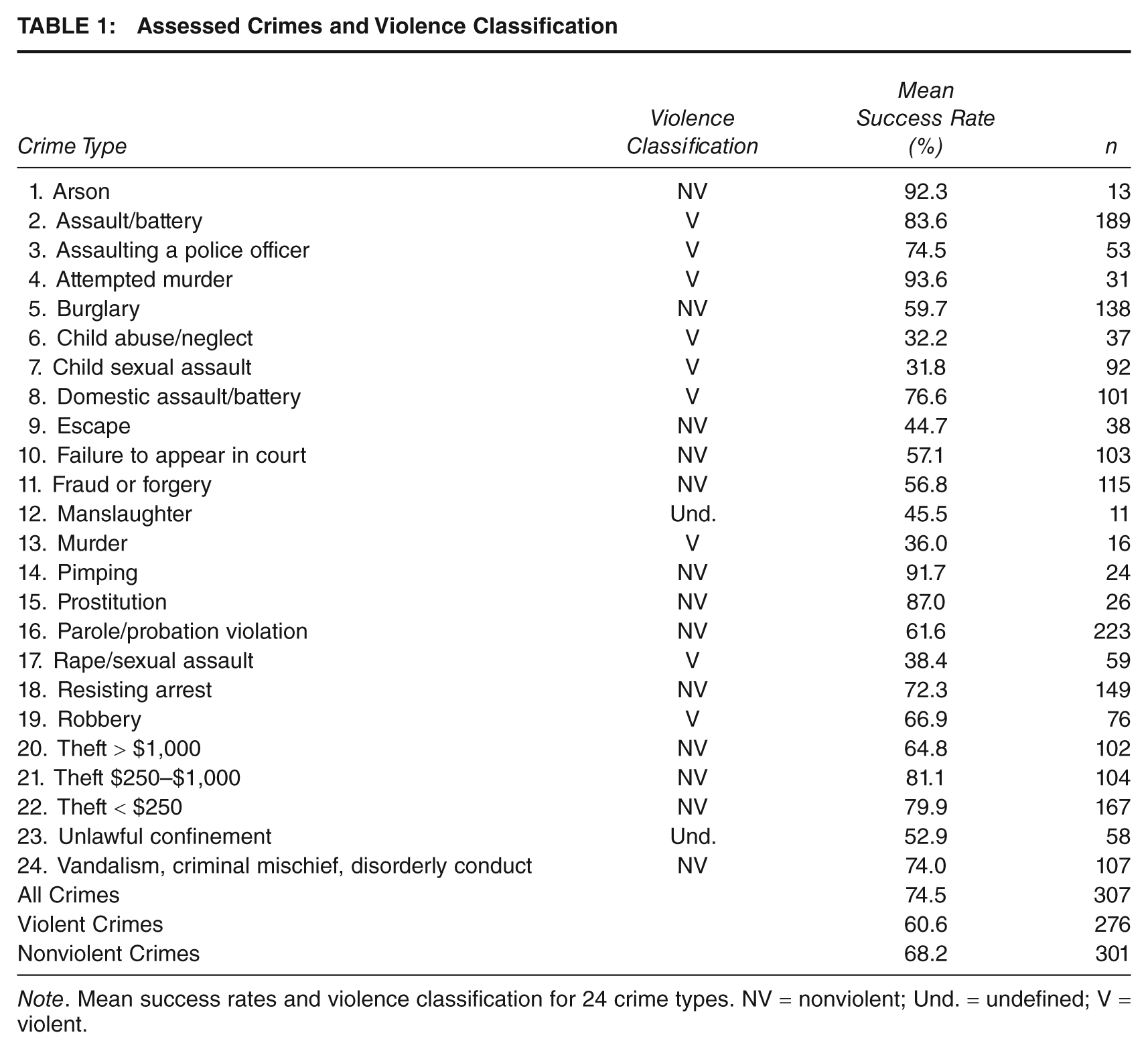
Note. Mean success rates and violence classification for 24 crime types. NV = nonviolent; Und. = undefined; V = violent.
Individual crime types were also examined when appropriate. The following crimes lacked the number of observations necessary for individual analysis: arson, child abuse or neglect, and escape murder, attempted murder, manslaughter. However, the three homicide-related crimes were combined into a single “homicide-related” crime composite.
Impression management (IM) was assessed using the Balanced Inventory of Desirable Responding (Paulhus, 1998), a 40-item scale that has been validated for prediction of crime and assessment of underreporting crimes in offender samples (Kroner & Weekes, 1996; Mills, Loza, & Kroner, 2003). The IM subscale has yielded a high alpha reliability coefficient of .84. It has successfully distinguished between admitting and nonadmitting sex offenders as well as offenders measured at intake and institutional release (Kroner & Weekes, 1996). The present IM sample mean fell within 5 points of the original validation sample means (M = 67.2, SD = 18.3) of 140.
Evidence suggests that high intelligence is typically a protective factor against risk of criminal behavior (Gendreau, Little, & Goggin, 2006). Intelligence quotient (IQ) was estimated in the present study to account for this possibility. IQ was assessed using the Vocabulary and Matrix Reasoning subtests of the Wechsler Adult Intelligence Scale (M = 94.1, SD = 12.5; Wechsler, 1997; validated by Ryan, Lopez, & Werth, 1999).
Psychopathy was assessed using the Psychopathy Checklist–Revised (PCL-R; Hare, 2003), a detailed archival analysis of collateral file information and semistructured interview with demonstrably high reliability and validity in forensic contexts (Hare, 1996; Harpur, Hare, & Hakstian, 1989; see Fulero, 1996, for a review). Clinical psychopathy is conventionally diagnosed by a total score of 30+ out of 40 (Hare, 1991). PCL-R assessments were conducted by 17 raters who completed extensive PCL-R training and regular reliability testing. Training in this lab has been shown to yield interrater reliability scores exceeding kappa of .92 (see Harenski, Harenski, Shane, & Kiehl, 2010). Of the experimental sample, 5% met traditional criteria for a clinical diagnosis of psychopathy, which is lower than the normative rate (Hare, 2003). Although this number was insufficient to justify diagnostic comparisons, the hypotheses could still be tested using an assumption of dimensionality of psychopathy score. See Table 2 for PCL-R total, factor, and facet mean scores. When group difference tests are employed, this approach is only in service of interpreting the shape of the dimensional effects and adopts a theory-neutral grouping rather than a diagnostic split.
PCL-R Total and Facet Scores
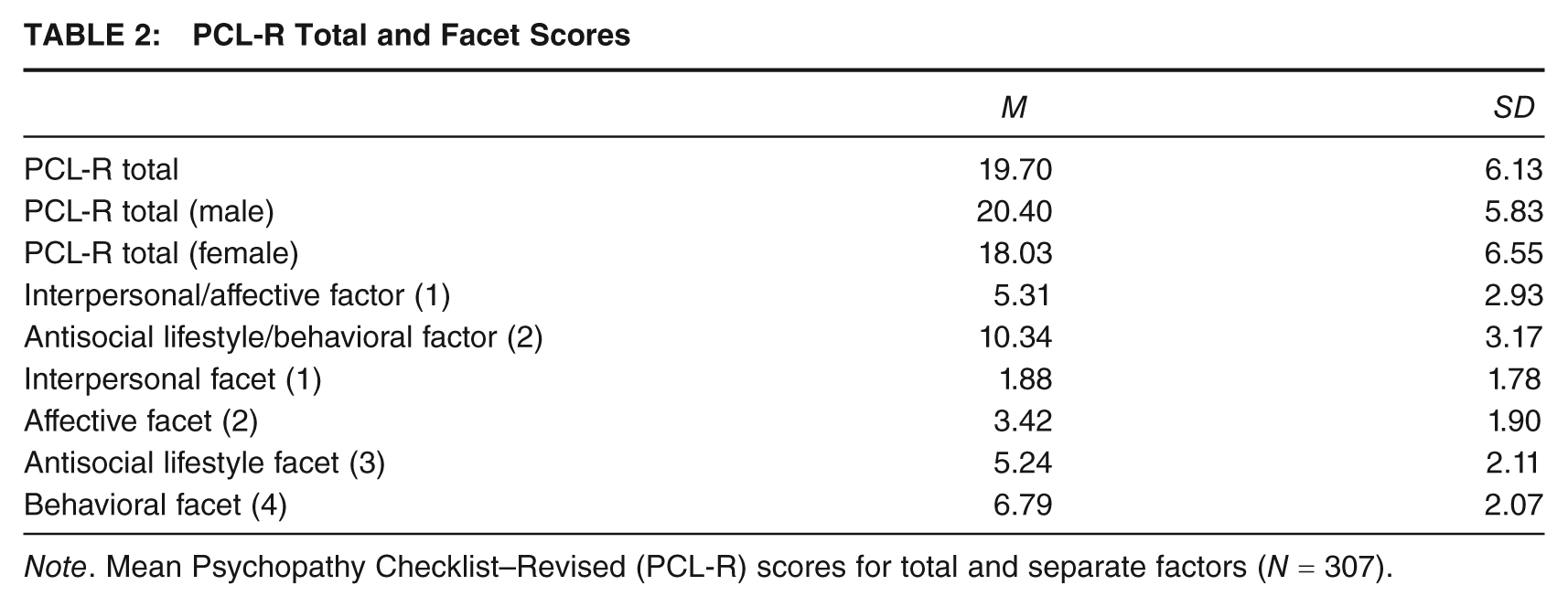
Note. Mean Psychopathy Checklist–Revised (PCL-R) scores for total and separate factors (N = 307).
Criminal success rate was determined by dividing the number of reported nonconvictions by the sum of reported nonconvictions and official convictions, then assigning a rank order to each rate. 1 The rank order distribution was employed to overcome problems associated with a negatively skewed distribution of success rates. Ties were resolved by assigning them the mean of the ranks that they would have received had there been no ties. This overall success variable was regressed on PCL-R score using hierarchical regression. In an extended analysis, individual crime types, and violent, nonviolent, and homicide-related crime composites were evaluated. Because the criminal success rate distributions of these latter variables were bimodal, these distributions were dummy coded into binary variables defined by ±50% success and subjected to binary logistic regression with PCL-R score.
Results
Descriptive Statistics
Participants as a whole reported high rates of overall criminal success (M = 74.5%, SD = 30.0%; see Table 1). 2 Figure 1 shows the overall success score frequencies, illustrating the asymmetric distribution in reported success. The mean number of overall crimes was 224.6 (SD = 614.4). The mean number of violent crimes was 34.5 (SD = 140.1). The mean number of nonviolent crimes was 190.1 (SD = 594.6).
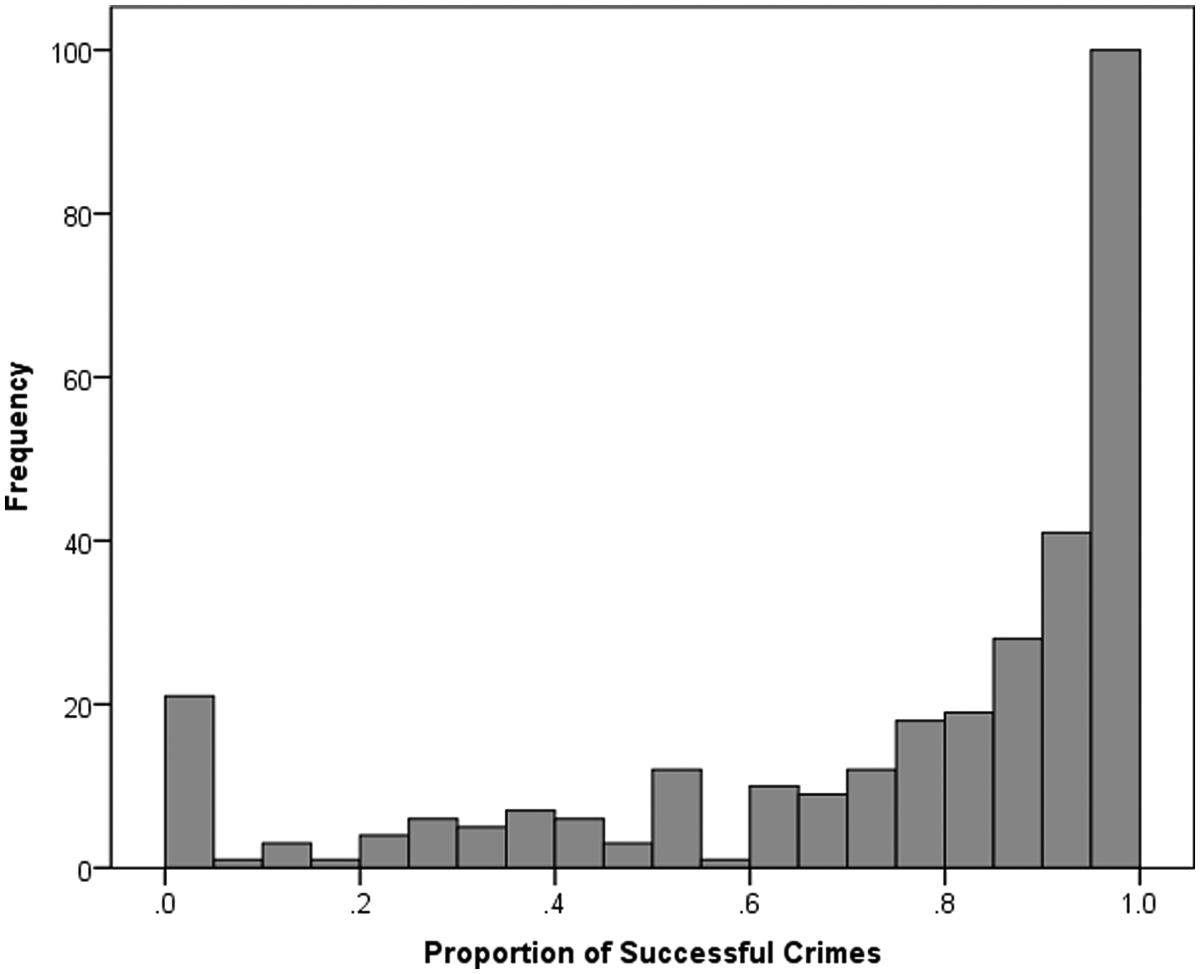
Criminal Success Histogram
Analysis of Covariates
A series of tests was used to evaluate whether any demographic variables might confound the potential relationship between criminal success and PCL-R total score (see Table 3). Using Pearson correlations, age was weakly negatively correlated with criminal success, but not with PCL-R score. IQ was not related to PCL-R or criminal success. Using a two-tailed independent sample t test, males on average had higher PCL-R scores than females, but did not show greater criminal success. Using hierarchical multiple linear regression, each well-represented race (Caucasian, African American, and Native American) was subjected to partial correlation with PCL-R score and criminal success rate separately, controlling for the other races in the first block (all mean centered). Variance in PCL-R score was explained by Native American (ΔR2 = .01, r = .10*, semipartial r = .11, β = .12) and African American (ΔR2 = .03, r = .16**, semipartial r = .16, β = .17) affiliation but not Caucasian affiliation (r = –.11). However, no single race affiliation explained a significant proportion of variance in criminal success. Using similar regressions, ethnicity (Hispanic or not) did not explain variance in PCL-R score or criminal success. This pattern suggests that none of the demographic variables collected are likely to explain variance in criminal success as a function of PCL-R total score, and therefore, need not be entered as covariates in corresponding hypothesis tests.
Relationship of Predictors
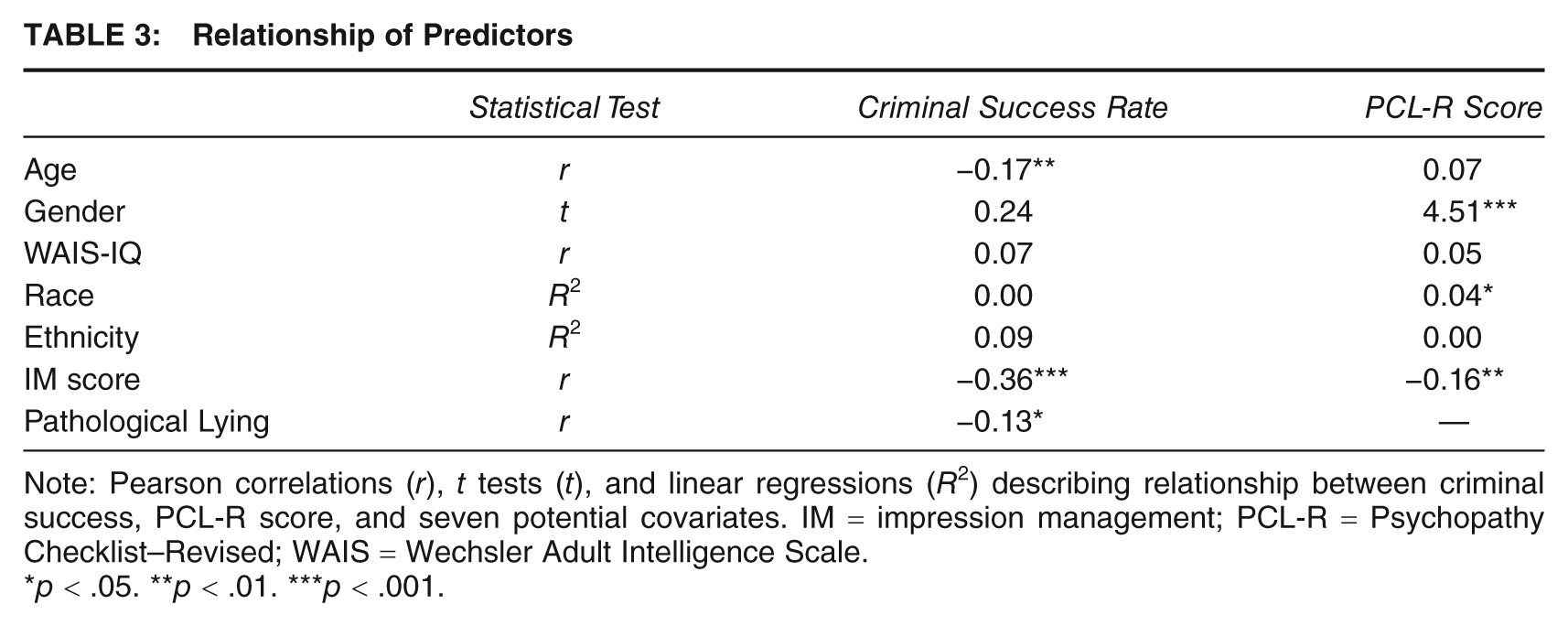
Note: Pearson correlations (r), t tests (t), and linear regressions (R2) describing relationship between criminal success, PCL-R score, and seven potential covariates. IM = impression management; PCL-R = Psychopathy Checklist–Revised; WAIS = Wechsler Adult Intelligence Scale.
p < .05. **p < .01. ***p < .001.
Because age was associated with criminal success, we examined its relationship to the PCL-R factor and facet scores. Age was positively correlated with the interpersonal/affective factor (r = .23***), the interpersonal facet (r = .25***), and the affective facet (r = .12*). Age was negatively correlated with the antisocial lifestyle/behavioral factor (r = –.13*) and the behavioral facet (r = –.18**), possibly reflecting behavioral “burnout.” Age was not correlated with the lifestyle facet (r = –.04, p = .47). This overall pattern suggests that subsequent hypothesis tests involving the PCL-R factors and facets should partial out variance attributable to age.
Did participants under-report their crimes? As expected, participants who scored higher in IM reported less criminal success, shown by a two-tailed Pearson correlation. Moreover, IM score was correlated with lower rather than higher PCL-R score, suggesting a demand to statistically control for IM (see Table 3).
Did participants overreport their crimes? If people are to overreport their crimes, it is likely to be those scoring high in pathological lying (an item of the PCL-R). However, contrary to expectation, participants high in this trait reported significantly lower criminal success. This unexpected effect could be partially explained by IM, which was positively associated with lying, r = .13, p < .05. Whatever the reason for the positive association between lying and criminal success, it allays the concern that participants high in psychopathy might have overreported their crimes (see Table 3). 3
Hypothesis Tests
Is PCL-R score associated with criminal success overall? Using a hierarchical linear regression, criminal success was regressed on PCL-R score, controlling for IM in Block 1 (all mean centered). A positive association was found in which participants with higher PCL-R scores reported greater criminal success, uniquely explaining 12% of the variance in success (see Table 4a). However, a quadratic regression controlling for both IM and the linear effect of PCL-R accounted for more unique variance in criminal success (17%) than did the linear model (see Table 4b and Figure 2).
Variance in Criminal Success Explained by Psychopathy Score, Factors, and Facets
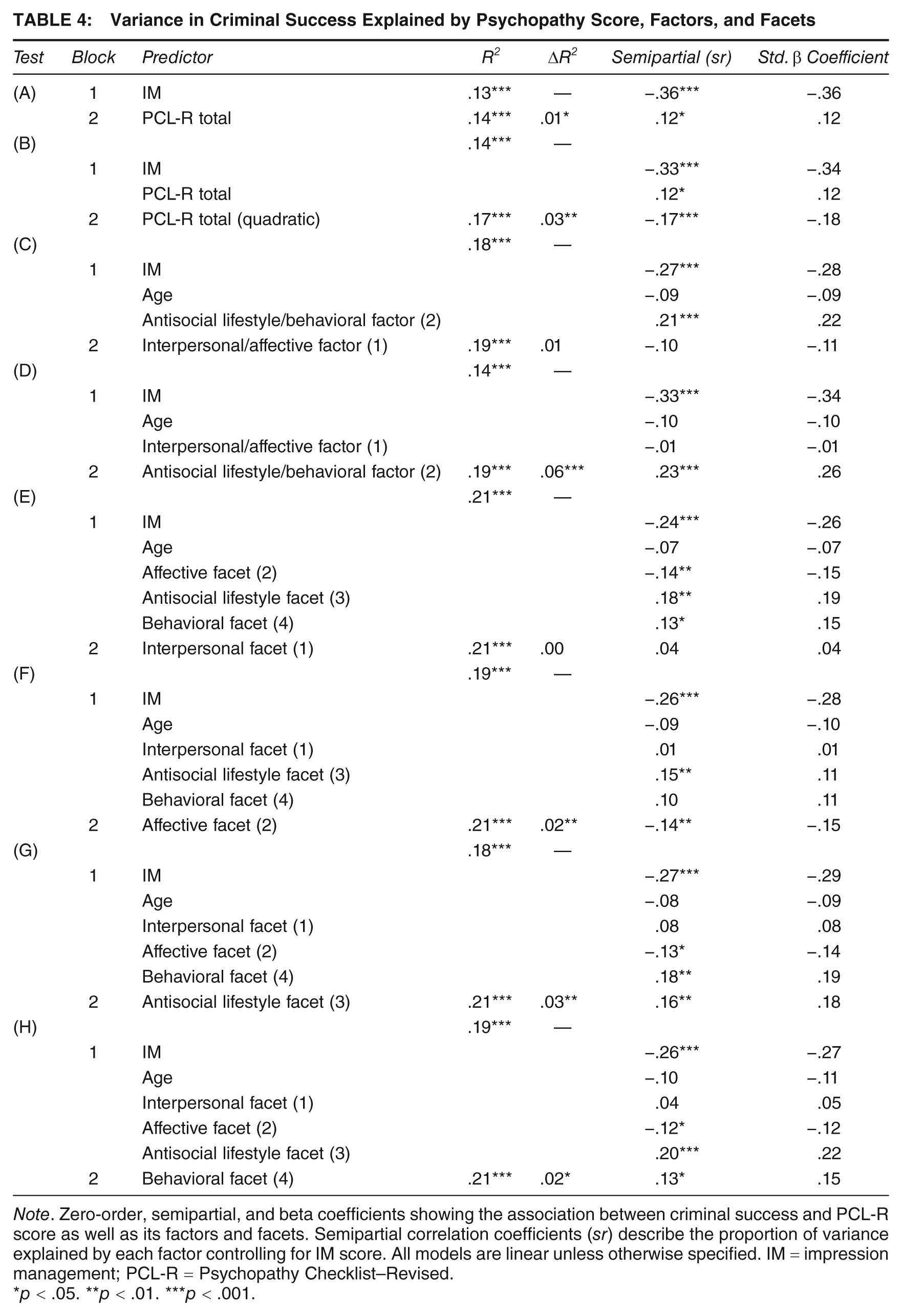
Note. Zero-order, semipartial, and beta coefficients showing the association between criminal success and PCL-R score as well as its factors and facets. Semipartial correlation coefficients (sr) describe the proportion of variance explained by each factor controlling for IM score. All models are linear unless otherwise specified. IM = impression management; PCL-R = Psychopathy Checklist–Revised.
p < .05. **p < .01. ***p < .001.

Unique Association Between Psychopathy Checklist–Revised (PCL-R) and Criminal Successes
To further evaluate the nature of the curvilinear effect, PCL-R scores were dummy coded into three equal groups of low, medium, and high psychopathy, and a Kruskal–Wallis omnibus test was used to examine whether any statistical differences existed between these groups. A significant difference was observed, χ2 = 20.40, p < .001. A series of pairwise Mann–Whitney tests comparing the means of each group revealed that the high psychopathy (U = 3582.50, p < .001; mean success rate = 78.9%, SD = 28.4%) and middle psychopathy (U = 3527.50, p < .001; mean success rate = 81.4%, SD = 23.2%) groups reported significantly greater criminal success than the low psychopathy group (mean success rate = 64.0%, SD = 33.8%). The high and middle psychopathy group success rates did not differ from each other (U = 5120.50, p = .847).
Next, we sought to determine whether the association between PCL-R and criminal success might be specific to violent or nonviolent crimes. PCL-R score and violent criminal success group (high ≥ 50% vs. low < 50%) were entered into a binary logistic regression (Block 2), controlling for IM and nonviolent success group (Block 1). This test revealed that for every one unit increase in PCL-R score, there was a significant increase in the likelihood of violent success classification by 7%, Exp(B) = 1.07 (95% CI = 1.02-1.12), model χ2 = 41.15***, Block χ2 = 9.56**. An equivalent test of nonviolent success failed to detect an association with PCL-R score, model χ2 = 41.52***, block χ2 = 0.39, p = .53.
Given the associations between psychopathy total score and overall criminal success, we sought to determine whether these patterns are paralleled by any of the psychopathy factors or facets. In separate hierarchical multiple linear regressions, we regressed criminal success score on each factor and facet score (Block 2), controlling for age, IM, and the other factor or facets (Block 1). Contrary to expectations, the interpersonal facet was not significantly associated with reported criminal success (Table 4e). The affective facet predicted reduced reported success (Table 4f), as did the interpersonal/affective factor (Table 4c), a marginal effect (p = .052) that was likely driven by the affective facet. It is surprising that the antisocial lifestyle facet predicted increased reported success (Table 4g). The behavioral facet also predicted increased reported success (Table 4h), as did the antisocial lifestyle/behavioral factor (Table 4d), which likely resulted from the additive effects of the antisocial lifestyle and behavioral facets. 4
Last, we evaluated the association between PCL-R total score and criminal success group (high ≥ 50% vs. low < 50%) for each qualified crime type using binary logistic regression, controlling for IM at Block 1. Only one of the 18 crimes survived an alpha threshold of p < .05: For every one-unit increase in PCL-R score, there was a significant increase in the likelihood of unlawful confinement success classification by 16%, Exp(B) = 1.16 (95% CI = 1.02-1.33), model χ2 = 10.13**, block χ2 = 5.56*. Marginal associations were observed for fraud or forgery and theft of less than $250, whereby every one-unit increase in PCL-R score was marginally associated with an increase in success classification for these crimes by the following percentage: fraud or forgery: 7%, Exp(B) = 1.07 (95% CI = 1.00-1.14), model χ2 = 7.09*, block χ2 = 3.74, p = .053; theft less than $250: 7%, Exp(B) = 1.07, (95% CI = 1.00-1.15), model χ2 = 7.61*, block χ2 = 3.30, p = .07.
Discussion
The primary purposes of this study were to (a) examine whether criminal success could be meaningfully evaluated in an institutional sample and (b) gain insight into the nature of psychopathy by testing hypotheses about the criminal success rates of incarcerated psychopaths.
First, this study observed wide variation in criminal success, with most offenders reporting disproportionately high success despite the fact of their current incarceration, consistent with previous findings (e.g., Dunford & Elliott, 1984; Lussier et al., 2011; Morselli & Tremblay, 2004), and confirming that it is in fact meaningful to study criminal success in an incarcerated sample. Second, a positive relationship was observed in which those with moderate to high levels of psychopathy reported the highest rates of overall criminal success, controlling for IM. This effect was strongest for violent crimes. Some of the variance in success may be attributable to the antisocial lifestyle/behavioral traits of psychopathy (Facets 3 and 4), which uniquely, though unexpectedly, predicted increased success. Affective psychopathic traits (Facet 2), in contrast, uniquely predicted reduced success, and interpersonal traits (Facet 1) were not related to success. The positive association between psychopathy score and criminal success was partially observable at the individual crime level, specifically for unlawful confinement and marginally for fraud or forgery and theft less than $250.
The positive relationship between total psychopathy score and reported overall criminal success may be surprising given the prediction based on antisocial lifestyle (Facet 3) traits such as impulsivity and associated risk management difficulties (see Koenigs et al., 2010; Michell et al., 2002; Siegel, 1978). However, this trait cluster itself proved to be associated not with greater detection but with relative criminal success. Although this result ran counter to our prediction for Facet 3, similar patterns have been observed by others. One such study found that predatory offenders exhibiting impulsive traits obtained more criminal earnings than less impulsive offenders (Morselli & Tremblay, 2004). Another study observed a positive association between criminal success and the accumulation of financial debt (Kazemian & Le Blanc, 2006), a characteristic that is commonly indexed by the antisocial lifestyle facet of psychopathy. A third study of drug-dealing youth showed a positive relationship between risk taking propensity and criminal earnings (McCarthy & Hagan, 2001). These patterns could potentially arise from the opportunistic and nomadic traits captured by the antisocial lifestyle facet. Given the low base rates of detection (e.g., Ehrlich, 1996), the frequent shifting of jobs, relationships, and residences could potentially help psychopaths to encounter new criminal opportunities and cover their tracks.
The effect of antisocial Lifestyle traits was mirrored by the behavioral facet (Facet 4), which resulted in a combined positive effect of PCL-R Factor 2. The behavioral trait effect on criminal success is not well explained by characterizations that psychopathic behavioral traits are evidence of criminal failure (e.g., failure of conditional release). However, behavioral traits such as criminal versatility could potentially help to explain this association to the extent that they reflect greater criminal experience.
The prediction that the interpersonal traits of psychopathy (Facet 1) would be positively associated with criminal success was not supported. Given that our sample’s interpersonal scores were notably low (see Hare, 2003), the nonpositive effect may simply reflect a narrow representation of interpersonal facet scores. Another explanation for this result could be that the tendency to charm and manipulate others does not imply the ability to do it well.
The negative association between criminal success and psychopathic affective traits (Facet 2) suggests that psychopathic emotional detachment might contribute to failures to evade detection. This interpretation is consistent with arguments that psychopathic deficits in avoidance learning can be explained by a low fear response (Lykken, 1982) or low anxiety levels (Newman & Schmitt, 1998). This pattern could also be driving the marginal, negative association between interpersonal/affective (Factor 1) traits and criminal success. However, in the context of the positive effect of psychopathy total score, it seems that the antisocial lifestyle/behavioral (Factor 2) traits of psychopathic inmates may outweigh the affective facet in their competing influence on criminal success. Additional research will be needed to fully address the above interpretations.
It is unclear why the positive association between psychopathy and criminal success was observable for unlawful confinement (and marginally for fraud or forgery and theft less than $250) but not other crimes. We suggest a statistical interpretation: Binary logistic regression, which we employed to overcome the bimodal shape of these variables, may have forced us to eliminate important variation in success rates at the individual crime level. Given the observed positive association between psychopathy and overall criminal success, we speculate that a normal distribution of success rates for individual crimes would yield a similar pattern for a wider array of crime types.
The present pattern of results has several broad implications. First, the fact that psychopathy score predicted overall criminal success in an incarcerated sample suggests that variation in inmate criminal success is sufficient to meaningfully examine its relationship to psychopathy and to identify specific traits underlying the relative criminal success of the most successful incarcerated offenders. As such, it may be overly restrictive to conceptualize incarcerated samples as categorically unsuccessful at crime. Second, these results support models of risk assessment, which maintain that psychopathy is a major predictor of violent recidivism (Dolan & Doyle, 2000) but have been somewhat limited to official records of detected crime. Third, these results challenge the view that psychopathy can be reduced to a pathological condition, suggesting instead that it may contain elements of a functional social strategy (see Cleckley, 1976; Gao & Raine, 2010; Glenn et al., 2011), at least in the narrow sense that offenders high in these traits appear to get away with a relatively large proportion of their exploitative behaviors. Given this pattern, it is easy to see why some scholars have proposed that criminal behavior might often be explained by reinforcement from past successes (see Paternoster, Saltzman, Waldo, & Chiricos, 1983).
Limitations and Future Research
As with any study, the current results should not be interpreted beyond the scope of the study procedures. First, although self-reported criminal behavior may be less problematic than other alternatives, self-reported criminal behavior cannot be erroneously equated with actual criminal behavior. We attempted to minimize the possibility of underreporting crimes by employing methods to statistically control for IM. However, this research field lacks instruments for estimating the overreporting of crime. Because criminal success was not positively correlated with pathological lying, we theorized that overreporting would be of minimal concern to the interpretation of our results. However, this assumption lacks validation, and its application may suffer from some circularity. Thus, a direct and independent assessment of overreporting would serve to increase confidence in such interpretations.
Second, although our large sample size permitted a wide distribution of PCL-R scores yielding effects that reached statistical significance, it would be instructive to identify a greater number of participants attaining a diagnostic PCL-R score of 30 or more. Greater numbers of high scorers could permit a greater variety of group comparisons between participants with and without clinical psychopathy. Additional high scorers could also permit tests of individual differences within clinical psychopathy, which may reveal systematic variation in psychopaths’ levels of cognitive functioning and extent of violent behavior, as shown in community studies of psychopathy (see Gao & Raine, 2010; Ishikawa et al., 2001).
Third, it was not feasible to measure or control for a host of exogenous factors likely to influence criminal success such as geographic variation in policing, time of day, time of year, judicial temperament, and so on. It would be extremely difficult to obtain accurate estimates of these variables, and research is lacking to suggest that any of them are systematically related to psychopathy score, but it will be necessary to rule out their potential effects to validate the observed relationship between psychopathy and criminal success.
Fourth, this study did not contain a measure of the likelihood of forgetting past crimes. To minimize this concern, we limited the task to the reporting of adult crimes only. We also utilized rank-order tests that placed more weight on smaller frequencies of crimes. Future studies could consider methods of estimating memory quality.
Fifth, there are many ways that crime types can be classified, either individually or in composite form. Not all of the individual crime measures in the present study contained sufficient numbers of observations or sufficient variability of scores to permit their individual analysis. In lieu of this limitation, we successfully examined success rates for violent and nonviolent crime composites, using a conventional classification scheme. However, other approaches remain to be examined, including (a) alternative violence classification schemes, (b) the moderating influence of crime seriousness level, and (c) other composite crime variables such as “predatory versus market” crimes (e.g., Morselli & Tremblay, 2004) and “reactive versus instrumental” crimes (e.g., Cornell et al., 1996), granted that sufficient observations can be obtained.
Finally, psychopathy is somewhat culturally variable (e.g., Cooke, 1998). Cross-cultural studies are needed to permit the conclusion that the observed curvilinear relationship with criminal success is geographically universal, or instead specific to the present U.S. sample.
Footnotes
Authors’ Note:
This research was funded in part by the National Institute of Mental Health (5R01MH070539-04, 1R01MH085010-01A1, and 1R01DA026505-01A1 PI: KAK) and by the University of New Mexico’s Office of Research. Eyal Aharoni was supported by an NRSA postdoctoral fellowship (5 F32 MH090668-02). The authors thank Rachel Kahn, Hanna Heinzen, Heather Dowdican, Matthew Shane, and the Mind Research Network.