



Abstract
This study investigated the effectiveness of the Relaxation Skills Violence Prevention (RSVP) program with a sample of juvenile detainees. The RSVP program is a five-session group therapy program that teaches ways to identify and cope with anger using the relaxation skills of deep breathing, guided imagery, and progressive muscle relaxation. Using a randomized controlled experimental design, the study obtained a total of 137 youth. Results supported the hypothesis that the RSVP group would experience significant declines on a measure of anger and perceived ability to control one’s present and future anger when compared to the control group.
Review of The Literature
In recent years, the juvenile justice system has begun to recognize the importance of mental health in the juvenile detainee population. Although the prevalence of psychological disorders within this population has been notoriously difficult to document, research to date indicates mental illness prevalence rates from 40% to 70% (Arroyo, Buzogany, & Hansen, 2001). Differences in findings have been attributed to a number of factors, prompting a meta-analysis of 25 studies on mental illness prevalence rates among juvenile detainees by Fazel, Doll, and Långström (2008). As one might expect, rates of mental illness in the reviewed studies were much higher than the typical population rates. For example, approximately 3% of juvenile detainees were found to have a psychotic illness, 12% of males and 28% percent of females suffered from Major Depressive Disorder, 21% of males and 24% of females were diagnosed with ADHD, and 62% of males and 48% of females were diagnosed with Conduct Disorder (Fazel et al., 2008).
Recently, the American Academy of Child and Adolescent Psychiatry outlined practice parameters for the assessment and treatment of juvenile detainees (Penn & Thomas, 2005). Of the 14 recommendations put forth in this practice guideline, the majority of the recommendations were specifically related to the assessment of detainees or the context of juvenile detention centers, whereas 4 recommendations addressed the treatment of detainees. These guidelines serve as a prologue to the discussion and dialogue that must take place regarding the treatment of juvenile detainees. Migdole and Robbins (2007) have commented recently on the conflicting roles of juvenile detention centers that serve to either seclude and secure detainees from society or provide treatment for this juvenile population. These authors argue that this false dichotomy of seclusion versus treatment has prevailed in the field but that recent political and scientific movements have increased the acceptability of detention centers fulfilling both roles (Migdole & Robbins, 2007). The fact that there has been virtually no research to date that has examined psychological interventions and their effectiveness with the juvenile detainee population has led to the call from leading professionals who outline the need for such research (Florsheim, Behling, South, Fowles, & Dewitt, 2004; Migdole & Robbins, 2007; Penn & Thomas, 2005; Williams, 2006).
The nature of juvenile detention centers may also add to the lack of research on psychological interventions for juvenile detainees. For example, available data indicate that the average length of stay in detention is approximately 15 days (U.S. Bureau of the Census, 1985-1995). This short length of stay can certainly provide a barrier to psychological intervention implementation as even the briefer psychological treatment modalities would often not fit within this time frame (Lambert & Ogles, 2004). Second, although much of the research on juvenile detainees is related to assessment of mental illness in this population, research continues to show that such mental illness continues to be underreported or unidentified in these youth (Osterlind, Koller, & Morris, 2007). Another potential reason for the lack of research on psychological interventions with detainees is the probability that there is simply very little psychological intervention or therapeutic programming currently occurring. For example, research by Osterlind et al. (2007) concluded that “detention facilities are generally ill-prepared to recognize and address mental health issues” (p. 276). Similarly, a recent review by Desai et al. (2006) did not find a single study that explicitly investigated the effectiveness of programming based on behavioral or cognitive-behavioral theory and principles in a detention setting.
Given that there is no previous research that is identical to the proposed study, the related (yet still limited) literature of treatment with youth who are on probation or incarcerated will be reviewed. To begin, Lipsey, Wilson, and Cothern (2000) performed a meta-analysis on 200 studies of juvenile delinquent youth who were either institutionalized or not institutionalized. The purpose of the review was to establish the types of treatment that were effective in reducing recidivism and estimating their effect size. Analysis of research on programs delivered to institutionalized youth (in long-term incarceration and not in detention) revealed a number of compelling findings. First, programs that involved mental health personnel, as opposed to juvenile justice personnel, tended to be more effective. Also, length of treatment was related to increased effectiveness. Finally, programs that were behaviorally based or that taught interpersonal skills tended to be the most effective types of programs in reducing recidivism. Some programs that were either not effective or had inconsistent evidence included Milieu therapy and wilderness programs (Lipsey et al., 2000).
Another important study by Florsheim et al. (2004) should be considered when examining the effectiveness of “treatment as usual” in the juvenile justice system. This study followed 175 juvenile delinquent youth who were remanded into state custody and experienced several types of placements. In fact, most participants experienced five of the seven possible placements, which were detention, proctor home, work program, group home, residential treatment center, wilderness program, and secure care facility. As one can see, the purpose of this study (Florsheim et al., 2004) was more focused on placement effectiveness and “treatment as usual,” which is often haphazard, as opposed to the controlled study of treatment type undertaken by Lipsey et al. (2000). However, this study of juvenile justice system “treatment as usual” found that youth recidivism was not reduced, and in fact longer lengths of placement were related to higher rates of recidivism in adulthood (Florsheim et al., 2004).
The current study examines the effectiveness of a behaviorally based relaxation skills training program with juvenile detainees. There is a rather large body of literature that has assessed the effectiveness of relaxation skills training with regard to pain management, anxiety, and anger (Tafrate, 1995). For example, Nickel et al. (2005) found that progressive muscle relaxation (PMR) had beneficial effects for stressed male adolescents. Similarly, Deffenbacher, Oetting, Huff, and Thwaites (1995) compared two types of social skills training programs as well as a cognitive-relaxation skills program on their effectiveness in reducing anger in college students and found that all three programs were effective over a 15-month follow-up period. However, neither of these studies applied a relaxation skills training (or similar) program with a juvenile delinquent or juvenile detained population. Currently, only one study was found to be published in a peer-reviewed academic journal in the last 20 years that examined the effectiveness of any psychotherapy intervention program with a juvenile detained population. The authors of this study (Nakaya et al., 2004) found that short-term relaxation therapy was effective when compared to a no-treatment group in a small sample (N = 16) of juvenile delinquent Japanese youth who were placed in a reformatory setting. Unfortunately, this is the only study of its kind that was found in this literature review. Some obvious limitations to this study are the very small sample size, the limited generalizability due to differences in the context (juvenile detention versus reformatory settings), and potential cultural differences that exist.
Therefore, the proposed study will attempt to fill a critical gap in the literature as it will evaluate the effectiveness of a behaviorally based relaxation skills program with youth in juvenile detention. Numerous organizations (e.g., American Academy of Child and Adolescent Psychiatry) and researchers have decried the lack of psychological services for youth in juvenile detention (Florsheim et al., 2004; Migdole & Robbins, 2007; Penn & Thomas, 2005; Williams, 2006). Hopefully, studies such as this will spur similar research on the efficacy of psychological interventions with detained youth as well as further the implementation of these interventions.
Therefore, the purpose of this study is to evaluate an existing group therapy intervention program entitled the Relaxation Skills Violence Prevention (RSVP) program. This program was developed by the first author and is a manualized, five-session, behaviorally based relaxation skills group therapy program designed to be delivered in a juvenile detention setting. The objectives of the program are to educate the participants regarding stress and anger and teach the relaxation skills techniques of deep breathing, PMR, and guided imagery. This program was specifically designed for a juvenile detention setting as it is brief in nature (five sessions), focuses on teaching straightforward behavioral relaxation skills, and can accommodate youth with below average reading ability or intellectual functioning.
The specific aims of the study are to test the hypothesis that the RSVP program participants will exhibit significant declines (from pre to post) on a measure of perceived anger and their current and future ability to cope with anger and stress that is significantly greater than a waitlist control group. Thus, a significant Between-Groups × Within-Groups interaction is hypothesized.
The RSVP Program
Development of the RSVP program began in 2005, and the program has undergone minor revisions and improvements since its inception. These revisions have mostly consisted of minor wording changes to some text to improve clarity, with no significant changes to the structure or content of the program. The RSVP program is a manualized, five-session program that teaches the relaxation skills of deep breathing, PMR, and guided imagery to a group of detained youth. The program is designed such that one or two trained facilitators can implement the program to a group of 2 to 10 youth. Groups comprised both males and females. The program was administered daily (Monday through Friday) by trained graduate and undergraduate psychology students (supervised by the primary investigator). Because of the sequential nature of the RSVP program, it is essentially a “closed” group, whereby new participants began the program in the first session rather than entering in the middle of the program. For safety reasons, all sessions were also supervised by a detention center program coordinator. This coordinator has been consistent since the beginning of the program and has become highly familiar with the program. As such, this coordinator was later used as an observer who would collect data on treatment integrity. Additionally, more experienced facilitators were chosen to supervise less experienced facilitators. These supervising facilitators were used as both trainers as well as observers to collect treatment integrity data.
The first session of the RSVP program educates the youth regarding stress, its effects on the body and mind, as well as general tips for coping with stress. The second session teaches the relaxation skill of deep breathing, while the third session teaches PMR and the fourth session teaches guided imagery. The last session reviews all three relaxation techniques and reviews participants’ use of these techniques over the last week. Each session lasts approximately 1 hour and includes a number of discussion questions that guide the participants through the topics of stress, identifying cognitive and physiological cues of anger, and appropriate coping. In general, each session provides for a mixture of teaching skills and interactive, on-topic discussion. Sessions 2 through 5 include specific scripts that can be read word-for-word in order to teach each specific relaxation skill. Additionally, an associated RSVP workbook has been developed that relates to the training in the program, provides for self-guided learning, and allows the youth to self-monitor their use of the relaxation skills outside of the group.
Finally, treatment integrity was intermittently measured using a treatment integrity rubric. A specific rubric was created for each session and was completed by both the detention center administrator as well as a supervising facilitator. Treatment integrity was collected by the detention center administrator on 45% of sessions and the supervising facilitator on 24% of sessions. Each treatment integrity rubric evaluated facilitators on between 12 and 20 key tasks, depending on the session, with possible ratings of unsatisfied, partially satisfied, or fully satisfied for each task. As such, each task was allotted a possible 0, 1, or 2 points depending on the rating, and a percent score was calculated for both raters by dividing the number of possible points by the points actually attained. Mean treatment integrity percent scores tended to be very high (between 96% and 99%) with the average score across sessions as 99% for detention center administrator ratings and 98% for supervising facilitators’ ratings.
Method
Participants
A randomized controlled experimental design was employed to evaluate the effectiveness of the RSVP program in a juvenile detention center in the Midwest. The juvenile detention center is moderate in size (approximate capacity of 50 youth) and is able to hold both males and females. The detention center is located in a geographic area that can be described as a mix of rural, suburban, and urban areas. The detention center accepts youth from age 10 to 17 years old. The average age of youth in both detention centers is midadolescence (14 to 15 years old). Participants in the study, after attrition, were 137 youth (93 youth in the experimental group and 44 in the wait-list control group) who were placed in a juvenile detention center in the Midwest from 2008 to 2010. As is typical, youth were placed in detention for a variety of crimes ranging in seriousness from misdemeanors to Class 1 felonies. For this sample of youth, 79% were male and the average age was 15 years old. Regarding ethnicity, 67% of the sample was Caucasian, 22% were African American, 3% were Hispanic, and 8% were of other ethnicities or multiracial.
Given the nature of the detention facility whereby average stays are quite short, attrition for both groups was relatively high (43% for the experimental group and 72% for the control group). Therefore, preliminary analyses of youth in both groups were conducted to determine whether initial pretest scores on the primary measure of program effectiveness differed between those who remained in detention long enough to complete the posttest compared to those participants who were dismissed from detention before completing the posttest. Two separate independent samples t tests indicated no such differences for either group.
Measures
The Anger and Coping Questionnaire (ACQ; see appendix for ACQ instructions and items) was designed by the author to serve as the pre- and posttest for the study. The ACQ is a 17-item questionnaire with items on a 5-point Likert-type scale that assess current feelings of anger and anxiety (e.g., “I feel annoyed”), perceived inability to control one’s anger (e.g., “I have a short temper”), and lack of ability to manage anger appropriately in the future (e.g., “I am afraid I will hurt others in the future when I’m angry”). Total scores on the ACQ can range between 0 and 68, with higher scores on the ACQ indicating poorer functioning. For a general estimate of the construct validity of the measure, Cronbach’s alpha was calculated for the 17 items on the ACQ (α = .90). Therefore, preliminary results on the psychometric properties of the ACQ indicate that one estimate of construct validity is promising with the limited existing data.
Self-reported utilization of the relaxation skills was gathered through the use of “tear sheets” while in the program. This tear sheet includes brief instructions for each relaxation skill and allows the participant to tear a section of the page (tear sheet) that corresponded with the skill that was used. This type of self-monitoring procedure was implemented as juveniles are usually not allowed any writing utensils for safety reasons. The mean rates of self-reported skill utilization were calculated per day by taking the total number of self-reported relaxation skills utilizations and dividing by the number of possible days prior to posttest that the participant was able to use that particular skill.
Finally, a single 7-point Likert-type scale item rating participants’ level of perceived stress was implemented immediately prior to and after the first time participants were taught each of the three relaxation skills. A rating of 1 on this item indicated participants were very tense, and a rating of 7 indicated that they were very relaxed and a rating of 4 indicated neither.
Procedures
Upon admission to the detention center, participants were randomly assigned to either the experimental group or a wait-list control group. Unique identification numbers used by the county probation system were used to identify youth, and researchers were not given any participant’s name or any other identifying information. All pre- and posttests were identified with this number. Pretests were administered to both groups at the beginning of each week (Monday), whereas participants were not told their group assignment. The experimental group began the program immediately after the pretest, and the control group began the program Monday of the following week. Posttests were administered to the experimental group at the end of the last session of the program (Friday), whereas posttests were administered to the control group immediately before beginning the program (1 week after the pretest). Based on these procedures, complete pre- and posttest data were obtained for 93 youth in the experimental group and 44 youth in the control group, leaving a total sample of 137 youth available for analysis. Participants in the experimental group on occasion did not attend all five sessions for a variety of reasons (e.g., refusal, assigned cell time for disciplinary reasons, court). Data were not used for any participant who did not attend at least four of the five program sessions, and the mean number of sessions for the experimental group was 4.83. It should also be noted that a variety of other services were offered to most youth during their detention stay as a matter of course per the facility, including full-time academic programming, tutoring, art therapy services, and others. In almost all cases, these services were offered to all youth in the detention center; thus with the random assignment and use of a control group in this study, the authors can be relatively confident that the only existing differences between groups was whether they received the RSVP program. Additionally, youth’s participation in other programs or services was unknown to the researchers and had no impact on their group assignment. Finally, all program facilitators were blind to the purpose and hypotheses of the study.
Results
Preliminary data regarding participants’ ratings of perceived stress immediately prior to and after being taught each relaxation skills were analyzed. The mean of participants’ perceived relaxation immediately prior to being taught each relaxation skill, with standard deviations in parentheses, are as follows: Deep Breathing, M = 3.03 (1.32); PMR, M = 3.27 (1.38); and Guided Imagery, M = 3.56 (1.46). Thus, prior to being taught each skill, participants indicated being mildly stressed. Participants’ perceived relaxation immediately after being taught each relaxation skill was found to be significantly more relaxed, with means and standard deviations as follows: Deep Breathing, M = 5.79 (1.27); PMR, M = 5.65 (1.22); and Guided Imagery, M = 5.84 (1.49). Paired samples t tests calculated on pre- and postratings for all three skills were statistically significant at the p < .01 level, with large effect sizes.
The primary analysis to test this study’s hypothesis regarding the effectiveness of the RSVP program was conducted using a repeated measures ANOVA with participants’ group as the between-participants factor and the pretest and posttest ACQ total scores as the within-participants factor. The assumption of equality of covariance was tested and was not significantly different across groups. As hypothesized, results of the ANOVA confirmed that there was a significant interaction effect between group and the (pre- to posttest) ACQ total scores, F(1, 135) = 22.70, p < .01, partial η2 = .14, which can be characterized as a large effect size. Table 1 displays the means and standard deviations by group and time period, and Figure 1 represents change in ACQ total scores from pre to post for the experimental and control groups separately. Again, higher ACQ scores reflect poorer functioning and represent greater feelings of anger and anxiety and less confidence in one’s ability to cope with anger appropriately in the present and future. These results are in the hypothesized direction, with the experimental group experiencing declines across time on the ACQ that are significantly different than increases on the ACQ experienced by the control group.
Pre and Posttest ACQ Scores by Group
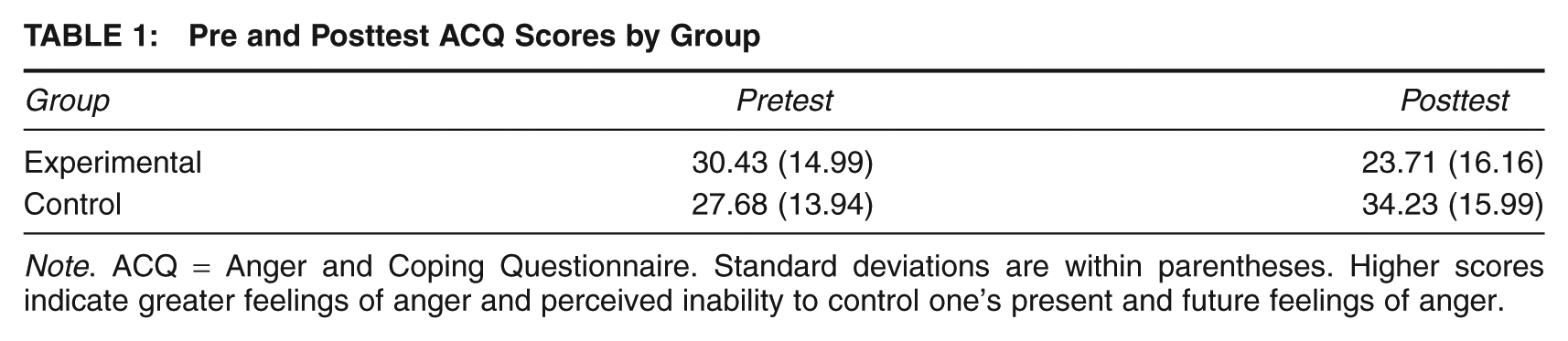
Note. ACQ = Anger and Coping Questionnaire. Standard deviations are within parentheses. Higher scores indicate greater feelings of anger and perceived inability to control one’s present and future feelings of anger.

ACQ Scores by Time and Group
Additional analysis was conducted on the data from the wait-list control participants (n = 24) who had completed the program as well. A repeated measures ANOVA was calculated examining the three ACQ total scores as the within-participants factor (pretest, posttest at beginning of RSVP program, and posttest at end of RSVP program). Observed power for this analysis was adequate (1-β = .84), and the multivariate test was significant, F(2, 22) = 6.15, p < .01, partial η2 = .36, which can be characterized as a large effect size. An additional pairwise comparison indicated that there was a significant increase in ACQ scores from pretest to posttest immediately prior to beginning the RSVP program (1 week later), t(23) = 2.51, p < .05, Cohen’s D = .46, potentially indicating that the youth’s incarceration is related to poorer functioning as measured by the ACQ. Finally, a significant decline in ACQ scores from the beginning of the program to the end of the program was significant, t(23) = 3.48, p < .01, Cohen’s D = .69, similar to previous analyses indicating that the program led to improved functioning (see Figure 2).

ACQ Scores by Time for the Wait-List Control Group
Additional data were gathered regarding the program participants’ self-reported utilization of the relaxation skills techniques using tear sheets, which are previously described. The mean rates of self-reported skill utilization per day, with standard deviations in parentheses, are as follows: Deep Breathing, M = 2.27 (2.48); PMR, M = 1.61 (1.82); and Guided Imagery, M = 2.58 (3.67). Thus, it appears that at least during the week the RSVP program was implemented, program participants used all of the techniques fairly frequently. Finally, participants were asked to rank their favorite relaxation technique at the end of the fifth session. As such, 53% of participants ranked deep breathing as their favorite technique, whereas 33% ranked guided imagery as their favorite and 14% ranked PMR as their favorite.
Discussion
Therefore, the results of this study indicate that the experimental group that immediately received the program indicated declines on the ACQ (representing improved functioning) after the program, whereas the wait-list control group had significant increases on the ACQ (representing poorer functioning) while waiting to enter the program. Additional analysis of data from participants in the wait-list control group also showed a significant decline in ACQ scores after they completed the program. These results are similar to those of other studies that found that relatively brief relaxation skills training programs can significantly lower feelings of anger (Deffenbacher et al., 1995) and stress (Nickel et al., 2005) in program participants.
This study also confirmed that the youth used these relaxation skills outside of the immediate therapy environment according to self-monitoring data. In fact, participants, on average, used each skill about twice per day. Another interesting finding, though not a primary purpose of the study, was that detainees’ functioning as measured by the ACQ appears to decline in their first week of detention. This finding is significant in that there is little to no research examining how short-term detention effects the emotional and behavioral functioning of these youth. Thus, it appears that the RSVP program has significant implications for youth treatment in a detention center setting. Strengths of the program include its brevity (only five sessions) that allow it to be used in settings with a very short length of stay. Related to this, relatively little staff time is needed to implement the program, and the concrete skills being taught make it appropriate even for those youth with a relatively low reading level or cognitive ability.
Results from this study are similar to those of Deffenbacher, Lynch, Oetting, and Kemper (1996), who compared three groups of middle school children identified as having anger problems. One group participated in a brief cognitive-relaxation coping skills training, the second group was provided with social skills training, and the third was a comparison control group. Results of their study indicated that both program groups were similar to each other and superior to the control group on most measures, whereas the cognitive relaxation coping skills group was superior to both groups on some measures of depression and general deviancy. Although this study did not use a sample of detained youth, the results point to the importance of relaxation skills training to improve the coping skills of angry youth.
Although this study provides encouraging results, some limitations to the study exist. These limitations include the fact that the sample was limited to only one detention center. Additionally, gender differences in response to the program were not able to be investigated due to the relatively few females who participated in the program. A final and significant limitation is the fact that results on the effectiveness of the program are limited to an immediate posttest with no estimate of the program’s long-term effectiveness or its impact on recidivism. Therefore, although these initial results appear to be encouraging regarding the effectiveness of the RSVP program, further research is needed on this topic. This research could include a study of the effectiveness of the program on recidivism using a matched control group as well as other indicators of effectiveness, including parent and teacher reports of aggression.
Effective therapy programs for detained youth are sorely needed given the increased rates of mental illness in this population (Arroyo et al., 2001). Currently, there are virtually no psychological intervention programs (individual or group-delivered) that are specifically designed for a juvenile detention population. The most difficult challenge to overcome when developing interventions for this population is their typical short length of stay. The RSVP program, on the other hand, has been specifically designed for use with this population and takes this short length of stay into account by limiting itself to five sessions. Additionally, the program focuses only on teaching behaviorally based relaxation techniques rather than attempting to change cognitive structures (as is often found in cognitive behavioral therapy programs), which typically requires a lengthier period of treatment.
Footnotes
Appendix
Authors’ Note:
The implementation of this study would not have been possible without the work of individuals too numerous to fully list here. However, the authors would like to directly acknowledge the following individuals who were especially critical to this project: Stacey Adams, Carrie Bobrosky, Melissa Hild, Emily Kreke, Allison Lawler, Renee Lider, Nicole Pepin, and Alexis Reid. The authors would also like to thank Judy Dallas and Steve Bowker of Madison County Probation and Court Services for their support for this project.