



Abstract
In a time of restricted budgets, true recognition of staff as a resource calls for correctional institutions to be more prudent in developing an environment that promotes staff commitment. Although prior research has examined affective commitment, far fewer studies have modeled the relationship between critical workplace factors and continuance and normative commitment. This study uses three key organizational concepts (job stress, job involvement, and job satisfaction) to explore their differing impacts on the three types of organizational commitment (continuance, normative, and affective). The study found that key workplace and demographic variables had varying effects on each type of commitment. This supports and extends findings from prior correctional studies suggesting that organizational commitment is not only a multidimensional construct but also that the mechanisms responsible for the development of each type of commitment differ. With this in mind, correctional administrators should recognize the need for various strategies to increase different forms of commitment among correctional staff.
A significant quantity of public tax dollars is spent each year on correctional institutions. In the United States alone, over $30 billion are spent annually for the operation of about 1,200 correctional institutions. These institutions house over 1.4 million inmates and employ more than 400,000 staff members (Maguire, 2011). Because of impact that correctional institutions have on people and on government budgets, there is a growing body of research on a wide array of correctional topics, such as treatment interventions, violence, inmate misconduct, and staff. One of the reasons that staff have been of interest is that employees play a critical role in correctional institutions. According to Archambeault and Archambeault (1982), “correctional workers represent the single most important resource available to any correctional agency or institution in attempting to accomplish its mission, goals, and objectives” (p. XXII). Staff are responsible for innumerable tasks, functions, and duties necessary to ensure a safe, secure, and humane facility. They play a vital role in the success (or failure) of the institution. Moreover, the operation of correctional institutions is labor intensive, with staff being the largest expenditure, often accounting for over 75% of the annual budget of a correctional institution (Camp & Lambert, 2005). It is important to keep in mind that although staff significantly influence correctional institutions, workplace factors also affect staff. As noted by Poole and Pogrebin (1991), “we should be asking what the organization means to the worker instead of what the worker means to the organization” (p. 170). The correctional environment provides for a unique work experience unlike those found in most other organizations (Brough & Williams, 2007). Correctional facilities follow a paramilitary structure and are charged with holding individuals against their will for violations of criminal laws. As noted by Armstrong and Griffin (2004), “few other organizations are charged with the central task of supervising and securing an unwilling and potentially violent population” (p. 577). As a result of this unique work environment and its heavy reliance on staff, over the past several decades a considerable amount of research has examined the workplace forces that influence staff members.
Although earlier research has focused mainly on job stress and job satisfaction, more recent research also has examined the issue of organizational commitment. The literature suggests that commitment to the organization is of great importance to the corrections management (Lambert, Barton, & Hogan, 1999). High organizational commitment among correctional workers has been linked to various significant outcomes, such as increased prosocial organizational behaviors (i.e., going up and beyond what is expected at work), higher levels of job performance, decreased turnover intent and turnover, and lower levels of absenteeism (Camp, 1994; Culliver, Sigler, & McNeely, 1991; Lambert, 2006; Lambert, Edwards, Camp, & Saylor, 2005; Lambert & Hogan, 2009b; Lambert, Hogan, & Griffin, 2008; Stohr, Self, & Lovrich, 1992). Without committed staff, it is unlikely that a correctional institution will be successful in the long run. As noted by Lincoln and Kalleberg (1990), “the committed employee’s involvement in the organization takes on moral overtones, and his/[her] stake extends beyond the satisfaction of merely personal interest in employment, income, and intrinsically rewarding work” (p. 22). Clearly, the efficiency and effectiveness of a corrections organization relies to a large extent on understanding and promoting organizational commitment among employees (Griffin & Hepburn, 2005).
Because of its importance, the factors associated with organizational commitment have received increased attention by organizational researchers. Such studies have shown that many workplace factors are important in explaining correctional staff organizational commitment, particularly job stress, job involvement, and job satisfaction. Although this research has provided valuable insights, what remains less clearly articulated is the influence of such factors on specific forms of organizational commitment. Although organizational commitment is the bond between the employee and the employing organization, it has been defined as possessing three distinct components: continuance commitment, normative commitment, and affective commitment (Allen & Meyer, 1990; Meyer, Allen, & Smith, 1993). As such, careful attention must be paid to these separate and discrete facets of commitment. Failure to do so results in an incomplete understanding of the processes or mechanisms that lead to the development of these forms of commitment.
In an effort to provide greater insight into the complex relationship between the organization and the employee, this study builds on previous work (e.g., Lambert, Hogan, & Jiang, 2008) to examine the impact of key work environment variables (job stress, job involvement, and job satisfaction) on three facets of organizational commitment among correctional staff at a state maximum security prison. Specifically, Lambert, Hogan, and Jiang (2008) examined how input into decision-making, job autonomy, perceived promotional opportunities, instrumental communication, organizational fairness, and job stress were associated with different forms of organizational commitment. Although the current study includes job stress, it also adds the variables of job involvement and job satisfaction to see how they are related to affective, continuance, and normative commitment among correctional staff, which has not been reported in a published article to date. Without this information, the relationships of job stress, job involvement, and job satisfaction with organizational commitment will not be fully known and understood. It has been claimed that each of these key work environment variables are linked with correctional staff organizational commitment (Lambert, 2004, 2008; Lambert & Paoline, 2008; Robinson, Porporino, & Simourd, 1997). These studies, however, only examined how job stress, job involvement, and job satisfaction are associated with affective commitment. It is unknown what type of relationship these variables would have with continuance and normative commitment. Moreover, the past studies have failed to include job stress, job involvement, and job satisfaction in the same analyses to see how each are linked with the different forms of commitment once controlling for shared effects. To date, the picture of how the three major forms of organizational commitment are influenced by job stress, job involvement, and job satisfaction among correctional staff has yet to be fully developed. This study adds to the literature by exploring new areas of how the three key workplace variables of job stress, job involvement, and job satisfaction affect the affective, continuance, and normative commitment of correctional staff at a Midwestern prison.
Literature Review
Organizational Commitment
People express commitment toward various groups or organizations in their lives, including social, political, religious, professional, and employer-related. Organizational commitment is specific, however, in that it refers to the commitment between the employee and the employing organization (Morrow & McElroy, 1986). At the same time, it is a global commitment in that it represents a commitment to an overall organization, rather than just a division, department, or work group (Ford, Weissbein, & Plamondon, 2003). There are different forms of organizational commitment based on how the bond between the employee and employing organization is viewed. Over the years, various definitions of organizational commitment have been proposed; however, they can be grouped into three forms: continuance commitment, normative commitment, and affective commitment (Allen & Meyer, 1990). Importantly, Allen and Meyer (1990) and Jaros, Jermier, Koehler, and Sincich (1993) demonstrated that normative, continuance, and affective commitment were conceptually and empirically distinct constructs through factor analysis and finding that each had different predictors.
Continuance commitment
Continuance commitment refers to bond-arising investments that are made in the employing organization over time, such as salary and benefits, skills, social relationships, and lost opportunities (Hrebiniak & Alutto, 1972; McElroy, Morrow, & Wardlow, 1999). In his side-bet theory, Becker (1960) referred to these investments as “sunken costs” or “anything of importance that an employee has invested such as time, effort or money, which would be lost or devalued at some cost to the employee, if he or she left the organization or occupation” (Wallace, 1997, p. 728). As a result, continuance commitment “reflects a sense of being locked in place because of the high costs of leaving … the employee feels compelled to commit to the organization because monetary, social, psychological, and other costs associated with leaving are high” (Jaros et al., 1993, p. 953). Sometimes continuance commitment is referred to as calculative commitment because an employee calculates in some manner the benefits and costs of working for an organization and these calculations determine the level of the bond between the employee and the organization (Lambert et al., 1999).
Normative commitment
Normative or moral commitment has been described as “the totality of internalized normative pressures to act in a way that meets the organizational goals and interests” (Weiner, 1982, p. 421). Scholars have described a process by which increased levels of normative commitment reflect an individual’s increased “predisposition to be guided in his actions by such internalized standards rather than by a consideration of the consequences of these actions” (Weiner, 1982, p. 421). Such committed individuals engage in certain behaviors because they believe that it is the honest, loyal, and ethical thing to do. Normative commitment represents the obligation to commit to the organization because it is expected of them and it is similar to a “sense of duty” (Lambert, Hogan, & Jiang, 2008).
Affective commitment
Affective commitment is a positive emotional bond between the employee and the employing organization and is formed after a period of time is spent working for that organization (Allen & Meyer, 1990; Jaros et al., 1993). It is seen as having the core elements of loyalty to the organization, identification with the organization (i.e., pride in the organization and internalization of organizational goals), and involvement in the organization (i.e., personal effort made for the sake of the organization) (Mowday, Porter, & Steers, 1982). Unlike continuance commitment (bonds are a result of sunken costs) and normative commitment (bonds are the result of obligation), affective commitment occurs because the person wants to commitment to organization and does so freely (Mowday, Steers, & Porter, 1979). Affective commitment also is referred to as psychological commitment because it represents an emotional psychological attachment by the employee with the employing organization (Allen & Meyer, 1990; Mowday et al., 1979, 1982).
Job Stress
According to Matteson and Ivancevich (1987), “there are literally hundreds of definitions for stress to be found in the research and professional literature. Virtually all of them can be placed into one of two categories, however: stress can be defined as either a stimulus or a response” (p. 10). In general, stress is used to “refer to damaging stimuli in the environment and to the immediate or longer range results of such stimuli” (Kahn, 1987, p. 312). The term stress can, therefore, be used to describe either a force that causes stress (i.e., a stressor) or the response to a stressful stimulus (i.e., job stress). Stressors are “conditions that place excessive/unusual demands on a person and are capable of engendering psychological discomfort (that is, stress, physiological pathology, and/or social disability)” and include concepts such as role conflict, role ambiguity, and dangerousness of the job (Cullen, Link, Wolfe, & Frank, 1985, p. 507). Job stress is seen as the psychological response to continued exposure to stressors at work. In the corrections literature, a common definition of job stress embodies the feelings of job-related hardness, tension, anxiety, frustration, and worry arising from work (Armstrong & Griffin, 2004; Cullen et al., 1985; Dowden & Tellier, 2004).
Job Involvement
A variety of definitions have been attached to the term job involvement. Job involvement has been described as “the degree to which a person has identified psychologically with his [or her] work” (Lodahl & Kejner, 1965, p. 24), a “generalized cognitive state of psychological identification with the job” (Elloy, Everett, & Flynn, 1992, p. 162), and a state wherein an employee “is cognitively preoccupied with, engaged in, and concerned with one’s present job” (Paullay, Alliger, & Stone-Romero, 1994, p. 224). Clearly, the underlying theme here is a psychological bond between the person and his or her job. One’s identification with a job reflects the level of importance that the job occupies in a person’s life and the extent to which an individual places the job at the center of his or her life’s interest. Individuals with low job involvement focus on interests other than their work, whereas those with high levels of job involvement would be said to “live, eat, and breathe” their job (DeCarufel & Schaan, 1990).
Job Satisfaction
Much like job involvement, the extensive research on job satisfaction has produced many definitions. Locke (1976) defines job satisfaction as “a pleasurable or positive emotional state resulting from the appraisal of one’s job or job experiences” (p. 1300). According to Muchinsky (1987), job satisfaction is an emotional, affective response resulting from the extent to which a person derives pleasure from his or her job. Put more simply, job satisfaction is “the extent to which people like their jobs” (Spector, 1996, p. 214). Common throughout these various definitions is the basic premise that job satisfaction is an affective/emotional response by an employee concerning his or her particular job and whether the employee likes the job. It is a subjective, affective individual-level feeling reflecting the extent to which a person’s needs are being met by a particular job (Locke, 1976; Spector, 1996).
Differences in Organizational Commitment, Job Stress, Job Involvement, and Job Satisfaction
It is important to note that organizational commitment is a concept distinct from job stress, job involvement, and job satisfaction (Mowday el al., 1982). Differences are found in the foci and resulting outcomes for each of these concepts. Organizational commitment measures one’s attachment to an organization. It is the bond to the overall organization and not a particular aspect of the organization, such as a job or work group. Job stress, such as the degree of anxiety, tension, frustration, and hardness experienced as a result of the job, does not represent an employee’s feelings of commitment to the organization. In fact, job stress can either inhibit a person committing to an organization or weaken the bond to the organization over time (Lambert, 2004). Both organizational commitment and job involvement deal with employee bonds; the difference, however, is the nature of the connection. Organizational commitment is the bond between the employee and the organization, whereas job involvement is the bond between the person and the job (Kanungo, 1982a). Unlike job involvement, organizational commitment is more global, focusing on one’s relationship with the entire organization and not just the job at hand. For example, a staff member could be committed to the correctional institution but have no connection with his or her particular job, even desiring another position in the organization. Likewise, a staff member could have a psychological identification with his or her job but have no bond with the overall correctional organization, even wishing employment in the same position with another correctional agency. The literature suggests that job involvement has a positive association with organizational commitment, at least for the affective form (Paoline & Lambert, 2011). Organizational commitment also is a separate and distinct concept from job satisfaction, which is more limited in its scope (Brooke, Russell, & Price, 1988; Mowday et al., 1979). Brooke et al. (1988) noted that job satisfaction is the “emotional state of liking one’s job” (p. 139). Organizational commitment is the bond with the overall organization (Mowday et al., 1982). Not only is the focus different for each concept, but the affective state can differ as well. For job satisfaction to occur, the person must like his or her job and as such displays a positive affective state for the job. This is not necessarily true for organizational commitment, which is a bond to the organization. Although a positive affective state toward the organization is included in the definition of affective commitment, it is not necessary for either normative or continuance commitment.
Prior Correctional Staff Organizational Commitment Research
There is a small but growing body of research that has focused on organizational commitment among correctional staff. The majority of these studies have used an affective measure of commitment (Lambert, Hogan, & Jiang, 2008). Such studies have examined how various personal characteristics, such as gender, age, race, and position, are related to organizational commitment, and they generally report that personal characteristics are not significant predictors of affective commitment among correctional staff (Lambert, Hogan, & Jiang, 2008; Robinson, Porporino, & Simourd, 1992; Savicki, Cooley, & Gjesvold, 2003). Instead, research points to workplace factors as being significant predictors of affective commitment among correctional staff (Lambert, 2004). Role conflict, role ambiguity, and work–family conflict have all been found to be linked with lower levels of affective commitment (Lambert, Hogan, Camp, & Ventura, 2006; Lambert, Hogan, Paoline, & Clarke, 2005), whereas input into decision-making, institutional communication, job variety, trust in supervisors and management, equitable treatment, organizational support, and open and supportive supervision have all been found to be positive predictors of correctional staff affective commitment (Garland, McCarty, & Zhao, 2009; Griffin, Armstrong, & Hepburn, 2005; Lambert, 2004; Lambert, Barton, Hogan, & Clarke, 2002; Lambert & Hogan, 2009a; Lambert et al., 2009; Lambert, Jiang, & Hogan, 2008; Robinson et al., 1997; Stohr, Lovrich, Monke, & Zupan, 1994; Wright, Saylor, Gilman, & Camp, 1997).
More importantly, the literature supports the contention that job stress, job involvement, and job satisfaction are linked with correctional staff organizational commitment, at least in its affective form. Job stress has been consistently found to be negatively associated with affective commitment (Hogan, Lambert, Jenkins, & Hall, 2009; Lambert, 2004; Lambert & Paoline, 2008; Robinson et al., 1997). Stress from the job decreases the chances of bonding with the organization. Although there has been less research on the subject, the findings to date suggest that job involvement has a positive relationship with affective commitment (Lambert, 2008; Lambert, Hogan, & Cheeseman Dial, 2011; Paoline & Lambert, 2011). Increases in job involvement tend to lead to increased levels of affective bonding with the correctional organization. Job satisfaction also appears to be positively linked to affective commitment among correctional staff (Lambert, 2004; Lambert & Hogan, 2009b; Lambert & Paoline, 2008). In fact, in all three of these studies, job satisfaction was the strongest predictor of affective commitment.
Only five studies could be found that included a commitment measure other than affective commitment. Support for treatment was found to have a positive association with normative commitment, whereas support for punishment had a negative association (Lambert, Altheimer, Hogan, & Barton, 2011). In a study using measures of continuance and affective commitment, a belief that job skills were not transferable to another line of work and positive perceptions of support from the organization had significant effects on both affective and continuance commitment, whereas the lack of alternative employment opportunities had a positive impact on only continuance commitment (Griffin & Hepburn, 2005). In a comparison of male and female corrections officers, Griffin (2006b) found that marriage and breadwinner status both had a positive effect on a woman’s, but not a man’s, level of continuance commitment. Interestingly, her study also found that the inability to transfer skills negatively affected both men and women’s continuance commitment. Working alliance (i.e., a collaborative relationship between an institutionalized client and a program staff member) had a positive relationship with normative commitment and nonsignificant association with both continuance and affective commitment (Moore & Sales, 2005). Lambert, Hogan, and Jiang (2008) found significant relationships between various work environment variables and different forms of organizational commitment. Specifically, both input into decision-making and organizational fairness were significant predictors of affective and normative commitment but not of continuance commitment. Perceptions of promotional opportunity had a significant association only with affective commitment. Finally, burnout had a negative association with affective commitment, a positive association with continuance commitment, and a nonsignificant association with normative commitment (Lambert, Kelley, & Hogan, 2011).
Based on the review of the literature, three conclusions can be reached. First, most studies have been limited to a measure of affective commitment and have failed to explore normative and continuance commitment. Second, based on the few studies that included more than one form of commitment, it is clear that the effects of workplace factors on commitment vary based on the form of commitment examined. Third, additional research on how job stress, job involvement, and job satisfaction are related to the three forms of organizational commitment among correctional staff is needed. Although a handful of studies indicate that job stress, job involvement, and job satisfaction are important predictors of organizational commitment, these studies only examined the relationships for affective commitment. How each would be related to either continuance or normative commitment is unclear. In an attempt to fill this void, this study examined how job stress, job involvement, and job satisfaction were associated with continuance, normative, and affective commitment among correctional staff.
Hypotheses
The relative paucity of research specifically examining the impact of job stress, job involvement, and job satisfaction on two of the three commonly examined forms of organizational commitment makes the development of hypothesis more difficult. Based on the larger body of work that has explored affective commitment, however, some theoretical rationales have been developed.
Prior studies have suggested a negative connection between job stress and affective commitment for correctional staff (Hogan et al., 2009; Lambert, 2004; Lambert & Paoline, 2008; Robinson et al., 1997). Likewise, job stress was postulated to have a negative relationship with normative commitment. Although a person may feel a duty to bond with the organization, job-related stress may cause this bond to weaken. Finally, job stress and continuance commitment were expected to have no significant relationship in light of the fact that investments tie the staff member to the organization, and there is little reason to suspect that stress would weaken these investments.
Prior studies have found support for the contention that job involvement has a positive impact on affective commitment (Lambert, 2008; Lambert, Hogan, & Cheeseman Dial, 2005; Paoline & Lambert, 2011). Similarly, job involvement was predicted to have a significant and positive effect on normative commitment. Arguably, it is easier to bond with an organization that one views in a favorable light. Regarding continuance commitment, it is unclear in what manner and to what degree involvement would be linked with continuance commitment. Even if one had a cognitive identification with the job, it is doubtful that it would have a direct impact on feeling the need to remain committed to the organization because of sunken costs. It was therefore hypothesized that there would be no significant association between job involvement and continuance commitment among correctional staff.
Prior research has found job satisfaction positively associated with the affective form of commitment (Lambert, 2004; Lambert & Hogan, 2009b; Lambert & Paoline, 2008). As the job provides satisfaction, a staff member may feel a greater sense of obligation to be committed since the job was provided by the organization. Job satisfaction, therefore, was predicted to have a positive relationship with normative commitment. Again, it is unclear in what manner and to what degree job satisfaction would be associated with continuance commitment. In the absence of any published study, we believe it is unlikely that being satisfied with a job would affect commitment to the correctional organization as a result of investments.
Method
Participants
All available staff at a maximum-security state correctional institution received a survey packet that contained a cover letter, the survey, a bifurcated raffle ticket, and a return envelope. The survey packet was administered to staff when they picked up their paycheck. Staff could complete the survey at a place and time of their own choosing and were allowed to complete it at work. Although the prison employed 450 staff at the time of the survey, only 420 received the packet due to various types of staff leave (e.g. sick, annual, training, administrative). At the time of the survey, this institution housed approximately 1,000 male felony offenders who were serving relatively long sentences (i.e., 10 years or more) for drug and violent crimes. The cover letter explained the purpose of the study and emphasized that participation was voluntary and that all responses would be anonymous. Staff were informed that only the researchers would collect and handle the surveys and that no institutional administrators would be part of this process. To encourage participation, a raffle of cash prizes ranging from $50 to $100 was held with a total of $250 awarded. Completion of the survey was not a requirement to enter the raffle. To enter, staff simply returned half of their raffle ticket. To ensure anonymity, raffle tickets that were returned were separated from the survey. At a later date, the survey was reviewed and entered into a database. The envelope with the survey and/or raffle ticket was returned using a locked box at the main entrance (accessed only by one of the researchers) or could be mailed to the researchers. One follow-up reminder survey was sent as well. A total of 272 useable surveys were returned, a response rate of 65% based on the base number of 420 staff provided the survey.
Among those who participated, 76% indicated that they were men. The mean age was 42.55 years, with a standard deviation of 8.32. The age of participants ranged from 20 to 61 years of age. Approximately half worked in the position of correctional officer. The mean number of years at the institution was 9.64, with a standard deviation of 6.82 years. Tenure at the institution ranged from 0 to 26 years. In terms of education, 10% were high school graduates, 47% had some college but no degree, 20% had an associate’s degree, 16% had a bachelor’s degree, and 5% had a graduate or professional degree. Approximately 82% of the participants indicated that they were White, 8% Black, 2% Hispanic, 3% Native American, and 5% another race. In an effort to compare the survey respondents to the overall employee population at the prison, the human resource office at the prison provided some demographic information. Of all people working at the correctional institution, 77% were male, 86% were White, and 53% were correctional officers. Additionally, the human resource office estimated that the median age was 45 and the average tenure at the facility was approximately 10 years. Based on gender, race, position, age, and tenure, the participants appeared to be similar to those who were employed at the institution at the time of the survey.
Variables
Dependent variable
The three forms of organizational commitment were the dependent variables. All the commitment items were answered using a 5-point Likert-type scale of strongly disagree (coded as 1) to strongly agree (5), and the items were summed to form the index for each form of organizational commitment. All the commitment items are presented in the appendix. Continuance commitment was measured using three items from Jaros et al. (1993). The continuance commitment items had a Cronbach’s alpha value for internal reliability of .70. Normative commitment was measured by three items from Jaros et al. (1993). The continuance commitment items had a Cronbach’s alpha value of .72. Affective commitment was measured using nine items from Mowday et al. (1982), and the Cronbach’s alpha value for affective commitment was .88.
Two different factor analyses were conducted to determine whether the commitment items had convergent and discriminant validity. All the items for each type of organizational commitment were entered into a factor analysis using principal axis factoring (Comrey & Lee, 1992; Gorsuch, 1983). Based on the eigenvalues and the scree plot, a single factor was extracted for each of the types of organizational commitment, and each of the items had factor loadings above .45. A second factor analysis was conducted using a full confirmatory model with all commitment items entered into the factor analysis using AMOS. The fit indexes indicated that the items loaded on the predicted latent commitment concepts (i.e., Goodness of Fit Index = .91, Comparative of Fit Index = .93, Incremental Fit Index = .94, and Root Mean Square Error of Approximation = .06).
Independent variables
The three independent variables of focus in this study were job stress, job involvement, and job satisfaction. All the items for these variables were answered using a 5-point Likert-type scale of strongly disagree (coded as 1) to strongly agree (5). The responses for the items representing a particular concept were summed together to form the index measuring the particular concept. Job stress was measured using four items from Crank, Regoli, Hewitt, and Culbertson (1995) (see Appendix for items). The job stress items had a Cronbach’s alpha of .78. Job involvement was measured by using the following response to three items adopted from Kanungo (1982a, 1982b). The three items had a Cronbach’s alpha value of .74. See the Appendix for the job involvement items. Job satisfaction was measured as a global (i.e., satisfaction with the overall job) rather than a facet-oriented concept (i.e., specific dimensions of satisfaction, such as pay, coworkers, and so forth) and was measured using five items (see Appendix) from Brayfield and Rothe (1951). The job satisfaction additive index had a Cronbach’s alpha of .89. Factor analysis was conducted with the job stress, job involvement, and job satisfaction indexes, and the items loaded on the predicted factors.
Control variables
The personal characteristics of gender, age, position, tenure, educational level, and race were included in the analyses as control variables (see Table 1).
Descriptive Statistics

Note. CO = correctional officer; Involve = involvement; com = commitment; α = Cronbach’s alpha (a measure of internal reliability). N = 272.
Results
The descriptive statistics for the variables are presented in Table 1. There appeared to be significant variation in both the dependent and independent variables (i.e., none were constants). There appeared to be no problem with skewness or kurtosis based on those statistical tests. The Kolmogorov–Smirnov test also was conducted indicating that the variables were normally distributed, which was also suggested by the similarity of each variable’s median and mean.
The Pearson correlation values are reported in Table 2. Except for position, none of the personal characteristics had a statistically significant correlation with continuance commitment. Correctional officers in general expressed higher levels of this form of commitment than did their noncustody counterparts. Job stress and job involvement were both significantly correlated with continuance commitment but in opposite directions. Increased levels of reported job stress and decreased levels of job involvement were associated with an increase in reported levels of continuance commitment. For normative commitment, position and race were the only personal characteristics significantly correlated with this type of commitment. Those employed as correctional officers reported lower levels of normative commitment, whereas White staff reported higher levels compared to their non-White counterparts. Job stress had a significant negative correlation with normative commitment, whereas both job involvement and job satisfaction exhibited positive correlations. The only personal characteristics significantly correlated with affective commitment were position and tenure. Compared to noncustody staff, correctional officers reported lower levels of affective commitment. As tenure increased, the self-reported level of affective commitment dropped. Job stress was associated with lower levels of affective commitment, whereas job involvement and job satisfaction were observed to have positive correlations. Affective and normative commitment had a significant positive correlation with one another, suggesting a moderate relationship between the two variables. Continuance commitment, however, had nonsignificant correlations with both affective and normative commitment.
Correlation Matrix

Note. See Table 1 for a description of the variables and their descriptive statistics. Com = commitment. N = 272.
p ≤ .05. **p ≤ .01.
Ordinary Least Squares regression equations were estimated with the three forms of organizational commitment as the dependent variables and the personal characteristics, job stress, job involvement, and job satisfaction as the independent variables. The results are reported in Table 3. Based on the correlations in Table 2, the Variation Inflation Factor (VIF) scores and the tolerance values, collinearity, and multicollinearity were not a problem in the regression equations. In addition, the issues of outliers, influential cases, normality, linearity and homoscedasticity of residuals, and independence of errors in the regression analysis were tested.
Regression Results
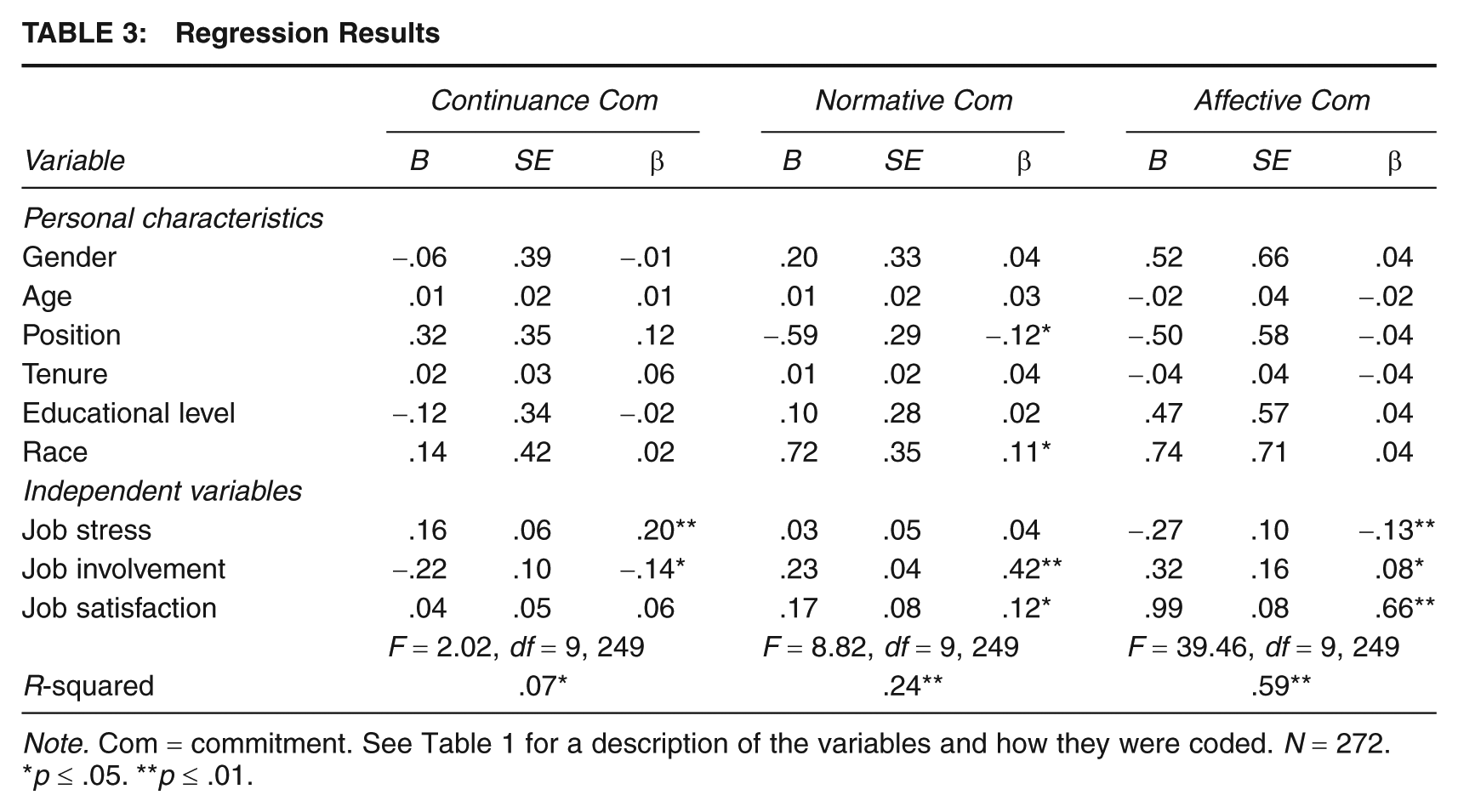
Note. Com = commitment. See Table 1 for a description of the variables and how they were coded. N = 272.
p ≤ .05. **p ≤ .01.
For the continuance commitment equation, the VIF scores ranged from 1.02 to 1.56, and the tolerance values ranged from .64 to .98. Based on the R-squared value of .07, the independent variables explained about 7% of the observed variance in the continuance commitment variable. None of the personal characteristics had a statistically significant association. Job stress had a positive relationship with continuance commitment, whereas job involvement had negative association. Job satisfaction was not a significant predictor of continuance commitment.
For the normative commitment equation, the VIF scores ranged from 1.02 to 1.56, and the tolerance values ranged from .64 to .98. Based on the R-squared value of .24, the independent variables accounted for approximately 24% of the observed variance in the normative commitment variable. Both position and race significantly influenced employees’ normative commitment to the organization. Compared to their noncustody colleagues, correctional officers reported lower levels of normative commitment. White respondents reported higher levels of normative commitment compared to responding non-White staff. Both job involvement and job satisfaction had positive associations with normative commitment. Based on the standardized regression coefficients (β in Table 3), job involvement had a larger sized effect on this form of commitment compared to that of job satisfaction. Job stress had no impact on employees’ normative commitment to the organization.
For the affective commitment equation, the VIF scores ranged from 1.02 to 1.56, and the tolerance values ranged from .71 to .98. Based on the R-squared value of .59, the independent variables explained about 59% of the observed variance in the affective commitment variable. None of the personal characteristics had a statistically significant association with affective commitment. Job stress, job involvement, and job satisfaction all had significant relationships with the dependent variable. As job stress increased, the level of affective commitment dropped. As job involvement and job satisfaction rose, so too did the level of this form of commitment. Based on the standardized regression coefficients, job satisfaction had the largest effect on affective commitment, much more so than either job stress or job involvement.
Discussion
Many but not all of the hypotheses were supported. The results of these analyses make clear that the type of organizational commitment being measured matters. A great deal of variation exists in terms of the impact of employee characteristics and the perception of the work environment on different types of commitment. Although not the focus of the study, two of the personal or sociodemographic characteristics significantly influenced one form of organizational commitment. Race and employee position had an effect on commitment but only in the case of normative commitment. White employees expressed increased levels of loyalty to the organization compared to their non-White colleagues, whereas corrections officers expressed lower levels of normative commitment than did the nonline staff employees. With White employees commonly making up a large majority of the staff working within correctional organizations, it is not surprising that research suggests prison organizations continue to be “highly racialized” environments wherein race significantly influences perceptions of the work environment (Britton, 2003; Griffin et al., 2005). In this study, only 19% of the staff was comprised of non-White employees. Perhaps an employee’s feelings of obligation and loyalty toward the organization are made more difficult when one is unsure of the organization’s own commitment to equitable treatment of employees regardless of race. The finding that corrections officers express lower levels of normative organization commitment supports research, both qualitative and quantitative, that corrections officers believe that administrators often fail to support them (Griffin, 2006a). Again, there is certain reciprocity to the notion of loyalty. If officers believe that administrators too often fail to support them, whether it is in regards to such matters as problems with inmate complaints or legal considerations, such officers may be less inclined to express high levels of loyalty to the organization.
Interestingly, none of the personal characteristics had a significant association with either affective or continuance commitment in the multivariate analyses. This suggests that once job stress, job involvement, and job satisfaction are taken into account, the personal characteristics measured in this study are not significant predictors of these two forms of commitment. It is unclear why this might be the case. As mentioned previously, individual-level variables are neither consistent nor strong predictors of employee attitudes in the correctional setting and often are used as control variables. On a more speculative note, this finding would suggest that those attitudes and beliefs an individual brings into the correctional organization are modified once organizational policies and informal norms are introduced, thus becoming less important to the formation of some types of commitment.
Of greater interest was the extent to which the impact of work environment factors varied based on the type of commitment examined. For example, of the three independent variables of interest, only job involvement had a significant impact on all three forms of organizational commitment, yet the direction of the relationship changed depending on the form of commitment examined. Job stress influenced only continuance commitment and affective commitment, and in each case, the direction of that relationship differed. Job satisfaction significantly influenced both normative and affective commitment, but the impact of job satisfaction on affective commitment was much greater than that on normative commitment. Finally, as noted earlier, only one type of commitment, normative, was influenced by personal characteristics of the employee.
Beyond the important finding that different forms of commitment are influenced differently by workplace experiences, what can be taken from these analyses? First, it is important to note the positive impact of job involvement on both normative and affective commitment. This suggests that bonding with the job appears to increase emotional bonds with the entire organization. Staff who connect with their jobs may feel an obligation or a sense of loyalty to the organization, which in turn increases the level of normative commitment felt by the staff member. Similarly, staff who express high job involvement may feel appreciation towards the organization for their jobs, and this appreciation increases the chances of forming an affective connection with the organization. Additionally, staff who identify with their jobs may see the organization in a more favorable light and may be more willing to bond with it. Interestingly, these analyses found that job involvement had a negative relationship with continuance commitment. At first glance, this relationship might appear counterintuitive. Why would an employee who reports a high level of identification with his or her job not also express a high level of commitment to the organization regardless of the nature of that commitment? Again, it appears that the nature of the commitment does matter and employees with high job involvement do not feel tied to the organization because of sunken costs. Perhaps those employees who report high levels of job involvement do not interpret their own commitment to the organization as being associated with a cost or a loss of investment if they were to leave. Instead, they reject what could arguably be viewed as negative reasons to remain associated with an organization and, due to their significant identification with their job, necessarily embrace a type of commitment that meets their moral and affective needs. This seems a reasonable interpretation given the relationship between job stress and the three forms of organization commitment.
Job stress had a positive association with continuance commitment, a negative association with affective commitment, and a nonsignificant association with normative commitment. Regarding the relationship between job stress and continuance commitment, it would seem doubtful that job stress would increase an employee’s commitment to remain with the organization. Perhaps this analysis tapped into what appears to be a complex relationship between stress and continuance commitment. Factors leading to an employee’s feelings of frustration and anger also may be associated with the feeling of being “trapped” in one’s job due to an inability to leave. The lack of control over one’s ability to leave a job can only create more stress and resentment. With this in mind, it does not seem reasonable to expect the opposite relationship—that low levels of job stress would lead to increased continuance commitment. A more fully articulated model, one that would allow for reciprocal relationships between stress and continuance commitment, would be better able to identify those specific factors leading to increased levels of stress that also may very well be related to one’s inability to leave a job.
The negative relationship between job stress and affective commitment does make intuitive sense, however. Job stress is a negative condition for most staff members. As the level of job stresses increases, the more likely staff will blame the organization for creating such a stressful work environment. In the end, this decreases the likelihood of forming an emotional attachment to the organization. It is not surprising that staff find it more difficult to bond with something that causes them psychological discomfort and pain. Of the three forms of commitment, affective represents the most voluntary form—staff form a bond with the employing organization because they want to and not because they must. Interestingly, there was no significant link between job stress and normative commitment. Normative commitment is based on the obligation principle—a person must commit to the organization because the organization has done something positive for them, such as employing them. This sense of obligation may not be easily affected by stress from the job. For example, a line officer may feel stress related to his or her job, but the duty to maintain safety and security of the institution remains. It is also important to remember that normative commitment is shaped in part by socialization experiences before a person is hired by the employer and thus perhaps less likely to be influenced by workplace stressors (Weiner, 1982).
Job satisfaction had no significant influence on continuance commitment. Again, due to the nature of continuance commitment, whether an employee is satisfied with the job may have little to do with whether or not he believes he is able to leave the job without significant loss. Job satisfaction did have significant and positive effects on both normative and affective commitment. The finding that job satisfaction is a significant predictor of normative commitment suggests that employees who enjoy their job feel a sense of obligation to commit to the organization. Staff who are satisfied with their jobs also may be more likely to see the organization in a positive light and, as such, may be more likely to form a voluntary affective bond with the organization. Job satisfaction not only had a positive impact on affective commitment, it had the largest impact of all the independent variables in the regression equation. This is consistent with prior research that has found job satisfaction to be one of the strongest predictors of affective commitment among correctional staff (Lambert, 2004). It should be noted, however, that job satisfaction was not the strongest predictor of normative commitment. In this study, job involvement had a larger significant impact on normative commitment than job satisfaction.
Importantly, the amount of variance accounted for across the equations differed greatly for the three forms of commitment. Little variance was accounted for in the continuance commitment model, whereas the other two models explained a larger percent of the variance, especially for the affective commitment model. This further strengthens the contention that the three commitment measures are separate concepts and are not affected similarly by the key work environment factors of job stress, job involvement, and job satisfaction. Additionally, such differences in explained variance, when added to the lack of association between continuance commitment and the other two forms of commitment, reinforce the idea that the mechanism by which continuance commitment is developed differs significantly from that of normative and affective commitment. Clearly, a different model is necessary to understand more completely the relevant predictors of continuance commitment in the correctional setting.
From a policy perspective, this study suggests that correctional administrators must understand that commitment to the organization is not one monolithic concept. Instead, commitment takes on many forms. Commitment may reflect a sense of loyalty, an emotional attachment, or an assessment of one’s investment. In each instance, differing sociodemographic characteristics and workplace factors influence an employee’s commitment to the organization. The generally weak predictive ability of personal characteristics could be viewed as good news for correctional administrators. Correctional administrators have little ability to alter personal characteristics but have much more control over conditions that affect job stress, job involvement, and job satisfaction. These findings also illustrate the need for correctional administrators to recognize that different strategies are necessary to increase different types of commitment among employees.
What remains unexplored is a more informed understanding of the relationship between organizational commitment and various outcomes and whether these relationships vary by the type of commitment being examined. For example, it makes theoretical sense that commitment would be negatively associated with turnover among correctional staff, but it not known if this relationship would vary based on the type of commitment examined. The research to date has noted a negative association between affective commitment and turnover intent, yet no published research could be found that examined the relationship of the other two forms of commitment with turnover intent or turnover. Most likely, one could argue that continuance commitment would have an inverse association with turnover since the investments made over time tie staff to the correctional agency. Since normative commitment stems from a sense of obligation, it is less clear how strongly this type of commitment would be related to turnover. Feelings of loyalty may be more easily swayed by other employment opportunities. Employees who remain tend to be those who elect to do so after having formed an affective attachment to the organization or have accrued, over time, too many sunken costs.
Although there is the need to understand, in a descriptive manner, how the different dimensions of commitment are related to various outcomes, it is perhaps more critical to recognize the ways in which the relationship between the three forms of commitment and work outcomes can be quite nuanced. For example, organizational commitment may be linked to lower staff turnover, but depending on the nature of that commitment, decreased turnover may be viewed as either a positive or negative outcome. If one chooses to remain with an organization due to a sense of loyalty or a sense of affection, such attitudes may bring with them other prosocial behaviors. Remaining with the organization because one feels he or she is unable to leave due to investments made in the organization may elicit negative consequences. Similarly, increased levels of affective commitment are associated with low levels of burnout among correctional staff, whereas increased levels of continuance commitment appear to increase burnout among correctional staff (Lambert, Hogan, & Jiang, 2008). Clearly, there are significant implications for the organization depending on what type of commitment is promoted. This study, supporting previous studies that incorporate multiple measures of commitment (e.g., Lambert, Hogan, & Jiang, 2008), highlights the finding of continuous commitment as the “odd man out.” In his discussion of the theory of side bets, Becker (1960) argued “that people often follow lines of activity for reasons quite extraneous to the activity itself” (p. 40). This suggests that the mechanism that produces continuous commitment and the factors that influence this type of commitment may very well reflect nonorganizational factors, ones not included in this model.
This study, of course, has limitations. First, it was a single preliminary study based on a survey of staff at a state-run maximum-security correctional institution. The generalizability of the study’s findings must take into consideration contextual and situational differences, and relationships among variables may vary across regions of the country as well as by type of facility (e.g., adult, juvenile, public, private, jail, security, level). As previously indicated, the cross-sectional design used precludes demonstrating a causal relationship. Longitudinal designs will need to be used to demonstrate the casual process for the various forms of organizational commitment. Furthermore, since only limited measures of normative and continuance commitment were used in this study, future researchers should consider using more detailed measures of each form of commitment. Additional research also is necessary to explore the relationship of other factors with organizational commitment. This is particularly true of continuance as the majority of the variance was unaccounted for in the regression equation. Taken as a whole, this study adds to the limited extent literature providing the framework for further examination of such issues by illustrating the complex nature of this multifaceted notion of organizational commitment.
A consistent theme across recent research exploring the correctional work environment highlights the importance of workplace factors in shaping employee behavior, influencing such areas as loyalty and commitment to the organization. It is not apparent, however, the extent to which such findings have been incorporated into the correctional setting. Facing increasingly limited budgets, it is clear that prison administrators must consider alternative means for maximizing positive staff behavior in an effort to minimize costly negative behaviors (e.g., absenteeism, burnout, and turnover). These staff behaviors may ultimately put the safety and security of the institution at risk. A better understanding of how commitment among staff functions within the organization may provide prison administrators with additional tools to address such serious workplace problems.
Footnotes
Appendix
All the below items were answered using a 5-point Likert-type scale of strongly disagree (coded 1) to strongly agree (coded 5). In parentheses after each item is reported the factor loading for the items from a principal axis factor analysis.
Authors’ Note:
The authors thank Janet Lambert for editing and proofreading the article. The authors also thank the anonymous reviewers and the editor for their comments and suggestions. These comments and suggestions improved the article. All the authors contributed equally and are listed in random order.