




Abstract
A dearth of scientific knowledge currently exists regarding human nonverbal predictors of violence. Using a sample of 178 adults, this study sought to identify a series of nonverbal behaviors the research participants perceived to be associated with the communication of imminent violence. Assuming a boxer’s stance, invading personal space, clenched hands, and threatening remarks were almost uniformly associated with impending violence. Several other gestures and behaviors were also perceived to be associated with violence to a lesser degree. Behaviors least perceived to be associated with violence were crying, rapid eye blinking, placing hands on hips, and avoiding eye contact. Analyses by sex and race found only minor, and substantively insignificant, differences, suggesting these perceptions may be innate rather than cultural.
Members of the animal kingdom rely on nonverbal cues to communicate threats of violence and defend territory. Animals make sounds, change color, puff up their bodies, or move about in a particular manner (Bradbury & Vehrencamp, 2011). These nonverbal displays of warning to potential rivals and predators are biological in origin (Dugatkin, 2008; Hickson & Stacks, 2010) and can often be understood by both the animal’s own species and other species with which it commonly interacts (Bradbury & Vehrencamp, 2011; Dugatkin, 2008). Humans may also have standard ways of nonverbally communicating to others threats of impending violence.
Identifying the nonverbal cues humans use to warn others of their growing aggression levels could be important for research and practice in criminal justice and psychology. Such knowledge could help criminal justice and mental health professionals recognize when a client is posing a potential threat. Such knowledge could better inform research and therapy with chronically violent persons, helping them identify their own behavioral precursors of violence. It could also be useful in educational programs for those with autism, or brain injuries to the frontal lobe, who have difficulty naturally interpreting the social meanings behind the nonverbal cues of others.
To explore the possibility of generalized cues to human aggression, the present study examined adult human perceptions of nonverbal cues potentially indicative of impending violence. Using a racially diverse sample of 178 adults, the research participants were presented with a verbal argument scenario and a list of potential nonverbal behaviors their opponent could display. Participants indicated the level of concern about impending violence each nonverbal behavior would create, in order to identify which cues were associated with potential violence in the mind of the research participants. Sex and race differences were explored to determine if impressions of these cues were driven by the sex or cultural heritage of the observer.
Review of the Literature
Over the last half-century, there has been steady growth in research related to nonverbal cues in human communication in various social contexts. Just a sampling of the diverse contexts studied include relations between superiors and subordinates (Hall, Coates, & Smith-LeBeau, 2005), classroom teaching (Guerrero & Miller, 1998), employment interviews (Gifford, Ng, & Wilkinson, 1985), marital relations (Noller & Feeney, 1994), flirting (LaFrance, Henningsen, Oates, & Shaw, 2009), medical care providing (Hall, Roter, & Katz, 1988), and medical care seeking (Roter, Frankel, Hall, & Sluyter, 2006).
Some of the research on perceptions of nonverbal cues has included criminal justice contexts. Studies of courtroom behavior have included the reliance on nonverbal cues by attorneys during the jury selection process (Leiberman & Sales, 2007) and the influence of nonverbal cues on juror impressions of prosecutors and defense attorneys during opening and closing statements at trial (Barge, Schlueter, & Pritchard, 1989). Shoretz (1995) examined how the nonverbal behaviors of judges could bias jurors during trials, and Salekin, Ogloff, McFarland, and Rogers (1995) explored juror perceptions of the nonverbal cues displayed by defendants during trial. A large body of research has also developed regarding the reliance on nonverbal cues by criminal justice actors to detect deception (Akehurst, Kohnken, Vrij, & Bull, 1996; Johnson, 2006, 2007; Stromwall & Granhag, 2003; Vrij & Semin, 1996).
It is unusual and unfortunate, therefore, that the topic of nonverbal predictors of violent behavior has been neglected. Exhaustive searches in 2011 within the Criminal Justice Abstracts, PsycINFO, Social Science Abstracts, and Google Scholar databases revealed little research regarding nonverbal cues associated with violent behavior. To date, the existing research regarding nonverbal cues and violence has dealt with displays of anger and aggression in experiments with preschool and elementary school children.
Hubbard (2001) studied the emotional displays of 111 African American second-graders while playing board games with a peer. She measured aggression as displays of anger emotion, measured in facial expression, verbal intonation, and body movements. Facial displays of anger were described as “inwardly furrowed eyebrows and mouth set in a hard line” (Hubbard, 2001, p. 1430). Verbal intonations denoting aggression were described as using a “forceful, growling voice” (p. 1431). The body movements she associated with anger, however, included both displays of anger and behaviors that would be classified as violence by the criminal justice system if committed by an adult. The behaviors she measured included what she called “nonverbal teasing” (pointing and laughing or making faces), stomping feet, pretending to cry, slapping one’s own head, and punching one’s fist into one’s open hand. She also measured violent behaviors such as throwing objects, damaging property by hitting or kicking it, and threatening peers by swinging a fist toward the peer’s face (p. 1432). She found that the children were more likely to display these behaviors when they were rejected by their peer or were losing the game. Male students were also more likely to display these cues than were female students (Hubbard, 2001). No attempt was made, however, to explore any relationships between the anger cues and actual violent actions.
In a later study by Hubbard and her associates, a racially diverse sample of 272 second-graders participated in an experiment where the children lost a board game and prize to a confederate peer (Hubbard et al., 2002). The same measures of aggression were used, with the addition of physiological measures of skin conductance (sweating) and heart rate. Most of the students responded to being cheated by increases in all of the nonverbal aggression measures, including displaying increases in heart rate and skin conductivity. Males displayed aggression at a greater rate than females, but race differences were statistically insignificant (Hubbard et al., 2002). Unfortunately, no examination was made of the students’ perceptions of these nonverbal behaviors or their links to the occurrence of the actual violent acts. Nevertheless, Hubbard’s studies provided a collection of specific nonverbal measures that could be tested for their associations with violent behavior.
In a step toward linking nonverbal behavior cues to aggressive acts, Arsenio, Cooperman, and Lover (2000) studied affective predictors of aggression in a sample of 51 preschool students. They measured angry affective indicators of impending aggression as increases in voice volume with a harsh demanding quality, negative verbal attacks (such as “I hate you!”), narrowing of the eyelids, lowered brows, lips pressed together, slightly lowered head, tensed posture, and clenched fists (p. 441). Aggression was measured as any act in which the child deliberately bit, kicked, hit, or otherwise tried to hurt another person, or verbally insulted or derogated another. They found that, after controlling for each child’s baseline for aggressive acts, increases in angry affect predicted verbal and physical acts of aggression, with a beta value of .44 (Arsenio et al., 2000).
Because so few studies on this area of human nonverbal communication exist, searches of the nonscientific literature were also made to identify what cues, if any, popular culture associated with impending violence. A 2011 Google search of the World Wide Web using the search terms nonverbal predictors of violence returned 3.67 million website hits. The only scientific information revealed by these websites dealt with social predictors of violence, such as a history of previous violence, substance abuse, or personality disorders (e.g., Burt & Donnellan, 2008; Swanson et al., 2008). None of the scientific literature discussed nonverbal predictor cues of impending violence. Nonscientific Internet sources for information on nonverbal predictors of impending violence, on the other hand, were prolific.
Dozens of websites devoted to how to read body language discussed, among other forms of body language, nonverbal cues associated with violence and aggression. Literally hundreds of websites devoted to martial arts, street smarts, and other forms of self-defense discussed nonverbal cues used to detect an impending attack from another person. Many websites devoted to occupational fields such as policing, corrections, emergency medical care, mental health, education, and human resources discussed how to use nonverbal cues to determine when a client is about to become violent. Across all these forums, it was often stated that the nonverbal cues described stemmed from “scientific research,” yet not one of these statements was accompanied by a reference to this “scientific research.”
The nonverbal cues described in these Internet sources were numerous, with some even contradictory of others (such as avoiding eye contact and staring someone in the eye). The author reviewed a nonrandom sample of 200 of these websites and analyzed the content they contained. The nonverbal cues encountered most frequently on these websites included the following: jutting out jaw, flushed face, tightened face or jaw muscles, throbbing veins in temple or forehead, flared nostrils, rapid breathing scowling, glances around, stares you in the eye, avoids eye contact, blinks eyes rapidly, raises voice, screams, cries, makes verbal threats, violates personal space, body muscles tense up, takes a boxer’s stance, lowers center of gravity, removes unnecessary clothing, places hands on hips, places hands in pockets, exaggerated hand gestures while talking, stretches arms and shoulders, performs head and neck stretches, clenches fists, and sweats profusely.
To summarize the existing literature, there has been little scientific study of nonverbal cues associated with impending physical aggression. The little research that does exist has examined only a limited number of nonverbal indicators, dealt primarily with young children, and some failed to examine gender, cultural, or racial variation in behavior. The popular, nonscientific literature has suggested a wide array of nonverbal cues as predictive of violent behavior, many of which are contradictory. Finally, although the nonscientific sources claim these cues are based on scientific studies, no such studies were found. The present study, therefore, sought to begin to fill this void in the social scientific literature by examining the conscious perceptions of nonverbal cues of assault held by adults. Because sex and race differences were often revealed in previous studies concerning the interpretation of nonverbal cues (Elfenbein & Ambady, 2002; Hall, 1990; Johnson, 2006, 2007; LaFrance et al., 2009; McClure, 2000; Weathers, Frank, & Spell, 2002), it also sought to examine the possibility of racial differences based on cultures of origin, in the perceptions of these nonverbal cues.
Method
To explore adult perceptions of nonverbal cues associated with impending violence, adult test participants were presented with an interpersonal conflict scenario and then answered questions about several nonverbal behaviors by indicating how concerned they would be that the other party was about to become violent. The descriptive statistics were analyzed to identify which of the cues, if any, the respondents perceived as predictive of aggression and which they did not. Finally, bivariate analyses were conducted to examine any potential variation in the responses by race and sex of the respondents.
Participants
The participants in this study were 178 university students who volunteered to complete the questionnaire for extra credit. The respondents ranged in age from 17 to 30 years old, with a mean age of 20 years old. Fifty-six percent of the sample was male. Seventy percent of the respondents indicated they were Caucasian, 20% African American, 7% Hispanic/Latino, and all other categories (Asian, Native American, Middle Eastern, and “other”) made up 3% of the sample. Each respondent was asked to complete the survey and told the survey dealt with their perceptions about interpersonal conflict. Each respondent also read and signed a consent form to participate. The respondents completed the surveys in the presence of the researcher and returned the questionnaires directly to the researcher.
Instrumentation
The questionnaire instrument presented each respondent with the same, interpersonal conflict scenario, followed by questions about 23 nonverbal cues that may be associated with impending violence. The conflict scenario was intentionally left ambiguous with regard to the age, race, gender, or social status of the aggressor in the scenario to collect general data on nonverbal aggression cues. The purpose of the scenario was to set the context for a violent altercation with an acquaintance, stemming from an argument. It was intended that specific aggressor characteristics, such as race, age, and sex, would be introduced in later studies, once generalized findings were determined. The conflict scenario was presented in the questionnaire as follows: Imagine that you are in a verbal argument with another adult acquaintance. At this point, the argument is only verbal in nature, but you both strongly disagree with each other. You are both becoming very angry. Below are a number of behaviors you might witness in the person with whom you are arguing. For each of these behaviors, please indicate on a scale from one to seven how concerned you would be that the other person is about to become physically violent. Please circle the level of concern you might have, with a one indicating no concern the person will become violent, and seven indicating that you would be very concerned that the person will become violent.
This text was followed by a list of 23 behaviors that may be associated with impending violent behavior. The behaviors selected for the questionnaire included nine behaviors identified by the limited, previous empirical research. These behaviors were found in both the empirical research (Arsenio et al., 2000; Hubbard, 2001; Hubbard et al., 2002) and the nonscientific material found on the Internet. They included frowning, yelling, crying, sweating, increasing respiration, making verbal threats, clenching hands, violating personal space, and tensed posture. Another 14 behaviors were also added to the questionnaire from the behaviors encountered most consistently in the nonscientific, Internet sources. These included removing unnecessary clothing, blinking eyes, tense jaw muscles, flushed face, hands on hips, exaggerated hand gestures, stretching arms or shoulders, stretching neck, glancing around, hands in pockets, pacing, staring in the eyes, avoiding eye contact, and taking a boxer’s or fighter’s stance. 1
For each behavior described, the respondents were expected to rank their level of concern that their acquaintance was about to become violent, using a 7-point scale ranging from no concern on the low end to very concerned on the high end. The survey instrument concluded with questions collecting data on the respondents’ sex, age, and race.
Procedure
The survey was administered to students for extra-credit in three sections of an introductory criminal justice course at a large urban university in the Midwestern United States. The surveys were completed after the completion of a course examination. Each respondent completed the survey in less than 10 minutes, suggesting the respondents did not spend an extended amount of time contemplating their responses. This was considered beneficial as it implied the respondents based their answers on first instinct rather than intellectual reasoning. The surveys were completed in the classroom and returned to the researcher who remained present in the room.
After the data from the questionnaires were entered into SPSS, univariate statistics were calculated for each of the 23 behaviors measured. The means and standard deviations were examined to determine which behaviors the respondents perceived were associated with violence potential and which were not. Bivariate analyses were then conducted to determine if sex or race differences existed in perceptions of the violence potential of each behavior.
Results
Table 1 presents the univariate, descriptive statistics for each of the 23 behaviors examined. The behaviors are grouped by categories (muscle cues, facial characteristics, body movements, vocal sounds, and physiological changes) to improve readability of the data. As Table 1 reveals, wide individual variation existed between the respondents. All of the behaviors examined in the questionnaire caused at least some of the respondents to be very concerned their opponent would become violent, as all of the behaviors had at least one respondent rate the behavior a 7. Interestingly, 19 of the behaviors also had minimum scores of 1, meaning these behaviors caused some of respondents no concern. Examination of the mean scores also revealed that 19 of the 23 behaviors had means in the upper half of the scale (means greater than 3.5).
Univariate Descriptive Statistics for Entire Sample (N = 178)
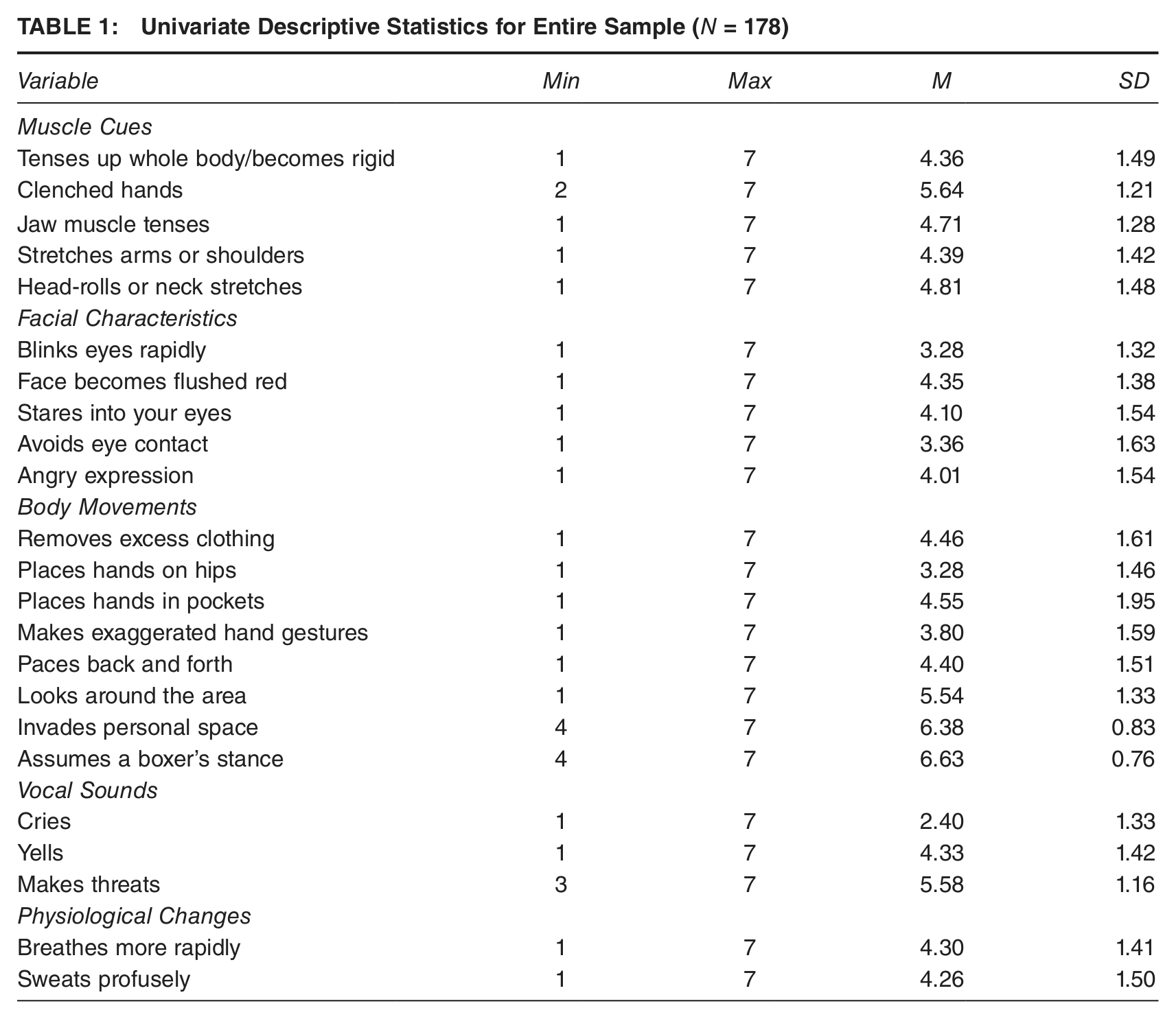
Invading personal space and taking a boxer’s stance stood out as the behaviors most strongly associated with concerns about violence. These two behaviors were the only behaviors with mean scores above 6 (ranging from 4 to 7) and standard deviations of less than 1. Eighty-four percent of the respondents scored invading personal space as a 6 or 7, and 90% scored taking a boxer’s stance as a 6 or 7. This suggests the sample universally accepted that violating personal space or taking a boxer’s stance in the middle of an argument signaled potential violence.
Three other behaviors associated with strong perceptions of potential violence were making verbal threats, clenching hands, and glancing around the area, as all three of these behaviors produced mean values above 5. More than half of the respondents rated each of these three behaviors as a 6 or 7. Another 13 behaviors produced midrange mean scores between 4.0 and 5.0. These included (in order from highest to lowest mean scores) head-rolls/neck stretches, tense jaw, hands in pockets, removing clothing, pacing, stretching arms/shoulders, tensing body, flushed face, yelling, breathing rapidly, sweating profusely, staring in the eye, and scowling. Of these 13 behaviors, head-rolls/neck stretches, tense jaw, hands in pockets, removing clothing, pacing, and stretching arms/shoulders each had more than half of the respondents scored them as a 5 or higher.
As 4 was the scale midpoint, the mean scores of the remaining five behaviors indicated that they generally produced little concern about violence. These five behaviors had mean scores ranging from 2.4 to 3.8. Crying, blinking eyes rapidly, hands on one’s hips, avoiding eye contact, and making exaggerated hand gestures when speaking raised low to moderate concerns about violence among the respondents. Sixty-two percent of the respondents scored crying as a 1 or 2, and it had the lowest mean value. Placing hands on hips and avoiding eye contact each had a third of respondents rank them as 1 or 2.
Sex Differences
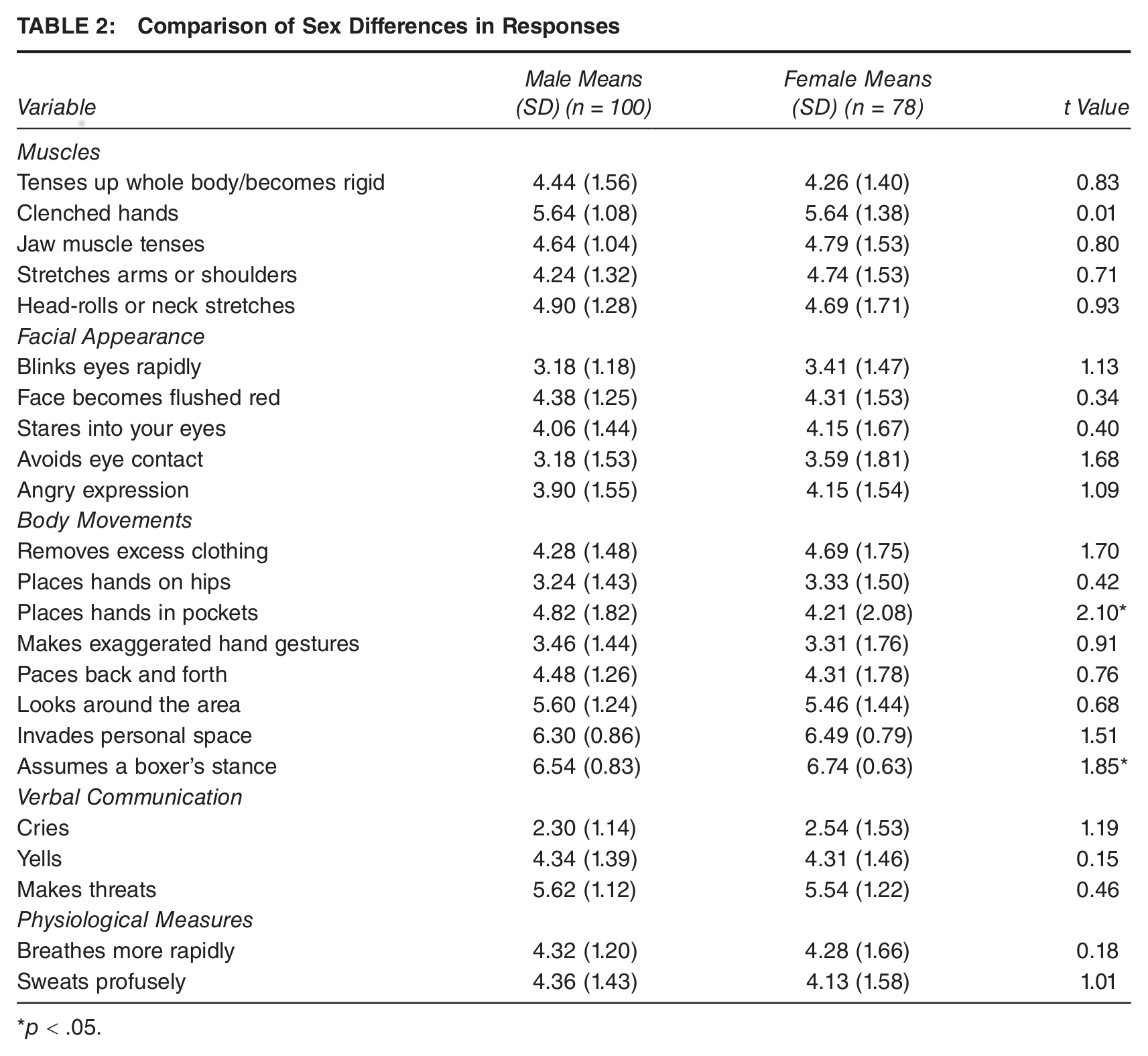
The mean scores for these 23 behaviors were then compared between the males and females in the sample to determine if sex differences existed. Several studies have revealed sex differences in the use and interpretation of nonverbal cues in other contexts (Hall, 1990; LaFrance et al., 2009; McClure, 2000), so it was determined prudent to explore the possibility of sex differences in the perceptions of nonverbal cues associated with violence. Table 2 reveals the mean scores on each behavior for the male and female respondents and t test results of each comparison of means test. As Table 2 reveals, only two statistically significant differences were revealed between male and female perceptions. Men were slightly more likely to be concerned about placing one’s hands in one’s pockets, and women were slightly more concerned about persons who assumed a boxer’s stance. Although these differences were statistically significant, their substantive differences were small. Regarding hands in pockets, the male and female means only differed by 0.61 points on a 7-point scale. The difference for the boxer’s stance was even less at 0.20. These results suggest little difference exists between male and female interpretations of nonverbal cues associated with violence.
Comparison of Sex Differences in Responses
p < .05.
Race Differences
Race differences regarding nonverbal cues, often tied to cultural heritages, have been revealed in a number of studies (Elfenbein & Ambady, 2002; Johnson, 2006, 2007; Weathers et al., 2002). Racial differences have been found in both the displays of certain nonverbal cues and in how certain cues are interpreted (Johnson, 2007; Vrij & Winkel, 1992; Weathers et al., 2002). This prior research suggested that an examination of racial differences in the present study would be appropriate. Of the 178 respondents in the sample, 124 indicated their race was Caucasian, 36 African American, and 12 Hispanic/Latino. The remaining six were a mixture of Asians, Native Americans, and those who selected “other.” Because of the low representation of other groups, only the Caucasian, African American, and Hispanic respondents were examined for between-group differences.
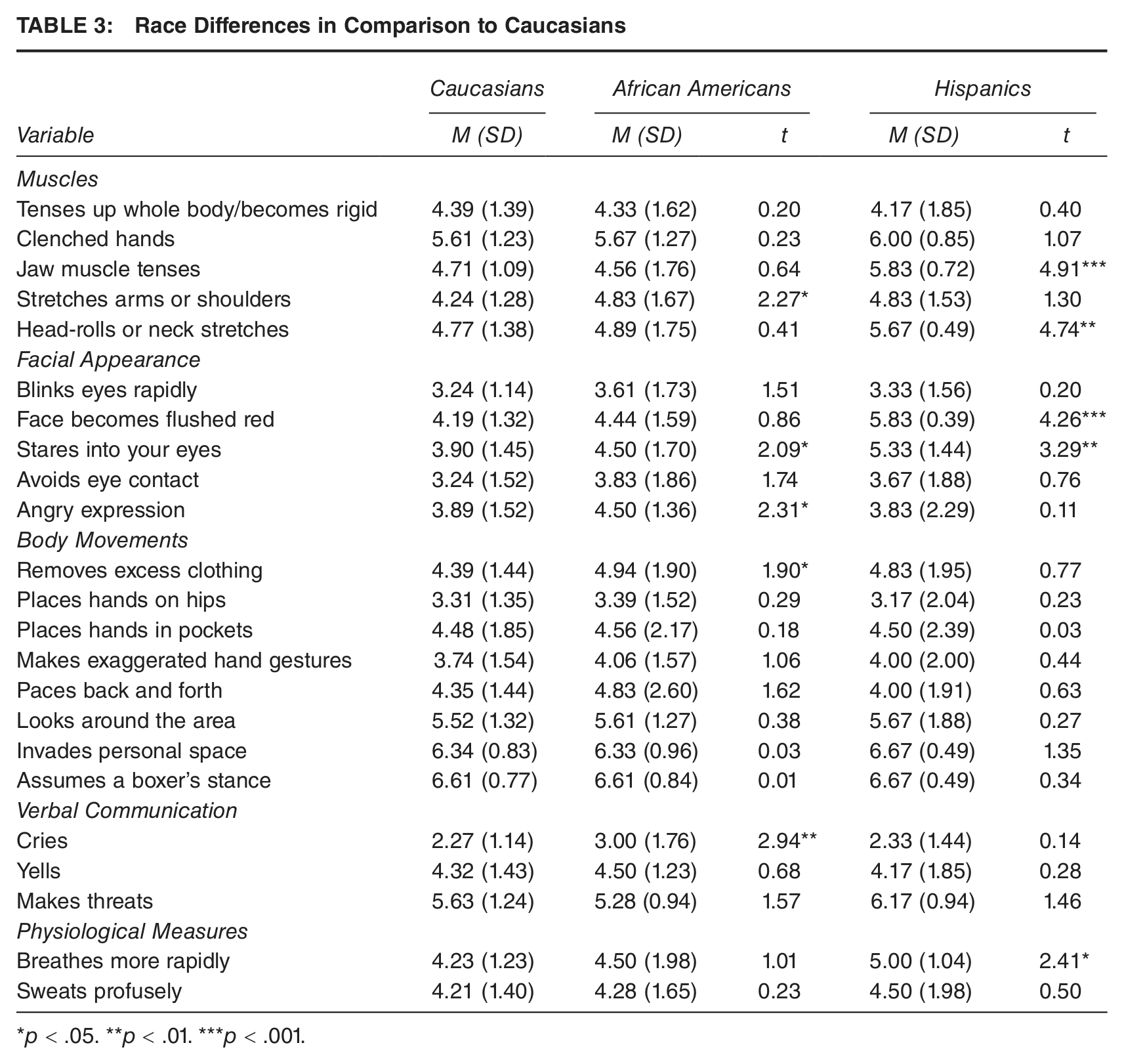
Using the most dominant group as the reference group, t tests were calculated for each behavior by comparing African American responses to those of the Caucasian respondents and Hispanic responses to those of the Caucasians. The groups’ mean scores and the results of these t tests are displayed in Table 3. Using the Caucasian respondents as the reference category, the African American respondents revealed several statistically significant differences in their scoring on five of the behaviors associated with potential violence. The African American respondents in this sample generally rated stretching arms, staring in the eye, scowling, removing extra clothing, and crying as more concerning than did the Caucasian respondents. These differences, while statistically significant, were all rather small in substantive differences. On the behavior with the greatest magnitude of mean difference—crying—the African American mean score was only 0.73 points higher than the Caucasians’ mean score. All of the statistically significant mean score differences were differences of less than 1 point on the 7-point scale.
Race Differences in Comparison to Caucasians
p < .05. **p < .01. ***p < .001.
The differences between the Caucasian respondents and the Hispanic respondents, however, were more substantial. The Hispanic respondents found a tense jaw muscle, head/neck stretches, flushed face, staring in the eye, and rapid breathing more threatening than did the Caucasian respondents. These five differences were statistically significant, and their mean differences from Caucasians ranged from 0.77 to 1.64. The Hispanic mean for tense jaw muscles was 1.12 points higher than that of the Caucasian respondents, the mean for staring in the eyes was 1.43 points higher, and a flushed face 1.64 points higher than the means for Caucasians. 2
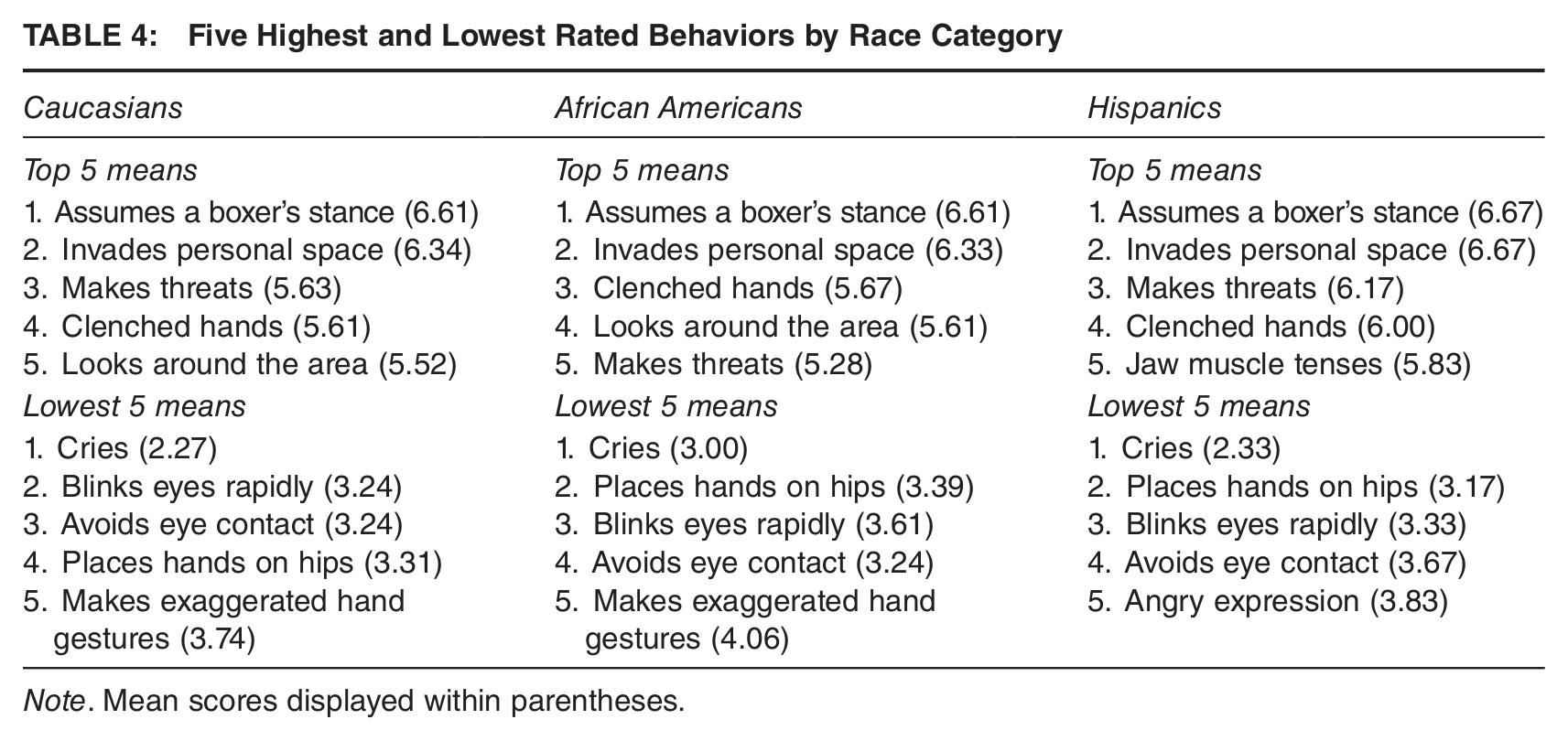
Regardless of these individual mean score differences, similarity was found across all three racial groups in the five highest scored and five lowest scored behaviors associated with potential violence. Table 4 lists these highest and lowest scoring behaviors and their mean values for each racial group. As this table reveals, minor ordering differences existed between the Caucasian and African American top and bottom five behaviors, but both lists contained the same behaviors for both races. Four out of five behaviors in both the top and bottom five for Hispanics were also shared by Caucasians and African Americans. All three racial groups were most concerned about violence when the opponent assumed a boxer’s stance, invaded personal space, made threats, or clenched hands. They were all also least concerned by crying, hands on hips, rapidly blinking eyes, and avoiding eye contact.
Five Highest and Lowest Rated Behaviors by Race Category
Note. Mean scores displayed within parentheses.
Where the Hispanic respondents differed from the other two groups in the top five behaviors involved looking around the area and having tense jaw muscles. Caucasians and African Americans perceived the potential assailant looking around the area more threatening than did the Hispanic respondents. Conversely, the Hispanic respondents found tensed jaw muscles as more threatening than did the African American and Caucasian respondents. Among the Hispanic respondents, an angry scowl expression was one of the five least threatening behaviors, while not so for the Caucasians and African Americans. Alternatively, Caucasians and African Americans perceived exaggerated hand gestures as among their least threatening gestures. This reveals, yet again, minor differences between Hispanics and the other two groups in their perceptions about these behaviors and violence.
Discussion
This study involved an initial, descriptive analysis of adult perceptions regarding 23 nonverbal behaviors suggested to be predictive of violence. In spite of the descriptive nature of this study, five specific conclusions can be drawn from the findings. The first of which was that individual variation between persons, regardless of their ascribed characteristics, is substantial. The range of responses given for 19 of the 23 behaviors ranged from 1 to 7. In other words, at least one respondent felt no concern about the behavior, while at least one respondent felt the maximum amount of concern. When generalizations are made about these nonverbal cues, therefore, one must always remember the existence of individual variation.
Second, in spite of individual variation, generalizations can be made about which behaviors are recognized as associated with violence. Specifically, taking a boxer’s stance and/or invading someone’s personal space in the context of an argument can almost certainly be interpreted as threatening violence. Clenching one’s hands (which is essentially making fists) and making verbal threats also are very likely to be perceived as signs a person is at least considering violence. In fact, most of the behaviors examined here created at least a moderate level of concern in the majority of the respondents.
Third, assumptions can be made about which behaviors are not generally perceived as indicative of potential violence. Crying is clearly an intense display of emotion, but it was not very strongly associated with concerns about violence, even in the context of an argument. Placing one’s hands on one’s hips, while possibly a sign of frustration or disgust in Western culture (Dimitrius & Mazzarella, 2008; Pease & Pease, 2006), also failed to raise concerns about violence for most of the respondents. Likewise, rapidly blinking one’s eyes was of little concern to the majority of the sample, and avoiding eye contact, often considered a sign of deference (Dimitrius & Mazzarella, 2008; Pease & Pease, 2006), did little to arouse the respondents’ concerns.
The fourth conclusion that may be drawn from this study was that men and women differ little in their perceptions of cues related to violence. On only two of the behaviors were male and female respondent differences statistically significant, yet the substantive differences on these two behaviors were minor. Despite the many previous studies that revealed sex differences in the display and interpretation of nonverbal cues (Hall, 1990; LaFrance et al., 2009; McClure, 2000), cues related to displays of human aggression may be so primal that they transcend any sex differences. In order to survive, early humans of both sexes may have learned how to detect danger signs from other humans.
Fifth, mild differences do exist between races in their perceptions of behavior cues associated with violence. The Caucasian and African American respondents in this sample were similar in their responses, and the five statistically significant differences were minor in their substantive differences (less than a whole point difference in their mean scores). This finding may reveal the extent of cultural integration experienced by the respondents, with both groups having grown up in a shared cultural setting in multigenerational American families. The differences presented by the Hispanic respondents, however, suggest that real cultural differences may still exist. Some studies have demonstrated that one’s culture mediates one’s display and interpretation of nonverbal cues (Elfenbein & Ambady, 2002; Johnson, 2006, 2007; Vrij & Winkel, 1992; Weathers et al., 2002). It could be that the Hispanic respondents in this study had formative experiences less integrated into mainstream culture in the United States, due to being fewer generations removed from their ancestral nations. Even though small variations by race were detected, the findings did suggest that to some degree there are universal perceptions about these violence cues that may be innate survival instincts.
As with all studies, however, this one had its limitations that must be considered when contemplating the study’s results. First, the analysis was limited by the small sample size and diversity. The findings for African Americans were based on 36 respondents, and only 12 respondents for Hispanics, all of which were university students living in the Midwestern United States. Other racial groups beyond African Americans and Hispanics were too few to analyze. Furthermore, as most differences in perceptions and interpretations of nonverbal communication tend to be culturally derived (Elfenbein & Ambady, 2002; Elfenbein, Beaupre, Levesque, & Hess, 2007), using race categories might not have tapped the full extent of cultural differences. For example, Caucasians and African Americans who grew up in the same neighborhood and interacted with a multiracial environment might share the same cultural interpretation of nonverbal cues regardless of race.
Another important aspect of this study that must be considered is that the scenario we presented to the respondents set the context of a heated, interpersonal conflict. All of the results must be considered within that context, as context likely had great influence over how the behaviors were interpreted. For example, while invading personal space uniformly raised concerns about potential violence in a conflict context, it would not likely be the case in a scenario where the acquaintance was attempting to show empathy by offering a hug. Although assuming a boxer’s stance during a conflict was perceived by most in this study to be a signal for potential violence, doing so in the context of describing a fight one saw in a movie, or intended as joking around, would probably elicit different perceptions from the observer.
A third consideration is the lack of controls regarding each respondent’s past experience with violent conflict. It is unknown how often the respondents had encountered violent confrontations in their lives and if different experiences with violent conflict may have influenced the perceptions measured here. For example, would a person who has engaged in many street fights in his life perceive these behaviors in the same manner or intensity as someone who has never been in a physical fight? The current data did not permit the examination of this issue.
Finally, it is important to remember that this initial, exploratory study dealt with cognitive perceptions of behaviors predictive of physical violence. These cognitive perceptions may, or may not, be consistent with unconscious, instinctual reactions to these behaviors. Furthermore, human perceptions that certain behaviors are indicative of potential violence do not prove their validity. Humans could very easily be incorrectly interpreting specific nonverbal cues as hostile signals when, in fact, they are not. This would not be surprising given the amount of conflict and violence throughout human history. Unfortunately, the present study was unable to address the validity of the true predictive nature of these behaviors.
Nevertheless, these findings have practical usefulness in many areas. First, knowledge of the nonverbal behaviors associated with violence potential could aid individuals who often work in environments with volatile clientele. Correctional staff, police officers, security guards, emergency medical personnel, mental health professionals, and teachers may find this knowledge useful when trying to defuse potentially explosive interpersonal conflicts. Second, those who educate and counsel persons with diminished abilities to interpret nonverbal cues naturally may find these findings helpful. Persons with autism (Mundy, Sigman, Ungerer, & Sherman, 1986; Vivanti et al., 2011), and those who have suffered injuries to the frontal lobe of their brains (Corbett, Jefferies, Ehsan, & Lambon-Ralph, 2009; Rolls, Hornak, Wade, & McGrath, 1994), often do not detect or interpret nonverbal social cues in the same manner as neurotypical persons. Educating individuals such as these about which behaviors to avoid displaying in a conflict situation may prove very helpful to improving their quality of life.
Finally, the findings of the present study open the way for many forms of future research. Chronically violent individuals could be studied to determine if they perceive these nonverbal cues in the same manner as less violent people. It is possible that chronically violent individuals are either unaware of the aggressive nonverbal cues they display (seeing themselves as victims of others’ hostility) or grossly misread the nonverbal cues displayed by others interpreting nonhostile behaviors as aggressive ones.
Further research is needed to determine if persons with experience with interpersonal violence, such as boxers and other martial artists, police officers, and corrections officers, perceive the nonverbal behaviors differently than those who lack personal experience with violence. Lastly, further research is needed to examine the actual validity of these behaviors in predicting human violence as perceptions may not match reality. Perhaps security camera footage of violent incidents in prisons or bars could be analyzed in a frame-by-frame nature to examine if the parties actually displayed any of these nonverbal cues before the violence erupted.
In conclusion, the present study revealed that adults associate many nonverbal cues with concerns about potential violence in the context of an argument. Some behaviors were more concerning than were others, while a few behaviors were of little concern at all. Only minor race and sex differences existed in perceptions held about these nonverbal behaviors. This implies that perceptions about aggression nonverbal cues may be innate more than culturally based.