



Abstract
The Static-99 is the actuarial risk assessment instrument most commonly used and best validated for sexual offenders. Some research has indicated that the original version of the instrument does not sufficiently cover the influence of age-related decreases in recidivism risk of sexual offenders. Therefore, an age-corrected version, the Static-99R, has been proposed. It includes four age categories compared with only two in the original instrument. The purpose of this study was to examine the influence of several age-related variables on the predictive accuracy of the German version of the Static-99 using a population-based sample of prison-released sexual offenders (N = 1,077). The results indicated that—for the prediction of sexual reoffenses in a population-based prison sample—the original Static-99 performed better than the age-corrected Static-99R. Theoretical and empirical implications for research as well as recommendations for applied risk assessment settings are discussed.
Despite substantial research effort during the last 20 years, the assessment of risk in sexual offenders is still one of the most difficult challenges in the field of forensic psychology and psychiatry. Different assessment methods and scientific approaches have been described aiming to improve risk assessment. As in other areas of psychological prediction, practice, and research, empirical results indicate that structured and standardized risk assessment instruments are more accurate in predicting recidivism than unstructured prediction methods (e.g., Bonta, Law, & Hanson, 1998; Dawes, Faust, & Meehl, 1989; Grove & Meehl, 1996; Grove, Zald, Lebow, Snitz, & Nelson, 2000). Recently, meta-analytic research has shown that this is also true for sexual offenders (Hanson & Morton-Bourgon, 2009). In particular, actuarial risk assessment exhibited a higher predictive validity compared with unstructured risk assessment approaches as well as standardized clinical-idiographic methods. Nevertheless, actuarial risk assessment instruments are still objects of criticism (e.g., Boer & Hart, 2009; Craig, Browne, Stringer, & Beech, 2004; Litwack, 2001; Rogers, 2000). The most obvious objections are the lack of an underlying theory, the predominance of static (i.e., unchangeable) items, and, thus, the lack of idiographic information which could trigger future intervention strategies. However, not only because of the high validity of actuarial instruments but also as a result of their easy applicability, actuarial risk assessment is regarded as state of the art in many countries (e.g., Helmus, Hanson, & Morton-Bourgon, 2011).
The Static-99 (Hanson & Thornton, 2000) is the actuarial risk assessment instrument most commonly used and best validated for sexual offenders (e.g., Anderson & Hanson, 2010; Archer, Buffington-Vollum, Stredny, & Handel, 2006; Hanson & Morton-Bourgon, 2009). The instrument consists of 10 static risk factors: age when exposed to risk, any live-in intimate relationship for 2 or more years, any index offense of nonsexual violence, prior offenses of nonsexual violence, prior charges or convictions for sexual offenses, prior sentencing dates, any convictions for noncontact sexual offenses, any unrelated victims, any stranger victims, and any male victims (for further information, see Harris, Phenix, Hanson, & Thornton, 2003). The individual risk factors of a sexual offender add up to a maximum total score of 12, assigning the offender to one of the four risk categories as well as to relative and absolute risk estimates (Eher, Schilling, Haubner-MacLean, Jahn, & Rettenberger, 2012; Helmus, Hanson, Thornton, Babchishin, & Harris, 2012; Phenix, Helmus, & Hanson, 2012; for further information, see also http://www.static99.org).
Hanson and Thornton (2000) investigated the predictive accuracy of the Static-99 using four different datasets of 1,301 sexual offenders in Canada and the United Kingdom. Datasets included child molesters and rapists from prison as well as high security forensic psychiatric settings. The Static-99 showed moderate to good predictive accuracy for sexual recidivism (area under curve [AUC] = .71 derived from receiver operating characteristics [ROC]; see, for example, Rice & Harris, 2005) as well as for any violent (including sexual) recidivism (AUC = .69). Further results from studies with Canadian (Barbaree, Seto, Langton, & Peacock, 2001), Dutch (de Vogel, de Ruiter, van Beek, & Mead, 2004), Belgian (Ducro & Pham, 2006), Austrian (Rettenberger, Matthes, Boer, & Eher, 2010), and Swedish (Sjöstedt & Långstrom, 2001) sexual offender samples confirmed these results. For sexual recidivism, the predictive accuracy values ranged from moderate (AUC = .66; Ducro & Pham, 2006) to good (AUC = .76; Sjöstedt & Långstrom, 2001).
Age and Crime—Age or Aging
The relationship between age and criminal behavior is one of the most robust findings in the field of criminology (e.g., Barbaree, Langton, Blanchard, & Cantor, 2009; Hirschi & Gottfredson, 1983; Sampson & Laub, 2003; Wollert, 2006). The so-called “age effect” describes the age-related reduction in crime rates—in simple words: the older the offender, the lower the probability of criminal behavior. As Hirschi and Gottfredson (1983) pointed out, the age effect can be observed in different centuries, different countries, and different offender populations.
The “age effect” has also been described for sexual offenders. A large body of evidence indicates that the risk of recidivism in sexual offenders decreases as their age increases (Barbaree & Blanchard, 2008; Hanson, 2002, 2006; Prentky & Lee, 2007; Thornton, 2006). Findings about age-related reductions in recidivism rates for sexual offenders are consistent with a general decrease in sexual behavior among aging males (Barbaree & Blanchard, 2008; Rowland, Greenleaf, Dorfman, & Davidson, 1993). Barbaree and Blanchard (2008) argued that the age-related reduction in blood testosterone might serve as an explanation not only for general but also for criminal sexual behavior. The authors proposed the addition of “maturation” as a protective factor in risk estimates about sexual offender recidivism distinct from previously specified static and dynamic risk factors. Further hypotheses about why sexual crime would decline with age have been given according to the “General Theory of Crime” developed by Gottfredson and Hirschi (1990). Hence, the reason for the age-related decline in crime was seen as closely connected with a general increase in self-control and decrease in impulsivity.
However, other investigators have postulated that the so-called “aging effect” may in fact simply be an age effect (Doren, 2006; Harris & Rice, 2003, 2007). Doren (2006) and Harris and Rice (2003, 2007) claimed that the age of onset of criminal behavior is an indicator of the general level of antisociality. Therefore, the most important information for risk assessment would be the age of onset of antisocial behavior rather than the age of the offender at some other distinct point in time. Thornton (2006) described a nonlinear relationship between age and recidivism risk and claimed a more comprehensive model (than simple linear assumptions) for the age-related change process in the recidivism risk of sexual offenders. Thornton (2006) reported that the relationship between age and recidivism—in a representative sample—varied depending on the degree of prior criminal behavior. Among offenders with no prior sexual offenses, age and recidivism were virtually unrelated, whereas for offenders with more than one prior sexual offense, there was a significant cubic trend (i.e., the graph describing the relationship between age and recidivism changed slope twice).
Age and Actuarial Risk Assessment
One of the most important features of the actuarial paradigm of risk assessment is the sole reliance on empirically derived relations between data and the event of interest (Grove & Meehl, 1996). An age variable is integrated in most risk scales. For example, the Violence Risk Appraisal Guide (VRAG; Quinsey, Harris, Rice, & Cormier, 2006) and the Sex Offender Risk Appraisal Guide (SORAG; Quinsey et al., 2006) include the heavily weighted (−5 up to +2) variable “age at index offense.” The Static-99 (Hanson & Thornton, 2000) includes the categorical (0/1) variable “age at release,” which is weighted from 0 to 3 in the Static-2002 (Hanson & Thornton, 2003) and from −3 to 1 in the revised Static-99R and the Static-2002R versions (Helmus, Thornton, Hanson, & Babchishin, 2012). Although there is broad consensus regarding the inclusion of age items in actuarial risk scales, the question still remains: Which age variable should be used (e.g., age at first offense, age at index offense, or age at release from custody), and what weighting method would perform best in the prediction of recidivism?
A number of further studies revealed important associations between risk and age when investigating the fit of risk assessment instruments for older sexual offenders (Barbaree, Langton, & Blanchard, 2007; Barbaree, Langton, Blanchard, & Boer, 2008; Barbaree et al., 2009; Hanson, 2006; Harris & Rice, 2007; Helmus, Thornton, et al., 2012). For example, Barbaree et al. (2008) found that the predictive accuracy of the Sexual Violence Risk-20 (SVR-20; Boer, Hart, Kropp, & Webster, 1997) could be significantly improved by including the offender’s age at release from prison as a continuous variable. Furthermore, the authors found similar results for the VRAG and the SORAG (Barbaree et al., 2007). Other researchers have proposed statistical methods for adjusting estimates of actuarial risk based on age at release from prison (Prentky, Janus, Barbaree, Schwartz, & Kafka, 2006; Wollert, 2006), even though most instruments already include an age variable.
As mentioned before, Harris and Rice (2003, 2007), however, argued against an additional inclusion of the “age at release” variable into actuarial instruments. They showed that age at time of first offense was the most important age-related risk factor and that age at release from custody could not incrementally add predictive accuracy to models including age at time of first offense (Harris & Rice, 2007). The authors claimed that there would be no meaningful effect of aging on the recidivism risk of sexual offenders since risk would entirely be associated with stable and enduring traits. Although they did not include the “age at first offense” variable in their VRAG and SORAG, they included an age variable based on age at the index offense. Also, they argued that there would be no need for a revision of their instruments taking into account age at release from prison or the amount of time that passes between index offense and release (i.e., “aging”; Harris & Rice, 2003, 2007).
Age-Related Changes and the Static-99
Actuarial risk scales should continuously be reevaluated and revised to reflect advances in knowledge (Dawes et al., 1989). Harris and Rice (2007) replaced age at release with age at first offense in the Static-99 leading to a significant improvement of the prediction of violent recidivism. Helmus, Thornton, et al. (2012), however, argued that the “age at release” variable in the Static-99 should be weighted more heavily, thus leading to the revised version of the Static-99, the Static-99R. They examined the relationship between Static-99 scores, age, and reoffense rates. Using a large dataset with approximately 8,400 sexual offenders from 24 different samples, 1 the offender’s age at release was found to add incremental predictive validity beyond the Static-99 score. Therefore, they presented a revised version of the instrument with new age weights, called the Static-99R. In the original Static-99 version, offenders aged between 18 and 24 at the time of release from prison received one additional point on their total score, whereas offenders aged 25 and older received zero additional points on their total score (Harris et al., 2003). In the new Static-99R version, offenders younger than 35 receive one additional point and offenders between 35 and 39 receive zero additional points. One point is subtracted from the Static-99R total scores of offenders between the ages of 40 and 59, and three points are subtracted from the total scores of offenders aged 60 and older. Using a validation sample of approximately 2,400 subjects, the Static-99R showed a slight improvement in predictive validity compared with the Static-99 for sexual and violent recidivism (Helmus, Thornton, et al., 2012).
The Current Study
Research Questions
This study investigated the influence of different age-related variables on the predictive ability of the German version of the Static-99 (Rettenberger & Eher, 2006). First, the influence of sexual offenders’ age at release from prison on the accuracy of Static-99 risk assessments was examined by using data derived from a population-based (i.e., a non-preselected high- or low-risk) prison-released sexual offender sample (N = 1,077) from Austria. We investigated whether age would add incrementally to the predictive accuracy of the Static-99 in the present sample, thus justifying a greater weight of the age variable also for the German version of the Static-99. We hypothesized that the new age weights, as proposed by Helmus, Thornton, et al. (2012), would improve the predictive accuracy of the Static-99 in our dataset as well. Since previous analyses showed that there are substantial differential effects in the predictive validity of the Static-99 regarding different sexual offender subsamples and different recidivism criteria (e.g., Bartosh, Garby, Lewis, & Gray, 2003; Rettenberger et al., 2010), we investigated the influence of age variables separately for rapist and child molester subgroups as well as for both recidivism categories (i.e., sexual and violent, respectively). To test Harris and Rice’s (2003, 2007) hypothesis that the age of onset of criminality is more important than age at the time of release, the predictive influence of age at first offense was examined by removing the age item from the Static-99 and by testing whether age at first offense would perform better than age at the time of release.
Method
Data Collection
The data of all participants (N = 1,077) were registered between October 2001 and August 2007 at the Federal Evaluation Centre for Violent and Sexual Offenders (FECVSO) in the Austrian Prison System, a department within the Austrian Ministry of Justice (Eher, Matthes, Schilling, Haubner-MacLean, & Rettenberger, 2012). In brief, since 2001, every sexual offender sentenced to an unconditional prison term by an Austrian court because of a sexually motivated offense has to be reported to the FECVSO. The report has to be done by the correctional facility where the offender is detained. Therefore, each of the 27 correctional facilities in the Austrian Prison System has to transfer file-based information about each sexual offender to the FECVSO as soon as they receive the data from the court. The obligation of the FECVSO is to appraise the risk of every reported offender, collect data about all offenders reported, and continuously evaluate the accuracy of its forensic, diagnostic, and risk assessments tools.
The Static-99 data used in this study were collected within the routine assessment procedure that is typically conducted for every sexual offender. After reporting a new offender to the FECVSO, a file-based risk assessment screening (including the Static-99) is carried out by experienced forensic psychiatrists and psychologists. All Static-99 users have attended at least one 3-day training workshop about how to correctly apply the German versions of several risk tools including the Static-99 (Eher, Matthes, et al., 2012). Moreover, there have been regular peer consulting sessions at the FECVSO where cases are discussed with experienced colleagues. If there were some missing Static-99 data files at the time of data collection (less than 1% of the sample), Static-99 scores were coded retrospectively by trained Static-99 users who were blinded to any outcome variable. The scores of the Static-99R were calculated retrospectively by replacing the age item of the original Static-99 with the new age weights as proposed by Helmus, Thornton, et al. (2012). After removing all subjects who did not meet the inclusion criteria of the official Static-99 manual (Harris et al., 2003), a final sample of N = 1,077 remained. This total sample was composed of n = 394 individuals already described in the risk assessment study by Rettenberger et al. (2010) and a new sample of n = 683 subjects.
Data on recidivism (defined as reconviction) were retrieved from the Federal Central Register of the Austrian Ministry of Internal Affairs. The evaluators of the reconviction data were blinded to all other variables including Static-99 data. Each new conviction listed in the official criminal record was counted as a reoffense. We used two different recidivism criteria: sexual reconviction (i.e., each new conviction because of a sexual hands-on or hands-off reoffense) and violent reconviction as commonly defined in the international risk assessment literature (i.e., each new conviction because of nonsexual violent and sexual hands-on [violent] reoffenses; cf. Quinsey et al., 2006).
Sample Characteristics
The sample consisted of N = 1,077 male sexual offenders whose file reports were transferred to the FECVSO between 2001 and 2007. Subjects were followed up after prison release until September 14, 2011 (end of follow-up period). The sample of this study included offenders who were (a) convicted by an Austrian criminal court because of at least one sexually motivated crime (by legal definition), (b) subsequently detained in an Austrian prison, (c) released with a minimum follow-up period of 3 years, and (4) met the inclusion criteria of the revised Static-99 manual (i.e., a male adult sexual offender with at least one officially recorded category “A” offense as defined in the coding manual; cf. Harris et al., 2003). All variables pertaining to the index offense, sociodemographic characteristics, criminal history, follow-up time, and recidivism rates are presented in Table 1. For subgroup analyses, participants were allocated either to the child molester subgroup (n = 550) or to the rapist subgroup (n = 501) according to the age of all documented victims in the index offense as well as in all previous sexually motivated offenses. Allocation to the subgroups was based on an internal FECVSO coding manual that provided clear definitions of all relevant variables for the data collection process. To warrant high data quality, FECVSO staff members involved in data entry were trained in the application of the FECVSO coding manual. Mixed offender types were allocated to the subgroup that best matched their predominant victim type. Twenty-six participants were sexual hands-off offenders (e.g., exhibitionism or child pornography), sexual murderers, or sexually motivated offenders not convicted for a sexual crime (e.g., sexual burglary, which is not an official statutory offense in the Austrian penal law; therefore, sexual burglary is judicially regarded as a conventional, i.e., nonsexual, burglary). These participants were not allocated to either of the subgroups and were, therefore, excluded from further subsample analyses. A substantial part of the sample but not all offenders had been assigned to at least one treatment regime during their prison sentence, after (conditional) release, or both. It can be estimated from previous experience and unstructured data collection that at least two thirds of the total sample was treated or supervised in some form.
Sample Characteristics
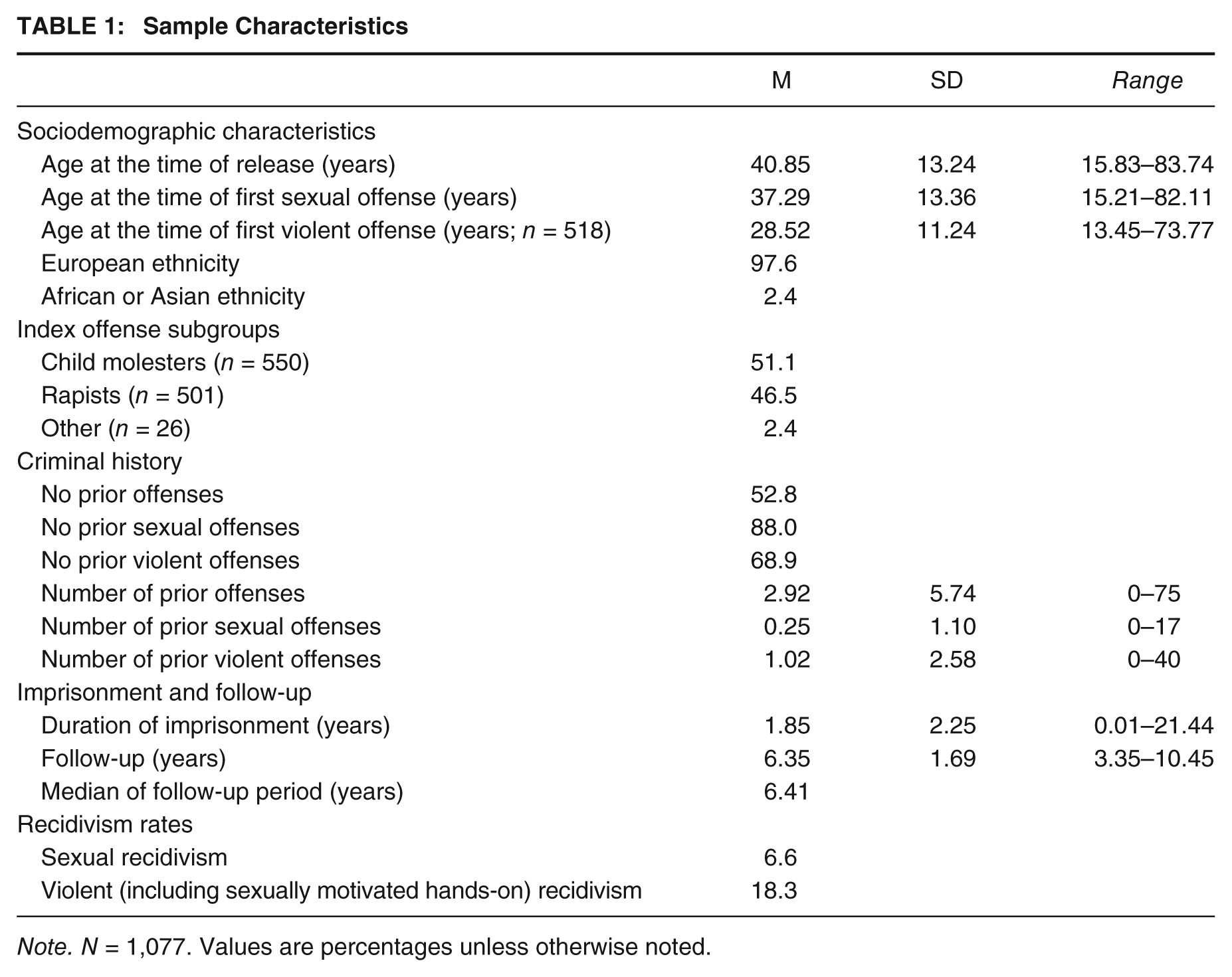
Note. N = 1,077. Values are percentages unless otherwise noted.
Statistical Analysis
Interrater reliability was examined by calculating intraclass correlation coefficients (ICC; single measure). For interpretation, we used the critical values reported by Fleiss (1981; ICC < .39 = poor, .40 to .59 = fair, .60 to .74 = good, and ICC > .75 = excellent). The relationship between age and Static scores was estimated by Pearson correlations.
The predictive accuracy of risk assessment instruments was determined by calculating AUC values of ROC curves (Hanley & McNeil, 1982). The ROC curve is produced by plotting the hit and false alarm rates across the possible cutoff values. This statistical procedure is commonly used to examine the predictive accuracy of binary decisions, such as “release” or “do not release” (Mossman, 1994). The AUC values lie between 0 and 1, with an AUC value of .5 indicating prediction at the chance level and an AUC value of 1 indicating perfect prediction. Because of its low sensitivity to base rates of recidivism and to users’ biases for or against Type I or Type II prediction error and the easy interpretation, the AUC is a standard measure of diagnostic and predictive accuracy in clinical and forensic research (Hanson, 2008; Mossman, 1994). Referring to Cohen (1992), Rice and Harris (2005) formulated criteria for the interpretation of the predictive accuracy of risk assessment tools: AUC values of .71 or above are classified as “good” and AUC values between .64 and .70 are classified as “moderate.” Significant AUC values below .64 are classified as “small.”
For testing incremental validity, we used Cox regression analyses that allow the inclusion of all cases of the sample by taking into account the length of follow-up periods. Cox regression estimates relative risk ratios associated with one or more predictor variables from data with unequal follow-up periods (e.g., Aalen, Borgan, & Gjessing, 2008; Eher, Matthes, et al., 2012; Hanson, 2006). The rate ratio (i.e., hazard rate; exp [B]) resulting from Cox regression analysis is an indicator of the strength of the association between predictor and outcome (recidivism). The rate ratio is defined as the probability of recidivism in one group (e.g., for a specific age group of offenders) divided by the probability of recidivism in another group (e.g., a younger or older age group) measuring the relative change of recidivism between both groups (Helmus, Thornton, et al., 2012).
One of the strongest arguments by Helmus, Thornton, et al. (2012) for the Static-99R was the better fit between expected and observed sexual recidivism rates within the older age bands. Therefore, we examined the calibration of the Static-99 and the Static-99R using the E/O index (Gail & Pfeiffer, 2005) for each age band. For this purpose, however, the two highest age bands defined by Helmus, Thornton, et al. (2012; between 60 and 69, and 70 or over) were merged into a single category of 60 and over. The calibration of a risk assessment tool is commonly evaluated by contrasting the observed number of events with the number of events predicted by the risk assessment tool (Viallon, Ragusa, Chavel-Chapelon, & Bénichou, 2009). The E/O index, therefore, is defined as the ratio of the predicted recidivists divided by the observed recidivists (Helmus, Thornton, et al., 2012). Because this kind of E/O index is only an appropriate calibration measure when fixed follow-ups were available, we compared the predicted and the observed number of recidivists for a fixed 5-year follow-up period (n = 789). Predicted 5-year reoffense rates were calculated by logistic regression analyses. Therefore, we used a subsample of the total sample with fixed 5-year follow-up periods. Confidence intervals (CIs) for the E/O index and an overall significance test by the traditional χ2-goodness of fit statistic were calculated as reported in Helmus, Thornton, et al. (2012). All statistical analyses were conducted using IBM Statistical Package for Social Sciences (SPSS) version 19.0.0.
Results
To ascertain interrater reliability, three randomly selected skilled clinicians who had rigorous training in the application of the Static-99 independently rated 10 cases. These 10 cases were randomly selected within the sample of this study. Using the critical values for intraclass correlations (ICC; single measure) reported by Fleiss (1981), the interrater reliability of the Static-99 was excellent (ICC = .98, p < .001).
The average raw score of the Static-99 was M = 2.72 (SD = 1.96, range = from 0 to 10), the average score of the Static-99R was M = 2.41 (SD = 2.37, range = from −3 to +10). The Static-99 total scores were negatively correlated with age at release (r = −.20, p < .001) as well as with age at first offense (r = −.52, p < .001). As expected, the correlation between the age variables and the Static-99R was substantially stronger and significantly negative (r = −.58, p < .001, for age at release; r = −.75, p < .001, for age at first offense). When the original age item of the Static-99 was completely removed and not replaced by new age weights, the correlation between age at release and the total score of the remaining nine Static-99 items was relatively small but still significantly negative (r = −.11, p < .01).
For sexual recidivism, the variable age at release (AUC = .47, 95% CI = [.38, .56], p = .529) did not show any predictive accuracy, whereas age at first offense indicated moderate predictive accuracy (AUC = .64, 95% CI = [.57, .71], p < .001). For violent recidivism, age at release exhibited moderate predictive accuracy (AUC = .68, 95% CI = [.63, .73], p < .001) and age at first offense exhibited strong predictive accuracy (AUC = .77, 95% CI = [.73, .80], p < .001).
The Incremental Validity of Age
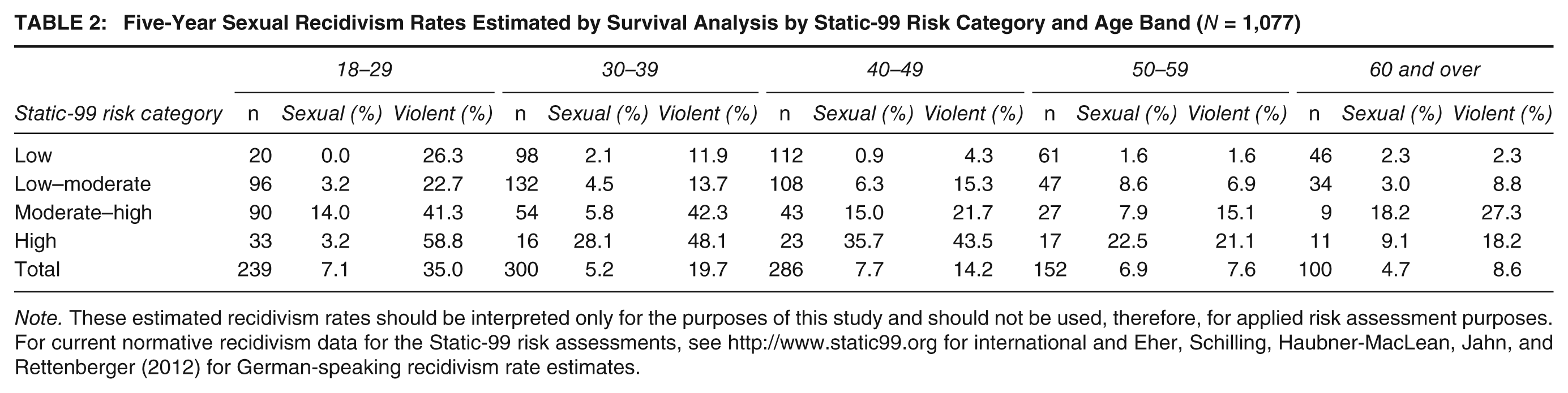
Table 2 shows 5-year sexual and violent recidivism rates estimated by survival analysis by Static-99 risk category and different age bands for the total sample (N = 1,077). We defined the following five age groups: up to 30, between 30 and 39, between 40 and 49, between 50 and 59, and 60 and over. In contrast to the study by Helmus, Thornton, et al. (2012), we merged the group aged between 60 and 69 with the group aged 70 and older due to small sample sizes in the latter age group.
Five-Year Sexual Recidivism Rates Estimated by Survival Analysis by Static-99 Risk Category and Age Band (N = 1,077)
Note. These estimated recidivism rates should be interpreted only for the purposes of this study and should not be used, therefore, for applied risk assessment purposes. For current normative recidivism data for the Static-99 risk assessments, see http://www.static99.org for international and Eher, Schilling, Haubner-MacLean, Jahn, and Rettenberger (2012) for German-speaking recidivism rate estimates.
Sexual recidivism rates increased as a function of risk calculated by the Static-99 in each age band with only two exceptions (i.e., the highest risk categories in the youngest and the eldest age bands show unexpectedly low recidivism rates). With regard to the age groups, the sexual recidivism rates were more or less the same over the age bands (ranging from 4.7% to 7.7%), whereas violent recidivism rates clearly decreased with age (from 35% in the youngest group to 8.6% in the oldest group).
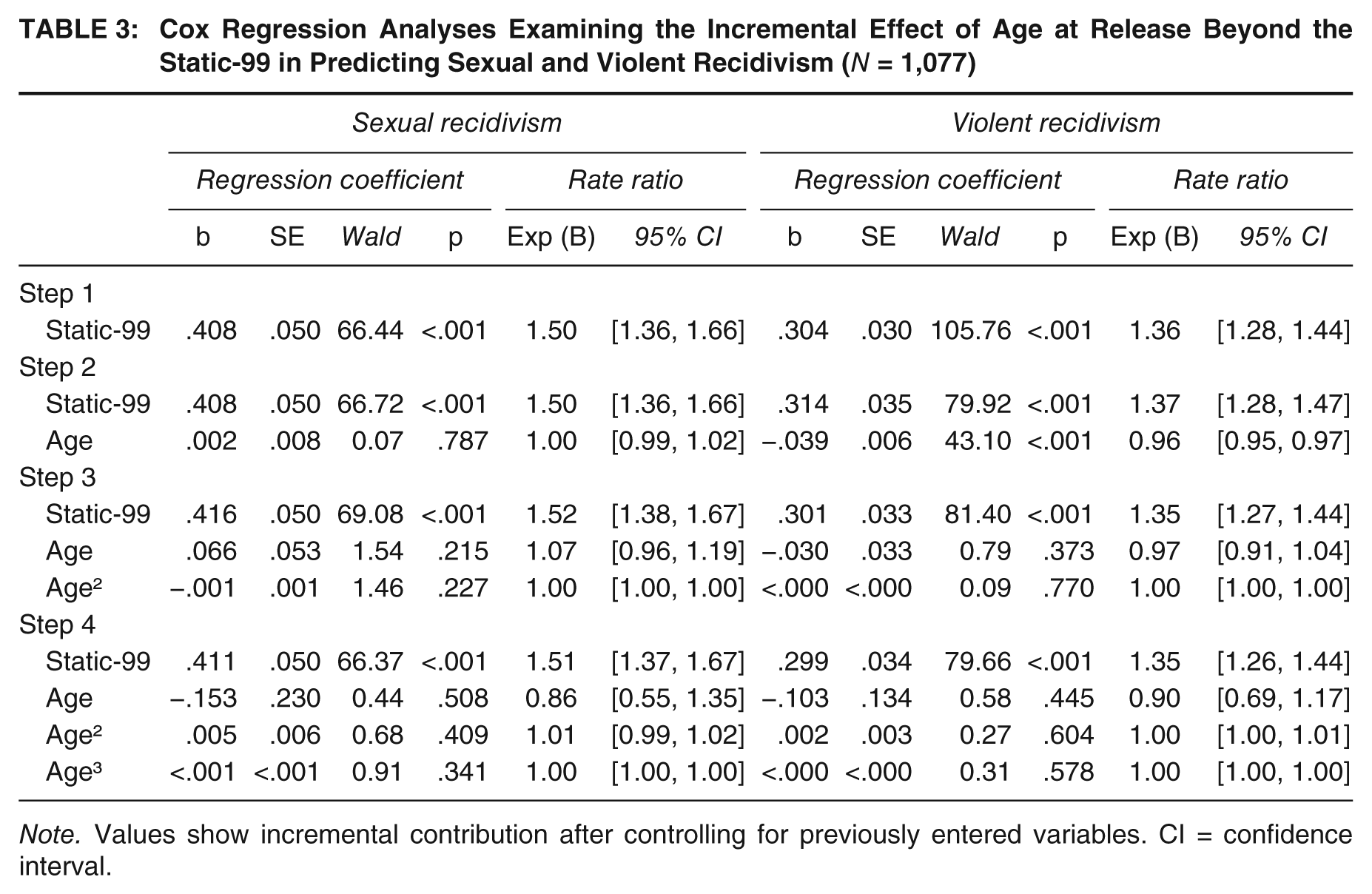
In a next step, Cox regression analysis was used to test a possible incremental predictive power of age variables beyond the Static-99 scores when predicting sexual and violent recidivism. As can be seen in Table 3, the results for sexual recidivism show that—after controlling for the Static-99—age entered as a continuous variable had no significant incremental effect in predicting sexual recidivism for the total sample (Δχ2 = 0.07, df = 1, p = .787). Since previous research indicated the possibility of a nonlinear relationship between age and Static-99 scores (Helmus, Thornton, et al., 2012; Thornton, 2006), nonlinearity was tested by entering a squared and a cubed age variables. Neither variable reached statistical significance (for age2, Δχ2 = 1.57, df = 1, p = .210, and for age3, Δχ2 = 0.95, df = 1, p = .329). Therefore, our results did not indicate a nonlinear relationship between age and sexual recidivism after controlling for the Static-99. In general, these results suggested that the German version of the Static-99 sufficiently accounts for age when predicting sexual recidivism.
Cox Regression Analyses Examining the Incremental Effect of Age at Release Beyond the Static-99 in Predicting Sexual and Violent Recidivism (N = 1,077)
Note. Values show incremental contribution after controlling for previously entered variables. CI = confidence interval.
In contrast to the sexual recidivism analysis, offenders’ age at release had a significant negative linear relationship with violent recidivism after controlling for Static-99 scores (Δχ2 = 48.07, df = 1, p < .001; see Table 3). The rate ratio was exp (B) = 0.96 (95% CI = [0.95, 0.97]), meaning that each 1-year increase in age was associated with a decrease of 4% in the risk of violent recidivism compared with the year before. Again, we tested nonlinearity by entering a squared and a cubed age variables. Both variables again failed to reach statistical significance after controlling for Static-99 scores (for age2, Δχ2 = 0.08, df = 1, p = .769, and for age3, Δχ2 = 0.32, df = 1, p = .572). To summarize, age at release provides significant incremental validity beyond Static-99 scores for the prediction of violent recidivism in sexual offenders. In other words, the German version of the Static-99 does not sufficiently account for the age variable when predicting violent recidivism in prison-released sexual offenders.
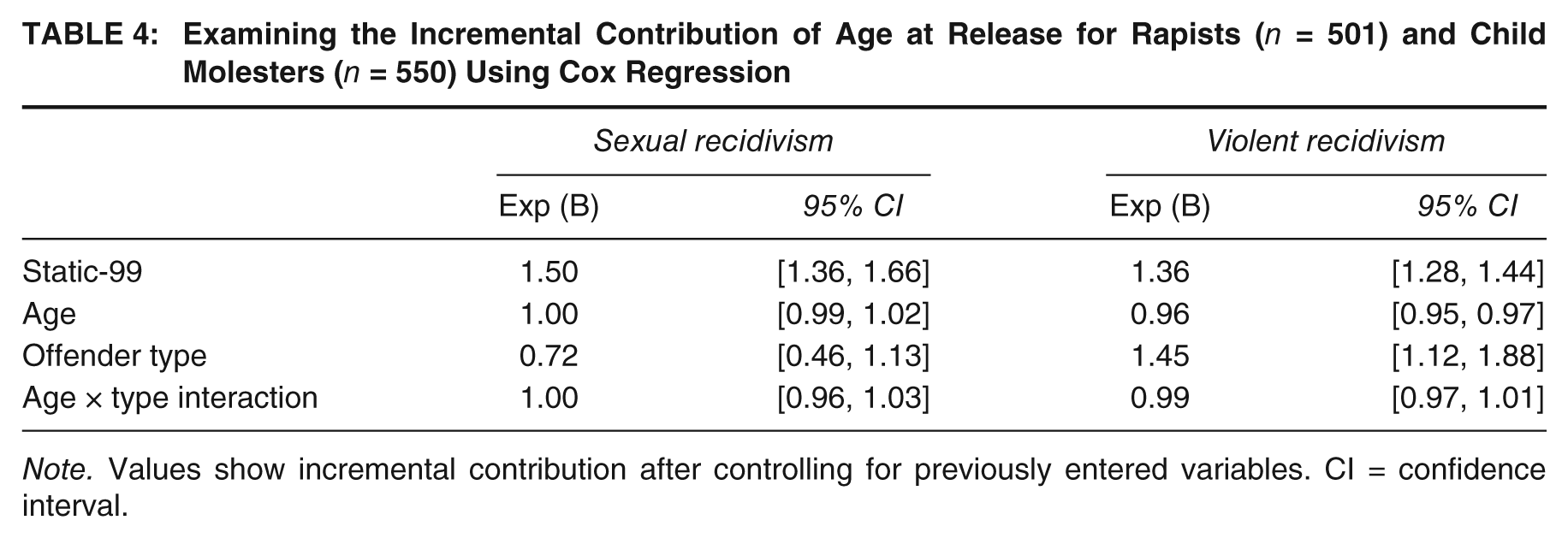
The next step of our analyses was to test whether there were differences between both subgroups (i.e., rapists and child molesters). We wanted to reassure that—for the prediction of sexual recidivism—the age weights of the original version of the Static-99 would suffice for rapists (n = 501) as well as for child molesters (n = 550). As can be seen in Table 4, the interaction between age and offender type was not significant in the regression model, meaning that age did not predict sexual recidivism for rapists and child molesters differentially (Δχ2 = 0.06, df = 1, p = .810). Similar results were obtained for violent recidivism. As for sexual recidivism, there was also no significant interaction between age and offender type (Δχ2 = 0.71, df = 1, p = .399). However, there was a further significant main effect for offender type in violent recidivism (Δχ2 = 7.78, df = 1, p ≤ .01) because of substantially higher violent recidivism rates in the rapist subgroup compared with the child molester subgroup. For sexual recidivism, there was no significant main effect for offender type (Δχ2 = 2.15, df = 1, p = .142).
Examining the Incremental Contribution of Age at Release for Rapists (n = 501) and Child Molesters (n = 550) Using Cox Regression
Note. Values show incremental contribution after controlling for previously entered variables. CI = confidence interval.
Predictive Validity
To compare the predictive validity of the original Static-99 and the age-corrected revised version Static-99R proposed by Helmus, Thornton, et al. (2012), we replaced the original version of the age item of the Static-99 with the appropriate new age weights. Table 5 shows the AUC values for the original Static-99 and the age-revised Static-99R. In general, the differences in the predictive accuracy between the Static-99 and the Static-99R were only marginal and nonsignificant as can be seen from the overlapping CIs.
Predictive Accuracy of the Static-99 and the Static-99R for the Total Sample and Both Subgroups Using ROC Analyses
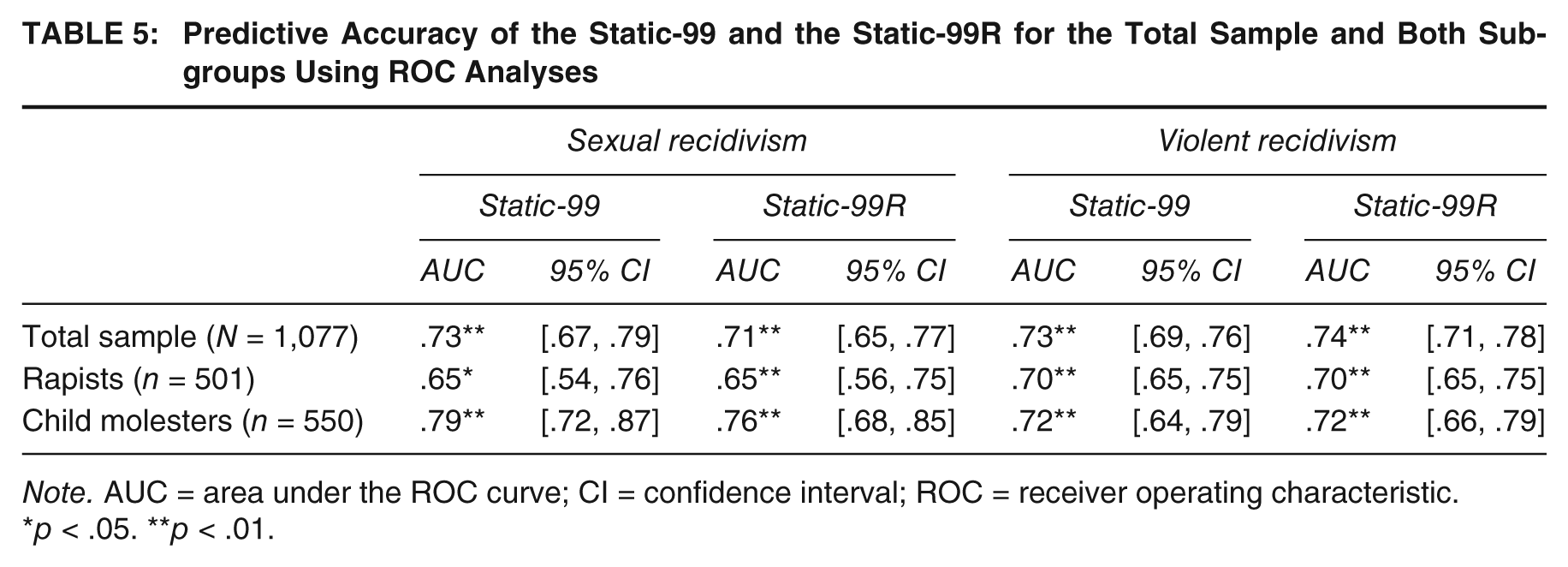
Note. AUC = area under the ROC curve; CI = confidence interval; ROC = receiver operating characteristic.
p < .05. **p < .01.
One of the strongest arguments for including the age adjustment into the Static-99R was the better fit between the expected and the observed number of recidivists. Therefore, we calculated E/O indices for the Static-99 and the Static-99R for each age band and total score by using a subsample (n = 789) with fixed 5-year reoffense rates. For sexual recidivism, the Static-99 and the Static-99R produced E/O indices with CIs indicating no significant differences between observed and predicted rates (see Table 6). However, there is one exception for the Static-99R: The sexual recidivism risk for offenders in their 40s was significantly underestimated (E/O = 0.58, 95% CI = [0.34, 0.99]). The goodness of fit statistic showed no overall significant difference between observed and predicted rates across age bands for the Static-99 (χ2 = 3.01, df = 4, ns), whereas for the Static-99R, the difference reached statistical significance (χ2 = 11.36, df = 4, p < .05). For violent recidivism, the Static-99 yielded recidivism rates significantly overestimating the risk of offenders in the two highest age bands (50–59.99: E/O = 1.93, 95% CI = [1.00, 3.71]; 60 and over: E/O = 3.13, 95% CI = [1.17, 8.33]; overall goodness of fit: χ2 = 19.99, df = 4, p < .001), whereas for the Static-99R, observed and predicted recidivism rates did not differ significantly (χ2 = 3.15, df = 4, ns).
Observed and Predicted Recidivism Rates for the Static-99 and the Static-99R for Sexual and Violent Recidivism
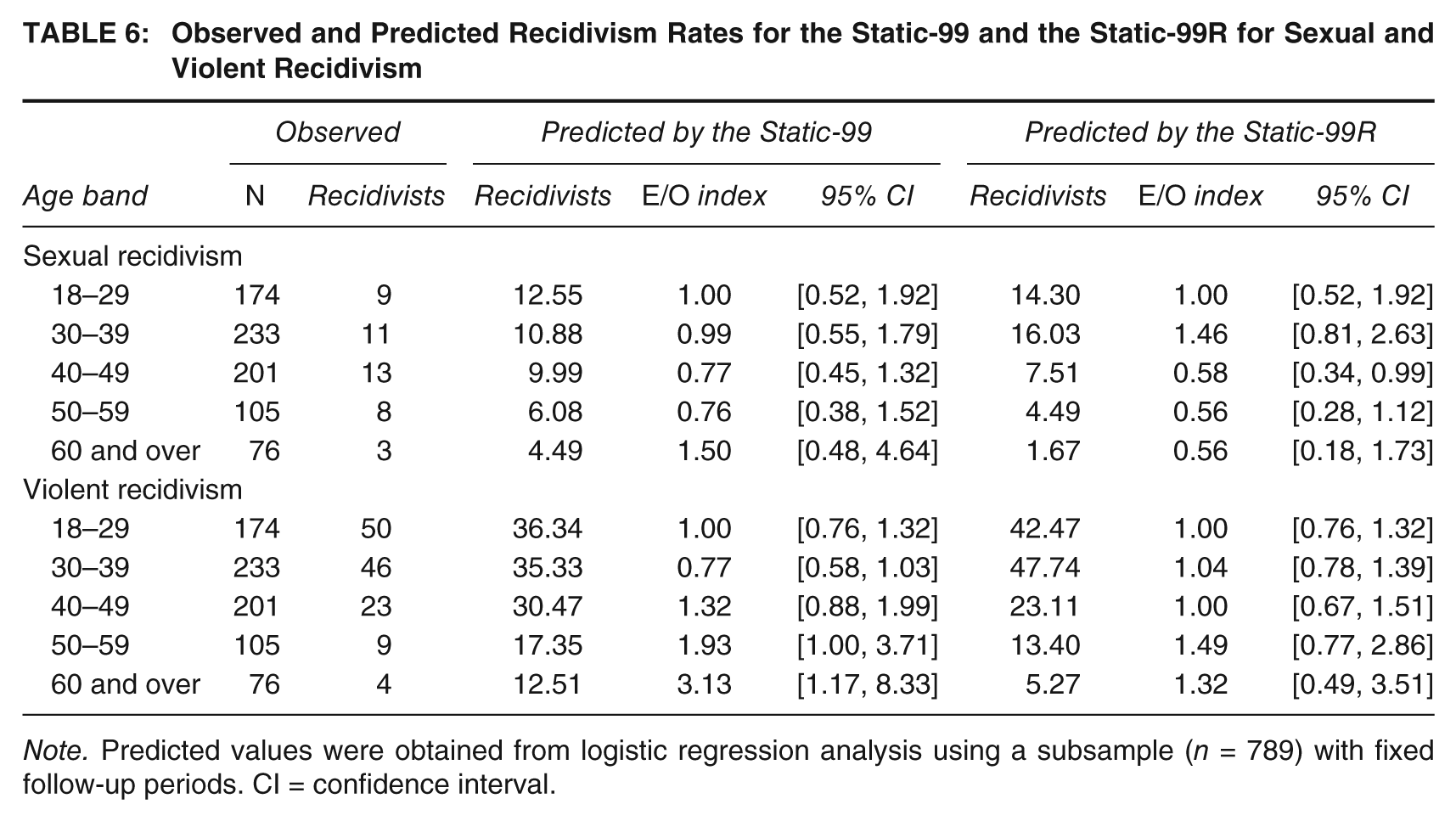
Note. Predicted values were obtained from logistic regression analysis using a subsample (n = 789) with fixed follow-up periods. CI = confidence interval.
The Static-99r and Violent Recidivism
Since our findings indicated an incremental contribution of age at release for violent recidivism, we examined whether the new age weights of the revised Static-99R would sufficiently account for age when predicting violent reoffense after controlling for Static-99R (Table 7). Age at release—as a continuous variable—still significantly added predictive information beyond the Static-99R for violent reoffenses. The rate ratio for the age variable for the total sample (N = 1,077), after controlling for the Static-99R (Δχ2 = 13.52, df = 1, p < .001; exp [B] = 0.98, 95% CI = [0.96, 0.99]), indicated that each 1-year increase in age was associated with a decrease of 2% in violent recidivism for each Static-99R score. As Table 7 shows, this result was particularly due to a stronger influence of age at release on the violent reoffense risk in the rapist subgroup (Δχ2 = 5.77, df = 1, p < .05) than in child molesters (Δχ2 = 0.96, df = 1, p = .326). Taken together with the results from Table 3, the findings indicated that—for the prediction of violent recidivism—neither the Static-99 nor the Static-99R sufficiently covered the influence of the age variable on the outcome.
Examining the Incremental Contribution of Age at Release Beyond the Static-99R for the Prediction of Violent Recidivism
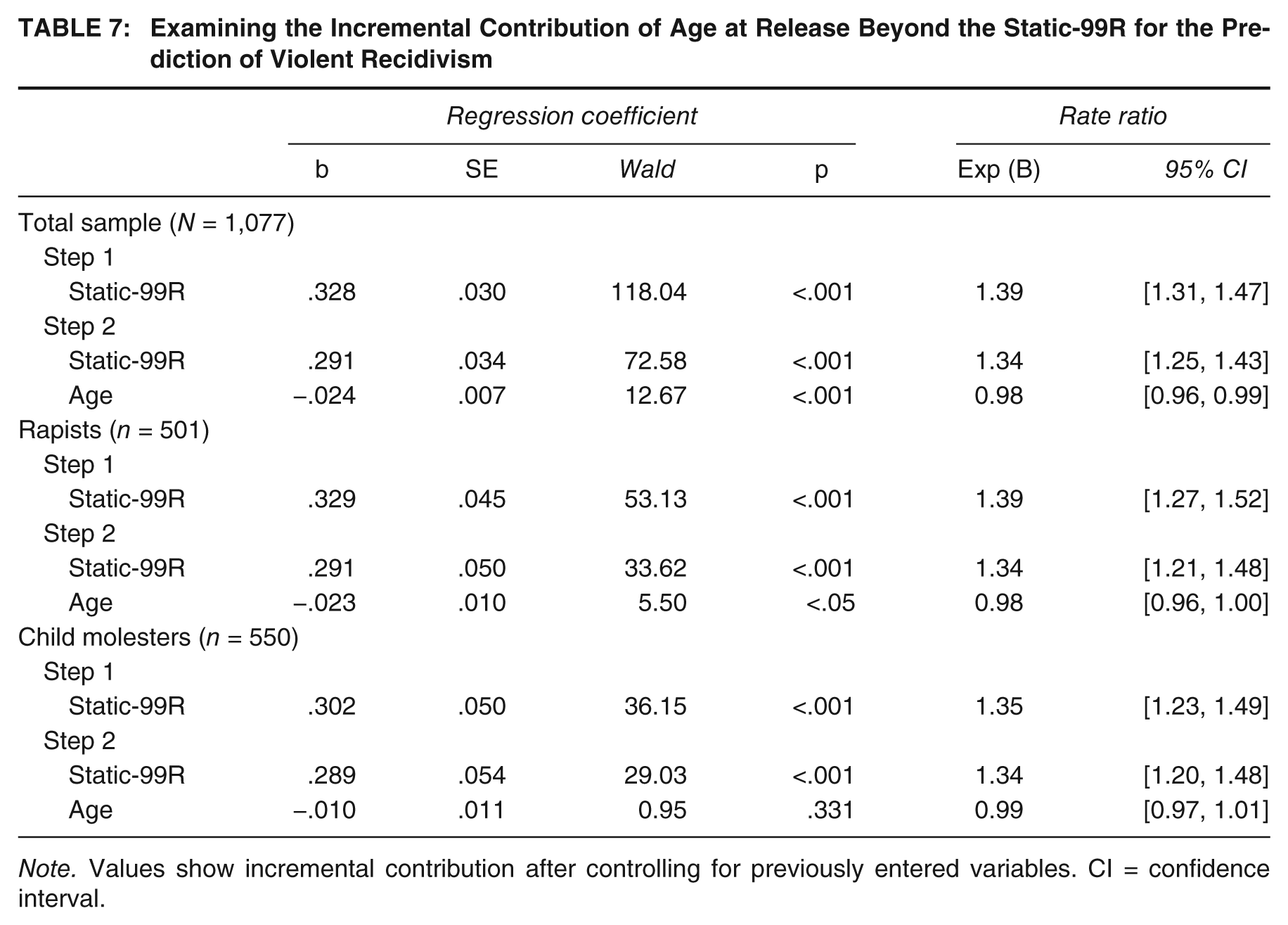
Note. Values show incremental contribution after controlling for previously entered variables. CI = confidence interval.
The Influence of Age at First Offense
In the last step, Cox regression analyses were conducted separately for sexual and violent recidivism for the total sample and both subsamples to examine the incremental predictive validity of age at first offense beyond Static-99 scores. Therefore, we first removed the age item from the Static-99. Then the Static-99 total score was entered followed by age at first offense as well as age at the time of release (Table 8). 2 The results show that for the total sample (Δχ2 = 0.56, df = 2, p = .755) as well as for the child molester subgroup (Δχ2 = 1.56, df = 2, p = .458), neither age at first offense nor age at release has incremental predictive accuracy for the prediction of sexual recidivism after controlling for Static-99 scores without the age item. However, for the rapist subgroup, age at first offense, but not age at release, contributed significantly to the prediction of sexual recidivism (Δχ2 = 7.86, df = 2, p < .05). For the prediction of violent recidivism, for the total sample, both age variables showed incremental predictive accuracy after controlling for Static-99 scores (Δχ2 = 89.06, df = 2, p < .001), whereas for the rapists, only age of onset contributed significantly (Δχ2 = 51.24, df = 2, p < .001). Although for child molesters the inclusion of both age variables after controlling for the Static-99 led to a significant increase of the predictive accuracy (Δχ2 = 15.59, df = 2, p < .001), the single variables failed to reach significance.
The Incremental Contribution of Age at Release (AaR) and Age at First Offense (AaFO) Beyond the Static-99 in Predicting Sexual and Violent Recidivism
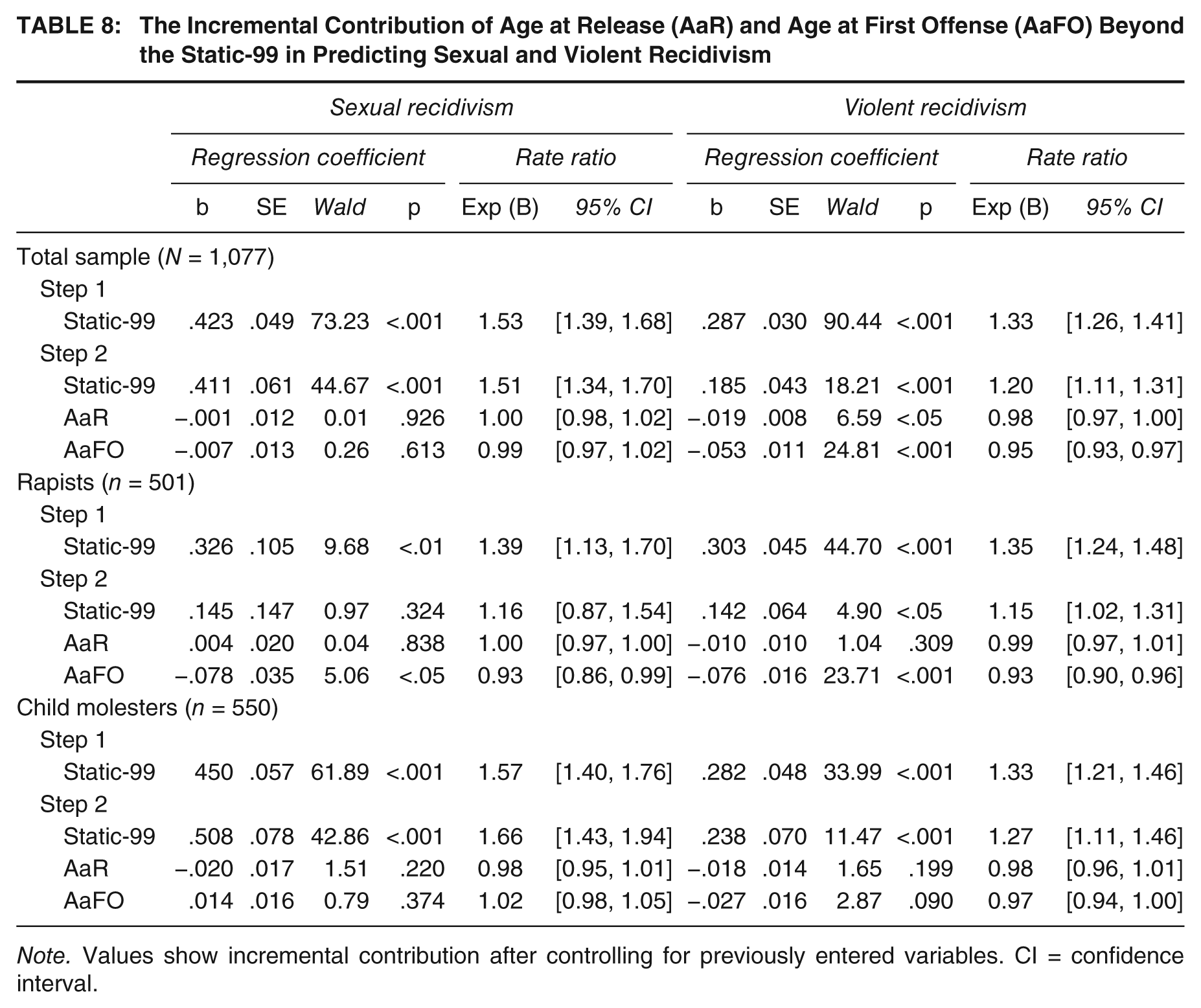
Note. Values show incremental contribution after controlling for previously entered variables. CI = confidence interval.
Discussion
The purpose of this study was to investigate the influence of different age-related variables on the predictive accuracy of the Static-99 in a population-based prison-released German-speaking sexual offender sample. Specifically, the focus of the present investigation was on the impact of the age effect (e.g., Hirschi & Gottfredson, 1983) on the recidivism risk of sexual offenders. In a first series of analyses, we tried to replicate the findings reported by Helmus, Thornton, et al. (2012) who found that the age variable in the Static-99 was not weighted sufficiently, thus leading to the revised version Static-99R. In contrast to the findings of Helmus, Thornton, et al. (2012), in our study, age at release did not add incremental validity to the Static-99 for the prediction of sexual recidivism. These results proved true for child molesters as well as for the rapist subgroup. However, for the prediction of violent recidivism, the results indicated incremental predictive validity of age at release after controlling for the Static-99 for the total offender sample and both subgroups. Also, our results revealed that even the age-corrected Static-99R could not sufficiently capture the effect of age at release on violent recidivism. Therefore, we could not replicate the results of the current study on the age-revised Static-99R (Helmus, Thornton, et al., 2012). In general, in our study, the differences in the predictive accuracy between the Static-99 and the Static-99R were only marginal and nonsignificant. For the prediction of sexual recidivism, the original Static-99 version showed a somewhat higher predictive accuracy than the age-corrected Static-99R, whereas for the prediction of violent recidivism, there was virtually no difference between both versions. Comparing observed and predicted recidivism rates calculated by logistic regression analyses indicated a better fit for the original version of the Static-99 for the prediction of sexual recidivism, whereas for violent recidivism, the goodness of fit statistics favored the revised Static-99R over the Static-99.
The differences found between the study conducted by Helmus, Thornton, et al. (2012) and the present investigation might have several reasons. One possible explanation might refer to differences in the compilation of the subjects and samples. Helmus, Thornton, et al. (2012) used 24 different samples predominantly from North America together with a few studies from Europe and one study from New Zealand resulting in a high heterogeneity of the total sample with a relatively wide range of average Static-99 scores, sample sizes, and follow-up periods as well as heterogeneous institutional, juridical, governmental, demographical, and societal backgrounds (e.g., Harris & Hanson, 2010; Helmus, Hanson, & Thornton, 2009, Helmus, Hanson, et al. 2012). In contrast, in our study, we used a population-based and relatively homogeneous sample when including all imprisoned sexual offenders of a country within a defined timeframe without any preselection procedure. To emphasize the importance of this aspect, we wanted to illustrate this issue by referring to the differences of the average Static-99 scores in the samples used by Helmus, Thornton, et al. (2012): The 24 samples differed substantially in the average Static-99 score and ranged between 1.9 (i.e., the average total score indicated a nominal recidivism risk level of low to moderate; Swinburne Romine, Dwyer, Mathiowetz, & Thomas, 2008) and 5.5 (i.e., indicating a relatively high-risk sample; Wilson, Cortoni, & Vermani, 2007; Wilson, Picheca, & Prinzo, 2007). Helmus, Thornton, et al. (2012) also included a nonrepresentative subsample of our study’s sample that yielded an average Static-99 score of 2.7 (the same mean value as in the present sample). Only seven studies showed lower average total scores and two studies had the same average Static-99 score. This indicates that the “typical” sexual offender released from prison in the German-speaking part of Europe showed substantially fewer Static-99 risk factors than the subjects in most of the other samples reported by Helmus, Thornton, et al. (2012). The different proportions of high-risk offender subsamples might be one explanation for the differences in the findings regarding the incremental contribution of the age variable. For example, in Europe, sexual offenders who are detained in forensic psychiatric institutions usually exhibit more risk factors captured by the Static-99 on average than imprisoned sexual offenders (Eher et al., 2013). Consequently, one possible explanation for the sample differences between the meta-analytic report published by Helmus, Thornton, et al. (2012) and this study may be the inclusion of subjects from forensic psychiatric sexual offender populations in the Helmus report.
When comparing fixed 5-year sexual reoffense rates between Helmus, Thornton, et al. (2012) and our data, those of the first two age bands in the Helmus study are substantially higher. At the same time, violent reoffense rates of the first two age bands are comparable. Therefore, it can be assumed that particularly the younger sexual offenders differ between these two studies inasmuch as they tend to have a higher disposition for sexual violence in terms of more risk factors for sexual recidivism in the Helmus study than in the present investigation.
From a theoretical point of view, the results of this study could be interpreted as an indicator supporting the arguments by Harris and Rice (2003, 2007). These authors attributed recidivism risk in sexual offenders predominantly to stable and enduring traits that, once initiated, exhibit lifelong persistence. Therefore, Harris and Rice (2003, 2007) predicted no meaningful effect of aging on recidivism of sexual offenders above the general actuarial risk level—provided that the actuarial instrument contains adequate measures of antisociality. The results of this study support this point of view. Looking at the predictive accuracy of age variables and the regression analyses in Table 8, the results indicated that age at first offense seems to be of more relevance for recidivism risk than age at release in adult male sexual offenders since age at first offense exhibited higher (incremental) predictive accuracy than age at release. This conclusion is supported by previous studies about sexual murderers (Hill, Habermann, Klusmann, Berner, & Briken, 2008) and domestic violent offenders (Hilton, Harris, Rice, Houghton, & Eke, 2008), which have also provided evidence that age at first offense is more relevant than age at release for recidivism risk assessment. However, the results of the Cox regression analyses in Table 8 indicated that age at first offense is particularly relevant for the prediction of general violent recidivism. For risk assessment of sexual recidivism, in our study, both age variables were of minor relevance.
From a methodological point of view, the differences between sexual and violent recidivism rates indicate that there might exist moderator variables (e.g., the recidivism criterion or sample selection effects) that have to be taken into account when trying to explain the relationship between age and recidivism risk in a specific sample. In this regard, recently published articles are of interest for the discussion of the present findings (Barbaree et al., 2007, 2008). In these studies, the authors showed that the relationship between age, actuarial scores, and recidivism in sexual offenders is more complex than originally assumed and depends on whether the items reflect antisocial behavior or sexual deviance. More specifically, age at release was negatively related to items of risk assessment instruments that capture antisociality, whereas items that reflect facets of sexual deviance are virtually unrelated to age. For the discussion of the present results, these findings could have implications in different ways. One plausible explanation of why age did not contribute to the prediction of sexual recidivism in this study beyond the Static-99 is that the Static-99 was particularly developed for the prediction of sexual recidivism (rather than violent recidivism) and that age-related information reflecting antisociality is generally less relevant for the prediction of sexual recidivism than of violent recidivism. Furthermore, both risk factors reflecting antisociality or sexual deviance may show differential predictive power for different offender subgroups (e.g., Bartosh et al., 2003; Rettenberger et al., 2010). According to the results of this study reported in Table 8, age at first offense seems to be more relevant for the rapist subgroup than for the child molester subgroup. This finding is in line with previous investigations showing that measures of general antisociality are more important for rapists than for child molesters in recidivism risk assessment (Rettenberger, Boer, & Eher, 2011).
In this regard, the findings of this study may create a further hypothesis about the relationship between age and recidivism. As can be seen from the recidivism rates shown in Table 2, the differences between violent and sexual recidivism rates decline with age, that is, the younger the offender, the more important the risk for general violent reoffenses compared with sexual reoffenses. If general violent rather than particular sexual recidivism (which may be linked to stronger degrees of impulsiveness, aggressiveness, and a more impaired capacity of self-control) is more relevant for younger age bands, then the age-related corrections of actuarial risk assessment may strongly depend on the recidivism criterion predicted, at least when the prediction refers to prison-released sexual offenders of younger age. For users of the German version of the Static-99 in applied risk assessment settings, the question arises whether evaluators should further use the original Static-99 or switch to the age-corrected Static-99R version. Because the results of this study are predominantly inconsistent with the findings reported by Helmus, Thornton, et al. (2012), we would argue against the general transferability of the new age weights to the German Static-99 version. Therefore, we would recommend that applied risk assessment settings use the original version of the instrument rather than the revised Static-99R.
Comparable with the developmental study (Helmus, Thornton, et al., 2012), one limitation of this study was the shortage of older subjects. Compared with the two older age bands, the three younger age bands had more subjects per age band. Another possible limitation concerns the source of recidivism data that were retrieved only from one data source. For this study, we used official reconviction data from the computerized data base of the Austrian Ministry of Internal Affairs as the only recidivism criterion. As a consequence, the reconviction rate was—as all official crime rates—inevitably an underestimation of the actual recidivism. Previous research indicated that this limitation seems to be relevant, especially for data collection of sexually motivated reoffenses (Rice, Harris, Lang, & Cormier, 2006). Given the fact that recent research has demonstrated reductions in recidivism risk due to treatment and supervision (e.g., Hanson, Bourgon, Helmus, & Hodgson, 2009; Lösel & Schmucker, 2005), another shortcoming of this study was the fact not being able to control for treatment-related changes in risk since detailed data about treatment and supervision were not available at the time of data collection. A further limitation of this study was the relatively short follow-up periods that prevent calculations of 10-year reoffense rates. However, despite these limitations and differences between the study conducted by Helmus, Thornton, et al. (2012) and this study, we conclude that the present results indicate that—at least for the German version—the original Static-99 yields better predictive accuracy than the age-corrected Static-99R for the prediction of sexual recidivism. For further investigation of the relationship between age and recidivism, the influence of different moderator variables (e.g., different offender subgroups, recidivism criteria, and item content areas) should be taken into account.
Footnotes
Authors’ Note:
We would like to thank R. Karl Hanson, Marnie Rice, and Leslie Helmus for their very helpful comments in the preparation of this article. The current research project was conducted in accordance with the legal and ethical demands of the Austrian Department of Justice and the national Data Protection Act. The views expressed are those of the authors and not necessarily those of the Austrian Prison System.