



Abstract
The law can be a systemically induced decision point for offenders and can act to help or hinder desistance. Desistance can be described as a change process that may be initiated by decisive momentum, supported by intervention, and maintained through re-entry, culminating in a citizen with full rights and responsibilities. Desistance within courts, corrections, and beyond is maximized by applying the law in a therapeutic manner. In common, desistance, therapeutic jurisprudence, and human rights support offender autonomy and well-being. The intersections between the three models have been explored to propose a normative framework that provides principles and offers strategies to address therapeutic legal rules, legal procedures, and the role of psycholegal actors and offenders in initiating, supporting, and maintaining desistance.
Contemporary policy in the management of offenders assumes that community protection can be best achieved by overriding offender rights. Reactionary public policy is weighted toward community protection. Rather than being considered an individual in need of support, the offender is more likely perceived as a risk to be managed. Systemic responses to offending therefore have an offense-related focus (reiterating “malfunctioning” history, behavior, and attitudes) rather than a future focus (the aspiration of an intervention and the broader social context and conditions that support change; McNeill, Batchelor, Burnett, & Knox, 2005).
Independent of public policy, desistance from crime is described as a gradual or emergent process through which people cease and refrain from persistent offending (Maruna, 2001). McNeill et al. (2005) portrayed desistance as ambivalence in which motivation may be prompted by life events or a person “believing in” the offender, based on narrative identities or self-stories. Supporting desistance requires human capital (internal capacities to change) and social capital (external opportunities to exercise those capacities to change), redeems or restores the person who makes positive contributions to local communities, and is an active process in which agency or autonomy (the ability to make choices and govern one’s life) is realized; interventions therefore focus on strengths, resilience, and protective factors. Systemically induced decision points include reform school, work, residential change, marriage, and military service (Sampson & Laub, 2005). The role of the law will be considered a systemically induced decision point. In considering desistance and rehabilitation, Maruna (2011a) concluded that rehabilitation needs to do the following: Address the collateral consequences of the social stigma of conviction; actively support desistance rather than passively waiting many years for a person to be crime-free (although he acknowledges this may be normatively just); acknowledge reintegration through symbolism and ritual; and “certify” rehabilitation to lift all civic, social, and economic barriers as an alternative to expunging the criminal record (described as “forgive rather than forget”).
Based on previously established desistance and behavior change models, Göbbels, Ward, and Willis (2012) formulated a four-phase process:
Decisive momentum: initial desistance triggered by a positive or negative life event, influenced by individual and environmental factors, and crystallizing in discontent with offending or a desire for a conventional identity resulting in readiness to change;
Treatment: promoting desistance by providing formal and informal support by way of problem solving that addresses individual and environmental factors to re-construct the self or re-establish a previously adaptive self;
Re-entry: maintaining desistance with an emphasis on approach goals (what the offender wants) rather than avoidance goals (what the community wants) and the reinforcement of a non-offender identity through individual capacities and environmental supports; and
Normalcy or reintegration: succeeding in desistance over a long period of time and defining themselves as non-offending members of the community, possibly after years or decades.
McNeill (2011) listed eight principles to support desistance from re-offending, which, as will be seen, are equally applicable to therapeutic jurisprudence (TJ) and human rights: (a) be realistic about setbacks and relapses, and manage non-compliance appropriately; (b) individualize interventions by considering identity and diversity; (c) develop and maintain hope as well as motivation; (d) understand desistance in the context of relationships, including between the offender and correctional staff, the people who matter to them, and ex-offenders; (e) focus on the strengths and resources of offenders to overcome obstacles to desistance, not just their risks and needs; (f) base interventions on social capital (external supports) as well as human capital (internal capacities); (g) acknowledge and celebrate achievements and positive potential for development and redemption; and (h) desistance is about discovering agency, which means working with offenders, not on offenders to support self-determination or autonomy.
Systemically Maximizing Desistance
The following section will consider how systemic responses may affect the desistance process within courts, corrections, and beyond. Systemic responses that help desistance can be enhanced by the humanistic principles of TJ and human rights with a specific concern for offender autonomy and well-being.
TJ and Offenders
TJ is a legal theory concerned with how the law affects the psychological well-being of individuals who are in contact with it (e.g., repeat offenders). It is a legal theory that supports the law acting as a therapeutic agent and embraces a multidisciplinary approach to the law. The normative stance of TJ is that it aims to maximize the overarching aims of the law and assumes that therapeutic effects are desirable and should generally be the aim of the law, and that anti-therapeutic effects are undesirable and should be minimized by the law (Winick, 1997). TJ relies on social science evidence to consider the impact of legal rules or legislation, legal procedures such as hearings and trials, and the role of legal actors such as judges, lawyers, and mental health professionals in the legal context (Wexler, 1990). The TJ framework will be expanded to include the role of psycholegal actors in courts, corrections, and beyond.
Therapeutic Legal Rules
Legal rules make up the law. A TJ question is as follows: How can the law maximize desistance through legal rules?
Sentencing principles in the criminal justice system generally includes the aims of punishment, deterrence, denunciation, incapacitation, and rehabilitation (but not desistance). Rehabilitation can be delivered via treatment-as-support to meet offender needs but is more often delivered via treatment-as-management to manage offender risk (Birgden & Cucolo, 2010). In the current public policy climate, do the legal rules with their emphasis on punishment deter? “Given available behavioral science data, the shorter answer is: generally, no” (Robinson & Darley, 2004, p. 2). Changes to legal rules require law reform, which is unlikely at present.
However, whether in courts or corrections, therapeutic legal rules can harness the “teachable moment” where offenders may be motivated to seek help (Casey & Rottman, 2000). Techniques for judges to engage offenders include positive expectations of participants, supporting self-efficacy, goals setting and behavioral contracts, persuasion rather than coercion, motivational interviewing skills, praise, and graduation ceremonies (King, 2009). These strategies, supported by social science evidence, can also be applied to trigger and sustain the decisive momentum required for treatment readiness by lawyers in court and by correctional staff in prison or community corrections (Birgden, 2002, 2004).
Although ideally the law should do no harm, because of the values that current policy promotes, anti-therapeutic consequences are likely.
Therapeutic Legal Procedures
Legal procedures specify how the law will carry out its work. A TJ question is as follows: How can the law maximize desistance through legal procedures?
Anti-therapeutic effects may be minimized through TJ procedures that support autonomy, promote procedural justice, and apply compliance techniques (King, 2009). Problem-solving courts and re-entry courts emphasize rehabilitation. Problem-solving courts use their authority to forge new responses to chronic social, human, and legal problems such as mental health problems, family violence, and substance abuse; broaden the focus of legal proceedings to change future behavior; and ensure community well-being rather than merely adjudicating past facts (i.e., forward looking rather than backward looking). In a joint resolution of support in 2000, the U.S. Conference of Chief Justices and the Conference of State Court Administrators endorsed problem-solving courts underpinned by TJ principles (Wexler, 2001). 2 Drug courts have been shown to be effective in reducing re-offending, improving quality of life, and being cost-effective, while mental health courts and community courts require more research, and family violence courts tend not to include offender rehabilitation (King, 2009). In practice, problem-solving courts can be criticized for being coercive (a forced choice between treatment and imprisonment) and paternalistic (widening governmental control; Berman & Feinblatt, 2001) but these approaches are not supported by TJ.
In the United States, re-entry courts manage parolees. For example, the Harlem Re-Entry Court does the following: assesses and plans; provides active oversight with court appearances occurring immediately after release; coordinates support services such as substance abuse treatment, employment, housing, and family support with case management accountability to the court; delivers graduated sanctions and rewards; and has a neighborhood focus (King, 2009). A re-entry court can also work in conjunction with a correctional center. At present, there is little research on the effectiveness of re-entry courts (King, 2009). In practice, re-entry courts can also take a “carrot and stick” approach to managing risk such as electronic monitoring and intensive supervision with home visits.
Therapeutic Psycholegal Roles
Psycholegal roles reflect the behaviors and attitudes of psycholegal actors. A TJ question is as follows: How can the law maximize desistance through psycholegal roles?
From a TJ perspective, the role of all psycholegal actors (judges, lawyers, mental health professionals, correctional staff, probation officers, etc.) is to be therapeutic. In an Australian benchbook for judges, King (2009) described the judge as transformational leader, facilitator, and change agent, who demonstrates an ethic of care. Meanwhile, the contemporary role of correctional staff is to conduct surveillance and monitoring, rather than to offer welfare and assistance. TJ is concerned with how psycholegal actors relate to offenders using procedural or natural justice. Tyler (2006, 2010) conducted extensive research within the criminal justice system (courts, corrections, and police) and found that if the law fails to engage individuals, they will perceive a legal procedure as unfair, resulting in less respect for the law and legal authorities and thus a lesser likelihood of compliance. Conversely, those individuals who feel they have been treated fairly, respectfully, and with dignity have greater satisfaction and are more inclined to “obey the law.” As described by Ronner (2008), procedural fairness is the three “Vs” when offenders have their say (voice), they are acknowledged as a citizen (validation), and if the process is viewed as fair, the offender is more likely to comply with the order/sentence (voluntariness). Moral legitimacy is a good fit with desistance.
Fundamental to TJ is offender autonomy. Whether the law should be concerned with autonomy is a values-based question; however, autonomy is a basic human need that can maximize individual and community well-being, and “treating individuals as competent adults able to make choices and exercise a degree of control over their lives rather than as incompetent subjects of governmental paternalism and control will predictably have a beneficial effect” (Winick, 1992, p. 1765). The value of autonomy leads into a discussion of human rights.
Human Rights and Offenders
What is known as the International Bill of Rights lists both civil and political rights (that the State is to protect individuals from violation) and economic, social, and cultural rights (what the State is to provide to individuals). There is no doubt that offenders have enforceable human rights protected by international law and codes (Birgden & Perlin, 2008; Ward & Birgden, 2007). Although obvious, Ward and Birgden have stated that offenders should be accorded the same rights as all human beings and should not be treated as means to an end (e.g., subjecting serious offenders to “tough on crime” prevention policy to garner public support). Furthermore, offenders are simultaneously rights-violators who have infringed on the rights of others when offending, rights-holders who require support to function in a dignified manner, and duty-bearers who should be able to pursue goals as long as they do not infringe on the rights of others (Ward & Birgden, 2007). A humanistic approach is responsive to all three offender roles.
Again, autonomy plays an important role in human rights. To function as dignified agents, Ward and Birgden (2007) argued that offenders have the right to two core values: freedom (non-coerced decision making) and well-being (physical, social, and psychological needs). Curtailing freedom through sentencing dispositions can be justified (where the offender is subjected to specified restrictions, reasonably related to the seriousness of the crime, and for a specified period; Maruna, 2011b). However, curtailing well-being such as access to educational resources, medical care, adequate nutrition, leisure activities, healthy living conditions, employment opportunities, quality services, and choice regarding rehabilitation options is not justified. Strangely, in the United States, access to a recreational, vocational, or rehabilitative program is not a general constitutional right (Madrid v. Gomez, 1995).
Human Rights and TJ
There has been little intersection between TJ and human rights (see Birgden & Perlin, 2008, regarding prisoners with mental disability and Birgden & Cucolo, 2010, regarding sexual offenders). Winick (2002) provided a TJ analysis of mental health law in Hungary and Bulgaria, as the countries transitioned from a medical model (no treatment and human rights abuses) to a rights-based model (improved but vague legal standards) and to a TJ model (balancing legal and therapeutic needs). According to Perlin (in press), combining TJ and human rights provides for liberty, due process, the right to receive or refuse treatment, and the exercise of informed decision making. From a human rights perspective, problem-solving courts are an attempt to achieve better outcomes while protecting individual rights (Berman & Feinblatt, 2001).
TJ can balance justice principles and therapeutic principles, as it is a humanistic approach concerned with supporting due process and offender autonomy, not punishment (see Wexler & Winick, 1996). It has been debated as to whether TJ ought to be neutral (a theory) or normative (a philosophy). TJ as a theory would explain behavior without taking a value stance on how the law should function, whereas TJ as a philosophy would take a value stance about what the law should do. On one hand, TJ has been described by Saks (2000) as “utterly non-normative” in that it supports both autonomy (e.g., the right to refuse treatment) and paternalism (e.g., the benefits of coerced treatment can outweigh refused treatment). Applying an argument set forth by Winick (1997), if the law places restrictions on released offenders so they cannot utilize natural supports to desist (social capital), TJ may describe the empirically determined anti-therapeutic consequences but not draw conclusions about the value of the law in recommending legislative reform. Philosophical theorists are then left to balance justice and therapeutic principles (Saks, 2000). On the other hand, TJ may be normative but it does not need to follow any particular theory or take a particular stance on controversial issues, as long as it supports therapeutic effects (Kress, 1999). In support of a normative stance, La Fond (1999) indicated that TJ must build a normative base as it cannot accept values that have anti-therapeutic consequences such as sex offender “treatment” programs based on “gulag” cultures, no ethic of care, and depersonalized staff. Birgden (2009) recommended that TJ declare itself a philosophy and take a normative stance by actively seeking to limit anti-therapeutic consequences of the law on offender rights.
Between the normative and neutral positions is that put forward by Schopp (1999). Schopp argued that although in principle, TJ is neutral, in practice, it is prescriptive in that it recommends effective methods. Slobogin (1995) applied this approach to compare individual interests (autonomy vs. well-being) and compared these individual interests with other interests, allowing that a law may be therapeutic for some but anti-therapeutic for others. Therefore, it seems that TJ can both address empirical questions as a means to an ends (as a theory) and the normative questions to justify those ends (as a philosophy). In this way, TJ could support desistance based on evidence and then recommend subsequent law reform to influence institutional responses to help desistance.
Human Rights and Desistance
It is assumed that helping desistance can be enhanced by considering human rights but surprisingly, there has been little explicit intersection between the two. Fenton (2013) considered whether it is actually possible to combine human rights and desistance within a managerial and risk-averse public policy environment. She advocated balancing offender rights and victim rights, or responding to the intersection between offender rights and offender risks where inevitably negative and unforeseen events will occur. A normative framework is required to do this. However, in response to a U.K. parole board member pronouncement, she concluded that “. . . we are still a long way from the necessary and explicit acknowledgement that the human rights of the offender are as essential a consideration as risk assessment and public protection” (Fenton, 2013, p. 87). Nevertheless, she felt that a human rights approach could trigger a culture change to help desistance rather than offender management that hinders desistance.
In also considering desistance and human rights, Laws and Ward (2011) noted that intervention is normative requiring an ethical debate regarding the moral status of offenders, the relationship between punishment and rehabilitation, and the degree to which offenders retain their basic human rights. In other words, systemic responses cannot be based on a crude utilitarian ethical theory that justifies managing offender risk; offenders are fellow members of the moral community who carry rights and responsibilities. Laws and Ward describe communitarian ethics, which delivers punishment but is relational, inclusionary, persuades rather than coerces offenders to take responsibility for their crimes (a TJ strategy), and aims to communicate the wrongfulness of offenders’ actions so they can redeem themselves and be reconciled to the community. There is a commonality between human rights, communitarian ethics, and desistance; all human beings have inherent dignity based on their capacity to engage in personal projects that are self-determined (human capital and specifically autonomy) in the context of the wider community (social capital). The risk is that emphasizing desistance could tip toward preferencing community rights over offender freedom and well-being rights when conflicts between stakeholder interests arise. This risk occurs in other ethical frameworks.
On a more practical note, Durnescu (2011) thematically analyzed the experiences of 47 probationers placed on suspended sentences in Romania. He found human rights deprivations included restricted autonomy, travel time and cost, stigmatization, threat of imprisonment, and forced return to the offense; the location, discussion, and programs reminded probationers of their offending, although they did consider this aspect instrumental for desistance. There were additional punishments not necessarily intended by Romanian law such as the inability to travel abroad to obtain employment or rejoin families (including children), restricted access to social capital (bonding with family, friends, and workmates), families subject to required participation in the supervision process, stigmatization of the offender and the family, and punishment coming with a financial cost. These are the anti-therapeutic consequences of the law.
Again, autonomy plays an important role in desistance. Autonomy is often overlooked although it is part of the constant interaction between individual and environmental events: Humans make choices about offending within their situational contexts although randomizing life events will ultimately make the trajectory difficult to predict, and so “choice alone without structures of support, or the offering of support alone absent a decision to desist, however inchoate, seems destined to fail” (Sampson & Laub, 2005, p. 43). This points to the need to work beside offenders to enhance their motivation, capacities, and social and human capital, or “the will and the way” (Birgden, 2004).
TJ and Desistance
The following section will place desistance research within a TJ framework.
Therapeutic Legal Rules and Desistance
Legal rules specify how the law will carry out its work. From a desistance perspective, legal rules ought help desistance.
Mainstream courts can deliver therapeutic law to acknowledge desistance. Herzog-Evans (2011b) described how legal rules in France support a “desistance-friendly culture” by acknowledging desistance in judicial hearings, limiting the amount of information that is available through criminal records and the people who can access them, and emphasizing the desocializing effects of the law and the need for re-socialization throughout the sentence. Specifically, the 1994 Penal Code introduced “judicial rehabilitation,” which retroactively expunged the sentence, “there is a subliminal contract between the society and the rehabilitated person with the latter promising to continue to make good in order to merit the highly desired ruling” (Herzog-Evans, 2011b, p. 17). Judicial rehabilitation is automatic if there are no re-convictions, but prior to the automatic period, offenders can prove that they have been rehabilitated after a certain period depending on the offense and if all damages to the victim have been paid. However, obtaining judicial rehabilitation has been the exception, with an average of 17 cases per year between 2006 and 2009. Herzog-Evans reported that, when they do occur, such hearings resulted in satisfaction, elation, and pride being expressed by both the offenders and the court (who is also “making good”). These hearings are in camera to protect offender privacy, but Herzog-Evans suggested that the court hearing could be a public event if the offender agreed so that the court can proclaim that a person is a desister, and this form of “judicial truth” or “legal magic” may further help ongoing desistance. From a TJ perspective, this would be a therapeutic legal procedure.
Therapeutic Legal Procedures and Desistance
Legal procedures specify how the law will carry out its work. From a desistance perspective, legal procedures ought to help desistance.
Problem-solving courts may take a “carrot and stick” approach. Including desistance would respond to setbacks, relapses, and non-compliance as “teachable moments.” Applying desistance to problem-solving courts, Maruna and LeBel (2003) suggested that re-entry courts be based on a strength-based or “restorative” narrative to determine in what way offenders can contribute as a way of “social exchange” or “earned redemption.” A strength-based narrative assumes that parolees be provided the opportunity to make amends by contributing to their communities and being future-oriented. That is, victim reparation, voluntary work, mentoring, parenting, and so on are acknowledged through a “public recognition ceremony,” and ex-offenders may become mentors to newly released prisoners. Ultimately, full citizenship rights and responsibilities are restored by expunging the criminal record; “the reentry court could become a ‘court of redemption,’ through which a stigmatized person has the opportunity to formally ‘make good’” (Maruna & LeBel, 2003, p. 100).
Desistance research considers the impact of social context, often lacking in intervention responses, particularly in corrections. For example, LeBel, Burnett, Maruna, and Bushway (2008) argued the following: Ex-prisoners require social support and routine structures; that a job alone is ineffective; and that job stability, work commitment, and ties with workers and employers are required. Kirk (2012) suggested that residential migration be allowed for parolees to separate from their former social context to sustain behavior change. Kirk studied the consequences of neighborhood destruction after Hurricane Katrina in New Orleans and found at a 3-year follow-up that parolees who moved to a new neighborhood were less likely to be re-imprisoned than those who remained in their old neighborhood.
Therapeutic Psycholegal Roles and Desistance
Psycholegal roles reflect the behaviors and attitudes of psycholegal actors. From a desistance perspective, psycholegal roles should help desistance.
In a desistance model, the role of psycholegal actors is as counselor (to develop motivation), as advocate (to develop social supports), and as educator (to deploy skills and capacity; McNeill, 2009). Psycholegal actors are therefore secondary to the person’s desistance process; the role is to listen to their narrative, help them with the problems they identify as important, and build a genuine therapeutic relationship (Fenton, 2013). Likewise, King (2009) had added offender empowerment as an element of problem-solving courts so that offenders, not the court, are the “active agent” in developing their own rehabilitation plan. Furthermore, although “problem-solving courts” imply that the court solves the offender’s problem, King noted that in Australia, the role of judges has been relabeled as “solution-focused” in recognizing the transformational role of the court in supporting offenders to solve their own problems, with the assistance of human and social capital, while allowing the offender to own the change.
Wexler (2001) suggested that research evidence, regarding psychological strategies to engage compliance and promote cognitive self-change, be applied by judges in problem-solving courts. Applied further to desistance and “making good,” Wexler (2001) proposed that graduation ceremonies and re-entry courts utilize the judge as “the perfect prestigious person to confer public and official validation on the offender and the offender’s reform efforts” (p. 22). However, King (2009) rightly noted that problem-solving courts should be regarded as time-limited interventions that help facilitate and support the change process, or as Winick (2003) stated, “. . . judges must understand that that although they can assist people to solve their problems, they cannot solve them. The individual must confront and solve her own problem and assume the primary responsibility for doing so” (p. 1067).
While “the will and the way” are expected in offenders to change, motivation and capacity are also required of professionals to support offenders (see Birgden, 2004). A small survey of a French probation officers and desisters concluded that the staff did not have the capacity or the will to assist offenders in desistance; “we are not welfare assistants but probation officers. It’s not our job to help” (Herzog-Evans, 2011a, p. 36). Ironically, the role of judges in problem-solving courts has become more that of helping professionals than correctional staff who ought to be working within a human service delivery framework.
Summary
When considering systemic responses to desistance, institutional responses need to weight values concerning community rights (justice principles) and offender rights (therapeutic principles) in ensuring that legal rules, legal procedures, and psycholegal roles are therapeutic rather than anti-therapeutic. In practice, such weightings are often indeterminate and are influenced by competing moral theories (Kress, 1999). A normative framework highlights complex moral, social, and ethical principles and provides a set of principles for psycholegal actors to balance competing values (Birgden, 2008). A cautionary note is that a normative framework is values-based and merely a proposition; it is neither true nor false (Winick, 1997). Therefore, the reader can choose to reject the proposed normative framework.
A Normative Framework
Although the delivery of programs and services may assist, offenders need to ultimately decide to transform themselves. How the system responds to offenders can hinder or help desistance. Current public policy results in practitioners lacking “. . . any stable ideology or conceptual framework to guide their actions and shape their visions” (Garland, 2001, p. 5). The following section will populate a normative framework with a guiding set of principles based on evidence (TJ as theory) and informed by human rights (TJ as philosophy). The normative stance will be that the law ought to maximize desistance by offering therapeutic legal rules, legal procedures, and psycholegal roles that support offender rights. The meaning of “therapeutic” is a human rights approach to offenders.
Principles
The following section will propose nine principles that place desistance research within a TJ–human rights framework mapped against a behavior change process to maximize or help desistance.
Therapeutic Legal Rules and Decisive Momentum
1. Therapeutic legal rules should initiate desistance.
2. Therapeutic legal rules should balance offender rights with community rights by being based on a clearly articulated relational ethical position.
3. Therapeutic legal rules should create decisive momentum in which a negative or positive life event may trigger readiness to change either as a push (discontent with offending) or a pull (a desire for a conventional identity).
Therapeutic Legal Procedures and Intervention
4. Therapeutic legal procedures should support desistance.
5. Therapeutic legal procedures should ensure that although freedom may be justifiably curtailed for a set period, well-being cannot be curtailed.
6. Therapeutic legal procedures should provide strength-based interventions that address both human and social capital, and celebrate achievements, to create a new identity or re-establish an adaptive identity.
Therapeutic Psycholegal Roles and Re-entry
7. Therapeutic psycholegal roles maintain desistance.
8. Therapeutic psycholegal roles should acknowledge their position as duty-bearers toward offenders who are both rights-violators and rights-holders, and are also fellow duty-bearers.
9. Therapeutic psycholegal roles should weight approach goals (what the offender wants) over avoidance goals (what the community wants) and reinforce the new or re-established identity through human and social supports.
Strategies
There are several ways to configure strategies to maximize desistance in mainstream courts, problem-solving and re-entry courts, corrections, and community agencies supporting re-entry. Figure 1 represents one way, gleaned from scoping the intersections between desistance, TJ, and human rights to initiate, support, and maintain desistance. However, these strategies may occur in all phases of the change process (i.e., decisive momentum is required throughout the sentence/order, intervention can occur in courts or corrections, and re-entry planning should commence on sentencing).
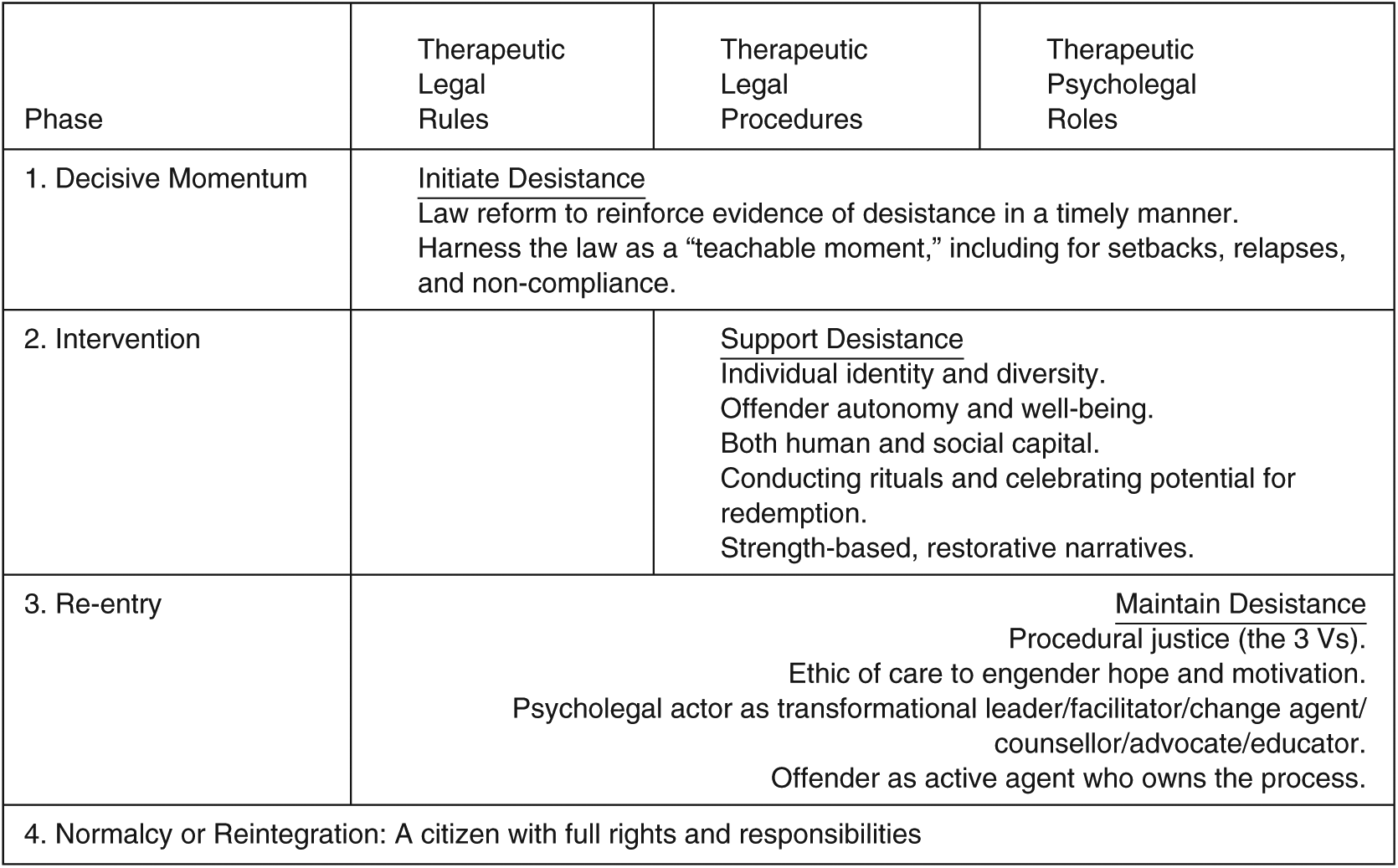
Strategies for maximizing desistance.
Conclusion
Systemic responses to offending ought to have a desistance-related future focus rather than a backward offense-related focus. Put another way, it is the difference between deficit-based “falling down” and strength-based “getting up” (Clark, 2005). Therefore, a systemic response ought to engage less in “correcting” wrong doers and focus more on building community capacity for reintegration (Maruna, 2010). A humanistic approach requires systemic responses to offenders in courts and corrections that maximize desistance. The proposed TJ–human rights framework assumes that the well-being of offenders and the community is best met when the likelihood of re-offending is reduced through helping desistance, rather than engaging in punishment, deterrence, denunciation, incapacitation, and/or rehabilitation-as-management. In this way, the anti-therapeutic consequences of the law on offender rights can be minimized and the therapeutic effects of the law on desistance can be maximized.