



Abstract
Work stress has been linked to a number of negative outcomes for employees and organizations. Drawing from the Job Demand–Control (–Support) model, we examined the influences of work stress among more than 1,800 prison officers working in 45 prisons across Ohio and Kentucky. Multilevel analyses revealed that individual factors such as experiencing victimization and greater job demands were related to more stress among prison officers, whereas perceived control over inmates and support from coworkers and supervisors were associated with less stress. Facility violence was also linked to higher levels of officer stress across prisons.
Work stress is a health issue that has been linked to a number of negative outcomes such as mental health problems, job dissatisfaction, drug and alcohol abuse, substandard job performance, and fatalities (Finn, 2000; National Institute for Occupational Safety and Health, 1999; Spinaris, Denhof, & Kellaway, 2012). Identifying the individual and environmental sources of work stress is critical for informing the development of prevention and intervention strategies designed to reduce the problem. The Job Demand–Control (–Support) model (which suggests that greater job demands, lower job control, and less social support are associated with more adverse occupational outcomes) has often guided inquiries into the sources of work stress (Dollard & Winefield, 1998; Hausser, Mojzisch, Niesel, & Schulz-Hardt, 2010; Johnson & Hall, 1988; Karasek, 1979; Van Der Doef & Maes, 1999). 1 Here, we apply this perspective to an examination of work stress among prison officers.
Prison work is physically and psychologically demanding, but prisons are also workplaces that pose relatively unique health and safety risks (Cullen, Link, Wolfe, & Frank, 1985; Liebling, Price, & Shefer, 2011; Spinaris et al., 2012). Work stress among prison officers can be influenced not only by individual-level characteristics, experiences, and perceptions of the organization but also by aggregate-level factors reflecting the characteristics of a prison environment (such as security level and crowding; Cullen et al., 1985; Wright, Saylor, Gilman, & Camp, 1997). Yet the extant research has been primarily limited to the examination of stress among prison officers from one or only a few institutions, prohibiting a meaningful analysis of environmental effects measured at the prison level (Blau, Light, & Chamlin, 1986; Wright et al., 1997). For example, it could be not only that officer perceptions of workplace safety affect their individual feelings of stress but also that objective indicators of unsafe environments measured at the prison level (e.g., prisons with higher rates of assaults) exert an independent influence on levels of stress in the work force across prisons (e.g., by increasing the ambient threat of victimization). To provide greater insight into the sources of work stress among prison officers, we examine data collected from more than 1,800 officers working in 45 adult institutions in Ohio and Kentucky. Our analysis contributes to the literature concerning work stress by (a) examining the applicability of the Job Demand–Control (–Support) model among prison officers, (b) assessing the potential relevance of both subjective and objective sources of work stress, (c) examining both person- and prison-level sources of stress, and (d) making use of a unique data set that includes data collected via separate surveys of prison officers and inmates, along with official records pertaining to those individuals.
A Bi-Level Model of Prison Officer Work Stress
Stress has been defined as the psychological discomfort or tension that results from exposure to stressors or stimuli that disturb individuals’ equilibrium and exceed their ability to cope (e.g., Cullen et al., 1985; Gerrig & Zimbardo, 2002). Work stress can be defined as a distinctive relation between an employee and his or her work environment that is caused by exposure to job stressors, or occupational conditions that place demands on an employee that exceed their individual coping resources (Schaufeli & Peeters, 2000). Coping resources have been described as factors that allow employees to deal effectively with or to remain insulated from the potential negative consequences of stressors (Cullen et al., 1985; Schaufeli & Peeters, 2000).
Researchers of occupational health (e.g., work stress, job satisfaction) among various employee populations have often framed their inquiries within the Job Demand–Control model (Karasek, 1979) or the Job Demand–Control–Support model (Johnson & Hall, 1988). Our examination of work stress among prison officers is informed by these perspectives. However, we recognize that a prison is a relatively unique place that presents safety risks that may contribute to stress (Cullen et al., 1985; Schaufeli & Peeters, 2000), and thus we also consider these potential sources of stress. Our bi-level model of work stress among prison officers is inclusive of both individual-level factors such as individual work experiences and perceptions of the organization, as well as environmental characteristics reflecting aggregate-level features of prisons and attributes of inmate and officer populations.
Individual-Level Influences on Prison Officer Work Stress
Job Demands
Similar to workers in other occupations, the job demands of prison officers reflect workload, time pressure, and role problems (e.g., Dollard & Winefield, 1998; Hausser et al., 2010; Karasek, 1979; Van Der Doef & Maes, 1999). Owing to increases in U.S. incarceration rates in the 1980s and 1990s (Blumstein & Beck, 2005; Glaze, 2010), officers in most states have been required to supervise more inmates and complete more job-related tasks (Finn, 2000; Schaufeli & Peeters, 2000; compare Stephan, 1997, with Stephan, 2008), although the burden typically varies across officers based on their assignment within a prison. The addition of more inmates without appropriate increases in officers also amplifies officers’ workloads by increasing the number of inmate needs and requests that require officers’ time and attention. Based on the Job Demand–Control model, prison officers who do not perceive that they have the requisite number of staff or time needed to meet the demands of their job may feel greater levels of stress (e.g., Dollard & Winefield, 1998; Schaufeli & Peeters, 2000). Supervisors may also experience greater stress, owing to the added demands of their position relative to line officers (Blau et al., 1986). High demands or workload have been linked to higher stress among prison officers (Lambert, Hogan, & Griffin, 2007; Schaufeli & Peeters, 2000).
Role problems reflect conflicting or ambiguous job expectations (Cullen et al., 1985; Schaufeli & Peeters, 2000). Role problems are inherent to prison work and often stem from the divergence between prison officers’ primary goals of maintaining a safe and secure environment versus promoting rehabilitation among the inmates (Cressey, 1959; Cullen et al., 1985). Rehabilitative treatment, for instance, requires officers to grant inmates a degree of trust and freedom of movement; yet from a custodial perspective, permitting such movement only increases the odds of conflict among inmates. Furthermore, the prescribed means by which officers should achieve their goals are rarely well defined, nor are they transmitted through adequate training or formal-on-the-job socialization processes (Cullen et al., 1985; Lambert & Paoline, 2005; Schaufeli & Peeters, 2000). For example, prison officers maintain institutional safety and security via effective inmate management, which requires flexibility and the use of discretion (Liebling et al., 2011); yet the use of discretion conflicts with the paramilitary structure and formal regulations common to most prison bureaucracies (Cullen et al., 1985; Jurik & Musheno, 1986). Following from the Job Demand–Control model, prison workers who experience ambiguous and frequently conflicting demands may experience stress. Several studies of prison workers have uncovered a relationship between role problems and work stress (Cullen et al., 1985; Lambert & Paoline, 2005; Philliber, 1987; Schaufeli & Peeters, 2000).
Control
Job control typically refers to skill discretion and decision authority (e.g., Hausser et al., 2010; Karasek, 1979; Van Der Doef & Maes, 1999). Prison work is a “low control” occupation; officers typically have little control over the inmate population or the policies regarding how prison rules are enforced (Dollard & Winefield, 1998; Hepburn, 1987; Jacobs, 1977; Lombardo, 1989; Sykes, 1958). Yet, there is variation in perceptions of job control among prison officers, and greater perceived authority over inmates has been linked to higher levels of job satisfaction and lower levels of burnout (Griffin, Hogan, & Lambert, 2012; Hepburn & Knepper, 1993). Prison officers who report more involvement in decision-making also report lower levels of stress (Dollard & Winefield, 1998; Liebling et al., 2011; Philliber, 1987; Slate & Vogel, 1997; Wright et al., 1997). According to the Job Demand–Control model, prison officers who perceive greater control over inmates or rule enforcement may experience less stress (e.g., Dollard & Winefield, 1998; Karasek, 1979).
Support
Support within a workplace (e.g., assistance, affirmation) can be derived from coworkers and supervisors. Supports can offer affective and instrumental assistance to officers (Cullen et al., 1985). Supports can also buffer stressful situations and events by providing resources that facilitate coping (Cohen & Wills, 1985; La Rocco & Jones, 1978). Thus, supports can directly affect work stress while also weakening the effects of other stressors (Dollard & Winefield, 1998; Hausser et al., 2010; Van Der Doef & Maes, 1999). Support from coworkers and supervisors, along with favorable relations among prison officers and between officers and supervisors, has been associated with greater well-being among prison officers (Cheek & Miller, 1983; Cullen et al., 1985; Dollard & Winefield, 1998; Lambert, Altheimer, & Hogan, 2010; Philliber, 1987; Poole & Regoli, 1980; Schaufeli & Peeters, 2000).
Social contacts can also influence levels of stress among prison officers (Dollard & Winefield, 1998; Schaufeli & Peeters, 2000). Frequent contact with inmates or coworkers might lessen social distance between officers and others, possibly contributing to the perception among officers that they have a stake in the prison environment. Such perceptions could contribute to more positive feelings regarding their work (Liebling, 2004). Frequent contact with others could also help to pass time and reduce opportunities for the development of tension or anxiety. In contrast, some researchers have found that frequent contact with inmates is linked to burnout among prison officers (Schaufeli & Peeters, 2000; Whitehead, 1989).
Workplace Safety
Similar to emergency responders and other law enforcement personnel, prison officers are exposed to violence at a higher rate than the general population (Brown, Fielding, & Grover, 1999; Finn, 2000; Haslam & Mallon, 2003; Kop, Euwema, & Schaufeli, 1999; Revicki & Gershon, 1996; Spinaris et al., 2012). Although most officers are never assaulted, their observations of violent incidents involving other officers and the constant risk of victimization may contribute to stress (Cullen et al., 1985; Lombardo, 1989; Schaufeli & Peeters, 2000). Officers who are assaulted, threatened, or perceive that their environment is unsafe may also experience higher levels of stress. There is evidence of a relationship between direct exposure to violence and workers’ perceptions of safety and stress (e.g., Cullen et al., 1985; Lambert et al., 2007; Lambert & Paoline, 2005; Schaufeli & Peeters, 2000; Spector, Coulter, Stockwell, & Matz, 2007).
Prison-Level Influences on Officer Work Stress
Only a handful of researchers have examined the effects of environmental characteristics measured at the prison level on stress and well-being among officers (Bierie, 2012; Blau et al., 1986; Wright et al., 1997). Based on research involving employees in other organizations (e.g., Blaug, Kenyon, & Lekhi, 2007; Panari, Guglielmi, Ricci, Tabanelli, & Violante, 2012), however, we expect that these objective sources of stress may have unique effects beyond the subjective and objective individual-level sources of stress that are more frequently examined in related studies. We expect that environmental factors measured at the prison level could impact stress among prison officers by impacting job demands or job control, opportunities for social support, or workplace safety.
A facility’s size and level of crowding (population beyond a facility’s design capacity) may be relevant. Crowded prison environments generate higher workloads for most prison officers, and although individual perceptions of workload may have direct effects on stress (Dollard & Winefield, 1998; Finn, 2000), an objective source of increased workload (crowding) could contribute independently to the general level of stress among officers in a prison because the size of the officer workforce is typically not increased at same rate as the inmate population (Finn, 2000; compare Stephan, 1997, with Stephan, 2008). Larger and more crowded environments could also contribute to perceptions of less control among workers, owing to increased autonomy and less authority (Cohen & Wills, 1985; Szilagyi & Holland, 1980). Crowding also inhibits prison officers’ capabilities to effectively manage the inmate population (Steiner & Wooldredge, 2008, 2009b), whereas larger facilities contribute to less familiarity among officers and between officers and inmates, which could generate uncertainty among officers (Liebling, 2004) and reduce opportunities for supportive relationships to develop. All of these processes could contribute to higher levels of stress.
The objective level of inmate violence in a prison might also increase stress by impacting the odds of exposure to violence. Prisons with a higher level of violence have a greater ambient threat of victimization. Officers are also more likely to observe violence in prisons with higher levels of inmate violence, and observations of violent incidents could directly impact their perceptions regarding workplace safety (Spector et al., 2007). Also possibly related to officers’ perceptions of safety is the overall level of inmates’ dissatisfaction with officers. Inmates who are dissatisfied with prison officers may view them as illegitimate, unresponsive, and ill-equipped to ensure an orderly and safe environment (see Kirk & Papachristos, 2011 for a related discussion pertaining to citizens and legal authorities in the general population). If inmates do not feel they can rely on officers to help them solve problems posed by their environment, then they may be more likely to engage in rule-breaking as a form of problem-solving (Black, 1983; Kirk & Papachristos, 2011). Higher levels of assaults and rule-breaking among inmates could contribute to higher levels of stress among officers, both owing to concerns related to officer safety and because officers are often evaluated by the level of rule-breaking in their part of a prison (Cullen et al., 1985; Lambert & Paoline, 2005; Lombardo, 1989; Schaufeli & Peeters, 2000; Sykes, 1958).
A prison’s security level has also been associated with work stress (Cullen et al., 1985). Compared with maximum, close, and medium security prisons, minimum security prisons are typically filled with an inmate population that is lower risk. The design of minimum security prisons is also less authoritarian and sterile relative to higher security prisons (Steiner & Wooldredge, 2009a). These environmental features of minimum security prisons may result in lower stress among prison officers.
Current Study
This study involved an examination of the individual and environmental sources of work stress among prison officers. Based on the discussion above, we propose the following hypotheses:
Method
The data analyzed for this study were collected as part of a larger project that involved the administration of separate surveys to samples of line-level prison officers and inmates from each of the 42 state-operated confinement facilities for adults in Ohio and Kentucky and the three privately operated facilities for adults in Ohio. Official data on these officers, inmates, and facilities were also collected from state records (e.g., officer’s length of service, age, race/ethnicity, facility population size). For this study, we analyzed the data collected from officers, although some of the survey data collected from inmates and the official data pertaining to prisons were used to create measures reflecting characteristics of prison environments.
Officer Participants
Systematic random samples were drawn from lists of all line officers and sergeants employed in each prison. The sample sizes varied across prisons based on the size of the officer populations within each prison. In Ohio, sample sizes were determined using probabilities proportionate to size, with the goal of 95% confidence intervals for parameter estimates. We also included an oversample of 50% in anticipation of refusals and incomplete surveys based on prior research on prison officers (e.g., Hepburn, 1985). These procedures resulted in 36% samples of the officer populations working in facilities in Ohio. Procedures differed in Kentucky because the Ohio portion of the study was completed prior to the Kentucky portion, and the remaining available resources permitted selection of 100 officers per facility in Kentucky. All officers were automatically included if there were fewer than 100 officers employed at a facility. Final sample sizes ranged from 19 to 178 officers across prisons in both states, for a total target sample size of 3,857 officers. Some of the officers were transferred, fired, placed on leave, or resigned during the study, which reduced the usable target sample size to 3,710 officers.
An envelope containing a survey, a letter explaining the study (and voluntary consent to participate), and a postage paid return envelope was placed in each officers’ employee mail. Two waves of follow-up surveys were distributed to nonrespondents in Ohio (at 3 and 7 weeks), and one follow-up survey was distributed in Kentucky (6 weeks after the initial survey). Nonrespondents (and duplicate responses) were determined through the use of unique identifiers that corresponded to the sampled officers and were placed on each survey. The difference in follow-up procedures was based on the wishes of the Kentucky Department of Corrections (KDOC). However, several weeks after the administration of the initial survey, an announcement was made during roll calls at each Kentucky prison encouraging officers who were so inclined to complete the surveys. These procedures resulted in the return of 1,848 surveys and comparable response rates within each state (50% overall), typical of multisite studies of correctional officers (Hepburn, 1985). Missing data on the measures reduced the sample used in this to 1,802. All of the cases were weighted inversely to their odds of selection into the sample. The weighted Ohio sample was representative in terms of sex, race/ethnicity, rank, and length of service. The Ohio sample was slightly older, however, than the target population (M = 42.4 vs. µ = 41.3). For Kentucky, the weighted sample was representative on sex, race/ethnicity, and rank. The parameters for length of service and age were unavailable from the KDOC.
Inmate Participants
Random samples of inmates were also selected from each facility. Prior to selecting the samples, the inmates who had served less than 6 months were excluded from the sampling frames because the survey administered to the inmates included questions that inquired about their experiences, routines, and behaviors in prison during the previous 6 months of incarceration at the same prison. (The relevant measure for the analysis presented here involved whether the inmate engaged in assaults during the previous 6 months.) The sampling frames were also stratified by whether inmates had previously been imprisoned to capture the experiences of both first-time inmates and those who had previously served time. Next, equal numbers of inmates were randomly selected from each stratum. The inmate sample sizes differed across facilities due to practical constraints dictated by the Ohio Department of Rehabilitation and Correction (ODRC) and the KDOC. Either 130 or 260 inmates were selected from each Ohio prison, and between 100 and 200 inmates were selected from each Kentucky prison, which resulted in a total target sample size of 7,294 inmates across the 45 prisons. 2 Some inmates were not available on the day of the survey, reducing the target sample size to 6,997 inmates. 3
In contrast to the officers, inmates were surveyed on-site. Administration of the inmate surveys in most of the prisons involved surveying general population inmates in designated areas such as the gymnasium, visiting area, or chapel, and then surveying inmates in segregation or protective custody in their cells. Attempts were made to ensure confidentiality of the inmates’ responses by having inmates complete the surveys outside the direct view of security staff and away from surveillance cameras. After briefly describing the study, a member of the three person research team gave each inmate a survey and a voluntary consent form. Each survey was subsequently collected by one of the researchers. 4 Inmates were not compensated for their participation in the study. These procedures resulted in 5,800 completed surveys, but missing data for some of the survey questions reduced the sample used here to 5,630 inmates (an 80% participation rate). Comparisons between weighted samples used for the study and the respective populations of inmates who had served at least 6 months in state custody revealed no significant differences with respect to age, sex, race, committing offense type, prior incarceration, sentence length, or time served.
Measures
All of the measures included in the analysis are described in Table 1. Work stress was measured with a six-item scale comprised of items derived from prior studies of work stress among prison officers (e.g., Cullen et al., 1985; Lambert & Paoline, 2005). Individual-level measures included in the analysis were job demands (role problems, perceived adequacy of the number of staff to maintain safety and security, perceived adequacy of time to meet job demands, supervisor), control (perceived control over rule enforcement, perceived control over inmates), support (coworker support, supervisor support, average number of inmates talked with per shift, average number of coworkers talked with per shift), and workplace safety (victim of assault, number of times threatened in the past month, number of assaults on officers per month, perceived safety). We also included measures of officers’ age, sex (male as reference category), and race/ethnicity (White as reference category) as control variables, although the evidence concerning the effects of these characteristics on stress is mixed (e.g., Bierie, 2012; Blau et al., 1986; Britton, 1997; Cullen et al., 1985; Griffin et al., 2012; Lambert et al., 2007; Lambert & Paoline, 2005; Schaufeli & Peeters, 2000). 5
Sample Means and Standard Deviations

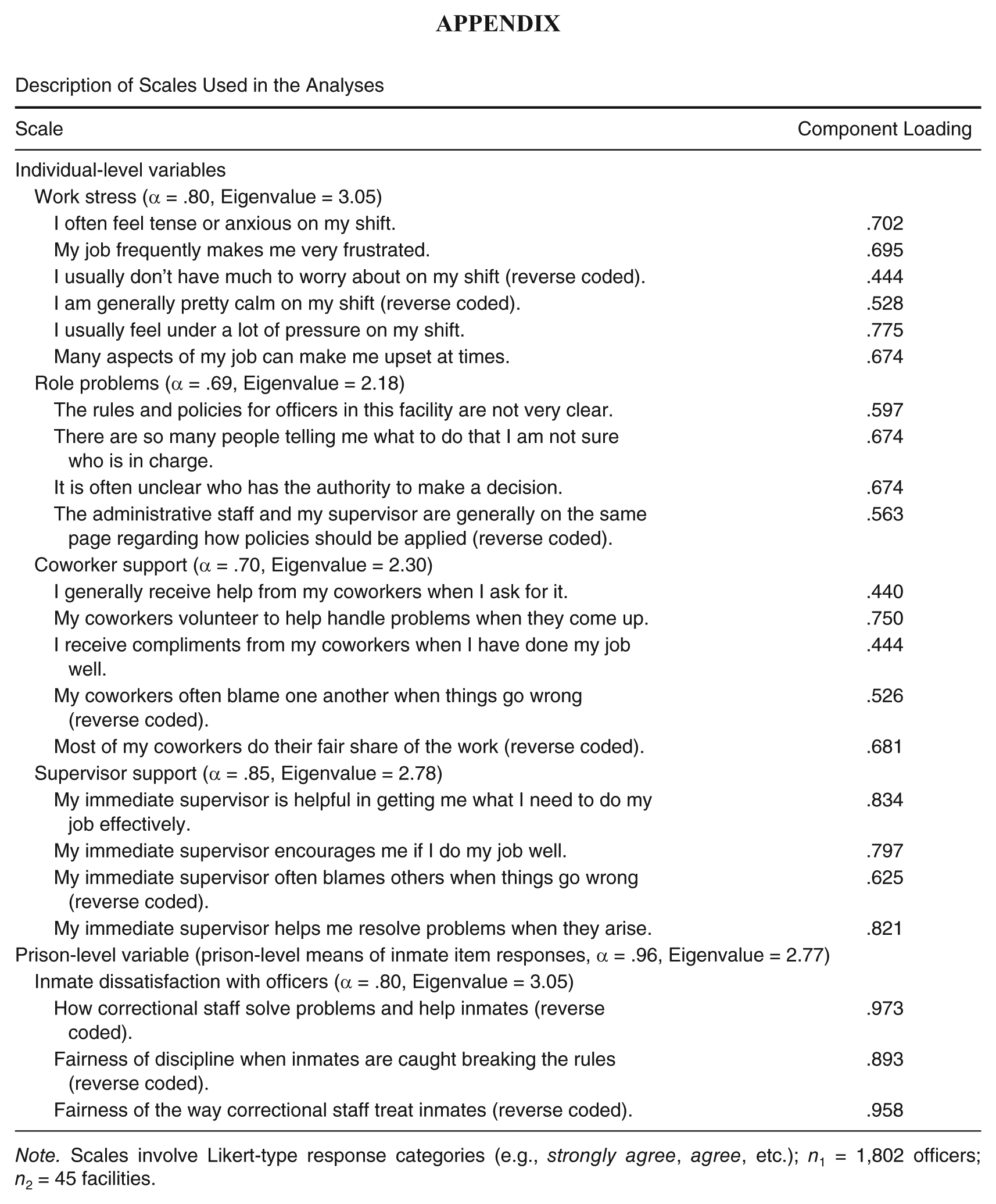
Scale created via principal components analysis, individual items, Eigenvalues, and component loadings listed in the appendix.
All of the measures described above were created from items on the officer survey, although official data were used to impute missing values for the measures of age, sex, and race. Most of these measures are intuitive, while a few require explanation. The scales that measure work stress, role problems, coworker support, and supervisor support were created via principal axis factor analysis. Items that comprise these scales, their components loadings, and corresponding Eigenvalues and reliability indices are described in the appendix. The items used in these scales were derived from prior studies of work stress among prison officers (e.g., Cullen et al., 1985; Lambert et al., 2010; Lambert & Paoline, 2005; Poole & Regoli, 1980). The perceived adequacy of the number of staff to maintain safety and security was measured with a survey item that inquired whether the officer agreed with the statement that there is enough staff on their shift to maintain the safety and security of the inmates. Perceived adequacy of time to meet job demands was measured with an item that asked officers whether they agreed that there is enough time to perform all of their required tasks on their shift. Following Hepburn (1987) and Tannenbaum (1961), perceived control over rule enforcement is a scale that was created by differencing responses to two survey items that inquired about officers’ perceptions of their actual and ideal control over rule enforcement. Perceived control over inmates was measured with a survey item that asked whether officers reported that inmates usually did what they told them to do. Officers’ perception of safety was measured with an item that inquired whether officers typically felt safe on their shift. The natural log of the scales for the number of times threatened in the past month, number of assaults on officers per month, number of inmates talked with per shift, and the number of coworkers talked with per shift was taken to remove the skew in these distributions.
Prison-level variables included prison size (design capacity), inmate population size, assault rate, inmate dissatisfaction with officers, and minimum security prison. Other prison-level measures were considered for the analysis (e.g., sex of inmates housed, ratio of officers to inmates), but they were ultimately excluded based on tests for multicollinearity or relatively weak zero-order relationships. Prison size, inmate population size, and minimum security prison were all compiled from official records on the day the survey was administered. Including the measures of population and prison size in the same model may also proxy institutional crowding, and these measures were included over other measures of crowding to capture the unique effects of prison size (design capacity) and crowding (population beyond a prison’s design capacity; Wooldredge & Steiner, 2009). Assault rate measures the number of self-reported assaults perpetrated by inmates in the 6 months prior to the survey date divided by the number of inmate respondents from each facility. Self-report data of inmate misconduct have been found to be valid indicators of inmate behavior (e.g., Steiner & Wooldredge, 2014; Van Voorhis, 1994), but it is worth noting that self-report data are also subject to potential limitations stemming from poor recall and overreporting or underreporting by certain groups of respondents. Inmate dissatisfaction with officers is a scale adapted from Tyler’s (1990) examination of citizen’s satisfaction with the police and was created via principal axis factoring of the prison-level means of responses to three inmate survey items described in the appendix.
Statistical Analysis
Bi-level models were estimated due to the analysis of both individual and environmental effects on work stress. 6 The continuous measure of work stress was examined with hierarchical linear regression using the software package HLM 7.0 (Raudenbush, Bryk, & Congdon, 2011). An unconditional model was estimated to derive estimates of variance in stress existing at each level of analysis, and to determine whether the between-prison estimate was significant. Next, a fixed effects model including the individual-level variables was estimated. We initially explored random coefficient models, but only two of the Level 1 slopes varied significantly across prisons (victim of assault, number of times threatened in past month), and the reliabilities for these effects were low (λ < .3). As the magnitude of the coefficients for the significantly varying effects were very similar to the magnitude of the fixed effects coefficients, we present the fixed effects for all of the Level 1 relationships. However, the Level 1 intercept was still allowed to vary across prisons to permit examination of Level 2 main effects on levels of stress. The individual-level measures were group mean-centered to remove between-prison variation in individual characteristics that might have corresponded with differences in levels of stress across prisons. The drawback to this strategy is that it offers more conservative tests of Level 1 effects and more liberal tests of Level 2 effects (the Level 1 predictors can only “explain” within-prison variance in each outcome as opposed to between-prison variance due to compositional differences in officer populations). However, group mean centering also reduces the odds of finding spurious Level 1 effects due to unmeasured environmental effects that might also be related to compositional differences in officer populations across prisons (Raudenbush & Bryk, 2002). Finally, the intercepts-as-outcome model was estimated, which provided the main effects of environmental characteristics on work stress at the prison level.
Results
The findings from the bi-level analysis of work stress are shown in Table 2. Before delving into the findings, however, it is worth noting the level of stress reported by these prison officers. Approximately 36% of officers agreed that they felt tense or anxious on their shift. Fifty-four percent of the officers agreed that the job frequently makes them frustrated, while 55% of the officers reported they typically have much to worry about on their shift. Officers frequently agreed with the statement that they were generally pretty calm on their shift (89%), but 31% of the officers reported that they felt under a lot of pressure on their shift, and 62% agreed with the statement that many aspects of the job made them upset.
Individual and Environmental Effects on Work Stress

p < .05. ** p < .01. †p < .10 (Level 2 only).
Results of the unconditional model revealed significant variation in the level of officer stress across facilities, although it is worth noting that most of the variation in work stress fell among officers within the same facility (96%). Table 2 shows that officers who reported greater job demands also experienced more stress. For instance, stress levels were significantly higher among officers who felt that the number of staff in their facility was inadequate to maintain the safety and security of the inmates, and officers that reported they had inadequate time to meet job demands. Prison officers who experienced higher levels of role conflict and officers charged with supervising other staff were also significantly more stressed. Job control had mixed effects on stress among officers; officers’ perceptions of control over rule enforcement was not related to stress, but those who reported less control over the inmates did suffer more stress. In contrast, support was associated with less stress among officers. Officers who reported more social contacts with coworkers and officers who perceived more support from their coworkers or supervisors experienced significantly less stress. Contact with inmates was not associated with stress. Workplace safety issues also impacted officers’ stress levels; officers who were assaulted or threatened more often suffered significantly more stress. Similarly, officers experienced more stress when they perceived a higher number of other officer assaults in their prison and when they felt less safe. Neither officers’ age nor their sex was related to stress, but White officers experienced significantly greater stress than minority officers.
The significant individual-level predictors in the model explained 37% of the within-prison variation in work stress. Based on the standardized coefficients (beta weights) reported in Table 2, the strongest predictors of work stress included role problems, perceived safety, and perceived adequacy of time to meet job demands. A one standard deviation increase in the role problems scale was associated with .29 standard deviation increase in work stress. In contrast, a standard deviation increase in perceived safety contributed to a .16 standard deviation decrease in work stress. A standard deviation increase in perceived adequate time to meet job demands was associated with a .14 decrease in work stress.
Turning to the environmental influences on work stress, it is important to note that a different criteria was used for assessing statistical significance (p < .10) due to the differences in sample sizes for individuals (n1 = 1,802) versus prisons (n2 = 45). The analyses revealed that officers who worked in prisons with higher assault rates experienced significantly higher levels of stress. Facility size, inmate population, and inmates’ satisfaction with officers had no impact on levels of stress across prisons. Officers who worked in minimum security prisons experienced significantly less stress than officers working in higher security facilities. The significant prison-level predictor variables explained 51% of the between-facility variation in work stress. A one standard deviation increase in minimum security was associated with a .40 standard deviation decrease in the level of stress, whereas a one standard deviation increase in the assault rate was associated with a .24 standard deviation increase in level of stress across facilities.
Discussion
Drawing from the Job Demand–Control model (Karasek, 1979) and the Job Demand–Control–Support model (Johnson & Hall, 1988), and considering relatively unique health and safety risks posed by prison environments, we examined the antecedents of work stress among a large sample of prison officers working in 45 prisons across Ohio and Kentucky. Our analyses revealed that a number of the prison officers working in these two states were under stress. Based on officer’s responses to three of the six items used to measure stress, more than 50% of these officers experienced work stress; whereas responses to two of the other items suggested a smaller (but still substantive) percentage of officers (more than 30%) experienced work stress. Estimates of work stress among the general public range from 26% to 40% (National Institute for Occupational Safety and Health, 1999). Thus, the prison officers in this study typically experienced more stress than workers in other occupations.
We examined individual and environmental sources of work stress and uncovered several themes pertaining to the antecedents of work stress among prison officers. First, we found support for the Job Demand–Control model (e.g., Dollard & Winefield, 1998; Karasek, 1979) and our first hypothesis; prison officers who were more likely to perceive inadequate resources (in terms of staffing or time) to meet their job demands experienced higher levels of stress. Supervisors and prison officers who experienced role problems were also more likely to experience stress. For prison officers, role problems often stem from the conflict between expectations of maintaining a safe and secure facility while also facilitating rehabilitation among the inmates (Cressey, 1959; Cullen et al., 1985; Grusky, 1959; Lambert & Paoline, 2005; Schaufeli & Peeters, 2000). Role problems may also have resulted from the disjuncture between an officer’s need to be flexible in responding to a wide assortment of situations within the context of a rigid paramilitary structure and formal regulations common to prison bureaucracies (Cullen et al., 1985; Liebling et al., 2011; Jurik & Musheno, 1986). Also, officers who reported less control over the inmates also experienced more stress.
Second, we found support for the Job Demand–Control–Support model (Johnson & Hall, 1988) and our first hypothesis; work stress was lower among prison officers who received more support from their coworkers or supervisors. Similarly, officers who had more contact with coworkers on their shift also experienced less stress. The latter finding also supports researchers’ predictions pertaining to the link between isolation and work stress (e.g., Cohen & Wills, 1985; Dollard & Winefield, 1998; Karasek & Theorell, 1990). Both sets of findings are also consistent with those derived from prior studies of stress among prison workers (e.g., Cheek & Miller, 1983; Cullen et al., 1985; Dollard & Winefield, 1998; Lambert et al., 2010; Schaufeli & Peeters, 2000). Officers who received more support from their coworkers or supervisors may have received assistance, which served to buffer against stressful situations that occurred on their shift or the stress associated with prison work in general (Cohen & Wills, 1985; Cullen et al., 1985). At a minimum, perceptions of greater support may increase the confidence of officers to perform their work even if they do not actually fall back on this support to do so. Altogether, our findings suggest that the Job Demand–Control–Support model applies to prison workers.
Prisons are relatively unique workplaces in terms of health and safety risks. For instance, both inmates and prison officers are more likely to be assaulted than the general population (Wolff, Blitz, Shi, & Bachman, 2007; Wooldredge & Steiner, 2013). We found that nearly 35% of these officers reported having been assaulted by inmates, and just more than 30% of the officers indicated they had been threatened by an inmate in the past month. Officers also reported that one staff member was typically assaulted in their facility every month. Consistent with our second hypothesis, these safety issues were all linked to higher stress levels among officers and likely contributed to the perception among many officers that they were not safe on the job. Our analyses revealed that officers’ perceptions of safety had a strong effect on their level of stress even after controlling for objective individual (e.g., victimization) and environmental (e.g., assault rate) sources of danger.
This study was one of the first studies of prison officers to date that examined the impact of environmental sources of work stress measured at the prison level. Consistent with our findings pertaining to the individual-level sources of work stress and our third hypothesis, safety concerns also impacted levels of officer stress across prisons. Officers who worked in prisons that had higher rates of inmate assaults also experienced higher levels of stress, whereas officers who worked in minimum security facilities, which hold inmates who are presumably less dangerous, experienced less stress. When considered alongside the individual-level findings pertaining to officers’ perceptions of safety, our findings suggest that perceptions of safety and the objective threat to officer safety contribute independently to work stress among prison officers. These findings are consistent with those derived from research involving employees in other organizations (e.g., Blaug et al., 2007; Panari et al., 2012); that is, both subjective and objective measures of stressors independently impact work stress among prison officers.
The findings from this study also point to several avenues for future research. First, the majority of the individual-level relationships estimated here did not vary across facilities, but this may not be the case in larger samples with more facilities. Given the relevance of both individual and environmental effects observed here, a logical next step would be to examine whether the interaction of these two sources of stress uniquely contribute to stress—that is, assuming individual-level effects vary across prisons. It could be, for example, that the individual-level relationship between role problems and stress is more pronounced in larger or more crowded prisons. Large prisons have a longer chain of command and crowded prisons are more difficult to manage due to the shortage of officers relative to inmates discussed earlier; both of these processes could moderate the role problems–work stress relationship. The relationship between officers’ perceptions of safety and stress may also be stronger in facilities with a greater ambient threat of victimization such as those with a higher assault rate. Furthermore, it might be worthwhile to examine the individual and environmental influences on officers’ perceptions of safety in light of the relevance of those perceptions for stress levels across officers. A critical next step could be to identify whether objective sources of dangerousness directly impact officers’ perceptions of their safety.
It is worth noting some potential limitations to this study that could be additional directions for future research. First, the items used to create the measure of work stress and most of the predictor variables were based on individuals’ self-reports. Potential limitations of self-report data include recall error and over- or underreporting by certain groups of respondents. To increase our understanding of whether these self-report measures are valid, researchers may wish to compare objective and subjective indicators of concepts such as stress or examine measures derived from multiple informants for concepts such as supervisor or coworker support. Second, a few of the concepts included in our model were measured with single item indicators, which raises concerns related to measurement validity and reliability. Future researchers may want to measure concepts such as job demands and control with multiple item scales that more adequately capture the breadth of these concepts. Furthermore, although the scales we used here were derived from prior studies, there could be other items worth including in those scales. Including additional items in the scales could increase the reliability of those measures. For instance, other items could be included alongside those used to measure role problems in this study, which could not only increase the reliability of the measure but also permit empirical testing for whether ambiguity and conflict are distinct dimensions of role problems. Finally, there could be other measures that could impact work stress that were not examined here. For instance, Lambert et al. (2007) found that work and family conflict were associated with greater work stress, whereas role overload was linked to less work stress. Wright et al. (1997) observed that prisons with officers who reported greater job autonomy also had less stress among their officers. Indeed, researchers may seek to examine these possible sources of work stress alongside those determined to impact stress among the prison officers examined here.
Taken together, the findings from this study of work stress among prison officers have relatively straightforward implications for organizations seeking to reduce work stress among custodial staff. First, prison administrators should ensure that officers have the necessary resources to complete their required tasks, perhaps by re-allocating staff to specific shifts or areas within prisons that are more labor-intensive. Administrators might also seek to clarify officers’ role expectations by clearly defining goals and policies in writing and improving organizational communication via collaborative meetings between line-level officers and prison administrators (Finney, Stergiopoulos, Hensel, Bonato, & Dewa, 2013). Collaborative meetings could not only reduce role problems but also increase support and provide officers with a forum for discussing other problems that contribute to stress. Prison administrators could also increase officer involvement in decision-making, which could provide for greater transparency in organizational decision-making, reduce role problems, and increase support (Brower, 2013; Finney et al., 2013). Furthermore, administrators could develop policies that allow officers some latitude to use their professional judgment and discretion, which could foster a sense of control among officers. And, providing additional training on the efficacious use of discretion could not only reduce role problems but also go a long way toward making prisons safer (Liebling et al., 2011), and safer prisons also would result in less stress among prison workers.
To be sure, our findings suggest that prison administrators should take measures to improve prison safety. Possible strategies might include the use of rehabilitative programming (French & Gendreau, 2006), and training officers regarding precautionary behaviors, conflict de-escalation skills, and the legitimate treatment of the inmate population (Liebling et al., 2011; Sparks, Bottoms, & Hay, 1996). Administrators might also develop programs that foster supportive relationships among coworkers and between coworkers and supervisors. Training for supervisors, team building exercises, support groups, and wellness programs might go a long way in this regard (Brower, 2013; Dollard & Winefield, 1998; Shamir & Drory, 1981). In particular, training supervisors on how to balance their disciplinary responsibilities with positive encouragement and recognition could foster more supportive relations with staff and ultimately reduce stress (Brower, 2013). It is worth noting, however, that many of these strategies may be difficult to implement in the current era of mass incarceration in the United States (Blumstein & Beck, 2005). Mass incarceration has increased the job demands placed upon prison officers. The increases in the use of imprisonment in the United States over the past several decades have also stretched agency budgets, reducing dollars allocated to inmate programming, staff training, and other resources that may aid agencies seeking to reduce work stress among their officers (Gottschalk, 2010; Henrichson & Delaney, 2012). Many prisons have also become crowded (Steiner & Wooldredge, 2008) and, in addition to the problems discussed above, we observed that crowding may indirectly contribute to higher levels of stress among officers. Thus, efforts to bring prison populations in line with design capacities may help to ameliorate work stress and a number of its other causes.
Conclusion
All told, the findings from this study offered some new insights into the sources of work stress among prison officers by examining both objective and subjective sources of stress at the individual and environment(prison) level. We uncovered that both objective and subjective stressors influence work stress among prison officers. We also uncovered that there are individual and environmental influences on work stress, including the relevance of job demands, social support, and control, along with safety risks pertaining to prison environments.
Work stress is an issue that has been associated with a number of negative health outcomes such as mental health problems, job dissatisfaction, drug and alcohol abuse, substandard job performance, and mortality (Finn, 2000; National Institute for Occupational Safety and Health, 1999; Spinaris et al., 2012). We found that, similar to other first responders, work stress is particularly high among prison officers. Our findings suggest that prison administrators should consider taking steps to reduce work stress among their employees, perhaps by lowering job demands (e.g., clarify role expectations) and increasing support from coworkers and supervisors within the workplace (e.g., via team building exercises). Our findings also suggest prison administrators should take measures to improve prison safety (e.g., provide training to officers regarding conflict de-escalation skills). Finally, it is only by continuing to study the individual and environmental sources or work stress that we might be better able to understand the problem and inform the development of prevention and intervention strategies that can reduce the problem.
Footnotes
Appendix
Description of Scales Used in the Analyses
| Scale | Component Loading |
|---|---|
| Individual-level variables | |
| Work stress (α = .80, Eigenvalue = 3.05) | |
| I often feel tense or anxious on my shift. | .702 |
| My job frequently makes me very frustrated. | .695 |
| I usually don’t have much to worry about on my shift (reverse coded). | .444 |
| I am generally pretty calm on my shift (reverse coded). | .528 |
| I usually feel under a lot of pressure on my shift. | .775 |
| Many aspects of my job can make me upset at times. | .674 |
| Role problems (α = .69, Eigenvalue = 2.18) | |
| The rules and policies for officers in this facility are not very clear. | .597 |
| There are so many people telling me what to do that I am not sure who is in charge. | .674 |
| It is often unclear who has the authority to make a decision. | .674 |
| The administrative staff and my supervisor are generally on the same page regarding how policies should be applied (reverse coded). | .563 |
| Coworker support (α = .70, Eigenvalue = 2.30) | |
| I generally receive help from my coworkers when I ask for it. | .440 |
| My coworkers volunteer to help handle problems when they come up. | .750 |
| I receive compliments from my coworkers when I have done my job well. | .444 |
| My coworkers often blame one another when things go wrong (reverse coded). | .526 |
| Most of my coworkers do their fair share of the work (reverse coded). | .681 |
| Supervisor support (α = .85, Eigenvalue = 2.78) | |
| My immediate supervisor is helpful in getting me what I need to do my job effectively. | .834 |
| My immediate supervisor encourages me if I do my job well. | .797 |
| My immediate supervisor often blames others when things go wrong (reverse coded). | .625 |
| My immediate supervisor helps me resolve problems when they arise. | .821 |
| Prison-level variable (prison-level means of inmate item responses, α = .96, Eigenvalue = 2.77) | |
| Inmate dissatisfaction with officers (α = .80, Eigenvalue = 3.05) | |
| How correctional staff solve problems and help inmates (reverse coded). | .973 |
| Fairness of discipline when inmates are caught breaking the rules (reverse coded). | .893 |
| Fairness of the way correctional staff treat inmates (reverse coded). | .958 |
Note. Scales involve Likert-type response categories (e.g., strongly agree, agree, etc.); n1 = 1,802 officers; n2 = 45 facilities.
Acknowledgements
The authors also wish to thank Guy Harris, along with Brian Martin and Gayle Bickle with the Ohio Department of Rehabilitation and Correction for their assistance with the collection of the data for this study.
This study was supported in part by grants from the National Institute of Justice (Award 2007-IJ-CX-0010) and the National Science Foundation (Award SES-07155515). The opinions, findings, and conclusions expressed in this study are those of the authors and do not necessarily reflect those of the Department of Justice or the National Science Foundation.