



Abstract
This study extends Hipple and colleagues’ variation analysis by examining how varying degrees of restorative justice, procedural justice, and defiance in family group conference (FGC) processes and outcomes affect long-term juvenile recidivism measures in one large Midwestern U.S. city. The current study uses two data sets from the Indianapolis Juvenile Restorative Justice Experiment that include conference observations, juvenile histories, and adult criminal histories to examine how variations in FGC elements shape juvenile recidivism outcomes in a long-term follow-up period. Findings reveal that the greater fidelity of FGCs to the theoretical foundations of restorativeness and procedural justice, the better outcomes in the long term as measured by future offending. Specifically, offense type and conference restorativeness influenced the probability of recidivism in the long term. Results are consistent with the theoretical predictions of reintegrative shaming and procedural justice theories, providing further support that FGCs are a viable youth justice program option.
Keywords
As many remain skeptical of the effectiveness of restorative justice programs for meeting traditional criminal justice goals (e.g., Zernova, 2007), it is necessary to understand more fully how restorative programs like family group conferences (FGCs) can affect juvenile recidivism in the United States. Some studies have reported promising reductions in juvenile recidivism following restorative justice interventions (Petrosino, Guckenburg, & Turpin-Petrosino, 2010), but other scholars have been more critical of these studies due to potentially biasing flaws in research design (Weatherburn, McGrath, & Bartels, 2012). Admittedly, restorative justice programs are unlikely to replace conventional justice programs in the foreseeable future. Nevertheless, the integration of particular restorative program components and adjudicatory practices into existing justice programs seems plausible considering some of the successes that programs have enjoyed elsewhere. For this reason, identifying unique restorative elements of FGCs and other restorative justice programs is critical for developing best practices that can be implemented in the future.
Interest in the viability of restorative justice as an alternative to traditional criminal justice programs, particularly for juveniles, has continued to increase. Studies stemming from field experiments and other observational research have examined the processes and outcomes of restorative conference interventions, including important work conducted in South Australia (Daly & Immarigeon, 1998), New Zealand (Maxwell & Morris, 1993), Great Britain (Shapland et al., 2007), and the United States (McCold & Wachtel, 1998; McGarrell, 2001; McGarrell & Hipple, 2007). Central to this research are two questions that have yet to be fully answered. The first question regards how to evaluate program restorativeness, or the extent to which restorative values and principles are reflected in an intervention. Although some have identified key elements of restorative justice programs, such as respectful listening and making amends, that may serve as evaluative criteria (Braithwaite, 2002; McCold, 2000; Presser & Van Voorhis, 2002; Van Ness & Strong, 2010), exactly what makes a program restorative has not been settled. The second question that is also of vital importance to juvenile justice practitioners and policy makers pertains to the effectiveness of restorative justice alternatives for producing positive changes in the behaviors of juveniles, including reductions in recidivism. Although preventing future delinquency through restorative justice measures is not a priority for all (Johnstone, 2002; Miers, 2001; Morris, 2002), some have sought to simultaneously evaluate varying degrees of restorative values and principles reflected in restorative justice interventions and their effects on juvenile delinquency (Hayes, 2005; Hayes & Daly, 2003; Hipple, Gruenewald, & McGarrell, 2014; Maxwell & Morris, 2001). As research in this area continues to advance, it is both natural and good scientific practice to consider how certain design features of previous research have potentially affected results so that they may be improved. For example, Weatherburn et al. (2012) noted that small sample sizes and lacking controls for selection effects have threatened the validity of findings from experimental and quasi-experimental research on restorative justice interventions. Also important is the lack of long-term follow-up periods for measuring juvenile recidivism.
Some important ways that restorative justice programs differ from traditional justice programs are their goals of restoring impaired relationships, creating greater understanding of the impact of the offense, cultivating respect for the law, and supporting offenders’ successful reintegration into their communities. In theory, achieving such goals through restorative interventions would also reduce the likelihood of repeat juvenile offending. Very little is known, however, about the long-term impact of restorative processes on reoffending.
FGCs bring together victims, offenders, and others affected by delinquent acts (family members, community members, etc.) to participate in meetings aimed at empowering victims, holding offenders accountable, as well as other goals designed to restore impaired relationships (Daly & Hayes, 2002). Hipple and colleagues (2014) found that while some restorative elements incorporated into FGCs led to reductions in reoffending among juveniles, the study’s results were highly dependent on the time intervals (i.e., follow-up period) in which reoffending outcomes were measured. Moreover, it appeared that some delinquency and juvenile participant characteristics that were strong predictors of recidivism at 6 months were not important predictors of recidivism at 24 months. Whereas Hipple and colleagues’ analysis extended the literature in several ways, it left questions about the long-term effects of FGCs on juvenile recidivism unanswered. Consequently, little is known about whether and how restorative interventions affect recidivism long after juveniles participate in these alternative programs.
Notably, restorative justice scholars Maxwell and Morris (2001) reminded us that long-term follow-up periods are required to measure persistence in offending and that recidivism needs to be measured at both short and extended time intervals following FGCs. To date, findings related to the effects of restorative justice on recidivism have only recently begun to emerge and long-term studies of restorative justice processes remain rare. Therefore, one way to advance the growing research in this area is to improve upon Hipple and colleagues’ (2014) study by adding a follow-up period for comparison to determine whether restorative measures and other FGC elements affect juvenile reoffending similarly or differently over the long term. Evaluations incorporating multiple measurement points should be increasingly revealing about the restorative potential of particular programs. In this way, examining the effects of FGCs on juveniles’ behaviors months and years after their initial exposures to restorative justice is an important step in the ongoing discussion on the utility of restorative justice as a viable intervention option.
Building on the work of Hipple and colleagues (2014), we examine how characteristics of juvenile FGCs, as well as other victim, juvenile, and incident characteristics, affect recidivism during a long-term follow-up period of up to 12 years. The research question that guides the current study is as follows:
We rely on three theoretical frameworks, including reintegrative shaming (Braithwaite, 1989), procedural justice theory (Tyler, 1988, 1990), and defiance theory (Sherman, 1993), as potential explanations for why particular elements of FGCs might increase or decrease the likelihood of juvenile recidivism. Data come from the Indianapolis Juvenile Restorative Justice Experiment (IJRJE; McGarrell, 2000, 2001), and include information on youth who participated in FGCs in Marion County, Indiana.
Family group conferencing has become an integral component of juvenile justice across different parts of the world as one way to divert juveniles from entering the traditional juvenile justice system (see Galaway & Hudson, 1996). New Zealand effectively replaced juvenile courts with FGCs in some parts of the country in the late 1980s (Maxwell & Morris, 1993). Police officer–led FGCs have become a routine way to process juvenile cases in Australia as well (Moore & O’Connell, 1994). In the late 1990s, Great Britain began integrating conferencing into mainstream juvenile case processing (see Dignan & Marsh, 2001) and circle sentencing practices have become a popular alternative to traditional criminal justice in some parts of Canada (Umbreit, 1996).
There have also been some developments in new restorative justice programs operating in the United States; however, such developments remain at the fringes of traditional juvenile justice processes. In one article, Beale (2003) questioned whether restorative justice for juveniles will become popular in the United States, as penalties for offenders have generally become harsher in past decades (see Clear, 1994), especially for violent juvenile recidivists. Under these circumstances, we suggest that the fate of alternatives to traditional juvenile justice in the United States will depend in part on positive (or negative) restorative justice program evaluations.
FGCs
Abstractly, restorative justice can be distinguished from other models of justice by how the role of crime in society is conceptualized (Zehr, 1990). In restorative justice, crime is conceptualized as a violation against people and the social bonds that exist between victims, offenders, and their respective communities, as opposed to simply being against the state (see Zehr & Mika, 2003). The restorative justice model insists that victims, offenders, and community members should be treated as equitable stakeholders who have a collective interest in seeing that relationships are restored and amends are made for victims. As diversions from the traditional adversarial model of criminal justice, restorative programs place the responsibility of victim support, reintegration of offenders, and the lessening of criminogenic conditions back on the shoulders of communities (Zehr & Mika, 2003). This alternative model of justice serves as a response to conventional justice programs, which often place exaggerated emphasis on punitive outcomes. FGCs are one type of restorative justice approach that involves structured group dialogues and decision-making processes administered through face-to-face meetings voluntarily attended by victims, offenders, and other stakeholders, including extended family and members of the community. Originating in New Zealand during the late 1980s, FGCs offer an alternative way to administer justice in a way that more aptly address wrongdoings by youth within the context of the family (Maxwell & Morris, 1993).
Theoretical Orientation and Prior Research
To date, scholars have primarily relied on three criminological theories to explain why restorative justice interventions can lead to positive changes in juvenile behaviors: reintegrative shaming theory, procedural justice theory, and defiance theory. Reintegrative shaming theory (Braithwaite, 1989) proposes that conventional criminal justice processes and punishment outcomes are too often degrading and stigmatizing to offenders. Stigmatic forms of shaming can cause offenders to lose their self-worth and become alienated from their communities of care (Braithwaite & Mugford, 1994), thus reducing the likelihood of successful reintegration. Procedural justice theory (Tyler, 1990, 2003, 2006) causally links program restorativeness and positive outcomes for juveniles. This theory serves as a challenge to overtly punitive philosophies of punishment and related practices by assuming that laws are obeyed as part of conformance to normative obligations of an established moral order rather than fear of harsh legal sanctions. A key tenet of procedural justice theory is that for individuals to feel obligated to follow social rules, it is necessary for them to believe that they are being treated justly throughout the stages of the criminal justice system. Finally, defiance theory (Sherman, 1993) incorporates key concepts of shame and rage with components of procedural justice theory and reintegrative shaming theory (Scheff & Retzinger, 1991). Defiance theory maintains that stigmatizing and degrading justice processes, such as those described by Braithwaite (1989), cause offenders to perceive sanctions as being excessive, hurtful, and unfair. Drawing upon notions of procedural justice, Sherman (1993) suggested that prideful and shameless reactions result when those who are poorly bonded to society view sanctions as unfair and stigmatizing, increasing the likelihood of further deviance. Sherman’s theory also accounts for variations in subsequent offending outcomes, as those who reject shame placed upon them by disrespectful processes or perceived unfair sanctions, but who are also strongly bonded to society, are not expected to escalate in deviant behaviors.
The restorative values and principles reflected in restorative justice programs and their expected effects on juveniles’ behaviors can be linked to several of the main tenets of the aforementioned theoretical approaches. McCold (2000) has suggested that the presence (or absence) of core elements in restorative justice programs determines their restorativeness, and that for programs to be fully restorative they must include such restorative justice elements (see also Van Ness & Strong, 2010). To increase the restorativeness of FGCs, meetings are structured in ways that minimize potential power imbalances existing between conference participants. Avoiding these inherent power differentials, equitable attention and concern is granted to all FGC participants. One of the most important components of FGCs is the semi-structured dialogue process that unfolds among conference participants (Roche, 2001; see also Kuo, Longmire, & Cuvelier, 2010). Conferences are designed to promote offender accountability, as juveniles are expected to admit to their offense and to gain an understanding of how others were affected. Rather than being forced to participate in degrading and stigmatizing criminal justice rituals, offenders are held accountable for their behaviors within a community of care so that punishment can become increasingly restorative.
For FGCs to be truly restorative, it is necessary for participants to also be treated respectfully and for the process to be viewed as fair and equitable. Braithwaite (2002) has described respectful listening as one constraining standard of restorative justice programs. Constraining standards are critical program components that help to ensure conference environments protect the rights of participants. Conference participants have been more likely to report that they had been treated with respect compared with others participating in traditional criminal justice interventions (McCold & Wachtel, 1998; McGarrell, 2001; McGarrell & Hipple, 2007; Sherman & Barnes, 1997). When conference participants are treated fairly and respectfully, their attitudes toward the process and outcomes also tend to be more positive (Tyler, 1990), though perceptions may depend on personality traits (Scheuerman & Matthews, 2014). Other studies have overwhelmingly found that FGCs result in more positive offender perceptions of justice processes (Fercello & Umbreit, 1998; Hayes & Daly, 2003; Latimer, Dowden, & Muise, 2005; Maxwell & Morris, 1994; Moore & O’Connell, 1994; Wundersitz & Hetzel, 1996) and increased satisfaction with conference proceedings (Gal & Moyal, 2011; McCold & Wachtel, 1998; McGarrell, 2000, 2001; McGarrell & Hipple, 2007; Strang, Barnes, Braithwaite, & Sherman, 1999).
In addition to constraining standards, Braithwaite (2002) suggested that other emergent standards of restorative justice interventions, though unnecessary for restorative justice programs to be successful, can increase the restorativeness of alternative interventions. One such element of restorativeness is the voluntary expression of remorse by juveniles, which often comes as a consequence of a better understanding of the harm inflicted on victims (Presser, 2003). Relatedly, Braithwaite (2002) has suggested that offender apologies and the censure of past behavior by offenders can increase the restorativeness of conference proceedings (see also Braithwaite & Mugford, 1994; Maxwell & Morris, 2001).
Variation Analysis and Juvenile Recidivism
Although most evaluations of restorative conferences and recidivism to date have taken a comparative approach, distinguishing conventional and restorative program effects (Latimer et al., 2005; Luke & Lind, 2002; McCold & Wachtel, 1998; McGarrell & Hipple, 2007; Rodriguez, 2007; Sherman, Strang, & Woods, 2000; Umbreit, Coates, & Vos, 2002), a few other studies have examined how variations in the restorativeness of restorative justice programs affect juvenile recidivism (Hayes, 2005; Hayes & Daly, 2003; Hipple et al., 2014; Maxwell & Morris, 2001). The purpose of a variation analysis is not to compare restorative justice interventions with conventional justice processes and outcomes of interest, but instead to determine how variations within conferences, such as the presence of restorative principles (i.e., restorativeness), are associated with measures of program effectiveness (i.e., juvenile recidivism).
Using both observational and survey data, Maxwell and Morris (2001) and Hayes and Daly (2003) studied the effects of FGCs on juvenile recidivism. They found that restorative elements like remorse, lack of stigma, and participation in the process were associated with reductions in juvenile offending. A more recent variation analysis by Hipple and colleagues (2014) similarly found that increases in restorativeness and procedural fairness during FGCs were associated with reductions in juvenile recidivism. Moreover, the relationship between restorativeness indicators and recidivism was found to only be significant after 6 months, while observed FGC restorativeness was not a significant influence on outcome measures after the second (and longer) time interval of 24 months.
Other studies focusing on juvenile recidivism which have not included predictive measures of restorativeness include Hayes (2005) and Jeong, McGarrell, and Hipple (2012). Hayes reanalyzed data from the Bethlehem (PA) Restorative Policing Experiment (McCold & Wachtel, 1998). He found that for youth who participated in conferences, only gender significantly affected juvenile recidivism. Jeong et al. moved beyond the relatively short follow-up periods limiting variation analyses and most of the impact studies of FGCs on future offending to date. Jeong and colleagues’ study of the IJRJE examined long-term (i.e., up to 12 years) recidivism rates for youths randomly assigned to FGC (treatment) or traditional court ordered diversion programs (control). Whereas the earlier study of the Indianapolis Experiment found significant short-term effects (McGarrell & Hipple, 2007), Jeong et al. found no differences in prevalence or survival rates over the extended 12-year period. What remains unanswered by the previously reviewed studies is how variations in the qualities of FGC experiences are related to long-term recidivism effects on juveniles.
The Current Study
This study extends Hipple et al.’s (2014) variation analysis by examining how variations in dimensions of restorativeness, procedural justice, and defiance in FGC processes and outcomes affect measures of juvenile recidivism in one large Midwestern U.S. city. Newly collected juvenile recidivism data extend the follow-up period from 24 months to up to 12 years (144 months). In addition, this study extends Jeong et al.’s (2012) long-term study of the impact of FGCs on future offending. Although Jeong and colleagues did not find a long-term difference between treatment (FGC) and comparison youths, they also did not take into account variation within conferences in terms of restorativeness, procedural justice, and defiance.
Method
Sample
The IJRJE was implemented in the Marion County Superior Court, Juvenile Division in late 1990s as a diversionary program for first time, youthful offenders. Seven hundred eighty-two youthful offenders under the age of 14 meeting certain eligibility criteria were randomly assigned to either a FGC (n = 400) or 1 of 23 other diversion programs (i.e., the control group, n = 382; for a detailed description of youth eligibility criteria and the sampling methodology please refer to Hipple & McGarrell, 2008; McGarrell & Hipple, 2007; Jeong et al., 2012). During the first 2 years of the study period, researchers observed 215 of the 400 FGCs.
Researchers were unable to implement random assignment within the conference observation process as observations were based on conference time, place, and observer availability. Inter-rater reliability was high (r ≥ .97) between two trained observers for 413 checked items (Hipple et al., 2014; Hipple & McGarrell, 2008), and internal validity checks comparing offender characteristics (i.e., age, race, gender, and initial offense type) between conferences that were observed and not observed did not indicate any threats to internal validity (Hipple et al., 2014; Hipple & McGarrell, 2008). Observed conferenced youths tended to be male (n = 133; 61.9%), around 13 years of age, and non-White (n = 116; 54%).
Procedure
This study uses two data sources originally collected as part of the IJRJE conducted in Marion County, Indiana (Jeong et al., 2012; McGarrell, 2000, 2001; McGarrell & Hipple, 2007), and supplements these data with a third data set collected in the late 2000s. Data from conference observations and juvenile histories of offending from the IJRJE are supplemented with adult criminal histories to extend the follow-up period to up to 12 years. Observers captured information about the length of proceedings, role of the coordinator, conference involvement of the offender, youth supporter(s), victim(s), victim supporter(s), reparation agreement elements and dimensions of shame, remorse, acceptance, satisfaction, respect, and defiance.
Observation data are used to measure indicators of restorativeness, procedural justice, and defiance. Based on these indicators, restorative justice dimensions are evaluated against measures of recidivism (Hipple et al., 2014). The original variation analysis study used juvenile history of offending data from 6- and 24-month follow-up periods. Recidivism was examined at 6 and 24 months because earlier experimental findings indicated that the FGC generated a more significant impact in the short term (6 months), though there was still a significant impact on reoffending at 24 months (McGarrell & Hipple, 2007). The current study extends the follow-up period to up to 12 years (144 months) to assess whether these theoretically derived FGC characteristics have a long-term impact on recidivism. Recidivism was operationalized as any arrest within the 12-year follow-up period after the initial qualifying arrest.
Data
Independent Variables
Elements of restorativeness were observed in the behaviors of the youth offender, victim, and other supporters for each. The victim’s overall reaction, the conference process, and a general rating of the positiveness (i.e., group dynamic) of the conference were observed as well. Specific restorativeness items focused on the presence or lack of an apology to the victim from the offending youth, expressions of remorse, and an understanding by the offending youth of the harm caused by his or her actions. Other restorativeness indicators focused on the victim and the group conveying forgiveness toward the offending youth, and overall satisfaction and reintegration. Items capturing how the conference was conducted by the coordinator, whether the conference group appointed someone to follow up to ensure the youth completed the reparation agreement, and whether the conference focused on the act as opposed to condemning the youth were also included as restorativeness items.
Sherman (1993) suggested that punishment may result in embarrassment and shame, and subsequently a form of defiant pride, leading to rage and further criminal behavior. Expressions of defiance by the offending youth, the victim, or the youth supporters during the FGC were also captured in the current study. Tyler (1990, 2000) suggested demonstrations of respect by officials and whether or not those officials are seen as neutral shape an individual’s view of procedural justice. Perceptions about the fairness of justice processes and outcomes, and consequently views on the legitimacy of law enforcement, influence offenders’ compliance with the law, and therefore decisions to reoffend. In this study, observed procedural justice indicators focused on conference dynamics related to respect and thus included demonstrations of respect toward the offending youth by the victim and the group as well as the offending youth’s respect toward the victim.
All of the observation instrument items included in this study were ordinal-level Likert-type scale items with the exception of a few other measures, which are noted in Table 1. Trained conference observers read each item and recorded his or her level of agreement with the item based on a 5-point scale ranging from strongly disagree to strongly agree. The Likert-type scale items were reverse coded when necessary, ranging from strongly disagree or negative on the low end to strongly agree on the high end. 1
Independent Variable Coding Scheme
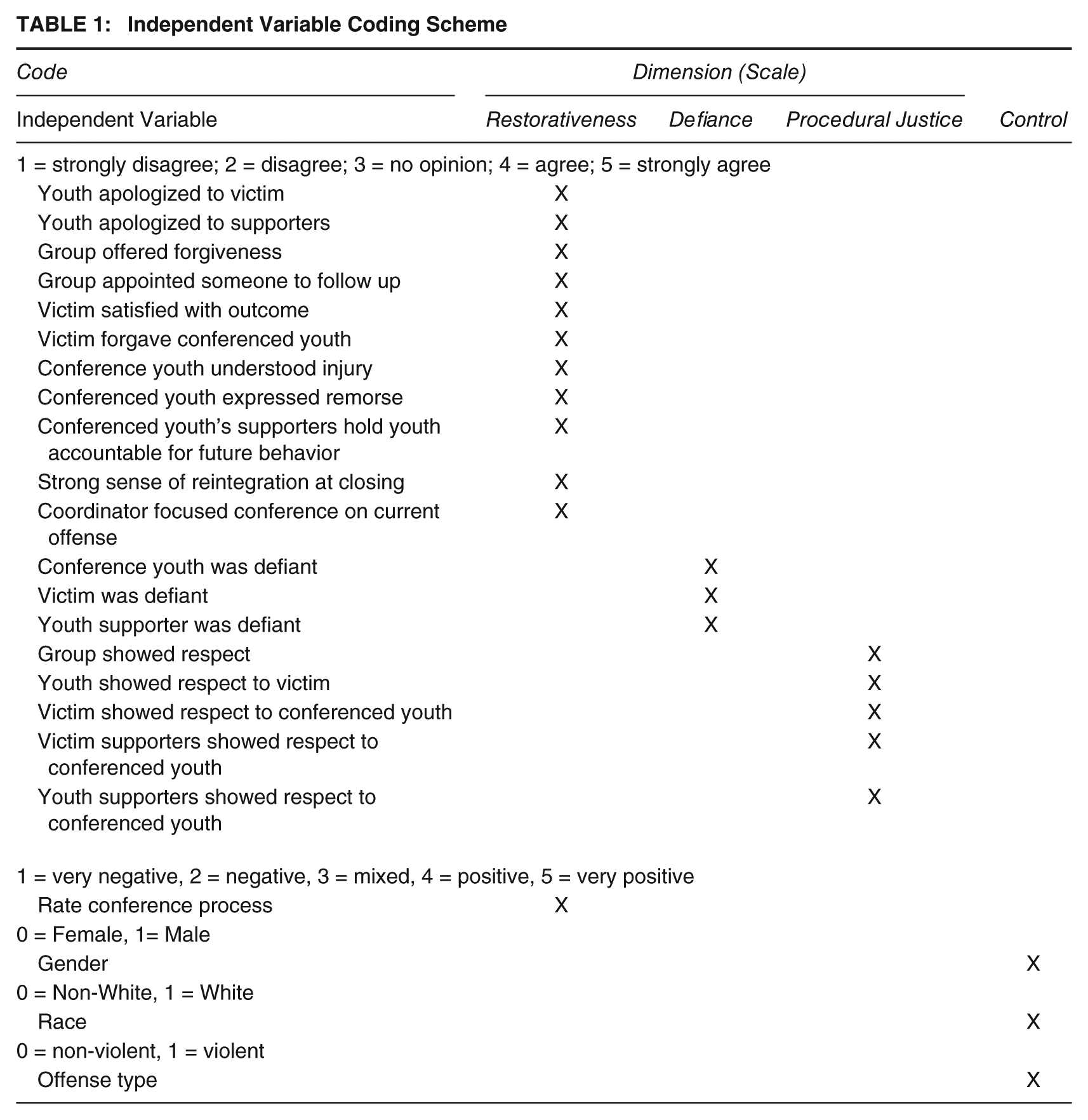
The research team used factor analyses to generate scales from the individual indicators of restorativeness, defiance, and procedural justice. The restorativeness scale incorporates all 12 variables shown in Table 1. A Cronbach’s alpha value of .87 shows the scale to be a reliable indicator of restorativeness. Three defiance indicators comprise the defiance scale supported by a Cronbach’s alpha value of .60. Five items that specifically ask about respect toward each of the different conference participants create the procedural justice scale. A Cronbach’s alpha score (α = .63) also suggests that these items comprise a reliable scale. The research team considered several other indicators scales (e.g., balance between offender and victim supporters), but they did not prove to be reliable (i.e., α < .60). 2
Dependent Variables
Failure was defined as any rearrest within the long-term (i.e., up to 12 years) follow-up period. The rearrest data were restricted to arrests occurring in Marion County, Indiana. During the shorter 2-year follow-up period, the young age of the juveniles make it more likely that the county data include nearly all of the youth’s offending during that time period. However, as the follow-up period progresses and study participants became adults, the likelihood of rearrest outside the study area (i.e., Marion County) increases as individual mobility increases. Due to the nature of criminal history records, researchers were unable to correct for this issue and therefore it is likely the number of rearrests are undercounted. It is possible that there may be an interaction effect between moving out of the county and recidivism that would threaten internal validity. However, because completed internal validity checks failed to find any differences between treatment and control groups, we assume that any such interaction effects are consistent throughout the entire sample and this subsample.
Analytic Approach
Following the previously utilized variation analysis approaches (Hayes & Daly, 2003; Hipple et al., 2014), the current analysis uses a two-stage process. First, bivariate relationships are examined between single item indicators of restorativeness, procedural justice, and defiance and reoffending for the long term. Second, the ability of the restorativeness, procedural justice, and defiance scales to predict reoffending is tested.
Results
Bivariate Analysis
The current study revealed that 75% (n = 161) of the observed youths reoffended in the 12-year follow-up period (see Table 2). We are again asking whether selected restorativeness, procedural justice, and defiance indicators can explain likelihood in reoffending. As a starting point, chi-square analysis was utilized to examine the relationship between measures of restorativeness, defiance, procedural justice, and failure (rearrest). The relationship between control variables including gender, race (i.e., White or non-White), and initial offense type (non-violent and violent) were also examined using chi-square analyses.
Bivariate Relationships Between Indicators and Long-Term Failure

p < .10. **p < .05. ***p < .01.
The long-term analysis reveals that 8 of the 12 restorativeness items were significant with p values less than .05. Two other restorativeness items are significant at the .10 level. All 3 of the defiance items showed significant relationships with failure at the long term (p < .05). Four of the 5 procedural justice items (all but “youth showed respect for the victim”) had a significant relationship with failure at the long term as well as offense type. That is, conferences where observers perceived lower levels of restorativeness and lower levels of procedural justice were related to higher levels of failure at the long term. The current examination of the direction of the relationship revealed that higher levels of perceived defiance by the conference youth and the victim were related to failure in the long term. Race, gender, and offense type were not related to failure at the long term (p > .05). Because of the use of ordinal variables and a dichotomous nominal variable (with the exception of race, gender, and offense type), we include Gamma (γ) as a measure of association in cases where the correlation is significant. Next, scales were created to assess the impact of the degree of restorativeness, defiance, and procedural justice of the FGCs on reoffending (see Table 2).
Multivariate Analysis
The theoretically based scales were first correlated with long-term failure. Both the procedural justice and restorativeness scales were significant at the p < .01 level. The defiance scale was also significant, but not at the .05 threshold (p < .10). 3 Chi-square analysis results were similar with all three scales having significant relationships with failure at the long term (see Table 3).
Relationships Between Scales and Long-Term Failure

p < .10. **p < .05. ***p < .01.
We next entered these three scales into a logistic regression to estimate their effect on failure at the long term as the dependent variable. Race, gender, and initial offense type were also included as control variables (Table 4). The restorativeness scale was the only one of the three scales that was significant at the long term (p < .05). The procedural justice scale was also significant at the long term but only at a less rigorous cutoff (p < .10). The defiance scale was not significant with failure during the long-term follow-up period. Offense type was a significant predictor of failure at the long term (p < .05). That is, youths whose initial qualifying offense was violent were more likely to be rearrested during the long-term follow-up period. Neither individual race nor gender was related to rearrest at long term.
Logistic Regression Results for Offender Characteristics, Scaled Conference Characteristics, and Long-Term Failure (1 = Failed)
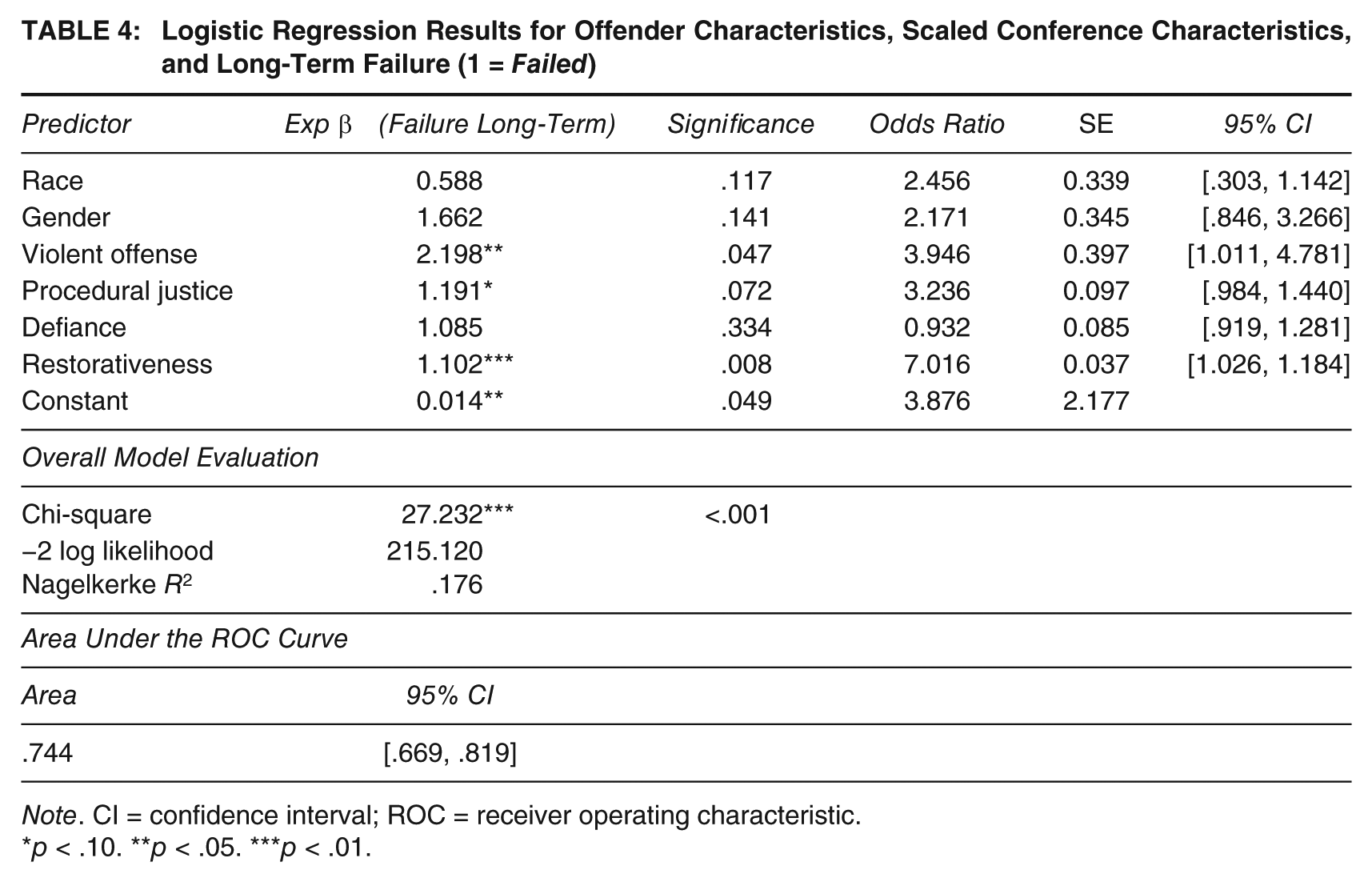
Note. CI = confidence interval; ROC = receiver operating characteristic.
p < .10. **p < .05. ***p < .01.
The area under the receiver operating characteristic (ROC) curve examines the ability of the full model to predict those who recidivate during the long-term follow-up period and those that do not. The area under the curve (AUC) ranges from 0 to 1. An area of 1.0 means the test is perfect; an area of 0.5 or less means the test is no better than flipping a coin. Figure 1 displays the ROC curve for the full model predicted probabilities. The closer the curve follows along the left-hand border and then along the top border, the more accurate the model. The AUC is .744 which indicates a fair model with acceptable discriminatory power (DeMaris, 2004).

ROC Curve for Long-Term Failure
Finally, to better understand our logistic regression models, we created predicted probabilities (Spohn & Holleran, 2001). Using the means for all variables except those that were significant in our logistic regression, we estimated the probability of failure at the long term for four types of youth/conference combinations using the two significant variables at the long term: offense type and conference restorativeness. The additional findings indicate that at the long term, youths who committed violent offenses were most likely to fail. Youths who committed a violent offense and attended a non-restorative conference were most likely to fail at the long term (probability 99%) whereas committing a violent offense and attending a restorative conference decreased the probability of failure at the long term to 71%. Lack of restorativeness increased the probability of failure at the long term for non-violent offenders to roughly 98% compared with 54% for non-violent offenders who attended a restorative conference. Thus, consistent with the earlier analyses, the findings suggest that the degree of restorativeness coupled with offense type influenced rates of reoffending in the long term.
Discussion
Previous research on FGCs, like many other restorative practices, suffers from a lack of long-term research on recidivism. The theoretical foundations of restorative justice practices generally, and of FGCs in particular, suggest that the processes involved in conflict resolution affect opportunities for accountability, learning, and forgiveness and are central to perceptions of fairness, justice, inclusion, voice, and respect. Ultimately, processes that promote or deny such experiences and affect such perceptions are believed to relate to more or less positive outcomes for victims, offenders, and other participants in FGCs or in alternative processes such as court proceedings. The findings of this research serve to inform ongoing debates over the utility of restorative practices for achieving traditional goals of juvenile justice, including the curbing of recidivism. Although critics of restorative justice programming may showcase the null effects of this prior research as evidence of a flawed justice model, it should be of little surprise that participation in a single program would fail to yield significant positive effects for juveniles 12 years after their initial exposure. That studies have uncovered positive effects after more abbreviated time intervals is impressive enough considering the thousands of hours lived between conference exposure and short-term follow-up observations. What is remarkable and encouraging about the findings of the current variation analysis is that it appears the desired effects on juveniles were evident for those who originally benefitted the most from restorative processes. Indeed, the results from this study indicate that the greater fidelity of FGCs to the theoretical foundations of restorativeness and procedural justice, the better outcomes in the long term as measured by future offending. These findings have both theoretical and practical implications.
Reintegrative shaming theory (Braithwaite, 1989) and procedural justice theory (Tyler, 1990, 2003; Tyler, Sherman, Strang, Barnes, & Woods, 2007) emphasize the importance of these conflict resolution processes. Specifically, processes that are more integrative and less stigmatizing, such as those that place an emphasis on the offense itself as opposed to the offending person, should produce more positive outcomes. Similarly, processes that are perceived as procedurally just, such as those where all participants feel they have been treated respectfully, are believed to reinforce reintegration and reduce stigmatization, and thereby produce positive outcomes. The findings in the current research are consistent with these theoretical predictions. 4
In terms of implications for practice, the findings provide strong evidence that significant attention should be given to the process of FGCs. Clear patterns emerge suggesting that what occurred in the FGC, especially in terms of the level of restorative process and procedural justice, mattered. Those involved in restorative justice programming should give significant attention in training and in monitoring to the principles of reintegrative shaming (Braithwaite, 1989) and procedural justice (Tyler, 1990), as they seek to promote positive long-term outcomes including reductions in reoffending.
The single items included in the scales in the present study (see Table 1) suggest principles upon which training and monitoring could build. Specifically, FGC coordinators should attempt to facilitate processes whereby the emphasis remains on the offense, where all parties have a voice, where there are opportunities for the victim and other participants to describe the harm, and where there are opportunities for expressions of apology and forgiveness. Similarly, the coordinator should ensure that the group develops a plan for follow-up and accountability and should work to promote a sense of reintegration as the process closes. Finally, in planning for the conference, the coordinator should be attuned to the possibility of participants expressing disrespect toward others and to try and minimize this from occurring. It would appear likely that a skilled FGC coordinator could facilitate demonstrations of respect through pre-conference discussions with participants and in the tone of the initiation of the conference itself.
In the case of the IJRJE, all conference facilitators received the same training grounded in the Wagga Wagga model of family group conferencing (Hipple & McGarrell, 2008). The curriculum included discussion about reintegrative shaming theory (Braithwaite, 1989); however, there was little focus on procedural justice and defiance theory. The study findings suggest the importance of additional attention to the theoretically grounded dimensions of restorativeness and procedural justice. Facilitator training should be modified accordingly in an attempt to create a conference experience that includes the positive aspects of these dimensions. Ensuring conference facilitators conduct conferences with as much fidelity to the new training model will be important as well.
Empirically based observation details about what actually could happen during a conference both positively and negatively along those dimensions would be extremely beneficial for facilitators so they can attempt to make corrections if needed during a conference, or as an aspect of continued development as a facilitator. This emphasis on facilitator training and development could be enhanced by process and outcome evaluations on restorative justice processes that measure these theoretically grounded elements of the conference. Linking evaluation research to facilitator training, participant perceptions, and outcomes could hold significant benefit for the quality and impact of restorative practices.
The theoretical and practical implications should be tempered, however, in light of several limitations. First, in contrast to the experiment itself, this variation study is subject to selection effects. We cannot rule out the rival explanation that there were characteristics of the participants of these conferences that generated the outcomes as opposed to the degree of restorativeness or procedural justice. Perhaps the conferences exhibiting greater restorativeness or procedural justice, with fewer signs of defiance, were generated by the inclusion of offending youths who were more inclined to understand the harm they had caused or to victims with a greater sense of empathy toward the offending youth. Future research to rule out these threats will likely come back to the original experimental design. Although ethics preclude randomly varying levels of restorativeness and procedural justice, future experiments should include great attention to the fidelity of the treatment. If FGCs are to result in more positive short- and long-term outcomes including reduced reoffending, theory and these results suggest that the FGCs must provide restorative and procedurally just processes. Thus, the true test of the impact of FGCs will come from an experiment where a very high proportion of the conferences are characterized by fidelity to foundational theory.
A second limitation relates to the scales measuring restorativeness, procedural justice, and defiance. The reliability assessment for procedural justice and defiance suggested that each should be interpreted cautiously. Continued theoretical development would benefit by improvements in the measurement of these dimensions. The fact that the restorativeness, with very acceptable reliability measures, related to reoffending does give confidence in the observed link between the quality of conferences and their long-term outcomes.
An additional and related limitation results from the reliance on observations alone. The conferences were assessed for their restorativeness, procedural justice, and defiance, by trained observers. Ideally, these observations would be compared with assessments by the participants themselves. Having said this, it is also clear that the observers had no way to know which youths would reoffend over the next 12 years, and the consistency of the pattern in the results does suggest that dimensions of restorativeness and procedural justice made a difference in reoffending.
A fourth limitation is that the recidivism data are limited to the county where the original offense occurred. Thus, any reoffending that occurred outside of Marion County was not captured. Researchers were unable to control for these possible interaction effects. Although this is not an uncommon limitation in recidivism research given the jurisdictional nature of criminal histories systems, it is possible that this could be addressed in the future as more states move to statewide criminal history information systems.
Finally, the binary recidivism outcome variable is limiting in that it does not allow for a more robust survival analysis (Schmidt & Witte, 1988). Future long-term research surrounding restorative justice practices should pay particular attention to incidence as well as details related to reoffending seriousness. Theory would suggest conference characteristics may indeed affect time to failure, risk of failure, repeat failures (i.e., rearrest incidence), and reoffending characteristics (i.e., seriousness).
The need for continued research surrounding restorative justice practices and their effects on recidivism, especially at the long term, is clear. This study is a step in that direction. Overall, despite the discussed limitations, the findings are consistent with the theoretical predictions of reintegrative shaming and procedural justice theories. Practically, the findings provide strong evidence that significant attention should be given to the process of FGCs.