



Abstract
This study takes stock of empirical research examining the relationship between gang membership and offending by subjecting this large body of work to a meta-analysis. Multilevel modeling is used to determine the overall mean effect size of this relationship based on 1,649 effect size estimates drawn from 179 empirical studies and 107 independent data sets. The findings indicate that there is a fairly strong relationship between gang membership and offending (Mz = .227, confidence interval [CI] = [.198, .253]). Bivariate and multivariate moderator analyses not only reveal that this relationship is robust across the vast majority of methodological variations but also show that the gang membership–offending link is stronger when studying active gang members, and weaker in prospective research designs, non-U.S. samples, and when controlling for theoretical confounders and mediators. These results affirm the efforts of researchers, policymakers, and practitioners to understand and respond to gang behaviors, and are used to identify aspects of this literature that are most worthy of continued attention.
The fact that crime and delinquency are more likely to occur in the company of peers has drawn attention to the social sources and group processes of criminal behavior. Much like how Wolfgang, Figlio, and Sellin’s (1972) finding that 6% of delinquents accounted for the majority of offenses underpinned the criminal career paradigm, Shaw and McKay’s (1931) observation that more than 80% of juveniles in the Chicago Juvenile Court had accomplices is a staple in the literature on peer groups and crime. Such observations gave rise to some of the most prominent and influential works in criminology that aim to understand how peer groups influence criminal behavior (Akers, 2009; Cohen, 1955; Short & Strodtbeck, 1965; Sutherland, 1947; Warr, 2002). Several generations of scholarship have identified the importance of one specific peer group—the street gang—in the etiology of criminal behavior, making the explanation of gangs and the behavior of gang members an essential part of criminological theory and research. There is good reason for this attention: Studies have found that gang members account for a disproportionately large share of offending, and their rates of involvement in crime are at their highest during periods of active gang membership (Battin, Hill, Abbott, Catalano, & Hawkins, 1998; Esbensen, Peterson, Taylor, & Freng, 2010; Pyrooz, 2013; Thornberry, Krohn, Lizotte, Smith, & Tobin, 2003). 1
Few would dispute that gang membership is associated with offending, but there are serious questions about how much (i.e., magnitude) and when (i.e., variability) it matters to the study of crime. Such concerns come in several varieties, but claims of spuriousness and, to a lesser extent, the exaggeration of the empirical relationship between gang membership and offending, have been taken most seriously. Thornberry, Krohn, Lizotte, and Chard-Wierschem (1993) organized competing theoretical perspectives of the mechanisms underlying this relationship into selection and facilitation hypotheses. According to control and propensity theorists (e.g., Gottfredson & Hirschi, 1990), the criminological significance of gang membership has been overstated, and any observed relationship originates only in the absence of accounting for self-control, social bonds, or other forms of self-selection. Others held that even if the spuriousness critique was not supported empirically, the offenses of gang members are not monolithic and are instead sensationalized by the media, researchers, and gang members themselves to the point that it distorts the larger picture of youth crime and violence (Felson, 2006; J. Katz & Jackson-Jacobs, 2004; Kennedy, 2009; Klein, 1995; Sullivan, 2005).
A lengthy roster of empirical studies has examined the relationship between gang membership and offending. Existing syntheses of this literature, however, have been in the form of traditional narrative reviews (Curry, Decker, & Pyrooz, 2014; Krohn & Thornberry, 2008), which are unable to resolve many of the issues related to the relationship between gang membership and offending because the full body of empirical literature is too large to be assessed reliably in this way and may ultimately mask important patterns (Gough, Oliver, & Thomas, 2012; Pratt, 2010). An alternate method is required that can assess with more precision the link between gang membership and offending in the literature, and how this effect varies under different methodological conditions.
The present study subjects the body of research on gang membership and offending to a meta-analysis. Our analysis is based on a systematic sample of 1,649 effect size estimates drawn from 179 empirical studies and 107 independent data sets that we analyze using appropriate multilevel modeling procedures. Quantitatively assessing the full body of literature on the gang membership–offending link allows us to accomplish three objectives. First, we determine the overall effect size of gang membership on offending across this large body of research. Our second objective is to evaluate how the magnitude of the relationship varies according to the methodological choices made by the scholars who have produced this work. Some of the moderators we explore are relevant to the generality of the gang membership–offending relationship (e.g., measurement, sample type), whereas others address more theoretically relevant points (e.g., spuriousness, offending type). Third, we identify which aspects of this literature are most worthy of continued attention and offer directions for the next generation of research in this area. In the end, the broader purpose of this study is to inform the field about the extent to which and how gang membership should be treated as an important correlate of offending, and by extension, situated within the broader literature on the social sources and group processes of criminal behavior.
Gang Membership and Offending in Perspective
The study of street gangs has an important place in the history of criminology. In social disorganization theory, gangs were among the primary mechanisms for transmitting delinquent traditions across generations of youth (Shaw & McKay, 1942; Thrasher, 1927). In the “golden era” of criminological theory (Laub, 2004), the explanation of gang behavior was the study of juvenile delinquency in several criminological classics (Cloward & Ohlin, 1960; Cohen, 1955; Klein, 1971; W. B. Miller, 1958; Short & Strodtbeck, 1965; see Klein, 1995). However, such high levels of interest in gang-related behaviors and processes soon gave way to broader criminological trends in theory and method. The focus of delinquency research shifted away from groups as the primary unit of analysis in criminology and either aggregated up to neighborhoods (e.g., Sampson & Groves, 1989) or disaggregated down to individuals (e.g., Pratt & Cullen, 2000; Bookin-Weiner & Horowitz, 1983; Kreager, Rulison, & Moody, 2011). Although some viewed micro-social processes as the bridge between macro- and individual levels of explanation (Short, 1974, 1985, 1998), gangs all but vanished from the mainstream criminological landscape in the 1970s. Yet, this sabbatical did not last long. Beginning in the late 1980s (Decker, Melde, & Pyrooz, 2013), there was an explosion of gang research that has continued to this day. 2
Fueling this renewed interest was an eroding consensus concerning whether the street gang was a primary source of criminal behavior. Of course, this was not a new criticism (Glueck & Glueck, 1950; Hirschi, 1969), but gangs and gang membership found themselves wedged between the theoretical crosshairs of thorny debates surrounding control/propensity theories and learning/socialization theories (Akers, 1985; Gottfredson & Hirschi, 1990; Nagin & Paternoster, 1991). Thornberry and colleagues (1993) captured the sentiment of the times:
This relationship is remarkably robust, being reported in virtually all American studies of gang behavior regardless of when, where, or how the data were collected. The link between gang membership and delinquency appears indisputable, but there is little information about the causal mechanisms that bring it about. (pp. 55-56)
The primary issue was determining the extent to which gangs attracted or created delinquents. As a result, Thornberry and colleagues (1993) introduced a tripartite theoretical model—selection, facilitation, and enhancement—to bring the study of the gang membership–offending link into the broader debates in the criminological community (e.g., Haynie, 2001; Matsueda & Anderson, 1998).
The selection model is a spuriousness hypothesis: Gangs are simply a collection of people who share individual deficits such as low self-control, low intelligence, or poor neuropsychological functioning. As a result of these problems, youth and young adults self-select into gangs. Any observed relationship between gang membership and offending should therefore wash away once accounting for sources of selection. Such a view is consistent with control theories of deviance (e.g., Gottfredson & Hirschi, 1990; Hirschi, 1969). The facilitation model is a causal hypothesis: A host of gang-related group processes elevate levels of offending while people are actively involved in gangs. Before and after gang membership, these individuals are no different from their non-gang peers, as they are not exposed to these processes. Such a view is consistent with a range of mid-level theoretical perspectives, but is commonly associated with Akers’s (2009) social learning theory. The enhancement model is a blended hypothesis: The kinds of persons who end up in gangs and the kinds of contexts associated with gangs combine to produce high levels of offending. The key distinction of the enhancement model is that gang membership still has a causal effect on offending net of selection processes.
With the underlying mechanisms linking gang membership to offending called into question, the floodgates for empirical testing were opened. However, in the absence of experimentation or the adequate instrumental variables for gang membership, 3 it was an open question as to how to best study the relationship between gang membership and offending. The original Thornberry et al. (1993) work called for longitudinal data to examine offending before, during, and after gang membership (see also Esbensen & Huizinga, 1993), and the literature has since been dominated by sophisticated longitudinal analyses aiming to disentangle static and dynamic forms of selection (e.g., Bjerk, 2009; Matsuda, Melde, Taylor, Freng, & Esbensen, 2013; Sweeten, Pyrooz, & Piquero, 2013). Of course, that does not mean cross-sectional data are irrelevant because adjusting for criminal propensity should eliminate any association between gang membership and offending, as posited by theories consistent with the selection perspective (see Melde & Esbensen, 2011; Pyrooz, Moule, & Decker, 2014). Yet consistent with the facilitation perspective, others were interested in uncovering the independent contribution of gang membership to offending (Battin et al., 1998) or the change mechanisms endogenous to entering or exiting gangs (e.g., Melde & Esbensen, 2011). Although there is no agreed-upon standard in model specification, any study that leaves out controls for rival hypotheses risks misstating the empirical relationship and, as a consequence, offers little to the larger discussion about the social sources of criminal behavior—a question of fundamental importance to criminology.
Part of what made it possible to study the gang membership–offending link was the emergence of numerous individual-level data sources with gang-related measures. These data sources contain population-, school-, neighborhood-, arrestee-, detention-, and field-based samples, all of which raised questions about biased portrayals of gang membership. Indeed, studies relying on official records of gang membership might reveal a much different story than studies relying on survey research (Curry, 2000; Esbensen & Huizinga, 1993; Klein & Maxson, 2006; Pyrooz, 2014b; Thornberry & Porter, 2001). And although allowing youth to self-report their involvement with gangs in survey research sidestepped the contentious and impassioned debates about how to define a gang (Fagan, 1990; Spergel, 1990), 4 there is an emerging debate about how to best measure gang membership in settings where the word “gang” has alternative cultural connotations, particularly outside the United States (Aldridge, Medina, & Ralphs, 2012; Matsuda, Esbensen, & Carson, 2012; Weerman et al., 2009). 5 Even so, the extent to which research findings on gang membership and offending vary depending on these contested issues remains unclear. Any attempt to take stock of the empirical body of research must use techniques that can account for such wide and varied methodological approaches across a large number of studies.
A full synthesis of the literature on gang membership and offending has not yet been undertaken. To date, the most comprehensive reviews of this literature have been carried out by Curry et al. (2014) and Krohn and Thornberry (2008). However, these reviews were designed to evaluate the status of the theoretical models proposed by Thornberry et al. (1993) specifically and not the gang membership–offending link generally. 6 Indeed, there is a wider universe of gang studies that extends beyond explicit empirical tests of the selection and facilitation perspectives. Not only is it important to assess this larger body of work, but it is important to do so in a way that is more rigorous than a narrative review (Pratt, 2010), where studies are described discursively and afforded relative importance by the reviewer, usually based on null hypothesis significance testing. Even the most carefully conducted narrative review can only provide rough estimates of the degree to which two variables are related, and it would still depend heavily on the judgment of the author to tell the reader what the literature really says (Light & Smith, 1971; Pratt, 2010; Rosenthal & DiMatteo, 2001). Broader patterns of findings regarding the generality of the gang membership–offending link might be masked because a narrative review cannot tease out differences across studies in how gang membership is measured, how models are specified, and how samples are selected (Gough et al., 2012). To be sure, even the appearance of consistent or statistically significant findings in the literature falls short of a comprehensive understanding of this empirical relationship (Bushway, Sweeten, & Wilson, 2006; Cumming, 2012; Pratt, 2010). A quantitative synthesis of this well-established literature is thus needed to take stock of the empirical status of gang membership in criminology.
Current Study
In the current study, we subject the body of research on gang membership and offending to a meta-analysis. Meta-analyses are important methodological tools that can provide information on the strength of an empirical association and can uncover whether an empirical relationship is moderated by differences in research design and model specification across studies (Glass, McGaw, & Smith, 1981; Rosenthal & DiMatteo, 2001). Accordingly, our study proceeds as follows. First, we determine the overall effect size of gang membership on offending across this large body of research. Second, we evaluate how the magnitude of the relationship between gang membership and offending varies according to the methodological choices made by the scholars who have produced this work. Some of the moderators we explore are relevant to the generality of the gang membership–offending relationship (e.g., measurement, sample type), whereas others address more theoretically relevant points (e.g., spuriousness, offending type). Last, we weigh in on the theoretical debates surrounding the effects of gang membership on offending and offer directions for the next generation of research in this area.
Method
Sample
Empirical studies published through February, 2013, were systematically collected in two phases. First, an extensive literature search through electronic databases was conducted using Criminal Justice Abstracts, Psychological Abstracts, Sociological Abstracts, and Google Scholar. Second, electronic holdings of a number of criminology/criminal justice, sociology, psychology, and social work journals, including the 40 identified by Pratt, Turanovic, Fox, and Wright (2014) and Jennings, Higgins, and Khey (2009), were investigated for studies of gang membership and criminal offending. The search through electronic databases began using the key phrases “gang” and “offending.” Additional searches were conducted replacing the keyword “gang” with “gang member,” “gang affiliation,” “gang youth,” “street gang,” “gang participation,” “gang involvement,” “Eurogang,” and “group.” Likewise, in place of the keyword “offending,” the terms “crime,” “delinquency,” “violence,” “arrest,” “assault,” “attack,” “robbery,” “harm,” “theft,” “steal,” “weapon,” “gun,” “abuse,” “fight,” “vandalism,” “drugs,” and “damage” were used. All 406 studies indexed through Google Scholar citing Thornberry et al. (1993) were also reviewed. Forthcoming peer-reviewed articles published online, ahead of print during this time were included. Any quantifiable relationship between gang membership and criminal offending served as the minimum criteria for inclusion in the study. Studies that did not explicitly focus on gang effects, but that nonetheless included gang membership as a control variable in their statistical models, were included in the sample. Effect sizes were drawn from peer-reviewed journal articles (88%), books and book chapters in edited volumes (8%), and reports from the National Institute of Justice and the Bureau of Justice Statistics (4%).
Overall, the sample is composed of 179 empirical studies containing 1,649 effect size estimates, representing the integration of 332,080 unique persons. 7 The 179 studies included in the sample draw from 107 independent data sets and 17 different nations. 8 The number of effect sizes exceeds the number of empirical tests because studies often estimate multiple statistical models (e.g., for different forms of offending, with different model specifications), and the number of studies exceeds the number of data sets because several studies can be published from a single data source (e.g., the National Longitudinal Survey of Youth). Although this raises the issue of a lack of statistical independence, we adjust accordingly for this in our analyses (discussed below).
There can be controversy in using only published work in a meta-analysis because inferential errors might be made as a result of “publication bias” (Lipsey & Wilson, 2001; Rosenthal, 1979). In particular, the effect sizes may be inflated, and the range of values restricted, because studies revealing non-significant relationships may be more likely to be either rejected for publication or to remain unsubmitted by authors (Cooper, DeNeve, & Charleton, 1997; C. M. Olson et al., 2002). Accordingly, we investigated this issue in four ways.
First, we assessed whether effect size estimates drawn from gang-focused studies—those where the effects of gang membership on offending were of primary focus and gangs were noted in the article’s title (70%, n = 1,147)—significantly differed from those where gang membership was included only as a control variable (30%, n = 502). If publication bias was present, we would expect that studies with a substantive focus on the gang membership–offending link would have inflated effect size estimates (Egger & Smith, 1998). Our analyses revealed this not to be the case, as effect size estimates drawn from gang-focused studies did not significantly differ from those drawn from other studies (p = .143). Second, we assessed whether effect sizes from studies published in peer-reviewed journals (89%, n = 1,463) differed from effect sizes coded from reports and books (11%, n = 186). No significant differences emerged (p = .873). Third, further analyses revealed no significant problems with outliers, or truncation in the distribution of effect sizes or the empirical Bayes residuals, which would be expected with publication bias (Hox, 2010; Sterne, Egger, & Smith, 2008). And last, the effect sizes in our data ranged from −.220 to .839 (with a standard deviation of .179), which indicates that considerable variation in effect sizes exists—something that would be unlikely if publication bias was present. Based on these assessments, the probability that our results are an artifact of publication bias is low. 9
Effect Size Estimate
The effect size estimate is the meta-analytic equivalent of the dependent variable. In the current study, the effect size estimate represents the magnitude of the relationship between gang membership and offending in each statistical model. Effect size estimates are measured using two possible proxies available in correlational or non-experimental research: the zero-order correlation coefficient (r) and standardized coefficients from multivariate models (Hedges & Olkin, 1985; Peterson & Brown, 2005; Pratt & Cullen, 2005). Zero-order correlation coefficients are bivariate estimates that are typically obtained from each empirical study’s correlation matrix when provided, and standardized regression coefficients are drawn from multivariate statistical models in each study. The r coefficient was chosen not only for its ease of interpretation but also because formulas are available for converting other test statistics into an r value (see Wolf, 1986). This kind of flexibility is particularly useful in the gang literature where various multivariate methods and different scales measuring gang membership/involvement are used across studies. By using these formulas, we could convert various test statistics to a common effect size (Borenstein, Hedges, Higgins, & Rothstein, 2011), something that could not otherwise be done with statistics such as Cohen’s d.
Following the methods described by Pratt et al. (2014), effect sizes from nonlinear models (e.g., logistic and negative binomial regression models) were coded by converting a t ratio to an r using the equation
Although it is common practice to include both bivariate and multivariate effect size estimates in meta-analyses of studies using correlational research designs (e.g., Baier & Wright, 2001; Paternoster, 1987; Pratt et al., 2014), the use of each effect size proxy carries certain limitations. The potential downside of using zero-order bivariate correlations is that they may produce inflated effect size estimates because the variation in offending explained by other factors has not been removed. Although standardized coefficients from multivariate models may produce more valid effect size estimates than coefficients calculated from bivariate correlations (because issues with spuriousness have already been dealt with), a drawback of using multivariate effect sizes is that they can vary widely within studies according to the ways in which statistical models are specified (Hanushek & Jackson, 1977; Hunter & Schmidt, 2004).
To address these issues, it is necessary to control statistically for methodological variations across empirical studies. Effect size estimates may vary, at least in part, according to how gang membership is measured, the type of offending examined, which variables (if any) are used as statistical controls, and the composition of the sample. Accordingly, each empirical study was coded for a number of variables related to methodological variations that may moderate the effect size of gang membership on offending (Glass et al., 1981; Jüni, Witschi, Bloch, & Egger, 1999). 12 Nevertheless, there are limits to what meta-analysis can do with these kinds of moderator analyses. Because important methodological characteristics are often related to one another (Lipsey, 2003), disentangling their independent influence on the effect size estimates in a meta-analysis will only reveal broad patterns across studies. Therefore, uncovering how a particular relationship varies according to different methodological approaches will still be assessed more precisely by the individual study. Yet, consistent with contemporary meta-analytic methods (Hunter & Schmidt, 2004; Pratt et al., 2014; Trikalinos, Salanti, Zintzaras, & Ioannidis, 2008), there is value in moderator analyses to the extent that uncovering broad patterns across studies has important implications for theory and gang research. It is important to note, however, that the studies included in our sample are observational and represent statistical associations—causality cannot be inferred from our findings.
Key Moderators of Theoretical Interest
Type of Offending
Because the effects of gang membership on crime may vary depending on the type of offending under examination (Decker, 1996; Esbensen & Huizinga, 1993; Melde & Esbensen, 2013; Pyrooz & Decker, 2013), we coded a series of binary variables for whether each effect size corresponded to violent offending (e.g., assault, robbery, and homicide), weapon carrying/possession, drug sales, substance use (e.g., illegal drug and alcohol use), property offending (e.g., theft, arson, and property damage), and general offending (for studies that combined violent and nonviolent offending into a single outcome measure). The violent offending effect size estimates encompass robbery (n = 37), sexual assault (n = 8), simple assault (n = 92), aggravated assault (n = 26), homicide (n = 4), and combined indicators of violence (n = 259); the property offending effect size estimates include theft (n = 129), vandalism (n = 36), burglary (n = 27), fraud (n = 9), and combined measures of nonviolent offending (n = 110). Regardless of how violent and property offending were operationalized (e.g., disaggregated by type or not), findings remained the same.
Measurement of Offending
In light of research suggesting that findings may vary according to the use of self-report versus official records of offending (e.g., Kirk, 2006; Maxfield, Weiler, & Widom, 2000; Thornberry & Krohn, 2000), we coded for whether offending was derived through official records (1 = official report, 0 = self-report). In addition, to assess the extent to which the gang membership and offending effect size estimates are sensitive to the scaling of the dependent variable, we indicated whether binary or continuous/interval-level measures of offending were used (1 = binary dependent variable, 0 = otherwise). Within every study, measures of offending had a lower boundary that represented no offending or no propensity to offend.
Measurement of Gang Membership
Debates over the measurement of gang membership persist in the literature, with some research indicating that different definitions of gang membership may produce varying effects on offending (Curry, 2000; Decker, Pyrooz, Sweeten, & Moule, 2014; Esbensen, Winfree, He, & Taylor, 2001; Matsuda et al., 2012; Thornberry et al., 1993). To assess the impact of this variation, we coded for whether each effect size corresponded to a measure of current gang membership, former gang membership, or whether respondents were ever gang members at any point in their lives. Studies were also coded as to whether the Eurogang definition of gang membership was used. In studies that used the Eurogang approach, respondents were not asked directly whether they belonged to a gang or not. Instead, individuals were identified as gang members if they belonged to any “durable, street-oriented youth group whose involvement in illegal activity is part of its group identity” (Weerman et al., 2009, p. 20). Such groups typically (a) have 3 or more people, (b) involve people mostly between the ages of 12 and 25, (c) have been in existence for more than 3 months, (d) spend a lot of time in public places, and (e) accept and participate in illegal activity (e.g., Esbensen & Weerman, 2005). In addition, to assess whether self-nomination affects the strength of effect size estimates, we coded for whether gang membership was self-reported by respondents or indicated in official records (1 = self-report, 0 = official report). Finally, studies were coded as to whether gang membership was captured using a gang involvement scale as opposed to a binary measure (e.g., Sweeten et al., 2013).
Controls for Theoretical Variables
The theoretical models proposed by Thornberry et al. (1993) pointed to specific mechanisms linking gang membership with offending. Some of these mechanisms are theorized as mediators (i.e., facilitation: endogenous to gang membership), whereas others are confounders (i.e., selection: exogenous to gang membership). No matter how the mechanisms operate, this suggests that the effect size of gang membership on offending should vary depending on whether other criminal correlates are taken into account. Accordingly, all of the studies were coded for whether each statistical model included direct controls for theoretical variables (1 = yes, 0 = no) that may mediate or confound the relationship between gang membership and offending. These included self-control (Gottfredson & Hirschi, 1990), social learning (i.e., deviant peer behaviors and attitudes; Akers, 2009), unstructured routines (participating in unstructured or unmonitored social activities; Felson & Boba, 2010), social bonds (attachment and commitment to parents and school among youth, or attachment to spouse and job stability/employment among adults; Hirschi, 1969), and general strain (stressful life events and negative emotions; Agnew, 2006). To determine whether certain theoretical variables had different influences on the effects of gang membership, each of the theoretical variables we coded was also assessed individually. We note, however, that these theoretical variables are not mutually exclusive because effect size estimates can be derived from multivariate models that control statistically for multiple theoretical variables. A single statistical model estimating the relationship between gang membership and offending, for example, may include controls for self-control, social bonds, unstructured routines, and deviant peers.
In addition, the measurement of particular theoretical variables—namely, social bonds and general strain—varied widely across studies. For social bonds, some studies included detailed indicators of attachment and commitment to family, school, and peers, whereas others simply indicated whether respondents were enrolled in school, had a job, or lived in a two-parent household. And for general strain, some studies included indicators of negative emotionality (e.g., anger or depression) alongside stressful life events, whereas others did not. When ambiguity arose regarding the coding of particular intervening mechanisms, we deferred to the study’s theoretical context and reviewed thoroughly the study’s justification for including particular variables. Coding decisions were mutually agreed on and discussed collectively among the research team. To take extra caution that the coding of theoretical variables was uniform, studies were carefully reviewed for consistency prior to analyzing the data.
Additional Moderators
Research Design
Model specification and research design characteristics of each study were coded to evaluate their influence on the effect size estimates. Specifically, we include variables for whether statistical models controlled for confounding influences of gang-related variables (e.g., length of time in the gang; 1 = yes, 0 = no) and offending (1 = yes, 0 = no). Given issues associated with the transient nature of gang membership and the temporal sequencing of gang membership with offending (Decker et al., 2013; Medina-Ariza, Cebulla, Aldridge, Shute, & Ross, 2014; Pyrooz, 2014b; Thornberry et al., 1993), we also assessed whether the effect size estimates were derived prospectively (1 = prospective, 0 = cross-sectional), and whether each effect size was calculated from a within-person assessment (1 = within-person, 0 = between-person). In addition, because the nature of gangs and offending in street and institutional settings is very different—where penal institutions represent a “deep end” sample (DeLisi, Spruill, Peters, Caudill, & Trulson, 2013; Maxson, 2012; Pyrooz, Decker, & Fleisher, 2011; Skarbek, 2014; Worrall & Morris, 2012)—we coded for whether studies captured offending within correctional institutions (1 = yes, 0 = no). These institutions included prisons, jails, and juvenile detention facilities. An indicator for whether each effect size estimate was calculated from a multivariate statistical model is also included (1 = multivariate, 0 = bivariate).
Sample Characteristics
Debates over how sample composition may influence findings in gang research, including the gang membership–offending link, have been ongoing for decades (Curry, 2000; Curry et al., 2014; Esbensen & Huizinga, 1993; Klein & Maxson, 2006; Pyrooz, 2014b; Thornberry & Porter, 2001). Accordingly, a number of factors related to the sample(s) used in each study are included, such as whether effect size estimates were derived from a school sample, a criminally involved sample (e.g., arrestees, inmates, and system-involved youth), a targeted neighborhood sample (e.g., respondents selected from high-crime areas), or a general population sample. Other variables include whether the sample was mixed gender, male, or female, and whether effect sizes were derived from a racially heterogeneous sample, a juvenile sample (individuals under 18 years of age), an adult sample (individuals above 18 years of age), an all age sample (those that combine both juveniles and adults), and a non-U.S. sample.
Analytic Strategy
Following the methods described by Hox (2010) and Pratt et al. (2014), multilevel modeling (MLM) procedures are used to estimate mean effect size estimates of gang membership on offending. This strategy is appropriate given that our sample of effect size estimates is nested within a three-level hierarchical structure. Specifically, Level 1 of the data corresponds to statistical models producing effect size estimates (N = 1,649), Level 2 corresponds to individual studies (N = 179), and Level 3 corresponds to independent data sets (N = 107), such that effect sizes are nested within studies that are nested within data sets. When using nested meta-analytic data, the assumptions that observations are independent and that error terms are uncorrelated are violated (Snijders & Bosker, 2012). For instance, multiple effect size estimates drawn from a single study often share the same sample, and the same respondents may contribute to the estimation of effect sizes across different studies sharing a common data set. These issues can result in problems such as the estimation of artificially narrow confidence intervals (CIs) and low standard errors—problems that can bias the results in favor of statistical significance (Kreft & DeLeeuew, 1998). MLM techniques resolve these issues by incorporating into the statistical model a unique random effect for each organizational unit. In doing so, several sources of dependence (e.g., dependence in effect size estimates both between and within studies and data sets) can be accounted for simultaneously.
In addition to issues of statistical dependence, in meta-analytic data, a portion of the variance of each effect size estimate at Level 1 is assumed to be known (Hox & de Leeuw, 2003; Raudenbush & Byrk, 2002). The calculation of variance at Level 1 is critical because effect size estimates are statistics that are drawn from other analyses that have varying precision reflected within studies in the form of standard errors. 13 When analyzing meta-analytic data, this precision is taken into account through estimating a variance component equal to the square of these standard errors (the “known variance” model; see Raudenbush & Byrk, 2002). 14 Accordingly, our multilevel models are specified by including the standard error of effect size estimates in the random part of the Level 1 equation with a constrained variance of one (Hox, 2010). As specified, our models contain both the known variance and within-study variance of effect size estimates at Level 1. Doing so allows for within-study variation in effect size estimates beyond that already implied by their known variance (Pratt et al., 2014; Van den Noortgate, López-López, Marín-Martínez, & Sánchez-Meca, 2013).
Our analyses proceed in three stages. First, overall mean effect sizes are estimated to assess the relative magnitudes—or the strength of effects—between gang membership and offending in the sample. Second, a series of moderator analyses are conducted to determine the degree to which the effects of gang membership on offending are, or are not, robust across various methodological specifications. Third, because the large sample size allows for the unique opportunity to conduct more rigorous statistical tests, a series of multivariate moderator analyses are conducted. Both sets of moderator analyses complement the meta-analysis by assessing the stability of effects of gang membership on offending across studies. All variance-known multilevel models were estimated in Stata 13 using meglm with maximum likelihood estimation (StataCorp, College Station, TX).
Results
Before moving forward with the meta-analysis, an unconditional random intercept model was estimated to determine the amount of variation in the gang membership and offending effect size estimates at each level of the data. The results demonstrated significant variation in the effects of gang membership on offending across individual statistical models, studies, and data sets. In particular, at Level 1 of the data, the unconditional variance component was .015 (p < .001) with an intraclass correlation coefficient (ICC) of .473, indicating that approximately 47.3% of the total variation in the gang membership and offending effect size estimates lies between statistical models. At the study level of analysis (Level 2), the variance component was .009 (p < .001) with an ICC of .263, demonstrating that 26.3% of the variation in effect size estimates is between, rather than within, studies. And last, the variance component at the data set level of analysis (Level 3) was .009 (p < .001) with an ICC of .264. Because significant variation in the gang membership–offending effect size estimates existed at each level of the meta-analytic data, the analyses proceeded by estimating multilevel variance-known models to assess the strength and stability of effects of gang membership on offending.
Strength of Effects
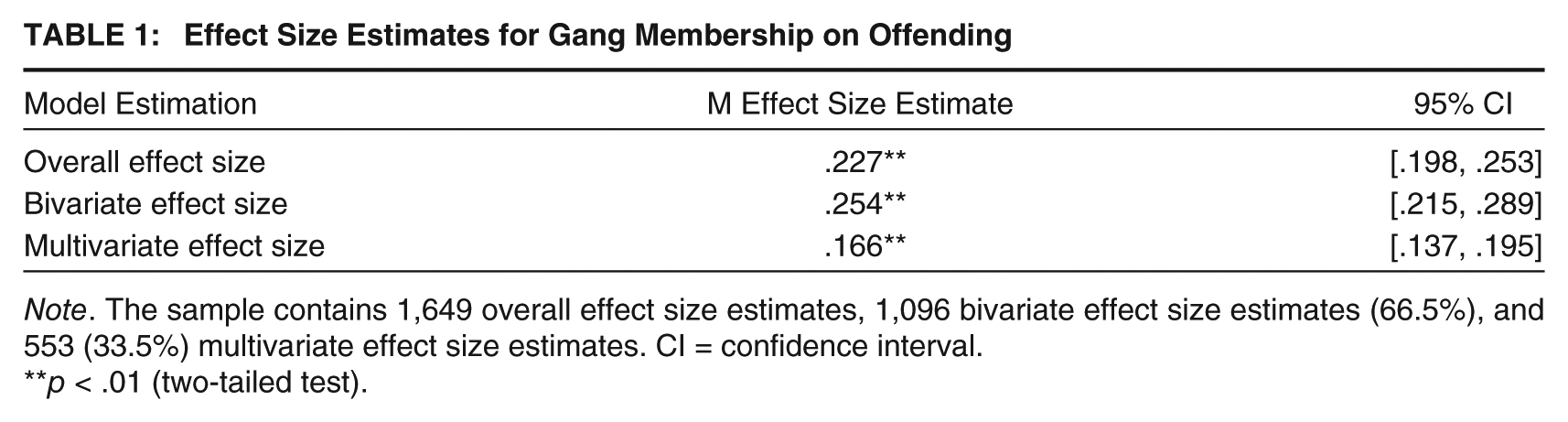
Table 1 contains the mean effect size estimates for gang membership and offending across all studies. These estimates are drawn from known variance models that contain covariates for sample size and the number of effect sizes produced by a given study. These covariates were grand mean centered because neither of them have a meaningful zero point (where effect sizes cannot be produced by samples with n = 0, nor can an effect size be derived from a study that yields no effect sizes). As such, the resulting mean effect size estimates (Mz) presented in Table 1 are model intercepts and should be interpreted as the expected value of an effect size when the sample size and the number of effects per study are held constant at their respective means.
Effect Size Estimates for Gang Membership on Offending
Note. The sample contains 1,649 overall effect size estimates, 1,096 bivariate effect size estimates (66.5%), and 553 (33.5%) multivariate effect size estimates. CI = confidence interval.
p < .01 (two-tailed test).
As seen in Table 1, the overall mean effect size for gang membership on offending is .227 (p < .01), indicating that, on average, gang membership results in a .227 standard deviation increase in offending. In comparison with the mean effect size of attitudinal low self-control (Mz = .257; Pratt & Cullen, 2000) and differential association (Mz = .225; Pratt et al., 2010) predictors on crime and deviance, the mean effect size of gang membership on offending is rather strong. The findings in Table 1 also indicate that there are notable differences in the effects of gang membership between bivariate (Mz = .254, p < .01) and multivariate (Mz = .166, p < .01) statistical models, where the multivariate mean effect size of gang membership on offending is reduced by nearly 35% from the bivariate estimate. Overall, the effect of gang membership on offending is large and robust (in that it is statistically significant across bivariate and multivariate methods), but, as expected, weaker in studies that use multivariate modeling techniques.
Stability of Effects
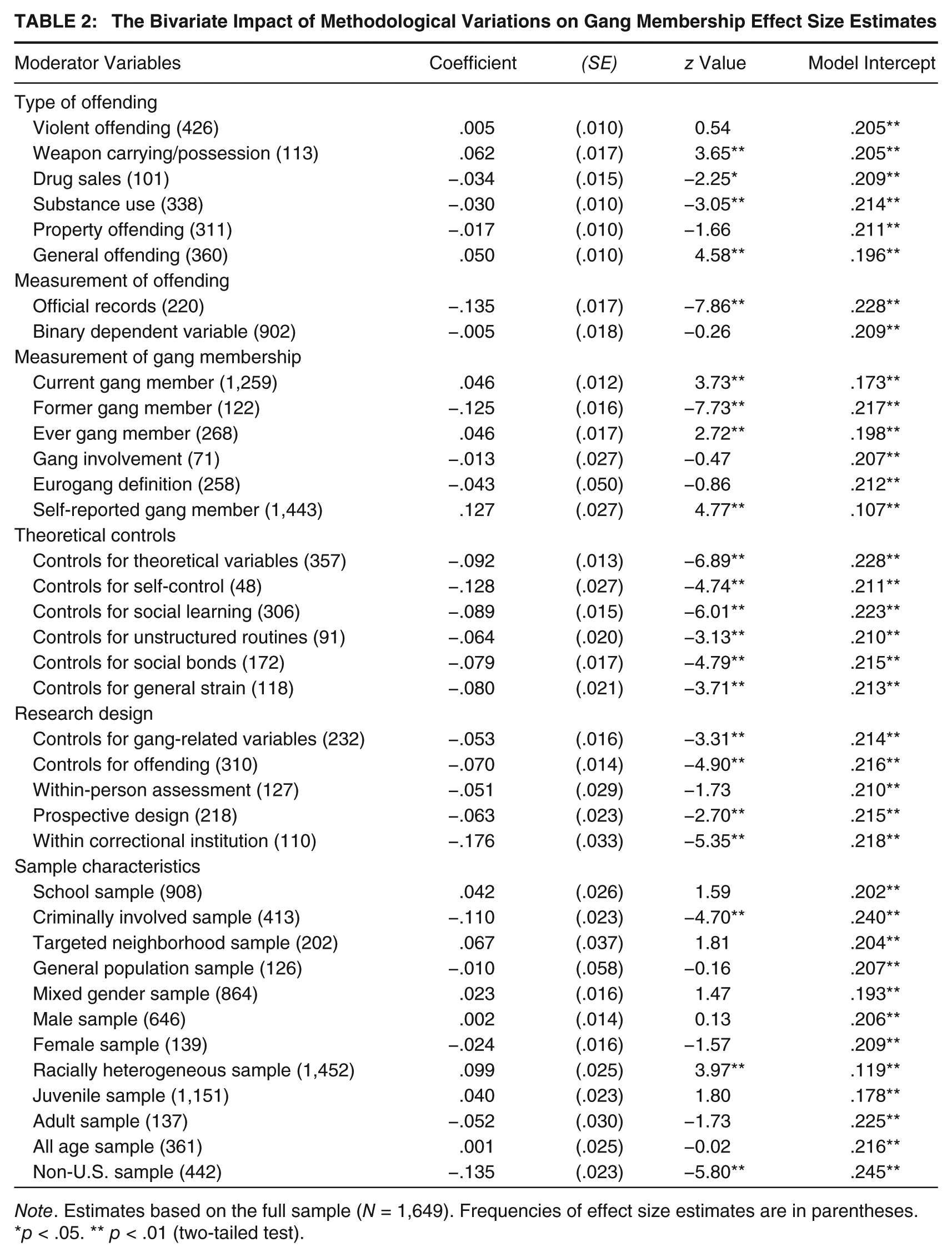
To assess the impact of various methodological conditions on the gang membership and offending effect size estimates, a series of moderator analyses were conducted (see Table 2). Consistent with the approach in Table 1, the analyses in Table 2 were estimated via separate variance-known hierarchical linear models for each moderator characteristic, controlling only for sample size and the number of effect sizes per study. Given these analyses, it appears that the effects of gang membership vary substantially according to differences in model specification, research design, and sample characteristics across studies. In particular, nearly two thirds of the coefficients presented in Table 2 are statistically significant, and the model intercepts vary substantially across each model specified (between .119 and .245). Although the mean effect size estimates are never statistically indistinguishable from zero (i.e., null), the broad trend indicated in Table 2 is that the effects of gang membership on offending are rather sensitive to the methodological variations we assessed.
The Bivariate Impact of Methodological Variations on Gang Membership Effect Size Estimates
Note. Estimates based on the full sample (N = 1,649). Frequencies of effect size estimates are in parentheses.
p < .05. ** p < .01 (two-tailed test).
More specifically, the criminogenic effects of gang membership differ according to the type of offending under examination, where the effects of gang membership are stronger when assessing weapon carrying or possession (b = .062, p < .01), and weaker when assessing drug sales (b = −.034, p < .05) and substance use (b = −.030, p < .01). The effect of gang membership is also found to be stronger in studies that combine both violent and nonviolent forms of offending into a general measure (b = .050, p < .05) and weaker when official reports of offending are used (b = −.135, p < .01). Notably, no differences are found with respect to the effects of gang membership on violent offending versus other forms of crime. The effect size estimates are stronger in studies that assess the effects of current gang membership (b = .046, p < .01) or having ever been a gang member on criminal offending (b = .046, p < .01), and markedly weaker when assessing the effects of former gang membership (b = −.125, p < .01). The effects of gang membership on offending are also stronger when using self-reported measures of gang membership (b = .127, p < .01) than official measures. The use of gang involvement scales or Eurogang definitions of gang membership has no significant influence on the strength of the effect size estimates.
Furthermore, the effects of gang membership are significantly reduced in statistical models that include controls for major theoretical variables (b = −.092, p < .01). It is also noteworthy that this pattern is revealed for all of the different types of theoretically relevant controls that were coded across studies (self-control, social learning influences, unstructured routines, social bonds, and strain). The effects of gang membership on offending are also found to be significantly weaker in studies that include controls for gang-related variables (b = −.053, p < .01), that control for other forms of offending (b = −.070, p < .01), that assess the effects of gang membership on crime prospectively (b = −.063, p < .01), and that examine offending within correctional institutions (b = −.176, p < .01). Finally, the effects of gang membership on offending are found to be weaker in criminally involved samples (b = −.110, p < .01), stronger in racially heterogeneous samples (b = .099, p < .01), and weaker in non-U.S. samples (b = −.135, p < .01). In general, however, sample characteristics have little influence on the strength of the effect size estimates, where the effects of gang membership on offending are robust across sampling frames, gender, and age groups.
The pattern of findings so far lends credence to the various methodological debates that currently exist in the gang literature in that effect sizes vary considerably according to differences in measurement, model specification, and research design. Although the results presented in Table 2 are informative, they are limited in that significant moderators may be correlated and confounded with each other in ways that might lead to inferential errors (Lipsey, 2003). For example, although it seems that studies that include controls for gang-related variables demonstrate significantly weaker mean effect size estimates, these patterns may simply reflect reductions in effect size as a result of multivariate, rather than bivariate, statistical models. In addition, the moderating effects observed by the use of official records of offending may be confounded with the use of a criminally involved sample or official designations of gang membership. Accordingly, it is critical to empirically disentangle the relationships between moderators. To do so, the third step in our analyses was to see whether the systematic variation found in Table 2 would hold up in a multivariate context.
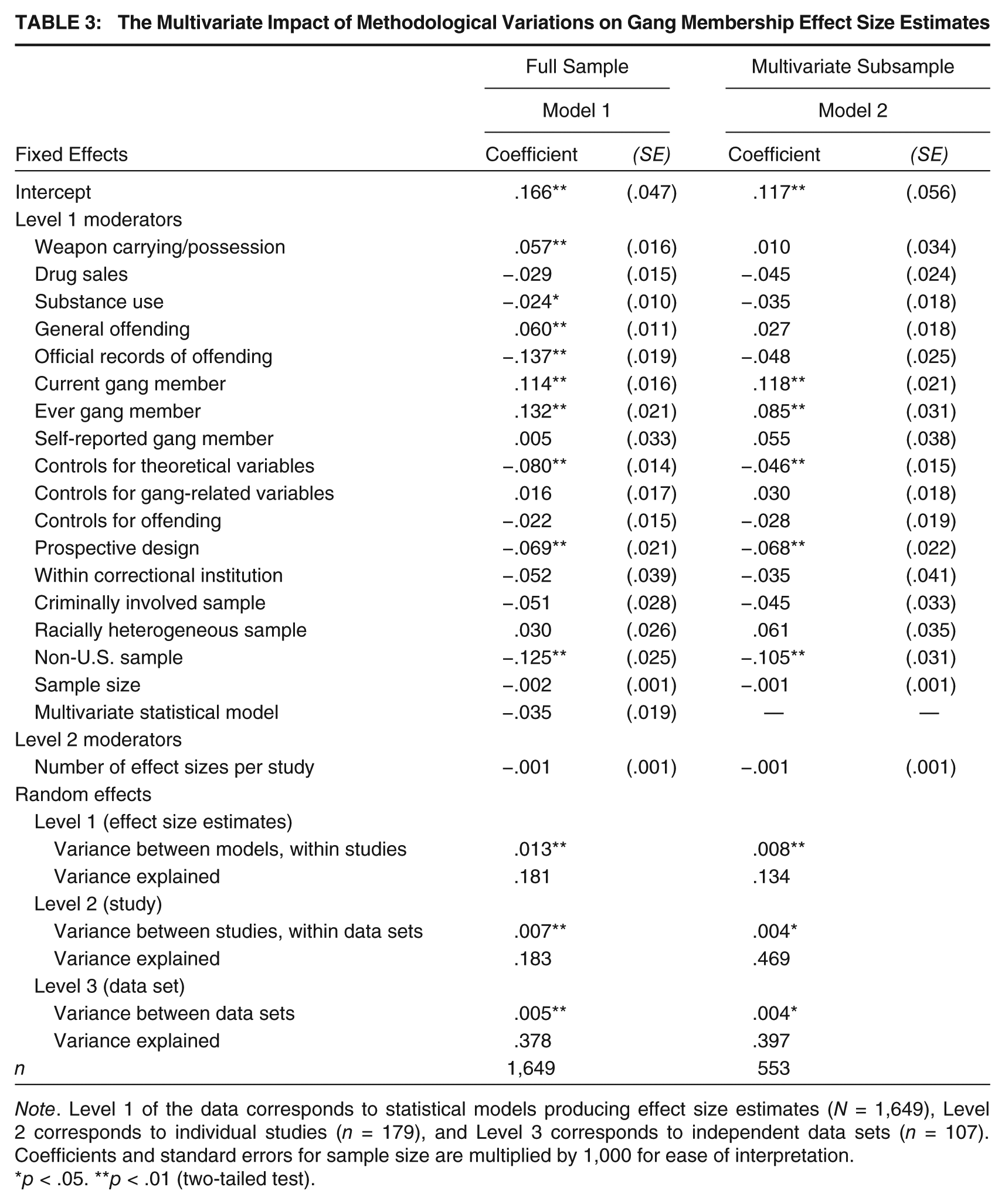
After conducting various model diagnostics to rule out the presence of problematic levels of collinearity, two multivariate variance-known hierarchical linear models were estimated (see Table 3). Model 1 of Table 3 was estimated using the full sample of effect size estimates. Consistent with earlier findings, these results demonstrate that the effects of gang membership are stronger on weapon carrying/possession (b = .057, p < .05) and general offending (b = .060, p < .01), and are weaker on substance use (b = −.024, p < .05). In addition, relative to the effects of former gang membership on offending, effect size estimates remain stronger when assessing current gang members (b = .114, p < .01) or individuals who have ever been gang members (b = .132, p < .01). Even in this multivariate specification, the effects of gang membership remain markedly weaker in studies that include controls for theoretical variables (b = −.080, p < .01), that use prospective research designs (b = −.069, p < .01), that use official reports of offending (b = −.137, p < .01), and that use non-U.S. samples (b = −.125, p < .01). Other moderators that appeared to influence the gang membership effect size estimates in Table 2—drug sales, controls for other forms of offending, self-reports of gang membership, the use of a criminally involved sample, offending within correctional institutions, and the racial composition of the sample—no longer hold once taking into account the influence of other moderators.
The Multivariate Impact of Methodological Variations on Gang Membership Effect Size Estimates
Note. Level 1 of the data corresponds to statistical models producing effect size estimates (N = 1,649), Level 2 corresponds to individual studies (n = 179), and Level 3 corresponds to independent data sets (n = 107). Coefficients and standard errors for sample size are multiplied by 1,000 for ease of interpretation.
p < .05. **p < .01 (two-tailed test).
To ensure the results are not confounded with the use of bivariate effect size estimates that lack controls for important moderators, the second model was specified using only multivariate effect size estimates. As seen in Model 2 of Table 3, only a few moderating effects remained statistically significant this context. In particular, relative to the effects of former gang membership, measures of current gang membership (b = .118, p < .01) and having ever been a gang member (b = .085, p < .01) were associated with stronger effects of gang membership on offending. Theoretical control variables were still found to reduce the effects of gang membership on offending (b = −.046, p < .01), and even in this most conservative specification, the effect size estimates were weaker in prospective designs (b = −.068, p < .01) and in non-U.S. samples (b = −.105, p < .01). When comparing Models 1 and 2, we see that types of offending studied, along with the use of official reports of offending, are no longer distinguishable from zero in Model 2.
Taken together, the findings in Tables 2 and 3 present two very different versions of the nature of the relationship between gang membership and offending. The results shown in Table 2 seem to support the notion that the effects of gang membership on criminal offending are highly sensitive to methodological variations, where the overwhelming majority of the moderators we assessed were statistically significant. The more rigorously specified multivariate results presented in Model 2 of Table 3, however, reveal that much of that support is an artifact of confounded methodological characteristics and the use of bivariate analyses that dominate this literature.
A Note on Selection, Facilitation, and Enhancement Effects
Given the prominence of the Thornberry et al. (1993) theoretical models to the study of gang membership and offending, there are certain patterns in the data that warrant emphasis. Although we cannot directly test selection, facilitation, or enhancement effects using meta-analysis, we can compare the mean effect size estimates of gang membership on offending across studies according to these theoretical models. To do so, we grouped certain effect size estimates in our data according to selection and facilitation models. We considered bivariate, between-person effect sizes comparing current gang and non-gang members to be most consistent with a facilitation model (because these do not include controls for rival or complementary explanations for the gang membership–offending association; n = 825), and we considered bivariate, within-person effect sizes, and all other effect sizes that included controls for criminal propensity (e.g., self-control) but not endogenous factors (e.g., deviant peer influences), to be most consistent with the selection model (n = 109).
There are notable differences in the effects of gang membership on offending between “facilitation” (Mz = .262, p < .01) and “selection” models (Mz = .154, p < .01), where the mean effect of gang membership on offending is reduced by more than 41% after selection effects are taken into account (such as by using a within-person design and/or controlling for criminal propensity). Nevertheless, even across studies that adjust for selection effects, the mean effect size of gang membership on offending remains statistically significant. These patterns seem to indicate a lack of adherence to either a pure selection or pure facilitation model, suggesting that the relationship between gang membership and offending may be better represented by the enhancement model. Still, these simply represent broad patterns in the data, and we cannot infer causality nor definitively conclude that a particular theoretical model reigns supreme. Disentangling selection, facilitation, and enhancement effects of gang membership on offending will always be the domain of the individual study.
Discussion
Gangs and gang members have long captured the attention of researchers, policymakers, and practitioners because they tap both a common scholarly and public concern over factors that contribute disproportionately to the crime problem. There is a long history of explaining and responding to gang behaviors in criminological theories (e.g., conflict, strain, subculture) and criminal justice policy and programs (e.g., legislation, specialized units, task forces). However, if the criminal behavior of gang members is driven not by their involvement in gangs but by some other extraneous factors, whether biological, psychological, or sociological in nature, why should theories and policies be built around gangs and not alternative explanations? To be sure, criminologists have studied the criminal consequences of gang membership for more than half a century. Although a massive body of empirical research on the link between gang membership and offending has been produced, the overall empirical status of this relationship remains uncertain, due in no small part to the absence of a systematic review of this literature. The purpose of the present study was to address this very problem by taking stock of research on gang membership and offending in the form of a meta-analysis. In doing so, four conclusions are warranted.
First, the relationship between gang membership and offending is robust, in that it is rather general across a variety of methodological conditions. Although there is some fluctuation in the mean effect sizes depending on the methodological choices made by researchers, our analyses reveal that gang membership is consistently and significantly related to offending regardless of the measurement of key variables, sampling approaches, and model specifications across studies. Indeed, the overall magnitude of the effect of gang membership on offending is on par with other well-established correlates of crime, notably self-control and social learning variables (see Pratt & Cullen, 2000; Pratt et al., 2010). These findings stand in sharp contrast to critiques that the gang-offending link is spurious or exaggerated, and the evidence lends virtually no support to the idea that this relationship “derives more from politics and romance than from the results of research” (Gottfredson & Hirschi, 1990, p. 206). To the extent that criminological theory and criminal justice policy are built around the correlates of criminal offending, these findings validate efforts to understand and respond to gangs and gang members.
Second, although the effects of gang membership on offending are for the most part general, they are not invariant. The results of our multivariate moderator analyses in Model 2 of Table 3 indicate that the relationship between gang membership and offending is stronger when studying active gang members and weaker in statistical models that control for theoretical confounders and mediators, use prospective research designs, and use non-U.S. samples. The effects of these latter three methodological characteristics warrant further discussion. First, it is noteworthy—although not unexpected—that the effects of gang membership on offending are significantly reduced in statistical models that include controls for theoretical confounders and mediators. This finding speaks to the importance of including these kinds of variables in future studies of the gang-offending link. Although doing so may seem like an obvious point to the field at large, nearly half of the effect size estimates in our study that were coded from multivariate models did not include controls for theoretical variables (n = 250, 45.2%). These effect size estimates were, on average, 33% higher than those coded from models that included such controls (Mz = .201 vs. .151). To avoid inflating the association of gang membership with offending due to the absence of confounders or mediators, it is critical that these types of theoretical variables (e.g., self-control, differential association, social bonds, strain, and unstructured routines) are taken into account regardless of whether they are thought of as being endogenous or exogenous to gang membership.
In addition, the magnitude of the gang membership–offending link is weaker when modeled prospectively rather than contemporaneously. The larger implication of this finding concerns the causal significance of gang membership. That is, compared to studies using prospective research designs with proper time ordering, it is much harder to disentangle the effects of gang membership on offending from other risky attitudes, behaviors, and contexts when all of the key variables are measured contemporaneously. The weaker effect size in prospective models is likely a consequence of the fact that gang membership is usually short in duration, typically 1 to 2 years, and is often intermittent (see the appendix in Pyrooz, Sweeten, & Piquero, 2013). Recent commentary on this topic (Decker et al., 2013; Medina-Ariza et al., 2014) debated the adequacy of contemporaneous and prospective models of offending in longitudinal studies, expressing concern about the extent to which offending actually overlaps with short-term gang membership. It is important to have a measurement strategy that captures the realities of the patterning of gang membership, something that is not easily possible with the current inventory of data sets containing gang membership measures represented in this meta-analysis. Future research could advance individual-level gang studies by using shorter survey intervals, life-event calendars, or space-time budgets (Bernasco et al., 2013; Griffin & Armstrong, 2003; Mears, Stewart, Siennick, & Simons, 2013; Nguyen & McGloin, 2013).
Our results also demonstrate that the relationship between gang membership and offending is weaker in research settings outside the United States. A total of 17 nations were represented in our data, and the moderation finding could not be explained by alternative measures of gang membership, notably Eurogang indicators. 15 Although gangs have existed in European and Latin American countries for quite some time, in the last decade, scholars have increasingly pointed to gangs as an important driver of violence, particularly youth violence (Densley, 2013; Jütersonke, Muggah, & Rodgers, 2009; Klein, Weerman, & Thornberry, 2006). What might help explain this effect is the observation that gangs and gang members in the United States generally have greater levels of gang organization and structure, more access to firearms, and higher rates of disproportionate offending relative to their European and Latin American counterparts (Decker & Pyrooz, 2010; Esbensen & Weerman, 2005; Huizinga & Schumann, 2001; C. M. Katz, Maguire, & Choate, 2011; Klein et al., 2006; Pyrooz, Fox, Katz, & Decker, 2012). Klein (1995, 1996) recognized that gangs in European countries are in their early stages of development, much like the “emergent” and “chronic” typology used by Spergel and Curry (1993) to differentiate cities in the United States with long-standing versus newer gang problems. At this point, it is unclear whether the currently evolved status of gangs, sociocultural conditions, or some combination of the two produces a weaker relationship between gang membership and offending. Even in the United States, however, there is little empirical evidence that members of more well-established gangs have higher rates of criminal behavior than members of gangs that have been formed more recently (Decker, Katz, & Webb, 2008; although see Klein & Maxson, 2006). It is important to determine whether this finding is a reflection of American exceptionalism, or if it is instead due to gang activity outside the United States still being in its infancy. A comparative agenda is ripe for better understanding this moderation effect outside the United States.
Third, the results of our moderator analyses have implications for conducting meta-analyses more generally. Specifically, multivariate analysis of methodological moderators should be conducted whenever the sample of effect sizes is large enough to permit it, as was the case here. We advocate for this approach because many of the methodological characteristics we assessed in our analyses were confounded with one another. This problem is compounded by the fact that moderator variables tend to be unevenly distributed across studies, which makes it difficult to determine which moderating relationships are meaningful and which are spurious unless a multivariate assessment is undertaken (Lipsey, 2003; Pratt et al., 2014; Raudenbush, 2004). This point is clearly illustrated in this study. Had we stopped our moderator analyses at Table 2, we would have erroneously concluded that the effects of gang membership on offending are highly sensitive to virtually all of the methodological variations in this body of work, and therefore, virtually all of the methodological debates that have gone on in the gang membership–offending literature have proceeded with good reason. The results of the multivariate models presented in Table 3 (particularly Model 2), however, paint a much different picture in that the majority of the significant findings from Table 2 are revealed to be spurious, and instead, only a few significant moderating effects remain. Thus, the ultimate takeaway is that only a handful of these methodological debates seem to be warranted—a key conclusion that would have been missed had we not pushed our analyses into the multivariate context. Of course, the present study is one of the largest meta-analyses ever undertaken in criminology; therefore, not all meta-analytic data sets have enough observations to accommodate multivariate moderator analyses. Nonetheless, our results show that it is important to conduct these types of analyses when possible.
Fourth, in addition to highlighting what has already been done in a body of research, one of the key strengths of a meta-analysis is that it can also identify what still needs to be done. Accordingly, as stated at the outset, one of our key objectives was to specify the kinds of questions that the next generation of research should be asking. In addition to the issues outlined above, we suggest future research focus on two additional lines of work. First, because there is no criminal threshold to self-nominate as a gang member in survey research or to be documented as a gang member by law enforcement, the relationship between gang membership and offending should be either confounded or mediated by rival or complementary theoretical explanations. Unpacking the mechanisms underlying the gang membership–offending link was the basis for the selection and facilitation models introduced by Thornberry et al. (1993). Our moderator analyses confirm that the effect sizes of gang membership are weaker in statistical models that adjust for theoretically relevant variables. Nevertheless, in the vast majority of the individual-level gang studies, this relationship is typically only partially confounded or mediated. What this means is that despite the large amount of ground that has been covered, the precise mechanisms of this relationship still remain unknown. The work of Melde and colleagues (Matsuda et al., 2013; Melde & Esbensen, 2011, 2014), as well as others (e.g., Sweeten et al., 2013), has begun to identify the causal mechanisms that link joining and leaving gangs to criminal behavior. However, the fact that the relationship remains in the presence of numerous confounders and mediators might expose the limits of what individual-level data have to offer the study of gang membership in criminology. A more profitable route may be to better integrate group processes and social network properties into the study of gang membership and offending, as some have recently proposed (Decker et al., 2013; Hughes, 2013; Papachristos, 2011; Pyrooz et al., 2014). Indeed, identifying the features of gangs that make them similar to and different from other social collectives—whether criminal or not—and sources of peer or social influence should be a high priority for future research.
The second line of research we propose for the future is that scholars should assess a broader spectrum of personal and social harms associated with gang membership, by treating gang membership itself as a risk factor for other negative outcomes. These would include short-term adverse outcomes as well as those that persist over time. Just as offending and other major correlates of crime (e.g., self-control) have been linked to a wide array of negative outcomes (Caspi, Bem, & Elder, 1989; Masten & Cicchetti, 2010; Piquero, Daigle, Gibson, Piquero, & Tibbetts, 2007), future work could assess the proximal and distal effects of gang membership on behavioral (victimization, substance use), social (educational deficits, joblessness, relationship failure), psychoemotional (depression, anxiety), and health-related outcomes (early death, chronic health problems; Augustyn, Thornberry, & Krohn, 2014; Dmitrieva, Gibson, Steinberg, Piquero, & Fagan, 2014; Gilman, Hill, & Hawkins, 2014; Krohn, Ward, Thornberry, Lizotte, & Chu, 2011; Pyrooz, 2014a). Determining whether these outcomes are a product of selection processes, the problem behaviors linked to gang membership, or unique to gang membership itself, should be central to this line of work. Research that can shed light on the full set of non-criminal consequences of gang membership would be of interest not only to criminologists but also to scholars doing work in psychology, social work, and public health.
In the end, the study of gangs and gang members has a long history within criminology, and even the early roots of criminological thought were intertwined in important ways with gang research. Nevertheless, contemporary gang research has matured in a way that seems somewhat independent from mainstream criminology in general, and even from criminological research on peer influence and group-based processes in particular. This is unfortunate because gang membership is clearly an important correlate of offending, which should be considered not only in gang research but also in any study that is interested in predicting criminal behavior where a variable for gang membership is present in the data. Put simply, we are calling for gang research to be better integrated into the field at large, and for a broader recognition that the gang membership–offending link is one that demands our attention.
Footnotes
Acknowledgements
The authors thank Emily Salisbury and the three anonymous reviewers at Criminal Justice and Behavior, along with Travis Pratt, for their comments on this study.
An earlier version of this article was presented at the annual meeting of the American Society of Criminology in Atlanta, GA.