




Abstract
This study examined responses to a self-report questionnaire on interviewing techniques administered to 291 incoming adult male prison inmates across Japan who were convicted of murder, robbery, arson, rape, forcible indecency, or kidnapping. The questionnaire focused on interrogations that led to confessions. Four interview styles (Evidence-confrontational, Relationship-focused, Undifferentiated-high, and Undifferentiated-low) were identified. For prisoners who had already decided to confess before their interrogation, interview styles had no effect on the tendency to confess. However, when prisoners were undecided about confessing or had previously decided to deny allegations, the Relationship-focused and Undifferentiated-high interview styles were associated with confessions. Furthermore, prisoners who experienced Relationship-focused interviews were more likely to provide previously undisclosed information to the police.
Since two miscarriages of justice in 2007, Japanese criminal procedure has seen many changes, including the partial video recording of suspect interviews, the use of such recorded interviews as evidence in citizen judge (saiban-in) trials, and, very recently, the introduction of official training courses for police interviewers (Shigematsu, 2012, 2013). However, scientific research on Japanese interrogations is limited. Little is known about the kinds of interviewing techniques—especially those that effectively elicit true confessions—commonly used by the Japanese police. As Japanese criminal procedures have certain unique characteristics, such as detention periods (the maximum period of detention is 23 days from arrest to the initiation of prosecution for the offense in question) and the need for corroborative evidence when suspects confess (see Wachi et al., 2014 for a description of the Japanese criminal procedure), it is unclear whether findings obtained in Western countries can be applied to Japan. In the Japanese criminal system, interrogation plays several roles, including not only obtaining suspects’ accounts but also revealing subjective aspects of criminal acts and contributing to the reformation and rehabilitation of offenders (Ueno & Matsui, 2012). These goals and possibilities may influence Japanese police officers’ attitudes toward suspects and their interviewing methods.
Japanese prosecutors also directly interview suspects in their offices during periods of detention. However, police officers are the first to meet and conduct interrogations with suspects. According to a survey conducted by the Japanese Ministry of Justice (2011), the mean duration of police interrogations concerning general crimes was 18 hr 52 min, compared with 2 hr 47 min for prosecutors’ interrogations. Regarding serious crimes such as murder, robbery, and arson, the mean duration of police and prosecutors’ interrogations was 34 hr 13 min, and 9 hr 1 min, respectively. These figures are the sum total durations of all interrogations for each case. Although the above survey did not report the average number of interrogations suspects underwent, according to a survey by the National Police Agency (2011), the mean duration, mean number of days, and mean number of interrogations for individual general crime cases were 15 hr 15 min, 5.7 days, and 10.1 times, respectively. The average duration of each interrogation was 1 hr 31 min.
Most studies about police interviewing techniques and confessions have been conducted in Western countries. For example, Leo (1996) investigated interrogation techniques by observing actual (n = 122) and videotaped (n = 66) interrogations in the United States. He examined 25 interrogation tactics taught through police training manuals and training courses, as well as those depicted in popular culture. The most commonly employed tactics were appealing to the suspect’s self-interest (used in 88% of the cases), confronting suspects with existing evidence of guilt (85%), undermining the suspect’s confidence in his or her denial of guilt (43%), and identifying contradictions in the suspect’s story (42%). By contrast, touching the suspect in an unfriendly manner (0%), the good cop/bad cop routine (1%), minimizing the nature/purpose of questioning (1%), and attempting to confuse the suspect (1%) were rarely observed in his sample. Further analysis showed that four tactics—appealing to the suspect’s conscience, identifying contradictions in the suspect’s story, using praise or flattery, and offering moral justification/psychological excuses—were more likely to elicit incriminating information (Leo, 1996).
King and Snook’s (2009) Canadian study analyzed 44 videotaped interrogations, replicating Leo’s (1996) findings. In addition, they examined the effectiveness of the Reid model of interrogation (Inbau, Reid, Buckley, & Jayne, 2004), which is commonly taught and used in North American police forces. Confronting the suspect with existing evidence of guilt (used in 82% of the cases), offering moral justification/psychological excuses (64%), using praise and/or flattery (57%), and identifying contradictions in the suspect’s account (46%) were the most frequently used tactics, whereas exaggerating the nature/purpose of questioning (0%), exaggerating the moral seriousness of the offense (0%), the good cop/bad cop routine (2%), and attempting to confuse the suspect (2%) were used infrequently. Concerning the core Reid model techniques, changing the theme if the suspect continued to reject it (used in 85% of the cases), allowing the suspect to voice objection (81%), and returning to the beginning of the crime when the suspect made a partial admission of guilt (80%) were most frequently used. However, the police officers did not employ all core Reid techniques in their interrogations. The examination of the techniques used and interrogation outcomes revealed that those who confessed fully or partially were more likely to have been exposed to the core Reid techniques and Leo’s influential interrogation tactics than those who denied guilt or made no comments.
In the United Kingdom, Pearse and Gudjonsson (1996) studied 161 audiotaped interviews conducted at two police stations in London and examined common interview techniques, suspects’ reactions, and their confessions. Most of the examined cases were common offenses (i.e., 102 cases were property offense cases and 22 assault cases). The most common techniques were the use of open questions (98% of the participants asked open questions), introduction of evidence (74%), use of leading questions (73%), and challenging lies and inconsistencies (20%). In contrast, more manipulative tactics were uncommon; 8% of the sample emphasized the seriousness of the offense and only 3% manipulated the suspects’ self-esteem. Pearse and Gudjonsson also noted that only five officers (3%) initially established rapport with the suspects. In addition, the mean number of tactics used was 3.75, suggesting that they had used limited techniques. Regarding suspects’ reactions, the most common were being polite (97%), being generally compliant (83%), giving full answers (62%), and confessing readily (36%). In addition, 93 suspects (58%) made either full confessions or admissions, of which 90 occurred in the first interview. These results indicated that most police officers conducted nonconfrontational interviews with polite suspects and question “the widely held belief that suspects make admissions because of the highly skilled questioning or manipulative psychological ploys adopted by the police” (Pearse & Gudjonsson, 1996, p. 71).
However, this result may have been influenced by the type of offense examined, namely, common high-volume crimes. Pearse and Gudjonsson (1999) investigated police interview tactics for dealing with reluctant suspects who had committed serious crimes such as murder, rape, arson, armed robbery, and blackmail. These cases had been referred to psychologists to examine the reliability of the suspects’ confessions and understand their psychological vulnerabilities. All 18 suspects examined denied their crime at the beginning of the interview and finally confessed during the interview. By analyzing 5-min audio segments of each interview, Pearse and Gudjonsson identified 39 interviewing techniques. A factor analysis involving 33 of the 39 tactics yielded six factors: Intimidation, Robust Challenge, Manipulation, Question Style, Appeal, and Soft Challenge. The first three factors were regarded as “overbearing” styles, while the latter three were more “sensitive” (Pearse & Gudjonsson, 1999, p. 231). Suspects’ confessions were more likely to be elicited when tactics were used at an extreme level. Further analysis demonstrated that cases were more likely to be inadmissible in court when police officers used the overbearing style of interviewing at an extreme level. In contrast, when sensitive tactics were used at an extreme level, interviews were admissible as evidence in court (Pearse & Gudjonsson, 1999). Thus, although aggressive interviewing techniques are likely to lead to confessions, they are more likely to be regarded as inadmissible by the public and court. The finding that police officers tended to resort to coercive tactics to deal with suspects’ resistance was contrary to the previous study examining high-volume crimes (Pearse & Gudjonsson, 1996).
In a more recent British study, Soukara, Bull, Vrij, Turner, and Cherryman (2009) studied frequently used interview techniques by analyzing 80 audiotaped interviews from one police station in England. Among the 17 tactics identified in prior research, the most frequently used techniques were disclosure of evidence (99% of the sample), open questions (99%), leading questions (91%), repetitive questioning (84%), emphasizing contradictions (75%), positive confrontation (74%), and challenging the suspect’s account (71%). Problematic techniques, as defined by Kassin and Gudjonsson (2004), were almost never used in this sample: maximization (1%), minimization (0%), intimidation (0%), and situational futility (0%; Soukara et al., 2009). Thus, police officers followed the new interview model, namely, the PEACE model (which is an acronym for planning and preparation [P], engage and explain [E], account [A], closure [C] and evaluation [E]), attempting to “obtain information from the suspect . . . then to test this information” (Soukara et al., 2009, p. 502). Moreover, the techniques most significantly associated with suspects’ shifts from denial to confession were open questions and disclosure of evidence. However, emphasizing contradictions and challenging the suspects’ accounts negatively affected this shift. In other words, when these interrogation techniques were used, suspects were more likely to continue denying their guilt (Soukara et al., 2009). Although disclosure of evidence appeared to be effective, it was not clear how or when interviewers presented their evidence. For example, they may have disclosed evidence after suspects provided their narratives, as in the Strategic Use of Evidence technique (e.g., Hartwig, Granhag, Stromwall, & Kronkvist, 2006), or may have disclosed it gradually (Dando & Bull, 2011), or even at the beginning, as recommended in the American Reid Technique Manual (Inbau et al., 2004).
In Sweden, Holmberg and Christianson (2002) surveyed 83 prisoners convicted of murder and sexual crimes. They identified two different interviewing techniques, characterized by domineering and humanitarian behavior. The domineering approach, which involved interrogators being hostile and critical, was associated with denials, whereas the humanitarian approach—which involved showing empathy, respect, and friendliness—was associated with confessions. However, because self-report surveys do not involve the manipulation of variables, confounding variables cannot be excluded, and causal relationships cannot be identified (Kebbell, Alison, & Hurren, 2008). Other factors may have affected the relationship between interviewing styles and confessions.
Other researchers have also highlighted the importance of displaying positive attitudes toward suspects. Kebbell, Alison, Hurren, and Mazerolle’s (2010) study on 43 prisoners convicted of sexual crimes in Australia found that those who confessed were more likely to perceive police interviews as humane and ethical. The participants also reported that increasing humanity and ethical standards as well as decreasing dominance could increase the likelihood of suspects confessing.
Although there have been a few studies on Japanese police interrogations, a recent study conducted by Wachi et al. (2014) reported findings that were consistent with Holmberg and Christianson’s (2002) and Kebbell et al.’s (2010) studies. Wachi et al. (2014) surveyed 276 Japanese police officers who interviewed adult offenders suspected of murder, robbery, rape, arson, forcible indecency, and kidnapping. The interview techniques used by police officers were factor-analyzed, yielding five factors: Presentation of Evidence, Confrontation, Active Listening, Rapport Building, and Discussion of the Crime. Presentation of Evidence was related to using evidence during interrogations. Confrontation included techniques wherein police officers confronted suspects. Active Listening included techniques related to the police officers listening closely to the suspect’s accounts. Rapport Building included techniques wherein police officers tried to build trusting relationships with suspects. Discussion of the Crime involved directly talking about the crime. Based on these factors, four interviewing styles (Evidence-focused, Confrontational, Relationship-focused, and Undifferentiated) were identified. In the Evidence-focused approach, police officers attentively listened to suspects’ accounts and used the evidence obtained to confront them. In the Confrontational approach, police officers confronted suspects by talking about the crime and victims. In the Relationship-focused approach, police officers closely listened to the suspects’ accounts and attempted to develop good relationships with them. When police officers tended not to employ the interviewing techniques examined in this study, their approach was described as Undifferentiated. Relationship-focused interviewing was associated with suspects’ full confessions during the later periods of interrogations. By contrast, the Evidence-focused approach was associated with suspects’ partial confessions. In addition, those who were exposed to Relationship-focused interviewing were more likely to disclose information unknown to the police after they confessed (Wachi et al., 2014).
Thus, Wachi et al.’s study revealed the importance of Relationship-focused interviewing in Japan, albeit only using a self-report questionnaire completed by police officers. The present study was designed to supplement Wachi et al.’s (2014) study by examining interrogations from the offenders’ perspectives.
Overview of the Present Study
This study was the first attempt to investigate prisoners’ perspectives on Japanese police interrogations. Special focus was placed on interview techniques that stress the importance of good relationships between police officers and suspects as such techniques are considered likely to elicit true confessions. To permit comparisons between police officers’ and prisoners’ reports, some questions from the questionnaire completed by police officers in Wachi et al.’s (2014) study were also asked in this study.
In all, this study was designed to examine common investigative interviewing techniques in Japan as reported by prisoners, identify the interviewing techniques that led offenders to confess, and examine interviewing techniques in relation to the offenders’ disclosure of new information.
Based on Wachi et al.’s (2014) results, we predicted that (a) interviewing techniques reported by prisoners would include the Relationship-focused style, (b) prisoners subjected to Relationship-focused interviewing would be more likely to confess than other prisoners were, and (c) prisoners who experienced Relationship-focused interviews and had confessed would be more likely to disclose new information.
Method
Sample
We recruited adult male prison inmates who had committed serious crimes such as murder, robbery, arson, rape, forcible indecency, and kidnapping, as defined in the police officers’ survey (Wachi et al., 2014). A total of 310 questionnaires were distributed in 36 prisons, and 303 questionnaires (97.7%) were returned during the study period. However, it was impossible to calculate the actual response rate because prison officials were not required to report how many prisoners they approached. Thus, the total number of prisoners approached remains unknown. Data from 12 participants were excluded from the analysis: 1 participant did not answer most of the questions (87.2% of the responses were missing), 2 were younger than 20 years of age (minors, according to Japanese law) at the time of interrogation, and 9 committed none of the six listed crimes. Thus, the responses of 291 participants were analyzed.
The mean and median ages of the 291 prison inmates were 37.37 (SD = 12.47) and 35.00 years, respectively, with a total range of 20 to 80 years. Mean and median ages at the time of interrogation (n = 290 1 ) were 36.10 (SD = 12.56) and 33.00 years, respectively. Regarding marital status (n = 288), 75 prisoners (26.0%) were married at the time of arrest, 40 (13.9%) were in common-law marriages, and the remaining (60.1%) were single. Concerning educational background (N = 291), 59 prisoners (20.3%) had completed only compulsory education (9 years of school), and 72 (24.7%) were high school dropouts (less than 12 years of school). With regard to criminal record, 148 out of 291 prisoners (50.9%) had previous arrests, and 52 (17.9%) had been imprisoned previously.
Forty-one prisoners (14.3% of 286 prisoners) admitted committing murder, 107 (37.4%) robbery, 19 (6.6%) arson, 85 (29.7%) rape, 90 (31.5%) forcible indecency, and 6 (2.1%) kidnapping. Because some cases involved several types of crime for each incident, the total number of crimes admitted (348) was greater than the number of prisoners involved (286). With regard to evidence against them, 198 prisoners (68.3% of 290 prisoners) believed that it was strong, 41 prisoners (14.1%) believed the evidence was weak, 26 prisoners (9.0%) believed that there was no evidence, and 25 prisoners (8.6%) answered that they did not know.
The mean number of days of interrogation was 58.59 (SD = 66.43) and the median was 30, with a range of 2 to 397.5 days. 2 One interrogation was completed in the year 1998, 2 were completed in 2005, 1 in 2006, 3 in 2007, 4 in 2008, 4 in 2009, 18 in 2010, 81 in 2011, 173 in 2012, and 2 in 2013. About 90% of the participants had undergone interrogation less than 3 years before completing the questionnaires.
Materials
After developing the questionnaire, the appropriateness of items, wording, and the administration procedure were checked by the National Police Agency, Supreme Public Prosecutors’ Office, and the Ministry of Justice in Japan.
Prisoner’s Demographic Characteristics
These items recorded the prisoners’ age, marital status at the time of arrest, educational background, and history of previous arrests and imprisonment.
Details of the Crimes and Interrogations
The crimes for which the prisoners had been convicted and the details of their interviews, such as dates, periods, and the prisoners’ perceptions of the strength of the evidence were obtained. The prisoners were also asked whether they had decided to confess or deny before being interviewed.
Furthermore, they were asked to rate the frequency with which they were exposed to specific interviewing techniques. The items were the same as those employed in Wachi et al.’s (2014) study, with simplified wording. Each statement was rated on a 5-point Likert-type scale (1 = never, 2 = on rare occasions, 3 = sometimes, 4 = often, and 5 = always).
Confessions
At the top of all pages addressing confession-related details, we explicitly defined confession as “admitting to the offenses you were arrested for and telling the truth.” Prisoners were then asked to rate the degree to which they confessed their crimes (“To what degree did you finally confess the crime during the police interview?”) on a 5-point Likert-type scale (1 = not at all, 2 = a little, 3 = partially, 4 = almost, and 5 = fully).
Disclosure of Information after Confession
The prisoners were asked to respond to “Did you voluntarily disclose information unknown to the police after you had confessed your crime?” (rated as 1 = strongly disagree, 2 = disagree, 3 = neutral, 4 = agree, and 5 = strongly agree), which was included in the police officers’ questionnaire (Wachi et al., 2014). This question was not asked of those who had denied the allegations.
As prosecutors also directly interview suspects, the questionnaire repeatedly emphasized that it was concerned with police interviews and not prosecutors’ interviews.
Procedure
The National Police Agency sought the assistance of the Ministry of Justice for survey administration. The Ministry of Justice selected 36 adult male prisons across Japan and identified the number of potential participants in each prison. The National Research Institute of Police Science (NRIPS) then distributed questionnaires to these prisons. In each prison, officials asked incoming prisoners who met the criteria for participation (new adult male inmates, convicted of the six listed crimes, who had been interviewed by the police, and who had no mental disorders or intellectual disabilities) whether they would volunteer to participate in the survey. Once prisoners agreed to participate, the study was explained to them and they were asked to sign consent forms; they were then given the questionnaires. Upon completion, prisoners placed the consent forms and questionnaires in envelopes and submitted them to a prison official, who then sealed them and sent them back directly to the NRIPS. Prison officials were directed not to read the answered questionnaires. The study began in September 2012 and ended in May 2013. All participants were treated in accordance with the guidelines delineated by the Japanese Psychological Association. Furthermore, the internal ethical review board of the NRIPS approved the project.
Results
Interviewing Style
The distribution of participants’ responses regarding interview techniques is presented in Appendix Table A1. Mean ratings ranged from 2.15 to 3.80. The most frequently used techniques as reported by prisoners were “Respecting you as a human being,” “Listening to your life stories, such as personal history,” “Emphasizing the serious nature of the crime you had committed,” “Listening closely to your word,” “Being friendly to you,” and “Listening to your stories about your significant others (e.g., parents, spouse, children).” Thus, the most frequently used techniques were listening to prisoners’ stories and treating prisoners humanely.
The five factors obtained by exploratory factor analysis in Wachi et al.’s (2014) study on police officers—Presentation of Evidence, Confrontation, Active Listening, Rapport Building, and Discussion of the Crime—were used to compare their responses with the prisoners’ in the present study (see Appendix Table A1). Alpha coefficients of the five factors were as follows: .49 for Presentation of Evidence, .85 for Confrontation, .83 for Active Listening, .72 for Rapport Building, and .68 for Discussion of the Crime. Although the alpha coefficient for Presentation of Evidence was less than ideal, we retained it to compare the police officers’ and prisoners’ perceptions in this exploratory study. While the factor structures between the perceptions of police officers and prisoners are also worth examining, for this study, we decided to focus on the frequencies of factors and interviewing styles reported by both parties. Therefore, we did not run a new factor analysis with the current data.
The composite score for each factor was calculated by averaging item scores. A one-way repeated measures ANOVA was used to examine the mean factor scores (n = 254). Mauchly’s test indicated that the assumption of sphericity had been violated. Thus, degrees of freedom were corrected using Greenhouse-Geisser estimates of sphericity. The result was significant, F(2.34, 591.67) = 48.02, p < .001, ηp2 = .16. Post hoc tests (Bonferroni correction) revealed that participants were more likely to experience Active Listening (M = 3.16, SD = 0.86) than Presentation of Evidence (M = 2.44, SD = 0.83), Confrontation (M = 2.48, SD = 1.05), or Rapport Building (M = 3.00, SD = 0.72). They were more likely to experience Discussion of the Crime (M = 3.06, SD = 0.86) than Presentation of Evidence or Confrontation. The participants were also more likely to experience Rapport Building than Presentation of Evidence and Confrontation.
As with the study on police officers (Wachi et al., 2014), a nonhierarchical cluster analysis (k-means) was conducted to classify the prisoners into groups with common characteristics as indexed by the mean factor scores. Four clusters were identified. The first cluster included 70 participants, the second 42 participants, the third 95 participants, and the fourth 84 participants. Welch’s test, which was conducted because Levene’s tests showed that assumptions regarding homogeneity of variance were not met, revealed a significant group difference with respect to Presentation of Evidence, Welch’s F(3, 129.00) = 40.53, p < .001. One-way ANOVAs showed significant differences among clusters in Confrontation, F(3, 287) = 181.43, p < .001, η2 = .65, Active Listening, F(3, 287) = 116.32, p < .001, η2 = .55, Rapport Building, F(3, 287) = 71.83, p < .001, η2 = .43, and Discussion of the Crime, F(3, 287) = 108.58, p < .001, η2 = .53. Post hoc Games-Howell tests (Presentation of Evidence) and Bonferroni procedure (Confrontation, Active Listening, Rapport Building, and Discussion of the Crime) were conducted to examine the group differences (see Table 1).
Average Scores on the Five Factors by Cluster (Means and Standard Deviations)

Note. Scale ranged from 1 = never, 2 = on rare occasions, 3 = sometimes, 4 = often, to 5 = always. Means scores in rows sharing a common subscript were not significantly different at α = .05 according to the Bonferroni (for Confrontation, Active Listening, Rapport Building, and Discussion of the Crime) and Games-Howell (for Presentation of Evidence) post hoc analyses.
Table 1 shows the scores for the four clusters. The first and second groups had significantly higher scores for Presentation of Evidence and Confrontation than did the third and fourth groups. Concerning Active Listening and Rapport Building, the third group’s mean scores were significantly higher than those of the other three groups. Furthermore, the first and third groups’ scores for Discussion of the Crime were significantly higher than those for the second and fourth groups (see Table 1).
The four clusters were subsequently labeled the Undifferentiated-high, Evidence-confrontational, Relationship-focused, and Undifferentiated-low group, respectively (see Figure 1). The first (Undifferentiated-high) group was characterized by the highest scores on the Presentation of Evidence, Confrontation, and Discussion of the Crime factors. Scores for Active Listening and Rapport Building factors were also high. Thus, respondents in this group believed that all the interview techniques examined in this study were employed frequently.
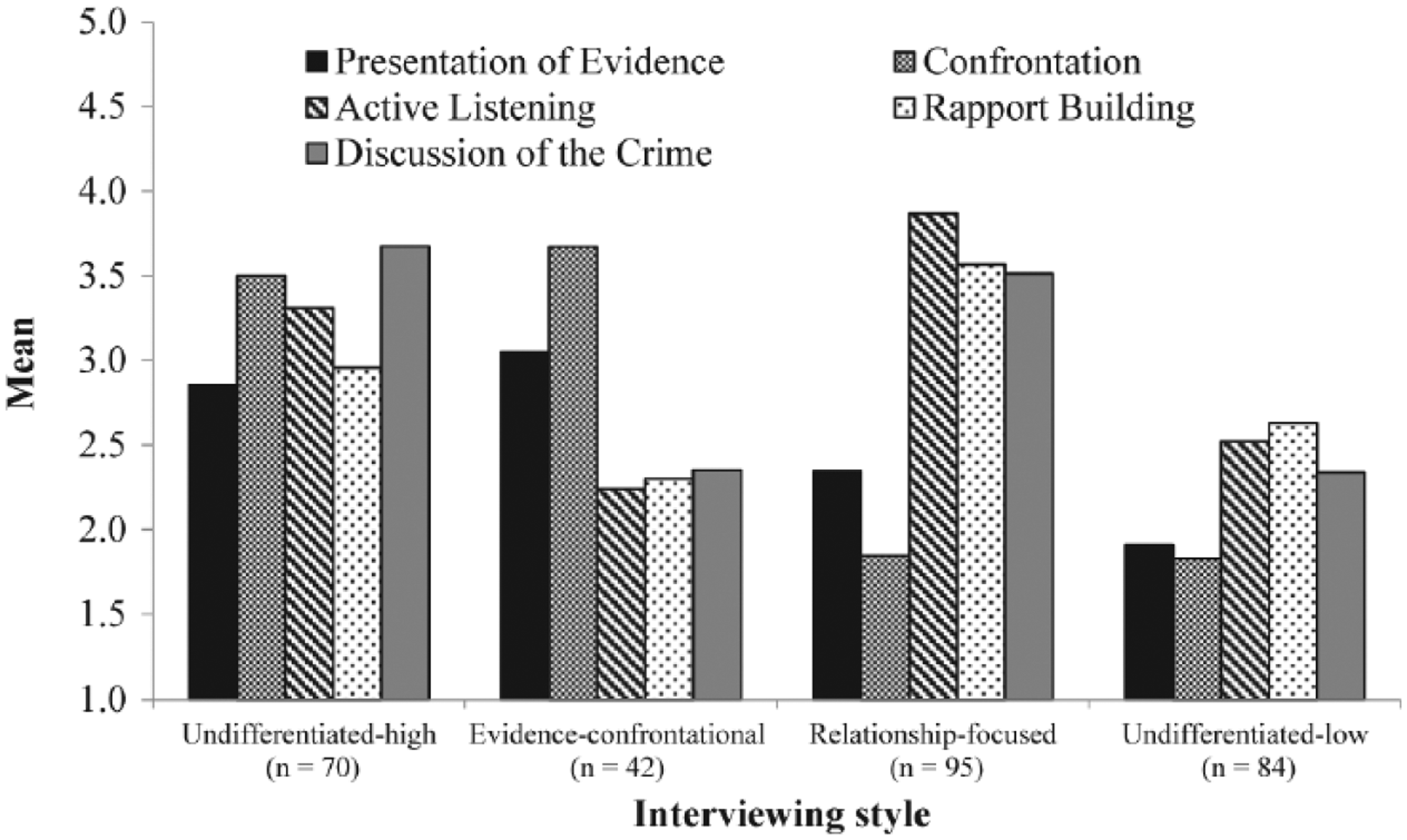
Four Interviewing Styles Based on the Prisoners’ Responses
The second (Evidence-confrontational) group was characterized by the highest scores on Presentation of Evidence and Confrontation factors. The interrogators in this group tended to confront suspects by presenting evidence, according to the prisoners.
The third (Relationship-focused) group was characterized by the highest scores on Active Listening, Rapport Building, and Discussion of the Crime factors. The interrogators in this group were likely to listen closely to the suspects’ accounts, attempt to build rapport, and discuss their offenses.
Finally, the fourth (Undifferentiated-low) group was characterized by the lowest scores on Presentation of Evidence, Confrontation, Active Listening, and Discussion of the Crime factors. The scores on the Rapport Building factor were the second lowest among the groups. Prisoners in this group appeared to have experienced interrogations where the techniques examined in this study were unlikely to have been employed.
Interviewing Styles and Confessions
Most prisoners (183, 63.5% of 288 prisoners) decided to confess before undergoing police interrogation. Only 20 prisoners (6.9%) had decided to deny the allegations. The remaining (85, 29.5%) were undecided about confessing. In the following analysis, we combined those participants who had decided to deny allegations prior to interrogation and those who were undecided, as the former group was small. Regarding the degree to which they confessed, 201 prisoners (69.6% of 289 prisoners) reported that they confessed fully, 55 (19.0%) confessed mostly, 16 (5.5%) confessed partially, and 7 (2.4%) confessed “a little.” Only 10 prisoners (3.5%) did not confess at all.
A 2 × 4 (Previous decision [confess, deny / undecided] × Interview style [Undifferentiated-high, Evidence-confrontational, Relationship-focused, Undifferentiated-low]) ANOVA was conducted on the degree to which the participants confessed. There was a significant interaction between previous decision and interview style on the participants’ confession scores, F(3, 279) = 15.42, p < .001, ηp2 = .14. There were also significant main effects of previous decision, F(1, 279) = 73.09, p < .001, ηp2 = .21, and interview style, F(3, 279) = 8.56, p < .001, ηp2 = .08. This suggests that the difference between interview styles was dependent on the participants’ prior decision to confess. When participants had decided to confess before their interrogations, there were no differences in the degree to which they confessed across the four interview groups. The mean scores for each group were as follows: 4.58 (SD = 0.83, n = 38) for the Undifferentiated-high group, 4.95 (SD = 0.23, n = 19) for the Evidence-confrontational group, 4.80 (SD = 0.47, n = 69) for the Relationship-focused group, and 4.88 (SD = 0.33, n = 57) for the Undifferentiated-low group. However, when participants had not decided whether they would confess or had decided to deny the allegations, participants in the Relationship-focused group (M = 4.65, SD = 0.56, n = 26) were more likely to confess than those in the Evidence-confrontational group (M = 3.14, SD = 1.28, n = 21) and the Undifferentiated-low group (M = 3.50, SD = 1.42, n = 26). Those in the Undifferentiated-high group (M = 4.35, SD = 1.17, n = 31) were also more likely to confess than those in the Evidence-confrontational group and the Undifferentiated-low group (see Figure 2).

Participants’ Confession Scores by Interview Style and Previous Decisions Regarding Confession (1 = did not confess at all, 5 = confessed fully)
Disclosure of Information after Confession
A 2 × 4 (Confession [full, partial 3 ] × Interviewing style [Undifferentiated-high, Evidence-confrontational, Relationship-focused, Undifferentiated-low]) ANOVA was conducted on scores for postconfession disclosure of information. The analysis revealed significant main effects of confession type, F(1, 270) = 49.28, p < .001, ηp2 = .15, and interview style, F(3, 270) = 3.15, p = .026, ηp2 = .03. Participants who had confessed fully were more likely to have provided information unknown to the police than those who had confessed partially. Post hoc tests (Bonferroni procedure) showed that participants in the Relationship-focused group were more likely to have provided information than those who had experienced Undifferentiated-low interviews. The corresponding means and standard deviations are presented in Table 2.
Scores for Prisoners’ Disclosure of Information by Confession Type and Interviewing Style (Means and Standard Deviations)
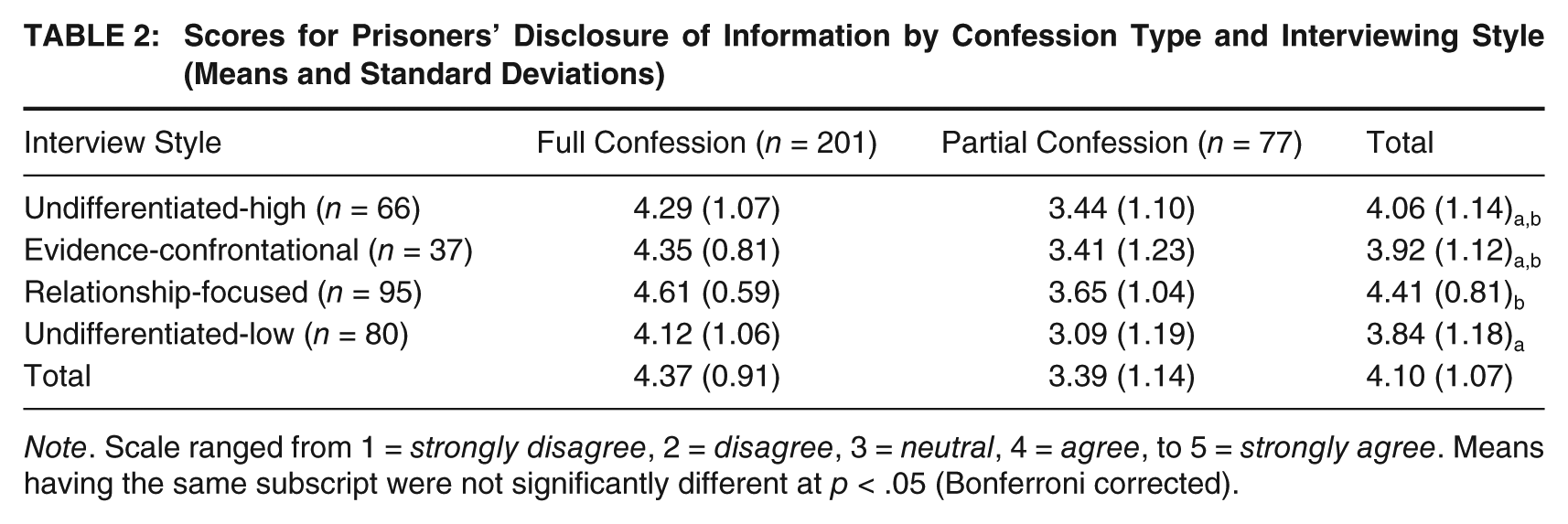
Note. Scale ranged from 1 = strongly disagree, 2 = disagree, 3 = neutral, 4 = agree, to 5 = strongly agree. Means having the same subscript were not significantly different at p < .05 (Bonferroni corrected).
Discussion
This study examined offenders’ opinions about Japanese interviewing styles by administering a self-report questionnaire to adult male prisoners across Japan. The results revealed that the most frequently used techniques (rated as often or always, by more than half of the participants) were “Respecting you as a human being,” “Listening to your life stories, such as personal history,” and “Listening closely to your words.” This result was not consistent with a previous study on Swedish prisoners convicted of murder and sexual offenses that also used a self-administered questionnaire (Holmberg & Christianson, 2002). Holmberg and Christianson reported that few prisoners experienced similar techniques, namely, “Interviewer expressed a positive attitude toward you as a human being” (only 28% of those convicted of murder and 18% of the convicted sex offenders answered very much, that is, 6 and 7 on a 7-point Likert-type scale), and “Interviewer showed a personal interest and tried to create a personal conversation” (only 21% of those convicted of murder and 10% of the convicted sex offenders answered very much; p. 35). Furthermore, the reported Japanese emphasis on positive interviewing techniques, such as listening and building rapport with suspects, is inconsistent with the results of previous studies in the United Kingdom and the United States, which indicated that introducing evidence and challenging suspects were commonly used techniques (Kassin et al., 2007; King & Snook, 2009; Leo, 1996; Pearse & Gudjonsson, 1996; Soukara et al., 2009). In contrast, Kebbell, Hurren, and Mazerolle (2006) conducted semistructured interviews with Australian police officers, observing that officers believed in the importance of building rapport, displaying humanity, and avoiding an aggressive attitude, which is consistent with the present study’s findings.
Further examination of the five factors showed that participants were more likely to have experienced Active Listening, Rapport Building, and Discussion of the Crime than Presentation of Evidence and Confrontation. Kebbell et al. (2010), who also utilized a self-administered questionnaire on prisoners convicted of sexual offenses in Australian correctional centers, showed that most participants experienced the Dominant interview style rather than styles characterized by Strength of Evidence, Ethical Behavior, Humanity, Dominance, Minimization, Maximization, and Cognitive Distortions. This contradicts our finding that most prisoners reported positive interviewing techniques. It also contrasts those reported by Kassin et al. (2007) who surveyed interrogators and identified four factors: “Isolation, Rapport, and Minimization,” “Confrontation,” “Threatening the Suspect,” and “Presentation of Evidence” (Kassin et al., 2007, p. 390), of which confrontational techniques were most commonly used.
A further cluster analysis based on the five factors used in the present study identified four interview styles: Evidence-confrontational, Relationship-focused, Undifferentiated-high, and Undifferentiated-low. In Evidence-confrontational interviews, the prisoners believed that police officers were aggressive and confronted the offenders with the evidence they had obtained. In Relationship-focused interviews, police officers reportedly listened attentively to the offenders’ accounts, tried to build good relationships, and discussed the crime. In the Undifferentiated-high approach, police officers reportedly employed various techniques. They listened closely to the suspects’ accounts, attempted to build good relationships, and discussed the crime while also presenting evidence and confronting suspects. In contrast, in the Undifferentiated-low interviews, police officers were reportedly less likely to employ any of the specific interview techniques examined in this study. As predicted, the results indicated that many prisoners reported experiencing Relationship-focused interviews.
In Wachi et al.’s (2014) study of Japanese police officers, Evidence-focused, Confrontational, Relationship-focused, and Undifferentiated interview styles were identified. When comparing the current study with Wachi et al.’s findings, comparable Relationship-focused and Undifferentiated interviewing styles (Undifferentiated-low approach in the prisoners’ study) were described by the police officers and prisoners. Those who adopted or were exposed to the former approach had high scores for Active Listening, Rapport Building, and Discussion of the Crime factors. Those who adopted or were exposed to the latter approach had low scores on all five factors. The Relationship-focused approach identified in these studies was similar to the humane approach described by Holmberg and Christianson (2002) and Kebbell and colleagues (2008, 2010).
However, the two other interviewing styles differed. In the police officers’ study, high scores for Presentation of Evidence and Confrontation were distinct; those with high scores on the Confrontational factor did not necessarily have high scores on the Presentation of Evidence factor. However, in the prisoners’ study, Presentation of Evidence and Confrontation were not distinct; scores were equally high for those describing the Evidence-confrontational approach. This suggests that prisoners perceived the presentation of evidence as a type of confrontation. Furthermore, the study of prisoners’ perceptions identified the Undifferentiated-high interview style wherein scores on all factors were high. However, this interviewing style was not evident in analyses based on the police officers’ responses.
Confessions and New Information
It is worth noting that as many as 63.5% of the participants had already decided to confess before their interviews began, while only 6.9% had decided to deny police allegations. In addition, 69.6% of the participants eventually made full confessions, whereas only 3.5% completely denied the allegations against them. Despite the fact that all participants had committed serious crimes, a significant percentage intended to confess their crimes beforehand; indeed, they confessed fully. By contrast, Kassin and Gudjonsson (2004), after reviewing the previous literature, argued that the confession rate in England was approximately 60%, and in the United States, about 42% to 55%. The confession rate in this study was quite high, even higher than that reported in the Japanese National Police Agency study in 2011 (National Police Agency, 2011) in which the confession rate for felony offenses was about 65%. Previous studies (e.g., Kassin & Neumann, 1997; Leo, 1996) have shown that cases involving suspect confessions are more likely to yield convictions. Thus, the confession rate in the present study may be comparatively high because all the participants had been convicted. The high confession rate could also be explained by the perceived strength of the evidence against the suspects. Most participants (82.4%) believed that evidence against them existed. Moreover, 68.3% believed that the evidence was strong. This may have led them to confess their crimes.
The police officers’ study (Wachi et al., 2014) showed that Evidence-focused interviewing styles were more likely to be associated with partial confessions, whereas Relationship-focused interviewing styles were more likely to be associated with full confessions when suspects were initially reluctant to confess. The current study of prisoners’ perceptions provided further interesting results: The relationships between interviewing styles and suspects’ confessions depended on the suspects’ previous decisions regarding whether or not to confess.
For those who had decided to confess their crimes before interrogation, interview style was unrelated to the completeness of their confessions. As they had already decided to confess when the interrogation began, they confessed voluntarily during the interrogation, regardless of the type of interrogation. In contrast, interview style was an important factor for participants who had not decided whether to confess beforehand or who had decided to deny the allegations against them. For these participants, those who experienced either the Undifferentiated-high or Relationship-focused interview types were more likely to confess. As the scores on Presentation of Evidence and Confrontation factors were almost the same in the Undifferentiated-high and Evidence-confrontational groups, this suggests the importance of engaging in Active Listening, Rapport Building, and Discussion of the Crime strategies when encouraging suspects to confess. When police officers listened closely to the suspects’ accounts and attempted to build good relationships while talking about the crime, the suspects were more likely to confess regardless of whether the interrogators were confrontational or not. This result partly supports the hypothesis that prisoners who experienced Relationship-focused interviews would be more likely than other prisoners to confess.
As factors facilitating full confessions differed depending on whether or not the suspects had intended to confess prior to interviewing, it is difficult to directly compare these findings with those from studies that did not differentiate between individuals based on their initial intentions. However, the current findings are partly consistent with previous studies demonstrating the effectiveness of the humanitarian approach (Holmberg & Christianson, 2002; Kebbell et al., 2010). Our findings also suggest that the interrogators’ positive interviewing techniques (e.g., listening to suspects’ accounts without interrupting, building a good relationship) were important when eliciting full confessions. Although Soukara et al. (2009) showed that disclosing evidence can facilitate suspects’ shifts from denials to confessions, similar findings were not evident in the current study. However, all of these previous studies showed that dominant and confrontational interviewing were associated with suspects’ denials. The current study also showed that the confrontational type of interviewing was less likely to yield confessions.
Furthermore, suspects in the Relationship-focused group were more likely to volunteer additional information unknown to the police than those in the Undifferentiated-low group. The police officers’ study (Wachi et al., 2014) revealed that suspects who were interviewed using a Relationship-focused approach were more likely to volunteer additional information unknown to the police. These results were based on the police officers’ perceptions, but the current result showed that the prisoners’ perceptions were similar.
The current study showed that, even when presenting evidence to suspects, good relationships with them are necessary if confessions are to be obtained, although previous studies in Western countries (e.g., Soukara et al., 2009) have not demonstrated this. In addition, experimental studies examining the technical use of evidence (e.g., Dando & Bull, 2011; Hartwig et al., 2006) have not shown that good relationships with suspects facilitate lie detection when evidence is strategically presented. As discussed in the previous study by Wachi et al. (2014), cultural factors may help explain this emphasis on relationships in Japan. Japanese individuals view themselves as interdependent, embedded in social relations with others, whereas Western individuals have an independent view of themselves, stressing autonomy and independence (Markus & Kitayama, 1991). As a result, good relationships with others form the basis of social interaction for Japanese individuals, including offenders. Therefore, even when interrogators challenge suspects, the underlying relationships between them are important, whereas in Western cultures, social relationships affect decision-making less when objective evidence is presented.
Strengths and Limitations of the Study
This was the first Japanese study to solicit prisoners’ perspectives on interviewing techniques. Because it is difficult for researchers to gain access to prisoners in Japan, the current findings are uniquely informative regarding offenders’ perspectives. The results underscore the positive effects of police interviewing in solving crimes, obtaining confessions, and eliciting unknown information, whereas most previous research has focused on such negative aspects of interrogation as the risk of false confessions (e.g., Horselenberg, Merckelbach, & Josephs, 2003; Kassin & Kiechel, 1996; Klaver, Lee, & Rose, 2008). As interrogation is essential for solving crimes, especially in Japan, research can play an important role in informing police officers about efficient and humane ways of interrogating suspects.
However, the study had some limitations. First, because this study utilized a self-report questionnaire, the prisoners’ responses may have been biased toward social desirability. Although Kassin et al. (2007) argued that social desirability issues are reduced when data are anonymous and confidential (both of which were stressed to participants in the current study), the bias toward social desirability still exists. In addition, some of the responses may have been inaccurate. For example, some participants may have retrospectively believed that they had decided to confess beforehand because they had confessed fully. It is difficult to examine the accuracy of responses when using this kind of methodology. Furthermore, it has been difficult for researchers to directly approach prisoners in Japan. Instead, in this study, prison officials distributed the questionnaires, which may have influenced the participants’ responses even though it was explained that the participants’ responses would not be read by prison staff and would not lead to detrimental treatment. Moreover, because we used a self-report questionnaire, it was impossible to exclude confounding variables. To examine causal relationships between interviewing styles and confessions, experimental research needs to be conducted.
Second, as Fisher and Perez (2007) have pointed out, long delays after interrogations may lead participants to forget, change, or even distort their earlier perceptions. To avoid memory decay and the influence of prison life, all participants in our study were new prison inmates. However, participants still needed to answer the questionnaire retrospectively. Furthermore, because trials for serious criminal cases are often prolonged, some participants had been interviewed by police several years earlier. This might have made it more difficult for them to remember their interrogations. In addition to memory decay, participants might remember certain interview sessions better than others because memory is selective. For example, prisoners may remember the first and last sessions better than the middle ones, due to primacy and long-term recency effects (Nakajima et al., 1999) and we do not know which interrogation sessions the current participants remembered well. Thus, to supplement this retrospective survey, observational studies are needed.
Third, in Japanese criminal procedures, both police officers and prosecutors interview suspects although the police are more extensively involved in interrogations. While some prisoners could distinguish between police officers’ and prosecutors’ interrogations (e.g., Hayashi, 2001), others may have found this difficult. However, we expect that the prisoners’ reported memories were more likely to be of police interrogations because these are significantly more extensive (Ministry of Justice, 2011).
Fourth, this study examined only male prisoners convicted of serious criminal cases, namely, murder, robbery, arson, rape, forcible indecency, and kidnapping. Therefore, the current findings only apply to these types of cases. Interrogations of serious criminals who were not prosecuted or convicted may have been perceived differently.
Finally, it is worth noting that the context of the current study may have been unique as we examined only those who were both convicted of serious crimes and volunteered to participate. Furthermore, most of them had confessed their crimes to some extent. In addition, the total duration of detention or interrogation was longer than those reported in most prior research on police interviews. Therefore, the interpretation or applicability of the current findings may be limited.
Implications
The present findings could inform training programs designed to encourage police officers to use appropriate interview techniques. In December 2012, the National Police Agency in Japan published a pioneering basic training manual for investigative interviewing, which incorporated psychological findings (Tasaki, 2013), to provide uniform guidelines for the entire Japanese police force. The manual mainly focused on methods of interviewing witnesses and cooperative suspects to obtain as much accurate information as possible from them. Furthermore, in May 2013, the first full-scale national training for police investigative interviewing involved about 10 chief inspectors from across Japan. This 8-day training provided participants with basic psychological knowledge about interrogation as well as practice, through role-playing exercises. Following this, several national training programs have been conducted using this manual.
As the new training courses for Japanese police officers have mainly focused on witnesses and cooperative suspects, this study’s findings can guide the development of appropriate interviewing techniques for interactions with those suspected of committing serious crimes. For example, police officers may be asked to record actual interrogations before receiving advanced training, during which they might learn to employ techniques highlighted in the present research, such as actively listening to suspects’ accounts and building rapport with suspects (in addition to recommended questioning styles such as open questioning). Posttraining interviews could then be examined in terms of suspects’ confession rates and the quantity and quality of information elicited. In addition, the fairness of these interviews could be evaluated by other police officers and/or psychologists, which could further improve the officers’ interrogation skills. Police officers in other countries may also find the present findings—including the emphasis on active listening and rapport building rather than the presentation of evidence—informative and relevant.
Footnotes
Appendix
Mean scores of interviewng techiniques clustered within five factors and percentages who rated them as always or often

| Items | N | Always/Often (%) | M | SD |
|---|---|---|---|---|
| Presentation of evidence | ||||
| Implying that there was evidence of guilt | 285 | 22.8 | 2.30 | 1.39 |
| Confronting you with actual evidence | 285 | 32.9 | 2.72 | 1.41 |
| Showing you photographs of the crime scene and/or victims | 287 | 22.3 | 2.55 | 1.21 |
| Stating differences between your story and a witness’ version | 282 | 14.6 | 2.21 | 1.21 |
| Confrontation | ||||
| Becoming angry at you | 290 | 20.0 | 2.49 | 1.30 |
| Raising his or her voice during the interview | 289 | 15.9 | 2.15 | 1.30 |
| Interrupting your denials and objections | 287 | 21.6 | 2.43 | 1.29 |
| Treating you in a friendly and strict manner | 288 | 38.5 | 3.12 | 1.29 |
| Telling you that the police officer knew you were lying | 286 | 22.3 | 2.32 | 1.43 |
| Rapport building | ||||
| Trying to form a good relationship with you beyond that of a suspect and police officer | 289 | 20.7 | 2.41 | 1.31 |
| Being friendly to you | 291 | 46.4 | 3.32 | 1.25 |
| Respecting you as a human being | 290 | 63.8 | 3.80 | 1.19 |
| Speaking about his or her own (interrogator’s) personal story | 290 | 19.3 | 2.57 | 1.20 |
| Trying to find something the police officer and you had in common | 285 | 13.7 | 2.31 | 1.15 |
| Drawing a line between the police officer and you (Reversed) | 286 | 29.0 | 2.83 | 1.17 |
| Showing the attitude that the police officer believed what you had said | 290 | 37.6 | 3.06 | 1.18 |
| Appealing to your self-interest | 288 | 45.5 | 3.10 | 1.44 |
| Active listening | ||||
| Listening to your life stories, such as personal history | 290 | 53.1 | 3.44 | 1.06 |
| Listening to your stories about your significant others (e.g., parents, spouse, and children) | 289 | 39.1 | 3.20 | 1.11 |
| Listening closely to your words | 290 | 50.0 | 3.40 | 1.13 |
| Listening attentively to your stories, even if they were not directly related to the case | 291 | 35.7 | 3.07 | 1.20 |
| Getting well versed about your history and/or situations beforehand | 287 | 37.6 | 2.99 | 1.19 |
| Talking about your future, for example, making a fresh start | 288 | 26.4 | 2.56 | 1.30 |
| Discussion of the crime | ||||
| Trying to make you think about the meaning of the crime committed | 288 | 32.7 | 2.87 | 1.20 |
| Speaking to your conscience | 286 | 32.9 | 2.94 | 1.22 |
| Speaking about the victim | 285 | 33.3 | 2.94 | 1.23 |
| Emphasizing the serious nature of the crime you had committed | 289 | 49.1 | 3.43 | 1.16 |
Acknowledgements
The authors are grateful to the Supreme Public Prosecutors’ Office, Ministry of Justice, and National Police Agency in Japan for assistance in conducting the study.
This study was conducted as part of the first author’s doctoral dissertation at the University of Cambridge.