



Abstract
Desistance from crime has been associated with numerous social influences. Although researchers have explored different theoretical rationales and underlying mechanisms between external social developments and individual changes in behavior, little focus has been given to the individual versus cumulative influences, and social complexities, of different informal controls influencing reduction in criminal behavior. The current study explores the individual and combined impact of marriage and employment on arrest using 17 years of monthly level data from the National Longitudinal Survey of Youth (1997). The results address isolated and cumulative influences of each social control on arrest and provide insight into the relevance of acknowledging the complexities of social events developing over time.
Introduction
Deviant behavior can have an attenuating effect on social and institutional bonds, which can facilitate future offending through a lack of opportunities to change (Laub & Sampson, 2001). However, later life events, such as marriage, can reduce such behavior by providing chances for growth and personal development (Laub & Sampson, 2003). Modern criminological research has begun to shift focus from explaining why offenders begin committing crimes to why most desist (Laub & Sampson, 1993). Some researchers have argued that desistance is embedded in a developmental context and that reduction in offending is largely explained by changes in physical characteristics that comes with age (Loeber & LeBlanc, 1990), but numerous studies have identified and elaborated on the importance of external social events, such as marriage or employment, and individual changes in offending behavior (Craig & Foster, 2013; Horney, Osgood, & Marshall, 1995; Kerr, Capaldi, Owen, Wiesner, & Pears, 2011; Laub & Sampson, 2001).
Social developments like these not only change offending behavior but also create opportunities for the accumulation of additional pro-social experiences (Kalmijn & Luijkx, 2005). Despite a large and growing body of research aimed at understanding the relationship between life events, or turning points, and criminal offending, limited attention has been given to the complex nature of social events, such as the timing of different events over the life course, and the accumulative effects of experiencing multiple pro-social life events (i.e., marriage plus stable employment) referred to by some as the “respectability package” (Giordano, Cernkovich, & Rudolph, 2002).
The relationship between external social experiences and personal behavioral change can be addressed through a number of mechanisms, but the theoretical concept of informal social controls offers an explanation of change through attachment to others, be it spouses or stable employment (Laub & Sampson, 2001). The current study examines the additional influences of marriage and employment as sources of desistance in greater detail. Past research has explored both of these developments in concert, but most research efforts combine these elements into a singular measurement (Giordano et al., 2002; Piquero, Brame, Mazerolle, & Haapanen, 2002; Sweeten, Piquero, & Steinberg, 2013), thereby missing an opportunity to examine independent versus combined influences on criminal behavior.
Literature Review
Desistance
Desistance from crime has become an influential topic in criminological research, but it is complicated by a number of factors. Desistance may be influenced by a number of different external social experiences, working independently or as cumulative influences of change. Recent studies have begun to examine the complex relationships involved in different social factors, such as family developments or employment opportunities (Bersani & Doherty, 2013; Craig & Foster, 2013; Kerr et al., 2011). It is generally accepted that most offenders stop committing crimes, but the behavioral outcomes that often define desistance reveal a complex phenomenon that often requires the researcher to examine changes over time rather than treating the concept as a stable end state (Horney et al., 1995; Laub & Sampson, 2001).
Recent research efforts have focused on identifying within-individual changes to establish temporal significance (Bersani & Doherty, 2013), and examining changes in behavior over time may provide greater precision in exploring different social influences in different contexts.
Crime appears to decline for all offenders over time (Sampson & Laub, 2003), but differences in individual timeframes and different patterns across specific demographic comparisons indicate the potential significance of external influences shaping internal changes. For example, men are more likely to engage in ongoing offending behavior than women once they enter adulthood (Giordano et al., 2002), but desistance rates for men and women appear to have similar influences (Uggen & Kruttschnitt, 1998), and the impact of different social developments on individual engagement in crime requires further elaboration (Laub & Sampson, 2001).
Social Influences
Desistance from crime can be influenced by a number of personal and social developments, including advancing age, marriage, and employment (Laub & Sampson, 2001). These social influences reduce criminal conduct by creating attachments to others and establishing something for the offender to lose if their behavior remains unchanged (Sampson & Laub, 1993). Informal social ties develop in different forms depending on age and context, but variations in social bonds such as family or stable employment can inhibit criminal behavior among active offenders, and these later life events positively influence desistance (Laub & Sampson, 2003; Sampson & Laub, 1993). Informal social controls also lead to involvement in other socially normative institutions, such as marriage influencing a desire to seek stable employment (Kalmijn & Luijkx, 2005), that can further facilitate a de-escalation in offending behavior. The development of differing social ties in adulthood is also important in facilitating desistance through the establishment of interdependent systems of obligations or restraints on offenders (Laub & Sampson, 1993).
These social experiences provide unique value for desistance research by making it possible to examine changes in role commitment and the acquisition of additional pro-social roles. Social developments often facilitate further change, such as providing information on employment opportunities or instilling a desire to provide for one’s family (Johnson, Honnold, & Threlfall, 2011). However, challenges to studying different social influences involve acknowledging that such experiences affect behavioral change gradually (Laub, Nagin, & Sampson, 1998) and that there may be a cumulative influence of different social developments on desistance from crime (Horney et al., 1995; Laub & Sampson, 2001).
Once offenders start developing informal social controls, their stake in conformity begins to rise (Laub & Sampson, 1993; Piquero et al., 2002). Models that address different social influences typically include multiple items compressed into a singular measure (Giordano et al., 2002; Piquero et al., 2002; Sweeten et al., 2013). This approach undervalues the complexity of social reality, wherein dynamic social influences evolve in varying ways. For example, individuals with unstable career histories, characterized by low occupational status and regular periods of unemployment, are less likely to get married than those who have established stable employment (Kalmijn, 2011). This in turn could hinder desistance from previously established patterns of offending behavior.
Before elaborating on the underlying mechanisms between marriage, employment, and offending, it is important to address the complication of gender. Gender is an important factor to consider, particularly in the context of marriage, as it has been argued that men are more likely to marry pro-social spouses and desist while women are more likely to marry offending spouses and persist (Haynie, Giordano, Manning, & Longmore, 2005; Laub & Sampson, 2003; Simons, Stewart, Gordon, Conger, & Elder, 2002). However, others have elaborated on a distinct pattern of social influences by gender, identifying adult life transitions such as establishing a new family as influencing greater change among women compared with men (Graham & Bowling, 1995). For women, informal social controls can be a significant source of desistance (Craig & Foster, 2013), but different researchers have questioned the impact of marriage (Kreager, Matsueda, & Erosheva, 2010) and employment (Johnson et al., 2011) as sources of change.
Marriage
Marriage has been consistently identified as a source of pro-social change, by increasing personal bonds and investment in normative social environments (Craig, Diamond, & Piquero, 2014; Siennick & Osgood, 2008). This in turn increases the cost of criminal activities, as offenders may lose the social, emotional, and legal connection to an important other (Laub & Sampson, 2003). Empirical support linking marriage and desistance has been clearly established from a number of data sources, including samples of offenders (Horney et al., 1995; Laub & Sampson, 2003) and members of the general population (Warr, 1998). The impact of marriage on altering behavior produces both a short- and long-term effect (Sampson, Laub, & Wimer, 2006). However, the lasting effects may be particularly important, as marriage may influence the development of stable employment (Laub & Sampson, 2001).
The effect is complicated by the subjective nature of marriage itself. It has been suggested that individuals who are likely to marry are not likely to offend, suggesting the relationship is spurious (Hirschi & Gottfredson, 1995). However, this observation has been challenged by findings showing that propensity to marry is not significantly different between offenders and non-offenders (Farrington & West, 1995).
It has also been theorized that the marriage effect is biased by gender, and that it would be more beneficial for men than women (Laub & Sampson, 2003). Although some researchers have found partial support for this distinction (King, Massoglia, & Macmillan, 2007), in general, the marriage effect significantly reduces the likelihood of criminal conduct regardless of gender (Bersani, Laub, & Nieuwbeerta, 2009; Craig & Foster, 2013). Others have argued that parenthood is a greater source of change for female offenders (Kreager et al., 2010), identifying a desire to provide for one’s child as a stronger influence than a possible antisocial partner.
Employment
Employment has also been identified as a positive source of change for offenders (Laub & Sampson, 2003), but the impact of employment on crime reveals significant complications. Some have argued that work is the second most impactful social influence on desistance, after marriage itself (Benda, Harm, & Toombs, 2005). The likelihood of an offender continuing to engage in crime is reduced if the expectation of legal earnings outweighs that of illegal earnings (Pezzin, 1995). Likewise, offending rates are higher among unemployed versus employed individuals (Farrington, Gallagher, Morley, St. Ledger, & West, 1986). The employment effect is not universal, as it has been found to significantly reduce offending among individuals above the age of 27 but not younger (Uggen, 2000), and increases in age reduce likelihood of arrest outside of established social influences (Tripodi, Kim, & Bender, 2010). Prior research has also established that employment can increase offending over a short-term period (Horney et al., 1995).
Although these and other studies have demonstrated an independent effect of employment on crime, there has been relatively little examination of employment and the long-term process of desistance. A study examining parolees in Texas found that employment was associated with a reduction in likelihood of arrest, in general, and a significantly longer period of time between arrests (Tripodi et al., 2010). These results illustrate the need to address different characteristics of desistance and to study employment over broader periods of time.
Employment can facilitate change in criminal behavior (Tripodi et al., 2010), but there may also be an additive effect with other social developments. For example, securing work can increase the likelihood of an individual forming a stable romantic relationship. This development can provide further motivation for an individual to improve his or her career opportunities (Kalmijn & Luijkx, 2005). This pattern has been identified in general sociological research where the odds of entering a long-term romantic relationship are significantly higher for employed versus unemployed individuals (Kalmijn, 2011). Criminological research has recognized the value of addressing both social influences (Giordano et al., 2002; Piquero et al., 2002), but thus far has created singular measures combining them, thereby removing the opportunity to address the complex, potentially cumulative nature of social experiences affecting desistance.
As with the effect of marriage, there may also be a gendered impact of employment on desistance. Among women in the general population, the association between employment and marriage weakens over time (Kalmijn & Luijkx, 2005). However, employment can establish financial security and provide advancements in social status for men, such as an increase in the likelihood of marriage and a reduction in the odds of engagement in crime (Kalmijn & Luijkx, 2005; Sampson et al., 2006). The issue of employment as a source of desistance by gender, however, has not received sufficient attention in criminological research.
Hypotheses
Given existing research examining individual and combined measures of social developments, I hypothesize that both marriage and employment will negatively affect offending, both separately and cumulatively, but that the combination of both will provide a stronger desistance effect.
Method
Sample
This study utilized data from the National Longitudinal Survey of Youth (NLSY97), initiated in 1997 using a sample representative of people living in the United States. The sample consisted of respondents born between 1980 and 1984, who were between the ages of 12 and 16 during the initial survey (Bureau of Labor Statistics, 1997-2014).
The NLSY97 included 8,984 youth in the initial survey. Respondents are interviewed annually. The survey began in 1997, and respondents completed a self-administered survey that collects information on a number of topics, including criminal activities, arrests, and social developments, broken down into monthly measures. The NLSY97 was designed as a general population survey, albeit one that oversampled African American and Hispanic youth, and the majority of respondents have no significant criminal histories. Given the focal interest in studying the accumulation of social controls among offenders, the current study focused on individuals who reported being arrested at least once in their lives.
To isolate the effects of different social influences on desistance from crime, the current study used data from a subset of the original, consisting of individuals who had been arrested at least once by the end of the available study period, specifically the first 6 months of the year 2014 (N = 3,051). Table 1 provides the descriptive details of this subset.
Ever-Arrested Sample

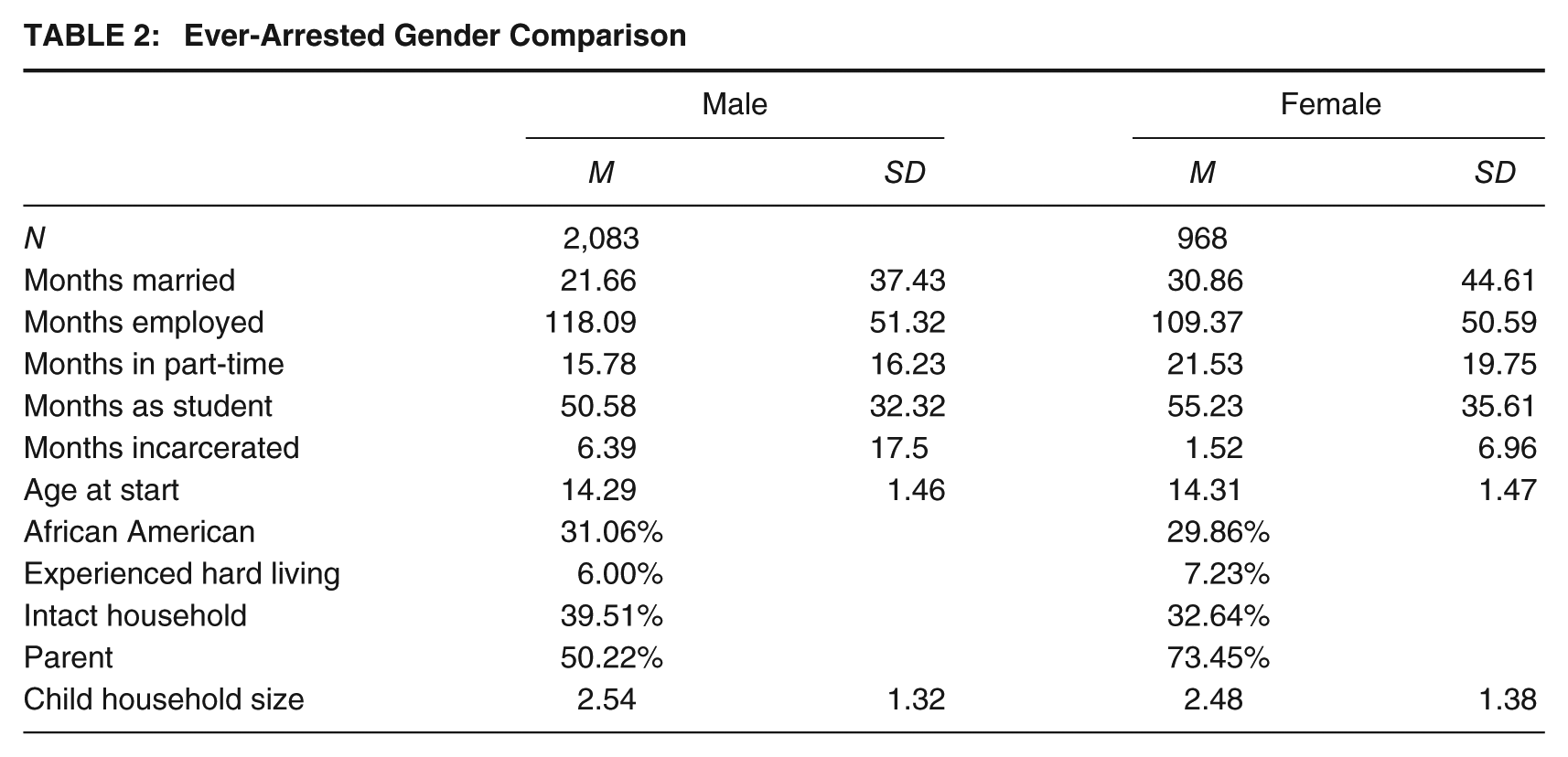
To explore desistance, and different social experiences, by gender, I further divided the sub-sample into male (n = 2,083) and female (n = 968) subsets. Table 2 provides a comparison by gender and indicates that male offenders spent less time in marriage (t = −5.93, p < .001), more time employed (t = 4.39, p < .001), and more time incarcerated (t = 8.35, p < .001) than female offenders. Women in this sub-sample spent more time working in part-time employment (t = 8.49, p < .001), more time in education (t = 3.58, p < .001), and were more likely to experience parenthood, χ2(1) = 146.07, p < .001, than male offenders.
Ever-Arrested Gender Comparison
Variables
Time-Varying Aspects
The dependent variable is a self-reported measure of arrest. During each annual interview, respondents reported on their arrest history over the previous year. If a respondent reported an arrest, they were asked to provide additional details of the event, specifically with regard to timing. Therefore, a month-by-month assessment of arrest was available for all. This measure was dichotomized and dummy coded for each month of the identified study period, producing a binary measure of arrest for 211 months, for each respondent.
The key independent variables are marriage and employment. Like the arrest measure, each respondent reported his or her marital, divorce, and separation status annually and provided information on the timing of these developments to produce monthly measures of each. Although separation and divorce are important aspects to consider in the context of desistance (Bersani & Doherty, 2013), the central purpose of this study is to demonstrate the importance of acquiring social controls; thus, the current focus is on only the monthly marriage measurement. Therefore, any marriage results, including within- and between-person changes, reflect the impact of marriage relative to a previously unmarried state (e.g., single, separated, or divorced) or in comparison between married and unmarried respondents.
Respondents also reported their employment status, including current military service, but the additional details provided on the timing of work allowed for measurements reported by the week instead of the month. Self-reported employment was converted to a monthly measure by dichotomizing and dummy coding each weekly assessment and counting the respondent as employed for the month if he or she reported working for at least 2 weeks during that month. In addition to reporting employment status per week, respondents also revealed the number of hours worked per week. I incorporated an additional complication of employment by utilizing a monthly measure of part-time status, identifying respondents who reported working between 1 and 20 hr per week. I then transformed this weekly measure into a monthly assessment through the same format as that of self-reported employment, specifically counting an individual as a part-time worker if they identified as employed part-time for at least 2 weeks per month. These measures were intended to address the complication of stability of employment as a key feature of change in crime (Farrington et al., 1986).
Age has also been identified as important to the employment effect (Uggen, 2000), and given the inclusion of an adolescent age-range in the early years of the study, I created a separate monthly measure of ongoing education, in either high school or college, to address current student status as comparable with employment status. I also included a monthly measure of current incarceration status as a final measure of control in the employment effect, as anyone currently imprisoned would not be able to secure or maintain employment.
Time-Stable Aspects
Additional variables are included for control purposes or for general comparison between respondents. These time-stable variables included a dummy coded indicator for male respondents and one specifying African American individuals. In 1997, respondents gave a dichotomous response to the question of if they had spent any part of their childhood living through hard times, defined as any time spent living without running water or electricity, or any time spent living in a homeless shelter. Early family experiences, such as parental separation and childhood family size, can also play an influential role in later life outcomes, including offending patterns and pro-social developments (Bersani & Doherty, 2013). Parenthood has been identified as an important element of behavioral change, both in relation to marriage and as an independent social experience (Kerr et al., 2011), and custodial parenthood status was included as a between-individual control measure throughout the study period. In addition, age and age2, identified by self-reported years of age, were included as within-individual measures of control.
Analyses
I used STATA 12 to perform all analyses, as it allows for appropriate multilevel modeling techniques and provides an opportunity to examine goodness-of-fit estimates for the different estimated models. Descriptive statistics addressed the sub-sample and provided a gender specific comparison. A multilevel mixed-effects logistic regression model was utilized to examine the independent and cumulative influences of social controls on arrest. This model format addresses the violation of the assumption of independence between measurements and provides an opportunity to study changing influences within and between respondents.
Raudenbush and Bryk (2002) suggested decomposing time-varying aspects into within- and between-individual comparisons for a more comprehensive method of modeling change over time. To explore within-individual changes in social experiences and arrest, I isolated the individual specific mean of these variable by group-mean centering marriage, employment, part-time status, student status, and incarceration. I also created aggregate measures of these variables to control for individual differences in arrest, marriage, and employment (Raudenbush & Bryk, 2002).
The Level 1 equation, specifying within-individual change, follows this format:

where ln(pit / [1 − pit]) is the natural logarithm of the odds of an arrest for individual i at month t. The equation includes a quadratic function of age (age
it
,
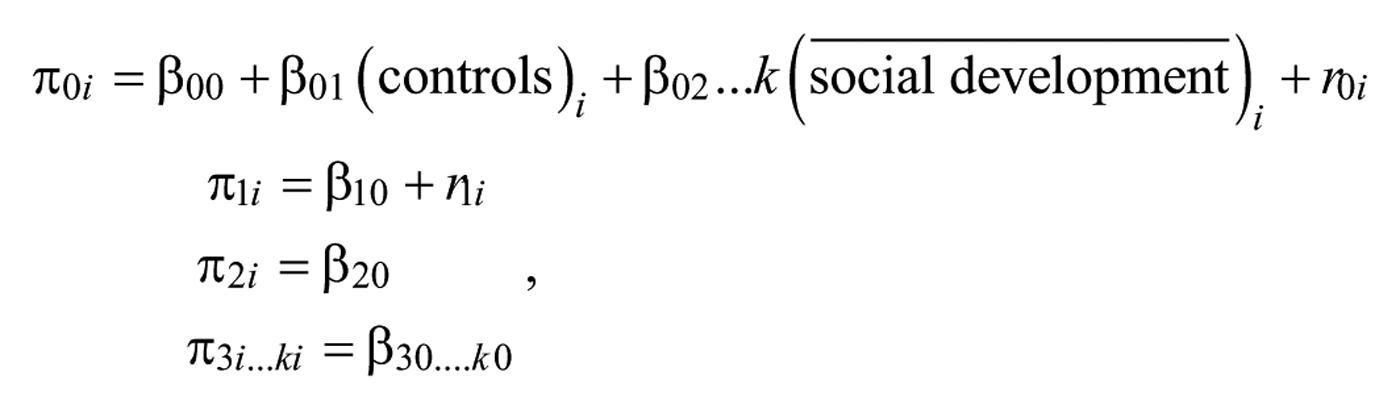
where variations in the log-odds of the arrest outcome can be explained by aggregate measures of employment, marriage, and time-stable controls. This allows for variation in arrest between individuals, and by age, identified by the error terms r0i and r1i, respectively. Age2 and all other time-varying estimates are assumed to have fixed effects.
The first model explores arrest through marriage, while the second addresses arrest through aspects of employment. The final model incorporates both marriage and employment in a full estimation. To examine the importance of gender more directly, this analytical pattern was repeated for male and female sub-samples.
Results
Desistance through Differing Social Influences
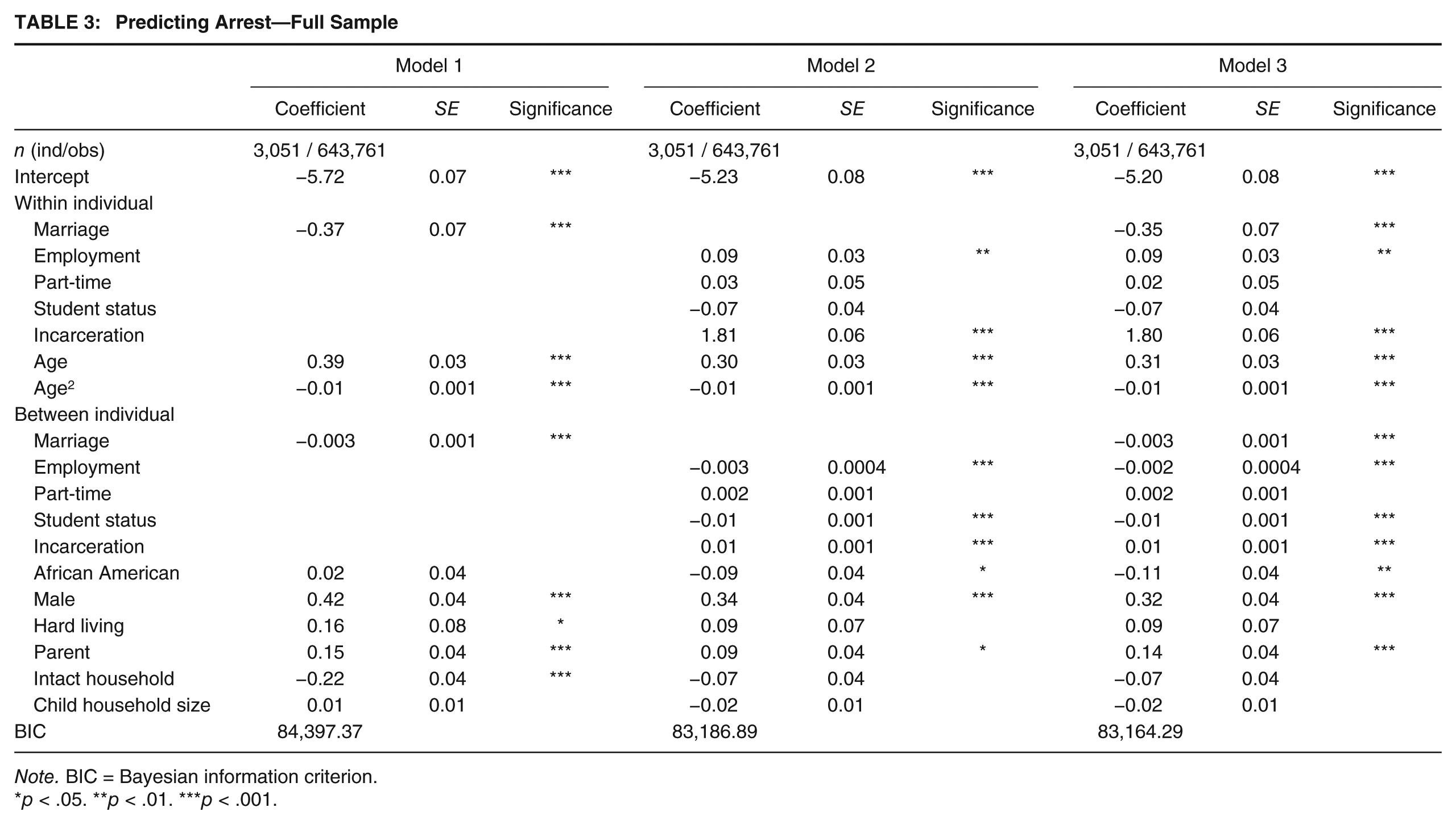
Model 1 of Table 3 addresses marriage independently and reveals a within-individual effect reducing the odds of arrest by 30.93%. In this model, being male, a parent, and experiencing hard living in childhood increase the likelihood of arrest, whereas coming from an intact family in childhood reduces the likelihood. Model 2 examines employment independent of marriage and demonstrates that the odds of arrest increase 1.09 times for those employed, as a within-individual comparison. The within-individual control for incarceration increases the log-odds of arrest. As in Model 1, the control measures for male and parental status significantly increase the odds of arrest, while the control measure for African American respondents reduces the likelihood of arrest. The final model explores both social influences together, and controlling for employment status, reveals that marriage decreases the odds of arrest by 29.53% within-individuals. When incorporating marital status into the model, employment increases the odds of arrest 1.09 times. The impact of control measures in this model follows the pattern identified in Model 2.
Predicting Arrest—Full Sample
Note. BIC = Bayesian information criterion.
p < .05. **p < .01. ***p < .001.
To assess the value of including multiple social influences in predicting criminal behavior, I compared Bayesian information criterion (BIC) results for each model discussed. The results indicate that the complete model, exploring both social influences together, provides a stronger explanation of the log-odds of arrest than either isolated model.
Male Subset
The marriage effect decreases the likelihood of arrest by 25.92% at the within-individual level in Model 1 of Table 4 and indicates that controls for African American respondents, parenthood status, and hard living in childhood increase the likelihood of arrest, while the control for intact childhood house decreases it. Model 2 indicates that employment increases the odds of arrest 1.17 times at the within-individual level. In this model, both within- and between-individual measures of incarceration increase arrest likelihood, as does experiencing hard living, while a between-individual assessment of student status reveals a significant decrease in odds of arrest.
Predicting Arrest—Males Only

Note. BIC = Bayesian information criterion.
p < .05. **p < .01. ***p < .001.
The full model reveals that marriage reduces likelihood of arrest by 23.66% at the within-individual level. Employment, after controlling for marriage, increases the odds of arrest 1.19 times within-individuals. The control measures reveal a pattern consistent to that identified in Model 2. As previously identified in Table 3, the BIC comparison of each isolated model with the combined one reveals that the full model provides a stronger explanation of arrest likelihood.
Female Subset
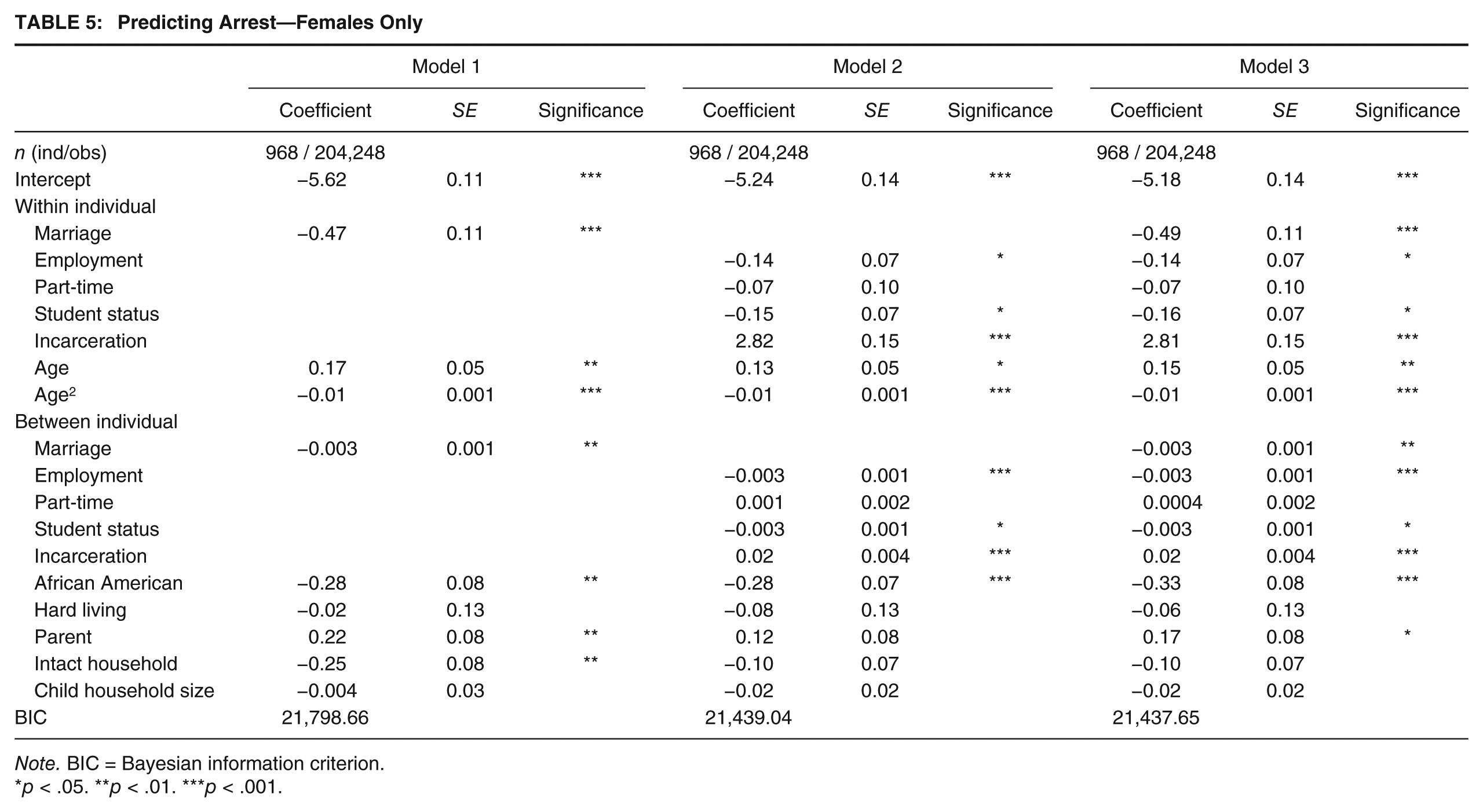
The assessment of female offenders in Table 5 also illustrates different social influences on the likelihood of arrest. Marriage, in the first model, reduces the likelihood of arrest by 37.50% at the within-individual comparison. Parenthood increases arrest likelihood in this context, while African American women, and those who reported an intact childhood home, are less likely to be arrested. Model 2 indicates that employment produces a 13.06% decrease in arrest at the within-individual comparison. In this model, both within- and between-individual controls for incarceration increase arrest, while all controls for student status and race decrease arrest likelihood. The final model shows that marriage decreases arrest likelihood by 38.74% within-individuals. Likewise, employment decreases the within-individual likelihood of arrest by 13.06%. As previously established in the full and male only subset, the control influences repeat the pattern established in Model 2, with the only change being that parenthood increases arrest likelihood in the full model. The BIC assessment for each model reveals a pattern consistent with the initial sample and the male only subset. Specifically, incorporating both marriage and employment provides a fuller explanation of arrest likelihood relative to each influence studied in isolation.
Predicting Arrest—Females Only
Note. BIC = Bayesian information criterion.
p < .05. **p < .01. ***p < .001.
Discussion
Desistance research has identified both marriage and stable employment as important social controls influencing change (Giordano et al., 2002; Piquero et al., 2002), but longitudinal studies have missed the opportunity to address different influences of isolated versus cumulative social experiences affecting changes in behavior, and little research has elaborated on gender-specific differences in social developments and changes in crime (Graham & Bowling, 1995). The current results support and extend the position that informal social controls create lasting change, provide significant support for Hypotheses 1A and 2, and identify an important cumulative effect of the controls explored. Past research has explored a number of social developments that reduce crime, but the significance of accumulated experiences provides additional theoretical relevance to the idea of different informal social controls unfolding over time (Laub & Sampson, 2003; Siennick & Osgood, 2008). The current findings also support qualitative assessments that link marriage and stable employment to personal investments in social controls and the development of things to lose, such as relationships or career status (Giordano et al., 2002). However, the results provide new insight into the value of stable employment as a source of change, specifically supporting Hypothesis 1B for women, but not men.
Previous desistance research argued that social influences for men and women would be similar (Uggen & Kruttschnitt, 1998), but the discrepancy in the employment effect suggests a crucial distinction. Laub and Sampson (2003) argued that employment could reduce offending behavior by the alteration of individual routine activities, the establishment of social controls where an employer can monitor the activities of an employee, and the accumulation of legal income. However, these arguments could not be tested by gendered comparison, and further insights into desistance suggested a lack of distinction by gender when examining the impact of employment (Giordano et al., 2002).
Some research suggested a greater likelihood of employment as a source of desistance for men (Cobbina, Huebner, & Berg, 2012), while other findings identified no significant differences in employment history by gender (Cecil, 2002). The current findings suggest changes in gendered employment trajectories, specifically that female offenders may be more interested in securing stable employment than males. The gender specific difference in the employment effect warrants further elaboration by different age patterns, specifically adolescent, early adulthood, and beyond, as well as qualitative or mixed-methods assessments examining attitudes toward work, income potential, and relationships with supervisors.
The relationship between adult life outcomes and different social influences does not simply reflect the selection issue (Sampson et al., 2006), as transitioning into new roles and developing identities produces turning points away from criminal conduct. Just as a lack of social opportunities can increase likelihood of crime, the development of certain social influences can reduce future offending or spur the desire to attain additional advancements in other pro-social contexts (Kalmijn, 2011). Individual offenders have the ability to change their conduct through altering social connections, suggesting desistance is influenced both by personal motivation and external developments (Giordano, Cernkovich, & Holland, 2003).
The significance of each social influence on arrest indicates that pro-social ties create broad changes among offenders (Wright, Caspi, Moffitt, & Silva, 2001). However, obtaining certain social advancements does not guarantee an individual will maintain and utilize such an opportunity. The sample identified here held more jobs, but spent less time consistently employed, than respondents in the NLSY97 who were never arrested, reiterating employment stability as a particular challenge for individuals with criminal histories (Farrington et al., 1986).
Strengths
This study includes several strengths that improve knowledge of social developments and methodological strategies. It is an initial effort to examine how different social controls influence desistance in isolation and combination, where past research has typically combined marriage and employment in a single package of social change (Sweeten et al., 2013). The current study covered a significant period of time in late adolescence and adulthood. Exploring month-by-month changes in employment, marriage, and arrest over a 17-year period allows for an assessment of changes in individual behavior from the transition into adulthood and a significant amount of time beyond. Previous research has identified the importance of studying within-individual variation in behavior to more accurately capture the concept of desistance (Laub & Sampson, 2001; Sampson & Laub, 1993), and the current study addresses both within- and between-individual differences in social patterns to provide a more comprehensive assessment. The current study examines time-varying influences not readily available in previous data sources (King et al., 2007) and studies differences by gender that past studies could not (Laub & Sampson, 2003).
Weaknesses
The current study has certain limitations, as well. Defining desistance through reports of arrest misses less severe behavior that could still be classified as offending (Laub & Sampson, 2001). Although external social developments are clearly important aspects of desistance research, the perspective of the offender directly relates to changes in behavior and influences whether someone will consider marriage or seek out stable employment (Giordano et al., 2003).
Spousal attitudes and behaviors are also important influences of desistance (van Schellen, Apel, & Nieuwbeerta, 2012) that could not be adequately studied in the current context. Likewise, restrictions on employment capability, such as physical disability, could not be addressed in the current study.
Policy Considerations
Building effective policy approaches around the marriage effect is particularly difficult, given the selection concerns and the subjective value of marriage to the individual offender. However, marriage has been consistently identified as a positive source of change, specifically when predicting recidivism (Benda, Toombs, & Peacock, 2003). Providing family reconciliation and counseling services, to reconnect individuals with spouses and children, could help reduce risk of future offending.
Providing financial and logistical support for job training would be an easier task than promoting marriage, but would likely demonstrate inconsistent support, given the findings established here. Workforce development programs, educational training opportunities, and job fair connections to hiring agencies could help reduce individual offending likelihood for all offenders, but might be more beneficial for female offenders. Individual criminal histories have a lasting effect that reduces future chances for employment, including military service (Bouffard, 2005), which facilitates future risk by limiting legitimate advancements (Benda et al., 2003). Acknowledging the importance of multiple social experiences producing changes in behavior creates new avenues to identify those most capable of sustaining long-term desistance.
Future Research
There are several additional points to consider for future research. Specifically, future studies should address additional characteristics of work, such as subjective valuation of current job or income relative to perceived cost of living. This is particularly relevant, given the differences in employment effect established along gender lines. Future work should also address the important distinction of marriage versus cohabitation in further detail (Forrest, 2014). This point is particularly important as cohabitation with a partner does not always produce the same desistance effect as marriage (Horney et al., 1995). Future research exploring the connection between external social developments and internal change in perspective should also attempt to study the linkage between aggregate level changes, such as economic recessions, and influences on individual desistance, such as reduced opportunities for stable employment or altered perceptions of the quality of available jobs (Laub & Sampson, 2001).
Race plays an influential role in the likelihood of arrest, marriage, and employment. Sociological research has established that African Americans may be less likely to marry than Whites, in general (Bulanda & Brown, 2007; South, 1993), and this trend has some impact on desistance research (Bersani & DiPietro, 2014). Prior research has also established that marriage is less prevalent in neighborhoods with significant proportions of African American residents (Barr & Simons, 2012). The differences in arrest likelihood by racial control measures within the gender-specific subsets suggest that future efforts should explore differences in social developments and criminal opportunities by both race and gender more explicitly.
Future research should also address the complexity of different definitions of desistance, such as reduction in frequency, severity, or diversity of behavior, as well as outright termination (Laub & Sampson, 2001). The current study utilized a monthly dichotomous measurement of arrest, but the complex nature of social experiences influencing change could be elaborated upon by utilizing count-based modeling techniques. Although some research has explored different social influences affecting desistance by gender differences, limited timeframes used to establish desistance create missed opportunities to explore the complexities of change over longer periods of time (Graham & Bowling, 1995).
Finally, additional research should incorporate additional time-varying social influences beyond marriage and employment, such as parenthood. Parenthood has been identified as a source of positive behavioral change by increasing pressure to seek employment or legally stabilize romantic relationships to provide for offspring (Kerr et al., 2011). Parenthood may also be a more meaningful force for desistance than marriage for women (Doherty & Ensminger, 2013; Kreager et al., 2010). Although the current findings address parenthood as a between-subject control measure, the available data did not allow for a time-varying estimation of the impact of parenthood, or the possible significance of custodial versus non-custodial status.
Conclusion
Salient social events in adulthood, such as marriage and employment, can significantly influence changes in offending behavior. Adult social ties are important because they establish interdependent systems of obligation or restraint, thus facilitating social controls that reduce the likelihood of future criminal behavior (Laub & Sampson, 1993). An increase in the number and type of social ties produces a stronger influence on desistance. Developments in self-identity and social role create changes in behavior, but the subjective value of these roles remains an important point of consideration. Studying the changing impact of individual versus cumulative social influences provides an additional examination of the complex interactions between external developments and internal changes in crime.
Footnotes
Acknowledgements
I would like to thank Chester Britt and Bianca Bersani for their helpful comments on early versions of the manuscript. I would also like to thank the three reviewers for their time and insights into the work.