



Abstract
Career stage theory suggested that workers progress through career stages, each marked by unique work attitudes. Little evidence exists, however, about the influence career stages have on the work activities of criminal justice agents. Using a sample of 401 police officers from 23 individual police departments, the present study examined the influence of employee career stage on three measures of work productivity, and the constructs of expectancy motivation theory. The results revealed curvilinear declines in productivity with progression through the career stages. The predictive values of opportunity, ability, and instrumentality on work activities varied with career stage and type of work output. Only performance-reward expectancy retained predictive value across all career stages and outputs. The findings emphasize the importance of intrinsic and informal extrinsic rewards for the management of experienced criminal justice agents.
The management and control of criminal justice agent work behaviors is an important issue. Correctional officers, police officers, probation officers, assistant prosecutors, and lower court judges are the ones who dispense justice to individuals in society and implement criminal justice policies on a daily basis (Lipsky, 1980). Law enforcement officers wield great power through their discretionary decisions, decisions that can change, or even end, an individual’s life. Effective supervisory oversight and control of officer behaviors in the field are paramount to ensuring fair and efficient policing. It is extremely important, therefore, that we understand how best to shape and modify the work outputs of criminal justice agents. Recent years have seen a growth in the body of psychological literature regarding organizational influences on criminal justice agent work behaviors (see, for example, Griffin, Hogan, & Lambert, 2014; Johnson, 2011; Johnson & Dai, 2016; Lambert, Altheimer, & Hogan, 2010; Lambert & Paoline, 2012), but there is still ample room for additional growth. One such area needing further exploration involves the influence of criminal justice agent career stages.
Career stage theory (Super, 1957) suggested that employees progress through various stages during a career, each marked by work attitudes and behaviors unique to each stage. There is empirical evidence of a relationship between career stage and employee work attitudes, such as job satisfaction, organizational commitment, career commitment, work ethic, and turnover intent (Adler & Aranya, 1984; Griffin et al., 2014; Kopelman, 1977; Morrow & McElroy, 1987; Pogson, Cober, Doverspike, & Rogers, 2003). There is less evidence of a relationship between career stage and actual work behaviors, especially within a criminal justice setting.
This is unfortunate for several reasons. First, the criminal justice agent’s actual behavior is as important as the agent’s attitude. What a government employee does, and how she does it, is as important as how she feels about it. Second, the motivation and management of criminal justice agents’ work is of paramount interest to the study of criminal justice (Lipsky, 1980; Wilson, 1968). Managing criminal justice employees is difficult due to civil service regulations that limit the use of external incentives (such as promotions and raises), and the vague nature of the products government agencies deliver (such as “public safety” or “justice”). Any knowledge that can assist with managing criminal justice agent work behaviors would prove useful to practice. Third, as the workforce in the world is aging, with employees living longer and deferring retirement (Feldman, 2007), how career stage influences work and motivation is growing in importance.
The present study, therefore, examined a sample of police officers from multiple municipal police departments across two states. First, it explored how career stage influenced enforcement activities for three specific categories of offenses. Second, it used Vroom’s (1964) expectancy motivation theory as a framework to examine whether career stage influenced the strength of its theoretical constructs. This study continued to extend the new criminal justice literature on the influence of criminal justice agent career stages. It expanded the general literature on employee career stages by adding new work output measures to the small number of outcomes variables already examined. Finally, it began a new line of research on expectancy motivation theory by introducing the effects of employee career stage into the theory.
Career Stage Research
For more than a half century, the influence of career stages on employee attitudes and behaviors have been examined within organizational research. The idea that employees progress through various stages, generally delineated by length of tenure, originated with Super (1957). Career stages are conceptualized as distinct periods of psychological and behavioral exploration, adaptation, and stabilization in one’s employment (Super, 1980). According to Super’s (1957) theory of career development, employees experience four stages during the development of their careers, often conceptualized in 5-year increments of work experience. First is the exploration stage in which neophyte employees are concerned with clarifying their career interests and aptitudes in constructing their career. Next is the establishment stage, in which employees focus on strengthening their career by refining their basic skills. During the third stage, the maintenance stage, employees strive to hold onto career successes (reputation, position, etc.) they have established, and may seek advancement. The final stage, disengagement, involves dissipation of an individual’s energy for, and interest in, their occupational area (Savickas, 2002; Smart, 1998; Super, 1957).
While Super (1957) defined each of these career stages as psychological stages with specific career attitudes, in practice, the research has generally used length of tenure to delineate each career stage (Aryee, Chay, & Chew, 1994; Cohen, 1991; Conway, 2004; Griffin et al., 2014; Morrow & McElroy, 1987; Ornstein & Isabella, 1990). These studies have conceptualized career stages as linear developments over the course of time. Despite the fact these career stages have not been operationalized exactly as Super had proposed, this research has still revealed differences across career stages for employee work attitudes and behaviors (Allen & Meyer, 1993; Pogson et al., 2003; Smart, 1998).
The prior empirical literature regarding employee career stage has emphasized its effects on employee attitudes, such as organizational commitment, career commitment, job satisfaction, and work ethic. This research suggested that organizational commitment and career commitment tend to increase as employees progress through the career stages (Aryee et al., 1994; Cohen, 1991; Wright & Bonett, 2002), but job satisfaction and work ethic tend to decline (Adler & Aranya, 1984; Morrow & McElroy, 1987; Pogson et al., 2003). The existing empirical literature is limited, however, regarding the effects of career stage on actual employee work behaviors as only a few such studies exist.
Adler and Aranya (1984), surveying 764 accountants in the United States, found that as they progressed through their career stages, they also shifted from an emphasis on higher order needs (such as interesting work), to an emphasis on security needs (such as financial compensation). Employee turnover and absenteeism have also been examined with the results indicating turnover decreases, but absenteeism increases across career stages (Aryee et al., 1994; Cohen, 1991; Wright & Bonett, 2002). The performance of salespersons have also been explored with regard to career stage, revealing that sales performance rises during the first career stage, levels off during the second stage, then declines across the two remaining career stages (Ornstein, Cron, & Slocum, 1989; Slocum & Cron, 1985).
Criminal Justice Agent Career Stages
Among correctional setting research studies, correctional staff length of tenure has been explored for a relationship to job satisfaction, organizational commitment, job burnout, attitudes toward rehabilitation, and use of force (Griffin, 2002; Griffin et al., 2014; Lambert et al., 2010; Lambert, Hogan, & Griffin, 2008; Lambert & Paoline, 2012; Minor, Wells, Angel, & Matz, 2011). The results have only revealed weak and inconsistent relationships to correctional staff length of tenure. One study, however, examined the influence of career stages on correctional staff. Griffin and associates (2014) recently examined the influence of career stage on the turnover intent of state correctional staff in a prison system in the Southwestern United States. Their findings revealed that turnover intent was lowest during the first career stage and increased across each successive stage. They also discovered the effects work environment variables had on predicting turnover intent varied across each career stage, indicating correctional staff may need to be managed differently at different points in their careers. This recent finding suggests the need for further career stage exploration within a criminal justice agency setting.
Regarding law enforcement officers, early qualitative research by Van Maanen (1973) and Bayley and Bittner (1984) suggested that experience was extremely important to the development of officer attitudes and behaviors. They suggested that experience on the job constituted the learning of the goals, tactics, and norms of the police working culture. Barker (1999), after 18 years of ethnographic research within the Los Angeles Police Department, suggested the existence of specific career stages for officers on that department. These career stages were roughly divided into 5-year increments and were characterized by an evolution in work attitudes and behaviors. As officers progressed through these career stages, she suggested, their arrest productivity declined and they began to view their work instrumentally, focusing more on pay and pension than self-actualization needs (Barker, 1999).
Reviews of the empirical literature on the correlates of police behavior (Riksheim & Chermak, 1993; Sherman, 1980; Skogan & Frydl, 2004) have consistently found officer tenure negatively correlated with many officer work activities. For example, Brandl, Stroshine, and Frank (2001) found that officer tenure was negatively associated with arrest productivity and use of force complaints. Brown (2005) examined arrest decisions in police–citizen encounters and found higher levels of tenure corresponded with a lower likelihood of arrest after controlling for situational factors such as seriousness of offense and degree of evidence. This same tenure–arrest relationship was also found by Mastrofski, Snipes, Parks, and Maxwell (2000) when examining citizen requests of officers to arrest someone. Johnson (2006) found tenure negatively associated with both traffic citation and drunken driver arrest productivity.
Officer tenure has been found negatively correlated with filing crime reports, making arrests, and using force. McElroy and Morrow (1999) examined the influence of officer career stage on officers’ organizational commitment, intention to stay in the profession, job involvement, and work ethic. Surveying a sample of 164 police officers, they divided the sample into three career stages and found organizational commitment and intention to stay in the profession increased across the three career stages. Career stage had no influence, however, on job involvement and work ethic.
LaFrance and Day (2013) used years of experience, rather than specific career stages, to examine police officer attitudes toward departmental rules and procedures. Using cross-sectional data, this examination revealed a curvilinear relationship between tenure and attitudes as officers began their careers perceiving department rules and procedures as very important, but this attitude quickly declined with experience. Yet, in about their 10th year of experience, officers began placing more importance on rules and procedures again, a trend that increased for the rest of their careers.
A dearth of research exists, however, in the scientific knowledge regarding the influence of career stage on police officer productivity. The present study sought to explore this aspect. First, it examined the influence of career stage on three work productivity measures. Second, it examined whether the elements of expectancy motivation theory (Vroom, 1964) explained employee productivity similarly across career stages.
Expectancy Motivation
As the present study sought to test the influence of career stages on the factors that influence police officer work productivity, decisions needed to be made about which influences to examine. Rather than select these work output influences randomly or on a hunch, it was decided to base the selection of these influences on a well-established framework. The literature within criminal justice is often accused of lacking a theoretical basis (Bernard & Engel, 2001; Maguire & Duffee, 2007). Therefore, as we examined the influence of career stage on work motivations, we elected to use a theoretical framework from a well-established work motivation theory that was already well tested within police agency contexts (Dejong, Mastrofski, & Parks, 2001; Johnson, 2006, 2009b, 2010b; Mastrofski, Ritti, & Snipes, 1994). Expectancy motivation theory is a cognitive theory of employee motivation based on workers’ perceptions of the likelihood of obtaining desired outcomes contingent on performance (Mitchell, 1982; Porter & Lawler, 1968; Vroom, 1964). Expectancy theory consists of theoretical constructs that mediate perceptions of the value of increased performance: effort-performance expectancy, instrumentality of performance, performance-reward expectancy, and reward-cost balance (Porter & Lawler, 1968; Vroom, 1964).
The theoretical construct “effort-performance expectancy” suggests that employees must have the competence to perform at a desired level. In other words, workers must perceive that they have both the capability and opportunity to perform the assigned task. “Instrumentality of performance” refers to the behaviors desired by management being perceived by employees as leading to desired outcomes. There are many potential activities to occupy employees, but only those activities the organization communicates will be perceived as instrumental to the employee. “Performance-reward expectancy” proposes that rewards must be linked to performance, and employees need to either experience these rewards themselves or vicariously by observation of others’ rewards. Finally, “reward-cost balance” is whether the outcome is worth the effort and other costs that might be incurred. In other words, is the reward worth the effort (Porter & Lawler, 1968; Vroom, 1964)?
Expectancy motivation theory has been tested with many outcome measures in a variety of work settings (see Mitchell, 1982; Van Eerde & Thierry, 1996). It has recently seen use in explaining police officer variation in work outputs in terms of traffic citations (Johnson, 2006), arrests (Johnson, 2010b; Mastrofski et al., 1994), community problem solving (Dejong et al., 2001), and security checks of businesses (Johnson, 2009b). While the theory can serve as a useful framework for examining the influence of career stage on police officer work outputs, it is important to note that the present study was not a direct test of expectancy theory. It was simply an application of the framework to organize the analysis of career stage within the available data.
Hypotheses
Based on the prior literature discussed above, specific hypotheses were developed. First, regarding productivity, the prior literature suggested police officer tenure was negatively associated with arrests (Riksheim & Chermak, 1993; Sherman, 1980; Skogan & Frydl, 2004). It was thus hypothesized as follows:
Second, Super (1957, 1980) suggested that work skill increases throughout the first two stages of one’s career, and Barker (1999) suggested the same specifically for police patrol officers, as most work skills are mastered within the first or second career stage. Workers who remain in the organization’s entry-level position (such as that of a patrol officer) do not continue to advance in skill after mastering their job tasks in the first or second career stage. It was hypothesized, therefore, as follows:
Finally, as Adler and Aranya (1984) and Barker (1999) suggested that tenure was associated with an increased emphasis on financial and security needs, it was hypothesized as follows:
Method
Data
The present study used data collected through a 2004 management issues survey of 401 police officers representing 23 municipal police departments from two states. The survey tapped aspects of expectancy motivation theory, which were used to create proxy measures of constructs from the theory. Each officer’s responses were then compared with specific, measurable performance outputs for 2003, namely, each officer’s number of traffic citations issued, arrests made for drunken driving (driving under the influence [DUI]), and arrests for drug offenses. These comparisons were made by the career stage of the respondents to examine whether productivity and associations with each of the expectancy theory theoretical constructs varied by career stage.
Sample
Cooperation was obtained from a convenience sample of 23 municipal (town, village, and township) police departments: 19 from a Midwestern state and four from a Southern state. The agencies that participated ranged in size from 10 officers to 119 officers, and policed communities varying in population from 3,500 to 64,300 residents. Admittedly, this was not a random sample of agencies, and it is unknown how representative the agencies or officers surveyed were of the general U.S. population of police officers. Nevertheless, it comprised mostly smaller suburban agencies, and 90% of the municipal law enforcement agencies in the United States serve populations of less than 100,000 (Reaves, 2011). Within each police department, only officers assigned to general uniformed patrol duties were surveyed. All officers were the rank of patrol officer.
To conduct the survey, a memo was distributed by the police chief of each agency notifying officers about the upcoming survey and that participation was voluntary. Next, one of the researchers attended the roll call briefing sessions of every shift of each police agency involved in the study. This researcher identified himself as a former police officer and asked the officers present for their voluntary participation in the survey. The researcher explained the purpose of the study and discussed how the participants’ individual responses would be protected from identification. The researcher distributed the survey instruments and completed survey instruments were returned directly to the researcher in the roll call briefing room. At no time did agency personnel (other than the individual respondent) see the responses on a completed questionnaire.
The response rates varied by department and ranged from 54% to 90% of the officers assigned to the patrol division of each agency. Across the agencies, 453 surveys were distributed and 401 useable surveys were returned, for a mean response rate for the entire sample of 88.5%. It was assumed that this high response rate was the result the combined effect of several elements. These elements were the endorsement memo from the chief, the researcher being identified as a former police officer, the opportunity for the researcher to explain and answer questions about the study, the survey instruments being returned directly to the researcher, and the measures taken to protect the confidentiality of both the officers and their agencies. The respondents were assured of both their own anonymity and the anonymity of their agency. Further identity protection was achieved by collecting data on age and experience in bracketed time spans, and not measuring sex or race at all. Roll calls were attended on all shifts and on multiple days to catch officers who had been on days off on previous visits.
In all, 401 usable surveys were returned. Fifty-four percent of the respondents were under 36 years of age, and 55% had less than 10 years of experience as a police officer. Thirty-two percent primarily worked the day shift during 2003, 38% worked the evening shift, and 30% worked the midnight shift.
The survey instrument contained mostly Likert-type scale questions asking the respondents their perceptions about a number of aspects related to the constructs of expectancy motivation theory. These questions were specifically related to three, quantifiable types of work outputs: traffic citations, DUI arrests, and drug arrests. The questions examined the respondents’ perceptions of their work environment related to opportunity, ability, instrumentality, and performance-reward expectancy, specific to each of the three work outputs being measured. Official data on each officer’s arrest activity, and the arrest activity of each officer’s shift supervisor, were also obtained.
Measures
The endogenous variables were three work outputs recorded for each respondent for 2003: traffic citations, DUI arrests, and drug offense arrests. It is hard to define quantifiable police work outputs (Lipsky, 1980; Wilson, 1968). Citations and arrests were selected as work outputs for three reasons. The first was availability. Second, they were easily quantifiable. Third, all three were likely to result from officers’ proactive efforts. While arrests for offenses such as thefts or assaults usually result from dispatched calls from a citizen, citations, DUI arrests, and drug arrests result most often from proactive stops or investigations. Thus, these work outputs are good measures of employee work effort. Fourth, proactive arrest statistics remain the most common metric by which police officer and police agency performance is measured (Koehle, Six, & Hanrahan, 2010; Lilley & Hinduja, 2006). Admittedly, these output measures were not ideal, nor did they capture the quality of the arrests made, but only the quantity. Nevertheless, they served as an effective measure of work output based on employee effort.
As the respondents came from 23 different communities, each with their own traffic, crime, and community characteristics, the effects of these characteristics needed to be controlled. For example, one community may be a small village with mostly residential streets, while another may have a major highway. Officers working on the former police department may encounter far fewer traffic and DUI violations than on the latter. The officers’ work outputs needed to be measured in comparison with their peers on the same department, rather than in comparison with officers across departments. To do this, each officer’s raw number of citations and arrests was standardized by converting it to a z score by police department.
Four independent variables were then crafted for each type of work output. Each exogenous variable measured a different construct of expectancy theory. These constructs were opportunity, ability, instrumentality (expectation), and performance-reward expectancy (rewards).
Opportunity
Opportunity is described as a combination of circumstances favorable to the achievement of a work output (Porter & Lawler, 1968; Vroom, 1964). In previous work with expectancy theory and police behavior (Johnson, 2006, 2010b), opportunity was operationalized with three items: shift, available time in the shift, and sufficient equipment to perform a task. First, enforcement opportunities may vary by time of day, especially with regard to DUI enforcement as most DUI offenses occur during hours of darkness (Newstead, Cameron, & Leggett, 2001). Respondents were asked what shift they primarily worked in 2003, and the evening shift and midnight shift responses were combined to produce a dichotomous measure of nighttime shift.
Second, the respondents were asked whether they usually had enough time to engage in enforcement in each of the three specific output areas (one question for each output). For example, one question stated, “I usually have enough time to engage in proactive traffic enforcement during my shift.” The officers’ response choices ranged from strongly disagree to strongly agree on a 4-point scale. Third, the respondents were asked whether they had enough equipment to engage in enforcement in each of the three specific output areas, with responses again ranging from strongly disagree to strongly agree on a 4-point scale. 1
The responses to these three measures were standardized and summed to create one opportunity index for traffic enforcement, one for DUI enforcement, and one for drug enforcement. Cronbach’s alpha reliability scores were calculated for each of these three opportunity indices to ensure content validity. The traffic enforcement opportunity alpha score was .523, the DUI opportunity score was .472, and the drug enforcement alpha score was .473, suggesting moderate validity.
Ability
Ability is having the skill, expertise, or talent necessary to perform a task (Porter & Lawler, 1968; Vroom, 1964). Modeling Johnson (2006, 2009b, 2010b) and Dejong and associates (2001), ability was operationalized by education and training. Education was measured by whether or not the respondents held a baccalaureate degree. Training was measured as the number of hours of formal training the respondent had received in each specific enforcement area during his or her career. The respondents were asked to indicate how many hours of training they had received in traffic enforcement, DUI enforcement, and drug interdiction. While it is reasonable to conceive that both police training and formal education would contribute to an officer’s ability to perform complex tasks in law enforcement, it is not reasonable to assume that these two measures are correlated with one another. (In fact, Cronbach’s alpha scores for each “ability” scale were insignificant.) Nevertheless, while not correlated with one another, they both are assumed to improve ability (Dejong et al., 2001; Johnson, 2006, 2009b, 2010b) and therefore were joined together in additive scales. The education and training responses were standardized and summed to create ability indexes for traffic enforcement, DUI enforcement, and drug enforcement.
Instrumentality
Instrumentality reflects what the employer has communicated will lead to rewards (Porter & Lawler, 1968; Vroom, 1964). In other words, it is what the employees think are the production priorities of the employer. Again modeling Dejong and associates (2001) and Johnson (2006, 2009b, 2010b), this construct was operationalized by combining three measures: immediate supervisor priority, chief executive priority, and immediate supervisor productivity. Respondents were asked whether each enforcement area was a priority for their immediate supervisor. For example, one question stated, “DUI enforcement is a top priority for my immediate supervisor.” The response choices ranged from strongly disagree to strongly agree on a 4-point scale. The same set of three questions was asked about the priorities of the chief executive, such as “Drug enforcement is a top priority for my police chief.” Assuming that some supervisors lead by example more than by verbal direction (Johnson, 2015), we also measured the number of traffic citations, DUI arrests, and drug offense arrests each respondent’s immediate supervisor made during 2003.
Cronbach’s alpha reliability scores were calculated for each of these three instrumentality indices to ensure content validity. The traffic enforcement instrumentality alpha score was .739, the DUI opportunity score was .744, and the drug enforcement alpha score was .700, suggesting strong internal validity. Using these measures, three indexes of instrumentality were created, one for each performance output, by standardizing and summing the measures.
Performance-Reward Expectancy
Performance-reward expectancy, the workers’ belief that a linkage exists between rewards and work outputs (Porter & Lawler, 1968; Vroom, 1964), was measured as the perception that each specific work output was rewarded by the organization or brought intrinsic personal rewards. Johnson (2006, 2009b, 2010b) operationalized this construct by asking respondents whether they felt specific work tasks were rewarded by their organization. Likewise, in the present study, the officers responded to survey statements about agency rewards for each specific work output, such as “On my department, officers are recognized and rewarded for making drug arrests.” The officers also responded to statements about their own intrinsic orientation toward each work output, such as “I personally believe that DUI enforcement should be a high priority.” The responses to the statements ranged from strongly disagree to strongly agree on a 4-point scale.
For each of the three work outputs, the two items were standardized and summed to create an index of performance-reward expectancy. The Cronbach’s alpha value for the traffic enforcement performance-reward expectancy scale was .431, the DUI scale alpha was .520, and the drug enforcement scale alpha was .713, revealing moderate to high internal validity. Table 1 reveals the descriptive statistics for all of the variables used in this study.
Variable Descriptive Statistics
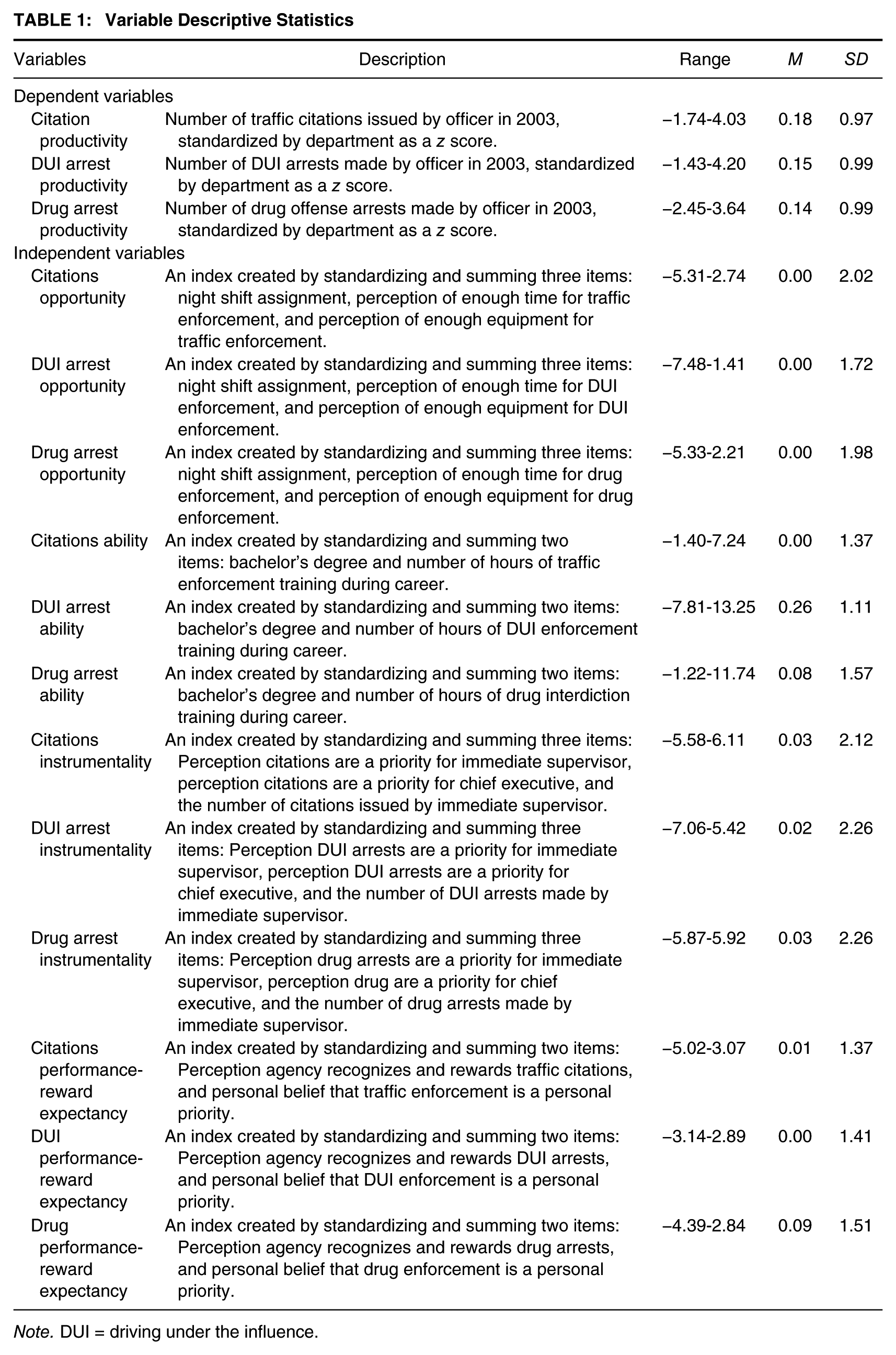
Note. DUI = driving under the influence.
Procedure
The prior empirical literature utilizing Super’s (1957) four career stages have used tenure to differentiate each career stage, usually in 5-year increments (Allen & Meyer, 1993; Morrow & McElroy, 1987; Pogson et al., 2003). Barker’s (1999) ethnographic work on police officer career stages also suggested four stages, each spanning roughly 5 years. Using four 5-year stages was also appropriate as most public employees operate under a 20-year minimum retirement system (Grant & Omdahl, 1993). The present study, therefore, divided the sample into four career stages in a similar manner.
The first stage, containing 131 cases, consisted of all officers with 0 to 5 years of employment. The second stage, containing 90 cases, included the officers with 6 through 10 years of experience. The third stage, consisting of 78 cases, contained officers with 11 through 15 years of experience. The final stage had 102 cases and involved all officers with more than 15 years of experience.
Mean work outputs for each of the three outputs were examined by career stage group to determine whether statistically significant differences were found between career stages. Next, multiple regression models were estimated for each specific work output, by career stage group, using the constructs of expectancy as independent variables, to determine whether the theory constructs varied in influence across career stages for police patrol officers. Out of concerns about the sufficiency of the sample sizes for each career stage (ranging from 78 to 131 cases), an a priori statistical power analysis was conducted to determine the minimum sample size needed for each regression analysis. For multiple regression models with only four predictor variables, a minimum significance level of <.05, and an anticipated effect size of .20, the minimum sample size needed was 75 cases. As the lowest subsample size consisted of 78 cases (the third career stage), we were within acceptable bounds for using multiple regression analysis.
Results
The first step in the analysis process was to examine whether work productivity changed across career stages. Table 2 reveals the mean values, by career stage, for each of the three work outputs examined. Recall that these dependent variables are z scores standardized by police department, not raw numbers of arrests or citations. They indicate the number of standard deviations away from each police department’s mean arrests value. As Table 2 reveals, work productivity in all three categories started high in the first career stage, increased during the second stage, but declined across the last two career stages. The differences between these mean values were statistically significant, as indicated by an F test across the four career stages, and in individual t tests conducted between each pair of means (not shown in the table). While the previous literature suggested proactive enforcement declines with experience among police officers (Riksheim & Chermak, 1993; Sherman, 1980; Skogan & Frydl, 2004), the present results suggested the relationship is curvilinear, increasing across the first two career stages and then declining over the last two stages.
Mean Work Output Comparisons by Career Stage
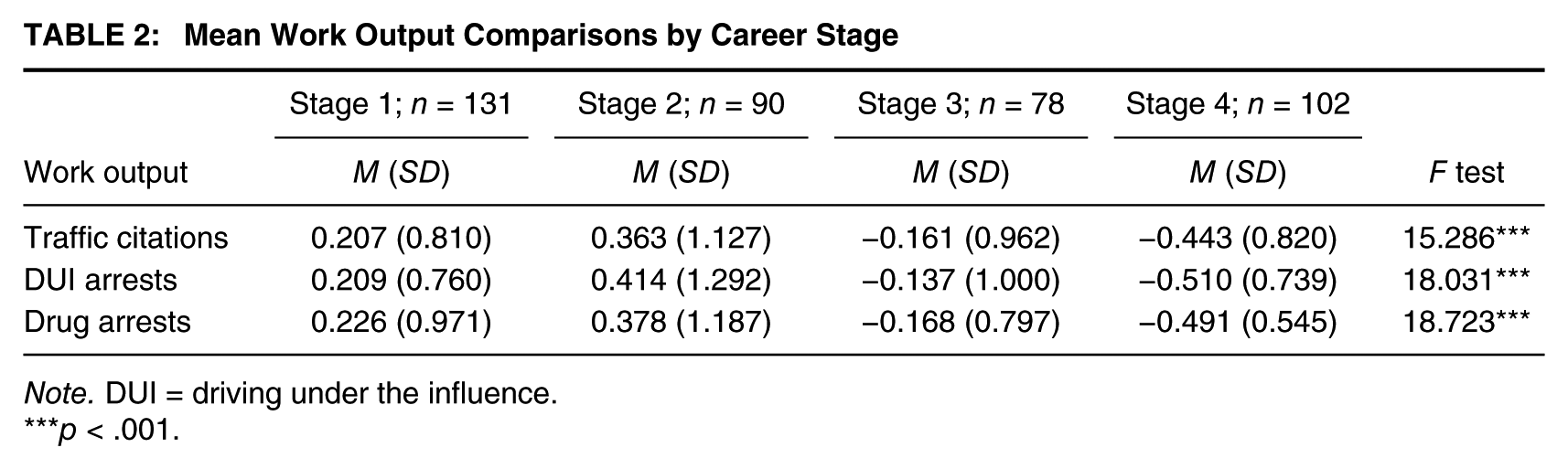
Note. DUI = driving under the influence.
p < .001.
The next step in the analysis was the estimation of multiple regression models. Ordinary least squares regression models were calculated for each work output by each career stage, using constructs of expectancy theory as independent variables. Before the models were created, the potential for multicollinearity among the independent variables was examined through the calculation of variance inflation factors (VIF). The VIF values ranged from 1.30 to 1.51, never approaching Allison’s (1999) threshold of 2.50, suggesting multicollinearity among the independent variables was not a concern. Furthermore, to examine how the measures of opportunity, ability, instrumentality, and performance-reward expectancy were distributed across each of your career stages, a table was created and can be found in the appendix to this article.
The first work output, traffic citations, was examined in Table 3. The first career stage model revealed variation in citation productivity for officers was predicted by opportunity, instrumentality, and performance-reward expectancy. In the second model, involving officers in the second stage of their careers, only instrumentality and performance-reward expectancy held predictive value, as opportunity lost statistical significance in the second career stage. The model for the third career stage produced the same results, with only instrumentality and performance-reward expectancy retaining predictive value. In the final career stage, however, instrumentality also lost its statistical significance, leaving performance-reward expectancy as the sole predictor of traffic citation productivity.
Ordinary Least Square Regression Models of Expectancy Motivation Constructs on Traffic Citation Productivity

p < .05. **p < .01. ***p < .001.
These models suggested that, with regard to traffic citation productivity, during the first career stage characteristics related to opportunities, perceptions that citations are expected, and perceptions that citations lead to intrinsic or extrinsic rewards hold predictive value. In the second and third career stages, only perceptions that citations are expected and the perception that citations lead to rewards held predictive value. In the final career stage, only the perception that citations led to rewards predicted citation productivity. The weak model R2 value also suggested that the constructs of expectancy motivation theory hold little value in explaining this behavior in the last career stage. Across the four models, the R2 measure of variance explained followed the overall curvilinear pattern of productivity previously found in Table 2. The first career stage model predicted approximately 29% of the variance, while the second career stage (with fewer statistically significant measures) explained even more of the variance. The third and fourth career stages, however, revealed marked declines in explained variance.
Table 4 reveals the results of the analyses of DUI arrests. In the first career stage model, only opportunity and performance-reward expectancy had predictive value. The same was the case in the second career stage. In the third career stage, however, instrumentality also gained statistical significance. In the final career stage, only instrumentality and performance-reward expectancy retained statistical significance for DUI arrest productivity. This suggests that increased opportunities to make DUI arrests and the perception that DUI arrests are linked to intrinsic or extrinsic rewards best predict within-agency variation in DUI arrests during the first two career stages. In the third career stage, the perception that management identified DUI arrests as a priority also gains statistical significance, but in the final career stage, only expectation and rewards for DUI arrests remain important.
Ordinary Least Square Regression Models of Expectancy Motivation Constructs on DUI Arrest Productivity
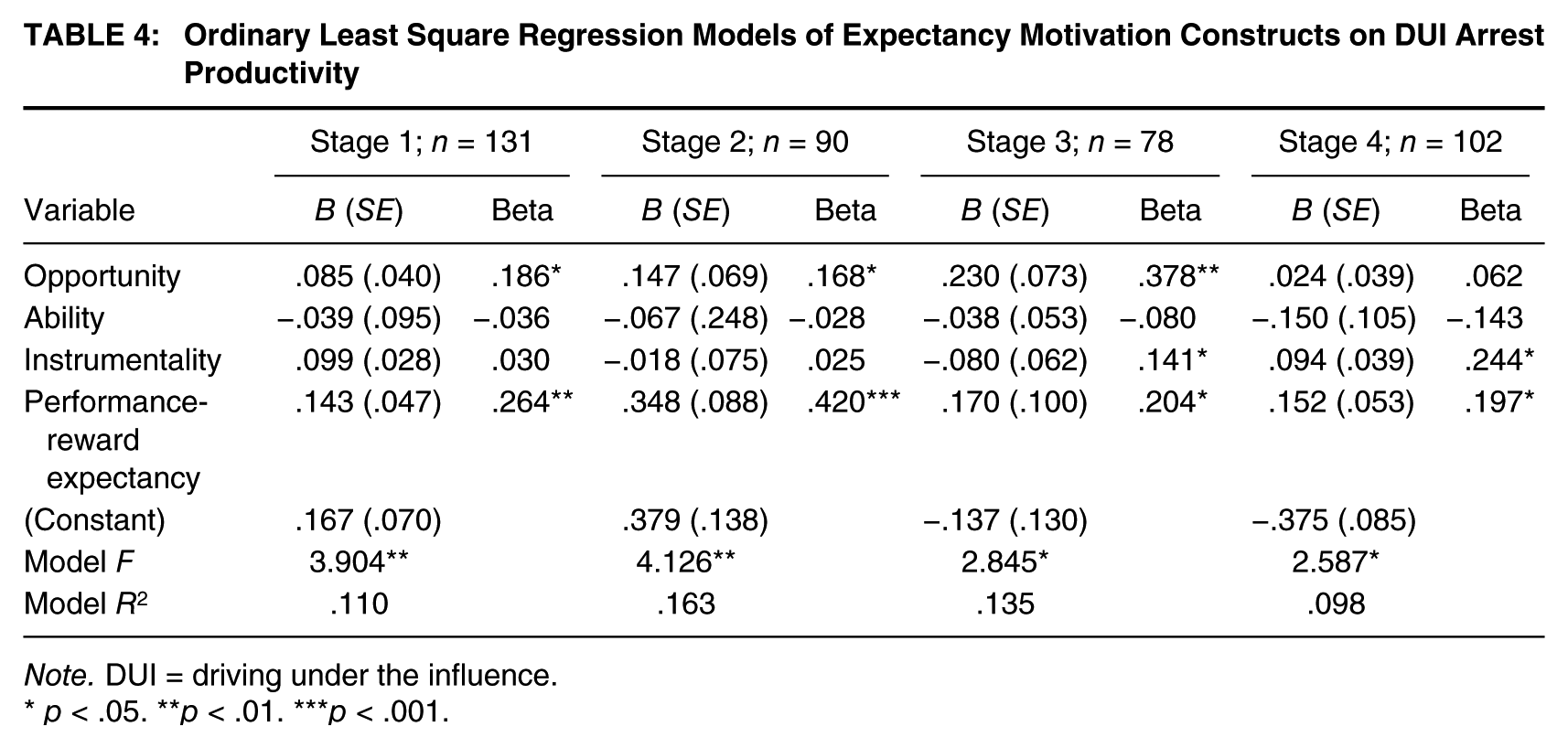
Note. DUI = driving under the influence.
p < .05. **p < .01. ***p < .001.
The pattern of R2 values across all four DUI arrest models revealed a pattern similar to that for the traffic citations. The amount of variance explained by the models started at 11% in the first stage, increased in the second career stage (16.3%), then declined in third and fourth career stages (13.5% and 9.8%, respectively). These low R2 values also suggest that the factors most predictive of officer DUI arrest productivity lie outside the framework of expectancy motivation theory.
Finally, Table 5 contains the four models analyzing drug arrest productivity. As this table reveals, during the first career stage, ability and performance-reward expectancy predict within-agency variation between officers in drug arrest productivity. Instrumentality was also statistically significant, but produced a negative relationship. One possible explanation for this finding is that officers in their first career stage often made drug arrests while perceiving management did not prioritize such arrests. This might be explained by the emphasis of the “war on drugs” in entry-level police training (Hari, 2015), and the importance of this war metaphor among young officers (Moskos, 2008). Veteran officers in later career stages, however, often become disillusioned with the war on drugs, and perceive their drug enforcement efforts as futile against the national drug use epidemic (Barker, 1999; Moskos, 2008). Veteran officers may not focus on drug enforcement unless they perceive they are being directed to do so.
Ordinary Least Square Regression Models of Expectancy Motivation Constructs on Drug Arrest Productivity

p < .05. **p < .01. ***p < .001.
In the second career stage, ability and performance-reward expectancy continued to hold predictive value. This was also the case in the model for the third career stage. In the model for the final career stage, opportunity gained statistical significance, ability lost statistical significance, performance-reward expectancy maintained statistical significance, and instrumentality returned to statistical significance with a positive relationship.
These models suggested that the perception that drug arrests are linked to intrinsic or extrinsic rewards best predict drug arrest activity in all four career stages. Ability to make drug arrests predicts drug arrest productivity for all but the last career stage, and opportunity only predicts drug arrest productivity in the final career stage. Interestingly, perceptions about the instrumentality of drug arrests within the organization are at odds with drug arrest productivity in the earliest career stage, but actually promote drug arrest activity in the final career stage. Finally, the R2 values across the four models demonstrated the same curvilinear pattern revealed in the previous analyses. Although the model R2 values were more robust in explaining the within-agency variation in drug arrests than they were in explaining DUI arrests, the pattern of initial increase and then decrease in model strength again held true.
Discussion
This study began with three hypotheses. First, regarding productivity, it was hypothesized that arrest and citation productivity would be highest in the first career stage and lowest in the last stage, declining steadily across all four career stages in a linear fashion. The findings here, however, revealed that productivity followed a curvilinear pattern, increasing before declining. This was the case for all three of the work outputs examined. This trend may best be explained by Barker’s (1999) ethnographic work with police careers. She suggested that officers began their careers highly motivated to do proactive police work but were apprehensive as they were still learning how to do the job. As they mastered the skills of their job by the second career phase, which Barker aptly referred to as “hitting their stride,” their productivity increased. After having established their workplace reputations in the first two career phases, Barker suggested patrol officers became burned out from performing the same tasks for so long, and became disgruntled from experiencing injuries, lawsuits, citizen complaints, and being passed over for promotions or transfers. Finally, in the last career stage, Barker suggested that patrol officers began to disengage from the career, focusing more on outside interests and avoiding any risky situations that might jeopardize their retirement pensions.
Second, it was hypothesized that opportunity and ability would gradually become less important in explaining variation between officers’ productivity as they progressed through the four career stages. Recall that Super (1957, 1980) suggested that work skill increases throughout the first two stages of one’s career. Barker (1999) suggested that police patrol officers mastered their work skills within the first or second career stage and then do not continue to advance in skill after mastering their specific job tasks in the first or second career stage. In the present study, however, opportunity and ability appeared to vary inconsistently across career stages and work outputs.
When dealing with traffic citation productivity, opportunity only mattered in the first career stage. Super (1957, 1980) and Barker (1999) would have predicted this outcome. Examination of DUI arrest productivity, however, revealed that opportunity mattered in all but the last career stage. In drug arrests, opportunity only mattered during the last career stage. Ability was also fickle and inconsistent across career stage and type of work output measured. These findings suggested that the importance of opportunity and ability vary not only across career stages but also across types of work activities. The results suggest that some tasks, such as detecting traffic violations and issuing traffic citations for them, are mastered very early in an officer’s career and are abundant, making detection easy. Other tasks, such as detecting drunken drivers appear to take greater skill and are also dependent upon the availability of drunken drivers to arrest, such as during evening hours when alcohol consumption occurs at higher rates.
Third, it was hypothesized that instrumentality (expectations) and performance-reward expectancy (rewards) gradually increase in importance across the four career stages. This was only true with regard to performance-reward expectancy. Instrumentality was an inconsistent predictor across career stages and type of work output. This may be explained by the barriers that exist to communicating work expectations to street-level bureaucrats. Lipsky (1980) suggested that street-level bureaucrats, such as police officers, face a work environment fraught with contradictory and ambiguous goals, making it difficult to know which goals to prioritize in any given circumstance. The situation is further exacerbated by the fact chief executives, in responding to various constituencies, send mixed signals to their subordinates about agency priorities (Lipsky, 1980; Wilson, 1968). Moreover, Johnson (2010a) found that supervisor priorities for patrol officers varied dramatically across three layers of managers in police departments. LaFrance, Day, Ewing, and Rohall (2012) also found that police managers often had different expectations for themselves than they did for their subordinates, the proverbial, “Do as I say, not as I do.” Perhaps the inconsistent predictive influence of instrumentality was the result of these communication difficulties.
Despite the inconsistent results of opportunity, ability, and instrumentality, the predictive nature of performance-reward expectancy and the patterns of variance explained by each of the career stage models remained consistent. Across all four career stages and all three productivity measures, performance-reward expectancy illustrated the importance of worker’s perception that specific work activities are tied to rewards. Providing rewards to public employees, unfortunately, can be very difficult due to the constraints of civil service regulations. Civil service rules prevent managers from using the same incentives as the private sector, such as offering vacations, shares in the corporation, or cash bonuses for meeting productivity or performance goals (Lipsky, 1980; Wilson, 1968). Nevertheless, informal rewards (such as the approval of time off requests and assignment of tasks, areas, partners, and vehicles) are still available to public managers. Intrinsic rewards also should not be overlooked. Public managers can reward employees by assigning them to tasks they favor, or granting them a reprieve from the tasks they do not (Brehm & Gates, 2008).
The variance explained by each regression model also followed a consistent pattern. Across all three dependent variables measured, the strength of the models (i.e., variance explained) increased when moving from the first to the second career stage, then declined across the third and fourth career stages. If mapped out on a line graph for each independent variable, the R2 values for each career stage model would produce a curvilinear pattern. Given the low R2 values of some of the models and the smaller sample sizes in the second and third career stages, care should be used in drawing conclusions simply on the pattern of R2 values. Nevertheless, as officer productivity followed a similar curvilinear pattern, this seems to suggest that productivity was highest when the constructs of expectancy motivation theory best explained productivity. When productivity was lowest, expectancy motivation theory explained the least variance. When the conditions of expectancy motivation theory were optimum, productivity was at its highest.
The findings here suggested specific policy implications for the management of police patrol officers and criminal justice agents generally. First, the inconsistent influence of instrumentality on work productivity suggested the need to find better ways to communicate performance expectations and priorities. Johnson (2009a) revealed that supervisor modeling was one effective way of communicating priorities and expectations. Brehm and Gates (2008) also found training to be an effective signaler to subordinates of supervisory expectations. These two methods of communicating work expectations deserve further examination. Second, both intrinsic and extrinsic rewards may be used to influence patrol officer productivity. While civil service rules and bureaucracies limit the use of formal rewards in criminal justice agencies, informal rewards such as approval of a day-off request or assignment to a choice task are within the authority of most first-line supervisors (Van Maanen, 1985; Wilson, 1968). These types of rewards should be utilized more often and future research should examine which specific rewards are the most effective motivators of officer behavior.
Third, as work productivity appeared to decline sharply in each of the last two career stages, perhaps it is important to plan novel experiences or tasks for late-career officers. It would appear that promotion or specialty assignments (such as training or public relations officer) are crucial to keeping officers from stagnating and declining in productivity. Even if these opportunities are unavailable, assigning late-stage employees to new roles or responsibilities within their current job assignment may prevent productivity stagnation.
The present study provided a much-needed examination of the effects of career stage on employee productivity and expectancy motivation. Despite its strengths, there were limitations. First, the inability to determine temporal order is an issue inherent in any cross-sectional, correlational study; therefore, we cannot know for sure whether the attitudes measured preceded the performance output. Second, as is the case with the vast majority of policing research, it involved a convenience sample, making generalizations about the findings to other agencies difficult. Similarly, a lack of gender and race measures further limits generalizations to female and non-White officers. The rather low R2 values for some of the models, and the small subsamples in two of the four career stages, are also limitations that must be taken into consideration.
The emphasis on quantitative analysis rather than qualitative data collection made a trade-off on the side of breadth rather than depth. This came at the price of a deeper, qualitative analysis that could have accounted for the aggregate findings. The study was not designed to prove why longer serving officers are less motivated by opportunity and ability variables; however, this could be the focus of future research on this topic. Another issue is that police officers do much more than make arrests, so other activities could have been chosen as measures of productivity. Future research is needed to discern whether alternative productivity measures share similar relationships to those observed in the present study. Third, the present study, while examining employees from 23 different agencies, was limited to only uniformed police patrol officer. It is unknown whether the findings here are as applicable to probation officers, detectives, correctional officers, or deputy prosecutors. Future research is warranted in other criminal justice settings as this study could easily be replicated with other types of criminal justice agents.
In conclusion, the present study examined the influence of career stage on police officer work behavior. The findings revealed that work productivity was curvilinear across the career, with productivity dropping in the final two career stages before retirement. The findings revealed that opportunity and ability play inconsistent roles in productivity across career stages, and instrumentality was also inconsistent as employees struggle with trying to determine what specific work behaviors are expected. Finally, it appears that employees focus most on activities that are clearly linked to extrinsic or intrinsic rewards.
Footnotes
Appendix
Descriptive Statistics by Career Stage
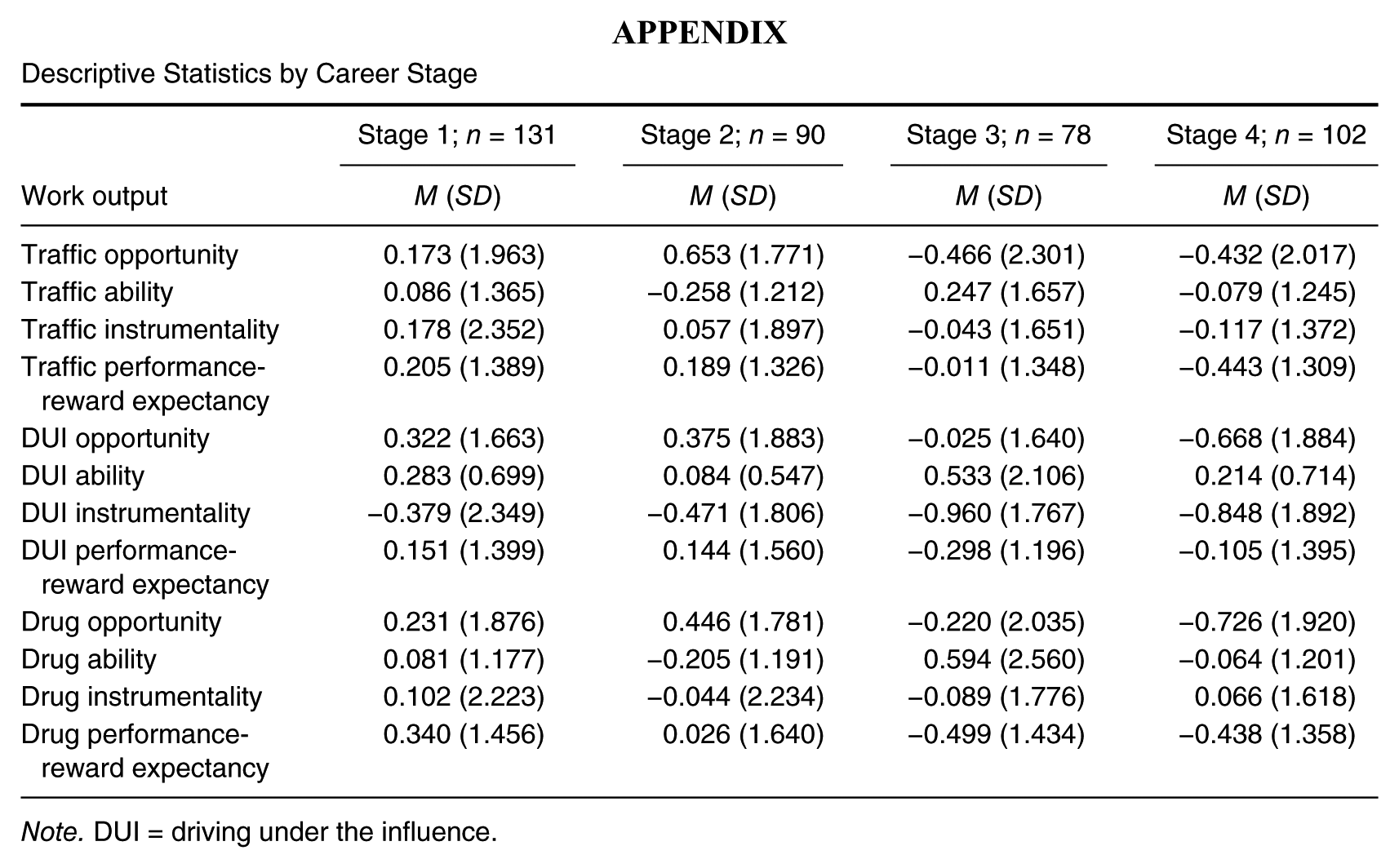
| Work output | Stage 1; n = 131 |
Stage 2; n = 90 |
Stage 3; n = 78 |
Stage 4; n = 102 |
|---|---|---|---|---|
| M (SD) | M (SD) | M (SD) | M (SD) | |
| Traffic opportunity | 0.173 (1.963) | 0.653 (1.771) | −0.466 (2.301) | −0.432 (2.017) |
| Traffic ability | 0.086 (1.365) | −0.258 (1.212) | 0.247 (1.657) | −0.079 (1.245) |
| Traffic instrumentality | 0.178 (2.352) | 0.057 (1.897) | −0.043 (1.651) | −0.117 (1.372) |
| Traffic performance-reward expectancy | 0.205 (1.389) | 0.189 (1.326) | −0.011 (1.348) | −0.443 (1.309) |
| DUI opportunity | 0.322 (1.663) | 0.375 (1.883) | −0.025 (1.640) | −0.668 (1.884) |
| DUI ability | 0.283 (0.699) | 0.084 (0.547) | 0.533 (2.106) | 0.214 (0.714) |
| DUI instrumentality | −0.379 (2.349) | −0.471 (1.806) | −0.960 (1.767) | −0.848 (1.892) |
| DUI performance-reward expectancy | 0.151 (1.399) | 0.144 (1.560) | −0.298 (1.196) | −0.105 (1.395) |
| Drug opportunity | 0.231 (1.876) | 0.446 (1.781) | −0.220 (2.035) | −0.726 (1.920) |
| Drug ability | 0.081 (1.177) | −0.205 (1.191) | 0.594 (2.560) | −0.064 (1.201) |
| Drug instrumentality | 0.102 (2.223) | −0.044 (2.234) | −0.089 (1.776) | 0.066 (1.618) |
| Drug performance-reward expectancy | 0.340 (1.456) | 0.026 (1.640) | −0.499 (1.434) | −0.438 (1.358) |
Note. DUI = driving under the influence.
Authors’ Note:
The authors would like to thank the anonymous reviewer’s for their helpful comments that improved the overall depth of this article. They would also like to thank Managing Editor Dr. Jaime Henderson and Editor-in-Chief Dr. Emily Salisbury for their patience and assistance with the revisions of this article.