



Abstract
Theory and research highlight the importance of procedural justice for inculcating people’s obligation to obey and willingness to cooperate with legal authorities, yet questions remain about the universality of these relationships across cultures and contexts. We examine the influence of procedural justice and other factors on Ghanaian immigrants’ obligation to obey and willingness to cooperate with police. The findings suggest that when police are perceived to behave in a procedurally just manner, people feel an increased obligation to obey their directives and willingness to cooperate with them. Perceived police effectiveness does not influence Ghanaian immigrants’ obligation to obey police, but is the most dominant factor in shaping their willingness to cooperate with police. Respondents’ views of police in Ghana did not influence obligation or cooperation. The implications of the results for theory development, empirical research, and policies intended to improve police–immigrant relations are discussed.
Keywords
Introduction
A large body of theory and research highlights the importance of procedural justice for stimulating an internalized sense of obligation to obey the law and legal authorities among the populace. Research and theory also emphasize the joint influence of procedural justice and obligation to obey on people’s willingness to cooperate and comply with police and other legal authorities (Sunshine & Tyler, 2003; Tyler & Huo, 2002). Taken together, this scholarship reinforces the idea that when legal authorities use fair procedures, they may be more effective at securing prosocial outcomes like obligation to obey, cooperation, and compliance. This scholarship calls into question the wisdom of aggressive policing styles that the public is likely to view as procedurally unfair (Gau & Brunson, 2010; Meares, 2015). While many of the factors that shape people’s obligation to obey and willingness to cooperate or comply with police are not easily influenced by changes in policy and practice, police leaders can adopt mechanisms to encourage the use of fair procedures by police officers. As a result, this body of scholarship has direct relevance for contemporary police reform. Indeed, President Barack Obama’s Task Force on 21st Century Policing issued numerous recommendations calling for police to embrace procedurally just strategies and tactics (President’s Task Force, 2015).
While research evidence on the beneficial effects of procedural justice is mounting, questions have arisen about the universality of its effects across different cultures and contexts (e.g., Brockner, Wiesenfeld, & Diekmann, 2009; Murphy & Cherney, 2012; Reisig & Lloyd, 2009; Tankebe, 2009). For instance, little is known about its effects in immigrant communities, and particularly immigrant communities whose residents may have struggled with police brutality and corruption in their country of origin. More generally, while research has examined citizen perceptions of the police among numerous subpopulations, relatively few studies have explored citizen perceptions of police among immigrants. This gap in the research evidence is noteworthy given the well-known deficits in police–community relations in many immigrant communities (Davies & Fagan, 2012). As immigration rates in the United States have soared in recent decades (Davies & Fagan, 2012), the police have faced new challenges associated with policing immigrants and immigrant communities. An improved understanding of immigrant perceptions of the police, and the behavioral implications of those perceptions, would pay dividends for both theory and policy. On the theoretical side, understanding the extent to which the relationships postulated in procedural justice theory apply to a variety of populations would help to illuminate the scope and generality of the theory (Wolfe, Nix, Kaminski, & Rojek, 2016). On the policy side, a clearer understanding of how immigrants view police could enable policy makers and police leaders to “to develop new strategies that will improve public attitudes, change policies that are determined to be detrimental to positive attitudes, and reinforce those behaviors that are responsible for positive behaviors” (Frank, Smith, & Novak, 2005, p. 212).
Based on data from a sample of 304 Ghanaian immigrants in Alexandria, Virginia, the present study examines the effects of perceived procedural justice and other exogenous factors on people’s obligation to obey the police and willingness to cooperate with police. We also examine the effect of obligation to obey on willingness to cooperate, as well as the indirect effects of procedural justice and other factors on willingness to cooperate through obligation to obey. While procedural justice represents a powerful normative explanation for obligation and cooperation, theorists have contrasted it with instrumental or utilitarian explanations, including distributive justice, police effectiveness, and risk of sanctioning for lawbreaking. 1 Much of the literature pits these normative and instrumental explanations against one another (Sunshine & Tyler, 2003; Tyler, 2006; Tyler & Huo, 2002). Research on immigration in the United States highlights another important factor worthy of consideration: that immigrants may carry with them “former experiences with and perceptions of the criminal justice systems of the countries from which they emigrated” (Davies & Fagan, 2012, p. 106; also see Arthur, 2008). Thus, we also examine the relative influence of Ghanaian immigrants’ trust and confidence in the Ghana police on their obligation to obey and willingness to cooperate with police in the United States.
Background
Clarifying the antecedents and consequences of people’s voluntary sense of obligation or duty to obey and their willingness to cooperate or comply with police and other legal authorities constitutes a major new frontier in criminology and sociolegal studies. A key part of the intellectual foundation of this line of scholarship is Tyler’s process-based model of regulation (e.g., Sunshine & Tyler, 2003; Tyler, 2006; Tyler & Huo, 2002). In the process-based model, people’s internalized sense of obligation to obey the law serves as a mediator between their perceptions of the procedural justice of legal authorities and their decisions to obey the law and to cooperate or comply with legal authorities. 2 According to this perspective, people make judgments about the extent to which legal authorities like police officers, prosecutors, judges, and prison guards behave in a procedurally just manner. These judgments have a powerful influence on their internalized feelings of obligation or duty to obey the law and legal authorities. Procedural justice and obligation to obey, in turn, shape people’s willingness to obey the law and cooperate or comply with the directives of legal authorities. Thus, according to the process-based model, when legal authorities treat people in a procedurally just manner, they cultivate cooperation, compliance, and other beneficial outcomes (e.g., Sunshine & Tyler, 2003; Tyler, 2006; Tyler & Huo, 2002).
In contrast to the normative judgments that serve as the foundation of the process-based model are instrumental or utilitarian judgments that serve as potential alternative explanations for obligation, cooperation, compliance, and other outcomes. In this section, we begin by discussing the two outcomes examined in this study: obligation to obey and willingness to cooperate. We then discuss the various normative and instrumental factors thought to shape these two outcomes.
Obligation to Obey
A key component of Tyler’s process-based model of regulation, as well as scholarship deriving from this perspective, is an internalized sense of obligation or duty to obey the law or the directives of legal authorities. According to Sunshine and Tyler (2003), this “feeling of obligation is not simply linked to the authority’s possession of instruments of reward or coercion, but also to properties of the authority that lead people to feel it is entitled to be obeyed” (p. 514; also see Beetham, 1991). Obligation to obey is typically treated as a proxy for institutional legitimacy. For instance, Tyler (2006) refers to obligation to obey as “the most direct measure of citizens’ assessments of legitimacy” (p. 38). Tyler draws from Weber (1968) in arguing that legitimacy is based primarily on the ability of an authority figure to encourage voluntary compliance with commands, rules, or laws. According to this perspective, a legitimate authority “is one that is regarded by people as entitled to have its decisions and rules accepted and followed by others” (Skogan & Frydl, 2004, p. 297). Given recent debates about the meaning and measurement of legitimacy (e.g., Johnson, Maguire, & Kuhns, 2014; Tankebe, 2013; Tankebe, Reisig, & Wang, 2016), we do not include legitimacy as a construct in our model. Instead, our interest is in the antecedents and downstream consequences of obligation to obey itself. Following Tankebe (2013), we treat it as a standalone concept rather than as a proxy for institutional legitimacy (also see Johnson et al., 2014). In the process-based model of regulation articulated by Tyler and his colleagues, fair treatment by legal authorities activates people’s internal feelings of obligation and responsibility to abide by community norms. This sense of obligation, in turn, helps to promote cooperation and compliance with law and legal authorities (Sunshine & Tyler, 2003; Tyler, 2006).
Willingness to Cooperate
Citizen cooperation is fundamental to the “production of security” in a democracy (Davies & Fagan, 2012). The ability of police to maintain order and security in communities rests largely on their ability to cultivate voluntary cooperation from members of the public. In communities where relationships between police and the public have soured, residents are often less willing to call the police, to aid the police in investigations, to serve as witnesses and testify in court, or to support police requests for increased funding. As Tyler (2005) notes, “It is much more difficult for legal authorities to effectively manage the problems of community crime control without public cooperation” (p. 322; also see Sampson & Bartusch, 1998). A small body of research has sought to clarify the relative roles of normative and instrumental factors in shaping people’s willingness to cooperate with police and other legal authorities (e.g., Bradford, 2012; Sargeant, Murphy, & Cherney, 2014; Tankebe, 2009; Tyler & Fagan, 2008).
Of greatest relevance for the present study is Tankebe’s (2009) research in Ghana, which found that perceived effectiveness exerted a stronger effect on willingness to cooperate with police than perceptions of procedural justice. As noted by Tankebe (2009), people’s willingness to cooperate with police in Ghana “seems to be contingent on the expectations of a minimum threshold of police effectiveness as well as a show of concern for, and responsiveness to, public security” (p. 1281). One potential explanation for this finding is that people may need to know that the information people provide to police will be put to good use. Weak performance may signal to people that police “cannot be relied on to make good use of the information offered to them to help protect citizens” (Tankebe, 2009, p. 1281).
Procedural Justice
Procedural justice theory provides a normative basis for understanding obligation and cooperation. Early definitions of procedural justice focused heavily on the fairness of formal procedures and the quality of decision making by authority figures (Thibaut & Walker, 1975). Later, Tyler and Lind (1992) proposed a relational model of authority that widened the focus of procedural justice scholarship to include the nature of the interpersonal interactions between authority figures and subordinates. The relational model emphasized the influential idea that procedural justice is “strongly linked to quality of treatment issues, such as treating people with politeness and dignity in social interactions” (Tyler & Blader, 2003, pp. 351-352). Consistent with its conceptual evolution, procedural justice is now typically conceptualized as having two components: the quality of the decision-making processes relied upon by authority figures, and the quality of treatment by authority figures. Procedural justice theory posits that people are influenced more heavily by these two aspects of the processes used during encounters with legal authorities than by the outcomes of these encounters (De Angelis & Kupchik, 2009; Sunshine & Tyler, 2003; Wolfe et al., 2016). Thus, residents who are arrested or cited by the police are more likely to accept the decision and less likely to believe they were treated unfairly if officers relied upon fair procedures and treated them with dignity and respect. Using fair procedures, police can help the people they encounter, including those who receive a negative outcome like an arrest or citation, to maintain their dignity, thus reducing the likelihood that they “will feel a sense of indignation, anger, or both” (Gau, Corsaro, Stewart, & Brunson, 2012, p. 334).
Instrumental Factors
While procedural justice is thought to be an important normative factor in shaping obligation and cooperation, instrumental factors may also exert an influence. As noted by Sunshine and Tyler (2003),
Instrumental models suggest that people’s willingness to accept and cooperate with legal authorities is linked to evaluations of police performance, to risk, and to judgments about distributive justice. This model, the instrumental perspective, suggests that the police gain acceptance when they are viewed by the public as (1) creating credible sanctioning threats for those who break rules (risk), (2) effectively controlling crime and criminal behavior (performance), and (3) fairly distributing police services across people and communities. (distributive fairness; p. 514)
Consistent with Sunshine and Tyler (2003), in this article we contrast the normative effects of procedural justice with the instrumental effects of three factors: police effectiveness (performance) in controlling crime, risk of sanctioning, and distributive justice (also referred to in the literature as distributive fairness).
The instrumental perspective suggests that people’s obligation to obey and willingness to cooperate with legal authorities derives from three distinct judgments. First, people’s appraisals of their likelihood of being sanctioned for wrongdoing may shape their sense of obligation and cooperation. When the perceived risk of sanctions for illegal behavior is high, people may fear being caught by the police and then punished. As a consequence, they may feel a greater obligation to obey and cooperate with the police. On the other hand, those who view the police as unlikely to capture wrongdoers may feel a weakened sense of obligation and cooperation.
Second, obligation and willingness to cooperate with legal authorities may be linked to perceived police effectiveness. According to Sunshine and Tyler (2003), when people view police as effective at controlling crime and disorder, they may feel encouraged to cooperate with authorities because their actions are more likely to have an impact on crime. Conversely, when police are perceived as less effective at controlling crime and disorder, citizens may feel less of a duty to obey or cooperate with legal authorities because their actions are less likely to produce tangible benefits. Drawing on earlier work by Beetham (1991) and Coicaud (2002), some recent scholarship has argued that effectiveness is a component of perceived legitimacy rather than an antecedent (Bottoms & Tankebe, 2012; Tankebe, 2013). In the theoretical formulation outlined by these scholars, effectiveness is expected to influence obligation and cooperation through its role as one of several components of legitimacy.
Third, given the democratic ideal of equality under the law, the extent to which police distribute outcomes in a fair and equal manner across groups may also influence people’s willingness to obey or cooperate with police. As Sarat (1977, p. 434) notes, the “perception of unequal treatment is the single most important source of popular dissatisfaction with the American legal system . . . ” When police are viewed as distributing police services inequitably, people may feel less of a duty to obey or cooperate with police. Moreover, if the perception of being treated inequitably by authority figures triggers a sense of resentment and defiance, then it could undermine the perceived legitimacy of the law and its agents and promote lawbreaking behavior (Sherman, 2010).
Police–Immigrant Relationships
Citizen perceptions of the police have been studied extensively in the United States, including comparative assessments of the views of Whites, Blacks, and Hispanics (e.g., Rosenbaum, Schuck, Costello, Hawkins, & King, 2005; Weitzer & Tuch, 2006). 3 A growing body of literature has also evaluated immigrant perceptions of police, with scholars focused largely on Asian and Latino immigrant groups. Although research findings are not consistent about whether (and when) immigrant attitudes toward the police are more positive or more negative than those of native populations, these studies regularly find that immigrant perceptions of the U.S. police are influenced by immigrant-specific factors such as country of origin, experiences with authorities in their home country, immigration status, immigration generation and length of residence in the United States, and experiences with immigration enforcement (Barrick, 2014; Chu & Hung, 2010; Chu, Song, & Dombrick, 2005; Correia, 2010; Davis & Hendricks, 2007; Menjívar & Bejarano, 2004; Rengifo & Fratello, 2015).
In addition to these factors, police–immigrant relations are affected by language and cultural differences, the patterns and practices of law enforcement, and experiences with crime and victimization, all of which influence the nature and quality of interactions between police and immigrants in the United States. For example, immigrants have an elevated risk of victimization. Empirical research has found that immigrants are susceptible to hate crimes (Hendricks, Ortiz, Sugie, & Miller, 2007), sexual violence (Decker, Raj, & Silverman, 2007), and “exploitations [by] unscrupulous landlords, bankers, financiers, and employers. Language barriers and cultural mistrust of the police may make immigrants reluctant to report crime and otherwise interact with authorities, making immigrants more open to predation” (Davies & Fagan, 2012, p. 103).
In addition, immigrants may be inaccurately associated with crime, and immigrant communities may face disproportionate enforcement patterns and practices as a result (Kubrin, Zatz, & Martinez, 2012). This is likely particularly true for immigrants who share similar phenotypic and sociodemographic characteristics with native born minority group members who are also stereotypically associated with crime. Davies and Fagan (2012) warn of the risk of this inaccurate association, noting that “the potential alienation of immigrant communities—even law-abiding, cooperative individuals—from the criminal justice system can compromise safety through the loss of legitimacy and the withdrawal of citizens from cooperation with the police” (p. 120).
Finally, the events of 9/11 and other social trends have led to policy changes in the way communities are now policed in the United States, with local police sometimes enforcing immigration laws and engaging in counterterrorism efforts (Gladstein, 2005; Jones & Supinski, 2010). These new police roles have clouded the once-distinct roles of immigration enforcement and policing (Davies & Fagan, 2012). They have the potential to increase distrust of the police, especially among undocumented immigrants and those of Arab descent (Jones & Supinski, 2010), and may affect the willingness of immigrants to cooperate with police.
Ghanaian immigrants in the United States are part of a subgroup of foreign-born nationals that Mercer (1995) called visible minorities. According to Mercer (1995), “When substantial numbers of people, seen as and thought to be different, come to reside in an urban area, the adjustments and coping required are most acutely felt in a few select metropolitan areas” (p. 174). The presence of the newcomers in these large metropolitan areas leads to notable changes in culture and diversity (Mercer, 1995). Moreover, “[t]he new immigrants [bring] about important changes in urban social life, including education, health care, policing, business development, and labor markets” (Mercer, 1995, p. 169).
Research on the experiences of those who have immigrated to the United States from Ghana highlights the many complexities of their relationship with U.S. culture and structures of authority (e.g., Pryce, 2016a, 2016b). First, as noted by Ackah (2000), respect for authority is an important cultural value in Ghana. At the same time, when Ghanaian immigrants and their children experience racism and discrimination in the United States, especially at the hands of authority figures, it can be challenging to exercise this sense of respect. Ghanaian immigrants in the United States report that their statuses as Black and immigrant make them doubly prone to heightened levels of suspicion by police. According to one Ghanaian youth, “When we go to the mall, the police watch us with eagle’s eyes. They think we are dealing drugs or plotting to commit crime when all we are doing is killing time and milling around” (Arthur, 2008, p. 109). Some Ghanaian immigrants are acutely aware of what happened to Amadou Diallo, a 22-year-old West African immigrant from Guinea who was shot and killed in 1999 by New York City police when he removed a cell phone from his pocket. Arthur’s (2008) ethnography of Ghanaian immigrants reveals a potent sense of mistrust in U.S. police resulting from perceptions of discrimination and racism.
Adding to this complexity in attitudes toward police among Ghanaian immigrants are their experiences with police back home in Ghana. A common theme in the social science literature on immigration is that immigrants may conceptualize the nature and role of police based on how police behave in their country of origin (Correia, 2010; Menjívar & Bejarano, 2004). Public justice systems in the developing world are often weak and ineffectual, regularly failing to hold offenders accountable for their crimes and protect the poor while exposing the innocent to sanctions for crimes they did not commit (Haugen & Boutros, 2014). Police in many nations in the developing world are corrupt, brutal, and ineffective. According to Tankebe (2009), policing in Ghana “continues to be characterized by abuse, violence, intimidation, and widespread corruption” (p. 1271). Direct experiences with, or vicarious accounts of police in Ghana may color how Ghanaian immigrants think about police and legal authority more generally in the United States. Thus, any effort to understand the way Ghanaian immigrants in the United States think about police and legal authorities should account for the influence of their attitudes toward police in their country of origin.
The Current Study
This study uses data from a survey of Ghanaian immigrants to explore the effects of procedural justice and other factors on obligation to obey the police and willingness to cooperate with the police. Based on theory and research on procedural justice and legitimacy, we examine the influence of one normative factor (procedural justice) and three instrumental factors (distributive justice, perceived effectiveness, and risk of sanctions). Based on theory and research in the study of immigrants and immigration, we also examine the influence of trust and confidence in the Ghana police on obligation and cooperation among Ghanaian immigrants in the United States. Our analysis also examines the effect of obligation to obey on willingness to cooperate as well as the indirect effects of the five theoretically meaningful exogenous variables on cooperation through obligation. Finally, we account for the influence of several socioeconomic and immigration-related control variables. Figure 1 illustrates the basic model to be tested in this study.
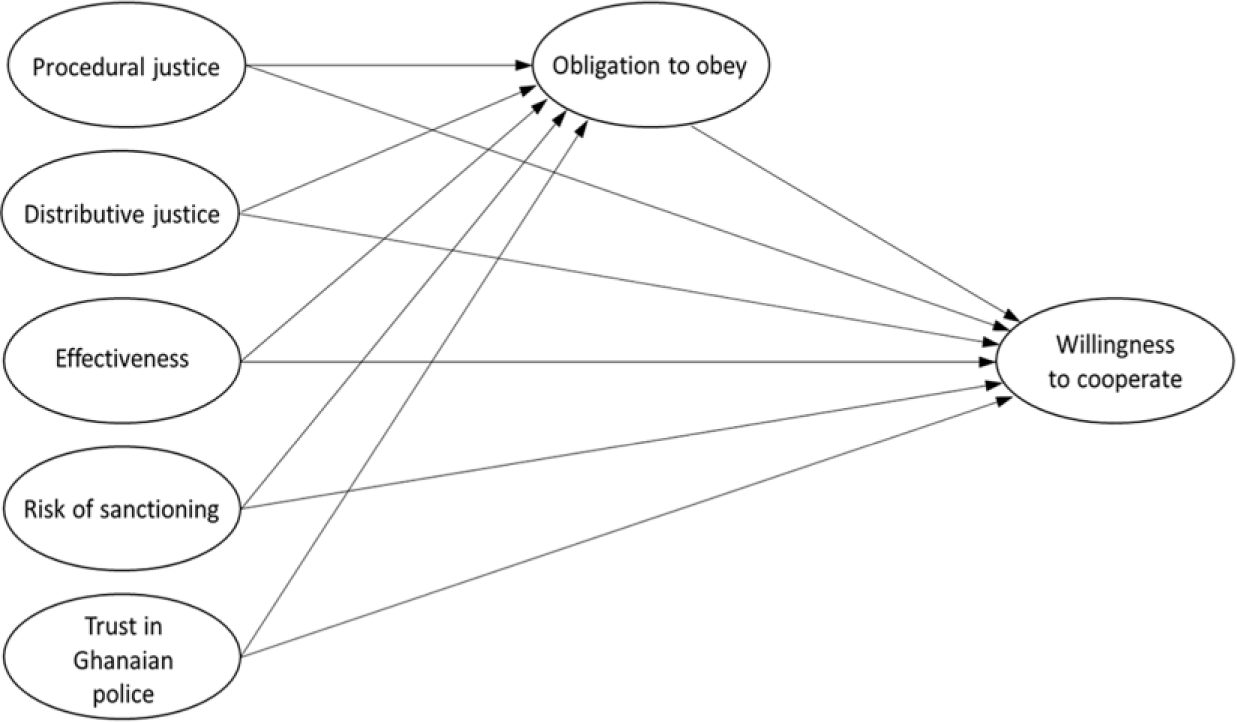
Basic Conceptual Model
Method
Data
The data for this study were collected between January and February 2014 from a sample of Ghanaian immigrants in Alexandria, Virginia. Using a time-space sampling method, 4 we obtained a sample of 304 Ghanaian immigrants 5 who worshiped in one of eight predominantly Ghanaian churches 6 and who were at least 18 years of age. The first author worked with faith leaders in each church to secure access to their congregations, and surveyed their membership immediately following their main weekly service. The overall response rate was 89% (304 completed surveys out of 341 distributed), and ranged from 82% to 100%. Each participant received $3.00 in cash for participating in the survey.
Measures
This study includes two outcome measures, each measured as a composite: obligation to obey and willingness to cooperate. We measured obligation to obey using four items. Respondents were asked to indicate their agreement with these items on a 4-point Likert-type scale ranging from “strongly disagree” to “strongly agree,” with higher scores indicating a higher level of agreement. We measured willingness to cooperate using four items. Respondents were asked to indicate their likelihood of engaging in each form of cooperation on a 4-point ordinal scale ranging from “very unlikely” to “very likely,” with higher scores indicating a higher likelihood of cooperating with police. The items used to construct all composite measures are listed in Appendix A.
We also constructed composite measures of five substantively meaningful concepts thought to influence obligation and cooperation. These measures—including procedural justice, distributive justice, effectiveness, risk of sanctioning, and trust and confidence in the police in Ghana—are treated as exogenous variables in our model. For the items comprising the first four of these composite measures—including procedural justice, distributive justice, effectiveness, and trust and confidence in the Ghana police—respondents were asked to indicate their agreement with each item on a 4-point Likert-type scale ranging from “strongly disagree” to “strongly agree,” with higher scores indicating a higher level of agreement. Based on previous research (Reisig, Bratton, & Gertz, 2007), we measured procedural justice using seven items: three that focus on quality of decision making and four that focus on quality of treatment. We measured distributive justice using three survey items adapted from Reisig et al. (2007). We measured perceptions of police effectiveness in controlling crime using six items adapted from Sunshine and Tyler (2003). We measured trust and confidence in the Ghana police using four items adapted from Tankebe (2009). Finally, we measured risk of sanctioning using six items with different response options than those used in the first four measures. Respondents were asked to indicate the likelihood of being sanctioned for each illegal behavior on a 4-point ordinal scale ranging from “very unlikely” to “very likely,” with higher scores indicating a higher level of risk for sanctioning.
We also included six control variables in the model to account for the potential influence of respondents’ socioeconomic and immigration-related characteristics. We measured age in years as a continuous variable. We measured sex as a binary variable (female = 0, male = 1). We measured education as an ordinal variable with five categories: (a) less than high school diploma, (b) high school diploma/equivalency, (c) associate’s degree, (d) bachelor’s degree, (e) postgraduate or professional degree. We measured annual income as an ordinal measure (adapted from Tyler & Wakslak, 2004) with seven categories: (a) less than $20,000, (b) $20,000 to $29,999, (c) $30,000 to $39,999, (d) $40,000 to $49,999, (e) $50,000 to $74,999, (f) $75,000 to $99,999, (g) $100,000 or higher. We measured home ownership as a binary variable (renter = 0, home owner = 1). Finally, we measured birthplace as a binary variable (1 = born in Ghana, 0 = born elsewhere to at least one Ghanaian parent). All six control variables were included in the model as exogenous variables.
Sample Characteristics
The sample included 54% women and 46% men. Respondents ranged in age from 18 to 69 years old with a mean age of approximately 40 (M = 40.3, SD = 13.4). Respondents’ annual household incomes varied considerably, with the majority (82%) reporting incomes less than $50,000. Only 23% of respondents reported owning their own home, with 77% indicating that they rent a home. With regard to education, 13.1% of respondents had less than a high school diploma, 35.6% had a high school diploma/equivalency, 22.9% had an associate’s degree, 17.5% had a bachelor’s degree, and 10.9% had a postgraduate or professional degree. Most respondents (95%) reported that they were born in Ghana to at least one Ghanaian parent; 2.9% were born in the United States to at least one Ghanaian parent; and 2.2% were born elsewhere (not in the United States or Ghana) to at least one Ghanaian parent. Finally, the survey participants reported that they have lived in the United States from 1 to 44 years, with slightly more than half having lived in the United States for 10 years or less.
Analysis
We relied on a parsimonious model estimation procedure in which all parameters were estimated simultaneously in a single structural equation model. The structural equation model includes both a measurement and a structural (regression) component. The measurement component includes a series of latent variables each measured using multiple indicators in a confirmatory factor analysis (CFA) framework. 7 The relationships between all latent variables and their indicators are specified as reflective, which means the direction of the relationship flows from the latent variable to the indicator. Because the indicators used to construct the latent variables are ordinal, we chose a robust mean and variance adjusted weighted least squares (WLSMV) estimator available in Mplus for model estimation. Monte Carlo simulation research has found that this categorical estimation method works well for models with ordinal outcomes, including those with small samples and asymmetric distributions (Flora & Curran, 2004; Li, 2014; Muthén, Du Toit, & Spisic, 1997).
Our initial model estimation revealed that because procedural justice and distributive justice have an almost perfect bivariate correlation (r = .980), including them both as exogenous variables in the model introduced a severe multicollinearity problem. The variance inflation factor (VIF) for distributive justice was 16.1, well above conventional thresholds for inferring a problem with multicollinearity. Much of the literature on the relative effects of procedural and distributive justice does not report collinearity diagnostics, so it is unclear how often other studies have encountered this same issue. Our findings highlight the importance of testing for multicollinearity when contrasting the effects of procedural and distributive justice. This finding also has important theoretical and conceptual implications, which we explore later in the Discussion section.
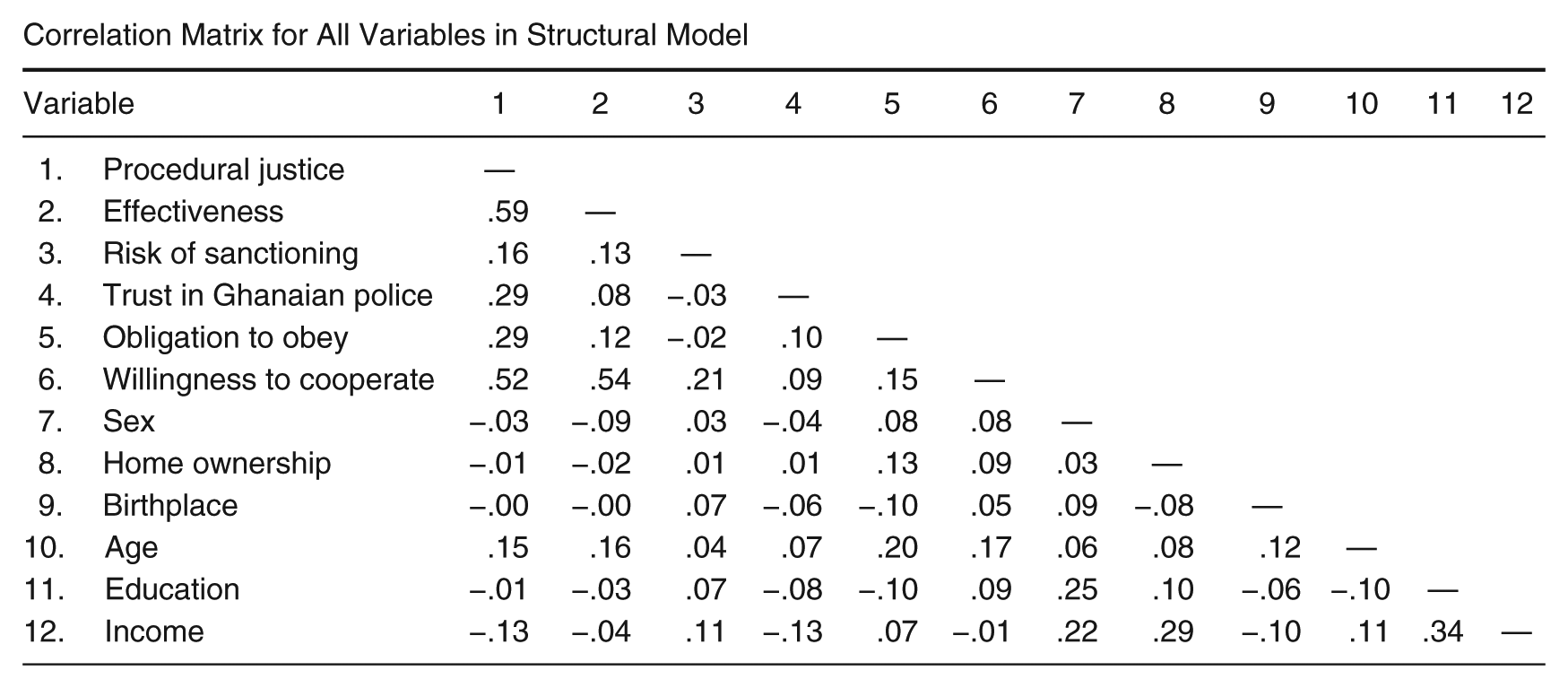
As a result of the multicollinearity issue, we excluded distributive justice from the model and reestimated all parameters. 8 The revised model fit the data well according to four of the five goodness-of-fit measures (χ2 = 770.7, df = 593, p < .001; root mean square error of approximation [RMSEA] = .035; confirmatory fit index [CFI] = .989; Tucker–Lewis index [TLI] = .988; weighted root mean square residual [WRMR] = .938). 9 In the measurement portion of the model, the factor loadings for all latent variables were strong and positive. Across all latent variables in the model, CFA factor loadings ranged from .58 to .96, with a mean of .86 and a median of .87. 10 The regression results from the structural portion of the model are reported in the following section. The correlation matrix for all latent and observed variables included in the structural (regression) model is shown in Appendix B.
Findings
Main Results
We begin by discussing the regression results for obligation to obey the police. The full results are shown in Table 1. The model explains 19.8% of the variation in obligation, with two of the four substantively meaningful exogenous variables exerting a statistically significant effect: procedural justice (β = 0.30) and risk of sanctions (β = −.015). The results suggest that Ghanaian immigrants who view the police as behaving in a procedurally just manner feel a stronger obligation to obey the police. The significant negative coefficient for risk of sanctions suggests that as perceived risk of being caught and punished for legal infractions increases, obligation to obey decreases. 11 We return to this counterintuitive finding in the Discussion section. Neither perceived effectiveness nor trust in the Ghanaian police exerted a significant effect on obligation to obey. Only one of the six control variables exerted a statistically significant effect on obligation to obey: age. The significant positive coefficient for age (β = 0.23) suggests that older respondents feel a greater obligation to obey the police than younger respondents. The remaining controls, including sex, home ownership, birthplace, education, and income, had no statistically significant effect.
Regression Results for Obligation to Obey and Willingness to Cooperate
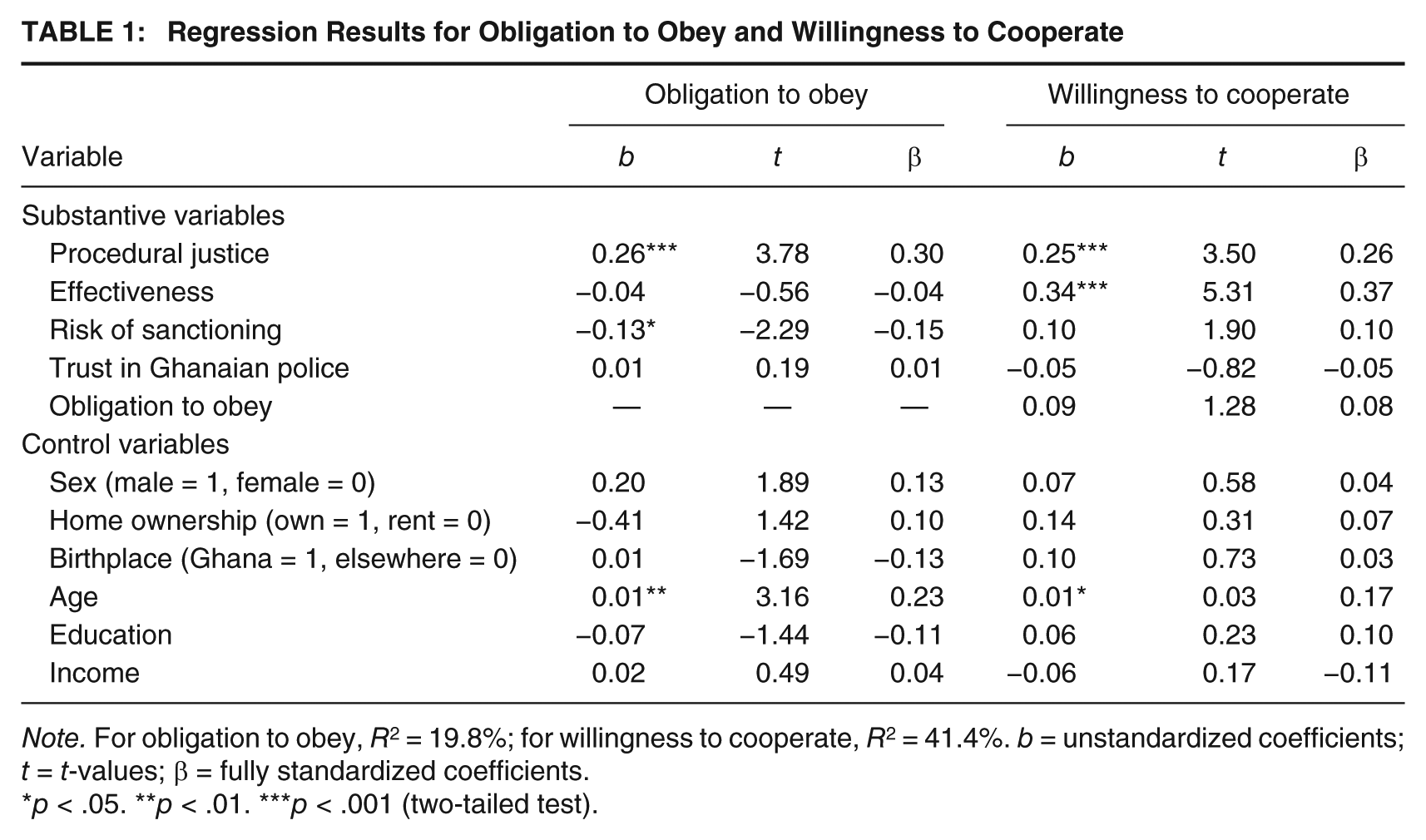
Note. For obligation to obey, R2 = 19.8%; for willingness to cooperate, R2 = 41.4%. b = unstandardized coefficients; t = t-values; β = fully standardized coefficients.
p < .05. **p < .01. ***p < .001 (two-tailed test).
Next we turn to the regression results for willingness to cooperate (see Table 1). The model explains 41.4% of the variation in willingness to cooperate, with two of the five substantively meaningful exogenous variables exerting a statistically significant effect: perceived effectiveness (β = 0.37) and procedural justice (β = 0.26). Perceived effectiveness exerted a stronger influence than procedural justice on willingness to cooperate with police. This finding runs contrary to much of the literature, but is consistent with findings from research carried out in Ghana by Tankebe (2009). We explore this finding in greater detail in the Discussion section. The effect of obligation to obey on willingness to cooperate was not statistically significant. As expected given this finding, the indirect effects of the four substantive exogenous variables on cooperation through obligation were also not statistically significant. Only one of the six control variables exerted a statistically significant effect on willingness to cooperate: age. The significant positive coefficient for age (β = 0.17) suggests that older respondents feel a greater willingness to cooperate with police than younger respondents. The remaining controls, including sex, home ownership, birthplace, education, and income, did not have a statistically significant effect.
To further explore the potential influence of immigration experiences on obligation to obey and willingness to cooperate, we conducted two additional analyses. First, we sought to determine whether there were any differences between first- and second-generation immigrants on these outcomes. To examine this, we used an immigrant generation variable in place of the birthplace variable (which is similar, but not identical). 12 Our findings revealed that the immigrant generation variable did not have a statistically significant effect on either obligation to obey (β = −0.08; p = .325) or willingness to cooperate (β = 0.01; p = .885). Second, we tested the effect of length of residence in the United States on obligation to obey and willingness to cooperate. This analysis included only the respondents who were first-generation immigrants (those born outside the United States). Length of residence in the United States did not have a statistically significant effect on either obligation to obey (β = 0.07; p = .465) or willingness to cooperate (β = −0.04; p = .688).
Supplementary Analysis
In light of recent debates in the field about the meaning and measurement of legitimacy (see Note 2), we undertook a supplementary analysis to investigate the influence of trust and confidence in the U.S. police. As noted previously, institutional trust is often conceptualized as a component of legitimacy, and is frequently combined with obligation to obey to form a single measure of legitimacy. This composite measure of legitimacy is regularly used as a dependent variable in models where procedural justice is included as a key independent variable. Recently, scholars have called this practice into question. Though peripheral to our primary theoretical interests in this study, the data set we are using provides a unique opportunity to explore the relationship between trust in the U.S. police and procedural justice. Because the results from this supplementary analysis are relevant to these current debates, we include them in this ancillary section.
We began by examining the correlations between our four-item measure of trust and confidence in the U.S. police (see Appendix A for a listing of items) and other variables in the model. The institutional trust measure exhibited discriminant validity problems, correlating highly with our measure of procedural justice (r = .998). This finding is consistent with similar results from recent research (e.g., Gau, 2011, 2014; Johnson et al., 2014; Reisig et al., 2007). Due to the high correlation between these two constructs, including them both together as exogenous variables in the model would introduce a severe multicollinearity problem. As noted in our earlier discussion of distributive justice, one potential approach would be to combine these two constructs into a single overall construct measuring institutional trust and procedural justice to explore their effects on people’s obligation to obey and willingness to cooperate. We do not see a substantive justification for doing this, particularly given theoretical and conceptual questions about the meaning of institutional trust and where it belongs in the nomological network of related concepts (Johnson et al., 2014; Kaina, 2008). 13 We explore these issues in greater detail in the Discussion section.
Discussion
This article examined the antecedents of obligation to obey and willingness to cooperate with the police in a sample of Ghanaian immigrants in Alexandria, Virginia. Drawing on procedural justice theory and the literature on immigrant experiences in the United States, we tested the direct and indirect effects of several factors on obligation and cooperation. Consistent with the literature, the findings revealed that perceptions of procedural justice play an important role in shaping both obligation and cooperation. Ghanaian immigrants who view the police as behaving in a procedurally just manner feel a greater obligation to obey police directives and a greater willingness to cooperate with police. This finding provides a powerful endorsement for recent policy prescriptions that encourage police agencies to embrace procedural justice in both their training and operations (President’s Task Force, 2015). This finding also adds to the growing body of scientific research on the potent effects of procedural justice on a variety of beneficial outcomes among different populations.
Our findings also revealed that the perceived effectiveness of police in fighting crime has uneven effects on obligation and cooperation. Perceived effectiveness does not have a statistically significant effect on obligation to obey the police, but it does have a strong, positive effect on willingness to cooperate. Ghanaian immigrants who view the police as more effective report a greater willingness to cooperate with police on issues such as reporting crime or suspicious activity and providing information to police. While procedural justice is more influential in shaping Ghanaian immigrant’s internal feelings of obligation to obey the directives of police, perceived effectiveness is more important in shaping their willingness to cooperate with police. Consistent with findings from Tankebe’s (2009) research in Ghana, these findings reinforce the importance of utilitarian considerations in shaping people’s calculus about whether to cooperate with legal authorities. These findings are also consistent with how police leaders believe their agencies can improve people’s willingness to cooperate. Based on data from a national survey of U.S. police executives, Nix (2015) found that respondents viewed effectiveness in controlling crime as significantly more important than procedural justice in securing citizen cooperation.
We cannot state with confidence why perceived effectiveness is the dominant predictor of willingness to cooperate with police. One straightforward possibility is that when an institution is perceived as effective in performing its core tasks, people may be more inclined to cooperate with representatives of that institution. In contrast, people may question the wisdom of cooperating with an institution they do not perceive to be effective in carrying out its essential mission. Put differently, for some respondents, competence may breed cooperation. Tankebe (2009) attributed his findings about the primacy of perceived effectiveness to the accumulated experiences of Ghanaian residents with a corrupt, brutal, and ineffective police force. In such a circumstance, getting police to perform their basic community protection function may rise to the top of their hierarchy of needs and expectations from the police. Procedural justice is still valued, but it may be located a rung below effectiveness in this hierarchy of needs and expectations. To the extent that this interpretation of Tankebe’s findings in Ghana is accurate, the Ghanaian immigrants in our sample may simply be carrying these expectations of police with them from their homeland.
We found that another instrumental factor—risk of sanctioning—had a significant negative effect on obligation and a nonsignificant effect on willingness to cooperate with the police. Perceptions about the likelihood of being apprehended and punished for engaging in unlawful behavior represent a key aspect of deterrence theory, a classic utilitarian explanation for why people obey the law. The negative effect was unexpected and we can only speculate about the reason for this finding. However, ethnographic accounts of African immigrants in the United States and their interactions with police provide a rich basis for speculation (Arthur, 2000, 2008). For instance, some Ghanaian immigrants report that they are unfairly targeted by police due to the combination of their race and their status as immigrants (Arthur, 2008). To the extent that they perceive themselves to be stigmatized by police and placed under heightened levels of suspicion, they may judge their risk of sanctioning to be higher. Under such conditions, an elevated risk of sanctioning would likely be viewed as both unjust and inappropriate. Therefore, it may have the unintended consequence of inhibiting people’s moral alignment with legal authorities and reducing their internalized sense of obligation to obey the police. This interpretation is consistent with defiance theory, which suggests that unjust and inappropriate behavior on the part of legal authorities can ignite “a moral intuition to defy or resist the status quo” (Sherman, 2010, p. 367).
The logic behind this explanation is consistent with Anthony Harriott’s (2001) account of the urban poor in Jamaica, which, like Ghana, is a former British colony that continues to struggle with the vestiges of colonialism. Many of the critiques that have been leveled against the Ghanaian police—including corruption, brutality, and failure to protect the most vulnerable communities—have also been made against the Jamaican police. According to Harriott (2001), the tenuous relationship between the urban poor who live in stigmatized Jamaican communities and the police is due in large part to the fact that they are subjected “to overpolicing and a fair degree of harassment based on a lower threshold of criminal guilt being applied to them relative to other citizens. They are thus more likely to be unjustly arrested or detained” (p. 61). While sanction risk is typically conceptualized as a proxy for the extent to which the criminal justice system is able to deter crime by holding offenders accountable for their unlawful behavior, for some respondents it may have a different meaning. Some Ghanaian immigrants may view perceived sanction risk as a function of the extent to which the police engage in unlawful or unethical targeting of Blacks, immigrants, or the chronically impoverished. 14 If some respondents view sanction risk as a proxy for unfair policing tactics that target them or their loved ones, then we would expect to find a negative effect of perceived sanction risk on obligation to obey the police. Future research should seek to clarify how respondents in different contexts think about perceived risk of sanctioning, whether in the conventional manner (as a proxy for the deterrent capacity of police) or in the unconventional manner we have posed here.
In addition to the normative and instrumental explanations for obligation and cooperation that we have just examined, it was also important in this study to draw on insights from the study of immigrant assimilation. The immigration literature emphasizes the role of immigrants’ experiences (whether direct or vicarious) with institutions in their country of origin in shaping their attitudes toward parallel institutions in their destination country (Correia, 2010; Davis & Henderson, 2003; Menjívar & Bejarano, 2004). For instance, Davis, Erez, and Avitabile (2001) argue that mistrust in police in an immigrant’s country of origin acts as a deterrent to seeking help from the police in the United States. In this case, Ghanaian immigrants’ obligation to obey and willingness to cooperate with U.S. police may be influenced by their trust (or mistrust) of the police in Ghana. We tested this hypothesis by including a measure of trust and confidence in the Ghanaian police as an exogenous variable in our structural model. Contrary to our expectations based on the immigration literature, the measure did not have a statistically significant effect on either obligation to obey or willingness to cooperate.
One possibility for this finding is that Ghanaian immigrants may maintain their attitudes toward police in Ghana and the United States in separate cognitive “accounts.” Thus, attitudes toward one may not have a direct effect on obligation to obey or willingness to cooperate with the other. A common pattern in the immigrant acculturation experience is finding ways to separate the old (the country of origin) from the new (the destination country). For instance, in Watson’s (2004) study of African immigrants in the United States, one mother said, “I tell them (my children) every day. This house is Ghana. When you go outside, that is America.” To the extent that immigrants are able to separate their experiences with Ghanaian and U.S. police, trust in the Ghanaian police may not have a direct impact on obligation to obey or willingness to cooperate with U.S. police. This does not necessarily mean that attitudes or experiences with the Ghanaian police do not color their expectations of police in the United States in more subtle ways. For instance, our finding that trust and confidence in the Ghanaian police does not influence obligation and cooperation in the United States is not incompatible with our earlier argument that Ghanaian immigrants may simply have lower expectations of American police because of their experiences in their country of origin. A key part of understanding how immigrants perceive and interact with law and legal authority in the United States is unpacking the many ways—both straightforward and subtle—in which these perceptions may be shaped by people’s experiences with police in their country of origin.
Our finding that public expressions of obligation to obey police did not have a significant effect on willingness to cooperate with the police is consistent with some previous studies (Reisig et al., 2007; Reisig, Tankebe, & Mesko, 2012; Tankebe, 2009) but not others (Gau, 2011; Tankebe, 2013). 15 This finding illustrates that while normative explanations for cooperation with legal authority are still valid (as evidenced by the significant effect of procedural justice), they are not necessarily universal across all populations and settings. In our sample of Ghanaian immigrants, an internalized sense of obligation to obey the police does not appear to be a precondition for willingness to cooperate. Cooperation may not always be predicated on an internalized or moral sense of duty. Instead, cooperation is often heavily influenced by the extent to which police are perceived as protecting the community effectively and treating people fairly.
Two other findings from our analysis are important to highlight. First, in our initial model, which included a measure of distributive justice as an exogenous variable, we found that distributive justice had an almost perfect correlation with procedural justice (r = .98) and therefore we dropped it from the model due to multicollinearity concerns. Recall that a cornerstone of procedural justice theory is that people form separate evaluations of the extent to which authority figures rely on fair procedures (procedural justice) and generate fair outcomes (distributive justice). The idea that people make separate judgments about procedural and distributive justice is what enables scholars to argue that the former is more important than the latter in shaping people’s decisions to obey the law (Tyler, 2006). If the two concepts are not empirically separable as suggested in this study, then a key component of procedural justice theory as articulated by Tyler and his colleagues needs to be reconsidered.
Unfortunately, it is not clear to what extent the high correlation that we found between procedural and distributive justice is unique to our specific sample or is a common pattern in the literature. 16 A recent study of London residents by Tankebe (2013) also found a high correlation between distributive and procedural justice (r = .89), which is lower than what we found here, but still high enough to raise concerns about discriminant validity in measures of these key concepts. These findings raise important conceptual issues. Are procedural and distributive justice separate perceptual phenomena, and if so, under what conditions? Given the importance of these foundational concepts in theories of public compliance and cooperation with the law and legal authorities, clarifying the extent to which (or the conditions under which) they represent distinct cognitive/affective judgments deserves greater attention by theorists and researchers.
Second, based on research and theory on the role of institutional trust, we carried out a supplementary analysis that examined the influence of trust in the U.S. police. As with our earlier analysis of distributive justice, we found that our measure of trust was almost perfectly correlated with procedural justice (r = .998), therefore its independent effects could not be estimated. Once again, this finding raises important conceptual issues. Recall that in most of the scholarship on procedural justice and legitimacy, trust is conceptualized as an aspect of institutional legitimacy. The modal approach to research in this genre is to combine measures of institutional trust and obligation to obey (and sometimes other phenomena) into a composite measure of legitimacy. Scholars then estimate the effects of procedural justice and other factors on this measure of legitimacy, typically concluding that procedural justice is the dominant predictor of legitimacy. However, as trust (which is part of the dependent variable in these analyses) is so highly correlated with procedural justice (which is an independent variable), the resulting findings may be largely tautological. We are not the first to point out this issue (see Gau, 2011, 2014; Johnson et al., 2014; Maguire & Johnson, 2010; Reisig et al., 2007). Once again, the extent to which trust represents a separate concept from procedural and distributive justice deserves greater attention (for a discussion of this issue, see Jackson & Gau, 2016). While theorists have articulated the conceptual differences between trust and procedural justice, at an empirical level the key question is whether (or under what conditions) people are able to form separate cognitive/affective judgments about these issues.
While this study makes several useful contributions to the literature, it also has some limitations. First, because the study looked at procedural justice and related factors through the eyes of Ghanaians who attended church in one city, our results may not be generalizable to Ghanaian immigrants in other cities or to those who do not attend church. Second, the views and experiences of sub-Saharan African immigrants may be very different from those of other immigrant groups, so we urge caution in generalizing the results of this study beyond the sub-Saharan African immigrant community. Third, our analysis is based on general impressions and not on those derived from specific experiences with police and other legal authorities. Finally, while the analysis of survey data offers many benefits, the use of other methods would help provide a more complete understanding of Ghanaian immigrants and their perspectives on the police.
Conclusion
The findings of this study have implications for theory, research, and policy. For theory, our findings suggest that while normative models of compliance and cooperation are indeed robust, they may not be universal. People from different cultures and contexts think about law and legal authority in different ways and are differentially influenced by normative and utilitarian considerations. This study contributes to a growing body of scholarship that is helping to define the scope of procedural justice theory. Our findings also have numerous implications for future research. One key implication is the importance of testing for discriminant validity between closely related perceptual concepts like procedural justice, distributive justice, and trust. Research that clarifies the nature of these concepts and the relationships between them will provide evidence that is useful for modifying theories of compliance and cooperation. For policy, our findings reinforce the essential notion that police cannot produce secure communities by themselves. The success of the police depends heavily on the willingness of people to cooperate with their efforts, call the police when something is amiss, provide information to police, and serve as witnesses in criminal proceedings. Our research suggests that through a combination of fair and effective policing practices, police can stimulate a voluntary willingness to cooperate with police among Ghanaian immigrants.
Footnotes
Appendix A
Appendix B
Correlation Matrix for All Variables in Structural Model
| Variable | 1 | 2 | 3 | 4 | 5 | 6 | 7 | 8 | 9 | 10 | 11 | 12 |
|---|---|---|---|---|---|---|---|---|---|---|---|---|
| 1. Procedural justice | — | |||||||||||
| 2. Effectiveness | .59 | — | ||||||||||
| 3. Risk of sanctioning | .16 | .13 | — | |||||||||
| 4. Trust in Ghanaian police | .29 | .08 | −.03 | — | ||||||||
| 5. Obligation to obey | .29 | .12 | −.02 | .10 | — | |||||||
| 6. Willingness to cooperate | .52 | .54 | .21 | .09 | .15 | — | ||||||
| 7. Sex | −.03 | −.09 | .03 | −.04 | .08 | .08 | — | |||||
| 8. Home ownership | −.01 | −.02 | .01 | .01 | .13 | .09 | .03 | — | ||||
| 9. Birthplace | −.00 | −.00 | .07 | −.06 | −.10 | .05 | .09 | −.08 | — | |||
| 10. Age | .15 | .16 | .04 | .07 | .20 | .17 | .06 | .08 | .12 | — | ||
| 11. Education | −.01 | −.03 | .07 | −.08 | −.10 | .09 | .25 | .10 | −.06 | −.10 | — | |
| 12. Income | −.13 | −.04 | .11 | −.13 | .07 | −.01 | .22 | .29 | −.10 | .11 | .34 | — |