



Abstract
To maintain safety and order, some correctional settings permit the use of controls on youth in response to behavioral problems; however, use of controls may exacerbate trauma symptoms that many youth bring to the carceral experience. Data from the Survey of Youth in Residential Placement are used in this study (N = 7,073). Structural equation modeling was used to test three hypotheses: (a) youth with a history of physical, sexual, and emotional abuse report greater use of staff controls; (b) externalizing behaviors partially mediate this relationship; and (c) externalizing behavior and staff controls are mutually reinforcing. Findings suggest that youth with physical and sexual abuse histories experience greater staff controls. Externalizing behavior was a partial mediator and a reciprocal product of staff controls. Such findings warrant caution for institutional policies and staff practices that promote the use of control, and instead call for the use of trauma-informed responses to misbehavior.
Keywords
On any given day, more than 50,000 youths reside in secure placements (Office of Juvenile Justice and Delinquency Prevention [OJJDP], 2016). Although this statistic has been halved since the mid-1990s (OJJDP, 2016), pervasive institutionalization of young offenders remains a serious social problem facing the United States. With the largest incarceration rate in the world, the United States places more youth behind bars relative to all other industrialized countries (Sabol, West, & Cooper, 2009). Incapacitation is reasoned to act as a deterrent, a public safety measure, and a remedial response (Gottfredson & Gottfredson, 1994). Therefore, imprisonment of young offenders will likely remain a sentencing option, even with the emergence of smart decarceration initiatives (see Grand Challenges outlined by the American Academy of Social Work and Social Welfare, 2017).
The goals of juvenile justice have long been deliberated (Gottfredson, Taylor, National Institute of Justice, & Johns Hopkins University, 1983; Monahan, 1981); a system that balances punishment with rehabilitation is an ideal model for responding to youthful offending (Howell, 2003). Juvenile justice-involved youth have higher rates of early life abuse than the general population (Coleman, 2005; Coleman & Stewart, 2010; Ford, Chapman, Connor, & Cruise, 2012). However, very few carceral settings are trauma-informed or comprehensively screen for trauma (Crosby, 2016; Donisch, Bray, & Gewirtz, 2016; Yoder, Whitaker, & Quinn, in press). Therefore, staff controls can be applied to youth without consideration of early life abuse experiences. Some correctional settings have protocols that permit infliction of harm, other physical punishments, or psychological measures directed toward youth to maintain control and order within facilities and to prevent behavioral disruptions (Day, 2002; Schwalbe & Maschi, 2011).
Externalizing behaviors are one way that youth manifest emotional responses associated with abusive experiences (DeLisi et al., 2010). Emotions such as anger and frustration can showcase themselves as behaviors including, but not limited to, fighting, stealing, destruction, or refusal to follow rules. Because behavioral problems are often reasoned to be an impetus for the use of staff controls (Wasterfors, 2009), it may partially explain the relationship between prior abusive experiences and the use of staff controls in correctional settings. Using an integrated framework of general strain, importation, and deprivation theories, this study tested the complex relationships between youth reports of disparate abusive experiences and staff physical and isolating controls, and the mediating influence of externalizing behaviors. This study also tested the mutually reinforcing relationship between staff controls and externalizing behaviors.
Literature Review
General Strain Theory and Abusive Experiences
There are several criminological theories from which to contextualize youth offending and penology. Agnew’s general strain theory (GST) is one optimal framework that considers the impact of early abusive experiences (Agnew, 1992). GST suggests there are inadequate opportunities for disenfranchised groups to meet societal goals, and that delinquent behavior is both a coping mechanism and an illicit attempt to meet these goals. Agnew presents three possible sources of societal strain: inability to accomplish goals, removal of positively valued stimuli, and/or the presence of harmful stimuli (Agnew, 1992). Negative emotional responses can result if an individual has perceived a strain event as threatening or harmful (Agnew, 2001, 2013; Broidy & Agnew, 1997). In fact, certain types of strain, such as experiences of physical, sexual, or emotional abuse, increase the likelihood for negative emotional responses (Agnew, 2001). Emotional responses such as anger and frustration are disinhibiting mechanisms that can manifest as externalizing behaviors, which often resemble “delinquency” (Agnew, 1992, 2001, 2013).
Direct forms of violence including sexual, physical, and emotional abuse can be identified as strain among youth (Watts & McNulty, 2013). Youth exposed to such early adverse childhood experiences face increased risk for juvenile justice involvement (Bennett & Kerig, 2014; Evans & Burton, 2013; Kerig & Bennett, 2013). Juvenile justice-involved youth tend to experience early life victimization more frequently than the general population—including direct or indirect abuse or neglect. For example, 40% to 60% of adjudicated youth have been victimized (Currie & Tekin, 2006; Ford, Chapman, Mack, & Pearson, 2006; Stahl, 2006); approximately 90% of detained youth report a history of at least one abusive experience (Ford, Hartman, Hawke, & Chapman, 2008); 35% of detained youth report histories with at least one physically abusive experience (Ford, Hawke, & Chapman, 2010); and epidemiology studies suggest incarcerated youth have victimization rates that are two times higher than the general population (Coleman, 2005; Coleman & Stewart, 2010; Ford et al., 2012). In addition, prospective research suggests that victimized youth are at an elevated risk for delinquency (C. Smith & Thornberry, 1995; Widom, 1989), as victimization can lead to a host of psychological impairments and behavioral disruptions (Cloitre et al., 2009; Monnat & Chandler, 2015; Watts & McNulty, 2013).
Response to Strain: Externalizing Behaviors and Importation Theory
Left inadequately treated, a person with abusive histories and associated externalizing behavioral problems can experience a regeneration of those problems in various settings (Agnew & DeLisi, 2012). Moreover, carceral settings have been shown to exacerbate externalizing behavioral problems (Harder, Knorth, & Kalverboer, 2013; Innes, 1997; Shulman & Cauffman, 2011). The relative effects of individual characteristics and facility responses that contribute to behavioral problems in correctional institutions can be understood through importation and deprivation models, respectively. Importation theory postulates that internal characteristics are linked to behavioral problems in prison (Byrne & Hummer, 2008; Irwin & Cressey, 1962). Some characteristics identified by research include race, prior adjudication, prior record, or mental health history (Byrne & Hummer, 2008). Early life experiences including victimization or abuse also fit into the importation model; violence, abuse, or adverse childhood experiences can fuel chronic patterns of emotional and behavioral dysregulation (DeLisi et al., 2010; Farrington & Welsh, 2007; Gover, 2004).
Abusive experiences have been studied as a determinant of externalizing behavioral problems (Finkelhor, Ormrod, Turner, & Holt, 2009). Abusive experiences may produce neurological impairments underlying behavioral and emotional dysregulation (Perry, Pollard, Blakley, Baker, & Vigilante, 1995). Abuse or neglect that occurs during formative periods of neurological development can disrupt “normative” developmental pathways and alter physiological and psychological responses (Perry et al., 1995). In threatening situations, normative neurological responses are overridden by the amygdala’s “fight or flight” functionality. If the abusive experience is replicated in the same or other contexts, the individual adopts a response on the continuum between hyperarousal and dissociation (Perry et al., 1995). This response can contextualize the link between abusive experiences and externalizing behavioral problems. Adverse childhood experiences can chronically affect youth development that leads to impairments of self-regulation capacity, attachments, or cognitive abilities (Cook et al., 2005).
Importation theory can explain how these problems manifest in juvenile justice settings; internalization of strain, or processing of the abusive experience, can lead to externalization, or overt displays of that internal stress (DeLisi et al., 2010). One seminal research study tested the importation model and found evidence above and beyond other individual-level variables that greater early life trauma was associated with more total institutional misconduct (DeLisi et al., 2010). In particular, aggression, anger, or conduct problems were expressions that reflected underlying stress. It is argued that such behaviors can be especially harmful when intersected with traumatic reminders common in juvenile justice settings (Ford et al., 2012). For example, in a review of the associations between complex trauma and aggression, child abuse was connected to reactive defense responses in the presence of painful physical triggers (Ford, Fraleigh, Albert, & Connor, 2010).
Institutional Control Methods and Deprivation Theory
Conversely, the deprivation model posits that the institutional culture deprives youth of resources and engenders problem behaviors (Skyes, 1958). The deprivation model suggests that experiences within the institutional context shape the development of misconduct, because they deprive youth of basic human rights, including liberty, freedom, goods or services, or human contact (Skyes, 1958). Some prison environments employ strict controls or restrictive securities that intensify deprivation, which also fuels misconduct (Gover, MacKenzie, & Armstrong, 2000; Kuanliang, Sorensen, & Cunningham, 2008).
Correctional facility staff are responsible for supervision, monitoring, and guidance of the youth in their care. Facility protocols often call for staff to use “controls” in an effort to assist with daily operations. There are many forms of control used in facilities including chemical agents or pepper spray (Council of Juvenile Correctional Administrators, 2011; Kearney, Hiatt, Birdsall, & Smollin, 2014), coercion and physical coercion (Marquart, 1986; Schwalbe & Maschi, 2011), strip searches (Feierman & Shah, 2007), seclusion (D. E. Miller, 1986), or restraints (Leidy, Haugaard, Nunno, & Kwartner, 2006). The hierarchical configuration (the demand process) of institutional control has long been studied (Goffman, 1961), and several understandable reasons exist as to why such methods of control are employed. However, the negative implications that may result from such controls also merit careful consideration.
Research has begun to discover institutional mechanisms of control and associated impacts on youth development. The contentious debate surrounding justification for methods of control including restraint or seclusion have been ongoing (Day, 2002; Wasterfors, 2009). The use of restraints and seclusion has been argued necessary in some instances to maintain order (Mason & Magnan, 1995). Control methods are also used to keep other residents in the facilities safe from physical harm (Bartollas, Miller, & Dinitz, 1976). Nevertheless, more recent research suggests that mechanisms of control could be damaging to youth in precarious stages of development (Inderbitzin, 2005), and children who are involved in juvenile justice are entitled to the same constitutional rights and privileges of personhood as nonprisoners; control methods may be a violation of these rights (Feierman & Shah, 2007).
Many youth in correctional and residential placements are subjected to staff controls, and youth with histories of abuse may be at an increased risk for receiving restrictive controls. Research has shown that insensitivity to adverse childhood experiences can intensify psychological difficulties (Hipwell & Loeber, 2006). Furthermore, research has highlighted how using strip searches can be retraumatizing for youth who have been previously sexually abused (Feierman & Shah, 2007), or that solitary confinement or seclusion can have multiple psychological effects and exacerbate early trauma; those in solitary confinement with trauma histories may be more likely to complete suicide (DeLisi et al., 2010). The use of controls may perpetuate a cyclical effect whereby controls beget externalizing behaviors, which subsequently fuels more restrictive or harsher controls (Mansdorf, 1977). Youth who are subjected to control methods such as restraints may have associated retraumatization (Lawrence & Hesse, 2010), successively exhibiting externalizing behavioral problems (M. L. Smith & Bowman, 2009).
Testing an Integrated Theory
Scholars have hypothesized that strain can engender maladjustment in multiple contexts (Blevins, Listwan, Cullen, & Jonson, 2010), suggesting that GST, importation, and deprivation models can be integrated. For example, Blevins and colleagues (2010) argue that the carceral experience characterizes all three types of Agnew’s accumulated strain. Taken together with the importation model, which suggests that misconduct is a coping mechanism associated with earlier strain (Berg & DeLisi, 2006), and the deprivation model, which exemplifies how new strain can be reinforced and old strain is exacerbated in the correctional context (Blevins et al., 2010), these theoretical positions can be tested concurrently.
This process can be conceptualized in the following way: serious forms of strain—abusive experiences (Agnew, 2001)—can lead to offending behaviors that can result in correctional placements. In correctional placements, early abusive experiences (strain) continue to generate negative emotional responses, thus spawning repeated externalizing behaviors (Strain × Importation). Staff controls are used to maintain general order among youth who have endured abuse (Strain × Deprivation), but may especially be used to reduce externalizing behavioral problems manifested in the facility that are associated with early strain (Strain × Importation × Deprivation). Last, correctional controls can fuel additional externalizing behaviors (Importation × Deprivation).
While multiple research studies have tested general strain, deprivation, and importation theories separately, there is limited research testing an integrated framework. This study tests the interconnected framework of GST, importation, and deprivation to learn more about the use of staff controls on abused youth, the mediating role of externalizing behaviors, and the reciprocal relationship between externalizing behaviors and staff controls. Three hypotheses were proposed:
Method
Sample
Participants in this study were drawn from the Survey of Youth in Residential Placement (SYRP; Sedlak, 2003)—an anonymous, self-report survey administered to a nationally representative sample of pre- and postadjudicated youth, who ranged in age from 10 to 20 years old, and resided in state and local juvenile facilities. Sponsored by the OJJDP, the SYRP joins two existing surveys—the Census of Juveniles in Residential Placement (CJRP) and the Juvenile Residential Facility Census (JRFC). While the census surveys collect data from facility administrators, the SYRP gathers information directly from the youth. Collectively, these surveys inform national knowledge of custody statistics.
Facilities included in the CJRP and JRFC were used to inform a probability proportional-to-size sample design used by the SYRP. Random sampling among 36 states resulted in the identification of 290 facilities. A total of 240 facilities met criteria for data collection. Due to an inability of some facilities to gain clearance through state or local authorities, or the decline of facility administrators (Sedlak, 2010), the final sample of participating facilities totaled 204 (85%). Across those facilities, the SYRP identified 9,495 eligible youth participants. Youth who were unable to obtain parental consent, were not available at the time the survey was administered, or were not permitted by their facility to participate were not included in the final sample size of 7,073 youths (74.5%; Sedlak, 2010). Participants averaged 16.5 years of age (SD = 1.5), were primarily male (n = 5,378; 76%), and predominantly identified themselves as Hispanic (any; n = 2,308; 32.6%), Black or African American (n = 2,026; 28.6%), or White (n = 1,951; 27.6%). Other racial and ethnic categories of the sample included American Indian/Alaska Native/Asian/Native Hawaiian/Other (n = 197; 2.8%) and two or more non-Hispanic groups (n = 421; 6%). When the survey was administered, youth had accumulated an average of 6.32 months (SD = 8.38) of facility time.
Procedures
Cross-sectional surveys were delivered between March and June in 2003. Participants were linked to unique identification numbers to ensure the anonymity of their responses. To aid in the administration of the surveys, a software program known as audio computer-assisted self-interview (ACASI) was used; the program reads prerecorded questions aloud to youth (who listen on headphones), while also displaying the text on the computer screen (Sedlak, 2010). To access and use the SYRP data for this study, necessary approvals were obtained from the Ohio State University’s Institutional Review Board and the National Archive of Criminal Justice Data (NACJD) through the Inter-University Consortium for Political and Social Research (ICPSR) Data Access Request System (IDARS).
Measures
The SYRP survey reflects a combination of items taken from standardized instruments and others deemed important to stakeholders by the SYRP advisory board and team members, as well as OJJDP (Sedlak, 2010; Sedlak et al., 2012). Survey questions covered topics ranging from early life experiences, health and mental health symptoms and facility service delivery, facility experiences, and educational and vocational opportunities. Variable selection for this article was done in a way to preserve temporal order and parse out the individual effects of abuse. Three observed exogenous variables were chosen to represent abusive experiences, and then additional items were pooled to create three endogenous latent constructs that reflected externalizing behavior and staff methods of physical control and isolation. Demographic variables were used as controls.
To determine the latent constructs, exploratory factor analyses (EFA) were conducted using SPSS version 22 (IBM, 2013). Next, the reliabilities were run using Cronbach’s alphas (α) for each construct. Finally, Mplus version 7.4 (Muthén & Muthén, 2015) was used to conduct confirmatory factor analysis (CFA) and corroborate each factor’s structure.
Frequency of Abusive Experiences
Three variables were used to capture the frequency of abuse while youth were “living with [their] family or in another household . . .” As a measure of physical abuse, youth were asked, “. . . did a grown-up in your life hit, beat, kick, or physically abuse you in any way?” As a measure of emotional abuse, youth were asked, “. . . did you ever get scared or feel really bad because grown-ups called you names, said mean things to you, or said they didn’t want you?” And, as a measure of sexual abuse, youth were asked, “. . . did a grown-up ever touch your private parts when you didn’t want them to, or make you touch their private parts?” As a follow-up question to each of these items, youth were asked to indicate, “How many times did this happen to you?” Response options included (1 = 1 time, 2 = 2 times, 3 = 3 to 10 times, 4 = More than 10 times). The values 3 and 4 were collapsed into one value because victims of abuse may not always accurately recall event details (Welton-Mitchell, McIntosh, & DePrince, 2013) and may not differentiate more than three events with complete certainty. The resulting measure of frequency is represented as (0 = 0 times, 1 = 1 time, 2 = 2 times, 3 = 3 or more times) for each abuse item.
On average, youth reported one prior experience of physical abuse (M = 0.99, SD = 1.37). However, more than half of the sample (64.3%) reported no prior incidents of physical abuse (n = 4,550). Of those remaining, 150 youths (2.1%) reported one incident, 260 (3.7%) reported two incidents, and 2,113 (29.9%) reported three or more incidents. Past sexual abuse (M = 0.32, SD = 0.88) was not endorsed by 87.1% of the sample (n = 6,162). Of those remaining, 160 youths (2.3%) reported one incident, 150 (2.1%) reported two incidents, and 601 (8.5%) reported three or more incidents. Last, youth reported an average of one prior experience being emotionally abused (M = 0.88, SD = 1.34). However, more than half of the sample (n = 4,869, 68.8%) reported no prior incidents. Of those remaining, 95 youths (1.3%) reported one incident, 191 (2.7%) reported two incidents, and 1,918 (27.1%) reported three or more incidents.
Externalizing Behavior
An EFA was conducted to determine the factorability of the set of items operationalized as Externalizing Behavior. Bartlett’s test of sphericity indicates whether correlations in the correlation matrix are significantly different from zero at p < .05 (Leech, Barrett, & Morgan, 2005); this test was statistically significant at p < .01. The Kaiser-Meyer Olkin (KMO) measure of sampling adequacy is frequently used to determine whether factor analysis is appropriate; values >.60 indicate that there are enough items with common variance to be predicted by a factor (Leech et al., 2005). The overall KMO for this construct was .75. Using principal axis factoring and promax rotation, one factor returned an Eigenvalue greater than 1.0, suggesting that externalizing behavior as a latent construct explained more information than any single item could explain; this was also visible when looking at the scree plot (Leech et al., 2005). This factor accounted for 56.1% of the total variance explained. Ideally, item communalities should be at least .50 as higher values indicate the likelihood that associated items will load on the same factor (Leech et al., 2005). While the communalities were low (ranging from .19 to .56), the factor loadings were adequately near or above .40 (Floyd & Widaman, 1995). The factor also yielded good reliability (α = .74).
The latent construct Externalizing Behavior was comprised of four observed variables, which asked youth if, in the past few months, they have (a) “lost [their] temper easily, or had a short fuse,” (b) “been easily upset,” (c) “felt angry a lot,” and (d) “hurt or broken something on purpose, just because [they] were mad.” All items were dichotomously measured (0 = no, 1 = yes). Responses of “don’t know,” “inapplicable,” or those refused were coded as missing. While three of these items capture affect and one is more behavioral in nature, combined, they serve as the best proxy for externalizing behavior from the SYRP data available.
Staff Methods of Physical Control and Isolation
A second EFA was conducted to determine the factorability of the variables comprising Staff Controls—Physical and Staff Controls—Isolation. The results indicated that Bartlett’s Test of Sphericity was significant at p < .01. The overall KMO for these constructs was good at .83. Using principal axis factoring and promax rotation, two factors returned Eigenvalues greater than 1.0, which suggested that physical control and isolation methods were separate constructs. Together, both factors accounted for 51.8% of the total variance explained. Item communalities were again low (ranging from .21 to .60), and factor loadings were acceptably near or above .40. Tests of reliability for physical control and isolation returned alphas of .66 and .70, respectively.
The latent construct Staff Controls—Physical is comprised of five observed variables, which asked youth if, since coming to the facility, staff have (a) held them down, (b) used handcuffs or wristlets on them, (c) used a security belt or chains on them, (d) strip-searched them, and (e) sprayed them with pepper spray. All items were dichotomous (0 = no, 1 = yes).
The second latent construct Staff Controls—Isolation was comprised of three observed variables, which asked youth if, since coming to the facility, staff have (a) put them into solitary confinement or locked them up alone as discipline, (b) confined them to their own room as discipline, and (c) moved them to a different location within the facility as discipline. All items were dichotomous (0 = no, 1 = yes).
Demographics/Controls
Four demographic variables were included in the models: (a) age represents the number of years old a youth was when they completed the survey; (b) gender was measured as female (0) or male (1); (c) race/ethnicity was dummy coded (0 = absence; 1 = presence) to represent the three dominant categories of youth responses: (1) White, (b) Black or African American, and (3) Hispanic (any); and (d) facility time was measured as months in the current facility up to the survey date.
Data Analysis
Structural equation modeling (SEM) was used to analyze the data using Mplus v. 7.4 (Muthén & Muthén, 2015). SEM was a suitable analytic approach for this study because of the large sample size (Bowen & Guo, 2012) and the nature of the relationships under investigation. To test the integrated theory, two sequential models were run. The main model, comprised of both observed and latent constructs, tested the first two hypotheses—the direct effects of abuse on staff controls and the mediational effects of externalizing behaviors. This model was overidentified and met the preferred criterion for unique parameter estimates to be generated (Kline, 2016); the number of known parameters in the model (210) exceeded the number of unknown parameters that were estimated (52), resulting in degrees of freedom (158) greater than zero (Bowen & Guo, 2012). The second model tested the third hypothesis, which examined the reciprocal relationship between staff controls and externalizing behaviors. This model was also overidentified (153 known parameters, 20 unknown parameters, and 133 degrees of freedom).
Weighting
Sedlak and colleagues (2012) assigned weights to the SYRP data responses to account for differences in sampling based on facility size, the oversampling of female and Hispanic youth, and the range of varying nonresponse rates from youth nested within each facility. In accordance with the SYRP technical manual (see Sedlak et al., 2012), our SEM was run using the Final Youth Weight variable (FYWT) in conjunction with a set of 74 jackknife replicate weights (R_FYWT1 to R_FYWT74); a jacknife2 variance estimator was also used. Jacknife2 aids in producing standard errors that inform p values and confidence intervals for complex designs. Barring the use of the jacknife2 estimator, variance and standard error estimations risk artificial inflation.
Results
Main Model
CFA
To test measurement construct validity, a CFA was run. Chi-square (χ2) values and the root mean square error of approximation (RMSEA) are indicators of model fit. When using replicate weights, Mplus does not produce a χ2 value. The main model returned an RMSEA = .047. RMSEA values of .06 or less indicate good model fit (Hu & Bentler, 1999). RMSEA is the primary standard for model fit (Hu & Bentler, 1999). Comparative fit indices (CFI) and Tucker-Lewis indices (TLI) > .95 are additional indications of a good fitting model (Brown, 2006; Hu & Bentler, 1999), however, they are also not reported by Mplus when using replicate weights. The components of this measurement model (each latent factor with its corresponding observed variables and their loadings) can be seen in Figure 1 as part of the general SEM.

General Structural Equation Model
H1: Abusive Experiences Lead to Greater Staff Controls (Direct Effects)
Results from the first model revealed that physical abuse (γ = .048, SE = .020, p = .017) and sexual abuse (γ = .064, SE = .019, p = .001) had statistically significant direct effects on staff physical controls. Physical abuse (γ = .066, SE = .026, p = .012) and sexual abuse (γ = .038, SE = .017, p = .027) had statistically significant direct effects on staff isolating controls.)
H2: Externalizing Behavior Is a Partial Mediator (Indirect Effects)
Results from the first model also revealed that physical abuse (γ = .137, SE = .016) and emotional abuse (γ = .158, SE = .017) had statistically significant direct effects (p < .001) on externalizing behavior. Externalizing behavior had statistically significant direct effects (p < .001) on staff physical and isolating controls (β = .256, SE = .021; β = .274, SE = .026, respectively). Physical and emotional abuse also had significant indirect effects (p < .001) on staff controls; externalizing behavior partially mediated the relationship between physical abuse (β = .035, SE = .007) and staff physical controls, and emotional abuse (β = .040, SE= .005) and staff physical controls. Likewise, externalizing behavior partially mediated the relationship between physical abuse (β = .038, SE = .006) and isolating controls, and emotional abuse (β = .043, SE =.007) and isolating controls.
Effects of Demographics
Age had a statistically significant negative effect on externalizing behavior (γ = −.129, SE = .015, p < .001) and a positive effect on the use of physical methods of staff control (γ = .086, SE = .020, p < .001). Males were less likely (γ = −.149, SE = .018, p < .001) than females to display externalizing behavior. Males were statistically more likely than females to experience both physical (γ = .092, SE = .036, p = .012) and isolating (γ = .058, SE = .028, p = .041) methods of staff control. The time youth spent in the facility was statistically significantly associated (p < .001) with externalizing behavior (γ = .069, SE = .018), and both physical (γ = .242, SE = .022) and isolating (γ = .196, SE = .020) staff controls. Table 1 displays the results.
General Structural Equation Modeling Standardized Results of Weighted Direct and Indirect Effects With Controls

Note. All are reported as two-tailed values; γ represents coefficient estimates between exogenous and endogenous variables; β represents coefficient estimates between endogenous variables.
Indicates significant at p < .05.
Reciprocal Model
CFA
The second model returned an RMSEA = .044, indicating good model fit. As before, running this model using replicate weights does not produce χ2, CFI, or TLI indices to gain additional support for model fit. This measurement model and corresponding item loadings can be seen in Figure 2.
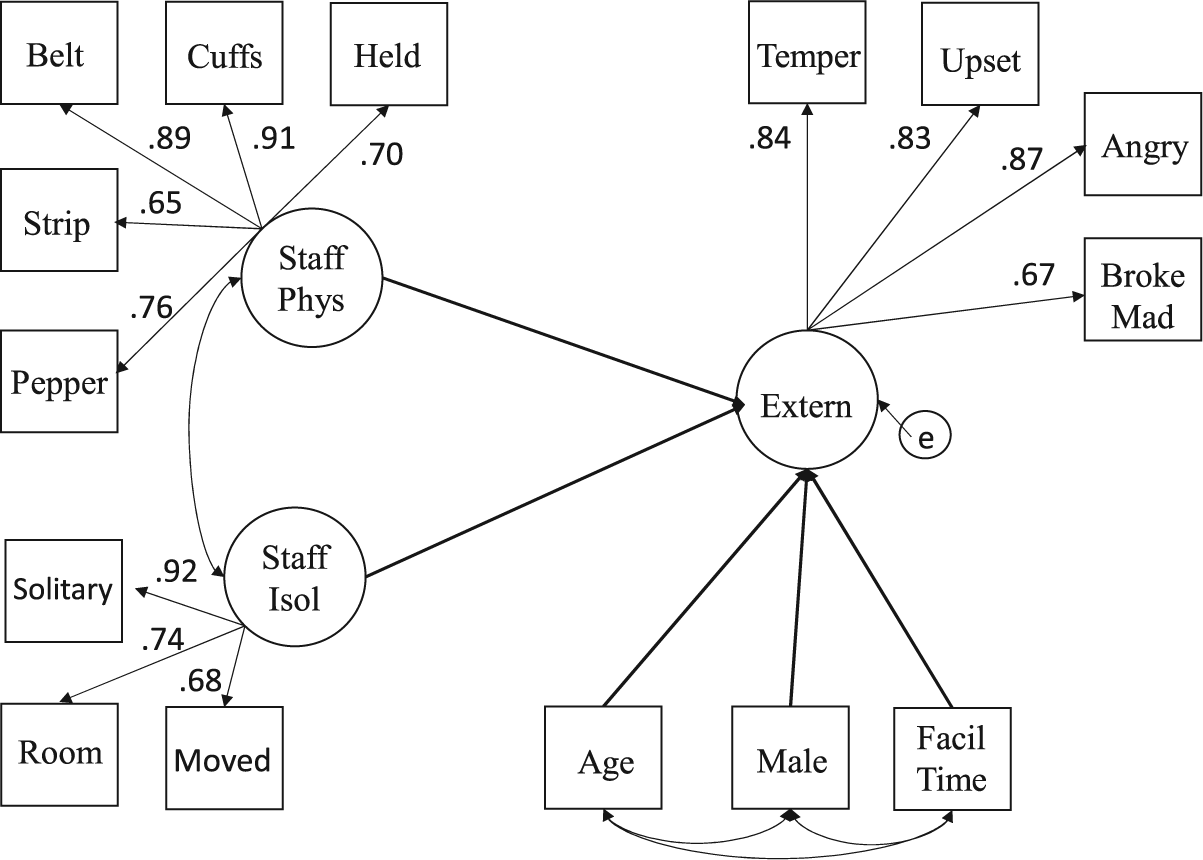
Reciprocal Model
H3: Reciprocal Relationship Between Staff Controls and Externalizing Behavior
Results from the second model revealed that youth reports of staff physical (γ = .141, SE = .046, p = .002) and isolating controls (γ = .185, SE = .051, p < .001) had statistically significant effects on externalizing behaviors. Gender, age, and time spent in the facility also had statistically significant relationships (p < .001) with externalizing behaviors in this model. As observed in the main model above, males (γ = −.156, SE = .018) were less likely to show externalizing behaviors than females, as were younger youth (γ = −.126, SE = .015). Finally, the longer youth spent in the facility, the more they demonstrated externalizing behaviors (γ = .066, SE = .017). Externalizing behavior had an R2 = .143 (SE = .011). This reciprocal model can be seen in Figure 2.
Discussion
Guided by an integrated model of general strain, importation, and deprivation theories, this study used SEM to test three hypotheses. The first hypothesis—experiences of early life abuse lead to greater use of staff controls—is partially supported; physical and sexual abuse are significantly related to increased use of physical and isolating controls by juvenile correctional facility staff. This relationship is not significant for emotional abuse. Our second and third hypotheses are also partially supported; overall, the findings reveal a partially mediated model for physical and emotional abuse, which suggests that youths’ externalizing behaviors explain some, but not all, of the relationship between these forms of early abusive experiences and the use of staff controls. In addition, there is a mutually reinforcing relationship between staff controls and externalizing behaviors, suggesting that youth display externalizing behaviors in response to physical and isolating controls, and the use of controls also predicts externalizing behaviors.
General use of staff controls is likely rooted in the goals of any carceral setting: the need to ensure a safe and orderly environment. Physical methods of control, like strip searches or the routine use of handcuffs and wristlets when transporting youth, may be deemed necessary for a smooth milieu (Green, 2016; Joshi, Moroney, Snyder, & Steele, 2016). However, findings from this study show that staff controls are used more often on youth with histories of physical and sexual abuse (Strain × Deprivation). This outcome is concerning because staff control techniques may exacerbate preexisting trauma and hinder rehabilitative efforts.
Physical and sexual abuse are serious forms of abuse that carry the power to disrupt normative neurological pathways. The direct association found between physically and sexually abusive experiences and staff controls could stem from youths’ increased vulnerabilities to harsher treatment. Research shows that physically and sexually abusive experiences can be among some of the most critical of all forms of adverse childhood experiences (Grasso, Dierkhising, Branson, & Ford, 2016; Knight & Sims-Knight, 2004). Trauma research is revealing that early abusive experiences may alter neurological processes, which can lead to overloaded stress-response systems and a change in how individuals perceive their surroundings (Perry & Hambrick, 2008; Perry et al., 1995). Abusive experiences activate fear responses in the brain and create vulnerabilities for experiencing recurring fear-based stimuli (Perry et al., 1995). These altered neurological pathways may partially explain why youth with prior abusive experiences can be prone to harsh penalties, and why they may be at risk for additional victimization within the facility (Yoder, Hodge, Ruch, & Dillard, under review).
Importation theory suggests that internal characteristics stemming from early life experiences are linked to behavioral problems in prison (Byrne & Hummer, 2008; DeLisi et al., 2010; Irwin & Cressey, 1962). In this study, externalizing behaviors partially explain the relationship between emotional and physical abuse and staff use of physical controls and isolation (Strain × Importation × Deprivation). It is possible that youth have learned externalizing behavioral patterns through early exposure to emotional and physical abuse (Aebi et al., 2015), where externalizing behavioral problems are manifestations of these experiences (Liu, 2004; Vaughn, Salas, DeLisi, & Perron, 2014). Frequently, youth with physically and emotionally abusive experiences are mistakenly diagnosed with oppositional-defiant disorder, conduct disorder, and attention-deficit/hyperactivity disorder, but not always diagnosed with a traumatic disorder (Perry & Szalavitz, 2006) or brain injury (Vaughn et al., 2014). Because of such abuse, youths’ stress-response systems become sensitized, and, “a heightened awareness to potential threat . . . might make someone . . . prone to fighting” (Perry & Szalavitz, 2006, p. 25); unable to regulate their feelings, youth act out in an attempt to restore their own sense of control and predictability (Perry & Szalavitz, 2006). When staff misinterpret this behavior and respond with punishment or deprivation, they could be interfering with the healing process and, instead, contribute to retraumatization (Perry & Hambrick, 2008; Perry & Szalavitz, 2006).
While externalizing behaviors partially explain the relationship between emotional and physical abuse and staff controls, they do not mediate the relationship between sexual abuse and staff controls. Conceptually, these findings corroborate extant research, which suggests that sexually abusive experiences may have a stronger association with internalizing behaviors (Lewis, McElroy, Harlaar, & Runyan, 2016; M. W. Miller & Resick, 2007). Youth with sexual victimization histories may still struggle with emotional regulation, but they may be more likely to overcontrol and internalize the struggle rather than undercontrol and externalize it (Lewis et al., 2016). Internalizing behaviors are harder to detect, but may show up in the form of social isolation, self-injurious behaviors, or other behaviors that reflect an anxious or depressed mood (Fliege, Lee, Grimm, & Klapp, 2009; Zahn-Waxler, Klimes-Dougan, & Slattery, 2000). Further research should test how internalizing behavior problems may explain or mediate this relationship.
The results from this study show a reciprocal relationship between externalizing behaviors and staff controls. The paths from externalizing behaviors to staff controls have been discussed above (Strain × Importation × Deprivation). However, deprivation theory also suggests that control methods can engender problem behaviors (Importation × Deprivation; Gover et al., 2000; Kuanliang et al., 2008; Skyes, 1958). The use of isolation and physical punishment to control youth with externalizing behaviors is not surprising. Punishments have long been argued as a technique for deterrence (Day, 2002) and even rationalized as “just deserts” (Hafer, 2000; Lerner & Miller, 1978). But the use of these control methods produces an unintended consequence: It generates more behavioral problems. One concern with using isolating techniques such as seclusion as a response to externalizing behavior is that it may temporarily suppress negative behavior, but does not help youth internalize necessary permanent behavior change (D. E. Miller, 1986). Furthermore, the use of such controls may retraumatize youth with trauma histories and exacerbate behavioral regulation capacities (Perry & Hambrick, 2008).
Last, there was no association in our study between race and ethnicity and the use of staff controls, however, gender and age were statistically significant. Males and older youth were less likely to demonstrate externalizing behaviors, yet were more likely to be subjected to staff controls. Gender biases in sentencing often result in higher rates of females being diverted to community alternatives in lieu of harsh carceral settings (Tam, Abrams, Freisthler, & Ryan, 2016). It is possible that females in this study were viewed as having behavioral problems that posed a level of risk too great to divert from confinement. Prior research presents mixed findings on the relationship between age and externalizing behaviors. Counter to our findings, Maschi, Morgen, Bradley, and Hatcher (2008) report that older males tend to have more externalizing behavior problems. In support of our findings, Bongers, Koot, van der Ende, and Verhulst (2004) conclude that younger youth display more externalizing behaviors. It has been reasoned that younger youth may be more prone to acting out because of a lower developmental capacity to regulate their emotions (Thompson, 1991). Unsurprisingly, our findings also revealed that longer lengths of stay were associated with more externalizing behaviors and use of staff physical and isolating methods of control.
Implications
The jobs of correctional staff are extremely difficult. Juvenile facilities across the United States require safety protocols because confined youth may be perceived as harmful—with or without behavioral disruptions or externalizing behaviors. The link we found between past abusive experiences and greater use of staff controls emphasizes the need for juvenile correctional facilities to consider implementing organizational change models that incorporate trauma elements into regular practice. One systems-based trauma-informed model, known as “The Sanctuary Model,” has been adapted in child-serving settings. The Sanctuary Model guides organizational change in a direction that is more sensitive to the trauma histories of children. This model has been publicized for its use in juvenile justice settings (Ford & Blaustein, 2013), and has been found to reduce physical restraints and critical incidents (Banks & Vargas, 2009). At the very least, training staff to tailor their responses to youths’ behaviors based on their trauma histories may result in more therapeutic outcomes. The National Child Traumatic Stress Network was created by Congress in 2000 to provide information on evidence-based practices related to child development and trauma for a variety of audiences—including juvenile justice professionals. The Network’s Learning Center contains training materials (“Think Trauma”) for helping staff create juvenile residential settings that are trauma-informed (National Child Traumatic Stress Network, n.d.).
Rather than simply treating the misbehavior in these settings, attempting to understand and treat the underlying problem may lead to greater success in rehabilitation. There are several ways that staff can be aware of the potential trauma histories of the youth they serve. Youth with maltreatment histories may have also had contact with the child welfare system (Herz, Ryan, & Bilchik, 2010). Systems integration through data sharing (Fromknecht, 2014) and interagency collaboration in the form of joint assessments and coordinated case planning can decrease duplicative efforts while increasing access to pertinent information (Lutz & Stewart, 2015). If data sharing and systems collaboration are not possible, relevant information can be obtained through trauma screenings and assessments administered at intake, and additional information may be elicited through trusted conversations as youth spend time in the facility.
It is important to tease out the situations in which staff methods of control are being used, and ensure they are implemented only as a last resort. Activities that involve the senses, exercises such as yoga, and music and movement classes can all assist youth in learning how to regulate themselves (Perry, 2009). Incorporating some of these coping methods into a youth’s daily routine, or engaging youth in these activities may minimize the need for staff to use physical or isolating control methods. Overall, it is vital to remember that healthy and supportive relationships with others foster therapeutic change in people over and above what any program can accomplish (Perry & Szalavitz, 2006).
Limitations
The SYRP is a secondary data set, and as such, the authors of this manuscript had no role in the study design or collection of data. SEMs, when used under ideal conditions (e.g., longitudinal designs), aid in understanding causality (Cole & Maxwell, 2003). Due to the cross-sectional nature of these survey data, we cannot guarantee the time-order sequence of our factors. Furthermore, the nature of the topics under study do not ethically lend themselves well to experimental designs with control groups. Therefore, our findings do not imply causality; instead, they demonstrate associations among the observed and latent variables outlined in our model. We acknowledge that some of the items comprising our factors (particularly staff controls and externalizing behaviors) may not be ideal. Survey questions were not representative of validated tools measuring these constructs; we tried to do our due diligence in creating factors with the observed variables that were available. Furthermore, because the effects of abuse were marginal, a more robust measure of each form of abuse is required in further research. Differential forms of abuse should be measured by using several items that represent latent variables. Because surveys were self-report, and questions relevant to this study required participants to be retrospective, it is possible for youth to have under or overreported their experiences. In addition, the dichotomous (yes/no) response format failed to account for the frequency of externalizing behaviors and staff physical and isolating events being measured; all such instances could change the nature of the outcomes we found. Future iterations of the SYRP could include additional measures of adverse childhood experiences and trauma through convergent tools or multiple informants to increase the validity and reliability of these data, thus leading to more robust analyses. In testing a basic model, we only included race/ethnicity, gender, age, and time in the facility as controls, and thus left out other variables that may be worth considering. Future studies using SYRP data could include variables such as mental health diagnoses, offense type, and perceptions of staff character.
Conclusion
Despite its several limitations, this study is the first known to test an integrated model of general strain, importation, and deprivation theories on a nationally representative sample of youth within the correctional setting. This study has demonstrated that youth with victimization histories are more likely to receive retributive action from staff for their behaviors. It is possible that these staff controls may perpetuate youths’ victimization experiences and exacerbate trauma symptoms. As organizations such as the Vera Institute of Justice (2017) spearhead national conversations around “reimagining prisons,” and the American Academy of Social Work and Social Welfare (2017) strive for “social progress powered by science,” the findings and implications from this study support the need for a shift from retributive to rehabilitative action within America’s juvenile justice systems.
Footnotes
Acknowledgements
Special thanks to the reviewers for their valuable feedback on an earlier draft of this article, and to Dr. Natasha Bowen, professor of social work at The Ohio State University, for sharing her time and knowledge regarding structural equation modeling (SEM). The authors are happy to share the correlation matrix associated with the variables used in this study to readers upon request.