




Abstract
Stalking (also known as “criminal harassment” in Canada) is broadly defined as repeated contact with another individual that elicits fear. By manipulating the details of an actual stalking case, the present study examined the role of actor sex (man–woman [M-W], woman–man [W-M]) on perceptions of stalking in a sample of local police officers. Consistent with previous research, officers who read the M-W case anticipated more physical, emotional, psychological, and economic harm, as well as greater likelihood of a prison sentence by judges, than officers who read the W-M case. Actor sex did not influence officers’ perceptions of seriousness, likelihood of a jury conviction, or identification of criminal harassment. The findings may be used to develop intervention programs aimed at educating law enforcement, social support workers, and community agencies to ensure appropriate protection and treatment of individuals stalked by former partners.
Social norms and roles associated with gender shape perceptions of individuals and the relationships between individuals (Butler, 2004; Connell, 2002). Given the strength and prevalence of gender norms, it is likely that individuals seeking support from the criminal justice system may receive differential treatment on the basis of gender under certain circumstances. Stalking has been defined as “a course of conduct directed at a specific person that involves repeated visual or physical proximity, nonconsensual communication, or verbal, written, or implied threats, or a combination thereof, that would cause a reasonable person fear” (National Criminal Justice Association [NCJA], 1993, pp. 43-44). In Canada, to meet the legal definition of stalking (i.e., “criminal harassment”), there must be fear for the safety of oneself or others (Criminal Code of Canada, 1985). Police officers’ perceptions of stalking behavior, including likely impact, may be influenced by social norms regarding sex and the performance of gender.
Cases of cross-sex stalking have been associated with greater (perceived and actual) likelihood of arrest and sentencing if the target of the behavior is female than if the case involves a male target (Cass & Rosay, 2012; Cormier & Woodworth, 2008; Sheridan & Scott, 2010). Although male-perpetrated stalking of a female target often results in more serious consequences for the target than female-perpetrated stalking of a male target (Davis, Coker, & Sanderson, 2002; Johnson & Kercher, 2009), generalizations may obscure individual variations in threat. Given previous research findings, differential perceptions of stalking based on the sex of the target and perpetrator may lead perceivers, including law enforcement, to underestimate potential risks and help needed for male targets of stalking (e.g., Dunlap, Hodell, Golding, & Wasarhaley, 2012). The current study thus examined the differential effects of actor sex on Canadian police officers’ perceptions of stalking by a former partner. Research with police officers is particularly important because it has the potential of influencing training for and practices carried out by law enforcement officers involved in stalking cases.
Sex and Gender
In the present research, sex referred to the biological characteristics of the actor or participant, whereas gender referred to participants’ interpretation of sex in the context of social roles. Although differential perceptions based on sex may reflect actual differences in risk and potential harm, social roles associated with biological sex (i.e., gender roles) can alter perception of aggressive interpersonal behavior. For example, preschool children presented with aggression scenarios were more likely to attribute physical aggression to boys and relational aggression to girls when actor sex was not provided (Giles & Heyman, 2005). Sex-based differences in the perception of aggression may reflect underlying expectations based on gender roles. Gender roles rely on prescribed notions of appropriate behaviors and characteristics for men and women (Butler, 2004). For example, in a qualitative analysis of the role of gender on perceptions of stalking, both the male target and the female perpetrator were perceived as behaving in ways inappropriate for their gender, but no comments regarding gender were made for scenarios involving a female target and a male perpetrator (Gavin & Scott, 2016). Gender roles ignore variations between individuals as well as social influences like power inequality (Connell, 1987). Perceiving interpersonal aggression through the lenses of gender (Bem, 1993) may obscure relevant details regarding actual risk.
One explanation for differential perceptions of female and male target cross-sex stalking and partner aggression is that female sex represents one dimension of victim vulnerability. Consistent with gender-role theory (Connell, 1987, 2002), factors associated with female sex such as physical size and strength, fewer economic resources, the presence of children or other dependents, and increased fear response are associated with variations in perceived vulnerability (Bem, 1993). Thus, whereas female sex itself may not be a risk factor, characteristics associated with being a woman (based on traditional gender roles) may lead law enforcement professionals (and others) to perceive greater levels of vulnerability among female compared with male victims (Lyon, 2006).
Police Perception
Law enforcement professionals often become involved in cases of stalking behavior (Spitzberg, Cupach, & Ciceraro, 2010; Trainor, 1999). Stalking and related behaviors are often motivated by rejection related to a relationship breakup (Davis, Ace, & Andra, 2000; Dutton & Spitzberg, 2007); ex-partner relationships comprise the majority of stalking cases in Canada (Statistics Canada, 2005). Although terms like “obsessive relational intrusion” (ORI; Spitzberg et al., 2010) and “unwanted pursuit behavior” (UPB; Langhinrichsen-Rohling, Palarea, Cohen, & Rohling, 2000) do not require “reasonable fear,” cases of ORI and UPB may also come to the attention of law enforcement. Thus, police officers need to distinguish between less serious conduct (i.e., “harassment”) and conduct that meets the legal definition of stalking (i.e., “criminal harassment”). Early identification of, and subsequent response to, stalking behavior may help to prevent serious harm (NCJA, 1993).
Unfortunately, officers may be susceptible to the influence of contextual factors on their perceptions of stalking. For example, although ex-partner stalkers are more likely to perpetrate acts of violence and to exhibit higher levels of dangerousness compared with acquaintance or stranger stalkers (Dutton & Spitzberg, 2007; Logan, Shannon, & Cole, 2007; McEwan, Mullen, MacKenzie, & Ogloff, 2009; Palarea, Zona, Lane, & Langhinrichsen-Rohling, 1999), and ex-partner stalking and harassment behavior are associated with both ongoing and past intimate partner violence (IPV), threats of violence, physical and nonphysical (i.e., emotional, psychological, economic) harm, and homicide (Bjerregaard, 2000; Davis et al., 2000; Tjaden & Thoennes, 1998), there continues to be a tendency among law enforcement professionals to perceive ex-partner stalking as less characteristic of stalking and less dangerous than other stalking relationships (Scott, Nixon, & Sherdian, 2013; Sheridan, Scott, & Nixon, 2014; Weller, Hope, & Sherdian, 2013). Fortunately, specialist officers with specific training in risk assessment, domestic violence, and stalking have been found to be less susceptible to relationship effects (Scott et al., 2013), suggesting that it is possible to lessen the influence of potentially irrelevant contextual factors. However, sex of the actors involved has been shown to play a role in perceptions of stalking and harassment behavior in student and community samples (Cass, 2008; Cass & Mallicoat, 2015; Finnegan & Fritz, 2012; Sheridan & Scott, 2010); therefore, sex and gender may play a role in law enforcement perceptions as well.
Research investigating police officer perceptions and decision making in cases of partner aggression has revealed that several factors may influence perception, including actor sex. After reading one of eight scenarios that described a case of IPV, 130 U.S. police officers rated male victims as more responsible for, and more in control of, their actions than female victims (Finn & Stalans, 1997). Police officers were also more likely to arrest male assailants than female assailants. Further examination revealed that credibility and responsibility of the victim and assailant influenced the likelihood of arrest for male assailants but were unrelated to the arrest of female assailants. Finn and Stalans’s (1997) research findings have been supported by Canadian data—Law enforcement officers were more likely to lay charges or take the perpetrator into custody when the victim was a woman than when the victim was a man (Brown, 2004).
Additional research findings have supported the notion that gender roles influence perceptions of partner aggression; police officers viewed female victims (wives) as less credible and their male assailants (husbands) as less dangerous when wives were depicted as abusing alcohol, but signs of alcohol abuse in husbands did not alter police officers’ views of husbands’ credibility (Finn & Stalans, 1995; Stalans & Finn, 1995). Differential perceptions were attributed to knowledge structures and categories (“schemas”) related to gender (e.g., Bem, 1993). The researchers suggested that compared with husbands, wives’ alcohol abuse was gender-role inconsistent, which may have led to differential perceptions. The researchers propose that if a situation is not easily categorized, officers are more likely to respond using “frames” rooted in normative experiences (i.e., social norms) and efficiency (e.g., predicting likelihood of harm in near future). Therefore, actor sex may affect perceptions of stalking and harassment behavior, particularly in the absence of additional contextual information.
Consistent with previous research (Finn & Stalans, 1995; Stalans & Finn, 1995) and gender-role theory (Bem, 1993; Butler, 2004; Connell, 2002), examinations of law enforcement professionals’ perceptions of intimate partner aggression have indicated that aggressive behavior is perceived differently on the basis of actor sex. Perceptions of same- and cross-sex IPV among Royal Canadian Mounted Police (RCMP; N = 62) were investigated using four hypothetical vignettes that consisted of a mock police report describing an escalating course of unidirectional (i.e., perpetrator-only) physical man–woman (M-W), woman–man (W-M), man–man (M-M), and woman–woman (W-W) IPV (Cormier & Woodworth, 2008). RCMP officers provided higher ratings for male-perpetrated abuse of a female (M-W), indicating that officers were more likely to report the incident to the police, that the incident was more violent, and that perpetrators were more distasteful and should be convicted compared with W-M, M-M, and W-M scenarios (Cormier & Woodworth, 2008). Given the lack of research on perceptions of stalking among law enforcement professionals, a study on the role of gender on police officers’ perceptions of a case of stalking is particularly relevant.
The Current Research
Researchers from Australia, Canada, the United Kingdom, and the United States have found that perception of harm, recommendations for help-seeking, and anticipated response by the criminal justice system are greater when a man is depicted as pursuing a woman than when a woman is depicted as pursuing a man, whereas actor sex does not appear to have an effect on whether or not a behavior is perceived as stalking (Cass, 2008; Cass & Mallicoat, 2015; Finnegan & Fritz, 2012; Kinkade, Burns, & Fuentes, 2005; Phillips, Quirk, Rosenfeld, & O’Connor, 2004; Scott, Rajakaruna, Sheridan, & Gavin, 2015; Sheridan, Gillett, Davies, Blaauw, & Patel, 2003). In two studies conducted with community samples from the United Kingdom, male pursuit of a female target was perceived as having a greater impact on the target, the pursuit behavior was perceived as more criminal, and the target was seen as less responsible (Sheridan & Scott, 2010). In addition, compared with other gender pairings, undergraduate students randomly assigned to read one of four trial summaries provided judgments that were more pro-prosecution, more positive toward the target, and more negative toward the perpetrator when the case described a female target and a male perpetrator (Dunlap et al., 2012). Police officers may demonstrate a similar tendency.
The intent of the research was to investigate the effects of gender on perceptions of stalking among law enforcement professionals following the breakup of a romantic relationship. The current study sought to extend previous research by presenting law enforcement officers with a single, detailed case based on an actual stalking charge to investigate the extent to which actor sex influences officers’ decisions regarding (a) identification of criminal harassment, (b) perceived seriousness of the case, (c) expectations of physical and nonphysical harm to target, and (d) likely response by the criminal justice system (jury conviction and sentencing by a judge). The hypotheses were actor sex would not influence officers’ identification of criminal harassment (Hypothesis 1; Cass, 2008; Finnegan & Fritz, 2012; Sheridan & Scott, 2010); officers would provide higher ratings on perceived seriousness for female targets of male perpetrators compared with male targets of female perpetrators (Hypothesis 2; Cass, 2008; Cass & Mallicoat, 2015); officers would provide higher ratings on anticipated physical and nonphysical harm for a female target of a male perpetrator (Hypothesis 3; Cass, 2008; Phillips et al., 2004; Sheridan et al., 2003); and officers would provide higher ratings on anticipated response from the criminal justice system (conviction and sentence) when the scenario depicted a female target and a male perpetrator (Hypothesis 4; Cass, 2008; Scott et al., 2015). Although a null effect was expected for Hypothesis 1, we felt it was important to investigate whether or not a nonsignificant effect of actor sex on identification of criminal harassment would be found in a police sample given previous nonsignificant findings in community and university samples.
Method
Design and Participants
The experiment was based on a between-participants design with two levels of actor sex (i.e., a male perpetrator–female target and a female perpetrator–male target). Participants were 101 (87 male, 13 female, one undisclosed) police officers from the Windsor Police Service recruited at Police Headquarters in Windsor, Ontario, Canada. Of the 101 officers who completed the study, 73 were in the Patrol Division and 28 were in the Investigations Division at the time of data collection. Years of experience as a police officer ranged from 1 to 33 years (M = 12.15, SD = 7.77). The modal approximate number of stalking cases worked was 100; almost a quarter of officers wrote some variation on “100,” “hundreds,” or “over 100.” Officers were recruited at the start of their shifts over a 2-week period. Four patrol units and three investigative units were approached to participate in the study. The response rate was 100%. Of the 101 officers who completed the study, 51 officers responded to a scenario depicting a male perpetrator and a female target and 50 officers responded to a scenario depicting a female perpetrator and a male target. Clearance to conduct the present study was requested and received from the authors’ institutional Research Ethics Board. No compensation was provided. Informed consent was obtained from all participants. In cooperation with members of the Windsor Police Service, the following materials and procedures were developed.
Materials and Procedures
Officers interested in participating were asked to read a one-page “charge summary” describing a case of stalking (i.e., criminal harassment). The summary was based on an actual stalking (i.e., criminal harassment) case investigated by the Windsor Police Service within the last year. Names and identifying information were changed. Officers who were involved in the original case were not included in data collection (n = 3).
Two different versions of the summary were created: a male harassing a female and a female harassing a male. The male–female summary is provided below; the female–male summary is identical except all names and pronouns are reversed: Mary and John Smith were married for four years and have a seven-year-old child Jamie. They have been divorced since March 2009. There have been numerous calls for domestic issues and on July 12, 2010, John Smith was arrested for threatening Mary and her now fiancé William Jones. He was later released on a recognizance with several conditions including not communicating or associating with Mary or Smith or William Jones. On January 1, 2011, at around 2:40 p.m., Mary was at home when the phone rang. Her call display showed “Ontario Government.” Mary knew this was the phone number for the County Jail as it had come up before when one of John’s friends had called. Mary did not answer the phone. It rang again 30 seconds later and then again another 30 seconds later. Mary finally answered the phone and said “Hello.” A voice which she recognized to be that of her ex-husband John said, “Is Jamie there?” She replied, “Jamie is unavailable.” John then said “okay bye” and she hung up. She immediately called the police. In February 2011, John began to send Mary letters. In March 2011, Mary contacted the Windsor Police Family Violence Unit as the letters started to become more disparaging in nature against her now fiancé William and alluded to the fact that there would be some kind of reconciliation between Mary and John. The letters continued and in April 2011, John began sending letters stating that he and Mary should get back together, and he even suggested that they get remarried on July 15, 2011. Mary is very afraid of John. She fears that John will try to harm her and her fiancé William. John does not appear to acknowledge that Mary has moved on in her life and still believes there is a chance of them remarrying.
Participants were randomly assigned to one of two experimental conditions. Prior to data collection, an informal request to participate was made to specific unit supervisors at the Windsor Police Service by the Director of Planning and Physical Resources. Once supervisors agreed to data collection, officers from that unit were approached by the researcher at the beginning of their shifts (“line-up”) and asked to participate in a study examining police officers’ perceptions of behavior following the breakup of a romantic relationship. A letter of information for consent to participate in research was used to ensure officer anonymity.
Once officers read the summary, they were asked to provide six ratings on four different dimensions: identification of criminal harassment, perceived seriousness, anticipated harm, and anticipated response by the criminal justice system. Perceived seriousness was included to assess participants’ general beliefs about the gravity of the behavior described in the charge summary, whereas anticipated harm assesses participants’ beliefs about the likelihood that the target will be hurt as a result of the behavior. The six questions were based on previous research with stalking scenarios (Cass, 2008; Finnegan & Fritz, 2012; Phillips et al., 2004; Sheridan et al., 2003). Participants were also asked to complete a demographic questionnaire, which asked for their gender, years of experience as a police officer, job assignment within the Windsor Police Service (current and past), and experience with stalking cases (approximate number of harassment cases worked). Officers were told that the study would take no more than 5 min to complete.
Police officers were asked to provide responses to six questions, each on a 7-point Likert-type scale, to assess (a) identification of criminal harassment (“To what extent does this case describe criminal harassment as you understand it?”; 1 = definitely not to 7 = definitely); (b) perceived seriousness (“How serious is this situation?”; 1 = not at all serious to 7 = very serious); (c) anticipated harm (“How likely is it that the target of this behavior will be physically harmed?” and “How likely is it that the target of this behavior will experience some other form of harm [i.e., psychological, emotional, economic]?”; 1 = not at all likely to 7 = extremely likely); and (d) anticipated response by criminal justice (“How likely is it that a jury would convict the perpetrator in a court of law?” and “If convicted, how likely is it that a judge would recommend a prison sentence?”; 1 = not at all likely to 7 = extremely likely).
Results
Preliminary Analyses
All data were entered, cleaned, and analyzed using SPSS 21.0. Variables were checked for missing data, outliers, univariate and multivariate normality, homogeneity of variances, and multicollinearity. Although some demographic variables had missing data, none of the dependent variables were missing any data. However, one participant wrote in and circled “0” on Item 6 (“If convicted, how likely is it that a judge would recommend a prison sentence?”). Given that ratings are on a scale from 1 to 7, this data point was changed to “1” in the analyses. Results of analyses did not change meaningfully when excluding this item from the analyses or when including the recoded value.
Analyses used to identify univariate outliers were grouped by scenario to ensure accurate identification of outliers within each experimental condition. One data point was identified as an outlier based on a z-score cutoff of ±3.0. Examination of the data revealed that the respondent endorsed a “2” on perceived seriousness, which fell below the normal distribution of scores for this dataset. The data point came from a male patrol officer with 10 years of experience who reported working “too many” harassment cases. Given that his response may reflect the experiences of other officers with a history of exposure to stalking cases, the outlier was left in the analyses. There were no issues with multicollinearity or singularity, and the variances of individual variables were approximately equal. Effect sizes are reported as partial eta-squared and Cohen’s d. Given the relatively small sample and the limited number of analyses, a correction for multiple comparisons was not applied.
Participants’ scores on the six dependent variables were correlated with participant sex and experience with harassment cases to assess whether participant sex or experience with harassment cases was associated with officers’ identification of criminal harassment, perception of seriousness, anticipated harm, or anticipated response by the criminal justice system. There were no significant relations between variables. Thus, participant sex and experience with harassment were not controlled for in the analyses. The mean, standard deviations, and range of each dependent variable are presented in Table 1.
Mean, Standard Deviation, and Range for Each Dependent Variable
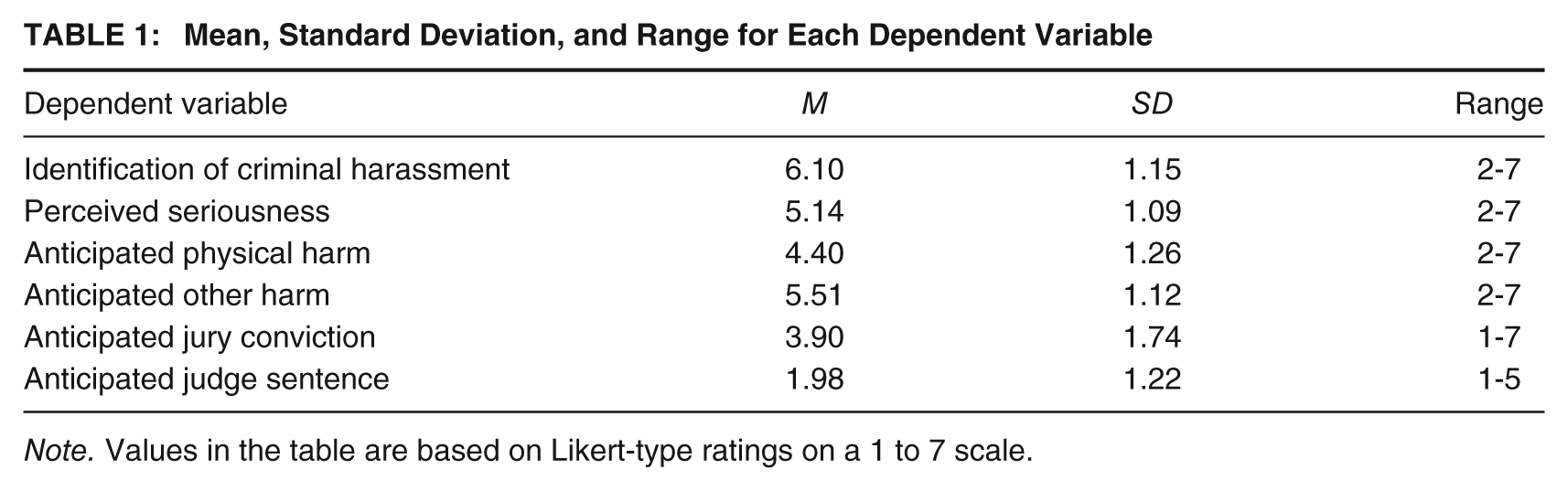
Note. Values in the table are based on Likert-type ratings on a 1 to 7 scale.
Main Analyses
Identification of Criminal Harassment
Consistent with Hypothesis 1, univariate ANOVA estimated no difference in mean ratings between Version 1 and Version 2 on the identification of criminal harassment, F(1, 98) = 0.275, p = .601,
Dependent Variable Means, Standard Deviations, and Confidence Intervals by Actor Gender
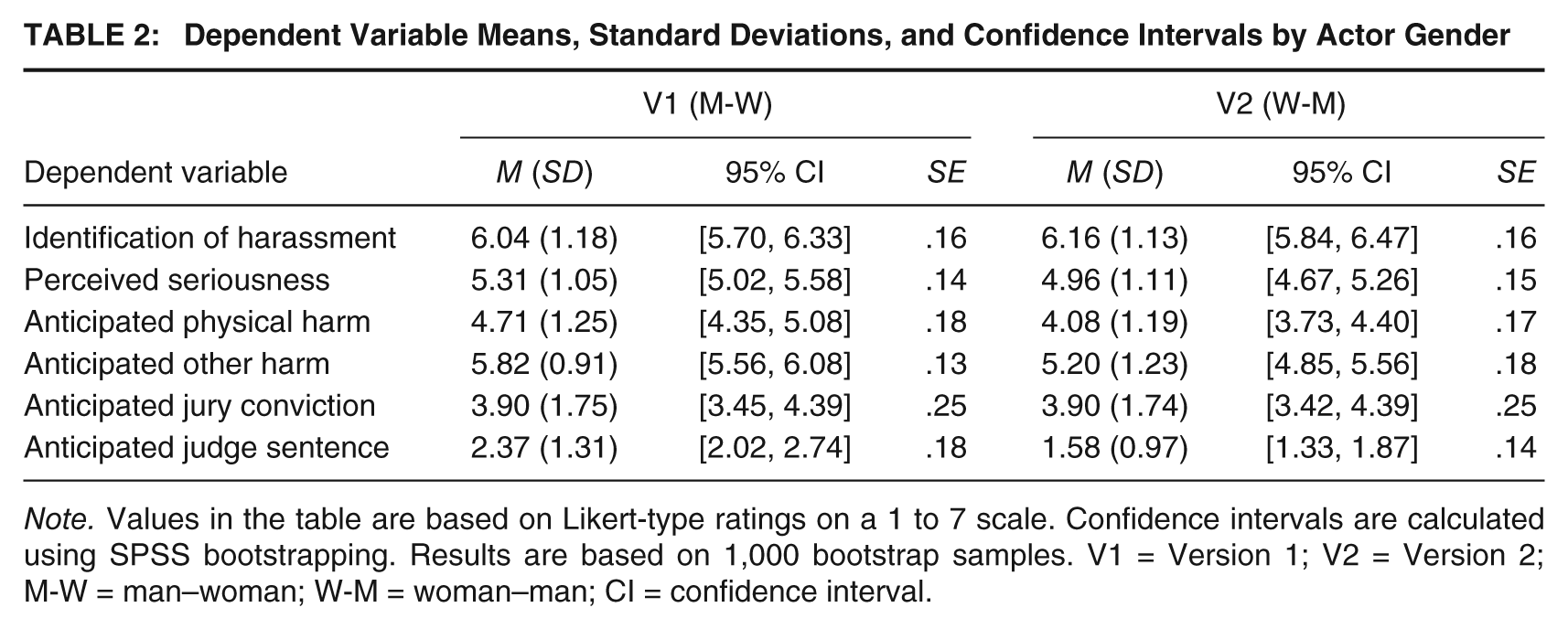
Note. Values in the table are based on Likert-type ratings on a 1 to 7 scale. Confidence intervals are calculated using SPSS bootstrapping. Results are based on 1,000 bootstrap samples. V1 = Version 1; V2 = Version 2; M-W = man–woman; W-M = woman–man; CI = confidence interval.
Perceived Seriousness
A univariate ANOVA estimated little to no difference in mean ratings between Version 1 and Version 2 on perceived seriousness, F(1, 99) = 2.722, p = .102,
Anticipated Harm
A univariate ANOVA estimated a difference in mean ratings between Version 1 and Version 2 on physical harm, F(1, 99) = 6.604, p = .012,
Anticipated Response From Criminal Justice System
Consistent with Hypothesis 4, a univariate ANOVA estimated a difference in mean ratings between Version 1 and Version 2 on ratings of anticipated sentencing by a judge, F(1, 98) = 11.885, p = .001,
Discussion
Based on previous findings in the literature, we predicted that officers’ ratings on the identification of criminal harassment would not differ based on actor sex. The results indicated that police officers provided similar ratings on the charge summary that described a man pursuing a woman as on the charge summary that described a woman pursuing a man, supporting the first hypothesis and previous research conducted with university students by Finnegan and Fritz (2012), Phillips and colleagues (2004), and Cass (2008). The current study suggests that police officers make similar judgments to university students. Thus, the evaluation of whether a situation reflects stalking (i.e., criminal harassment) appears to be based on the behavior rather than the sex of those involved. In addition, contrary to Hypothesis 2 and previous research on perceptions of seriousness based on sex (Cass, 2008; Cass & Mallicoat, 2015), officers did not perceive the charge summary describing a male perpetrator and a female target as more serious than officers who read the summary that described a female perpetrator and a male target. Thus, sex of the perpetrator and target does not appear to influence police officers’ perceptions of seriousness. The finding that police officers provided similar ratings on the identification of criminal harassment and perceived seriousness regardless of perpetrator and target sex suggests that officers primarily attend to behaviors when identifying stalking and evaluating seriousness.
Officers may not perceive harassment as more or less serious depending on the sex of the perpetrator and target, but an evaluation of the likelihood of harm may lead officers to rely on individual characteristics such as sex. Consistent with Hypothesis 3, mean ratings on anticipated harm differed based on actor sex. Participants who read the charge summary describing a male perpetrator and a female target anticipated greater physical, psychological, emotional, and economic harm than participants who read the summary describing a female perpetrator and a male target. The findings support Hypothesis 3 and are consistent with findings by other researchers (i.e., concern for the target; Cass, 2008; Finnegan & Fritz, 2012; Phillips et al., 2004; Sheridan & Scott, 2010). Officers may have perceived men as more capable of defending themselves whereas women were perceived as more vulnerable, which is consistent with research suggesting female victims report more harm and fear due to stalking behavior compared with male victims (Bjerregaard, 2000; Davis et al., 2002; Johnson & Kercher, 2009); it is also consistent with theories of perceived gender roles (Bem, 1993; Butler, 2004; Connell, 2002) and Goffman’s (1977) work on perceived helplessness in women. Police officers in this study may have based their judgment on a variety of factors, including anticipated biological differences, expectations about social roles, and the interaction between men and women, or on some entirely different factor like experiences on the job or even knowledge of the research. Nevertheless, these findings are consistent with previous research and support the notion that men and women are perceived differently in cases of stalking.
To determine whether police officers also anticipated differential responding by the criminal justice system on the basis of actor sex, participants were asked to predict conviction of the perpetrator by a jury as well as subsequent sentencing by a judge. Consistent with the results for anticipated harm, officers who read about a man pursuing a woman predicted that a judge would be more likely to recommend a prison sentence than those officers who read about a woman pursuing a man. However, in contrast to findings by Dunlap and colleagues (2012), officers did not anticipate a differential likelihood of conviction by a jury on the basis of actor sex. Regardless of whether the summary described a male perpetrator and female target or a female perpetrator and male target, officers made similar ratings on the anticipated likelihood of conviction by a jury. Given that officers expected judges would be more likely to sentence a male perpetrator than a female perpetrator to prison, but did not expect a similar pattern for jury conviction, it is likely that judgments are based on actual experiences with the criminal justice system. It is worth noting that mean ratings on both scales for both M-W and W-M scenarios were less than 4 on a 7-point scale, which suggests that officers in the study perceived both sentencing by a judge and conviction by a jury as relatively unlikely, regardless of actor sex.
Implications
The current research has implications for theory, research, and practice. The findings suggest police officers perceive stalking perpetrated by a man against a woman as more likely to result in harm (physical and nonphysical) than harassment perpetrated by a woman against a man, which is consistent with research demonstrating significantly higher fear and harm reported by female compared with male targets of stalking behavior (Bjerregaard, 2000; Davis et al., 2002; Johnson & Kercher, 2009). The findings also indicate police officers believe judges will be more likely to sentence the perpetrator in the M-W condition compared with the W-M condition. The results inform theory and research on gender and perception of intimate partner aggression and indicate a need for specialized training regarding evaluation of risk in cases of stalking and criminal harassment.
In regard to theory, findings from the current study support conceptualizations of gender as a lens, and as a performance of prescribed roles and norms in society (Bem, 1981, 1993; Butler, 2004; Connell, 1987, 2002). Law enforcement officers’ perceived male-perpetrated stalking of a female target as more likely to result in harm and sentencing by a judge compared with female-perpetrated stalking against male targets is indicative of differential perception on the basis of perceived gender roles and norms. Officers who read the M-W summary likely relied on social roles associated with sex wherein certain characteristics are assigned to women (e.g., nurturance) and other characteristics to men (e.g., aggression; Bem, 1981, 1993; Connell, 1987, 2002); norms and roles associated with gender likely led officers in the M-W condition to anticipate greater harm and sentencing than officers who read the W-M summary. Differential police officer perceptions based on gender for some variables (harm, anticipated sentencing by a judge) and not others (identification of criminal harassment, seriousness, anticipated conviction by a jury) suggest the social roles associated with sex of the target and perpetrator play a specific role in law enforcement officers’ evaluations of stalking and harassment behavior. Officers may rely on gender under certain circumstances or in the absence of additional contextual information.
The findings also have implications for research. Officers in the current study demonstrated differential perceptions based on gender after reading an actual case of criminal harassment worked by fellow officers. Additional actor sex permutations (i.e., M-M, W-W), contextual factors (e.g., detailed background information), and a qualitative assessment of officers’ decision-making processes (e.g., Gavin & Scott, 2016) may clarify the relation between gender and perceptions of stalking and harassment behavior. The impact of specialized training regarding identification of risk of harm in cases of stalking and criminal harassment would help to clarify the practical implications of the current research findings.
Differences in perception may translate into differences in practice (e.g., different reactions to the perpetrator and target of harassment behavior, despite a similar pattern of behavior). Male perpetrators may be treated as more dangerous, whereas male targets may be more easily dismissed or minimized. There is evidence to suggest that requests for temporary restraining orders against a violent male partner by a female plaintiff are more likely to be granted compared with requests made by a male plaintiff against a violent female partner (Muller, Desmarais, & Hamel, 2009). Thus, the perception and treatment of partner aggression by the criminal justice system can be influenced by the sex of the actor. Differential perception may be based on the reality that female targets of stalking experience more harm (e.g., Johnson & Kercher, 2009), but the practical effect is that male targets of harassment may not receive support and protection. Rather than relying on actor sex, criteria like threats of violence and target fear should inform police decisions about the likelihood of harm to the target.
Police officers are often the first responders and differential perceptions of a stalking incident on the basis of gender may influence immediate responding, as well as the likelihood that charges will be laid and that incidents of stalking or harassment will be reported in the future. Gender-based biases can also have repercussions for judges’ and juries’ perceptions of stalking, which may influence the likelihood of conviction and subsequent sentencing. The tendency to underestimate potential harm may prevent men from seeking help or contacting the police, particularly if law enforcement officers mirror these attitudes. Female targets of stalking are more common and tend to experience more negative consequences from harassment (Bjerregaard, 2000; Davis et al., 2002; Johnson & Kercher, 2009; Lyon, 2006), but there is evidence to suggest that men and women engage in similar levels of lesser forms of harassment termed unwanted pursuit behavior (Langhinrichsen-Rohling, 2012; Langhinrichsen-Rohling et al., 2000). Given feelings of shame among male victims of IPV are a significant barrier to help-seeking (Cheung, Leung, & Tsui, 2009; Tsui, Cheung, & Leung, 2010), and reporting of stalking and harassment behavior by male targets of female stalkers is perceived to be influenced by shame (Cass & Mallicoat, 2015), male targets of unwanted pursuit and harassment behavior may not receive necessary support.
It is important to note that in the current study, actor sex did not influence officers’ determination of whether the behavior constituted stalking. Therefore, the law was applied similarly, regardless of gender. Perceived seriousness also was not influenced by actor gender, which suggests that harassment of a man by a woman (W-M) is not minimized relative to harassment of a woman by a man (M-W). However, even if the determination and perceived seriousness are the same, officers’ reactions to the actors and decisions about how to proceed may be influenced by differences in anticipated harm. Likewise, the expectation of differential sentencing by judges on the basis of gender may lead officers to make different decisions about whether to pursue criminal charges. However, the low ratings (M = 1.98 on a 7-point scale) indicate that sentencing is unlikely to occur irrespective of actor sex. Although officers’ perceptions may reflect real differences between men and women involved in stalking, such perceptions may prevent appropriate action from being taken to identify female perpetrators and protect male targets.
Law enforcement officers who participated in the current study are trained to rely on their learned knowledge, understanding, and application of the Criminal Code. Officers use specific policing skills learned post hire (e.g., evidence gathering, interpretation of statements, fact-checking) to evaluate situations. Police officers in Ontario also fall under a very thorough and prescribed set of standards, which apply to a variety of situations and circumstances that may be encountered while executing their duties. A uniform set of standards ensures more consistent decision making regardless of geographical jurisdiction. The standards cover many key aspects of duty, including when and what method of “use-of-force” is appropriate. Standards tend to vary to some degree from province to province but are very similar in scope. Each individual police service also has its own set of policies and procedures. Collectively, the aforementioned lays the groundwork for how police officers evaluate risk of violence on a case-by-case basis. However, the results of the current study demonstrate the potential for officers to evaluate risk based on gender. Therefore, it would be helpful to emphasize focusing less on such variables as sex of the target/perpetrator and more on contextual factors of the stalking incidents and power dynamics. Joint training of police, judges, and prosecutors also may aid in the appropriate enforcement of stalking legislation (NCJA, 1993; Scott et al., 2013).
Limitations and Future Directions
This study represents an important extension of previous research by examining perceptions of stalking within a law enforcement sample. Police officers represent frontline personnel involved in responding to cases of stalking. Therefore, differential perception of these behaviors on the basis of actor sex is particularly relevant. One limitation of this study is the small sample size—Only 101 officers were included. The sample allowed for adequate power to run the analyses, but a larger sample size would have allowed for a greater number of conditions and analyses. Collection of additional data also would have allowed for analyses to determine whether or not characteristics of the sample influenced perceptions of the stalking case and might also have clarified potential actor sex effects on perceived seriousness. However, to maximize the sample size and minimize the impact on the sample, very few questions were asked and only basic demographic information was collected. Findings may not therefore generalize to other police officers in other parts of Canada.
The charge summary used in the current study was based on an actual case of stalking (i.e., criminal harassment) investigated by the Windsor Police Service, which could have influenced officer’s memories and perceptions. Future research should investigate the role of actor sex on perceptions of stalking in samples recruited from other agencies or organizations involved in law enforcement to determine whether reported findings can be generalized. Future research should also investigate whether being female-bodied is itself perceived as a risk factor, thus leading to higher ratings on anticipated harm, or whether factors associated with being female-bodied (i.e., increased vulnerability, fear response, smaller stature) are responsible for the differential effect of gender on police officer perceptions of stalking (Lyon, 2006). One way to test this hypothesis would be to examine whether the presence or absence of factors associated with vulnerability predict differences in police responding to female targets. If differential responding on the basis of gender is based on perceived vulnerability, variations in the presentation of vulnerability factors should result in differences in perceptions of harm and subsequent reactions. An investigation of vulnerability factors was beyond the scope of the current study due to limitations in sample size and power.
Although the current study represents a meaningful addition to the current body of research on perceptions of stalking and harassment behavior, an investigation into the effects of gender on perceptions of same-sex as well as cross-sex harassment scenarios would extend the generalizability of research findings to include other actor sex permutations (Sheridan et al., 2014). Given the heteronormative bias of previous research on ex-partner stalking, consideration of nonheterosexual relationships represents an important contribution to the literature. In addition, a match in perpetrator and target sex through the inclusion of same-sex harassment scenarios, in comparison with the mismatch in actor sex of cross-sex harassment scenarios, may provide insight into the mechanisms by which gender influences the perception of stalking behavior.
Footnotes
This research was supported by the Windsor Police Service, a Joseph-Armand Bombardier Canada Graduate Scholarship via the Social Sciences and Humanities Research Council (SSHRC), and a Graduate Student Research Grant through the University of Windsor Health Research Centre for the Study of Violence Against Women (HRC-VAW). Heather A. Finnegan is now at Department of Clinical Health Psychology, University of Manitoba.