



Abstract
The study uses Behavioral Tendencies Scales tests to examine how employment as a correctional officer affects personality change, particularly neuroticism. We found a significant and conclusive increase in the neuroticism factor among correctional officers and a significant decrease in the comparison groups, as well as higher levels of neuroticism among longer serving officers than among newly employed officers. A significant increase in neuroticism was also revealed among correctional officers after 3 to 4 years of employment. Our findings led us to conclude that employment in prison is linked to changes in correctional officers’ personalities and levels of neuroticism, unlike the trend seen in the comparison groups and in that age group in the wider population. This highlights the distinctive and stressful nature of correctional facilities as a workplace that generates particular, negative personality changes.
Introduction
Until three decades ago, much of the research literature in the field of incarceration related to the inmate population with very little attention paid to the correctional personnel (Bierie, 2012). Following academic recognition of the link between various stress factors stemming from the work, the physical and mental health, and the professional functioning of correctional staff (Lambert, Hogan, & Griffin, 2007), research started focusing on prison staff (Garland, McCarty, & Zhao, 2009; Morgan, Van Haveren, & Pearson, 2002). More specifically, studies addressed the feelings, attitudes, and behaviors of correctional officers in the workplace, their connection to the staff’s general level of functioning, and the correctional facility’s success in complying with its missions (Lambert, Hogan, & Allen, 2006; McCraty, Atkinson, Lipsenthal, & Arguelles, 2009).
Studies focusing on prison staff in general, and correctional officers in particular, revealed a link between the working environment in prison and stress and burnout (Armstrong & Griffin, 2004; Brough & Williams, 2007; Dowden & Tellier, 2004; Tewksbury & Higgins, 2006). These factors were linked to correctional officers’ physical and mental health (Armstrong & Griffin, 2004; Ghaddar, Mateo, & Sanchez, 2008), rates of absenteeism, intention to quit (Lambert, 2001b; Mitchell, MacKenzie, Styve, & Gover, 2000), and attitudes toward the workplace (Hogan, Lambert, Jenkins, & Wambold, 2006; Lambert et al., 2009). It should be noted, however, that all studies analyzed the impact of the work environment on correctional staff as reported or measured at a given moment and thus disregarded the long-term impact of the correctional officers’ work on their personality.
Long-term personality change has been extensively documented over the years (Caspi, Roberts, & Shiner, 2005). Several studies in this field used research tools based on the Five Factor Model of Personality (FFM; Lucas & Donnellan, 2011; Ludtke, Roberts, Trautwein, & Nagy, 2011) that presents personality as consisting of five pivotal components: Extraversion, Agreeableness, Conscientiousness, Neuroticism, and Openness to experience (McCrae & Costa, 2003). The majority of these studies indicated general stability in the personality factors throughout life alongside a certain degree of change, chiefly during young adulthood (ages 20-30), as reflected in an increase in Extraversion, Conscientiousness, Agreeableness, and Openness and a Decrease in neuroticism (Helson & Soto, 2005; Van Aken, Denissen, Branje, Dubas, & Goossens, 2006).
The aim of the present research is to explore the impact of employment in prison on correctional officers’ levels of neuroticism. Neuroticism represents the individual’s emotional stability and relates to anxiety, anger, depression, poor control of urges, social embarrassment, and vulnerability.
Personality According to the Five Factor Model
The concept of “personality” has been given a wide range of definitions and perspectives. Most theoreticians concur that personality is composed of several qualities or tendencies and specific behaviors. People are distinguishable from one another by their behavioral qualities and/or tendencies and the connections between them (Cook, 2005). One central theoretical model of personality is the FFM (McCrae & Costa, 2003; Salgado, 1997). The FFM (Tokar, Fischer, & Subich, 1998) assumes that personality is comprised of five major factors—Extraversion, Agreeableness, Conscientiousness, Neuroticism, and Openness to experience—and that each factor consists of six subscales (Costa & McCrae, 1992). Those factors crystallize early in life and mature during young adulthood (the 20s), and their reciprocal integration with the subscales that form them create the individual’s unique personality and reveal their attitudes, motivations, and modes of functioning in the interpersonal sphere (Bizan, 2008). Two theoretical approaches that rely on this model analyze and explain personality changes throughout life: universal and intrinsic processes with a genetic basis affect personality changes in the individual; in other words, the development and changes in a personality are programmed in advance regardless of the individual’s environment (Costa & McCrae, 2006; McCrae & Costa, 2003). A personality changes over time in accordance with experiences, significant events, social connections, involvement in societal roles, and changes in way of life and lifestyle (Hopwood, Donnellan, Blonigen, & Krueger, 2011; Roberts & Mroczek, 2008; Roberts, Wood, & Smith, 2005).
As noted above, the present research engages with the factor of neuroticism 1 and the correlation between changes in neuroticism over time and work as a correctional officer in prison. Neuroticism addresses the individual’s tendency to experience negative emotions. Most people with high levels of neuroticism tend to experience a relatively wider range of negative emotions and powerful emotional reactions than people with low levels of neuroticism (Havoosha, 2006). Furthermore, people with high levels of neuroticism have an impaired ability to distinguish between an emotional and a cognitive array (Bizan, 2008). Consequently, they tend to sense threats in routine situations that have a minor, if any, impact on other people and are easily frustrated (Ghaddar et al., 2008). These over-intensive reactions are distressing for them and have an adverse effect on their rational thinking and their ability to cope with stresses and difficulties over time, often causing them to experience anxiety, anger, depression, social embarrassment, poor control of urges, and vulnerability (Havoosha, 2006).
Empirical Background 2
One group of studies on the subject of stress among prison officers focused on the identification and classification of the stress factors. Tewksbury and Higgins (2006) examined stress levels among correctional officers in two facilities in the state of Kentucky. Their findings revealed that the three chief factors for perceived job stress are organizational in nature and include Role Conflict, Emotional Dissonance, and Feelings of Lack of Independence and Autonomy in Professional Tasks. Role Conflict occurs when employees feel that their job definition and its implementation are unclear, whereas Emotional Dissonance is the result of employees sensing certain emotions but having to conceal them in accordance with their job definition and work procedures.
Both Schaufeli and Peeters (2000) and Dowden and Tellier (2004) performed meta-analyses examining stress factors among correctional officers. Both studies indicated that the most powerful stress factors are emotional (i.e., Intensive and Emotionally Charged Relationships With Inmates, Coworkers, and Supervisors), social (Low Social Status), and organizational (Lack of Clarity About the Job, Role Conflict, Work Overload, and Multiple Tasks; see also Armstrong & Griffin, 2004). Similarly, Nylander, Lindberg, and Bruhn (2011) indicated the impact of the conflict between their security and rehabilitation roles on the high levels of stress and tension among Swedish correctional officers. They found that this role conflict leads many correctional officers to spontaneously develop strategies for repressing or faking emotions, which subsequently reinforce feelings of stress and tension.
Two additional studies (Lambert, Hogan, & Barton, 2002; Suliman, Berman, & Amit, 2014) examined the connection between family–work relations and stress among correctional staff. Both studies found the family–work conflict to be one of the most powerful stress factors for correctional officers. Suliman et al. (2014) also revealed a negative correlation between the level of support provided to the correctional officers’ families by the work organization (i.e., the Israel Prison Service) and the presence of a family–work conflict.
A second group of studies analyzed the impact of work stress on correctional officers (Armstrong & Griffin, 2004; Griffin, Hogan, Lambert, Tucker-Gail, & Baker, 2010; Schaufeli & Peeters, 2000). These studies identified the substantial impact of work stress on three pivotal areas: (a) rates of quitting and absenteeism from work, (b) damage to physical and mental health, and (c) burnout rates.
High Rates of Quitting and Employee Absenteeism
Various researchers have identified a link between work stress and high rates of quitting and absenteeism from work among correctional officers (Lambert, 2001a; Lambert, Hogan, & Altheimer, 2010). Schaufeli and Peeters (2000) found that the average rate of resignation among correctional officers in the United States in the 1990s ranged from 16% to 38%, and Lambert (2001b) and the Texas Juvenile Probation Commission (2003) revealed that the average rate of resignation and employee turnover of correctional officers in the United States is 12% to 25% in general and 20.1% in Texas in particular.
Likewise, Udechukwu, Harrington, Manyak, Segal, and Graham (2007) and Mitchell et al. (2000) found a correlation between job satisfaction, organizational commitment, and the intention to resign among correctional officers in adult and juvenile prison facilities in the United States. The researchers revealed that variables relating to job satisfaction, stress, communication, staff support, and levels of concern for the inmates are more likely to predict intentions to resign than demographic variables.
Damage of Physical and Mental Health
Cheek and Miller (1982, 1983) analyzed the connection between a sense of stress at work and the physical health of correctional officers in the state of New York. Their findings revealed high reported levels of hypertension, heart attacks, ulcers, and other diseases. The researchers contended that these health problems are linked to the high levels of stress characterizing the work of correctional officers. Similar findings were obtained by Johnson et al. (2005) in the United States and by Harenstam, Palm, and Theorell (1988) in Sweden. McCraty et al. (2009) examined the impact of self-regulating techniques on stress levels among correctional officers and other professionals and found the initial health condition of the correctional officers to be worse than all other control groups. Similarly, Ghaddar et al. (2008) demonstrated that the scores of correctional officers in several mental health indices were relatively low in contrast to their scores in several stress factors—lack of influence or control over work, insecurity, low self-esteem, and low social support—which were relatively high.
A small number of studies focused on the connection between work stress, mental health, consumption of illegal drugs, and alcohol and medical problems among correctional officers (Cheek & Miller, 1983). Svenson, Jarvis, and Campbell (1995) found that the percentage of Canadian correctional officers who used hashish and marijuana was 68% (n = 52), well above the average rate in Canada for population aged 15 and over. Bierie (2012) found a significant correlation between correctional officers’ work conditions (hygiene, crowdedness, maintenance, etc.), levels of drug and alcohol abuse, and general well-being.
Burnout
A rich body of research has dealt with the issue of burnout among prison employees in general, and correctional officers in particular. Most studies have found higher levels of burnout among correctional officers than among employees in other workplaces (Armstrong & Griffin, 2004; Whitehead & Lindquist, 1986). Lambert et al. (2010) revealed high levels of burnout among prison personnel in a private maximum-security prison facility in the United States, with the highest being among correctional staff. These findings were later supported by Lambert, Hogan, Cheeseman, Jiang, and Khondaker (2012).
Keinan and Malach-Pines (2007) revealed higher burnout levels among prison staff in Israel than among police officers and employees in other work sectors in Israel. Of all the employees of the prison services who participated in the research, the burnout levels of correctional officers were the highest, followed by social workers and administration staff.
Whitehead and Lindquist (1986) found that stress, conflict at work, lack of social support, and low satisfaction were the factors that most strongly correlated to correctional officers’ burnout. They thus concluded that correctional officers’ burnout is mainly correlated with their attitudes and feelings about their workplace and not with demographic variables and/or management of prisoners.
With regard to the impact of work burnout on correctional officers, Garland (2002) and Ivie and Garland (2011) maintained that the impact is wide-ranging and likely to find expression in physical reactions (headaches, respiratory problems, gastrological problems, sleep disorders, and a high tendency to get sick), emotional and psychological reactions (lower self-esteem, depression, anger, and nervousness), and behavioral reactions (drug and alcohol abuse).
As previously noted, no research has been conducted on the impact of working in a correctional facility on the correctional officer’s personality. As life events and work environment have been found to have an impact on personality change (Chiaburu, Oh, Berry, Li, & Gardner, 2011; Lucas & Donnellan, 2011; Ludtke et al., 2011; Sutin, Costa, Wethington, & Eaton, 2010), our hypothesis was that the prison work environment would be found to lead to personality changes among correctional officers. We assumed that these changes would be reflected in higher scores of anxiety, anger, depression, social embarrassment, poor control of urges, and vulnerability (neuroticism and its subscales) more among relatively veteran correctional officers (i.e., over 4 years of work) than among correctional officers in the early stages of their employment and, likewise, more among relatively veteran correctional officers than among relatively veteran employees (i.e., over 4 years of work) in other similar organizations.
Method
Sample
The participants of the study comprised four groups:
Correctional officers (Group A)—120 male correctional officers, aged 21 to 31, who took the Behavioral Tendencies Scales (BTS) test (see below under “Instruments”) on two separate occasions: during their admission process to the Israeli Prison Service 2009-2010 (Time 1) and later in 2013 (Time 2). Initially, we had the BTS results of 170 correctional officers who applied for a position in the Israeli Prison Service on 2009-2010 (Time 1). Nonetheless, 50 correctional officers declined to fill the questionnaires in whole (Time 2), for unexplained reasons, resulting in a final sample size of 120 officers. These 120 correctional officers construct the study group in this research.
Correctional officers (Group B)—167 male correctional officers, aged 21 to 31, who joined the Israeli Prison Service in 2013 and took the BTS test during their admission process.
Employees of organizations similar to the Israeli Prison Service (Comparison Group 1)—148 participants (59 men and 89 women) of similar ages to Groups A and B, employed in the Israeli National Insurance Institution and an Israeli security organization who took the BTS test prior to their employment and again 3 years later.
Job candidates who took the BTS test at Top-C (an Israeli organization which specializes in employment screening tests) and did not belong to Comparison Group 1 (Comparison Group 2)—739 male participants, of similar ages to Groups A and B, who took the BTS test at Top-C in 2013, before employment.
Instruments
The BTS test (Havoosha, 2006) is composed of a self-report questionnaire aimed at mapping behavioral traits in terms drawn from the Big Five personality model (McCrae & Costa, 1992). The questionnaire incorporates 240 statements expressing an attitude or behavior on a Likert-type scale (five dimensions, six scales, eight items in each scale). A general score is obtained for each of the five dimensions and, in addition, specific scores are attained for each of the six scales. The BTS test was conducted on all research participants.
A reliability test that was conducted for the BTS test (Havoosha, 2006) elicited the following coefficients: .92 for extroversion, .89 for agreeableness, .93 for neuroticism, .93 for conscientiousness, and .89 for openness to experiences. A reliability test that was conducted on the current research population obtained the following coefficients: .50 for extroversion, .46 for agreeableness, .87 for neuroticism, .88 for conscientiousness, and .17 for openness to experiences.
The reliability coefficients obtained in the current research population range greatly in magnitude and differ significantly from Havoosha’s (2006) sample. These differences likely relate to the various prison officers’ personal and professional backgrounds and job requirements and to the varying sample sizes of the two studies. With regard to the prison officers’ backgrounds and job requirements, it is possible that the preliminary requirements of the job may encourage a certain level of homogeneity around the dimensions of neuroticism and consciousness (as reflected by high coefficients in the current study); the relevance of prison officers’ backgrounds to the dimension of openness to experiences tends to vary significantly and is thus expressed by low coefficients in the current study. Our sample included 297 participants (Time 1 = 177 participants; Time 2 = 120 participants), in contrast to Havoosha’s (2006) sample that included 2,443 participants (756 women and 1,687 men).
The Israeli Prison Service utilizes the BTS test on a regular basis as part of the standard screening tests for all correctional officer candidates. The BTS test is also used more generally by Top-C. Top-C shared with the researchers results of the BTS tests that were conducted on candidates for a range of jobs prior to their acceptance and then after 4 years of employment.
Procedure
Approval to conduct the research was received from the Research Authority of the Israeli Prison Service, Bar-Ilan University’s Review Board, and Top-C. The list of all research participants and their BTS scores were delivered to the researchers by the head of the Department of Behavioral Sciences at the Israeli Prison Service 3 and the chief executive officer of Top-C. Research participants were informed of the general purpose of the study and asked about their willingness to reveal their BTS scores to the researchers. Ultimately, 287 correctional officials (120 Group A; 167 Group B) and 887 employees and job candidates (Comparison Groups 1 and 2) agreed to participate in the study and to reveal their BTS scores for the purpose of the research. All research participants were promised anonymity.
Analysis
To examine longitudinal changes in neuroticism following 3 years of employment as correctional officers in comparison with 3 years in a similar organization, mixed-measures ANOVA was computed. Analysis included time of measurement (Time 1 = 2009-2010; Time 2 = 2013) as within-subject factor, Group A and Comparison Group 1 as between subject, and neuroticism scale of the BTS as a dependent variable. Changes from Time 1 to Time 2 in each subscale of the neuroticism scale of the BTS were examined separately for each group (A and Comparison Group 1) using paired-sample t tests.
Two independent-samples t tests were computed to examine cross-sectional differences in neuroticism between correctional officers in 2013 following 3 years of employment (Group A) and correctional officers who were recruited (Group B) in the same year, and likewise for the control groups (Comparison Groups 1 and 2).
Results
Correctional officers (Group A) and Comparison Group 1 were first compared for neuroticism scores after 3 to 4 years of employment. As can be seen in Figure 1, a mixed-measures ANOVA revealed a significant main effect for Group A and Comparison Group 1, F(1, 265) = 39.11, p < .001, η2p = .13, according to which Comparison Group 1 had a lower score of neuroticism (M = 127.0, SD = 2.1) than Group A (M = 146.7, SD = 2.3). The analysis indicated a significant main effect for time of measurement, F(1, 265) = 4.07, p = .045, η2p = .02, according to which higher scores of neuroticism were measured at Time 2 (M = 135.1, SD = 1.74) than at Time 1 (M = 138.6, SD = 1.84). The analysis also indicated a significant interaction effect, F(1, 265) = 54.77, p < .001, η2p = .17. Paired-samples t tests were computed separately for each group to reveal the source of interaction. The analysis indicated a significant result, t(119) = 5.39, p < .001, d = .49, according to which the score for neuroticism among correctional officers after 3 to 4 years of employment was higher (M = 154.7, SD = 32.4) than at the start of their employment (M = 138.6, SD = 28.4). As for the comparison group, the analysis revealed a significant result, t(146) = 4.85, p < .001, d = .40, although in inverse to the research group: the score of neuroticism after 3 to 4 years of work in the organizations was lower (M = 122.4, SD = 27.75) than at the start of their employment (M = 131.6, SD = 28.1). Results showed that while an increase in score of neuroticism was observed among correctional officers following 4 years of service, there was a decrease among participants from Comparison Group 1.
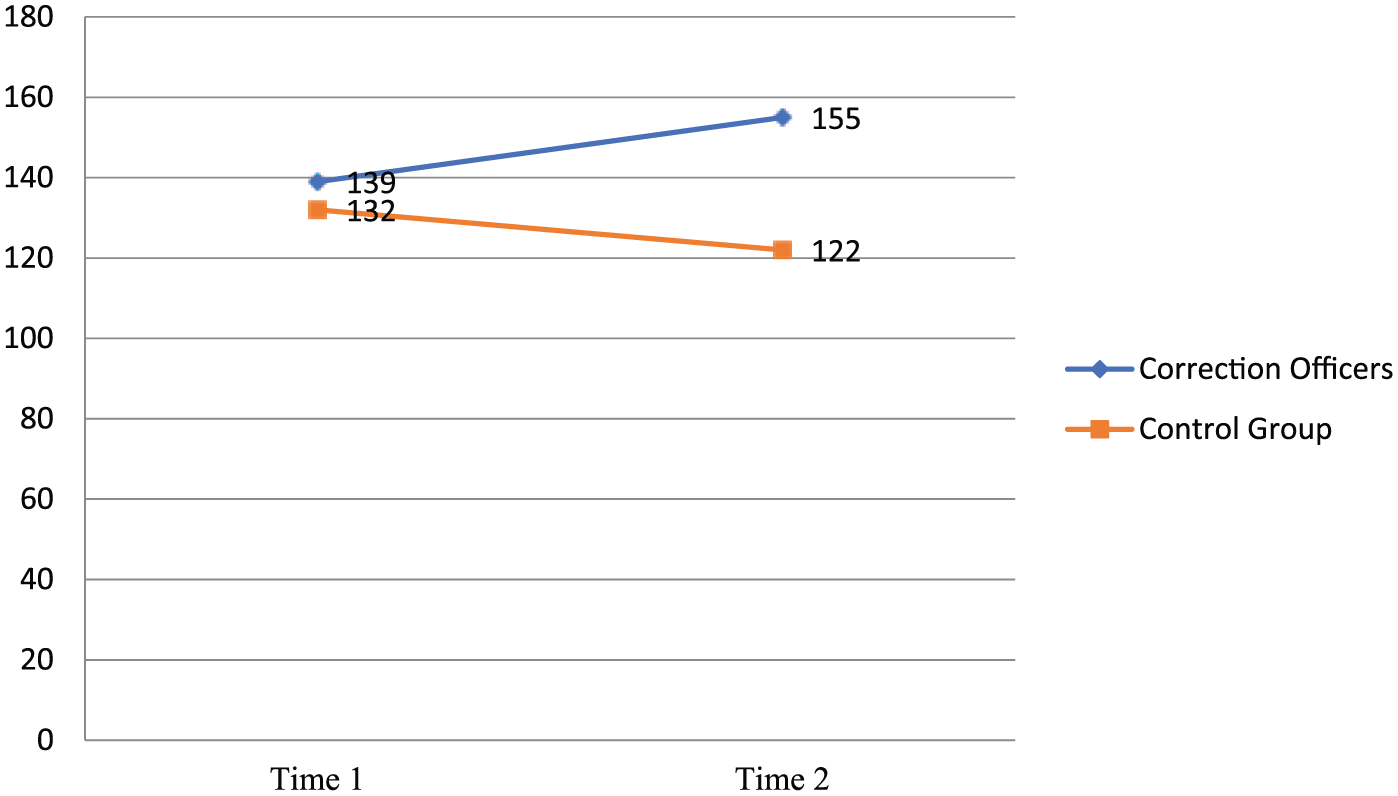
The Neuroticism Factor: A Comparison Within Subjects, Before and After
Following these findings, we explored the differences between Time 1 and Time 2 in each group (Group A and Comparison Group 1) in the subsets of the neuroticism scale of the BTS. In Group A, t tests for dependent samples indicated a significant increase in the scores of Anger, Depression, Social Embarrassment, Poor Control of Urges, and Vulnerability after 4 years of service and a nonsignificant increase in the score of anxiety. As for Comparison Group 1, the t tests for dependent samplings in the neuroticism subsets indicated that there was a significant decrease for the following subsets: Anxiety, Anger, Depression, Social Embarrassment, and Vulnerability. The subset of Poor Control of Urges showed a decrease, but this was not significant.
Table 1 displays results of the analysis, means, and standard deviations.
Subsets for the Neuroticism Factor, t Tests for Dependent Samplings in the Research Groups

p < .01. ***p < .001.
These data indicate an opposite trend: While among correctional officials an increase was seen in the neuroticism factor, a decrease was noted among members of the comparison group. The source of this difference is a decrease in the subsets of Anxiety, Anger, Depression, Social Embarrassment, and Vulnerability.
We subsequently examined the neuroticism factor between groups of employees with differing seniority at the same point in time. Regarding the groups of correctional officers, t tests for independent samples revealed a significant difference between the respondent scores in the two measurements of the neuroticism factor, t(294) = 6.64, p < .001, d = .79, according to which officers with 4 years of service (Group A) scored higher (M = 154.7, SD = 32.4) than the group of new recruits (Group B; M = 130.2, SD = 30.4). Regarding the comparison groups, t tests for independent samples revealed a significant difference between the two groups, t(241) = −6.02, p < .001, d = .50, according to which the score of neuroticism in the comparison group following 4 years of employment (Comparison Group 1) was lower (M = 122.4, SD = 27.7) than in the group of new candidates who had not yet started work (Comparison Group 2; M = 138.1, SD = 33.9).
Discussion
The workplace is more than a source of economic security; it is a place where we spend many hours of our adult lives, come into contact with co-workers, and face demanding challenges and tasks (Creed & Gagliardi, 2015; Krause, Obschonka, & Silbereisen, 2015). Prison is one of the most unique and demanding workplaces, characterized by strong and intensive pressures that require employees to comply with dramatic demands and adjustments (Armstrong & Griffin, 2004; Brough & Williams, 2007).
The findings of the current study reveal a significant and conclusive increase in the levels of neuroticism among correctional officers after 3 to 4 years in employment in contrast to a significant decrease in levels of neuroticism among employees in other nationwide public organizations with similar characteristics after the same number of years. Given that most studies in the sphere of personality have indicated a significant decrease in levels of neuroticism among the general population aged between 20 and 30 (Costa & McCrae, 2006; Roberts, Walton, & Viechtbauer, 2006), the findings of the present research are surprising and unique.
A possible explanation for the significant increase in levels of neuroticism among correctional officers is the impact of continuing traumatic pressures on personality. A number of studies have found that correctional officers are exposed to various strong and ongoing pressures in their daily work in prison (Dowden & Tellier, 2004; Schaufeli & Peeters, 2000). This constantly stressful work routine could be interpreted as an ongoing quasi-traumatic situation. In her book Trauma and Recovery, Herman (1992) addressed the concept of complex post-traumatic stress disorder and characterized it as a disorder stemming from exposure to prolonged traumatic situations of stress. She also suggested the possibility of enduring personality change after catastrophic experiences (p. 150). The whole range of experiences and pressures that correctional officers experience frequently constitute a prolonged situation of crisis that, over time, is sought to trigger a variety of post-traumatic reactions (not necessarily at the level of a clinical disorder). The need to function under constant threats to security and the objective just to get through the working day unharmed leaves its mark on the officers’ spirit (Brough & Williams, 2007).
The results of the current research shows that the correctional facility is a work environment with multiple pressures, tension, and hostility that wear the officers down and affect their successful job adjustment. In other words, the correctional setting creates pressures and demands that lead to feelings of anger, anxiety, depression, social embarrassment, poor control of urges, and vulnerability (which appear in the neuroticism factor and also characterize post-traumatic reactions), which sometimes exceed the correctional officers’ ability to cope. The findings of our research can be seen to reinforce other studies that examined the existence of post-traumatic phenomena among prison personnel (Keinan & Malach-Pines, 2007) and identified a high incidence (25.8% in the study by Stadnyk, 2003). 4
Lazarus (1961) maintained that the development of personality is a process that accompanies individuals throughout their entire lives and includes adjustment to external and internal demands. Maladjustment to these demands, which stems from the individual’s inability to solve problems deriving from stress, encourages the development of inappropriate defense mechanisms and solutions. In this theoretical context, the findings of the present research on the neuroticism factor among correctional officers indicate their incorrect or inappropriate adjustment to the implicit and explicit demands of their work environment. A significant increase in the subsets for anger, depression, poor control of impulses, social embarrassment, and vulnerability reflects psychological discomfort, if not total distress. In other words, it appears that new correctional officers are being enrolled in work before developing adequate strategies for coping with the whole range of daily pressures and stress.
The crowdedness of the prison setting, its noises, and its typical odors (Crewe, 2011; Haney, 2006), as well as the frequent emotional encounters with inmates, bring the new officers into an unfamiliar, frightening, and threatening reality that requires rapid adjustment and specific modes of action (Gordon & Baker, 2015). Although various studies have revealed a link (causal or correlative) between the prison environment and high levels of mental and emotional distress (i.e., depression, loneliness, anxiety, etc.; (Blevins, Listwan, Cullen, & Jonson, 2010; James & Glaze, 2006; Liebling, 2007; Palmer & Connelly, 2005), new officers must demonstrate from their very first day of work restrained, yet tough behavior emotionally and operate professionally and effectively. For many correctional officers, this entails a distancing of their immediate emotions and the presentation of a relaxed yet distance and possibly tough exterior (for more on this, see Crawley, 2011). We believe that this emotional work takes its toll on the officers’ mental powers and effects changes in their personality. 5 But the process does not end here: Correctional officers’ burnout and the dwindling of their emotional resources, stemming from the exhausting emotional work, lead to the development of a paradoxical situation in which they develop powerful inner negative emotions alongside a confident and distant appearance. These emotions do not necessarily find their expression externally, but rather they build up within the officers’ personalities, creating an effect which resembles post-traumatic reactions. As previously mentioned, mental trauma can usually be comprehended as the outcome of a set of continuing stressful events and not the result of a single incident. The correctional service should therefore acknowledge that work in prison under increasing accumulated pressures may lead to high levels of burnout which, together with these pressures, can serve as a potential traumatic factor. Erroneous and incorrect coping with burnout can lead to a reduction in mental resources and the development of post-traumatic reactions, such as anxiety, anger, and difficulty in controlling emotions, which can have a negative impact on personality and increase levels of neuroticism (Keinan & Malach-Pines, 2007; Stadnyk, 2003; Suliman et al., 2014].
Personality changes which are characterized by an increase in neuroticism may have several effects on both the correctional officer and the organization. Concerning the officers, intense feelings of stress and greater vulnerability are liable to lead directly or indirectly to adverse health events (Ghaddar et al., 2008; Williams et al., 2002). Different studies have indicated a correlation between neuroticism (the personality dimension of emotional stability) and health-related quality of life (Buneviciute, Staniute, Brozaitiene, Girdler, & Bunevicius, 2013; McCann, 2014). Costa and McCrae (1990) found a strong correlation between the Neuroticism factor and indices of Borderline, Paranoid, Schizoid, and Schizotypal personality disorders, while Brewer (2011) found that the Neuroticism factor is the only one of the five personality factors that successfully predicted the entire scale for Psychopathology among offenders. Accordingly, McCann (2014) held that individuals with high scores of neuroticism are in an at-risk group for different psychopathologies and for psychological distress in general. It can therefore be assumed that the increase in neuroticism (i.e., in the indices of anger, depression, and vulnerability) and the decline in emotional stability that were found in this research are likely to damage the psychological resilience of correctional officers as well as their mental and physical health. In other words, correctional officers are likely to see the world more negatively, to have more negative feelings and physical symptoms, and to fall ill more frequently.
Concerning the organization, a connection has been found between an increase in the neuroticism factor and emotional fatigue, depersonalization, and a low sense of gratification and achievement (three of the components of burnout; Bakker, Van Der Zee, Lewig, & Dollard, 2006). Higher neuroticism has also been found to be inversely connected with good organizational citizenship (a term that includes behaviors such as helping co-workers, volunteering for tasks beyond the specific job definition, and presenting the organization’s general values) and directly connected with work productivity loss, an unwillingness to come to work, and absence from work due to illness (Guenole & Chernyshenko, 2005; Jones, 2011). A rise in neuroticism was thus found to be connected to personality indices and behaviors that are undesirable for employers and organizations.
Practical Recommendations
As prisons are responsible for the well-being of their employees, chiefly when that well-being is related to working conditions, we believe that prison facilities must acknowledge the connection between correctional officers’ work and the damage to their personality, identify the major factors at play, and make every effort to reduce or eradicate them. We recommend three specific directions for action.
The first comprises the implementation of techniques to help decrease stress and self-regulation. Understanding prison officers’ psychological and emotional distresses and their effect on their behavior and adjustment to their work environment should be of paramount concern to correctional services. Correctional services should employ various stress-reducing mechanisms (pressure valves) and treatment interventions for correctional officers to reduce or eliminate such pressures. These could include a range of relaxation techniques, conversations with therapists, and respite sport activity. For example, McCraty et al. (2009) found that a biofeedback technique that focused on identification and control of physical symptoms of pressure significantly improved the physical and psychological well-being of 75 prison officers in California. Whatever the chosen means, correctional services should recognize their importance as integral and legitimate aspects of the correctional officers’ job definition and tasks.
Second, given the correlation between the prison work environment and correctional officers’ stress and burnout (Brough & Williams, 2007; Ghaddar et al., 2008; Lambert et al., 2009), we recommend correctional services carry out routine professional instruction and training to help correctional officers respond to the various occupational challenges (e.g., the appropriate response to provocations, coping with anger, etc.; Lambert et al., 2002). We believe that such training combined with granting correctional officers professional discretion and autonomy will enable them to achieve and implement better professional decisions.
Finally, correctional services should acknowledge the unique role and professional challenges of correctional officers and develop appropriate and accurate selection tests and employment criteria accordingly. Such tests and criteria should include personality assessment with a focus on emotional stability and maturity, a short stay in prison, and simulation of various stressful situations (e.g., physical confrontations, provocations, and open and hidden threats) to examine the candidate’s approach to such events and their personal tendency. Ones, Dilchert, Viswesvaran, and Judge (2007), who conducted a meta-analysis of several studies focusing on the effectiveness of psychological evaluation tests on job recruitment, have revealed that such tests are extremely valuable in making decisions about the recruitment and appointment of new employees.
Study Limitations
This study has three limitations concerning data validity, range restriction, and the design of the study. First, regarding data validity, data collection was performed using self-report questionnaires, among others (i.e., The Israeli Prison service demographics database). Several studies have indicated that this method can result in under- or over-reporting and thus bring the credibility of the reports into question. In addition, these questionnaires fail to explain the motives and factors leading personality changes among individuals and merely focus on presenting them (Ones et al., 2007). It is therefore possible that the use of other sophisticated data collection techniques, such as qualitative in-depth interviews and ethnographic observation of correctional officers at work (Leban, Cardwell, Copes, & Brezina, 2016), may facilitate detailed or additional data which have not been obtained in this study.
Regarding range restriction, approximately one third of the correctional officers who participated in the study did not return their second BTS questionnaires. The lack of response to the second questionnaire could be linked to the unwillingness of the officers who were coping less well emotionally to expose this fact. Hence, we can only assume that a larger response rate including the results of correctional officers who were coping less well would expand the range and yield more significant results.
The design of this study does not control group composition or multiple demographic variables (e.g., participants’ age, education, or familial status). We therefore cannot be certain that the differences in levels of neuroticism between the study group and the comparison groups stem from the work environment alone. Nonetheless, there is certain evidence that points to the centrality of the prison work environment. BTS tests were distributed to correctional officers and to employees of organizations similar to the Israeli Prison Service (e.g., public organizations nationwide with over 1,000 employees and a clear hierarchic structure). Likewise, no significant differences were found between the study group (Group 1) and the comparison groups in the variables conceivably related to the outcomes of interest. Moreover, significant differences were found in levels of neuroticism between the study group and the comparison groups (Comparison Groups 1 and 2). As a result, we could suggest that the differences between the neuroticism levels of the study group and the comparison groups are, in fact, related to the work environment.
Despite these limitations, our findings provide a starting point for future studies with different design, sampling, and data collection methods, which might include the random allocation of participants and control over various demographic variables. In addition, they add to the existing knowledge base about the difficulties and complexity of the role of correctional officers in prison and the impact of employment in prison on the personality change of correctional officers. This may provide scholars, criminologists, prison researchers, and prison authorities with a better understanding of the varied and multifaceted elements of correctional officers’ position in prison and possibly assist them in developing strategies and tools to improve correctional officers’ quality of life inside the prison and, subsequently, enable a calmer workplace.
Current research about the connection between the prison work environment and the personality changes of correctional officers is insufficient and fails to adequately address the central issues. In light of both this gap and the worrying findings of our study, there is a need for future research which will examine various aspects of such relationships.