



Abstract
Role strain has many negative outcomes. While the majority of role strain research has focused on its effects, this study explored possible antecedents of role strain among staff at a large, urban Southern jail in the United States. Based on regression analysis of survey data, instrumental communication, views that policy is followed, input into decision-making, formalization, and supervisory support each had significant negative effects on role strain. Administrative support and positive relations with coworkers, however, had nonsignificant effects. Jail administrators should attempt to reduce role strain by creating clear structure of job duties and expectations (formalization), providing staff with a greater organizational voice (input into decision-making), explaining the importance of organizational policies being followed and how they benefit staff, improving the flow of critical information about job and organizational matters (instrumental communication), and training supervisors about how to provide support to their subordinates and reward them for doing so (supervisory support).
Keywords
Jails are an essential part of the U.S. criminal justice system. Approximately 730,000 individuals are incarcerated in U.S. jails on any given day, and about 12 million persons are admitted annually to the approximately 3,000 jails in the United States that collectively employ more than 230,000 people (Minton & Golinelli, 2014; Stephan, 2011). Jail staff are charged with operating a humane, safe, and secure facility. Staff are an important and expensive resource, accounting for 70% to 80% of a jail’s operating budget (Tewksbury & Higgins, 2006). In light of being an important and expensive resource, surprisingly few research projects have explored how various workplace variables affect jail staff.
Compared with prisons, jail staff do not receive as much research attention as they warrant (Paoline & Lambert, 2012). Jails and prisons have both similarities and differences. Jails hold individuals of differing security levels and different categories of inmates. In addition to holding individuals convicted and serving sentences of less than a year, jails also house individuals awaiting trial, awaiting sentencing, or being held as a witness. Jails need to admit individuals whose full background is not known and those who may be under the influence of alcohol or drugs, as well as inmates suffering from a variety of diagnosed or undiagnosed medical and mental health issues (Castle, 2008). Furthermore, the inmate suicide rate is higher in jails than prisons (Bureau of Justice Statistics, 2005). In general, jail staff have less training than prison staff (Stohr, Lovrich, & Mays, 1997). Many jails are outdated, understaffed, and overtasked, which makes work harder for staff (Leip & Stinchcomb, 2013). The uniqueness of jails suggests the need to conduct research on how workplace factors affect jail staff, including role strain.
The rather limited research that has examined how workplace variables impact jail staff has focused on job satisfaction (Castle, 2008), organizational commitment (Griffin & Hepburn, 2005), job involvement (Lambert & Paoline, 2012), and job stress (Tewksbury & Higgins, 2006). One area where there is a dearth of research is role strain. While studies have examined the negative outcomes of role strain, the antecedents of role strain have been relatively unexplored. Specifically, past studies have found that role strain is positively associated with job stress (Tewksbury & Higgins, 2006), burnout (Lambert & Hogan, 2010), higher support for punishment of offenders (Lambert, Altheimer, Hogan, & Barton-Bellessa, 2011), and life stress (Cullen, Link, Wolfe, & Frank, 1985). In addition, prior studies have reported that role strain is negatively associated with job involvement (Lambert & Paoline, 2012), job satisfaction (Hepburn & Knepper, 1993), organizational commitment (Lambert, Hogan, Barton, Jiang, & Baker, 2008), and organizational citizenship behaviors (i.e., prosocial behavior of doing what is expected at work; Lambert, Hogan, Cheeseman, Altheimer, & Barton-Bellesa, 2012). In the long term, role strain is detrimental to individuals and their organization. To reduce role strain, potential workplace factors associated with it need to be identified. Overall, the vast majority of the research to date on role strain has focused on its effects rather than its predictors.
Our study adds to the literature by building on the past research of studies of Poole and Regoli (1980); Hepburn (1987); Hepburn and Knepper (1993); Liou (1995); Grossi, Keil, and Vito (1996); Reisig and Lovrich (1998); Lambert, Hogan, and Tucker (2009); and Garland, Hogan, and Lambert (2013) by exploring the effects of the variables instrumental communication, views that policies are followed, input into decision-making, formalization, administrative support, relations with coworkers, and supervisor support based on the job demands-resources model with role strain among staff at a large Florida jail, while controlling for gender, age, tenure, race, educational level, and supervisory status.
Role Strain
Goode (1960) is generally credited with coining the term role strain, which is also referred to in the literature as role stress or role problems (Wang, 2015). While role strain has different definitions in the correctional literature, all these definitions boil down to difficulty in fulfilling role obligations because of ambiguous demands and conflicts resulting from the job (Goode, 1960; Hepburn & Knepper, 1993; Wang, 2015). Overall, role strain occurs when there are poorly defined expectations and contradictory directions for job roles (Armstrong & Griffin, 2004; Cullen et al., 1985; Liou, 1995). In other words, role strain can be a function of both role ambiguity and role conflict. Role ambiguity is the lack of clarity in role duties and/or expectations (Ferdik & Smith, 2017; Triplett, Mullings, & Scarborough, 1996). Role conflict occurs because of conflicting demands on staff (Ferdik & Smith, 2017; Triplett et al., 1996). Some studies measure role ambiguity and role conflict as separate variables (e.g., Ferdik, 2016; Ferdik & Smith, 2016; Tewksbury & Higgins, 2006), while others use a measure that combines role ambiguity and role conflict (Armstrong & Griffin, 2004; Castle & Martin, 2006; Cullen et al., 1985; Hepburn & Knepper, 1993; Lambert et al., 2011; Lambert & Paoline, 2008, 2010, 2012). While there is no universally agreed upon measure of role strain, the current study utilizes that latter approach because we believe it to be the more commonly used approach in the literature.
It is important to note that role strain is conceptually distinct from work stress. Work stress is psychological, mental, and emotional feelings of tension, anxiety, and worry caused by problems and stressors (i.e., stimuli that result in stress) at work (Cullen et al., 1985). Role strain, on the contrary, is one such stressor that has been found to be positively associated with work stress (Castle & Martin, 2006; Liou, 1995; Tewksbury & Higgins, 2006) and job burnout (Dignam, Barrera, & West, 1986). In turn, work stress and burnout are linked with a wide array of adverse outcomes, including work absenteeism (Lambert, Edwards, Camp, & Saylor, 2005), physiological problems (Cheek, 1984), turnover intent/turnover (Mitchell, MacKenzie, Styve, & Gover, 2000), mental health issues (Cheek, 1984), substance abuse (Cheek, 1984), and even a shorter life span (Woodruff, 1993). Furthermore, role strain has been found to decrease both job satisfaction (Hepburn & Knepper, 1993) and organizational commitment (i.e., bonding with the organization) among correctional staff (Hogan, Lambert, Jenkins, & Wambold, 2006). In turn, job satisfaction and organizational commitment have been reported to result in lower absenteeism (Lambert, Edwards, et al., 2005), reduced burnout (Griffin, Hogan, Lambert, Tucker-Gail, & Baker, 2010), lower turnover intent/turnover (Mitchell et al., 2000), increased job performance (Culliver, Sigler, & McNeely, 1991), higher support for treatment of offenders (Lambert, Hogan, Barton, & Elechi, 2009), greater engagement in organizational citizenship behaviors (i.e., prosocial behaviors of going up and beyond what is expected at work; Culliver et al., 1991), and raised life satisfaction (Lambert, Hogan, Paoline, & Baker, 2005). Cumulatively, these findings point to a need to explore how various workplace factors are associated with role strain.
Past Studies of the Antecedents of Role Strain for Correctional Staff
Poole and Regoli (1980) were interested in examining how professionalism was related to role conflict. In a study involving 179 correctional officers at two adult prisons, the authors found that a sense of calling to working in corrections and a belief of self-regulation (both part of the larger concept they called professionalism) reduced role conflict, which they defined as uncertainty and ambiguity of job expectations. Using the same data set, Poole and Regoli (1983) reported that holding a professional viewpoint reduced role conflict among correctional supervisors. Hepburn (1987) examined different perceptions of control among correctional officers at four adult prisons and found five measures dealing with perceived control had no significant effects on role strain. Like Hepburn (1987), Hepburn and Knepper (1993) indicated role strain occurred when a staff member’s duties and responsibilities were vague and/or administrative directives were inconsistent or contradictory. Liou (1995) explored how the workplace variables of supervisor trust, punishment orientation, and treatment orientation were related to role strain among juvenile correctional staff at two southeast juvenile correctional facilities. Liou found supervisor trust was negatively related to role strain, but support for offender punishment was positively associated; support for treatment had a nonsignificant relationship. Grossi et al. (1996) found that, among correctional officers at three Southern prisons, community support had an effect on role strain, while supervisor support and perceived dangerousness of the job did not. Lambert, Hogan, and Tucker (2009) examined how the workplace variables of input into decision-making, supervision, formalization, integration, job feedback, and instrumental communication affected role strain among a staff at a Midwestern state prison. They observed that input into decision-making, quality supervision, formalization, integration, and instrumental communication all had significant negative effects on role strain, while job feedback had nonsignificant effects. It is important to note that none of the aforementioned studies tested a specific theoretical model.
Theoretical frameworks have guided other role strain works. In testing the dispositional model (i.e., personal characteristics) and the organizational model (i.e., how an organizations structures and operates) among supervisors at 11 prisons in different parts of the nation, Reisig and Lovrich (1998) reported that staff who worked at institutions with more balanced and fair managerial practices reported lower role strain, supporting the organizational model over the dispositional model. Garland et al. (2013) studied the link between workplace variables and role strain among staff at a private Midwestern prison using the conservation of resources model, which holds that resources aid employees, increasing the likelihood of positive outcomes, while missing or lost resources increase the chances of negative outcomes. Garland et al. reported that supervisor support, job autonomy, instrumental communication, and formalization had significant negative associations with role strain, while quality of supervision, integration, input into decision-making, and administrative support had nonsignificant effects. Having a theoretical foundation can help focus on what workplace variables to include as predictors of role strain, allowing for a more systematic approach for future studies.
Several conclusions can be drawn from the past research. First, workplace factors appear to affect role strain, but the effects are not equal for all factors. Second, some workplace variables, such as input into decision-making, integration, and quality of supervision appear to vary in their effects based on the type of correctional facility being studied. Third, some studies are guided by theoretical frameworks while others are not. Fourth, all the previous research that studied the antecedents of role strain examined prison staff, not jail staff. As such, we undertook this study of examining the effects of workplace factors on role strain among staff at a large county jail in Orlando, Florida, with the job demands-resources model as a foundation.
Job Demands-Resources Theoretical Model
A theoretical model from the field of psychology provides guidance for the selection of variables to explore the predictors of role strain, while also allowing for a comparison of results to other studies. The current study adapted the job demands-resources model to provide a theoretical framework for understanding why workplace factors would be associated with role strain. The job demands-resources model incorporated two previous models of job demands and conservation of resources. Under the job demands model, Karasek (1979) theorized that job demands over which the worker has little control result in heightened psychological strain. According to Hobfoll (2001), “the basic tenet of the conservation of resources theory is that individuals strive to obtain, retain, protect, and foster things that they value” (p. 341). Job resources are valued by staff and help staff to be more effective in their jobs, and they help create more enjoyable work environment (Hobfoll, 2001). Building upon the work of Karasek (1979) and Hobfoll (2001), Demerouti, Bakker, Nachreiner, and Schaufeli (2001) proposed the job demands-resources model.
Basically, the job demands-resources model classifies workplace factors as either demands or resources (Demerouti et al., 2001). Demerouti et al. (2001) defined job demands as “those physical, social, or organizational aspects of the job that require sustained effort and are, therefore, associated with physiological or psychological costs” (p. 501). Demands tend to result in negative outcomes. Conversely, workplace resources help people do their jobs, allowing them to be more successful and make the job more enjoyable, as well as feeling respected and valued (Demerouti & Bakker, 2011). Demerouti et al. (2001) defined job resources as “those physical, social, or organizational aspects of the job that may do any of the following: (a) be functional in achieving work goals; (b) reduce demands and the associated physiological and psychological costs; and (c) stimulate personal growth and development” (p. 501). Job resources can reduce the chance of negative outcomes, such as role strain, and increase the chance of positive ones (Mauno, Kinnunen, & Ruokolainen, 2006). Moreover, perceptions of a workplace resource being low or absent can itself become a demand (Schaufeli & Taris, 2014). As noted by Schaufeli and Taris (2014), “the job demands-resources model does not restrict itself to specific job demands or job resources. It assumes any demand and resource may affect employee health and well-being” (p. 44). Moreover, this model does not assume that demands and resources must be aligned. Rather, this perspective holds that demands result in strain and resources reduce strain. As previously indicated, our study examined the effects of the job resources of instrumental communication, views that policies are followed, input into decision-making, formalization, administrative support, relations with coworkers, and supervisor support on role strain.
Instrumental communication refers to the perception that important information about the job is conveyed to employees, a job resource that can help jail staff avoid psychological strain (Castle & Martin, 2006; Lambert, Minor, Wells, & Hogan, 2016). Providing clear information about salient job matters can help staff to be productive at work (Lambert & Hogan, 2006). Perceptions that this job resource is low or absent could result in role strain for staff, contributing to feelings of role strain (Lambert et al., 2016; Lambert & Paoline, 2012). As such, perceptions of instrumental communication were hypothesized to have a negative association with jail staff role strain.
Views that policies are followed focuses on perceptions of policies being consistently applied and followed within the jail organization. Policies that are consistently followed and enforced can be a job resource to staff, providing them with direction and guidance regarding their jobs (Paoline, Lambert, & Hogan, 2006). On the contrary, a belief that policies are not regularly followed can be a demand that results in uncertainty on how to proceed (Cheek, 1984). As such, this variable was hypothesized to have a negative effect on role strain.
Input into decision-making refers to perceptions that employees believe they have a voice in salient organizational matters and is a job resource (Lambert & Hogan, 2006). Input can allow staff to suggest changes to help reduce role strain (Castle & Martin, 2006; Lambert, Hogan, & Tucker, 2009). Conversely, low perceptions of having an organizational voice can be a job demand because staff may feel that they have little control over their jobs and cannot make changes to reduce role strain (Lambert & Paoline, 2012; Reisig & Lovrich, 1998). This variable was, therefore, hypothesized to have a negative association with role strain.
Formalization is the extent to which written rules and procedures are created and used within an organization (Lambert, Hogan, & Tucker, 2009; Pandey & Scott, 2002). Following written directions can help reduce the occurrence of role strain (Judge & Colquitt, 2004). This job resource helps standardize how job tasks and duties are carried out. It can be a job resource for staff by providing structure and directions for them to follow, as well as aiding in being more effective at work and reducing the level of uncertainty on the job, reducing role strain (Lambert, Hogan, & Tucker, 2009). A perception that this workplace variable is low can be a source of frustration because of the lack of clarity and information can make the job more difficult, increasing the chances of role strain (Lambert & Paoline, 2012). As such, perceptions of formalization were hypothesized to have a negative effect on role strain.
Social support can also help correctional staff deal with trying work experiences and, as such, is seen as a job resource (Savicki, Cooley, & Gjesvold, 2003; Triplett et al., 1996). This variable requires a connection with others who can provide guidance, feedback, and support and can help staff deal more effectively with work problems, as well as feeling valued (Cullen et al., 1985). It can provide information to avoid or overcome role strain, as well as possibly provide innovative ideas to address the problem (Castle & Martin, 2006). Conversely, a perceived lack of social support can result in feelings of being isolated, which can increase the chances of negative outcomes, such as role strain (Cullen et al., 1985; Triplett et al., 1996). There are different forms of workplace support, including administrative support, coworker support, and supervisor support (Cullen et al., 1985; Lee & Ashford, 1996).
Administrative support deals with the degree employees feel supported by upper management of the employing organization and is a job resource, helping staff to do their jobs, as well helping to avoid or overcome role problems (Eisenberger, Stinglhamber, Vandenberghe, Sucharski, & Rhoades, 2002). A lack of administrative support can result in frustration and being unclear of how to deal with role strain (Armstrong & Griffin, 2004; Lambert & Paoline, 2012). In the end, this job resource variable was hypothesized to be negatively related to role strain.
Coworker relations focuses on the perceptions of having positive interactions and support from coworkers (Cullen et al., 1985; Lambert & Paoline, 2012). Good dealings with fellow staff can help officers deal with ambiguity and conflicts encountered at work and, as such, is a job resource (Lambert, Hogan, & Tucker, 2009). It can make work more pleasant and enjoyable, resulting in positive psychological feelings, which can help staff from dwelling on negative aspects of the job, such as role strain (Lambert & Hogan, 2006). Coworkers can also provide ideas of how to avoid or reduce role strain (Cullen et al., 1985; Lambert et al., 2016). Poor connections with fellow staff, on the contrary, can be a demand on jail staff, creating unpleasant and isolated work experience, which would increase the likelihood of negative outcomes, such as role strain (Cullen et al., 1985; Lambert et al., 2016; Paoline et al., 2006). As such, this variable was hypothesized to have a negative association with role strain.
The final form of social support concentrated on perceptions of supervisors. Supervisor support is the degree a person feels his or her supervisor supports staff (Cullen et al., 1985; Eisenberger et al., 2002). As a job resource, it can aid staff in conducting their job duties and to feel value, as well as helping reduce the occurrence of role strain, and, if it does occur, help to deal with it effectively (Lambert, Hogan, & Tucker, 2009). Lee and Ashford (1996) contended that “with the right kind of supervisory support, workers may come to perceive ambiguous role expectations as opportunities to carry out their own initiatives (potential gains) rather than as restrictions on their actions (certain losses)” (p. 131). Perceptions of low supervisor support can not only hinder staff dealing with the situations which can result in role strain, but can be a demand in itself, which can raise the chances of negative work outcomes, including role stain (Armstrong & Griffin, 2004; Cullen et al., 1985; Lambert et al., 2016). This variable, hence, was hypothesized to have negative effects on role strain.
Method
Participants
The Orange County Jail Oversight Commission (Florida) contracted with the Department of Criminal Justice at the University of Central Florida (UCF), for the purpose of exploring concerns and issues of Orange County Corrections Department (OCCD) employees. The UCF research team first conducted a series of focus groups to understand those problems that might be unique to OCCD employees by conducting seven 2-hr focus groups, with 48 OCCD employees from different organizational levels and facilities, during a 10-day period. The focus groups included between five and 10 OCCD organizational members and two members of the UCF research team. The UCF research team directed the focus groups, whereby discussions concentrated on open-ended “talking points” regarding the strengths and weaknesses of the OCCD work environment. Findings from the OCCD focus groups were used in the development of a paper questionnaire that would be administered to staff at all levels of the jail organization.
With the consent of the jail director, full-time jail personnel received 2 hr of overtime for participating in the study. The calculation of overtime by jail director and the research team was based on an estimation that the 155-item survey would take approximately 1 hr to complete, while travel to (and from) the jail in Orlando, Florida, would take another hour. Staff could elect or decline to take the survey during the provided time, and their decision to take or not take the survey did not affect being paid overtime. In the fall of 2001, a four-person research team from UCF administered a paper survey to the staff from the nine separate facilities of the OCCD. The facilities included central booking, administration, community corrections, work release, and five inmate housing units (four of which were “new generation” podular, direct supervision units, while one was a traditional, linear, remote supervision area). Due to operation needs of the jail, the data collection was limited to five days. As the vast majority of staff were full-time paid employees, the jail administration indicated only full-time staff should receive the survey and would be paid overtime. As such, the data for the study was based on a survey of all full-time paid staff. A few staff were not available to take the survey because of sick leave or vacation leave. Staff were informed that the survey was voluntary, they could stop answering the survey at any time, they could skip any question or questions they wished, and all responses would be anonymous and only reported in an aggregate format. A total of 1,062 surveys were completed and returned, which was a response rate of approximately 71%. The OCCD housed approximately 4,000 jail inmates and employed approximately 1,500 paid employees at the time of the data collection. Except for upper administration, the surveyed staff represented all areas of the jail (e.g., correctional officer, community correction officer, detention service officer, medical, psych, administrative, classification, etc.).
Variables
Dependent Variable
The dependent variable for the current inquiry was role strain. Role strain was measured using seven items (see the appendix for the items and how they were answered). The items were adapted from Poole and Regoli (1980) and Cullen et al. (1985). The role strain items had a Cronbach’s alpha value of .72. The responses to the seven items were summed together to form an additive index measuring role strain. There is no agreed upon response categories to measure role strain items, with response options being a 5- or 7-point Likert-type scale of strongly disagree to strongly agree and frequency of occurrence (e.g., rarely to very frequently occurs). We used a 5-point Likert-type scale of strongly disagree to strongly agree to answer the role strain items. Our alpha value of .72 is consistent with past studies, where it ranged from .66 to .85, with most values being in the .70 area (Armstrong & Griffin, 2004; Castle & Martin, 2006; Cullen et al., 1985; Hepburn & Knepper, 1993; Lambert, Hogan, & Tucker, 2009; Lambert & Paoline, 2008, 2010, 2012).
Independent Variables
Instrumental communication, views that policies are followed, input into decision-making, formalization, administrative support, relations with coworkers, and supervisor support were the independent variables of focus in the current study (see the appendix for the items and the response options). Using five items from Curry, Wakefield, Price, and Mueller (1986), an additive index for instrumental communication was created. The items, which had a Cronbach’s alpha value of .89, were summed together to form an additive index.
Views policies are followed was measured using three survey items, all of which were created based on information provided by the focus groups. The responses to the items were summed together to form an index, which had a Cronbach’s alpha of .81. Four items from Curry et al. (1986) were used to create an index to measure input into decision-making, which had a Cronbach’s alpha value of .88. Five items were used to measure formalization, which were adapted from Oldham and Hackman (1981). The formalization items were summed together to form an additive index which had a Cronbach’s alpha value of .60, which is similar to that reported in past studies (Garland et al., 2013; Lambert, Hogan, & Tucker, 2009; Oldham & Hackman, 1981).
Administrative support was measured using five items developed from the focus groups. By summing the responses of the items an additive index for administrative support was created, which had a Cronbach’s alpha value of .79. Three items from Mueller, Boyer, Price, and Iverson (1994) were used to measure relations with coworkers. The items, which had a Cronbach’s alpha of .83, were summed together to form an index measuring relations with coworkers. Supervisor support was measured using a single item, which was based on feedback from the focus groups.
Finally, five measures of personal characteristics of gender, age, tenure, race, educational level, position, and supervisory status were included in the analyses more as control than explanatory variables, as done in past studies (Cullen et al., 1985; Garland et al., 2013; Lambert, Hogan, & Tucker, 2009; Liou, 1995). Gender measured whether the participant was a man (coded 1) or a woman (coded 0). Age was measured as an ordinal variable broken down into 5-year age intervals. Tenure was measured in continuous years worked at the jail. Race was measured as a dichotomous variable representing whether the participant was White (coded 1) or non-White (coded 0). Educational level was also a dichotomous variable representing whether the participant had reported earning a college degree (coded 1) or not (coded 0). Position measured whether the participant worked as a custody officer (i.e., correctional officer) who oversees inmates, ensuring order and security (coded 1) or another position, such as counselor, case manager, medical, and so forth (coded 0). Supervisory status was a dichotomous variable measuring whether the participant supervised other jail staff (coded 1) or did not (i.e., line staff, coded 0).
Analytic Strategy
Univariate, bivariate, and multivariate analyses were conducted. Univariate analysis was performed to provide descriptive statistics of all the study variables. Bivariate correlations were calculated to explore associations between the independent variables with the dependent variable role strain, and to check for collinearity issues among independent variables. Multivariate analysis, using ordinary least squares (OLS) regression, was conducted to determine whether the independent variables had effects on the dependent variable once shared effects were taken into account. The multivariate analysis was conducted for all responding staff and a subgroup of just custody officers (i.e., correctional officers). Because custody officers play a vital role (and are the largest assignment) in correctional institutions, including jails (Ferdik & Smith, 2017), a subgroup of custody officers was selected for separate analysis. It is possible that the effects of the independent variables differ for this group, and we wanted to account for this. The descriptive statistics and correlations for the subgroup of custody officers were run and checked but are not reported in this study because of page length concerns.
Results
The descriptive statistics for all the variables are reported in Table 1. There appeared to be considerable variation in both the dependent and independent variables (i.e., none were constants). The typical participant was a man in his late 30s to early 40s whose highest educational degree was a high school diploma or a general equivalency diploma (GED; or a certificate of high school equivalency [formerly know as the GED]). In addition, there were more Nonwhite staff employed at the jail and who responded to the survey. Most of the participants were nonsupervisory staff, worked in a custody position, and had been employed at the jail for approximately 7 years. In addition, tests of normality indicated no problems. A principal factor analysis using varimax rotation for each latent variable (i.e., index) was conducted to examine whether the items for a particular index were unidimensional (Gorsuch, 1983). Based on the Eigenvalues and the Scree plot, a single factor was extracted for each latent concept (see the appendix for the Eigenvalues) and the factor loading scores were above 0.40, which is viewed as acceptable (see the appendix for range of factor loading scores; Gorsuch, 1983). The factor analysis results indicated the indexes were unidimensional.
Descriptive Statistics
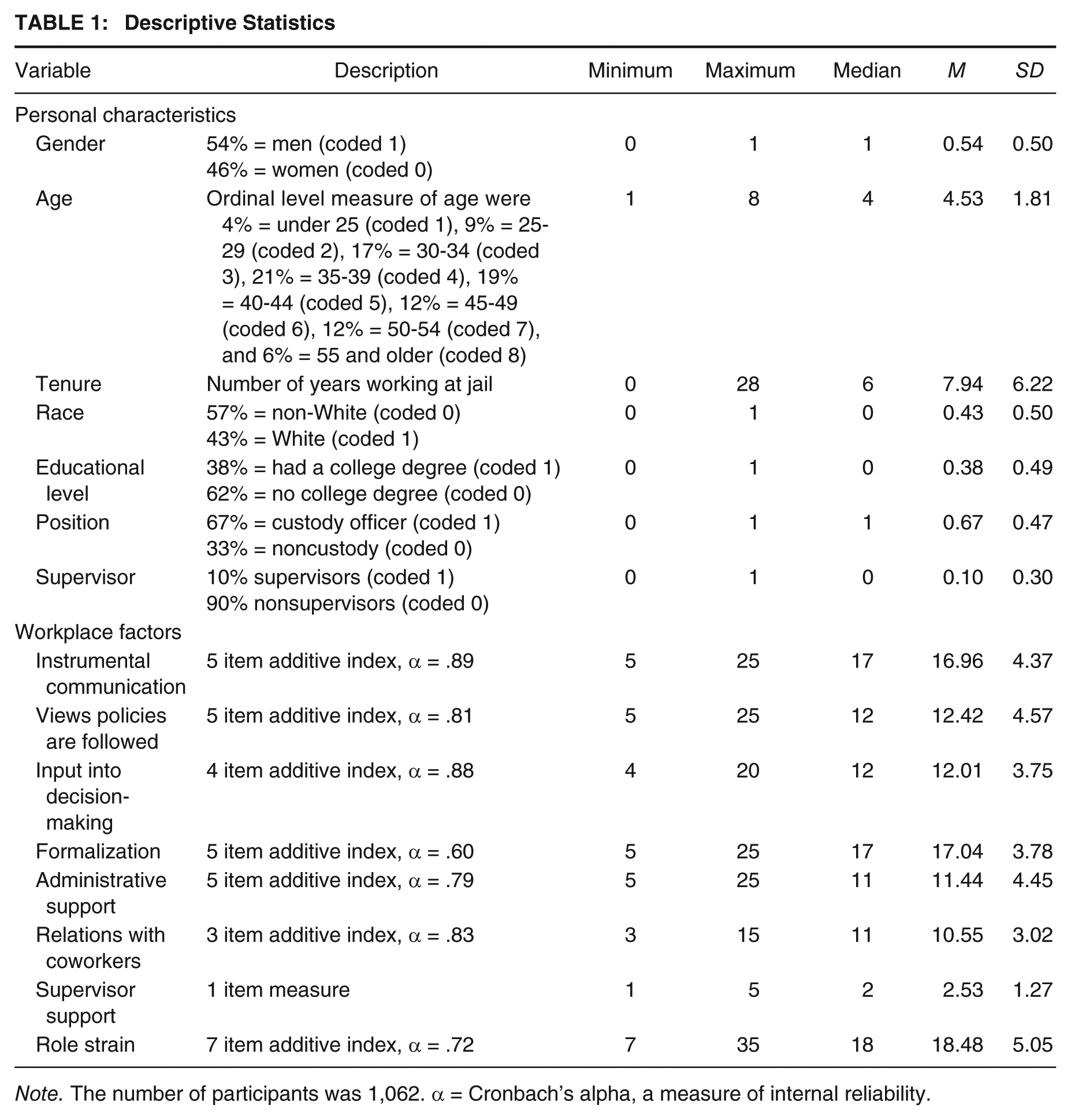
Note. The number of participants was 1,062. α = Cronbach’s alpha, a measure of internal reliability.
The correlation analysis of the study variables are presented in Table 2. Among the personal characteristics, only age, position, and supervisory status had statistically significant correlations. Older staff and supervisors reported lower role strain. All the workplace variables had significant negative relations with role strain, which means an increase in a particular job resource was associated with less role strain.
Bivariate Correlations for Study Variables
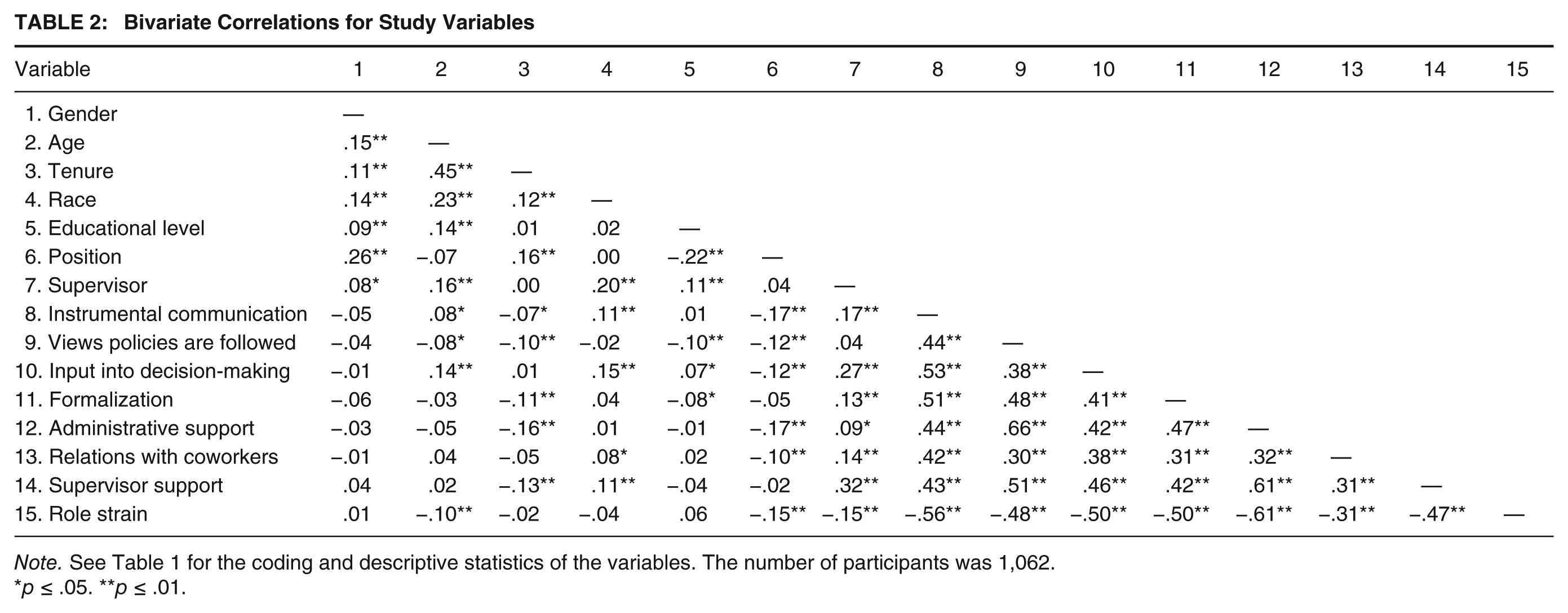
Note. See Table 1 for the coding and descriptive statistics of the variables. The number of participants was 1,062.
p ≤ .05. **p ≤ .01.
OLS regression equations were estimated, with the role strain as the dependent variable and the workplace factors and personal characteristics as the independent variables, for all the responding jail staff. The OLS results are presented in Table 3. High multicollinearity did not appear to be a problem (Tabachnick & Fidell, 2013). Variance inflation factor (VIF) scores above 6 indicate a problem with multicollinearity among the independent variables (Tabachnick & Fidell, 2013). The VIF values ranged from 1.07 to 2.29. The issues of outliers, influential cases, normality, linearity and homoscedasticity of residuals, and independence of errors, which can affect the regression results, were also tested (Berry, 1993; Tabachnick & Fidell, 2013), with no reportable issues.
Regression Multivariate Results of the Correlates of Role Strain Among Jail Staff
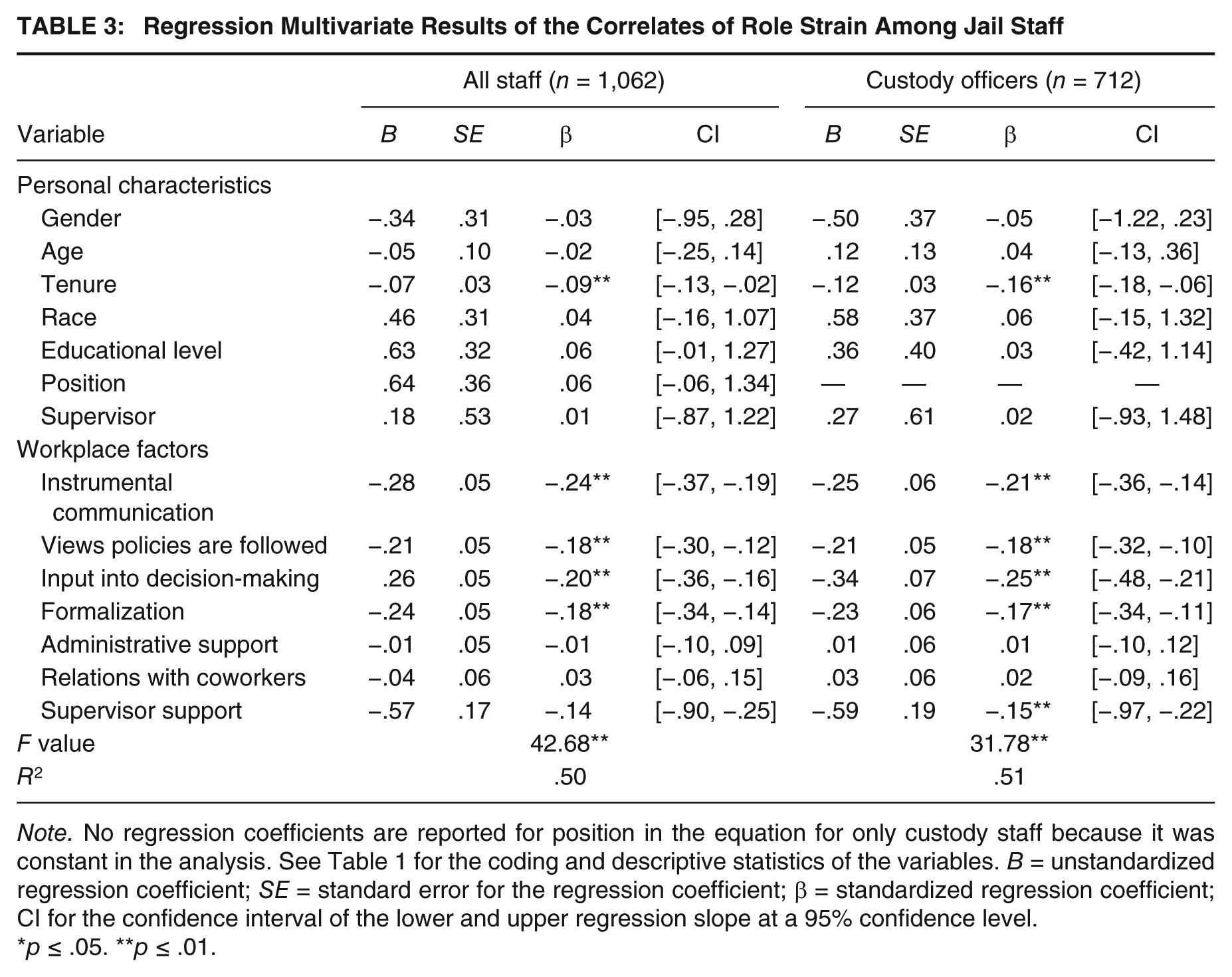
Note. No regression coefficients are reported for position in the equation for only custody staff because it was constant in the analysis. See Table 1 for the coding and descriptive statistics of the variables. B = unstandardized regression coefficient; SE = standard error for the regression coefficient; β = standardized regression coefficient; CI for the confidence interval of the lower and upper regression slope at a 95% confidence level.
p ≤ .05. **p ≤ .01.
Based on the R2 statistic of .50, approximately 50% of the variance in the role strain variable was explained by the independent variables for all staff. The only personal characteristic to have a significant effect was tenure. An increase in tenure was associated with reductions in reported role strain. In the equation for all staff, the only workplace factors to have nonsignificant effects were administrative support, relations with coworkers, and supervisor support. The other workplace variables all had significant negative associations, in the hypothesized direction, with the dependent variable. Based on the standardized regression coefficient (i.e., β column in Table 3), the size of the effects can be ranged from smallest to largest. Tenure had the smallest sized effect and instrumental communication had the largest sized effect. In fact, all the significant workplace factors had larger sized effects as compared with tenure. In addition, the control variables (i.e., personal characteristics) were entered in by themselves, and the R2 valued as .05, which indicated that they only explained about 5% of the variance of role strain.
A second OLS regression equation was estimated for only custody officers because of the central role (and size) that assignment represents within jails. The results are also reported in Table 3. About 51% of the observed variance in the dependent variable was accounted for by the independent variables. The findings are consistent with the all staff model. That is, tenure was the only personal characteristic to have a significant association with the role strain variable, and the association was negative. Furthermore, instrumental communication, views on policies being followed, input into decision-making, formalization, and supervisor support all had significant negative effects among custody officers. Administrative support and relations with coworkers did not have significant associations with role strain for jail custody officers. Input into decision-making had the largest sized effect, followed by instrumental communication, views policies are followed, formalization, tenure, and finally supervisory support.
Discussion and Conclusion
The results of the current inquiry support the job demands-resources model that workplace factors help shape role strain among jail staff. Five of the seven job resource variables had statistically significant associations with role strain in the multivariate regression analyses, with all responding staff, while four were significant for the custody officer model. Among the personal characteristics, only tenure had a significant effect in the regression analyses, and workplace resources explained the vast majority of the observed variance.
The workplace resource factors of instrumental communication, views policies are followed, input into decision-making, formalization, and supervisor support each had negative effects on the role strain variable. Instrumental communication helps provide clarity of job expectations, which, in turn, probably leads to fewer role problems encountered by staff. A lack of essential communication can hamper staff. The current finding that this variable had a significant effect comports with the findings of private and public prison staff reported by Garland et al. (2013) and Lambert, Hogan, and Tucker (2009). As such, this job resource may reduce role strain across different types of correctional organizations.
As predicted, views that policies are followed was significantly associated with lower role strain. Regular use of policies can help alleviate situations that result in ambiguity and conflict for staff. Input into decision-making also was a significant predictor. Allowing staff a voice in the organization can help reduce the occurrence of role strain, as well as sending a message that they are valued and trusted. Among public prison staff, input into decision-making resulted in fewer role problems (Lambert, Hogan, & Tucker, 2009) but was not the case among private prison staff (Garland et al., 2013). Overall then, the effects of this variable could be contextual and situational, varying by type of correctional facility.
Perceptions of formalization had significant negative effects on role strain, suggesting that codification can help provide direction and guidance for jail staff to avoid confusion and conflict in their job roles. It is important that the written guidelines and directions be clear, understandable, readily available, and reflect what is actually being done. Excessive or irrational formalization can result in “red tape,” which hampers the ability of staff to do their jobs in an effective and efficient manner (Pandey & Scott, 2002). Formalization also had a significant negative association with role strain among private and public prison staff (Garland et al., 2013; Lambert, Hogan, & Tucker, 2009). The current findings suggest that this particular job resource may reduce role strain across a variety of correctional contexts.
As postulated, supervisor support had a significant negative relationship with role strain, at least with custody officers. Supervisors who support staff likely help with dealing with role problems, as well as other job demands. A lack of supervisor support can result in frustration, increasing the chances of negative outcomes. The current study echoes the findings of the limited past studies of supervisor support. Garland et al. (2013) observed that supervisor support was linked with lower role strain for private prison staff. While not directly measuring supervisor support, Lambert, Hogan, and Tucker (2009) included in their measure of quality supervision an item asking about supervisor encouragement and support and found that their measure of supervision was negatively associated with role strain. The limited research to date suggests that supervisor support may result in a reduction of role strain in different correctional settings.
It is important to note that neither administrative support nor coworker relations were significant predictors. Supervisors have more daily contact with staff than management, and, as such, their support appears to be more important in dealing more directly with role issues. In addition, supervisors may have more knowledge and power to reduce the occurrence of role strain than do coworkers. Coworkers may not have the knowledge to deal effectively with role stressors or the power to change the forces which result in strain. The lack of a finding with administrative support and coworker relations does not necessarily mean that they are unimportant, because they could help to shape other outcomes such as job satisfaction.
While the current study successfully teased out some of the correlates, especially the workplace factors, it is not without limitations. Such limitations, if addressed by future research, could lead to an enhanced understanding of the antecedents of role strain. First, our data were collected in 2001, and we do not know the extent to which 2001 jail environments are identical to current settings. For example, Cheeseman and Downey (2012) reported that generation membership (e.g., Baby Boomers, Gen Xers, Millennials) differed in their effects on job satisfaction, and new generations will enter the jail workforce in the future. Also, outside social forces change across time, and these changes may affect what jail staff want from the job.
While the findings of the current study are from a large diverse county jail in Florida, it is just one setting. Research from other jails that vary in size, location, or facility type is needed to determine whether the findings reported here are replicated and generalizable. In addition, only full-time paid staff were surveyed. While full-time paid staff often make up the vast majority staff at a jail, as they did at the OCCD, they are not the only employees. Future research should examine whether the same results found among full-time paid workers would be observed among part-time staff.
The current study examined the resources part of the job demands-resources model. Future works should assess how job demand variables, such as time pressures, dangerous inmate interactions, and poor physical working conditions, impact staff. Relatedly, while our independent variables were relatively successful (for social science inquiries) in explaining half of the variance in the role strain measure, half of the variance was unaccounted for, suggesting that other factors shape role strain, and these variables need to be identified and studied. For example, workplace social support forms were tested. There are also external workplace social support forms, such as support by the community and support by family and friends, which should be examined to determine the extent to which they can help reduce role strain. As noted earlier, Grossi et al. (1996) observed that community support had a negative effect on role strain among prison officers. Other possible workplace variables to focus on are job variety, integration, job autonomy, correctional orientation (i.e., whether the goal should be to punish or treat offenders), supervisor structure (i.e., how much structure do supervisors set for staff), trust in the administration, supervisor trust, and quality of supervision (e.g., such as being considerate, listening, explaining decisions, being fair, being considerate, and being approachable).
In addition, future research may wish to explore how a larger overall concept of social support plays in minimizing role strain. Administrative support, coworker relations (i.e., coworker support), and supervisor support likely tap into the larger concept of social support, as does family/friends support, and community support. Finally, the current study utilized a cross-sectional design. While it was theorized that the workplace factors influenced role strain, temporal ordering cannot be determined. Future work would benefit from drawing on longitudinal data design to disentangle the casual connection between the variables.
The results of this study have implications not just for correctional studies but also for jail administrators. The direction, the significance of the effects, and explained variance of the workplace factors were nearly identical in the multivariate regression equations for all staff and for the subgroup of custody officers. As such, jail administrators interested in addressing role strain need not focus on a particular group of jail staff, such as custody officers, but can instead focus on the entire population of staff.
Furthermore, the fact that the personal characteristics do not explain much variance in the role strain variable is good news for jail administrators. Many personal characteristics, such as age and gender, are not within their ability to alter, while workplace factors are much more malleable and far more within their control. For example, the most consistent correlates of role strain (i.e., instrumental communication, views policy is followed, input into decision-making, and formalization) in our study illustrate areas of focus for correctional leaders. Jail administrators should examine the communication network to determine what obstacles hinder successful transmission of information. An analysis of what information is being delivered (and what is lacking) needs to be undertaken. Managers and supervisors need to be made aware of the importance of instrumental communications and provided informational workshops geared toward increasing salient communication within the organization. Focus groups of organizational line staff could be undertaken to explore how instrumental communication can be improved.
Similarly, jail administrators should undertake efforts to make sure policies are regularly and consistently enforced in the jail. Jail administrators should also stress the need to consistently and fairly apply policy to supervisors. Staff should be asked how fair and consistent policy enhancement can be achieved.
Leaders should attempt to raise perceptions of input into decision-making, preferably by increasing the level of say allowed. Allowing staff to have a voice in the organization is an inexpensive commodity. It is important to note that input does not mean that administrators’ power is circumvented or that they are bound to make the changes suggested. There are some suggestions that are either impossible to make, impractical to implement, or cost prohibitive. Input means listening to staff and providing feedback of why or why not suggestions can be implemented. Administrators should also make managers and supervisors aware of the importance of input from staff and have them encourage it.
Finally, jail administrators may wish to review their manuals and other written instructions for employees and see how they can be improved. Meetings with staff can be held to assess how perceptions of formalization can be increased. Dialogue should be geared toward gathering information from staff regarding potential threshold effects of formalization whereby too many written rules and procedures are interpreted as a bureaucratic constraints.
In closing, jails represent an integral part of the criminal justice system, despite the fact that most of the correctional literature tends to focus on prisons. The staff who are responsible for the 24-hr operation of these highly unstable environments are critical. Understanding and addressing problematic work conditions among jail staff can benefit the organization greatly, as unfulfilled personnel are more likely to experience work stress and burnout, which ultimately can lead to several unfavorable occupational (e.g., reduced commitment, absenteeism, turnover) and personal (e.g., mental health, family, and substance abuse problems) conditions. The current empirical inquiry tapped into the antecedents (versus outcomes) of role strain among jail staff. Our conclusions suggest that the correlates of role strain are less a function of one’s individual attributes and instead a by-product of the work environment itself.
Footnotes
Appendix
Role strain (Only one Eigenvalue was above 1.00 and was 2.74. The four items on input into decision-making loaded on a single factor with factor loading scores from 0.54 to 0.77.)
(Responses for all items: 1 = strongly disagree, 2 = disagree somewhat, 3 = uncertain, 4 = agree somewhat, 5 = strongly agree.)
Instrumental communication (Only one Eigenvalue was above 1 and was 3.48. All five instrumental items loaded on one resulting factor with factor loading scores from 0.75 to 0.82.)
(Responses for all items: 1 = not informed at all, 2 = informed very little, 3 = informed somewhat, 4 = informed, 5 = very well informed.)
Views policies are followed (Only one Eigenvalue was above 1.00 and was 2.86. The three items of views on policies are being followed loaded on a single factor with factor loading scores from 0.53 to 0.83.)
(Responses for all items: 1 = strongly disagree, 2 = disagree somewhat, 3 = uncertain, 4 = agree somewhat, 5 = strongly agree.)
Input into decision-making (Only one Eigenvalue was above 1.00 and was 2.97. The four items on input into decision-making loaded on a single factor with factor loading scores from 0.77 to 0.85.)
(Responses for all items: 1 = none at all, 2 = very little, 3 = some, 4 = a lot, 5 = a great deal.)
Formalization (Only one Eigenvalue was above 1.00 and was 1.94. The four items on input into decision-making loaded on a single factor with factor loading scores from 0.46 to 0.62.)
(Responses for all items: 1 = strongly disagree, 2 = disagree somewhat, 3 = uncertain, 4 = agree somewhat, 5 = strongly agree.)
Administrative support (Only one Eigenvalue was above 1.00 and was 2.75. The four items on input into decision-making loaded on a single factor with factor loading scores from 0.54 to 0.77.)
(Responses for all items: 1 = strongly disagree, 2 = disagree somewhat, 3 = uncertain, 4 = agree somewhat, 5 = strongly agree.)
Coworker relations (Only one Eigenvalue was above 1.00 and was 2.34. The four items on input into decision-making loaded on a single factor with factor loading scores from 0.76 to .80.)
Supervisor support (No factor analysis results reported because it is a single item variable.)
(Responses for all items: 1 = strongly disagree, 2 = disagree somewhat, 3 = uncertain, 4 = agree somewhat, 5 = strongly agree.)
Acknowledgements
The authors thank Janet Lambert for editing and proofreading the article. The authors also thank the editor and anonymous reviewers for their comments and suggestions, which improved the article.
